

Monday, January 31, 2005
Pastry for Butterfingers
My Grandma baked the most beautiful pies.
Part of their beauty rested in her ingredients; she only used lard, rendered from the hogs she and Grandpa raised, and the flavor was exquisite. Rich and full of the wonderful brown flavors that still speak to me of earth and its bounty. The texture was perfection itself; when you bit into those crusts, they would shatter into multitudes of flakes, then melt blissfully into your mouth.
I was an odd child--while my cousins were all gobbling down the filling and the top and bottom crust, I ate the fluted pastry edge first, and then scavenged the edges that they would leave behind. That is not to say I didn’t like the sweet fillings--I did, especially when she made cherry pie from fresh sour cherries.
But pie has always been about the crust for me.
I watched her make pie crust countless times, but I was not allowed to help. I helped with bread dough and biscuits and cookies and cakes, but pie crust was a mystery that was best left to Grandma’s talented hands.
I remember that she never measured out her flour, lard and water out very carefully. If at all. It looked rather to me like she put flour in a bowl, plumped down a glob of lard and then cut it together with either a fork or two knives, depending upon how she felt at that moment, I suppose. When the lard was worked in to her satisfaction (as I recall there were lots of different sized lumps in the bowl, some the size of peas, some granular and a few bigger pieces--not quite the size of a butter pat, but almost), then she would take a spoon, and scoop out of her glass of ice water, then drizzle what looked like precious few drops of water. Then she would gather it together with her hands, and work the dough into a ball. She’d cut it in half or quarters, depending on how many pies she was baking, and then either roll it out that minute, or chill it for a short time while she peeled and cut up apples or stirred the pumpkin on the stove or pitted cherries.
I was allowed to help with those chores, so long as I kept the number of cherries I ate to a minimum and was careful not to drop my long hair into the pot of pumpkin as it cooked down.
Then, she would roll out the dough between two sheets of saran wrap or waxed paper.
They were perfect rounds, and were seldom shaggy at the edges.
Then she would fit the bottom crusts into pans, fill them up, then roll the top crusts and lay them over the fillings. And with swift, practiced fingers, she would flute the edges beautifully--tucking the fillings into bed, she would call it. Then she would give me a little knife and I was allowed to cut vents into the top crust (so the pie could breath, she said) in the form of leaves, flowers, or letters of the alphabet. If the pie was for me, a “B” would go on it, as fancy as I could make it. If it was just a pie because that was what was for dessert, then leaves and stars and cat’s faces it was.
After watching this so many times, one would think that I would have inherited some of her pie making ability.
No such luck.
Pie making keeps me humble as a cook; if I didn’t have a culinary failing, I’d have an ego the size of Emeril’s and would be unbearable.
Though I did learn a bit from Grandma, because I don’t overwork my dough and I am careful to touch it with my hands as little as possible. She always told me that my hands were too hot to play with pie dough much--I would melt the lard, and make the crust tough. I listened to her admonitions enough times that when I cut in the fat, I never do as Madeline Kamman does, which is rub it together with her fingertips. Madeline can do that because she is special and her fingertips are magic. In fact, it looks to me like she puts a pile of flour down, and a lump of butter and then diddles her fingers in the air over it and somehow, voila! Magically, pastry dough appears, and she smiles her twinkly Alsatian smile and I am left wondering, “How the hell did she do -that-?”
When I was in culinary school, even though I was in the chef track, not the pastry track, I had to take two baking and pastry classes. That was okay, the pastry students had to take a couple of cooking classes, so we could laugh at each other as we walked by each other's classrooms. Baking students would giggle as they looked in the observation windows to see cooking students fumbling and dropping dough on the floor. We cooks, however, could always get back by observing a baking student staring morosely into a bubbling vat of stock, with a spoon in hand as they listlessly skimmed scum off the top and dreamed of making choux paste.
I didn’t mind my baking classes, though I did something stupid in my second baking class and admitted that I didn’t love to bake. In fact, it made me nervous. In fact, it gave me fits. I was the only one to raise my hand when our chef asked if any of us hated baking. He asked me why, and then I looked around and saw I was the only ass to have raised my hand. I scolded everyone else. “Liars! I know some of y'all hate baking--I heard you say so just outside five minutes ago.” The chef half-grinned and said, “So you are honest. Tell me why.”
“Because it is nerve wracking, and I am clumsy and you have to measure (even in culinary school I never measured--I just cooked. Drove the other students mad.) and it is all so precise and it gives me the willies.”
At least some of the kids nodded in agreement.
So, the chef divided us up into groups, and gave my group all of the hardest stuff--but the most fun stuff. At the end, when I presented my final project--an apple walnut strudel (yes, we hand stretched the dough) with caramel sauce and crème anglaise with a garnish of sugar stars (yes, we made those by hand, too), the chef graded it and then looked up at me slyly. “So, did you have fun?” I had to admit that I had. “And do you like baking?”
I had to admit that I did.
But I get ahead of myself. Before that class, where we made croquembouche and strudel and spun ethereal veils of golden sugar out of syrup, I had to take the basic baking class where I ended up being in my own group by myself because the chef said that the kids in my group were so clueless that I was carrying them. So, I ended up working alone, which was great while we made bread, and wonderful when we did cakes, laminated doughs and pastry creams.
It was not so good when it came to pie dough.
By the time we got to pie dough, I had already shown that I could make tender biscuits, good baguettes, and wonderful croissants. My genoise was even up to par and the Italian buttercream and the ganache were great--they involved cooking, after all.
But when it came to rolling out the dough for a simple two crust pie, I sucked.
The chef came by and watched over my shoulder as I struggled with the rolling pin. Beneath it, my formerly round disk of dough turned into a shaggy-edged map of some unknown country where people apparently cannot make pies. There was an explosive sigh. “What the hell is that?” chef asked.
“The bottom crust?” I squeaked as he grabbed the pin from my hands and turned my map into a decent looking pie crust.
He went on, muttering, to help the other students who were turning out pies that looked like they were ready for Saint Martha Stewart to come by and bless. When we carried our pies up to have them graded, mine was lopsided, the fluting was ragged and uneven, and the cut-outs on the top were crooked. The girl behind me had made her top crust entirely of leaves cut from dough and arranged artfully over the filling. I was an utter failure.
Years later, after Zak and I bought our first house, we had my parents, my daughter and friends over for Thanksgiving. I made a sweet potato pie--mostly because it only takes one crust. I used a pate brisee recipe for the dough, and rolled out a god awful ragged edged thing, and struggled to put it in the pan, dropped it so that it hung off the counter and dangled over the floor where two cats were waiting to deposit hair on it. I scooped it up and plopped it into the pan, and struggled to get it to fit right. I ended up cutting the long edges off one side and mushing them onto the short edge of the other side. I tried to be all Martha Stewart with the scraps and cut out leaves and make the edge that way rather than flute it.
When it was ready to go into the oven, it looked pretty good. The filling certainly tasted good--I had spiked it with Bailey’s Irish Cream, so how could it be bad?
When it came out, however, it wasn’t quite so pretty.
One side of the pastry had slumped, making the edge crooked and rather pathetic looking.
It did taste good, however, and the pastry was flaky and flavorful.
So, I began the quest to make a pretty pie.
This Thanksgiving--three years later--my daughter and I made two pies--one for our household and one for my parents. The filling was apples, golden raisins and dried cranberries. I made the crust for one pie out of lard, the other out of half lard and half butter, not out of any spirit of experimentation, but because I ran short of lard.
I assembled the first pie crust, the all lard one, showing Morganna how to cut the fat into the flour, and sprinkle in just the tiniest bit of water. Then she put together the second one, and we put the crusts in the refrigerator, where they would rest until after Thanksgiving dinner the next day.
The next afternoon, we pulled out the dough, and I began rolling.
Morganna perched on the counter next to me and giggled.
“Oh my God, Mom!” she crowed. “You really can’t roll out pie crust to save your life.”
Beneath the rolling pin what had been a round disk was turning into something jagged edged and freeform and appalling.
“It looks like a map of Australia,” she declared mirthfully. “It is so weird to see you fumble something up in the kitchen!”
At least I was entertaining.
We put the first pie together and it slumped and slouched in its pan, the fluting resembling the rambling path of a crazed drunk. The acorn-shaped cutout I made in the center for a vent was off center and stretched so it looked like a lopsided circle. Morganna kept giggling.
While I rolled out the crusts for the second pie, I appealed to a higher authority. I appealed to St. Martha of the Pie Crusts and begged that her holy power enter my hands. (For the record, I don’t think much of Martha Stewart--I knew a chef who worked with her who never spoke ill of anyone else but her--he said she was a horrible person. On the other hand, she is the epitome of a person who makes pretty pie crusts.) As I rolled, this crust didn’t look quite so bad, as I began speaking a mantra of Marthaisms to myself.
Morganna still giggled, and the pie crust still looked like a map, this time of Germany instead of Australia, but, once the second pie was together, the fluting was straight and the crust looked quite good.
We baked them, and the first pie looked pretty bad, but the second one was quite decent. In fact, it qualified as the prettiest pie I had ever made.
Morganna said decisively, “Give Grammy and Poppy the ugly one.” I frowned. “That isn’t nice.”
She said quite matter-of-factly, “Mom, if you give them the pretty one, they will expect every other pie you give them to be pretty. Knowing your luck, this is the only pie you will ever make that will not only taste great, but look good, too. If you give them the ugly one, and all of the rest of your pies are pretty, then it will be a pleasant surprise.”
Her logic was impeccable.
We ate our pie--and we discovered that a mixture of lard and butter makes the best crust--flaky and tender, with a complex and utterly divine rich flavor.
A few weeks ago, at Sur la Table, I taught a class in raclette. I decided that since the main thrust of the class was about melted cheese, which doesn’t much require a recipe, I should present other recipes that would round out a menu if people wanted to have a party. I decided on a puff-pastry (no, I did not make it myself--do you think I am nuts?) crusted cheese, bacon and onion “pizza” from Alsace called a Flammenkueche for an appetizer and an apple and pear galette for a dessert.
A galette is made with a single pate brisee crust that is laid on a baking sheet, and a single layer of fruit is laid on the bottom and the edges of the pastry are folded over and perhaps pleated. It is meant to look “rustic.”
Rustic is good if you are a fumble fingers when it comes to pastry.
The class went really well, though I started to beat myself over having to get up and make a pie crust in front of people. Morganna, who was assisting with the class started giggling early, just to practice up, I guess. The culinary coordinator, Shelley, however, pointed out that it was a hands-on class. Which meant--I could have other people demonstrate putting the dough together, rolling it out and shaping it.
As Peter Pan would say, “Oh, the cleverness of me!”
I went ahead and made the first dough disk in order to have it properly chilled. No one was watching, so they couldn’t hear me saying "hail Marthas" under my breath.
By the time it came to make the dough and roll it out in class, I admitted up front that I am terrible at making pies. I told my students, “That is what is cool about a galette--it is a pastry made for butterfingered, pastry-inept people like me. If I can do it, you can do it.”
I found that my admission boosted the confidence of the students, and when they came up to help put the dessert together, they did a great job. The older woman who came up to roll out the dough was a dear grandmotherly sort who swore she had never been able to roll out dough. I had her roll it out on a silpat, with a piece of saran wrap over the dough, and I stood at her side, encouraging her along the way.
She did great--it was a circle, with just a few shaggy bits at the edges. She grinned when she was done and said, “I never have been able to do that!” All she needed was coaching, I guess.
The woman who came up to shape the edges of the galette had never made pie successfully either. She was very tentative at first with the pinching and pleating, but buoyed by the simplicity of it, she ended up making it look fantastic in a rustic, informal way. Which is how it is supposed to be. Which means, it was perfect.
What was not perfect was the oven. The thermostat was off by fifty degrees, so it took longer to bake than normal. Of course, I pointed out that even if your oven is messed up, look how wonderful the result is.
And it was--I glazed it with melted apricot jelly and it really looked fine.
As I read the comments left on the form after class, several of the students said I should teach a class in how to make pies. I can only imagine the title--“Pasty for Butterfingers.”
So, for all of you out there who shudder with horror at the thought of baking pies, let me stand as a testimony for you--there is hope. You can do it, eventually. With practice and appeals to St. Martha of the Perfect Pies, you may be able to make a lovely pie.
Or if not, make a galette. They are supposed to look different. Rustic.
And take heart--as I said to my students--you cannot be more fumble-fingered than me.
Apple-Pear Galette
I learned the trick of putting crisp cookie crumbs under the fruit so that they absorb some of the juices so there are not drastic overflows into the bottom of the oven from an article in Fine Cooking Magazine.
Do not use really juicy apples like Granny Smith in this recipe or there will be a drastic overflow, cookie crumbs be damned.
Ingredients for Pastry:
2 ½ cups all purpose flour
2 tbsp. sugar
½ tsp. salt
2 sticks unsalted butter, cut into ½ inch pieces and chilled
2/3 cup ice water
Instructions:
In a large bowl, mix together dry ingredients. Cut in the chilled butter using a stand mixer a food processor or pastry blender until the butter is evenly distributed but still in larger than a pea-sized (sugar cube sized is fine) pieces. Add the ice water all at once to the flour and butter. Mix together the dough until it begins to come together (If you are using a food processor or mixer, be careful not to over mix), and gather the dough with your hands. Cut the gathered dough in half and shape it into two disks. Wrap the disks in plastic and refrigerate for at least one hour. (This recipe makes dough for two tarts--you can freeze one of the disks for future use if you like, up to two months. Thaw in fridge one day before using.) Preheat oven to 400 degrees while dough chills.
Ingredients for filling:
½ cup crushed vanilla biscotti or crisp almond cookies
1 tbsp. all purpose flour
2 large baking apples like Cortland, Empire, Jonathan or Rome
2 large Bartlett Pears
1 disk galette dough
1 tbsp. melted butter
2 tbsp, sugar
2 tbsp. melted apricot or apple jelly--optional
Instructions:
Adjust oven rack to center of oven.
Combine biscotti crumbs and flour.
Peel, core and slice apples and pears thinly.
Put a silpat down on a rimless baking sheet, or use kitchen parchment.
On a lightly floured surface, roll out galette dough into a 15 inch round. Transfer the dough to the lined baking sheet. Sprinkle with crumb mixture evenly, leaving a 2 inch border without crumbs.
Arrange the fruit slices in concentric circles over the crumbs, overlapping slightly, still leaving the 2 inch border.
Lift edges of dough over the filling and pleat slightly to make a nice pretty edge. Brush with melted butter and sprinkle with sugar.
Bake 45 minutes--until crust is browned and the fruit is cooked and tender. Slide galette off silpat and onto cooling rack--cool 10 minutes before slicing. If you wish, you may brush with a glaze of warm apple or apricot jelly before serving to make a shiny finish.
Part of their beauty rested in her ingredients; she only used lard, rendered from the hogs she and Grandpa raised, and the flavor was exquisite. Rich and full of the wonderful brown flavors that still speak to me of earth and its bounty. The texture was perfection itself; when you bit into those crusts, they would shatter into multitudes of flakes, then melt blissfully into your mouth.
I was an odd child--while my cousins were all gobbling down the filling and the top and bottom crust, I ate the fluted pastry edge first, and then scavenged the edges that they would leave behind. That is not to say I didn’t like the sweet fillings--I did, especially when she made cherry pie from fresh sour cherries.
But pie has always been about the crust for me.
I watched her make pie crust countless times, but I was not allowed to help. I helped with bread dough and biscuits and cookies and cakes, but pie crust was a mystery that was best left to Grandma’s talented hands.
I remember that she never measured out her flour, lard and water out very carefully. If at all. It looked rather to me like she put flour in a bowl, plumped down a glob of lard and then cut it together with either a fork or two knives, depending upon how she felt at that moment, I suppose. When the lard was worked in to her satisfaction (as I recall there were lots of different sized lumps in the bowl, some the size of peas, some granular and a few bigger pieces--not quite the size of a butter pat, but almost), then she would take a spoon, and scoop out of her glass of ice water, then drizzle what looked like precious few drops of water. Then she would gather it together with her hands, and work the dough into a ball. She’d cut it in half or quarters, depending on how many pies she was baking, and then either roll it out that minute, or chill it for a short time while she peeled and cut up apples or stirred the pumpkin on the stove or pitted cherries.
I was allowed to help with those chores, so long as I kept the number of cherries I ate to a minimum and was careful not to drop my long hair into the pot of pumpkin as it cooked down.
Then, she would roll out the dough between two sheets of saran wrap or waxed paper.
They were perfect rounds, and were seldom shaggy at the edges.
Then she would fit the bottom crusts into pans, fill them up, then roll the top crusts and lay them over the fillings. And with swift, practiced fingers, she would flute the edges beautifully--tucking the fillings into bed, she would call it. Then she would give me a little knife and I was allowed to cut vents into the top crust (so the pie could breath, she said) in the form of leaves, flowers, or letters of the alphabet. If the pie was for me, a “B” would go on it, as fancy as I could make it. If it was just a pie because that was what was for dessert, then leaves and stars and cat’s faces it was.
After watching this so many times, one would think that I would have inherited some of her pie making ability.
No such luck.
Pie making keeps me humble as a cook; if I didn’t have a culinary failing, I’d have an ego the size of Emeril’s and would be unbearable.
Though I did learn a bit from Grandma, because I don’t overwork my dough and I am careful to touch it with my hands as little as possible. She always told me that my hands were too hot to play with pie dough much--I would melt the lard, and make the crust tough. I listened to her admonitions enough times that when I cut in the fat, I never do as Madeline Kamman does, which is rub it together with her fingertips. Madeline can do that because she is special and her fingertips are magic. In fact, it looks to me like she puts a pile of flour down, and a lump of butter and then diddles her fingers in the air over it and somehow, voila! Magically, pastry dough appears, and she smiles her twinkly Alsatian smile and I am left wondering, “How the hell did she do -that-?”
When I was in culinary school, even though I was in the chef track, not the pastry track, I had to take two baking and pastry classes. That was okay, the pastry students had to take a couple of cooking classes, so we could laugh at each other as we walked by each other's classrooms. Baking students would giggle as they looked in the observation windows to see cooking students fumbling and dropping dough on the floor. We cooks, however, could always get back by observing a baking student staring morosely into a bubbling vat of stock, with a spoon in hand as they listlessly skimmed scum off the top and dreamed of making choux paste.
I didn’t mind my baking classes, though I did something stupid in my second baking class and admitted that I didn’t love to bake. In fact, it made me nervous. In fact, it gave me fits. I was the only one to raise my hand when our chef asked if any of us hated baking. He asked me why, and then I looked around and saw I was the only ass to have raised my hand. I scolded everyone else. “Liars! I know some of y'all hate baking--I heard you say so just outside five minutes ago.” The chef half-grinned and said, “So you are honest. Tell me why.”
“Because it is nerve wracking, and I am clumsy and you have to measure (even in culinary school I never measured--I just cooked. Drove the other students mad.) and it is all so precise and it gives me the willies.”
At least some of the kids nodded in agreement.
So, the chef divided us up into groups, and gave my group all of the hardest stuff--but the most fun stuff. At the end, when I presented my final project--an apple walnut strudel (yes, we hand stretched the dough) with caramel sauce and crème anglaise with a garnish of sugar stars (yes, we made those by hand, too), the chef graded it and then looked up at me slyly. “So, did you have fun?” I had to admit that I had. “And do you like baking?”
I had to admit that I did.
But I get ahead of myself. Before that class, where we made croquembouche and strudel and spun ethereal veils of golden sugar out of syrup, I had to take the basic baking class where I ended up being in my own group by myself because the chef said that the kids in my group were so clueless that I was carrying them. So, I ended up working alone, which was great while we made bread, and wonderful when we did cakes, laminated doughs and pastry creams.
It was not so good when it came to pie dough.
By the time we got to pie dough, I had already shown that I could make tender biscuits, good baguettes, and wonderful croissants. My genoise was even up to par and the Italian buttercream and the ganache were great--they involved cooking, after all.
But when it came to rolling out the dough for a simple two crust pie, I sucked.
The chef came by and watched over my shoulder as I struggled with the rolling pin. Beneath it, my formerly round disk of dough turned into a shaggy-edged map of some unknown country where people apparently cannot make pies. There was an explosive sigh. “What the hell is that?” chef asked.
“The bottom crust?” I squeaked as he grabbed the pin from my hands and turned my map into a decent looking pie crust.
He went on, muttering, to help the other students who were turning out pies that looked like they were ready for Saint Martha Stewart to come by and bless. When we carried our pies up to have them graded, mine was lopsided, the fluting was ragged and uneven, and the cut-outs on the top were crooked. The girl behind me had made her top crust entirely of leaves cut from dough and arranged artfully over the filling. I was an utter failure.
Years later, after Zak and I bought our first house, we had my parents, my daughter and friends over for Thanksgiving. I made a sweet potato pie--mostly because it only takes one crust. I used a pate brisee recipe for the dough, and rolled out a god awful ragged edged thing, and struggled to put it in the pan, dropped it so that it hung off the counter and dangled over the floor where two cats were waiting to deposit hair on it. I scooped it up and plopped it into the pan, and struggled to get it to fit right. I ended up cutting the long edges off one side and mushing them onto the short edge of the other side. I tried to be all Martha Stewart with the scraps and cut out leaves and make the edge that way rather than flute it.
When it was ready to go into the oven, it looked pretty good. The filling certainly tasted good--I had spiked it with Bailey’s Irish Cream, so how could it be bad?
When it came out, however, it wasn’t quite so pretty.
One side of the pastry had slumped, making the edge crooked and rather pathetic looking.
It did taste good, however, and the pastry was flaky and flavorful.
So, I began the quest to make a pretty pie.
This Thanksgiving--three years later--my daughter and I made two pies--one for our household and one for my parents. The filling was apples, golden raisins and dried cranberries. I made the crust for one pie out of lard, the other out of half lard and half butter, not out of any spirit of experimentation, but because I ran short of lard.
I assembled the first pie crust, the all lard one, showing Morganna how to cut the fat into the flour, and sprinkle in just the tiniest bit of water. Then she put together the second one, and we put the crusts in the refrigerator, where they would rest until after Thanksgiving dinner the next day.
The next afternoon, we pulled out the dough, and I began rolling.
Morganna perched on the counter next to me and giggled.
“Oh my God, Mom!” she crowed. “You really can’t roll out pie crust to save your life.”
Beneath the rolling pin what had been a round disk was turning into something jagged edged and freeform and appalling.
“It looks like a map of Australia,” she declared mirthfully. “It is so weird to see you fumble something up in the kitchen!”
At least I was entertaining.
We put the first pie together and it slumped and slouched in its pan, the fluting resembling the rambling path of a crazed drunk. The acorn-shaped cutout I made in the center for a vent was off center and stretched so it looked like a lopsided circle. Morganna kept giggling.
While I rolled out the crusts for the second pie, I appealed to a higher authority. I appealed to St. Martha of the Pie Crusts and begged that her holy power enter my hands. (For the record, I don’t think much of Martha Stewart--I knew a chef who worked with her who never spoke ill of anyone else but her--he said she was a horrible person. On the other hand, she is the epitome of a person who makes pretty pie crusts.) As I rolled, this crust didn’t look quite so bad, as I began speaking a mantra of Marthaisms to myself.
Morganna still giggled, and the pie crust still looked like a map, this time of Germany instead of Australia, but, once the second pie was together, the fluting was straight and the crust looked quite good.
We baked them, and the first pie looked pretty bad, but the second one was quite decent. In fact, it qualified as the prettiest pie I had ever made.
Morganna said decisively, “Give Grammy and Poppy the ugly one.” I frowned. “That isn’t nice.”
She said quite matter-of-factly, “Mom, if you give them the pretty one, they will expect every other pie you give them to be pretty. Knowing your luck, this is the only pie you will ever make that will not only taste great, but look good, too. If you give them the ugly one, and all of the rest of your pies are pretty, then it will be a pleasant surprise.”
Her logic was impeccable.
We ate our pie--and we discovered that a mixture of lard and butter makes the best crust--flaky and tender, with a complex and utterly divine rich flavor.
A few weeks ago, at Sur la Table, I taught a class in raclette. I decided that since the main thrust of the class was about melted cheese, which doesn’t much require a recipe, I should present other recipes that would round out a menu if people wanted to have a party. I decided on a puff-pastry (no, I did not make it myself--do you think I am nuts?) crusted cheese, bacon and onion “pizza” from Alsace called a Flammenkueche for an appetizer and an apple and pear galette for a dessert.
A galette is made with a single pate brisee crust that is laid on a baking sheet, and a single layer of fruit is laid on the bottom and the edges of the pastry are folded over and perhaps pleated. It is meant to look “rustic.”
Rustic is good if you are a fumble fingers when it comes to pastry.
The class went really well, though I started to beat myself over having to get up and make a pie crust in front of people. Morganna, who was assisting with the class started giggling early, just to practice up, I guess. The culinary coordinator, Shelley, however, pointed out that it was a hands-on class. Which meant--I could have other people demonstrate putting the dough together, rolling it out and shaping it.
As Peter Pan would say, “Oh, the cleverness of me!”
I went ahead and made the first dough disk in order to have it properly chilled. No one was watching, so they couldn’t hear me saying "hail Marthas" under my breath.
By the time it came to make the dough and roll it out in class, I admitted up front that I am terrible at making pies. I told my students, “That is what is cool about a galette--it is a pastry made for butterfingered, pastry-inept people like me. If I can do it, you can do it.”
I found that my admission boosted the confidence of the students, and when they came up to help put the dessert together, they did a great job. The older woman who came up to roll out the dough was a dear grandmotherly sort who swore she had never been able to roll out dough. I had her roll it out on a silpat, with a piece of saran wrap over the dough, and I stood at her side, encouraging her along the way.
She did great--it was a circle, with just a few shaggy bits at the edges. She grinned when she was done and said, “I never have been able to do that!” All she needed was coaching, I guess.
The woman who came up to shape the edges of the galette had never made pie successfully either. She was very tentative at first with the pinching and pleating, but buoyed by the simplicity of it, she ended up making it look fantastic in a rustic, informal way. Which is how it is supposed to be. Which means, it was perfect.
What was not perfect was the oven. The thermostat was off by fifty degrees, so it took longer to bake than normal. Of course, I pointed out that even if your oven is messed up, look how wonderful the result is.
And it was--I glazed it with melted apricot jelly and it really looked fine.
As I read the comments left on the form after class, several of the students said I should teach a class in how to make pies. I can only imagine the title--“Pasty for Butterfingers.”
So, for all of you out there who shudder with horror at the thought of baking pies, let me stand as a testimony for you--there is hope. You can do it, eventually. With practice and appeals to St. Martha of the Perfect Pies, you may be able to make a lovely pie.
Or if not, make a galette. They are supposed to look different. Rustic.
And take heart--as I said to my students--you cannot be more fumble-fingered than me.
Apple-Pear Galette
I learned the trick of putting crisp cookie crumbs under the fruit so that they absorb some of the juices so there are not drastic overflows into the bottom of the oven from an article in Fine Cooking Magazine.
Do not use really juicy apples like Granny Smith in this recipe or there will be a drastic overflow, cookie crumbs be damned.
Ingredients for Pastry:
2 ½ cups all purpose flour
2 tbsp. sugar
½ tsp. salt
2 sticks unsalted butter, cut into ½ inch pieces and chilled
2/3 cup ice water
Instructions:
In a large bowl, mix together dry ingredients. Cut in the chilled butter using a stand mixer a food processor or pastry blender until the butter is evenly distributed but still in larger than a pea-sized (sugar cube sized is fine) pieces. Add the ice water all at once to the flour and butter. Mix together the dough until it begins to come together (If you are using a food processor or mixer, be careful not to over mix), and gather the dough with your hands. Cut the gathered dough in half and shape it into two disks. Wrap the disks in plastic and refrigerate for at least one hour. (This recipe makes dough for two tarts--you can freeze one of the disks for future use if you like, up to two months. Thaw in fridge one day before using.) Preheat oven to 400 degrees while dough chills.
Ingredients for filling:
½ cup crushed vanilla biscotti or crisp almond cookies
1 tbsp. all purpose flour
2 large baking apples like Cortland, Empire, Jonathan or Rome
2 large Bartlett Pears
1 disk galette dough
1 tbsp. melted butter
2 tbsp, sugar
2 tbsp. melted apricot or apple jelly--optional
Instructions:
Adjust oven rack to center of oven.
Combine biscotti crumbs and flour.
Peel, core and slice apples and pears thinly.
Put a silpat down on a rimless baking sheet, or use kitchen parchment.
On a lightly floured surface, roll out galette dough into a 15 inch round. Transfer the dough to the lined baking sheet. Sprinkle with crumb mixture evenly, leaving a 2 inch border without crumbs.
Arrange the fruit slices in concentric circles over the crumbs, overlapping slightly, still leaving the 2 inch border.
Lift edges of dough over the filling and pleat slightly to make a nice pretty edge. Brush with melted butter and sprinkle with sugar.
Bake 45 minutes--until crust is browned and the fruit is cooked and tender. Slide galette off silpat and onto cooling rack--cool 10 minutes before slicing. If you wish, you may brush with a glaze of warm apple or apricot jelly before serving to make a shiny finish.
Saturday, January 29, 2005
The Chinese Cookbook Project II: This Little Book

Surrounded by maneki neko, and shown with a pair of chopsticks in order to give a sense of scale, is Sara Bosse and Onoto Watanna's Chinese-Japanese Cookbook.
Earlier in this blog, I wrote about how I acquired a copy of Chinese-Japanese Cookbook by Sara Bosse and Onoto Watanna, published by Rand McNally in 1914. What I did not talk about was the book itself, its provenance, and its authors. It turns out that while this may not be the very first Chinese cookbook printed in English, it yet is a fascinating piece of Asian-American history, the depth of which can only be guessed by looking at its rather unassuming exterior.
Reading the text itself is interesting; while there are many recipes that will sound familiar to students of Chinese cuisine, the way in which cookery itself is approached is very different than what we are accustomed to reading in cookbooks today. For one thing, the standard recipe format which includes a separate list of ingredients is present, but instead of putting the list in a column, it is written in paragraph style; this is fairly typical for cookbooks of this time period. More interestingly, the reader is advised on page 9 under the "Rules for Cooking," that in order to make a rich stock for soup, "use only a quart of water for every pound of veal, mutton or beef bones."
Especially considering that the recipes recorded in this book are supposedly handed down from Vo Ling, who was the principal cook to "Gow Gai, one time highest mandarin in Shanghai, (page5)" the passage regarding the use of veal, mutton and beef bones struck me as incredibly odd. As I have come to understand it, most Chinese stock recipes for soup rely almost exclusively upon chicken carcasses and pig bones.
Beef was seldom used in China for eating as oxen were necessary as beasts of burden. I have not run across any recipes for veal that I can recall, and my study has led me to believe that mutton and lamb are meats seldom eaten among the Chinese, except in the northern regions where the Mongolian influence is strong, and among Chinese Muslims. My personal experience has also born these findings out; with few exceptions, most of the non-American born Chinese people I have known have shown little liking for either lamb or mutton. One friend in culinary school who was from Singapore even wrinkled his nose and shook his head when offered a bite of rare lamb chop, declaring it to be "stinky meat."
Other oddities that stood out as I read along was the recipe for fried bean sprouts (page 57) that directs the reader to fry one pound of bean sprouts in one quarter pound of fresh pork fat uncovered for five minutes, and then to add three tablespoons of soy sauce (which is called syou, apparently from the Japanese term, shoyu), and salt and pepper. So far, other than the large amount of pork fat, this sounds like a pretty standard and tasty bean sprout stir fry, however, after the addition of soy sauce, salt and pepper, the cook is told to cover tightly and allow it to simmer for fifteen minutes.
After fifteen minutes of simmering, the likelihood is that the bean sprouts are going to be on the slimy and mushy side, such that I cannot imagine any of my Chinese friends and aquaintances wanting to eat them. After directing the reader on how to grow ones own beans sprouts so as to avoid the canned lesser product, why then cook them until they have the same texture as the ones from a can?
Interestingly, recipes are presented for chow mein that include deep fried noodles, and chop suey; both dishes are Chinese-American adaptations or inventions, created to use available ingredients or appeal to American tastes. These recipes are recognizable even today, ninety-one years later, as dishes that you could walk into many American Chinese restaurants and order.
According to the preface of the book, by 1914, Chinese restaurants had spread out from the Chinatowns in large cities and had become competitive with even fine dining establishments. The book appears to have been written with the American housewife in mind; and instructions are given to help her recreate dishes she may or may not have tasted in a restaurant.
Fresh and canned bean sprouts are mentioned in the text, as is soy sauce and fresh water chestnuts. A recipe for bird's nest soup is presented, which tells us that dried bird's nest was also available, at least in Chinatown shops; these mentions give us a glimpse of what Chinese ingredients had begun to be imported into the American marketplace at the turn of the century.
The cooking fats mentioned most often are pork fat, lard, suet, chicken fat, and strangely enough, olive oil. The use of animal fat is not surprising; many older Chinese cookbooks and cooks I have spoken with have shown preference for the use of rendered animal fat in cookery, both for reasons of flavor and frugality. I suspect that the presence of olive oil reflects an adaptation to the most readily available vegetable cooking oil in the American markets at the time.
Just as interesting as the text of the book is the identity and history of its authors, neither of whom was Japanese, nor had ever been to Japan. Onoto Watanna was the pseudonym of Winnifred Eaton, and Sara (Eaton) Bosse was her sister. The two of them were the daughters of an Englishman, Edward Eaton and a Chinese woman, Grace "Lotus Blossom" Trefusis. Their father had been a silk merchant, and had met their mother, who had been adopted by English missionaries and educated in England, while he was visiting her home city of Shanghai.
The two had wed and gone to live in England for a time, then moved to Montreal, Canada, where Winnifred was born. Winnifred was a talented writer and at the age of fourteen, had articles published in a Montreal newspaper. She began selling stories to magazines in both Canada and the United States. At the age of seventeen, she moved to Jamaica to work as a stenographer for a Canadian newspaper. A year later, she moved to Chicago and began publishing short stories under the Japanese pseudonym, "Onoto Watanna."
In 1899, she published her first novel, Mrs. Nume of Japan and two years later, after she moved to New York City, she published her second novel, which became a runaway success, A Japanese Nightingale. She is often credited as the first Asian-American novelist published in the United States.
Onoto Watanna ceased to be a nom de plume, and became a persona as Winnifred posed for publicity photographs dressed in kimono, and passed herself off as a Japanese noblewoman. She would not acknowledge her Chinese heritage because of the very strong racist attitudes and laws against Chinese immigrants in the United States at that time. American attitudes towards the Japanese were much more favorable (probably because of the Meiji government's partnership with the American government and corporate interests in efforts to modernize Japan), and there was a great deal of interest in the "exotic" nature of Japanese society.
A topic that seemed central to many of Eaton's works was that of romance between Anglo-American men and Japanese women. Considering her background, this is not surprising, however, it is interesting to note that she both plays into and subverts racial stereotypes about Asians in her works. (An older sister, Edith Maude Eaton, was also an author; she confronted racism against the Asians more directly by writing very gritty stories revolving around the plight of Chinese immigrants in North America under the Chinese pseudonym of Siu Sin Far.)
Sara Eaton Bosse did not seem to be a writer; no other works are attributed to her. According to Winnifred Eaton's biographer and granddaughter, Diane Birchall, it is likely that Sara was attributed as a co-author in order to justify the addition of Chinese recipes. Of course, being Japanese, there would be no logical reason for Onoto Watanna to know how to cook Chinese food. Birchall also notes that while the sisters claim that the Chinese recipes were passed down from Vo Ling, she believes that it is likely that the cook was as fictitious a personage as Onoto Watanna. She further states that Winnifred Eaton was a terrible cook and boiled everything to death.
These facts could very likely account for the mushy bean sprout recipe and the out-of-place instruction to use veal, mutton and beef bones to make stock for Chinese soups. It is also possible that their mother, in cooking for their father, used such ingredients in order to create dishes that satisfied both to her husband's English palate and her Chinese aesthetic sensibilities.
I am still doing research on this little book; considering it is a slender volume only one hundred and twenty pages long, there are plenty of interesting details and tidbits that hint at the history of Chinese cooking in North America. Even more fascinating are the details of Asian-American life at the turn of the century and the complex issues of race, gender and stereotypes that the works of the Eaton sisters record and explicate.
Stay posted; as I do more research, and actually read the fiction of Winnifred and Edith Eaton, I will likely record my thoughts here.
Friday, January 28, 2005
Book Review: Land of Plenty
Land of Plenty
Fuchsia Dunlop
2001
Fuchsia Dunlop is an amazing woman.
For one thing, she is the only non-Chinese female graduate of the Sichuan Institute of Higher Cuisine in Chengdu, China. For another thing, she managed to write down the recipes for most of the dishes that Huy used to make at The China Garden for employee meals which I had been pining after for more than a decade. Her accurate rendering of these traditional recipes has put into place a few missing puzzle pieces in my quest to recreate the dishes that have haunted my memory.
In addition, she has managed to convey in a 394 page book a vivid picture of life in Sichuan province, with loving descriptions of teahouses, street hawkers and banquets. Her experiences at the culinary institute echoed my memories of culinary college here in the states, however, she had the added excitement of learning a cuisine that was totally unfamiliar to her own cultural background in a completely different language.
With in her book, Dunlop codifies the twenty-three distinct flavors of Sichuan food, lists the necessary pantry items, explains the different cooking techniques--some of them unique to Sichuan province--and provides a glossary of Chinese characters with anglicized spelling and meanings in English. The book is sparsely illustrated with gorgeously composed photographs which show ingredients and finished dishes in full color.
Cooking from this book is an absolute pleasure. Over time, I have adapted all of the recipes I have tried to reflect my memories of the home style dishes that Huy made as well as my own tastes, but I always make the recipe as written first. While I like my adaptations better because they are mine, her recipes are authentic and absolutely, hands-down, the best Sichuan recipes from a book I have ever used.
I understand that she is now working on a book about the cuisine of Hunan province, which is equally under-represented when it comes to cookbooks in English.
I cannot wait to read it.
More importantly, I cannot wait to cook from it.
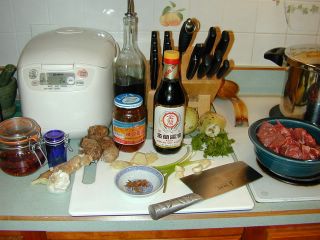
The ingredients for Sichuan Red-Cooked Beef with Turnips; note the Chinese turnips half-hidden beside and behind the soy sauce.
Red Cooked Beef with Turnips
The first time I had this dish was as an employee meal one blustery winter night at Huy’s restaurant. It was served in a bowl with a huge handful of cilantro leaves scattered over it. We ladled it over our bowls of rice and ate with chopsticks and a spoon. I took a bit of it home to Zak and he raved about it, and so I made it my mission to figure out how it was cooked. For years, I tried every kind of Red-cooked beef recipe out there, but never got the right taste until I learned from reading Fuchsia Dunlop’s book that in Sichuan, the ingredient that makes red-cooked beef red is not soy sauce as it is in the rest of China, but Sichuan chile bean paste. I had been using chili garlic paste in order to give the dish its characteristic deep heat, but the flavor was never, ever right. The first time I made this dish with that ingredient, Zak came running downstairs and said, “That’s it!” You can use daikon radish, Chinese turnips or regular American turnips in this dish. Just make sure to add them at the end so they don’t disintegrate. I like Chinese turnips the best of the three, though Huy made it with daikon. While it is not traditional, I have added taro roots and sweet potatoes to this stew and they are both very good in it.
This is my adaptation from Land of Plenty; I added some more scallions, ginger and garlic to it., and I prefer the use of chuck roast to short ribs.
Ingredients:
2-3 pounds good quality chuck roast
2-3 inch piece of fresh ginger, unpeeled
4 scallions, white and green parts, trimmed
3 cloves garlic, peeled
3 tbsp. vegetable oil
6 tbsp. or to taste of Sichuan chili bean paste (do not substitute chili garlic paste)
1 quart beef broth (I prefer the kind in the aseptic package)
4 tbsp. Shao Hsing wine or dry sherry
2 tsp. dark soy sauce
1 tsp. whole Sichuan peppercorns, toasted
1 whole star anise
1 black cardamom pod*
1 ½ pounds turnips, Chinese turnips or daikon radish
Fresh cilantro to garnish (to taste, but like Huy, I like lots of it)
Method:
Cut the chuck roast into several large pieces. Slice the ginger thickly, then smash slices with the side of the knife. Cut the scallions into two or three pieces each. Smash the garlic cloves.
Heat the oil in a heavy dutch oven or soup pot, and add chili bean paste and fry until fragrant--about thirty seconds. Add the ginger, scallions and garlic and fry another thirty seconds. Add in beef, broth, wine, soy sauce and spices. Bring to a boil. If any scum rises, skim it off.
Turn down the heat and simmer until the beef is fork tender--about two to three hours.
When the beef is tender, trim and peel the turnips. Cut them into thick bite-sized chunks. Add to the beef, and cook until the vegetables are just tender.
If you wish, you may thicken the sauce with a cornstarch and cold water slurry.
Garnish with lots of cilantro leaves.
*Black Cardamom is available at Indian grocery stores under that name. In Chinese markets, it is found under the name cao guo or tsao kuo. It is about the size of a Niscoise olive, and has a shaggy brown outer pod that looks rather like the outside of a coconut. It has a smoky, dark flavor that is really, really good with beef. I use it more often in Indian cookery than Chinese, but I have found that with this dish, I really like it, and find it to be essential.
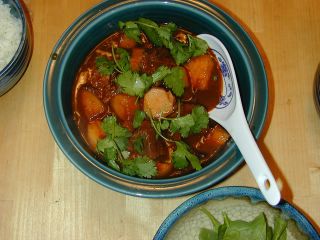
The finished dish, garnished with cilantro.
Fuchsia Dunlop
2001
Fuchsia Dunlop is an amazing woman.
For one thing, she is the only non-Chinese female graduate of the Sichuan Institute of Higher Cuisine in Chengdu, China. For another thing, she managed to write down the recipes for most of the dishes that Huy used to make at The China Garden for employee meals which I had been pining after for more than a decade. Her accurate rendering of these traditional recipes has put into place a few missing puzzle pieces in my quest to recreate the dishes that have haunted my memory.
In addition, she has managed to convey in a 394 page book a vivid picture of life in Sichuan province, with loving descriptions of teahouses, street hawkers and banquets. Her experiences at the culinary institute echoed my memories of culinary college here in the states, however, she had the added excitement of learning a cuisine that was totally unfamiliar to her own cultural background in a completely different language.
With in her book, Dunlop codifies the twenty-three distinct flavors of Sichuan food, lists the necessary pantry items, explains the different cooking techniques--some of them unique to Sichuan province--and provides a glossary of Chinese characters with anglicized spelling and meanings in English. The book is sparsely illustrated with gorgeously composed photographs which show ingredients and finished dishes in full color.
Cooking from this book is an absolute pleasure. Over time, I have adapted all of the recipes I have tried to reflect my memories of the home style dishes that Huy made as well as my own tastes, but I always make the recipe as written first. While I like my adaptations better because they are mine, her recipes are authentic and absolutely, hands-down, the best Sichuan recipes from a book I have ever used.
I understand that she is now working on a book about the cuisine of Hunan province, which is equally under-represented when it comes to cookbooks in English.
I cannot wait to read it.
More importantly, I cannot wait to cook from it.

The ingredients for Sichuan Red-Cooked Beef with Turnips; note the Chinese turnips half-hidden beside and behind the soy sauce.
Red Cooked Beef with Turnips
The first time I had this dish was as an employee meal one blustery winter night at Huy’s restaurant. It was served in a bowl with a huge handful of cilantro leaves scattered over it. We ladled it over our bowls of rice and ate with chopsticks and a spoon. I took a bit of it home to Zak and he raved about it, and so I made it my mission to figure out how it was cooked. For years, I tried every kind of Red-cooked beef recipe out there, but never got the right taste until I learned from reading Fuchsia Dunlop’s book that in Sichuan, the ingredient that makes red-cooked beef red is not soy sauce as it is in the rest of China, but Sichuan chile bean paste. I had been using chili garlic paste in order to give the dish its characteristic deep heat, but the flavor was never, ever right. The first time I made this dish with that ingredient, Zak came running downstairs and said, “That’s it!” You can use daikon radish, Chinese turnips or regular American turnips in this dish. Just make sure to add them at the end so they don’t disintegrate. I like Chinese turnips the best of the three, though Huy made it with daikon. While it is not traditional, I have added taro roots and sweet potatoes to this stew and they are both very good in it.
This is my adaptation from Land of Plenty; I added some more scallions, ginger and garlic to it., and I prefer the use of chuck roast to short ribs.
Ingredients:
2-3 pounds good quality chuck roast
2-3 inch piece of fresh ginger, unpeeled
4 scallions, white and green parts, trimmed
3 cloves garlic, peeled
3 tbsp. vegetable oil
6 tbsp. or to taste of Sichuan chili bean paste (do not substitute chili garlic paste)
1 quart beef broth (I prefer the kind in the aseptic package)
4 tbsp. Shao Hsing wine or dry sherry
2 tsp. dark soy sauce
1 tsp. whole Sichuan peppercorns, toasted
1 whole star anise
1 black cardamom pod*
1 ½ pounds turnips, Chinese turnips or daikon radish
Fresh cilantro to garnish (to taste, but like Huy, I like lots of it)
Method:
Cut the chuck roast into several large pieces. Slice the ginger thickly, then smash slices with the side of the knife. Cut the scallions into two or three pieces each. Smash the garlic cloves.
Heat the oil in a heavy dutch oven or soup pot, and add chili bean paste and fry until fragrant--about thirty seconds. Add the ginger, scallions and garlic and fry another thirty seconds. Add in beef, broth, wine, soy sauce and spices. Bring to a boil. If any scum rises, skim it off.
Turn down the heat and simmer until the beef is fork tender--about two to three hours.
When the beef is tender, trim and peel the turnips. Cut them into thick bite-sized chunks. Add to the beef, and cook until the vegetables are just tender.
If you wish, you may thicken the sauce with a cornstarch and cold water slurry.
Garnish with lots of cilantro leaves.
*Black Cardamom is available at Indian grocery stores under that name. In Chinese markets, it is found under the name cao guo or tsao kuo. It is about the size of a Niscoise olive, and has a shaggy brown outer pod that looks rather like the outside of a coconut. It has a smoky, dark flavor that is really, really good with beef. I use it more often in Indian cookery than Chinese, but I have found that with this dish, I really like it, and find it to be essential.
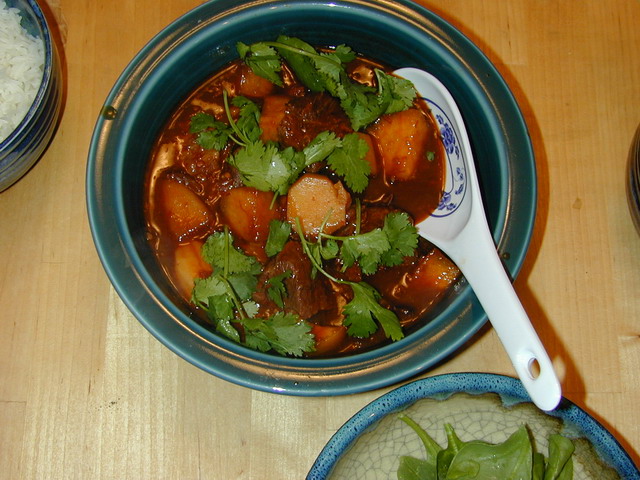
The finished dish, garnished with cilantro.
Thursday, January 27, 2005
Greener on the Other Side

A selection of Chinese greens: baby bok choy, Chinese broccoli or gai lan, and in the back, snow pea shoots. The sausages in the green dish are lop cheong.
In ruminating on the Appalachian tradition of cooking greens with pork, I was reminded of how I got Zak to eat greens. It did involve cooking dark leaves with piggy bits, but not in the traditional Appalachian country style I had grown up with. It came about by riffing on the Chinese way of cooking and eating greens.
The Chinese love greens as much, perhaps more, than hillbillies do. I discovered this years and years ago when I was working as a waitress at The China Garden restaurant in Huntington, West Virginia.
It was the end of lunch shift, and everyone was pausing in our preparations for the dinner shift to have some lunch. There were three of us waitresses working: Heather, a tough-talking but good-natured native West Virginian who had grown up in Columbus, Ohio, June, a young Chinese immigrant who had been a nurse and was working as a waitress to put herself through nursing school in the States, and myself. We had dished up some of whichever lunch special appealed to us and sat down at a table together to eat. Heather and I bantered together, while June, who was very sweet-tempered, laughed at our risqué jokes.
Mei, the chef-owner’s wife, came out of the kitchen with a small platter, and came to our table. We smelled something dark and delicious, and Heather and I, ever the adventurous eaters, looked up eagerly. “Whatcha got, Mei?” Heather asked, leaning forward to get a better look.
Mei waved her hand, as Huy and the rest of the kitchen staff came out and sat at the back table, carrying platters and bowls of rice. Huy was watching us as he sat down and began tucking into his bowl of rice.
Still waving her hand and shaking her head, Mei said, “Oh, its nothing, really, nothing fancy or special. And you probably won’t like it anyway, but Huy wants you to try it.”
I watched as she set it down and deeply inhaled the perfume of toasted sesame oil. It was some kind of greens, cooked until barely wilted and bathed in a shining sauce. To call them verdant was an understatement--they were colored in nearly obscene shades of brilliant green. My nose twitched. They smelled really good.
Heather was looking at them, too. She licked her lower lip, and raised a dark eyebrow at Mei. “What is it?”
Mei shook her head, “Oh, just some greens, Chinese greens, but I don’t think you will like them. I told Huy that only Chinese people like them. Americans won’t like them, but he wants you to try them.”
I shifted in my chair to look past Heather’s shoulder, and saw not only Huy, but Lo and the rest of the kitchen staff watching us intently. I shrugged my shoulder and picked up my chopsticks.
Heather had beaten me to the first bite. “Oh, Mei you know how Barb and I are. We’ll try anything once, right?” She plucked up a choice stalk with her chopsticks and popped it in her mouth, and chewed slowly. Mei, June and I watched her. She swallowed, nodded her head and said. “Mmmm. Tastes like grass.” A satisfied smile quirked the corner of her mouth.
Of course, I snagged a bit of stalk with darker, wilted leaves attached and bit into it. It was bitter and sweet and crunchy and soft and salty and redolent of the smoky wok and the dark mystery of sesame oil. I closed my eyes and nodded. Greens. I swallowed and smiled up at Mei. “Mustard greens. Oh, man, these are good.”
Mei blinked, and stared. “Yes, mustard greens, that’s what they are!”
June had been watching all of this with interest. She took up a very small bit of it and put it in her mouth, biting down on the crisp stalk. Instantly her face puckered and she shuddered, shaking her head. “Ooooh,” she exclaimed, her voice tinged with disbelief. “Tastes like grass.” With that, she shook her head and pushed the platter away from herself and toward Heather and I.
The back table erupted with laughter. Mei feigned great shock and pointed at June. “Wha--you never eat mustard greens?”
Heather took up another bite and chuckled. “So much for only Chinese people liking these.” She winked at me, and we both began eating the greens in earnest. Pausing to grin over at June, Heather added, "That's okay. It means more for us."
June blushed and shook her head, laughing. “No, I don’t like grassy things,” she said to Mei.
Mei watched us eat for a few seconds then tapped me on the shoulder. “Where’d you learn to like mustard greens, huh?”
I looked up at her and winked. “Didn’t you know that hillbillies and rednecks eat greens, too?” I looked down at the platter and added,” Though we don’t cook them so fancy or pretty as that.”
She shook her head. “I had no idea,” she answered, heading over to her table where lunch waited. As she sat down, Huy said, “I told you they’d like.” He peered over at June and made a face, teasing her. “Except June. She’s too spoiled.”
June switched into Mandarin to answer Huy back and the banter between the two tables flowed around Heather and I, a river of words and laughter we could not parse.
But we didn’t care. We had greens, and we ate the entire platter contentedly.
Years later, I decided that it was high time that Zak learn to like greens.
I decided to use his love of Chinese food to my advantage, and bought several varieties of green leafies, and began cooking them in a hot wok with sliced garlic, dressing them simply with a bit of sugar, some wine and light soy sauce, and a dash of rice vinegar. When they were done, I would drizzle sesame oil over them and scrape them out of the wok onto a waiting heated platter.
He ate them up.
My greatest coup was getting him to eat kale. I happen to love lacinato kale--a variety that has fairly tender, wrinkled ovoid leaves with crisp but not tough center veins. I had some lop cheong--dry cured Chinese pork sausage that has a good bit of sugar in them, so I diced it very small, and minced up a clove of garlic with an equal amount of fresh ginger. I cut the kale crosswise into thin ribbons so each slice had a bit of the crisp center rib.
I heated up my Cantonese style cast iron wok which I had recently bought from The Wok Shop in San Francisco, and tossed in the minced aromatics and the diced sausage. I cooked them until the sausage had started to brown and the garlic was golden, then added a drizzle of homemade chile oil with seeds and added the kale. I stirred like mad, letting the kale quickly wilt, and shook a bit of thin soy sauce into the wok along with some chicken broth. A sprinkle of sugar and a dash of chianking black rice vinegar finished the greens, and onto the platter they went.
They were by turns sweet, sour, smoky, gingery and garlicky. The sausage had rendered their fat so everything was coated with a porcine richness that exploded on the taste buds every time you bit into a piece of it. It was an unqualified success.
At a subsequent visit to the Columbus Asian Market, I picked up more lop cheong, and was replenishing my supply of greens. A little Chinese grandmother glanced into my cart and asked what I was going to do with the sausages. I told her about cooking them with greens.
She thought it sounded like a good recipe and said she might try it herself. In the meantime, she pointed out the pea sprouts and asked if I knew what they were, and we were launched on a bilingual discussion of greens, how to buy them, how to cook them and what ailments they were good for curing.
Which was fine, except we were slowing down the traffic in the produce section.
Time and again, in my multi-ethnic explorations of food, I have found that the culinary arts can become a bridge that brings people from very different backgrounds together. Food is a language that transcends linguistic and cultural boundaries, and when two native speakers of the culinary mother tongue come together, impassioned communication results. We can see that while we may have grown up on opposite sides of the planet, we have something in common which we both love.
A simple plate of greens.
Wednesday, January 26, 2005
Yin and Yang
Teaching culinary arts is one of my passions. I watch people learn; I have spent a large amount of my life studying and gaining experience and I enjoy sharing the information I have gained with others along the way. I like the shine of discovery in the eyes of students who are just now embarking on the journey that I first started so many years ago, and I love seeing others who are just as excited about food and cooking as I am have new experiences for the very first time.
Last night I taught an Introduction to Sichuan Cooking class at Sur la Table; it was a hands-on class and it was filled with seventeen people, which is the limit to the number of students we teach hands-on in that venue. I taught three traditional Sichuan dishes: dry fried green beans with minced pork, Ma Po Tofu, and red-cooked beef with turnips. I also taught an original recipe, called “Too Hot Chicken” a stir fry that is based upon Sichuan flavors. The four recipes were meant to be put together into a dinner party, with the first three recipes and steamed rice being able to be made ahead, with the only dish that required last minute cooking being the stir-fry. One of the mistakes a that a lot of novice cooks make when learning Chinese food is they assume that everything is stir-fried and so when they give a dinner party, they wear themselves out stir frying everything at the last minute. In fact, Chinese home cooks would never construct a party menu in that way, but would utilize other cooking methods: steaming or braising, for example, which produce dishes that can be cooked ahead of time and then reheated when needed, or which cook undisturbed on the back of the stove without any supervision from the cook other than starting a timer.
I like to give a great deal of cultural information while I am teaching, often in the form of stories or examples from my own learning experiences, and I always tell my students that they can ask me questions at any time. One question that came up last night from a very enthusiastic and attentive student was, “What is the difference between Sichuan and Cantonese cooking?”
I thought it was a very good question, and one that deserved a well-thought out answer.
One of the great fallacies that many Americans hold in regards to Chinese cookery is that there is one over-arching cuisine that is known as Chinese. That simply is not true; China is a vast country, with many different regions that have distinctive climates, growing seasons, crops, languages, cultures and correspondingly different culinary traditions. Some authors say that there are four main schools of Chinese cookery, others identify up to eight distinctive named variants in cuisine.
Americans come to this notion in several ways. One is that most Americans are woefully under informed when it comes to anything about China; most of us know very little about the history, philosophy or culture of China, because for many years, that country was extremely isolationist, and so there was little opportunity to learn anything accurate about it. Opportunities to share and learn have broadened within my lifetime, and cultural exchange that is available to the general public has exploded in the form of martial arts studios, Chinese medical practitioners, Buddhist teachers and temples, films, books, musicians and theatre companies.
The greatest influence upon American ideas of Chinese culinary homogeneity has come not only from a lack of cultural awareness in general, but from American experiences at Chinese restaurants where the same handful of Americanized Chinese foods are presented with slight variations from city to city, across our nation. Most Americans think of chow mein, chop suey, sweet and sour pork with the scary day-glo pink sauce and egg rolls as “Chinese food.”
This misconception is changing as Chinese restaurants develop and change in the United States, but the process is slow. The dishes mentioned above are still available on a majority of Chinese restaurant menus and many Americans order and enjoy them. What they do not know is that while those dishes are based upon actual Cantonese recipes, they have been strongly adapted to American tastes, and so are in essence more strictly understood as “American-Chinese” food, or as I call it, “American-Chinese Restaurant” food.
Which brings us back to the question of what are the differences between Sichuan and Cantonese foods?
Sichuan food tends to be robustly cooked and intensely flavored with a variety of condiments, from spices, pickled vegetables, chilis and vinegars, which are used in combination to create twenty-three distinct, named flavors, such as fish-fragrant flavor, strange flavor and scorched chili flavor. A great variety of cooking styles are employed in manipulating flavor and texture in Sichuan food, including cooking methods unique to the region such as dry-frying, which is a process that involves slow cooking in a wok over high heat with little oil in order to dry out and change the texture of the ingredient being cooked in this way. Chile peppers are used in a variety of ways--dried whole with seeds and toasted, ground up and steeped in oil, fresh and sliced or in a uniquely Sichuan condiment, fermented chile bean paste. In addition, the berries of the prickly-ash tree, which have a fragrant flavor and produce a pleasant tingling numbness on the tongue and lips, are used in many different ways. These Sichuan peppercorns, as they are called, create a distinctive flavor which is not often used in any other regional cuisine in China.
By contrast, the style of Cantonese cookery is one of restraint and sublime simplicity. The cooking of Canton is the regional style most highly regarded by Chinese gastronomes, in part because of the great respect paid to the quality and freshness of the ingredients used in creating a dish. Pure, fresh meat, seafood and vegetables are skillfully cooked and adorned with a minimum of condiments in order to bring out the natural fragrance, color and flavor inherent to the raw ingredients. There is great emphasis placed upon the aesthetic properties of food in Cantonese cuisine, and there is a lot of attention paid to contrasting colors, textures, tastes and scents of each dish. The Cantonese are particularly known for their stir-fried dishes where brilliantly hued crisp vegetables contrast with meltingly tender meat, which are often enhanced with one or two judiciously applied condiments like light-colored soy sauce or fermented black beans.
As a whole, Sichuan food is all about building flavors with many layers, and creating many different textures with different cooking techniques, but without regard to the natural colors of the ingredients. Many Sichuan dishes are muddy in color, and lack the kaleidoscopic color variety that is present in Cantonese food. By contrast, Cantonese food favors purer, more simple and clean flavors, which are no less satisfying for their lack of complexity, and the colors of each dish provide a delight to the eye as well as to the palate.
Interestingly, last night turned out to be an experience that perfectly illustrated the answer I gave to my student.
After the class was over, while we were cleaning up, I tasted the foods that I had prepared, along with my four assistants and some other employees of the Sur la Table store. I cook these dishes often at home, and so I was not surprised to find that they were really good. They were intensely flavored, which illustrated the layered effect that the use of many different condiments and unique ingredients that Sichuan food is known for. Zak had come to pick me up and he had a taste as well, and said that the Ma Po was particularly good, though I myself, was fond of the Too Hot Chicken and the green beans.
We planned to go to a local restaurant which was open late for supper; it had been suggested to me by one of the students from Grace Young’s class, a man who teaches Chinese cooking in a local high school as a special part of the home economics and social studies curriculum. We had stopped in for dim sum a few days before and were very impressed with the quality of the taro dumplings and turnip cake, as well as the steamed lotus seed buns. We had been told that they had two menus and that the Chinese menu was superb.
We were not led astray.
We sat down and set aside the silverware, and the woman who handed us both the Chinese and American menus said, “I see you want chopsticks.” She then brought out two sets of chopsticks, the homemade chili oil with seeds and a small dish of sliced fresh jalapenos in a dark soy based sauce, along with a pot of tea. We ordered a small order of tofu and sliced pork soup, and I ordered chicken with bitter melon and Zak ordered beef with Chinese broccoli. When she heard our orders, her eyes lip up and she smiled.
She brought out the soup and it was a typically delicate Cantonese offering--a good homemade chicken stock with billowy cubes of extremely fresh tofu, rich black mushrooms, thin slices of sweet pork, greens, baby corn and straw mushrooms. The chicken stock was light and seasoned with a bit of white pepper, the baby corn was the most fresh and flavorful I had ever tasted and the greens, choy sum, had the buttery-smooth leaves contrasted with the crisp stems with their distinctive salt-tinged vegetal savor. The soup came in a communal tureen, and we were given small individual bowls with Chinese style soup spoons. The bowls were perfectly sized to fit in one hand, so I felt confident eating the soup in a Chinese manner, by drinking it.
When our entrees came out, a different waitress brought them. Setting mine down, she declared, “You sure know what to order! This is the best dish on the menu--it is my favorite.” When Zak’s dish came moments later, we both dug in, cupping our small rice bowls in our off-hands while plucking morsels from the central platters with our chopsticks.
Both dishes were perfect examples of Cantonese restraint in seasoning and mastery of the wok. The chicken with bitter melon was seasoned with fermented black beans, a bit of thin soy sauce and some chicken stock, and was utterly sublime. The meat was filled with wok hay, that savory fragrance that only comes from being cooked in a well-seasoned wok on high heat and then rushed to the table before it can dissipate. The salty black beans accentuated the rich flavor of the meat, and coaxed out the natural sweetness that lays hidden in the heart of the bitter melon. Without that slightly smoky saltiness of the black beans, the bitterness would overpower the watery hint of sugar present in the fruit.
Zak’s beef with Chinese broccoli (gai lan) was a lovely dish, too. The gai lan was a provided a great contrast to the bitter melon; the broccoli was crisp where the melon was velvety, it was sweet with the slightest hint of bitterness while the melon was the opposite, and it was vibrant emerald green while the melon was the muted shade of celadon. The pale chicken breast meat slices contrasted with the meltingly tender richness dark beef slices; the two dishes complemented each other perfectly.
It was a meal of perfect yin and yang balance.
And in retrospect, I realized that the entire evening was a study in the balance of opposites.
Halfway through the meal, our original waitress came to check on us and refill our tea. Seeing me holding my rice bowl and eating casually in a Chinese way, she blinked and asked if I was from New York. Smiling, I shook my head and said, “No, I’m from West Virginia.” She blinked again and said, “Oh.” Then she paused and said, “I wondered, because you eat like a Chinese.”
I explained that I had worked in a Chinese restaurant, and she nodded, satisfied with my answer, though I suspect, still a bit confused. When she caught sight of my jade and gold wedding band, she commented on it, and smiled. Another contrast, another balance. A West Virginia farm girl wearing jade and teaching the cuisines of a completely different culture.
I wish that I could have brought all of my students from my Sichuan class there to eat, so they wouldn’t have to just take my word on the differences between Sichuan and Cantonese food. They could have tasted those differences directly, and would have had a perfect, unforgettable object lesson in the importance of balance and contrast when it comes to Chinese cookery.
Last night I taught an Introduction to Sichuan Cooking class at Sur la Table; it was a hands-on class and it was filled with seventeen people, which is the limit to the number of students we teach hands-on in that venue. I taught three traditional Sichuan dishes: dry fried green beans with minced pork, Ma Po Tofu, and red-cooked beef with turnips. I also taught an original recipe, called “Too Hot Chicken” a stir fry that is based upon Sichuan flavors. The four recipes were meant to be put together into a dinner party, with the first three recipes and steamed rice being able to be made ahead, with the only dish that required last minute cooking being the stir-fry. One of the mistakes a that a lot of novice cooks make when learning Chinese food is they assume that everything is stir-fried and so when they give a dinner party, they wear themselves out stir frying everything at the last minute. In fact, Chinese home cooks would never construct a party menu in that way, but would utilize other cooking methods: steaming or braising, for example, which produce dishes that can be cooked ahead of time and then reheated when needed, or which cook undisturbed on the back of the stove without any supervision from the cook other than starting a timer.
I like to give a great deal of cultural information while I am teaching, often in the form of stories or examples from my own learning experiences, and I always tell my students that they can ask me questions at any time. One question that came up last night from a very enthusiastic and attentive student was, “What is the difference between Sichuan and Cantonese cooking?”
I thought it was a very good question, and one that deserved a well-thought out answer.
One of the great fallacies that many Americans hold in regards to Chinese cookery is that there is one over-arching cuisine that is known as Chinese. That simply is not true; China is a vast country, with many different regions that have distinctive climates, growing seasons, crops, languages, cultures and correspondingly different culinary traditions. Some authors say that there are four main schools of Chinese cookery, others identify up to eight distinctive named variants in cuisine.
Americans come to this notion in several ways. One is that most Americans are woefully under informed when it comes to anything about China; most of us know very little about the history, philosophy or culture of China, because for many years, that country was extremely isolationist, and so there was little opportunity to learn anything accurate about it. Opportunities to share and learn have broadened within my lifetime, and cultural exchange that is available to the general public has exploded in the form of martial arts studios, Chinese medical practitioners, Buddhist teachers and temples, films, books, musicians and theatre companies.
The greatest influence upon American ideas of Chinese culinary homogeneity has come not only from a lack of cultural awareness in general, but from American experiences at Chinese restaurants where the same handful of Americanized Chinese foods are presented with slight variations from city to city, across our nation. Most Americans think of chow mein, chop suey, sweet and sour pork with the scary day-glo pink sauce and egg rolls as “Chinese food.”
This misconception is changing as Chinese restaurants develop and change in the United States, but the process is slow. The dishes mentioned above are still available on a majority of Chinese restaurant menus and many Americans order and enjoy them. What they do not know is that while those dishes are based upon actual Cantonese recipes, they have been strongly adapted to American tastes, and so are in essence more strictly understood as “American-Chinese” food, or as I call it, “American-Chinese Restaurant” food.
Which brings us back to the question of what are the differences between Sichuan and Cantonese foods?
Sichuan food tends to be robustly cooked and intensely flavored with a variety of condiments, from spices, pickled vegetables, chilis and vinegars, which are used in combination to create twenty-three distinct, named flavors, such as fish-fragrant flavor, strange flavor and scorched chili flavor. A great variety of cooking styles are employed in manipulating flavor and texture in Sichuan food, including cooking methods unique to the region such as dry-frying, which is a process that involves slow cooking in a wok over high heat with little oil in order to dry out and change the texture of the ingredient being cooked in this way. Chile peppers are used in a variety of ways--dried whole with seeds and toasted, ground up and steeped in oil, fresh and sliced or in a uniquely Sichuan condiment, fermented chile bean paste. In addition, the berries of the prickly-ash tree, which have a fragrant flavor and produce a pleasant tingling numbness on the tongue and lips, are used in many different ways. These Sichuan peppercorns, as they are called, create a distinctive flavor which is not often used in any other regional cuisine in China.
By contrast, the style of Cantonese cookery is one of restraint and sublime simplicity. The cooking of Canton is the regional style most highly regarded by Chinese gastronomes, in part because of the great respect paid to the quality and freshness of the ingredients used in creating a dish. Pure, fresh meat, seafood and vegetables are skillfully cooked and adorned with a minimum of condiments in order to bring out the natural fragrance, color and flavor inherent to the raw ingredients. There is great emphasis placed upon the aesthetic properties of food in Cantonese cuisine, and there is a lot of attention paid to contrasting colors, textures, tastes and scents of each dish. The Cantonese are particularly known for their stir-fried dishes where brilliantly hued crisp vegetables contrast with meltingly tender meat, which are often enhanced with one or two judiciously applied condiments like light-colored soy sauce or fermented black beans.
As a whole, Sichuan food is all about building flavors with many layers, and creating many different textures with different cooking techniques, but without regard to the natural colors of the ingredients. Many Sichuan dishes are muddy in color, and lack the kaleidoscopic color variety that is present in Cantonese food. By contrast, Cantonese food favors purer, more simple and clean flavors, which are no less satisfying for their lack of complexity, and the colors of each dish provide a delight to the eye as well as to the palate.
Interestingly, last night turned out to be an experience that perfectly illustrated the answer I gave to my student.
After the class was over, while we were cleaning up, I tasted the foods that I had prepared, along with my four assistants and some other employees of the Sur la Table store. I cook these dishes often at home, and so I was not surprised to find that they were really good. They were intensely flavored, which illustrated the layered effect that the use of many different condiments and unique ingredients that Sichuan food is known for. Zak had come to pick me up and he had a taste as well, and said that the Ma Po was particularly good, though I myself, was fond of the Too Hot Chicken and the green beans.
We planned to go to a local restaurant which was open late for supper; it had been suggested to me by one of the students from Grace Young’s class, a man who teaches Chinese cooking in a local high school as a special part of the home economics and social studies curriculum. We had stopped in for dim sum a few days before and were very impressed with the quality of the taro dumplings and turnip cake, as well as the steamed lotus seed buns. We had been told that they had two menus and that the Chinese menu was superb.
We were not led astray.
We sat down and set aside the silverware, and the woman who handed us both the Chinese and American menus said, “I see you want chopsticks.” She then brought out two sets of chopsticks, the homemade chili oil with seeds and a small dish of sliced fresh jalapenos in a dark soy based sauce, along with a pot of tea. We ordered a small order of tofu and sliced pork soup, and I ordered chicken with bitter melon and Zak ordered beef with Chinese broccoli. When she heard our orders, her eyes lip up and she smiled.
She brought out the soup and it was a typically delicate Cantonese offering--a good homemade chicken stock with billowy cubes of extremely fresh tofu, rich black mushrooms, thin slices of sweet pork, greens, baby corn and straw mushrooms. The chicken stock was light and seasoned with a bit of white pepper, the baby corn was the most fresh and flavorful I had ever tasted and the greens, choy sum, had the buttery-smooth leaves contrasted with the crisp stems with their distinctive salt-tinged vegetal savor. The soup came in a communal tureen, and we were given small individual bowls with Chinese style soup spoons. The bowls were perfectly sized to fit in one hand, so I felt confident eating the soup in a Chinese manner, by drinking it.
When our entrees came out, a different waitress brought them. Setting mine down, she declared, “You sure know what to order! This is the best dish on the menu--it is my favorite.” When Zak’s dish came moments later, we both dug in, cupping our small rice bowls in our off-hands while plucking morsels from the central platters with our chopsticks.
Both dishes were perfect examples of Cantonese restraint in seasoning and mastery of the wok. The chicken with bitter melon was seasoned with fermented black beans, a bit of thin soy sauce and some chicken stock, and was utterly sublime. The meat was filled with wok hay, that savory fragrance that only comes from being cooked in a well-seasoned wok on high heat and then rushed to the table before it can dissipate. The salty black beans accentuated the rich flavor of the meat, and coaxed out the natural sweetness that lays hidden in the heart of the bitter melon. Without that slightly smoky saltiness of the black beans, the bitterness would overpower the watery hint of sugar present in the fruit.
Zak’s beef with Chinese broccoli (gai lan) was a lovely dish, too. The gai lan was a provided a great contrast to the bitter melon; the broccoli was crisp where the melon was velvety, it was sweet with the slightest hint of bitterness while the melon was the opposite, and it was vibrant emerald green while the melon was the muted shade of celadon. The pale chicken breast meat slices contrasted with the meltingly tender richness dark beef slices; the two dishes complemented each other perfectly.
It was a meal of perfect yin and yang balance.
And in retrospect, I realized that the entire evening was a study in the balance of opposites.
Halfway through the meal, our original waitress came to check on us and refill our tea. Seeing me holding my rice bowl and eating casually in a Chinese way, she blinked and asked if I was from New York. Smiling, I shook my head and said, “No, I’m from West Virginia.” She blinked again and said, “Oh.” Then she paused and said, “I wondered, because you eat like a Chinese.”
I explained that I had worked in a Chinese restaurant, and she nodded, satisfied with my answer, though I suspect, still a bit confused. When she caught sight of my jade and gold wedding band, she commented on it, and smiled. Another contrast, another balance. A West Virginia farm girl wearing jade and teaching the cuisines of a completely different culture.
I wish that I could have brought all of my students from my Sichuan class there to eat, so they wouldn’t have to just take my word on the differences between Sichuan and Cantonese food. They could have tasted those differences directly, and would have had a perfect, unforgettable object lesson in the importance of balance and contrast when it comes to Chinese cookery.
Tuesday, January 25, 2005
The Chinese Cookbook Project

The beginnings of the Chinese Cookbook Project

It all started with my daughter.
She wanted to learn to cook Chinese food. And she wanted a wok and a rice cooker of her very own for Generic Winter Holiday.
Now, if she lived with me, all of this would be much simpler. She wouldn’t need her own rice cooker, because she could use mine; she could have her own small carbon steel wok and she could learn to cook Chinese food the best way--at my elbow.
But, since she doesn’t currently live with me, this posed a few interesting challenges.
I ended up getting her the wok and rice cooker, a pair of pretty good kitchen knives, some silicone prep bowls that she cannot break, a garlic peeler, a wok shovel and some rice paddles.
That just left the problem of a cookbook.
I wanted to get her a really good cookbook for absolute beginners that taught not only the hows of Chinese cooking, but the whys. She not only needed to know how the techniques worked together, but why they fitted together so well into a seamless whole of cuisine theory. The Chinese have been cooking, eating, and writing philosophical treatises on such since the time of Confucius. Indeed, the great philosopher was himself an epicure, and gastronomy is considered so highly that many Chinese scholars, ancient and modern, discourse upon the subject in their works.
In addition to the aesthetic and scientific principles of cookery, there is an entire underlying layer of meaning to Chinese food that has to do with the subtleties of health and physical energy, known as chi. As in tai chi, the Chinese martial art that has to do with moving the natural physical energy in the body in such a way as to bring harmony to the body, mind and spirit. Chi is the same things as hay in Cantonese--as in wok hay. And it is understood by the Chinese that food and eating are both integrally involved in one’s physical, emotional, and spiritual health on a subtle, energetic level.
I believe that all of these principles are extremely important to understanding Chinese cooking, and I try to at least expose my students to these ideas so that they get a good foundational understanding of the concepts behind the dishes I am teaching them. When I have taught private students, or when students take an entire series of courses that I teach publicly, they tend to get a deeper understanding of Chinese cookery as a holistic art that touches upon every aspect of Chinese culture and life. I wanted to help my daughter, who is turning fifteen in a few days, to get a foundational understanding of these principles while she learned to cook the dishes she enjoys from my kitchen and in various restaurants.
So, I started by looking through my rather large collection of Chinese cookbooks for a book to start a teenager down the path of learning to cook and eat in a Chinese manner.
And I discovered something.
There are some really great books in print that teach various Chinese dishes, and some of them teach the techniques well for beginners, but none of them really go in depth on the “whys” that form the essential logic and philosophy of Chinese cookery. Some touch on the healthy aspects of Chinese food, and other books do well at teaching physical techniques, but not many are well-illustrated to show how the techniques should look in practice. Chinese cookery is very technique-heavy, with a great deal of emphasis on very precise cutting in preparation for stir-frying, that it is difficult for an inexperienced person to grasp these without pictorial references.
I was lucky when I started learning Chinese cooking; I had the experience of watching a variety of trained Chinese chefs working in the kitchen with Huy. I had seen them do all of the various cuts and had watched them prepare meats for roasting and had even helped with some preparation, like filling wontons or wrapping spring rolls. And of course, there was always Martin Yan on television, so I could easily learn how to use a Chinese cleaver or how to dry fry from a book that had few or no illustrations. I had already seen these actions performed and had them in my memory.
I reluctantly ended up picking up Chinese Cooking for Dummies by Martin Yan, (what an unfortunate title) because it gave a very good step-by-step explanation of the fundamentals of Chinese cuisine in a way that was simple enough for an inexperienced cook to understand. There were very few photographs, but there were a lot of line-drawings show how to hold the knife and how various cuts should look. I also picked up, much less reluctantly, Yan-Kit So’s Yan-Kit’s Classic Chinese Cookbook, which is lavishly illustrated with full color photographs, not only of the finished dishes, but of ingredients, tools, and the techniques of cutting, steaming and stir-frying. The text is also written in a manner which I find to be very beginner-friendly, which is good for someone like my daughter, who is, unlike her mother, not in the habit of reading cookbooks for the sheer joy of it.
Books that I rejected out of hand because they were too densely written for someone with the patience level of a fifteen year old included Barbara Tropp’s The Modern Art of Chinese Cooking. It pained me to not give her that book, for it is a well-loved classic in my house, but I knew that Morganna would not have the patience to delve into some of the rather dense and dry prose that Tropp uses to explain the complex techniques and philosophy of the Chinese kitchen. I also turned aside Gloria Bley Miller’s doorstop classic, The Thousand Recipe Chinese Cookbook, which was the second Chinese cookbook that I owned, because it had very little in the way of useful illustration and too many of the recipes were simple variants of each other. I knew that if she had a volume of that size to dig through, my daughter might never pick up her wok and start to cook.
That is when I started looking at some of the books that I have which are out of print. Irene Kuo’s classic, The Key to Chinese Cooking has a nearly perfect balance of technical information and philosophical background, and once I picked it up, I began re-reading it for the pleasure of it. Her prose writing style gives the feeling of having an old friend whispering instruction into your ear, as you embark upon your adventure in the kitchen. Grace Chu’s Cooking School by Grace Zia Chu is similarly informative and comforting; both of these women were accomplished cooking instructors who worked primarily with American students, so they really can get to the heart of how to explain the complexities of Chinese food to people who were not born to that culture. Another great teacher whose books are all sadly out of print is Florence Lin.
As I read these older books, I began to realize that there was a lot of information out there that is just not available to modern students. Unless they are interested in digging around in used bookstores, or if they know what they are looking for, hunting up titles available online, few beginners will have heard of Grace Zia Chu, Irene Kuo or Florence Lin. The books do not look like much by modern standards--they are not full of photographs, and there aren’t a lot of line drawings, but the information is all presented in such no-nonsense, practical ways that I cannot help but see them as jewels hidden by the whims of the publishing world.
As I looked at these books, and traced their pages lovingly, I began to think beyond the plight of my daughter, and began to realize that the words of these great teachers might be lost to those who could benefit from them most. I remembered my experiences at Johnson & Wales culinary college, and remembered the way in which the cuisines of Asia were presented.
Culinary colleges in the United States teach the French principles of cuisine that were set down by Escoffier. It makes sense, since Escoffier was essentially creating an efficient method of running a restaurant kitchen, and also because much of American restaurant practice and culinary lineage comes directly from France. This is all fine and sensible, however, it means that the other cuisines of the world, particularly non-European ones, suffer from a lack of time and attention to cultural detail.
When we took “International Cuisine” which covered all the other cuisines of the world that were not covered in the classes “French Classical,” “American Regional” and “Continental Cuisines,” the whole of the continent of Asia was taught within three days of the nine day class. Three days spent on Chinese cuisines alone would not even scratch the surface of what there is to learn about even the basics, much less the complexities of the subject.
In addition, the library section on Chinese and other Asian cuisines was woefully inadequate. I did better relying on my own library at home when writing papers or researching recipes.
As I held these books in my lap and reminisced, an idea formed.
Why don’t I put together a library of both in print and out of print Chinese cookbooks, gathering together as many of the significant works I can find and then, at some point in the future, bequeath the collection to Johnson & Wales so that these books would be available to young students for generations to come?
I liked the idea well enough that I posted about it on a message board that an acquaintance of mine runs on his website. I figured that the posters in that community could give me suggestions on what books I should seek out and point out good leads on booksellers. Well, Gary Soup, the administrator of the site, liked the idea so much he gave me my own forum and we emailed back and forth to talk about which books he thought would have great historic significance that I should seek out.
At this point, I thought it might be best if I let my husband, Zak, know what is going on. He was up in his studio working on art, and so had missed all of the excitement that was happening downstairs, in my head, and on the Internet. So, over dinner (I believe I cooked him something particularly good, like Ma Po Tofu), I let him in on my cunning plan. He thought it was interesting, especially after I told him that I had the thought of attempting to unravel, then piece back together and record the history of Chinese cookbooks published in English. We both get bright-eyed over history, the more esoteric and generally odd, the better. So, the Chinese Cookbook Project was born.
One of the cookbooks that Gary suggested I pick up because of its historical significance is a very old one, called simply Chinese-Japanese Cookbook, written by Sara Bosse and Onoto Watanna, and published by Rand McNally in 1914. Gary has a link to an electronic archived edition of the book, and while it is not the very first Chinese cookbook printed in English in the United States, it is among the first handful.
Another book that the posters on the forums suggested I acquire was Florence Lin’s Complete Book of Chinese Noodles, Dumplings and Breads. That was one of her books I -did- not have, but which I heard raves from everyone who mentioned it.
So, I set forth. I had no belief that I would find a copy of the first book, being as it was so old, and even if I did find one, I assumed it would be prohibitively expensive. Oddly enough, within days of Gary’s suggestion, I looked it up on ebay and lo and behold--there was a copy listed, with the ridiculous opening bid of ninety-nine cents. Yes. You read that correctly.
I am not generally a superstitious person, but I have noticed that when I am doing something that seems to be “right,” or in line with what the Universe seems to want from me, small coincidences occur which make my endeavor start to fall into place. And this was one of those times. It was rather spooky, really, coming across this book on ebay within days of deciding to start this collection as a project that reached beyond myself and my own edification.
So, I watched the auction for several days. There were only two people bidding on it, and they seemed inclined to bid fairly low. I waited until the last five minutes of the auction and bid high, and picked up the book for a very small sum. Very gratified, I set my sights on the Florence Lin book.
Which I discovered to my dismay, is a highly sought after book, and is very expensive. Some copies go on ebay, Amazon or through Bookfinder for one hundred dollars or more. I couldn’t find a copy anywhere for less than seventy dollars. I was disheartened.
But, oddly, one evening after reading my email, blogs and message boards, I decided to check for the book on Amazon one more time. And there was a new listing for a used copy of it from Alaska, of all places, for the paltry amount of seventeen dollars.
Before you can say “gong hay fat choy,” I hit the “Buy this now with one-click” button, and lucked into a very well-cared for copy of the book.
So now, I am in the process of cataloguing the books I currently have. I have also been compiling a list of books that I am seeking. In the meantime, many little adventures in online book hunting have happened that I will relate in later posts. I also intend to write about what I have learned of the history of Chinese cookbooks published in English, as well as reviews for many of these books.
For now, let it suffice for me to say, that the Chinese Cookbook Project is well in hand and underway.
Monday, January 24, 2005
Hillbillies, Greens and Pigs
West Virginia is a weird place.
Anyplace that is known for moonshiners and Mothman is bound to be seen as a tad bit odd. But I am not talking about hillbillies and banjos here. Well, not directly, anyway.
I am talking about food and culture.
I can hear it now--you are laughing and saying, “West Virginia has culture?”
Well, sure it does--anyplace that has people in it has culture. I grew up in West Virginia, so I reckon I should know something about the culture in West Virginia, or at least enough that I can talk about it in an articulate fashion.
The reason that I said that West Virginia is a weird place has nothing to do with Mothman, and everything to do with history and food.
See, it is like this: technically speaking, West Virginia is considered a “northern” state, because during the Civil War, the northwestern portion of Virginia decided to stick with the Union, while the southeastern part seceded. Which is why West Virginia is a state. Which it is. I just wanted to make that clear, because I have noticed that a lot of folks from other parts of the country don’t get that. They seem to think that when we expatriate children of the rolling hills and red clay soil say “I am from West Virginia,” that we mean that we are from the western part of Virginia. They always ask, “How do you like Virginia Beach?”
My answer is always, “I dunno, everyone in West Virginia goes either to the Outer Banks or Myrtle Beach.”(If you are laughing while you read this, you are probably from West Virginia.)
Which confuses them. But that doesn’t confront me none; my point is this--West Virginia is a state, not of mind, but a physical place that has been a State in the Union for well over one hundred years now. Got it? Good.
Now, as I was saying, West Virginia is technically considered a “northern” state, but when you sit down to eat there, the food you are tucking into and tasting tells you that you are in the south. And if you listen to the accent in folks’ speech as they say grace, you might notice that it sounds a might bit southern.
What is going on here?
Well, as I have been saying for a while, West Virginia is historically northern, but culturally southern, which essentially makes it a no-man’s land that is betwixt and between political, cultural and philosophical borders. The Yankees are a mystery to us, and the Rebs won’t claim us because we stuck with the bluecoats over a hundred years ago, so I guess that the mountaineers stand alone in the cultural map of the United States.
Or do we?
I don’t think so.
I think that the answer is that we are neither north or south, but Appalachian, and our food, music and other cultural trappings all point to this truth.
Let me explain, by way of examining a phenomena that I noticed a while back. That being the phenomina of how greens are cooked and eaten by both black and white folks in the south, the north, and Appalachia.
Greens are a big thing in the culinary world these days. The most recent US dietary guidelines are trying to get everyone to eat more of these nutrient-dense leafy vegetables, along with lots of other fruits and vegetables. The green leafies are even finding their way onto the menus of upscale restaurants, usually cooked either as an Italian-inspired sauté with garlic and olive oil, or in a kind of neo-Asian stir-fry with lots of ginger, garlic and chile peppers.
Which is fine and great by me--I love the things, and will eat them so long as they taste good, in just about any way a human can figure out how to cook them. But those “newfangled” cooking methods are not related to how I grew up eating them, and how I once believed everyone ate them.
In West Virginia, quite a lot of folks eat greens of some sort, whether it is kale, collards, turnip greens, beet greens or creasy greens. Black or white, it doesn’t matter, you likely eat greens of some kind. City folk and farmers alike eat them, and I am told that rich or poor does not matter, though I have to admit that the only folks I personally knew of growing up who ate them tended to be middle class and on down the socio-economic ladder. This could just point to the fact that I grew up without knowing many rich folks, or it could just be that greens were a preferred food for poor folks. I don’t know the answer to that question, and besides it isn’t overly pertinent to the points I am trying to make.
The pertinent and interesting thing is, that unless we were from a different ethnic background, such as Italian, where the garlic and olive oil came in, we all tended to eat our chosen leaves cooked one way--with smoked pork of some sort included. Some people used a hambone, others a hamhock, and some used belly or jowl bacon. What kind of smoked pig didn't matter, what mattered was that the greens were simmered with it for a good long time so that the smoky flavor of the pork melded with the bittersweet flavors of the leaves and the whole thing became permeated with a delicious richness that one simply could not resist.
Of course there are variations depending on who is doing the cooking and eating; some people added hot sauce or peppers, and others did not, and some used onions, while others eschewed any other additional ingredients as being unnecessary to the point of sacrilege. One thing is pretty well constant and clear in my recollection of how things were done in the kitchen "back in the day."
And that is the idea that greens and pig go together in the pot.
Why does all of this matter, one might ask, and why would it set my mind to ruminating?
Well, it all started a month or so ago, when I went to cook dinner for the women at a local domestic violence shelter. I volunteer there, and cook dinner once a week, using my culinary skills to give the women and kids there something to look forward to. I take requests, do the shopping, and come out once a week or so to cook. While I’m there some of the women or kids come in to talk with me, or to help, or just to watch me cook, and I find that often I become a sympathetic ear for their woes or a shoulder for their tears. I also become a bit of entertainment, a source of funny stories and laughter.
And, I stand as a testament to the fact that there is a future beyond the cycle of pain and humiliation that domestic violence brings to people’s lives. In my own quiet way, I tell the folks there that that survival can become something beyond a day by day thing, and that growth and strength come from taking the hard road of stepping out of that cycle and into a new life, and working to make it happen.
Anyway, I had gotten a request from the only African American woman there to make collard greens.
So, I brought my pressure cooker and about fifteen pounds of greens, along with a pound of bacon, some onions, garlic and jalapenos, some chicken broth and set myself up to fix about four batches of greens as a side dish. I had to do them in batches to cook enough greens for everyone; luckily, they only take about five minutes to cook in a pressure cooker.
While I was washing the greens, an older white woman came in, and was so excited to see the collards, she hugged me. Her accent told me she was a southerner, and I laughed. “I ain’t had greens in so long,” she said. “I grew up eatin’ collards all winter long. Ain’t nothin’ better,” she added.
It turns out she grew up a sharecropper’s child in the hills of Arkansas. We traded Appalachian farm girl stories, and she helped me clean the greens.
Another white woman came in, and got equally excited. She was from southeastern Ohio, and she had grown up eating greens with bacon, too. Ohio is most undeniably a northern state, but here was a white woman who grew up there eating greens cooked “right and proper” as my Gram would say.
This started me thinking.
Then the woman who had asked for greens came in as the bacon was cooking with the chiles, onions, and garlic. She grew up in Pennsylvania, in the city if Pittsburgh, which is certainly not the south, nor is it overly Appalachian, though I would argue that there is a significant population of Appalachian folks there who came out of the hills and hollers, looking for work in the steel mills.
But I wasn’t surprised by her insistence that greens be cooked with pig. I had already figured out that African-Americans carried their southern ways of cooking with them when they went up north and out west. Again, there are variations, but a lot of black cooks, even after generations in the north, still cook essentially southern food. Soul food and the food that white southerners, particularly poor white southerners, eat is pretty much the same thing.
Years earlier, I had surprised a black friend of mine who grew up in Toledo, Ohio, by knowing how to cook greens. She was shocked that a white girl knew a thing about greens, because where she grew up, greens were soul food that white folks would not touch. I pointed out that I was a southerner when it came to cooking and eating, and that white folks in the south eat “soul food,” too.
When I served dinner that night, two other white women came in and started sniffing the pot of greens that I was dishing up alongside the meatloaf, mashed potatoes and gravy. One was from Newark, which is a small city on the edge of Appalachian Ohio, and she started licking her lips over the greens, and heaped a bunch of them on her plate. The other was from Columbus, Ohio, which is the capital city and is situated in the central part of the state far from the Appalachian foothills. Columbus is where the Great Plains begin, and all of the land from there north and west is flat from being scraped level by the glaciers of the last ice age.
She stuck her nose over the pot, wrinkled it and said, “What is -that-?”
I said, “Collard greens.”
She backed up and made a face. “Aren’t they black people food?”
I felt my shoulders stiffen, and I looked over at the woman who had requested the greens. She just rolled her eyes and shook her head. Casual racism obviously bothered her, but she, as the only black woman in the shelter, wasn’t going to say anything about it.
I, however, didn’t have to live there.
I plastered a smile on my face and said, “Where I come from, they are poor people’s food. Everybody eats them, from the middle class on down, whether we are white or black. We eat them, and love them, because not only are they really healthy for you, they taste really good.”
At which point the sharecropper’s daughter took up the conversation and began singing the praises of greens. The woman who was of Italian descent took up the thread and started telling how her grandma cooked them like rapini, with lots of garlic and olive oil. The tense moment was gone in a flood of food and reminiscence.
I was gratified that the woman from Columbus did eat them, and in fact liked them, but her words made me think and wonder about why it was that some white women in Ohio knew what greens were and how to cook them, while others evinced the belief that only black folks ate them and knew nothing about the eating and cooking of them. It wasn’t even that they cooked them without pork products--they didn’t cook them at all.
Well, it got me to thinking. And here is what I figured out.
The white folks who eat greens are not just southerners--because if that was the case, then no white folks in Ohio would eat them who wasn’t originally from the south. As I noted, the African American tradition of cooking and eating greens traveled up north, as illustrated not only by my friend from Toledo, but by my contact with black students in culinary school from Massachusetts, New Jersey and Pennsylvania who were scandalized by a chef’s attempt to bring down the fat content of collards by cooking them with smoked turkey wings instead of the sacred pig. Their horror was my own.
I finally realized that it was not only a southern tradition, but also an Appalachian tradition, to cook greens in combination with pork. The women from Newark and southeastern Ohio were the key to my hypothesis. They both grew up in the Appalachian region of Ohio, which showed the same exact culinary hallmarks that I grew up with in West Virginia, and the woman from the hills of Arkansas grew up with.
So that is what I think--the tradition of cooking greens of some sort with a smoked pork product is not only a soul food phenomena, or a white southern tradition--it is an Appalachian hillbilly culinary practice, which is just a little bit distinct from plain old southern foodways.
Now, if you have made it this far in my culinary detective work, you deserve a reward. Just for y’all, here is my recipe for my collard greens, which the women at the shelter, both black and white, rich and poor, city and country, insisted that I write down for them.
Quick Collard Greens
Serves 8
Ingredients:
2 pounds fresh collard greens
½ pound bacon
2 tbsp. olive oil
1 medium onion, diced
4 cloves garlic, minced
1 small jalapeno, seeded and minced, or ½ tsp. red chile flakes or to taste (optional)
1 cup vegetable or chicken broth
salt and pepper to taste
Method:
Wash collards and remove the thick vein. Roll each leaf up, cigar style, and cut into ½ inch wide ribbons. Drain well in a colander.
While collards drain, cut ½ pound sliced bacon into ½ inch pieces, and fry in the bottom of a pressure cooker on medium heat until crispy. Remove bacon, and set aside. Add olive oil to bacon grease, and sauté onion until golden brown. Add garlic
and jalapeno or chile flakes and sauté until fragrant.
Add broth, and bring to a boil. When boiling, put collards on top, put lid on pressure cooker and lock into place. Bring up to full pressure and cook for five minutes. Quick release pressure, open lid, stir in bacon and serve.
Note: If you do not have a pressure cooker, this will take several hours to cook—plan time accordingly.
Anyplace that is known for moonshiners and Mothman is bound to be seen as a tad bit odd. But I am not talking about hillbillies and banjos here. Well, not directly, anyway.
I am talking about food and culture.
I can hear it now--you are laughing and saying, “West Virginia has culture?”
Well, sure it does--anyplace that has people in it has culture. I grew up in West Virginia, so I reckon I should know something about the culture in West Virginia, or at least enough that I can talk about it in an articulate fashion.
The reason that I said that West Virginia is a weird place has nothing to do with Mothman, and everything to do with history and food.
See, it is like this: technically speaking, West Virginia is considered a “northern” state, because during the Civil War, the northwestern portion of Virginia decided to stick with the Union, while the southeastern part seceded. Which is why West Virginia is a state. Which it is. I just wanted to make that clear, because I have noticed that a lot of folks from other parts of the country don’t get that. They seem to think that when we expatriate children of the rolling hills and red clay soil say “I am from West Virginia,” that we mean that we are from the western part of Virginia. They always ask, “How do you like Virginia Beach?”
My answer is always, “I dunno, everyone in West Virginia goes either to the Outer Banks or Myrtle Beach.”(If you are laughing while you read this, you are probably from West Virginia.)
Which confuses them. But that doesn’t confront me none; my point is this--West Virginia is a state, not of mind, but a physical place that has been a State in the Union for well over one hundred years now. Got it? Good.
Now, as I was saying, West Virginia is technically considered a “northern” state, but when you sit down to eat there, the food you are tucking into and tasting tells you that you are in the south. And if you listen to the accent in folks’ speech as they say grace, you might notice that it sounds a might bit southern.
What is going on here?
Well, as I have been saying for a while, West Virginia is historically northern, but culturally southern, which essentially makes it a no-man’s land that is betwixt and between political, cultural and philosophical borders. The Yankees are a mystery to us, and the Rebs won’t claim us because we stuck with the bluecoats over a hundred years ago, so I guess that the mountaineers stand alone in the cultural map of the United States.
Or do we?
I don’t think so.
I think that the answer is that we are neither north or south, but Appalachian, and our food, music and other cultural trappings all point to this truth.
Let me explain, by way of examining a phenomena that I noticed a while back. That being the phenomina of how greens are cooked and eaten by both black and white folks in the south, the north, and Appalachia.
Greens are a big thing in the culinary world these days. The most recent US dietary guidelines are trying to get everyone to eat more of these nutrient-dense leafy vegetables, along with lots of other fruits and vegetables. The green leafies are even finding their way onto the menus of upscale restaurants, usually cooked either as an Italian-inspired sauté with garlic and olive oil, or in a kind of neo-Asian stir-fry with lots of ginger, garlic and chile peppers.
Which is fine and great by me--I love the things, and will eat them so long as they taste good, in just about any way a human can figure out how to cook them. But those “newfangled” cooking methods are not related to how I grew up eating them, and how I once believed everyone ate them.
In West Virginia, quite a lot of folks eat greens of some sort, whether it is kale, collards, turnip greens, beet greens or creasy greens. Black or white, it doesn’t matter, you likely eat greens of some kind. City folk and farmers alike eat them, and I am told that rich or poor does not matter, though I have to admit that the only folks I personally knew of growing up who ate them tended to be middle class and on down the socio-economic ladder. This could just point to the fact that I grew up without knowing many rich folks, or it could just be that greens were a preferred food for poor folks. I don’t know the answer to that question, and besides it isn’t overly pertinent to the points I am trying to make.
The pertinent and interesting thing is, that unless we were from a different ethnic background, such as Italian, where the garlic and olive oil came in, we all tended to eat our chosen leaves cooked one way--with smoked pork of some sort included. Some people used a hambone, others a hamhock, and some used belly or jowl bacon. What kind of smoked pig didn't matter, what mattered was that the greens were simmered with it for a good long time so that the smoky flavor of the pork melded with the bittersweet flavors of the leaves and the whole thing became permeated with a delicious richness that one simply could not resist.
Of course there are variations depending on who is doing the cooking and eating; some people added hot sauce or peppers, and others did not, and some used onions, while others eschewed any other additional ingredients as being unnecessary to the point of sacrilege. One thing is pretty well constant and clear in my recollection of how things were done in the kitchen "back in the day."
And that is the idea that greens and pig go together in the pot.
Why does all of this matter, one might ask, and why would it set my mind to ruminating?
Well, it all started a month or so ago, when I went to cook dinner for the women at a local domestic violence shelter. I volunteer there, and cook dinner once a week, using my culinary skills to give the women and kids there something to look forward to. I take requests, do the shopping, and come out once a week or so to cook. While I’m there some of the women or kids come in to talk with me, or to help, or just to watch me cook, and I find that often I become a sympathetic ear for their woes or a shoulder for their tears. I also become a bit of entertainment, a source of funny stories and laughter.
And, I stand as a testament to the fact that there is a future beyond the cycle of pain and humiliation that domestic violence brings to people’s lives. In my own quiet way, I tell the folks there that that survival can become something beyond a day by day thing, and that growth and strength come from taking the hard road of stepping out of that cycle and into a new life, and working to make it happen.
Anyway, I had gotten a request from the only African American woman there to make collard greens.
So, I brought my pressure cooker and about fifteen pounds of greens, along with a pound of bacon, some onions, garlic and jalapenos, some chicken broth and set myself up to fix about four batches of greens as a side dish. I had to do them in batches to cook enough greens for everyone; luckily, they only take about five minutes to cook in a pressure cooker.
While I was washing the greens, an older white woman came in, and was so excited to see the collards, she hugged me. Her accent told me she was a southerner, and I laughed. “I ain’t had greens in so long,” she said. “I grew up eatin’ collards all winter long. Ain’t nothin’ better,” she added.
It turns out she grew up a sharecropper’s child in the hills of Arkansas. We traded Appalachian farm girl stories, and she helped me clean the greens.
Another white woman came in, and got equally excited. She was from southeastern Ohio, and she had grown up eating greens with bacon, too. Ohio is most undeniably a northern state, but here was a white woman who grew up there eating greens cooked “right and proper” as my Gram would say.
This started me thinking.
Then the woman who had asked for greens came in as the bacon was cooking with the chiles, onions, and garlic. She grew up in Pennsylvania, in the city if Pittsburgh, which is certainly not the south, nor is it overly Appalachian, though I would argue that there is a significant population of Appalachian folks there who came out of the hills and hollers, looking for work in the steel mills.
But I wasn’t surprised by her insistence that greens be cooked with pig. I had already figured out that African-Americans carried their southern ways of cooking with them when they went up north and out west. Again, there are variations, but a lot of black cooks, even after generations in the north, still cook essentially southern food. Soul food and the food that white southerners, particularly poor white southerners, eat is pretty much the same thing.
Years earlier, I had surprised a black friend of mine who grew up in Toledo, Ohio, by knowing how to cook greens. She was shocked that a white girl knew a thing about greens, because where she grew up, greens were soul food that white folks would not touch. I pointed out that I was a southerner when it came to cooking and eating, and that white folks in the south eat “soul food,” too.
When I served dinner that night, two other white women came in and started sniffing the pot of greens that I was dishing up alongside the meatloaf, mashed potatoes and gravy. One was from Newark, which is a small city on the edge of Appalachian Ohio, and she started licking her lips over the greens, and heaped a bunch of them on her plate. The other was from Columbus, Ohio, which is the capital city and is situated in the central part of the state far from the Appalachian foothills. Columbus is where the Great Plains begin, and all of the land from there north and west is flat from being scraped level by the glaciers of the last ice age.
She stuck her nose over the pot, wrinkled it and said, “What is -that-?”
I said, “Collard greens.”
She backed up and made a face. “Aren’t they black people food?”
I felt my shoulders stiffen, and I looked over at the woman who had requested the greens. She just rolled her eyes and shook her head. Casual racism obviously bothered her, but she, as the only black woman in the shelter, wasn’t going to say anything about it.
I, however, didn’t have to live there.
I plastered a smile on my face and said, “Where I come from, they are poor people’s food. Everybody eats them, from the middle class on down, whether we are white or black. We eat them, and love them, because not only are they really healthy for you, they taste really good.”
At which point the sharecropper’s daughter took up the conversation and began singing the praises of greens. The woman who was of Italian descent took up the thread and started telling how her grandma cooked them like rapini, with lots of garlic and olive oil. The tense moment was gone in a flood of food and reminiscence.
I was gratified that the woman from Columbus did eat them, and in fact liked them, but her words made me think and wonder about why it was that some white women in Ohio knew what greens were and how to cook them, while others evinced the belief that only black folks ate them and knew nothing about the eating and cooking of them. It wasn’t even that they cooked them without pork products--they didn’t cook them at all.
Well, it got me to thinking. And here is what I figured out.
The white folks who eat greens are not just southerners--because if that was the case, then no white folks in Ohio would eat them who wasn’t originally from the south. As I noted, the African American tradition of cooking and eating greens traveled up north, as illustrated not only by my friend from Toledo, but by my contact with black students in culinary school from Massachusetts, New Jersey and Pennsylvania who were scandalized by a chef’s attempt to bring down the fat content of collards by cooking them with smoked turkey wings instead of the sacred pig. Their horror was my own.
I finally realized that it was not only a southern tradition, but also an Appalachian tradition, to cook greens in combination with pork. The women from Newark and southeastern Ohio were the key to my hypothesis. They both grew up in the Appalachian region of Ohio, which showed the same exact culinary hallmarks that I grew up with in West Virginia, and the woman from the hills of Arkansas grew up with.
So that is what I think--the tradition of cooking greens of some sort with a smoked pork product is not only a soul food phenomena, or a white southern tradition--it is an Appalachian hillbilly culinary practice, which is just a little bit distinct from plain old southern foodways.
Now, if you have made it this far in my culinary detective work, you deserve a reward. Just for y’all, here is my recipe for my collard greens, which the women at the shelter, both black and white, rich and poor, city and country, insisted that I write down for them.
Quick Collard Greens
Serves 8
Ingredients:
2 pounds fresh collard greens
½ pound bacon
2 tbsp. olive oil
1 medium onion, diced
4 cloves garlic, minced
1 small jalapeno, seeded and minced, or ½ tsp. red chile flakes or to taste (optional)
1 cup vegetable or chicken broth
salt and pepper to taste
Method:
Wash collards and remove the thick vein. Roll each leaf up, cigar style, and cut into ½ inch wide ribbons. Drain well in a colander.
While collards drain, cut ½ pound sliced bacon into ½ inch pieces, and fry in the bottom of a pressure cooker on medium heat until crispy. Remove bacon, and set aside. Add olive oil to bacon grease, and sauté onion until golden brown. Add garlic
and jalapeno or chile flakes and sauté until fragrant.
Add broth, and bring to a boil. When boiling, put collards on top, put lid on pressure cooker and lock into place. Bring up to full pressure and cook for five minutes. Quick release pressure, open lid, stir in bacon and serve.
Note: If you do not have a pressure cooker, this will take several hours to cook—plan time accordingly.
Sunday, January 23, 2005
Book Review: The Story of Corn
The Story of Corn
Betty Fussell
North Point Press: New York, New York 1992
Winner of the IACP Jane Grigson Award 1993
Out of Print
This book isn’t a cookbook, but it is a book that cooks might enjoy. It is a book that unlocks the cultural history of that most American of crops: corn.
If you think of corn only as that stuff in your freezer that you pop in the microwave and serve with butter, you might not realize the complex tangle of mythology, history, biology and anthropology that come together to weave the complete tapestry of this one plant’s relationship with humanity. But, if you realize that corn underlay the entire diets, monetary systems and religions of various Native American societies, you might have an inkling of the power that this crop held and still holds today. Or, if you are a farmer who grows the stuff and knows just how dependant upon human intervention corn is for continued existence, you might know a piece of the picture Betty Fussell paints. If you live in a Latino community and you cook and eat such corn-based foods as tortillas and tamales on a daily basis, you will know that corn is integral to the lives of you, your family and your neighbors, and more importantly, you will understand intimately that corn is a part of you, your culture and your people.
All of these different facts come together in The Story of Corn; it is a monumental achievement to write such a complex cultural history of an extremely important foodstuff; Betty Fussell’s research is complete and very accurate. Because of this, some readers whose interests are not so catholic as my own might skip around from chapter to chapter, but the book is written in such an engaging way that I cannot imagine not being enchanted by finding out where each new thread will lead as the author unravels the tangled skein of corn’s meaning and place in the world.
Interesting facts abound in the book; from a culinary perspective there are many nuggets of worthwhile knowledge to be mined here. For example, Native Americans of various cultures discovered that treating dried flour corn with alkali in the form of wood ashes or slaked lime (calcium hydroxide), not only removed the hull of the grain and made it more digestible and easier to grind, but actually made corn more nutritious as well. Alkali treatment made more protein available for digestion and released three important amino acids--tryptophan, niacin, and lysine--for use in the human body. Simply grinding corn into meal or flour does not release these necessary nutrients, and so it was found that people who live with simple ground corn as a staple will contract pellagra, a nutritional deficiency that, if untreated by a change in diet, can kill.
However, every Native American society that used corn as a staple also treated the majority of it with alkaline substances, thus creating a variety of very nutritious foods, and so were able to thrive on their corn based diets. The variety of foodstuffs created from this treated corn were great--there is hominy, and of course, grits, both favorites in the Southeastern United States regional cuisine. Then, there is posole--hominy that is dried after being processed, and then later cooked into stews in the Southwest. Posole with green chiles and pork is a traditional festival stew in the Pueblos; among Anglos and Latinos in New Mexico, it has become a favorite Christmastime dish. And, of course, the damp, treated corn can be ground into a flour known as masa, which then can be shaped and cooked into tortillas, or mixed with various other ingredients and made into tamales. Both of these dishes have roots that are twined deep in pre-Columbian history; the Aztecs cooked and ate both tortillas and tamales for centuries before Cortez “discovered” them and recorded the range of their foodstuffs.
Though there is not a recipe in sight in the book, reading it did make me hungry. I found myself longing to taste some of the dishes described in the book, so I went into my pantry and dug out some posole, and set to work making up a pot of stew. I had neither pork nor green chiles in the larder, but I did have lamb and various dried red chiles; remembering that the Navajo are herders of sheep and will eat mutton and lamb, I named the dish in honor of them. Since I can’t very well invite everyone who reads this review to come over for a bowl of stew, I will share the recipe. It is written with the use of a pressure cooker in mind, but if you do not have one, just use your regular stewpot. However, I would suggest soaking your posole overnight, and draining off the water, and then making sure you have time to simmer the treated corn for at least three hours to get it to cook properly.
Navajo Posole
1 large onion, sliced thinly
3 tbsp. olive oil or bacon grease
1 lb. lamb stew meat
3 tbsp. flour
salt and pepper to taste
2 chile colorado toasted in a hot pan and soaked in hot water until softened
1 ancho chile done just as the chiles colorado
1 tbsp. whole cumin, toasted
1 tbsp. whole coriander seeds, toasted
1 chipotle en adobo
2 tsp. adobo sauce
4 large cloves garlic
1 ½ cups dried posole, rinsed and drained
bay leaf
1 cup chicken or vegetable broth
1 can Muir Glen fire roasted diced tomatoes
Flour as needed to thicken
Fresh cilantro
Heat olive oil or pork fat in pressure cooker and cook onions until they just start to brown.
Toss lamb with flour, salt and pepper until well coated. Brown in hot oil with onions until well browned.
Take the stem and core out of the three dried chiles and discard seeds if you like. Grind along with cumin, coriander, chipotle and garlic into a rough paste. If you use a blender, grind spices first with a mortar and pestle or a coffee grinder.
When meat is browned, add chile mixture and cook until fragrant and rich-scented. Add soaking water and chicken broth. Fill pressure cooker until halfway full. Add posole and bay leaf, bring to a good boil, lock down lid, bring up to 15 psi.
Cook on low heat for 45 minutes. Take off heat, allow pressure to lower naturally, open lid and put back on high heat and reduce liquid by about an inch or so. Add can of tomatoes and reduce liquid further until it is only about 1” above the level of the solids.
Thicken as needed with flour, correct seasoning and serve with fresh cilantro.
A good hot bowl of this stew was just the thing to drag me out of my snow-induced cabin fever; eating it while reading the Story of Corn was enough to transport me across time and space and deposit my imagination among the cliff dwellers and the folk whose king was feasted upon hundreds of masa-based dishes and who drank chile-spiced chocolate. Reading the book gave me a sense of how much the foods of the New World changed the way that every culture on Earth ate, and it helped boost my appreciation for the creativity and ingenuity of cooks everywhere.
Interestingly, after writing this review this morning, I ended up making a variant of posole stew this evening for dinner. I had taken out a pork butt to cook into shredded pork; I had planned to make corn tortillas and use the pork as a filling. However, upon unwrapping it, I discovered that there was a larger than usual amount of fat running throughout the piece of meat, and the thought of shredding it was very unappealing to me. So, a change of plan ensued.
Out came my trusty boning knife, and I began removing as much of the fat as I could while cutting the meat into bite sized chunks. I had already begun to caramelize a thinly sliced onion and jalapeno pepper, so I decided to make a pork stew. After I took care of the meat, I tossed it in flour and Penzey's Adobo seasoning. I then added the meat to the onions and chile, and browned it, adding four thinly sliced garlic cloves and another jalapeno and a minced chipotle. I deglazed the pot with a good slosh of sherry, and added chicken broth, some freshly toasted and ground cumin and coriander seeds and Penzey's Mexican Oregano, then poured in about a cup or so of rinsed dried posole. I locked the lid down on the pressure cooker and cooked it at 15 psi for about twenty-five minutes. While that was going on, I picked over some pink beans I had, and rinsed them.
When the timer went off, I released the pressure, opened the pot and stirred in the beans, along with some frozen roasted red bell pepper bits I forgot I had laying around. I locked it back up and brought it back up to pressure and cooked it for another twenty minutes, opened it up, checked the beans--they were nearly done, and threw in a can of Muir Glen diced fire roasted tomatoes, some paprika and some more adobo. Then, I locked the lid back on and cooked it for a final fifteen minutes. I thickened it up with a little bit of roux, and served it garnished with some sour cream and cilantro.
Considering it wasn't what we expected to eat, nor was it what I expected to cook, dinner turned out fabulous. Zak pronounced the recipe a keeper, which is why I went ahead and wrote it down here in abbreviated form--it is better than relying completely upon my memory or scribbling it down on a notepad somewhere. Or worse, on an envelope.
The flavors were complex but quite clean--I credit the freshness of Penzey's spices for that. The meat was fantastic--it was tender and very flavorful, and there was enough fat to moisten it and give it richness without leaving the stew mired in pools of liquid grease. That is always an unappetizing prospect. The posole, as always, gave the entire stew a good strong corn flavor, and the kernels themselves were both tender and chewy, and complemented the pork perfectly. The beans were soft without falling apart, and gave a nice textural contrast to the chewier corn, while at the same time adding a bit of thickness to the broth.
I am glad I was forced to change my plans--it is fortuitious accidents such as these that lead to happy challenges for the cook, and memorable meals.
Betty Fussell
North Point Press: New York, New York 1992
Winner of the IACP Jane Grigson Award 1993
Out of Print
This book isn’t a cookbook, but it is a book that cooks might enjoy. It is a book that unlocks the cultural history of that most American of crops: corn.
If you think of corn only as that stuff in your freezer that you pop in the microwave and serve with butter, you might not realize the complex tangle of mythology, history, biology and anthropology that come together to weave the complete tapestry of this one plant’s relationship with humanity. But, if you realize that corn underlay the entire diets, monetary systems and religions of various Native American societies, you might have an inkling of the power that this crop held and still holds today. Or, if you are a farmer who grows the stuff and knows just how dependant upon human intervention corn is for continued existence, you might know a piece of the picture Betty Fussell paints. If you live in a Latino community and you cook and eat such corn-based foods as tortillas and tamales on a daily basis, you will know that corn is integral to the lives of you, your family and your neighbors, and more importantly, you will understand intimately that corn is a part of you, your culture and your people.
All of these different facts come together in The Story of Corn; it is a monumental achievement to write such a complex cultural history of an extremely important foodstuff; Betty Fussell’s research is complete and very accurate. Because of this, some readers whose interests are not so catholic as my own might skip around from chapter to chapter, but the book is written in such an engaging way that I cannot imagine not being enchanted by finding out where each new thread will lead as the author unravels the tangled skein of corn’s meaning and place in the world.
Interesting facts abound in the book; from a culinary perspective there are many nuggets of worthwhile knowledge to be mined here. For example, Native Americans of various cultures discovered that treating dried flour corn with alkali in the form of wood ashes or slaked lime (calcium hydroxide), not only removed the hull of the grain and made it more digestible and easier to grind, but actually made corn more nutritious as well. Alkali treatment made more protein available for digestion and released three important amino acids--tryptophan, niacin, and lysine--for use in the human body. Simply grinding corn into meal or flour does not release these necessary nutrients, and so it was found that people who live with simple ground corn as a staple will contract pellagra, a nutritional deficiency that, if untreated by a change in diet, can kill.
However, every Native American society that used corn as a staple also treated the majority of it with alkaline substances, thus creating a variety of very nutritious foods, and so were able to thrive on their corn based diets. The variety of foodstuffs created from this treated corn were great--there is hominy, and of course, grits, both favorites in the Southeastern United States regional cuisine. Then, there is posole--hominy that is dried after being processed, and then later cooked into stews in the Southwest. Posole with green chiles and pork is a traditional festival stew in the Pueblos; among Anglos and Latinos in New Mexico, it has become a favorite Christmastime dish. And, of course, the damp, treated corn can be ground into a flour known as masa, which then can be shaped and cooked into tortillas, or mixed with various other ingredients and made into tamales. Both of these dishes have roots that are twined deep in pre-Columbian history; the Aztecs cooked and ate both tortillas and tamales for centuries before Cortez “discovered” them and recorded the range of their foodstuffs.
Though there is not a recipe in sight in the book, reading it did make me hungry. I found myself longing to taste some of the dishes described in the book, so I went into my pantry and dug out some posole, and set to work making up a pot of stew. I had neither pork nor green chiles in the larder, but I did have lamb and various dried red chiles; remembering that the Navajo are herders of sheep and will eat mutton and lamb, I named the dish in honor of them. Since I can’t very well invite everyone who reads this review to come over for a bowl of stew, I will share the recipe. It is written with the use of a pressure cooker in mind, but if you do not have one, just use your regular stewpot. However, I would suggest soaking your posole overnight, and draining off the water, and then making sure you have time to simmer the treated corn for at least three hours to get it to cook properly.
Navajo Posole
1 large onion, sliced thinly
3 tbsp. olive oil or bacon grease
1 lb. lamb stew meat
3 tbsp. flour
salt and pepper to taste
2 chile colorado toasted in a hot pan and soaked in hot water until softened
1 ancho chile done just as the chiles colorado
1 tbsp. whole cumin, toasted
1 tbsp. whole coriander seeds, toasted
1 chipotle en adobo
2 tsp. adobo sauce
4 large cloves garlic
1 ½ cups dried posole, rinsed and drained
bay leaf
1 cup chicken or vegetable broth
1 can Muir Glen fire roasted diced tomatoes
Flour as needed to thicken
Fresh cilantro
Heat olive oil or pork fat in pressure cooker and cook onions until they just start to brown.
Toss lamb with flour, salt and pepper until well coated. Brown in hot oil with onions until well browned.
Take the stem and core out of the three dried chiles and discard seeds if you like. Grind along with cumin, coriander, chipotle and garlic into a rough paste. If you use a blender, grind spices first with a mortar and pestle or a coffee grinder.
When meat is browned, add chile mixture and cook until fragrant and rich-scented. Add soaking water and chicken broth. Fill pressure cooker until halfway full. Add posole and bay leaf, bring to a good boil, lock down lid, bring up to 15 psi.
Cook on low heat for 45 minutes. Take off heat, allow pressure to lower naturally, open lid and put back on high heat and reduce liquid by about an inch or so. Add can of tomatoes and reduce liquid further until it is only about 1” above the level of the solids.
Thicken as needed with flour, correct seasoning and serve with fresh cilantro.
A good hot bowl of this stew was just the thing to drag me out of my snow-induced cabin fever; eating it while reading the Story of Corn was enough to transport me across time and space and deposit my imagination among the cliff dwellers and the folk whose king was feasted upon hundreds of masa-based dishes and who drank chile-spiced chocolate. Reading the book gave me a sense of how much the foods of the New World changed the way that every culture on Earth ate, and it helped boost my appreciation for the creativity and ingenuity of cooks everywhere.
Interestingly, after writing this review this morning, I ended up making a variant of posole stew this evening for dinner. I had taken out a pork butt to cook into shredded pork; I had planned to make corn tortillas and use the pork as a filling. However, upon unwrapping it, I discovered that there was a larger than usual amount of fat running throughout the piece of meat, and the thought of shredding it was very unappealing to me. So, a change of plan ensued.
Out came my trusty boning knife, and I began removing as much of the fat as I could while cutting the meat into bite sized chunks. I had already begun to caramelize a thinly sliced onion and jalapeno pepper, so I decided to make a pork stew. After I took care of the meat, I tossed it in flour and Penzey's Adobo seasoning. I then added the meat to the onions and chile, and browned it, adding four thinly sliced garlic cloves and another jalapeno and a minced chipotle. I deglazed the pot with a good slosh of sherry, and added chicken broth, some freshly toasted and ground cumin and coriander seeds and Penzey's Mexican Oregano, then poured in about a cup or so of rinsed dried posole. I locked the lid down on the pressure cooker and cooked it at 15 psi for about twenty-five minutes. While that was going on, I picked over some pink beans I had, and rinsed them.
When the timer went off, I released the pressure, opened the pot and stirred in the beans, along with some frozen roasted red bell pepper bits I forgot I had laying around. I locked it back up and brought it back up to pressure and cooked it for another twenty minutes, opened it up, checked the beans--they were nearly done, and threw in a can of Muir Glen diced fire roasted tomatoes, some paprika and some more adobo. Then, I locked the lid back on and cooked it for a final fifteen minutes. I thickened it up with a little bit of roux, and served it garnished with some sour cream and cilantro.
Considering it wasn't what we expected to eat, nor was it what I expected to cook, dinner turned out fabulous. Zak pronounced the recipe a keeper, which is why I went ahead and wrote it down here in abbreviated form--it is better than relying completely upon my memory or scribbling it down on a notepad somewhere. Or worse, on an envelope.
The flavors were complex but quite clean--I credit the freshness of Penzey's spices for that. The meat was fantastic--it was tender and very flavorful, and there was enough fat to moisten it and give it richness without leaving the stew mired in pools of liquid grease. That is always an unappetizing prospect. The posole, as always, gave the entire stew a good strong corn flavor, and the kernels themselves were both tender and chewy, and complemented the pork perfectly. The beans were soft without falling apart, and gave a nice textural contrast to the chewier corn, while at the same time adding a bit of thickness to the broth.
I am glad I was forced to change my plans--it is fortuitious accidents such as these that lead to happy challenges for the cook, and memorable meals.
Saturday, January 22, 2005
An Evening with Grace Young
I remember the first time I saw Grace Young’s first book, The Wisdom of the Chinese Kitchen.
I worked at the Borders Bookstore in Columbia, Maryland in the café as a barista. That wasn’t all I did, of course--I also was a personal chef and had just started teaching Asian cookery through Howard County Parks and Recreation’s excellent adult education program. But I kept my job at Borders for several reasons; I enjoyed making coffee drinks--being a barista, I have always said is like having all the good parts of being a bartender--the fun atmosphere, the cool coworkers, the witty banter with guests, and the creativity of making drinks--without the downside of dealing with drunks. In addition to actually enjoying the job, I got a great benefit--a discount on books, music and DVD’s.
Anyone who has seen my library can attest to the love of books being a major portion of my life. Cookbooks, especially, take up an inordinate amount of room on my shelves, and I am constantly looking at new titles in bookstores, as well as scouring musty-smelling used bookstores for long out of print titles which might contain a crumb of information that I would find crucial at some point in my culinary wanderings.
So, the first time I saw Wisdom of the Chinese Kitchen, I had just finished my shift at the Café at Borders and decided to check out the new cookbook titles I had seen a coworker studiously shelving all day. There is where I discovered Grace Young. And her mother and grandmother, all of whom smiled at me from the cover of her book. I picked it up and was hooked.
Unlike many cookbook authors, Grace Young is a storyteller. I appreciate that, since not only do I cook from cookbooks, I read them the way other people read novels. I fully admit that perhaps such behavior is strange; however, it is an outgrowth of a belief that I have held since I was a child that if only you understand what people of other cultures eat, how they cook and why they cook and eat it the way they do, then you have a hold of a key which opens the door to your understanding of them as a people. Food is a transmitter of culture, and I have understood this since childhood. Every culture has special foods that are eaten at certain holidays that have not only nutritional value, but layers of symbolic religious and cultural meaning that can help us understand a great deal about others if we only try and decipher what those meanings are.
I came by this belief because of a single photograph in one book. That photograph haunts me still--it was of a little girl who was probably about four years old in Hong Kong, eating a simple bowl of noodles with chopsticks. The photograph was a close-up, focusing on her eyes, her hands as they held the bowl up close to her mouth, and her expression as she deftly ate what looked to me to be impossibly slippery thread-slender noodles with her chopsticks held in softly rounded fingers.
It was in a book that was part of an encyclopedia set for children, and the book was about culture and holidays around the world. The girl with the noodles headed the chapter that was about food around the world. My cousins had that book, and every time we visited them, I would take that book out and absorb the photographs of people all around the world celebrating beautiful, wondrous holidays and eating foods that I could not even dream of, they were so fascinatingly different. But I always came back to that little girl, her bowl, her noodles and her chopsticks. I just knew that if I could eat those noodles, if I could pick them up with chopsticks and taste what she was tasting, I would be able to have some measure of understanding of what lay behind her haunting eyes. I would be able to experience her world.
So, I took to reading cookbooks about foods from other lands, and in my mind, I traveled to kitchens all over the world and smelled and tasted the lives of people who did not speak English, but that did not matter. I knew that we spoke the same universal language--that of food, family, and celebration.
I digress. At any rate, I opened Wisdom of the Chinese Kitchen and came upon a wealth of stories from Grace Young’s family, tales of what they cooked and ate and how they cooked and why they cooked it that way. A full four chapters covered the celebration of the Spring Festival, also known as Chinese New Year, with discussions of the symbolism behind each food that was eaten at that time, and how and why. The complexities of Chinese philosophy and folk belief could be conveyed in a single meal, and I knew I was in familiar territory. Grace Young -got- it.
Clutching the book to my bosom, I scurried up to the cash register, plunked down my tips and bought it. I then spent several days devouring it in great gulps of fast reading, and then, later, took my time digesting the many treasures within.
One great piece of information had me rushing in to flap my arms and crow excitedly to my husband, “That’s it! That’s how to do it! I thought it was impossible!”
Zak is a patient man. He looked up from his drawing desk where he was working on a project for his master’s thesis in digital art and blinked owlishly at me. “What?”
I then rattled off in breathless sentences how Grace Young was the only author who told the secret of getting the true scent and flavor of stir fried food on a home stove. “You have to let the meat sit on the bottom of the wok without stirring it so it will brown a bit and after it sears, -then- you start stirring it!”
He looked at me as if he was disappointed in the great revelation. “But don’t you do that already?” he asked mildly.
I nodded avidly. “Yes, yes, but I thought I was crazy! No other author says to do it. They all say you have to stir fry as soon as the meat goes in, but if you do that, it doesn’t get that seared taste that you get in restaurant kitchens because the stoves are so hot. In a restaurant kitchen, you -have- to stir fry immediately or the food will burn! I’d been doing this, because I answered the phone once while cooking and left the wok on the heat and it turned out really good, but I thought I was doing it wrong! Now I know that is how Chinese American home cooks have been doing it all along!”
I dashed away before he could shake his head and mutter at me. He is patient, really, and can discuss food intelligently--my nattering has probably worn off on him. But sometimes, I still speak in tongues when I come running up to him and blather some incomprehensible thing in his general direction. He almost always smiles and nods, because he knows that he will reap the benefit at the dinner table.
So, at any rate, I felt confident teaching that technique of stir-frying in a wok on a home stove, knowing that it was taught in at least one Chinese-American cookbook and was a technique that had been passed down in a family. It wasn’t just a mistake that I made once that turned out really well. It was something that other people really did, too.
At any rate, when Grace Young’s second book, The Breath of a Wok came out, I ordered it immediately from Amazon. And when it was delivered, I tore the cardboard wrapping from it and proceeded to stare gleefully at the beautiful photographs by Alan Richardson and to read snippets of Grace’s prose, my eyes breath quickening as I learned more about wok culture in one book than I had been able to synthesize from my years of experiences working in a Chinese restaurant, reading Chinese cookbooks and teaching Chinese cookery to countless students, both public and private.
It was funny, too--I had just received a flat-bottomed Chinese cast iron wok from Tane Chan at the Wok Shop in San Francisco, and had been cooking the best Chinese food that I had ever made in it, and was amazed at how hot I could get it on my electric cast iron burner elements on my stove. I had started producing dishes filled with “wok hay” which is what the title refers to--the breath of the wok. It is that wonderful rich scent/flavor that you get from Chinese restaurant food that comes to your table sizzling hot, filled with the savor that comes from being cooked at very high heat in a well-seasoned wok. It is that elusive flavor that I called “wok taste” for years when teaching cooking, but which I refer to now by its Cantonese name, which sounds more poetic, and does have that mystical connotation that food is not only a bundle of nutrients, but it has an energy of its own that we add to our personal energy that exists in our bodies.
“Wok hay” has been pronounced as impossible to recreate at home by such Western cooking authorities as Alton Brown, who insists that Americans are better stir-frying in a regular sauté pan and just resign ourselves to never having Chinese food at home that is as good as a restaurant. Well, I have wanted to tell Alton Brown for a while now that I am going to side with all the thousands of Chinese American mothers, grandmothers, fathers and grandfathers who have been serving food blossoming with “wok hay” and passing the knowledge of how to do it along with their woks to their kids for generations.
At any rate, it was back in November when I found out that Grace Young, as part of her tour of public appearances, was going to be in Columbus at Sur la Table to teach a class on “The Chinese New Year Menu” on January 12, 2005. As soon as I saw that, I emailed Shelley, the coordinator of the culinary programs at the Columbus store and asked if I could volunteer to assist Ms. Young that night. Usually, Sur la Table employees assist the instructors, but I thought that it might be nice if there was someone there who specialized in Chinese cooking to help with prep and cooking so that Ms. Young could talk and teach at the same time and not worry about things like playing with the deep frying oil for the spring rolls.
I was thrilled that Shelley gave me a very enthusiastic yes.
When I showed up that afternoon, Shelley was nowhere in sight, but there was Grace, and an assistant, chopping away at things. Although I was, as my Gram would say, “as nervous as a cat in a room full of rocking chairs,” I did as I always do in those circumstances. I held my head high, walked in as if I was supposed to be there, stowed my jacket and purse, put on an apron, and walked up and asked if I could help.
Grace looked at me, smiled, introduced herself and as I shook her hand and told her my name, and said that I taught Asian cooking at Sur la Table, specializing in Chinese, she squeezed my hand, her smiled widening, and said, “Oh, you are -that- Barbara. Shelley told me you would be here.” As I started wiping down countertops and straightening things, Grace began the process of getting to know me, which meant she began asking a lot of questions. I could tell that she was good at interviewing people.
As she handed me several pounds of romaine lettuce hearts to wash, dry and cut up to be stir fried (yes, stir fried lettuce--I am getting to that), she asked me how I had learned about Sichuan food. I told her the long tale of how I had worked as a waitress in a Sichuan restaurant in, of all places, Huntington, West Virginia, and how I then became “adopted” into the family of the chef/owner, who then started feeding me dinner at his table. In that simple act--in that one act of fellowship, Huy Khuu, the chef, began the process, completely unknowingly, of training my palate to parse out the flavors of Sichuan food. I began to understand the difference between Americanized Chinese foods, and true Chinese foods, both celebratory dishes and home style meals. As I related to Grace, Huy had under chefs from all over China; one was from Beijing, another had been educated in Shanghai, and several were Cantonese, and one grandfatherly gentleman who took a great liking to me, was a dim sum chef from Hong Kong. All of them cooked dishes from their repertoires for employee meals and celebratory dinners that Huy and his wife, Mei, would host.
I told her that once Huy realized that I could cook, I wasn’t allowed to watch him cook anymore, out of fear that I would give away his secrets, but that the other chefs, particularly Lo, my dim sum chef friend, would take me aside and teach me on the sly. It was from Lo that I learned my first Sichuan dish--it was extremely popular in the restaurant, and people would line up around the block to get it when it was a lunch special. It was called “Shredded Chicken with Garlic Sauce,” though the proper name is “Shredded Chicken with Fish-Fragrant Sauce.” Fish-fragrant does not mean that it tastes like fish, it means that the sauce is traditionally used on fish to give it a beautiful, delicious scent. But you can see why the name is nearly always changed to “Garlic Sauce” on an American menu; while it is less poetic, it is more appetizing to the average American.
I told her how, on my last day working at the restaurant, Lo waited until Huy had gone to take his daughters lunch he had cooked for them, then beckoned me back into the kitchen. Glancing around furtively, the tall man, whispered to me to get out a pen and paper, and he said, “I will show you this one time. One time.” He took my elbow and brought me back into the chef’s domain--the inner sanctum. He brought me back to the wok stove, and picked up the Peking pao pan--the smaller, one handled carbon steel wok, and then, began the process of cooking “Shredded Chicken with Fish-Fragrant Sauce.” He explained carefully, in his spotty English, what he was doing and smiled at me as I scribbled furiously in a notebook.
When it was done, we ate it together, and he said, “See, this tastes like my garlic sauce, not like Huy’s. He does something different. I cannot show it to you--it is his. But I give you this gift to say goodbye, because you remind me of my granddaughter back home--full of wanting to know. When you cook it, you will think of your old friend, Lo.”
Lo was right--his garlic sauce tasted different. I had known that for a while--I could always tell when Lo cooked it and when Huy cooked it. There was the slightest different flavor that I could not for the life of me quantify, but it was there.
I told Grace how I remember nearly crying at the sweetness of Lo’s gift that he had entrusted to me, and how for years and years, I studied and looked up recipes in books, and cooked that recipe over and over. And how, finally, about ten years later, figured out what the difference was.
Lo used only white rice vinegar in the recipe, while Huy used both black and white rice vinegar.
Such a small thing, but something that was crucial, that put Huy’s stamp on a traditional Sichuan recipe, and made it his own. When I finally replicated that flavor, I did cry, because I remembered both Huy and Lo, and how Huy would teasingly hide his wok while he cooked with his body when I was in the kitchen, and how Lo would, behind Huy’s back, explain the mysteries of Chinese food to me.
Here is the recipe for Chicken with Garlic Sauce--if you want to taste it as Lo taught me, then replace the black rice vinegar for white rice vinegar. If you want to taste it Huy’s way, then use both. I do not feel guilty giving this recipe away now; Huy has retired and his restaurant is closed, and besides--there are good recipes for just this dish in many other places, if you know where to look. (Try Fuchsia Dunlop’s excellent book, Land of Plenty--it is the single greatest work on the food of Sichuan province written in English that is in print today--I will review it in a future entry. But don’t look for the secret under the name Chicken with Garlic Sauce, because you won’t find it!)
Chicken with Garlic Sauce
1 lb boneless skinless chicken breasts, cut into 1" long thin strips.
2 tbsp. Shao Hsing wine, or dry sherry
2 tsp. cornstarch
1 tbsp. freshly ground black pepper
2 tbsp. rice vinegar
2 tbsp. black rice vinegar
2 tbsp. dark soy sauce
1 tbsp. Shao Hsing wine
2 tbsp. sugar
2 tsp. chili garlic paste
1/4 tsp. sesame oil
1 head garlic, minced
2 tbsp. minced fresh ginger
1 bunch scallions, white and light green parts, minced
8 fresh water chestnuts, peeled and thinly sliced *
1 piece (about 2 ½-3” square) black cloud ear fungus soaked and drained
1 bunch scallions, dark green parts, thinly sliced
2 tsp. cornstarch dissolved into 2 tsp. water
Peanut oil as needed for stir frying
Marinate chicken with wine, cornstarch and black pepper while cutting vegetables. Mix together sauce ingredients: vinegars, soy sauce, wine, sugar, chili garlic paste and sesame oil. Set aside.
Slice water chestnuts into shreds, about three pieces per slice. Trim any woody parts from the fungus and discard. Roll up fungus into a cigar shape and thinly slice crosswise to make thin ribbon-like shreds.
Heat wok on high heat until it is about to start smoking, add oil and heat until it shimmers, then stir fry garlic, ginger and white part of scallion together for thirty seconds. Add drained chicken, and pat into a layer on the bottom of the wok. Allow chicken to brown lightly by sitting undisturbed on the wok for 45-60 seconds. Stir and fry until chicken is nearly done.
Add water chestnuts, fungus and sauce ingredients. Bring sauce to a boil. Add cornstarch and water, boil until thickened and glossy. Remove from heat and garnish with green scallion tops.
*If you cannot find fresh water chestnuts, which is a very sad thing, then I would suggest that you do like Ming Tsai says and use jicama instead. Jicama looks kind of like a cross between a water chestnut and a giant radish, and has a similar crisp texture and slightly sweet flavor that a fresh water chestnut has. It is also increasingly available in grocery stores. Just peel it and cut it into pieces a bit smaller than the chicken strips, and cook as you would the water chestnuts. If you cannot find jicama, then go ahead and use canned water chestnuts. They have the nice texture, but they contribute nothing to the flavor of the dish. I tell you, that if you use fresh water chestnuts, you will turn up your nose at the canned ones for ever afterwards. There is just no comparison. The fresh ones are sweet and divinely crisp, and they add a delicate sparkle to this particular dish.
By the time all of these stories were told, the lettuce had been washed, drained, put through a salad spinner, cut into bite sized pieces and then towel dried. I was just portioning the lettuce into three bowls for cooking--it had to be done in batches, there was so much of it, and was nearly finished with that when Grace said, “So, you have this old Chinese soul in you and you don’t know where it came from, do you?”
I looked up in shock, and then laughed and said, “In culinary school, all of my Asian student friends used to tease me and say that in my last life I was an old Chinese epicure, and that my tongue is constantly trying to find those familiar flavors again.” She laughed with me and nodded. “Maybe they are right.”
We kept working together, and after that, we traded stories like friends. I discovered that she is as much of a storyteller in person as in print, and we had a good time as the students began trickling in, and the prep work was done. We watched them, and she told me a story of a friend who once had the fortune of having a class with Julia Child, though this friend was not a cook herself. She had been invited to go along with another friend, an avid cook, who bowed out at the last minute. When she realized that it was a hands-on class, the woman tried to bow out, but because she had brought Julia a bottle of wine as a gift, Julia insisted that she stay, and promised to help her.
Well, when the recipes were given out, Julia gave the non-cook the sole, because it was the simplest dish. As the other students scattered with their recipes and began working, apparently our non-cooking protagonist began to make great messes and as Grace said to me, “All the other students just kept as far away from her as possible.”
When the dishes were assembled and done, and were given to Julia to present to the class so they could be eaten, apparently the sole was burned. Completely black. And this, Grace said, was way before Paul Prudhomme had taken the country by storm with his blackened redfish. So, when Julia picked up the dish, and presented it to the class, she said, “And this is a very fine dish of blackened sole. Do try it.”
To the horrified cook, Julia said in an undertone, “Never, ever apologize my dear. Present it as if it is meant to be that way, and smile, and you will be fine.”
Just as the class was about to start, Grace and I nodded together and I agreed--one should never apologize--many dishes’ births come from culinary mistakes.
So, the class began, and we started work. Grace was a wonderful teacher, full of witty stories and funny tales, not only of the dishes themselves, but of her experiences in writing the book. She told of standing behind the cooking line in restaurants in Hong Kong where the wok stoves pour out flames that can jet many feet into the air as the chefs toss the food in large heavy pao woks. She told of one incident where her photographer had clipped a flash to the hood of the stove and she was taking notes avidly beside a chef while three-foot flames roared up from the stove and heat blazed into her face. She said she was thinking to herself “This is great--I hope he is getting lots of pictures.”
When they left the restaurant, she said to Alan, “Did you get a lot of shots of those flames, weren’t they great?” And he said, “Well, I hope I did. The flash fell.” Apparently, it had fallen off of the hood and into a simmering pot of stock and every time the shutter tripped, a flash of light was coming up from the stockpot instead of down from the hood. When she asked him what he was going to do about the flash, he said blandly, “I’ll take it apart and dry it out.”
Apparently, it all worked out well, because there are photographs commemorating that restaurant visit in the book, and she said that the flash, though greatly mistreated, did dry out and work fine.
As she told these stories, Grace was busy cooking cleanly-flavored home style Cantonese dishes in her well-seasoned carbon-steel wok. Blackened by years of careful use and cleaning, she had brought it in her carry-on luggage from New York City, much to the fascination of the TSA. Though she was happy for it, she, just as the rest of us, found it amusing that nail-clippers were too dangerous to carry aboard a domestic flight, but a heavy steel pan was perfectly safe. Though, while it was perfectly safe, she added, it was subject to much careful scrutiny as it was passed through the x-ray machine twice.
She cooked a great version of salt and pepper shrimp, then launched into a home style braised sweet and sour chicken dish that used lemon slices and thick planks of fresh ginger as well as a dash of sugar and some rice wine. Then she made the stir-fried lettuce, which comes to the New Years table to symbolize abundance.
The lettuce was simply cooked and seasoned, with the oil flavored by a lot of whole cloves of garlic simply smashed under the side of the cleaver and tossed into the hot wok. Once they were browned, in went the completely dried lettuce--if it is wet, it cools down the wok too much and you lose the “wok hay” and your lettuce steams or braises, rather than being stir fried. A bit of salt, pepper, soy sauce and sesame oil and the dish was finished, fragrant and sizzling. As we tasted it, I was struck by how the romaine was a study in contrasts; the central rib of it was still crisp and very sweet, while the edges of the leaves had been softened to the texture of silk, and had soaked up the savory flavor of the sesame oil. It was a completely unexpected set of sensations and flavors and I think surprised everyone with its simple, yet satisfying flavors.
After the break, she demonstrated the making of both spring rolls and jiao-zi--northern style boiled dumplings, which she learned from Amy Tan and her sisters. Both dishes represent abundance because they are shaped like different styles of ancient Chinese coins. I had agreed during the break to heat up the deep frying oil and to both fry the spring rolls--something I have done many times myself--and put together the rest of the spring rolls so there would be enough for everyone to eat. It was fun to do the cooking while Grace went on with demonstrating the making and rolling of the dough for the dumplings, and then demonstrated filling and shaping them. By the time the spring rolls were done, the dumplings were ready to put in and I once again got to mind the pot while Grace continued explaining New Year customs and food symbolism, which helped make her teaching go more smoothly and easily.
After class, every copy of The Breath of a Wok was bought and signed by Grace; even though I already had a copy at home, I bought another and had her sign it for me. I didn’t mind--I want her to be as successful as possible with her book tour. I asked her if she had any idea what her next book was going to be and she shook her head and said, “I have no idea.”
Whatever it is, I have no doubt it will be not only beautiful and filled with very useful information, but it will be a very personal recounting of her journey in understanding Chinese cookery, a journey which we are privileged that she shares with us.
I worked at the Borders Bookstore in Columbia, Maryland in the café as a barista. That wasn’t all I did, of course--I also was a personal chef and had just started teaching Asian cookery through Howard County Parks and Recreation’s excellent adult education program. But I kept my job at Borders for several reasons; I enjoyed making coffee drinks--being a barista, I have always said is like having all the good parts of being a bartender--the fun atmosphere, the cool coworkers, the witty banter with guests, and the creativity of making drinks--without the downside of dealing with drunks. In addition to actually enjoying the job, I got a great benefit--a discount on books, music and DVD’s.
Anyone who has seen my library can attest to the love of books being a major portion of my life. Cookbooks, especially, take up an inordinate amount of room on my shelves, and I am constantly looking at new titles in bookstores, as well as scouring musty-smelling used bookstores for long out of print titles which might contain a crumb of information that I would find crucial at some point in my culinary wanderings.
So, the first time I saw Wisdom of the Chinese Kitchen, I had just finished my shift at the Café at Borders and decided to check out the new cookbook titles I had seen a coworker studiously shelving all day. There is where I discovered Grace Young. And her mother and grandmother, all of whom smiled at me from the cover of her book. I picked it up and was hooked.
Unlike many cookbook authors, Grace Young is a storyteller. I appreciate that, since not only do I cook from cookbooks, I read them the way other people read novels. I fully admit that perhaps such behavior is strange; however, it is an outgrowth of a belief that I have held since I was a child that if only you understand what people of other cultures eat, how they cook and why they cook and eat it the way they do, then you have a hold of a key which opens the door to your understanding of them as a people. Food is a transmitter of culture, and I have understood this since childhood. Every culture has special foods that are eaten at certain holidays that have not only nutritional value, but layers of symbolic religious and cultural meaning that can help us understand a great deal about others if we only try and decipher what those meanings are.
I came by this belief because of a single photograph in one book. That photograph haunts me still--it was of a little girl who was probably about four years old in Hong Kong, eating a simple bowl of noodles with chopsticks. The photograph was a close-up, focusing on her eyes, her hands as they held the bowl up close to her mouth, and her expression as she deftly ate what looked to me to be impossibly slippery thread-slender noodles with her chopsticks held in softly rounded fingers.
It was in a book that was part of an encyclopedia set for children, and the book was about culture and holidays around the world. The girl with the noodles headed the chapter that was about food around the world. My cousins had that book, and every time we visited them, I would take that book out and absorb the photographs of people all around the world celebrating beautiful, wondrous holidays and eating foods that I could not even dream of, they were so fascinatingly different. But I always came back to that little girl, her bowl, her noodles and her chopsticks. I just knew that if I could eat those noodles, if I could pick them up with chopsticks and taste what she was tasting, I would be able to have some measure of understanding of what lay behind her haunting eyes. I would be able to experience her world.
So, I took to reading cookbooks about foods from other lands, and in my mind, I traveled to kitchens all over the world and smelled and tasted the lives of people who did not speak English, but that did not matter. I knew that we spoke the same universal language--that of food, family, and celebration.
I digress. At any rate, I opened Wisdom of the Chinese Kitchen and came upon a wealth of stories from Grace Young’s family, tales of what they cooked and ate and how they cooked and why they cooked it that way. A full four chapters covered the celebration of the Spring Festival, also known as Chinese New Year, with discussions of the symbolism behind each food that was eaten at that time, and how and why. The complexities of Chinese philosophy and folk belief could be conveyed in a single meal, and I knew I was in familiar territory. Grace Young -got- it.
Clutching the book to my bosom, I scurried up to the cash register, plunked down my tips and bought it. I then spent several days devouring it in great gulps of fast reading, and then, later, took my time digesting the many treasures within.
One great piece of information had me rushing in to flap my arms and crow excitedly to my husband, “That’s it! That’s how to do it! I thought it was impossible!”
Zak is a patient man. He looked up from his drawing desk where he was working on a project for his master’s thesis in digital art and blinked owlishly at me. “What?”
I then rattled off in breathless sentences how Grace Young was the only author who told the secret of getting the true scent and flavor of stir fried food on a home stove. “You have to let the meat sit on the bottom of the wok without stirring it so it will brown a bit and after it sears, -then- you start stirring it!”
He looked at me as if he was disappointed in the great revelation. “But don’t you do that already?” he asked mildly.
I nodded avidly. “Yes, yes, but I thought I was crazy! No other author says to do it. They all say you have to stir fry as soon as the meat goes in, but if you do that, it doesn’t get that seared taste that you get in restaurant kitchens because the stoves are so hot. In a restaurant kitchen, you -have- to stir fry immediately or the food will burn! I’d been doing this, because I answered the phone once while cooking and left the wok on the heat and it turned out really good, but I thought I was doing it wrong! Now I know that is how Chinese American home cooks have been doing it all along!”
I dashed away before he could shake his head and mutter at me. He is patient, really, and can discuss food intelligently--my nattering has probably worn off on him. But sometimes, I still speak in tongues when I come running up to him and blather some incomprehensible thing in his general direction. He almost always smiles and nods, because he knows that he will reap the benefit at the dinner table.
So, at any rate, I felt confident teaching that technique of stir-frying in a wok on a home stove, knowing that it was taught in at least one Chinese-American cookbook and was a technique that had been passed down in a family. It wasn’t just a mistake that I made once that turned out really well. It was something that other people really did, too.
At any rate, when Grace Young’s second book, The Breath of a Wok came out, I ordered it immediately from Amazon. And when it was delivered, I tore the cardboard wrapping from it and proceeded to stare gleefully at the beautiful photographs by Alan Richardson and to read snippets of Grace’s prose, my eyes breath quickening as I learned more about wok culture in one book than I had been able to synthesize from my years of experiences working in a Chinese restaurant, reading Chinese cookbooks and teaching Chinese cookery to countless students, both public and private.
It was funny, too--I had just received a flat-bottomed Chinese cast iron wok from Tane Chan at the Wok Shop in San Francisco, and had been cooking the best Chinese food that I had ever made in it, and was amazed at how hot I could get it on my electric cast iron burner elements on my stove. I had started producing dishes filled with “wok hay” which is what the title refers to--the breath of the wok. It is that wonderful rich scent/flavor that you get from Chinese restaurant food that comes to your table sizzling hot, filled with the savor that comes from being cooked at very high heat in a well-seasoned wok. It is that elusive flavor that I called “wok taste” for years when teaching cooking, but which I refer to now by its Cantonese name, which sounds more poetic, and does have that mystical connotation that food is not only a bundle of nutrients, but it has an energy of its own that we add to our personal energy that exists in our bodies.
“Wok hay” has been pronounced as impossible to recreate at home by such Western cooking authorities as Alton Brown, who insists that Americans are better stir-frying in a regular sauté pan and just resign ourselves to never having Chinese food at home that is as good as a restaurant. Well, I have wanted to tell Alton Brown for a while now that I am going to side with all the thousands of Chinese American mothers, grandmothers, fathers and grandfathers who have been serving food blossoming with “wok hay” and passing the knowledge of how to do it along with their woks to their kids for generations.
At any rate, it was back in November when I found out that Grace Young, as part of her tour of public appearances, was going to be in Columbus at Sur la Table to teach a class on “The Chinese New Year Menu” on January 12, 2005. As soon as I saw that, I emailed Shelley, the coordinator of the culinary programs at the Columbus store and asked if I could volunteer to assist Ms. Young that night. Usually, Sur la Table employees assist the instructors, but I thought that it might be nice if there was someone there who specialized in Chinese cooking to help with prep and cooking so that Ms. Young could talk and teach at the same time and not worry about things like playing with the deep frying oil for the spring rolls.
I was thrilled that Shelley gave me a very enthusiastic yes.
When I showed up that afternoon, Shelley was nowhere in sight, but there was Grace, and an assistant, chopping away at things. Although I was, as my Gram would say, “as nervous as a cat in a room full of rocking chairs,” I did as I always do in those circumstances. I held my head high, walked in as if I was supposed to be there, stowed my jacket and purse, put on an apron, and walked up and asked if I could help.
Grace looked at me, smiled, introduced herself and as I shook her hand and told her my name, and said that I taught Asian cooking at Sur la Table, specializing in Chinese, she squeezed my hand, her smiled widening, and said, “Oh, you are -that- Barbara. Shelley told me you would be here.” As I started wiping down countertops and straightening things, Grace began the process of getting to know me, which meant she began asking a lot of questions. I could tell that she was good at interviewing people.
As she handed me several pounds of romaine lettuce hearts to wash, dry and cut up to be stir fried (yes, stir fried lettuce--I am getting to that), she asked me how I had learned about Sichuan food. I told her the long tale of how I had worked as a waitress in a Sichuan restaurant in, of all places, Huntington, West Virginia, and how I then became “adopted” into the family of the chef/owner, who then started feeding me dinner at his table. In that simple act--in that one act of fellowship, Huy Khuu, the chef, began the process, completely unknowingly, of training my palate to parse out the flavors of Sichuan food. I began to understand the difference between Americanized Chinese foods, and true Chinese foods, both celebratory dishes and home style meals. As I related to Grace, Huy had under chefs from all over China; one was from Beijing, another had been educated in Shanghai, and several were Cantonese, and one grandfatherly gentleman who took a great liking to me, was a dim sum chef from Hong Kong. All of them cooked dishes from their repertoires for employee meals and celebratory dinners that Huy and his wife, Mei, would host.
I told her that once Huy realized that I could cook, I wasn’t allowed to watch him cook anymore, out of fear that I would give away his secrets, but that the other chefs, particularly Lo, my dim sum chef friend, would take me aside and teach me on the sly. It was from Lo that I learned my first Sichuan dish--it was extremely popular in the restaurant, and people would line up around the block to get it when it was a lunch special. It was called “Shredded Chicken with Garlic Sauce,” though the proper name is “Shredded Chicken with Fish-Fragrant Sauce.” Fish-fragrant does not mean that it tastes like fish, it means that the sauce is traditionally used on fish to give it a beautiful, delicious scent. But you can see why the name is nearly always changed to “Garlic Sauce” on an American menu; while it is less poetic, it is more appetizing to the average American.
I told her how, on my last day working at the restaurant, Lo waited until Huy had gone to take his daughters lunch he had cooked for them, then beckoned me back into the kitchen. Glancing around furtively, the tall man, whispered to me to get out a pen and paper, and he said, “I will show you this one time. One time.” He took my elbow and brought me back into the chef’s domain--the inner sanctum. He brought me back to the wok stove, and picked up the Peking pao pan--the smaller, one handled carbon steel wok, and then, began the process of cooking “Shredded Chicken with Fish-Fragrant Sauce.” He explained carefully, in his spotty English, what he was doing and smiled at me as I scribbled furiously in a notebook.
When it was done, we ate it together, and he said, “See, this tastes like my garlic sauce, not like Huy’s. He does something different. I cannot show it to you--it is his. But I give you this gift to say goodbye, because you remind me of my granddaughter back home--full of wanting to know. When you cook it, you will think of your old friend, Lo.”
Lo was right--his garlic sauce tasted different. I had known that for a while--I could always tell when Lo cooked it and when Huy cooked it. There was the slightest different flavor that I could not for the life of me quantify, but it was there.
I told Grace how I remember nearly crying at the sweetness of Lo’s gift that he had entrusted to me, and how for years and years, I studied and looked up recipes in books, and cooked that recipe over and over. And how, finally, about ten years later, figured out what the difference was.
Lo used only white rice vinegar in the recipe, while Huy used both black and white rice vinegar.
Such a small thing, but something that was crucial, that put Huy’s stamp on a traditional Sichuan recipe, and made it his own. When I finally replicated that flavor, I did cry, because I remembered both Huy and Lo, and how Huy would teasingly hide his wok while he cooked with his body when I was in the kitchen, and how Lo would, behind Huy’s back, explain the mysteries of Chinese food to me.
Here is the recipe for Chicken with Garlic Sauce--if you want to taste it as Lo taught me, then replace the black rice vinegar for white rice vinegar. If you want to taste it Huy’s way, then use both. I do not feel guilty giving this recipe away now; Huy has retired and his restaurant is closed, and besides--there are good recipes for just this dish in many other places, if you know where to look. (Try Fuchsia Dunlop’s excellent book, Land of Plenty--it is the single greatest work on the food of Sichuan province written in English that is in print today--I will review it in a future entry. But don’t look for the secret under the name Chicken with Garlic Sauce, because you won’t find it!)
Chicken with Garlic Sauce
1 lb boneless skinless chicken breasts, cut into 1" long thin strips.
2 tbsp. Shao Hsing wine, or dry sherry
2 tsp. cornstarch
1 tbsp. freshly ground black pepper
2 tbsp. rice vinegar
2 tbsp. black rice vinegar
2 tbsp. dark soy sauce
1 tbsp. Shao Hsing wine
2 tbsp. sugar
2 tsp. chili garlic paste
1/4 tsp. sesame oil
1 head garlic, minced
2 tbsp. minced fresh ginger
1 bunch scallions, white and light green parts, minced
8 fresh water chestnuts, peeled and thinly sliced *
1 piece (about 2 ½-3” square) black cloud ear fungus soaked and drained
1 bunch scallions, dark green parts, thinly sliced
2 tsp. cornstarch dissolved into 2 tsp. water
Peanut oil as needed for stir frying
Marinate chicken with wine, cornstarch and black pepper while cutting vegetables. Mix together sauce ingredients: vinegars, soy sauce, wine, sugar, chili garlic paste and sesame oil. Set aside.
Slice water chestnuts into shreds, about three pieces per slice. Trim any woody parts from the fungus and discard. Roll up fungus into a cigar shape and thinly slice crosswise to make thin ribbon-like shreds.
Heat wok on high heat until it is about to start smoking, add oil and heat until it shimmers, then stir fry garlic, ginger and white part of scallion together for thirty seconds. Add drained chicken, and pat into a layer on the bottom of the wok. Allow chicken to brown lightly by sitting undisturbed on the wok for 45-60 seconds. Stir and fry until chicken is nearly done.
Add water chestnuts, fungus and sauce ingredients. Bring sauce to a boil. Add cornstarch and water, boil until thickened and glossy. Remove from heat and garnish with green scallion tops.
*If you cannot find fresh water chestnuts, which is a very sad thing, then I would suggest that you do like Ming Tsai says and use jicama instead. Jicama looks kind of like a cross between a water chestnut and a giant radish, and has a similar crisp texture and slightly sweet flavor that a fresh water chestnut has. It is also increasingly available in grocery stores. Just peel it and cut it into pieces a bit smaller than the chicken strips, and cook as you would the water chestnuts. If you cannot find jicama, then go ahead and use canned water chestnuts. They have the nice texture, but they contribute nothing to the flavor of the dish. I tell you, that if you use fresh water chestnuts, you will turn up your nose at the canned ones for ever afterwards. There is just no comparison. The fresh ones are sweet and divinely crisp, and they add a delicate sparkle to this particular dish.
By the time all of these stories were told, the lettuce had been washed, drained, put through a salad spinner, cut into bite sized pieces and then towel dried. I was just portioning the lettuce into three bowls for cooking--it had to be done in batches, there was so much of it, and was nearly finished with that when Grace said, “So, you have this old Chinese soul in you and you don’t know where it came from, do you?”
I looked up in shock, and then laughed and said, “In culinary school, all of my Asian student friends used to tease me and say that in my last life I was an old Chinese epicure, and that my tongue is constantly trying to find those familiar flavors again.” She laughed with me and nodded. “Maybe they are right.”
We kept working together, and after that, we traded stories like friends. I discovered that she is as much of a storyteller in person as in print, and we had a good time as the students began trickling in, and the prep work was done. We watched them, and she told me a story of a friend who once had the fortune of having a class with Julia Child, though this friend was not a cook herself. She had been invited to go along with another friend, an avid cook, who bowed out at the last minute. When she realized that it was a hands-on class, the woman tried to bow out, but because she had brought Julia a bottle of wine as a gift, Julia insisted that she stay, and promised to help her.
Well, when the recipes were given out, Julia gave the non-cook the sole, because it was the simplest dish. As the other students scattered with their recipes and began working, apparently our non-cooking protagonist began to make great messes and as Grace said to me, “All the other students just kept as far away from her as possible.”
When the dishes were assembled and done, and were given to Julia to present to the class so they could be eaten, apparently the sole was burned. Completely black. And this, Grace said, was way before Paul Prudhomme had taken the country by storm with his blackened redfish. So, when Julia picked up the dish, and presented it to the class, she said, “And this is a very fine dish of blackened sole. Do try it.”
To the horrified cook, Julia said in an undertone, “Never, ever apologize my dear. Present it as if it is meant to be that way, and smile, and you will be fine.”
Just as the class was about to start, Grace and I nodded together and I agreed--one should never apologize--many dishes’ births come from culinary mistakes.
So, the class began, and we started work. Grace was a wonderful teacher, full of witty stories and funny tales, not only of the dishes themselves, but of her experiences in writing the book. She told of standing behind the cooking line in restaurants in Hong Kong where the wok stoves pour out flames that can jet many feet into the air as the chefs toss the food in large heavy pao woks. She told of one incident where her photographer had clipped a flash to the hood of the stove and she was taking notes avidly beside a chef while three-foot flames roared up from the stove and heat blazed into her face. She said she was thinking to herself “This is great--I hope he is getting lots of pictures.”
When they left the restaurant, she said to Alan, “Did you get a lot of shots of those flames, weren’t they great?” And he said, “Well, I hope I did. The flash fell.” Apparently, it had fallen off of the hood and into a simmering pot of stock and every time the shutter tripped, a flash of light was coming up from the stockpot instead of down from the hood. When she asked him what he was going to do about the flash, he said blandly, “I’ll take it apart and dry it out.”
Apparently, it all worked out well, because there are photographs commemorating that restaurant visit in the book, and she said that the flash, though greatly mistreated, did dry out and work fine.
As she told these stories, Grace was busy cooking cleanly-flavored home style Cantonese dishes in her well-seasoned carbon-steel wok. Blackened by years of careful use and cleaning, she had brought it in her carry-on luggage from New York City, much to the fascination of the TSA. Though she was happy for it, she, just as the rest of us, found it amusing that nail-clippers were too dangerous to carry aboard a domestic flight, but a heavy steel pan was perfectly safe. Though, while it was perfectly safe, she added, it was subject to much careful scrutiny as it was passed through the x-ray machine twice.
She cooked a great version of salt and pepper shrimp, then launched into a home style braised sweet and sour chicken dish that used lemon slices and thick planks of fresh ginger as well as a dash of sugar and some rice wine. Then she made the stir-fried lettuce, which comes to the New Years table to symbolize abundance.
The lettuce was simply cooked and seasoned, with the oil flavored by a lot of whole cloves of garlic simply smashed under the side of the cleaver and tossed into the hot wok. Once they were browned, in went the completely dried lettuce--if it is wet, it cools down the wok too much and you lose the “wok hay” and your lettuce steams or braises, rather than being stir fried. A bit of salt, pepper, soy sauce and sesame oil and the dish was finished, fragrant and sizzling. As we tasted it, I was struck by how the romaine was a study in contrasts; the central rib of it was still crisp and very sweet, while the edges of the leaves had been softened to the texture of silk, and had soaked up the savory flavor of the sesame oil. It was a completely unexpected set of sensations and flavors and I think surprised everyone with its simple, yet satisfying flavors.
After the break, she demonstrated the making of both spring rolls and jiao-zi--northern style boiled dumplings, which she learned from Amy Tan and her sisters. Both dishes represent abundance because they are shaped like different styles of ancient Chinese coins. I had agreed during the break to heat up the deep frying oil and to both fry the spring rolls--something I have done many times myself--and put together the rest of the spring rolls so there would be enough for everyone to eat. It was fun to do the cooking while Grace went on with demonstrating the making and rolling of the dough for the dumplings, and then demonstrated filling and shaping them. By the time the spring rolls were done, the dumplings were ready to put in and I once again got to mind the pot while Grace continued explaining New Year customs and food symbolism, which helped make her teaching go more smoothly and easily.
After class, every copy of The Breath of a Wok was bought and signed by Grace; even though I already had a copy at home, I bought another and had her sign it for me. I didn’t mind--I want her to be as successful as possible with her book tour. I asked her if she had any idea what her next book was going to be and she shook her head and said, “I have no idea.”
Whatever it is, I have no doubt it will be not only beautiful and filled with very useful information, but it will be a very personal recounting of her journey in understanding Chinese cookery, a journey which we are privileged that she shares with us.
Friday, January 21, 2005
Introduction
If I were to open a restaurant, Tigers and Strawberries would be the name I would choose. It is in reference to an old Buddhist koan which goes something like this:
Once, a young monk was sent forth from the monastery to carry a message to another monastery far away. As he walked through the dense forest, he caught glimpses of orange fur in the dappled shade and heard low growls. Surmising that he was being stalked by a tiger, he quickened his steps, but the large cat easily kept pace with him. Fear gnawed at the young monk, and he began to run blindly through the trees, leaving the path he knew in an attempt to outdistance the hungry cat whose panting breath he could feel upon his neck.
The monk lost his way, and to his terror, found himself at the edge of a great precipice. Behind him, he heard the tiger stop, and begin pacing back and forth among the trees, its golden eyes glinting among the leaves. Shaking, the monk looked down and saw that there were vines clambering over the jagged rocks and he determined to try and climb down them. Just as he swung himself over the cliff, and began clambering down the vines which creaked under his weight, he heard the tiger roar, and saw it stare balefully down at him from above.
From below cane an answering roar, and the monk startled and looked down to see a second tiger, pacing along the stones that lined the bottom of the cliff face, waiting for him to descend.
Shuddering, the young monk closed his eyes and clung to the vine, his only means of support. The sound of nibbling teeth caught his attention and he opened his eyes to see a mouse chewing at the vine that held him suspended between the hungry cats.
Next to the mouse, he saw a flash of red.
A wild strawberry grew in a crevice of the stone, and a lone fruit shone invitingly.
The monk reached out, and plucking the crimson fruit, held it to his nose. The sweet fragrance rushed into his nostrils as the last bit of the vine gave way and the monk began to fall. As he plummeted toward the tiger, the monk popped the strawberry in his mouth, and the flavor was the sweetest thing he had ever experienced.
I am inordinately fond of that tale; there is something beautiful in the idea of savoring every small experience given to you in life, even in the face of death, and the idea that life gives us gifts of unexpected sweetness even in the darkest times has given me comfort every time the shadows of sorrow have threatened to overtake me.
In lieu of starting a restaurant, a venture rife with financial and personal risk, I decided to start a blog by the same name instead to chronicle my culinary doings and to give form to many of the ideas that have been fermenting in the back of my brain for years now. Writing is my other passion next to cooking, and it seemed logical to blend the two into a new and interesting presence on the web. Here you will find not only recipes and photographs of the foods that I cook, but also rants, links to articles involving food, essays and book reviews.
My greatest love in the culinary world is Asian food; I have been teaching classes in Asian cookery for years now, with much success. Of the Asian cuisines, I admit that I am most firmly attached to the varied cuisines of China, most particularly the complex flavors of Sichuan province and the clean, pure colors and fragrances of Cantonese cooking. I have tracked down recipes and cookbooks, teachers and tools, ingredients and philosophies inherent to Chinese food for years now, and so will give away these experiences to you in the course of writing this blog.
But it isn’t all about China. You will hear about all of my experiments in the kitchen, whether I am learning how to brew mead or perfecting my ability to make a pie that not only has a flaky crust and tastes phenomenal, but is also beautiful to behold as well. I will document failures as well as successes, and endeavor to tell the whole truth about the good, the bad and the ugly things that go on in my laboratory, my temple, my kitchen.
There will be restaurant reviews and meditations on the sacred nature of food and the psychology of eating. I will talk of history, tell of my cookbook hunting adventures and let you know how my latest classes are going. I hope to entertain as well as inform, and in addition to feeding bodies with good food, I also hope to feed minds and souls as well.
Welcome to my world. I hope you enjoy your stay.
Once, a young monk was sent forth from the monastery to carry a message to another monastery far away. As he walked through the dense forest, he caught glimpses of orange fur in the dappled shade and heard low growls. Surmising that he was being stalked by a tiger, he quickened his steps, but the large cat easily kept pace with him. Fear gnawed at the young monk, and he began to run blindly through the trees, leaving the path he knew in an attempt to outdistance the hungry cat whose panting breath he could feel upon his neck.
The monk lost his way, and to his terror, found himself at the edge of a great precipice. Behind him, he heard the tiger stop, and begin pacing back and forth among the trees, its golden eyes glinting among the leaves. Shaking, the monk looked down and saw that there were vines clambering over the jagged rocks and he determined to try and climb down them. Just as he swung himself over the cliff, and began clambering down the vines which creaked under his weight, he heard the tiger roar, and saw it stare balefully down at him from above.
From below cane an answering roar, and the monk startled and looked down to see a second tiger, pacing along the stones that lined the bottom of the cliff face, waiting for him to descend.
Shuddering, the young monk closed his eyes and clung to the vine, his only means of support. The sound of nibbling teeth caught his attention and he opened his eyes to see a mouse chewing at the vine that held him suspended between the hungry cats.
Next to the mouse, he saw a flash of red.
A wild strawberry grew in a crevice of the stone, and a lone fruit shone invitingly.
The monk reached out, and plucking the crimson fruit, held it to his nose. The sweet fragrance rushed into his nostrils as the last bit of the vine gave way and the monk began to fall. As he plummeted toward the tiger, the monk popped the strawberry in his mouth, and the flavor was the sweetest thing he had ever experienced.
I am inordinately fond of that tale; there is something beautiful in the idea of savoring every small experience given to you in life, even in the face of death, and the idea that life gives us gifts of unexpected sweetness even in the darkest times has given me comfort every time the shadows of sorrow have threatened to overtake me.
In lieu of starting a restaurant, a venture rife with financial and personal risk, I decided to start a blog by the same name instead to chronicle my culinary doings and to give form to many of the ideas that have been fermenting in the back of my brain for years now. Writing is my other passion next to cooking, and it seemed logical to blend the two into a new and interesting presence on the web. Here you will find not only recipes and photographs of the foods that I cook, but also rants, links to articles involving food, essays and book reviews.
My greatest love in the culinary world is Asian food; I have been teaching classes in Asian cookery for years now, with much success. Of the Asian cuisines, I admit that I am most firmly attached to the varied cuisines of China, most particularly the complex flavors of Sichuan province and the clean, pure colors and fragrances of Cantonese cooking. I have tracked down recipes and cookbooks, teachers and tools, ingredients and philosophies inherent to Chinese food for years now, and so will give away these experiences to you in the course of writing this blog.
But it isn’t all about China. You will hear about all of my experiments in the kitchen, whether I am learning how to brew mead or perfecting my ability to make a pie that not only has a flaky crust and tastes phenomenal, but is also beautiful to behold as well. I will document failures as well as successes, and endeavor to tell the whole truth about the good, the bad and the ugly things that go on in my laboratory, my temple, my kitchen.
There will be restaurant reviews and meditations on the sacred nature of food and the psychology of eating. I will talk of history, tell of my cookbook hunting adventures and let you know how my latest classes are going. I hope to entertain as well as inform, and in addition to feeding bodies with good food, I also hope to feed minds and souls as well.
Welcome to my world. I hope you enjoy your stay.


