

Thursday, June 30, 2005
Utensibility
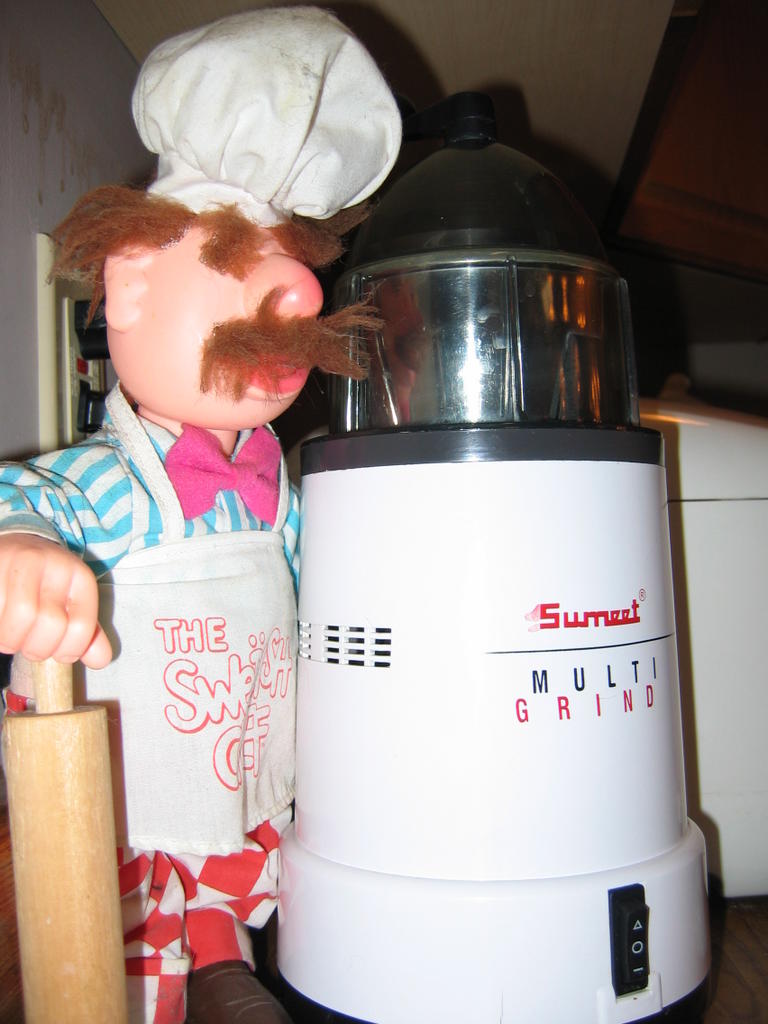 So, I was wondering what to talk about today, and was thinking about it, and then I was wandering the blogosphere, and hiked over to check out Becks & Posh, and saw that they are having a meme thingie that has to do with our favorite appliances/utensils and whatnots in the kitchen.
And the idea is to talk about our one money-is-no-object, best-beloved thingiedingie that we would not give up if our lives depended on it.
And this stumped me.
So, I consulted with a panel of experts, and this is what we came up with.
The Swedish Chef agrees with me that the bestest thingiedingie in my entire kitchen is the Sumeet Multi-Grind.
(You always wondered what happened to Swedish Chef when they cancelled "The Muppet Show" didn't you? Well, I'll tell you; he was in a few movies, and he catered a few swinging Hollywood parties, but then he fell on hard times. There was a deal offered to him to head up a Food Network show, but the language barrier was too high, and they replaced him with Emeril. Despondant, he headed up to New England where he worked for a while with Martha Stewart, but she fired him because she said he didn't have a green card. He tried to tell her that Muppets didn't need green cards, but she insisted that he had to go. I think that his insistence on singing his little song just worked her very last nerve and she was looking for an excuse to get rid of him. Thinking to end his days as an instructor at Johnson & Wales, he worked there until he was accidentally thrown into a dumpster by a student who thought he was just a puppet of some kind. I found him there, dragged him out and gave him a good home in my kitchen. He's worked for me ever since. He keeps my pots from boiling over.)
What was I talking about? Oh, right. The Sumeet!
I know I have talked about the magnificence of the Sumeet before. But I don't care. I love the thing. And I am the only person I know who has one. But everyone should have one. Well, actually, not everyone needs one, but if you cook a lot of Indian, Thai or Mexican foods, as I do, it is the single bestest electric appliance that ever was invented. It is better than a blender. It is cooler than a Cuisinart. It is cannier than a KitchenAid.
Because it can grind up wet or dry spice pastes so fast your head will spin, and the hand that you usually use to grind stuff up with a mortar and pestle with thank you.
It can grind soaked lentils. It can grind dried corn into cornmeal.
More importantly, it can take a bunch of disparate ingredients, such as are illustrated here, including whole spices, nuts, fresh herbs, garlic, chiles and ginger and turn them into a silky-smooth spice paste--without the addition of any water--in less than two minutes.
It has a 400 watt, 1/2 hp motor, and I have had the thing for oh, six years now and it has shown no inclination to stop working. And I have worked the poor dear to death; I have used it to cook for catering jobs, personal chef clients, and culinary classes, and it still keeps going and going and going.
On top of everything else, it is simple to clean up. The two pieces that come into contact with the food come apart, then can be rinsed off and tossed in the dishwasher.
How cool is that? But wait! That is not all--it isn't so terribly expensive as all of that!
It is only, get this--$80.00.
Zak paid more than that back when he bought it for me years ago, but the price has come down!
So, you can order one here, which is something I highly suggest that you do if you ever make Thai curry pastes (wow--green curry that doesn't take an hour of pounding with a mortar and pestle), Mexican moles or any kind of Indian food. It is also good for Indonesian, Burmese and some Chinese foods.
Heck, the first thing I used it for was to make a paste out of fresh sage, thyme, rosemary, garlic, shallots, chipotles and butter to stuff under our Yuletide turkey the day after the thing arrived all the way from India.
It is a wonder of modern technology, I swear.
And, if you act now, you can hear about my favorite not so bloody expensive nifty gifty in the kitchen! No, not the little rolling pin that the Swedish Chef is holding, that is his. No, the Microplane grater that South Park's most swingingest Chef is cradling in his hot little hand.
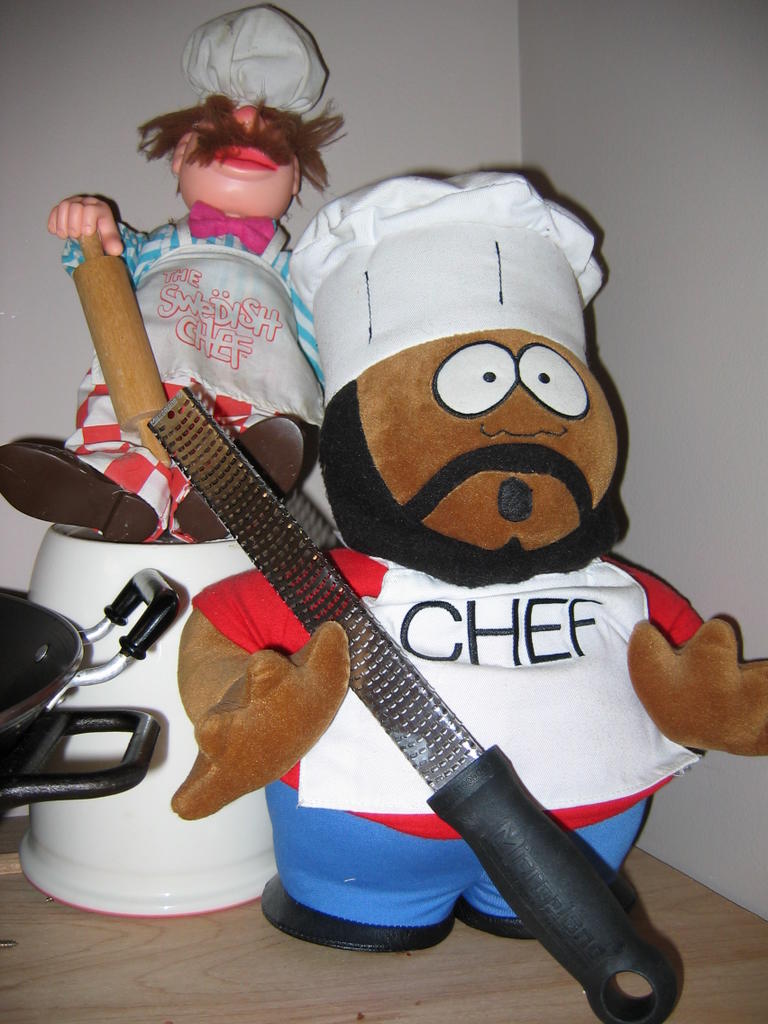 Yes, Chef knows a good thing when he sees it, and he likes the way that the Microplate grates up any kind of citrus zest. It takes only the colored part of the peel where the yummy citrus oils live, and leaves the white, bitter pith every time. Those other kinds of zesters always get some pith and that isn't any fun.
And, as if that wasn't enough you can grate other stuff with it, too! You can grate hard cheeses, or even more fun, chocolate with it! Oooh. All this for only $12.95.
And it is easy to clean, too. Rinse under water and pop it in the dishwasher. Woohoo! That really makes Chef excited--he likes to avoid dishpan hands if he can.
So there you are.
Tuesday, June 28, 2005
A Blueberry Update
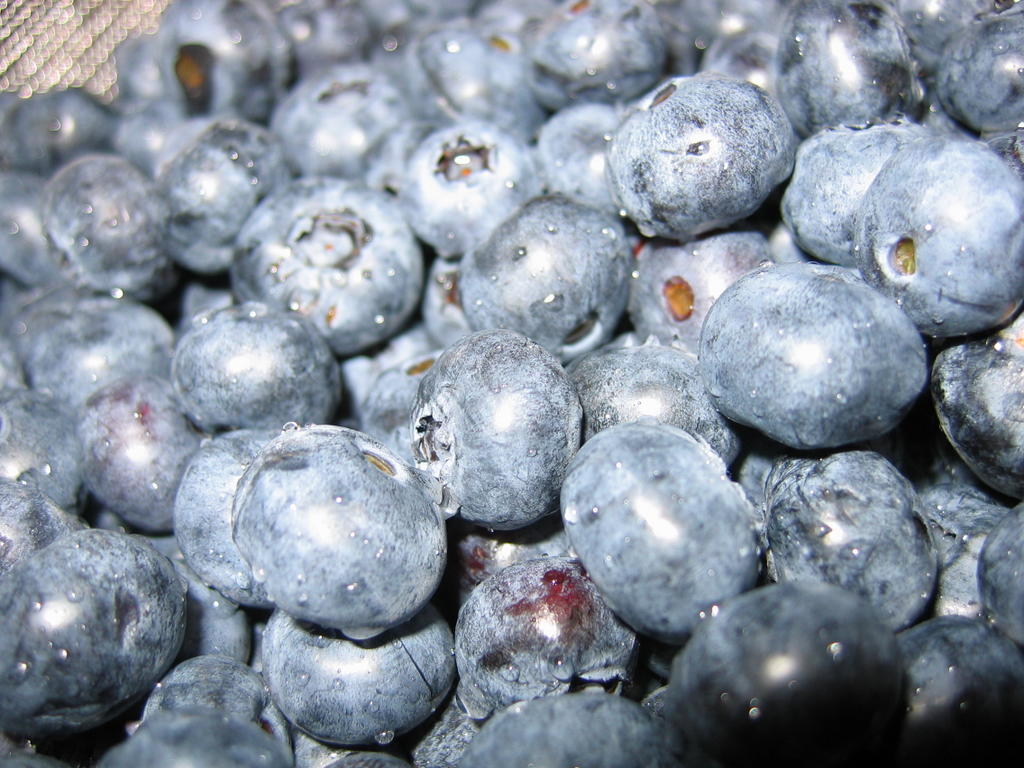 Well, as noted previously, in the post entitled, Am I Blue? my father's stated opinion on blueberries is that they are his least favorite berry of all time. My mother simply said, "I hate them."
Which is all fine and dandy, except for the fact that I had baked a big batch of Blueberry Crumb Scones instead of birthday cake for my Dad.
I heard from them today on the issue.
I was told, "Those scones were damned good."
Apparently so. Dad has had three of them and Mom has had two. That leaves three for them to fight over.
Apparently, neither of them had ever had such flavorful, tart blueberries, and to be honest, they'd not had exemplary scones, either. In fact, I am not certain that my mother had ever had any kind of scone, and Dad only had one once, a long time ago and he said it was "kind of dry."
So.
The upshot of it all is that I do not have to bake a birthday cake.
Though, I did say that they should have lied to me and said they'd hated them so I would be honor-bound to bake a cake anyway.
I guess I should be grateful to have honest parents.
And now, I am off to throw some rice in the rice cooker, braise some ma po tofu and stir fry some bok choi so we can have dinner.
A Beef with the USDA
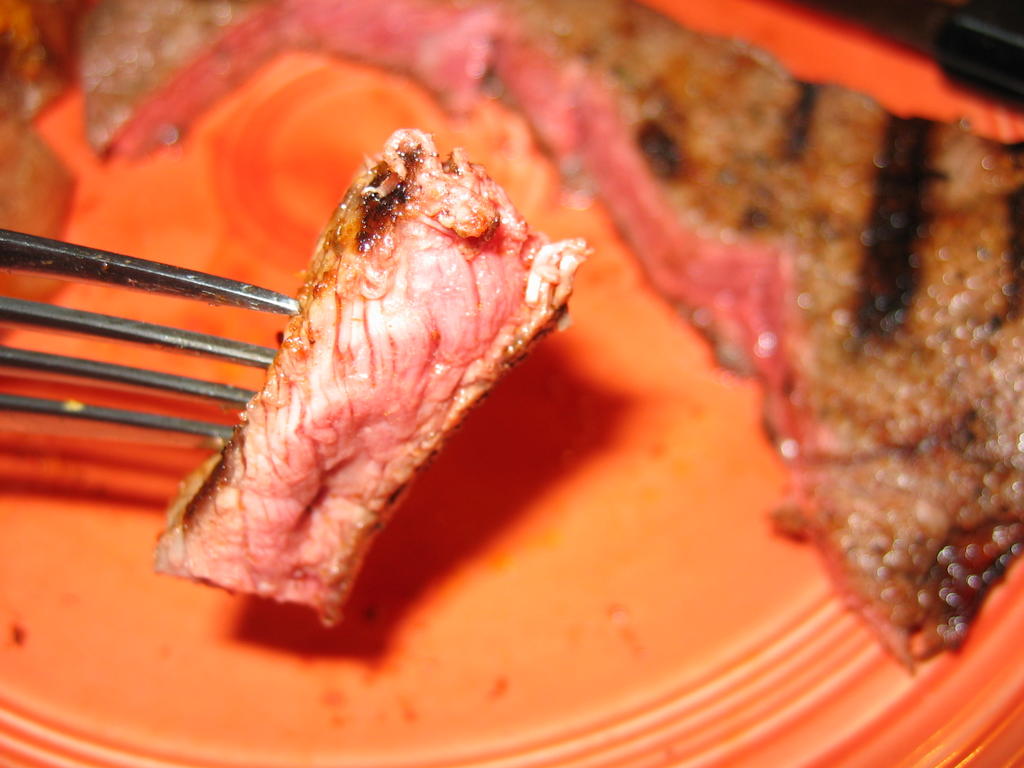
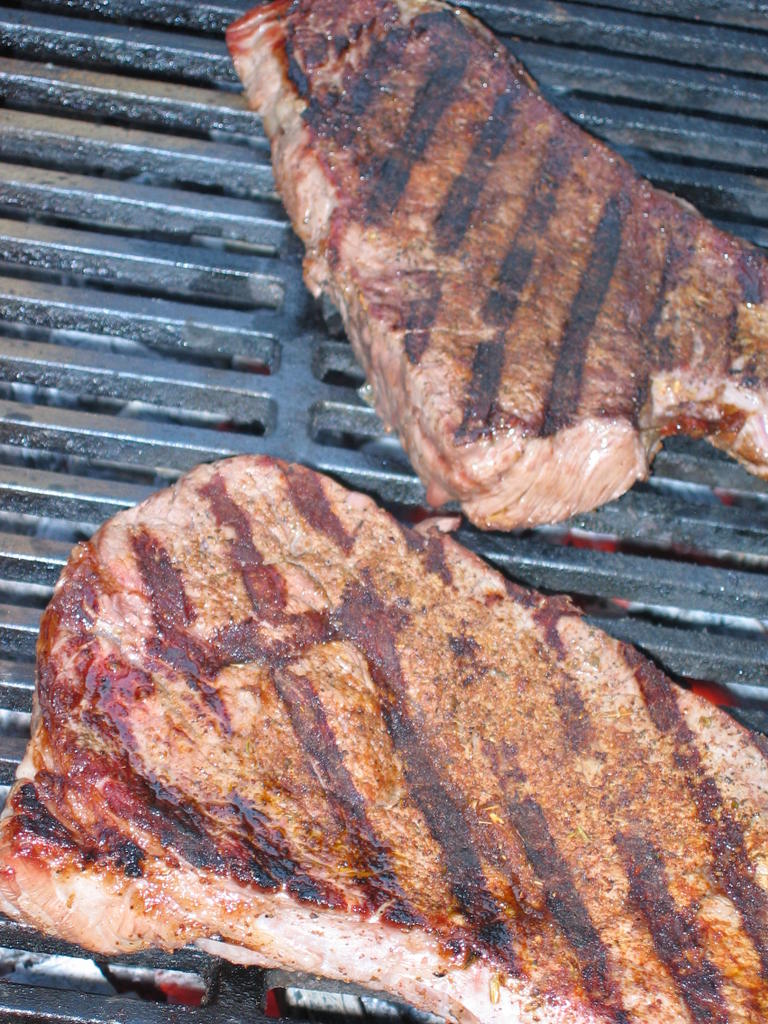 Some folks might think that it is weird choice for me to illustrate a post about the recent revelation of a second case of BSE (Bovine Spongiform Encephalopathy) in the United States with photographs of the steak we had for dinner here last night. I mean, shouldn't I be eschewing beef, and running out to become a vegan the way that author and former cattle rancher, Howard Lyman (most famous to for his controversial appearance on the Oprah Winfrey show back in 1996 that reaped a lawsuit against Oprah by the National Cattleman's Association) has done?
Well, no, not necessarily. That is to say--if folks feel better eating a vegan diet, then they are welcome to do that, but I am more into a moderate, varied diet that includes a great deal of vegetables and grains, but does not exclude animal products, including beef.
See, here is the deal. I agree with Kate at Accidental Hedonist, when she says that panic about the US beef supply is not yet warranted, but anger at the USDA's handling of BSE is. She points out quite correctly that the USDA has implimented exactly none of the World Health Organization's guidelines to help curb the spread of BSE. Testing standards for BSE are laughable and the materials that are allowed to go into the making of supplemental cattle feed (which at least no longer are allowed to include bovine brain or nerve tissue) are dubious at best and horrifying at worst. The number of cattle undergoing testing for BSE is still miniscule in comparison to the number of cows which are slaughtered for food. Essentially, what the USDA and the FDA are doing is kowtowing to the demands of the demands of the powerful agriculture and trade lobbies which do not really want to change their factory farming methods which result in higher profit margins in order to serve the needs of Americans for a safe food supply.
There are some who claim that the USDA's foot dragging on the BSE issue is a massive conspiracy to cover-up the "fact" that BSE is a problem in US. While that contention cannot currently be proven, I do find it likely that political expediency and profit motive are getting in the way of the USDA putting together a coherent, workable method of safeguarding the US meat supply from BSE. Parke Wilde over at the excellent blog US Food Policy, posted an AP story outlining the political machinations at the root of Friday's announcement that a second cow in the US has been confirmed with BSE.
Kate suggests that those of us who are concerned should call and write our elected representatives and nag them about the issue, and I completely agree. In addition to bugging your Congresspersons, you can also try irritating Secretary of Agriculture Mike Johanns by phone or by email. Just keep your queries polite, succinct and to the point, and don't just contact these folks once. Call or write them back, and let them know you are still thinking about the issue. Make a big deal out of the fact that you vote, if you do. And when you do write or call them, it wouldn't hurt if you could show some knowledge about BSE, its effects, and how it is transmitted.
Which brings me to my next point: do you know how hard it is to find unbiased information on BSE?
It is nearly impossible.
Go type "BSE information" into Google, and then look at the top ten sites listed. The first site listed, BSEInfo.org, is copyrighted by Cattlemen's Beef Board & National Cattlemen's Beef Association. And surprisingly, even though a second cow has been confirmed to have BSE in the US, the very first topic, "About U.S. Beef Safety," states "Because of progressive steps taken by the U.S. government over the past 15 years, all U.S. beef is safe from BSE."
I think that they need to update their website.
The second website listed is copyrighted by The University of Illinois at Urbana-Chapaign and is actually a decent source of unbiased information on BSE. The next two websites are divisions of the USDA and the FDA, and are gateways into rabbit-warrens of doublespeak and poor website design. Besides, after reading about the political shenanigans involved in the testing of the second BSE cow in the US, I can't imagine anyone could consider any governmental agency involved in overseeing the cattle industry as being anything resembling unbiased.
Then, there are a couple of sites based in the UK, and they give pretty good information. Then, there is the CDC site, which once again, being a governmental agency, is probably not unbiased.
The last two sites of the top ten Google sites for BSE information are the websites of the Iowa Beef Center and the American Association of Meat Processors.
Seven out of ten of the top sites found on Google when one seeks information on BSE represent either the U.S. government or beef producers, neither of which are likely to be what I would call reliable sources for unbiased factual information on BSE in the United States.
So, where does one go for information?
I am rather fond of this site, Priondata.org. It does get a bit technical, but that is fine with me. It does have areas set up specifically to serve as clearinghouses of information for non-scientifically minded sorts such as journalists, so really, lay-persons should be able to understand what they are talking about. It includes information on the latest research, (which includes tests on a virus which appears to kill prions in mice) as well as news stories on BSE and other prion diseases.
 But other than arming oneself with knowledge, and communicating our displeasure with how our government has handled the issue thus far, what else can we do? Should we stop eating beef? Should we run away screaming from hamburgers? Should we become vegans and say to hell with it all and throw in the towel?
Well, all of those are very personal decisions that we each have to make, but I have no intention of ceasing my consumption of beef altogether. For one thing, the likelihood of a prion disease being transmitted to me, even if our meat supply was rife with BSE is very small.
For another thing, I gave up buying grocery store beef several years ago. My reasons for doing so had little to do with BSE, and much to do with my own personal ethics and political beliefs.
I took to buying all of my beef, pork, lamb, goat and veal from local farmers. Now, I buy all of my chicken locally as well.
And to be honest, what really caused me to make this choice in changing how I ate was not ethics, or health or politics. It was flavor.
The meat that I am getting from local organic farmers who pasture raise their animals and feed them on grass tastes better than anything I have ever bought in a grocery store. It tastes like the meat I grew up eating on my grandparents' farm.
The fact that it costs slightly more is immaterial to me; I just eat less meat. But the meat that I am eating is of such a high quality, I don't miss it. In fact, I relish it all the more because it is more precious to me, and tastes better.
And I feel pretty confident about the meat that I am buying. I know the farmers, I know thier farming practices, and I know the slaughterhouses and how they work. These folks would never have sent a downer cow (a cow that is too sick to walk) to the slaughterhouse to be chopped up and put into the human food chain. They are just as disgusted as I am with the practices of factory farming that include feeding herbivores feed rendered from dead animals.
There are smaller farmers out there, producing good wholesome beef, even near the larger cities. And I suspect that as demand rises for these products more farmers will take up the slack.
If you are interested in finding alternative sources for beef, there are a few ways to go about it. Check this website, LocalHarvest, for listings of farmers, farmer's markets and CSA's near you. It is a meant to serve as a national database to connect consumers with local food producers, and has grown greatly in scope over the past several years. Other websites meant to connect consumers with farmers are cropping up, such as Food and Farm Connections. These sites can give you places in your area to start looking for small local producers of grass fed beef and other safely and ethically-raised animals.
Or go to your local farmer's market. If you don't see anyone there selling beef, ask around. If you cannot find anyone doing direct marketing of beef to consumers this year, if enough people ask, someone will step up to the plate and start offering meat next year.
Sure, looking for local beef producers means going out of your way, and yeah, it is more expensive. But, it is a positive step that you can take if you are spooked by the recent stories on BSE in the United States.
Besides--if you do get a bite of a steak like the one we had last night--I think that your taste buds will make up your mind for you. After tasting really good quality meat, it is hard to go back to the stuff they sell at the local Safeway, which may or may not be so safe.
Monday, June 27, 2005
Am I Blue?
 No, I am not blue, but my berries are.
Saturday at the Farmer's Market, the dance of the summer season is in full swing; while the flood of strawberries is starting to dwindle, the cherries are in their prime, and blueberries are just starting to appear in gorgeous array.
The colors of blueberries are amazing. I say colors because they are not a single hue, but show varied tones on each individual berry, from the frosted lavender bloom over the glossy indigo skin to the deep violet interior, each small round berry is a work of art. And when they are fully ripe and freshly picked, each one is a revelation in flavor that bursts in the mouth in an explosion of inky juice.
So, of course, even though I had already bought a quart of sour cherries in order to make a pie for dessert that night, I saw quarts of blueberries sitting in neat rows on a table, and had to have them, too.
I resisted the urge to bake them together in a pie, though I think that might have been interesting, and would be a worthy experiment someday. Instead, I decided on making a cake, coffee cake or scones. I would have made muffins, but Morganna pleaded that I not, because she had recently had a blueberry muffin and had gotten quite sick on it, and thus was not ready to brave another any time soon.
So, cake or scones it was.
I decided upon scones, and realized when I researched recipes that I could make two batches of them--one to have for breakfast Sunday morning before we drove Morganna back to her father's house, and one to give to my father instead of a birthday cake.
Thinking I was insufferably clever, I got up early Sunday morning and proceeded to bake two batches of blueberry scones from a recipe I had never used before. I set out two mixing bowls, measured out the rinsed berries into two other bowls, and measured all the ingredients in sequence: two and a quarter cups of flour for this bowl, and the same for that one. And so forth.
I even utilized my new trick of rubbing the butter into the flour with my fingers, emboldened by the flakiness of the pie I had made the day before and the galette from several days previously. That went fine. In fact, all was well until it came time to mix the dough and then knead the fresh berries into it until they were evenly distributed.
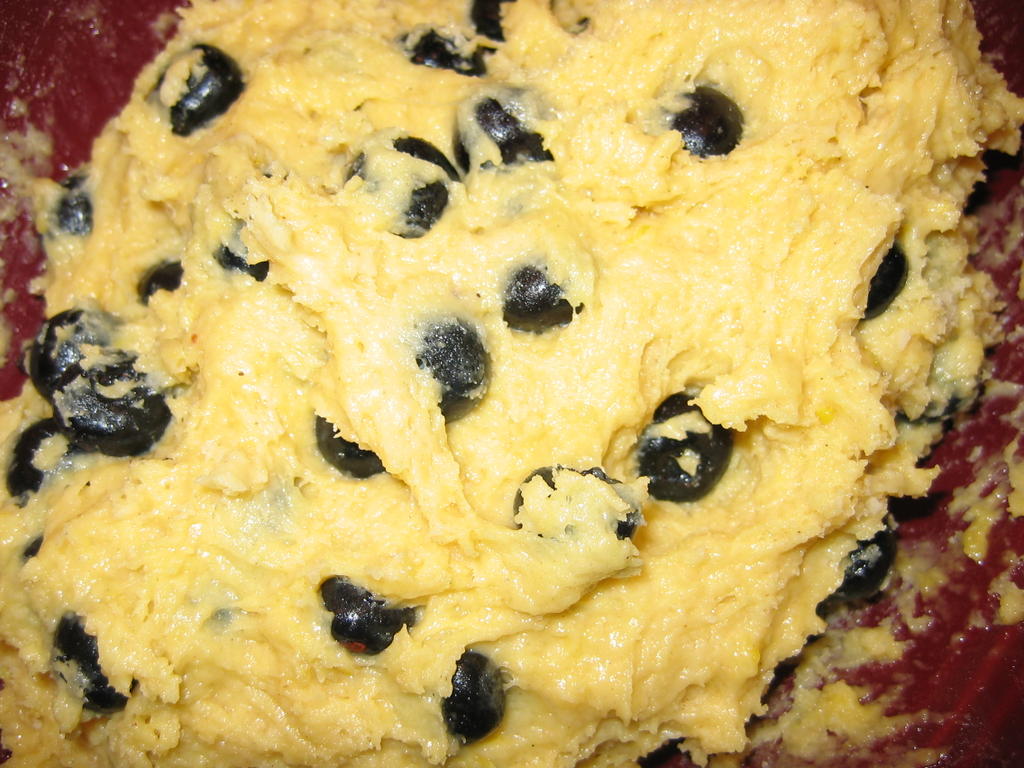 The recipe, which I had never used before, came from Leslie Weiner and Barbara Albright's wee book, Simply Scones, which is still in print and available used as well. I will admit to playing with it a bit, mostly in terms of flavoring, but also in the sequence of mixing, but really, I didn't do anything that would radically alter the dough in a significant way.
And in truth, the authors mentioned that the dough was sticky.
But, I am sorry. To my mind, sticky does not adequately warn the unwary baker of the wily, unruly nature of this particular dough. It is fractious, cantankerous, gluey and goopy in the extreme, and mixing it together with a spoon first thing in the morning sans coffee was a frustrating exercise in patience. I was extremely glad for my well-developed forearm muscles, as the dough fought being mixed together as tenaciously as a pitbull terrier who is desperately trying to hold onto a favored toy. I stirred, it pulled. I pushed, it glopped. I folded, and it attempted to evade.
And of course, after finally getting the first batch mixed up, I was winded, but had to face another bowl of the stuff with shaking hands and frazzled nerves. I nearly put all of it in the fridge to face at another time, but I really wanted to give a sweet to Dad for his birthday, so I took a deep breath, counted to twenty and dove in with renewed vigor and an iron will.
And lo, the dough was done. I just needed to knead the berries into the twin piles of rich yellow stickiness.
The authors blithely warned that I might want to use "lightly floured hands" to accomplish this task, but their admonition was to no avail. I floured my hands lightly and ended up with dough up to my elbows, and blueberries attempting escape at every turn. I felt like B'rer Rabbit and the tarbaby, only I was smart and did not try to use my feet to free my hands.
I did manage to mix the berries in, though I have no idea how evenly I did it. By the time I was done with the first batch, I didn't much care how evenly it had turned out. I just eyed the second dough ball, scraped as much dough from my hands as possible, turned the sink tap on with a relatively clean elbow and scrubbed my fingers and palms clean.
I then dried my hands, dug out the Baker's Joy, sprayed my hands liberally, and set to work on the second batch.
Baker's Joy is my friend. Not only is it a good alternative to greasing and flouring cake pans, it can make instant teflon for the hands when it comes to herculean baking jobs such as kneading some fresh berries into cthuloid scone dough. The second batch was subdued in half the time it took for me to wrangle the berries into the first batch.
All that was left was the shaping of the scones, and putting the crumb topping on, then cutting them and baking them.
Ah, yes, the crumb topping.
Instead of making two batches of it, I simply doubled the recipe and made a typical struesel sort of topping. But after I shaped both sticky piles of dough into relatively flat, round disks on silpat-lined baking sheets, I eyed the bowl of crumbly goodness and then looked at the scone dough.
And realized with a sinking heart that there was absolutely no way I was going to put all of those crumbs on top of those two batches of scones. The recipe had instructed me to make way too much stuesel stuff.
I did the best I could to scoop and pat the crumbs onto the top of the sticky rounds, but I still ended up with lots of crummy bits decorating the silpats. As it was, when I finally stopped with the patting and squishing, there was still a good handful of struesel left.
I gave it to the dogs. It was probably not a good idea, healthwise, but the dogs were happy with the arrangement. They thought I was just showing them how much I loved them.
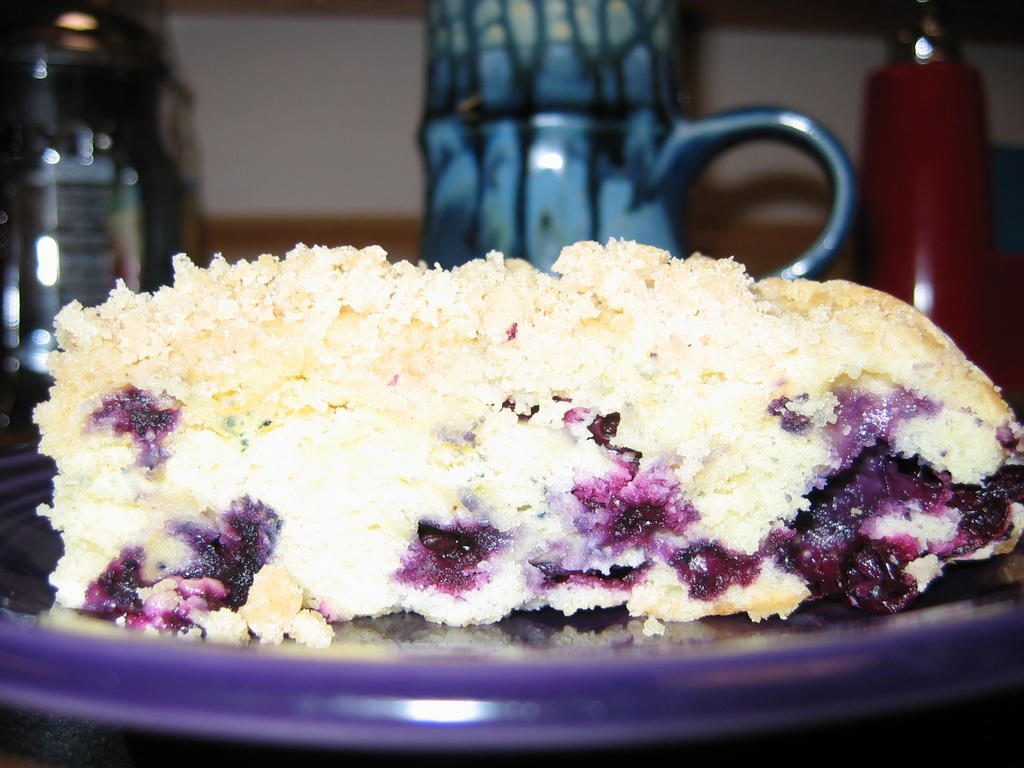
After that, I cut the scones into eight wedges each and baked them. The cutting, of course, made more of a crummy mess, but that was okay. They baked up beautifully, with a delicate, cakey texture and a scrumtious flavor. The crumbs really added a lot to the scones, such that I do not regret using them. I just will adjust the recipe next time to make fewer, or put the excess in the freezer. Or, give them to the dogs again, since they liked them so much the first time.
 Blueberry Crumble Scones
Crumb Ingredients:
3/4 cup all purpose flour
1/4 firmly packed brown sugar
1/8 teaspoon cinnamon
1/4 teaspoon cardamom
1/8 teaspoon ground ginger
1/4 cup chilled butter
Dough Ingredients:
2 1/4 cups all purpose flour
1/2 cups raw sugar
2 teaspoons baking powder
1/2 teaspoon salt
1/4 teaspoon cardamom
1/2 teaspoon finely grated lemon zest
1/2 cup chilled butter
2 large eggs
1/4 cup milk
1 teaspoon double strength vanilla extract
1 1/2 cups fresh blueberries
Baker's Joy
Method:
Preheat oven to 375 degrees F. Lay silpat on baking sheet and spray lightly with canola oil spray, or Baker's Joy. Or just smear slightly with butter.
Mix the dry ingredients for the crumb topping thoroughly. Cut the butter into it until it looks like coarse crumbs. Set aside until needed.
In a large bowl, stir together dry ingredients. Cut the butter stick into 1/2 inch cubes and distribute evenly over the flour mixture. Using whatever method you prefer, cut butter into the flour until mixture looks like coarse crumbs. (Again, if you use your fingers, it will look more like flakes or shavings rather than shaggy crumbs.)
In a small bowl, mix together eggs, milk and vanilla. Make a well in the butter and flour mixture, and pour liquids into well, then with a sturdy spoon and a great deal of muscle power, stir until well combined. It will be very sticky. That is okay, it is the way it is supposed to be.
Spray your hands with Baker's Joy and knead the fresh berries into the dough. It will look like you have too many berries and the dough won't hold together. Don't worry, it will hold. It will also taste good.
Scoop dough out of bowl, and dump it onto the silpat. Sort of smoosh and pat it into a 9 or 10 inch circle and flatten it on top. Wash your hands.
Scoop up the crumbs and squish and pat it onto the top of the dough circle. This is messy. Do not fret, it will taste fine when it is done. Do this until you have used most of the crumbs.
Spray a bench knife or chef's knife with Baker's Joy and use it to cut the dough circle into eight wedges. This is also messy--lots of crumbs attempt escape at this point. If you want, pick them up and press them back on top of the dough. If not, don't worry over it.
Bake for 30-35 minutes, or until the top is lightly browned Cool for ten minutes on baking sheet, then remove to a wire rack to cool. Recut into wedges. Serve warm.
They turned out exceedingly well--very fragrant, with a moist tender crumb that contrasted with the crunchy struesel. The berries were sweet and oozed with floral juice.
Of course, by the time I took Dad his batch, I found out that blueberries are his least favorite berries. And Mom, apparently, despises them.
Oops. But, Dad said he would try them anyway, because they looked awfully good.
I told him that if he didn't like them, to let me know, and I would bake him whatever cake he would like for his birthday and bring it next week when we passed through on our way to Morganna's father's house.
Sunday, June 26, 2005
Chinese Fermented Black Beans
 A staple of the Chinese pantry, fermented black soy beans, also known as salted black beans, add a giant helping of flavor to a variety of foods.
Some people seem to think that they are "stinky" or overly salty, but I don't know what they are talking about--I love the smell of them and don't find them to be offensive at all. The brand that I use has ginger added to them, which adds a tiny whisper of floral fragrance to the earthy, salty scent of the beans. It is a mysterious fragrance, reminiscent of ripe cheese or newly tilled, rich humus in a spring garden, and it never fails to perk up my appetite. Every time I smell it, my mouth waters, because I know that something good is about to happen to my tastebuds.
I am told that some folks soak them in cold water then drain them about a half an hour before using them to remove the excessive salt, but I never have seen that to be a necessary step in using them. I just crush them lightly with a spoon before throwing them into the hot oil in the wok before anything else goes in to cook. This releases the flavor of the beans into the oil so it carries to all parts of the dish.
Fermented black bean sauce, which I have also used, is a different condiment altogether. I found after experimenting with both, that I prefer the beans themselves for several reasons. For one thing, they are more versatile; you can change around the other flavors that you mix them with to create completely new dishes, while the black bean sauce will put a singular flavor stamp on whatever you cook with it. Another reason I prefer them is that most of the black bean sauces I have come across use a lot of oil and salt and it will make any dish that is cooked with it overly heavy, as well as being very salty in flavor.
Fermented black beans are strongly flavored, so they are classically paired with other strong aromatic ingredients such as garlic, scallion, ginger and chile. Garlic is my favorite partner for black beans; the sharp tang of the garlic is the top note that rides the crest of the darker wave of black bean. Perhaps because my first exposure to black beans was in ma po tofu, I like to have the fiery kiss of chile peppers involved in most dishes that I season with black beans, but I will restrain myself if I have to. It doesn't do to use too many strong flavors all at once--instead of enhancing the natural flavors of the main ingredients, it can mask them and make what could have been a delightful dish into a muddy mess.
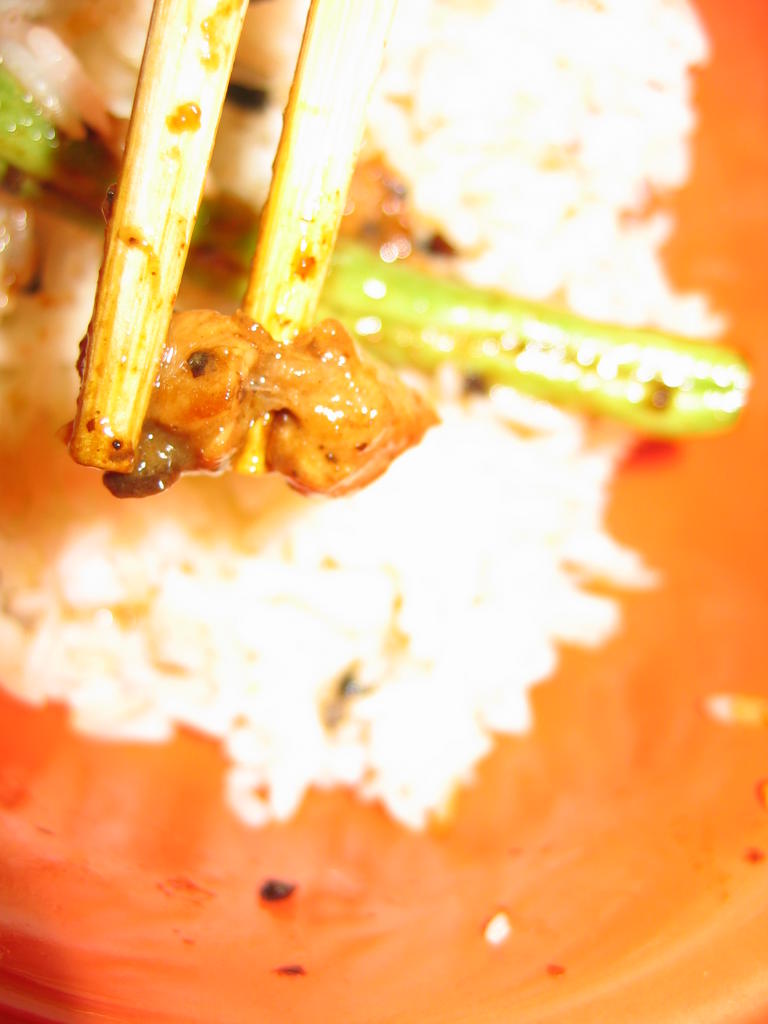
 This evening, I used black beans with garlic, scallions and a single Thai bird chile to season a simple stir fry featuring fresh pork loin and the first string beans from the Farmer's market. An uncomplicated dish that I usually serve with steamed jasmine rice for a plain supper, it can be cooked with many variations, but I believe that the addition of black beans was an inspired choice that will appear on our table more often. It added a lovely complication to the usually clean, uncluttered flavors of the dish that a client of mine once likened to the cooking of Susanna Foo. (I was extremely flattered by this comparison, and I still blush when I think about Gala's praise of my Chinese dishes.)
 Pork and String Beans With Fermented Black Beans
Ingredients:
1/2 pound lean pork loin chop, cut into thin 1"by 1/4" strips
1/8 cup Shao Hsing wine or dry sherry
1 tablespoon corn starch
1 pound fresh green beans stringed and rinsed
boiling water for blanching green beans beans
peanut oil for stir frying
2 teaspoons fermented black beans
4 large cloves garlic, peeled and thinly sliced
3 scallions, white parts thinly sliced
1 Thai bird chile, thinly sliced on the diagonal
1 teaspoon thin soy sauce
1/2 teaspoon raw sugar
2 tablespoons chicken broth or stock
1/2 teaspoon toasted sesame oil
green tops to scallions cut on the diagonal in 1" lengths
Method:
Toss pork with wine and cornstarch. Marinate while preparing other ingredients, or at least for twenty minutes.
Blanch string beans in boiling water for one or two minutes, until tender-crisp and very brilliant green. Drain and rinse with cold water, then pat with paper towels until they are as dry as possible.
Lightly crush fermented black beans with the back of a spoon.
Heat wok over high heat; when it smokes, add enough oil to stir fry in. Throw in the fermented black beans, garlic, white part of scallion and chile, and stir fry for one minute, until quite fragrant.
Lift meat out of marinade (reserve marinade) and add to wok, flattening it into a single layer on the bottom of wok with the back of a wok shovel. Allow to sit still on the bottom of the wok for one minute to begin browning on one side, then stir fry vigorously. As meat begins to look mostly cooked, add the reserved marinade, soy sauce, sugar and broth.
Add string beans, and stir fry until the sauce thickens and clings to the meat and beans. This is a fairly dry dish. Add scallion tops, stir to heat through, drizzle with sesame oil and serve with steamed rice.
The blog is back!
Well, it was a nice idea.
I ("I" in this case being Zak, not Barbara) tried to move the blog to http://www.tigersandstrawberries.com/, but Blogger didn't feel like cooperating. At all. So, now that page has a redirect here until I figure something else out.
I apologize for the mess. It could have been worse ... several years ago I managed to 'lose' all of Barbara's recipe files -- hundreds of them. I don't think she's entirely forgiven me, and I haven't forgiven myself, for sure, but I was bound and determined not to let THAT happen again. And it won't.
So, enough from me. I now return you to your regularly scheduled culinary entertainment.
Saturday, June 25, 2005
Folklife Festival and Food
So, after the weekly trip to the Farmer's Market, I came back and scanned the New York Times online edition and found an article on the ongoing Smithsonian Folklife Festival.
And suddenly, I am regretting that I no longer live close to Washington.
This year, for the first time in its 39-year history, the Folklife Festival will include an entire program entitled "Food Culture USA" which will feature recent immigrants and famous chefs doing cooking demonstrations, as well as talks from wild mushroom foragers, members of a Tanzanian coffee growing co-op, and artisan cheesemakers. The theme of the food program will revolve around sustainability issues, the innovations brought by immigrants and the roles of chefs and home cooks in shaping American food.
I am seriously bummed not to be there, as this is just the sort of thing that I am always thinking about, talking about and writing about.
But, as much as I regret not being able to attend, I am just as happy to know that the event is happening, and is getting a lot of publicity. It means that the things that matter to me are becoming part of the consciuosness of others, and that makes me feel like my blathering is worthwhile.
So--if you are anywhere near Washington DC, the festival started June 23 and is going on until July 5 on the Mall.
If you attend, have fun, take pictures, and think of me.
And suddenly, I am regretting that I no longer live close to Washington.
This year, for the first time in its 39-year history, the Folklife Festival will include an entire program entitled "Food Culture USA" which will feature recent immigrants and famous chefs doing cooking demonstrations, as well as talks from wild mushroom foragers, members of a Tanzanian coffee growing co-op, and artisan cheesemakers. The theme of the food program will revolve around sustainability issues, the innovations brought by immigrants and the roles of chefs and home cooks in shaping American food.
I am seriously bummed not to be there, as this is just the sort of thing that I am always thinking about, talking about and writing about.
But, as much as I regret not being able to attend, I am just as happy to know that the event is happening, and is getting a lot of publicity. It means that the things that matter to me are becoming part of the consciuosness of others, and that makes me feel like my blathering is worthwhile.
So--if you are anywhere near Washington DC, the festival started June 23 and is going on until July 5 on the Mall.
If you attend, have fun, take pictures, and think of me.
Thursday, June 23, 2005
Cherry Memories
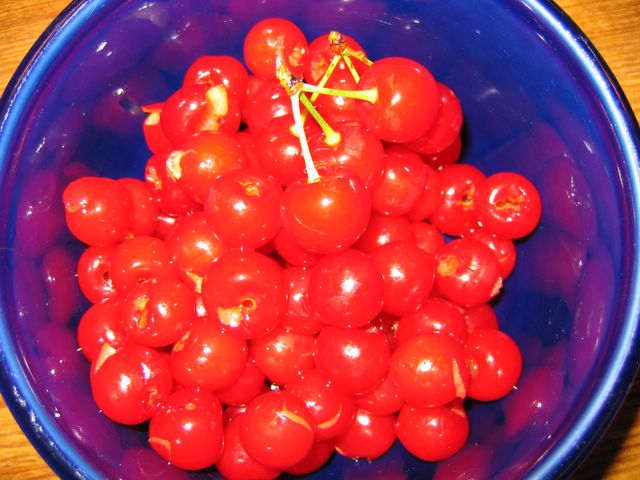
Sour cherries are my favorite fruit and always have been. Yes, even as much as I love strawberries, I love cherries even more.
When I was a little girl, I never wanted Grandma to make me a birthday cake.
When she asked me what kind of cake I wanted her to bake for my birthday, I always gave the same answer.
Cherry pie.
And she would toss back her bandana-clad head and laugh, but on my birthday, I always had a pie made out of the prettiest scarlet sour cherries with a flakey crust made of lard. She'd cut a cursive monogram of a "B" on the top crust as a vent so everyone would know it was for me. The cherries themsleves were sour enough to bring tears to your eyes, and Grandma never over-sweetened them, so their burst of tart juice cut the richness of the crust perfectly.
When I was three or so, my Grandpa gave me a pair of sour cherry saplings as an early birthday present. I remember how I clapped my hands and danced around them with the watering can after Dad dug the holes, backfilled them with cow manure, also donated by Grandpa, and then set the root balls in, and hilled good dark earth over them. The first year they were planted, they bloomed like a shower of snow, and I was thrilled, but of course, everyone explained that they wouldn't bear cherries that year.
Those saplings grew into shapely little trees, and I remember playing under their shade in the summer and thier blossoms in the spring. And the first year they bore fruit--I think I was six or seven, I was ecstatic, and raced into the kitchen to tell Mom that there were tiny green cherries on the trees.
She came out to see them and smiled, nodding at them.
Every day, I went out to check on them. I watered the trees when it was dry and patted their branches and petted the wee green fruits, watching them grow plump and shapely, my mouth watering in anticipation.
"She's like a miser with those cherries," Dad would laugh after I had dragged him out for the third time that week to look at them as they started to ripen. "I swear she has them counted."

Aren't they pretty?
They were beautiful, that first crop of cherries.
One afternoon, I saw that some of the cherries were ripe on one side, and my Grandma told me on the phone that the next morning, the other side would be ripe, and I could taste them.
I could barely get to sleep that night, for the thought of those beautiful cherries, my cherries, my first crop of cherries off of my very own sour cherry trees would be waiting for me in the morning and I could finally taste them.
I set my heart on a breakfast of nothing but sour cherries and milk.
I did sleep, of course.
And woke up with the sun on a June morning to a sky bluer than a landlocked child's dream of the ocean. I didn't bother to put on clothes, I just tumbled out of bed in my pajamas and darted for the back door, my long hair a tumbled halo around my head, my bare feet chilled in the dewy grass, my faithful blonde and white border collie, Rufus, bounding by my side.
The sound of birdcalls was loud and raucus.
And it was coming from my cherry trees.
I raced toward the trees, joy and desire for gustatory satisfaction spurring my short legs to churn across the yard in a blur of purposeful motion. Rufus dashed back and forth and around me like a whirling dervish dog, her white-tipped tail wagging incessantly.
When I got to the trees, they erupted in a rush of wings, and birds of all shapes, colors and sizes burst from the leaves and flung themselves at the sky in a torrent of twitters, chirps and squawks. Cardinals, bluejays, starlings, chickadees, mockingbirds and sparrows all flew past me, their feathers stirring the still morning air into a froth of wind.
At first, I was thrilled to see so many birds, and I clapped my hands, jumping up and down.
Rufus, on the other hand, knew damned good and well those birds had been up to no good, so she set up a chorus of sharp barks, and dark snarls, her nose pointed to the sky.
Joy froze in my heart as I realized that all of the ripe cherries were gone, with only their stems and pits dangling from the branches to remind me that they had been there at all. Even the cherries that were half-ripe had been taken--or rather, the ripe parts had been pecked, leaving the unripe half still clinging to the pit, forlorn and ruined.
Tears stung my eyes, and I flung myself on the ground and wept, beating the earth with my fists and feet, as I howled, "You damned old birds! You ate my cherries, you bad, bad things! You bad, bad, mean damned old birds!"
Rufus whined and flung herself down beside me, her pink tongue lapping at my cheeks as she nuzzled at my face. I glanced up at her, and my last coherent words were, "You should go bite all those awful birds--they stole all our cherries."
After that pronouncement, I hid my face in my hands and sobbed miserably.
Mom came running out, sloshing coffee down the front of her housecoat in her haste to see what had me screeching so hard; she probably thought that I had tried to climb the tree and had fallen and broken my head.
Our neighbor, a tiny white-haired lady named Mrs. Welch, came running out of her house next door, and she and Mom met next to the tree, and they picked me up out of the grass, where my rage had subsided into incoherent sobs and snorts.
"Did you fall, Sweetpea?" Mrs. Welch asked as I hiccuped and shook my head. "Did you hurt yourself?" Mom asked, twisting my arms and feet and legs this way and that to see if they were broken. "Can you move your fingers and toes?" I nodded and pointed at the tree, before dissolving into tears again. "Did you fall out of the tree?" Mom asked. "I told you not to climb it."
Why are adults so damned dumb? Couldn't they see what was wrong? Even as they fussed over me the starlings began flitting back to their posts at the top of the tree, and then the mockingbirds and bluejays. The brazen birds went back to gobbling down my precious cherries while these two crazy women clucked over me instead of helping me get those goddamned birds out of my tree!
Seeing those birds hopping around in my tree, rapaciously tearing into my fruit rekindled my rage, and it erupted into a wave of fury. Shaking off Mom and Mrs. Welch, I flung myself at the tree and began shaking the trunk with all of the strength in my body while I howled imprecations at the feathered interlopers above.
Rufus leapt into action and jumped at the tree, howling a war-cry, her ears down and her teeth bared.
"Get outta my tree you nasty thieving varmints, you!" I screamed. Most of the birds flew away, wisely avoiding the two-legged tempest below, but one bold bluejay refused to quit and cede me the field. He just screeched right back at me and continued gulping down cherries. Scooping up a rock, I took aim and was just about to bean that awful bird between the eyes, when Mom's left hand intercepted my arm and her right hand smacked into my bottom.
"Young lady!" she shouted into my ear as the bluejay kept blithely eating, though he did punctuate his repast with a few loud imprecations of his own in my direction. My Mom, undeterred by my twisting and the bird's screams, continued her tirade. "I better not ever catch you trying to throw a rock at a bird again." Every other word was emphasized by a good whack on my backside. "Don't you ever think to hurt a bird ever again, you hear me?"
Defeated, the rock dropped from my clutching fingers. That sassy bird kept up a steady stream of invective while I watched him eat every last one of the ripe cherries on that tree. "Damned bird," I muttered under my breath, glaring up at it with the patented Look of Death.
Mrs. Welch petted my hair, but Mom gave me one more swat. "And stop cursing, you little shit. I have no idea where you learned to do that."
I wisely kept my mouth shut; it wouldn't do to blurt out in front of our nice lady neighbor that I learned all my cuss words from her and Dad and Gram and Pappa. I just nodded and agreed, and watched that damned bluejay fly off. "Fat old bird," I muttered. "I hope you get a stomach ache."
Mom snorted and stomped back toward the house. "You better come in and have breakfast," she called back to me, but I shook my head. "Rufus and I are staying out here to scare the birds away," I declared. "So I can eat the cherries that ripen tonight tomorrow morning."
"Suit yourself," Mom called over her shoulder as she went inside.
Mrs. Welch smiled and patted my head. "So, what are you going to do?" she asked.
"I'll yell at them and shake the tree every time they land," I declared, crossing my arms. I glanced down at Rufus, and reached out to scratch behind her ear. "And Rufus will bark at them."
"Be careful with shaking the trees," she warned me. "That might hurt them."
I nodded. "I promise only to shake hard enough to scare them away, but not enough to hurt the trees. I wouldn't want to do that."
Smiling, Mrs. Welch turned to go into her kitchen. "Wait here. I might have something that can help."
She was gone for a while, and while we waited, Rufus and I worked out that we'd pretend to be wild Indians and would give war whoops at the birds every time they tried to land. We may not be able to really take a tomahawk to the birds, but we could make it sound like we were going to.
Mrs. Welch came back with a basket over one arm and a stack of disposable aluminum pie pans in her other hand, while string dangled from her apron pocket. Taking out of the basket some heavy kitchen shears, she sat on the grass with me, and showed me how to cut stars and hearts and moon shapes out of the aluminum, and then she carefully used an awl to punch holes in them. I threaded string through them, and then she helped me hang them all over the trees. "Birds don't always like shiny things, so this will help scare them," she told me.
I nodded soberly, then told her how Rufus and I were going to make like we were wild Indians and whoop at them every time they flew near the trees. Mrs. Welch asked if our tribe could use another member, and after consulting with Rufus, we came to the consensus that our tribe could always use such an upstanding lady as Mrs. Welch among us.
So, every time a bird landed, Mrs. Welch helped me hoot and holler at it until it flew away, while Rufus danced a war dance and yipped and barked in her best impersonation of a coyote.
After we were tuckered out from all that war dancing, Mrs. Welch asked me if the tribe might be a bit hungry. I eyed that covered basket, as Mrs. Welch produced freshly baked biscuits and a thermos of milky coffee from its depths. A jelly jar and a spoon soon followed, and were duly set out on the napkin she spread out on the grass.
"Scaring birds is mighty hungry work," she told me as she poured a small cup of warm, milky coffee for me. She spread some of her homemade blackberry jam on the biscuits and I giggled because I liked the way the seeds crunched under my teeth.
While we had breakfast, we gossipped about the neighbors' dogs and cats and who had the best flower beds. Rufus was a very polite tribal member. She laid down beside me and waited until Mrs. Welch had spread jam on a biscuit and set it in front of her white paws, and patted her head and said, "That's allright, it is for you," before she picked it up daintily, then gobbled it down.
While Rufus was licking her lips, Inoticed that there were a lot less birds coming to eat the cherries.
After breakfast, Mrs. Welch went inside to watch her stories and have a nap, but Rufus and I stayed there all day. Mom brought me a grilled cheese sandwich and a thermos of cream of tomato soup for lunch, which Rufus and I shared after she went back inside to start cooking supper. We spent the rest of the afternoon whooping and barking at the dwindling number of birds who braved our antics to try and steal a few more cherries.
We would have eaten dinner outside, but Dad wouldn't hear of it.
"Next year," he promised me after Mom told him of my shameful behavior, "next year we'll put a net over the trees to keep the birds out so you can get some cherries."
"You mean, we could have put a net over it to save my cherries?" I asked, incredulous.
Boy are adults dim, I thought. Here we could have avoided this whole mess, and they didn't even think about it. Gosh.
I told Grandma about it on the phone, just before bed. She told me to get up before the birds and go out and pick cherries before the sun was up.
Mom refused to set an alarm clock, since it was Dad's day off, so I just told myself to wake up before the sun.
Which is what I did.
Dawn was grey and silent when I padded out of the back door, with Rufus galumphing at my heels. A damp mist wafted through the trees, half-obscuring the houses as we drifted across the wet grass. I carried a cereal bowl in one hand and a flashlight in the other. We dashed breathlessly to the cherry trees against the back fence; I clicked on the light and flashed it between the leaves.
Dangling like plump rubies before my eyes were ripe cherries. Stifling a chortle, I gave a wobbly victory dance before running to the back porch and dragging down my step stool. I climbed up and started picking them, dropping them with little ringing plunks into the bowl.
There weren't all that many.
But I didn't care.
There were some. And they were ripe, red, and juicy.
And they were mine.
My own.
My precious.
I think that there was only a handful that I could get to before the birds woke up and decended upon the fruit-laden upper branches.
The trees were denuded of fruit by an hour after sunrise.
I took my meager harvest inside and waited until Mom got up at eight. I stared at the cherries while Rufus curled up at my feet and huffed a sigh before going to sleep.
After Mom got up, I asked if I could go see Mrs. Welch. Mom told me I could go so long as I came back when she called me for breakfast.
I dashed off, clutching the bowl of cherries to my breast.
By the time I got to Mrs. Welch's door, and knocked, I was very impatient to try the cherries. My mouth watered in anticipation of the sensation of all of that delicious sour juice bursting on my tongue.
When she answered the door, the smell of freshly brewed coffee and baked biscuits swept over me, and I nearly swooned. "Come in, come in, Mrs. Welch said. "What do you have? Your first harvest?"
Nodding soberly, I set the cherries down on her little kitchen table. There really weren't very many cherries in the bottom of the bowl--the birds didn't leave me much more than a handful.
But they were mine.
And I was all set to share them with Mrs. Welch, who had helped me chase the birds away.
Mrs. Welch set the biscuits on the table and gave me another cup of coffee which was mostly warm milk with just enough coffee to color it and to make me feel grown up. "And you brought these over to share with me?" she asked, her bow-shaped mouth stretching in a smile.
I nodded. "Rufus doesn't like cherries, and you helped scare the birds away." I pushed the bowl over to her. "You have the first one."
Mrs. Welch shook her head. "No, no--I've watched you watch those cherry trees for years. The first one should be yours."
I grinned and picked up a cherry by the stem, then nudged the bowl towards her again. "We both eat one at the same time?"
Mrs. Welch's smile deepened, and a dimple winked in her pink cheek. She plucked a cherry from the bowl with a graceful little hand and on the count of three, the two of us bit into the cherries at the same time.
Citrus-sour juice jetted into our mouths, and our eyes popped open at the intensity. The floral aftertaste of the cherry struck our tongues and we both grinned. "Now that's a cherry!" Mrs. Welch exclaimed, giggling. "Sour cherries are the best fruit because they tickle your tongue."
I nodded avidly, and spitting out the pit onto a paper napkin, took another cherry and bit into this one slowly, savoring the wild dance of flavors and textures in my mouth. "These are the best cherries ever," I murmurred in agreement.
Mrs. Welch nodded, and smiled. "That's because you put your heart into them," she said. "Tending those trees, watering them, and keeping bugs away and scaring away the birds. That's what makes these cherries the best I've ever tasted."
We ate that first meager harvest together, Mrs. Welch and I, laughing and sipping coffee and nibbling biscuits.
My next birthday, Grandpa gifted me with some bird netting, which Dad and I installed the next spring after the flowers were spent, and that year we harvested enough cherries for Grandma to make more pies than I could eat, so she ended up canning cherries to make pie in the winter.
But no matter how many cherries there were, I always brought the very first handful to Mrs. Welch, and we shared them together, eating them out of hand, because she understood that sour cherries were better than the sweetest berries or the crispest apples.
They were the best because they were mine, and I grew them, and they made your tongue dance with wakefulness and joy.
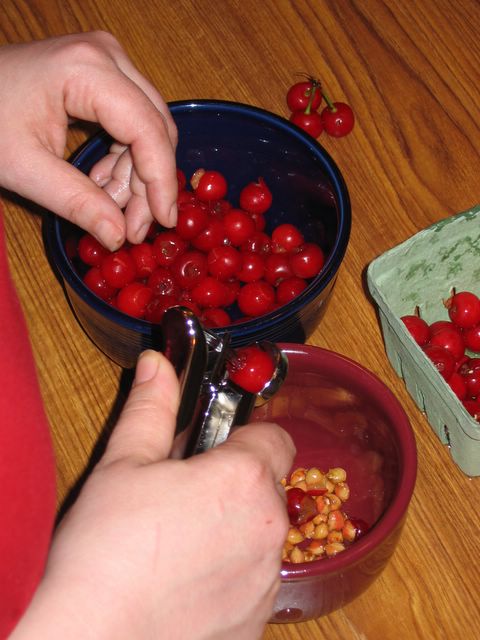
Using a cherry pitter is easier than I thought it would be. I can't imagine using this critter with ten pounds of cherries, but for a pint, it was completely doable.
This batch of cherries came from the Athens Farmer's Market, of course. Morganna wanted them--and she had a choice between sweet or sour cherries, and not surprisingly, she chose sour. She didn't eat many, though, so I had to do something with them. In preparation for baking with them, I picked up a little manual cherry pitter at Sur la Table on Tuesday when I was there to teach a class in Dim Sum. (I forgot to take pictures of all the goodies we made in class, too. I could kick myself.)
The pitter made short work of a pint of little sour cherries.
Then there was the problem of what to make with them. By the time I started baking last night it was ten o'clock, so I was pretty sure I didn't want to take the time to make a wee tart in a tart pan. That would require pre-baking the shell, filling it, making a sugar glaze and and then baking it again.
I settled on my all-time favorite dessert, a galette. But sour cherries alone sounded boring, so instead, I paired them with almonds. Almonds and cherries are a classic combination; many German kuchen feature the kissing cousins of the fruit and nut world as main flavorings. I say kissing cousins because both almonds and cherries are stone fruits, part of the genus "Prunus," which in turn, are part of the family, "Rosaceae."
"Rosaceae?" As in rose, I bet you are wondering.
As in rose. Yes, in addition to rose, strawberries, blackberries, raspberries , apples, pears and quince, the family Rosaceae includes all the Prunus species--cherries, plums, apricots, peaches and almonds.
Which means, of course, that rosewater would be nice sneaked into a cherry tart some day.
But not last night--I had just made several desserts featuring a whiff of rosewater, and I didn't want the flavor to get worn out.
So instead of grabbing for the rosewater, I picked up the almond extract, a heady flavoring that is made from bitter almonds. This, I used to flavor the pastry dough for
Cherry Almond Galette
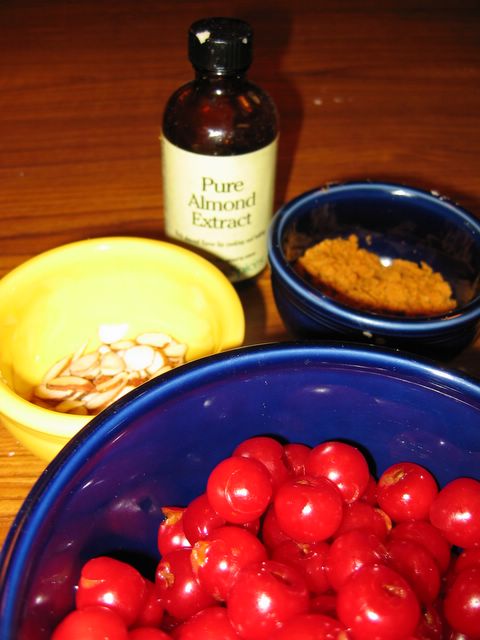
The main flavoring ingredients for a cherry-almond galette.
Ingredients:
1 1/4 cups all purpose flour
1 tablespoon sugar
1/4 teaspoon salt
1 stick chilled unsalted butter, cut into small cubes
1 teaspoon almond extract
barely 1/3 cup ice water
1/4 cup sliced almonds
1/4 cup dry, coarsely crushed vanilla or almond cookie crumbs
1 pint fresh sour cherries, washed and pitted
1 tablespoon raw sugar, or to taste
Method:
Preheat oven to 4oo degrees.
Mix dry ingredients in a bowl, then scatter cold butter cubes evenly over the surface of the flour. Cut in butter using whatever method you like, until the mixture resembles coarse crumbs. (Usually, I use a pastry blender, but last night, I tried using my hands. For a wonder, this yielded as tender and flakey a crust as I usually get with the blender, in far less time and with less effort. I was very careful to only use my fingertips, so as to avoid melting the butter overmuch.)

Here I am, pressing my luck, making pastry dough by hand. Usually I use a pastry blender to cut the butter in, but I wanted to see if I could be as cool as Madeline Kammen and Julia Child.

The butter is blended in when the mixture looks like coarse crumbs, though when you use your hands it looks more like flakes or shreds than crumbs.
Roll out the dough into a twelve-inch diameter circle, more or less.
Press the almonds into the surface of the pastry dough all over the surface except for a border about one and a half inches wide around the circumference. Sprinkle the cookie crumbs evenly over the almonds, then arrange the cherries in a single layer over the cookie crumbs and almonds. Sprinkle with one tablespoon (or more if you like your cherries a little sweeter than I do) of raw sugar, then fold and pleat the edge up over the cherries.
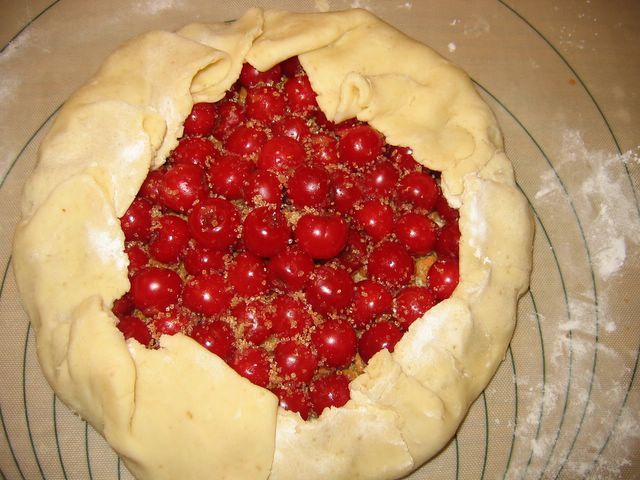
Then, I placed the cherries in a single layer on the crust, sprinkled them with raw sugar, and then gathered the edges and pleated them roughly.
Transfer to a silpat-lined baking sheet (if you are afraid of moving the filled tart, then transfer the dough to the baking sheet first, and then fill and shape it--but if I can move it without destroying it, you probably can, too) and bake for thirty to forty five minutes. Check after twenty five minutes--if the cherries are starting to blacken, place a piece of foil over the galette, and keep baking in order to crisp up the crust.
It is best served warm, but even cold it makes a good breakfast, as Zak and I can attest to.
Especially with hot, strong black coffee.
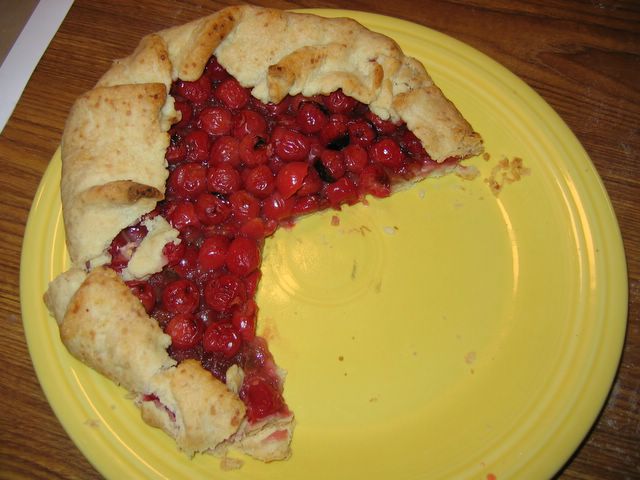
I forgot to take a picture before we cut into the galette, but you can get the idea anyway. The crunchy almonds and almond-flavored crust are a perfect foil for the sour cherry filling.
Monday, June 20, 2005
Whispered Secrets of a Kitchen Tantrika

A batch of Aphrodite Cakes decoratively piled under a cake dome. The cake dome is to protect them from rapacious felines, friends and family who cannot wait until after dinner to taste them.
So, a reader asked if my cookies were orgasmic, and I promised to answer in the next few days or so.
They were delectable, as always. They were seductive, enticing, teasing little bites of bliss.
I always feel weird writing about my own food and talking about how good it is; such behavior is perilously close to bragging and bragging was something I was taught not to do as a child. It is tacky to boast, it is unseemly and only people with low self esteem and no sense of class brag, or at least, so I was led to believe as a child. Now, of course, I recognize this as the root of my utter inability to do my own PR as a chef, personal chef, caterer or instructor, much less as a plain old cook, so it is something I try to sidestep in my life these days.
I decided a while back that if I just report the facts about my cooking ability and my food, it isn't bragging--it is merely telling the truth.
So, the truth about the Aphrodite Cakes is this: the are decadance in cookie form and they do cause oral orgasm upon ingestion. Only one person out of the hundreds who have tried them has not liked them, and that had more to do with his limited taste than anything to do with the cookies. He barely liked anything at all, so I discount his rather strong negative reaction.
Everyone else loves them, without fail, and will eat inordinate amounts of them.
Last Sunday, I used them in my presentation to the local Unitarian Fellowship on the subject of "The Sacred Table: Food and Spirituality," to great effect. Not only did everyone get into the fun and sensual pleasure of feeding each other wee roseate bits of heaven, but the cookies garnered me requests for catering: one wedding and a big birthday party, as well as a possible contract to cater for some Ohio University employees.
Maybe, instead of talking about how good my food is, which still makes me blush, I should just pass out those cookies, and wait for people to fall at my feet and beg me to cook for them.
Sounds like a plan.
Photographs of the wee delights do not do them justice: they are tiny, pastel things which look somewhat washed out on the screen. When they are seen in natural light, they are unassuming and very innocent looking-- ivory cookie bases topped with rosettes of creamy pink icing. But when you pick them up, and raise them to your lips, their scent gives them away as the breath of roses tickles the nostrils and whispers naughty thoughts into the olfactory centers of the brain.
When you bite into them, the tender domed cookie melts on the tongue, releasing the butter and vanilla cloaked in their hearts, while the icing dissolves, jolting the senses with the sweet kiss of rosewater, evoking sunwarmed summer skin, the laughter of a lover and the fleeting touch of trailing fingertips.
These cookies are potent.
I wrote an article about them entitled "Whispered Secrets of a Kitchen Tantrika" that was published a couple of summers ago in SageWoman magazine, and am reprinting it here for everyone to read, as it not only describes the origin story of these wicked morsels, but a good chunk of my own kitchen philosophy is contained therein.
Whispered Secrets of a Kitchen Tantrika
Some flavors haunt you, like a ghost of a half-remembered dream, hidden in a dusty, dark corner of your mind. Amidst the cobwebs and skittering shadow creatures live golden nuggets of crystalline sensation live, waiting to be discovered, dusted off and brought to life upon your tongue.
An unabashed sensualist, when I am in the kitchen working my alchemy, I continually seek to bring memories to life for people, to give them flavors that inspire the closed eyes, and the reverent rolling of the tongue that presages a whispered, wordless utterance of awe. Like Tita, the main character of Laura Esquivel’s novel, “Like Water for Chocolate,” I know that cooking is essentially a sacred act, and an intimate one. In making food for others to consume, I am giving part of myself to them, which, when they eat it, joins with them, and becomes a part of them, forever. With food, I can make love to the entire world, if I so wish, and never be considered a slut for it.
When I cook, I want it to be an act of kitchen tantra.
So, as a kitchen tantrika, a seductress and enchantress of the cookstove, there are a few flavors which I will use in order to induce the voluptuous pleasure that falling in love gives the human psyche. I think of these flavors as an extension of my own energy, as elixirs and philters which help transfer my life-giving force into a physical form which seeps into another person by way of their lips, tongue and tastebuds. These flavors are like my signature, and are very personal to me.
I am told by other alchemists of the culinary arts that I should hide my secrets, keep my flavor riches to myself, and cloak my magicks in mystery. To these assertions, I shrug and say, “Even if others use my flavors, they will not taste exactly as they do in my hands.” This has proven to be true, for even accurately reproduced recipes transcribed from my hand, and recreated by perfectly competent cooks have not resulted in a dish exactly like mine. That is because the energy is different, even if the flavors are the same, and not every cook knows the way to imbue every dish with their essential nature, such that they give a bit of their spirit away with each bite. Nor should they.
My Gram, a very wise old woman indeed, once told me that the saying, “Too many cooks spoil the broth,” did not only refer to the fact that if too many people work on one project, they will not agree. She said it also meant that too many people’s energy put into one thing, in this case, food, would make that thing confusing, and not focused or well directed. In the case of the broth, it might not taste good, because it would have the conflicting energy of disagreeing cooks in it.
What flavors, then, do I have in my palette, that I save for those moments when I want to entice, beguile and tantalize the senses?
There are several, but one of my favorites is the essence of rose: also known as rosewater.
Roses have been known as the Queen of Flowers, and a symbol of love and sensuality for thousands of years. Roses were one of the symbolic flowers of Aphrodite; the other was the lily. Interestingly, when the Virgin Mary came along, she took on much of the symbolic content of the mythos of Aphrodite, including the roses and lilies. I find that fascinating, that what had once symbolized sensuality and carnality, had become a symbol of purity and innocence.
But, be that as it may, the rose has emblematic of love and sensuality for a very long time. Think of it, the velvety petals, cupped and softly unfurling around a secret center, the intoxicating fragrance, both honey-sweet and musky: how could the rose -not- be seen as a potent avatar of love and beauty?
Rosewater is the distilled essence of roses, known as attar of rose, combined in minute amounts (for it is one of the most expensive botanical products in the world) with pure, distilled water. It is clear, and ranges in scent from light and sweet to heady and intoxicating. The brands made in Persia (Iran), Lebanon and India are among the most strongly scented, while some of the brands made in the United States and France are very sweet, and more light in fragrance.
Whatever can one flavor with roses one might ask? Well, it would do one a bit of good to know, first of all, that the use of rose petals, rose water and attar of roses in cookery has a long and noble history, dating back to the Greeks in the West and the Persians in the East, and likely they both got the idea at the same time, while they were at war with each other, during the age of Alexander the Great.
Rose petals have been candied and used as decoration for thousands of years, but roses have better uses than as a garnish. They have been made into sauces, jellies, preserves, liquors, and fillings for cakes. Rosewater and essences have flavored dairy products, drinks, primitive and refined sorbets and sherbets, pastries, main dishes and more for as long as mankind has been growing roses.
With a pedigree like that, you can bet that I wasn’t about to be shy with the use of rosewater. It is one of my “secrets” in my arsenal of flavors which are meant to induce diners to shed their dignity and become unabashed voluptuaries. And I have to say, every time I use rosewater, people know that there is -something- special in there, but they seldom guess what it is.
I mostly use it in conjunction with fruit. I find that it adds a breath of freshness, a spring-like innocence that belies a flagrant sensual nature that lies underneath the surface. It adds depth to a fruit salad, when combined with a dash of champagne. It is particularly effective when combined with its kin, the bramblefruits: raspberries and blackberries. Because they are cousins to roses, these fruits really shine when they are kissed with the essence of the Queen of Flowers. Rosewater is subtle with these fruits, sliding into the flavor mix like a nymph sinking into water, until she is but a shimmer beneath the surface: you know it is there, but you cannot tell what it is. It is only a flowery scent, a flicker of something familiar that is just maddening to the senses, but that cannot be grasped: the nymph dances laughingly beyond the satyr’s reach.
Last year, my friends, the very friendly and very healthy hippie organic farmers at the farmer’s market, had a banner crop of blackberries, so they were selling these plump, shining beauties for next to nothing. These berries were so soft, so yielding and so full of sugar, that you could barely pick them up without bruising them and being stained with roseate juice. Just driving home with them filled my car with a miasma of sweetness, and when I brought them into the house, my kitchen smelled like the very tumescent essence of summer Herself.
I ate some by themselves, but I also decided to create a fitting frame for these lovely wonders. I baked a batch of sweet cream scones, a very rich and short pastry that is still moist, due to the addition of cream. They are not overly sweet however, because they did not need to be: the berries were dripping with fructose by themselves. I took some of the berries, the prettiest, and left them whole. The others, I macerated with just a touch of sugar to get them to release their juices, a squeezing of lemon juice to balance the sweetness with a note of acid, a goodly dollop of Chambord to add richness, and a few crystalline drops of rosewater to deepen the flavors.
I split the scones while they were barely warm, and spooned macerated berries over the first layer, then laid a spoonful of softly whipped, barely sweetened cream over it. I capped it with the top of the scone, added another spoonful of berries and juice, then the cream, and topped it all with three whole, perfect berries.
Then, I served them, and watched the reactions. Ah, the eyes closed, and the corners of the mouths tipped up in soft smiles, and the inarticulate vocalizations began. Rosewater had done it again.
Rosewater is also very friendly with strawberries. There is something just special about the scent of strawberries anyway, that brings to mind a sun-warmed afternoon, with breezes carrying the scent of early summer blossoms to your nostrils. If you add a bit of rosewater to that, it carries one’s senses over the top, and there is no turning back from the fact that magic is taking place right there, inside your mouth.
For some friends from Pakistan and Bangladesh, I made an ice cream that included strawberries, cardamom (another of my secrets), a bit of vanilla and a smidgen of rosewater. They come from a culture which uses rosewater in cooking, but they were confounded by the flavor. It was indefinable, indescribable, and very, very intoxicating. They said that it almost tasted a bit sinful, it was so good.
My best use of rosewater came about as an offering for the wedding of two friends of mine. They were having a very sedate Pagan wedding: sedate in that they had Christians from the family coming and they didn’t want to upset them. But, they had a Pagan minister marry them, outdoors, in a very non-traditional wedding. But no God or Goddess was invoked, so, since they had me catering the affair, I decided to create a dish in order to invoke Aphrodite, and invite Her into their union.
The limitation was that it had to be something small, as it was an hors d’oeuvres buffet.
That let out most fruit preparations, like compotes, or salads. I could make individual tuile cups, and fill them with fruit, but that would be too strenuous a job. I thought of making meringues in the shape of swans and flavored with rosewater, but that, too, was too much work, considering that I was making a wedding cake topper in the form of a Norman castle with five towers out of sugar cubes and royal icing already. Besides which, southeastern Ohio is one of the most humid places on the planet, and meringues do not appreciate humidity. I could imagine an entire flotilla of graceful, airy, crisp swans turning into rubber as the moisture in the air attacked them and made their graceful S-curved necks droop until they looked like little indefinable globs of goo.
My sanity would not allow for me to make eighty individual swan-shaped meringues which were doomed to an early demise, rose flavored or not. If I were fool enough to attempt such a thing, I would have gone screaming down the street, pulling my hair out by the roots.
So, I thought. And puzzled. No petits fours, as I was making a large tiered cake, with a bloody castle on top. No fruits. No little swans to die prematurely, in a most unromantic fashion. I briefly thought of inoculating strawberries with a rosewater-filled syringe, then dipping them in chocolate, but that struck me as a bit difficult to control, and the use of the medical equipment in the process made it feel ever so unromantic and not Aphroditeish at all.
Finally, I hit upon it.
Cookies.
I could make cookies, and top them with icing flavored with rosewater, and tinted palest pink. I already had a cookie recipe handed down from my great-great grandmother by way of my dear Aunt Emma. This recipe had come all the way from Bavaria from before the days of Kaiser Wilhelm, and was a family heirloom. The cookies were white, tender, akin to shortbread, but much more soft and inviting. They were iced with a plain confectioner’s sugar icing that Aunt Emma said was always tinted pink with food coloring, though she remembered that her mother used beet juice.
So, I began to bake. The cookies were simple, the formula was already there. It was the icing that was crucial. I wanted it to be sweet, but not too sweet. I finally ended up making a cream cheese buttercream style icing which was flavored only with rosewater. No vanilla. And, I tinted it pink.
Instead of using a spatula to cover the cookie with a thin crust of icing as Aunt Emma used to do, I used a piping bag and a star tip, and made rosettes. Zak helpfully pointed out that they looked rather like perky little pale pink nipples on the tops of ivory colored breasts, and I shrugged and said, “Well, they are Aphrodite cookies after all.”
I let him taste one.
His eyes closed, and his mouth moved very slowly, as he savored it. Inarticulate utterings came next, and I knew I had done it right.
Those cookies are my best creation, bar none, for they never fail to induce a similar reaction. The cookie base is delicate and soft, yielding and sweet, but it is the dairy-rich icing that melts so willingly, embracing the tongue in a rush of summer-sweet flavor that is the grace note. They are, indeed, sinful delights, fully deserving to carry the name of the Golden Goddess of Love.
I have made them for every wedding I have ever catered, and have never failed to garner compliments. I made them several times when I was in culinary school, to the delight of my chefs and instructors.
My table service instructor took one bite, closed his eyes, went, “Mmmph,” then swallowed and paused. He opened his eyes, and said, “Roses. You put a garden full of roses into two bites of cookie. Hold on.” He ran out of the room, and got my advisor, Chef Rainer. He dragged him in, and said, “Rainer, you gotta taste this. Here.”
Chef Rainer, who is also from Bavaria, took a bite, and had a bit of a swoon. He finished it, opened his eyes, and said, in his accented baritone “It is like going to Church. It is better than communion. What do you call it?” I said, “Aphrodite’s Cakes.” And he smiled, and said, “Which would you rather eat, Christ, or Aphrodite?”
Aphrodite Cakes
Cookie Ingredients:
1 cup butter, softened
1 ½ cups powdered sugar
1 lg. egg
1 tsp. vanilla extract
2 ½ cups flour, sifted
2 tsp. baking powder
¼ tsp. salt
Icing Ingredients:
½ stick butter
4 ounces light cream cheese
1 pound powdered sugar
3 tbsp. heavy cream
2 tsp. rosewater (or to taste)
food coloring as needed to tint icing pale pink (I use Wilton paste coloring in burgundy, with only the amount you get by dipping a toothpick into the jar then dragging said toothpick through the butter or cream cheese.)
Method:
Preheat oven to 350 degrees.
Cream together butter and sugar, add egg and vanilla and beat well.
Sift together flour and remaining ingredients and gradually add to sugar mixture, beating until well combined.
Roll into 1” balls and flatten slightly unto an ungreased cookie sheet.
Bake ten minutes; do not brown. (If you have a convection oven as I do, you only need to bake for eight minutes.)
Allow to cool a minute on the baking sheet, then carefully transfer to wire rack to finish cooling completely.
To make the icing, blend together butter and cream cheese, then blend in the powdered sugar. Add rosewater and enough cream to bring it to a spreadable consistency.
Add food coloring to tint it pale pink, and pipe rosettes onto the cooled cookies.
Sunday, June 19, 2005
Tandoori Chicken of a Different Color

Sindhi Elaichi Murgh--verdant with cilantro and redolent of the sweetness of cardamom and sparked with chile and black pepper, this Indian grilled chicken kebab is superior in flavor to most of the tandoori chicken I have had in restaurants.
I adore the foods of India. Most of my experience has been with the foods of northern India, Pakistan and Bangladesh, but there has hardly been more than a couple of dishes I have encountered from the Indian subcontinent which did not appeal to me. The vast majority of the them I have tasted or cooked have been no less than divine revelations of flavor, texture and color dancing a whirlwind in my mouth.
Heather asked last Saturday that I cook Indian food for her this week, and so I resolved to do so. But it is hot outside, and I didn't want to heat up the kitchen overmuch with lots of braising and simmering, I decided to employ the huge edifice of our large steel smoker/grill creature that lives on the upper deck. With the use of hardwood lump charcoal, it can come close to the infernal temperatures that are stoked inside Indian tandoors--huge clay, wood-fired outdoor ovens which are used to quickly cook meat, fowl and bread.
Tandoori chicken is a staple of Indian restaurants here in the United States, but I have to admit to not loving it as much as I could. I adore good, smoky, barbequed or grilled chicken, but only if it is done correctly, meaning, it had best not be dried out, chewy or filled with all the character and flavor of sawdust. Unfortunately, the red-dyed chicken parts I have eaten in many Indian restaurants under the name "tandoori chicken" fall into the category of badly done grilled chicken. It is often desert-dry, with a mealy, cottony texture and the flavor is listless on the tongue. The yogurt marinade often tastes simply like sour milk, and the spicing is usually non-existant.
Not wanting to recreate such an untoothsome morsel, I nevertheless wanted to make a good grilled chicken dish, knowing as I do how wonderful the Canaan Hill Farm birds are here. So, faced with this dilemma, I dug around in my cookbooks for inspiration, and in Smita Chandra's Indian Grill: The Art of Tandoori Cooking At Home, I found my salvation: Sindhi Elachi Murgh.
While the province of Sindh no longer lies within the political borders of India (it is part of Pakistan), apparently, migrants from the region have travelled all over the Indian subcontinent taking their cookery with them. And what cookery it is, judging from this one recipe I adapted. While yesterday was my first time cooking it, everyone eating last night assured me that it was not the last time I would be serving this tandoori chicken of a different color.
It is simply chicken breast pieces marinated in a yogurt based sauce which is green with cilantro and chile and fragrant with cardamom and black pepper. That is it. (The original recipe included fresh tomato in the marinade, but knowing the tastes of my crowd, I left them out--and I am glad I did. The color of the marinade--a vivid green--would not have been enhanced by the addition of the tomato. In place of the tomato, I added lemon zest--a salutory combination of flavors and colors.) The meat is then strung on skewers and grilled over a very hot fire, very quickly, searing the dairy based marinade onto the chicken and sealing in the juices.
Since my daughter was here this weekend, she was available to help prepare the dish, and she was involved in every step of the process. From making the marinade, which involved the use of the Sumeet to grind the spices and the cilantro, to boning out the chicken breasts, to threading the meat onto skewers, she was with me every step of the way. In fact, this was the first time she ever saw anyone bone out chicken breasts and after watching me intently and asking questions during the first three breast halves, she did the fourth one herself with minimal coaching from me. I was impressed with how steady and deft her hands were using the boning knife, especially since it was her first experience with it.
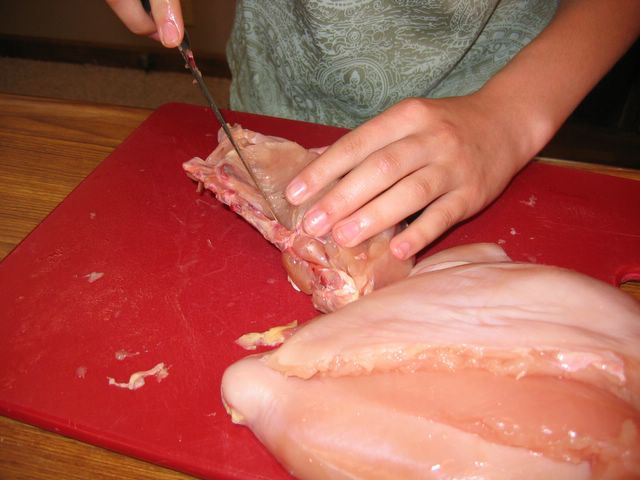
Here is Morganna boning out her first chicken breast. See how she follows the ribs, simply cutting the connective tissue with the tip of the knife while peeling the flesh away with her fingers.
We served cucumber raita, cilantro chutney, minced chiles, lime and lemon wedges, and finely diced red onion as side dishes, along with the chappli kebab (ground lamb patties), a salad of mixed greens, fresh strawberries, goat cheese, almonds and a pomegranate molasses vinaigrette, and an almond and golden raisin basmati rice pillau.
It turned out to be a memorable feast.
I cooked enough to have leftovers, or so I thought. There was nothing left but a small amount of salad, a tiny bowl of rice and a bit of the cilantro chutney.
I take it as a testimony to the power of Indian food--I suspect that no matter how much I made for this meal, most of it would have been gone by the end, it all tasted so good.

Pictured with a myriad of side dishes, from left to right: cilantro chutney, lime and lemon wedges, minced chiles, red onions, cucumber raita, and sugar snap peas stir fried with lemon juice, lemon zest and cardamom.
Sindhi Elaichi Murgh
Serves 8
Ingredients:
8 tablespoons whole milk yogurt
4o whole green cardamom pods
2 teaspoons whole black peppercorns
salt to taste
1 teaspoon coriander seeds
2 cups packed fresh cilantro leaves and upper stems, washed and drained well
1 green serrano chile
zest of one lemon
2 whole chicken breasts (four halves) skinned, boned and cut into 1 inch cubes
Method:
In a large bowl, whisk yogurt until smooth.
In a blender or a spice grinder such as the Sumeet, grind the spices, chile and cilantro into a smooth, dark green paste. Add lemon zest if you remove it using a zester that cuts into fine strips. If you use a microplane grater, you don't have to grind the zest any further.
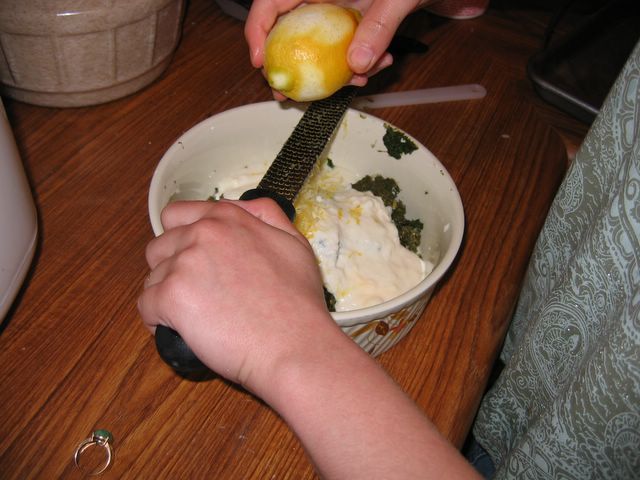
My daughter Morganna zests a lemon using a Microplane grater. The Microplane makes such fine flakes of zest that it doesn't need to be ground with the other spices.
Mix the spice paste, salt and zest into the yogurt and blend thoroughly. Marinate the chicken chunks in it for at least one or two hours.
Thread the chicken chunks and skewers and cook over a hot fire, turning often so that they do not burn. They will cook in about eight to twelve minutes, depending on the heat of your fire. (On my grill which was up to 375 degrees, they cooked in about nine minutes.)
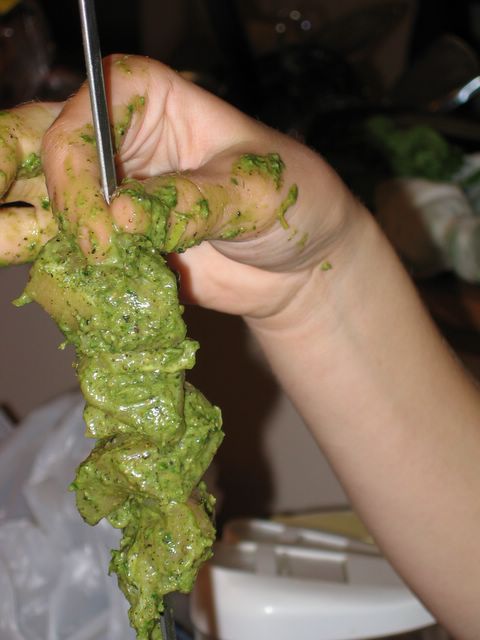
Here she threads the chicken onto the skewers. Look how vibrantly green the marinade is!
Serve with lemon wedges, raita and other goodies on the side.
Saturday, June 18, 2005
CSA Today
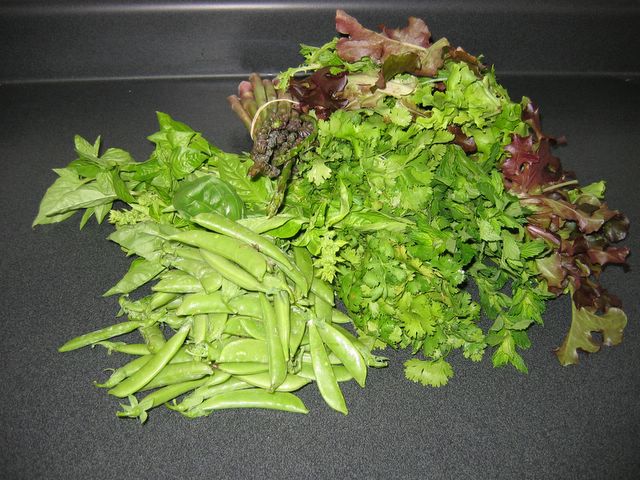
Green goodness: a pile of goodies from the Athens Hills CSA. Salad mix includes red and green oak leaf lettuces and mizuna, among other good things. Also pictured are a big bunch of basil, a bunch of spearmint and lots of cilantro, a pile of sugar snap peas and a bunch of asparagus.
So today was the opening weekend of the CSA season, and my first bag of goodies was chosen bright and early at the Athens Hills CSA booth at the farmer's market. This is their first year selling the CSA way, and I am pleased to be a charter member of the program. Instead of the way that a lot of CSA's work where you get a set box of whatever is being harvested that week, the folks at Athens Hills lets the member choose what they get, so if you happen to despise chard, you are safe from ever having to eat it. I think that this is a great way to structure the CSA thing--it allows the buyer to have say in their diet within the parameters of what is in season.
The farmers send out an email on Thursdays letting folks know what will be available on market day, so you can plan ahead for what you want and need. That is a really nice idea, as it lets those who are into menu planning to really dig in and think ahead, while for those who are like me and cook what looks good on a given day, it gives us something to look forward to browsing.
I picked out piles of herbs today because tonight, we are having friends over to celebrate the end of the quarter at Ohio University, the beginning of summer in Athens, which is a laid-back, relaxed affair what with most of the college students gone, the arrival of my daughter, Morganna, as she transitions between her father's home and my own, and the bon voyage to Heather, who is off on Monday to go study at a university in Lebanon for a couple of months.
Since Heather is the one who is travelling, she got to pick the cuisine I'd cook from to honor her. Last year, when she was on her way to Indonesia (Heather is a world traveller and explorer extraordinaire), she asked me to send her off with lasagne, knowing that she would not have a chance at eating anything Italianesque for months. This year, she asked for Indian food.
So, to say goodbye to Heather, hello to Morganna and summer, congratulations to those of us who have finished another quarter of school, I decided to have Zak fire up the grill and we'd throw on Seekh Kebabs, and Murgh Elachi Kebabs. The lamb and chicken are marinating right now, but I still have to put together the cucumber mint raita, the pomegranate molasses salad dressing to go with the greens and strawberry salad, and I have to string the snap peas for the snap pea, lemon and cardamom stir fry.
For dessert, which was promised to Heather's husband, the intrepid Digital Media professor of OU, Dan, and to Zak, we are having the ever popular and famed Aphrodite Cookies, which are also known as Barbara's Little Boobie Cookies, Rosewater Cookies and Orgasm Cookies. I'll be posting about all of the menu items over the next week, have no fear, and I promise to explain the names behind those cookies as well as posting a recipe and an article I wrote about them that was published in SageWoman magazine last summer.
So, since I have lots of folks to feed today, I'd best get on the ball and get cooking!
Tuesday, June 14, 2005
Pasta Primavera
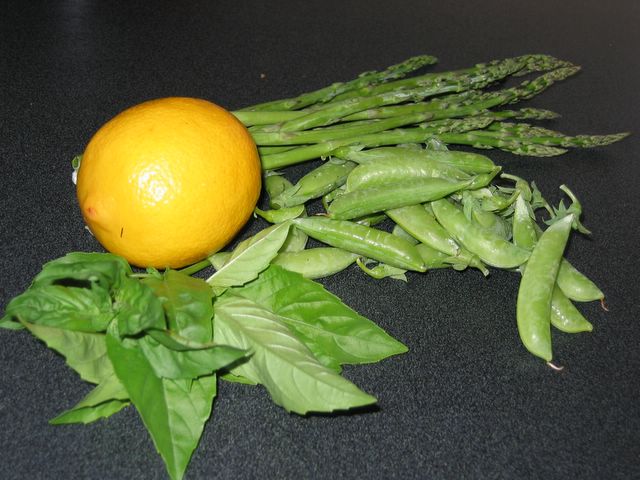
The ingredients for my lemon pasta primavera. Everything except the lemon is locally grown.
It all begins at the farmer's market Saturday morning.
The sun was bright, the air was warm and breezy, and the parking lot upon which the tents and awnings had been staked was filled with a teeming throng of shoppers, people-watchers, buskers and strollers. Kids laughed and babies squealed, grandmothers sniffed huge bouquets of flowers and fathers gave tastes of honey to their children, while mothers stood around, shading their babies from the sun, and discussing which type of cloth diaper system they favored.
Music from South American flutes trilled and soared over the waterfall of language and the galloping rhythym of calloused hands thumping the goathide skin of a djembe put a dance in the steps of young and old as the river of people ebbed and flowed through the market.
Stepping boldly into the fray, Zak and I began our weekly excursion, with no thought in our minds except procuring foodstuffs for a dinner to go with the promised Strawberry Rose ice cream that night.
First, I stopped at Canaan Valley Farms, and picked up a frozen chicken breast, and passed the time of day with the dear farmer whose chicken is so delicious.
Let me tell you about his chicken.
The meat is firm and velvety to the touch, not slimy and mushy. Even Bell and Evans organically raised free range poultry has a rubbery texture that slithers under my fingertips as I cut it up for cooking. This usually comes from the addition of water in the form of injected saline that is part of standard poultry packing these days. It plumps the meat and makes for a higher price for the buyer, who is paying for extra water, and it supposedly tenderizes the bird. What it does is it makes the meat slimy and unpalatable to the point where I usually wear latex gloves when I work with chicken.
This is not the case with the truly fresh, truly pasture fed birds that I get at the farmer's market. They are a pleasure to bone out and cut up. There is no slick residue left on my hands and touching the meat and skin doesn't make my skin crawl.
It is an honest prelude to the succulent moistness of the meat and the truly light and fresh flavor it delivers to every dish I have cooked in it. So far I have used it in Thai Spicy Basil Chicken, Chicken with Bitter Melon and now, I planned on using it in whatever I cooked for Saturday's dinner.
Moving on, I decided on making a version of Pasta Primavera with shiitake, chicken and asparagus, with a cream sauce based in lemon.
Pasta Primavera is meant to be cooked with springtime vegetables, and is a celebration of the sweet green things after a winter of dried and canned foods. I figured that since I could always get the shittake and I knew exactly where to get pencil-thin asparagus, that I could add whatever baby spring vegetables I happened to find. Tiny carrots or scallions or maybe morels, if anyone had any for sale.
I headed for Art and Peggy Gish's awning, for they are purveyors of very fine tiny asparagus that has the freshest flavor imaginable. As I sauntered up the table, I spied not only the asparagus, but quarts of freshly picked sugar snap peas! Plump lime green pods sat in little baskets, thier skins stretched tightly over the pearly peas within, they shimmered faintly in the sunlight.
Grinning like a possum at Art, I indicated the peas and asparagus. "A quart of the peas and two pounds of asparagus, please," I said. He smiled and busied himself with weighing out the produce while visions of sugar snap peas in pasta primavera danced in my head.
At my final stop, Athens Hills CSA/Green Edge Gardens, I picked up salad greens, microgreens, and a lovely bunch of basil. The snappy licorice-edged green basil scent wafted up from my bags as we headed back to the car, and drove back home.
Later that day, I began work on the pasta primavera, which went something like this:
Lemon Pasta Primavera
Ingredients:
Olive oil as needed for saute
1/2 pound pencil thin asparagus spears, bottoms trimmed and cut into 1" lengths
1/2 pound sugar snap peas, strung and rinsed
1 small red onion, peeled, cut in half and thinly sliced
1/4 pound fresh shiitake mushrooms, stems removed, caps thinly sliced
1 1/2 chicken breasts, skinned boned and cut into thin strips about 1" long and 1/4" wide
1/4 cup flour
1/4 teaspoon. turmeric
salt and pepper to taste
3 small heads fresh hardneck garlic (or four fat cloves of regular softneck garlic), peeled and minced
1/4 cup sherry or dry white wine
1/4-1/2 cup chicken broth or stock
Juice of two lemons
2-3 drops lemon oil (optional)
1/2 cup heavy cream
1 1/2 pounds of pasta, cooked al dente
zest from two lemons
Handful of fresh basil leaves, cut into chiffonade
Method:
In a large saute pan, heat a small amount of olive oil. Add asparagus, snap peas and sliced purple onions, and stir fry until colors deepen and vegetables tenderize slightly. Remove from heat immediately and place in a bowl, and set aside.
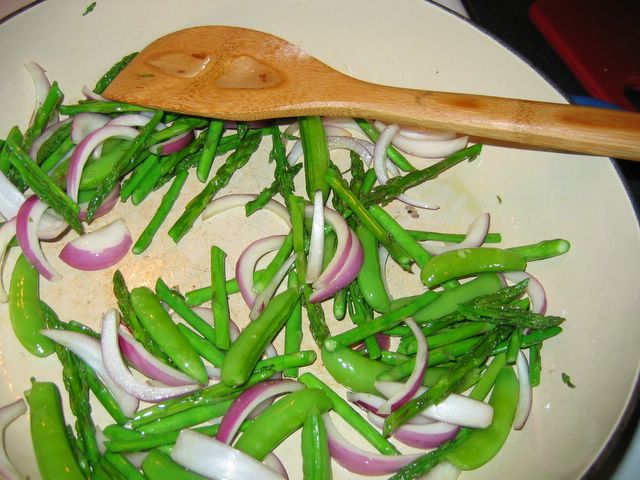
Saute the vegetables very lightly for this dish. You want to retain the fresh colors, flavors and aroma of them as much as possible.
Add enough oil to pan in order to saute the mushrooms and chicken. Heat up and add mushrooms. Mix flour, turmeric and salt and pepper, then toss chicken strips in this mixture. Add to pan and stir fry until chicken begins to brown and some flour begins to stick to the bottom of the pan and brown. Add the garlic and cook until quite fragrant, stirring constantly: about two minutes.
Deglaze pan with sherry or wine. Scrape up all the browned bits. As the wine reduces and the pan becomes nearly dry again, add the broth or stock and reduce, continually stirring and scraping the browned bits at the bottom of the pan.
Add the lemon juice and lemon oil, then the cream. Reduce until it coats the back of a spoon.
Add reserved vegetables to sauce, toss with cooked pasta of your choice.
Remove from heat and garnish with lemon zest and basil.

The little bit of turmeric I use in the flour mixture used to coat the chicken pieces gives the sauce a slight yellowish tint, which conveys the visual appeal of the lemon juice and oil in the dish.
Notes:
This recipe serves a small army of people, or six to eight folks, especially if you have a nice salad to go with it and a great dessert.
This is great with penne rigante. I learned from cooking Chinese food to always match the shapes of meat and vegetables that I cut in a dish--when I cook Italian style pasta, I follow the Chinese aesthetic of putting similar sized and shaped pasta with the sauce ingredients. I think it looks prettier this way.
Lemon is not traditional in pasta primavera, as I recall. Actually, I am not sure of primavera is a traditional sauce in the first place, as Italian foods are not my speciality, but, I do know that spring vegetables are great in pasta, and I love lemon cream sauces created by reduction. So, somewhere in my mind the two fused and become a part of my standard springtime pasta feasts.
The lemon oil that I use is pure lemon oil made by Boyajian. It is not necessary, but it really pumps up the lemon flavor a great deal. It is made of the essential oil that is present in the lemon zest.
Baby artichokes might be nice in this. Rapini might also be good. Fresh, shelled garden peas are nice, but I like the sugar snaps even better. Fennel might taste nice.
Chive flowers would be an outstanding garnish. However, I don't have any chives to use for this purpose.
Nasturtium blossoms look nice in this dish, too.
Monday, June 13, 2005
The Empire Strikes Back
I find it to be so interesting that local control and individual freedom are upheld as patriotic, core American values by talking heads in our country until issues like gay marriage, the USA PATIOT act and local control of the food supply come into focus.
Then, suddenly, we have Constitutional amendments, pleas to keep the Patriot Act up and running, and laws that favor corporate farming interests over local governments' rights to ensure the safety of the food supply start flying.
Here is a report on efforts by the Big Food industry to wrest control from local governments on issues of food and farm safety, biodiversity and public health.
And for all those who don't read Parke Wilde's excellent blog, US Food Policy, (and you should read it daily; it is a great roundup of news) here is a link to a story about a likely case of BSE (Mad Cow Disease) in a downer beef cow in the US.
"Downers,"when referring to cattle are not depressant drugs, they are cows who are unable to walk when they get to the slaughterhouse. Currently, many downer cows are killed and put into the food supply; this goes against all rational and sane policy. Cows that are too sick to walk are not, in my opinion, safe to be eaten.
And before someone tells me I am talking out of my bum, here are a few facts about my background: I grew up with grandparents who raised beef cattle, I am the great granddaughter of a butcher who owned a local slaughterhouse and managed it very well, I have a degree in culinary arts which includes extensive training in food safety issues, and I once was a zoology major with an eye towards veterinary science. I have studied the issues of food, health, animal husbandry, and animal disease my entire life. You want to think I am a wild-eyed left-wing freak, go right ahead.
But don't bother to tell me I don't know what I am talking about.
Because I do.
These two news stories once again tell me that we need to be concerned about our local food supplies. We need to be active in the politics that determine where our food comes from, how it is grown, how it is treated at harvest and how it is distributed. We need to be concerned because if we are not--who will be? Our government seems content to deregulate the food industry and give free reign to corporate interests.
My answer for all of this?
One--arm yourself with knowledge. Inform yourself on the issue. Read about the issue, not just in the local paper, but online. Read any one or all of these books, in order to get an idea of what I am talking about when I blather on about a sustainable local food supply: This Organic Life: Confessions of a Suburban Homesteader by Joan Dye Gussow, Food Politics: How the Food Industry Influences Nutrition and Health by Marion Nestle, The Eco-Foods Guide by Cynthia Barstow, Bitter Harvest, by Ann Cooper and Lisa Holmes, Holy Cows & Hog Heaven: The Food Buyers Guide to Farm Friendly Food by Joel Salatin, and Coming Home to Eat: The Pleasures and Politics of Local Foods by Gary Paul Nabhan.
Check out Eating Well Magazine, which includes information on these issues as well as a good round up of the latest nutritional research. They also feature some really creative, flavorful recipes for healthy food that doesn't look or taste like low-fat glop.
Two--once you have some grounding in this issue, start getting involved in the poltiical process. Write to your elected officials on the local, state and federal level. Let them know what you think, and how you feel, and keep at it. Make a hobby of them. Eventually, you may find that you get correspondance in return, and if enough people do this, they may start changing the way they cast their votes.
Three--try and buy as much locally produced food as you can, and urge others to do the same. Start a food co-op. Meet local farmers and try to help them start a CSA program. Support restaurants that rely on local food producers with your food dollars. Shop at a farmer's market in your town or city.
Four--educate others. Talk to your family and friends, neighbors and kids. Do workshops or presentations in schools, in churches and on campuses. Try not to stand on a corner and yell your message out to the passing crowd while holding a badly spelled placard--that generally gets you classified as a loon and means your message, no matter how noble or logical, will fall on deaf ears. But get the word out in email, on message boards, and in person, in whatever sensible way you can.
Five--Learn to grow some portion of your own food. Even if it is just a pot of herbs on your doorstep or in your windowsill, do it. Take some small measure of responsibility for the growth of your own food and learn how it is done. There is nothing better than the sense of accomplishment that growing your own food brings.
Six--watch out for Mad Cows. (I hear tell they run in packs.)
Okay, I was being silly on number six, but really--there are practical things we can do to take responsibility for our own food, and I would like to see more people becoming aware of these issues and doing something about them. If nothing else comes from my writing here at Tigers and Strawberries, I will be satisfied if more people start questioning the status quo of our huge, unwielding and oil-dependant food system.
So, that is your assignment for the day.
Get to work.
Then, suddenly, we have Constitutional amendments, pleas to keep the Patriot Act up and running, and laws that favor corporate farming interests over local governments' rights to ensure the safety of the food supply start flying.
Here is a report on efforts by the Big Food industry to wrest control from local governments on issues of food and farm safety, biodiversity and public health.
And for all those who don't read Parke Wilde's excellent blog, US Food Policy, (and you should read it daily; it is a great roundup of news) here is a link to a story about a likely case of BSE (Mad Cow Disease) in a downer beef cow in the US.
"Downers,"when referring to cattle are not depressant drugs, they are cows who are unable to walk when they get to the slaughterhouse. Currently, many downer cows are killed and put into the food supply; this goes against all rational and sane policy. Cows that are too sick to walk are not, in my opinion, safe to be eaten.
And before someone tells me I am talking out of my bum, here are a few facts about my background: I grew up with grandparents who raised beef cattle, I am the great granddaughter of a butcher who owned a local slaughterhouse and managed it very well, I have a degree in culinary arts which includes extensive training in food safety issues, and I once was a zoology major with an eye towards veterinary science. I have studied the issues of food, health, animal husbandry, and animal disease my entire life. You want to think I am a wild-eyed left-wing freak, go right ahead.
But don't bother to tell me I don't know what I am talking about.
Because I do.
These two news stories once again tell me that we need to be concerned about our local food supplies. We need to be active in the politics that determine where our food comes from, how it is grown, how it is treated at harvest and how it is distributed. We need to be concerned because if we are not--who will be? Our government seems content to deregulate the food industry and give free reign to corporate interests.
My answer for all of this?
One--arm yourself with knowledge. Inform yourself on the issue. Read about the issue, not just in the local paper, but online. Read any one or all of these books, in order to get an idea of what I am talking about when I blather on about a sustainable local food supply: This Organic Life: Confessions of a Suburban Homesteader by Joan Dye Gussow, Food Politics: How the Food Industry Influences Nutrition and Health by Marion Nestle, The Eco-Foods Guide by Cynthia Barstow, Bitter Harvest, by Ann Cooper and Lisa Holmes, Holy Cows & Hog Heaven: The Food Buyers Guide to Farm Friendly Food by Joel Salatin, and Coming Home to Eat: The Pleasures and Politics of Local Foods by Gary Paul Nabhan.
Check out Eating Well Magazine, which includes information on these issues as well as a good round up of the latest nutritional research. They also feature some really creative, flavorful recipes for healthy food that doesn't look or taste like low-fat glop.
Two--once you have some grounding in this issue, start getting involved in the poltiical process. Write to your elected officials on the local, state and federal level. Let them know what you think, and how you feel, and keep at it. Make a hobby of them. Eventually, you may find that you get correspondance in return, and if enough people do this, they may start changing the way they cast their votes.
Three--try and buy as much locally produced food as you can, and urge others to do the same. Start a food co-op. Meet local farmers and try to help them start a CSA program. Support restaurants that rely on local food producers with your food dollars. Shop at a farmer's market in your town or city.
Four--educate others. Talk to your family and friends, neighbors and kids. Do workshops or presentations in schools, in churches and on campuses. Try not to stand on a corner and yell your message out to the passing crowd while holding a badly spelled placard--that generally gets you classified as a loon and means your message, no matter how noble or logical, will fall on deaf ears. But get the word out in email, on message boards, and in person, in whatever sensible way you can.
Five--Learn to grow some portion of your own food. Even if it is just a pot of herbs on your doorstep or in your windowsill, do it. Take some small measure of responsibility for the growth of your own food and learn how it is done. There is nothing better than the sense of accomplishment that growing your own food brings.
Six--watch out for Mad Cows. (I hear tell they run in packs.)
Okay, I was being silly on number six, but really--there are practical things we can do to take responsibility for our own food, and I would like to see more people becoming aware of these issues and doing something about them. If nothing else comes from my writing here at Tigers and Strawberries, I will be satisfied if more people start questioning the status quo of our huge, unwielding and oil-dependant food system.
So, that is your assignment for the day.
Get to work.
Sunday, June 12, 2005
Summer is a comin' in

Summertime, and desserts are easy: Strawberry Rose ice cream with more strawberries on top. Homemade, low sugar and simple, that is, if you have an ice cream maker.
Okay, I know that technically, it isn't summer yet. Summer doesn't start until after the summer solstice, which is coming up in a couple of weeks or so.
But when it is ninety degrees out and the ground is dry from lack of rain, my body says it is summer.
And when it is summer, and it is hot outside, the last thing most normal people want to do is bake something for dessert.
My answer--invest in an ice cream maker, make ice cream and let people think you are the best and brightest genius on the block.
And since it is that time of year--make strawberry ice cream!
As you can see from the following illustrations, the process is pretty simple, with the bonus that it does not heat up the house.

You start with fresh, ripe berries, hopefully locally grown. Rinse them and let them drain completely, or dry them gently with paper towels.

Cut them up into small pieces (they do not have to look pretty), and sprinkle with sugar to taste (I used a couple of tablespoons) and allow to macerate until a lot of juice has been released.

Add rosewater and lemon juice to taste.
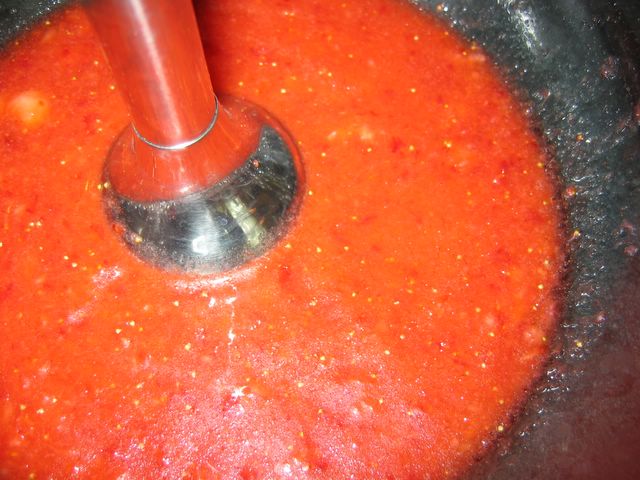
Puree two thirds of the berries; I like to use an immersion blender for this step.

Add dairy products with the immersion blender--here I used heavy cream and sour cream. Be careful not to introduce too much air into the mixture by keeping the active part of the blender completely submerged. After the dairy products are mixed in, you can stir the reserved one third of the berry mixture into the ice cream base, or do what I did and leave it out to use as a topping.
After you have the dairy products mixed in, you pour it into the ice cream maker's mixing chamber, and then follow the manufacturer's instructions.
As you can see, my ice cream maker is an electric version of the old fashioned hand-cranked kind that uses layers of crushed ice and salt in the plastic outer chamber. The inner chamber is metal and conducts the cold temperature from the ice into the ice cream mix. The motor is on the base, and the dasher, which churns the ice cream, is attached to the blue lid, and connects to the base through a piece in the metal chamber. The motor turns the dasher, and the dasher circulates the ice cream mixture, in order to evenly freeze it. The action of the dasher also incorporates some air into the mixture, which lightens the product, and the continual mixing prevents the formation of large ice crystals.
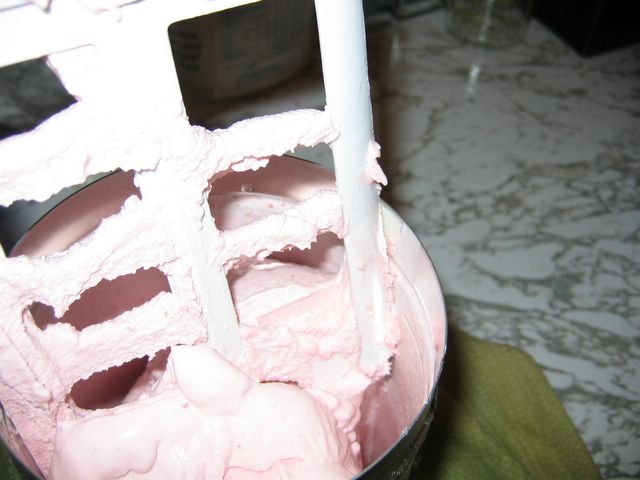
My ice cream maker's motor stops as soon as the ice cream is finished freezing. At this point, I unplug the motor, lift out the freezing chamber, pull off the lid and pull out the dasher. The ice cream is the texture of soft serve ice cream at this point, and while you can eat it now, I like to pack it into a plastic container and seal it then put it into the freezer for a while to harden.
Here is the exact recipe I used to make the ice cream pictured above:
Strawberry Rose Ice Cream
Ingredients:
1 quart fresh, ripe strawberries at room temperature
3 tablespoons sugar
rosewater to taste
fresh lemon juice to taste
2 cups sour cream
1 cup heavy cream
Method:
Follow the instructions as pictured above! You can use more sugar if you like, but I prefer to use less sugar in the ice cream and serve it with a sweeter topping, like the reserved 1/3 of a quart of berries.
Friday, June 10, 2005
Mad About Mulberries

Here is what mulberries look like up close and personal.
Moving into a house is a voyage of discovery. Living in a thirty-something odd year old house for the first couple of months is like an archeological dig--you are always finding things. Stuff you didn't know was there, and there is a surprise around every corner. You never know what you will find.
That is exciting. It is like two or three months or so of Christmas, especially when it comes to inheriting someone else's yard and garden. Gifts just pop up out of the ground in a most delightful fashion every day.
Or they fall out of the sky and plonk one on the head.
That is how I discovered the mulberries.
I was walking down the driveway to cross the road and get the mail when something dropped out of a tree and plopped on top of my head.
I thought that I might have been hit by a fly-by dropping, but no, it rolled and then plunked onto the pavement right in front of my toes, then rolled down the slight incline. I watched it and saw that it was a reddish-purple berry and that many of its brethren had been squashed upon our driveway. Purple splotches stained the entire bottom half of the driveway. I picked up the wee fruit and blinked.
A mulberry.
I looked up, and saw a fruit-laden branch arching gracefully over the drive, just a foot or two above my head, toothy leaves dancing in the breeze.
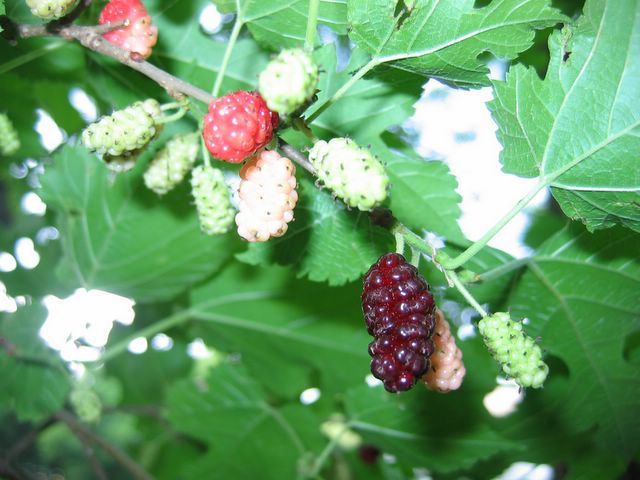
Surprise! I have a mulberry tree in my yard!
Further up the tree, a female cardinal was dining on the berries. She saw me looking up at her and flew away.
"Mulberries!" I did a little jig of happiness and reached up and picked a couple of them. The deep purple, almost black fully ripe ones were quite sweet, almost to the point of being insipid, but the reddish ones that were the exact color of the crayon entitled, "mulberry" in the old 64 box of Crayolas I grew up with were tart and sweet and firm and juicy. I picked a small handful and boogied inside to share them with Zak.
In the meantime, I forgot about the mail, but really, who gives a damned for bills and credit card offers when you have mulberries?
Zak obediently opened his mouth when I commanded and chewed the dark purple berry I popped in thoughtfully. "Kinda overly sweet," he commented. He opened his mouth to say something else, and I tossed in one of the slightly underripe ones. He bit into it and his eyes flew open as the tartness played tag with his tastebuds.
"That," he said as he swallowed, "Is more like it."
I gave him the last one I had and smiled as he ate it.
"So, what are you going to do with them?" he asked.
What, indeed.
I had no bloody idea.
But, of course, one does not refuse a gift so gladly given by Mother Nature as a mulberry tree right there in the front yard at the end of your driveway. So, I had to do something.
But what?
I really didn't want to go clambering up the tree in order to pick enough to make a tart or a pie; for one thing, my tree clambering skills are a bit on the nonexistant side these days, what with being creaky in the knees and whatnot. So, sweets were out. Salad was a possiblity, but I didn't want salad.
What I wanted to cook and what I had planned to cook was Chinese food. Something to do with pork sirloin chops (from Bluescreek Farm, of course) that I had thawed, with some Shanghai bok choi and maybe some carrots. That was what I was planning on.
And says I to myself, "You know, they grow mulberries in China, don't they?"
And a light went on in my head and I decided to do a sweet pork recipe with mulberries.
A quick search online showed that it likely wasn't a traditional Cantonese practice to put some mulberries in a pork stir-fry, but that has never stopped me before. I did read, however, that mulberries were used as a liver tonic in traditional Chinese food cures, and that was good enough for me to give it a go.
So, I grabbed a bowl and went out and filled it with mulberries. I picked most of them off the two branches that I could reach, and some unblemished ones off the ground.
It seems that in the American South, farmers used to let hogs forage off of mulberries in the woods. It was a "harvest free" crop, because you just let the trees drop them, and the hogs wander along and gobble them up. It makes the pig's meat apparently sweet and tender. Since there were no hogs about to eat up the berries, I took their place, and picked some up.
Chickens apparently like them, too, which stands to reason; I noticed as I was picking that there were nuthatches, titmice and cardinals all flitting up in the higher branches, eating berries with great merriment. Birds are very into mulberries, so I left lots of fruit on the ground for the doves and grackles and other ground-feeding avians.
So, I dashed inside and rinsed them, and plucked off the thread-like stems, which meant I stained my fingers with the lovely reddish purple juice, then fell to cutting and slicing while the rice cooker burbled in the corner, billowing forth periodic clouds of jasmine-rice scented steam.
Here is how I made the dish:
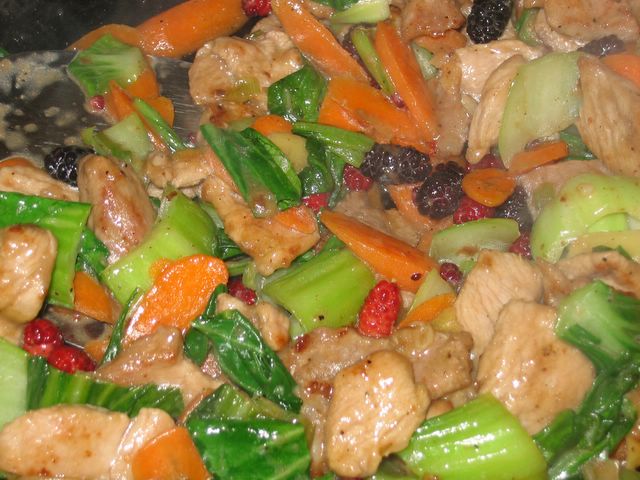
Mulberry Pork, just off the stove, still filled with wok hay--the essence or breath of the wok. I preferred the underripe berries in this dish--when I make it again, I will use only the sourer red ones.
Mulberry Pork
Ingredients:
1 pound lean pork, thinly sliced into strips about 1" long and 1/2" wide
2 tablespoons Shao Hsing wine
1/2 teaspoon thin soy sauce
2 tablespoons cornstarch
3 tablespoons peanut oil for stir frying
3 garlic cloves, peeled and thinly sliced
1 1/2" chunk fresh ginger, peeled and thinly sliced
3 scallions, white part thinly sliced
freshly ground black pepper to taste
1 cup carrots peeled and sliced on the bias
1/2 cups Shanghai bok choi, trimmed and cut into 1" slices
1/4 teaspoon salt
1/2 teaspoon sugar
1/4 cup chicken broth
1 tablespoon rice vinegar (optional--if you use mostly half-ripe mulberries, you won't need it)
1 cup rinsed, stemmed mulberries
Method:
Toss pork with wine and soy sauce and cornstarch. Allow to marinate at room temperature for twenty minutes or so while you cut vegetables.
Heat wok until smoking on high heat. Add oil and allow to heat thirty seconds more, or until oil shimmers from convection. Add garlic, ginger and scallions, and stir and fry for about forty-five seconds to a minute, until very fragrant and golden. Add a few grindings of black pepper.
Add pork, arrange so it is all in one layer on the bottom of wok, and let sit and brown for about thirty-five to forty seconds. (If there is liquid standing in the marinating bowl, reserve it for later in the cooking process.) Stir fry vigorously until most of the outside is no longer pink. Add carrots and stir fry about a minute.
Add bok choi, and stir-fry until it begins to brighten in color and wilt ever so slightly. Add salt, sugar, broth and vinegar, and stir fry until liquid thickens into a sauce that clings to everything.
Add mulberries, and stir and fry for about forty five seconds more.
Serve with steamed rice and green tea with jasmine.
It turned out well, but I wish that I would have had some fresh water chestnuts to add to it. The crunch and sweetness would have been superb.
All in all, I think it was successful.
Next year, when I know that there will be mulberries, I think that I will attempt a mulberry sorbet. Maybe I can talk someone who is more adept at tree climbing than I am to take a basket up in their teeth and fetch us down enough berries to do something along those lines. That could be fun!
Wednesday, June 08, 2005
Breast is Best
Okay, I just read something that got me het up enough to get political in my food blog again. It is about the conflicting messages that nursing mothers are given when it comes to feeding their babies.
I got up this morning early to send a fax to my mother, and so, while the fax machine was whirring away, I sat down with tea and decided to read the New York Times online, and a headline catches my eye: "'Lactivists' Taking Their Cause, and Their Babies, to the Streets."
The American College of Pediatrics urges all women to breastfeed their babies, because as we should all know by now, breastmilk is the best food for all human babies to have for the first year of their lives. Their bodies are made to digest it, mother's bodies are made to make it--it seems to be a simple, logical process to decide to breastfeed one's own child. And, according to this article, it is becoming an overwhelming choice for a majority of mothers: apparently, 70% of new mothers are nursing their babies at least for the first few weeks of life, which is a huge jump from the nearly 0% who were breastfeeding their kids thirty-nine years ago when I was born and the 50% of women doing so in 1990. (I am proud to say that I was one of those 50%.)
This is great! This is good news, not only from my perspective as a chef, and a woman interested in public nutrition, but from my perspective as a mother. I am glad to see more women getting the message that breastmilk is the single best food for infants and not only is nutritionally superior to both dairy and soy-based formulas, but also confers greater immune system strength to the child, through the influence of the mother's immune system. No formula can do that, and the result is healthier babies who would require much less medical intervention.
The American College of Pediatrics estimates that if all women followed their guidelines and exclusively breastfed for the first six months of life and then continued to breastfeed in addition to supplementing with solid foods for six more months, health care costs for sick infants would be reduced by 3.6 billion dollars per year.
Doesn't that sound good? Don't we all want our babies to be healthy? Don't we want every baby to be healthy, happy and well-fed?
Apparently not.
While 70% of new mothers are breastfeeding upon leaving the hospital, only 36% are still breastfeeding at six months, and 17% at twelve months. Only 14% are exclusively breastfeeding at 6 months.
Houston, we have a problem.
What is happening here? Why are few mothers able to stick with breast feeding, even when they know conclusively that it is the best nutritional choice they can make for their babies?
It isn't a lack of knowledge or experience out there; in 1990, when I was breast-feeding my daughter, I was one of the lucky women who had female relatives who had breast-fed and could help me figure out how to do it effectively. My grandmother and mother-in-law both had experience breast feeding and could teach me how to go about it; contrary to popular belief, breast-feeding is not an instinctive skill among we higher primates. Gorillas, chimps and humans all learn to feed our babies by watching others go about it. (When a captive gorilla in a zoo kept having trouble feeding her babies, the zoo administrators found a lactating human mother to sit outside the enclosure and feed and care for her infant where the gorilla could observe her. When the gorilla had her next baby, she fed it like a pro.)
Most other women who were breast-feeding at that time, however, were hard-pressed to get good information. Few doctors and nurses were trained in the mechanics of human lactation, and while there were chapters of La Leche League in larger cities, it was difficult to find any books on the subject, save for a few copies of their Womanly Art of Breastfeeding, which while supportive, wasn't that technically useful.
Today, there is a plethora of titles available to teach the techniques of breastfeeding to the increasing number of new mothers who want the best for their babies. A survey of some of the best include Bestfeeding, The Ultimate Breastfeeding Book of Answers and The Breastfeeding Book.
In addition to books, most hospitals have lactation consultants available on staff to answer questions and support new mothers in learning how to nurse their babies effectively. In addition, there is simply a larger pool of peers available who have breastfed or are breastfeeding, and there are support groups for lactating women in big cities, small towns and rural communties across the nation. And of course, there is the Internet, which is teeming with information and support on the subject of breastfeeding.
So, obviously, it isn't a lack of information or medical support that is causing this drop-off in mothers who breastfeed. What is happening?
According to research by the FDA cited in the New York Times article, one of the greatest barriers to women continuing to breastfeed thier infants is the degree of embarrassment women feel about nursing. This factor was found to have more influence over women's decision over whether or not to breastfeed than household income, maternity leave or employment status.
Women feel icky about it, in large part, because women are made to feel icky about our bodies in general, but our breasts in specific.
Why?
Because breasts, particularly in the United States, have been sexuallized to the point that women feel weird using them for thier primary function, which is feeding their babies.
And even if a woman herself doesn't feel strange about putting her baby to her breast, there are plenty of Americans who will feel weird about it if they see her doing it, and will go out of their way to make her feel ashamed of doing the right thing for her baby. Women have been asked to go to the bathroom to feed their babies when they are in public places, because other people are uncomfortable watching them.
This is a ludicrous situation. Do you eat while sitting on a toilet? I didn't think so. So why should a baby be sent to a room where defecation and urination happens, which are less than sanitary activities, in order to eat?
The answer, my friends is this: they shouldn't.
And apparently, new mothers are tired of these mixed messages, and have taken to the streets over it, organizing "Nurse-ins" across the country in order to bring awareness to the fact that they are doing nothing wrong, dirty, shameful or disgusting and that there is no reason that they and their babies should be hidden away in their homes or a bathroom stall just because other people are made uncomfortable by the sight of babies eating in the way that nature intends them to.
In response, six states have passed legislation which require that women be allowed to nurse their babies in public without being harrassed or intimidated. Other states are following suit, while many corporations such as Starbucks and Burger King are making policy changes which allow nursing on premises without being asked to leave.
Perhaps, by 2010, Americans will have grown up enough to deal with the "horrifying" sight of women feeding babies that the Surgeon General's Goal for Healthy People might be met wherein 75% of mothers nurse their babies at hospital discharge, 50% are still nursing at six months, and 25% are still nursing after a year.
Until then, let us all stand up for nursing mothers and babies and give them emotional support and positive reinforcement. If you see a mother being harrassed, stand up for her, and tell the harrasser to look away if the sight of a baby being fed bothers them so much. Write to your elected officials and tell them what you think about the issue. And if you have a baby of your own, breastfeed him or her for as long as you can, and if you need help learning how, ask for it without shame or embarrassment.
It takes a village to raise a child--and sometimes, it takes a village to help feed that child, too.
I got up this morning early to send a fax to my mother, and so, while the fax machine was whirring away, I sat down with tea and decided to read the New York Times online, and a headline catches my eye: "'Lactivists' Taking Their Cause, and Their Babies, to the Streets."
The American College of Pediatrics urges all women to breastfeed their babies, because as we should all know by now, breastmilk is the best food for all human babies to have for the first year of their lives. Their bodies are made to digest it, mother's bodies are made to make it--it seems to be a simple, logical process to decide to breastfeed one's own child. And, according to this article, it is becoming an overwhelming choice for a majority of mothers: apparently, 70% of new mothers are nursing their babies at least for the first few weeks of life, which is a huge jump from the nearly 0% who were breastfeeding their kids thirty-nine years ago when I was born and the 50% of women doing so in 1990. (I am proud to say that I was one of those 50%.)
This is great! This is good news, not only from my perspective as a chef, and a woman interested in public nutrition, but from my perspective as a mother. I am glad to see more women getting the message that breastmilk is the single best food for infants and not only is nutritionally superior to both dairy and soy-based formulas, but also confers greater immune system strength to the child, through the influence of the mother's immune system. No formula can do that, and the result is healthier babies who would require much less medical intervention.
The American College of Pediatrics estimates that if all women followed their guidelines and exclusively breastfed for the first six months of life and then continued to breastfeed in addition to supplementing with solid foods for six more months, health care costs for sick infants would be reduced by 3.6 billion dollars per year.
Doesn't that sound good? Don't we all want our babies to be healthy? Don't we want every baby to be healthy, happy and well-fed?
Apparently not.
While 70% of new mothers are breastfeeding upon leaving the hospital, only 36% are still breastfeeding at six months, and 17% at twelve months. Only 14% are exclusively breastfeeding at 6 months.
Houston, we have a problem.
What is happening here? Why are few mothers able to stick with breast feeding, even when they know conclusively that it is the best nutritional choice they can make for their babies?
It isn't a lack of knowledge or experience out there; in 1990, when I was breast-feeding my daughter, I was one of the lucky women who had female relatives who had breast-fed and could help me figure out how to do it effectively. My grandmother and mother-in-law both had experience breast feeding and could teach me how to go about it; contrary to popular belief, breast-feeding is not an instinctive skill among we higher primates. Gorillas, chimps and humans all learn to feed our babies by watching others go about it. (When a captive gorilla in a zoo kept having trouble feeding her babies, the zoo administrators found a lactating human mother to sit outside the enclosure and feed and care for her infant where the gorilla could observe her. When the gorilla had her next baby, she fed it like a pro.)
Most other women who were breast-feeding at that time, however, were hard-pressed to get good information. Few doctors and nurses were trained in the mechanics of human lactation, and while there were chapters of La Leche League in larger cities, it was difficult to find any books on the subject, save for a few copies of their Womanly Art of Breastfeeding, which while supportive, wasn't that technically useful.
Today, there is a plethora of titles available to teach the techniques of breastfeeding to the increasing number of new mothers who want the best for their babies. A survey of some of the best include Bestfeeding, The Ultimate Breastfeeding Book of Answers and The Breastfeeding Book.
In addition to books, most hospitals have lactation consultants available on staff to answer questions and support new mothers in learning how to nurse their babies effectively. In addition, there is simply a larger pool of peers available who have breastfed or are breastfeeding, and there are support groups for lactating women in big cities, small towns and rural communties across the nation. And of course, there is the Internet, which is teeming with information and support on the subject of breastfeeding.
So, obviously, it isn't a lack of information or medical support that is causing this drop-off in mothers who breastfeed. What is happening?
According to research by the FDA cited in the New York Times article, one of the greatest barriers to women continuing to breastfeed thier infants is the degree of embarrassment women feel about nursing. This factor was found to have more influence over women's decision over whether or not to breastfeed than household income, maternity leave or employment status.
Women feel icky about it, in large part, because women are made to feel icky about our bodies in general, but our breasts in specific.
Why?
Because breasts, particularly in the United States, have been sexuallized to the point that women feel weird using them for thier primary function, which is feeding their babies.
And even if a woman herself doesn't feel strange about putting her baby to her breast, there are plenty of Americans who will feel weird about it if they see her doing it, and will go out of their way to make her feel ashamed of doing the right thing for her baby. Women have been asked to go to the bathroom to feed their babies when they are in public places, because other people are uncomfortable watching them.
This is a ludicrous situation. Do you eat while sitting on a toilet? I didn't think so. So why should a baby be sent to a room where defecation and urination happens, which are less than sanitary activities, in order to eat?
The answer, my friends is this: they shouldn't.
And apparently, new mothers are tired of these mixed messages, and have taken to the streets over it, organizing "Nurse-ins" across the country in order to bring awareness to the fact that they are doing nothing wrong, dirty, shameful or disgusting and that there is no reason that they and their babies should be hidden away in their homes or a bathroom stall just because other people are made uncomfortable by the sight of babies eating in the way that nature intends them to.
In response, six states have passed legislation which require that women be allowed to nurse their babies in public without being harrassed or intimidated. Other states are following suit, while many corporations such as Starbucks and Burger King are making policy changes which allow nursing on premises without being asked to leave.
Perhaps, by 2010, Americans will have grown up enough to deal with the "horrifying" sight of women feeding babies that the Surgeon General's Goal for Healthy People might be met wherein 75% of mothers nurse their babies at hospital discharge, 50% are still nursing at six months, and 25% are still nursing after a year.
Until then, let us all stand up for nursing mothers and babies and give them emotional support and positive reinforcement. If you see a mother being harrassed, stand up for her, and tell the harrasser to look away if the sight of a baby being fed bothers them so much. Write to your elected officials and tell them what you think about the issue. And if you have a baby of your own, breastfeed him or her for as long as you can, and if you need help learning how, ask for it without shame or embarrassment.
It takes a village to raise a child--and sometimes, it takes a village to help feed that child, too.
Cookbooks!

A small portion of my cookbook library, including most of the Asian cookbooks.
And so, Steph over at Da*xiang tapped me with this meme about cookbooks that seems to be floating about the food blogosphere, and like the good sport that I am, I decided to answer the questions, and in fact, even post a picture so folks could have visual proof about how obsessed I really am!
So, here goes nothing:
1. Total number of (cook) books I’ve owned:
Are you ready? Are you sure? Do you really want an answer to this question? Positive?
Okay, here goes. Sit down and take a deep breath, in through the nose, and let it out, slowly through the mouth.
Currently, at this moment, I own 403 books on subjects related to food. These include cookbooks, reference books, textbooks, and non-fiction books with essays on the subject of food and cookery. There are books on the history of food, nutritiuon, and books on all aspects of food preparation including preservation, brewery, fermentation, cheesemaking and winemaking. There are rare, out of print tomes and oddities of historical value, along with reprints of historically significant works.
In the recent past, that number probably was closer to 450 books. Just before moving, I weeded out the books I decided were not useful to me. Let us just say that Half-Price Books is my friend and ally.
Since I collect cookbooks on Chinese cuisine in English, particularly rare titles, those of historical significance and those which are out of print, the total number of cookbooks I own is constantly going up, not down.
I did not count any of the several file boxes worth of back issues of Fine Cooking Magazine, Cook's Illustrated, Eating Well Magazine, Chocolatier, Vegetarian Times, Chile Pepper Magazine or any other magazines having to do with food. I have no idea how many of those I own.
Here is a photograph of one of the bookshelves of my books, showing most of my collection of Chinese and other Asian cookbooks.
Last (cook) book I bought:
I am giving two answers here, one for an out of print/used cookbook and one for a cookbook that I bought new.
The out of print book I most recently aquired would be Classic Deem Sum: Recipes from Yang Sing Restaurant, San Francisco by Henry Chan, Yukiko Haydock and Bob Haydock, published by Holt, Rinehart and Winston in 1985. The photographs and recipes for dim sum in this book are excellent, and I am amazed to see how much lard is mentioned as going into these delectable snacks. More recent books on the subject tend to downplay the role of lard in making dim sum specialities which are moist, rich and delicious.
The most recently purchased new cookbook would be one I just ordered from Amazon yesterday: American Farmstead Cheese: The Complete Guide to Making and Selling Artisan Cheeses by Paul Kindell et al. As I have not read it yet, I cannot really comment upon it, but I do hope it gives good instruction for making cheese as I want to try my hand at it.
Last (food) book I read:
I take it this means last non-cookbook food book I have read. That would be Best Food Writing 2004 edited by Holy Hughes. I enjoyed this book greatly, even if the editor decided she needed to take a cheap shot in her introduction at all the food bloggers who write not for money, but for the sheer joy of it. I particularly enjoyed Paul Bertolli's essay, "Cooking is Always Trouble," John Thorne's "Conflicted About Casseroles."
Five (cook) books that mean a lot to me:
Allright, here there will be two answers as well. I will give answers for cookbooks, and then books about food that are not cookbooks, but relate to cooking in some way. These are not in order of importance, rather, they are listed chronologically--in the order in which I encountered them.
The Cookbooks:
Mediterranean Cooking by Paula Wolfert--This was the first cookbook I ever bought for myself, (I was thirteen) and it introduced me to the wonderous world of fruity olive oil, tart lemons, ripe Roma tomatoes, anchovies and lots and lots of garlic. For a girl who grew up on hearty, but not overly seasoned farm fare and Appalachian cookery, this book was a key to an entirely different realm of flavors. Wolfert's evocative prose led me towards the ideal of seeing food not only as bodily sustainence, but as a transmitter of human culture. The original book is out of print; Wolfert came out with a revised edition in 1994 which replaces many of the richer recipes with more low-fat versions that represent the "healthier" cooking styles of the region.
I prefer the original text, but then, I am biased being that it is my very first cookbook.
Alice's Restaurant Cookbook by Alice May Brock--Yes, it is a cookbook written by that famous Alice from that famous song by Arlo Guthrie. I came across it when I first went to college back in the fall of 1983, in the stacks of the library at Marshall University. I checked the book out and kept it checked out for months. It became a touchstone for me, not because Alice's recipes were so good, but because I loved the way she wrote and her philosophy of the kitchen, which is essentially this: cooking is love on a plate, and should be fun and playful as well as taste good. My favorite quote from the book, which is the entire text of chapter ten, which is entitled "Foreign Cookery," is this:
"Don't be intimidated by foreign cookery. Tomatoes and oregano make it Italian; wine and tarragon make it French. Sour cream makes it Russian; lemon and cinnamon make it Greek. Soy sauce makes it Chinese; garlic makes it good. Now you are an International Cook."
Alice gave me the guts to just jump in and cook, even if I thought I didn't know what I was doing. She taught me that sometimes bravado is more important than knowledge, and I am happy to have since found out that none other than Julia Child agreed with her. Though it is out of print, I am happy to say that you can pretty easily find copies of this book on Amazon used for a not too high price. Included in the back on a floppy bit of vinyl, is a recorded introduction by Arlo; mine has the little "record" intact, but I have never listened to it, being as I don't have an old-fashioned turntable with a needle anymore.
An Invitation to Indian Cooking by Madhur Jaffrey--I first encountered this book at the public library in Huntington, West Virginia, and even though I had never tasted Indian food in my life, reading this book helped me get up the gumption to cook it anyway. The first dish I cooked following Madhur's instructions was rogan gosht. I had no idea if I did it right, being as I had never tasted the dish in my life, but the result tasted fine to me, and my friends all ate it up with great glee and gusto, so I guessed that I did it right. Later on, I bought my own copy of it, and have cooked many dishes from its pages with great success. This one is still in print, with its orginal text intact.
It Rains Fishes: Legends, Traditions and the Joys of Thai Cooking by Kasma Loha-Unchit--I have lots of Thai cookbooks, and this is my favorite. Many have more recipes, but none of them capture the culture of Thai's cooking traditions the way Kasma does. Illustrated with charming watercolor paintings, the text not only describes in full detail how to cook authentically Thai foods, it places these foods within their cultural context through the use of mythology, personal stories and folklore. The writing is very clear, but also poetically rendered, such that I imagine that Kasma is standing next to me, telling these stories as we cook together in a kitchen filled with the floral scent of lime leaves, the sharp pungency of shrimp paste and the sweet aroma of freshly grated coconut.
Land of Plenty by Fuchsia Dunlop--I have praised this book more than once in my blog, but I have to do it one more time. Fuchsia transcribed the flavors I held close in memory of Huy's kitchen, and put them down in words that I could follow. Between her clear instruction and my memory for flavors, I have been able to recreate dishes that I often only tasted once at Huy's table, and this is a gift beyond price to me. The dishes he cooked for us after hours--those are the essence to comfort for me now, because he did this for me at a time when I felt as if I was alone in all the world. I don't know if he will ever understand how important that was to me then, but it was. And this book makes all of those memories come to life and dance on my tongue again.
Non-Cookbook Food Books
Larousse Gastronomique edited by Jenifer Harvey Lang--This should come as no surprise. It should also come as no surprise that I read about it in childhood, terribly distraught that I could not find a copy of it in West Virginia. I read copies of this encyclopedia of the culinary arts in college, however, in the reference section of the library, and later, right before going to culinary school, I bought my very own copy and read it cover to cover in a week. Yes, a week. Yes, I read fast. Yes, I am obsessed.
On Food and Cooking by Harold McGee--This book I read years before culinary school, when I first lived in Athens, Ohio. I had gone back to college to finish my degree, and found it in the cookbook section and proceeded to keep it checked out for a couple of months while I read it cover to cover two or three times. When I found a copy of it in a bookstore, I snatched it up. I recently replaced that dogeared copy with the new revised edition that just came out last year. This book completely explains the science behind cookery has probably been the most influential food book upon my psyche ever--even more so than Larousse. My cooking improved drastically once I began to grasp the physics and chemistry that are the basis of all culinary expression. Understanding these processes has also made me a better cooking teacher. I owe a lot to McGee.
Why We Eat What We Eat by Raymond Sokolov--This book is in part, a history describing the impact of the discovery of the foods of the New World had upon the cuisines of the earth. Sokolov's thesis is that every cuisine around the globe was fundamentally changed with the discovery of the foodstuffs of the New World, and that once the culinary borrowing and trading back and forth between cultures on either side of the Atlantic began, the foods we recognize in our modern world began to develop. Chile peppers, potatoes, tomatoes, pumpkins and various squash, turkeys, wild rice, and cranberries are just some of the foods he discusses in this book that happened to get me into a spot of trouble in culinary school when I contradicted a chef who was trying to tell the class that potatoes were native to Ireland.
Of course, they are not--they are native to Peru, which I already happened to know, but it was fresh on my mind, because I had been in the midst of reading this book. To make a long story short--the chef did apologize to me the next day and he praised me for correcting him, though he apparently lost face in front of a few other chefs in the process. Ooops.
Perfection Salad and Something from the Oven by Laura Shapiro--These books are social histories on the subjects of food and women in the United States. The first book tells what could be an irritatingly boring story of the development of home economics as a profession and the rise of nutrition as an academic subject from the latter part of the nineteenth century through the middle of the twentieth. The second book picks up the tale in the 1950's and shows how the rising status of women and technological advances in home appliances and food marketing began a revolution at the dinner table.
Both books are so well researched that they should be dry, dull and pedantic, but because Shapiro is such a facile and engaging writer, they read less like a textbook and more like a novel. They are full of characters, personalities and wit, unlike most social histories, and are not to be missed.
Which 5 people would you most like to see fill this out in their blog?
Dagmar at A Cat in the Kitchen
Alan at The Impetuous Epicure
Zarah Maria at Food and Thoughts
And Foodgoat and Ladygoat at Food Goat
Tag, folks, you're it!
Tuesday, June 07, 2005
Sweet Seasonal Shoots
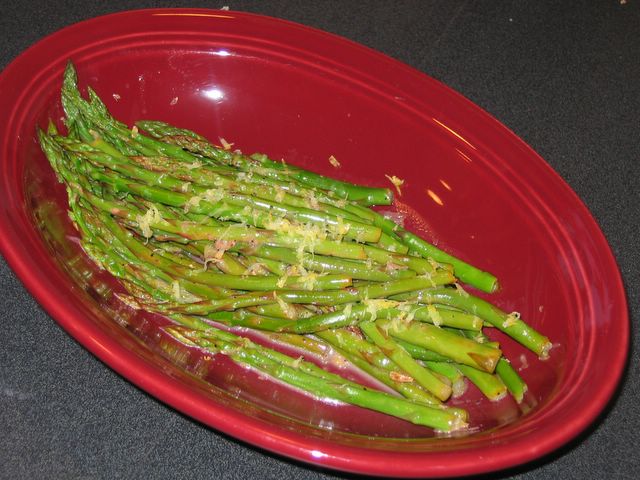
Best simply dressed: asparagus with a bit of butter, lemon juice, lemon zest and pepper is a seasonal treat.
Speaking of eating locally and in season, let's talk about asparagus.
It is one of those foods that, when it is in season, I will gorge on. I am the same way with strawberries (as if you hadn't noticed, since the last three photographs on this blog had strawberries featured in them), tomatoes and blackberries. So long as they are glutting the garden, I will be a glutton for them, eating them as often as three meals a day if I can get away with it.
Zak has become the same way with asparagus as I am; however, things were not always thus with us. He used to swear he hated asparagus.Then again, he barely ate green things at all, so it probably wasn't what one could call an aversion to asparagus itself: he was just prejudiced against chlorophyll.
All of that changed a couple of years ago when I finally convinced him that he wanted to try asparagus. I had cooked it as I usually do: simmered in a tiny bit of water until barely tender, then drained and dressed with a tiny bit of melted butter, some lemon juice and salt, with a sprinkling of black pepper and lemon zest.
He tasted the first shoot, nipping it with much trepidation and hesitation from my fork. His eyes widened in surprise and he declared, "Hey, that's pretty good."
He then proceeded to eat half of what I had cooked for myself.
Which was allright, as I went right out the next day and bought two pounds more. And we ate all of it for dinner.
And that is what we do. When it is in season, especially when we can get it locally grown, we buy about two or three pounds of it at a time and eat it at least twice a week. By the time we start getting tired of it, it is no longer in season, and all that is left are the tough, mealy things imported from "somewhere else," and we can move on to whichever new seasonal obsession is upon us.
Inevitably, when we eat large quantities of asparagus, the topic of urine comes up in conversation. This is not only because the two of us have the same sick sense of humor as a pair of twelve year olds who were raised watching "Beavis and Butthead" for twelve hours a day, but because it is a scientific fact that eating asparagus makes your pee smell funny.
It has to do with some sort of sulfur compound that is present in the asparagus along with healthy doses of folic acid, potassium, thiamin, fiber, and vitamins B6, A and C. There hasn't been a ton of research on the subject, probably because there is no money in figuring out which harmless chemical in asparagus makes one's urine smell objectionable (have you ever known anyone's pee to smell good--I mean, really), and it isn't exactly a burning question that needs answered. I'd much rather have organic chemists worrying about the effects of pesticides on human and animal neurology or something useful like that, than figuring out why asparagus tastes good but makes something go awry in the urinary tract.
But be that as it may, back to asparagus itself.
It is a member of the lily family, along with garlic, onions and leeks, and unlike most vegetable plants, is a perennial. One plants the crowns, or roots, in a specially prepared bed, and then mulches them and feeds and waters them for three years without harvesting a single shoot. Not one. Nope. None. Growing asparagus requires patience and willpower. Even more so than strawberries--you only have to wait a year to harvest them the first time. So anyone who grows asparagus gets tortured by having to watch lovely green shoots erupt from the soil, and climb toward the sky, then turn into a cloud of glorious lacy ferns without ever tasting one for three whole years.
That is the bad part of growing asparagus.
The good part is that once you plant a bed of it, and you let it establish a tidy mat of vigorous roots under those ferns for three years, you can harvest shoots by the tens of pounds for the next fifteen years. Yeah, that is right. If you can restrain yourself for three years, you get payoff for at least fifteen years. I say at least, because I know of some folks who have had the same patch of asparagus going for over twenty years.
That is pretty darned cool, in my book. Which is why, after we terrace our steeply inclined backyard into servicable garden space, I intend to plant an asparagus patch. I'm just going to interplant it with the flowers and decorative shrubbery--the ferns are quite lovely, and it is a well-established tradition in cottage gardening to mix together ornamental and edible plants. Besides, I like putting surprises in gardens, and what can be more surprising than walking along, admiring the water feature, then bending down and snapping off an asparagus stalk and munching it?
I find that asparagus is best cooked simply, and quickly. I know that the new fad for cooking it is roasting it, but I haven't had good luck with it. So, generally, I simmer it in a tiny bit of salted water until it is barely tender, then either boil off the water or drain it. I melt butter in the pan, squeeze in lemon or lime juice, and sprinkle it with the zest of whichever citrus fruit I juiced, and give it a few good turns of the peppermill. I have been known to add lightly crushed pink peppercorns to the standard mixture, not only because they look quite pretty against the brilliant emerald stalks, but because the sweet flavor of them complements the asparagus quite well. A pinch of dried dill is nice as well, if you have some. Chive blossoms are nice, too, though Zak objects to them, as he isn't enamored of the onion flavor.
There is a debate over whether the pencil-thin asparagus shoots are better or the finger-thick spears are superior. I think it depends on which texture you like and how much you enjoy peeling the bottom third of the stalk.
I prefer the tiny spears, because all you have to do is snap off a bit of the bottom end, and voila! They are ready to cook or eat out of hand. With the thicker spears, you have to either snap off a significant portion of the bottom because of toughness, or you have to snap off a smaller amount and peel the bottom third or so of the stalk.
That is a pain in the rear end, and I dislike doing it. And even peeled, I think that the rest of the more mature, larger asparagus is somewhat tough and stringy. It still tastes springtime fresh, but the texture is off. I tend to stick with the tiny asparagus for using in salads or cooking simply, and will sometimes use the thicker stuff to make cream of asparagus soup.
I make it sound like I am picky. That really isn't the case. I will eat just about any fresh asparagus that I can get, and will do what I must to cook it properly.
We are about a third of the way through asparagus season around here, so we have probably several more weeks to gobble down countless pounds of the wee green shoots. As the supply dwindles, our appetites will probably be close to satiated; our palates will tire of the delicate green flavor sparked with the tang of lemon and smoothed with the velvet caress of butter, and will want for something new.
That is, until next spring, when once again, we will pounce upon any fresh asparagus we see and eat it until we feel as if we will burst in a glorious explosion of springtime goodness.
Monday, June 06, 2005
Sunday Breakfast, Fresh and Local
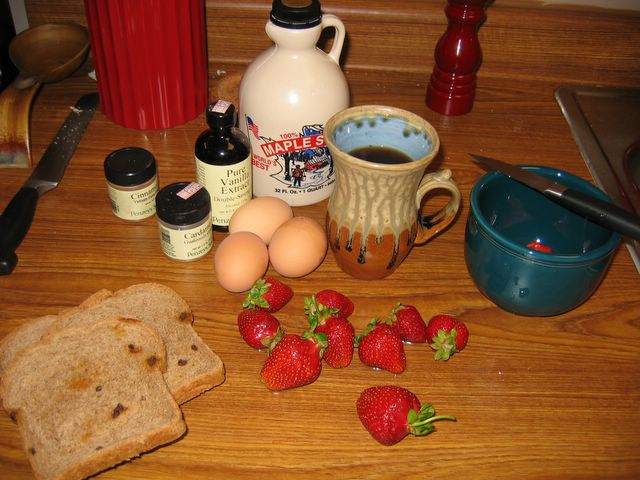
The ingredients for a mostly local, fresh Sunday breakfast.
As many of you know, I tend to emphasize eating a lot of fresh, locally produced foods. Not only are you getting something that tastes amazingly better than what you get at the grocery store, you are usually getting more nutritious food and you are helping to protect the environment and boosting the local economy as well. In addition, you can feel good about helping out a local farmer as well.
Last week, a fellow blogger named Jen from Life Begins at Thirty, began chronicling everything she ate in a day, noting where and how the food items were all produced in an effort to see how much her food intake matched her philosophy of eating local food. The results were interesting to follow, and as was her intention, it made me think about how differently Zak and I have been eating in recent years and how radically moving to Athens has changed our eating habits.
Witness the breakfast I cooked for Zak and I yesterday: the bacon, eggs, bread and strawberries were all locally produced and harvested. The spices, milk and coffee were not, and neither was the maple syrup, though I bought it a year ago when we were on vacation, directly from the man who had collected the sap and boiled it down.
The bacon came from Harmony Hollow Farms out on Terrell Road in Athens County, where Rich and Jane Blazier raise Duroc pigs in a free range set up. Allowing hogs to forage for their food not only makes for happier, healthier pigs, it makes for sweeter, firmer meat. The bacon itself was firm and meaty, and due to its careful hardwood smoking and curing, was not overly salty and was full of the sweet pork flavor accented with just the right amount of smokiness.
The strawberries came from a stand by the side of the road off in a parking lot of a gas station. Two young women sell them from a farm beside the Hocking River in Beverly, Ohio. These are raised conventionally, and some pesticides are used, but I'd rather have delicious local non-organic berries and wash them than awful organic berries from California that taste as good as cotton balls in my mouth. Besides, as the price of oil increases (and it will, and there is not a thing anyone can do about it), the cost of shipping those disgusting berries from one end of the country to the other will make them unreachably expensive in the next decade. Why pay more for something that isn't even good in the first place?
The cinnamon currant bread (made with organic whole wheat) came from a cooperatively owned and run bakery here in Athens called Crumb's Bakery. This co-op was started by a group of idealistic young folks more than a decade ago, and has become a local not only a feature in grocery stores locally, but has begun shipping products as far away as Columbus, Ohio. In addition to whole grain breads, Crumbs makes granola, pizzas, pasta, including tofu-based pasta, and crackers.
And finally, the eggs. Normally, I buy eggs at the farmer's market from any one of a number of folks who sell chicken or duck eggs. But these eggs are special. I didn't buy them--they were given to me by our friend Bryian who came driving up on his motorcycle with two dozen of them stashed carefully in his backpack. And how he came by them is a story in and of itself.
Bry runs a computer servicing company, and in addition to doing work for his paying clients, he donates time to various non-profit organizations. While he was working for the local AIDs Task Force, one of the folks there pointed out a huge bunch of eggs that had been donated the day before by an elderly woman who had brought them from her farm in Morgan County. They asked Bry to take some of the eggs with him, as there were more than they could use. He tried to refuse, but they pressed four dozen on him, and so, knowing that he couldn't use all of them, he passed some along to me.
So, we have been eating a lot of eggs in the form of scrambled eggs and omelets, but mostly as french toast, or as it is called in French, "pain perdu"--"lost bread." French toast is one of those dishes that is essentially frugal in nature, being as it is a method to use up bread that is too stale to eat alone. It is akin to bread pudding, another necessity born dish meant to make the best of an ingredient that is no longer fresh; both of these dishes take something essentially non-palatable and instead of just making it edible, raise it to the level of the sublime. I like dishes that do that--take scraps of nothing and turn it into something better than it was before. (Sausage is another example of taking oddments of something barely palatable like meat scraps and intestines, and making it taste better than can generally be imagined.)
Crumb's currant bread is perfect for french toast because it tends to be somewhat dry in the first place, owing to the presence of only whole wheat flour, and because it is lightly sweet. It is also of a firm enough texture to stand being soaked in the egg mixture without becoming soggy or falling apart as many spongier breads will. The currants themselves are a nice touch--sweeter and softer than raisins, and tiny so they stay in place when the bread is sliced.
French Toast is also easily made, so much so that I feel silly giving you a recipe, but here is one, anyway. It is rather sketchy, as I don't measure anything when I make it, so I am estimating amounts here.
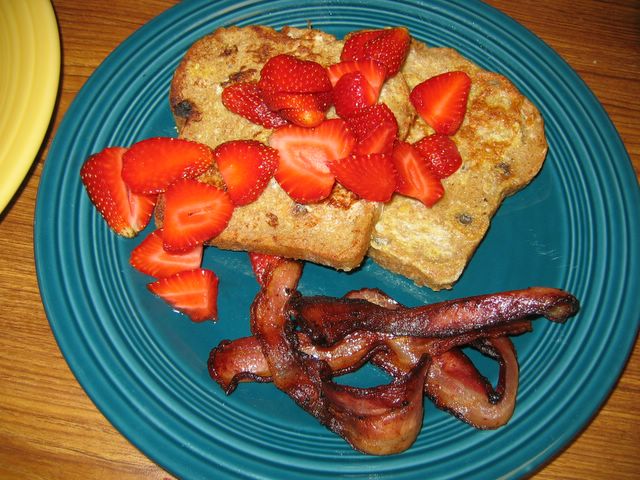
French toast with strawberries and bacon.
French Toast
Ingredients:
3 eggs, at room temperature
1/4 cup milk
1 teaspoon vanilla extract
1/8 teaspoon ground cardamom
1 tablespoon raw sugar or evaporated cane juice (optional)
dash cinnamon
6 slices stale bread
butter or canola cooking spray
Method:
Beat together eggs, milk, extract, spices and sugar until well combined. Heat oil or butter in pan over medium heat. Lay bread slices, one at a time in egg batter, and allow to soak very briefly, about thirty seconds total, turning once.
Fry, turning once, until bread is golden brown and fragrant. Serve with maple syrup and fresh fruit.
Notes:
Use a firm textured bread to make french toast--many store bought brands are too spongey and will fall apart when you try and soak the bread in the batter.
You can simulate stale bread by leaving how ever many slices you need out overnight.
You can hold french toast in a warm (170 degrees) oven for fifteen minutes or so while you finish cooking up enough for everyone. You can do the same thing with bacon, by the way. That is the secret to cooking breakfast for a crowd--a hot oven.
Fried apples are great with french toast in the fall. Fresh peaches are great in the summer, but not as good as strawberries.
The only gap I have found in the Athens food pyramid is a lack of local dairy products. I, personally, want to see if I can start producing goat cheese, but I need to look into the state laws governing dairies here in Ohio to see if it is worth my time attempting it. I know that they are extremely strict; I know of several folks at the farmer's market who have herds of dairy goats but who cannot sell the milk because of these health codes. So, I will have to do some research and see what I can come up with myself, as I would very much like to start making local cheeses, as I see a market for them and I know how it is done.
Until then, I will continue my quest to eat locally, and I urge everyone to try and do the same. Not only is it good for the earth and your neighbors--it is good for you.
Sunday, June 05, 2005
Strawberries, as God Intended
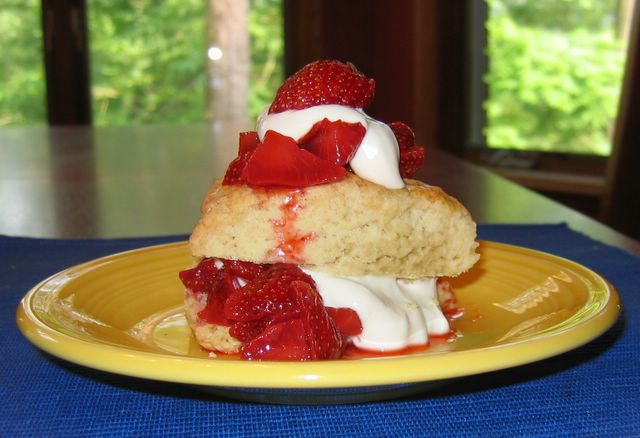
"Doubtless God could have made a better berry, but doubtless God ever did."--William Butler 1600.
As you most likely noticed in yesterday's photograph, I aquired some fresh, (just picked yesterday morning, in fact) locally grown strawberries, and I must tell you, they were a far cry from the plastic nubbins of nonsense that are sold in typical grocery stores. Not only are these fine beauties fragrant and brilliant crimson, they fairly burst with flavor when you bite them. The flesh yields to the teeth with tender grace without the slightest tendency to the swampy mush that berries will turn into if overripe or left to sit too long after picking. Honey sweet juice scented with floral delicacy rushes into the mouth, kissing the tongue with the promise of summer, while the faintest tang of acidity cleanses the palate and lingers as an aftertaste.
They are, in a word, delightful.
And so, I bought two quarts of them, just as I did last week.
And instead of eating them on top of french toast with maple syrup or folded into sour cream like we did last week, I decided I must do something more ambitious and jolly with them, and I knew just thing.
I had to make strawberry shortcake.
But, of course, it is foolish to make strawberry shortcake for only two people--it is rather a chore to bake the cakes and macerate the strawberries and then make some sort of creamy bit and then put it all together if only two people are going to be enjoy it. And I utterly refuse to purchase pound cake or worse, those little sponge cakelets with the divet in the center. Yes, I grew up eating those little squishy things, but I abhor them now; the little air pockets in the cakes fill up with strawberry juice and soon become soggy pink puddles of goo.
In a word: ugh.
No, I don't like angelfood cake as a base for shortcake, either.
As far as I am concerned, strawberry shortcake is properly made with a slightly sweetened biscuit as the base, not a bit of spongy cake that is mostly air. Etymology and history are on my side in this case; according to Merriam-Webster, "shortcake" is "a dessert typically made with a very short baking powder biscuit...spread with fruit." A "very short" biscuit is one made with shortening, meaning solid fat. In other words, the cake of a shortcake is a baking powder biscuit made with lots of solid fat. There is no mention over whether or not it should be sweetened, nor is there any about the presence of cream.
Historically speaking, however, strawberries and cream are a perfect pair, and have been eaten together in Europe probably ever since there were strawberries and cream available at the same time, which means at least as long as there have been people milking cows and goats and whatnot. There is a mention of how fond English ladies were of strawberries and cream in the writings of Henry IV's physician dating to 1560, so it is obvious that the pairing of dreamy dairy products and berries has been classic for at least 445 years or so.
As for where the idea of pairing the biscuit with the berries comes from, I had always assumed it was a British innovation, but I may be wrong. It seems as though strawberry shortcake is a homegrown American invention that may have been inspired by a native American strawberry bread that was made from mashed wild berries (which were supposedly better than the European berries) mixed with a cornmeal dough, then baked on a hearthstone. The English colonists took the idea, and applied their knowledge of baking and used wheat flour, and a classic recipe was born. With the invention of baking powder in the nineteenth century, the dish took off and became wildly popular from the 1850's on to the present day.
I am not sure when the spongecake abominations started to appear on grocery store shelves, nor am I going to waste the time to find out. I suspect it was an innovation of the 1950's or 1960's when mass-produced processed foods began to explode on the market and were eagerly adopted both by working mothers and stay-at-home housewives alike. It seems likely. I just know that I ate enough of those sodden sweets to last a lifetime and I refuse to eat any more.
So, where was I? Oh, yes--yesterday's conundrum: I wanted to make shortcake, I had the ingredients, but didn't want to make it for just two people. I was stewing on this problem when when the phone rang.
Zak answered it.
It was our dear friend Dan, who wanted to know if he could bring the new episodes of Dr. Who, downloaded from the Internet and burned to VCD for us to watch. Aha! An excuse! An excuse to make dinner and an excuse to make shortcake! And on top of it all, I get to see the new Dr., about whom Dan has been raving for the past several weeks or so.
So, the deal was made--he and Heather would come over, I would make dinner and then we would watch the good Dr. and all would be well. So, we bustled about, tidied up the house, beat the cathair off of the couch and I ran upstairs and started cutting up bits for Thai Basil Chicken.
Zak questioned the wisdom of pairing Thai Basil Chicken with strawberry shortcake.
"They won't go together," he said.
"Strawberry shortcake goes with everything," I answered and returned to my slicing and dicing.
When they got there, I informed them that I was making strawberry shortcake for dessert, and there was great rejoicing.
And so it came to pass, that after dinner, I rolled up my sleeves, and proceeded to make dessert. It is quite easy, though it requires a bit more effort than simply opening packages of spongecake and shaking up a can of whipped cream.
I make cream scones as the shortcakes using a recipe that I adapted from one in a tiny volume called, Simply Scones by Leslie Weiner and Barbara Allbright. I confess to having only used one other recipe in the book besides the one for cream scones, but to my taste, those scones are the ones I measure all other scones against. They are the Ur-Scone in my culinary universe, and few others measure up to the velvety, melting crumb and the hauntingly delicate flavor of these scones.
But before you make the scones, you have to make the filling so that the berries have time to macerate and release their juices, and the cream has time to come to full flavor. Strawberries are related to roses, so I add a splash of rosewater to them while they sit and come to room temperature. It heightens the flavor of the berries while adding an elusive, seductive note to the fruit. And instead of using whipped cream, I follow the Eastern European tradition of using lightly sweetened sour cream. I learned this from Zak, whose mother always ate strawberries with sweetened sour cream; the idea probably was passed from her family who were Lithuanian.
At any rate, here is the recipe for my version of strawberry shortcake, which is guaranteed to knock the socks off of anyone who eats it.
Oh, and by the way, it -does- too go with Thai food, just like I said. There was not one complaint last night during dessert about it being too weird of a combination. So, not only will this recipe taste great--it goes with anything.
Every cook needs a dessert recipe that is that versatile.
Strawberry Shortcake
Ingredients:
1 quart fresh, local strawberries, hulled and sliced
raw sugar to taste
rosewater to taste
1/2 pint sour cream
1 1/2 tablespoons evaporated cane juice (Sucanat) or white sugar
2 cups all purpose flour
1/4 cup raw sugar
2 teaspoons baking powder
1/8 teaspoon ground cardamom
1/8 teaspoon salt
1/3 cup chilled butter, cut into small cubes
1/2 cup heavy cream
1 large egg
1 1/2 teaspoons vanilla extract (I use Penzey's double strength vanilla extract for a heavy punch of flavor)
1 egg mixed with 1 teaspoon water for glaze
Method:
Preheat oven to 425 degrees F. Set a silpat on a baking sheet and spray it lightly with baking spray or butter it lightly. (If you don't have a silpat, just lightly butter the baking sheet.)
Put berries in a bowl in a warm place and sprinkle with sugar and rosewater. Toss lightly and allow to sit undisturbed until they come to room temperature and the berries release their juices.
In another bowl, whisk together the sour cream and evaporated cane juice or sugar. Whisk until the sugar dissolves. Cover and refridgerate until it is time to assemble the shortcakes.
In a medium sized bowl, mix together all dry ingredients. Whisk together the cream, egg, and vanilla extract until well combined.
Sprinkle cubes of butter over the flour mixture and cut in with a pastry blender until mixture resembles coarse crumbs. Add the wet ingredients to the dry ingredients, mixing together until just combined.
With lightly floured hands, knead the mixture gently until it comes together into a single ball of dough. Lay it on the prepared baking sheet and pat it into a flat disk about 1" thick.
With a bench knife or sharp chef's knife, cut in half and each half into thirds until you have six roughly equal sized wedges. Pull the wedges slightly apart so that air can circulate between them.
Mix together second egg and water until well combined. Brush over the tops of the scones with this glaze and bake in preheated oven for 13-18 minutes, or until lightly browned.
When they are golden, take them out of the oven and cool slightly on a wire rack. When cool enough to handle, split scones in half. Place bottom half on a plate, top with a tablespoon or two of berries, and then a tablespoon and a half of cream. Place top of scone on top of cream, top with more berries and a dollup more of the cream.
If you wish, garnish with mint leaves or a strawberry fan.
Serves six.
Notes:
To cut a strawberry fan, choose a small, perfect berry. Leave the leafy top on. Starting at the tip and cutting toward the leaves, cut thin slices about 3/4 of the way through the berry, stopping all at the same point. When these slices are cut, lay the berry on a cutting board and lightly flatten it, fanning out the slices.
About the rosewater: I usually use about 2 teaspoons of it, but how much you use depends on what brand you use and how strong it is. I suggest Cortas brand.
About the sour cream: you can use lowfat, but full fat is better tasting--but which ever one you use, make sure to use a really good naturally produced brand without a lot of guar gum and other weirdo ingredients.
About the evaporated cane juice and raw sugar: I use the cane juice because it has a slightly more complex flavor and because it dissolves better in the sour cream. I use the raw sugar because I like the flavor of it better. If you want, you can substitute plain white sugar in the same amounts in this recipe.
Variation: For really sweet berries, you can be Italian and add a dash of really good balsamic vinegar to the maceration mixture. It really works, and tastes absolutely divine.
You can also use this recipe with blackberries to wonderful effect, including the use of rosewater. However, with blackberries, I use whipped cream to which I have added a bit of Irish Cream liquor.
Saturday, June 04, 2005
An Embarrassment of Riches and a Richness of Embarrassment

The bounty from today's excursion at the Athens Farmer's Market. Clockwise from the bottom left: pencil-thin asparagus, baby Japanese turnips, smoked bacon, scallions, a locally grown hydroponic tomato, hardneck garlic, chicken breasts, basil, cilantro and fragrant strawberries, just picked this morning on a farm next to the Hocking River.
I have returned, again.
No, I have not beeen writing, though it is not for lack of trying. The RSI (Repeated Stress Injury) in my wrists has returned with a hideous vengeance, making it difficult to nigh on impossible for my to type for any period of time. It is not surprising--moving involves lots of use of arms and hands for packing, lifting, loading and carrying. Now that we are here, there is a lot more lifting loading and carrying in the unpacking department; furthermore, I have been washing down walls, painting, scrubbing and using screwdrivers, hammers and other impliments of construction and destruction, which leads to new repetative motions and load-bearing activities that my wrists, forearms, shoulders and back disagree with.
So, I have been icing my wrists, going to a new massage therapist and searching in vain for my wrist braces. I finally bought some more, knowing that if I do that and wear them, then the old ones will show up out of the blue, and I will feel foolish for plunking down the cash for a new set of them.
Such is life. So that is the richness of embarrassment. How about the embarrassment of riches?
We just came back from the farmer's market with a lovely stash of local goodies to cook and consume. It is very fulfilling to get up early in the morning on Saturday, and wander over to see the crowds of people at the farmer's market, all milling around, talking, laughing, eating and drinking, visiting and buying locally grown and produced vegetables, herbs, meats, eggs, honey, cider, fruits, and flowers. Folks buy bedding plants, vegetable starts, herbs and seeds for their gardens, and choose from an array of freshly baked goods like hearth breads, pies (rhubarb is in season now), scones, rolls and pretzels. One lady brings cookies to which I am addicted: she calls them Peanut Butter Slammers. I have to watch myself, or I would eat two of them a day--they are two big, tender peanut butter cookies sandwiched with a filling of peanut buttercream icing. Oh, they are sinfully delectable.
Luckily all of this lifting, loading, hefting, toting and going up and down the stairs in the new house has resulted in a loss of flab and a gain of muscle. Otherwise each bite of a Slammer would probably throw another pound or two of excess flesh upon my frame.
A trip to the Athens Farmer's Market isn't just a shopping excursion. There is a real community atmosphere at the market; there is always live music, bakers and and canners give out samples of their wares, there is an outdoor cafe where folks sit and have a nosh and drink coffee, and everywhere you look there are friends you know and friends you just haven't met yet. It is just a happy place.
Today, in addition to picking up a delicious haul of ingredients for the coming week's meals, we got to talk with some friends who had brought kittens from a stray they had taken in, and managed to adopt them out. I was buying asparagus from some wonderful Quaker farmers when Zak, who was munching contentedly on a blueberry scone heard the unmistakable sound of a wee kitten mewling. He saw a tiny white and orange kitten go by on someone's shoulder. It turned out it was our friends Eli and Mikio, who had brought the last kittens of the litter to give them away at the market. While we stood and talked with them, a lady brought by the last of a litter of puppies a stray had whelped at her house.
Athens is a place where you can trust the folks you give a kitten to at the market to take care of that cat as it grows up. Not only are people committed to growing and eating good food, and working towards a sustainable local food economy, but they care about animals, kids and each other. Even though it happens in the parking lot of a mostly-empty strip mall, the farmer's market is a relaxed sort of place where you can take the time to visit with neighbors while you shop for food--it is a far cry from the soulless environment of most huge grocery stores. You can visit with the farmers, ask them questions, and give them feedback about their produce. You can share recipes with strangers, and get gardening advice from the Master Gardeners from OSU's Extension Program or from the gardeners who just happen to be milling around.
It is an amazing experience to see people come together and celebrate food and community, not only on a holiday, but once a week, in the spirit of friendship and local solidarity.
It is really good to be home.

