

Sunday, October 30, 2005
Noodles as an Economic System
 When I went back to college, one of my dearest friends used to calculate the cost of everything by how many packages of ramen it could buy.
This was a winter when her funds were low, so every time a lightbulb burned out, or she needed to replace a tire, or purchase a bottle of Nyquil to get through the never-ending round of colds and flu, she would say, "And with the money I spent on that I could have bought thirty two and a half packages of ramen."
Or however many packages it worked out to.
She was on the all-ramen diet. All ramen all the time.
She regaled us with the various ways she ate it, once she tired of eating it as a soup.
She ate the noodles raw, like chips, and dipped them in salsa.
She cooked them and drained them and put ketchup on them and called it "spaghetti."
She crushed the raw noodles up and put salad dressing over them and tossed them with a few pathetic lettuce leaves.
And I even think she might have poured milk on them, doused them in sugar and called it cereal, but don't quote me on that. I could be wrong.
But the fact remains, that while ramen are fat-laden and utterly horrific for one, while she was living on her "all ramen, all the time" diet, she lost weight.
And she didn't even need to.
Well. I couldn't have that--so, Zak and I started inviting her over, and making certain she would arrive at supper time. This took a bit of cleverness on our part, because if we were to invite her formally for supper, she would feel as if she should reciprocate or bring wine or something, and she couldn't afford such niceities. So, we just "happened" to tell her to come over, and when she arrived, I just "happened" to be "late" putting "supper on the table," and, "look," I'd say--"there is plenty for three of us! And, oh, do sit down and eat, I will be most put out if you don't, of course you can, look, see, I have already dished it up for you, and everything, and I'll have to wash the plate anyway, so you might as well eat it."
She always ate plenty, and helped wash up afterwards, and after a couple of weeks of this, she finally got suspicious and said, "You guys are doing this on purpose aren't you?"
Well, when asked directly, one cannot lie to a friend, so we had to 'fess up to it. And which point, she said, "Oh, you don't have to, and I will pay you back somehow," and before she could get really self-abasing, we made it clear that she need not worry, and that there was no need for payment, because her company and friendship is beyond price.
It was quite simple.
We had.
She had not.
So, we shared.
She stopped losing weight, and went on to have much less lean winters and now, I suspect would die rather than even look a bowl of ramen straight in the eye again.
And we all laugh about the noodle-based monetary system.
But, I cannot blame her.
Even if, when push comes to shove, I can make ramen taste like it started out as food.
And I did so just tonight, and I will tell you how I did it and why.
It is my and Zak's twelfth anniversary.
(No, silly, I did -not- make ramen for our anniversary dinner. Sheesh. Read on.)
And so, we gallivanted off to spend the day in Columbus doing couple-like things together--which for us included shopping for food, shoes and Chinese movies.
For people like us who posess bad feet, sensible shoes and the aquisition thereof is the stuff of which great romance is made. One simply cannot be human, much less loving, if one's feet are about to fall off in a most painful way. And of course, food shopping--is utterly erotic, what with the promise of all the goodies that will be made with the delightful ingredients we can pick up in "the big city."
And Chinese movies--well, we are as passionate about them as we are about each other.
We did all of this, plus had ravishingly luscious sushi, before coming home to Morganna.
Ah--see--that is where the noodles come in.
 She graciously allowed us a day to be silly newlyweds again, instead of parental units, and stayed home. And though I fed her on freshly made waffles and bacon, and extracted a solemn promise from her that she would eat something nutritive during the day, she fenced a friend to a standstill, and then ate ice cream.
So, needless to say, when we waltzed in at eight o clock, she was ravenous. We showered her with her presents, (Japanese chocolates and Batz Maru goodies) and showed her the precious DVD's we had brought, and showed off our new shoes and clothes, and she was properly excited and happy.
And then, her stomach growled, I sighted the empty carton of Ben & Jerry's and it was all over.
"You didn't eat anything but ice cream, did you?"
She shook her head, trying to look contrite and failing utterly.
"And now you are hungry for something with nutritional value, aren't you?"
She nodded avidly.
So, upstairs to the kitchen I went, and broke out the ramen.
Ramen is one of the few convenience food items I will still use and eat now and again. I don't use that "Top Ramen" crap you get in most American grocery stores--it tastes like sawdust and MSG with a side of salt and plastic for flavor. I use the Korean and Japanese brands, and add goodies to it to make it taste like real food.
For example--tonight, I added to the cooking water chicken broth, leftover sauce from ja jiang mein which I had in the fridge, slivers of dried Chinese black mushrooms, a goodly slosh of Shaoxing wine and the two very lonely baby Shanghai bok choy which were not worth cooking on their own, and were thinking of wilting into a pathetic huddle at the bottom of the vegetable drawer.
A few slivers extra of garlic and ginger, and voila!
Within minutes, something hot, edible and with nutritive value appeared in a bowl and was gobbled up by the hungry girl who was too silly to cook the noodles on her own, even though I know she can do it herself--I have seen the proof of it with my own eyes.
But, in truth--I think she wanted me to do it.
It must taste better with a bit of Mom magic in it.
Saturday, October 29, 2005
Weekend Cat Blogging: Happy Birthday Kiri!
 All of my kitties were invited to Kiri's Birthday Party at Eatstuff!
But look at them!
They are all lazy and slept in.
They didn't put on party clothes, or bring presents or bake a cake!


 I have wicked, slothful kitties.
All they do is sleep.
And lounge around.
And nap.
They are good at napping.

At least Grimalkin likes festivity. As you can see--she is under last year's Christmas tree.
It was her favorite accessory.
At least one of our cats knows how to party.
Sort of.
Anyway--Happy Birthday, Kiri--you are a handsome boy, and I know that your Clare is proud!
Friday, October 28, 2005
The Kitchen Update: Lights, Walls and Infrastructure
 This is the second week of kitchen rennovation, and I thought I would post some photographs of the progress so far.
I know it doesn't look like there has been much in the way of progress, but there has. For one thing, the walls, ceiling and floor are all intact, and the walls are ready for paint, tile and cabinetry.
My first excitement is the number of lights they installed in this kitchen. Look at all those can lights recessed into the ceiling. Look at that. Isn't it beautiful? When we moved in, the only sources of light were the ugly fruit lamp which everyone universally hates, three cans over the sink, and the light under the microwave over the stove.
 All of you folks who read here who cook know that it is just not enough. Cooking in a dim room is like cooking in a cave; a dim kitchen is not ambiance, it is annoying.
Now, I have fourteen can lights installed, with undercabinet lights coming along when the cabinets are installed.
I need never fumble in the dark again.
I am ecstatic.
A lot of the improvements you cannot really see in these photographs--they happened under the drywall. They rewired everything, and apparently had a not too fun time doing it, considering the cursing that went on while they worked. But now we have plenty of juice coming in to power the stove (it is a dual fuel--gas cooktop, and four electric ovens below), the horrifyingly huge vent that the stove requires, the garbage disposal, which we did not have before, and all the other bells and whistles that the kitchen will possess. Next to that mop pictured above is where the stove will live and dominate the kitchen with its magnificent presence.
 What had been a gaping hole in the wall, exposing the guest room to scrutiny, is, as you can see to the left, now a niche into which bookshelves to hold most of the cookbook collection will go. The patch next to the door to the dining room there, where the glass fronted cabinet was hung, will have another glass-doored cabinet, and below it a cart with a butcher's block top that can be wheeled away from there to be used as a kitchen island, or left in place to serve as a second prep area.
 The corner to the right is where a small desk area will be put, along with glass doored cabinets above, and drawers below. That is where the desktop will live, which will house, among other things, all of my recipes, so if I want one, I don't have to print it out and waste paper in my office and carry it to the kitchen. I can call it up and read it from the screen. A telephone line is there as well, and look--lights above that don't involve either the still extent ugly torchier or the hateful fruit lamp that tried to kill everyone who came near it.
 Finally, there is another view of the window area with the lights. I really like lights. They make me happy.
Here, I can tell you a bit more of the colors that the kitchen will have--the extent red tile floor is staying--it has streaks of black in it.
The window will have an exterior frame of moss green stained wood, with an interior frame painted a green so dark it registers as black. All of the appliances save the stove will be black--the hood will also be black enamel. A moss green shelf will go over the windows, and the walls behind the cabinets on the upper part of the room will be painted a paler moss green.
Below the cabinets, along the sink area and behind the stove will be tiled with a variagated tile that has reddish tones, green, moss, black and golden sandstone colors. The majority of the cabinetry is golden oak, and will have solid doors--about the color of the door to the dining room, and the floors throughout the house. The glass fronted cabinets on the other end of the kitchen where the desk and kitchen island will be are going to be the moss green stained oak.
The sink is undermounted beneath the quartz countertop which will be a warm color that incorporates flecks of green, the exact same red as the floor tile, gold and black veining. The sink is a single large black enamelled cast iron sink which is deep and wide enough to hold my stockpots and woks--no more balancing woks on two compartment sinks and scrubbing which sends water flying in all directions. Gah. None of that. The faucets will match the Arts and Crafts/Mission style bronze cabinet hardware, and are an antique-style bronze. They will be very pretty.
I will take more pictures as this takes shape, and might do an entire before/after thing when it is done.
The Naked Post: Pork, Tofu and Gai Lan
So you notice that this post is naked.
No, not that way--there are no pictures.
There are two good reasons for this.
While I was cooking dinner last night and Morganna was poised to record it all with the camera, she got through photographing the ingredients and poof! The rechargable batteries went dead, and that was that.
And--when I tried to upload at least those photographs this morning, Blogger was having none of that. After three tries, I gave up and decided to have an all-nude-review of a recipe today, and to heck with it.
I would have written about this last night, but my computer was busy being taken apart and put back together. Yes, I now have a new computer desk, one made of wood, even, so it has a keyboard drawer that works. It isn't held on with duct tape, prayers and baling twine anymore. That is, to misquote Martha, "A good thing."
So, now that we have established that my post is unillustrated, and I have a desk that works, lets talk about dinner last night.
It all started as I was looking through some of my out of print Chinese cookbooks, looking for recipes I could do at some point in the future, particularly when I write about each book. I think that my write ups for "The Chinese Cookbook Project" will be more fun if I did a recipe or two from each book, rather like I did that one recipe from one of Fu Pei Mei's book. So, in preparation for that, I was digging through the books I had planned to highlight with a pack of post-it notes and a pen and was marking recipes that sounded fine and tasty.
And I came upon one, in one of the books--it might have been Irene Kuo's excellent Key to Chinese Cooking--for pork and some sort of green in black bean sauce. Fermented black beans tend to make everything taste good; they have an overabundance of compounds in them that give the savory flavor that the Japanese call "umami." And since I have a nice cannister of them on my counter, I thought, "Why not?"
I also had another pound of gai lan still in the refrigerator that needed to be eaten. And I had a pair of small but thick boneless pork loin chops in the freezer. I knew that by themselves, that wouldn't be enough for three people for dinner, even with lots of rice, but I also knew that Zak and Morganna could pick up some pressed tofu at the Asian market, after he picked her up from school, and I had some fantastically sweet carrots from the farmer's market that would go quite well with it all.
So, out of the freezer came the pork, and I explained to Zak where to find the spiced dry (pressed) tofu at the market and the game was afoot.
Did I use the Irene Kuo recipe? Well, no, not so much, because by the time I had decided to do pork and gai lan, I had moved on to another book, and when I went back through all of the bookmarks, I couldn't find the recipe. Maybe it was a phantom--maybe the idea came out of my own head and I just thought I had seen it in one of my books.
Maybe, just maybe, I am losing what is left of my mind. I just turned forty and senility is already plucking at my sleeve. Great.
Maybe, just maybe, I am over-reacting, because it didn't matter if I didn't have a recipe. While I cannot show you how prettily the dish turned out, I can tell you that it ended up tasting quite delicious--I used a lot of garlic which mellowed out the sharpness of the larger gai lan stems, and the fermented black beans added a dark mysteriousness to the sauce which was nothing more than soy sauce, chicken broth and Shaoxing wine with a final kiss of sesame oil. Garlic also pairs perfectly with pork; Zak and I are of the opinion that the sharpness of ginger is a better partner to beef, while the rounder heat of garlic goes with the sweetness of pork. I will still use a bit of garlic in a beef dish and a bit of ginger with pork, but always in smaller amounts.
Zak and Morganna appeared fresh from the store, and starving, right after I had given up and put all of my cookbooks fairly neatly away in their new shelves upstairs. Zak plopped two packages of tofu in front of me--one, the proper one, and the other a spicy extra firm marinated tofu by the same company. Fascinating. I set that one aside (look for a new tofu recipe next week), and took up the proper one, and after being implored by Morganna's beseeching eyes, I started making dinner.
"Spicy or not spicy, Morganna?"
"Spicy," she said decisively. "We've had mostly mild food this week."
"Need to heat up your chi?" I asked as I dug in the freezer for the Sichuan peppercorns and the ripe jalapeno chiles.
Morganna looked up from rinsing the gai lan. "Yep."
We worked together in silence; she peeled garlic, I sliced an onion, she measured out the fermented salted black beans and mashed them with the back of a spoon, I cut the large stalks of gai lan into diagonal slices. Jasmine rice bubbled away in the rice cooker, perfuming the air with its hunger-inducing sweet fragrance.
Our stomachs growled.
Morganna patiently shook the frying pan into which we had poured a few of the Sichuan peppercorns, waiting until their flowery scent wafted up. She took them from the heat and poured them into the stone mortar to cool before she ground them into a fine, reddish-brown powder. By that time I had sliced the carrots into thin diagonal ovals, and was working on the pork. The tender meat was more difficult to cut fully thawed than it would have been if I had gotten to it when it was still half-frozen, but the extremely sharp edge of little cleaver took care of that, and I still ended up with thin morsels of pork. Thinner slices cook faster, and they also give the illusion of an abundance of meat in a dish.
One of the new things I did that I know was influenced by my re-reading of Irene Kuo was that I marinated the pork not only in cornstarch and Shaoxing wine, but also in sugar. This accomplishes two things--it flavors and tenderizes the meat, but also, when the sugar hits the hot wok with the pork, it caramelizes and forms a delectable coating on the pork, and on the wok, which is then deglazed by a good slosh of soy sauce and wine. I really think that adding the sugar to the marinade and not the sauce really made a difference with the sauce in this dish--it was so good, Morganna and I wanted to drink it from a spoon.
It cooked as usual--heat the faithful cast iron wok, add the oil, heat some more, and then in went the aromatics--a tiny pinch of the Sichuan peppercorns, and the sliced onion. I cooked the onion until it turned quite golden, and then added the sliced garlic, ginger and chile. I also think that thoroughly cooking the onions until they soften and begin to caramelize before adding other ingredients added another layer of depth to the sauce's flavor. I know I have gotten that way about cooking onions from my experiences with Indian foods, but now, I cook onions darker in everything I cook. No more cooking them just until they are transluescent for me--they seem too water and insipid in flavor.
So, no matter if I am cooking Chinese, Thai, Italian, Mexican or French--I cook my onions until a color of one shade or another blooms on them, and the flavors are so much better--and it is a debt I owe to Indian cookery.
I haven't come up with a fun name for this dish yet--maybe I should ask my readers to name it. When I asked Zak and Morganna they said, "Just call it good."
So, for now, that is what we are calling it:
Good Pork Tofu and Gai Lan
Ingredients:
2 small, but thickly cut pork loin chops, sliced into 1" X 1/2" slices
1 1/2 tablespoons Shaoxing wine, or sherry
1 tablespoon cornstarch
1 teaspoon brown or raw sugar
3 tablespoons peanut oil
1 medium onion, peeled and thinly sliced
1 heaping tablespoon fermented black beans, mashed
5 cloves garlic, peeled and sliced thinly
1/2" cube fresh ginger, peeled and thinly sliced
2 red jalapeno chiles, thinly sliced on the diagonal
1 tablespoon Sichuan peppercorns, stems removed
1 8 ounce package thick cut dry spiced tofu, cut on the diagonal into thin slices
1-2 tablespoons thin soy sauce
1 tablespoon Shaoxing wine
1 pound gai lan, washed and trimmed
4 small carrots, peeled and sliced into 1/4" thick diagonal slices
1/4 cup chicken broth
1/4 teaspoon sesame oil
Method:
Mix together pork slices, wine, cornstarch and sugar and set aside to marinate for at least twenty minutes. (You can do this while you prepare all the other ingredients for cooking.)
Toast the Sichuan peppercorns by putting them in a heavy-bottomed skillet and shaking it back and forth over high heat until they release a nice, strong, flowery-spicy scent. Pour them into a mortar, and after they are cool enough to touch, grind them up into a nice reddish brown powder.
To prepare the gai lan--trim the bottom bit of the stalks where it was cut from the roots, and discard. After washing, dry thoroughly in a salad spinner. Cut off large leaves, and then cut them into 3-4" lengths. Cut off any thick stems--thicker than 1/2" or so--and if the peel is very tough, peel them. Then cut these thick stems diagonally into slices about as thick as your carrot slices. Put your carrot slices and gai lan stem slices together in a bowl, and put the leaves and thinner stem pieces together in a bowl.
Heat up your wok, when it releases its breath in a wisp of white smoke, then add peanut oil and allow it to heat for a minute, until it shimmers from the convection currents. Add onion, and stir and fry until they wilt. Add a pinch of the powdered Sichuan peppercorn, and keep stir frying until the onion turns distinctly golden.
Add the ginger, garlic, chile and black beans all at once, and stir and fry until the whole is very fragrant. (At this point is usually when the stomach starts to growl--I swear that nothing is better than the smell of garlic, onions and fermented black beans cooking.) This should take about one minute.
Add the meat, reserving any liquid marinade that isn't clinging to the meat. Spread the meat into a single layer on the bottom of the wok, and let it sit, undisturbed until you can smell it browning--because of the sugar in the marinade this is faster than usual. At that point, start stirring and frying. Add tofu, and keep stirring and frying until most of the pink is gone from the meat. Add the extra marinade, if there is any, the soy sauce and the Shaoxing, and if there is any browned bits in the bottom of the wok, scrape them up.
Add the gai lan stem slices and the carrot, and stir and fry for about a minute or two. Spread the gai lan leaves over all, and add the chicken broth, then stir vigorously but carefully. The idea is to get the already cooked stuff up on top of the gai lan and get it down into the wok where the leaves will wilt into a velvety-sweet texture and be coated by the sauce. Add another pinch of Sichuan peppercorns and stir madly until the leaves begin wilting.
Once the leaves have wilted sufficiently, pull the wok from the heat, and stir in the sesame oil, then put into a warmed serving dish.
Sprinkle with a very generous pinch of the ground Sichuan peppercorns, and serve with steamed rice.
I am really sorry that I have no pictures of this dish--however--as I am informed that I will be making it again, I figure I can post photographs next time.
No, not that way--there are no pictures.
There are two good reasons for this.
While I was cooking dinner last night and Morganna was poised to record it all with the camera, she got through photographing the ingredients and poof! The rechargable batteries went dead, and that was that.
And--when I tried to upload at least those photographs this morning, Blogger was having none of that. After three tries, I gave up and decided to have an all-nude-review of a recipe today, and to heck with it.
I would have written about this last night, but my computer was busy being taken apart and put back together. Yes, I now have a new computer desk, one made of wood, even, so it has a keyboard drawer that works. It isn't held on with duct tape, prayers and baling twine anymore. That is, to misquote Martha, "A good thing."
So, now that we have established that my post is unillustrated, and I have a desk that works, lets talk about dinner last night.
It all started as I was looking through some of my out of print Chinese cookbooks, looking for recipes I could do at some point in the future, particularly when I write about each book. I think that my write ups for "The Chinese Cookbook Project" will be more fun if I did a recipe or two from each book, rather like I did that one recipe from one of Fu Pei Mei's book. So, in preparation for that, I was digging through the books I had planned to highlight with a pack of post-it notes and a pen and was marking recipes that sounded fine and tasty.
And I came upon one, in one of the books--it might have been Irene Kuo's excellent Key to Chinese Cooking--for pork and some sort of green in black bean sauce. Fermented black beans tend to make everything taste good; they have an overabundance of compounds in them that give the savory flavor that the Japanese call "umami." And since I have a nice cannister of them on my counter, I thought, "Why not?"
I also had another pound of gai lan still in the refrigerator that needed to be eaten. And I had a pair of small but thick boneless pork loin chops in the freezer. I knew that by themselves, that wouldn't be enough for three people for dinner, even with lots of rice, but I also knew that Zak and Morganna could pick up some pressed tofu at the Asian market, after he picked her up from school, and I had some fantastically sweet carrots from the farmer's market that would go quite well with it all.
So, out of the freezer came the pork, and I explained to Zak where to find the spiced dry (pressed) tofu at the market and the game was afoot.
Did I use the Irene Kuo recipe? Well, no, not so much, because by the time I had decided to do pork and gai lan, I had moved on to another book, and when I went back through all of the bookmarks, I couldn't find the recipe. Maybe it was a phantom--maybe the idea came out of my own head and I just thought I had seen it in one of my books.
Maybe, just maybe, I am losing what is left of my mind. I just turned forty and senility is already plucking at my sleeve. Great.
Maybe, just maybe, I am over-reacting, because it didn't matter if I didn't have a recipe. While I cannot show you how prettily the dish turned out, I can tell you that it ended up tasting quite delicious--I used a lot of garlic which mellowed out the sharpness of the larger gai lan stems, and the fermented black beans added a dark mysteriousness to the sauce which was nothing more than soy sauce, chicken broth and Shaoxing wine with a final kiss of sesame oil. Garlic also pairs perfectly with pork; Zak and I are of the opinion that the sharpness of ginger is a better partner to beef, while the rounder heat of garlic goes with the sweetness of pork. I will still use a bit of garlic in a beef dish and a bit of ginger with pork, but always in smaller amounts.
Zak and Morganna appeared fresh from the store, and starving, right after I had given up and put all of my cookbooks fairly neatly away in their new shelves upstairs. Zak plopped two packages of tofu in front of me--one, the proper one, and the other a spicy extra firm marinated tofu by the same company. Fascinating. I set that one aside (look for a new tofu recipe next week), and took up the proper one, and after being implored by Morganna's beseeching eyes, I started making dinner.
"Spicy or not spicy, Morganna?"
"Spicy," she said decisively. "We've had mostly mild food this week."
"Need to heat up your chi?" I asked as I dug in the freezer for the Sichuan peppercorns and the ripe jalapeno chiles.
Morganna looked up from rinsing the gai lan. "Yep."
We worked together in silence; she peeled garlic, I sliced an onion, she measured out the fermented salted black beans and mashed them with the back of a spoon, I cut the large stalks of gai lan into diagonal slices. Jasmine rice bubbled away in the rice cooker, perfuming the air with its hunger-inducing sweet fragrance.
Our stomachs growled.
Morganna patiently shook the frying pan into which we had poured a few of the Sichuan peppercorns, waiting until their flowery scent wafted up. She took them from the heat and poured them into the stone mortar to cool before she ground them into a fine, reddish-brown powder. By that time I had sliced the carrots into thin diagonal ovals, and was working on the pork. The tender meat was more difficult to cut fully thawed than it would have been if I had gotten to it when it was still half-frozen, but the extremely sharp edge of little cleaver took care of that, and I still ended up with thin morsels of pork. Thinner slices cook faster, and they also give the illusion of an abundance of meat in a dish.
One of the new things I did that I know was influenced by my re-reading of Irene Kuo was that I marinated the pork not only in cornstarch and Shaoxing wine, but also in sugar. This accomplishes two things--it flavors and tenderizes the meat, but also, when the sugar hits the hot wok with the pork, it caramelizes and forms a delectable coating on the pork, and on the wok, which is then deglazed by a good slosh of soy sauce and wine. I really think that adding the sugar to the marinade and not the sauce really made a difference with the sauce in this dish--it was so good, Morganna and I wanted to drink it from a spoon.
It cooked as usual--heat the faithful cast iron wok, add the oil, heat some more, and then in went the aromatics--a tiny pinch of the Sichuan peppercorns, and the sliced onion. I cooked the onion until it turned quite golden, and then added the sliced garlic, ginger and chile. I also think that thoroughly cooking the onions until they soften and begin to caramelize before adding other ingredients added another layer of depth to the sauce's flavor. I know I have gotten that way about cooking onions from my experiences with Indian foods, but now, I cook onions darker in everything I cook. No more cooking them just until they are transluescent for me--they seem too water and insipid in flavor.
So, no matter if I am cooking Chinese, Thai, Italian, Mexican or French--I cook my onions until a color of one shade or another blooms on them, and the flavors are so much better--and it is a debt I owe to Indian cookery.
I haven't come up with a fun name for this dish yet--maybe I should ask my readers to name it. When I asked Zak and Morganna they said, "Just call it good."
So, for now, that is what we are calling it:
Good Pork Tofu and Gai Lan
Ingredients:
2 small, but thickly cut pork loin chops, sliced into 1" X 1/2" slices
1 1/2 tablespoons Shaoxing wine, or sherry
1 tablespoon cornstarch
1 teaspoon brown or raw sugar
3 tablespoons peanut oil
1 medium onion, peeled and thinly sliced
1 heaping tablespoon fermented black beans, mashed
5 cloves garlic, peeled and sliced thinly
1/2" cube fresh ginger, peeled and thinly sliced
2 red jalapeno chiles, thinly sliced on the diagonal
1 tablespoon Sichuan peppercorns, stems removed
1 8 ounce package thick cut dry spiced tofu, cut on the diagonal into thin slices
1-2 tablespoons thin soy sauce
1 tablespoon Shaoxing wine
1 pound gai lan, washed and trimmed
4 small carrots, peeled and sliced into 1/4" thick diagonal slices
1/4 cup chicken broth
1/4 teaspoon sesame oil
Method:
Mix together pork slices, wine, cornstarch and sugar and set aside to marinate for at least twenty minutes. (You can do this while you prepare all the other ingredients for cooking.)
Toast the Sichuan peppercorns by putting them in a heavy-bottomed skillet and shaking it back and forth over high heat until they release a nice, strong, flowery-spicy scent. Pour them into a mortar, and after they are cool enough to touch, grind them up into a nice reddish brown powder.
To prepare the gai lan--trim the bottom bit of the stalks where it was cut from the roots, and discard. After washing, dry thoroughly in a salad spinner. Cut off large leaves, and then cut them into 3-4" lengths. Cut off any thick stems--thicker than 1/2" or so--and if the peel is very tough, peel them. Then cut these thick stems diagonally into slices about as thick as your carrot slices. Put your carrot slices and gai lan stem slices together in a bowl, and put the leaves and thinner stem pieces together in a bowl.
Heat up your wok, when it releases its breath in a wisp of white smoke, then add peanut oil and allow it to heat for a minute, until it shimmers from the convection currents. Add onion, and stir and fry until they wilt. Add a pinch of the powdered Sichuan peppercorn, and keep stir frying until the onion turns distinctly golden.
Add the ginger, garlic, chile and black beans all at once, and stir and fry until the whole is very fragrant. (At this point is usually when the stomach starts to growl--I swear that nothing is better than the smell of garlic, onions and fermented black beans cooking.) This should take about one minute.
Add the meat, reserving any liquid marinade that isn't clinging to the meat. Spread the meat into a single layer on the bottom of the wok, and let it sit, undisturbed until you can smell it browning--because of the sugar in the marinade this is faster than usual. At that point, start stirring and frying. Add tofu, and keep stirring and frying until most of the pink is gone from the meat. Add the extra marinade, if there is any, the soy sauce and the Shaoxing, and if there is any browned bits in the bottom of the wok, scrape them up.
Add the gai lan stem slices and the carrot, and stir and fry for about a minute or two. Spread the gai lan leaves over all, and add the chicken broth, then stir vigorously but carefully. The idea is to get the already cooked stuff up on top of the gai lan and get it down into the wok where the leaves will wilt into a velvety-sweet texture and be coated by the sauce. Add another pinch of Sichuan peppercorns and stir madly until the leaves begin wilting.
Once the leaves have wilted sufficiently, pull the wok from the heat, and stir in the sesame oil, then put into a warmed serving dish.
Sprinkle with a very generous pinch of the ground Sichuan peppercorns, and serve with steamed rice.
I am really sorry that I have no pictures of this dish--however--as I am informed that I will be making it again, I figure I can post photographs next time.
Wednesday, October 26, 2005
Short and Serious: Avian Flu
Okay, first of all, this is a short post, because I don't really have a functioning computer desk, because my keyboard shelf has given up the ghost for the last time. Particle board desks do not appreciate being taking apart and put back together more than say, once, maybe twice. This poor thing has had this treatment three times in a year, and that was enough. It is done, finished, over, and gone.
So, we haven't put the new desk together, and as I do have a wee spot of the carpal tunnel, I don't want to spend too long typing in this bizarro position.
So, I thought I would post a bit about the Avian flu, which is tangentially food-related as this killer virus is carried primarily by domestic poultry. And while so far, it hasn't seemed to mutate into a variant that can jump from human to human, there are folks in Asia who caught it from birds dying from it anyway. Not a whole lot of folks, but enough to make myself, and the World Health Organization, a tad bit paranoid. (Ever hear of a pandemic? I bet you wish you hadn't.)
So, I decided to highlight a few news items relating to this current health issue, just to, you know, maybe get folks to pay attention to it and you know, be prepared. (How do you prepare for a pandemic?)
So, today, the EU has issued a health warning to their citizens to not eat raw poultry (do people do that?) or eggs (okay, that I know from) because there have been some wild birds infected with the fatal Avian flu virus found in Croatia. They have also suspended importation of poultry and eggs from countries where there have been outbreaks. Mind you, the link between humans eating infected poultry products and catching the disease has not been proven--it is just a supposition.
Here is a good overview of the issue of a possible avian flu pandemic which delves deep into the science of it, but in a language that laypersons can wrap our heads around.
What is the US government doing about the possibility of an influenza pandemic? Well, some money has been allocated for research, but some congressional democrats say this isn't enough, and warn that the Bush administration is delaying on taking action while other countries, such as Great Britain, have already started implimenting their plans. (I am not surprised--considering how well FEMA responded to a hurricane that it could see coming for days--none of us should expect our government to work efficiently to avert a disaster that is formless and on the horizon.)
It isn't just the democratic congresscritters who are upset about how unprepared the US government is in the face of avian flu; Micheal Leavitt, Secretary of Health and Human Services, is also pretty sure no one is ready to deal with this issue.
What can we do?
Well, Tamiflu, an anti-viral, might help prevent you from getting the virus in the first place, but I will tell you the first line of defense is to eat well, and have a good immune system, and WASH YOUR HANDS. Often. All the time. Most people pick up influenza viruses from touching surfaces where the virus hangs out for a little while until you get it on your hands. Like lavatory knobs in public restrooms, or telephones.
Also, as noted by an anonymous, poster, check out Flu Wiki, and especially take note of their preparedness guide.
And, in the case of an epidemic--have some supplies in your home--food, water, that sort of thing. Food deliveries may be affected and slowed, and one of the surest ways to have a strong immune system is to be well-nourished. Stock up on any medication which you need on a daily basis, and have lots of soap, and for situations where you have no water, get some hand sanitizer, too, and maybe some breathing masks like medical personnel wear.
After that, I guess we all pray a lot, and hope that the damned virus doesn't mutate any further.
And on that cheery note, I will leave you all to have as sleepless a night as I am going to have.
I promise that tomorrow I will post about something more happy.
So, we haven't put the new desk together, and as I do have a wee spot of the carpal tunnel, I don't want to spend too long typing in this bizarro position.
So, I thought I would post a bit about the Avian flu, which is tangentially food-related as this killer virus is carried primarily by domestic poultry. And while so far, it hasn't seemed to mutate into a variant that can jump from human to human, there are folks in Asia who caught it from birds dying from it anyway. Not a whole lot of folks, but enough to make myself, and the World Health Organization, a tad bit paranoid. (Ever hear of a pandemic? I bet you wish you hadn't.)
So, I decided to highlight a few news items relating to this current health issue, just to, you know, maybe get folks to pay attention to it and you know, be prepared. (How do you prepare for a pandemic?)
So, today, the EU has issued a health warning to their citizens to not eat raw poultry (do people do that?) or eggs (okay, that I know from) because there have been some wild birds infected with the fatal Avian flu virus found in Croatia. They have also suspended importation of poultry and eggs from countries where there have been outbreaks. Mind you, the link between humans eating infected poultry products and catching the disease has not been proven--it is just a supposition.
Here is a good overview of the issue of a possible avian flu pandemic which delves deep into the science of it, but in a language that laypersons can wrap our heads around.
What is the US government doing about the possibility of an influenza pandemic? Well, some money has been allocated for research, but some congressional democrats say this isn't enough, and warn that the Bush administration is delaying on taking action while other countries, such as Great Britain, have already started implimenting their plans. (I am not surprised--considering how well FEMA responded to a hurricane that it could see coming for days--none of us should expect our government to work efficiently to avert a disaster that is formless and on the horizon.)
It isn't just the democratic congresscritters who are upset about how unprepared the US government is in the face of avian flu; Micheal Leavitt, Secretary of Health and Human Services, is also pretty sure no one is ready to deal with this issue.
What can we do?
Well, Tamiflu, an anti-viral, might help prevent you from getting the virus in the first place, but I will tell you the first line of defense is to eat well, and have a good immune system, and WASH YOUR HANDS. Often. All the time. Most people pick up influenza viruses from touching surfaces where the virus hangs out for a little while until you get it on your hands. Like lavatory knobs in public restrooms, or telephones.
Also, as noted by an anonymous, poster, check out Flu Wiki, and especially take note of their preparedness guide.
And, in the case of an epidemic--have some supplies in your home--food, water, that sort of thing. Food deliveries may be affected and slowed, and one of the surest ways to have a strong immune system is to be well-nourished. Stock up on any medication which you need on a daily basis, and have lots of soap, and for situations where you have no water, get some hand sanitizer, too, and maybe some breathing masks like medical personnel wear.
After that, I guess we all pray a lot, and hope that the damned virus doesn't mutate any further.
And on that cheery note, I will leave you all to have as sleepless a night as I am going to have.
I promise that tomorrow I will post about something more happy.
Tuesday, October 25, 2005
Pei Mei's Chicken with Sweet Soybean Paste
 Morganna thinks that I should give this recipe a more dramatic name--something like, "Falling Down the Stairs Chicken," or "Accident-Prone Chicken."
No, the chicken didn't fall down the stairs, but Morganna did, on her way to dinner, whereupon she cracked the back of her head on a step and bled a lot and was in a lot of pain.
So, we learned a few things:
One--peroxide is great at getting blood out of hair.
Two--my ability to diagnose a concussion is still operative. (No, she doesn't have a concussion--we took her to the ER to make sure.)
Three--this chicken is really just as good cold as it was when it first came out of the wok.
We discovered the third, because we didn't get to eat until I had cleaned Morganna's head bump up and got the bleeding to slow down, and I checked her eye tracking and pupil dialation rates. By the time we sat down, the chicken was pretty well cold, but it tasted mighty fine anyway, and even Morganna ate some of it, along with a full bowl of rice. (An encouraging sign--nausea is a symptom of a concussion.)
After dinner, we all trooped off to the ER, where we spent a delightful evening waiting around to be ignored. Finally, the doctor came in and confirmed my suspicion that she probably didn't have a concussion, then they cleaned her up again and sent us on our way with some peroxide and neosporin.
But, back to the chicken.
 As you might be able to tell from the title of this post, I adapted this recipe from Pei Mei's Home Style Chinese Cooking, though I made a few changes.
First of all, I exchanged the cucumber that was supposed to be diced and stir-fried for a kohlrabi. For one thing, I had kohlrabi and I didn't have a cucumber; for another thing, neither Morganna nor Zak will touch a cucumber under any circumstances. I figured that while kohlrabi doesn't taste like a cuke, it will have a similar enough texture and color that it would work well in the recipe.
I also used both purple and red peppers in the recipe, because that is what I had--it originally called for two red bell peppers, and what I had was one red one and one purple one, so I figured that was what I was going to use. I also substituted a very small leek for the scallion--again--because that is what was on hand. (I also added some baby bok choi because I wanted some greens and felt too lazy to do two stir fries for one meal.)
I also used chicken breast meat because--can you guess? That is what was thawed out. The original recipe called for 1/2 of a chicken, boned and then cut into 1/2 inch dice. I figured I could bone out a breast and dice it just as well.
The only difference in the sauce was that I used a tiny bit of Shao Hsing wine in addition to the ingredients Pei Mei specified; I used it primarily to deglaze the bottom of the wok after a bit of the soy sauce and cornstarch that I used to marinate the chicken stuck to the bottom and browned.

Technique wise--I changed the entire thing. She called for frying the chicken and vegetables in three cups of oil for fifteen seconds before draining out the oil and stir frying the scallions and garlic, then adding the chicken and veg back in and adding the sauce ingredients.
As I noted in my previous post, I do not do that whole oil-blanching thing. That is something that is done in restaurants, where you can have a wok or a fryolater full of oil in order to just dunk some foodstuffs in it for a few seconds. At home--it is too much work for too little benefit, and you end up with food that is really too oily to be very healthy. I just stir fried the ingredients in a standardized order--the aromatics first, then the chicken, then the vegetables, then the sauce mixture and the garnish, and it was done.
 I am pretty sure this is a Taiwanese recipe, though neither Pei Mei, nor her co-author, Angela Cheng, who is her daughter, make mention of this. I just think so because of the prominent use of the sweet bean paste as an ingredient--I have read that Taiwanese dishes are noted for their use of sweet bean sauce or paste. Some dishes from Beijing also make use of this ingredient, so it could be of northern derivation as well.
Wherever it comes from, it is a thoroughly delightful dish, and one that I will cook again in the future. It is easy, with an elegantly simple sauce that has a very pleasing flavor and appealing color.
In the recipe below, I am giving the ingredients and techniques as I made it tonight, though in parenthesis, I am giving the ingredients used by Pei Mei in her original dish. I won't go into the actual original method, however, because I cannot imagine anyone wanting to heat up three cups of oil just to fry something for fifteen seconds, then drain it out and stir fry the rest of the dish. It just seems--like a waste of time and materials to me.
Although I am keeping the more accurate title, "Chicken with Sweet Soybean Paste," I think I will always remember this dish as "Falling Down the Stairs Chicken."
Maybe I should have named it "Family Crisis Chicken" for its ability to withstand whatever small household emergency crops up right before dinner.
 Pei Mei's Chicken with Sweet Soybean Paste
Ingredients:
1 whole boneless skinless chicken breast, cut into 1/2 inch dice (1/2 chicken)
1 tablespoon thin soy sauce
1 1/2 tablespoons cornstarch
1 1/2 tablespoons sweet soybean paste
2 1/2 teaspoons sugar (2 teaspoons sugar)
1 teaspoon sesame oil
1/2 tablespoon thin soy sauce
2 tablespoons chicken broth (water)
3 tablespoons peanut oil
3 garlic cloves, thinly sliced
1 small leek or large scallion, thinly sliced, white and light green parts only
1 tablespoon Shao Hsing wine (not in original)
1 medium kohlrabi, peeled and cut into 1/2 inch dice (1 medium cucumber, diced)
2 small sweet peppers, cut into 1/2 inch squares
3 baby bok choi, cut into 1/2 inch slices (not in original)
1 small leek or scallion, dark green parts, thinly sliced
Method:
Toss chicken with soy sauce and cornstarch until liberally coated. Marinate for at least twenty minutes.
Mix sweet soybean paste, sugar, sesame oil, soy sauce and chicken broth in a small container, set aside.
Heat wok. When it smokes, add peanut oil, and heat until it ripples. Add garlic and leek or scallion, and stir fry for ten to fifteen seconds. Add chicken all in one layer, and allow to sit undistirbed on the bottom of the wok for about thirty-five to forty seconds, or until you can smell the meat begin to brown. Stir fry, scraping chicken off the bottom of the wok and tossing it vigorously, until most of the chicken is opaque.
Drizzle wine into pan, and scrape browned bits from it. Add kohlrabi to pan and stir fry for about a minute. Add sweet peppers, and continue stir frying for thirty seconds. Add sauce ingredients and bring to a boil, then add bok choi and stir and fry just until the leaves begin to go limp. Add sliced leek or scallion tops and serve immediately.
Or, alternatively, allow to cool to room temperature while you deal with whatever family crisis happens just as you bring the dish to the table, and eat it over warm rice. It will still taste good anyway--I promise.
Monday, October 24, 2005
The Chinese Cookbook Project VI: The Julia Child of China
 Julia Child said that her second favorite cuisine next to French was Chinese; she recognized that Chinese cookery was a complex art dependant upon fresh ingredients and mastery of technique, and she appreciated the depth and breadth of flavor called forth by one of the oldest culinary traditions in the world.
Often called by the media, "The Julia Child of China," author, cooking instructor and television personality Fu Pei Mei undertook a great challenge--to teach mastery of Chinese cooking technique to as many people as possible.
A native of Dalien, in Northeastern China, Pei-Mei moved to Taiwan when she was nineteen years old, and there she worked at a trading company, and then appeared in television commercials promoting electric appliances. Much like Julia Child, she did not learn to cook until she was married, and like Julia, once she started learning the skills of the kitchen, Pei-Mei strove to perfect them.
Her quest for perfection and her ability to teach the skills she aquired to others led to her starting a popular weekly television show in Taiwan in 1962; her show continued for thirty-nine years. During those years, she taught nearly four thousand recipes to untold numbers of viewers in Taiwan and around the world. (There are some Chinese-Americans and Taiwanese who grew up watching her show, much as many of us here grew up watching Julia Child.)
In addition to the television show, in 1955, she started the oldest cooking school in Taiwan, "Pei-Mei's Chinese Cooking Institute." More than thirty thousand students, Chinese and foreign, attended and learned the techniques and secrets of regional Chinese cookery. She also judged Chinese cookery contests in Taiwan, Hong Kong and Japan, and she put on cooking demonstrations around the world.
 Of course, Pei-Mei also wrote cookbooks--some of the most popular cookbooks ever written in China.
Pei Mei's Chinese Cookbook, Volumes I-III are beautifully put together sets of recipes, with full-color illustrations of each dish. The text appears in both Chinese and English, making this set of books a treasured resource for both Chinese and Chinese-American households.
Her books were de rigeur for every bride, and copies, often with hand-written notes in the margins, have been passed down from mother to daughter to granddaughter in both China and the United States for years. They are now all sadly out of print, and are somewhat difficult to find, but they are all worthy of attention from serious students of Chinese cookery.
Volume I is set up regionally; after a basic introduction to Chinese ingredients which includes photographic illustrations, the recipes are arranged according to general geographical boundaries of Eastern, Southern, Western and Northern cuisines. These chapters give pictorial introductions to dishes representative of each region, while snacks and desserts merit their own chapter at the end of the book.
For example, the chapter on the Southern region, which includes Canton, showcases the ubiquitous white-steamed whole chicken with scallions, minced pigeon in lettuce cups, and soup in winter melon.
Volume II is put together in a completely different way; the recipes are arranged according to their main ingredients, starting with chicken, moving through duck, pork, beef, fish, seafood, eggs and beancurd and vegetables, with separate chapters for soups , noodles and desserts. As with Volume I, each recipe is illustrated with a full-color photograph, and the book includes explanatory notes and illustrations on Chinese ingredients and techniques.
Similar to Volume I, Volume III is organized regionally, but this time, instead of broad regional categorizations, the chapters are more specific to named provinces. In addition to being focused on provincial cookery, this book presents dishes appropriate for formal dinners and banquets, resulting in dishes that include luxury items like shark's fin and are beautifully garnished. Instructions on how to present a formal dinner, including seating etiquette are presented both in Chinese and English.
After the very composed and artful dishes of Volume III, the more laid-back and simple foods presented in Pei Mei's Homestyle Chinese Cooking are a welcome comfort. I have to admit that while I have attended a formal Chinese banquet (Zak's grandfather's 80th birthday, hosted by his business partner Mr. Ting), and I greatly enjoyed myself, I do prefer the more robust and homey dishes that are cooked by and for family, so I saw many more recipes that I wanted to try in this slim volume. Maybe it is because my first tastes of "real" Chinese cookery were the homestyle dishes that Huy cooked for the employees to eat at dinner time at China Garden, or maybe it is because that is the kind of cooking I prefer in any cuisine. (I should also note that this book has text only in English--perhaps it was written with an American/European/Australian audience in mind; however, the dishes are still very "Chinese"--they use authentic ingredients such as preserved vegetables, hot bean sauce and dried bean curd sticks.)
However, while I like the fourth, smaller book the best, I have to say that all of the books are lovely and well worth seeking out. The way I see it--millions of Chinese housewives, Mammas and Popos cannot be wrong--these books teach real Chinese food for real people to cook and eat. If you find them, pick them up and do not let them go, unless you are passing them down to another person to learn from--they really are a wonderful resource.
Sadly, Fu Pei Mei died last September of cancer at the age of seventy-three. She was mourned and honored by many people all over the world who saw her as their mentor and teacher. Her daughter, Angela Cheng, and her daughter-in-law, Theresa Lin, are both great cooking teachers and authors in their own rights, and they are carrying on in Pei-Mei's footsteps: writing books, teaching classes, appearing on television and on the radio across the world.
I very much hope that they are as influential upon generations of Chinese cooks as Fu Pei Mei was, and they continue the good work she started--I would hate to see China lose its culinary heritage to the booming success of Western-style fast food.
Saturday, October 22, 2005
News, Food and More News
 Halal Food Choices Rise in US Markets
This is good news: along with the growing population of US citizens who are Muslim, there is a corresponding rise of markets which sell food which conforms to the requirements of halal.
Halal roughly equates to the more commonly known kosher dietary laws held by many Jews, and until very recently, it was difficult for American Muslims to find halal food, which is a requirement for the observation of Ramadan.
According to the Miami Herald, there are around fifty restaurants and markets which sell halal foods in that city alone; nationwide, the number is up to 3,500, which is a significant rise from the just 300 outlets in 1999.
The high point of the story for me was this quote from the owner of a halal food internet outlet: "'Over the last two or three years in particular, there has been demand for halal foods of other types: Mexican, Italian, Philly cheese steak,'' said zabihah.com's Amanullah. ``My cultural food is American cultural food.'''
The United States is truly becoming multi-cultural and globalized--and I think that is a good thing, for many reasons. My favorite reason is this--countries which have been the crossroads of several civilizations have always had the most interesting culinary traditions. Perhaps, the United States is in the process of evolving a truly global cuisine, one that is representative of every ethnicity and tradition on earth.
That thought does my heart good.
US Studies Show that if Humans Are Served Too Much Food, They Will Eat It
That is another "duh" moment in research--anyone who has ever been near one of those, "All you can gobble down" buffet restaurants like Golden Corral could have told folks that. People belly up to salad bars and buffet lines like they haven't eaten within the past decade, and their waistlines generally show it.
At any rate--Reuters reports that US researchers have found that people will eat past their point of hunger, if they are served larger portions of food. The study tracked nearly two dozen men and women over an eleven day period, and shows that human behavior is remarkably consistent where "super-sized" meals are concerned. Folks eat them, consistently, and it makes them overweight.
Now, I would like to point out two things: the sample size is very small, possibly skewing the results. And--eleven days isn't as long as it seems.
However, some of the findings were dicouraging--like, people would eat larger portions when offered of everything -but- vegetables. I bet that made nutritionists want to fall on their swords.
And, no matter what increments food came in, small or large, people would overeat.
I suspect that overeating in times of abundane is an evolutionary strategy that is hard-wired. We are meant to put on fat, because it helps humans survive lean times. However, in the US today, there are hardly ever any lean times, so our genetic programming is working against us.
Beignets are Back!
Okay, this is from NPR's All Things Considered, so you have to listen up.
Cafe du Monde served chicory coffee and beignets again for the first time since Hurricane Katrina swept through, this past Wednsday, October 19th. The New Orleans landmark center for hot fried dough and coffee survived the hurricane relatively unscathed, and so could open her doors and serve the slowly returning population once more.
That, like the declaration that "My cultural food is American cultural food" has made my week.
Food news can be good news.
Weekend Cat Blogging: An Introduction to Mei-Mei Ari
 We still miss Minnaloushe; nothing will change that except time and work. And no one will replace her in our hearts, especially not Zak's. She was a wonderful little cat.
But, I have been doing better for days--the kitchen excitement and the writing has kept me from moping excessively, except that yesterday, we got a card from MedVet--a sympathy card.
I have gotten sympathy cards before from vets, and once again, I am impressed with the vets and techs who work at MedVet--their personal notes were so sweet and touching, that I choked up.
But what made me cry is that they sent us inked paw-prints from Minna to remember her by. I was in my office, which is right off the kitchen, and started bawling like a baby, and had to grab up the mail and go scurrying upstairs to hide from the workmen, because I hate to cry in front of people.
Besides, upstairs was where all of our other cats were, and I could hold them and pet them and be comforted by them.
Upstairs is also where little Ari is.
The little spriggan, ragamuffin kitten above--that is Ari--the Lioness. She can sit in the palm of my hand, but fears neither man nor beast.
How she came to our house so soon is this: Tuesday, we had to go to Columbus to order a ventilator hood for the new stove, and while we were there, we resolved to visit our old vet in Pataskala, and tell her about Minna. And, as Zak said, "To look at the kittens. Just in case. I don't want a cat, but just in case."
Dr, Schwab was very sad to hear about Minna, but knowing us as she did, she said, "Come, come to the back--here is a cat who was dropped off just now, and you will be the first to see her."
Zak had been saying he wanted a tortoiseshell cat for years, and back in the exam room was a lovely female tortoiseshell, and her kittens. She looked up at us with a peacefully accepting look, and purred when we petted her. Zak was besotted, and named her Dandelion on the spot.
We will pick her up in about three weeks, after they have fed her up and gotten her back on her feet. The poor thing is underweight from feeding her babies and not being provided with adequate nutrition, and she looks like she is only nine months old herself.
 But Dandelion doesn't explain Ari, does it?
Ari was there, too--and she came galloping up to us and jumped right into our hearts.
So, she came home right away.
And she is a wild little thing.
As you can see to the right, Grimalkin was not happy at first--see her balefully glare over Ari's shoulder while the kitten peacefully sleeps?
Well, yesterday, I caught Grimmy playing with her, so I know Grimmy is getting over it. All of the boys love Ari, and play with her and sleep next to her, and Gummitch washes her from head to toe and treats her like the baby she is.
 Grimalkin is still not happy with having to stay upstairs while the work goes apace with the kitchen, but she will get over it.
For more cat blogging--check out
Kiri as a baby at Eatstuff. (Clare at Eatstuff hosts every week and will have many more links to more kitties.)
Glinda in a kitty sling at Anne's Food.
Kittens and an umbrella at Masak-Masak
The handsome, striped Tigger at Look, Hunny I Cooked.
The newly named Bowser at A Cat in the Kitchen.
Lovely Trina at Indy Food.
Maneki Neko at Le carnats de submarie.
Friday, October 21, 2005
Sugar High Friday #13: The Dark Side
 It is my birthday.
I am forty years old today.
And what better way to celebrate than to enter a blogging event: my very first Sugar High Friday?
This one is hosted by Kelli at Lovescool, where she asks us to turn to the dark side--of chocolate, I mean. She asks that we do something new and different with what is a common baking ingredient: dark chocolate.
Well, that is right up my alley--I don't bake often (those of you who have followed my pie adventures are probably shaking your head and saying, "liar, liar, pants on fire," but bear with me) but when I do, I like to do the unexpected.
Like making an apple pie with hardly any sugar.
Or putting duck sauce in cookies.
Or icing delicate vanilla cakes with rosewater.
So, what to do, what to do?
I didn't really feel like baking on my birthday, but neither did I feel like making fudge, so, what could I come up with that is simple, but infinitely malleable?
 Truffles, of course.
But not just any truffles.
Russet Divinity and Dark Mystery Truffles.
What are truffles?
At their simplest, truffles are a French confections made of a cream-based ganache, sometimes flavored with liquors, spices or fruits and either dipped in tempered chocolate, or rolled in cocoa, powdered sugar or ground nuts. They are named after their resemblance to the coveted and delicious underground fungus which is so much a part of French cookery.
The next question is--what is ganache?
According to my beloved Larousse Gastronomique, ganache is an emulsified mixture of chocolate and heavy cream, sometimes enriched with egg yolks and butter, which was invented around 1850 at the Patisserie Siraudin in Paris. It is used to fill, frost or glaze cakes and pasteries, and is the basis for chocolate truffles, a confection which became a Christmas tradition in France.
 Now that we know what I am talking about, let's talk about how to make them.
First of all, pick out a good chocolate. Since Kelli stipulated dark chocolate, the choices are narrowed down a bit--dark chocolates have no milk added to them, and not nearly as much sugar as is found in milk chocolates. Two types of dark chocolate are excellent for truffle making-- semi-sweet and bittersweet. Semi sweet has more sugar and nearly always less cocoa butter than bittersweet; this affects the flavor of your truffle, especially if you do not add any sugar to the mixture. (And I never do add sugar.)
Couveture is the best quality chocolate, with a high percentage of both chocolate liquor (pure, roasted ground chocolate beans) and added cocoa butter (the fat extracted from the cocoa bean). Many brands of couveture have more than 70 percent cocoa solids in them, which makes for a richer, more nuanced chocolate flavor.
Couveture is what is best to use for tempering and dipping confections; it has superior flavor, gloss, color and snap; for truffles, one can use couveture, but it isn't necessary.
I used what I had around the house--Scharffen-Berger Bittersweet, which is 70 percent cacao, and Scharffen-Berger Semi-sweet, which is 62 percent cacao. Usually, I make my Aztec Gold brownies with a mixture of these two chocolates, using more of the bittersweet. (This is pre-Hershey buyout Scharffen-Berger. I don't know if the quality is still the same as it was when I bought this chocolate.)
Today, I did a fifty-fifty mixture of the two, in large part, because I know that neither Zak nor Morganna particularly love really dark chocolate.
Truffles are really simple. There are two ways to make them. Both require that you chop the chocolate finely before beginning--but I never chop the chocolate. Chopping chocolate with a chef's knife is seriously messy business--I don't care what they show you in the movie, "Chocolat." Instead, I usually grate it, either by hand with a box grater or in a food processor. The food processor is faster and safer--my family didn't call box graters "knucklebusters" for nothing.
Once is it chopped, you either melt the chocolate in a glass bowl over a hot water bath or you let it sit in a glass bowl and pour boiling cream over it, and mix them together. The heat of the cream melts the chocolate and it emulsifies. Or, in if you melt your chocolate in the beginning, you can bring the cream to a boil, cool it slightly, and stir it into your already melted chocolate.
In either case, you must do two things lest you ruin your chocolate. One--you must not get water in your chocolate, or it will seize up and refuse to melt or cooperate. And two--if you are going to use any liquor to flavor your truffles, (rum is a favorite), you must wait until the cream and chocolate are emulsified before adding it, lest you end up with seized up, hard crunchy nasty chocolate.
 So far, it sounds like I am doing a standard truffle--I have spent so much time talking chocolate, I haven't really gotten to the creative twist that makes these truffles Russet Divinities and Dark Mysteries. All we have gotten to is a bunch of nattering about cocoa solid percentages, and dire warnings about chocolate with seizures.
Well, be patient--I am getting to that.
In the opening photograph, you can see my ingredients laid out--including two glasses of some sort of liquid and two powders.
Those are the secret special ingredients that make my truffles into Divinities and Mysteries.
I essentially made one batch of ganache and after the cream and chocolate were emulsified, I scooped one half of the ganache into a second clean, warmed glass bowl and then added the secret ingredients with a steady hand and a swift wrist.
Into the ganacheI had designated to become Russet Divinities, I stirred one tablespoon of ground chipotle chile and one scant tablespoon of Kalua and a few drops of double-strength Penzey's vanilla extract. The rest of the ganache became a Dark Mystery with the addition of a tablespoon of Chambord, one teaspoon of finely ground mixed white and black peppercorns, and a couple of drops of Boyajian Natural Raspberry Flavoring.

Then, both bowls were covered tightly with plastic wrap and taken downstairs to chill enough to firm up down in the Sub-Zero downstairs, which is much colder than the upstairs, rather crowded refrigerator.
Once that was done, and the ganache was cooled to a nice solid, it was a simple matter of shaping and coating them.
Simple, but messy that is.

Morganna helped, and while fussing about the amount of velvety chocolate goo that was swiftly coating her palms, said, "Why the hell didn't they show them making these in 'Chocolat?'" The answer, of course, is self-evident--while some may find the idea of Juliet Binoche coated in sticky chocolate erotic, many others would be turned off by the messiness of the entire process. So, instead we saw lots of shots of her stirring melted couveture languidly to the beat of the soundtrack, or chastely dipping creme centers or wrapping already made chocolates and tying them with golden ribbons.

However, her tune changed after she tasted them, particularly the spicy little "Russet Divinities."
"Mom," she asked as she licked paprika-spiced cocoa from her fingers. "Can we open a chocolaterie?" She popped another Russet Divinity into the bowl bowl that held the mixture of smoked Spanish paprika and American-style cocoa. "It would be fun, and I bet we could make a killing on truffles alone, especially at Christmastime."
As I rolled the last bit of ganache between my chocolate-slicked palms, I considered the possibility. I have to admit that it is tempting. One silly pipe-dream my Aunt Judy (the person who popped the first truffle in my mouth when I was a child) and I had for many years was of opening a combination patisserie-chocolaterie together, and selling dainty desserts and confections to those who had the taste for such fine things but no patience or will to make them on their own.
I will consider it. Athens doesn't have a place that makes really stellar confections, and it would be very fun to make up new and different combinations to flavor truffles.
I bet you are wondering how they turned out?
They are an awfully good birthday present, I must say that. Not only are my hands soft and delightfully scented from having been coated with cocoa butter, but tje lingering flavor of chiles, coffee, raspberry and black pepper are haunting.
We all preferred the Russet Divinities, for what it is worth. In large part, that is because we all like chile peppers over raspberries. However, I think that if I added some raspberry puree to the mixture, and a bit more black pepper, the Dark Mysteries will catch up to the Russet Divinities in flavor.
All in all--it was a successful experiment, and here is the recipe:
 Russet Divinities and Dark Mysteries
Ingredients:
8 ounces premium dark chocolate
5 liquid ounces heavy cream
Russet Divinity Flavoring:
1/2 tablespoon ground chipotle chile
1 scant tablespoon Kalua
3 drops Penzey's double strength vanilla extract
1/4 cup smoked Spanish paprika
1/4 cup non-Dutch process cocoa
Dark Mystery Flavoring:
1 teaspoon finely ground mixture of black and white peppercorns
1 tablespoon Chambord
3 drops Boyajian natural raspberry flavoring
1/3 cup Dutch process cocoa
Method:
Finely grate chocolate in a food processor. Put it into a perfectly dry glass bowl, and set bowl over a pot of simmering water, making certain that water does not touch the bottom of the bowl, and does not get inside the bowl. Stir often until it is melted and turn the heat off, but leave the bowl over the water as you wait for the cream to boil.
Bring cream to a boil in a separate pan. When it boils bring it off heat, and swirl it in the pan for about a minute or two to cool it slightly. Keeping chocolate over the water (though if the chocolate is still liquid, you do not need heat under the pan of water--the steam will be enough to keep it liquid), slowly pour the cream into the chocolate in three stages, stirring all the while. Make certain to completely incorporate the cream after each stage, before adding more. (Some people use a whisk for this, but I use a silicon scraper--whisks cool the chocolate down too much and make it more finicky to play with for my nerves.)
After cream and chocolate are emulsified, scrape half of it into another glass bowl that has been warmed in the microwave or over another pot of water.
Into each bowl of ganache, add the dry flavoring (chile pepper or peppercorns) first, stirring until incorporated, then the liquid ingriedients. (Add the vanilla to the Kalua and the raspberry flavoring to the Chambord before pouring them into the chocolate.) Pour the liquor in a steady stream, while stirring constantly until it is fully incorporated into the emulsion.
Immediately cover tightly with plastic wrap and refrigerate for about an hour and a half, or until it solidifies.
For the Russet Divinities, mix together the cocoa and paprika in a small bowl and put the dutch cocoa in a separate bowl.
Using a small melon-baller, portion out half-teaspoon or so bits of ganache--it is easiest if one person does this, while the other digs the ganache out of the melon scoop with a finger, and carefully rolls it a few times between her palms until it is mostly round. Do not get OCD about it--the lumps are part of their charm.
Put each truffle separately into the appropriate bowl of coating, and swirl the bowl around a few times to coat it. It is easiest if the scooping person does this, because they do not have chocolate all over her their hands.
Set truffles into candy cups. Store in a tightly covered container in the refrigerator, unless you keep your house very cold.
Enjoy.
Note: I have to give credit to Sarah Patton for the name, "Russet Divinity." She used to teasingly call me that back in college, because I had red hair.
Thursday, October 20, 2005
What Does My Kitchen Look Like Now?
 Aptly enough, it looks like a construction site.
I haven't gotten really good pictures of it looking like a war zone, but you can see it now, sans flimsy cabinetry, 1BTU gas stove (we joked that it had 1BTU that it shared among all four burners), sink, dishwasher and the Sub Zero.
Oddly, Zak pointed out that it looked smaller than it did with stuff in it.
Oh, and that soffit is now gone. Which is great, because that opens up more room for cabinetry.
The truck is blocking our street, and they are offloading said cabinetry into our garage right now.
 In the rain, but hey--rain is better than sleet.
And, to the right, you can see the hole they cut into the wall to put in the built-in bookcases for the cookbook collection.
All of this the day before my birthday.
That is a heck of a birthday present!
I took a picture of the Sub-Zero's new home--the laundry/utility room. They had a hell of a time moving the thing, but it forced me to take everything out and clean it, so no harm was done. And none of the guys was hurt or maimed in the moving of it--the thing is monstrous.
I am wondering if the lack of it is part of what is making the kitchen look smaller.
As more things happen, I will photograph and record them here.
Stewing in Fusion
 I'm weird.
Although I am always improvising and "winging it" when it comes to cooking, I don't much like the idea of "fusion food."
Part of the reason I am not into culinary fusions is because I have had a lot of dishes that should have been called "confusion food." Stuff that just seemed to be thrown together without any sense of cultural awareness or understanding because it looked or sounded good.
Looking good is not the same thing as tasting good, and for my money I'd rather eat a dish of something that looked like it came out of a retching dog and tasted just this side of heaven than a cunningly constructed tower of colorful comestibles endowed with jarring flavors that do not go together well.
This could be taken as a simple prejudice against fusion cuisine, but that is not the case.
For one thing, I think that a case could be made that some national cuisines are fusions between the food products and cooking techniques of more than one culture that have come together harmoniously. Northern Indian cookery, Northern Mexican cookery and the cuisine of Thailand are three examples of very complex culinary traditions that gain a great deal of vivacity from the fact that these countries are home to more than one cultural or ethnic group.
For example, Northern Indian foods still reflect the tastes of the Persian Mogul emperors with their emphasis on rich dairy based sauces thickened and further enriched with ground nuts, the pairing of savory with sweet in the form of meats cooked with dried fruits such as golden raisins, and the making of biryani, a rice and meat dish that is very like a Persian pillau. (They have pillau as well, in Northern India.) Thailand, on the other hand, has been a culinary crossroads for centuries, and its many cuisines reflect this background in a perfect marriage of Chinese wok cookery, the Indian emphasis on spices and curries, and the native abundance of seafood, herbs, fruits and vegetables.
In order to make a good fusion between two cuisines, one should take care to understand both cuisines and their cultural backgrounds. In this way, the cook can find the commonalities between the cooking traditions, and use those similarities to bind the fusion dish into a coherent, flavorful and realistic representation of food that is rooted in something other than a chef's ego. It helps give the dish depth and context that a lot of fusion foods seem to lack. Innovation is always up to the moment, but it should taste as if it has centuries of tradition behind it.
 The other night, I had a chunk of dry aged blade beef chuck that I wanted use to make Sichuan Beef with Turnips--a traditional braised dish that features the fire of broad-bean chile paste and ginger married to the smoky tang of black cardamom and the icy tingle of Sichuan peppercorn.
However, I noticed that I didn't really have enough broad bean paste and I did have a bunch of leeks that were going to wither away into a disreputable heap of mushy leaves if I didn't use them. I also lacked Chinese turnips, which are my favorites to use in the dish, but I had picked up at the farmer's market a bunch of lovely Japanese turnips and gorgeous carrots.
 I looked at the mostly full bottle of Shao Hsing wine and shrugged my shoulders. I decided to use the leeks, carrots and turnips, and what spices and bean pastes I had, and using French braising techniques, create a stew that had the basic flavors of the Sichuanese original, but tweaked with the sweetness of browned leeks and fresh carrots.
I am glad I made that decision; it turned out to be the right one. The stew turned out to be fabulous, and it had just the right blend of the richness of a French beef braised in wine and the tingling heat of a Sichuan dish meant to cool the body by causing the diner to sweat.
I had ready access to very fresh black cardamom, called cao guo by the Chinese. The large, somewhat shaggy looking pods are strongly scented, and have a smoky, almost medicinal tang to them. They are used in the cookery of Northern India, but in very sparing amounts. The only Chinese recipes I have ever seen which use them are long-cooked braised or stewed dishes, and then they are most often used in Sichuanese cooking. Here, they are also used in sparing amounts, usually only one or two per large pot of food.
Like many other ingredients in Chinese cookery, the cao guo is considered to have medicinal properties. It is considered to be a warming food, which is good for the spleen.
 I decided that since it was a large piece of beef, I would use two black cardamom pods, and instead of the Sichuan peppercorn, I would use a mixture of black and white pepper. I left out the usual star anise that creates a background sweetness for the traditional stew, and instead, browned leeks that I had cut diagonally into slices that the Chinese call "horse-ear slices," and browned them in a bit of canola oil.
Instead of blanching the beef as is done in the traditional Chinese fashion, I dusted it with flour and ground white and black pepper, and browned it along with the leeks, then added diagonally sliced chilies and thinly sliced garlic and ginger.
 While I left the beef to form a nice brown crust, the mingled scents of the aromatics wafted through the kitchen in a cloud of wraith-like steam, which brought my four-footed helpers at a gallop. They danced under my feet in waves, purring and rubbing, forcing me to dodge them and nudge them out of the way as I dug around in the refrigerator for the broad bean chile paste.
I came up with a lonely jar with about two tablespoons huddled listlessly in the bottom; the recipe usually calls for four or five tablespoons.
If it was just heat that was contributed by the paste, I wouldn't worry about it, but the fermented beans add a great deal of depth to the braising liquid. They are full of the components that create the flavor known to the Japanese as "umami:" a savory, meaty, dark flavor that is particularly luscious in a stew.
So, I dug out some plain ground bean paste which is made from fermented soybeans, and used a couple of tablespoons of that as well as wine and beef broth to deglaze the brown crust that had formed at the bottom of the pot.
 Chinese black mushrooms, which are nothing but dried shiitake mushrooms, also are packed with "umami," so I added those to the stew. And, of course, I used the soaking liquid--in this case, more wine--in order to maximize the musky-woodsy flavor of the mushrooms.
All of these ingredients simmered together for a couple of hours before I peeled, cut and added the carrots and turnips.
The Japanese turnips were so crisp and juicy that I had a hard time not gobbling them down raw myself while I was peeling them. The snow-white globes amazingly sweet with just a hint of icy bite that gave them a shivery-wintery quality that went perfectly with the carrots more mundane, earthy-autumnal sweetness.
The marriage between Chinese flavors and French technique and ingredients worked well, despite my usual misgivings about culinary fusions. At least there is precedent; both Ming Tsai and Susanna Foo deftly balance their Chinese culinary heritage with French techniques and ingredients, resulting in food that somehow manages to be both exquisitely light yet full-bodied and deep.
Led by their stellar example, and by the reactions of both Zak and Morganna, I will continue mine the rich veins of the two most influential pillars of cuisine in the world--Chinese and French culinary arts, and report back as the work continues. I don't know what will come of my experimentations, but they are bound to be better than the flirtatious attempt at Thai tacos I made many years ago on the premise that Mexican and Thai food both featured garlic, cilantro, lime and chile, and both cuisines had a common love of street foods and snacks.
That premise wasn't enough to support a successful fusion, to say the least. In fact, I think it was one of the worst meals I have ever made. I am comforted by the fact that it was years ago, however, when I was younger, more foolish. and possesed of judgement impaired by a bit more beer than was strictly necessary for kitchen duty.
This Chinese/French invention, though it was forced by necessity, is at least informed by extensive study and understanding of both cuisines and traditions, and as such, will hopefully prove to be a more fruitful pursuit.
 Boeuf Braisee a la Chinois
Ingredients:
3 large leeks, white and light green parts sliced thinly on the diagonal
5 tablespoons canola oil
3 pound beef chuck roast
3 tablespoons flour
freshly ground black and white pepper to taste
2 fresh ripe jalapenos thinly sliced diagonally
3 cloves garlic, peeled and thinly sliced
1 1/2" chunk fresh ginger, peeled, thinly sliced
2 black cardamom pods
1 cup Shao Hsing wine or dry sherry
2 tablespoons chile broad bean paste
2 tablespoons fermented ground bean paste
1 teaspoon honey
1 quart beef stock or broth
6 Chinese black mushrooms, soaked in 1/2 cup Shao Hsing wine and 1/2 cup hot water
5 medium carrots, peeled and sliced diagonally 1/4" thick
3 large sweet turnips, peeled and cut into 3/4" dice
fresh cilantro for garnish
Method:
Rinse leek slices very well: put them in a large bowl, and soak in a lot of cold water to cover. Swish leeks around, then lift out and put in colander. Pour water out, rinse bowl, put leeks back in, cover with water, repeat steps at least three times. (Do not pour the water out over the leeks and drain them directly in the colander. This would just let the grit and dirt settle back on the leeks--which is quite counterproductive.)
Drain the leeks until completely dry on paper towels.
Heat oil in a heavy bottomed pot until it is nearly smoking. Add leeks, and allow to begin browning.
Season beef on both sides with liberal amounts of freshly ground white and black pepper, then dust well with flour. Put into pot on top of leeks, and allow to brown until a nice crust is formed. Turn beef over, and sprinkle the chile, garlic, ginger and cardamom over and around it. Brown beef on all sides, then remove to a plate and set aside.
Deglaze pan with wine, scraping up all browned bits from the bottom of the pot. Add bean pastes and beef stock or broth and put beef back into the pot.
Remove mushrooms from soaking liquid, and squeeze out excess water. Carefully cut off and discard stems, and cut each mushroom into quarters. Add mushrooms to pot, and carefully add all but the last little bit of the soaking liquid--that will have any bits of grit or dirt from the mushrooms in it.
Cover pot, bring to a boil, turn down heat and allow to simmer until beef is nearly fork tender. (By nearly fork tender I mean, a meat fork will go easily into the meat, but when you lift it, the meat will not slide off easily.)
Add vegeables, and remove lid, to allow liquid to reduce. Cook until meat is fully fork tender--a fork will insert easily, and then, when lifted, will slide right out of the meat. At this point, the carrots should be just tender and the turnips meltingly soft and sweet without being mushy.
By this point, the leeks will have broken down and the braising liquid will have reduced considerably; however, if you like you may add roux, or a cornstarch or flour slurry in order to thicken the juices further.
With meat fork, break up meat into serving sized chunks. Serve over steamed rice or with plain steamed buns, and garnish with cilantro, if you have it. (I think you can see from the photograph that I was out of cilantro.)
Tuesday, October 18, 2005
Preparing for the Onslaught
 We were in Columbus today, so we could purchase the last bit of kitchen equipment we needed for the rennovation--a ventilator hood. The stove I am getting (in five to nine weeks, instead of the four to six they originally quoted me) requires more ventilation power than the one I had picked out, so we needed to go back to the place we got our appliances and order a different hood.
But then, Minna got sick, and so we kept putting it off and putting it off. Today, Morganna went to the last soccer game of the season after school, so we headed off to Columbus.
While we were in the process of buying said hood, we got a call from the kitchen designer asking if the contractors could come tomorrow to start tearing out the old kitchen.
Not even twenty-four hours notice.
Of course, I said yes, because a lot of the stuff had already been moved upstairs. But, still--it is a pain in the rear end, so we rushed home and have been, for the past three hours, running about like nutballs moving stuff, picking up Morganna, getting the cats squared away upstairs and locked up in the second floor, and feeding the dogs, doing laundry and every other thing we could think of to do.
They are tearing everything out and somehow, someway, it will get to Dan and Heather's house, where when they buy the place, it can help them rennovate their kitchen.
Everything, that is, except for the ugly hanging light pictured above.
That is promised to someone else. Someone who has a special purpose in mind for it.
Someone who has hit his head on it more times than I can count.
(It is so low that I have hit my head on it--and I am not tall. Banging one's head on it and then ducking back to avoid it gets light in the eyes--and then, looking up at the stained glass fruit is really surreal. Rather like being interrogated by the Fruit of the Loom guys.)
Anyway--Bry gets the lamp.
I believe he will take it out in the woods and use it for target practice.
I just hope I get one little shot in myself, as I rather loathe the thing.
However, there is a silver lining--I have been so busy today and this evening, that I haven't had a chance to mope over Minnaloushe's absence. That is good--when I am grieving, I can be an utter lump, sitting about in a daze. It is better to do something, to keep the body and mind active--that way, when I think about Minna--I think about happier times, and it isn't so crushingly sad.
Then, I found out that Morganna's boyfriend is coming for dinner tomorrow--which, truly, is fine--I was planning on stir-fried pork and green beans anyway--I will just add some mushrooms, carrots and maybe some greens and call it something new. He's a nice boy--maybe he can help me move my cookbooks and cookbook shelf upstairs while he is here....hrm. Maybe he should come to dinner more often. (Actually, he and his Mom are invited to dinner on Saturday, anyway.)
There is more--and of course, I will post pictures of the destruction and construction as the project goes along, as well as descriptions of the adventures that happen along.
And, we have good kitty news, but that can wait for another post.
Yes, I am going to keep all of you in suspense.
Monday, October 17, 2005
Homestyle Bean Curd with Mushrooms
 When Morganna was about two, I worked in a Chinese restaurant as a waitress. This meant that Morganna ate a lot of really good Chinese food from the time she could toddle, and this affected her palate from the very beginning.
She used to love to go to dinner with me, and she adored the owner, Mei, and as I opened the door, she would wriggle from my arm, hop to the floor and run up to Mei, calling, "Mei, Mei--Mordanna want dofu!"
Mei would catch her, grab up a highchair and giving Morganna a kiss on the cheek, would settle her at the table, amid much laughter and giggles. "What else do you want, eh?" she would ask.
"Noodles!" Morganna would cry. "And rice!"
And Mei would tickle Morganna under the chin and go off to get a bowl of fried wonton strips and sweet and sour sauce, and tell Huy, the chef, that Morganna wanted bean curd with black mushrooms again.
 I thought about that dish again, when I saw Sarah Gilbert's post last week on Slashfood, asking for some good, simple recipes for extra firm tofu that didn't require a bazillion weird ingredients or a ton of time to prepare and cook.
She had used my recipe for Ma Po Tofu as an example of something that sounds fabulous, but which would take a long time and trips to various supermarkets for her to make, so I resolved to make a version of Morganna's first favorite Cantonese dish. Not only would it serve as a trip down memory lane, but it would also make for a simple to make stir fry for the specialized ingredient impaired. (I always forget that most American cooks do not have three kinds of fermented bean paste, five kinds of soy sauce and dried shrimp in their pantries at all times. I have to work on that, I suppose.)
 I ended up not remaking Morganna's favorite so much as using it as a springboard for a dish that sounded good to me at that time.
Now, here is the deal about this recipe--you don't have to follow it exactly. If you don't have ginger, don't use it--use more garlic. If you don't like chiles, then leave them out. If you want to add sweet red pepper instead, more power to you. And if mushrooms really squidge you out--don't use them.
But please, do eat greens. They're good for you.
Also--feel free to substitute ingredients. For example, the greens I had were fresh tatsoi. If you have no idea what that is, or where to get it--use bok choi. Or mustard greens. Or chard. ("Bright Lights," a variety with pretty, different colored stems would be cool.) Or heck, turnip greens.
I don't care, just make sure they are fresh and snappy and green.
Also--you notice that I used both dried and fresh shiitake. That is because I had them. If you don't--don't sweat it. Use some other kind of mushrooms--portabello would be fine, as would plain old white mushrooms. Dried porcini or morels would work. Just remember to save the soaking water from the dried mushrooms and use some of it in your sauce.
Speaking of the sauce, and the marinade--dry sherry is the usual stand-in for Shao Hsing wine, but you can also use any dry white wine you have. Chardonnay is fine. Pinot Grigio would work well. Chablis--whatever. It won't taste authentically Chinese, but it will taste good, have no fear.
 I figure that every American probably has soy sauce in the kitchen somewhere. If not, you can get it at any grocery store unless you really do live out in the middle of Nowhere Holler. And even then, on the outskirts of Nowhere Holler, there is a small store that has a lone bottle of Kikkoman on a dusty shelf in the back. I have seen it at the Hillbilly Mart in the backwoods of West Virginia, so I know whereof I speak.
(I bet you want to know if there really is a convenience store called the Hillbilly Mart. There is. Now, I bet you want to know why the heck I have been there. That is because my Mom used to work there. Yes, she did. No, I am not making this up.)
And as for broth--look, I like the little Pacific Foods four-packs of one cup organic, free-range aseptically packaged broths, but you can use whatever you want. You can use a bit of boullion from one of those cube things, too--but I would rather you use the low-sodium kind. They actually have a flavor other than salt. Rapunzel makes a nice low-salt vegetable broth cube. (Here is a comparison of various vegetable broths from Vegetarian Journal that includes sodium levels in each.)
 As for the stir-frying--if you don't have a wok (and why don't you--after reading this blog, you should probably want to run right out and get one) you can use a frying pan. You might make a bit of a mess with wilting the greens, but well, you will do a good job browning the tofu.
And if you make a mess, that will give you incentive to go out and get a wok.
Now we come to the fanciful name for this dish comes from the new movie, "Serenity," which is based on Joss Whedon's cancelled but amazingly cool and addictive science fiction series, "Firefly." Morganna wanted to name the dish for Jayne Cobb, one of the characters from the show, because it was something like she would imagine he would make in the kitchen. She wanted to call it, "Jayne's Tofu Greens Mess," or the like, but I vetoed that on the grounds that he would not be allowed in the kitchen for fear of food borne disease. (Yes, Jayne is male.)
We made a compromise with the present name, which relates to the show, the film, and the fact that the tofu has a lightly crispy brown coat.
Yes, in addition to having food geeks in this house, we have science fiction geeks. Some of us are the same people. Accept and move along.
 Browncoat Tofu, Mushrooms and Greens
Ingredients:
16 ounces extra firm tofu (If you can, get some of the Spring Creek tofu--it is the best I have ever had.)
1/4 cup soy sauce
1/2 cup Shao Hsing wine (or dry sherry)
1/4 cup cornstarch
4 tablespoons peanut or canola oil
3 large cloves of garlic, thinly sliced
6 scallions, white and light green parts thinly sliced on the bias
1/2" piece fresh ginger, peeled and thinly sliced
1 ripe jalapeno, sliced thinly
freshly ground black pepper to taste
1 dozen mushrooms, fresh or rehydrated, sliced
1 teaspoon sugar
1 pound fresh greens, washed, dried, and trimmed to bite sized pieces
1/4-1/2 cup broth (vegetable, chicken or pork--I don't care which)
green tops to the scallions, cut on bias into 1" lengths
Method:
Cut tofu block in half parallel to the cutting board. Cut each half into nine cubes, then cut each cube in half just like you cut the block the first time. (If you try to cut large slabs of tofu that thinly, it will be a pain in the butt. That is why I advocate cutting the cubes first, and then just cutting them into thinner pieces. It is much easier.)
Mix soy sauce and wine in a bowl, and put tofu in to marinate for ten minutes. After ten minutes, turn it over and marinate the other side. (I did this while I cut up everything else. Or, you could do this the night before, or in the morning, and let it marinate while you sleep or work.)
Take tofu out of the marinade, shaking some of the excess liquid off. Put cornstarch on a plate and toss the tofu in it to dust all sides of each piece.
Heat up wok until it smokes, then add oil. Allow to heat up until it is nearly smoking, then add the garlic, scallions, ginger and chile, and cook, stirring, until fragrant--about one minute. Add as much black pepper as you like at this time.
Carefully set the tofu pieces in the wok or pan, and allow to sit without stirring for about a minute or two to let the tofu brown on the outside. Turn each piece so and repeat on other side, then add mushrooms and sugar and stir fry as normal. Add the marinade.
Add the greens and the broth--and if you have mushroom soaking liquid, add that at this time. Cook, stirring, until the greens wilt and a dark sauce has formed, clinging to everything.
If you use the optional sesame oil, drizzle into wok.
Toss in scallion tops, give a good stir, and turn out onto a platter.
Serve with steamed rice.
That is about as simple as I can make it, even if the story of its inception is complicated.
Sunday, October 16, 2005
It is Finished
 Minna is gone.
Her condition worsened over the day yesterday, to the point where we drove her to Columbus to MedVet, a veterinary ER and specialized health services facility where a friend of ours is a vet.
When they admitted her, the examining doctor was of the opinion that it was FIP--feline infectious peritonitis. FIP is a coronavirus that she could have carried all of her life, and only in the last few months, it could have mutated into the fatal form of the FIP virus.
Or, according to the internal medicine specialist who looked at her this morning, it could have been cancer.
Rather than put her through any more pain to diagnose her illness when the prognosis was terminal--we chose to let them euthanize her immediately, and then do a necropsy to determine if our other cats were in any danger.
We've had her for almost exactly eight years--it would be eight years this week or next.
I just wish we could have been there with her, but we didn't want to prolong her suffering for the hours it would take us to get there, and then we didn't want to risk not being here when Morganna came home from visiting with her father.
I am very sad right now, because she was an amazing little cat, so full of love and personality.
But, as sad as I am, I know that Zak feels worse, because she was his little shadow who followed him everywhere, and was happiest draped over his shoulders while he played flute.
Zak and I want to thank everyone who has given support and love through this past week. It really means a lot, even though we have never met most of you, to know that you were with us.
I'll be back to posting about food tomorrow.
Saturday, October 15, 2005
Weekend Cat Blogging: Minnaloushe Update
 Minna went back to the hospital for a day on Thursday, and we picked her back up on Friday; she had stopped eating again.
The doctor determined it was likely the oral antibiotic making her nauseous, so he took her off of it, and started giving her appetite stimulants.
She is back to eating again, hard food only--and she is more active, stubbornly pushing herself to walk around. She hates being confined to one room, though, and cries piteously when one of us leaves and closes the door.
But she is really too weak to let out to roam unsupervised. She tries to clamber, climb and jump, and she fell off the couch last night, and barely landed on her feet, the poor thing.
Here are pictures of her from better times. Above, she is curled up in a ball on our bed--our cats are the excuse we give for sometimes not making the bed, because during the day, the curl up, sometimes together in piles, and sleep. Minna and Grimmy always sleep curled up alone, but the boys sleep in groups. I hate to disturb sleeping cats, so sometimes--the bed never gets made.
 The second picture is from Maryland--Minna is looking out the window, which is one of her favorite pastimes. That was our office window, and there were always birds in that tree there, and she would sit for hours and watch them.
She could also see her friend, Liriel, when she was outside, from that vantage point, and just looking at the dog would make her start purring and rubbing the window.
And when Liriel came in, Minna would run to her, rub and purr, and groom the dog, which freaked Liriel out a bit, but she accepted it with good grace, and would sometimes groom Minna back, which was always a funny and endearing sight.
I don't think Minna would want us to post pictures of her now, as she isn't at her best. She, like most cats, has a sense of vanity to her, I think, and would not want to appear in public except at her most elegant.
So, that is the news from here. I have to go to the farmer's market and then make a batch of brownies and cookies to take to a friends' house. Zak will stay home with Minna and nurse her along today, though.
Thursday, October 13, 2005
Those Darned Chemicals V: The Final Confrontation
Finally--I have come to the end of the list of those dreadful, evil, awful synthetic chemicals that are allowed to dirty up all of our processed USDA Certified Organic foods.
Throughout the duration of this series, I have received emails from various left-leaning organizations, urging me to call my congressfolk over this issue and raise hell until the synthetics are banished and then there will be peace and love and happiness for the rest of eternity. Or, well, until the next thing ruffles our leftist feathers and we go off yammering to the congressfolk on yet another cause.
None of those emails gave any substantive information on what exactly those additives were and what we should be cheesed off about--all I got were the standard phrases, "synthetic chemicals," "bowing to pressure from agribusiness corporations," "big food corporations," and "lowering government organic standards."
None of the news stories I have read over the 'net have been any more substantive than the oft-repeated Grist article I posted at the beginning of this series.
I find this to be dismaying, because I rather dislike the "follow the herd" mentality that seems to be in operation here. It certainly pisses me off a lot more than having some lecithin in my yogurt or low-methoxy pectin in my low-sugar jelly.
So, here is the deal with this post.
I am going to post the entire annotated list, all in one place, just so it is a more useful resource for people who might be curious about the additives in question.
Then, I am going to do a quick and dirty analysis of what I think of the list as a whole and a few items in specific. I want to stress that this is my opinion as someone who has studied culinary arts, nutrition and biology, formally and informally, for many years. I am not a medical doctor, a nutritionist or a biochemist, so take what I say not as the "gospel truth," but as the opinion of an informed layperson. (And even if I did have a couple of PhD's after my name, I still wouldn't want you to take anything I say as "gospel truth," because if there is one thing I learned as a journalist it is this--everyone has a natural bias built into themselves. No one has access to the complete and whole truth about any subject, no matter how prestigious their scholarly pedigree may be.)
So, without further ado, here is the complete list.
Annotated List of Synthetic Food Additives Allowed in USDA Certified Organic Foods
Alginates are linear copolymers (a specific kind of polymer, or long chain of molecules made up from structural units and repeating units strung together by chemical bonds) which form gums or gels. Commercially, these are derived from algae or bacteria, both of which are naturally ocurring lifeforms. Alginates are used to thicken food products such as soups and salad dressings, and are used in the pharmaceutical industry in the production of antacids.
Ammonium bicarbonate has been covered in my previous post on the subject, but I want to note that the USDA has allowed its use -only- as a leavening agent--this use has been determined safe by the FDA. Similarly, the use of the related compound, ammonium carbonate in the production of organic food products has been limited to use as a leavening agent. Interestingly, ammonium carbonate used to be derived from organic compounds such as hair, urine and horn--hence the old name of "salt of hartshorn."
Ascorbic acid, also known as vitamin C, is allowed to be used in any way in the production of organic foods. An antioxidant, ascorbic acid is used to help preserve processed foods and to boost the nutrient value of them; humans are one of the few animals incapable of producing our own vitamin c--a nutrient necessary to maintain life. It is found in many plant and animal sources including citrus fruits, peppers, tomatoes, broccoli, potatoes, papaya, calf liver, oysters and cod roe. It is synthesized from glucose--a natural sugar.
Calcium citrate is the calcium salt of citric acid. (A salt is a ionic compound composed of positively charged ions and negatively charged anions with a crystalline molecular structure which has a neutral charge.) It is used as a preservative, and because it is both sour and salty, as a flavor enhancer. Studies have shown that calcium citrate dietary supplements may be better absorbed by the body than calcium carbonate to prevent bone density loss. It also may increase aluminum toxicity in people with kidney problems.
Calcium hydroxide has been used in food processing for thousands of years by Native Americans who used it in the production of posole, nixtamal or what we would now call masa. It is used to loosen and remove the outer hull of corn kernels, and in the process, renders more of the grain's protein and vitamins available for absorbtion. This treatment of corn makes the grain more nutritious, allowing people to use it as a staple protein source. Without such treatment, those who eat corn as a staple food often develop the serious disease pellagra, which is a deficiency in niacin. It is still used to create posole or masa, and is also used in the production of sodas and some alcoholic beverages. (Masa is used in the making of corn chips and corn tortillas.)
Calcium phosphates (di-, mono- and tri-)are mineral salts found in teeth and bones, and are also often found as naturally occurring rock in various Middle Eastern countries. As a food additive it is used as a leavening agent, oxidizing agent, yeast food, nutritional supplement, anti-caking ingredient, and dough conditioner. Dough conditioners are ingredients used to help make yeast doughs rise higher and lighter--they contain carbohydrate yeast foods which help the yeast multiply more rapidly and produce more carbon dioxide, and they are particularly useful to make whole grain breads rise up light and airy as opposed to heavy and leaden. Dough conditioners often contain calcium and oxidizing agents, which helps strengthen the dough. Dough conditioners are often used by commercial bakeries in Europe and are becoming more commonly accepted in American bakeries; it is sold to American home bakers under the name of Lora Brody, a well-known cooking instructor. (I have a couple of cans of it myself and have used it frequently.)
A naturally occurring gas, carbon dioxide is part of the Earth's atmosphere, and is used in food production to add bubbles to beverages, (a process called strangely enough, carbonation) and as a packing gas. It is utilized in packing fresh produce in sealed environments; in keeping out the oxygen, it limits the potential for oxidization, wilting and decomposition of such fragile produce as salad greens. There are two listings for carbon dioxide in the NOSB database--one for natural carbon dioxide and another for synthesized version; chemically, the two are identical in form and function, and chemically speaking, are indistinguishable.
Chlorine is used in the food industry as a bleaching agent for flour, and oxidizing agent and as a preservative, however, the NOSB allows its use in USDA Certified Organic products only as a disinfectant for food processing equipment, and only if residual chlorine levels on the equipment do not exceed the maximum residual disinfectant limit under the Safe Drinking Water Act. Chlorine is present in all public municipal drinking water systems where it is used as an anti-microbial agent.
Ethylene has been covered in my first post on this subject, but I will reiterate that it is a gaseous plant hormone that is emitted by various fruits and vegetables as a natural part of the fruit-ripening process and is used to ripen fruits while they are in storage. Bananas will not ripen off the tree without application of ethylene gas; ethylene that is produced naturally by a fruit, or in a laboratory, are chemically indistinguishable.
Glycerine is a naturally occurring substance in the human body, where it is known as glycerol; it is an important component of triglycerides, a component of body fat. When body fat is burned as fuel, glycerol is released into the bloodstream; it is then converted into glucose by liver and is burned for energy. In food products, it is most often used as binder, a humectant (an agent which is helps retain moisture) and as a solvent. Glycerine can be produced from animal fat or vegetable oils, and is the by-product of saponification, which is the reaction between a base and a fat which produces soap. It is also a by-product of the creation of biodiesel: a form of fuel that is derived from vegetable oils and is used as an alternative to petrochemicals.
Hydrogen peroxide is commonly used as a hair bleach and in low concentrations in medical applications such as disinfection, wound cleaning and debriding, and as a household cleaner. In food production, it is used as preservative, though I cannot find any information on exactly how it functions chemically in that capacity. Although sufficient quantities of food-grade (35%) hydrogen peroxide can be fatal when ingested, it is sometimes used in alternative medicine to treat various health issues. NOSB has allowed the use of hydrogen peroxide without restriction in the production of USDA Certified Organic foods. Hydrogen peroxide breaks down into water and oxygen, which leaves no dangerous pollutants after it has been used to sterilize something--unlike chlorine, which always leaves traces of itself behind.
Iron, in the form of ferrous sulfate, is an ionic compound which is made by the oxidization of pyrite (a naturally occuring mineral) or by treating iron with sulfuric acid. Iron is a necessary nutrient which used to enrich various products as regulated by the federal government (flour and breakfast cereals are among the products mandated to be enriched) as well as products that are recommended for iron enrichment by medical or nutrition professionals.
Bleached lecithin is derived from egg yolks or soybeans, either by a mechanical or chemical process. (Only bleached lecithin is considered synthetic by the NOSB--unbleached lecithin is considered non-synthetic; they are, however, both allowed in USDA Organic Certified foods.) Lecithin is found in all cell walls, and is used as an emulsifier and can be completely metabolized by humans, and is considered to be completely non-toxic. It is widely used in foods and pharmaceuticals that require an emusifying agent (an emulsifying agent is a substance which keeps two unalike liquids--such as vinegar and oil--mixed together) or a lubricant.
Magnesium chloride is only allowed by NOSB as a food additive if it has been derived from sea water; in order to do this, the sodium chloride (table salt) is removed from the solution, and then the water is evaporated. The white powder that is left behind is magnesium chloride, which is called nigari in Japanese. In Japan, it has been used for centuries as a coagulant in the making of tofu from soy milk; the tofu processed in this way has a very smooth and fine texture amd is called silken tofu.
Mono- and diglycerides are esters (an organic compound where an organic group is replaced by a hydrogen atom in an oxygen acid--I know, this probably just turned into mumbo-jumbo) of glycerol and fatty acids. Depending on how many fatty acids esterize with the glycerol, one can have monoglycerides, diglycerides or triglycerides, which are found in animal fats and plant oils. (Including in humans.) Triglycerides, when ingested, are broken down by enzymes into mono- and diglycerides and free fatty acids, which can then be used as energy by the body. In conventional food processing, mono- and di-glycerides are commonly used as emusifliers and humectants--they are what keeps many commercial peanut butters from separating. However, NOSB specifically states that they can only be used in USDA Certified Organic foods in the process of drum-drying of foods.
Nutrient minerals, are chemical elements such as chromium, cobalt, copper, fluorine, iodine, iron, magnesium, manganese, potassium, selenium and zinc, are considered by medical and nutritional professionals to be necessary nutrients for sustaining human life. They are naturally found in the earth and in various plant and animal food sources, and can be derived from these sources or synthesized in various ways. They are allowed by the NOSB in USDA Certified Organic foods as required by federal regulation for enrichment or as recommended by nutritional or medical experts. (Iodized salt is a good example of a food product enriched in order to enhance health; enriched wheat flour is another example.)
Nutrient vitamins, such as vitamin A, the B-complex vitamins, vitamins C, D, E and K, are all organic (meaning, they contain carbon) molecules that are required in very small amounts for humans (and other animals) to thrive. Some are naturally occurring in foods, while others, such as vitamin D, are synthesized in the human body when the skin is exposed to sunlight. Since their discovery in the early twentieth century, vitamins have been used to enrich foods; accordingly the NOSB allows their use to enrich USDA Organic Foods if required by federal regulation or if it is recommended by nutritional or medical professionals.
Ozone consists of three oxygen atoms bound loosely together; it is an unstable molecular formation. A colorless gas at standard room temperature and pressure, is both a powerful oxidant and a corrosive, poisonous pollutant. It can be found in low concentrations naturally in the atmosphere, and it can also be formed from the more prevalant (and breathable) O2 by electrical discharges. (Ozone is that funny smell that is in the air during a big thunderstorm with lots of lightning.) It is also what forms the ozone layer in our upper atmosphere, which shields the earth from harmful ultraviolet radiation from the sun.
In industrial application, ozone is used to sterilize water and food production surfaces, to wash fruits and vegetables and to remove yeast and mold particles from the air. Ozonated water (water into which O3 gas has been dissolved) is used to wash fresh produce. This treatment reduces the bacterial and fungal population on the fruits and vegetables by 90% without leaving behind a residue as chlorine treated water does. Since it is an unstable molecular formation, the byproduct of ozone is oxygen gas, which is most certainly not harmful.
Pectin (low-methoxy) is a naturally occuring heterogenous polysaccharide found in the cell walls of plants. Pectin, both low-methoxy (synthetic) and high-methoxy (non-synthetic) , is used to cause liquids to gel; low methoxy pectin is to make low-acid, low-sugar jellies and preserves, while the non-synthetic high-methoxy pectin is used to make the usual high-sugar fruit preserves, jams and jellies.
Pectin, which naturally occurs in high concentrations in apples and citrus fruits, is nutritionally classified as a water-soluble fiber and considered by health professionals as a necessary part of a healthy diet.
Despite being used for various purposes in conventional food processing, phosphoric acid is allowed by the NOSB to be used only in cleaning food contact surfaces and equipment in the production of USDA Certified Organic Foods. In non-organic food processing, it is used to acidify various products, including popular cola sodas. It is an agricultural chemical, so it is cheap and plentiful, but there is evidence to suggest that drinking large amounts of such beverages may disturb the normal balance of calcium-phosphorus ionic ratio in the bloodstream. When this happens, in order to compensate, the body may metabolize calcium from the bones, resulting in a loss of bone density. The popularity of cola drinks may be a factor in the appearance of increasing numbers of young women and older men with low bone density or osteoporosis.
Potassium acid tartrate, also known as cream of tartar when sold for household use, is generally derived from the acidic tartarate crystals that are a byproduct of wine fermentation. It is used, along with sodium bicarbonate (baking soda) as a leavener in many old recipes; it is also often used to stabilize egg whites when they are beaten into foam. In food processing it is used as the acidic portion of a chemical leavener, and is used as an acidic ingredient and a buffer.
Potassium carbonate is notated by the NOSB to only be used for FDA-approved applications where natural sodium carbonate is not an acceptable substitute. That said, sodium carbonate, or soda ash, is used in the manufacure of monsodium glutamate and soy sauce. (One suspects it is used in the soy sauces that are not naturally fermented.) It is also used as a neutralizing agent.
Potassium citrate is used as a buffer to lower the acidity of foods. It is also used medically to lower the acidity of the urine to prevent the formation of kidney stones, or to treat a potassium deficiency.
Also known as lye, potassium hydroxide is used in the process of saponification, or turning fats into soap. Lye is also used in conventional food production to chemically peel fruits and vegetables, however, this usage is prohibited by the NOSB. However, it is traditionally used in the production of Dutch cocoa, and has been used for centuries in the production of hominy and masa. In this preparation, he outer seed coat of corn is stripped away by soaking the grain in a solution of potassium hydroxide (often in the form of wood ash) or calcium hydroxide and water. After rinsing the corn, the lye is washed away with the seed coat, and the corn is made more digestible and nutritious as more of the protein is available to be metabolized.
Silicon dioxide is a naturally occurring mineral that has seventeen distinct crystalline forms. Examples include quartz and opal, glass or sand. Silicon dioxide is most often used as a water-absorbtive agent and an anti-caking agent in powdered food products so that they will continue to flow freely.
Sodium citrate, like calcium citrate (see above), is the sodium salt of citric acid. Because it is both sour and salty in flavor it is commonly known as "sour salt" (which is also a name that citric acid itself goes by for household use), and it is used commonly as a flavoring agent and preservative in foods. It is used in both club soda and in lemon-lime sodas to give them their sour flavors. In blood collection, it is also used as an anticoagulant. It is most often derived from citric acid , which is a weak acid found in citrus fruits. The process of deriving sodium citrate (which is also used in the formulation of environmentally friendly detergents) from citric acid currently involves a difficult starch-based fermentation process which results in non-environmentally friendly waste products such as heavy-metal contaminated gypsum. Experimentation to create a more ecologically-friendly method of extraction is currently underway.
Both potassium hydroxide and sodium hydroxide are commonly known as lye, or caustic lye, and are both used in similar ways in industry and food processing. Most often, sodium hydroxide is used to make soap, however, it is also commonly used in conventional food processing to do a lye wash or chemical peel on fruits and vegetables. This use, however, is prohibited by the NOSB, so instead, it is more likely to come into use in the processing of raw cocoa into Dutch cocoa.
Dutch cocoa is darker and less acidic than untreated cocoa powder, and it the cocoa most commonly used in baking everywhere around the world, except the United States.
Other uses to which sodium hydroxide is put in food processing include the production of caramel coloring, poultry scalding (this is a process that loosens the feathers so they can be plucked from the carcass more easily) soft drink processing, the softening of olives and the making of the traditional Scandinavian favorite, lutefisk. (If you are wondering, lutefisk is a dried whitefish soaked in lye to soften it.) The NOSB also prohibits the use of sodium hydroxide in any process for which sodium bicarbonate, a harmless substance, can be used instead, such as buffering an acidic product or as a leavening agent.
Sodium phosphates are a group of chemicals used in many capacities in conventional food processing: they are used as buffers, whipping agents, foaming agents, neutralizing agents and dietary supplements. They also are the subject of much contention, and the NOSB has a great deal of documentation regarding these chemicals; the first link given in this annotation is to a lengthy document prepared by the board on the subject of this chemical group, its chemical properties and derivation, and its purposes in food processing. (If you are concerned about this group of chemicals--and make no mistake, some of them are highly toxic substances, then I suggest you read the document--there was no way for me to condense it into any sort of useful one paragraph blurb.)
Currently, the NOSB allows the use of these chemicals only in the production of dairy products where they act as emulsifiers, keeping the fat and protein in cheese from separating out. They are also used as a boiler water additive where it functions as an anti-bacterial, and in the cleaning of food processing equipment. (Some of you may be aware of the use of trisodium phosphate--TSP--as a heavy duty degreaser and cleanser. If you are familiar with it, recall the warnings contained on the instructions on the label of the stuff. )
Tocopherols may be more familiar to the common person by the name of vitamin E, which is a powerful antioxidant in the body, protecting cells from the damaging affects of substances known as free radicals which can cause cellular damage that may result in cancer or cardiovascular disease. These substances are commonly found in foods such as green leafy vegetables, vegetable oils, nuts and wheat germ. In food production, it is used as a preservative, where it delays the degradation of oils and fats into rancidity. It is used in snack foods, cereals and naturally expressed vegetable oils. According to the NOSB, tocopherols must be derived from vegetable oils when rosemary extracts are not a suitable alternative.
Xanthan gum, as noted in my very first commentary regarding this subject, is a polysaccharide (a molecule made up of a chain of simple sugars bound together by glycosidic linkages) that is produced by the fermentation of glucose or sucrose (naturally occurring simple sugars) by the bacteria, Xanthomonas campestris. It is used to increase the viscosity, or thickness of fluids. Very small amounts of it are capable of greatly increasing the viscosity of a given liquid, and it is stable under a wide range of temperatures and pH. It is considered as a safe food additive in both the US and Europe. It is also used to replace gluten in a variety of gluten-free baked goods prepared for the growing number of people who suffer from celiac disease, which is a genetic inability to tolerate gluten.
There it is, folks. The List.
Now, what are my final comments regarding these synthetic chemicals?
The vast majority of them are harmless or beneficial, and are really nothing over which to get one's knickers in a knot. Many of them are naturally occurring or are derived from natural substances, so while they are technically synthetic, they are not some strange thing purely cooked up in a lab. Some of them have completely non-synthetic versions, which are functionally no different on a molecular level than the synthetic ones.
For example, ascorbic acid, calcium citrate, ferrous sulfate, nutritive minerals, nutritive vitamins, pectin and tocopherols are all beneficial to health. In addition to serving as preservatives, acidifiers, thickeners and flavor enhancers, these additives can enhance the nutritional profile of processed foods.
Others of these chemicals, such as the two different versions of lye, potassium hydroxide and sodium hydroxide, on the face of it, are very dangerous--they are caustic and highly toxic. However, both of these chemicals have a very long history of traditional useage in various cultures in the processing of cocoa, codfish and corn, all without massive loss of human life. This historical use leads me to believe that when used with care in food processing, both potassium hydroxide and sodium hydroxide are likely harmless, and in the case of processing corn, positively beneficial.
Similarly dangerous-sounding chemicals are chlorine, hydrogen peroxide, ozone and phosphoric acid; however, none of these additives are placed directly -into- processed foods themselves. Instead, they are used to clean food processing equipment and raw materials, and are used in water purification.
The only two additives in this entire list which truly trouble me are the sodium phosphates and silicon dioxide. Sodium phosphates bother me because some of them are very toxic, and silicon dioxide bugs me because I don't really like to think about sand in my food.
However, in general, I trust the NOSB to make sound judgements regarding the safety of the food additives allowed in organic foods, so I realize that my worry about sand in my food is a bit emotional and silly. (Though those sodium phosphates still make me wary.)
My basic feeling is this: so long as American consumers demand that there be organic convenience foods like cold cereals, crisp crackers, fruity yogurt drinks, fizzy natural sodas, macaroni and cheese mixes and bread, and so long as we prefer to eat ripe bananas and tofu, we are going to have to accept some additives in our food. Additives serve a lot of functions which make processed foods edible, tasty and last longer than a day or two. They also help clean processing equipment and keep it free of harmful foodborne bacteria.
So, if we want bacteria-free cereal, tofu, soda, bananas and gluten-free baked goods--we are going to have to have some chemicals in our food.
If you don't want any of them, then take my advice: don't eat processed foods.
Or tofu.
Or bananas.
It is just that simple.
Thus we come to the end of the "Those Darned Chemicals" drama, where you can hear Barbara mutter, "I'd like a drink of ethanol, if you please."
For more information on the list of both natural and synthetic chemicals allowed by the NOSB in USDA Certified Organic Foods, check out the official list. Also look at their "National List in the Final Rule" page.
To find out what these additives are used for, and for general information on health and nutrition, look at the Nutrition Data Food Additive Finder and the Center for Science in the Public Interest's list of food additives, as well as their section on food safety issues and nutrition policy.
Throughout the duration of this series, I have received emails from various left-leaning organizations, urging me to call my congressfolk over this issue and raise hell until the synthetics are banished and then there will be peace and love and happiness for the rest of eternity. Or, well, until the next thing ruffles our leftist feathers and we go off yammering to the congressfolk on yet another cause.
None of those emails gave any substantive information on what exactly those additives were and what we should be cheesed off about--all I got were the standard phrases, "synthetic chemicals," "bowing to pressure from agribusiness corporations," "big food corporations," and "lowering government organic standards."
None of the news stories I have read over the 'net have been any more substantive than the oft-repeated Grist article I posted at the beginning of this series.
I find this to be dismaying, because I rather dislike the "follow the herd" mentality that seems to be in operation here. It certainly pisses me off a lot more than having some lecithin in my yogurt or low-methoxy pectin in my low-sugar jelly.
So, here is the deal with this post.
I am going to post the entire annotated list, all in one place, just so it is a more useful resource for people who might be curious about the additives in question.
Then, I am going to do a quick and dirty analysis of what I think of the list as a whole and a few items in specific. I want to stress that this is my opinion as someone who has studied culinary arts, nutrition and biology, formally and informally, for many years. I am not a medical doctor, a nutritionist or a biochemist, so take what I say not as the "gospel truth," but as the opinion of an informed layperson. (And even if I did have a couple of PhD's after my name, I still wouldn't want you to take anything I say as "gospel truth," because if there is one thing I learned as a journalist it is this--everyone has a natural bias built into themselves. No one has access to the complete and whole truth about any subject, no matter how prestigious their scholarly pedigree may be.)
So, without further ado, here is the complete list.
Annotated List of Synthetic Food Additives Allowed in USDA Certified Organic Foods
Alginates are linear copolymers (a specific kind of polymer, or long chain of molecules made up from structural units and repeating units strung together by chemical bonds) which form gums or gels. Commercially, these are derived from algae or bacteria, both of which are naturally ocurring lifeforms. Alginates are used to thicken food products such as soups and salad dressings, and are used in the pharmaceutical industry in the production of antacids.
Ammonium bicarbonate has been covered in my previous post on the subject, but I want to note that the USDA has allowed its use -only- as a leavening agent--this use has been determined safe by the FDA. Similarly, the use of the related compound, ammonium carbonate in the production of organic food products has been limited to use as a leavening agent. Interestingly, ammonium carbonate used to be derived from organic compounds such as hair, urine and horn--hence the old name of "salt of hartshorn."
Ascorbic acid, also known as vitamin C, is allowed to be used in any way in the production of organic foods. An antioxidant, ascorbic acid is used to help preserve processed foods and to boost the nutrient value of them; humans are one of the few animals incapable of producing our own vitamin c--a nutrient necessary to maintain life. It is found in many plant and animal sources including citrus fruits, peppers, tomatoes, broccoli, potatoes, papaya, calf liver, oysters and cod roe. It is synthesized from glucose--a natural sugar.
Calcium citrate is the calcium salt of citric acid. (A salt is a ionic compound composed of positively charged ions and negatively charged anions with a crystalline molecular structure which has a neutral charge.) It is used as a preservative, and because it is both sour and salty, as a flavor enhancer. Studies have shown that calcium citrate dietary supplements may be better absorbed by the body than calcium carbonate to prevent bone density loss. It also may increase aluminum toxicity in people with kidney problems.
Calcium hydroxide has been used in food processing for thousands of years by Native Americans who used it in the production of posole, nixtamal or what we would now call masa. It is used to loosen and remove the outer hull of corn kernels, and in the process, renders more of the grain's protein and vitamins available for absorbtion. This treatment of corn makes the grain more nutritious, allowing people to use it as a staple protein source. Without such treatment, those who eat corn as a staple food often develop the serious disease pellagra, which is a deficiency in niacin. It is still used to create posole or masa, and is also used in the production of sodas and some alcoholic beverages. (Masa is used in the making of corn chips and corn tortillas.)
Calcium phosphates (di-, mono- and tri-)are mineral salts found in teeth and bones, and are also often found as naturally occurring rock in various Middle Eastern countries. As a food additive it is used as a leavening agent, oxidizing agent, yeast food, nutritional supplement, anti-caking ingredient, and dough conditioner. Dough conditioners are ingredients used to help make yeast doughs rise higher and lighter--they contain carbohydrate yeast foods which help the yeast multiply more rapidly and produce more carbon dioxide, and they are particularly useful to make whole grain breads rise up light and airy as opposed to heavy and leaden. Dough conditioners often contain calcium and oxidizing agents, which helps strengthen the dough. Dough conditioners are often used by commercial bakeries in Europe and are becoming more commonly accepted in American bakeries; it is sold to American home bakers under the name of Lora Brody, a well-known cooking instructor. (I have a couple of cans of it myself and have used it frequently.)
A naturally occurring gas, carbon dioxide is part of the Earth's atmosphere, and is used in food production to add bubbles to beverages, (a process called strangely enough, carbonation) and as a packing gas. It is utilized in packing fresh produce in sealed environments; in keeping out the oxygen, it limits the potential for oxidization, wilting and decomposition of such fragile produce as salad greens. There are two listings for carbon dioxide in the NOSB database--one for natural carbon dioxide and another for synthesized version; chemically, the two are identical in form and function, and chemically speaking, are indistinguishable.
Chlorine is used in the food industry as a bleaching agent for flour, and oxidizing agent and as a preservative, however, the NOSB allows its use in USDA Certified Organic products only as a disinfectant for food processing equipment, and only if residual chlorine levels on the equipment do not exceed the maximum residual disinfectant limit under the Safe Drinking Water Act. Chlorine is present in all public municipal drinking water systems where it is used as an anti-microbial agent.
Ethylene has been covered in my first post on this subject, but I will reiterate that it is a gaseous plant hormone that is emitted by various fruits and vegetables as a natural part of the fruit-ripening process and is used to ripen fruits while they are in storage. Bananas will not ripen off the tree without application of ethylene gas; ethylene that is produced naturally by a fruit, or in a laboratory, are chemically indistinguishable.
Glycerine is a naturally occurring substance in the human body, where it is known as glycerol; it is an important component of triglycerides, a component of body fat. When body fat is burned as fuel, glycerol is released into the bloodstream; it is then converted into glucose by liver and is burned for energy. In food products, it is most often used as binder, a humectant (an agent which is helps retain moisture) and as a solvent. Glycerine can be produced from animal fat or vegetable oils, and is the by-product of saponification, which is the reaction between a base and a fat which produces soap. It is also a by-product of the creation of biodiesel: a form of fuel that is derived from vegetable oils and is used as an alternative to petrochemicals.
Hydrogen peroxide is commonly used as a hair bleach and in low concentrations in medical applications such as disinfection, wound cleaning and debriding, and as a household cleaner. In food production, it is used as preservative, though I cannot find any information on exactly how it functions chemically in that capacity. Although sufficient quantities of food-grade (35%) hydrogen peroxide can be fatal when ingested, it is sometimes used in alternative medicine to treat various health issues. NOSB has allowed the use of hydrogen peroxide without restriction in the production of USDA Certified Organic foods. Hydrogen peroxide breaks down into water and oxygen, which leaves no dangerous pollutants after it has been used to sterilize something--unlike chlorine, which always leaves traces of itself behind.
Iron, in the form of ferrous sulfate, is an ionic compound which is made by the oxidization of pyrite (a naturally occuring mineral) or by treating iron with sulfuric acid. Iron is a necessary nutrient which used to enrich various products as regulated by the federal government (flour and breakfast cereals are among the products mandated to be enriched) as well as products that are recommended for iron enrichment by medical or nutrition professionals.
Bleached lecithin is derived from egg yolks or soybeans, either by a mechanical or chemical process. (Only bleached lecithin is considered synthetic by the NOSB--unbleached lecithin is considered non-synthetic; they are, however, both allowed in USDA Organic Certified foods.) Lecithin is found in all cell walls, and is used as an emulsifier and can be completely metabolized by humans, and is considered to be completely non-toxic. It is widely used in foods and pharmaceuticals that require an emusifying agent (an emulsifying agent is a substance which keeps two unalike liquids--such as vinegar and oil--mixed together) or a lubricant.
Magnesium chloride is only allowed by NOSB as a food additive if it has been derived from sea water; in order to do this, the sodium chloride (table salt) is removed from the solution, and then the water is evaporated. The white powder that is left behind is magnesium chloride, which is called nigari in Japanese. In Japan, it has been used for centuries as a coagulant in the making of tofu from soy milk; the tofu processed in this way has a very smooth and fine texture amd is called silken tofu.
Mono- and diglycerides are esters (an organic compound where an organic group is replaced by a hydrogen atom in an oxygen acid--I know, this probably just turned into mumbo-jumbo) of glycerol and fatty acids. Depending on how many fatty acids esterize with the glycerol, one can have monoglycerides, diglycerides or triglycerides, which are found in animal fats and plant oils. (Including in humans.) Triglycerides, when ingested, are broken down by enzymes into mono- and diglycerides and free fatty acids, which can then be used as energy by the body. In conventional food processing, mono- and di-glycerides are commonly used as emusifliers and humectants--they are what keeps many commercial peanut butters from separating. However, NOSB specifically states that they can only be used in USDA Certified Organic foods in the process of drum-drying of foods.
Nutrient minerals, are chemical elements such as chromium, cobalt, copper, fluorine, iodine, iron, magnesium, manganese, potassium, selenium and zinc, are considered by medical and nutritional professionals to be necessary nutrients for sustaining human life. They are naturally found in the earth and in various plant and animal food sources, and can be derived from these sources or synthesized in various ways. They are allowed by the NOSB in USDA Certified Organic foods as required by federal regulation for enrichment or as recommended by nutritional or medical experts. (Iodized salt is a good example of a food product enriched in order to enhance health; enriched wheat flour is another example.)
Nutrient vitamins, such as vitamin A, the B-complex vitamins, vitamins C, D, E and K, are all organic (meaning, they contain carbon) molecules that are required in very small amounts for humans (and other animals) to thrive. Some are naturally occurring in foods, while others, such as vitamin D, are synthesized in the human body when the skin is exposed to sunlight. Since their discovery in the early twentieth century, vitamins have been used to enrich foods; accordingly the NOSB allows their use to enrich USDA Organic Foods if required by federal regulation or if it is recommended by nutritional or medical professionals.
Ozone consists of three oxygen atoms bound loosely together; it is an unstable molecular formation. A colorless gas at standard room temperature and pressure, is both a powerful oxidant and a corrosive, poisonous pollutant. It can be found in low concentrations naturally in the atmosphere, and it can also be formed from the more prevalant (and breathable) O2 by electrical discharges. (Ozone is that funny smell that is in the air during a big thunderstorm with lots of lightning.) It is also what forms the ozone layer in our upper atmosphere, which shields the earth from harmful ultraviolet radiation from the sun.
In industrial application, ozone is used to sterilize water and food production surfaces, to wash fruits and vegetables and to remove yeast and mold particles from the air. Ozonated water (water into which O3 gas has been dissolved) is used to wash fresh produce. This treatment reduces the bacterial and fungal population on the fruits and vegetables by 90% without leaving behind a residue as chlorine treated water does. Since it is an unstable molecular formation, the byproduct of ozone is oxygen gas, which is most certainly not harmful.
Pectin (low-methoxy) is a naturally occuring heterogenous polysaccharide found in the cell walls of plants. Pectin, both low-methoxy (synthetic) and high-methoxy (non-synthetic) , is used to cause liquids to gel; low methoxy pectin is to make low-acid, low-sugar jellies and preserves, while the non-synthetic high-methoxy pectin is used to make the usual high-sugar fruit preserves, jams and jellies.
Pectin, which naturally occurs in high concentrations in apples and citrus fruits, is nutritionally classified as a water-soluble fiber and considered by health professionals as a necessary part of a healthy diet.
Despite being used for various purposes in conventional food processing, phosphoric acid is allowed by the NOSB to be used only in cleaning food contact surfaces and equipment in the production of USDA Certified Organic Foods. In non-organic food processing, it is used to acidify various products, including popular cola sodas. It is an agricultural chemical, so it is cheap and plentiful, but there is evidence to suggest that drinking large amounts of such beverages may disturb the normal balance of calcium-phosphorus ionic ratio in the bloodstream. When this happens, in order to compensate, the body may metabolize calcium from the bones, resulting in a loss of bone density. The popularity of cola drinks may be a factor in the appearance of increasing numbers of young women and older men with low bone density or osteoporosis.
Potassium acid tartrate, also known as cream of tartar when sold for household use, is generally derived from the acidic tartarate crystals that are a byproduct of wine fermentation. It is used, along with sodium bicarbonate (baking soda) as a leavener in many old recipes; it is also often used to stabilize egg whites when they are beaten into foam. In food processing it is used as the acidic portion of a chemical leavener, and is used as an acidic ingredient and a buffer.
Potassium carbonate is notated by the NOSB to only be used for FDA-approved applications where natural sodium carbonate is not an acceptable substitute. That said, sodium carbonate, or soda ash, is used in the manufacure of monsodium glutamate and soy sauce. (One suspects it is used in the soy sauces that are not naturally fermented.) It is also used as a neutralizing agent.
Potassium citrate is used as a buffer to lower the acidity of foods. It is also used medically to lower the acidity of the urine to prevent the formation of kidney stones, or to treat a potassium deficiency.
Also known as lye, potassium hydroxide is used in the process of saponification, or turning fats into soap. Lye is also used in conventional food production to chemically peel fruits and vegetables, however, this usage is prohibited by the NOSB. However, it is traditionally used in the production of Dutch cocoa, and has been used for centuries in the production of hominy and masa. In this preparation, he outer seed coat of corn is stripped away by soaking the grain in a solution of potassium hydroxide (often in the form of wood ash) or calcium hydroxide and water. After rinsing the corn, the lye is washed away with the seed coat, and the corn is made more digestible and nutritious as more of the protein is available to be metabolized.
Silicon dioxide is a naturally occurring mineral that has seventeen distinct crystalline forms. Examples include quartz and opal, glass or sand. Silicon dioxide is most often used as a water-absorbtive agent and an anti-caking agent in powdered food products so that they will continue to flow freely.
Sodium citrate, like calcium citrate (see above), is the sodium salt of citric acid. Because it is both sour and salty in flavor it is commonly known as "sour salt" (which is also a name that citric acid itself goes by for household use), and it is used commonly as a flavoring agent and preservative in foods. It is used in both club soda and in lemon-lime sodas to give them their sour flavors. In blood collection, it is also used as an anticoagulant. It is most often derived from citric acid , which is a weak acid found in citrus fruits. The process of deriving sodium citrate (which is also used in the formulation of environmentally friendly detergents) from citric acid currently involves a difficult starch-based fermentation process which results in non-environmentally friendly waste products such as heavy-metal contaminated gypsum. Experimentation to create a more ecologically-friendly method of extraction is currently underway.
Both potassium hydroxide and sodium hydroxide are commonly known as lye, or caustic lye, and are both used in similar ways in industry and food processing. Most often, sodium hydroxide is used to make soap, however, it is also commonly used in conventional food processing to do a lye wash or chemical peel on fruits and vegetables. This use, however, is prohibited by the NOSB, so instead, it is more likely to come into use in the processing of raw cocoa into Dutch cocoa.
Dutch cocoa is darker and less acidic than untreated cocoa powder, and it the cocoa most commonly used in baking everywhere around the world, except the United States.
Other uses to which sodium hydroxide is put in food processing include the production of caramel coloring, poultry scalding (this is a process that loosens the feathers so they can be plucked from the carcass more easily) soft drink processing, the softening of olives and the making of the traditional Scandinavian favorite, lutefisk. (If you are wondering, lutefisk is a dried whitefish soaked in lye to soften it.) The NOSB also prohibits the use of sodium hydroxide in any process for which sodium bicarbonate, a harmless substance, can be used instead, such as buffering an acidic product or as a leavening agent.
Sodium phosphates are a group of chemicals used in many capacities in conventional food processing: they are used as buffers, whipping agents, foaming agents, neutralizing agents and dietary supplements. They also are the subject of much contention, and the NOSB has a great deal of documentation regarding these chemicals; the first link given in this annotation is to a lengthy document prepared by the board on the subject of this chemical group, its chemical properties and derivation, and its purposes in food processing. (If you are concerned about this group of chemicals--and make no mistake, some of them are highly toxic substances, then I suggest you read the document--there was no way for me to condense it into any sort of useful one paragraph blurb.)
Currently, the NOSB allows the use of these chemicals only in the production of dairy products where they act as emulsifiers, keeping the fat and protein in cheese from separating out. They are also used as a boiler water additive where it functions as an anti-bacterial, and in the cleaning of food processing equipment. (Some of you may be aware of the use of trisodium phosphate--TSP--as a heavy duty degreaser and cleanser. If you are familiar with it, recall the warnings contained on the instructions on the label of the stuff. )
Tocopherols may be more familiar to the common person by the name of vitamin E, which is a powerful antioxidant in the body, protecting cells from the damaging affects of substances known as free radicals which can cause cellular damage that may result in cancer or cardiovascular disease. These substances are commonly found in foods such as green leafy vegetables, vegetable oils, nuts and wheat germ. In food production, it is used as a preservative, where it delays the degradation of oils and fats into rancidity. It is used in snack foods, cereals and naturally expressed vegetable oils. According to the NOSB, tocopherols must be derived from vegetable oils when rosemary extracts are not a suitable alternative.
Xanthan gum, as noted in my very first commentary regarding this subject, is a polysaccharide (a molecule made up of a chain of simple sugars bound together by glycosidic linkages) that is produced by the fermentation of glucose or sucrose (naturally occurring simple sugars) by the bacteria, Xanthomonas campestris. It is used to increase the viscosity, or thickness of fluids. Very small amounts of it are capable of greatly increasing the viscosity of a given liquid, and it is stable under a wide range of temperatures and pH. It is considered as a safe food additive in both the US and Europe. It is also used to replace gluten in a variety of gluten-free baked goods prepared for the growing number of people who suffer from celiac disease, which is a genetic inability to tolerate gluten.
There it is, folks. The List.
Now, what are my final comments regarding these synthetic chemicals?
The vast majority of them are harmless or beneficial, and are really nothing over which to get one's knickers in a knot. Many of them are naturally occurring or are derived from natural substances, so while they are technically synthetic, they are not some strange thing purely cooked up in a lab. Some of them have completely non-synthetic versions, which are functionally no different on a molecular level than the synthetic ones.
For example, ascorbic acid, calcium citrate, ferrous sulfate, nutritive minerals, nutritive vitamins, pectin and tocopherols are all beneficial to health. In addition to serving as preservatives, acidifiers, thickeners and flavor enhancers, these additives can enhance the nutritional profile of processed foods.
Others of these chemicals, such as the two different versions of lye, potassium hydroxide and sodium hydroxide, on the face of it, are very dangerous--they are caustic and highly toxic. However, both of these chemicals have a very long history of traditional useage in various cultures in the processing of cocoa, codfish and corn, all without massive loss of human life. This historical use leads me to believe that when used with care in food processing, both potassium hydroxide and sodium hydroxide are likely harmless, and in the case of processing corn, positively beneficial.
Similarly dangerous-sounding chemicals are chlorine, hydrogen peroxide, ozone and phosphoric acid; however, none of these additives are placed directly -into- processed foods themselves. Instead, they are used to clean food processing equipment and raw materials, and are used in water purification.
The only two additives in this entire list which truly trouble me are the sodium phosphates and silicon dioxide. Sodium phosphates bother me because some of them are very toxic, and silicon dioxide bugs me because I don't really like to think about sand in my food.
However, in general, I trust the NOSB to make sound judgements regarding the safety of the food additives allowed in organic foods, so I realize that my worry about sand in my food is a bit emotional and silly. (Though those sodium phosphates still make me wary.)
My basic feeling is this: so long as American consumers demand that there be organic convenience foods like cold cereals, crisp crackers, fruity yogurt drinks, fizzy natural sodas, macaroni and cheese mixes and bread, and so long as we prefer to eat ripe bananas and tofu, we are going to have to accept some additives in our food. Additives serve a lot of functions which make processed foods edible, tasty and last longer than a day or two. They also help clean processing equipment and keep it free of harmful foodborne bacteria.
So, if we want bacteria-free cereal, tofu, soda, bananas and gluten-free baked goods--we are going to have to have some chemicals in our food.
If you don't want any of them, then take my advice: don't eat processed foods.
Or tofu.
Or bananas.
It is just that simple.
Thus we come to the end of the "Those Darned Chemicals" drama, where you can hear Barbara mutter, "I'd like a drink of ethanol, if you please."
For more information on the list of both natural and synthetic chemicals allowed by the NOSB in USDA Certified Organic Foods, check out the official list. Also look at their "National List in the Final Rule" page.
To find out what these additives are used for, and for general information on health and nutrition, look at the Nutrition Data Food Additive Finder and the Center for Science in the Public Interest's list of food additives, as well as their section on food safety issues and nutrition policy.
Wednesday, October 12, 2005
Those Darned Chemicals, Part IV: What, Me, Worry?
I grew up in Chemical Valley.
Well, that isn't the official name of my hometown, but it might as well be.
Charleston, West Virginia, the medium-sized capitol of the state, is situated along the Kanawha River valley, where it is bracketed on both the east and west sides with chemical plants.
DuPont, Union Carbide and Monsanto all have plants within spitting distance of the Kanawha River, while Union Carbide's Technical Center--the site where experimental "pilot plants" are tested--is sited just above the city in the hills above South Charleston. Downriver, Dow, FMC, the German company, Bayer, and Fike Chemical all have plants, many of the clustered around the town of Nitro, which was named for the munitions plants situated there during World Wars I and II.
My grandfather and Dad both worked for Union Carbide for their entire adult lives; currently, an uncle and an aunt work in chemical plants, and my ex-father-in-law is a chemist at DuPont.
I grew up with air that smelled of chlorine, a river tainted with carbon tetrachloride, and the knowledge that if we heard something like an air-raid siren in the night, something bad had happened at one of the plants, and it might mean a relative's death. My grandfather had a cancer on his neck as a result of accidental exposure to something toxic, and nearly everyone I know who lives there is plagued with chronic colds, sinus infections, asthma or other respiratory diseases, all attributed to the low air quality due to the presence of so many chemical plants.
One of the plants was, at the time I was living in Charleston, the only other site in the world where a pesticide containing methyl isocyanate--the gas that killed thousands in Bhopal, India-- was made. When my Dad, who worked at Union Carbide, told me that the same process was used in the South Charleston plant, I was confronted with the knowledge that what had happened in India could happen to us.
Even though I was half a world away, I grew up in the shadow of the deaths at Bhopal, and I know what it is like to be afraid of chemicals.
Fear and mistrust of the chemical industry is nothing new in the United States. Bhopal happened twenty years ago, but is still fresh in the minds of many people. Closer to home for many Americans is the memory of the residents of Love Canal in Niagra Falls, New York, who had high rates of cancer and birth defects due to their houses being built over a former toxic waste dump for Hooker Chemicals and Plastics Corporation. Meryl Streep's powerful performance in the film Silkwood, helps Americans recall the fate of Karen Silkwood, a chemical technition at the Kerr-Mcgee plutonium fuels production plant; she was unknowingly exposed to dangerously high amounts of radiocative plutonium at the plant. She died in a car wreck on the way to blow the whistle on the lax safety of her workplace; some speculate that she was run off the road to shut her up.
Facts aside, popular fiction often uses the chemical industry as bad guys, further bolstering American mistrust of chemicals.
The origin story of the Green Goblin, a perennial foe of comic hero, Spider-Man, is a tale of hubris, chemicals and greed. A corrupt industrialist, Norman Osborn created an intelligence-enhancing serum, which turned green and blew up in his face, making him into a maniacal murderer who took to inventing pumpkin bombs and flying razors which helped him in his quest to kill Spider-Man.
An even older neo-Luddite screed against human meddling with chemicals comes from the H. G. Wells tale, "The Food of the Gods," a story which became fodder for a string of B-movies about giant rodents and insects wreaking havoc and eating people just because a scientist decided to create the "perfect food" to help mankind. They test it out on various creatures, which then grow into giant monstrousities, and
Even the newly released film, "Serenity," a continuation of Joss Whedon's cancelled science-fiction/western television series "Firefly," carps on the dangers of chemical interference with human life.
So, from all sides, Americans are bombarded with the message that "chemicals are bad, and are not to be trusted."
The problem with that message is that it is not exactly true.
It's not true because everything in the world is made up of chemicals.
Our bodies are made up of chemical compounds. Our metabolism works by way of complex chemical reactions in our lungs, guts, bloodstream and brain.
The air we breathe, the water we drink--these are chemicals.
Our food, whether we are talking about an apple straight from the tree, or an apple-flavored candy that never saw a tree in its life--our food is all made up of chemicals.
All of matter is made up of atoms and molecules, elements and compounds, solutions and substrates. The Universe is one big chemistry lab, in a metaphorical sense.
Another point I would like to reiterate is this: there is no structural, elemental or chemical difference between molecules that occur in nature and those created in a lab.
None whatsoever.
H2O is always water. If it comes out of a river it is water, if it comes out of your tap it is water, if it is synthesized in a lab from oxygen and hydrogen--it still is water. And when you drink it, the water from all of these sources will be metabolized in your body in the exact same way.
There is no functional difference between, say, carbon dioxide that is respired from our lungs, and carbon dioxide that is created in the lab. Either one could be used to carbonate a soda made from organic fruit juice, water and expressed cane juice or to replace the oxygen in a bag of organically grown salad greens, and there would be no functional difference between those products.
CO2 is CO2.
End of story.
Now, I am not saying that there are no chemical compounds in the world we should worry about. Agent Orange still sucks, the deaths at Bhopal still happened and I still don't want artificially hydrogenated vegetable oils in my food. I am just saying that unquestioning and automatic fear of chemicals is unwarranted.
Chemicals are natural--that is just the way it is.
Knee-jerk, emotional fear of chemicals is not rational, and that irrational fear is being manipulated by some folks in the Organic Consumers Association in order to pursue their own agenda.
In reviewing and researching the list of synthetic chemical food additives allowed by the NOSB for USDA Certified Organic foods, I have found only one or two compounds that I think are the least bit questionable. Many of these compounds are naturally occuring molecules, and their non-synthetic counterparts are also on the list of allowable additives for organic processed foods, which I assume would not send the OCA into a tizzy of worry and fear-mongering.
Most of these chemicals are not that bad.
And in fact, some of them, particularly the vitamins and minerals, are actually benefical, and no rational individual could possibly object to them.
That is, if they knew what they were objecting to.
Annotated List of Allowable Food Additives:
Ozone consists of three oxygen bound loosely together; it is an unstable molecular formation. A colorless gas at standard room temperature and pressure, is both a powerful oxidant and a corrosive, poisonous pollutant. It can be found in low concentrations naturally in the atmosphere, and it can also be formed from the more prevalant (and breathable) O2 by electrical discharges. (Ozone is that funny smell that is in the air during a big thunderstorm with lots of lightning.) It is also what forms the ozone layer in our upper atmosphere, which shields the earth from harmful ultraviolet radiation from the sun.
In industrial application, ozone is used to sterilize water, food production surfaces, to wash fruits and vegetables and to remove yeast and mold particles from the air. Ozonated water (water into which O3 gas has been dissolved) is used to wash fresh produce. This treatment reduces the bacterial and fungal population on the fruits and vegetables by 90% without leaving behind a residue as chlorine treated water does.
Pectin (low-methoxy) is a naturally occuring heterogenous polysaccharide found in the cell walls of plants. Pectin, both low-methoxy (synthetic) and high-methoxy (non-synthetic) , is used to cause liquids to gel; low methoxy pectin is to make low-acid, low-sugar jellies and preserves, while the non-synthetic high-methoxy pectin is used to make the usual high-sugar fruit preserves, jams and jellies.
Pectin, which naturally occurs in high concentrations in apples and citrus fruits, is nutritionally classified as a water-soluble fiber and considered by health professionals as a necessary part of a healthy diet.
Despite being used for various purposes in conventional food processing, phosphoric acid is allowed by the NOSB to be used only in cleaning food contact surfaces and equipment in the production of USDA Certified Organic Foods. In non-organic food processing, it is used to acidify various products, including popular cola sodas. It is an agricultural chemical, so it is cheap and plentiful, but there is evidence to suggest that drinking large amounts of such beverages may disturb the normal balance of calcium-phosphorus ionic ratio in the bloodstream. When this happens, in order to compensate, the body may metabolize calcium from the bones, resulting in a loss of bone density. The popularity of cola drinks may be a factor in the appearance of increasing numbers of young women and older men with low bone density or osteoporosis.
Potassium acid tartrate, also known as cream of tartar when sold for household use, is generally derived from the acidic tartarate crystals that are a byproduct of wine fermentation. It is used, along with sodium bicarbonate (baking soda) as a leavener in many old recipes; it is also often used to stabilize egg whites when they are beaten into foam. In food processing it is used as the acidic portion of a chemical leavener, and is used as an acidic ingredient and a buffer.
Potassium carbonate is notated by the NOSB to only be used for FDA-approved applications where natural sodium carbonate is not an acceptable substitute. That said, sodium carbonate, or soda ash, is used in the manufacure of monsodium glutamate and soy sauce. (One suspects it is used in the soy sauces that are not naturally fermented.) It is also used as a neutralizing agent.
Potassium citrate is used as a buffer to lower the acidity of foods. It is also used medically to lower the acidity of the urine to prevent the formation of kidney stones, or to treat a potassium deficiency.
Also known as lye, potassium hydroxide is used in the process of saponification, or turning fats into soap. Lye is also used in conventional food production to chemically peel fruits and vegetables, however, this usage is prohibited by the NOSB. However, it is traditionally used in the production of Dutch cocoa, and has been used for centuries in the production of hominy and masa. In this preparation, he outer seed coat of corn is stripped away by soaking the grain in a solution of potassium hydroxide (often in the form of wood ash) or calcium hydroxide and water. After rinsing the corn, the lye is washed away with the seed coat, and the corn is made more digestible and nutritious as more of the protein is available to be metabolized.
Silicon dioxide is a naturally occurring mineral that has seventeen distinct crystalline forms. Examples include quartz and opal, glass or sand. Silicon dioxide is most often used as a water-absorbtive agent and an anti-caking agent in powdered food products so that they will continue to flow freely.
And with that, I will end for today and pick up tomorrow with sodium citrate.
I know that the suspense is killing you, and you are probably on the edge of your seats, wanting to know how the drama known as "Those Darned Chemicals" will end.
You just have to be patient and tune in tomorrow when you will hear Morganna say, "Oh my god! I don't want sand in my food!"
And Zak will pipe in with, "Why, back in the day, when we were poor, we ate crawdads, and when there were no crawdads, we ate sand!"
Barbara will say, "No crawdads were hurt in the writing of this post."
Until tomorrow, folks.
Well, that isn't the official name of my hometown, but it might as well be.
Charleston, West Virginia, the medium-sized capitol of the state, is situated along the Kanawha River valley, where it is bracketed on both the east and west sides with chemical plants.
DuPont, Union Carbide and Monsanto all have plants within spitting distance of the Kanawha River, while Union Carbide's Technical Center--the site where experimental "pilot plants" are tested--is sited just above the city in the hills above South Charleston. Downriver, Dow, FMC, the German company, Bayer, and Fike Chemical all have plants, many of the clustered around the town of Nitro, which was named for the munitions plants situated there during World Wars I and II.
My grandfather and Dad both worked for Union Carbide for their entire adult lives; currently, an uncle and an aunt work in chemical plants, and my ex-father-in-law is a chemist at DuPont.
I grew up with air that smelled of chlorine, a river tainted with carbon tetrachloride, and the knowledge that if we heard something like an air-raid siren in the night, something bad had happened at one of the plants, and it might mean a relative's death. My grandfather had a cancer on his neck as a result of accidental exposure to something toxic, and nearly everyone I know who lives there is plagued with chronic colds, sinus infections, asthma or other respiratory diseases, all attributed to the low air quality due to the presence of so many chemical plants.
One of the plants was, at the time I was living in Charleston, the only other site in the world where a pesticide containing methyl isocyanate--the gas that killed thousands in Bhopal, India-- was made. When my Dad, who worked at Union Carbide, told me that the same process was used in the South Charleston plant, I was confronted with the knowledge that what had happened in India could happen to us.
Even though I was half a world away, I grew up in the shadow of the deaths at Bhopal, and I know what it is like to be afraid of chemicals.
Fear and mistrust of the chemical industry is nothing new in the United States. Bhopal happened twenty years ago, but is still fresh in the minds of many people. Closer to home for many Americans is the memory of the residents of Love Canal in Niagra Falls, New York, who had high rates of cancer and birth defects due to their houses being built over a former toxic waste dump for Hooker Chemicals and Plastics Corporation. Meryl Streep's powerful performance in the film Silkwood, helps Americans recall the fate of Karen Silkwood, a chemical technition at the Kerr-Mcgee plutonium fuels production plant; she was unknowingly exposed to dangerously high amounts of radiocative plutonium at the plant. She died in a car wreck on the way to blow the whistle on the lax safety of her workplace; some speculate that she was run off the road to shut her up.
Facts aside, popular fiction often uses the chemical industry as bad guys, further bolstering American mistrust of chemicals.
The origin story of the Green Goblin, a perennial foe of comic hero, Spider-Man, is a tale of hubris, chemicals and greed. A corrupt industrialist, Norman Osborn created an intelligence-enhancing serum, which turned green and blew up in his face, making him into a maniacal murderer who took to inventing pumpkin bombs and flying razors which helped him in his quest to kill Spider-Man.
An even older neo-Luddite screed against human meddling with chemicals comes from the H. G. Wells tale, "The Food of the Gods," a story which became fodder for a string of B-movies about giant rodents and insects wreaking havoc and eating people just because a scientist decided to create the "perfect food" to help mankind. They test it out on various creatures, which then grow into giant monstrousities, and
Even the newly released film, "Serenity," a continuation of Joss Whedon's cancelled science-fiction/western television series "Firefly," carps on the dangers of chemical interference with human life.
So, from all sides, Americans are bombarded with the message that "chemicals are bad, and are not to be trusted."
The problem with that message is that it is not exactly true.
It's not true because everything in the world is made up of chemicals.
Our bodies are made up of chemical compounds. Our metabolism works by way of complex chemical reactions in our lungs, guts, bloodstream and brain.
The air we breathe, the water we drink--these are chemicals.
Our food, whether we are talking about an apple straight from the tree, or an apple-flavored candy that never saw a tree in its life--our food is all made up of chemicals.
All of matter is made up of atoms and molecules, elements and compounds, solutions and substrates. The Universe is one big chemistry lab, in a metaphorical sense.
Another point I would like to reiterate is this: there is no structural, elemental or chemical difference between molecules that occur in nature and those created in a lab.
None whatsoever.
H2O is always water. If it comes out of a river it is water, if it comes out of your tap it is water, if it is synthesized in a lab from oxygen and hydrogen--it still is water. And when you drink it, the water from all of these sources will be metabolized in your body in the exact same way.
There is no functional difference between, say, carbon dioxide that is respired from our lungs, and carbon dioxide that is created in the lab. Either one could be used to carbonate a soda made from organic fruit juice, water and expressed cane juice or to replace the oxygen in a bag of organically grown salad greens, and there would be no functional difference between those products.
CO2 is CO2.
End of story.
Now, I am not saying that there are no chemical compounds in the world we should worry about. Agent Orange still sucks, the deaths at Bhopal still happened and I still don't want artificially hydrogenated vegetable oils in my food. I am just saying that unquestioning and automatic fear of chemicals is unwarranted.
Chemicals are natural--that is just the way it is.
Knee-jerk, emotional fear of chemicals is not rational, and that irrational fear is being manipulated by some folks in the Organic Consumers Association in order to pursue their own agenda.
In reviewing and researching the list of synthetic chemical food additives allowed by the NOSB for USDA Certified Organic foods, I have found only one or two compounds that I think are the least bit questionable. Many of these compounds are naturally occuring molecules, and their non-synthetic counterparts are also on the list of allowable additives for organic processed foods, which I assume would not send the OCA into a tizzy of worry and fear-mongering.
Most of these chemicals are not that bad.
And in fact, some of them, particularly the vitamins and minerals, are actually benefical, and no rational individual could possibly object to them.
That is, if they knew what they were objecting to.
Annotated List of Allowable Food Additives:
Ozone consists of three oxygen bound loosely together; it is an unstable molecular formation. A colorless gas at standard room temperature and pressure, is both a powerful oxidant and a corrosive, poisonous pollutant. It can be found in low concentrations naturally in the atmosphere, and it can also be formed from the more prevalant (and breathable) O2 by electrical discharges. (Ozone is that funny smell that is in the air during a big thunderstorm with lots of lightning.) It is also what forms the ozone layer in our upper atmosphere, which shields the earth from harmful ultraviolet radiation from the sun.
In industrial application, ozone is used to sterilize water, food production surfaces, to wash fruits and vegetables and to remove yeast and mold particles from the air. Ozonated water (water into which O3 gas has been dissolved) is used to wash fresh produce. This treatment reduces the bacterial and fungal population on the fruits and vegetables by 90% without leaving behind a residue as chlorine treated water does.
Pectin (low-methoxy) is a naturally occuring heterogenous polysaccharide found in the cell walls of plants. Pectin, both low-methoxy (synthetic) and high-methoxy (non-synthetic) , is used to cause liquids to gel; low methoxy pectin is to make low-acid, low-sugar jellies and preserves, while the non-synthetic high-methoxy pectin is used to make the usual high-sugar fruit preserves, jams and jellies.
Pectin, which naturally occurs in high concentrations in apples and citrus fruits, is nutritionally classified as a water-soluble fiber and considered by health professionals as a necessary part of a healthy diet.
Despite being used for various purposes in conventional food processing, phosphoric acid is allowed by the NOSB to be used only in cleaning food contact surfaces and equipment in the production of USDA Certified Organic Foods. In non-organic food processing, it is used to acidify various products, including popular cola sodas. It is an agricultural chemical, so it is cheap and plentiful, but there is evidence to suggest that drinking large amounts of such beverages may disturb the normal balance of calcium-phosphorus ionic ratio in the bloodstream. When this happens, in order to compensate, the body may metabolize calcium from the bones, resulting in a loss of bone density. The popularity of cola drinks may be a factor in the appearance of increasing numbers of young women and older men with low bone density or osteoporosis.
Potassium acid tartrate, also known as cream of tartar when sold for household use, is generally derived from the acidic tartarate crystals that are a byproduct of wine fermentation. It is used, along with sodium bicarbonate (baking soda) as a leavener in many old recipes; it is also often used to stabilize egg whites when they are beaten into foam. In food processing it is used as the acidic portion of a chemical leavener, and is used as an acidic ingredient and a buffer.
Potassium carbonate is notated by the NOSB to only be used for FDA-approved applications where natural sodium carbonate is not an acceptable substitute. That said, sodium carbonate, or soda ash, is used in the manufacure of monsodium glutamate and soy sauce. (One suspects it is used in the soy sauces that are not naturally fermented.) It is also used as a neutralizing agent.
Potassium citrate is used as a buffer to lower the acidity of foods. It is also used medically to lower the acidity of the urine to prevent the formation of kidney stones, or to treat a potassium deficiency.
Also known as lye, potassium hydroxide is used in the process of saponification, or turning fats into soap. Lye is also used in conventional food production to chemically peel fruits and vegetables, however, this usage is prohibited by the NOSB. However, it is traditionally used in the production of Dutch cocoa, and has been used for centuries in the production of hominy and masa. In this preparation, he outer seed coat of corn is stripped away by soaking the grain in a solution of potassium hydroxide (often in the form of wood ash) or calcium hydroxide and water. After rinsing the corn, the lye is washed away with the seed coat, and the corn is made more digestible and nutritious as more of the protein is available to be metabolized.
Silicon dioxide is a naturally occurring mineral that has seventeen distinct crystalline forms. Examples include quartz and opal, glass or sand. Silicon dioxide is most often used as a water-absorbtive agent and an anti-caking agent in powdered food products so that they will continue to flow freely.
And with that, I will end for today and pick up tomorrow with sodium citrate.
I know that the suspense is killing you, and you are probably on the edge of your seats, wanting to know how the drama known as "Those Darned Chemicals" will end.
You just have to be patient and tune in tomorrow when you will hear Morganna say, "Oh my god! I don't want sand in my food!"
And Zak will pipe in with, "Why, back in the day, when we were poor, we ate crawdads, and when there were no crawdads, we ate sand!"
Barbara will say, "No crawdads were hurt in the writing of this post."
Until tomorrow, folks.
Minna is Home
 I wanted to share the good news: Minnaloushe's liver enzyme counts are back to normal levels. This fast reversal came about because we caught her anorexic behavior in time to provide aggressive treatement (force-feeding) and whatever it was that started the lack of interest in food is no longer an issue, as she has been eating both soft and dry food in large amounts, twice a day. She is also drinking water well, and there is no sign of permanent kidney or liver damage.
We brought her home today; we have to isolate her for a while in order to monitor her eating, drinking and output; we will probably keep her isolated from the other cats until she has regained her weight. She seems much more herself--Zak is up in the room where we are keeping her, playing flute for her. (She loves his flute music--the shakuhachi that she is pictured with there--a Japanese end-blown bamboo flute--is one of her favorites. She likes to sit on his lap or wrapped around his shoulders while he plays.)
So that is good news! Look for part IV of "Those Darned Chemicals" later tonight; Part V, which should just be the last of the annotated list of the troublesome food additives will come either tomorrow or the next day.
Thank you all for your support and concern--I am just glad that we don't have to force feed her for weeks on end.
Tuesday, October 11, 2005
October Flavors
 October is my favorite month.
Autumn finally regales us with her glory, as she enrobes herself in a cloak of fiery color and shakes out her hair in a flurry of damp, chill breezes.
The nights grow subtly longer, and crickets, nightbirds and toads sing a lullaby to summer as clouds skitter across the somber face of the moon.
Crisp atumnal air calls out for deep, assertive flavors, a prelude to the heavier meals of winter when all the world sleeps, and our bodies crave comfort and warmth.
Root vegetables arise from the fecund earth, filled with sweetness, thier skins in jewel tones from amber to amethyst to rubine; the late fruits of the now-drooping tomato plants glimmer like smooth jade. Russet-skinned apples and pears hide honey-sweetness beneath thier dull skins like secrets held close to the heart of a confidante. The cool nights coax autumn greens into unfurling verdant leaves to the sky, thier flavors a suble blend of bitter salt tears and pungent pepperiness that is tempered by a kiss of sugar that appears magically after the first frost.
 Pork lends itself perfectly to the seasonal fruits and roots of October, and is as at home in the autumn kitchen as it is on the summer grill.
A simple spice rub and dusting of flour before sauteeing pork loin chops brings out their flavor, while a pan sauce of reduced wine, vegetable broth, soy sauce and honey creates a sparkling russet glaze that enrobes the meat in moisture. On another night, apple cider replaces the wine and dried cranberries will add a piquant note of whimsy to a dish which is always good, but never tastes exactly the same way twice.
Versatility in the kitchen relieves boredom of the palate.
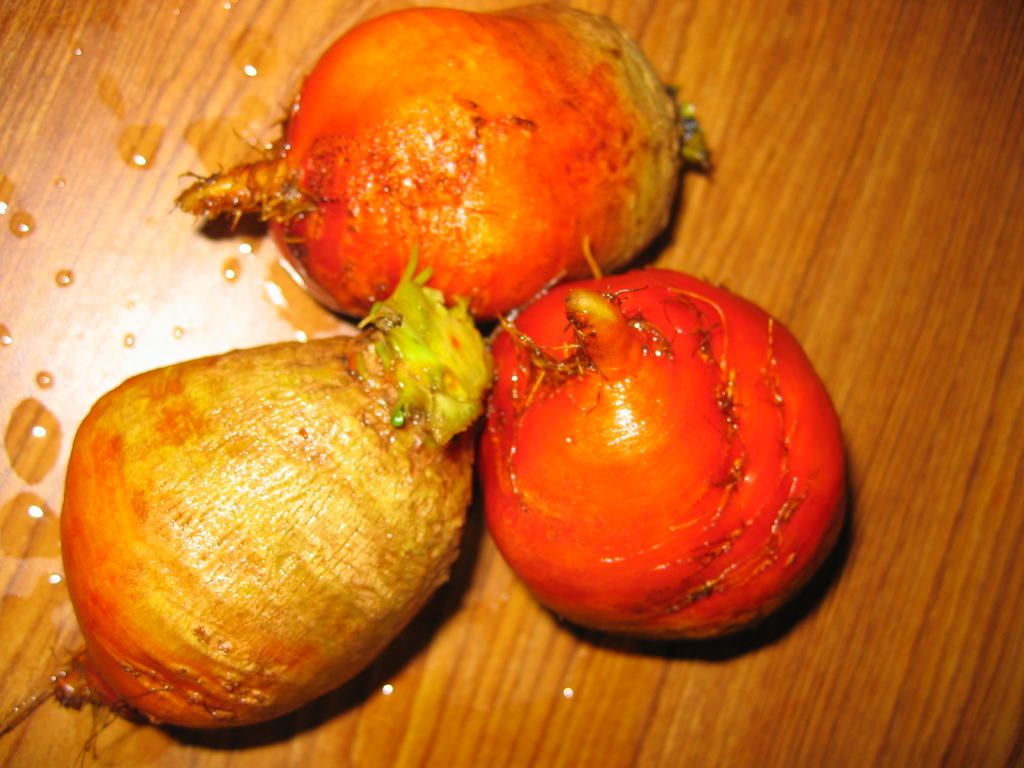 When I was a child, I had a love-hate relationship with beets. I loved the color of them; the garnet-wine hue was intensely attractive to me, and I liked the way that they turned transluescent when they were cooked and glowed on a white plate like rondels of stained glass.
But I hated the way that they tasted. I didn't even like them pickled, though I loved helping Grandma when she put them up in jars, glistening in rows like gemstones captured in glass. I liked the smell of them, and the way the juice stained our hands pink; my eyes ate the vivid color of them, but my tongue would have nothing to do with them. I tried them every year and hated them, until one year, sixteen years ago, I began to crave them.
I was pregnant with Morganna and my mother-in-law was cooking Harvard beets--baby beets in a sweet and sour sauce. The smell caused me to salivate immediately and I remember diving into the pot with a fork, and plucking one out before it was fully cooked and popping it in my mouth.
It burst beneath my teeth in a shower of honey and vinegar, with juice tinged with the flavor of the earth itself.
I moaned, and from that time on, I have adored beets in many guises.
Golden beets are just as beautiful as the more usual red ones, though they are colored like topaz instead of garnet. They are also just as sweet, and I like to roast both kinds in the oven, just drizzled with olive oil, until they are tender, then peel them and feature them in salads. Together, the colors are evocative of a sunset as they glisten against a bed of autumn greens like arugula or mizuna. Paired with sweet honey pears, walnuts and goat cheese, then dressed with a simple balsamic vinaigrette, beets make a gorgeous salad filled with all of the flavors of autumn: bitter and sweet, earthy and peppery, milky, mild and tangy.
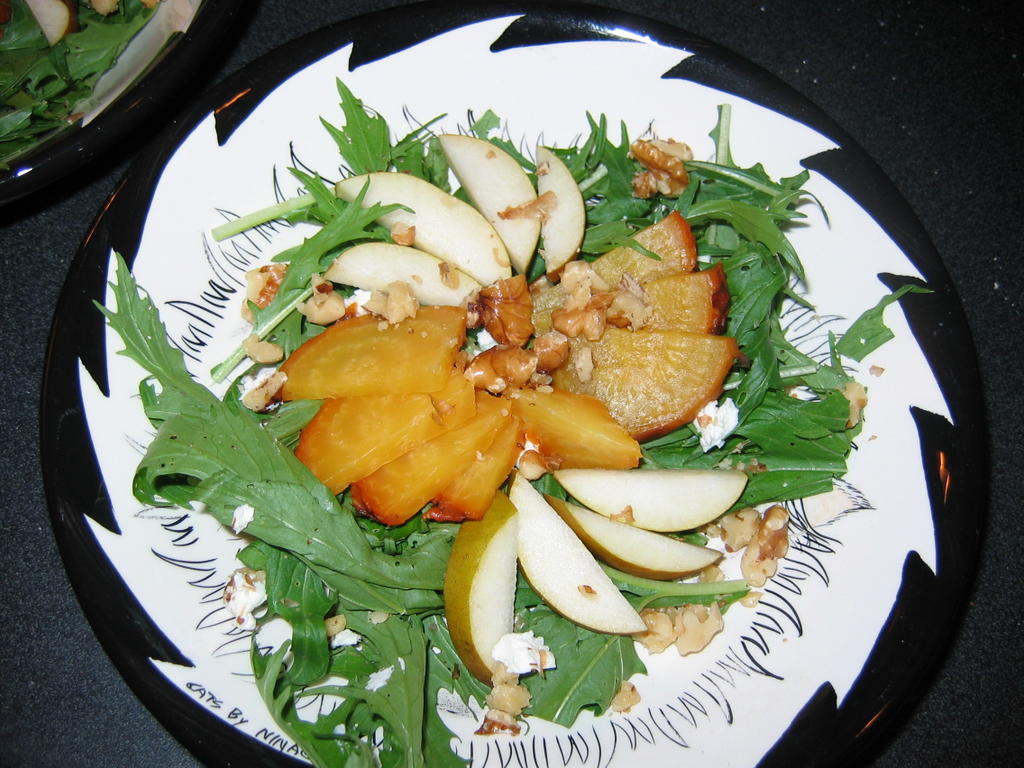 October Beet Salad with Mizuna and Pears (serves 3)
Ingredients for the Salad:
2 medium sized beets
1 tablespoon olive oil
2 honey pears, washed, dried, cored and thinly sliced
1/4 cup crushed walnuts
3 tablespoons crumbled goat cheese
3 cups mizuna leaves, washed, dried and torn into bite-sized pieces
Method:
Heat oven to 375 degrees. Line a baking pan with foil, and rub with a little of the olive oil.
Trim greens and large roots from beets, scrub skin thoroughly. If you are worried about juice staining your hands, wear latex gloves while handling beets. (Golden beets stain less.) Dry beets and put into baking pan, then drizzle with olive oil.
Put pan into oven and roast, uncovered, until beets have wrinkled, somewhat dried out looking skins and have shrunken a bit and are easily pierced with a fork. (Depending on the size of your beets, this can take from forty-five minutes to an hour.)
Remove from oven, allow to cool enough to handle. Using a paring knife and your fingers, peel off skin--it should be quite easy to remove. Cut beets in half laterally, then slice them into thin half-moon shapes.
Place one cup of mizuna leaves on each salad plate, and sprinkle one tablespoon of crumbled goat cheese over each plate. Arrange slices of beets and pears attractively over the greens, and sprinkle with walnuts.
Just before serving, drizzle with balsamic vinaigrette.
Ingredients for Balsamic Vinaigrette:
1 part balsamic vinegar
3 parts extra virgin olive oil
1 part honey
tamari soy sauce to taste
Method:
Mix vinegar, oil and honey together; I like to put them in a bottle, put the lid on it and shake them to combine.
Season to taste with soy sauce; the flavor should be sweet and sour with the pepperiness of the olive oil, with the salt from the soy sauce just a hint in the background.
Notes:
Mizuna is a type of Japanese mustard green. It is very mild and has attractive, very jagged leaves that are long and narrow. It grows in clumps, and has a thick central rib that is very crisp and has an icy sort of flavor, while the leaves themselves are peppery. It is very good raw; I am not as fond of it cooked.
My dog, Liriel, and our cat, Minna, both love mizuna and will beg for it when I bring it home from the farmer's market. As long as I give them leaves, they will eat them.
The beets are very good marinated in the vinaigrette, and could be served as a chilled dish on their own that way. Or you could heat them and call the vinaigrette a sweet and sour sauce.
Monday, October 10, 2005
About Minnaloushe
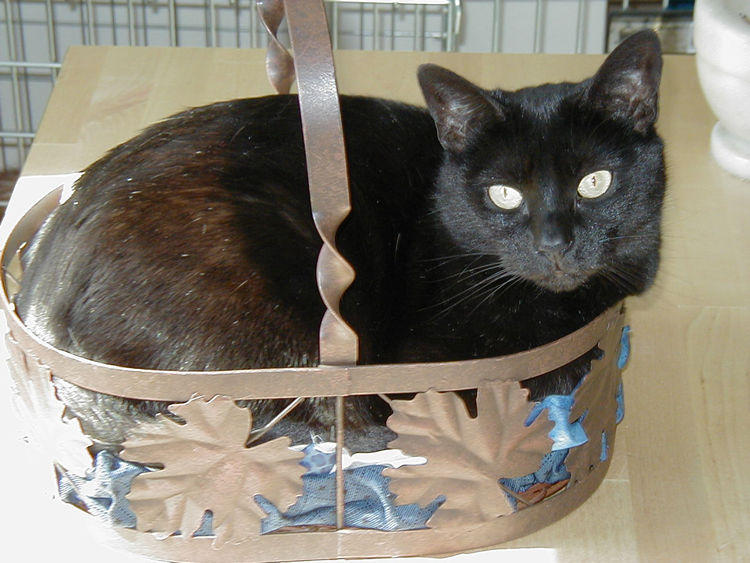 I know it isn't weekend cat blogging time, but I have some not so good news about Zak's beloved girl cat, Minnaloushe.
She is at the vet hospital right now; she has Feline Hepatic Lipidosis, commonly known as "Fatty Liver Syndrome."
It happens when a cat stops eating for whatever reason; when they do this, and their bodies resort to metabolizing fat to survive, the liver ends up with fat deposited in its tissues. For whatever reason, cats are not efficient at metabolizing body fat, so it tends to build up in the liver and cause liver failure.
We have lost a cat in the past to this, over a decade ago, before vets knew much about it and how to treat it.
It is, however, treatable, and since we caught it so early, Minna has a good chance to pull through. What we have to do is force-feed her and give her IV fluids until her body stops metabolizing itself to survive. At that point, the liver damage is reversable. It just means that we may end up feeding her either through a stomach tube, or forcing food from a syringe into her mouth, for six or eight weeks.
I just thought I should let my readers know. For one thing, lots of you are cat lovers and know how Zak and Morganna and I dote on our kitties, and you would understand. For another thing, I don't know how much time I will be able to devote to the blog if we are going to be running a kitty convalescence center in addition to getting our kitchen redone and keeping all and sundry fed and happy.
I will still finish "Those Darned Chemicals," though, and I have lots of other stuff planned, including a new installment of "The Chinese Cookbook Project." So, stay tuned and wish us all luck.
Thanks.
Preserving the Harvest: Basil, Chiles and Tomatoes, Oh, My!
 Summer is officially gone; October's chill is in the air, the sun has hidden her face behind a veil of grey clouds, and night descends earlier with each turn of the Earth. The trees are flecked with scarlet and gold, and the air thrums with the beat of wings and the calls of geese as they fly toward warmer climes.
But the gardens of Athens county are yet prolific; the Farmer's Market is filled with produce that sings to summer's faded glory while trumpeting the autumn harvest. Wedding bouquet bunches of basil are cheaper than flowers, chiles of every size and color tempt from baskets and boxes, and tomatoes, both ripe and green are to be had from every farmer for next to nothing.
Of course, I have been buying these last hurrahs of summer up; for the past several weeks, at every trip to the market--generally a twice weekly journey--I pick up at least two bunches of basil, sometimes three. When I get home, I plunk them into a quart-sized recycled yogurt container of water and sit them on the counter to wait until I have a few spare moments.
 When I am not busy with dinner or with anything else in the kitchen, I pull out the Cuisinart and make a batch or two of pesto. It is the simplest thing in the world to do: first, I toast some pine nuts (if I have them, and usually do), and throw them into the processor bowl. Then I peel garlic, and toss it in as well. Then I pluck all the leaves from the basil and throw that in on top, then grate some parmesan cheese on top of it all. I sprinkle about a half teaspoon of salt and some generous grindings of black pepper over the cheese, put the lid on, and pick up the bottle of extra virgin olive oil.
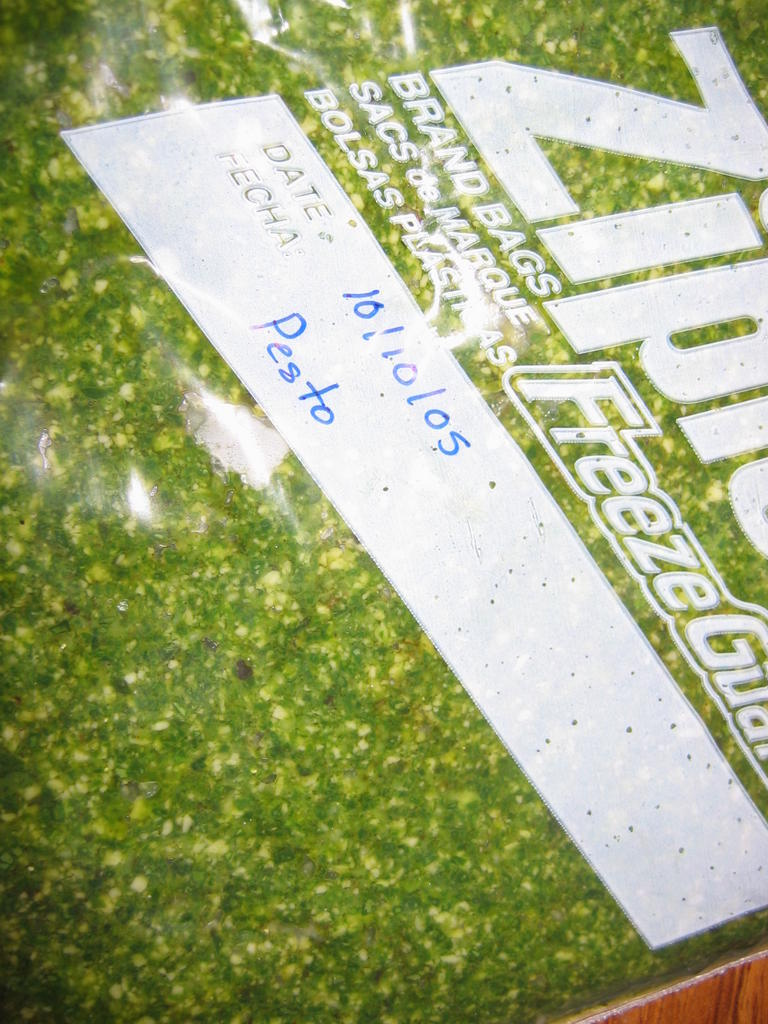 Then, I turn on the machine and start pouring the oil in a slow, steady drizzle. When a thick, brilliant green paste results, I stop the oil and the food processor. When I make pesto for freezing, I don't make it as liquid as I do normally, because I never know what I am going to do with it. If I am going to use it for a pasta sauce, liquidy is better, but if I am going to use it to season a soup or as a pizza topping or to stuff a chicken breast, then I want it to be fairly thick. It is easier to thin a paste than to add bulk, so, I leave the pesto fairly thick.
Then it is a simple matter of scooping it with a silicone spatula into a couple or three freezer bags. (Here's a big tip--label it first with a Sharpie pen--it is easier to write legibly if there is nothing in the bag.) After the bag has as much as I want in it (about a cup), I lay it flat on the counter, and squeeze out the air by spreading the pesto into a smoothly between the two pieces of plastic, then zip the bag shut. These stack easily in the freezer and take up very little room. Also, if you only want a little bit of pesto you can easily break or cut off a hunk and put the rest of it, still frozen, back into the freezer.
I have tried freezing it in ice cube trays and then popping out the green cubes and packing them in bags, but it really is a big pain in the butt to get the pesto out of the tray. It is pretty messy getting it, too, now that I think on it.
At this point, I have a dozen batches of pesto safely nestled in the freezer, waiting to bring the voluptuous flavor of summer into a blustery winter evening.
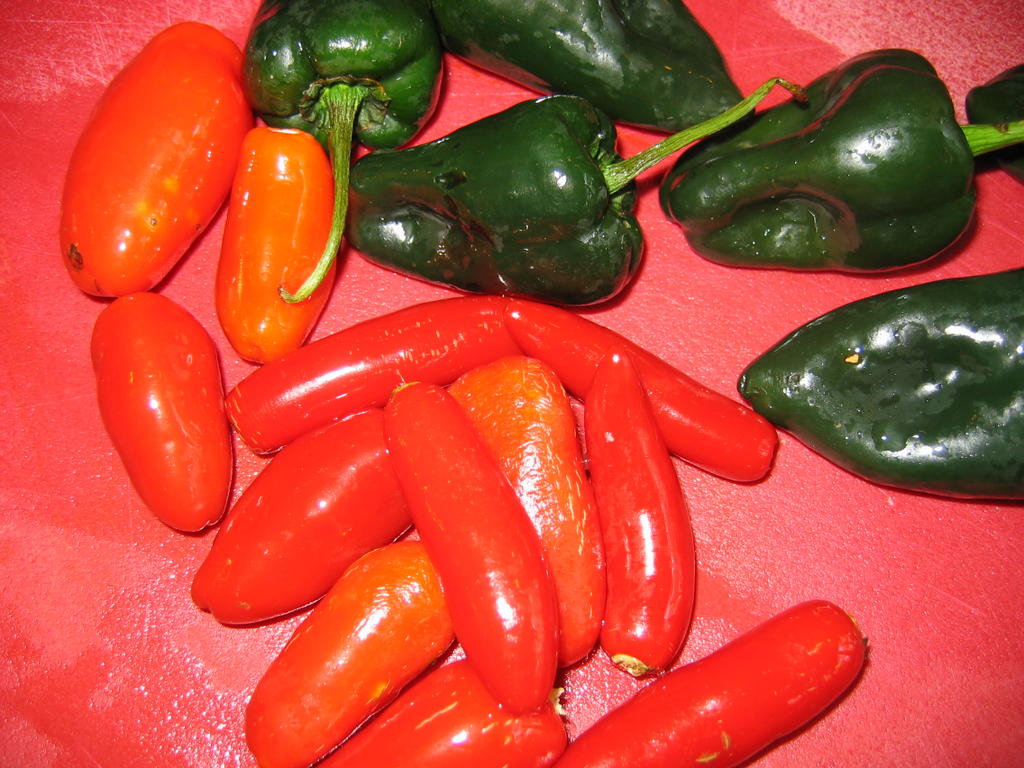 Chiles bring the heat of summer to my winter kitchen every year. I used to process them by mincing or chopping them up and then packing them in bags, but I found that it was hard for me to judge how much chile to use for any given recipe. I never measure chiles by teaspoons, but always by whole or half chile increments.
So, this year, I tried something new and just washed and dried the chiles, then removed their stems and stuck them in bags and froze them whole, separated by variety.
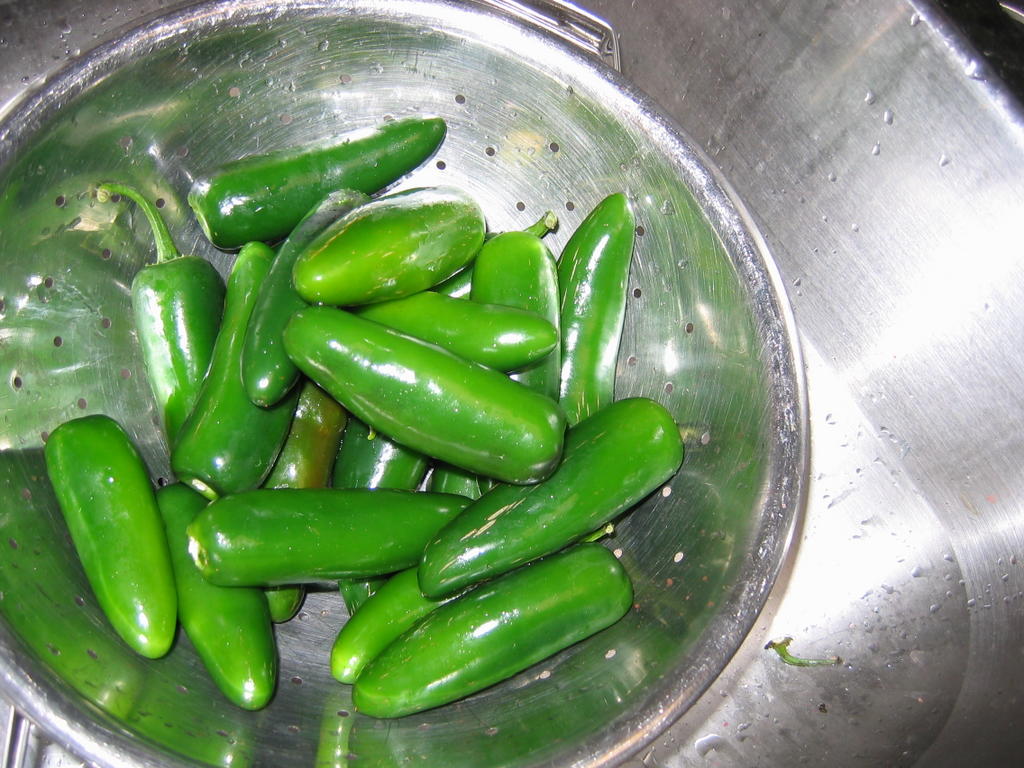 And what a variety there was: I ended up with a quart of Thai bird chiles, half a quart of serranos, a quart of ripe and green jalapenos, a quart of habaneros and a quart of cayenne.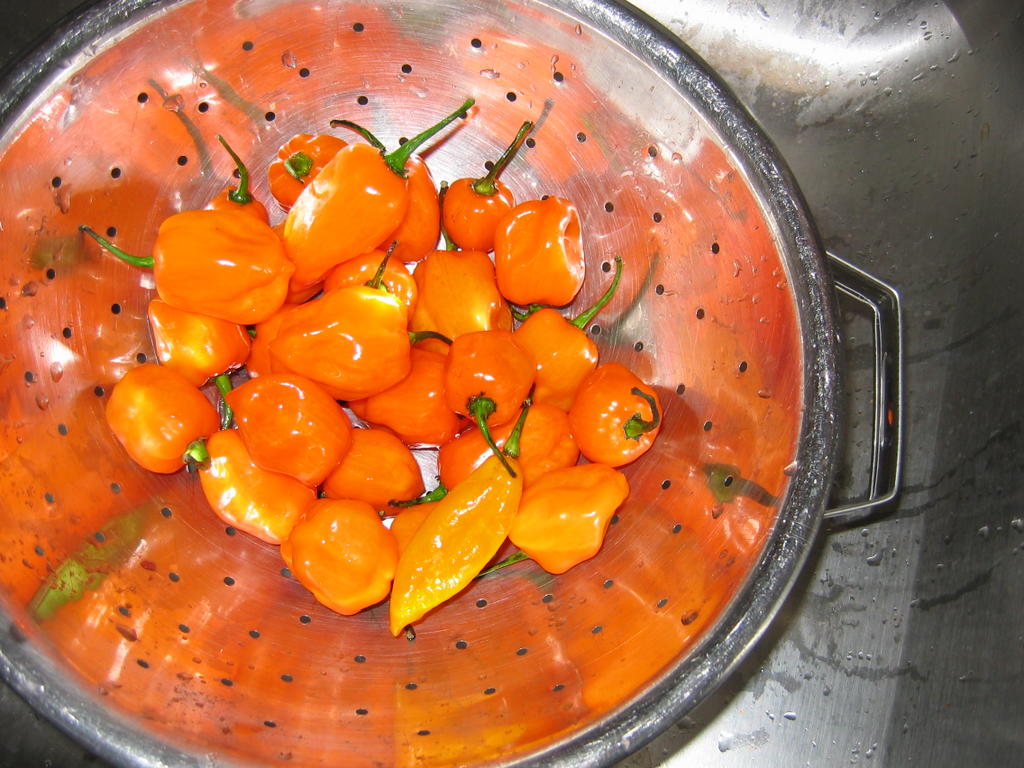
 When we made kofta the other night, I used a whole, frozen Thai chile in it, to see how my new trick worked out, and it was easily chopped up in the Sumeet, and added just the
right amount of flavor to the curry paste. I
think it worked marvelously.
I will have to try one of the larger chiles, like the green jalapenos, to see if I can cut them still frozen, or if I need to let them thaw a bit first.
I also still have some poblanos and New Mexico green chiles to process; those will be a bit more complicated. I have to light the grill (which means I have to wait for the rain to stop) and blacken them completely on all sides, then let them steam, covered in a bowl. When they are cool enough to handle, I will peel off the burned skin, and then cut the roasted flesh into strips and pack those into freezer bags and use them in Mexican sauces over the winter.
I was given a huge bag of fresh tomatoes from Morganna's friend Donny's garden. His Mom had enough tomatoes, and wanted to be rid of them, so I was the thankful recipient of about twelve pounds of them. Since Zak and Morganna only really like tomatoes in salsa or pasta sauces, I decided to use them to make a basic marinara, and freeze that to use as the basis for any number of pasta dinners this coming winter.
Going from fresh tomatoes to sauce is kind of a messy journey, which is why we only have an illustration of the final product. While I was in the midst of peeling and seeding these very ripe, rich red babies, I was up to my elbows in tomato juice. Since Morganna was still visiting her grandfather and Zak was doing some computer work for a friend, there was no one else to take pictures, so you will have to make do with my description of the process, and hope that I luck into another big basket of tomatoes on a day when I have another photographer handy.
In that case, I will post more photographs.
But, at the end of all the tomato-juice follies, I ended up with three quarts of basic marinara that I can dig out of the freezer some night this winter when I have no clue what to cook, and just want something quicky and easy.
Next year, I think I will actually start canning some of the harvest. I really enjoy making fresh tomato sauces and salsas, even if it is messy, and I love the flavor of fresh jellies and jams. I have the equipment to start canning, so why not? I used to help my Grandma do canning and freezing all the time.
But not this year. This year, it is up to my friend the freezer and I to try and preserve the brilliant colors, flavors and scents of summer, so that when the icy wind blows and snow pours from the sky, I can cook up a meal that will remind us that warmth and sunlight always follows winter's chill embrace.
 Fresh Tomato Marinara
Ingredients:
10-12 pounds fresh tomatoes
2 1/2 tablespoons olive oil
1 large onion, diced finely
1 red sweet pepper, diced finely
1 teaspoon dried thyme
2 teaspoons dried oregano
1 teaspoon dried powdered rosemary
1 tablespoon dried basil
1/2 teaspoon dried marjoram
1/4 teaspoon ground fennel seeds
pinch red pepper flakes
1 head garlic, minced
1 cup dry red wine
salt and pepper to taste
2 bay leaves
1 can tomato paste (optional)
fresh herbs (optional)
Method:
Bring a large pot of water to a boil. Wash the tomatoes thoroughly.
On the bottom of the tomatoes, opposite the stem, score a small X just through the skin with a paring knife. When all the tomatoes are scored, drop them into the boiling water, and let cook for about a minute. Drain into a colander, and when cool enough to handle, pick at the raised skin where you scored the tomatoes, and peel the skin off.
After they are skinned, cut out the core with a paring knife. To seed the tomatoes, cut them in half horizontally--between the stem and the bottom. This exposes all the seed pockets. Holding the tomato halves upside down over a bowl, use your fingers to scoop the seeds from the pockets. (Don't get anal retentive about this--some seeds will get away from you. Don't worry, no one will die from a few seeds in your pasta sauce.)
Discard the seeds, and set the now gnarly-looking, deformed tomatoes into a bowl until it is time to put them in the sauce.
In a big, heavy-bottomed pot, heat olive oil. Add onions and pepper and cook until golden. Add all dried herbs and spices, and continue cooking and stirring until the onions begin to brown slightly. At this point, add the garlic, and stir until the garlic is very fragrant.
Pour in the wine, and allow the alcohol to boil off.
When the alcohol is gone, add the tomatoes: if you want to, you can dice them, but I like chunky sauce, so I just pick them up in my hands, and holding them over the pot, squish them, pulverizing them into mushy bits, then letting them fall into the pot. Add salt and pepper and bay leaves; when you add them, keep in mind that you are going to simmer away most of the water, so do not salt so it tastes right at that moment. Undersalting is the rule of the day. If you want, you can add tomato paste to thicken the sauce even more, and to add a sweeter tomato flavor.
Turn the heat down to low, and simmer until the juice is reduced down, and the sauce is as thick as you like it.
When it is done, mince up as many fresh herbs as you like and add to the sauce and correct for salt.
This makes about three quarts of sauce. To freeze, cool down sauce, pack in bags, leaving about one and a half inches of headspace. Carefully push out the air and seal the bags closed, then lay them flat in the freezer. This ensures that they will take up very little room once they are frozen and they will stack nicely.
Note:
Roma or plum tomatoes make the best pasta sauces, but I was given just plain old garden tomatoes. And as ripe and wonderful as they were, they made a lovely sauce.
You can add other vegetables to this, but I like making a plain sauce and then later, when I use it, I can customize it into a mushroom sauce, a veggie sauce or a spicy arrabiata, depending on what I add to it after it is thawed. Or, I can brown some sausage, or make meatballs, or ground pork or veal for a quick meaty sauce.
Saturday, October 08, 2005
Public Enemy Number One: The Kitten
 The only reason the little git yet lives is because he is so damned cute.
I was nearly finished with Part Four of the seemingly never-ending series of "Those Darned Chemicals" when Mr. Pain in my Tuchus decided to step on the switch to the power bar/surge protector on my computer.
And I lost the whole blessed post.
The little twit.
And he just skittered under my desk again. (Only to be chased out with a well-placed hiss from me and muttered threats of beheading.)
I wonder how he would taste, sauteed with butter and garlic?
Or perhaps I should stir fry him with garlic, and scallions with just a hint of sesame oil at the end?
I am going to leave off with the writing now and recreate the post on Monday. I have too many other things to do today to worry about it.
I can't believe it! He went back there AGAIN! ARGH!!!!!
Weekend Cat Blogging: The Old and the Restless
 Ozy and Lennier sharing a chair.
Ozy is doing what he does best: sleep.
 Lennier is doing what he does best: avoid sleep.
He's exactly like a toddler--he will fight sleep until the bitter end.
More later!
Friday, October 07, 2005
Learning Kofta
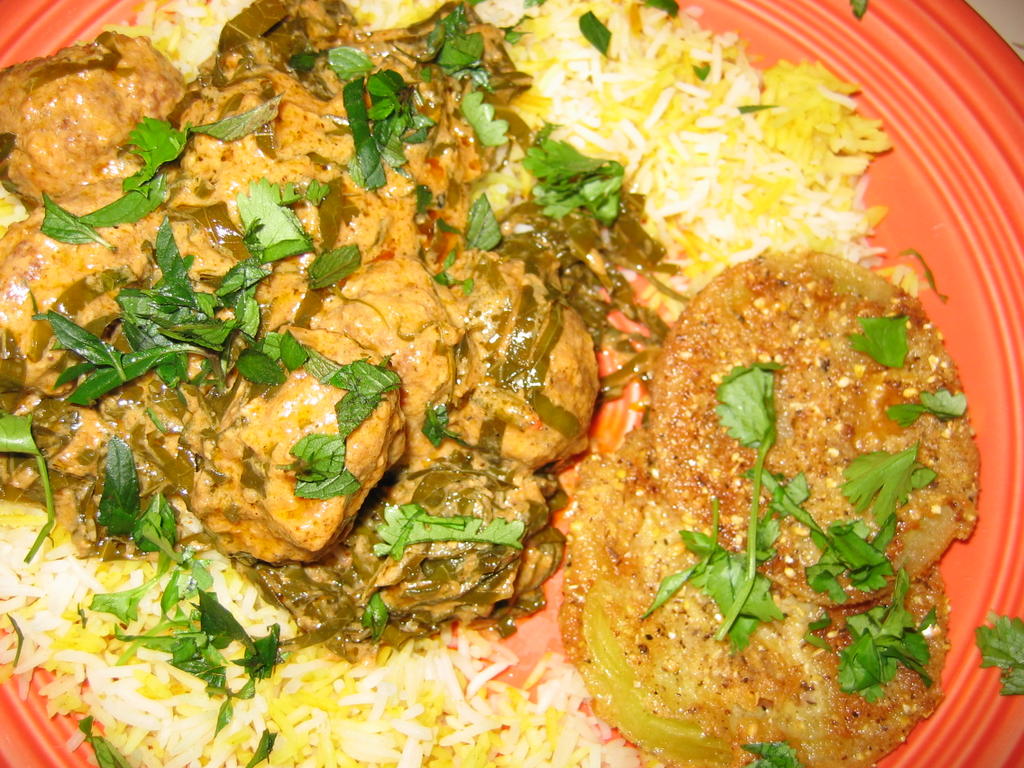 As I have mentioned before, Morganna is taking a class called "World Foods" at school which is a clever way to get kids to take Home Economics, learn to cook, and learn about other cultures all at the same time. It is a pretty good class, and the kids get to cook and eat foods from the countries that they voted on learning about at the beginning of the class. Each student also chooses a country to do a final project on that will include a written and oral report, a physical cultural display about the country, culture and cuisine, and a sample dish cooked from that cuisine.
Morganna chose India, so from now one, each week, we will cook at least one Indian meal. The last time we did this, Morganna learned how to make masoor dal tarka; this time, she learned how to make lamb kofta. We decided to add the greens directly to the dish to make saag kofta, which is very like the palak kofta I learned from my Pakistani friends.
"Palak" means spinach; "saag" is a general term which means "greens." In most Indian restaurants in the US, if you see "saag gosht" it technically means "meat cooked with greens," but usually it is meat cooked with spinach. The only other greens I have had in a restaurant have been fenugreek greens, in which case, the specific term, "methi" is used in the title of the dish.
Kofta can be made of minced meat or vegetables; I decided to start with minced lamb kofta, because the meat is easier to work with for a beginner. Interestingly, the word, "kofta" is from the language of the Persians who conquered the northern part of India centuries ago. It is the same exact word that is used in Iranian cuisine when describing similar meatball dishes. Much of the cuisine of northern India is related to Persian foods and so there is a great correlation between the foods of the near east and the Indian subcontinent.
Whether they are made of meat or vegetables, I learned that the best kofta are very light, and tender in texture; they are nothing like the tough, sometimes rubbery meatballs that are often served in the west. I learned the trick of how to make light kofta from one of my client's mothers--she said to never pack the meat down tightly and to handle the kofta as little and as gently as possible when shaping them and when browning them, to move them as gently as possible, as the minced lamb ones do not have any binder in them at all. (This also makes them tender.)
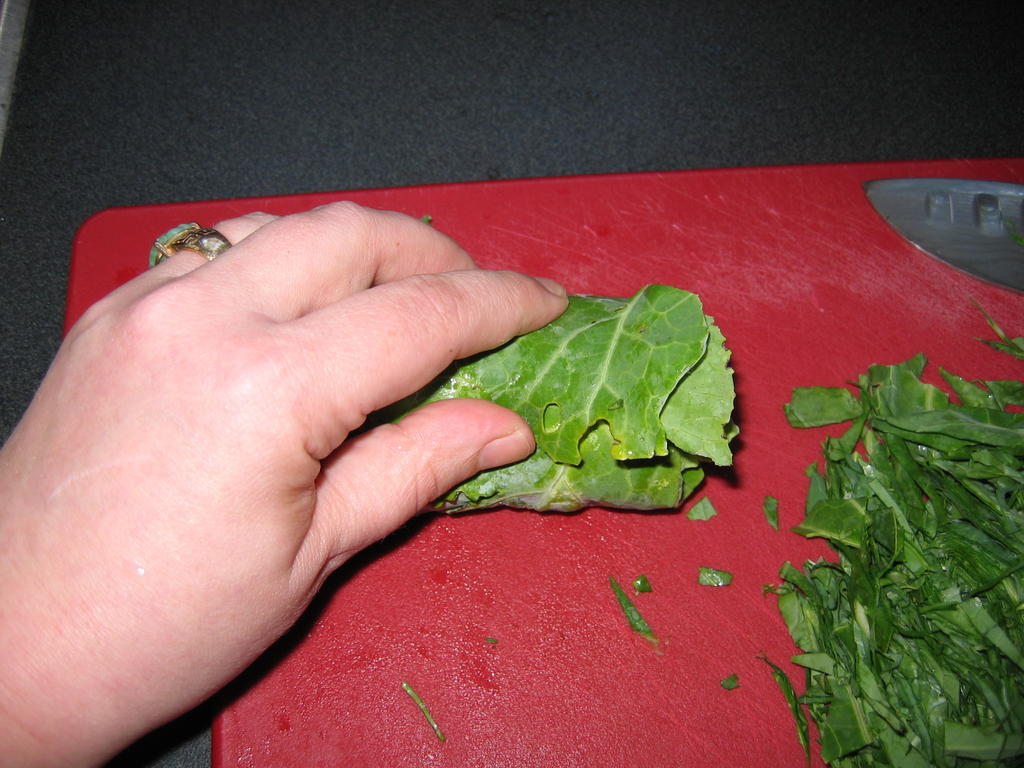 One of the keys to making good Indian food is to be relaxed and do good prep work; precision is almost as important in Indian cookery as it is for Chinese food. In order to present the greens well, they should be minced, shredded or ground in some way; I chose to cut them in a chiffonade--long, narrow ribbons which look pretty and make an easily eaten dish when cooked. The simplest way to cut the greens this way is to prepare the collards for cooking in the usual way: wash and drain them thoroughly, then tear out the tough central vein. Stack the leaf pieces up neatly, the roll up tightly like a big fat cigar.
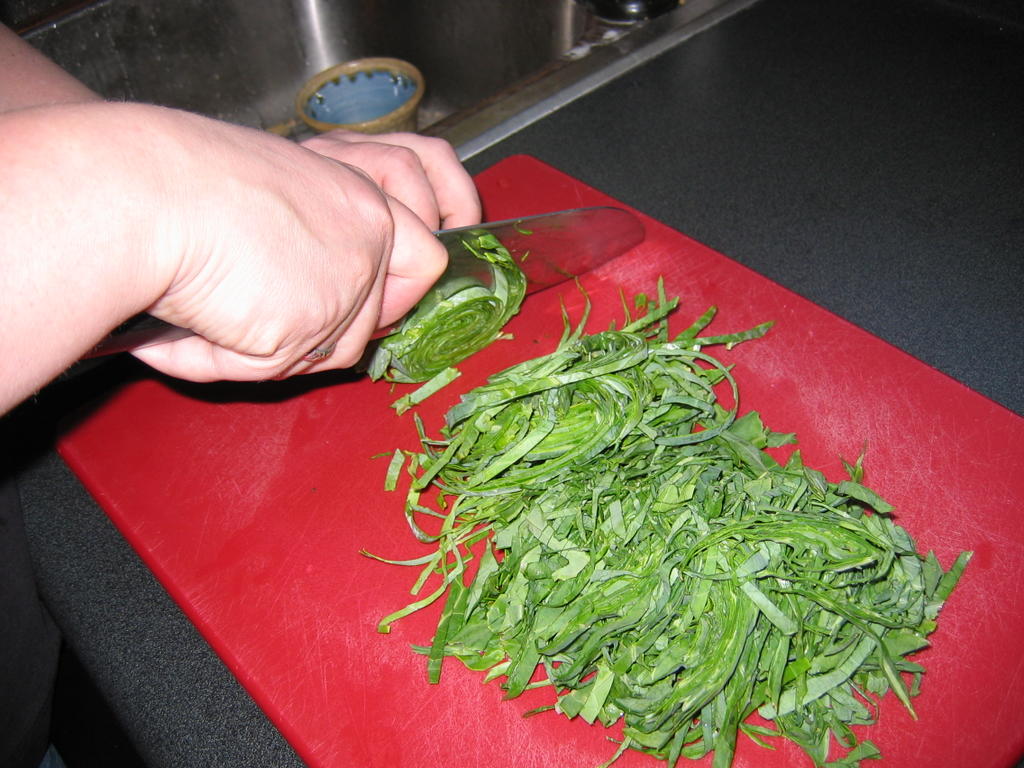 Lay the roll seam side down on the cutting board and then cut as narrow slices of it as possible. These coiled slices will unfurl into tiny green ribbons that look beautiful and cook in the curry sauce quite quickly. This chiffonade technique can be used with any leaves, from large cabbages to basil to Thai kaffir lime leaves. All that is needed is patience, a sharp knife and nimble fingers, and the hard work pays off--chiffonade makes a lovely presentation of cooked greens, of raw lettuces in a salad or as a garnish sprinkled over a soup or sauce.
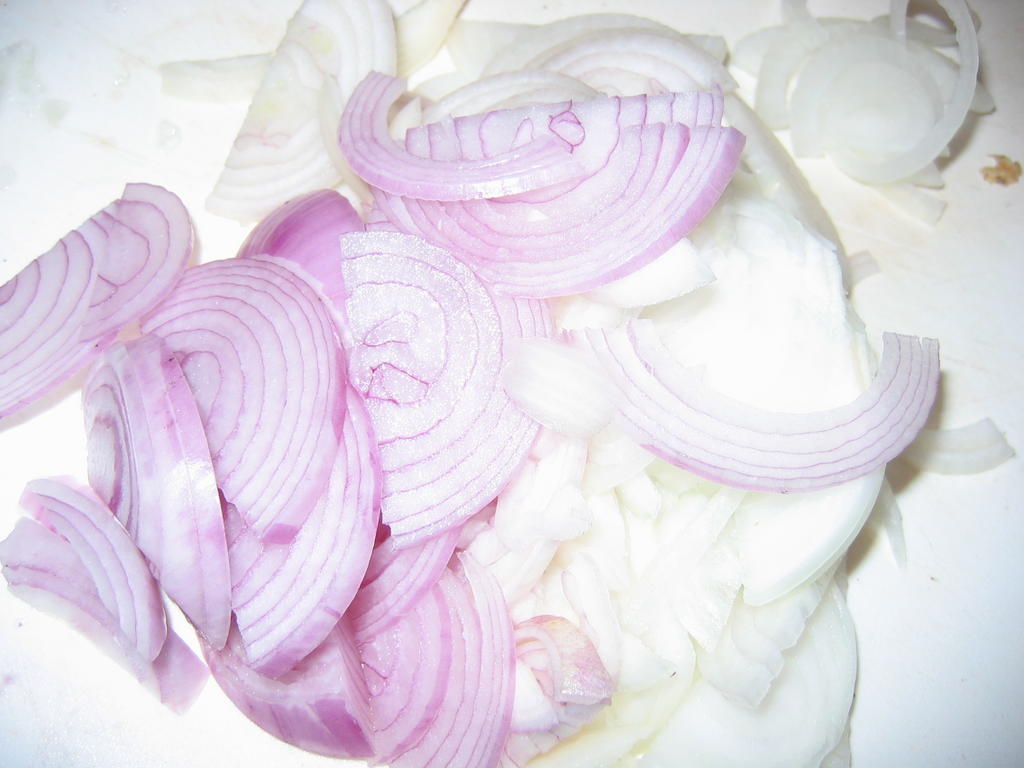 Another necessity for careful preparation when cooking Indian foods is to slice the onions very thinly. The reason for this is that in Indian cookery, particularly the cooking of the northern part of the country, it is crucial to brown the onions very well; they should be a dark golden-reddish brown when they are done. If you slice the onions too thick, then they take a long time to brown, and sometimes, because American onions are so juicy, they may not brown at all. So, I always try and cut them so thin that you can see through the slices. Morganna didn't do too badly at it, as you can see on the left. The purple ones are very pretty--it was almost a shame to cook them up! I almost felt that we should have made a dish to use them raw just to keep the lovely transluescent pearly violet color.
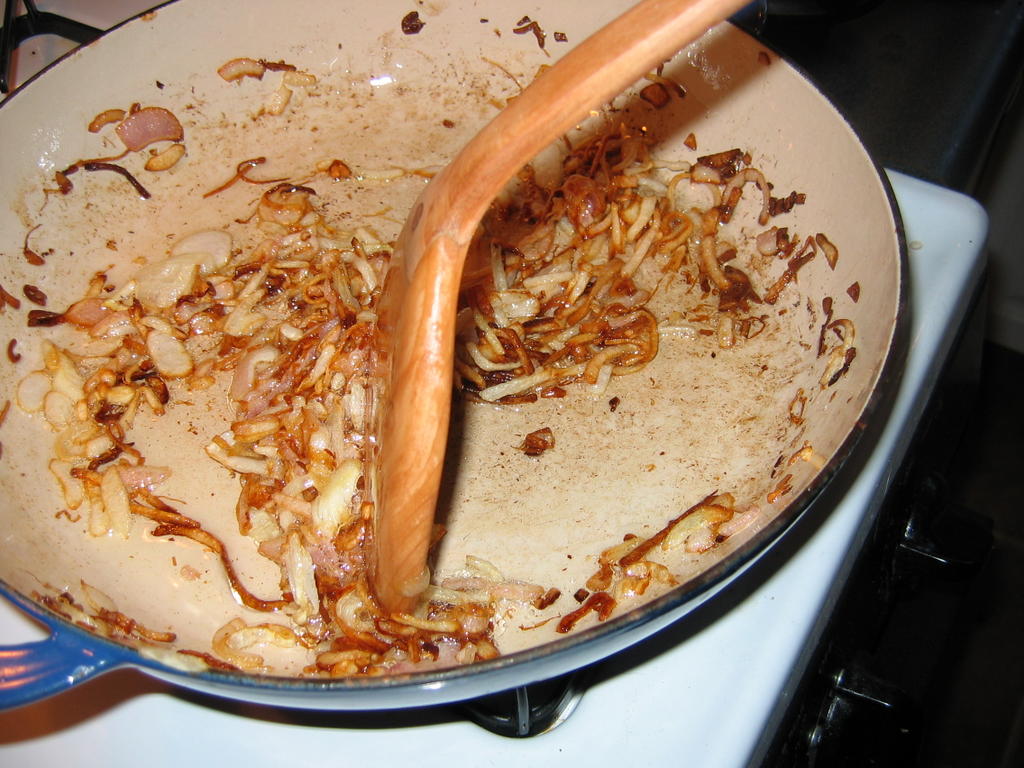 Browning the onions in oil or ghee takes a heavy pan on medium heat (we used the Le Crueset skillet), some salt, a good stirring implement and patience. If you turn the heat up too high, you risk burning the onions, and once they are burnt, you cannot undo it. You must throw them away, clean out your pan and start over. And since proper browning takes fifteen to twenty minutes--you really don't want to start over. But, I predict that you will likely burn a pan of onions at least once. The phone will ring and you will turn away to answer it, or a cat or child will drag your attention away for a few moments, and when you turn back, the onions will have gone from dark golden to perfect mahogany to black in mere seconds. (Yes, they can go wrong just that quickly. I have burned onions at least twice that way.)
Basically, you heat your oil or ghee until it is quite hot, and then put the onions in a single layer, and start stirring. When the first bits of juice are coaxed out--about two to three minutes into the cooking process, I sprinkle a bit of salt--no more than a half a teaspoon or so over them. The salt draws more of the water out of the onions, and as it boils away, that allows the browning process to begin. Keep stirring, and do not stop. It helps if you have music on so you can sing, or maybe dance in front of the stove while you do this. Morganna and I practiced belly dance hip thrusts and rolls while cooking the onions.
When the onions turn golden, start paying particular attention. They will have shrunk down in volume a great deal--much of an American onion is water after all, and after they turn distinctly golden, they will very quickly darken. They will turn dark gold, then reddish gold. You will be tempted to take them from the heat then, but wait until they are reddish brown or mahogany colored to turn off the fire, and quickly scrape the onions into a waiting bowl. Do not hestitate! If you leave them on the heat for just a few more seconds, they are likely to blacken and turn into an acrid, bitter mess that will destroy the flavor of both the kofta and the curry sauce, as the onions are used to flavor both.
The dark brown onions are important, not only because they give a special flavor to curries, but also because they are a component in coloring them as well. An Indian friend told me that she could always tell when an American had made Indian food because they never browned the onions deeply enough, so the curries tasted one-dimensional, and were weakly colored.
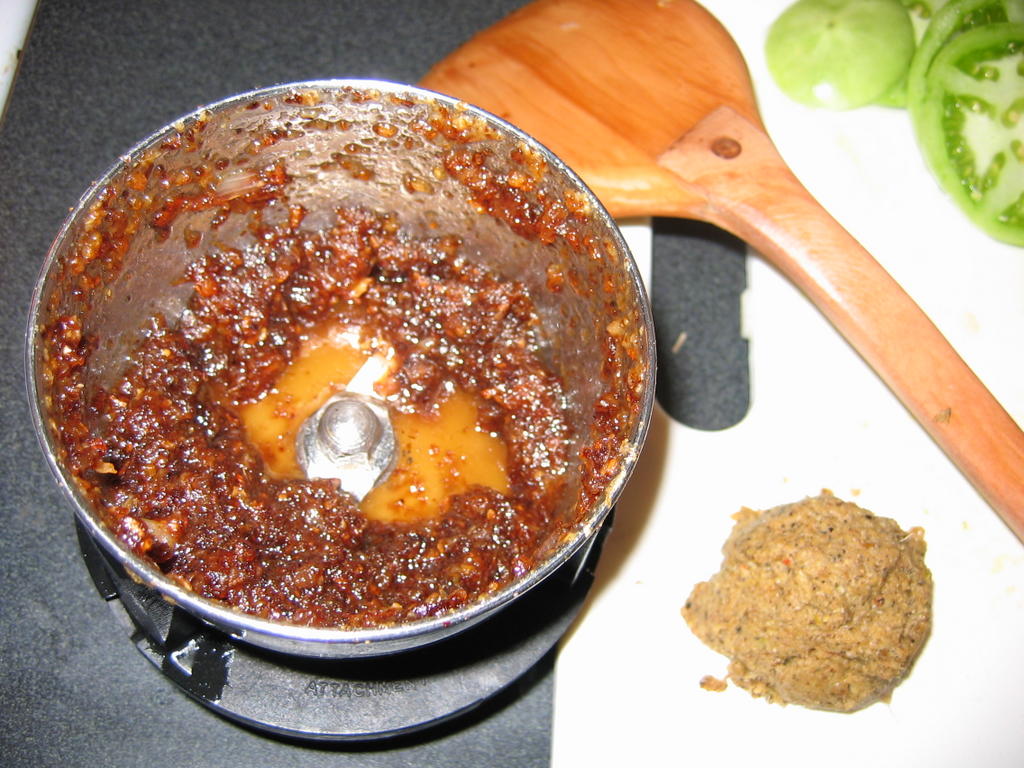 After they cooled, we put the onions into the Sumeet grinder and ground them into a thick, sweet-smelling dark red paste. The volume at this point has reduced by three-quarters the original volume. If you ever look at Indian recipes and they seem like they have way too much onion in them, this is why--they are cooked down to a very concentrated color and flavor--the browned essence of onion, if you will.
After they are ground up, the onions are portioned out; one third of them go into the kofta, and two thirds of them are set aside for the curry sauce. Pictured next to the onions, you can see the ball of curry paste that we made for the sauce: a mixture of ginger, garlic, fresh red Thai chile, cumin, coriander, black pepper, black cardamom and cinnamon. As in the onion paste, one third of the spice paste was gently kneaded into the kofta, along with about a half teaspoon of salt, while the rest was saved for the curry sauce.
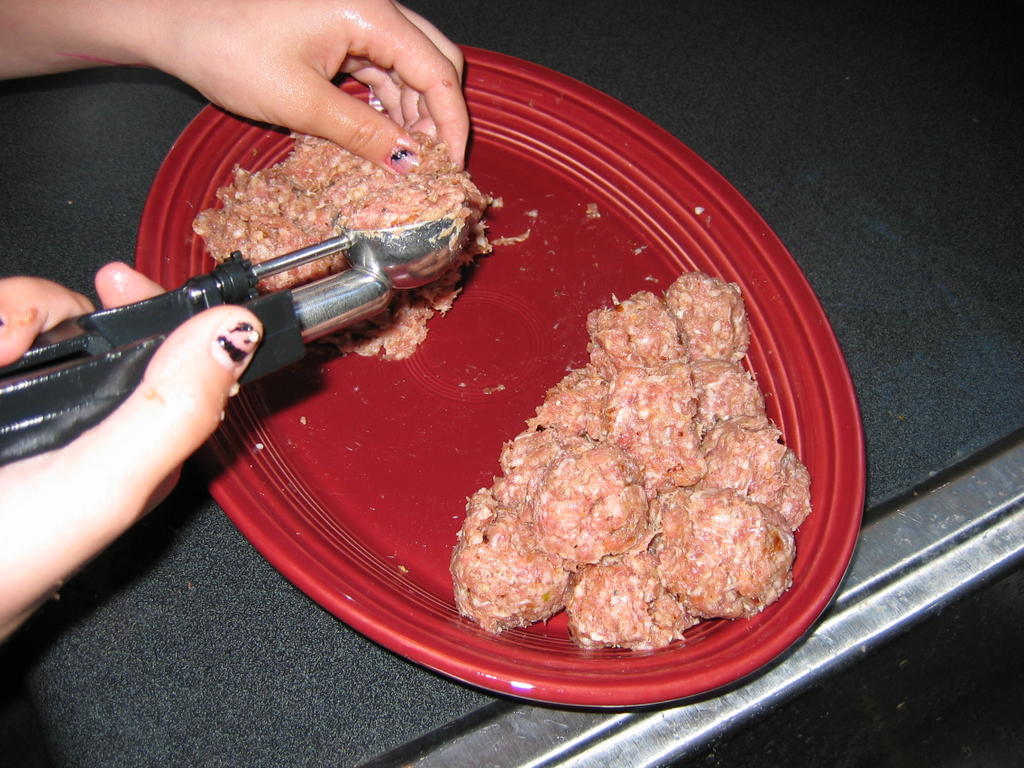 Shaping the kofta is another crucial point in the recipe; if you handle the meat mixture too much or too roughly, packing the kofta as you portion or shape them, they will toughen and will lose their delicate texture. Pictured at the right, you can see Morganna carefully portioning the meat out into rough ball shapes with a cookie scoop. Using a one-tablespoon volume scoop, she lightly presses a level amount into it, the squeezes the lever, releasing. She portioned out all of the meat before we began the process of shaping the kofta.
Some kofta are shaped round like typical meatballs, while others have sausage shapes. The ones I like to make are egg-shaped, or ovoid. I start by smoothing the rough portions into balls by lightly rotating them between my palms. To keep the meat from sticking, I dampen my palms with water. To shape the spheres into eggs, I roll them back and forth gently a couple of times between my palms.
 At no time do we compress the meat, and so the end result is a very light, very tender meatball that is filled with juice and flavor. Minced chicken is also very good cooked and shaped in this way, though, of course, I would use different spices in the paste for that.
Fresh herbs can be added to the spice paste, and of course, the spices themselves can be changed to reflect personal tastes. Sometimes, I add more chile, and sometimes I like to add fresh mint, minced finely. Cilantro is also good, and I really like a bit of fenugreek greens, but they are impossible to get fresh here in Athens.
Once the kofta are shaped, the next hurdle is browning them--this takes a heavy pan (non-stick is great for this) a light touch, patience and nerves of steel. Morganna quickly became frustrated with trying to gently turn the kofta so they could brown evenly without breaking them apart. Once the browning is done and the liquid is added to start the curry sauce and to poach the kofta to complete doneness, the process becomes simple: add the sauce ingredients and allow the liquid to reduce until it forms a clinging sauce, then enrich it further with a bit of half-and-half or cream and an extra dollup of full-fat yogurt.
Served with turmeric colored basmati rice with a sprinkling of minced fresh mint with fried green tomatoes on the side, the saag kofta were a wonderful supper. Morganna took the leftovers with her to school, and shared them with her friends, all of whom were quite enthusiastic in their liking of them.
Perhaps this weekend, I will teach her how to make aloo methi, (potatoes with fenugreek greens), if I can pick up some fresh fenugreek in Columbus tomorrow.
The recipe looks more complicated than it is--or rather, it is more difficult to write it out in a detailed way, than it is to make. I haven't used a recipe in years to make different kinds of kofta, but neither have I bothered to write down how I do it, either. It wasn't until writing this post that I realized how daunting a process making a simple curry of meatballs and greens might seem to someone reading this.
Now I understand why I was so intimidated by Indian food for so many years. It is second nature to me now, but when I took my first steps toward serious study of it, I was certain I would never be able to cook without referring constantly to a cookbook. Now, I am much more comfortable with it.
I just hope that my detailed posts don't scare people away from trying to cook Indian food themselves.
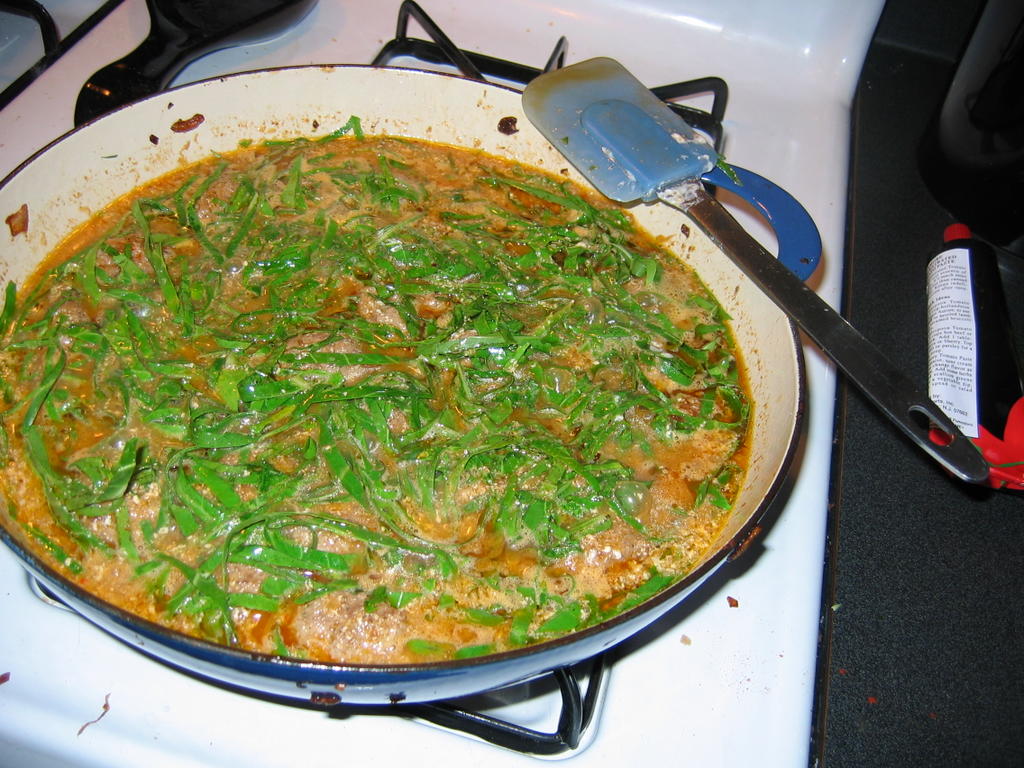 Saag Kofta (Lamb Meatball Curry with Greens)
For the Greens:
1 pound collard greens, washed and trimmed, with the thick vein removed.
Method:
Cut the greens into a 1/8 inch chiffonade as described and illustrated in the body of the post. Set aside until it is time to add them to the sauce.
Ingredients for the Curry Paste:
1" cube fresh ginger, peeled and sliced
5 cloves garlic, peeled and sliced
2 or 3 fresh red Thai chiles (or to taste)
1 tablespoon toasted cumin seeds*
1 tablespoon toasted coriander seeds
1 black cardamom pod
1/2 teaspoon black peppercorns
Method:
In a mortar and pestle, a food processor, blender or food grinder like the Sumeet (I love the Sumeet--if you cook Indian, Thai and Mexican food, you need to get one), grind the spices into a thick, damp paste. If you use a blender and have to add water, add as little as possible.
Separate out the curry paste into thirds by rolling it into a ball, then into a log. Cut the log into three pieces, and set one aside, and squish the remaining two together.
Ingredients for the Onions:
1 large or 2 medium onions, sliced as thinly as possible
1/2 teaspoon salt
1 1/2 tablespoons vegetable oil or ghee (I used canola oil for this recipe)
Method:
Follow the instructions in the body of the post to cook the onions and grind them.
After they are ground, scoop out one third of the very thick, liquidy paste, and add to the one third of the curry paste. Save the remaining two thirds of the onions to go with the two thirds of the curry paste in the sauce.
Ingredients for the Kofta:
1 pound ground lamb
1/3 of curry paste
1/3 of browned onion paste
1/2 teaspoon salt
4 tablespoons oil or ghee
Method:
Pat the meat out into a thin, flat layer in a bowl or on a cutting board. Mix together the onion paste with the curry paste and salt until a thin paste is formed and spread this over the meat, then carefully roll the meat up or fold it up. Then, gently knead the meat mixture together using as little pressure as possible to mix it thoroughly and evenly.
Shape the kofta as directed in the body of the post.
Heat oil or ghee over medium heat in a heavy-bottomed pan or skillet (nonstick is great, especially for the first time or two you cook this recipe) that is big enough to hold all of the kofta, the greens and the sauce.
Set all of the kofta into the pan, and gently turn them as they brown by either shaking the pan or very carefully turning them with a spatula. Be very gentle or the tender kofta will fall apart. (Probably the first couple you try to turn by hand will crumble, but you will quickly get the knack of it--it just requires a light touch and precision. Morganna learned it quickly--so can you.)
When the kofta are well browned on all sides, commence with making the sauce, and bringing it all together.
Ingredients for the Curry Sauce:
Reserved curry and onion pastes
1 cup chicken or vegetable broth (traditionally water or milk is used here, but I like the flavor the broths bring to the sauce)
1 cup full fat yogurt, cream layer removed and reserved
1/2 teaspoon ground turmeric
1/4 teaspoon paprika (I discovered that smoked Spanish paprika adds a nice flavor)
Prepared collard greens
1/4 cup cream from yogurt
1/4 cup half and half or heavy cream
salt to taste
handful fresh mint leaves, minced
Method:
After the kofta are cooked, turn down heat, tilt pan and spoon out about half the fat. Return pan flat to the burner and add onion and curry paste and, stirring carefully to avoid breaking the kofta (once the brown crust forms on them, they are a bit less fragile and are easier to handle), cook the pastes until they are very fragrant, about two minutes. Pour in the broth, and scrape up any browned bits at the bottom of the pan.
Stir yogurt, and add to the sauce, stirring to combine. Add the turmeric and paprika. Turn down the heat, and allow to simmer until the sauce has begun to reduce. Add the collards, sprinkling them over the kofta, and stirring them down into the sauce. Continue simmering uncovered until the sauce reduces almost to nothing.
Add the cream layer from the top of the yogurt container, and the half and half or cream, stirring it into the sauce. Taste and correct seasoning as needed with salt.
Sprinkle with mint before serving.
Thursday, October 06, 2005
Those Darned Chemicals, Part III: What are Food Additives, and Why Worry About Them?
Since I am doing this series (and I am glad to see that people are enthusiastic about it) on the topic of what synthetic chemicals are allowed in processed foods given the USDA Certified Organic seal of approval, I think I should probably talk a little bit about food additives in general and what they are doing in our food in the first place. Then, I'll discuss health issues surrounding the idea of food additives and why some people should be concerned about some additives, while other ones are likely to be completely harmless.
After that, we will return to our regularly scheduled annotated listing of the permissible food additives in the special seal-of-approval foods.
Strictly speaking, food additives are any substances which are added to food items to change its flavor, increase its shelf life, to improve its texture, or to improve its appearance. Humans have been using food additives for thousands of years, particularly for thier preservative function: salt, sugar, vinegar and spices have all played thier part in preserving food in the form of pickles, cured meats, jams and jellies, cross-culturally, for centuries. Technically speaking, smoke is a process, not a food additive, but for the purpose of my current project where the presence of carbon dioxide and ethylene gas in organic foods are being debated by consumer groups, I would consider woodsmoke, a traditional way to help dry and preserve meat, to be a food additive.
Preservatives act in many different ways to extend the shelf life of a given food item. Some of them create a hostile environment to bacteria, molds and fungi, thus making it harder for them to successfully live and grow on or in a food so that they cannot cause it to spoil. Bacteria, molds and fungi are living organisms which require water, food, a balanced pH, and a comfortable temperature in which to live, grow and reproduce--change or remove one or more of these requirements, and you disrupt the ability of some or all of these organisms to thrive on your food and make it unsafe to consume. (Some harmful bacteria require oxygen to live, while others thrive in oxygen-free environments, which is why I did not add air to the list of necessities for bacterial life, though in many cases, removing oxygen from an environment will protect food from some bacteria.)
Table salt, a household staple which most people consider to be a mere ingredient in food, is actually one of the first and still most commonly used food additives, both in the home and in food processing plants. It was also probably the very first preservative used by early man. As a preservative, it inhibits the growth of bacteria and other harmful organisms by drying out the food product, making it an inhospitable environment. It also makes food taste good, and when used in sufficient concentrate, changes the texture and appearance of the food item.
Salt is a naturally occurring chemical, and can be mined from the earth in the form of rock salt, or be obtained by evaporating sea water. It is a necessary part of our diet; our own blood and mucus membranes are saline.
Some preservatives are anti-oxidants; they retard the effects of oxygen on plant and animal tissues and slow down the process of oxidized decomposition. Anti-oxidants added to food include ascorbic acid, also known as vitamin C, another necessary nutrient.
Changing the texture of food is accomplished by food additives that act as leaveners, anti-caking agents, anti-foaming agents, thickeners, emulsifiers, bulking agents and humectants.
Leaveners have been in use in the kitchen since early man first came into contact with wild yeast by leaving dough out before cooking it on a griddle and discovered that the bubbly dough cooked up lighter and with a delightful flavor and texture. Leaveners include yeast, which is a living organism, which was the first and only leavener in use for centuries, and various chemical leaveners which work by way of an explosive exothermic reaction when an acid and a base come into contact with liquid and/or heat. Chemical leaveners first came into use in the nineteenth century and changed the way in which baking was accomplished both in the home, and by professional bakers, and many new bread, cookie, cake, and cracker recipes were the result. (Prior to the discovery of chemical leaveners, the way in which one got a cake to rise was through the use of well-beaten egg whites, a process that required lots of muscle and stamina in the days before electric mixers.)
Anti-caking agents are added to powdered food products to keep them from clumping; anti-foaming agents are similarly self-explanatory--they keep liquid food products from foaming. Thickeners are usually based on some sort of starch which absorbs some of the liquid in a food and makes the rest of the liquid thicker. (Thickeners have been and are used in home and restaurant cookery in the form of flour, cornstarch, arrowroot powder, tapioca starch, beurre manie and roux; in jams and jellies, pectin, which occurs naturally in fruit, acts to thicken the sugar and fruit juice solution.)
Emulsifiers are used to keep oil particles suspended in water; if you have ever made mayonnaise at home, you have employed egg yolks as an emulsifier. Bulking agents are non-nutritive additives that increase the bulk of a product without changing its caloric or nutritive value. Humectants straddle the fence between acting as preservatives or as texture-altering additives; they are hydrophilic and hydroscopic ingredients that keep foods moist. In baking, sugar is considered to be hydroscopic, and baked goods with a considerable amount of sugar stay moist longer than those which do not--in such cases, sugar can be seen as acting as a humectant.
When we get to the categories of additives which are used to change the flavor and appearance of foods, we step into the controversial realm of artificial flavors and colors. However, before we deal with the artificially derived flavors and colors, we should examine the additives that have been used for centuries to do the same things. Salt, sugar and vinegar have been used in many cultures not only to preserve foods, but also to alter their flavors. Spices and herbs have been similarly used. Natural plant extracts have also been in use in many cultures for thousands of years to change the color of foods to make them more festive or visually appealing. Turmeric, paprika beet juice, spinach juice and caramelized sugar are just a few examples of plant-based coloring agents that have been used to dye foods in the past and present.
Artificially derived flavors and colors, however, have become sources of worry to many consumers, and often with good reason. Among the lists of banned food additives, the largest category is the artificial colors that have been found to be detrimental to health, with synthetic (and some natural) flavorings following closely in number. Many of these additives were found to be carcinogens, or just plain toxic, and have thus been removed from the list of government-approved food additives in the US. (However, they may still be legal to use in other parts of the world. When eating processed food in other countries, be cautious.)
A lot of really great information on what food additives are, and what they are used for and information on how safe they really are (or are not) with sound medical/scientific/nutritional advice on which ones to avoid and which ones to not worry about can be found at the website of the Center for Science in the Public Interest. This organization works hard lobbying Congress, educating the public and working with the FDA and the USDA on issues of food safety; instead of using scare tactics, they provide consumers with factual information that they can use to make good nutritional choices for themselves and their families. When the CSPI sends out an action alert, it is filled with as many facts as possible, allowing the consumer to judge whether or not the issue is one to be concerned over, which is more than I can say for recent conduct of the Organic Consumers Association.
And now, back to Those Darned Chemicals!
Annotated List of Allowable Food Additives:
Iron, in the form of ferrous sulfate, is an ionic compound which is made by the oxidization of pyrite (a naturally occuring mineral) or by treating iron with sulfuric acid. Iron is a necessary nutrient which used to enrich various products as regulated by the federal government (flour and breakfast cereals are among the products mandated to be enriched) as well as products that are recommended for iron enrichment by medical or nutrition professionals.
Bleached lecithin is derived from egg yolks or soybeans, either by a mechanical or chemical process. (Only bleached lecithin is considered synthetic by the NOSB--unbleached lecithin is considered non-synthetic; they are, however, both allowed in USDA Organic Certified foods.) Lecithin is found in all cell walls, and is used as an emulsifier and can be completely metabolized by humans, and is considered to be completely non-toxic. It is widely used in foods and pharmaceuticals that require an emusifying agent or a lubricant.
Magnesium chloride is only allowed by NOSB as a food additive if it has been derived from sea water; in order to do this, the sodium chloride (table salt) is removed from the solution, and then the water is evaporated. The white powder that is left behind is magnesium chloride, which is called nigari in Japanese. In Japan, it has been used for centuries as a coagulant in the making of tofu from soy milk; the tofu processed in this way has a very smooth and fine texture amd is called silken tofu.
Mono- and diglycerides are esters (an organic compound where an organic group is replaced by a hydrogen atom in an oxygen acid--I know, this probably just turned into mumbo-jumbo) of glycerol and fatty acids. Depending on how many fatty acids esterize with the glycerol, one can have monoglycerides, diglycerides or triglycerides, which are found in animal fats and plant oils. (Including in humans.) Triglycerides, when ingested, are broken down enzymes into mono- and diglycerides and free fatty acids, which can then be used as energy by the body. In food processing, mono- and di-glycerides are commonly used as emusifliers and humectants--they are what keeps many commercial peanut butters from separating. However, NOSB specifically states that they can only be used in USDA Certified Organic foods in the process of drum-drying of foods.
Nutrient minerals, are chemical elements such as chromium, cobalt, copper, fluorine, iodine, iron, magnesium, manganese, potassium, selenium and zinc, are considered by medical and nutritional professionals to be necessary nutrients for sustaining human life. They are naturally found in the earth and in various plant and animal food sources, and can be derived from these sources or synthesized in various ways. They are allowed by the NOSB in USDA Certified Organic foods as required by federal regulation for enrichment or as recommended by nutritional or medical experts. (Iodized salt is a good example of a food product enriched in order to enhance health; enriched wheat flour is another example.)
Nutrient vitamins, such as vitamin A, the B-complex vitamins, vitamins C, D, E and K, are all organic (meaning, they contain carbon) molecules that are required in very small amounts for humans (and other animals) to thrive. Some are naturally occurring in foods, while others, such as vitamin D, are synthesized in the human body when the skin is exposed to sunlight. Since their discovery in the early twentieth century, vitamins have been used to enrich foods; accordingly the NOSB allows their use to enrich USDA Organic Foods if required by federal regulation or if it is recommended by nutritional or medical professionals.
That is all for today; I don't want to make too many huge posts with large amounts of reading to digest at a time. Tune in again tomorrow for the fourth episode of Those Darned Chemicals when you will hear Morganna say, "My Mom is a geek, "and Zak will reply, "And this surprises you how?"
And then Barbara will say, "You all can order pizza for dinner, dammit. This geek ain't cookin' unless she gets some more respect around here!"
After that, we will return to our regularly scheduled annotated listing of the permissible food additives in the special seal-of-approval foods.
Strictly speaking, food additives are any substances which are added to food items to change its flavor, increase its shelf life, to improve its texture, or to improve its appearance. Humans have been using food additives for thousands of years, particularly for thier preservative function: salt, sugar, vinegar and spices have all played thier part in preserving food in the form of pickles, cured meats, jams and jellies, cross-culturally, for centuries. Technically speaking, smoke is a process, not a food additive, but for the purpose of my current project where the presence of carbon dioxide and ethylene gas in organic foods are being debated by consumer groups, I would consider woodsmoke, a traditional way to help dry and preserve meat, to be a food additive.
Preservatives act in many different ways to extend the shelf life of a given food item. Some of them create a hostile environment to bacteria, molds and fungi, thus making it harder for them to successfully live and grow on or in a food so that they cannot cause it to spoil. Bacteria, molds and fungi are living organisms which require water, food, a balanced pH, and a comfortable temperature in which to live, grow and reproduce--change or remove one or more of these requirements, and you disrupt the ability of some or all of these organisms to thrive on your food and make it unsafe to consume. (Some harmful bacteria require oxygen to live, while others thrive in oxygen-free environments, which is why I did not add air to the list of necessities for bacterial life, though in many cases, removing oxygen from an environment will protect food from some bacteria.)
Table salt, a household staple which most people consider to be a mere ingredient in food, is actually one of the first and still most commonly used food additives, both in the home and in food processing plants. It was also probably the very first preservative used by early man. As a preservative, it inhibits the growth of bacteria and other harmful organisms by drying out the food product, making it an inhospitable environment. It also makes food taste good, and when used in sufficient concentrate, changes the texture and appearance of the food item.
Salt is a naturally occurring chemical, and can be mined from the earth in the form of rock salt, or be obtained by evaporating sea water. It is a necessary part of our diet; our own blood and mucus membranes are saline.
Some preservatives are anti-oxidants; they retard the effects of oxygen on plant and animal tissues and slow down the process of oxidized decomposition. Anti-oxidants added to food include ascorbic acid, also known as vitamin C, another necessary nutrient.
Changing the texture of food is accomplished by food additives that act as leaveners, anti-caking agents, anti-foaming agents, thickeners, emulsifiers, bulking agents and humectants.
Leaveners have been in use in the kitchen since early man first came into contact with wild yeast by leaving dough out before cooking it on a griddle and discovered that the bubbly dough cooked up lighter and with a delightful flavor and texture. Leaveners include yeast, which is a living organism, which was the first and only leavener in use for centuries, and various chemical leaveners which work by way of an explosive exothermic reaction when an acid and a base come into contact with liquid and/or heat. Chemical leaveners first came into use in the nineteenth century and changed the way in which baking was accomplished both in the home, and by professional bakers, and many new bread, cookie, cake, and cracker recipes were the result. (Prior to the discovery of chemical leaveners, the way in which one got a cake to rise was through the use of well-beaten egg whites, a process that required lots of muscle and stamina in the days before electric mixers.)
Anti-caking agents are added to powdered food products to keep them from clumping; anti-foaming agents are similarly self-explanatory--they keep liquid food products from foaming. Thickeners are usually based on some sort of starch which absorbs some of the liquid in a food and makes the rest of the liquid thicker. (Thickeners have been and are used in home and restaurant cookery in the form of flour, cornstarch, arrowroot powder, tapioca starch, beurre manie and roux; in jams and jellies, pectin, which occurs naturally in fruit, acts to thicken the sugar and fruit juice solution.)
Emulsifiers are used to keep oil particles suspended in water; if you have ever made mayonnaise at home, you have employed egg yolks as an emulsifier. Bulking agents are non-nutritive additives that increase the bulk of a product without changing its caloric or nutritive value. Humectants straddle the fence between acting as preservatives or as texture-altering additives; they are hydrophilic and hydroscopic ingredients that keep foods moist. In baking, sugar is considered to be hydroscopic, and baked goods with a considerable amount of sugar stay moist longer than those which do not--in such cases, sugar can be seen as acting as a humectant.
When we get to the categories of additives which are used to change the flavor and appearance of foods, we step into the controversial realm of artificial flavors and colors. However, before we deal with the artificially derived flavors and colors, we should examine the additives that have been used for centuries to do the same things. Salt, sugar and vinegar have been used in many cultures not only to preserve foods, but also to alter their flavors. Spices and herbs have been similarly used. Natural plant extracts have also been in use in many cultures for thousands of years to change the color of foods to make them more festive or visually appealing. Turmeric, paprika beet juice, spinach juice and caramelized sugar are just a few examples of plant-based coloring agents that have been used to dye foods in the past and present.
Artificially derived flavors and colors, however, have become sources of worry to many consumers, and often with good reason. Among the lists of banned food additives, the largest category is the artificial colors that have been found to be detrimental to health, with synthetic (and some natural) flavorings following closely in number. Many of these additives were found to be carcinogens, or just plain toxic, and have thus been removed from the list of government-approved food additives in the US. (However, they may still be legal to use in other parts of the world. When eating processed food in other countries, be cautious.)
A lot of really great information on what food additives are, and what they are used for and information on how safe they really are (or are not) with sound medical/scientific/nutritional advice on which ones to avoid and which ones to not worry about can be found at the website of the Center for Science in the Public Interest. This organization works hard lobbying Congress, educating the public and working with the FDA and the USDA on issues of food safety; instead of using scare tactics, they provide consumers with factual information that they can use to make good nutritional choices for themselves and their families. When the CSPI sends out an action alert, it is filled with as many facts as possible, allowing the consumer to judge whether or not the issue is one to be concerned over, which is more than I can say for recent conduct of the Organic Consumers Association.
And now, back to Those Darned Chemicals!
Annotated List of Allowable Food Additives:
Iron, in the form of ferrous sulfate, is an ionic compound which is made by the oxidization of pyrite (a naturally occuring mineral) or by treating iron with sulfuric acid. Iron is a necessary nutrient which used to enrich various products as regulated by the federal government (flour and breakfast cereals are among the products mandated to be enriched) as well as products that are recommended for iron enrichment by medical or nutrition professionals.
Bleached lecithin is derived from egg yolks or soybeans, either by a mechanical or chemical process. (Only bleached lecithin is considered synthetic by the NOSB--unbleached lecithin is considered non-synthetic; they are, however, both allowed in USDA Organic Certified foods.) Lecithin is found in all cell walls, and is used as an emulsifier and can be completely metabolized by humans, and is considered to be completely non-toxic. It is widely used in foods and pharmaceuticals that require an emusifying agent or a lubricant.
Magnesium chloride is only allowed by NOSB as a food additive if it has been derived from sea water; in order to do this, the sodium chloride (table salt) is removed from the solution, and then the water is evaporated. The white powder that is left behind is magnesium chloride, which is called nigari in Japanese. In Japan, it has been used for centuries as a coagulant in the making of tofu from soy milk; the tofu processed in this way has a very smooth and fine texture amd is called silken tofu.
Mono- and diglycerides are esters (an organic compound where an organic group is replaced by a hydrogen atom in an oxygen acid--I know, this probably just turned into mumbo-jumbo) of glycerol and fatty acids. Depending on how many fatty acids esterize with the glycerol, one can have monoglycerides, diglycerides or triglycerides, which are found in animal fats and plant oils. (Including in humans.) Triglycerides, when ingested, are broken down enzymes into mono- and diglycerides and free fatty acids, which can then be used as energy by the body. In food processing, mono- and di-glycerides are commonly used as emusifliers and humectants--they are what keeps many commercial peanut butters from separating. However, NOSB specifically states that they can only be used in USDA Certified Organic foods in the process of drum-drying of foods.
Nutrient minerals, are chemical elements such as chromium, cobalt, copper, fluorine, iodine, iron, magnesium, manganese, potassium, selenium and zinc, are considered by medical and nutritional professionals to be necessary nutrients for sustaining human life. They are naturally found in the earth and in various plant and animal food sources, and can be derived from these sources or synthesized in various ways. They are allowed by the NOSB in USDA Certified Organic foods as required by federal regulation for enrichment or as recommended by nutritional or medical experts. (Iodized salt is a good example of a food product enriched in order to enhance health; enriched wheat flour is another example.)
Nutrient vitamins, such as vitamin A, the B-complex vitamins, vitamins C, D, E and K, are all organic (meaning, they contain carbon) molecules that are required in very small amounts for humans (and other animals) to thrive. Some are naturally occurring in foods, while others, such as vitamin D, are synthesized in the human body when the skin is exposed to sunlight. Since their discovery in the early twentieth century, vitamins have been used to enrich foods; accordingly the NOSB allows their use to enrich USDA Organic Foods if required by federal regulation or if it is recommended by nutritional or medical professionals.
That is all for today; I don't want to make too many huge posts with large amounts of reading to digest at a time. Tune in again tomorrow for the fourth episode of Those Darned Chemicals when you will hear Morganna say, "My Mom is a geek, "and Zak will reply, "And this surprises you how?"
And then Barbara will say, "You all can order pizza for dinner, dammit. This geek ain't cookin' unless she gets some more respect around here!"
Gastronomica and Julia
 Being such a culinary nerd, I have read and subscribed to a lot of cooking magazines over the years. In point of fact, I have several large file boxes filled with back issues of Fine Cooking, Cook's Illustrated, Chile Pepper, Eating Well, Culinary Trends, Food & Wine, and Bon Appetit sitting around in the spare bedroom waiting for me to establish a permanent home for them. There are even a few scattered issues of Chocolatier, Saveur and Gourmet tucked into those boxes.
(I suppose that I should admit now that I never liked Gourmet and find Bon Appetit to be shallow and boring, while Saveur is pretentious and fluffy. Other folks like those magazines, and that is fine, but I find them to be, well, not all that.)
The only culinary magazine that I have unpacked from the confines of cardboard are my dogeared issues of Gastronomica--they live proudly in my office, in the bookshelf next to my desk.
Published quarterly by the University of California Press, Gastronomica isn't just a cooking magazine--actually--it isn't really a cooking magazine at all, but instead it bills itself as a "journal of food and culture." The billing isn't hype--every article, poem and review in each quarterly issue is written from the liminal places where food and humans intersect in a cultural context. For someone like myself who gets really into the sociological and anthropological importance of food, cooking, feasting and fasting in human cultures, Gastronomica is the motherlode.
The Summer 2005 issue is dedicated to Julia Child, whom everyone knows is the woman who taught Americans how to cook and eat. One wonders if there is anything left to write about her; streams of verbiage dedicated to singing her praises flowed like wine from the pens and keyboards of every writer of note after her death last year, but somehow the editors at Gastronomica found authors who could engage us with more insights into Our Lady of the Kitchen.
I have not been bored by a single article, essay, interview, personal memory or poem in the issue, and have been moved to laughter and tears more than once. Laughter, because I could not help but laugh at a friend's description of Julia doing Dan Akroyd's famous sketch where he impersonated Julia, and tears, because the sonnets her husband Paul wrote for her birthdays were so filled with adoration that it made my heart quite still.
I know that there are those who make fun of Julia, or who do not much care for her television presence, but I really do think that she was one person who really changed the course of American cuisine forever. She taught people how to eat, how to cook and how to be themselves--fearlessly--and I cannot help but love her for it. Were it not for her, I am certain that there would be no Food Network (though at this point, there are some who would say that would be no great loss), nor do I think would we have celebrity chefs who are loved like rock stars. I don't think that Americans would be embracing as many ethnic foods as we do today were it not for Julia teaching us all about French cuisine. And I doubt that without her guidance, there would be as many cooking magazines, or let's face it, food blogs out here to choose from today.
So, here's to Julia, and to Gastronomica, the finest journal about food and culture in the world. If you cannot find a copy at the newstand (I seldom can) order it from their website, or heck, go all out and subscribe. That is, if you are a culinary nerd who likes to read geeky articles like, "Oishinbo's Adventures in Eating: Food, Communication and Culture in Japanese Comics", or"Back from the Ashes: Resurrecting the Vineyards of Pompeii."
Like me.
I just think that stuff is cool.
Wednesday, October 05, 2005
Those Darned Chemicals, Part II: What is Really Going On Here?
Before I continue with my alphabetical list of the thirty-five synthetic food additives that the USDA currently allows food producers to include in products that are granted the USDA Certified Organic label, I want to talk about how I view food additives in general.
Food additives are a necessity for most processed foods. Some of them are harmless compounds which act as anti-oxidants, which help extend the shelf life of the food item. Some are actively beneficial to the functioning of the human body and are added to enrich the nutrient value of the product: vitamins and minerals fall into this category. Others are used as flavor enhancers, thickeners or leaveners, which improve the products taste, mouthfeel and texture; these products have their counterparts in our own kitchens in the form of sugars, salt and spices, cornstarch or roux and yeast, baking powder and baking soda.
Some food additives I take umbrage with, and avoid: high fructose corn syrup is one of them, and transfats in the form of partially or fully hydrogenated vegetable oils is another. The studies I have read on these additives which appear in nearly non-organic processed food item in American grocery store shelves, have made me suspect that these ingredients are injurious to my health and the health of others, and so I refuse to eat food which contains them.
So, I do understand why consumers might be skeptical about the role of food additives in processed food, as I myself am not a great consumer of processed foods for the very reason that I believe that they contain ingredients which may be harmful. However, it seems more sensible to me to simply avoid most processed foods entirely than to find fault with the food additives which are necessary in order to create palatability, leaven the product, enhances its nutrative value and lenthen its shelf life.
In researching this current conflagration over the use of synthetic chemicals in the production of processed foods which are certified as organic by the USDA, I have found among that list of additives many items which are used for reasonable purposes, which are not harmful to health, and some in fact, which are health-enhancing.
How, for example, can anyone object to vitamins and minerals being added to a product?
This makes me wonder how many people are actually aware of what they are protesting about. I do hate to sound like I am coming down on the side of the USDA (which I have reason to mistrust for their handling of the BSE crisis) and the big food corporations (whom I mistrust for many reasons) , but I see a distinct dearth of actual information available to consumers from the Organic Consumer Association regarding this list of additives. Mind you, I had to search diligently on the USDA website to get the list, but I -did- find it there, with all the information I needed to do further research on the topic myself.
I do not like outright lies; but I find half-truths even more odious and insidious.
Spin is ugly no matter who is doing the spinning.
I have been receiving information and calls to action from any number of different outlets regarding these additives, asking me to communicate with my congresscritters and email the USDA and all sorts of very responsible, civic-minded, good voter citizen actions. However, none of the information that has been sent me in this very active campaign sponsored by the OCA has contained the whole truth of what exactly it is that I am supposed to be protesting.
This worries me.
It seems to me that if the OCA were truly concerned with what people put into their mouths, then they would give out as much information as possible on these additives and let people make up their own minds about it. They would perhaps urge people to boycott brands that utilized these additives, and specifically state scientific research which concluded that these additives were detrimental to health.
But it seems to me that there is another agenda here. It looks as if the OCA is stirring up people's mistrust of government agencies (a mistrust which is not always unreasonable--look at FEMA's recent laughable performance in emergency managment) and sometimes misguided fears regarding all things chemical, synthetic and "unnatural." They seem to want people to be fearful, in order to accomplish a goal--one best articulated by Ronnie Cummins, the
national director for the OCA, who voices fears that the National Organic Standards Board (the independant advisory committee which drafted the rules governing what is and is not considered to be organic for the USDA, and which decides what additives are permissible) may be dismantled and abolished.
In the Alternet article I posted yesterday, he is quoted as saying that the NOSB is "the primary thing that stands between us and the corporate agribusiness takeover of the organics industry." (Italics mine.)
I believe in that phrase, he has shown the OCA's agenda; they wish to block large corporations from participating in the organic food marketplace.
One way to do that is to attack the way in which they manufacture food. Over and over, spokespersons for the Organic Trade Association have said that these food additives, some of which are labelled as synthetic, but which are derived from natural sources, allow the food companies to produce organic processed food to fulfil consumer demands for same, at as low a price as possible. Alternative ingredients, which fall under the definition of "natural," are more expensive, and would drive the cost of producing these foods up.
And to whom would that rise in price fall?
The consumers, of course.
And people already complain about how expensive organic foods are.
I'll leave my ruminations with that little fact for the readers to chew on while I return to my annotated list of food additives.
Annotated List of Allowable Food Additives:
Calcium phosphates (di-, mono- and tri-) is a mineral salt found in teeth and bones, and is often found as naturally occurring rock in various Middle Eastern countries. As a food additive it is used as a leavening agent, oxidizing agent, yeast food, nutritional supplement, anti-caking ingredient, and dough conditioner. Dough conditioners are ingredients used to help make yeast doughs rise higher and lighter--they contain carbohydrate yeast foods which help the yeast multiply more rapidly and produce more carbon dioxide, and they are particularly useful to make whole grain breads rise up light and airy as opposed to heavy and leaden. Dough conditioners often contain calcium and oxidizing agents, which helps strengthen the dough. Dough conditioners are often used by commercial bakeries in Europe and are becoming more commonly accepted in American bakeries; it is sold to American home bakers under the name of Lora Brody, a well-known cooking instructor. (I have a couple of cans of it myself and have used it frequently.)
A naturally occurring gas, carbon dioxide is part of the Earth's atmosphere, and is used in food production to add bubbles to beverages, (a process called strangely enough, carbonation) and as a packing gas. It is utilized in packing fresh produce in sealed environments; in keeping out the oxygen, it limits the potential for oxidization, wilting and decomposition of such fragile produce as salad greens. There are two listings for carbon dioxide in the NOSB database--one for natural carbon dioxide and another for synthesized version; chemically, the two are identical in form and function, and chemically speaking, are indistinguishable.
Chlorine is used in the food industry as a bleaching agent for flour, and oxidizing agent and as a preservative, however, the NOSB allows its use in USDA Certified Organic products only as a disinfectant for food processing equipment, and only if residual chlorine levels on the equipment do not exceed the maximum residual disinfectant limit under the Safe Drinking Water Act. Chlorine is present in all public municipal drinking water systems where it is used as an anti-microbial agent.
Ethylene has been covered in my first post on this subject, but I will reiterate that it is a gaseous plant hormone that is emitted by various fruits and vegetables as a natural part of the fruit-ripening process and is used to ripen fruits while they are in storage. Bananas will not ripen off the tree without application of ethylene gas; ethylene that is produced naturally by a fruit, or in a laboratory, are chemically indistinguishable.
Glycerine is a naturally occurring substance in the human body, where it is known as glycerol; it is an important component of triglycerides, a component of body fat. When body fat is burned as fuel, glycerol is released into the bloodstream; it is then converted into glucose by liver and is burned for energy. In food products, it is most often used as binder, a humectant (an agent which is helps retain moisture) and as a solvent. Glycerine can be produced from animal fat or vegetable oils, and is the by-product of saponification, which is the reaction between a base and a fat which produces soap. It is also a by-product of the creation of biodiesel: a form of fuel that is derived from vegetable oils and is used as an alternative to petrochemicals.
Hydrogen peroxide is commonly used as a hair bleach and in low concentrations in medical applications such as disinfection, wound cleaning and debriding, and as a household cleaner. In food production, it is used as preservative, though I cannot find any information on exactly how it functions chemically in that capacity. Although sufficient quantities of food-grade (35%) hydrogen peroxide can be fatal when ingested, it is sometimes used in alternative medicine to treat various health issues. NOSB has allowed the use of hydrogen peroxide without restriction in the production of USDA Certified Organic foods.
That is it for today. Tomorrow, look for another episode of "Those Darned Chemicals," when you will hear Zak say, "I thought iron was supposed to be good for you!"
And then you will hear Barbara say, "Why didn't I study my chemistry more diligently?" as she tears her hair out by the roots.
And then Morganna will say, "Are you still writing about those darned chemicals Mom? When's dinner?"
Food additives are a necessity for most processed foods. Some of them are harmless compounds which act as anti-oxidants, which help extend the shelf life of the food item. Some are actively beneficial to the functioning of the human body and are added to enrich the nutrient value of the product: vitamins and minerals fall into this category. Others are used as flavor enhancers, thickeners or leaveners, which improve the products taste, mouthfeel and texture; these products have their counterparts in our own kitchens in the form of sugars, salt and spices, cornstarch or roux and yeast, baking powder and baking soda.
Some food additives I take umbrage with, and avoid: high fructose corn syrup is one of them, and transfats in the form of partially or fully hydrogenated vegetable oils is another. The studies I have read on these additives which appear in nearly non-organic processed food item in American grocery store shelves, have made me suspect that these ingredients are injurious to my health and the health of others, and so I refuse to eat food which contains them.
So, I do understand why consumers might be skeptical about the role of food additives in processed food, as I myself am not a great consumer of processed foods for the very reason that I believe that they contain ingredients which may be harmful. However, it seems more sensible to me to simply avoid most processed foods entirely than to find fault with the food additives which are necessary in order to create palatability, leaven the product, enhances its nutrative value and lenthen its shelf life.
In researching this current conflagration over the use of synthetic chemicals in the production of processed foods which are certified as organic by the USDA, I have found among that list of additives many items which are used for reasonable purposes, which are not harmful to health, and some in fact, which are health-enhancing.
How, for example, can anyone object to vitamins and minerals being added to a product?
This makes me wonder how many people are actually aware of what they are protesting about. I do hate to sound like I am coming down on the side of the USDA (which I have reason to mistrust for their handling of the BSE crisis) and the big food corporations (whom I mistrust for many reasons) , but I see a distinct dearth of actual information available to consumers from the Organic Consumer Association regarding this list of additives. Mind you, I had to search diligently on the USDA website to get the list, but I -did- find it there, with all the information I needed to do further research on the topic myself.
I do not like outright lies; but I find half-truths even more odious and insidious.
Spin is ugly no matter who is doing the spinning.
I have been receiving information and calls to action from any number of different outlets regarding these additives, asking me to communicate with my congresscritters and email the USDA and all sorts of very responsible, civic-minded, good voter citizen actions. However, none of the information that has been sent me in this very active campaign sponsored by the OCA has contained the whole truth of what exactly it is that I am supposed to be protesting.
This worries me.
It seems to me that if the OCA were truly concerned with what people put into their mouths, then they would give out as much information as possible on these additives and let people make up their own minds about it. They would perhaps urge people to boycott brands that utilized these additives, and specifically state scientific research which concluded that these additives were detrimental to health.
But it seems to me that there is another agenda here. It looks as if the OCA is stirring up people's mistrust of government agencies (a mistrust which is not always unreasonable--look at FEMA's recent laughable performance in emergency managment) and sometimes misguided fears regarding all things chemical, synthetic and "unnatural." They seem to want people to be fearful, in order to accomplish a goal--one best articulated by Ronnie Cummins, the
national director for the OCA, who voices fears that the National Organic Standards Board (the independant advisory committee which drafted the rules governing what is and is not considered to be organic for the USDA, and which decides what additives are permissible) may be dismantled and abolished.
In the Alternet article I posted yesterday, he is quoted as saying that the NOSB is "the primary thing that stands between us and the corporate agribusiness takeover of the organics industry." (Italics mine.)
I believe in that phrase, he has shown the OCA's agenda; they wish to block large corporations from participating in the organic food marketplace.
One way to do that is to attack the way in which they manufacture food. Over and over, spokespersons for the Organic Trade Association have said that these food additives, some of which are labelled as synthetic, but which are derived from natural sources, allow the food companies to produce organic processed food to fulfil consumer demands for same, at as low a price as possible. Alternative ingredients, which fall under the definition of "natural," are more expensive, and would drive the cost of producing these foods up.
And to whom would that rise in price fall?
The consumers, of course.
And people already complain about how expensive organic foods are.
I'll leave my ruminations with that little fact for the readers to chew on while I return to my annotated list of food additives.
Annotated List of Allowable Food Additives:
Calcium phosphates (di-, mono- and tri-) is a mineral salt found in teeth and bones, and is often found as naturally occurring rock in various Middle Eastern countries. As a food additive it is used as a leavening agent, oxidizing agent, yeast food, nutritional supplement, anti-caking ingredient, and dough conditioner. Dough conditioners are ingredients used to help make yeast doughs rise higher and lighter--they contain carbohydrate yeast foods which help the yeast multiply more rapidly and produce more carbon dioxide, and they are particularly useful to make whole grain breads rise up light and airy as opposed to heavy and leaden. Dough conditioners often contain calcium and oxidizing agents, which helps strengthen the dough. Dough conditioners are often used by commercial bakeries in Europe and are becoming more commonly accepted in American bakeries; it is sold to American home bakers under the name of Lora Brody, a well-known cooking instructor. (I have a couple of cans of it myself and have used it frequently.)
A naturally occurring gas, carbon dioxide is part of the Earth's atmosphere, and is used in food production to add bubbles to beverages, (a process called strangely enough, carbonation) and as a packing gas. It is utilized in packing fresh produce in sealed environments; in keeping out the oxygen, it limits the potential for oxidization, wilting and decomposition of such fragile produce as salad greens. There are two listings for carbon dioxide in the NOSB database--one for natural carbon dioxide and another for synthesized version; chemically, the two are identical in form and function, and chemically speaking, are indistinguishable.
Chlorine is used in the food industry as a bleaching agent for flour, and oxidizing agent and as a preservative, however, the NOSB allows its use in USDA Certified Organic products only as a disinfectant for food processing equipment, and only if residual chlorine levels on the equipment do not exceed the maximum residual disinfectant limit under the Safe Drinking Water Act. Chlorine is present in all public municipal drinking water systems where it is used as an anti-microbial agent.
Ethylene has been covered in my first post on this subject, but I will reiterate that it is a gaseous plant hormone that is emitted by various fruits and vegetables as a natural part of the fruit-ripening process and is used to ripen fruits while they are in storage. Bananas will not ripen off the tree without application of ethylene gas; ethylene that is produced naturally by a fruit, or in a laboratory, are chemically indistinguishable.
Glycerine is a naturally occurring substance in the human body, where it is known as glycerol; it is an important component of triglycerides, a component of body fat. When body fat is burned as fuel, glycerol is released into the bloodstream; it is then converted into glucose by liver and is burned for energy. In food products, it is most often used as binder, a humectant (an agent which is helps retain moisture) and as a solvent. Glycerine can be produced from animal fat or vegetable oils, and is the by-product of saponification, which is the reaction between a base and a fat which produces soap. It is also a by-product of the creation of biodiesel: a form of fuel that is derived from vegetable oils and is used as an alternative to petrochemicals.
Hydrogen peroxide is commonly used as a hair bleach and in low concentrations in medical applications such as disinfection, wound cleaning and debriding, and as a household cleaner. In food production, it is used as preservative, though I cannot find any information on exactly how it functions chemically in that capacity. Although sufficient quantities of food-grade (35%) hydrogen peroxide can be fatal when ingested, it is sometimes used in alternative medicine to treat various health issues. NOSB has allowed the use of hydrogen peroxide without restriction in the production of USDA Certified Organic foods.
That is it for today. Tomorrow, look for another episode of "Those Darned Chemicals," when you will hear Zak say, "I thought iron was supposed to be good for you!"
And then you will hear Barbara say, "Why didn't I study my chemistry more diligently?" as she tears her hair out by the roots.
And then Morganna will say, "Are you still writing about those darned chemicals Mom? When's dinner?"
Tuesday, October 04, 2005
Those Darned Chemicals
You know, I get curious when I get a whiff that there is a bit of fuss going on over nothing.
Or if the fuss isn't exactly over nothing, it is out of proportion with the cause of the ruckus.
After I read the article about the "thirty-eight synthetic chemicals" that the USDA is thinking of permanently allowing in processed foods labelled "USDA Certified Organic," and found that while two of them are labelled by the USDA as "synthetic" they are created through partially natural processes or are chemically indistinguishable from naturally derived chemicals, I got to wondering about the other chemicals that a bunch of organic consumers are so het up about.
So, I looked all over Organic Consumer Association website to see if I could find a list of the thirty-eight offending synthetic food additives, and found nada.
Nothing.
Just general references to those pesky "thirty-eight synthetic chemicals."
You know, it seems to me, that before one gets mad about something, one should have a clear understanding of exactly what it is one is tweaked over. It just seems responsible. So, I found it odd that the OCA didn't have a list or a link to a list of these thirty-eight secret herbs and spices, I mean, chemicals, that are currently allowed in Certified Organic foods. I mean, if the OCA really wanted to educate consumers about what they are putting into their bodies, you't think they'd put the list right out there, along with an explanation, in mostly plain English, of just what is so objectionable about all of those food additives.
But this is not the case.
So, I went to the USDA, and lo and behold, found a list of the food additives, both synthetic and non-synthetic, that are both allowed and disallowed in the processing of foods labelled as "USDA Certified Organic."
And I decided to post the list of the "Black Thirty-Eight" (actually only thirty five, but who is keeping count besides me?) here, and then do a little research on what exactly these chemicals are, what they are used for, and how they are made. Just glancing at the list, I did see that many additives have very specific specifications on how and when they are used in the processing of organic foods, and in the cases of both synthetic and non-synthetic additives, it is obvious to me that some thought has gone into the decision-making process and at no time was carte blanche given to the food processors to just put whatever they want in foods labelled as "organic."
In point of fact, several additives are allowed for use -only- in foods that are labelled, "made with organic ingredients," which is not the same thing as "USDA Certified Organic," which tells me that while the OCA may not agree with how the National Organic Standards Board has done its job, I feel that the board is doing its best to keep the federal organic label as meaningful, and yet make it possible for food processors to create diverse products for the growing consumer interest in organic goods.
Again, I say this: if the addition of these products disturbs anyone, then perhaps they should rethink their support for processed foods of any sort, and should only consume foods that come to them in as unprocessed a state as possible.
At any rate, here is the list of food additives. In a series of posts, I will go through each additive on the list, giving all the information I can find on the use of it in food processing, how it is derived, and any possible harmful side effects of it. This series will be posted over days--I have no idea how many days, and will be supplemented by my usual, more colorful and entertaining posts.
When I am done with my annotations, perhaps I will take a look at the non-synthetic food additives--the ones which are apparently okay with the OCA, and see what they are used for and from what they are derived.
If nothing else, this should remind me of the chemistry classes I took umpteen years ago, and why I found them to be so fascinating, if somewhat difficult.
Of great use to me in this research is a list of food additives on the Nutrition Data website,
and Wikipedia.
Enjoy.
The List:
alginates
ammonium bicarbonate
ammonium carbonate
ascorbic acid
calcium citrate
calcium hydroxide
calcium phosphates
carbion dioxide
chlorine
ethylene
glycerine
hydrogen peroxide
iron (ferrous sulfate)
lethicin, bleached
magnesium carbonate
magnesium chloride
magnesium stearate
mono- and diglycerides
nutrient minerals
nutrient vitamins
ozone
pectin, low-methoxy
phosphoric acid
potassium acid tartrate
potassium citrate
potassium hydroxide
potassium iodide
potassium phosphate
silicon dioxide
sodium citrate
sodium hydroxide
sodium phosphate
sulphur dioxide
tocopherols
xanthan gum
You will note that there are actually only thirty five chemicals on that list.
That is because a couple of the chemicals are listed twice, because they have been examined more than once and the regulations on them have changed slightly and the USDA makes note of that.
Apparently, reporters cannot figure that out.
Now that the list is out of the way, here are the first six synthetic chemical food additives that are currently and may be permanently allowed to be used in processing USDA certified organic food.
Annotated List of Allowable Food Additives:
Alginates are linear copolymers (a specific kind of polymer, or long chain of molecules made up from structural units and repeating units strung together by chemical bonds) which form gums or gels. Commercially, these are derived from algae or bacteria, both of which are naturally ocurring lifeforms. Alginates are used to thicken food products such as soups and salad dressings, and are used in the pharmaceutical industry in the production of antacids.
Ammonium bicarbonate has been covered in my previous post on the subject, but I want to note that the USDA has allowed its use -only- as a leavening agent--this use has been determined safe by the FDA. Similarly, the use of the related compound, ammonium carbonate in the production of organic food products has been limited to use as a leavening agent. Interestingly, ammonium carbonate used to be derived from organic compounds such as hair, urine and horn--hence the old name of "salt of hartshorn."
Ascorbic acid, also known as vitamin C, is allowed to be used in any way in the production of organic foods. An antioxidant, ascorbic acid is used to help preserve processed foods and to boost the nutrient value of them; humans are one of the few animals incapable of producing our own vitamin c--a nutrient necessary to maintain life. It is found in many plant and animal sources including citrus fruits, peppers, tomatoes, broccoli, potatoes, papaya, calf liver, oysters and cod roe. It is synthesized from glucose--a natural sugar.
Calcium citrate is the calcium salt of citric acid. (A salt is a ionic compound composed of positively charged ions and negatively charged anions with a crystalline molecular structure which has a neutral charge.) It is used as a preservative, and because it is both sour and salty, as a flavor enhancer. Studies have shown that calcium citrate dietary supplements may be better absorbed by the body than calcium carbonate to prevent bone density loss. It also may increase aluminum toxicity in people with kidney problems.
Calcium hydroxide has been used in food processing for thousands of years by Native Americans who used it (sometimes in the form of wood ashes) in the production of posole, nixtamal or what we would now call masa. It is used to loosen and remove the outer hull of corn kernels, and in the process, renders more of the grain's protein and vitamins available for absorbtion. This treatment of corn makes the grain more nutritious, allowing people to use it as a staple protein source. Without such treatment, those who eat corn as a staple food often develop the serious disease pellagra, which is a deficiency in niacin. It is still used to create posole or masa, and is also used in the production of sodas and some alcoholic beverages.
That is it for today. Look for a continuation of "Those Darned Chemicals" tomorrow, when you will hear Barbara say, "Doesn't anyone study chemistry in college anymore?"
And then you will hear Zak say, "Are you still going on about those darned chemicals?"
And Morganna will say, "Mom, what's for dinner?"
Or if the fuss isn't exactly over nothing, it is out of proportion with the cause of the ruckus.
After I read the article about the "thirty-eight synthetic chemicals" that the USDA is thinking of permanently allowing in processed foods labelled "USDA Certified Organic," and found that while two of them are labelled by the USDA as "synthetic" they are created through partially natural processes or are chemically indistinguishable from naturally derived chemicals, I got to wondering about the other chemicals that a bunch of organic consumers are so het up about.
So, I looked all over Organic Consumer Association website to see if I could find a list of the thirty-eight offending synthetic food additives, and found nada.
Nothing.
Just general references to those pesky "thirty-eight synthetic chemicals."
You know, it seems to me, that before one gets mad about something, one should have a clear understanding of exactly what it is one is tweaked over. It just seems responsible. So, I found it odd that the OCA didn't have a list or a link to a list of these thirty-eight secret herbs and spices, I mean, chemicals, that are currently allowed in Certified Organic foods. I mean, if the OCA really wanted to educate consumers about what they are putting into their bodies, you't think they'd put the list right out there, along with an explanation, in mostly plain English, of just what is so objectionable about all of those food additives.
But this is not the case.
So, I went to the USDA, and lo and behold, found a list of the food additives, both synthetic and non-synthetic, that are both allowed and disallowed in the processing of foods labelled as "USDA Certified Organic."
And I decided to post the list of the "Black Thirty-Eight" (actually only thirty five, but who is keeping count besides me?) here, and then do a little research on what exactly these chemicals are, what they are used for, and how they are made. Just glancing at the list, I did see that many additives have very specific specifications on how and when they are used in the processing of organic foods, and in the cases of both synthetic and non-synthetic additives, it is obvious to me that some thought has gone into the decision-making process and at no time was carte blanche given to the food processors to just put whatever they want in foods labelled as "organic."
In point of fact, several additives are allowed for use -only- in foods that are labelled, "made with organic ingredients," which is not the same thing as "USDA Certified Organic," which tells me that while the OCA may not agree with how the National Organic Standards Board has done its job, I feel that the board is doing its best to keep the federal organic label as meaningful, and yet make it possible for food processors to create diverse products for the growing consumer interest in organic goods.
Again, I say this: if the addition of these products disturbs anyone, then perhaps they should rethink their support for processed foods of any sort, and should only consume foods that come to them in as unprocessed a state as possible.
At any rate, here is the list of food additives. In a series of posts, I will go through each additive on the list, giving all the information I can find on the use of it in food processing, how it is derived, and any possible harmful side effects of it. This series will be posted over days--I have no idea how many days, and will be supplemented by my usual, more colorful and entertaining posts.
When I am done with my annotations, perhaps I will take a look at the non-synthetic food additives--the ones which are apparently okay with the OCA, and see what they are used for and from what they are derived.
If nothing else, this should remind me of the chemistry classes I took umpteen years ago, and why I found them to be so fascinating, if somewhat difficult.
Of great use to me in this research is a list of food additives on the Nutrition Data website,
and Wikipedia.
Enjoy.
The List:
alginates
ammonium bicarbonate
ammonium carbonate
ascorbic acid
calcium citrate
calcium hydroxide
calcium phosphates
carbion dioxide
chlorine
ethylene
glycerine
hydrogen peroxide
iron (ferrous sulfate)
lethicin, bleached
magnesium carbonate
magnesium chloride
magnesium stearate
mono- and diglycerides
nutrient minerals
nutrient vitamins
ozone
pectin, low-methoxy
phosphoric acid
potassium acid tartrate
potassium citrate
potassium hydroxide
potassium iodide
potassium phosphate
silicon dioxide
sodium citrate
sodium hydroxide
sodium phosphate
sulphur dioxide
tocopherols
xanthan gum
You will note that there are actually only thirty five chemicals on that list.
That is because a couple of the chemicals are listed twice, because they have been examined more than once and the regulations on them have changed slightly and the USDA makes note of that.
Apparently, reporters cannot figure that out.
Now that the list is out of the way, here are the first six synthetic chemical food additives that are currently and may be permanently allowed to be used in processing USDA certified organic food.
Annotated List of Allowable Food Additives:
Alginates are linear copolymers (a specific kind of polymer, or long chain of molecules made up from structural units and repeating units strung together by chemical bonds) which form gums or gels. Commercially, these are derived from algae or bacteria, both of which are naturally ocurring lifeforms. Alginates are used to thicken food products such as soups and salad dressings, and are used in the pharmaceutical industry in the production of antacids.
Ammonium bicarbonate has been covered in my previous post on the subject, but I want to note that the USDA has allowed its use -only- as a leavening agent--this use has been determined safe by the FDA. Similarly, the use of the related compound, ammonium carbonate in the production of organic food products has been limited to use as a leavening agent. Interestingly, ammonium carbonate used to be derived from organic compounds such as hair, urine and horn--hence the old name of "salt of hartshorn."
Ascorbic acid, also known as vitamin C, is allowed to be used in any way in the production of organic foods. An antioxidant, ascorbic acid is used to help preserve processed foods and to boost the nutrient value of them; humans are one of the few animals incapable of producing our own vitamin c--a nutrient necessary to maintain life. It is found in many plant and animal sources including citrus fruits, peppers, tomatoes, broccoli, potatoes, papaya, calf liver, oysters and cod roe. It is synthesized from glucose--a natural sugar.
Calcium citrate is the calcium salt of citric acid. (A salt is a ionic compound composed of positively charged ions and negatively charged anions with a crystalline molecular structure which has a neutral charge.) It is used as a preservative, and because it is both sour and salty, as a flavor enhancer. Studies have shown that calcium citrate dietary supplements may be better absorbed by the body than calcium carbonate to prevent bone density loss. It also may increase aluminum toxicity in people with kidney problems.
Calcium hydroxide has been used in food processing for thousands of years by Native Americans who used it (sometimes in the form of wood ashes) in the production of posole, nixtamal or what we would now call masa. It is used to loosen and remove the outer hull of corn kernels, and in the process, renders more of the grain's protein and vitamins available for absorbtion. This treatment of corn makes the grain more nutritious, allowing people to use it as a staple protein source. Without such treatment, those who eat corn as a staple food often develop the serious disease pellagra, which is a deficiency in niacin. It is still used to create posole or masa, and is also used in the production of sodas and some alcoholic beverages.
That is it for today. Look for a continuation of "Those Darned Chemicals" tomorrow, when you will hear Barbara say, "Doesn't anyone study chemistry in college anymore?"
And then you will hear Zak say, "Are you still going on about those darned chemicals?"
And Morganna will say, "Mom, what's for dinner?"
Food...and Cats in the News
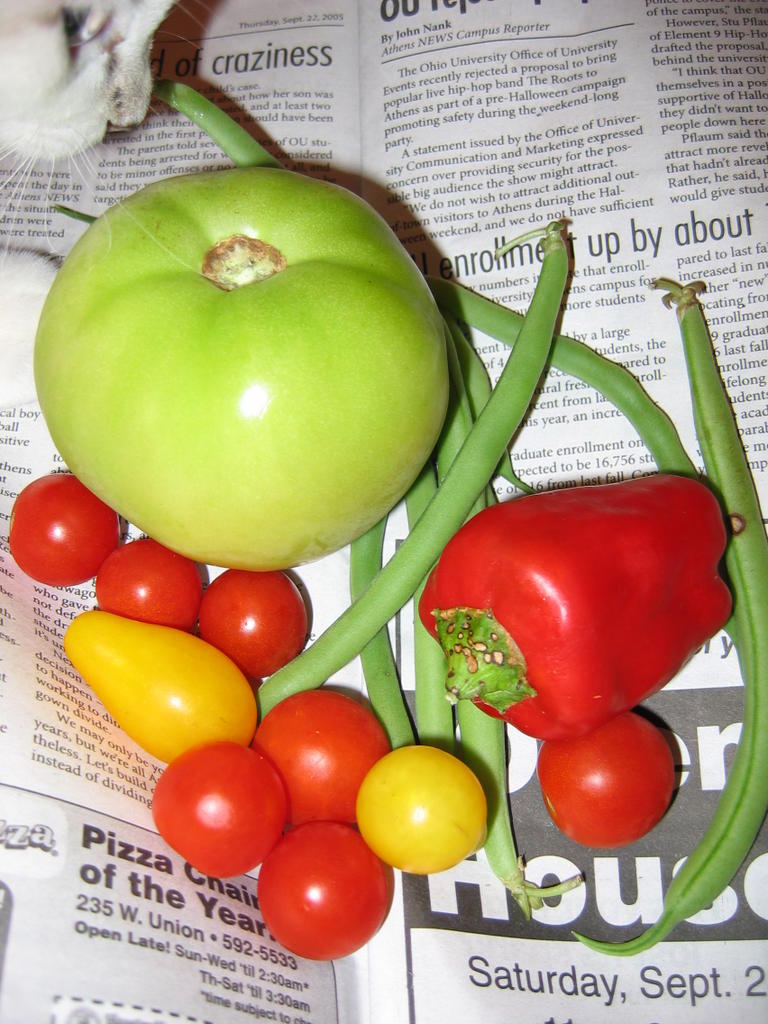 Coming Soon to a Grocery Store Near You: Cloned Cow
Scary huh? Cloned cow. Oooh. Spooky.
Well, not really, no. At least, not to me.
You know, there are reasons to get het up about factory farming. The maltreatment of animals, the unsanitary conditions of barns and slaughterhouses, the degradation of the environment due to poor waste managment--but should we really be upset about eating meat from a cow that was cloned?
Or more likely, eating meat from the offspring of a cow that was cloned?
Well industry officials and consumer groups warn that if the FDA does what is expected to do and permit the sale of meat from cloned cattle or the offspring of cloned cows in the US, that there may be a severe backlash from concerned consumers.
I am not certain why, except that the mere mention of the word, "clone," brings up memories of George Lucas' godawful movie, "Attack of the Clones." (I still have PTSD from seeing that film. Eueesh.)
But be that as it may, apparently, some people are afraid of eating cloned meat. Again, I don't really understand why--there are reasons to mistrust genetically modified organisms in our food supply, but being worried about cloned cows just strikes me as neo-luddite and weird.
However, considering the cost of cloning, and the possibility of a backlash, doesn't it make sense for the beef industry to just say, "That's nice," and go on their merry way without cloning cows? They've been getting on fine without it so far--I haven't noticed any beef shortages recently.
I mean, just because the FDA says they can sell cloned meat, doesn't mean that they have to.
I think consumer mistrust in cloned cattle shows just how badly our public schools fall down when it comes to teaching science.
Okay, I will drop the subject before I start ranting about Intelligent Design and how it bloody well isn't a theory, and if people actually knew the difference between a scientific theory and a philosophical construction, we wouldn't even need to have that argument in the first place.
On to the next news item:
Synthetic Chemicals in Organic Food?
The FDA isn't the only federal agency getting crap from consumers these days--the US Department of Agriculture has fomented a controversy by proposing an amendment to the rules governing the USDA Certified Organic labelling program that would allow foods which contain artificial ingredients such as ammonium bicarbonate, ethylene gas and xanthan gum, to still wear the USDA organic label. This time, the Organic Trade Association and the Organic Consumers Association are going head to head over the issue, with the OTA (which represents companies such as Kraft, Dole and Horizon) claiming that removing these food additives would hurt their bottom line, and the OTC claims that they are standing up against "corporate agribusinesses" which threaten to take over the organic food industry.
Now, here comes Barbara, the poopoohead skeptic again, pointing out what should be obvious: all of these ingredients go into processed foods that wear the organic label. If you want to avoid these sorts of ingredients, then avoid procesed foods. Ammonium bicarbonate is a leavening agent, ethylene gas is used to ripe fruit and xanthan gum is a thickening agent.
Let's start with the leavener, shall we? What are leaveners? They make baked products rise. What kind of leaveners are there? There are organic ones, such as yeast, which is a living organism, and which works by fermenting alcohol from sugar which produces carbon dioxide bubbles which then leaven the baked good. There also are chemical ones such as baking powder, which is a base and an acid, which in the presence of moisture and heat, react explosively, producing carbon dioxide bubbles which leaven the baked product, making it light and fluffy and not hard and cardboardy.
I hate to tell these organic consumers this, but they probably have chemical leaveners in their cupboards and use them every time they bake whole grain bran muffins and organic granola nut oatmeal cookies. If they have baking powder in their homes, they have a chemical leavener that is not "natural." From what I was taught in culinary school, ammonium bicarbonate isn't even used that much in the food industry anymore, and according to various sources on the net--it is seldom used by food processors. Even if it is used, it is no more harmful than the stuff in the stuff we use at home.
On to ethylene gas: it is a naturally occuring plant hormone in gaseous form that is emitted by some fruits and vegetables as a byproduct of ripening which causes the ripening process to continue.
Have you ever bought bananas which were too green, and then put them in a paper bag, and closed it up, then went back in a couple of days to find ripe bananas? Or if you want it to happen in a day, you throw in apple in with them? Was it magic that made the bananas yellow?
No. It was ethylene doing what it is supposed to do, naturally. Without ethylene treatments, most bananas would not ripen, so there would be no yellow organically grown bananas for people to eat.
As for xanthan gum--what is it and how is it made? It is a polysaccuride produced by allowing sugar to be fermented by a bacterium called Xanthanomas campestris. And what is fermentation?
A natural process.
So, here is my issue with this issue, which, if we go by the three examples used by the author of the article, is really a non-issue. (Some of the other thirty-five food additives may indeed be less than desireable in organic foods.)
With the exception ammonium bicarbonate, the other two chemicals/food additives are naturally derived. So, what exactly is the problem?
If you don't want these things used in processed foods that are labelled as organic, then come up with alternatives, stop eating processed foods or deal with runny yogurt, unripe bananas and cardboardy crackers and shut up. Bake your own crackers, for god's sake, and you had better not use baking powder, because--horrors--it is not natural.
There are reasons to get irritated with the USDA over the organic labelling rules. Their willingness to allow the use of harmful pesticides or toxic sludge on organic farms comes to mind. But freaking out about ethylene gas (which is chemically the same whether it is emitted by an apple or created in a laboratory and sprayed over bananas) is ridiculous and makes folks who care about organic food look like a bunch of idiots.
Once again, I say this: if our science education in this country was a little bit better, we wouldn't have these issues. Instead, we have consumers going off half-cocked on very little information and sometimes, just blatant superstition and suppositions.
Now, on to our "duh" newstory of the day:
Fried Fast Food Makes Kids Fat
Again, I say--well, duh.
Apparently, more and more kids are eating more and more meals outside of the home in fast food establishments where they eat lots of deep-fried stuff and lo, and behold--this is not making them slender.
These are the conclusions of a recent Harvard University study of the eating habits of more than 14, 000 US adolescents between the years of 1996 and 1999. During that time period the number of meals eaten outside of the home more than doubled, resulting in a higher body mass index for boys and a less varied and healthful diet for all participants.
The remedy suggested by the researchers: keep the kids home to eat, or failing that, teach them to eat more healthfully at fast food places by choosing a grilled chicken salad instead of a burger and fries.
There is a problem, of course, with that second idea.
Fast food restaurants specialize in making burgers and fries, not salads, and the former taste much better than the latter.
The likelihood of a kid picking a grilled chicken salad at McDonalds over a Quarter Pounder with Cheese and fries is about as great as my chance of having a torrid love affair with oh, I don't know--Antonio Bandaras.
It ain't gonna happen folks.
Here's a little tidbit to prove that I am not only a cynical harpy, but also a soft-hearted sentamentalist:
Cats Rescued from Hurricanes Arrive in Oregon
Forty-one cats rescued from hurricanes Katrina and Rita, arrived safely in Oregon on Monday, where they will be put up for adoption. They are in the care of The Cat Adoption Team of Sherwood, Oregon, a non-profit, no-kill shelter and hospital with room to house 600 cats.
Over 6,000 animals have been rescued by volunteers cleaning up after the two devastating hurricanes, thus far.
See--there are good things in the world.
Arroz Gratinado
 Nearly every culture has a dish related to a casserole. If there are ovens for baking bread, then casseroles are certain to follow; they are simple to put together, they cook undisturbed while the cook is engaged in other things, and they can utilize leftovers and be made to stretch to feed umpteen-eleven people without the cook breaking a sweat.
In other words, they are homey, delicious foods that are very little trouble to make.
Arroz gratinado is a rice-based Mexican casserole, and next to lasagne, is my all-time favorite among oven-cooked dishes that can be made for a crowd. You can use leftovers in the making of it--in fact, I am pretty sure it came about because of leftovers. As I was telling Morganna it likely arose when somebody's Abuela had leftover arroz rojo (red chile rice) and shredded meat, and wanted to do something new with it. Or maybe she had an extra guest or three coming to dinner and she wanted to add another dish to the menu without having to do too much extra work.
However it arose, arroz gratinado is a delicious dish.
I started making it at the request of a friend who had remembered eating it as a child at one of her Latina friend's home. Apparently, every year for the girl's birthday, her mother would make this dish for the party, and Nikki adored it. She had been reminded of it when she was at the grocery store and saw rice, beans and salsa in another shopper's cart, and she described the dish to me and begged me to figure out how to make it. I couldn't even look up a recipe for it, because she didn't know the name of the dish.
A rough description isn't much to go on, but I gave it my best shot.
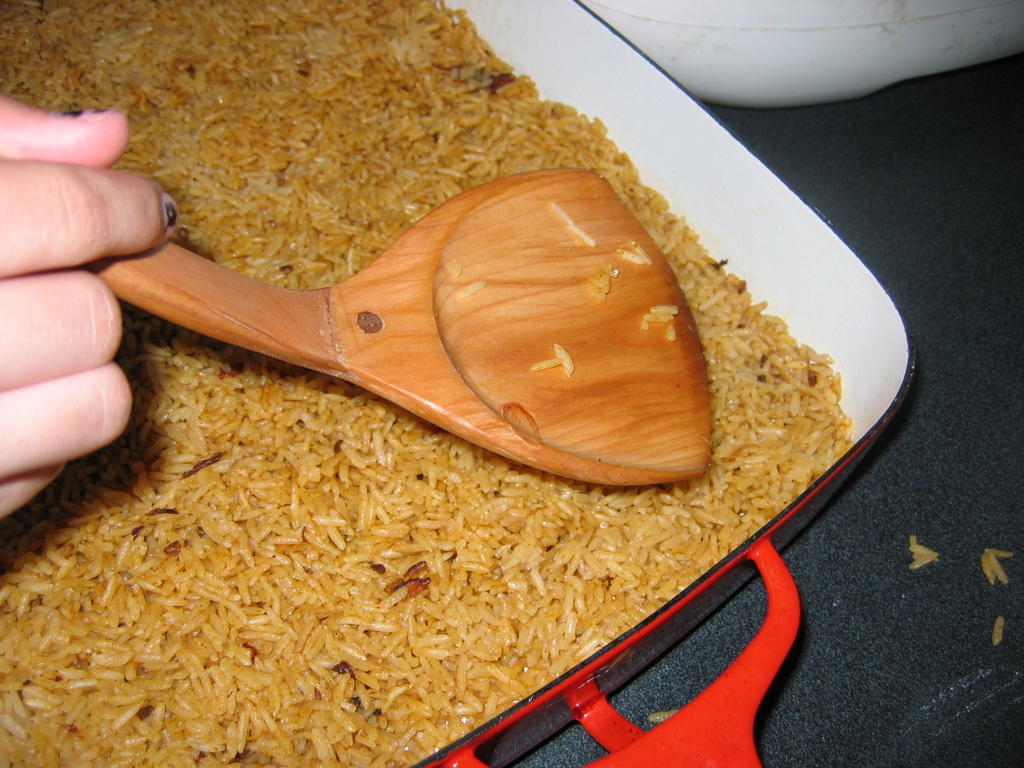 She told me that it involved tomato-flavored Mexican rice on the bottom, then shredded meat, tomato salsa, and then cheese melted on top with cilantro and scallions melted in the cheese, with refried beans served on the side.
How hard is that?
It turns out that it isn't difficult at all--which is what is best about casseroles--even if there are a lot of steps and ingredients, they are generally simple to put together, and so comforting that they create taste memories that can last for years.
So, the first time I made it, I made a pot of Mexican red tomato rice, then made a batch of shredded beef, a pot of cooked roasted tomato and poblano salsa and some refried beans, then put all of it but the beans together.
As Nikki had promised, it is a magnificently delicious dish and is so soul warming, I have never had anyone dislike it. Of course, at this point, it still had no name--she just called it, "That Mexican Rice Casserole You Make."
 Zak gave it our current unofficial name, which while descriptive and apt, is not appetizing. Because he would stir and mush his portion of refried beans into the rice casserole before eating the resulting unattractive glop, he named it, "Mash."
Which is what we called it amongst ourselves for years. Among company, we called it "Mexican Rice Casserole," which often made people wary that it might involve Ro-Tel tomatoes melted into Velveeta and taco meat over red rice baked to a state of crusty, gooey indifference, but once they tasted it, they loved it and always asked for the recipe.
It wasn't until I picked up a copy of Rick Bayless' Mexican Kitchen, that I found a real recipe for it and discovered its proper name, "arroz gratinado." Finally! I was pretty psyched to see that Rck made it much the way I did, though I confess to having switched to making the rice now by cooking it in the broth generated by cooking the shredded meat, and I generally used a good quality jarred salsa, especially if I was pressed for time. And, since Zak insisted upon squishing his beans into it, I just added a layer of "refried" beans. They were not really fried, but were simply freshly cooked pinto beans mashed with some scallions, some bean broth and maybe a teaspoon of bacon fat to give them an unctuous texture.
 One could, I suppose, use canned refried beans, or dehydrated ones, but really, it is so simple to cook a pot of beans and then mash some or all of them into a rough puree, that I see no reason to resort to the instant stuff. Freshly cooked beans taste so much better, and while I can stand the dehydrated beans, I despise the canned ones--they taste like metallic mud to me.
Beans really are simple to cook, and if you have a pressure cooker, they are even easier and quicker than one can imagine. The rules are simple--soak them or not--whichever method makes you feel better. Cook them in a flavorful liquid, and if you are not a vegetarian, add some sort of smoked meat product, preferably pork: ham, ham bone, ham hock, bacon, bacon grease--whatever. You can use smoked turkey wings if you are worried about fat or are a Muslim. (I taught my Islamic personal chef clients how to cook Mexican beans using smoked turkey wings--they loved it.) If you are a vegetarian, chipotle chiles will give a subtle smokey taste, as will spanish smoked paprika or smoked tofu. Sauteed onion and garlic--one small onion and 1/2 head garlic, add a great deal of flavor. Make sure you have enough liquid to cover the beans by an inch or two, and then start simmering them. Don't add salt at the beginning, add it once the bean skins split, and the beans start to soften. At that point, you can also add tomatoes, if you like.
And there you are. In a pressure cooker, it is usually twenty-five to forty five minutes to beans, on the stovetop alone, it usually takes four or five hours of simmering to cook unsoaked beans. Or stick them in the crock pot the night before or in the morning before work, and when you return, there are beans, ready to mash and turn into "refritos" for supper.
Yes, it is a bit more work than opening a can or pouring boiling water over bean flakes. But, it is certainly worth it in the long run. Besides--if you cook a whole pound of beans to make this casserole, you only need to mash half of them. In that case, you have half a pound of whole beans to make soup out of, to make beans and rice with, to add to enchiladas, or just to eat as is with cornbread. Two meals out of one dish.
That is something that every Abuela I have ever known could get behind.
 Arroz Gratinado
Ingredients:
2 cups raw long grain rice--I use jasmine
2 1/4 cups broth from cooking the shredded meat*
Canola oil spray or olive oil
1/2 pound (dry weight--before cooked) pinto beans, cooked and drained
3 scallions, sliced thinly
1/2 cup bean broth
1 teaspoon bacon fat or lard (optional)
1 pound cooked shredded meat
2 12-ounce jars high quality salsa
4 ounces shredded monterey jack or Chihuahua cheese
4 ounces shredded white extra sharp cheddar cheese
handful of minced cilantro and scallions
Method:
Preheat oven to 375 degrees
Using the broth you cooked the meat in (include any solid bits such as tomatoes, chiles, garlic or onion that are in the broth), cook the rice. *The amount given for the broth is the amount needed to cook jasmine rice in a rice cooker--follow your method of cooking long grain rice, and just use the same amount of broth you would use as water to get your rice to turn out right.
Put drained, cooked pinto beans in a bowl, and using a potato masher, mash them into a rough puree. I like to leave some bits of unmashed bean in there--it makes for a more interesting, chunky texture. Mix in the bean juice, scallion slices and optional bacon grease or lard with a wooden spoon until the puree is thick and pliable. (If it looks dry and clumpy, add more bean broth in tablespoon increments--you don't want the texture to be too fluid, but you don't want it to be chokingly dry, either.)
Spray the bottom of a 9"X13" casserole dish (it should be at least two inches deep) with canola oil spray or rub liberally with olive oil.
Spread cooked rice in the bottom of the dish, and press down flat. Don't pack it in super-tightly, just press it flat.
Sprinkle meat in an even layer over the rice, and pat down gently.
Spoon the bean puree over the meat layer in dollops; spread with the back of the spoon into a mostly even, thin layer of beans.
Pour salsa over all and spread evenly.
Sprinkle with cheese, and put in the oven. Bake until cheese melts and everything is warm and bubbly--20-35 minutes. In the last five minutes of baking, sprinkle the top with cilantro and scallions.
Notes:
You can use any kind of shredded meat you like in here, or if you are a vegetarian, leave it out and replace it with sauteed vegetables like sweet peppers and chiles, summer squashes, onions and garlic. Beef is traditional, but pork is really fine and tasty.
You can leave out the beans--they are only traditional in my house. Or, you can use whole beans sprinkled over the meat layer. Or you can use pureed black beans or whole ones.
You can add corn kernels over the bean layer. Grilled or roasted fresh corn cut from the cob is particularly nice.
You can make your own salsa for this.
You can leave out the salsa, and use heavy cream for a creamy version of the dish. If you do that, add corn and use whole beans instead of mashed ones, and flavor the cream with roasted garlic and poblano peppers. (In truth, I like the tomato salsa version best, and that is saying a lot coming from me--I adore cream. But in this dish, I like the tomatoes better.)
You can prepare it ahead of time and cover with foil and refrigerate it up to a day.
Leftovers can be cut into rectangles and be used to fill burritos for lunch. Just wrap it in a flour tortilla, and microwave on high for a couple of minutes. Nikki always said this stuff made the best damned burritos she'd ever had, and as they were one of her favorite foods, she had eaten a lot of them in her day.
This is a great dish for a crowd, but be aware that people like to eat a lot of it--it is really good. So, make a lot and don't worry about leftovers--if there is too much for burritos the next day, then freeze it in individual portions and use them as your very own microwave frozen meals for nights when you don't feel like cooking, but still want to eat something good.
Saturday, October 01, 2005
Weekend Cat Blogging: Feline Photographic Assistance
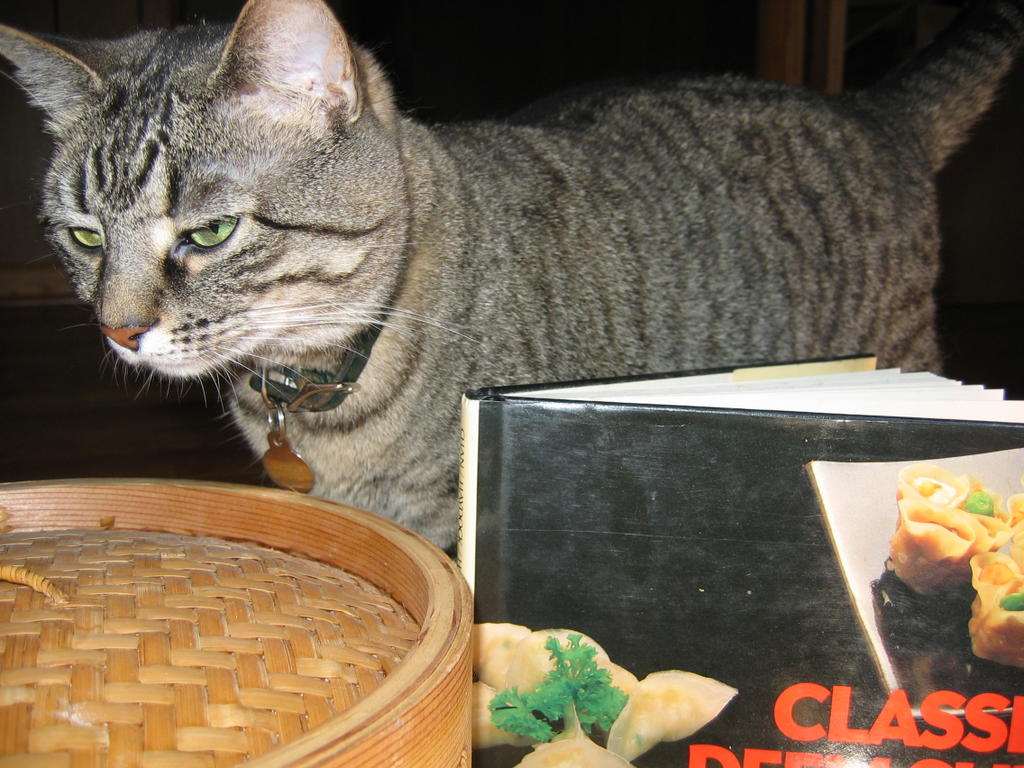 Anyone who reads my blog knows I take a lot of illustrative photographs. Generally, when I am doing photos that involve preparing food, I am safe from feline interlopers, because they know better than to jump up on counters and tables when I am working on food.
However, if I do a photo shoot that involves props like newspaper for my "Food in the News" posts or a shoot of a book cover for "The Chinese Cookbook Project," there is always much curiousity, as you can see.
Above, you can see Grimalkin trying to figure out what it is I am doing with a bamboo steamer on and a book on the floor.
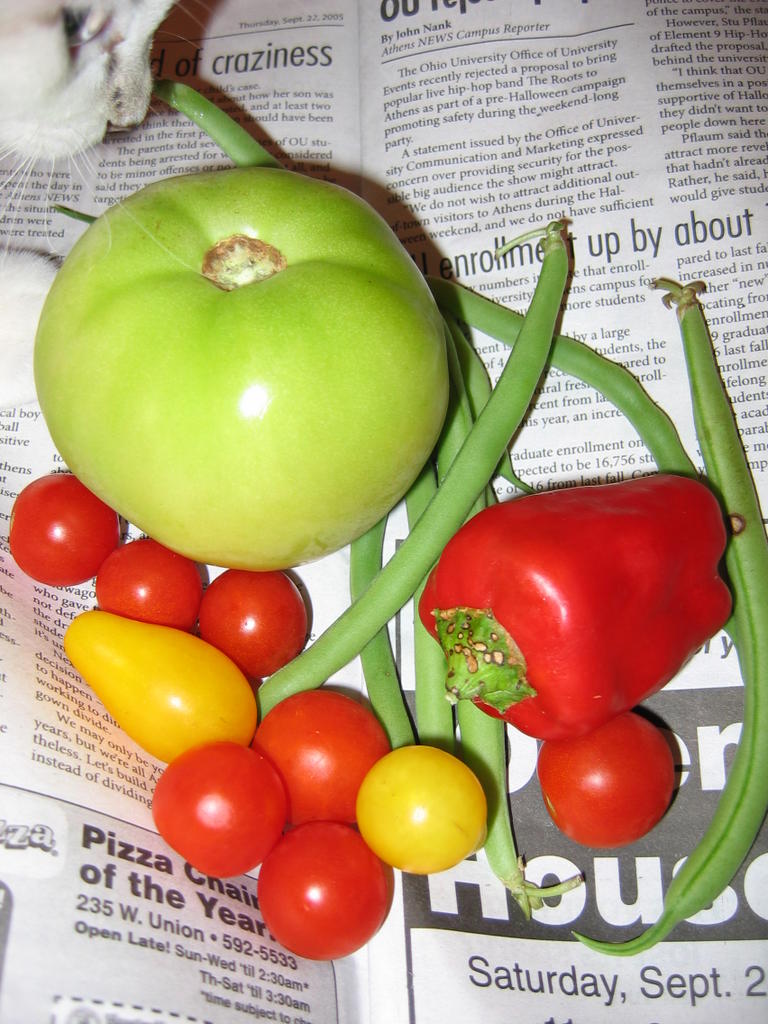 Next, we have Lennier's little face peering into the frame of the last shoot I did for "Food in the News."
Now, granted, he had to jump up on the dining room table to get there, but it was the rustle of newspaper that was too exciting to ignore.
And the scent of green beans. The little one apparently loves green beans, as you can see below, where he has nabbed one, and is about to jump off the table and run away with it in his mouth. He ate half of it, then batted the rest of it all over the dining room and kitchen floors.
He was, however, unimpressed with the tomatoes, exept in as much as the cherry tomatoes rolled nicely.
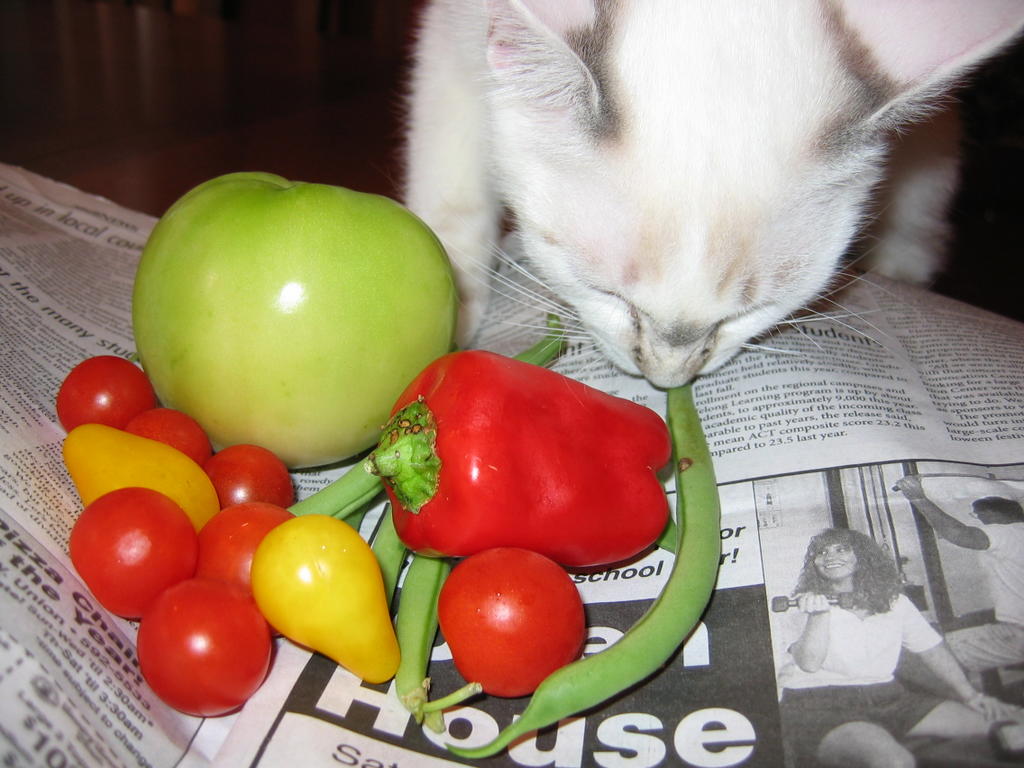 It is always funny to see what cats will do in any given situation. Cats are the reason why Zak and I seldom watch television, and could actually go for about two or three years without television reception at all. We had cats, and with multiple cats, someone is always up to something, and it is nearly always entertaining.
I sometimes think that cats view humans the same way.
Below, Gummitch appears to be saying, "Wow. Look at all this stuff Mommy has set up on the floor. I wonder why she did that. Humans are so very, very weird. I wonder what it all means."
(Note: I am now quite certain that cats get as much entertainment from the antics of humans as we get from feline shenanigans--our sewer is backed up, and the plumbers told us to flush our toilets after they had released the clogged drain, about four or five times apiece, in order to clean out the system. So, here I was, running up and down the stairs, flushing the four toilets in the house ten times apiece. Grimmy raced along to each bathroom with me, eyes wide, and tail quite erect, ears laid back in excitement. She watched the goings-on with great glee. I think she was trying to figure out what the hell I was up to.)
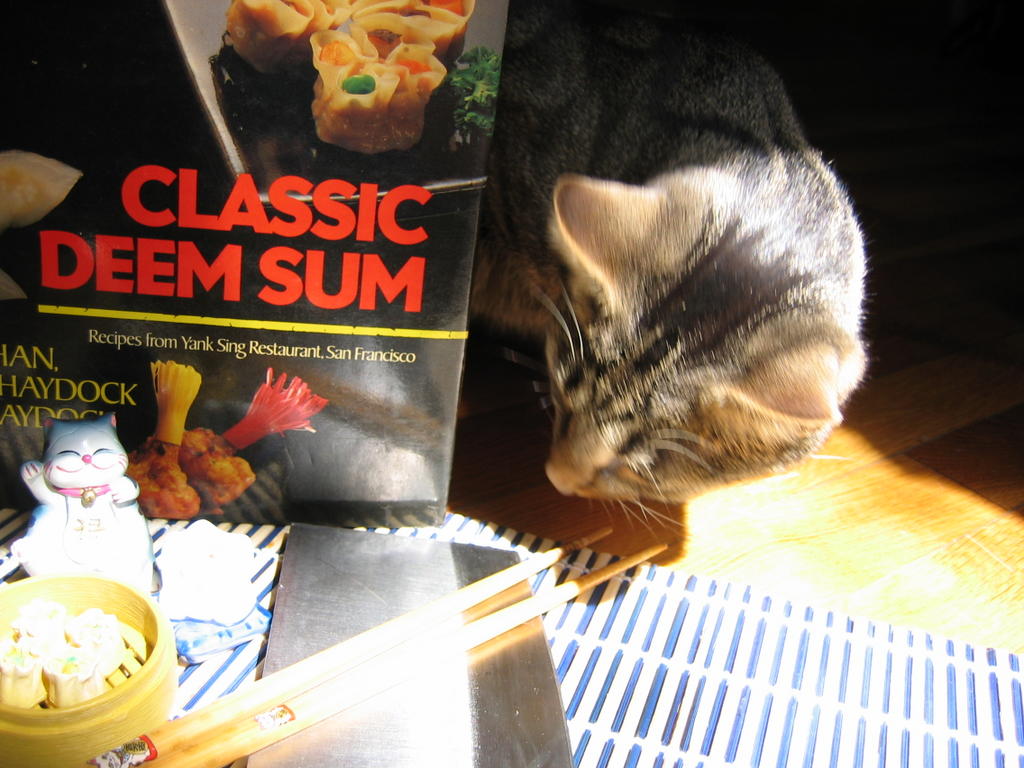 For more weekend cat blogging, check out Claire's Kiri destroying cardboard at Eatstuff.
Oreo's tongue at The Countess.
Ayla at Heather's Space having a bath.
Bella and Tasha practice Cat-fu at A Few of My Favorite Things.
Kittens for adoption at Masak-Masak!
Edith perching at Anne's Food.
Lixue with love-eyes at Look Hunny, I Cooked.
Cleo's sweet face at Le Sense du Gout.
Salsa taking in the sun at papilles et pupilles.
Grover Jay lookin' spooky at Restaurant Widow.
Scapin et Zadig relaxing at Le blog de Juliette.
Kittaya feels the autumn chill at Mahanandi.
Patchy Cat is loved at Farmgirl Fare.
Agnes eyes a frittata at Kayaksoup.
Lyle napping in a fine and private place at Basic Juice.
Trina in a box and a stray beauty at Indy Foodie.
Tinker and a shadow at Middle Fork.

