

Friday, May 27, 2005
Knives are Dangerous
This morning, I got up early, not because I intended to, but because I have been getting up early for the past four mornings. I have been impersonating a morning-person so that I could let the contractors into the house in order that they could finally finish their work; now my brain is trained to awaken at seven thirty, no matter what time I went to bed.
I was awake, though I did not want to be, so I decided to look in the New York Times, to see what is going on in the world outside of Athens, Ohio. I figured that I would find something that would disgust me enough that I would want to crawl back into bed as a means to avoid the world, thus ensuring that I might get enough sleep after staying up late working on a writing project.
I was not disappointed.
I found a story which was about yet another sign that the Apocalypse is nigh--or at least that is the studied opinion of none other than Anthony Bourdain, author of the best-selling memoir, Kitchen Confidential and executive chef at Les Halles.
For those who don't want to read the actual news article, the gist of it is this: three British physicians wrote an editorial in the most recent edition of The British Medical Journal calling for a ban on the sale of long, pointed kitchen knives. This is because the rate of violent crime in the UK, including murders where kitchen knives have been used as weapons, has risen by 18 percent between 2003 and 2994. The authors insisted that knife manufacturers redesign their knives with rounded, blunt tips, because the pointed tip of the standard chef's knife is a vestigial feature from less civilized ages when people speared their meat at the table.
Not only did they make the ridiculous claim that the sharp tips on chefs knives are essentially useless in the kitchen, they managed to get ten (unnamed in the New York Times article) UK chefs to back up their assertion. The chefs did however, say that while sharp tips were not necessary on long chef's knives, they were useful on short knives.
Not surprisingly, Anthony Bourdain, whom one can always expect to have something colorful to say on any subject, weighed in with the opinion that the chef's knife is an extension of a chef's hands, and is not an object whose design should be controlled by bureaucrats
I have to agree with Bourdain on this one.
First of all, anyone who says that there is no reason for a chef's knife to have a pointed tip either has never used one, or should not be using one. I would really like to know the names of these ten UK chefs so that I could find out what they do in a kitchen, because I suspect it has nothing to do with cooking. If they really believe that no long knife needs to have a pointed tip, then they need to go out and take a knife skills class in some reputable culinary school, because they have a buggered-up idea of how knives are used in the kitchen. The pointed tip on a chef's knife is not there as an arbitrary feature because historically people speared their meat and ate it off the points of dirks. It is there to make the knife more versatile than a blunted tipped knife would be. Furthermore, the sharp tip is absolutely essentially on two other long-bladed kitchen knives--the boning knife and the filet knife, both of which come equipped with extremely sharp, long, slender, flexible blades, the tips of which come to a very fine, definite point.
It is true that the sharp tips on chef's knives are not used in every cutting technique that a chef might use in his or her daily routine--the chef's knife is primarily used to cut with the long edge of the blade. One does very little cutting on vegetables using the tip, though, I do find it useful in mincing garlic and finely dicing onions. However, when trimming or boning some meats, I find the sharp tip to be not only useful in expanding the agility of the knife, but it can keep me from having to reach out for the boning knife, especially if I am working on a chicken breast. For me, that means one less knife to wash in the middle of preparing dinner.
But even if we were to decide collectively that the pointy tip is not necessary on a chef's knife, there is still the issue of a boning knives and filet knives to consider.
And consider it we must. One cannot effectively bone a chicken, a lamb chop or a leg of lamb without using the tip of a boning knife. The same goes with using the filet knife on fish: it is simply not possible, and because of that, I wonder of these ten chefs have ever used such a knife properly in their lives. Perhaps they are pastry chefs, or maybe they are vegetarians, because frankly, no cook who has ever prepared meat would make such a boneheaded comment.
The doctors who wrote the article would probably be appalled to see a good chef or butcher at work with a boning knife; there are techniques where one holds the knife like a dagger, with the edge of the knife perpendicular to the wrist. One leads with the tip of the knife, and makes cutting motions which are dependant upon the long, pointed, flexible tip, drawing it along the meat in order to separate it from the bone. At times, the angle of the knife blade is very close to the chef's wrist--in fact, the motion for this sort of cutting is all in the wrist and the shoulder, and nimble manipulation is quite possible, in large part because of the design of the boning knife's blade.
But beyond the necessity of having long bladed pointed knives in the kitchen, there is the fact that a short-bladed knife with a pointed tip is just as effective as a murder weapon as a long-bladed knife. One doesn't need a ten inch chef's knife to open up the carotid artery in a person; in fact, a surgically-sharp paring knife, with a blade under three inches long would not only work adequately for the job, but it would be superb at it, as the artery is not even three inches below the surface of the skin.
And even the ten chefs cited by the overly zealous doctors admitted that paring knives with points are useful in the kitchen. Not only do they peel vegetables, but they create precisely carved garnishes, for example.
In the end, the doctors' opinion just doesn't hold up to intense scrutiny. Actually, it doesn't even hold up to lackadaisical scrutiny. (I haven't even had coffee yet, and am poking holes in it.)
Yes, kitchen knives may have been used to commit sixteen fatal attacks and fifteen non-fatal attacks in the first couple of weeks of 2005 in the UK, but how many other times were they safely and non-violently used in the kitchens across that country in that same period of time?
How many cases of vehicular homicide occurred in that same time period? How many heavy blunt objects such as say, hammers, were used to kill people? How many fire pokers? How many household chemicals were used to poison people? How many nylon stockings were used to strangle someone?
Yet, there are not calls to ban hammers, fire pokers, household cleansers and panty hose.
It all comes down to this: if someone wants to kill someone else, they will find a way to do it. Human beings are incredibly creative when they are motivated by desperation, and unfortunately one of the things that we are really good at is coming up with ways to kill each other.
The reason that the violent crime rate is rising has nothing to do with kitchen knives, and everything to do with social issues. Banning the knives will do nothing to stem the violence--it will only change the form in which it occurs. It is so facile to believe that if we only take knives away from people, then there will be no more stabbings. But knives are not the problem.
People are the problem.
Yes, knives are dangerous tools, ones that can be used for both good and ill.
They can be used to create culinary works of art, or just put supper on the table. They can also be used to murder another human being. Such is the way of tools--seldom are they useful for only one purpose; however, just because they can be used for nefarious purposes does not negate the good that comes of using them properly.
Leave the kitchen knives of the world where they belong--in the hands of culinary professionals and home cooks, where they do much more good than harm.
I was awake, though I did not want to be, so I decided to look in the New York Times, to see what is going on in the world outside of Athens, Ohio. I figured that I would find something that would disgust me enough that I would want to crawl back into bed as a means to avoid the world, thus ensuring that I might get enough sleep after staying up late working on a writing project.
I was not disappointed.
I found a story which was about yet another sign that the Apocalypse is nigh--or at least that is the studied opinion of none other than Anthony Bourdain, author of the best-selling memoir, Kitchen Confidential and executive chef at Les Halles.
For those who don't want to read the actual news article, the gist of it is this: three British physicians wrote an editorial in the most recent edition of The British Medical Journal calling for a ban on the sale of long, pointed kitchen knives. This is because the rate of violent crime in the UK, including murders where kitchen knives have been used as weapons, has risen by 18 percent between 2003 and 2994. The authors insisted that knife manufacturers redesign their knives with rounded, blunt tips, because the pointed tip of the standard chef's knife is a vestigial feature from less civilized ages when people speared their meat at the table.
Not only did they make the ridiculous claim that the sharp tips on chefs knives are essentially useless in the kitchen, they managed to get ten (unnamed in the New York Times article) UK chefs to back up their assertion. The chefs did however, say that while sharp tips were not necessary on long chef's knives, they were useful on short knives.
Not surprisingly, Anthony Bourdain, whom one can always expect to have something colorful to say on any subject, weighed in with the opinion that the chef's knife is an extension of a chef's hands, and is not an object whose design should be controlled by bureaucrats
I have to agree with Bourdain on this one.
First of all, anyone who says that there is no reason for a chef's knife to have a pointed tip either has never used one, or should not be using one. I would really like to know the names of these ten UK chefs so that I could find out what they do in a kitchen, because I suspect it has nothing to do with cooking. If they really believe that no long knife needs to have a pointed tip, then they need to go out and take a knife skills class in some reputable culinary school, because they have a buggered-up idea of how knives are used in the kitchen. The pointed tip on a chef's knife is not there as an arbitrary feature because historically people speared their meat and ate it off the points of dirks. It is there to make the knife more versatile than a blunted tipped knife would be. Furthermore, the sharp tip is absolutely essentially on two other long-bladed kitchen knives--the boning knife and the filet knife, both of which come equipped with extremely sharp, long, slender, flexible blades, the tips of which come to a very fine, definite point.
It is true that the sharp tips on chef's knives are not used in every cutting technique that a chef might use in his or her daily routine--the chef's knife is primarily used to cut with the long edge of the blade. One does very little cutting on vegetables using the tip, though, I do find it useful in mincing garlic and finely dicing onions. However, when trimming or boning some meats, I find the sharp tip to be not only useful in expanding the agility of the knife, but it can keep me from having to reach out for the boning knife, especially if I am working on a chicken breast. For me, that means one less knife to wash in the middle of preparing dinner.
But even if we were to decide collectively that the pointy tip is not necessary on a chef's knife, there is still the issue of a boning knives and filet knives to consider.
And consider it we must. One cannot effectively bone a chicken, a lamb chop or a leg of lamb without using the tip of a boning knife. The same goes with using the filet knife on fish: it is simply not possible, and because of that, I wonder of these ten chefs have ever used such a knife properly in their lives. Perhaps they are pastry chefs, or maybe they are vegetarians, because frankly, no cook who has ever prepared meat would make such a boneheaded comment.
The doctors who wrote the article would probably be appalled to see a good chef or butcher at work with a boning knife; there are techniques where one holds the knife like a dagger, with the edge of the knife perpendicular to the wrist. One leads with the tip of the knife, and makes cutting motions which are dependant upon the long, pointed, flexible tip, drawing it along the meat in order to separate it from the bone. At times, the angle of the knife blade is very close to the chef's wrist--in fact, the motion for this sort of cutting is all in the wrist and the shoulder, and nimble manipulation is quite possible, in large part because of the design of the boning knife's blade.
But beyond the necessity of having long bladed pointed knives in the kitchen, there is the fact that a short-bladed knife with a pointed tip is just as effective as a murder weapon as a long-bladed knife. One doesn't need a ten inch chef's knife to open up the carotid artery in a person; in fact, a surgically-sharp paring knife, with a blade under three inches long would not only work adequately for the job, but it would be superb at it, as the artery is not even three inches below the surface of the skin.
And even the ten chefs cited by the overly zealous doctors admitted that paring knives with points are useful in the kitchen. Not only do they peel vegetables, but they create precisely carved garnishes, for example.
In the end, the doctors' opinion just doesn't hold up to intense scrutiny. Actually, it doesn't even hold up to lackadaisical scrutiny. (I haven't even had coffee yet, and am poking holes in it.)
Yes, kitchen knives may have been used to commit sixteen fatal attacks and fifteen non-fatal attacks in the first couple of weeks of 2005 in the UK, but how many other times were they safely and non-violently used in the kitchens across that country in that same period of time?
How many cases of vehicular homicide occurred in that same time period? How many heavy blunt objects such as say, hammers, were used to kill people? How many fire pokers? How many household chemicals were used to poison people? How many nylon stockings were used to strangle someone?
Yet, there are not calls to ban hammers, fire pokers, household cleansers and panty hose.
It all comes down to this: if someone wants to kill someone else, they will find a way to do it. Human beings are incredibly creative when they are motivated by desperation, and unfortunately one of the things that we are really good at is coming up with ways to kill each other.
The reason that the violent crime rate is rising has nothing to do with kitchen knives, and everything to do with social issues. Banning the knives will do nothing to stem the violence--it will only change the form in which it occurs. It is so facile to believe that if we only take knives away from people, then there will be no more stabbings. But knives are not the problem.
People are the problem.
Yes, knives are dangerous tools, ones that can be used for both good and ill.
They can be used to create culinary works of art, or just put supper on the table. They can also be used to murder another human being. Such is the way of tools--seldom are they useful for only one purpose; however, just because they can be used for nefarious purposes does not negate the good that comes of using them properly.
Leave the kitchen knives of the world where they belong--in the hands of culinary professionals and home cooks, where they do much more good than harm.
Saturday, May 21, 2005
Will Write For Food
I have returned from my partially enforced, partially voluntary writing hiatus, and thought it might be nice to warn my readers that I have a few ideas bubbling in the caudron of my mind for taking this blog in a few different directions from this entry forth.
I started this blog in large measure just as a means to get my writing chops up, and to give myself a semi-structured venue for my food writing. I have had fiction and articles published in a variety of print media over the years, but have not had the guts to submit any of my food writing to magazines or newspapers. Though I have flirted with the writing of a cookbook over the years, I haven't yet found a hook that will help me narrow my focus into a subject that is both compelling and entertaining.
When I had to rush off unexpectedly to help my aunt cope with my uncle's serious life-threatening illness, I was forced not only to abandon the momentum I had built up in my writing, but I had the time to take a good, hard look at what I was writing, why I was writing it and what I was capable of writing. I found that I had ceased to take what I was doing seriously enough to really be worthy of my goal of giving voice to some of the wisdom I had gleaned over the years, and so I have resolved to do better.
In light of that goal, I picked up and started reading Dianne Jacob's excellent book, Will Write For Food, which is essentially a "how-to" book for aspiring food writers.
Now, I will admit that the best way to learn about writing isn't to read books that are about writing, but to read good prose of any sort, and to write obsessively. Having a critical mind and an iron backbone helps as well; if one is serious about learning to write well, one needs to have the strength and discipline to take harsh criticism. If you cannot ruthlessly mow your sentences down like the Grim Reaper on a harvesting spree, then you shouldn't think about really being a writer. If you cannot take the well-meant, but often stinging words of the editorial red pen, then you need to find another hobby.
I can withstand the stroke of an editor's pen, no matter how painful the lashes might be. And I can push myself to rip apart my most carefully constructed paragraph in order to purge the dross and seek the one sentence or phrase of pure gold. I can start an essay and work on it for three days and then, realizing that it goes nowhere, can delete it out of existence with the stroke of a finger, and start over, and write it again until I get it right.
I can do these things, but I haven't been.
I confess that I had become lazy, and while I was away, all of the momentum I had built up to keep writing leached away as I watched my uncle fight successfully for his life. What I had been writing dwindled into insignificance beside his heroic struggle.
And so, when I came home, I nearly gave up and deleted the blog and forgot about what I had set out to do in a fit of artistic angst.
I despise angst, especially when it is unnecessary. Being grief-stricken over the impending death of a loved one is not angst--that is something that everyone who loves a mortal being must face at least once in their lives. That is real, and true, and it is at the heart of what it means to be human. Kvetching over what exactly I am going to write about today is whining, pure and simple, and I refuse to allow myself to wallow in manufactured angst any longer.
So, I have confessed to you. I have been lazy, whiny and alltogether too angsty for my or anyone else's own good. I have resolved to cease in this foolishness, and get back to what I set out to do, which is present the world with the best writing I can manage on the broad subject of food and all elements that touch upon that subject.
As I mentioned before--things are going to change around here.
For one thing, there probably will not be a long post every day. I will try to post shorter pieces once a day, just to let people know that I am still in my kitchen and at my keyboard, thinking, cooking and writing, but I cannot keep up the momentum of writing a huge post every day without the quality of my writing slipping.
I would rather present my readers with quality than quantity, so I will be presenting more longer pieces and series, carefully written and edited over a period of days, and sometimes weeks, in order to really give the world something worth reading. The first series will be a four-part series that will start in the next few days, and I hope that you will enjoy it. I will give a bit of a hint--it is about the architecture of world cuisines, and involves pillars.
With that, I wish you all a happy Saturday, and I hope that each of you live your lives to the fullest every second you walk upon our beloved planet.
I started this blog in large measure just as a means to get my writing chops up, and to give myself a semi-structured venue for my food writing. I have had fiction and articles published in a variety of print media over the years, but have not had the guts to submit any of my food writing to magazines or newspapers. Though I have flirted with the writing of a cookbook over the years, I haven't yet found a hook that will help me narrow my focus into a subject that is both compelling and entertaining.
When I had to rush off unexpectedly to help my aunt cope with my uncle's serious life-threatening illness, I was forced not only to abandon the momentum I had built up in my writing, but I had the time to take a good, hard look at what I was writing, why I was writing it and what I was capable of writing. I found that I had ceased to take what I was doing seriously enough to really be worthy of my goal of giving voice to some of the wisdom I had gleaned over the years, and so I have resolved to do better.
In light of that goal, I picked up and started reading Dianne Jacob's excellent book, Will Write For Food, which is essentially a "how-to" book for aspiring food writers.
Now, I will admit that the best way to learn about writing isn't to read books that are about writing, but to read good prose of any sort, and to write obsessively. Having a critical mind and an iron backbone helps as well; if one is serious about learning to write well, one needs to have the strength and discipline to take harsh criticism. If you cannot ruthlessly mow your sentences down like the Grim Reaper on a harvesting spree, then you shouldn't think about really being a writer. If you cannot take the well-meant, but often stinging words of the editorial red pen, then you need to find another hobby.
I can withstand the stroke of an editor's pen, no matter how painful the lashes might be. And I can push myself to rip apart my most carefully constructed paragraph in order to purge the dross and seek the one sentence or phrase of pure gold. I can start an essay and work on it for three days and then, realizing that it goes nowhere, can delete it out of existence with the stroke of a finger, and start over, and write it again until I get it right.
I can do these things, but I haven't been.
I confess that I had become lazy, and while I was away, all of the momentum I had built up to keep writing leached away as I watched my uncle fight successfully for his life. What I had been writing dwindled into insignificance beside his heroic struggle.
And so, when I came home, I nearly gave up and deleted the blog and forgot about what I had set out to do in a fit of artistic angst.
I despise angst, especially when it is unnecessary. Being grief-stricken over the impending death of a loved one is not angst--that is something that everyone who loves a mortal being must face at least once in their lives. That is real, and true, and it is at the heart of what it means to be human. Kvetching over what exactly I am going to write about today is whining, pure and simple, and I refuse to allow myself to wallow in manufactured angst any longer.
So, I have confessed to you. I have been lazy, whiny and alltogether too angsty for my or anyone else's own good. I have resolved to cease in this foolishness, and get back to what I set out to do, which is present the world with the best writing I can manage on the broad subject of food and all elements that touch upon that subject.
As I mentioned before--things are going to change around here.
For one thing, there probably will not be a long post every day. I will try to post shorter pieces once a day, just to let people know that I am still in my kitchen and at my keyboard, thinking, cooking and writing, but I cannot keep up the momentum of writing a huge post every day without the quality of my writing slipping.
I would rather present my readers with quality than quantity, so I will be presenting more longer pieces and series, carefully written and edited over a period of days, and sometimes weeks, in order to really give the world something worth reading. The first series will be a four-part series that will start in the next few days, and I hope that you will enjoy it. I will give a bit of a hint--it is about the architecture of world cuisines, and involves pillars.
With that, I wish you all a happy Saturday, and I hope that each of you live your lives to the fullest every second you walk upon our beloved planet.
Friday, May 13, 2005
Home Again

This is Springheel Jack, happily meditating on my lap.
We have returned from our sojourn in Tennessee, and my uncle is feeling better and for the first time in three weeks, is going out of the critical care unit into a more regular hospital room. He is not fully recovered, but he is much, much better. I suspect that he will have a long row to hoe yet as he struggles towards health.
It is good to be home, with a cat on my lap, and in my kitchen, though I have to admit to not having had a chance to cook much of anything interesting yet.
I probably should have taken the camera with me; while visiting, I took over my aunt's kitchen and whipped up puttanesca with a salad of roasted beets, pears and mixed greens with balsamic vinaigrette one night. Another night, I threw together Chicken and Portabello Marsala (the mushrooms were for my vegetarian cousin), roasted asparagus, and wild mushroom risotto with asiago cheese, and the last night we were there, I made a nice pasta primavera with chicken, asparagus, mushrooms and a light lemon cream sauce.
So, I kept busy.
Also, while we were there, we ate some fandamnedtastic southern food, which, of course, is what I grew up eating. And if I ate it every day now, I would be as big as my house--it is all so laden with pork fat that just looking at it makes my arteries want to jump out of my body and run away screaming, but boy, does it taste fine and dandy. I think my favorite meal out was at Linda's Pic-a-Rib, where I had pulled braised pork sandwitched between two hoecakes (that is cornmeal pancakes for the uninitiated) that had been fried in bacon grease. That was delicious in a totally down-home, unpretentious way, but I am glad to be home.
I missed my kitties.
Oh, and that cat up above--that is Springheel Jack, also known as Jackanape, Jackster, Jackie, Jackal, Jackalope, 'Nape, and Napester. He is a bizarro creature who is quite neurotic and skittish most of the time, but who has great fits of affection where he will swoop upon us and fling himself bodily against us and turn into a lump of purring fur. So, we pet him, and he is happy, until he starts twitching and then without warning, dashes away, and returns to his habit of skulking in the shadows and creeping under furniture.
I cannot explain him, but I do love him.
Now, I am off to go sign the papers that will close the deal on the sale of our old home, and to eat good Chinese food at Shangrila.
I will return to my regularly scheduled food blog entries in the next few days, after I get my bearings.
Wednesday, May 04, 2005
I will be gone for a while....
I just got a call from a relative; Zak and I are going to have to go out of town in support of someone who is very ill and needs us.
So, Tigers and Strawberries will be uncommonly quiet until I get back.
Thanks to all my loyal readers, friends and family.
I hope to be back soon.
So, Tigers and Strawberries will be uncommonly quiet until I get back.
Thanks to all my loyal readers, friends and family.
I hope to be back soon.
Dumpling Duds

From far away, they don't look too bad. But they still were not right.
I discovered something night before last.
When you have a fever, you really shouldn't try out a new recipe, especially one that requires numeric memory and nimble fingers.
Yes, I have the flu, but I decided that even though I had a fever and was woozy and dizzy and had a screaming headache, that shouldn't stop me from making potstickers.
I don't know why I decided this. Probably because I was delerious or something.
And I decided that instead of using gyoza wrappers, which is what I generally do because I was afraid of the dumpling dough, I should make the wrappers by hand. Because what I really wanted were the excellent pan fried dumplings that they make at Shangri-la. But since that restaurant is now about two hours away from where I live, that wasn't going to happen.
So, feverish and deluded, I tried to recreate them.
And failed utterly.
Now the dumplings that I ended up making were not bad. They just were not good.
And they were ugly.
Butt-ugly.
They looked leperous.
Making the dough wasn't so hard, or bad as I had imagined it. It was simple, really. It was no harder than scallion pancake dough, which I can make with my eyes closed.
It all went awry when it came to rolling them out and shaping them.
Why?
Because I was supposed to roll the dough into a fifteen inch long rope and cut it into thirty pieces, and then flatten each piece into a small disk and then roll out each disk into a little circle, and then fill those with a little spoonful of filling, and then pleat one edge and there we are.
I forgot the thirty part. I only remembered the fifteen part. I cut the rope into fifteen pieces and then wondered why my dumplings kept coming out as these massive freaks of nature.
Zak tried to say, "Maybe the dough disks are too big?"
"No!" I declared. "It cannot be! It said to cut them into fifteen pieces, and I cut it into more than that--more like nineteen pieces, and they are still coming out funny. And for some reason, I can't pleat the dough today. I don't know why."
Gently, my husband suggested, "Could it be because you have a fever and your eyes are glassy and your fingers are shaking?"
"No, of course not!"
Denial is not just a river in Egypt, folks.
Around the time that I pleated the last pathetic glob of dumpling, I looked at the recipe and wanted to bang my head into a wall. Because right there, in black letters it said, both in Mandarin and English, though I will admit to the letters swimming around in my vision: "Cut into thirty pieces."
Thirty pieces of silver, thirty pieces of dough, thirty dumplings. Oy vey.
So, I fried the little bastards anyway, until they were golden brown and crisp on the bottom, and then added the broth and closed the lid and steamed them until they were done.
And once they solidified, they didn't look nearly as much like alien life forms.
And they tasted okay, but the filling was too lean, I realized. And the filling was overcooked by the time the extra dough was cooked.
The usual pork I use is from Bluescreek Farms, and it has a good proportion of lean to fat. The local pork I bought at the farmer's market on Saturday, however, was not fatty enough.
I didn't cry, but I was frustrated.
And I had a lot of filling left.
So, yesterday, I left it alone, because I still had a fever and had learned my lesson. We had pizza for dinner, needless to say.
Today, I will use the ground pork filling to make Ma Po Tofu for dinner. Waste not, want not.
And, next week, after I teach at Sur La Table in Columbus, we will pick up Bluescreek pork, and I will make pan fried dumplings again, from scratch, and I will post pictures and a full recipe at that time.
And, the next time I am feverish and decide to do something ambitious and stupid, I have told Zak that he must hold a pillow over my face until I change my mind or pass out, thus saving the world from dumplings that look rather like embryonic alien lifeforms.
Monday, May 02, 2005
Blueberry Whole Grain Tea Bread

Zak liked this bread better than the Harvest Fruit Bread; but I don't agree. It is just a matter of personal taste--I like all the chewy, nutty goodness of a whole grain bread, and he likes a finer textured bread with fewer inclusions. The white flecks in the picture are whole grain oats that have been cut when I sliced the bread, exposing the uncooked interior.
Okay, so apparently this week's theme at Tigers and Strawberries is bread.
I didn't intend that, but it just seems to be going in that direction. So, rather than argue with it, I will go along and have fun with it. I am a big one for going with the flow of the Tao and letting it lead me to interesting places, so here we are, in the midst of a baking mood, talking about bread.
My favorite part of the two baking classes I took in culinary school was when we studied bread bakery, in Intro to Baking and Pastry. Every day, we created the breads for all of the dining rooms on campus. We made baguette, rolls, whole wheat breads, multi-grain breads, croissant, brioche and some rustic hearth breads. Every morning, we had a lecture on the science of bread bakery, a quiz on the material we learned the day before, and then we broke into groups and started baking bread before lunch. After lunch, we worked on desserts.
I am not a morning person, but the bread happened in the morning, and I was so into it.
I am into bread, in large part, because I love the fact that bread dough is alive. The yeast critters, when given food, warmth, water and air, create one of humanity's basic foods--bread.
Bread dough is intensely sensual. I love the feel of the dough under my hands; the springiness, the way it seems to pulsate and breath as I work with it, kneading it beneath my palms. I love the smell of yeast as it works at fermenting sugar into alcohol, and the scent of the wheat in the flour itself is intoxicating to me.
At the same time, bread baking is also intellectually satisfying. There are specific measures, proportions and formlae to learn in order to bake good breads, and there is a chance to learn to flex mathematics muscles left long dormant in the brain. There is the joy of knowing the reason behind all of the formulas, there is the thrill of discovery and experimentation.
Bread baking has it all.
And I have loved it ever since I stood on a chair at the counter with my Grandma, who never measured a thing as she turned out loaf after loaf of delicious farm bread and rolls in every shape you could imagine. She kneaded her dough with the skill of long practice, and her gnarled hands seemed to go about their business without any help from her, while her face would take on a peaceful expression, as if she were deep in meditation.
Perhaps she was.
So, in the spirit of experimentation and intellectual curiosity, and for the sensual joy of it, I offer you my recipe for Blueberry Whole Grain Tea Bread--which may get a more fun and funky name later on, when I think of one.
Blueberry Whole Grain Tea Bread
Ingredients:
1 cup bread flour
2 1/2 cups all purpose flour
1/2 cup + 1/3 cup wheat germ
1/3 cup Harvest Grains Blend from King Arthur Flour
4 teaspoons Lora Brody's Dough Enhancer
1/4 teaspoon cardamom
1/8 teaspoon cinnamon
2 teaspoons instant yeast (SAF is what I used)
1 1/2 teaspoons salt
3 tablespoons honey
1/2 cup milk
1/2-3/4 cups water (in this loaf I used a very little over 1/2 cup of water)
1/4 cup dried blueberries, packed
Method:
Put all dry ingredients except blueberries into the workbowl of a Kitchenaid or similar mixer fitted with a dough hook. Add all liquid ingredients, using the smaller amount of water to start with.
Mix together, starting on low, scraping down the bowl as necessary, until a slightly sticky dough comes together and is pulled from the sides of the bowl. Once it comes together coherently, turn speed up to medium and knead until gluten development is sufficient. (To test for this, take a tiny ball of dough, and holding it up to the light, stretch it gently to see if it will form a very thin membrane that you can see light through. This is called "the windowpane test." Be aware that the whole grains in this bread will mean that you cannot make a big windowpane--the whole grains will cut the gluten strands before they can stretch fully--this is part of why whole grain breads have trouble rising as much as breads made without inclusions of sharp-edged whole grains.)
When the gluten is developed sufficently, spray a bowl (I use a clear Pyrex one) with vegetable oil, and form dough into a ball, and roll it into the bowl. Spray the top of the dough with vegetable oil spray and cover with plastic wrap. Leave one side of it a little loose so air can get inside. Put into refrigerator overnight to slowly rise until double.
In the morning, bring out dough, and warm up oven to about eighty degrees. Put dough in and warm it up for about an hour or so. It should continue to rise.
Roll dough out onto a lightly floured surface, and pat into a thin disk. Sprinkle blueberries evenly over the surface, roll into a rope, and then cut into four chunks. Knead each chunk thoroughly to mix the berries into the dough. Flatten each chunk into a disk, and carefully pat them together into a rough rectangular shape. Roll this up into a thick rope and seal the edges. Tuck the two ends under and seal the edges.
Spray vegetable oil into a loaf pan, and lay dough carefully into pan. Spray top, cover loosely with plastic wrap and put into the oven, which hopefully is still around eighty degrees. (If it isn't, warm it back up.) Allow to rise until it is doubled and fills the loaf pan--about an hour to an hour and a half.
Take dough out of oven, set it carefully aside, and preheat oven to 350 degrees. Bake for 30-45 minutes at this temperature (if you have a convection oven, check bread after 25 minutes) until the internal temperature reads at 200 degrees. If the bread begins to brown too much on top, cover it for the last ten minutes or so of baking with a tented piece of aluminum foil.
This is a finer-textured bread than the Harvest Fruit Bread, and the dried blueberries are very fragrant when they bake. Adding the fruit after the first rise may have allowed the dough to rise more high than the Harvest Fruit loaf, or it may have been that I used bread flour and more dough enhancer. For whatever reason, this bread rose higher.
I like them both, but I think I prefer the first recipe.
And now for the weekly dose of feline pulchritude:
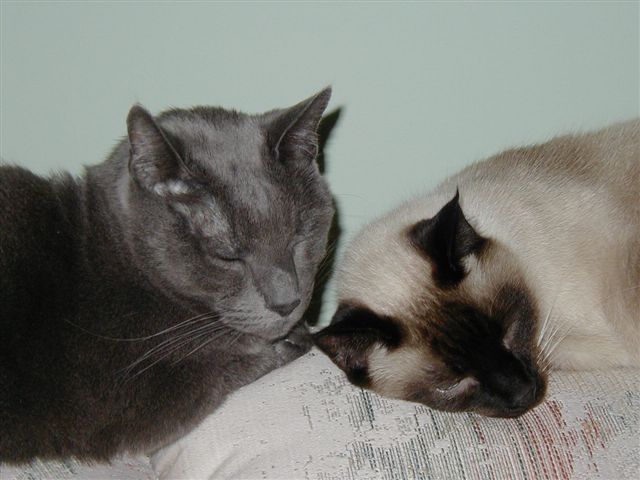
Here are our two eldest cats: Ozymandias, King of Cats, on the left, and Tristan on the right. Ozy is fourteen, and Tristan is nine or ten, give or take a few months. They are the best of friends, as you can see.
Zak's Cardamom Boule

Cardamom boule with a platter of pear and apple slices, havarti, gouda and good roast beef. In the background is the banneton Zak used for the final rise of the bread.
I have been promising to post the recipe for this bread once Zak was happy with consistent results and felt that it was perfect. It is based on Rose Levy Beranbaum's Basic Hearth Bread recipe in The Bread Bible, which has been his primer as he learns the art of bread baking. In her book, she gives measurements by weight in ounces and in grams, and by volume. Zak measures by weight for all ingredients except the spices, honey and yeast, so that is how I am giving the measurements in this recipe.
If you really like bread baking and are really obsessed, I mean precise, then you should probably pick up a copy of this book, or at least check it out from the library. It is a very, very good textbook on how to learn to make bakery quality breads at home one loaf at a time.
His next project is to learn how to make olive bread. When he gets around to it, that is; right now he is fighting off a flu bug and so is not into playing with dough.
As for me, I have a variant on the Harvest Fruit Bread I made last week in the fridge for an overnight rise. After I bake it tomorrow, I will let you know how it turns out. This one uses less of the grain mix in deference to Zak's preferences, with more wheat germ to make up the difference, and instead of apples and cranberries, I am using dried blueberries. We'll see how it turns out.
Until then, here is the recipe:
Cardamom Boule
Ingredients for the Sponge:
5.5 ounces bread flour
1.25 ounces kamut
3/8 teaspoon instant yeast (We use SAF Red yeast)
1 1/4 teaspoons honey
11.2 ounces water (by weight, not volume)
Method:
In workbowl of a stand mixer, or just a large bowl, place all the ingredients for the sponge. Whisk until very smooth in order to incorporate air, for two minutes. You can do this by hand or use the whisk that comes with your Kitchenaid. Guess which venue we of the carpal tunnel wrists choose? You got it in one: the mixer. If you do it with a mixer, though, you only need to do it for one minute. It will be a nice thick batter. Scrape down the sides of the bowl, and cover with plastic wrap while you put together your flour mixture.
Ingredients for Flour Mixture:
10.3 ounces bread flour
1/2 teaspoon instant yeast
1/2 teaspoon cardamom
1/4 teaspoon allspice
1/4 teaspoon ginger
1 1/2 teaspoons salt
Method:
Whisk all ingredients but the salt together by hand to get it all nice and combined happily together. Scoop it into the bowl with the sponge, covering the sponge completely. Cover it tightly with plastic wrap and stick it in the refrigerator to ferment overnight. (Here is where he differs with Rose's method--she says to do it for 1-4 hours. We like 8-10 instead.)
While it is fermenting, the sponge will come bubbling up through the flour here and there. That is normal, right and proper; do not be afraid. Leave it alone, it is doing its thing.
When you get up in the morning, mix the dough with the dough hook on your mixer. (Or, if you are a masochist, do it by hand, which is what I liked to do before I destroyed my wrists being a writer.) Mix on low speed (2 on a Kitchenaid) for about a minute, or until the flour forms a rough dough. Scrape down the bowl, cover and allow to rest twenty minutes.
Sprinkle the salt over the dough, and knead on medium speed (4 on the Kitchenaid) for about seven minutes. The dough should be elastic and smooth, but still sticky.
Scrape the dough into an oiled two-quart rising container or bowl. Oil the top of the bread (Zak and Rose both agree that spray oil stuff is great here; I have to agree with them) and cover tightly with a lid or plastic wrap. Allow dough to rise (ideally in a warm environment--about 74-80 degrees), until double. If the rising area is warm, this will take about an hour. If it is cooler, it will take as long as it takes.
After it has risen, scrape your dough with an oiled spatula or scraper onto a floured counter and press down on it gently to form a rectangle. Fold it up from the bottom into a third (like a business letter), then fold down the top, then round the edges. Oil the surface again, and put it back into the bowl, cover it and let it rise until double again--it will be puffier and will fill the container fuller than it did the first time because of the addition of air and more carbon dioxide. This will take about forty five minutes to an hour.
Now, you need to flour your banneton; use a lot of flour and coat the inside thickly. Turn the dough out onto a lightly floured counter and press it down to flatten it slightly. Use as little flour as possible in shaping it. Round the dough into a ball, and set it into the banneton, putting the smoother side down. Seal any seams on the bottom carefully. Cover with a large bowl or oiled plastic wrap and allow to rise until nearly doubled, which should take anywhere from forty-five minutes to an hour and fifteen minutes. You know it is ready when you press gently on the dough and the depression from your fingertip fills in very slowly.
Preheat your oven tp 475 degrees an hour before baking. Have an oven shelf in the lowest part of the oven, with a baking stone on it.
Now, you have to get the bread dough from the banneton to the baking sheet. This takes finesse and practice. Zak usually sets the sheet on the banneton, then carefully flips over the banneton and the sheet together, then lifts the basket away. It works, if you are quick and careful.
Then, slash the dough--this takes a very sharp knife (Zak uses a box cutter we bought especially for the job at Lowes--it is sharper than the lame we bought from Sur la Table, and it isn't curved--the lame was meant to be used on baguettes) and you must be quick and decisive. Oil your knife blade and move quickly, and slash the bread in one or two or four quick slashes in a pattern. Zak does a "Z" on his; I suppose I could have then called this bread "Zorro Bread," but I don't think he would appreciate that.
Then, finally, you put it in the oven, and bake for ten minutes. Turn the heat down to 425 and keep baking for twenty to thirty minutes or until the bread is golden brown and an instant read thermometer inserted into the center reads 2oo degrees (put it in from the side of the round loaf so you don't mess up your pretty design on the top.)
Cool on a wire rack.
Completely cool it before eating it. I know, I know. You want to eat it hot. But believe me, Zak and I have learned that Rose isn't lying when she says that it tastes better if you let it cool all the way. In fact, it tastes better if you can wait until the next morning to eat it. I know, you can't, certainly not for the first loaf. Well, try it on the second one. Really. Would I lie to you?
Variations:
Use all purpose flour instead of bread flour, or instead of kamut, use whole wheat flour or wheat germ.

You can use all purpose flour intead of bread flour for this bread; however, the texture becomes finer and more soft with the all purpose flour, as with this loaf. Zak prefers that texture--I like bread flour better, with its chewier texture and more uneven, larger holes.
Sunday, May 01, 2005
Creating Kofta
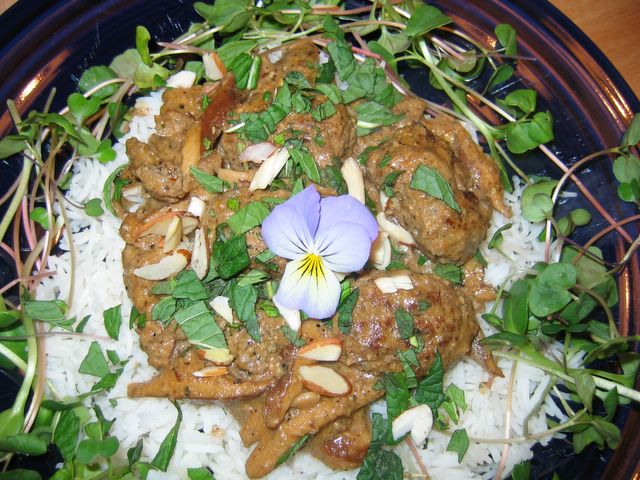
Kashmiri kofta, all dressed up on a plate. Basmati rice is the foundation, then the kofta, mushrooms and sauce go over. I used the microgreens to edge the plate, and then sprinkled the minced mint and sliced almonds over the kofta. And of course, I finished it all with a viola. Because, I could.
So, we went to the Farmer's Market yesterday, even though it was pissing rain and we both have some sort of influenza crud which is making us both feel, well, cruddy.
Zak's motivation was the Pie Lady, who it turns out wasn't there.
My motivation was some good fresh produce.
I ended up coming home with a huge handful of fresh spearmint, a bundle of microgreens, eggs, and a big bag of fresh shiitake mushooms.
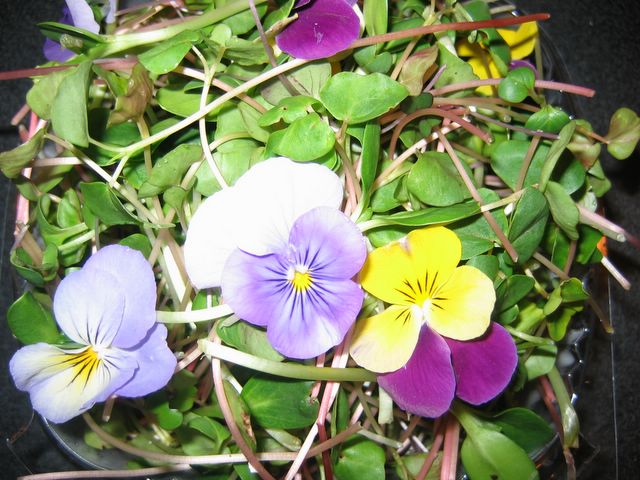
Microgreens from the nice lady from Green Edge Gardens who sells at the farmer's market. I think that "microgreen" is a new way of saying "sprout." I suppose it sounds more modern and less dirt-worshipper than the old term. There are radish, sunflower, buckwheat and cabbage babies in there. Oh, and as you can see, violas. Not only is this mixture beautiful, it is flavorful.
At home, I had my last bit of the Bluescreek Farms ground lamb.
And I had yogurt and cream.
I had to make Kashmiri Kofta.
I just had to.
Kashmir has been much in the press recently because currently India and Pakistan are having a territorial dispute over the region, and there have been some very tense moments in the past few years because of this. As of yesterday, Pakistani officials have declared that they seek a peaceful resolution to the problem, which I hope is how it goes down, as the sectarian violence there is not good for anyone.
A mountainous region in the extreme north of India, Kashmir is known for extreme natural beauty and a cuisine that is rich in dairy products, especially yogurt and cream. The land is fertile, and many crops are grown in the upland fields and valleys, with a great emphasis placed on fruit and nut orchards and wheat. Saffron crocus is grown in the fields of Pampore, and in the autumn, the land is carpeted by the pale lavender flowers open to the sky. Wild mushrooms and herbs grow in the forested hills and are gathered and used in many dishes.
The richness of Kashmiri cuisine comes in large part from the influence of the Mogul Emperors who came from Persia and conquered the region centuries ago. The Persian tradition of using flowers and flower essences, milk and cream, nuts and fruits in cookery have strongly influenced the cuisine of the region and to this day, many traditional dishes are ones that were first served in Imperial courts.
Lamb is a preferred meat in this region which is peopled by Hindus and Muslims both. It is cooked in many ways, but one of my favorites is kofta.
A kofta is a meatball, or a ball meant to resemble a meatball. (There is a Kashmiri dish called "malai kofta" that consists of balls made of minced vegetables bound together with chickpea flour, also known as besan. These balls are fried and then cooked in curry sauces, often ones that are based on nuts and cream, and are delicious served with rice or bread.)
I used to make kofta quite often for my clients, and I based the recipe I used last night on what I used to cook for them. I never used mushrooms in it, though I think that they would have liked it if I had thought to do it; both of them loved mushrooms. I found that the addition of the mushrooms gave a deeper flavor to the dish and really made it resemble Stroganoff.
The kofta are tender, and delicate--there is no binder present in the meat, so when frying them, you have to be very gentle with them. Once you add them to the sauce so they can finish cooking at a simmer, you have to stir carefully so that they don't break up.
Shiitake mushrooms are what I had to use in this, but I think that morel mushrooms would be fantastic, or chanterelles, or better yet, a mixture of many different kinds of wild mushroom. If you have nothing else, I bet that plain button mushrooms or crimini would be good, too.
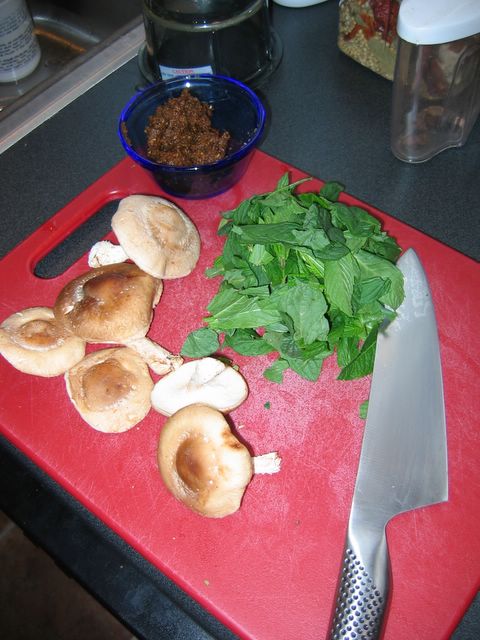
Fresh shiitake and spearmint. The paste in the small bowl in the corner of the cutting board is the curry paste for the sauce. The dark reddish color comes from the very deeply browned onions.
I used my Sumeet Multi-grind to make the curry pastes; if you do not have such a beastie (which I highly suggest you purchase if you make a lot of Indian, Thai and/or Mexican foods--it is invaluable for all three of those cuisines), then use a blender, but add a bit of water to get the mixture to grind finely enough. A food processor will work as a third choice. Or, you can use a food processor and then put the mixture in a mortar and pestle and finish smoothing out the paste.
But really, nothing compares to the Sumeet for making a smooth paste out of a mixture of wet and dry ingredients in under a minute. It really is amazing.
Kashmiri Kofta
Ingredients for the Kofta:
1 pound ground lamb
1 clove of garlic
1" piece of fresh ginger, peeled and sliced thinly
1 green Thai chile
1/2 teaspoon black peppercorns
1 pinch asafoetida/hing
3 black cardamom pods
1/4 teaspoon green cardamom seeds
4 teaspoons coriander seeds
1 teaspoon black cumin seeds (kala jeera)
1/4 teaspoon cumin seeds
1 pinch dried crushed Pakistani chile pepper
1/2 teaspoon salt
1 tablespoon sliced almonds
2 tablespoons golden raisins
1/4 cup fresh spearmint leaves
ghee or mustard oil as needed to fry kofta and mushrooms
1/2 pound fresh shiitake mushrooms, stems removed and sliced thinly
Ingredients for the Sauce:
1 medium yellow onion, thinly sliced
1 tablespoon ghee or mustard oil
3 cloves garlic
1/2" piece fresh ginger, peeled and sliced
1 green Thai chile
1 1/2 teaspoons black peppercorns
2 teaspoons coriander seeds
1 teaspoon kala jeera
2 black cardamom pods
1 teaspoon cumin seeds
1 pinch crushed Pakistani chile
1/4 cup skim or 1% milk
1 cup plain full fat yogurt
1/8-1/4 cup cream
1/4 cup golden raisins
salt to taste
handful of fresh mint, minced, for garnish
handful of sliced almonds, for garnish
microgreens (sprouts) and fresh edible flowers, for garnish
Method:
Put the ground lamb in a medium sized bowl. Take the remaining ingredients for the kofta, up to and including the spearmint leaves, and grind it as finely as you can by whatever method you possess. After it is ground, add it all to the meat, and mix together thoroughly with your hands, mashing and squishing it all into a fine, fine, mixture.
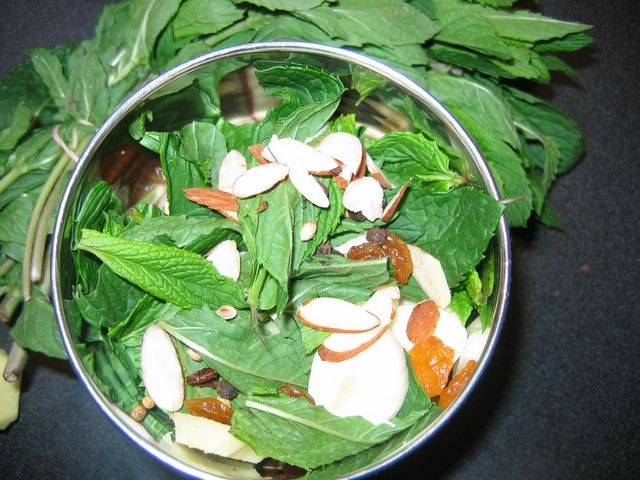
The ingredients for the seasoning paste that is mixed into the lamb to make the koftas in the workbowl of my Sumeet prior to being ground up.
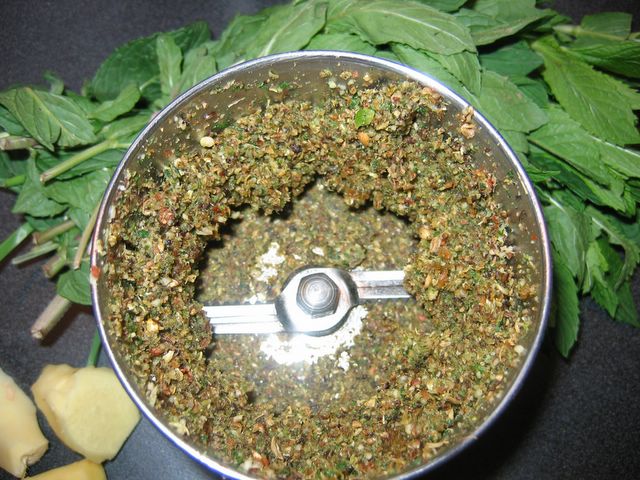
Here are the same ingredients after less than a minute of grinding. I love the Sumeet.
Using a tablespoon measure or cookie scoop, take level tablespoons of the kofta mixture and form them into football or egg-shaped little balls by gently shaping and smoothing them with your hands. Do not compact the meatballs overmuch; they should be light and tender in texture. If there are any seams or cracks on the outside of them, smooth them gently out with your fingers; the more seamless they are, the less likely they are to crumble apart during cooking.

This is the size and shape the kofta should be when you form them. I used a one tablespoon cookie-scoop to get them all to be the same size--that way they look nicer and they cook more evenly.
Set the kofta aside and heat ghee or mustard oil in a heavy, wide-bottomed pan. When it is very hot, add the thinly sliced onions and stirring constantly, cook them until they are a very dark mahogany color. Be very careful near the end of the cooking time--the onions can go from dark mahogany to burnt and black within seconds. As soon as the dark color is reached, scrape the onions out into a waiting bowl. Combine the garlic and the rest of the ingredients up to and including the Pakistani chile in the workbowl of your blender or food processor or whatever other device you are using to grind up the curry pastes. Add the onions, and process until a very smooth, dark reddish paste results.
Clean out your pan, add ghee or mustard oil, and heat up again. Add kofta and brown over medium heat on all sides. Turn the meatballs gently with a spoon or fork by rolling them. Don't try to scoop them up and turn them over; this will break them up. As soon as they are brown on all sides, remove them to drain on paper towels. Add mushroom slices to pan and allow them to brown slightly in the combined ghee/oil and lamb fat. When this is done, remove mushrooms and set aside with kofta.
If there is more fat than is needed to just barely coat the bottom of the pan, remove excess. Heat pan with its scant amount of oil and then add the reddish curry paste. Stir and fry until it is very fragrant, about a minute and a half. Add milk and deglaze the pan, scraping up all the browned bits. Add yogurt and cream, then kofta and mushrooms and turn heat to low. Add raisins. Simmer for about twenty minutes. After it has simmered, turn the heat up to medium and cook, stirring gently to keep from breaking up kofta, for about ten minutes to reduce the sauce until it will coat the back of a spoon.
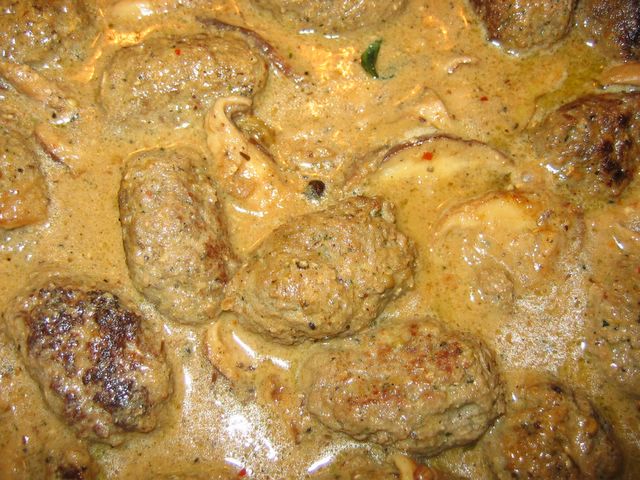
The finished kofta and mushrooms in the sauce; the brown color comes from the dark brown onions which have been cooked, then ground into the spice paste and cooked again.
Garnish with mint and almonds and serve with basmati rice or naan.

