

Monday, February 28, 2005
A Bowl of Compassion
What I have found in doing this is that I become a quiet presence in the kitchen.
Women and kids come in out of curiosity at first. Then, they ask if they can help, so we cook together. They sometimes ask me questions about cooking, and I answer. Other times, they get curious as to why I am there and I answer, "Because once I was in a situation where I was abused and some friends helped me get out and go on with life, and so I am repaying that debt."
Usually at that point, the women open up. And talk.
And I become an ear, a shoulder, a pair of arms. I listen, I comfort and I reinforce. I understand.
It is hard to do. Listening to these stories is difficult, not only because it reminds me of darker times in my past, but because it is hard to be truly open to the pain of another being. However, anything that is truly worth doing is seldom easy; I know that nothing is more healing to a human being than telling her story and having it truly heard. It gives the soul strength to go on. So, I listen.
And I love them. All of them. And it is not always easy, because some of the women there are not kind, gentle "victims" in the sense of the word that we usually think of them. Some of them have abused their kids. Some of them are so caught up in self-hatred and the need to escape that they are alcoholics or addicted to drugs, and they can't stop even when they are pregnant.
But these "difficult" women deserve compassion and understanding if they are ever going to stop the cycle of abuse and help themselves and their kids grow in a positive way. They have made bad choices, but sometimes, bad choices seem to be the only ones available. And often, they cannot see another way, until someone else reaches out, and touches them with love and shows them another way.
So, that is what I do.
Food is the connecting point, and compassion is the result.
In a sense, I consider what I do a kind of lay ministry to a congregation of the forgotten. Every meal I cook is then a prayer that the sustenance I give might open them to healing from within and without.
This is a soup that is a favorite at the shelter, one that I got requests for several times after the first time I cooked it. If you cook it, I ask that you remember the women and kids who are stuck in bad situations at home, or who are hidden in safe houses and shelters, and send a prayer for their health and safety.
Or, if you have a chance, stop in to your local shelter, and cook up a pot of soup and share it with those who could do with a bowl of love from a friend they never knew they had.
Pasta Fagiole Soup
Serves 10-12
Ingredients:
3 tbsp. olive oil
2 medium yellow onions, diced finely
1 green or red bell pepper, diced finely
6 cloves garlic, minced
3 stalks celery, diced finely 2 bay leaves
½ tsp. chile flakes or to taste
½ cup dry red or white wine (optional)
1 pound Italian sausage, removed from casing and crumbled
½ tbsp.dried basil
dried rosemary, thyme, oregano and marjoram to taste
1 ½ quarts chicken broth
3 14-ounce cans diced tomatoes with juice (seasoned, if you like)
1 30 ounce can dark red kidney beans, drained
1 14 ounce can green limas or cannellini beans or garbanzo beans, drained
3 carrots, peeled and sliced thinly
6 red new potatoes, scrubbed and quartered
¼ pound fresh kale leaves (optional)
4 ounces small dried pasta (small shells, elbows, wheels, rotini, small penne) cooked and drained
Fresh flat leaf parsley or basil, minced (optional)
Method:
Heat olive oil in bottom of soup pot on high heat. Add onion and saute until golden brown. Add bell pepper, garlic and celery, cook another two minutes or so. Add bay leaves and chili flakes and cook another three minutes.
If using wine, add at this time. Boil off alcohol, then crumble Italian sausage into pot. Cook, stirring until sausage is completely browned.
Add dried herbs at this time, and continue to cook, stirring, until very fragrant--about three minutes.
Add broth, tomatoes, drained beans, carrots, potatoes.
Cook until vegetables are nearly done. (Carrots should still be slightly crunchy.)
Wash kale and remove thick stems. Roll up cigar style, and cut into very thin (1/4 inch) ribbons. Add to soup, and allow to soften.
Add cooked, drained pasta, stir in well. Add freshly minced parsley and/or basil just before serving.
Sunday, February 27, 2005
Channa Masala

The ingredients for channa masala, including kala channa--black chickpeas. I usually cook this dish with the more common white chickpeas, but all I had in the cupboard was kala channa yesterday.
Channa masala is one of my favorite Indian dishes. The version I cook is one I learned from a waiter at an Indian restaurant called Akbar, in Columbia Maryland, which is known for excellent cooking. He wouldn't tell me what was in their channa masala, but we played a game, where I would guess and if I was right, he would tell me if I was right or not. If I was right often enough, he would give me hints. It was how I learned to refine my ability to discern ingredients in Indian foods; he would bring a dish, let me taste it and then ask me what was in it. After weeks of this, I began to be able to pick out the individual spices that would make up the complex bouquet of any given curry.
The channa masala I make, therefore, is based upon Northern Indian cookery principles, since that is the sort of cuisine that was served at Akbar. When we ordered the dish, often our waiter friend would bring us a plate of bhatura to go with it--it is a fried bread that is made to go especially with channa masala (which is also known as channa chaat). There are whole restaurants in Northern India, we were told, which served only bhatura and channa masala. If you ever get a chance to taste them, you can see why--the golden crust of the bread and steaming hot interior is a perfect foil for the tender channa with thier fiery spices.
Most of the time, I make my channa masala with regular white chickpeas, but since what I had was kala channa, or black chickpeas, I used them instead, to great effect. The nutty, somewhat firm texture and character of the kala channa went very well with the flavors of the curry, and since I served them not with bhatura, but on a bed of yellow basmati pillau, they mixed very well with the rice, being smaller and more texturally interesting.

As you can see, they are smaller and much darker than white chickpeas. They stay firmer when cooked and have a delicious nut-like flavor, too.
Channa Masala
Ingredients:
2 cups dried chickpeas, soaked overnight, then drained (or two large cans, drained)
1 pinch asafoetida
vegetable oil
1 large onion, sliced thinly
2 square hunk of ginger, peeled then slivered
1 hunk of ginger, peeled and minced
1 head garlic, peeled and minced
1 jalapeno pepper, sliced thinly
1 tablespoon ground turmeric
1 tablespoon sweet paprika
1 tablespoon cumin seeds, freshly ground
1 ½ tablespoons coriander seeds, freshly ground
½ tablespoon black peppercorns, freshly ground
1 tablespoon amchoor powder (or, several tablespoons lemon or lime juice)
ground cayenne pepper to taste
salt to taste
1 quart vegetable broth
two medium fresh (in season) tomatoes, peeled and quartered (If not in season, use canned tomato wedges)
juice from canned tomatoes or ½ cup tomato juice, if using fresh tomatoes.
chopped cilantro and mint for garnish.
Method:
Cook chickpeas by whatever method you wish to use until they are tender. If cooking dried ones, add a pinch of asafoetida (a resinous Indian spice which has the aroma of garlic and ginger it is said to help prevent flatulence when cooked with beans). If using canned beans, skip this step. (canned chickpeas are sometimes a bit overly tough. If this is the case, cook them longer after you add them to the spices and water mixture, until tender, adding water as necessary) When I use the pressure cooker, I cook them on high pressure for 18 minutes, then quick-release the pressure, drain them and continue the recipe.
In a large wok, karahi or dutch oven, heat enough vegetable oil to cover bottom. When hot, add onions and cook, stirring until browned and soft.

In cooking Indian food, the step of browning the onions is crucial. Most Americans do not brown their onions sufficiently, which results in an insipid onion flavor. Do not stop at this stage--they are not even halfway done. By the time they are cooked, they should be deep reddish brown, and smell sweet.
Add ginger slivers and minced ginger, and cook several more minutes. Add garlic and cook until golden, stirring continually.

When your onions are a deep golden brown, it is time to add the fresh chile pepper and ginger. I wait until the onions are nearly done--about two shades darker than this--to add the garlic.
Add spices, and cook, stirring one minute, until very fragrant. Add salt and ½ cup of water, stirring well.

The spices go into the pot after the onions are fully browned, and they are mixed in and allowed to cook in the oil for at least two minutes. They become very fragrant and the flavors begin a fruitful marriage.
Add drained cooked beans, the broth, the tomatoes with juice and turn the heat down and simmer to reduce by a third.

Then, I add the liquid, the tomatoes, and the channa, turn the heat down and let it simmer. I like to use vegetable broth, but water will do.
turn to a simmer and cook down into a thickish gravy, about 20 minutes.

Here, you can see how much I reduce the liquid by simmering. It thickens on its own, and takes about an hour or so of good simmering.
Garnish with chopped cilantro and mint.
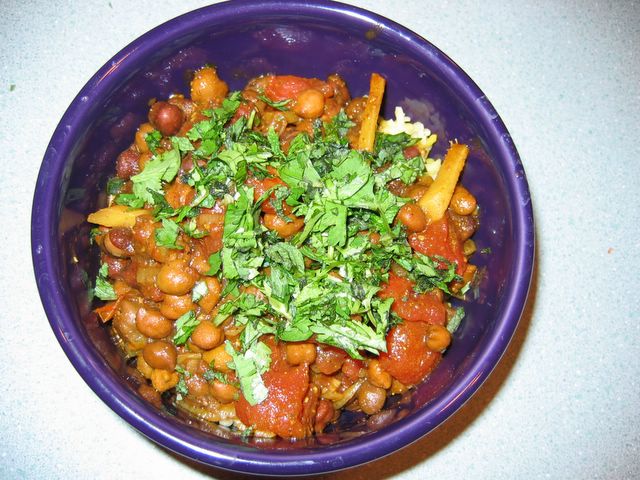
Here is the finished channa masala, in a bowl over yellow basmati pillau with a garnish of chopped fresh mint and cilantro. The colors are delicious together and the fragrance is redolent of earthy beans, shimmering spices, the tang of ginger and the delicate sweetness of mint.
Saturday, February 26, 2005
Eating Feet
I'm here to talk about chicken feet.
For all that I adore Chinese food, and have happily snarfed down things that make many Americans shudder to think of, such as tiny whole dried, salted fish, thousand year old eggs, jellyfish and sea cucumber, I had never, until today, partaken of a favorite dim sum dish: chicken feet.
At first it was for obvious reasons--the thought of eating fowl feet squicked me out; I grew up feeding the hens and gathering eggs on my grandparents' farm--I know what chickens do with their feet. Worse, I grew up helping to dismember said chickens and rendering them fit to eat, and had seen what their feet do when they die, and I couldn't get the picture of the dying spasms of a chicken out of my head when I saw chicken feet.
But, I hear Chinese folks talk about how good they are, and I have to wonder. What is it about the feet? There isn't much to them, really, if you think about it. Lots of bones, some skin, a bit of muscle, a lot of tendons and sinew and that is it.
But, the last time we had gone to the dim sum place, the guys at the table next to us had gotten them, and they smelled wonderful. I did not stare, though I was curious as to how one goes about eating chicken feet. It is really impolite to stare at strangers while they eat, even if you are only curious so you can imitate them and not make an ass of yourself trying to eat an utterly unfamiliar food. I suppose I could have tried to explain, but I don't want to be perceived as a rude gwailo under any circumstances.
So, I kept my eyes forward, and just let the smell of them drive me wild with curiosity. The sounds the two feet eaters were making were maddening--they were obviously enjoying themselves immensely.
So, I decided.
I would ask some of the folks who post over on the forum at eatingchinese.org how exactly, one goes about eating the feet.
And, as I expected, everyone was very kind and generous with their answers.
So today, I took the plunge, ordered the feet, and ate most of an entire order myself while Zak watched in fascination.
They came in a little bowl inside a metal steamer pan, four to an order. As promised, the feet had a pedicure before they came to the table--the claws were clipped off, but they were still recognizable as bird feet. They were bathed in a braising liquid of some sort, and sat, curled up side by side, their skin puffy and wrinkled from long cooking, and stained deep brown from dark soy sauce.
I plunged my chopsticks in, plucked up a foot and took a small bite from one of the toes. My incisors severed the last knuckle and it popped into my mouth, bones and all. I finally realized what the folks at eatingchinese meant when they said not to eat chicken feet at a business meeting or when you go out on a first date. They are not a dish to be eaten quietly and delicately. I ended up slurping, as I sucked the muscle, tendon and skin off the bone, then used my chopsticks to take the bone from between my teeth and convey it to the edge of my plate.
The flavor was evocative, and much richer than I expected. There was the deep sweetness of dark soy sauce, but really the chicken flavor was paramount and it exploded into my mouth. Chicken feet are juicy, and I had to fight to keep from dribbling broth down my chin.
The skin, though softened from being braised, had the flavor of fried chicken, which, as a kid who grew up on Southern country home cooking, I can really get behind. The texture was interesting, both soft and resilient, and I enjoyed nipping the skin off of the bones before popping them in my mouth to suck the tissue off of them. I wasn't too keen on the tendons; the texture was too rubbery for me, but I ate them anyway.
I discovered that there is a fat pad in the underneath part of the foot, and that is where all the juice and the richness was coming from. Biting into that was like taking a big spoonful of the best, most golden, glorious chicken stock in the world; the intensity of the chicken flavor in that tiny mouthful was as satisfying as an entire bowl of soup. It was utterly delightful.
And that is when I understood why chicken feet are so loved and are seen as comfort food. They are the essence of chicken flavor in a tiny, bony, rather creepy-looking package. I remembered how one of our chefs in culinary school told us that the best chicken stocks included chicken feet, because they were full of flavor and aroma. Everyone recoiled from his comment, except for my Chinese friend from Singapore, who nodded in agreement. "My grandma always puts feet in her soup," he whispered to me. "It makes it good."
I ate three of the feet, but had to let the fourth one go. I couldn't eat another bite; they were too intense, too rich, for me to eat an entire order myself. And no matter what I did, I couldn't convince Zak to try the last one.
Not even calling them "hobbit hands" did the trick, though he did perk up at the thought.
So, now the question is--will I eat feet again?
Undoubtedly, though I hope I can share them with someone, so I don't feel beholden to try and eat an entire order myself. I wouldn't want to fill myself up and miss all the other great dim sum dishes, after all.
Friday, February 25, 2005
The Chinese Cookbook Project III: With an Open Mind and an Open Mouth

How to Cook and Eat in Chinese by Buwei Yang Chao
One book that is mentioned as being a seminal Chinese cookbook written in English is Buwei Yang Chao's How to Cook and Eat in Chinese, first published in 1945. This is with good reason; it is often cited as the first attempt to present to an American audience authentic Chinese recipes without resorting to fifteen variations upon chop suey, chow mein and egg fu yung, all Americanized standards popular in the Chinese restaurants of the day, and calling them "Chinese."
As the book went through at least three editions, two of them revised and updated, and countless printings, I feel safe saying that it was successful at introducing American cooks to many of the core concepts, cooking techniques, ingredients and eating traditions of the Chinese kitchen.
How the book came about it an interesting one; the putative author was neither a writer, nor a lifelong cook, but instead, was a medical doctor. Ms. Chao relates how she did not learn to cook in childhood, but rather, while she was attending medical school at the Tokyo Women's Medical College. While there, she writes in her author's note to the first edition, "I found Japanese food so uneatable that I had to cook my own meals. I had always looked down upon food and things, but I hated to look down upon a Japanese dinner under my nose. So, by the time I became a doctor, I also became something of a cook. On my return to China, I surprised my old friends and relatives when I prepared a complete dinner of sixteen dishes the celebrate the opening of my hospital....How did I learn to cook so many things? My answer is: with an open mind and an open mouth. I grew up with the idea that nice ladies should not be in the kitchen, but as I told you, necessity opened my mind first. " (xx Chao.)*
Dr. Chao, in her own self-deprecating way, sets the tone for her entire work; her main theme, which she reiterates over and over, is that -anyone-, with the application of an open mind, an open mouth, and the will to work hard and refine one's ability to discern flavors and study, can learn to cook good Chinese food. By using herself as an example, a busy medical student, she assures her readers that they, too, can learn a subject which had previously been presented as very exotic and inscrutable, with mysteries that were too tangled for a mere Westerner to unravel.
Dr. Chao throws all of those ideals of the mysteriousness out of the window and applies her scientifically-oriented mind to the business of unraveling the knotted skein of philosophy, technique and ingredients that weave into the thorny problem of recreating Chinese foods in the setting of an American kitchen. She states that "The Chinese cook or housewife never measures space, time or matter. Hse* just pours in a splash of sauce, sprinkles a pinch of salt, does a moment of stirring and hse tastes the frying-hot juice out of the edge of a ladle, perhaps adds a little amendment, and the dish comes out right. It was only when I started on this cookbook that I began to get some measuring things so I can show you how to do it my way. What my way was, I could not tell myself until I measured myself doing it. " (31-32, Chao)
Encouraging her readers to be fearless in experimentation, Dr. Chao suggests that most conventions of cooking, serving and eating to be "a little silly," an understanding to which she came while learning Chinese cookery on her own in Japan. She suggests that it is very well and good and know how cookery is engaged in China, but that nothing replaces "a little thinking."
"If you cannot get beef," she writes, "get pork. If you cannot find an egg beater, use your head." (xx Chao)
The writing style throughout the book is by turns opinionated and droll, with interesting choices in phraseology. One gets a strong feel not only for Dr. Chao's personality, which is one of sharp wit and quick-thought, but also for the personalities of her husband, Professor Yuen Ren Chao, and their daughter Rulan. It is quite possible, considering Dr. Chao's lack of skills in speaking or writing English, that not only did her daughter assist in writing the book, as proclaimed in the author's note to the first edition, but that she and her linguist father, largely wrote the entire manuscript, with Dr. Chao providing the recipes, and technical information on cookery, ingredients and table manners.
Jason Epstein, in an article entitled, "Chinese Characters" written for the June 13, 2004 edition of the New York Times, contends that Professor Chao, whom he describes as whimsical and affable, wrote the text of the book, noting the use of the term, "eatable", from the Old English root "etan," instead of the more commonly used, but pretentious "edible, " from the Latin "edibilis." As Professor Chao was a celebrated linguist, it is entirely likely that he wrote the manuscript, but to not recognize the collaborative nature of the enterprise does a disservice to all involved. Epstein himself was the editor involved in bringing out the third revised edition from Random House books in 1967, and his description of the two authors is quite evocative, however, his characterization of the author's note to the original edition as brutally insulting shows a great misunderstanding of how Chinese people tease each other affectionately in the guise of insults.
Having experienced this sort of teasing myself, I found reading the introduction as an intimate look into the family dynamics between Dr. Chao, her husband and daughter, and saw it as being full of passionate discussion, agreement, disagreement, laughter and filial love.
Probably the greatest linguistic addition to the Western lexicon of words pertaining to Chinese food came from the Chao's book; Buwei Yang Chao is generally credited with the creation of the term, "stir-frying" to describe the action of "ch'ao." Here Professor Chao's influence as a linguist is crystal clear; the author(s) write "...the Chinese term, ch'ao, with its aspiration, low-rising tone and all, cannot be accurately translated into English. Roughly speaking, ch'ao may be defined as a big-fire-shallow-fat-continually-stirring-quick-frying of cut up material with wet seasoning. We shall call it 'stir-fry' or 'stir' for short." (43 Chao)
I don't believe I need to belabor the impact of the creation of a unique term in English to describe the specific cooking technique of ch'ao. Before the creation of "stir-fry" as a word meant to convey ch'ao, "fry" or "frying" was used, but the connotation of that word in English was woefully lacking in describing the full action that is ch'ao. Frying in European and American kitchens is a much more sedentary action, even the French term, "saute" is inadequate to describe what happens in stir fry cooking.
Since the word, "stir-fry" entered the English language in 1945, is has become part of common culinary parlance and in fact, is recognized even among people who have never eaten Chinese food in their lives.
It is odd to think that in writing a cookbook, the author(s) changed the English language along the way, for the better.
A great deal of useful, interesting and accurate information is also given on Chinese styles of eating, table manners and the standards of politeness which are in many ways, very different from what many Americans are used to. I was lucky to pick much of this up by watching it in action, but not everyone is observant in the same ways in which I am; the astute discussion of manners listed in the introduction is invaluable. The instruction of how to deal with bones, shrimp shells, chopsticks and wine drinking in the context of a family style Chinese meal or banquet are as applicable today as when they were written and the wry opinions presented still bring a smile and a chuckle to the reader.
The two chapters devoted to ingredients are divided into "eating materials" and "cooking materials." Eating materials refer to fresh or preserved meats, seafoods, fowl, fish, eggs, vegetables, fruits, tofu, grains and nuts--things that make up the main ingredients for any given dish. Chao discusses how to choose the best eating ingredients and stresses the importance of fresh, clean food to successful Chinese cookery. Cooking materials present the varied condiments that are used to enhance or change the natural flavors of the eating materials in Chinese cookery. It is interesting to see how many of these items, such as fagara, or Sichuan peppercorn, oyster sauce, and fermented bean curd (called soy-bean cheese) are listed as being somewhat available in the US at that time.
Which brings us to the recipes.
There are no recipes for American style Chop Suey or Chow Mein to be found in this book, which is a great departure from cookbooks of the period.
What is found in flipping through the pages are recipes for an array of red-cooked dishes, steamed minced meat dishes, quite possibly the first recipes for dim sum (transliterated as tien hsien) specialties published in English, and vegetable dishes that utilize both Chinese and traditional American vegetables. There are a few recipes that are quite clearly adaptations of American ingredients into a Chinese culinary context--Salted Turkey is an adaptation of a traditional duck recipe to utilize the more commonly available turkey, and the Chinese Style Roast Chicken (there is a variant on Turkey as well) show a typical American cooking method fused with Chinese seasoning.
The recipes look delicious and many are similar to recipes I learned by watching Huy and the other chefs cook, especially when they were cooking for employee dinners. None of them look as if they were attempts to cater to American tastes--there are recipes for tripe, chicken gizzards and pig's feet, though I would note that when this book was published, more Americans were apt to eat such "variety meats" as they were called at the time for a number of reasons. One, American households were not as generally affluent as they are now, and many lower-income people commonly ate lesser cuts of meat, including organ meats. This is not so true in these days of processed and convenience foods. And two, there was a war on, and meat rationing was in force, and variety meats were more available and less expensive than prime cuts. In fact, one of the selling points of the book was that it showed how to stretch smaller amounts of meat by cooking it with vegetables in such a flavorful way that no one would notice the lack.
Unlike the Watanna/Bosse book, I can see myself cooking from How to Cook and Eat in Chinese. In fact, I think that after we move and I become settled into my new kitchen, I will set forth to cook recipes from each of these out of print cookbooks, in order to evaluate the results. I think it would be a worthy project to engage in and record.
As I close the book and look at its plain yellow cloth cover, I cannot help but think that it is a shame that this little gem is out of print and thus is relatively unavailable to the student of Chinese cookery. The information presented therein, even though it was written more than fifty years ago, is still fresh, interesting, useful and relevant in today's world. I only hope that by writing about it here, I can help rekindle interest in the book, and perhaps get it out to a wider audience while copies of it are still available in the used book market.
I know that there are plenty of people with open minds and mouths who would enjoy devouring the feast of cultural information, culinary experience, and linguistic expertise that are wrapped together with a liberal dose of sparkling humor in the pages of this book.
* The page designation xx is the actual Roman numeral used for the notes in the front of the book before the actual text of the book starts.
*"Hse" is the gender-neutral term for he/she coined by Professor Yuen Ren Chao, Dr. Chao's husband, to make up for a third-person singular pronoun in English other than the rather formal and stiff sounding, "one." As I will write later, it is quite possible that Professor Chao wrote more than a little of the manuscript of Dr. Chao's book, since she admits in her forward that she "speak(s) little English and writes less." (xx Chao)
Thursday, February 24, 2005
One Potato, Two Potato, Red Potato, Blue Potato
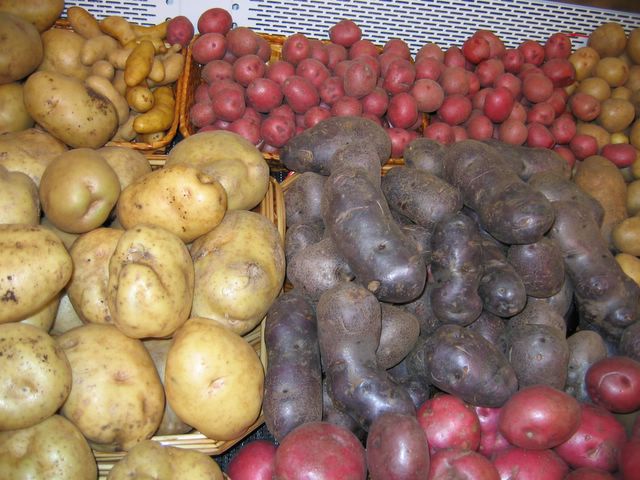
The potato section at the North Market Produce stall. The blue potatoes share space with Yukon Golds, red potatoes, the usual russets, fingerlings and ping-pong ball sized new potatoes.
I love potatoes.
Which is evident by my general size and shape. I am not small. Potatoes will do that to a person. Give you substance.
They are the perfect peasant food, and I grew up eating like a perfect peasant. Meat, potatoes and vegetables. Three food groups on the plate. Sometimes, we had bread, too, but there were always potatoes, even if we had biscuits, cornbread or dinner rolls, potatoes were ubiquitous.
The best potatoes were the ones Grandma and Grandpa grew. His favorite variety was the Kennebec, but I also remember him growing the Irish Cobbler, too. But he would hold forth at the dinner table about the good qualities of the Kennebec, while the rest of us shoveled many ounces of said potatoes into our gullets.
My Gram, Dad's mother, on the other hand, preferred red potatoes. Hence, her mashed potatoes had a different texture than Grandma's who always used russet-type potatoes, which have a drier, mealy texture that sheds moisture. I learned early on that the texture of Gram's mashed potatoes was silkier and more moist, in part because she used real butter and half and half in hers, but also because the red potatoes are a waxy potato with a starch structure that holds onto moisture.
Also, Gram used a hand potato masher, vintage from the 1920's--a steel disk with stars cut out on it with a steel stem growing up from it perpendicularly, with a green--painted wooden handle that fit perfectly into her palm. She was very thorough in her mashing and beating, but there were always small lumps that escaped her ministrations, and Gram always said that was how you could tell they were real.
Grandma's potatoes tended to be lighter and fluffier, and were always perfectly smooth. She whipped hers up using her old Sunbeam stand mixer, and she served them on the table right from the heavy glass mixing bowl that went with the mixer. She used milk, sometimes evaporated milk, and margarine in hers, and the flavor of the home grown potatoes really shone through the minimal enhancements.
I wonder what my Grandpa would have thought of blue potatoes?
He didn't much care for the red ones; he didn't like the waxy texture or the sweeter flavor. I suspect that not only would the unusual color of blue potatoes put him off, but the slightly sweet flavor would distress him, too. He always said that potatoes should taste like the earth they grew in, and that when we ate them, we were eating the land itself.
I reckon he might say that there must be something wrong with the land if the potatoes are purple.
For, indeed, blue potatoes are really purple, once you cut into them.
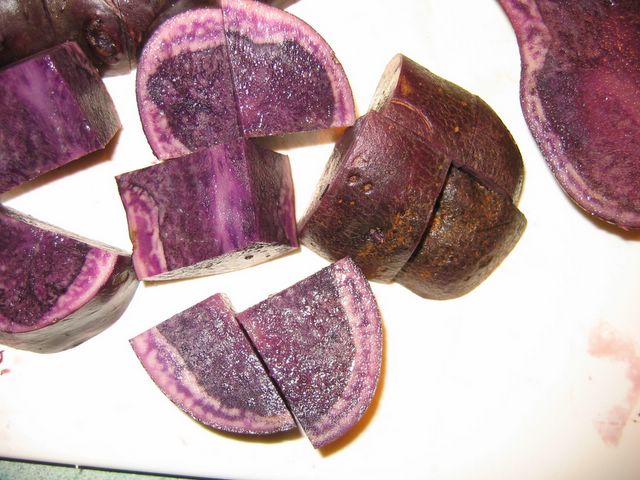
The vivid violet color of the raw potato fades to a medium blue when cooked. More color is retained if you cook the potato whole, as the pigments which make the potatoes such a rich royal purple, anthocyanins, are water soluble. They tend to be concentrated in the cell vacuoles, so if you cut the potatoes and damage the vacuoles, the color leeches out.
In addition, the vacuoles which store anthocyanins tend to be acidic, and most tap water used for cooking is slightly alkaline; in an acidic environment, the anthocyanins tend towards the red area of the spectrum, while in an alkaline environment, they tend more towards the blue-green coloration. So, if you cut up your blue potatoes and cook them in regular tap water without adding any acid, not only do you lose a significant amount of pigmentation to the water itself, you also change the color by virtue of a loss of acidic environment.
When cooking purple vegetables like say, red cabbage, it is traditional to add an acidic ingredient like vinegar (sweet and sour cabbage, anyone?) in order to keep the cabbage reddish purple, rather than have it turn a kind of greyish blue, which is not an appetizing color. I suppose you could do the same with blue potatoes, but I have found that simply boiling them whole helps retain a lot of the color, though it does fade to a more pale violet color rather than the bold royal violet hue of the raw vegetable.
If you are wondering why I know so much about plant pigments and the chemistry of cooking, you can thank Harold McGee, author of On Food and Cooking and The Curious Cook. He is one of my favorite authors; a chemist by profession, he has unraveled the mysteries of cooking and baking and has written the best tome to explain the science of the kitchen to lay persons I have ever read. And believe me, I have read all of the popular books on the subject, and his is the most complete and sensible of the lot.
Besides, he is fun to read, and his works have singlehandedly made me a much better cook than I would ever have been without reading them. His books should have been required reading in culinary school; I found my knowledge of his work invaluable when navigating the perilous shoals of baking and pastry classes. It also helped when it came to vegetable cookery; my vegetables were consistently prettier than other students, and I have McGee to thank for it.
Which brings me to the question of what exactly does one do with blue potatoes? Well, I like to make violet color mashed potatoes with them, but they are a bit shocking on the plate. Especially so for guests who are not used to my fits of culinary whimsy where I cook up a bunch of weirdly colored things and present them together. Some folks use them in potato salad, and I think that so long as you didn't use a mustard-based dressing, that would be great; a German potato salad made with them and some Yukon Gold potatoes would be striking.
My very favorite use for them is in Indian cookery, most specifically in a dish of potatoes cooked with spinach, called Saag Aloo. In many restaurants, saag aloo is a very creamy dish, with pureed, somewhat overcooked spinach in a somewhat spicy dairy-based sauce, with chunks of boiled white potato dotted throughout.
I make mine differently. I generally start with carefully browned thin slices of onion and garlic cooked until golden. Then, I add ground spices, and cook until they are fragrant, then add the spinach, which I have thawed and squeezed the excess water from. I turn up the heat and add a bit of yogurt and a tiny bit of cream, just to bind it together. Potatoes which I have cooked separately whole, are drained, cut up into dice and added, and the entire dish is cooked down until the still vibrant green spinach clings to the potato chunks, and the spices are married together into a melange of subtle flavors. Sometimes, chopped fresh mint is added at the last minute as a garnish, and I usually use it as a dish alongside something a bit spicier like a vindaloo or a korma.
I find that using a combination of red-skinned white potatoes and purple potatoes really makes the dish turn out beautifully, and makes it seem as if it tastes even better. The jewel-like colors are at home on a plate of Indian food; it makes me think of the gorgeous silk saris and the polychromatic painted statues of Hindu deities bedecked with flowers that are venerated with food offerings in the great temples and houses of the faithful. The dish is like a green field dotted with white and purple wildflowers, and that visual ideal only helps boost the mingled flavors of the vegetables and spices.
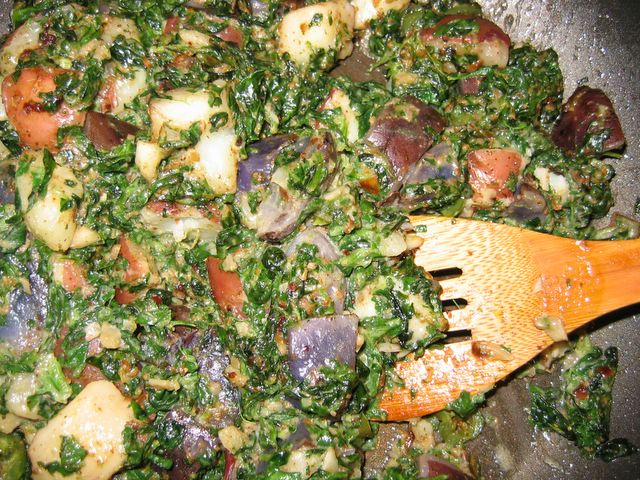
Blue potatoes add color interest to a dish of Saag Aloo.
Saag Aloo
Ingredients:
2 medium sized red skinned potatoes and 2 medium purple potatoes, scrubbed well and cooked in salted boiling water until tender
1 medium onion, cut in half and sliced thinly
1 tbsp. ghee
2 tbsp. vegetable oil
3 cloves garlic, minced
1/4 tsp. cardamom seeds, freshly ground
1 tsp. fennel seeds, freshly ground
1/4 tsp. fenugreek seeds, freshly ground
1/4 tsp. black peppercorns, freshly ground
1/4 tsp. ground cinnamon
1/2 tsp. coriander seed, freshly ground
1 8 ounce package frozen chopped spinach, thawed, drained and squeezed dry
1/2 cup whole milk yogurt
1/4-1/2 cup cream
salt to taste
1/4 cup fresh mint leaves coarsely chopped (optional)
Method:
After the potatoes are finished cooking, drain and cut into a medium dice, and set aside.
Heat ghee and vegetable oil in a heavy skillet. Add onions and cook, stirring constantly, until they are medium brown. Add garlic and cook, stirring constantly until garlic is golden in color and very fragrant. Add spices and cook one minute more, until the air is strongly scented.
Add spinach, along with yogurt and the smaller amount of cream. Add potatoes, and salt to taste and cook, stirring, to reduce sauce until the liquid is almost gone and the very green spinach clings to the potatoes.
If you wish, you may add a bit more cream to make the dish a bit more moist; I prefer it nearly dry.
Salt carefully; you can easily over salt if you salt it to perfect taste while there is still a lot of liquid. Under-salt at first and then reduce the liquid by simmering it off, then taste again and correct the salt at that time.
You can cook this ahead of time and set on a cold burner if you need to, then reheat gently with another bit of cream or some milk, until it is sufficiently hot. This has the effect of deepening the flavors, and so long as you take care not to overcook the spinach, nothing is harmed, and in fact, the dish is improved in this way.
Add the mint just before serving.
Chupacabra T-Shirt, Part II
So, if you hold the card with number 2 on it, post a reply here within three days to claim your very own Chupacabra Chili t-shirt, one of only three currently in existence, giving your email address so I can email you and get the proper snailmail address to send this lovely and talented bit of wardrobe whimsy right to your door. Yes, right to your door.
Stay tuned, I have more to post later, and a food related topic, even.
And the number, by the way, is 2.
Wednesday, February 23, 2005
A Boy and His Dog, I Mean, Dough
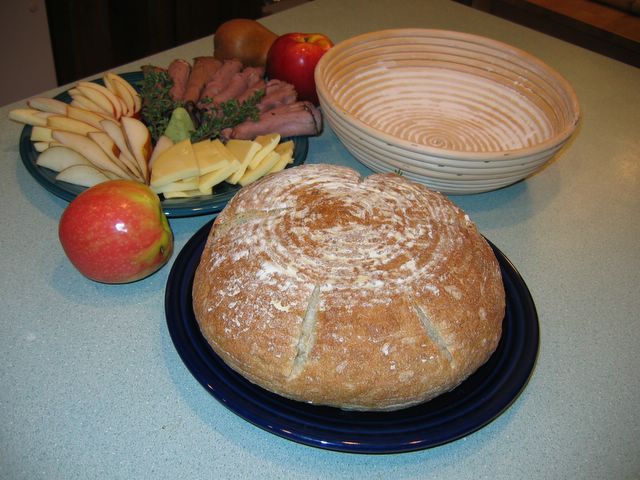
Zak's second loaf of bread, pictured with the rest of dinner and the banneton which he used for proofing the dough. The shape of the basket made an interesting spiral design on the bread.
So, the end of February seems like a good time to talk about New Year's Resolutions.
Right?
Well, I think so. By this time, most people have either finally gotten around to keeping their resolutions or have already broken them and gone on with life. Which is usually how it happens with me, but this year is different. This year, Zak and I made a pledge to each other to each learn a new, and useful skill.
I pledged to pick the guitar back up and learn to play it again and get it right this time around, and he promised to learn how to bake bread so we could do something fun in the kitchen together and he could contribute positively to our household caloric intake.
As you can see from the picture above, he is doing quite well. That is the loaf of bread he baked yesterday that we had for dinner. I put together the platter of sliced gouda, Pink Lady apples, a Bosc pear and some roast beef with wasabi. Yes, you can tell by looking that I studied under folks who were food stylists and worked with Martha Stewart. Yeah, every now and then I have to make the food pretty. It just happens.
But don't look at that, look at the pretty bread! It turned out really well; he used the recipe for Basic Hearth Bread in Rose Levy Beranbaum's The Bread Bible. It turned out very, very well--especially since it was only his second attempt; he even added a pinch of cardamom and allspice without fear of "messing up" the recipe. I was proud of him.
The crust was fantastic, chewy without being shatteringly crisp, which Zak doesn't much care for. The crumb was tender, but with many irregularly shaped holes that give artisan breads their character. It was fragrant, but the spices were delicate and not overpowering at all. His timidity with the kitchen served him well in this instance; it gave the bread a definite lift in flavor without being in the least bit obtrusive or overpowering.
He is getting very into baking; we bought the banneton just yesterday and used it for the final proofing of the bread, because he wanted to see what difference it made in the shape and the crust. The week before, we bought a baking scale so he could more accurately measure ingredients as well as a baker's lame, which is a curved razor used to slash the bread dough so that the crust splits evenly.

The first loaf of bread before being cut by the baker's lame, pictured in the lower right corner.
My previous attempts to get Zak to learn to cook have been failures, however, I think that the combination of the precision which baking requires and which appeals to his orderly way of doing things, and the forgiving nature of bread have combined to intrigue him.
His first loaf of bread, which he made a couple of days ago, was from the same recipe, but he ended up leaving the sponge in the refrigerator for around 36 hours total, which is about 32 hours more than Rose suggests. He became very anxious about it, and was certain that he had destroyed his poor little yeasty fellows, but I assured him that bread dough is very forgiving (and the SAF yeast we were using was a nice, strong strain) and all would be well. He was overjoyed when he took it out and kneaded it, then began the proofing process, to see that not only were the yeast beasties alive, but they were very active.

The first loaf of bread, after having the sponge sit in the refrigerator for 32 hours, the kneading and proofing continued in a more normal time frame.
When he baked it, a delicious aroma filled the kitchen, and when he took it from the oven, he was overjoyed to see such a pretty golden crust. We rubbed it with butter to keep it soft, and set to eating it for dessert.
I liked the bread--the yeast had a long time to transform starch into sugars, and some of them stuck around in the bread and gave it a nice, complex aromatic flavor. The crumb was very chewy and strong, owing in part, I suspect to the long, slow fermentation and the hand kneading. But he wasn't satisfied with that, so he made the same recipe again, only this time, he followed the directions more carefully.
In either case, I think that he is quite well on his way to becoming a good bread baker. Which is not only a useful skill, but it is a tasty one as well.
His next plans are to experiment with Rose's Heart of Wheat recipe, which uses bread flour and wheat germ, which she says makes whole wheat flour minus the bran, which make whole wheat bread bitter. I eventually want him to give focaccia a shot, but his very first bread, naan, which was quite good, made him want to try something other than a flat bread for a while.
Whatever he ends up doing, I will update everyone here.
Too bad I can't post samples for everyone to taste on the site, but while the Internet is great with words and images, it hasn't yet managed to transmit flavors and scents yet.
As for me--I am on my way to learning how to play Bob Marley's "Redemption Song." The first night I took up the guitar, I picked out the opening notes by ear, and memorized them, then two days later, Zak gave me the chords, which I am remembering how to play.
Not bad for a woman who last really tried to learn guitar over twenty years ago.
Tuesday, February 22, 2005
Spiced Dry Tofu
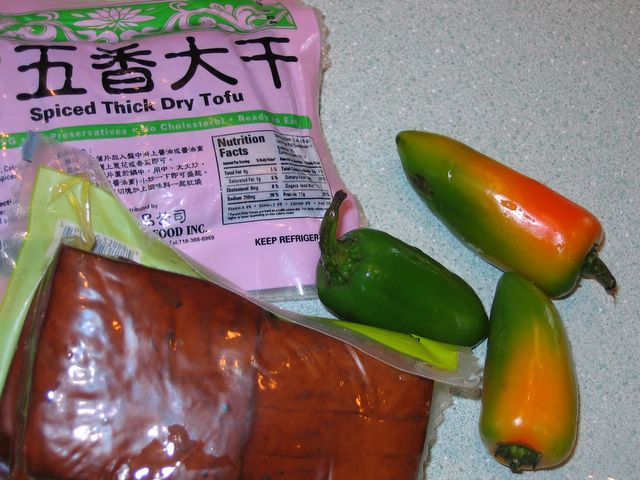
Two favorite ingredients in my kitchen: jalapeno chile peppers and spiced dry tofu.
Spiced dry tofu is a great variant on tofu that I suggest people try if they are of the belief that they "don't like tofu."
I know lots of people have told me that "I don't like tofu, but when I had yours, it was really good and I loved it." Well, part of the reason for that has to do with the fact that in the US, there are lots of people doing things to tofu that the innocent beancurd does not deserve which end up with results which are less than stellar, to say the least. I personally don't care for most of these American tofu travesties, and I hope that the Kitchen God snitches to the Jade Emperor and suggests that he strike me dead if I ever foist such a dish upon unsuspecting guests in my home.
I am strictly an Asian-style tofu woman, myself. Tofu was not meant to pretend to be hot dogs, bologna, and for God's sake, not cheese! Please, not cheese! No soy cheese! No. No, no. Ugh.
I used to work for a very sweet older vegan couple who wanted me to make vegan lasagne with bechamel sauce. Which presented me with lots of problems that had to be solved with cunning, quick wits and soy cheese.
Bechamel is a milk based sauce. However, I dislike the flavor of cooked soy milk intensely, and couldn't imagine making a soy milk bechameloid thing that wasn't just this side of nauseating. So, I improvised. I used a vegan "cream" of potato soup which was thickened with ground rice and potato, and used almond milk for the dairy, and added a great deal of sauted shallots and garlic to make it taste good. Faux bechamel achieved, I moved on to the problem of the ricotta filling.
I used Japanese style soft tofu which I mashed up with a little bit of white miso in order to give it the cheesy taste that Parmesan would add to ricotta filling. Then, I added cheeseless fresh pesto, and chopped spinach, and made a really pretty good approximation of ricotta filling.
The tomato sauce was easy and was made with all fresh ingredients, and turned out light and flavorful.
I thought that was good enough, but the lady of the house said, "I have soy mozzarella in the fridge. Shred that and put it on top.
I was not happy, but it is her food, so I did it. I assembled the lasagne and put it in the oven and baked it. It smelled pretty good.
But I want to say something about soy cheese--it has the texture of a rubber tire and doesn't bloody well melt. It just kind of goes stringy and rubberier, if one can imagine it. And the flavor--ugh.
The dish turned out fine, except for that rubbery white nastiness on the top. But my clients loved it, so whatever, fine, it is their food, they eat it, pay me, we are all happy.
But to this day, I have it in for soy cheese.
But I love, absolutely love tofu, especially spiced dry tofu.
I first had it at Huy's restaurant. He used it in his twice cooked pork, along with the pork, plain old regular cabbage, bamboo shoots and lots of chile action. Man, that stuff was good and Heather, June and I would fight over it. June may not have cottoned to greens, but she loved twice cooked pork, and for such a little delicate ladylike person, she sure could get pushy when it came down to one of the last few pieces of the dried tofu on the platter. At first, she was elaborately polite in the Chinese fashion about, "Here you take this," and putting it on my or Heather's rice bowl with her chopsticks, but when I realized I was supposed to refuse and the wrangling began back and forth in proper Chinese style, sometimes she would snatch that piece of tofu and gobble it down before anyone could say, "ai ya."
Which always made Huy and Mei laugh uproariously. Me, too, because then June would blush and apologize for her rudeness.
And of course, it seldom mattered, because Huy or one of the cooks would just go into the kitchen and bring out more.
When we moved to Columbia, Maryland, there were two restaurants which used my favorite tofu. One place, called Noodles Corner, was a pan-Asian noodle shop, and they used it in their version of pad thai. That is still Zak's favorite version of pad thai ever; we often got it without the shrimp or chicken and just had the tofu with the rice noodles and vegetables. They also used it in a dish they called Beijing meat sauce noodles, which consisted of ground pork seasoned with soybean paste, onions, and chile paste. They would dice the spiced tofu up finely and add it to the sauce, which was served over fresh wheat noodles with a garnish of shredded cucumber.
Another place, called Hunan Manor, which was our favorite Chinese restaurant in town, made a great dish called "Hunan Spicy Pork with Tofu." It consisted of shreds of pork, dry tofu and jalapeno peppers stir fried in a delicious dark sauce and garnished with slivered scallion tops. After we moved back to Ohio, I pined for that dish, and tried often to recreate it. It wasn't until I saw a very similar recipe in Grace Zia Chu's cookbook, Madame Chu's Chinese Cooking School that I was able to really replicate the dish. (I had been using less sugar and light instead of dark soy sauce.)
Spicy Pork with Pressed Beancurd
Ingredients:
1 pound fresh pork (I use a lean sirloin roast or chops), cut into thin 1 long shreds
1 ½ tbsp. cornstarch
1 tbsp. dark soy sauce
1 tbsp. Shao hsing wine
peanut oil for stir-frying
2" cube of fresh ginger, peeled and shredded
6 cloves of garlic, thinly sliced
3 scallions, trimmed and cut into 1 chunks, then shredded, green separate from white parts
6 Tsien tien dried chilis (used whole for the mildest taste, cut into chunks with seeds discarded for more heat, or chopped up with the seeds included for hottest flavor)
3-4 large jalapeno peppers, seeded, and cut into matchstick shreds
3-4 squares pressed tofu shredded into matchstick pieces
½ tbsp. raw sugar
2 tbsp. dark soy sauce
2 tbsp. Shao hsing wine
Method:
Toss pork with cornstarch and 1 tbsp. dark soy sauce and wine. Allow to marinate at least twenty minutes, while shredding and cutting other ingredients.
Heat wok, then heat oil until smoking. Add ginger, garlic, white part of scallions and dried chilis into wok, and stir fry until very fragrant. Add meat and allow to brown a bit on bottom before stirring constantly.
When meat is nearly done, add jalapenos and tofu. Stir and fry until you can smell peppers.
Add sugar, soy sauce and wine, stir and fry until sauce clings to meat and tofu. Serve immediately with steamed rice.
Since I started making this dish, I have done a few variations. I've added flowering chives instead of the scallions, but Zak thought they were too oniony in flavor, so I never did that again. A recent variant, which I will likely repeat in the future, included slivers of lop cheong sausage and pieces of gai lan--Chinese broccoli. That is the version pictured below.

The finished dish in the wok. In this version, I added some strips of lop cheong, sweet Chinese pork sausage and gai lan, or Chinese flowering broccoli. They were both inspired additions, though I think I will add less lop cheong next time. The sweetness can overpower the flavor of the dish. The gai lan, however, is a keeper. The contrast in flavor and texture was perfect.
Monday, February 21, 2005
Wrapping up the Chupacabra Chili

Here is the design on the t-shirt we are giving away. The T is a baseball shirt with black three-quarter length sleeves, sized extra large.
Okay, first, let's talk about this t-shirt contest. Saturday, at the North Market's Second Annual Fiery Foods Festival, I gave out fifty business cards with the Chupacabra design pictured above on them, along with the address to this blog, with a blurb about how folks could get the recipe for the chili and more at Tigers and Strawberries. On the back of each card I wrote a number between 1 and 50.
This is how it works: we will give away a t-shirt featuring the frolicking, fire-breathing cutsie Chupacabra to whosoever has the card with the number on it that I post on this blog. However, if you are the number holder, you have to notify me within three days of my posting this, so by Thursday night at midnight, you need to comment to this post, right here, and give me your email address so I can write and get your snail-mail addy so I can send you the shirt.
So, drumroll, please--the number that my random-number generating beastie is showing is:
36.
That is right, folks, 36. So, whosoever holds the card with the number 36 on the back of it, give me a holler on this blog by posting a comment (you do that by clicking on the comments link at the bottom of this post and following the directions) and leave me your email address in your comment. I will email, we will be in touch, the t-shirt will be yours.
If you do not get in touch with me in three days, I will employ the random number generator again and come up with a new number. If that doesn't work, I will try a third time. If that doesn't work, I will come up with a new plan.
Now, on to even more fun and exciting things: the recipe.
Note--it looks complex, but that is just because I put a lot of stuff in it. Once it is cooking, all you have to do is turn it down to low and keep an eye on it.
Another note--you can use already ground cumin and coriander, but you may have to use a bit more or less depending on how fresh your spices are and your own personal taste.
As always, these ingredients are "to taste." Meaning, to your own taste. You don't like cilantro? Fine, don't put it in. You don't like so much cumin, fine, use less. You can't find posole, add a can of drained hominy in the last hour of cooking (but rinse it first, please). You'd rather use freshly roasted corn and it is in season, go right on with your bad self, I am right behind you. You hate beans, leave them out. You don't have red beans, but pintos, fine, that is great, I don't care. You want more chiles or less, or you don't want to use powdered chiles and use only fresh, you want to roast them first, whatever floats your boat.
Do it, and when you do, write and tell me all about it. I'll be happy that you took my recipe and ran a marathon with it and made it your own.
The only thing I will insist upon is that you use lamb and you at least try using goat. I understand if you cannot find goat meat anywhere, but don't not use it because you are scared of what goat tastes like. If you don't believe me that it tastes good, then take it from Chupacabra. Goat is so good, that El Chupacabra took it as part of his own name, man.
That is devotion to a foodstuff, right there. You have to respect that.
Chupacabra Chili
Ingredients:
2 1/2 tablespoons cumin seeds
1 tablespoon coriander seeds
1 teaspoon whole black peppercorn
½ cup flour
2 tablespoons Northwoods Seasoning from Penzeys (or use seasoned salt)
olive oil to cover the bottom of your pot
1 lamb shank
1 pound lamb stew meat or lamb shoulder cut into small cubes
1½ pounds of goat stew meat (I removed the bones for the contest, but you can leave them in to flavor the stock, then remove them after it is cooked)
2 medium onions, chopped finely
2 fresh poblano chiles, chopped finely
1-3 chipotle en adobo, minced (to taste--1 makes a mild chili, 2, mild-medium and 3 medium hot)
4 large cloves of garlic, chopped
2 teaspoons ancho chile powder
1 teaspoon chipotle chile powder
2 bay leaves
1 teaspoon dried Mexican oregano or regular oregano
1 bottle dark beer
½ pound posole, rinsed and soaked overnight in water to cover, then rinsed and drained
¾ pound cannellini beans soaked overnight, then drained and rinsed
½ pound small red beans or pink beans, soaked overnight then drained and rinsed
1 quart chicken broth (homemade stock is great, but the organic Pacific brand in the aseptic packaging is good, too.)
1 quart vegetable broth (Pacific organic in the aseptic package is good)
¼ cup Penzeys Hungarian sweet paprika (for color and a slightly sweet flavor)
1 pound fresh tomatillos--husked, cored and cut into a medium dice
1 bunch cilantro, stems removed and roughly chopped
salt to taste
Method:
I know that the ingredient list looks long. Do not panic--it cooks down into a delicious stew. The prep takes a while, but once it is simmering, you just have to leave it alone and stir it now and again and that is all.
Take your cumin seeds and in a heavy-bottomed skillet, toast them over medium heat until they are brown and release a nutty aroma. Set aside to cool. Put into pan the coriander seeds and peppercorns and toast until they throw off a good aroma, then set aside to cool. Grind spices in an electric grinder (coffee grinders work well) or a mortar and pestle. Set aside.
Mix the flour with the Northwoods Seasoning (which btw, is great on pork chops when you grill them), and coat the bottom of your stew pot with olive oil and heat on high. While the oil heats, dredge the lamb shank into the flour mixture, and as soon as the oil is hot, brown the shank well on all sides. When it is nearly done, dredge the lamb chunks and coat well with flour. Remove the shank and set aside and brown your lamb meat on all sides. When it is nearly done, dredge the goat. Remove the lamb cubes when they are brown, and set aside, then add the goat and brown well.
When the goat meat is well browned, add the onions, poblano chiles, and chipotle en adobo, and let the onion barely begin to brown. Add the lamb shank and lamb back into the pot along with the garlic, and stir everything together well. As the onions reach a medium golden brown, add the cumin, coriander and peppercorns, then the ancho chile powder, the chipotle chile powder, the bay leaves and the oregano. Cook, stirring constantly, until the spices release a strong fragrance, then immediately pour beer into pot, and stir to deglaze the pan, digging up the bits of flour and spices that have stuck to the bottom of the pot. Allow most of the alcohol to simmer off.
Add posole and beans, then the two broths, and turn heat down to low and cover pot. Simmer, covered, until meat is tender and beans are cooked. Posole will still be a bit chewy, but will definitely be cooked. This takes anywhere from 3-6 hours. Add water or beer as needed to keep the chili reasonably hydrated. Most of this time, you can ignore the pot, and leave it alone and it will be fine.
Remove lid to pot, and add paprika to give the chili a nice reddish color. Allow the liquid to reduce, simmering off excess water, stirring frequently. Add tomatillos and cook until softened. Be careful to keep stirring so that the thickened chili doesnt stick to the bottom of the pot and burn. Add salt to taste.
Just before serving, stir in cilantro. You can serve with a dollop of sour cream and a sprinkling of sliced green onions if you like. Fresh flour tortillas, warm and buttered would be nice, too.
Sunday, February 20, 2005
The Pizza Tree: A Story about the Chef's Dog

Liriel, the dog who is trying to grow a pizza tree.
Okay, I wasn't going to post anything else until tomorrow when I posted the Chupacabra Chili recipe tomorrow, but as I was doing dishes, I looked outside and beheld a most droll sight and had to share.
The above picture is one of our two huskies, the eldest one, Liriel. Liriel used to live in the house about half the time and outside the other half, but she essentially prefers being outside. The other one, Nanika, has always had to live outside; we found her by the side of the road, starved, beaten and pregnant, and owing to her awful childhood, she never really got over her desire to eat cats, though she did eventually learn to become somewhat housebroken.
However, since we have a lot of cats, Nan has to stay outside.
Anyway, I looked out to where Liriel was supposed to be enjoying the leftover pizza I had just taken to her as a treat, and saw her half-hidden behind her doghouse. Her head was not visible, but most of her body was, and it seemed to be lurching in an odd, spasmodic fashion.
She is around fourteen years old, so I was afraid she was vomiting or choking on something, so I ran outside, leaving the sink water running in my haste, to see what was amiss.
When I got next to her, however, I could see that she was not in any sort of discomfort or distress. She was not retching, but was using her nose to cover something with dirt. She was burying something.
Now, here is the thing about some huskies. They can be ferocious diggers. Liriel is one of them; Nanika is not. Liriel used to dig such big holes in her youth, we thought she was either going to end up in China, or that we should hire her out to some archeologists as an assistant. She is an expert at excavating large expanses of heavy clay soil, and tends to go about with her forepaws constantly stained with mud and her nose covered in what looks like a clay mask. You'd never know it from the picture above--she cleans up to be a gorgeous dog, but in her natural state, she is generally coated in grime. Happily so, I might add.
I looked at what she was burying it and saw it was the crust to one of the pieces of pizza I had given her. Which is odd, because that is her favorite part of the pizza. Not that she turns up her nose at any of it, but still--she really likes the crust.
I looked at her, and she finished her burying job and looked up at me. "You trying to grow a pizza tree?" I asked. She tipped her head to one side, wagged her tail and bounced over to the remaining pieces of pizza and picked one up, then began pacing across the yard restlessly.
I went back inside, finished up the dishes and watched her.
She paced around until she came to the stump next to the driveway. This has been her favorite digging spot for a while--she has torn up at least half of the stump, and like Joe Starrett in the movie Shane, the stump has become a bit of an obsession for her. She hasn't had a handsome gunfighter ride up to help her dig out and destroy the stump yet, so she hasn't yet defeated it, but she has given it a good shot. She has a good sized hole on one side of it. She stood in front of the hole, chewed the flat part of the pizza off from the crust, ate it, then dumped the crust into the hole and began covering it with loose earth.
Then she took the third piece of pizza, and paced around until she found a good spot at the edge of the woods, where the former owners of the house had an ill-fated flower bed. Once again, she ate the flat part, and buried the crust.
By the time she got to the fourth piece of pizza, she was either creating a pizza graveyard or she really wanted to grow a grove of pizza trees.
I giggled as she worked, then realized what she was doing.
She was burying the "pizza bones."
Duh! How could I have not thought of it before?
The day before I had given her the bones from the lamb shanks, and had watched her gnaw the meat, gristle and fat from them, then crunch one of them up and carry the other to a spot next to her house and bury it. Dogs bury bones in part to save them for later, but also to let the marrow partially decompose. My Grandpa said it was to make the bones easier to chew up, but my Grandma always said she thought that the decomposition made them taste different and maybe to the dog's taste, a little bit better.
Considering that our dogs will eat deer scat and cat droppings when they can get them, I don't doubt that partially decomposed bones and such taste good to them.
To Liriel's mind, the thicker, harder crust of the pizza must be its "bone." And she thinks that by burying it, she is seasoning it more to her taste.
Leave it to me to have a gourmand for a dog.
Now, I wonder what it will taste like when she digs them back up?
Fiery Foods Festival

This is my favorite display from the festival--this was made by North Market Produce, and I thought it was terribly cool. Of course, I wanted to buy some of those pretty red chiles, but there were so many people milling around, it was hard to think of buying anything.
Zak says that he loves me and I should be happy.
Not only did he get up early-early for me yesterday and went to the Fiery Foods Festival at the North Market in Columbus, which is about forty minutes from where we live, and not only did he endure crowds for the sake of giving me support for my first chili contest, I didn't even have the grace to bring home a prize!
No, folks, Chupacabra Chili did not win, but it was very well liked, and I made a pretty good showing for it being my very first chili cook-off. The folks who did like it a lot, I was fascinated to note, tended to be Asian or Latin American or just people who really liked goat and lamb meat. Many Anglos were reluctant to try the chili because of the goat meat, but a surprising number of people knew what the Chupacabra was, and the cards I passed out to raffle off a t-shirt featuring the Goatsucker in all of his glory went very fast.
I think I went a little -too- easy on the seasonings--one judge said it was "bland," though it was hardly that. It was subtle--I wanted the meat to stand up and be the central flavor, which it was. But, I was concerned that a lot of folks in Columbus, Ohio, would not appreciate a lot of chile heat, so I tread lightly in that regard and perhaps too lightly. The predominate flavors were the meats, which were rich and dark, with cumin, garlic and onion predominating with the chile heat coming in at the back of the throat more as an aftertaste. Cilantro, stirred in just before tasting, and the tomatillos punctuated the combined melange with jolts of freshness, and the posole added a nice chewy corn deepness when you bit into it. It was quite a rich and heady dish, but maybe not traditional enough for a lot of folks.
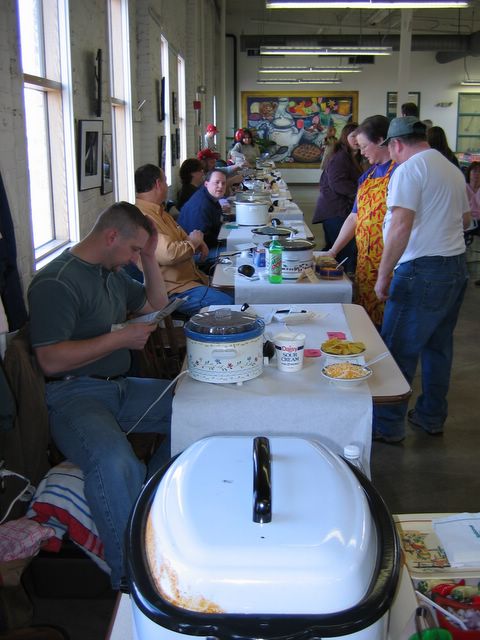
The competitors stretch as far as the eye can see.
As you can see, there were twenty competitors, and according to one taster, who assiduously and methodically tasted each entry and made notes, there wasn't one dog-awful bad chili entered. Interestingly, three of us, including the really nice man who shared the table with me, were all from Pataskala, Ohio--a very quiet formerly farming community that until very recently was steadfastly rural. It is currently becoming suburbanized as the reach of Columbus marches relentlessly eastward, but for now, it is still pretty country-like.
The winning chili, in fact, was made by one of the three Pataskalans. It was a smoked turkey and black bean chili, which unfortunately, I did not get to taste. In fact, by the time I got out from behind my table to go tasting, many of the chilis were already gone, including the other one I really had wanted to taste, the Chili Caliente, which won the People's Choice award. Interestingly, I marked, without tasting, the two winners, though from what I tasted, most of the entries were quite good.
I know that the creator of "Carnivorous Concoction" who shared my table, had some fine chili--the main flavors were meat and beer with a bit of spice at the end. A nice chili.
Before I ran out of chili, I sent Zak down to give samples to the folks I buy the meat from, David and Cheryl Smith of Bluescreek Farm Meats. They raise meat that tastes like the meats my grandparents raised on their farm--in other words, meat as it is meant to taste. Their pork is a revelation in flavor, sweet, firm and fragrant; their beef, especially the meat that comes from the Belgian Blue cattle, is tender and delicious. I am especially fond of both the lamb and goat, myself--which is why I ended up putting them in a chili recipe--they are deeply flavored and strong, but without any gaminess or harshness to them at all. And of course, they are meltingly tender.
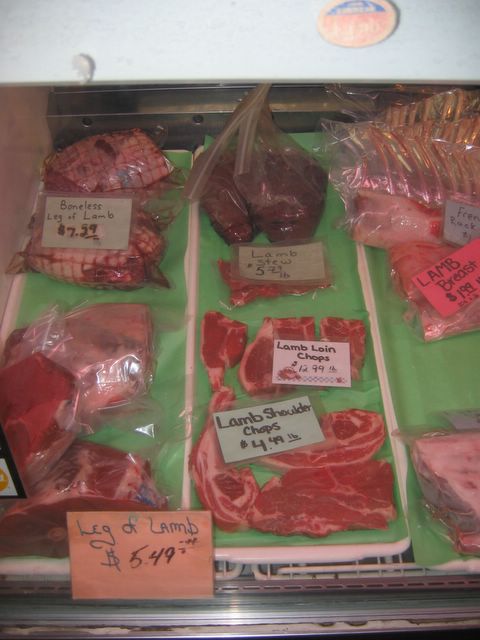
Some of the meat selection at Bluescreek Farm Meats. This meat is from a family farm--all organically raised cattle, sheep, goats and hogs. Look at those pretty cuts of lamb.
After the judging, I passed out cups of chili and cards with the blog address like mad, until I scraped up the last of the chili, then went foraging for tastes of my own. I really think that the contestants should be able to taste each others' chilis before the judging starts; the folks running the contest were very strict about not letting any tasting happen before the judging. However, I think that in order for the contestants to really get a chance to understand what the judges were looking for, they should be able to taste each others' chili and get a feel for what the winning and close to winning entries were like.
Besides, you know, we -all- wanted to know what the other ones were making.
Chili is such a personal thing. Everybody has a different taste in mind when they think of chili. Texans have their bowl of red, the uber-chili, the root of the chili family tree, the starting point of it all. Texas red is just chunks of beef simmered in chile peppers, onions, garlic, spices and sometimes tomatoes and often beer. That is it. Nothing else. No beans. Oh, lord, no beans. Beans are cooked separately and served on the side.
And then there is Cincinnatti chili, which I do not consider to be chili at all. I dislike it intensely, though some of my family really love it and crave it. There is standard midwestern ground beef and kidney bean chili--which seemed to be the standard that most of the entries in the contest were based upon. And then there are the white chilis with chicken or pork, there are the green chile-based pork chilis of New Mexico, there are venison chilis, vegetarian chilis and then there are other chile based stews such as pork posole. Beans, no beans, lots of beans, chunks of meat, ground meat, sausages...the varieties are endless.
What made this contest interesting, if difficult, is that there were no categories, so the criteria that the judges have in mind to judge the chili, other than the general terms of "aroma, consistency, flavor and overall" are unknown.
That is part of what makes it fun--trying to figure out what will appeal to the judges--what will make them think, "chili" when they taste it.
At any rate, I had fun, though I didn't get to do much shopping for spicy goodness. By the time the contest was over upstairs, the downstairs had become a crush of people, so I didn't get a chance to look at the offerings of the vendors or have a taste of any of the free samples on offer.
As we wended our way through the crowd, I did stop back by Bluescreek to see what they thought of the chili. They liked it and wanted the recipe. I gave them my blog address, and promised to put the recipe up in the next couple of days.
So--for those of you coming here because of the little cards I passed out with your samples of chili--keep coming back! I am writing out the recipe for the chili today and will post the recipe along with the number for the winner of the t-shirt raffle. Until then, find your little card, look at the number written on the back and see if you can use your Jedi mind powers to influence my random number generator.
And once I post the number, if it matches the number on your card, post a comment to the blog with your email address. I will email you, and get your snailmail address to send the shirt along to you. I'll give a couple of days for the winner to post--maybe by Wednsday or Thursday, and then I may be forced to generate another number, until a winner steps forward and claims the t-shirt designed by my lovely and talented husband, Zak.
Until tomorrow, then!
Friday, February 18, 2005
Countdown to Chili

Chupacabra Chili v. 3.2
Let's try this again, shall we? (I just killed the previous version of this post. (DOH!)
The final pot of Chupacrabra Chili, v. 3.2, is cooked, and is currently sealed up in a big cast iron pot, and is cooling out on the deck. One of the best things about winter is that I don't have to work as hard to cool off anything I need to stick in the fridge. No sinks full of ice water and frantic stirring. Just stick it out in the natural cooler outside.
This batch is the best yet; I made a small pot last night for dinner so I could further refine the recipe. This time I am using a different kind of posole with larger corn kernels, and two kinds of beans: cannellini and small red beans. I lucked into the posole because Zak suggested going to a Latin American market (DUH!) to pick some up as I had run out. I was so happy to see they had it and fresh tomatillos, that I bought five pounds of each!
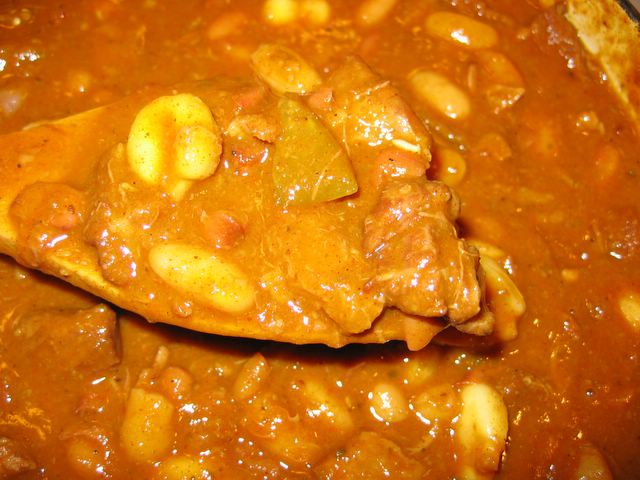
Here is a close-up so you can see the posole, the tomatillo, chunks of lamb and goat and two kinds of beans.
So, all I have to do now is mince up some cilantro to stir in at the last minute, get up early tomorrow, heat up the chili in the microwave, store it in the crock pot and get to the North Market on time. Then, check in, plug in the crock pot and get ready to serve up cups of chili.
Zak has to print up business cards with the web address for this blog so we can pass them out to those who want the recipe. They can come read the blog and look for the recipe to appear in a couple of days, after I get around to typing it up.
Now that the chili is done, I need to go clean up the pot so I can make our dinner: clam chowder!
Another comfort food that I didn't grow up eating. Clams in West Virginia? Uh, no.
Not happening.
Oh, and one more thing-- a piece of news on the Chupacabra front!
Someone has dragged a body they found in the desert near Albuquerque to a TV station and folks are saying it is a Chupacabra. Yes! Folks are saying it is the one, the only, Goatsucking Cryptid Creep--El Chupacabra. Click on the video for a sort of good look at the weird mummified--critter. Thing. Whatever.
It looks to me like the work of a mad taxidermist--rather like the"Fiji Mermaid" which is a monkey's torso wedded to a fish's tail. But hey--it is still fun, and a timely tie in to my Chupacabra Chili.
Thursday, February 17, 2005
Winter Returns, and Comfort Food Rules Supreme
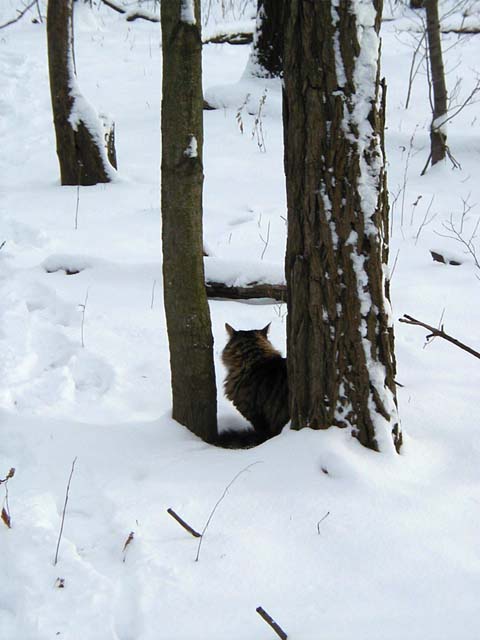
Okay, this picture was taking a year or so ago--but it is a good illustration for what the world is looking like right about now. That is our outside cat, Pyewacket, framed by two trees in our woods. I bet he wishes he could come inside for some ma po.
Two days ago, it was sunny and sixty degrees out. This morning, the forecast said that we would have some snow flurries and there might be a sprinkling of snow in grassy areas. I just looked outside to see a totally white world with no visibility and at least an inch of snow coating the ground.
An inch is not a sprinkling. I wanted to call the weather people up and suggest that they look outside before they update the website, but well, I think they live in a windowless bunker anyway, so it would do no good. Suffice to say, our world has gone from a muddy, damp place where spring was thinking about tip-toeing into the picture back into a winter wonderland in the space of about an hour.
This is a good picture of what our ravine looks like now:

Winter reached out and took hold of our world again this morning; this makes me all the more glad that I cooked comfort food last night and am making some more tonight.
So, I was looking at an old (1998) back issue of Bon Appetit that I found at the bottom of a stack of Fine Cooking Magazines in my office closet while packing stuff yesterday. I was about to stick it in the "donate it to a deserving doctors' office" pile when the cover story caught my eye. It declared, in what appears to be 28 point type (where is my type ruler these days?) that "Comfort Food Is Back!" The subhead is "Great New Recipes for Warming Up Winter."
Serendipity is my friend, you understand, so I had to open up the magazine and check out what they had to say, since now at least three blogs have taken up talking about comfort food these days. So, I open up to page 57 to have even bigger type greet me with the following statement: Comfort Food at its Best: Dinners Like Mom Used to Make--Only Better."
Okay, so the folks at BA agree with Alice May Brock (You remember Alice--she has a restaurant) and myself that comfort food is meant to remind us of Mamma's cooking, but they take it one step further--it is Mamma's cooking done better. I note that the author does not have an Italian surname, which is healthy for him; the Italian Mammas I knew growing up would have taken a wooden spoon to the backside of any kid who suggested they could top her cooking, even if it was just meant to sound good in a magazine.
Anyway, the text of the article opens with the question, "What in the world is comfort food?" Basically, the author's notion is that comfort food is those dishes that evoke memories of good, safe happy times that make human beings feel wrapped up in a glowing blanket of love. That isn't exactly what was said; that is a poetic paraphrase, but you get the idea. He also points out that comfort food is the perfect fit for the long, dull, cold days of February when all of us are so tired of winter that we just want to dive under a quilt and hibernate until April brings showers and May brings flowers.
So, I guess that it is only natural that we are all ruminating on this comfort food idea right about now. Winter is still here, the fickle sun had dashed back off to the tropics for the rest of her vacation and we are all still stuck here, hungry and cold and wanting love.
Lacking warmth, we head to the kitchen to create some.
Which is just what I did last night. I frolicked off to the kitchen, and cooked Zak and I up a nice mess of comfort food.
The only thing is--I realized something was flawed in my theory of comfort food. When I said it is essentially, the foods we grew up with that remind us of Mamma's kitchen and her arms around us, I wasn't thinking to clearly about what comforts me. Because I have a whole list of comfort foods that I crave on blustery days that have diddly squat to do with my childhood background. No one fed me real Chinese food until I was in high school, and I didn't taste Chinese home cooking until I was in my mid-twenties. So, if that is the case, why the heck did I crave Ma Po Tofu like it was a lifeline last night and had to make it even though it was nine-thirty in the p.m. before I was hungry?
Before I answer that, let me tell you what Ma Po Tofu is, so you know what the heck I am talking about. From Sichuan province, Ma Po Tofu is essentially a hearty one dish meal of firm tofu braised in a spicy sauce with ground meat. I am told that traditionally, it is ground beef that is in the dish, though I wonder about that; beef is rarely used in China because cattle are beasts of burden. Pork tends to be the preferred red meat in most places in China, with lamb as the primary choice in areas with a heavy Muslim population, or in the extreme north, where Mongolian influence was strong.
The main flavorings are Sichuan chili bean paste--a paste made from fermented soy and broad beans and chili peppers ground together, salted fermented black (soy) beans and Sichuan peppercorns, which are the seeds and seed cases of an ash tree that are dried and which impart a flowery, tingling peppery essence to any dish they are added to. I always buy them whole and toast them before grinding them up and adding them in generous amounts to my cooking.

Sichuan peppercorns being toasted in the wee green Le Creuset pan.
Anyway, the first time I ever tasted Ma Po was when I worked at Huy and Mei's restaurant around fourteen years ago, when I was well out of childhood. I only had it once, but I loved it immediately and longed for its flavor until I learned to make it myself. No other restaurant I ever had it in satisfied me--I think it is was because they didn't use the chili bean paste for the spiciness--lots of them used chili garlic paste which makes for a cleaner, less complex flavor and aroma. It is also less satisfying.
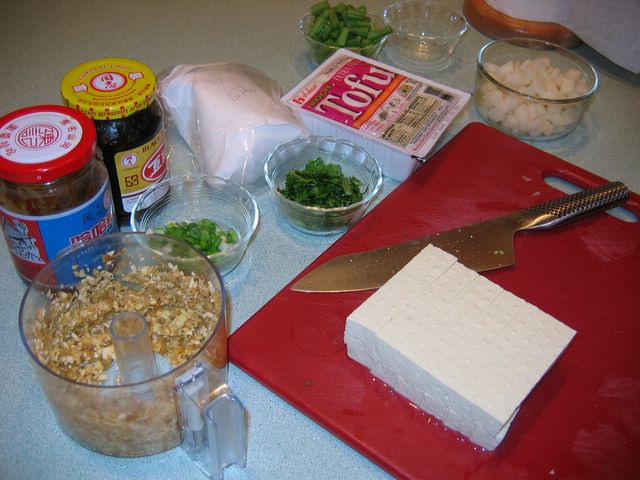
The ingredients for Ma Po Tofu. In the foreground is the cup to my mini food processor; inside it is minced garlic, fresh ginger and Sichuan preserved vegetable, which is a salty, spicy cabbage-like critter. Whatever it is, it is tasty. The stuff in the jar with the blue and red label is chili bean paste, and the jar with the yellow, red and white label contains salted, fermented black beans.
The name, "Ma Po Tofu" is often translated as "Pockmarked Woman's Bean Curd," which is one of those unappatizing names, but it is said that the woman who invented the dish an unspecified number of years ago, was marked with smallpox scars. It sounds really insulting to call a someone "pock-marked woman," but that isn't the way it is seen in China. Folks in China give each other nicknames based on physical characteristics all the time, and often these names are not flattering in the least, but no one minds it. It is teasing. For example, if someone is heavy in China, they often get called, "Fatty," which is shocking to Westerners. But it is simply how it is. Sometimes the names are poetic sounding, but they still refer to a physical characteristic. For example, all of we American waitresses had Chinese nicknames so the kitchen guys could talk about us without us knowing. One of Mei and Huy's daughters told me about it. One of the names they called me was "White Cloud," which I found to be odd, until one day I was asked, "How did your bosom grow so big?" by Mei. "Did you drink a lot of milk growing up?" Her daughters were scandalized, but she went on and said, "They make me think of fluffy clouds in the sky."
Then, suddenly, the name made perfect sense to me. I still giggle about it.
Anyway, that is why ma po tofu has such an odd name.
Ma Po Tofu
Serves 3 with rice for dinner, or 6 with rice and other dishes
Ingredients:
1 block extra firm tofu (about a pound—I like White Wave Organic Brand)
medium saucepan of simmering water
1 small (about 3 inches square) piece dried cloud ear fungus (optional)
1 tbsp. peanut oil for stir frying
3 cloves garlic, minced
½ tsp. fresh ginger, minced
2 tbsp. Sichuan preserved vegetable, minced
6-8 ounces ground pork
4 fresh water chestnuts, peeled and minced (or use fresh jicama--don't used canned water chestnuts)
2 ½ heaping tbsp. Sichuan chili bean paste (or to taste)
1 tsp. fermented black beans
¼ cup Shao Hsing wine
1 cup good chicken stock
1 tsp. sugar (optional)
2 tsp. light or thin soy sauce
4 tbsp. cornstarch dissolved with 6 tbsp. cold water
½ tsp. ground roasted Sichuan peppercorns
¼ cup thinly sliced scallion tops
handful of minced fresh cilantro (optional)
Method:
Cut the tofu into about 1/2” cubes. Put into saucepan of simmering water, and turn heat down so the tofu simply steeps. This will help keep the tofu firm, and preheats it before it is added to the sauce.
Soak the cloud ear in warm water until it rehydrates. Trim any woody parts, and then mince roughly.
Heat oil in wok until smoking. Add garlic, ginger and preserved vegetable. Stir fry 30 seconds. Add pork. Stir and fry until the pork is dry and somewhat crunchy, breaking up large clumps as you go.
Add bean paste and fermented black beans, stir-fry a minute, until very fragrant. Add wine, and allow alcohol to boil off.
Add chicken stock, sugar, thin soy sauce, bring to boil. Turn down heat.
Drain tofu, and add to the sauce. Allow to simmer in sauce about two or three minutes to pick up the flavor of it. Stir gently, using the back of a ladle in order to not break up tofu cubes. If you stir vigorously, no matter how firm your tofu started out, it will crumble.
Pour about 1/3 of cornstarch mixture into sauce. Stir. If it thickens to desired consistency, remove from heat. If you want it a bit thicker, add a little more. Do not just add it all at once! You may not need it all. You want it to just be a nice, moderately thick sauce, not a gel-like gluey consistency. As soon as it is the desired thickness, remove from heat.
Add peppercorns, scallion tops and cilantro, and stir.
Serve in bowls, with spoons, over rice or with the rice on the side, as you wish.
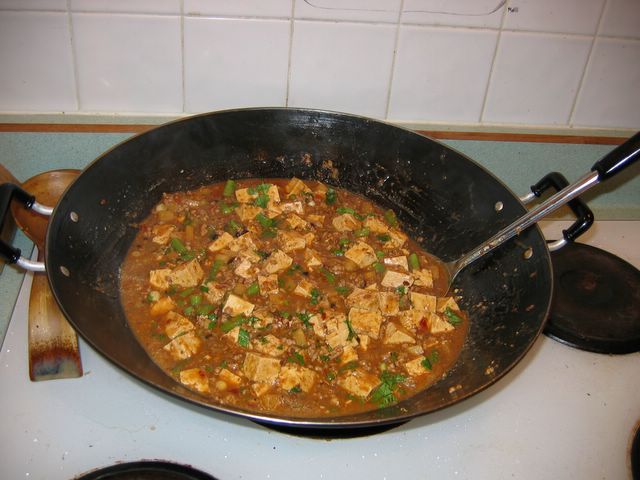
Here is the finished Ma Po. No, green beans do not traditionally go in there; generally I make a batch of Sichuan style dry-fried green beans with minced pork to go with, but I only felt like making one dish with steamed rice last night. I wish you could smell it; a divine and delicious combination of aromas swirl from a well-made batch of ma po.
So why is Ma Po Tofu a comfort food to me?
Maybe because it reminds me of Mei and Huy and how good they were to me at a really hard time in my life. I worked there during my divorce, and in that time period, I felt very beset upon from all sides; very few in my family were being supportive to me and the custody battle was a long, horrible process. The folks at the restaurant took me in as family, and that place became a haven for me. I was treated with kindness and respect and love, something that was in short supply in my life right then. The foods of my childhood no longer filled me with joy, but sorrow, so it is no wonder that my psyche and tastebuds latched onto newer flavors as sources of comfort.
I have since made peace with that time, and with my family, and so the hillbilly cooking that I grew up on no longer makes my throat close up with unshed tears, but brings me back to the kitchens of my grandmothers, aunts and mother in a positive way. But the foods I learned to eat in those cold years when I essentially learned to make my own family, still call to me, and I will cook and eat them when I want to remember that love is the greatest power that human beings wield in this world, and there is no act more sacred than sharing food and love with a lonely person who hungers.
Fourteen years ago some people shared with me. And they saved my heart and soul by it. And so, now, I pass that love along to others in need.
The world may buffet us with cold winds and blinding snow, and the sun may hide her face to us, but in our kitchens we can make our own warmth and give it to all who have need of it.
May you never hunger.
Wednesday, February 16, 2005
Rite of Spring
It isn't just that there are snowdrops blooming in our garden. Nor does the one brave purple crocus who is thinking of unfurling her petals tomorrow who tells me spring is just around the corner. It isn't the singing of the wrens nor the mating calls of the crows which give my sign that spring is imminent.
No, it isn't the calender, nor even the fact that it was sixty degrees and sunny out yesterday. (Yesterday. Today it was in the twenties, and snowing, and dismal. That is Ohio, for you.)
No, it is because the sacred purple bags are out on store shelves again.
The Cadbury Dairy Milk Mini-Eggs are available. They are out there, and Zak brought a bag of them home to me yesterday.

Yes, it is that time of year again. The Month of Mini-Eggs is at hand.
But what a bag! Supersizing has hit my favorite springtime treat. If you look closely at the picture you can see that the larger bag is a whopping 22 ounces--a bloody pound and a half of rich milk chocolate encased in crisp, vanilla scented sugar shells.
Can I say this?
OH MY GOD!
I think he is trying to kill me. Or, more likely, make me grow a bigger butt. I don't think he ever got over the loss of my ass when I went down about three dress sizes a few years ago.
I mean, I was happy, but then I saw the size of the bag and was torn--what do I do?
Because you know what? I love those damned little crispy, creamy, rich, milky wonderful little nuggets of Eastertide goodness so much that I cannot open a bag of them without dire peril. They are addictive. I cannot just have three of them at a time--which is why I buy them in the more moderate, fifty-cent one and half ounce sized bags, pictured next to its gigantic cousin.
I swear, they put crack in the sugar coating. I cannot be -that- much of a jello-kneed weakling about the things, can I? I mean, I -do- have willpower, after a fashion. I mean, I did lose that weight, though mostly that came about because I quit drinking soda habitually. But still. I quit smoking cigarrettes years ago, cold turkey. I should be able to open a harmless bag of chocolates and have just one or three or seven or a handful or half the bag: you see what I mean.
He laughed at me. The bag stayed on the counter, unopened for twenty-four hours. This is a record in our house. He knows I wait all year for these things, so he came home from his doctor's appointment and said, "I see you still haven't opened my present. You don't love me."
"I do," I pleaded, "But I don't dare open them. If I do, I my doom awaits and I will die of chocolate inhalation."
"Do you want me to open the bag, give you some and then hide the rest?" he asked helpfully.
"No!" I shook my head. "No--you don't want to turn me into a junkie, do you? You don't want me following you around, twitching and tugging at your sleeve all day begging for a fix, do you?" I folded my arms. "Or was that part of the plan?"
He told me I was paranoid.
I suddenly wished I was a devout Christian so I could give up Mini Eggs for Lent.
I told him I wasn't opening the bag until Morganna comes to visit. She has the metabolism of a hummingbird, and can burn off every calorie in that bag with one good spate of dancing or a long run out in the woods. I could walk from here to Shanghai, (Well, they'd have to build me a good long bridge to do it, but you get the idea) and still not burn enough calories to justify eating even half of that bag. You could probably fuel an entire small village in India with the calories in there.
So, we went out to the grocery store this evening so I can pick up green beans. And while we were there, I saw a display of the tiny bags of Mini Eggs. A huge display. I pointed. "Why didn't you get those?"
"I didn't see them!" he said, dragging me to the Easter candy display aisle. "See, here's the bag of Mini Eggs I got you." They are at eye-level right as soon as the aisle starts. And then, we walk down the aisle, and he says, "See--Reeses, Hershey's Kisses, Dove....do you see any other Mini Eggs? Any smaller bags? Because I looked, I did--I knew you would get neurotic over the huge bag. I knew it!"
At the end of the display, at the very end, there were two boxes of the tiny bags of Mini Eggs. I grabbed one and crowed triumphantly, "See! Here it is--a bag of a decent, reasonable size! A bag that I can open and eat every last one without feeling guilty or worry that every tooth will fall out or that my pancreas will crawl out of my body in despair! I'm buying it."
I tossed it in the basket and we went to check out.
There were two folks bagging our stuff--a high-school aged girl and a boy, and our cashier was a boy of about the same age. When the little purple bag came down the conveyor, the girl's eyes widened and she gasped. "Where did you find these?" she whispered. "Where?"
One of the boys says, "I told you there were little bags around here somewhere."
The cashier shook his head and said, "I don't see why you don't buy the big bag. It is cheaper in the long run."
She shook her head. "I -told- you I don't dare, because if I open it, I will eat them -all-!"
Zak and I cracked up, and I started nodding. She looked at me and said, "You understand! It's true--I keep telling them how good they are, but they don't believe me. You can't help yourself, can you?" She glanced around. "Where'd you find that little bag?"
"Come on," I said, beckoning her back to the Easter aisle. "I'll show you."
I told her about Zak buying the big bag, and she shook her head. "That is just torture," she said. "My boyfriend got me a huge bag for Valentine's Day, but I haven't opened them yet, and I won't. Not until Saturday when I'm having about seven girlfriends come over for chick flicks. A pound and a half of chocolate between eight girls is a better way to go about things."
I couldn't agree more.
I told Zak as we were going home that I was going to write about the big and little bags of Mini Eggs this evening. He thought it was cool. "Who knows," he said. "You may find more people in the world share your addiction to them."
It could be.
So, here I am. The huge bag of chocolate is still set up on the windowsill where I perched it for the photograph. One of my cats is laying next to it. She helped me photograph it. I can smell the vanilla scent of the sugar shell still and the rich sweet chocolate from here.
The smaller bag?
I had to open it for the picture, so there were some eggs scattered around for visual interest.
I bet you can guess the fate of those eggs and their fellows.
Yep.
But, I am not touching that big bag.
Nope.
Tuesday, February 15, 2005
Comfort Food Without Borders
I think that she has part of the answer. One generally does not find "comfort food" dishes on the menus of fancy restaurants; such artless, simple food, is not what one expects to get dressed up and sit down to a white linen and crystal laden table for. Wine lists and comfort foods just do not go together.
I think that "comfort food" encompasses any simple, homestyle foods which remind a person of their childhood, and the comforts of home, hearth and Mamma.
Alice May Brock, of "Alice's Restaurant" fame (yes, Virginia, there really is an Alice--did you think Arlo made the whole thing up?) says in her cookbook, The Alice's Restaurant Cookbook, that comfort foods are all those milky, soft things that make us feel like we are back in Mommy's lap being cuddled.
I tend to agree with Alice, except for the milky and soft part.
Because every culture has comfort food, and many of them have nothing to do with dairy products, nor are they all soft.
I mean, a lot of them are soft. A typical American comfort food is mashed potatoes--you cannot get much smushier than that. Oatmeal is a comfort food for many of my Scottish friends--that is pretty mushy, too.
Cantonese folk are comforted by congee--a porridge made with rice and chicken stock, which is served either plain or with a dizzying array of condiments or accompaniments, like fish balls, thousand year old eggs, shreds of pork or pickled vegetables. It is a breakfast food that is considered to be highly nutritious for everyone, but particularly for the very young or old, and women recovering from childbirth.
Soups are comforting the world over--chicken soup being a favorite almost everywhere. What Jewish American doesn't crave matzoh ball soup when they are feeling under the weather or a little depressed? I am told by my Thai friends that tom ka gai-chicken coconut milk soup with galangal will cure the common cold, a hangover and a broken heart. My Pakistani personal chef clients loved red lentil dal cooked with chicken and lots of garlic and chili peppers. They told me it cheered them up just to smell it cooking on the stove.
Cucumber mint raita was another big comfort food for them. I would make quarts of it for them, and they kept asking for it over and over.
My Syrian Aunt Nancy was comforted by the smell of garlic and basil cooking--she grew up in an Italian/Portuguese/Middle Eastern neighborhood in Providence Rhode Island, and just smelling anything Mediterranean in origin on the stove gave her a smile and spring in her step.
Among Native Americans, I suppose a good example of a comfort food would be fry bread--a Navajo recipe that is widely cooked and served on the powwow circuit. Fry bread serves as a substitute for tortillas in Indian tacos--ground buffalo or beef meat served on hot fry bread with some cheese and salsa and lettuce on top. My daughter craves those, and can eat inordinate amounts of them at a sitting.
Essentially, what I am saying is this--comfort food is no one thing. It has no one meaning, no one definition--it is a concept which is both universal and fluid. There are no borders to comfort foods--every culture has them, and while they may never feature in the fancy restaurants around the world, they form the backbones of the real cuisines of every country on earth. The real cuisines are not made in restaurant kitchens, but in the hearths of every family on the planet. Professional chefs do not invent cuisines--they refine them, they change them, they are inspired by them, but the soul of a cuisine comes from the hands of mothers and fathers all over the world who toil to feed their families every day.
The creators of "comfort foods," are the ones whose food moves our spirits and call us back to the table.
They are the real heroes of cooking, and one should -never- be ashamed to eat their food.
I agree with Kate wholeheartedly--food does not have to be anything but good.
Sweet Success
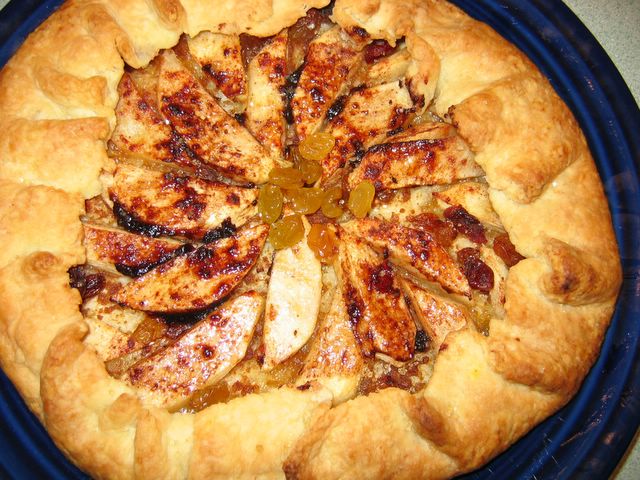
An apple raisin galette flavored with a bit of rose extract and wild berry glaze.
Faithful readers may remember my admission that I am fumble-fingered when it comes to pastry, and that I had vowed within this year to become better able to make pies that not only tasted good, but looked like something other than a map of Australia, or worse, like something a cow stepped in.
So, for Valentine's Day, my least favorite of all holidays, I decided to celebrate by doing something that makes me nervous and jittery. No, not making a pie, going to the dentist. Yes, I had a dentist's appointment yesterday, which made me an awful shrew to Zak. But, I was not so bad off as my friend Branwen--she had an appointment with her doctor to deal with two hernias. (Boy, we are two hot babes who know how to celebrate love and party hard, aren't we?)
Well, after being twittish and skittish all day, I made it up to Zak by making a good dinner--ribeye steaks dry-rubbed with Turkish spices cooked in cast iron skillets on the stove, with fingerling potatoes sauteed in olive oil with fresh garlic, thyme and rosemary, a goat cheese and spinach salad, and a dessert. And for dessert, I determined to make a galette. My theory was that it was simple, it is one crust, I had apples on hand and it was relatively quick.
So--I made the dough:
1 tbsp. sugar
1/4 tsp. salt
1 sticks unsalted butter, cut into ½ inch pieces and chilled
1/3 cup ice water
I mixed the dry ingredients together in a medium sized bowl, and then used the pastry blender to cut the butter in. I worked it that way until there were pieces about the size of garden peas, and little crumbs.
I wanted to break some of the larger pieces into smaller ones, so I threw caution to the wind and did as I have watched Madeline Kamman do, and used my fingertips to rub the flour and butter together, squishing the butter into flakes. I am a firm believer that you must be bold to get anywhere in life and love--or the kitchen for that matter. One must be fearless to learn to cook well.
Then I poured in the water, and used my hands to mix it in well, then gather the dough into a reasonbly dry, flat disk. Zak held open a ziplock bag for me, and I slipped it in, pushed out the air and stuck in the fridge to firm up while I cooked potatoes.
Then came time to roll it out, and add the filling, which I improvised:
I crushed a handful of crisp cookies--a pastry chef I knew in culinary school liked to use biscotti crumbs, but I was fresh out of biscotti, so cookies it was. These go on the bottom of the galette to absorb excess juices to keep the bottom of the crust from turning soggy. Then I peeled and thinly sliced two Braeburn apples, because that is what I had. I got out a bit of cinnamon, some rose extract, a bit of dried ginger and some golden raisins.
I rolled out the dough--it was almost completely round! Only the edges were a bit ragged, and the shape was vaguely circular! It was amazing. I wish Morganna could have seen it.

A nearly circular pastry crust rolled out by myself--queen of rolling perfectly good dough into perfectly wretched disasters.
Then I sprinkled the crumbs in an even layer over the dough, leaving a two inch edge free of crumbs. Then the apples went on top in a concentric pinwheel design. I sprinkled raisins over it, then sprinkled cinnamon, ginger and about 1/2 tsp. of the rose extract over it all. I sprinkled probably 1 tsp. of raw sugar over it all, and then folded over the edge, pinching it all in one direction. I brushed the excessive flour off the edges, and carefully transferred the galette (with Zak's help) to a silpat-lined baking sheet and popped it in a 400 degree oven for 45 minutes.
It came out very brown and fragrant--though I made a mistake with putting raisins in the exposed part of the tart. They browned too much, so I picked them off and sprinked new ones over it. I glazed it with melted wild berry preserves, and we ate it warm.
The crust was magnificently crisp and flaky and filled with a delicious browned butter aroma. The apples absorbed the flowery essence of the rose extract and the wild berries. The raisins added a depth and richness--those which were covered by the edge of the crust were quite protected and filled with sweetness.
Finally--a pie-like pastry made by moi that did not look ill in some way!
Monday, February 14, 2005
Fools for Pho
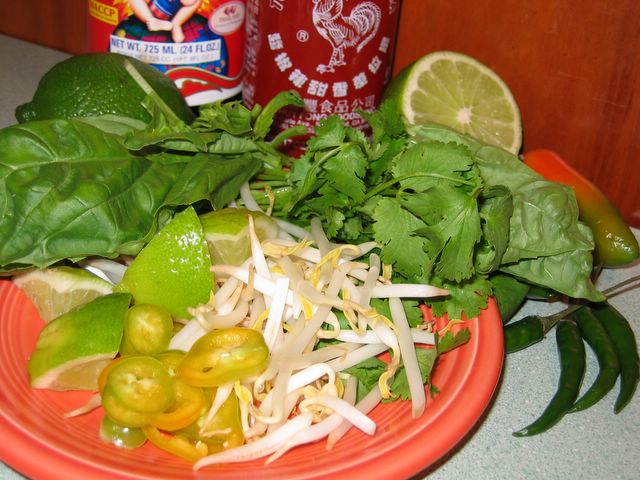
A plate of beautiful fresh vegetables meant to customize pho.
This is a love story. Like all love stories, it is about pursuit, frustration, elation and pain.
It is about obsession.
But it isn't about my beloved husband, and how we came together.
It is about soup. It is about a soup which arouses argument and jealousy, obsession and devotion, lust and desire in more people than just myself and a few others.
It is about pho.
The idea to write about it came to me two days ago while I was having coffee and a leftover naan (made by Zak--his first breadmaking outing--a round of applause, please!) for breakfast. I came across this Washington Post article about a quest to learn how to make pho. I had to giggle, because it made me remember my experimentations in that area, which were made more piquant by the desperation born of someone who needed to understand it so she could teach it to others.
I used to teach culinary arts in Columbia Maryland through Howard County Parks and Recreations Adult Education program. I specialized in teaching Asian cuisines: Chinese, Thai and Indian, mostly, and I was surprised to find that many of my students were Asian American adults who had never learned to cook from their parents or grandparents, but who said that my food reminded them of what they had in childhood. Other students were Anglo-Americans who had worked for the government in the intelligence community or diplomatic corps, and so had traveled quite extensively and wanted to learn to recreate the foods that they had eaten in various Asian countries often decades ago.
Many of my students became regulars, and I ended up making friends with many of them. At the end of class, I always had to pass out an evaluation form which asked questions about what they learned, my teaching style, and what other classes the students would like to see me offer.
The single most requested class was on on pho bo--the sublime Vietnamese beef and rice noodle soup. It is a deceptively simple dish: pliant, pre-cooked rice noodles are nested in a large, warmed bowl, with one or more of the following--well-done beef slices, chewy beef tendon, and paper-thin slices of raw beef--placed on top. Then, boiling hot, clear amber-colored beef stock, fragrant with spices and the mysterious depth of nam plaa--fish sauce, is poured over it all, cooking any of the raw beef within seconds. A sprinkling of scallion tops and translucent onion slices are scattered over the bowl, which is presented with a platter of Thai basil, cilantro sprigs, fresh bean sprouts, jalapeno chile slices, and lime wedges, so the diner can customize the dish to their own taste. On the table is always a tall bottle of scarlet sriracha, hoisin sauce, and nuac cham-- a spicy condiment of fish sauce, garlic, lime juice, sugar and fresh Thai chiles. These sauces allow further flavor possibilities, allowing individual diners to make as potently fiery or as soothingly mild dish as they prefer.
But, as I, and the Washington Post reporter discovered, pho may look simple, but it isn't.
The backbone of the dish is the beef stock, which, while it may be based upon French culinary principles, does not taste like most European style beef stocks at all. And while, on the face of it, stocks are simple to make--you stick bones in water and simmer for a long time--there is really a lot more to it than that.
First of all, in order to make stock at home, you need a -really- large pot (anything less than twenty quarts is a waste of time, in my opinion--there is no sense in making only a little stock), which may or may not fit on your stove. And even if it does fit, your stove may or may not throw out enough BTU's to adequately heat such a gigantic cooking vessel. And then, if you do have a pot and a stove that are adequate, you have to get beef bones. Good ones. Ones that are fresh. And that means that you have to have a butcher or grocer or a farmer whom you trust. If you are lucky, you can go to a large Asian market and talk with someone in the meat department and tell them that you are making pho, and they will know what to get for you, and usually, will give you advice on how to proceed. Of course, how they make pho may not be how the restaurant that you like makes pho, but as I discovered, there is apparently no one "right and proper" way to make pho--there are endless variants on the theme.
Once you have the pot, the stove and the bones, you have to go about making the stock.
Which you will find takes all day. In fact, that innocuous looking bowl of gorgeous soup takes about two days or so to make. It represents hours of work. Which, I suspect, is why most people go out and eat pho--at around six dollars a bowl it is a bloody bargain.
But, like the Post reporter, I was driven to learn how to make it, so I went out, and ate many bowls of the stuff, (it was a great sacrifice, I tell you) analyzed the flavors, and took notes. I shamelessly accosted cooks at the Asian markets, waitresses in restaurants and little elderly Asian ladies in parking lots to ask questions. I tool more notes, then read every Vietnamese cookbook I could get my hot little hands on in order to synthesize a recipe for pho.
Which I did. My recipe differs slightly from the one in the Post, but not by much. Instead of the sugar, mine uses parsnips--a touch I got from Nicole Routhier, whose mother always used parsnips for the subtle sweetness they added to the stock. I like that better than the sugar flavor--rock sugar is too easily overdone, whereas the parsnips add not only sweetness but an almost floral quality to the fragrance of the stock that you cannot get with rock sugar.
And then, I tested the recipes and refined them. In doing so, I remembered something I learned from culinary school--the early stages of making beef stock are a messy, smelly business.
Chicken stock smells good while it cooks, from the very beginning to its golden end.
Beef stock smells godawful until it is nearly done, and even then, the smells of the early stages are still hanging around, making a dank miasma of the atmosphere in not only the kitchen, but if you have inadequate ventilation, the entire house.
I persevered, bringing the bones to their first boil and then pouring out the water and washing the bones again, and then starting them over and diligently skimming the scum that rose to the top, and patiently watching to make certain that the liquid only simmered, never boiled, and skimming, and sweating, as the bone and marrow scent began to permeate my clothes, hair and my very skin.
For ten hours I cooked it until I ended up with a pale, and flavorful stock. I strained it and then refrigerated it and then the next day scraped most of the fat from the top and then brought it back to a simmer and added the spices and fish sauce, and simmered it a bit longer, then began cooking the noodles. I set up the condiments and then, sliced the half-frozen beef into shavings and presented it all to Zak.
It was really good, but not only was I exhausted, I smelled funny.
But I had a recipe I could teach to the class which my supervisor had told me was full and with a waiting list.
The day before I was to teach, I made another huge pot of stock, creating yet another cloud of stench in the house, and prepped the herbs and vegetables. On the day of class, I skimmed off most of the fat, flavored the stock with the spices, cooled it in order to transport it, and then packed all the food up. I packed some bones, and a small pot so I could demonstrate the early stages of stock-making, and went early to the classroom, so I could bring the finished stock to a simmer for presentation. By the time I was finished lugging all of this up the stairs, I was exhausted, and once again, felt like I smelled funny.
So, the students showed up, many of them regulars, and many others new faces. They were all fairly wriggling with excitement, because I was going to show them how to make pho.
So, I gave my talk about what I had learned, how I learned it and how many batches of pho I had made (quite a few) in order to figure out a good recipe for the beef stock. Then, I demonstrated the making of beef stock with some beef bones, parsnips, ginger and all that stuff. Predictably, when the water boiled the first time, the smell arose with the clouds of steam, and some folks in the front row curled their lips.
"Are those bones fresh?" a lady in the second row asked tentatively.
"Yes, they are, ma'am," I answered. "Beef bones just smell that way when they first start cooking. That is just how they are. It is the blood and other impurities coming off and out of them. The good smells come later."
People started to look decidedly less thrilled with the prospect of making pho.
Then, I showed them how you dumped the water out, washed the bones, the pot, the everything and started over and eyes widened and they began to understand why it is better just to go out and plunk down the six dollars when you had a craving. They looked at each other and said, "I had no idea it was so hard."
Indeed.
Once I demonstrated the scum skimming, and told them how many times they had to do that over the next seven to ten hour period, I turned off the heat under the stinky pot, and put it outside the classroom door and shut the door to keep the smell out. I turned up the heat on the crystal clear heavenly-scented finished stock, and brought it to a boil, while I showed them how to cut paper thin slices of rare beef. The well done beef, I had already cut. There were no tendons--I forgot to pick some up, but of course, someone asked about them, so I told them that you cook them the same amount of time as the well-done beef, and you take them out around the same time.
Then, I started assembling small bowls of pho for twenty-five people.
While I was occupied with this, and people were lining up for tastes, and playing with the plates of condiments and garnishes and bottles of sriracha, which I call "the sacred rooster sauce," I bantered back and forth with the students and learned that many of them had worked in Vietnam or had been stationed there at an embassy or who had gone there to adopt children. After everyone was served, silence fell, broken only by slurps and exclamations of satisfaction.
As they filed up for seconds, I opened the floor to questions. One extremely well-dressed, bejewelled and meticulously coifed woman raised her beautifully manicured hand and when I nodded to her, asked, "Is there any way to make pho more easily than this?"
To their credit, everyone else turned and looked at her as if she had just announced that she had come from the Planet Xenon and that she was sorry but we were all to be terminated in the next five minutes.
I bit my lip to keep from screaming, "If there was, don't you think I would have taught you that?!" Instead, I gripped the edge of the stove, and smiled sweetly. "Not really, no," I answered in my most polite voice.
She blinked and pursed her lips in a pout. "Well, why couldn't you use canned beef broth?"
I took a deep breath through my nostrils and let it out slowly. "Because it wouldn't taste right," I said. The lady in the front who lived in Vietnam for five years while working in the US consulate looked back at her and shook her head, "And anyone who really loved pho would know--it would taste awful."
The woman waved her fingers and shrugged. "Well, I just want to know if there is any way I can make this soup quick and easy? I mean, I don't have time to spend standing over a smelly pot of bones and skimming crap off of it all day. Is there any shortcut I can use?"
I nodded, and said, "Yes."
She leaned forwards, her face lit with eagerness.
"How?" she asked, her pen at the ready to take notes.
"There is a way to get pho in about fifteen minutes."
My regular students started to smirk, but the woman simply gritted her teeth and all but spat out, "How?"
I smiled sweetly and shrugged. "Go out to your favorite pho joint, plunk down about six bucks, and like magic, a bowl of pho appears before you in ten to fifteen minutes."
She was not amused, but everyone else was.
Needless to say, I never saw her again. But that was okay.
I never made pho at home again, either, nor did I teach the class again. The comments all mentioned how much work it was to make pho, and how they were unlikely to do it at home.
That said, here is my recipe for it. After we move to Athens, I will probably take up making it again, since there is no pho restaurant within a two hour drive of our new home.
Pho
Start this recipe two nights before you mean to serve it.
Stock Ingredients:
5 pounds beef bones with marrow (soup bones)
5 pounds oxtails
1 pound flank steak
1 pound beef tendon (optional)
2 lg. onions, unpeeled, halved and studded with 4 cloves each
3 unpeeled shallots
1 4 piece ginger, unpeeled
8 star anise pods
1 cinnamon stick
4 medium parsnips, cut into 2 chunks
2 tsp. salt
Garnishes:
1 pound beef sirloin
2 scallions, thinly sliced
¼ cup minced cilantro
2 medium onions, sliced paper thin
¼ cup chili sauce
1 pound ¼ wide rice sticks
½ cup fish sauce
freshly ground black pepper
Accompaniments:
2 cups fresh bean sprouts
3 Thai bird chilis, sliced thinly
2 limes cut into wedges
1 bunch fresh mint, stems removed
1 bunch Thai basil, stems removed
sriracha sauce
hoisin sauce
nuac cham*
Method:
Day One:
The night before you cook your pho, rinse the bones under cold running water, and soak overnight in a pot with enough water to cover in the fridge. (This will help the impurities to rise more quickly to the top of the stock and be skimmed away, which makes a prettier, clearer, tastier soup stock.)
The next morning, combine bones, oxtails, and flank steak in a large stockpot. Add COLD water to cover, and bring to a boil. Boil for ten minutes, then drain, rinsing the pot and the solid contents. Return the bones to the pot and add 6 quarts of water. Bring to a boil. Skim the scum that collects at the top of the pot, discarding it. Stir the bones at the bottom of the pot now and again to release more impurities. Skim the ugly stuff as it collects at the top of the pot. Continue until the foam ceases to rise. Add another three quarts of water, bring back to the boil and skim any remaining residue that rises. Turn down heat to the simmer.
Now that the stock is simmering, char the studded onions, shallots and ginger over a gas flame, or under your broiler until they darken and release their fragrance. Wrap onions, shallots, ginger and parsnips in cheesecloth and lower into the pot. Simmer for one hour.
Remove the flank steak from the pot. Reserve the meat, allowing the soup to simmer uncovered for at least four or five hours. Watch the liquid level: as it boils away, add fresh water to cover the bones.
For the last hour of simmering, add spices in a second cheesecloth bag. (If you like more spice flavor, add several hours before the stock is finished.
After stock has come to the desired strength, after at least seven to eight hours of simmering, strain and cool. Put into a covered container in the refrigerator overnight. It helps if you have a large refrigerator.
The Next Day:
Remove stock from refrigerator. Skim most of the solidified fat off the top. Strain back into clean stockpot and bring to a simmer.
Partially freeze the sirloin, then slice against the grain into paper thin slices: about 2X2 square would be a good size. Slice the flank steak as thin as possible. Set aside.
In a small bowl, combine the scallions and cilantro, and half the sliced onions. Set aside. Place the remaining sliced onions in a bowl and stir in chili sauce, set aside.
Soak the rice sticks in warm water for thirty minutes. Drain and set aside.
Add fish sauce to the simmering stock and bring to a boil.
In another pot, bring 4 quarts of water to boil. Drop in drained noodles, and immediately drain them. Divide the noodles among 4 large soup bowls and top them with the sliced meats. Ladle the broth directly over the meat in each bowl (this cooks the raw meat) and garnish with the scallion mixture and freshly ground pepper. Serve with the chili onions and other accompaniments, so each diner can customize their bowls as they see fit.
This serves four generously, or six less generously. This is meant to be a full, hearty meal.
The Quick Method:
Go to your favorite pho restaurant. Order your favorite type of pho. When it comes, eat it, and be happy. Pay the nice waitress, and wander off, full of beefy goodness with no smell of beef bones in your hair or clothes.
Saturday, February 12, 2005
The Riddle of Iron
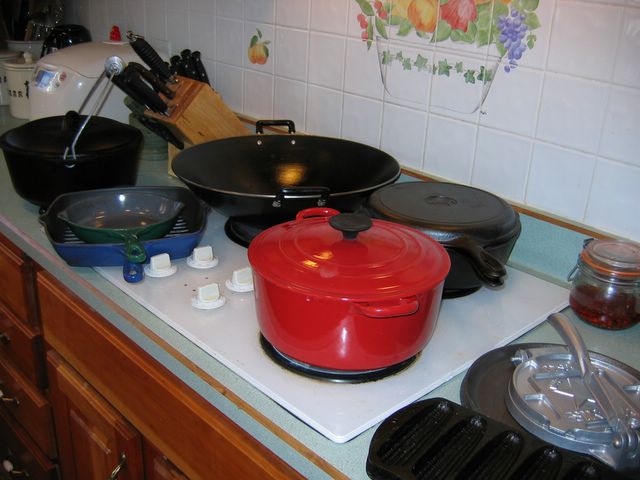
Some of my collection of cast iron cookware. The red Le Creuset dutch oven is about forty years old and was passed down from Zak's Grandma to me. In the lower right hand corner are the cornstick pans, the comal and the tortilla press.
So, I was going through my cabinets earlier this week, and putting things into boxes, when I realized, that for all of my command of culinary techniques, for my insistence upon throwing French terms into my speaking and writing about food, for all that it is obvious that I attended culinary school by my insistence upon the neat and tidy set up of mise en place, I don't really have a lot of high-end fancy pots and pans.
And the ones that I do have, I don't use very often.
As mentioned previously, I have my Gram's 1940's Revereware copper-bottomed stainless steel set, which is pretty much what I use when I need to boil something, like pasta or rice or water for steamed vegetables or buns.
The rest of my kitchen is equipped with a mish-mash of pieces, some of which get used all of the time, while others are set aside for special moments when nothing but a whole salmon will do. (That moment will come--you will see. Actually, if it were up to me, I would have cooked one by now, but as Zak can take salmon or leave it, that leaves me to eat the entire salmon myself, which means I would have to channel my inner grizzly bear, which is dangerous on many levels. Along with the bear-sized appetite comes the bear-sized temper, and we don't need that.)
What I noticed while digging through and packing some utensils and leaving others, was that I have a whole heck of a lot of cast iron, both bare black and clad in brilliant shades of enamel.
The Le Creuset was passed down to me by Zak's grandmother who had become too frail to lift it. It was all too heavy for Zak's sister to lift (she is a tiny elf-like lady), so it was passed on to me, sturdy wench that I am. Which is fine--I love the stuff. The Dutch oven comes out when it is time to make risotto, or a nice flageolet and lamb stew or even Sichuan red-cooked beef with turnips. Whatever I cook in it can come to the table, brightened by the warm crimson enamel which not only looks good, but keeps the cast iron easy to clean.
My tiny green Le Creuset skillet is mainly used for toasting spices such as cumin, coriander and Sichuan peppercorns. That seems like I don't use it for much on the face of it, but the amount of spices that get used in my kitchen makes the wee green pan one that is nearly always in use. I also use it for toasting dried chiles, if I am only doing a few. If I am doing many, I go with yet another piece of cast iron, like the lid to the Lodge chicken fryer--which is a deep frying pan with a lid that doubles as a shallow crepe pan.
I have a great deal of Lodge Logic cast iron, as well as a few traditional pieces of Lodge that I seasoned myself.
I don't know what kept the Lodge folks from figuring out that they would sell a lot more cast iron if folks who hadn't grown up with it weren't forced to season it, but they seem to be doing very well for themselves. All sorts of folks really like the stuff, including Alton Brown. A recent Chicago Tribune article detailed a contest of skillets where the author tested a bunch of different varieties in the kitchen, and liked the least expensive, the twelve-dollar Lodge pre-seasoned pan. All the pans were tested by caramelizing onions, frying an egg and sauteeing a chicken breast, and the cheap cast iron beat out the pricey All Clad and Calphalon at all three tasks.
Mind you--I, or any mountain mamma cook from the Appalachians could have told the author that would be the case, but then, there is nothing wrong with someone proving us right after all these years. We hillbillies have been passing down cast iron skillets and Dutch ovens from grandma to mother to daughter for hundreds of years, and we know that for all that it is inexpensive and it isn't pretty, cast iron pans are the gold standard for Southern Applachian cooking.
Cast iron kicks ass. Period.
I like to use mine to cook steak in the winter when it is too cold to go out and grill. It is simple, really--I use a dry rub on the steak, heat up the cast iron until it starts turning grayish, and slap the meat down on the hot surface. I use the vent for this--lots of smoke erupts from the meat. I sear it nicely on one side, flip it over, and either continue cooking stovetop, or I pop it into a really hot oven to finish cooking. That is it. No mess. No drama. Just steak cooked with a really flavorful browned crust and a moist and juicy interior.
Almost as good as the steaks we cook over hardwood charcoal in the summer.
I have cast iron cornstick pans, for baking corn-cob shaped cornbreads. You heat them up in the oven, then carefully pour batter into the wells and bake them for about ten or fifteen minutes, and when they are done, you have the best corn muffins ever. They are golden crispy on the outside and tender on the inside. I like to make different batters with different colored cornmeal--I use yellow for the spicy muffins with bits of green and red chile pepper, blue for the sweet muffins flavored with cardamom and cinnamon, and red for cornbread flavored with bacon and onion slivers.
I have a cast iron comal for cooking tortillas, and a cast iron press for shaping them, both from Mexico. Since I started making my own corn tortillas, I have noticed that all of my Mexican and Tex Mex recipes taste better; the corn flavor in freshly made tortillas is so superior, I cannot imagine going back to the store bought kind.
Cast iron is a favored material for cooking vessels in the Far East, as well. As you know, I have two cast iron woks--one from China, which is the one I use every day, and another from Lodge that I am waiting until we move to break out and use. The Chinese one, which is traditional except for its flat bottom, which makes it much more usable on American stoves, came from The Wok Shop in San Francisco, and it works beautifully. I have been able to get it consistently hotter and keep it hotter than the carbon steel woks I used previously. The "wok hay," or as I called it so unpoetically for years, "the wok taste" is very strong from this wok, and the speed and ease with which I can stir fry are incomparable. I will likely only use my carbon steel woks now and again after seasoning and cooking in the cast iron for a bit over a year now.
In Japan, sukiyaki and other nabemono dishes--simmered stews, essentially--are traditionally cooked in an iron pot with wooden lids that was hung over a fire or a brazier. I don't have one of those, or one of the Chinese iron casseroles; I tend to use my regular iron and enamelled dutch ovens for the dishes that would require those pots. On the other hand, I probably wouldn't refuse such a pot as a gift, if one should come my way. They are quite aesthetically pleasing in addition to being good conductors of heat.
In Japan, teapots are also made of cast iron. Tetsubin, as they are called, were used originally to boil water, but evolved into being used to brew tea as well. I think that they are beautiful works of art, and while I have yet to pick one up, I do love the graceful shapes and designs in which they are crafted. Someday, I mean to get one, but as yet, I still make tea in my old reliable glass teapots.
In addition to my lust for Asian cast iron kitchenware, I am dreaming of some pieces of enameled cast iron from Staub, particularly the teakettle and maybe a pretty green fondue set. Staub, a French company, makes enameled cast iron that is similar to Le Creuset in many respects, but also differs in design somewhat. The lids contain dimples or hobnail designs on the inside so that the condensation that collects there from the steam drips back into the food, keeping it moist. As I haven't cooked with them side by side, I cannot really compare Staub and Le Creuset's performance, but what I can tell you is that I like the colors of Staub better (the green is a nice forest color instead of the leprechaunish Le Creuset green, and they have purple--what else need I say?), and many of the designs have way more "oomph" than Le Creuset's.
Interestingly, even Lodge is starting to dabble in the enameled cast iron market--just this winter, they released a few pieces including some apple-shaped pots that are clearly meant to compete with Le Creuset's apple and vegetable shaped pots. Again, the Lodge designs are more aesthetic than the Le Creuset ones, though I am not certain that the electric lime green is an improvement over the "leprechaun frolicking in the clover" shade used by Le Creuset.
I guess that enameled cast iron is becoming more popular as people realize that they get many of the benefits of cooking in cast iron, with less of the worries about cleaning up and care that one gets with seasoned cast iron. I don't think that taking care of bare cast iron is such a chore, but I know that a lot of people get squigy if you tell them that you never use soap on seasoned cast iron. I guess that they figure you are going to let bacteria grow or something. But if you heat up your cast iron as hot as you are need to to dry the wash water out of it, you needn't worry about bacterial growth. If a bacteria can survive that, and then breed in an environment where it has nothing to feed on, then this is no ordinary bacteria and it is poised to take over the earth anyway. A little soap is not going to make much of a difference to such a critter.
So, in my kitchen, cast iron rules the roostIt it is often inexpensive (You can get Le Creuset cheaply by mail order at Caplan Duval--ooh, look, they are having a big sale--Damn. If I bought it now, I will only have to leave it in its box and not play with it...grrr) , it cooks like a dream and it will last more than a lifetime if it is properly cared for.
I intend to leave mine to my daughter and grandkids. When she gets around to having them, I mean. Not any time in the near future, though.
I'll still be cooking in them for the next forty years or so. Or at least, so I hope.
Friday, February 11, 2005
Music in My Kitchen
What is the total amount of music files on your computer?
None. Nada, zip, zero. For all that I blog, and have been an admin or mod on various online communities and bbs's and suchlike critters, for all that I participated in Usenet way back in the day and even MUSHed for several years, I am not a computer geek. I am rather a bit of a technophobe, if the truth be told. I don't adore each new technological gadget that comes along related to the computer. My own computer would probably keel over and die if I tried to download music onto it--I mostly use for my writing. It is woefully inadequate in the memory department, which is something I should remedy soon.
The CD you last bought?
Okay, it is time for another confession.
I seldom am the one who buys CD's in this house. Though I do love music and sing and tweedle along with music all the time, and have at various times played guitar and bass (and am picking the guitar back up and relearning), Zak is the music maven in the household. He has a better knowledge of exactly what is in our huge CD library than I do, especially when it comes to esoterica like his five bazillion shakuhachi (Japanese bamboo flute) CDs or the works of contemporary composter Steve Roach.
However, the last CD that I insisted we purchase is the soundtrack to the Zang Yimou film, The House of Flying Daggers. Composed by Shigeru Umebayashi, the music is sensitive, subtle and evokes the saturated colors of the film. The only part I dislike is the end theme, sung by Kathleen Battle who does have a lovely voice, but her over enunciation and operatic tremolo do not suit the simple melody of the love theme. (Okay, yeah, not only am I a food geek, but a music dweeb as well. And a film fangirl.)
What was the song you last listened to before reading this message?
I blush now to see what is in the CD player--the afformentioned soundtrack. I can't compose anything seriously when there is music with lyrics that I can understand on--because I will sing with it, and thus all other words in my mind fly out of my ears. It is quite unproductive.
But that soundtrack is quite easy to write to.
Write down 5 songs you often listen to or that mean a lot to you.
I am listening to one of them now. Light things like this I can write when listening to songs with lyrics in languages I can understand. It is When I Go by Dave Carter and Tracy Grammer. I love most of the songs by these two fantastic folk musicians, but this one hit me in the heart and brought tears to my eyes the first time I heard it and it gives me shivers to this day. I would like to cover the song with Zak and some friends of mine, if we really do start a band after we move back to Athens.
Come, lonely hunter, chieftain and king
I will fly like the falcon when I go
Bear me my brother under your wing
I will strike fell like lightning when I go
I will bellow like the thunder drum, invoke the storm of war
A twisting pillar spun of dust and blood up from the prairie floor
I will sweep the foe before me like a gale out on the snow
And the wind will long recount the story, reverence and glory, when I go
Spring, spirit dancer, nimble and thin
I will leap like coyote when I go
Tireless entrancer, lend me your skin
I will run like the gray wolf when I go
I will climb the rise at daybreak, I will kiss the sky at noon
Raise my yearning voice at midnight to my mother in the moon
I will make the lay of long defeat and draw the chorus slow
I'll send this message down the wire and hope that someone wise is listening when I go
Another one would be Sanvean by Lisa Gerrard, on her album, The Mirror Pool, her first solo album after being one half of the ideosyncratic duo, Dead Can Dance. There are no lyrics to share with you; Gerrard uses "vocables," nonsense verbal sounds that give her song structure, but without lyrical content. It sounds like a language, but isn't one, which allows the listener to attach meaning to the pure sound alone, without being hampered by words. This particular piece is my favorite of hers--its soaring melody is heartbreakingly romantic and beautiful in a tragic yet delicate way. It always makes me think of the epic power of love to both create and destroy, in the fashion of the goddesses of old who were both temptresses and warriors.
Kate Bush's entire album, The Hounds of Love.
But, especially, The Jig of Life, because that is the song that Zak and I used to dance The Spiral Dance with our guests when we were married. It was my daughter, Morganna's favorite song all through her childhood, which she called, "Big Music" before she knew its title. She'd demand I put it on the CD player and as the galloping rhythyms would catch her, she would whirl around the room, dancing on tiny feet, her eyes flashing with wild delight. The lyrics are part of a song cycle that describes life, death, rebirth and life again, and I cannot listen to them without thinking of the dance at our wedding, and the many dances with Morganna over the years.
Can’t you see where memories are kept bright?
Tripping on the water like a laughing girl.
Time in her eyes is spawning past life,
One with the ocean and the woman unfurled,
Holding all the love that waits for you here.
Catch us now for I am your future.
A kiss on the wind and we’ll make the land.
Come over here to where when lingers,
Waiting in this empty world,
Waiting for then, when the lifespray cools.
For now does ride in on the curl of the wave,
And you will dance with me in the sunlit pools.
We are of the going water and the gone.
We are of water in the holy land of water
And all that’s to come runs in
With the thrust on the strand.
It is hard to pick a single song by Loreena Mckinnett to mention, but I feel that I must say The Old Ways, from her album The Visit. It really is in a tie with the track All Soul's Night, but the lyrics to the former song are a bit more poignant and laced with sorrow than the latter. Melancholic songs always tend to get to me.
As we cast our gaze on the tumbling sea
A vision came o'er me
Of thundering hooves and beating wings
In clouds above.
As you turned to go I heard you call my name,
You were like a bird in a cage spreading its wings to fly
The old ways are lost, you sang as you flew
And I wondered why.
I love Nick Cave's work. He's a hell of a songwriter and his resonant voice can go from languid to horrifying in a split second. I am very fond of his song, "Where the Wild Roses Grow," which has all the hallmarks of a classic Applachian/Celtic ballad. He sings it with Kylie Minogue, and the first time I heard it, it planted a seed in my mind which came out as the first short story in what will hopefully be an anthology, called, "Wild Roses." The tales will be a series of folktales set in a mythical turn of the century Applachia that never was--rather like the Brothers Grimm meet Eudora Welty and H. P. Lovecraft. (Did that hurt your head? I'm sorry if it did.)
There are many other musicians, bands and CD's I didn't mention. Garmarna, from Sweden, Gjallarhorn of Finland, I believe, are two of my favorite bands in all the world. However, it is hard for me to say which song is a favorite. In fact, I like a lot of Scandanavian folk music and folk-influenced musicians: Bukkene Bruse, Hedningarna and Loituma are three more favorites.
Other musicians I really like include Talvin Singh, Johnny Cash, Kodo, and Axiom of Choice.
And other favorite soundtracks include Howard Shore's work on the Lord of the Rings trilogy of films, Basil Poledouris' score for Conan the Barbarian and Tan Dun's Crouching Tiger, Hidden Dragon soundtrack.
And of course the music of Zak. That is the soundtrack of my life--the music my husband and I make together. (Though we haven't recorded together yet. Like many other things, it will have to wait until we move.)
There is a lot more I could list, but I will cease and desist for the nonce. You guys get the idea--I like a lot of music, from many different genres, styles and countries, and I will sing with all of them whether I know the words (or even if there are no words) or not.
I like to sing while I cook.
As for whom I shall tag--
Christina at The Thorngrove Table, because I want to know if she listens to medieval period music when she is cooking food of that time period.
My friends at Cracked Cauldron Spillings, because I bet that they listen to fun music while they cook up thier dreams.
And Alan at The Impetuous Epicure, because he such an intrepid experimenter and I want to know what kind of musical tastes he has.
Thursday, February 10, 2005
Fish: Feast or Fast?
I found this to be ironic. Lots of people feasting on symbolic foods meant to bring abundance and luck in the New Year, while others begin a fast in order to in order to do penance for humanity's betrayal of Jesus.
Over at The Thorngrove Table, Christina wrote a great post about the observance of Lent in the medieval period, while Desmond Goh gives an overview of Chinese New Year customs in his blog.
The dichotomy struck me. It is Yin and Yang--the world in balance. Some eat, drink and are merry, while others abstain and meditate upon the coming joy of Christ's resurrection and the meaning it has for their lives today.
One thing I noticed in my musing is that Chinese New Year and Lent do have a food tradition in common: the consumption of fish.
A whole steamed or poached fish is always served as part of a Chinese New Year's Eve feast, with the head and tail intact. This symbolizes a good beginning and end to the new year. It is best to choose a fish which is still alive, swimming in a tank, and great care is taken to choose one which is spirited, for it will bring more good fortune into the new year than one which is listless and sluggish, or worse, already dead.
Fish is eaten in Chinese New Year because the sound of the word for fish, "yu" is a homophone for the word for wish in Cantonese, so it symbolizes a desire for all of your wishes to come true in the new year. The word for fish, "yu" also sounds like the word for abundance, so it is a wish for a surplus of good things to come into a family's life.
There is even more depth to the symbolism of a whole fish served at the traditional New Year's dinner. As Grace Young points out in her book, The Wisdom of the Chinese Kitchen, fish swim in pairs, and so can symbolize marital fidelity and harmony; a quick look at many traditional Chinese paintings will show a pair of carp swimming together in peaceful unity. Because fish lay many eggs, they are symbols of fertility, so they are wish for many children in a family.
For Catholics, fish is a substitute for meat, and is eaten on fast days, especially at Lent. In the aforementioned excellent blog entry over at Thorngrove, Christina outlines the history of why fish was substituted for meat during the Lenten season, so I won't go into that. Suffice to say that Lent, which is about abstaining from pleasures, including those of the table, to muse upon the sacrifice Christ made for every human being. Fish became a substitute for meat, and because of that, it became symbolic of self-willed deprivation.
For myself, I have trouble seeing fish as symbolic of deprivation of pleasure--I love the stuff. I love it, that is when we are talking about real fish, not fish sticks--those God-awful creations of the frozen foodocrats are a blight upon the supermarket shelves and really do symbolize privation and want. I agree completely with Elesha Coffman writing in Christianity Today that being forced to eat fish sticks in the school cafeteria on Fridays during Lent instead of pizza is a trial for the schoolchild's soul.
Later in that same article, Coffman notes that the use of fish in a spiritual fast was cause for great culinary creativity in the Medieval kitchen, and a French abbess is credited for the creation of the divine dish which I hesitate to categorize as "fish soup" called bouillabaisse. No one who tastes a well-crafted bouillabaisse could in any way call the dish a poor substitute for meat. In fact, were it myself, I'd take the fish soup and to heck with the meat.
That hardly seems penitent of me, but then, I was never Catholic and was barely raised Protestant, and am currently a heathen, so what do I know of it?
What I do find utterly fascinating is how fish can be considered the symbol of abundance and joy in one culture, and in another, be seen as a substitute for a preferred other food, and symbolic of personal sacrifice in the practice of a spiritual fast.
This dichotomy speaks clearly to the sacred function that food plays in cultures around the world and its centrality in the celebration or observance of holidays.
I am going to go out on a limb and say that there is probably no culture in the world which has a holiday in which food, by its presence or absence, does not take a central role in the rituals of that sacred time. I certainly can think of no such a holiday.
It is part of what draws me to the study of food--the meaning of it and its nature. It is a necessity for us to survive, yes, but it becomes so much more in every culture. It becomes a means of cementing family and communal bonds, a means of communication between human beings and the Divine.
It becomes a transmitter of culture--symbolism becomes very tightly wrapped in certain holiday foods, such that each mouthful brings with it layers of meaning that an eater can often only guess at. It becomes pleasure, treasure and art. It becomes something we do for fun, and something we do to escape reality, and something we do to remember our ancestors.
It becomes part of our expression of who and what we are.
So, at this moment, at this time when many people are feasting, and many others are fasting, when everyone is celebrating or observing the passage of time in ways that express who they are, I am in the midst of it all, filled with wonder to look upon this confluence of energies, and am content to observe, record and muse upon the meaning of it all.
Wednesday, February 09, 2005
Wok Words
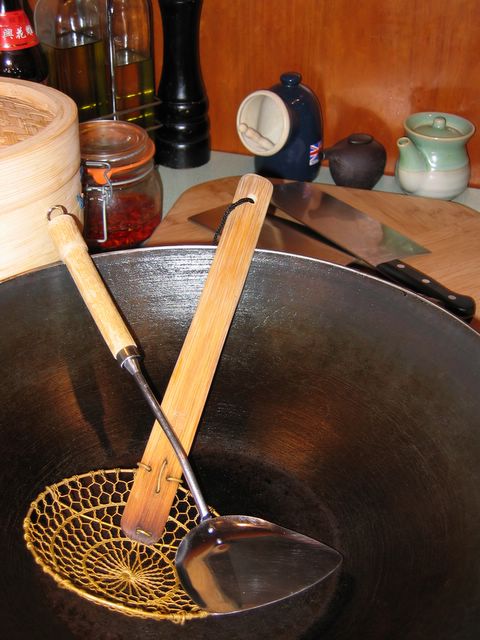
The cast iron wok surrounded by other Chinese cooking tools, including a bamboo steamer, bamboo cutting board, two cleavers, a wire and bamboo skimmer and the wok shovel.
Gong hay fat choy!
Or, in other words, happy new year!
Today is the first day of the Chinese year of the Rooster, and it is a good time to buy a wok. Buying kitchen utensils in the new year brings prosperity and luck to the kitchen. At least, it sounds good to me.
But don't take it from me that it is a good time of year to buy a wok. Check out this New York Times article on the subject; apparently it really is a good time to purchase new kitchen goodies like woks. (Again, if registering to read the article torques your gizzard, try bugmenot, then read it anyway. I wouldn't direct you there if it wasn't good.)
I don't need to buy a wok myself, mind you--I own four at this particular moment. Not that it would stop me from buying a nice hand-hammered one if I were browsing around in Tane Chan's Wok Shop in San Francisco's Chinatown, but I am not, so the wallet is safe. At least, for now. Though the article mentions some new iron contraption that lets you use a round bottomed wok on an American stove. It is supposed to be a great improvement over a wok ring, which keeps your wok too far from the heat--that is tempting.
Because then, I could -justify- having a beautifully made hand-hammered carbon steel wok.
Hmm. I must think on this.
At any rate, I use my woks for everything. I stir fry in them, of course, but I also deep fry in them. The shape of the wok means you use much less oil for deep frying than you do in a typical straight-sided pot or dutch oven. Indeed, deep fried foods like spring rolls are often the very first thing I cook in a wok after I season it, because the heat from the oil really opens up the pores in the metal and lets lots of the hot oil get in there. It hastens the natural patina process of continual seasoning that happens the more you use a carbon steel or cast iron wok.
I even scramble eggs in my woks. They cook faster and with less fuss in a wok than in any other pan. They are also fun to cook in a wok, which is really a substantial reason why I like cooking in them. It is fun.
My fifteen-year-old daughter was allowed to cook in my cast iron wok without me doing a lot in the way of assistance recently, and she took to it like crispy duck to a pancake. It was obvious to me that she had grown up watching my movements with using the wok, because she wasn't clumsy at all with the wok shovel. (I cannot say the same for myself--there was that incident, long, long before she was born that I tried to help an inebriated friend make fried rice when I was equally inebriated. A lot of rice ended up flying through the air and landing on the floor. It wasn't pretty. But the rice that stayed in the wok tasted really good.)
Upon tasting what she had cooked (the filling for char sui bai--steamed barbeque pork buns) and recognizing the presence of wok hay--the distinctive, but elusive flavor that comes from a hot wok, hot oil and properly dried food, was to jump up and down and dance around the room.
"It has wok hay!" she crowed as she pranced. Then she gobbled up another spoonful and boogied some more before declaring, "That was so much FUN! When can I do it again!"
She didn't even mind cleaning the wok with the bamboo brush and hot water, then drying it on the stove, and rubbing a bit of oil over the hot surface to deepen the seasoning. "Can I make fried rice for breakfast tomorrow?" she pestered.
When I answered in the affirmative, she bounced some more and then capered off to stick her nose back into Grace Young's The Breath of a Wok and digest more about the history, mystery and mastery of the Chinese kitchen.
Seasoning a new wok is really the only troublesome thing about owning one and it is so simple that I hesitate to call it a chore. A sidebar to the New York Times article gives Grace Young's method which involves frying garlic chives in hot oil. I will have to try that on my next wok.
Did I say that?
Yes, I did. I know that I am going to get another wok or more in the future. I just know I am. Call me a wokaholic, I don't care--I love the feel of them, the way they cook and the smell of them--yes, they have a smell. Well seasoned, or as the Chinese would say, "virtuous" woks have a smell to them--that is the essence of the breath of the wok--wok hay. My house often smells of it, especially in the winter when I cook with the windows closed. It is a scent that makes me comfortable and happy.
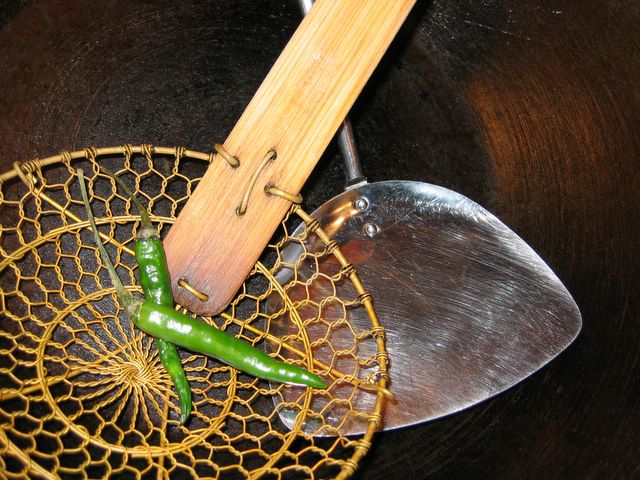
Closeup of wok shovel and bamboo and wire skimmer in the cast iron wok with two thai chile peppers for color.
When I taught Sichuan cooking a few weeks ago, as I was heating up my wok before putting the oil in, a student asked how I could tell if it was hot enough. I told her that the color of a cast iron wok will take on a slight greyish cast, that there may be a thin ribbon of smoke that will spiral out from the bottom of the wok, and that the wok will exhale, and you will be able to smell it.
So, they huddled around the stove and watched as I pointed out the signs. Just as I was about to point out the wafting wok hay, one very eager student nodded enthusiastically. "I can smell it! It smells--brown. And good."
Indeed it does.
As I usually do when I teach newcomers how to cook Chinese, I spoke at length about woks, and how to use them, and why to use them. As usual, someone brought up Alton Brown's assertion that one cannot effectively cook in a wok on an American stove, and I had to ask them if they would rather believe Brown, or their own senses. "How does the food taste?" I asked.
They couldn't answer because they were too busy eating. Later someone said that her taste buds told her that Alton was on the wrong wavelength.
In conclusion, if you want to go out and buy a wok and bring some good new year luck and cooking karma into your kitchen, run right out and think of me while you do it. Pick up a cast iron or carbon steel one (avoid nonstick or stainless steel like the plague) season it, and then cook up a batch of spring rolls in it. Not only will you help along the seasoning of your wok, you will be symbolically bringing even more abundance and luck into your life by eating these traditional new year's treats.
Spring rolls are eaten at the new year in China for two reasons. One, because they contain bamboo shoots, which are seasonal, and two, because they are shaped like old forms of Chinese gold money, which came in golden bars. My recipe is mostly traditional, except I add strips of lop cheong-- sweet dry cured Chinese sausages. The rich chewy sweetness of them adds a lingering, caramelized note to the filling, which brings out the sweetness of the bamboo shoots and shrimp, while contrasting with the dark mystery of the black mushrooms.
Spring Rolls
Ingredients:
2 tbsp. peanut oil for stir frying
Cornstarch for dredging
2 tsp. fresh minced ginger
2 ounces fresh lean pork loin chop, sliced into thin strips, dredged lightly in cornstarch
3 links Chinese lop cheong pork sausage
1 large can shredded bamboo shoots
4 scallions, trimmed and cut into thin shreds
4 dried black mushrooms, rehydrated, and sliced thinly
6 fresh medium shrimp, peeled and deveined, then cut into small chunks, then dredged in cornstarch
1 tsp. sesame oil
1 tbsp. light soy sauce
1 tbsp.sugar
black pepper to taste
2 tbsp. Shao Hsing wine
1 pkg. spring roll skins (thawed, if frozen)
1 egg, beaten with 2 tbsp. water
Peanut oil as needed for deep frying (about 5 cups or so)
Method:
Cut sausage into diagonal slices, then into thin shreds, roughly the same size as the pork strips.
Rinse and drain the bamboo shoots at least twice in warm water to rid them of tinny taste. Pat dry.
Heat wok, adding 2 tbsp. of peanut oil. Stir fry ginger and scallions until fragrant. Add the pork and sausage, stir frying until the meat is cooked. Add bamboo shoots, mushroom and shrimp, then the sesame oil, soy sauce, sugar, pepper and wine. Remove from heat.
Allow filling to cool until you can handle it with fingers.
Wrap spring rolls: Place wrapper so one corner is pointed towards you, and place about 1 ½ tbsp. filling down near that corner, slightly off center perpendicular to the angle of the corner. Dip fingers in egg mixture, and rub along edges of skin on all four sides. Fold bottom corner over filling, then roll once. Fold in the left and right corners tighly, and roll, keeping wrapper tight around the filling. Add more egg wash along edges as needed. Wrap to the upper corner, and press down, sealing with plenty of egg wash.
Heat about five cups of oil in clean wok over high heat until nearly smoking. To tell if oil is hot enough, dip a bamboo chopstick or other utensil into wok. If bubbles form around chopstick and travel up breaking on the surface of the oil, the oil is ready. Cook spring rolls about 3 or four at a time, until golden and crispy. Drain on paper towels. Serve hot.
Variation:
Vegetable Filling for Spring Rolls: Leave out pork, sausage and shrimp. Add several extra mushrooms, and add jullienned baby carrots, celery and snow peas and lightly stir fry. Not traditional at all, but tasty.
Chinese Hot Mustard: Mix Chinese mustard powder with water, and allow to sit for at least two hours, or overnight to mellow.
Dipping sauces: Equal parts sugar, dark soy sauce, and rice vinegar mixed together. Add a small amount of sesame oil, and any or all of the following ingredients to taste: chili garlic paste, minced fresh ginger, minced garlic, minced scallion and freshly ground black pepper.
Tuesday, February 08, 2005
Kung Pao Creation Myth

The finished dish, still steaming hot in the wok. Note that there is not much sauce; what is there clings tightly to the ingredients, and does not pool in the wok.
We ate some of the chili last night. I made a mistake in forgetting that frozen chiles are much more hot than fresh or dried; I suspect that the really large ice crystals that form when the water in the cells of the fruit is frozen in a home freezer puncture all of the cell walls, thus releasing much more capsaicin than normally would be the case in normal cooking.
The upshot is that the two jalapenos and one chipotle were too many chiles for a large pot of chili. Which is not usually the case. Zak could barely eat it, and while I could eat it, I didn't enjoy it at all; the flavors of all the other ingredients were overpowered by the chiles.
So, later in the week, another pot will be made, this time with roasted -fresh- peppers.
Zak made an interesting comment; he is able to eat much spicier Asian foods than Mexican; when I make Thai food or certain Sichuan dishes, they are actually much spicier than the chili was last night. Zak thinks it is because you eat rice with it, thus muting the heat; I think that is true, but it also has to do with the cooking method.
Most Mexican foods are stewed, which mingles flavors, while many Asian foods are stir-fried, which keeps flavors separate and distinct. Thus, there are many more discernable flavors going on in your average Thai or Chinese stir-fry than in your average Border cuisine such as chili, which has been simmered slowly for a long time.
Which leads me to the topic for today--Kung Pao Chicken.
Kung Pao Chicken is a perennial favorite at my dinner table; in fact, when my daughter, Morganna first broke out her new wok, it was the very first recipe she chose to cook in it, on her own, without help from Mom.
I am so proud of her.
I first fell under Kung Pao Chicken's spell when I worked at Huy and Mei's place; as is often the case, the first version I tasted is the one I wish to recreate in my kitchen. Huy made it very spicy, with many dried chili pepper pods scattered through the dish. He used celery and water chestnuts with the chicken, and there was a minimum of sauce clinging to the meat and vegetables, with no hoisin sauce in evidence. It was a very fiery, minimalist presentation.
After we moved to Athens, Ohio, I came to love a version created at my favorite Chinese restaurant there--China Fortune. They used a mysterious pale green vegetable that was tender-crisp and mildly flavored. Years later, when I was peeling broccoli stalks to add to cream of broccoli soup, I popped a sliver of it in my mouth and realized what those unidentified celedon-tinted vegetables were--peeled and sliced broccoli stalks. Ever frugral, the chef had used what many Americans throw away, along with onions, green bell peppers, celery and water chestnuts, to add further texture and flavor to the spicy chicken dish.
I have since used both broccoli stalks and kohlrabi to great effect as a vegetable in kung pao chicken dishes, though my favorite of all is fresh water chestnuts. These days, I use what I have and don't fret about it--I think that most vegetables that are presented in the dish in the United States are not "traditional." I am fairly certain that they exist as filler material; from what I can gather from my study the original dish, which hails most likely from Sichuan province, though Hunan province also claims it, the main ingredients are simply diced chicken breast and peanuts seasoned with dried chilis and Sichuan peppercorns.
As I cooked my version of Kung Pao a few days ago, I began to wonder about the origin of the dish. I had just recieved a copy of Henry Chung's Hunan Style Chinese Cookbook, by the proprietor of what is popularly believed to be the first Hunan restaurant in the United States, "Henry's Hunan" in San Francisco. As I was looking through this widely acclaimed out-of-print volume of recipes, I came across a recipe for Kung Pao chicken, along with the author's assertion that it was named for a famous Hunan general, General Tso, because it was created by accident when his little son playfully threw a handful of dried peppers into the wok while the chef was cooking a dish of diced chicken. They singed and flavored the entire dish with the smoky fire of the peppers, but the General liked it so much that the dish became known by his official title, Gong Bao, or Kung Pao.
There is a real dearth of Hunan cookbooks printed in English (Fuchsia Dunlop is apparently working on one, bless her); Henry Chung's is widely considered to be the best of them, so I have no reason to doubt his assertions. The minimalist approach of his recipe does seem quite in line with the authentic Sichuan recipes for the dish I have cooked and read from such authors as Dunlop and Ellen Shrecker, author of Mrs. Chiang's Szechwan Cookbook, another out-of-print gem.
Dunlop adds Sichuan whole peppercorns to her version, which adds a fragrant touch, while Mrs. Chiang, Shrecker's cook and inspiration, used both fresh and dried chile peppers in order to make a very incendiary version of the dish. All of these versions, however, focus on the three main ingredients: chicken, peanuts and chile peppers, even as they each tell different origin stories regarding the creation of the dish.
The generally accepted tale involves either a general or a public official of some sort who loved the fiery dish and so it came to have his name. It is not unusual for Chinese dishes to be named for the epicure whose sensitive criticism involving the dish was involved in the creation and refinement of the dish by the (usually) unnamed chef. Dunlop's rendition of the tale names the man as a late Qing dynasty official (late 19th century), Ding Baozhen, who was the governor of Sichuan province. She gives three possible origins for the dish: one possibility is that it was brought by Ding's cook from their home province of Guizhou, another is that he ate it in restaurants where he dressed as a commoner in order to experience the lives of his subjects, and another story relates that his chef invented it because the governor's teeth were so bad that he couldn't chew anything that wasn't cut into a small dice or mince. (That seems highly unlikely, however, as peanuts, a necessary ingredient, are not easy to chew with weak teeth.)
She goes on to inform us that while the dish continues to be popular in China, during the Cultural Revolution, it was renamed by radicals to "Gong Bao Ji Ding," (Fast Fried Chicken Cubes) or "Hu La Ji Ding," (Chicken Cubes with Seared Chiles) in order to disquise its unpopular affiliation with an Imperial bureaucrat. (Page 238, Land of Plenty, Fuchsia Dunlop.)
An online source gives the following explanation:
"One of the most famous Chinese dishes and a perennial foreigner favorite is Kung Pao Chicken (gongbao jiding). This dish first became popular in Sichuan and its legendary origin is a good example of the willingness of Chinese chefs to improvise. According to the legend, this dish is named after Ding Baozhen, who served under the Qing dynasty (1644-1911) Emperor Xianfeng as the governor of Shandong province. One day he arrived East China's home with asgroupsof friends, but his cook hadn't prepared for guests, and had but a meager chicken breast and some vegetables in the kitchen. The cook diced the chicken//into//tiny bits, and fried it up with cucumber, peanuts, dried red peppers, sugar, onion, garlic, bits of ginger - sundry ingredients that had been lying around the bottom of the cupboard.
Ding Baozhen and his guests really enjoyed the improvised meal, so much so that it became a regular item on the menu. Eventually, Ding Baozhen was promoted to Governor General of Sichuan Province, and his cook went with him to Sichuan//where//he began experimenting with the local product, including hot broad bean sauce and Sichuan chili peppers. Soon the humble chicken dish was all the rage in the province. The people honored Ding Baozhen by naming the dish after his official name, Gongbao. The moral of this story: If you work hard at your craft, like Ding Baozhen's chef, one day a dish will be named after your boss."
Of course, my favorite part is the moral of the story. It is typical for dishes in many cuisines to be named in honor of someone else rather than the chef who created them. Think of the dessert, Pavlova, or Beef Wellington. No, the great dancer was not making fruit-filled meringue baskets on her day off, nor was the strategist of Waterloo down in the kitchen wrapping a tenderloin with pastry. Someone else did the creation; I suppose it is a testiment to the humility of chefs that they are content with making masterpieces that are remembered by other people's names.
At any rate, though my intellectual curiousity is piqued by the idea of where Kung Pao Chicken came from and I will likely keep doing research to see what I can dig up, what matters most to me is the flavor. That is the heart of why the dish is so popular in both China and the United States--because it is a satisfying collection of contrasting colors, aromas, textures and flavors that come together into a glorious whole.
Here is my recipe for Kung Pao Chicken, as I cooked it last week. The vegetables are a matter of personal preference and availability. I happened to have jalapenos and baby carrots around that night, so that is what I used. If I had water chestnuts and kohlrabi sitting in the fridge, that is what I would have used. Just make sure and cut them so that they match the diced chicken in size and approximate shape.
This is an adaptation of several recipes, including both Dunlop and Mrs. Chiang's recipes, as well as the recipes I have deconstructed from several restaurants. You will note that I added a teaspoon of hoisin sauce; while it is not traditional, as near as I can tell, many Chinese restaurants in the US add it to their Kung Pao. Zak likes the flavor, so I use just enough to give it the essence of hoisin without turning the dish into a sweet, gloppy, overly sauced mess.
You will also note that I grind the Sichuan peppercorns. That is because I adore the flavor, but I don't like the texture of the whole ones in a stir-fried dish.
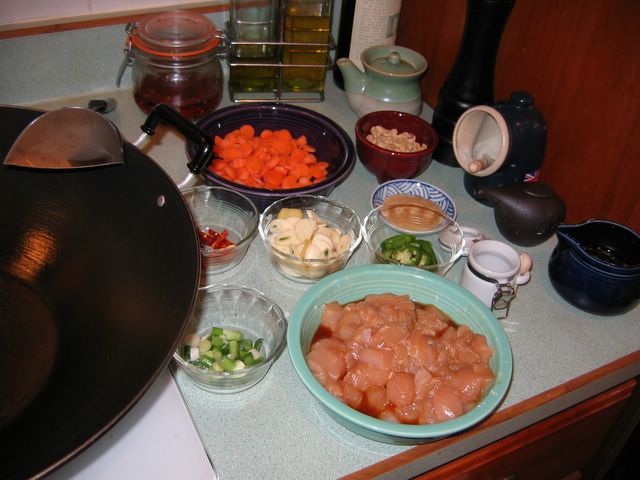
The ingredients for Kung Pao Chicken sit close at hand while the wok heats up.
Kung Pao Chicken
Sauce Ingredients:
2 tsp. raw or brown sugar
1 tsp. cornstarch
1 tsp. dark soy sauce
1 tsp. light soy sauce
3 tsp. Chinkiang black rice vinegar
1 tsp. hoisin sauce
1 tsp. toasted sesame oil
1 tbsp. chicken broth
Ingredients:
2 boneless, skinless chicken breasts cut into 1/2" cubes
2 tsp. light soy sauce
1 1/2 tbsp. Shao Hsing wine or dry sherry
2 1/2 tsp. cornstarch
Peanut oil or canola oil for stir frying
1 tsp. freshly ground Sichuan peppercorns
6-10 dried red Chinese peppers*
4 cloves of garlic and an equal amount of fresh ginger, both peeled and thinly sliced
3 scallions, white and light green parts, sliced into chunks as long as their diameter (to match the chicken cubes)
1 or 2 jalapenos, cut into thick slices about the size of the chicken cubes
handful of baby carrots cut into round thick slices to match chicken cubes
2/3 cups dry roasted unsalted peanuts
Method:
Mix together sauce ingredients well and set aside. I like to use a small measuring cup for this, so I can tell how well mixed it is, and so it is easily poured into the wok when the time comes.
Mix together chicken and next three ingredients--set aside to marinate while you are cutting up vegetables.
Heat oil in the wok, and when it is nearly smoking, add Sichuan peppercorns and chiles. Stir and fry until very fragrant. Add chicken, and settle into a single layer on the bottom of the wok. Allow to begin browning without stirring--about 30 seconds to one minute. Stir and fry. Add garlic and ginger, and jalapenos if you are using them. Stir and fry until the chicken is nearly done.
Add carrots and stir and fry until chicken is done. Pour in sauce ingredients, bring to a boil, and cook until it clings to all ingredients. Add peanuts and toss to coat.
* I use Tien Tsin dried chilis from Penzey's. They are wickedly hot little buggers, and I love them. To keep them fairly mild, use them whole. To make them a little hotter, snip them and sprinkle the seeds out, but expose the placental membranes where most of the capsaicin lives. For the hottest effect, snip them open and let the seeds fall into the wok and carry their heat all over the dish. If you are using fresh chiles as well, cut down on the number of the dried chiles. That is, unless you want to hurt your guests, in which case, use the maximum number of dried chiles with the seeds running loose and throw in four or five sliced jalapenos.
Monday, February 07, 2005
Chupacabra Part Two
Fun, huh?
Zak said I should get a Chupacabra Chili thong, however, I disagreed. I am not into the thong thing.
At any rate, I want to take this opportunity to thank Zak, the creator of not only the fantastic Chupacabra Chili art, but also the lovely tiger and strawberry images which grace my blog. He also did the pretty customizations of the background and the text and all of that. Without him, my blog would be boring indeed.
If you are interested in his art, or his music or comics or writings and whatnot, check out his website. And if you need any custom art, well, I bet he can handle it for you, though probably not until after we have moved and are settled in our new home, sometime in late March or early April.
Sunday, February 06, 2005
Chupacabra Sunday
Presently, however, due to the fact that I can take or leave football, and Zak doesn't like it one iota, the two of us will forget for weeks that we even own a television, we don't watch The Game.
So, there is no set menu for that particular Sunday even when we are aware enough to know which Sunday on which it falls.
This year, by odd chance, I got up on Super Bowl Sunday, trotted downstairs and started up a pot of chili.
Not just any chili, however.
Chupacabra Chili.
Before we go into what is Chupacrabra Chili and why the heck I bounced out of bed to make it if we are not having anyone over for Super Bowl Sunday, which we most certainly are not, let us talk about chili.
While at Johnson & Wales culinary, I had the task of helping to cook for various dorms at various times. My favorite was a grad student dorm that was located far from the main campus in downtown Providence, out in Warwick, near my apartment in seedy and unscenic Cranston. The kitchen was under the leadership of Chef Paul, a wonderful little man who was utterly laid back and unconcerned about any crisis. We never had to be yelled at, because we all liked him so much, we cooked our hearts out for him.
His teaching assistants, all students in the MA track of the culinary school, were equally laid back and fun. They were all younger than I, but were very respectful of my abilities and knowledge. Two of them were Yankee chile heads and adored spicy food, and another was a Latino who worked his heart out every day, and never ordered a student to do something that he wasn't willing to do himself.
They discovered that not only could they give me my assignment and leave me alone and then find it finished to perfection at the time of service, they discovered that I worked very fast, and was well-versed in the art of chili making. They found out that I could make a good, fast pot of chili out of nearly any ingredients that were just sitting around in the walk-in or on the shelves. I was equally good at gumbos and stews, but since they liked chili it was usually chili they were having me make. If we were short an entree or a soup for lunch or dinner, one of them would come to me and say, "Barbara, can you make a pot of chili--we don't care what kind."
"How much time do I have?" was my usual reply as I reached for my knife case.
Usually it was three hours or more, but now and again, it was two hours or less. When it was a rush job, I usually utilized leftovers from the walk in and co-opted the service of Beth, my preferred working partner, the only other woman in our particular group rotation. Under my direction, the two of us could bang out pots of different kinds of chili in record time, and due to various techniques and some trickery, we usually manage to make it taste like it had cooked for hours.
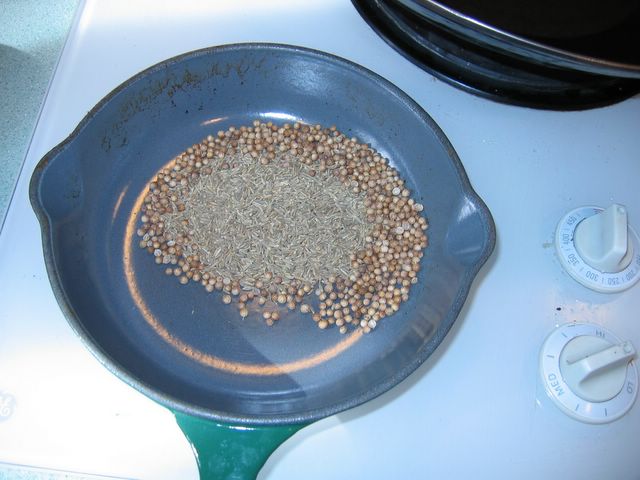
Toasting the cumin and coriander seeds in a small enamelled cast iron pan. Toasting the seeds brings the essential oils to the surface and makes them more fragrant while also creating a nutty flavor.
We became known as "The Chili Queens." Which of course made me laugh, because way back in the 1880’s, it is said that Texas Red, the ur-chili, if you will, was, if not invented, popularized by women who would cook it and sell it on the plaza down in San Antonio. These ladies, all of whom apparently overflowed with personality, and some of whom were singers, were known as Chili Queens.
I wrote down a recipe for each of the many pots of chili we made, so in my collection I have something like 10 or 12 variants from that time period. There was the classic Texas Red that convinced the TA’s I knew from chili--stewing beef, chile peppers, both fresh and dried, cumin, onion, garlic, beer and some tomatoes, with a sprinkling of cilantro at the end. No beans, of course. If you put beans in chili in Texas and call it chili, they'll hang you. Or at least call you a Yankee and laugh at you. Beans go on the side, if you must eat them with the sacred chili at all.
And then there was the classic Americana Chili that I based on the one I grew up with, though I dispensed with the margarine thickener. While I was cooking that recipe, Chef Paul told me that it used to be common in the food service industry to thicken that dish with peanut butter--it basically acts like instant roux and the chili is so strong you cannot taste the peanut flavor. However, when waiters failed to inform those with peanut allergies of its presence in the chili, there were tragic consequences. In one case Chef Paul knew of, a woman died.
That is even more of a horrifying thought than all the margarine I had unknowingly ingested at my mother's table for years.
Needless to say, Beth and I did not put anything remotely peanut-like in any of our chilis. Though, I will ‘fess up to using zucchini in some vegetarian versions; the bland squash really picks up and carries the chile and cumin flavors without asserting any character of its own.
Everyone’s favorite innovation was my version of a white chili made with canellini beans, poblano and jalapeno chiles. Instead of chicken, I used cubed pork shoulder. I browned the onions in bacon fat, and then at the end added leftover roasted corn cut off the cob. That was a favorite of everyone, and it became the standard chili at my house, because Zak who didn't adore Texas Red, would slurp down two bowls of the white pork chili with gusto and come back for more.
In honor of my Jewish husband’s love of the distinctly unkosher dish, I called it “Pale Treyfe,” though a quip from my brother-in-law gave it the better name: “Sacrilicious.”
Through a twist of fate, the chili known as “Sacrilicious” became “Chupacabra Chili”-- a slightly more observant Jewish friend invited me to visit and I offered to bring the house chili, though I said I could substitute lamb for the pork. Intrigued, he said, “Sure--I want to try lamb chili.”
So, I set out for Bluescreek Farms Meats in the North Market to pick up some lamb stew meat. When I got there, I saw that they had, in addition to delicious free-range organic lamb raised, some goat meat of the same quality. And I said, “I wonder what goat meat would taste like in chili?”
So, I bought some and set to finding out.
Instead of cooking the cannellini beans with a ham hock as I usually did for the treyfe version, I used the bone from a leg of lamb I had roasted earlier that week, and since I had no lager beer, I used brown ale. For chiles, I roasted some poblanos and jalapenos as I usually do, and added some chipotle en adobo to replace the smoked flavor of the ham hock. I had a cob of grilled corn left over from the same dinner with the leg of lamb, so I cut the kernels off the cob and added that, and I had some fresh Green Zebra tomatoes laying around, so they went in at the very end to add a hint of acidity and lovely chunks of bright green goodness.
It turned out to be one of the best damned pots of chili I had ever made. The lamb and goat meat were rich and strongly flavored enough to stand up to the chili heat and all the cumin and coriander seeds, while the corn added a top note of sugary sweetness mixed with the smoky depth from the grill. The tomatoes were perfect, and everyone who tasted it wanted to know what I was going to call it.
The original name was Apocalypse Chili, which was a rather heretical joking reference to the bit in the Book of Revelation about how when Judgment Day comes, “He shall separate the sheep out from the goats.” However, I decided that was a bit too likely to offend someone, and so I named it instead after Zak’s favorite cryptozoological wee wicked beastie--the one, the only Goatsucking fiend! El Chupacabra.
So, why was I making this chili today?
It is a practice run for the North Market’s second annual Chili Cook off, which is coming up on February 19. I wanted to see if I could adapt the recipe to a winter cupboard--I have no fresh corn or tomatoes available, nor do I have a leftover lamb leg bone laying around. Rather than be bold and just make a batch the day before the contest and leave it all to chance and instinct, I decided to try my adaptation first and see what I thought.
I ended up replacing the fresh tomatoes with sun dried tomatoes and will then add fresh tomatillos about twenty minutes before serving it as I simmer it to heat it up tomorrow. The grilled corn was replaced by posole; while it lacks the honeyed sweetness of corn on the cob, it has an expansive, rich corn flavor and is wonderfully chewy. And for the leftover leg bones, Cheryl at Bluescreek sold me a lamb shank, which worked admirably.
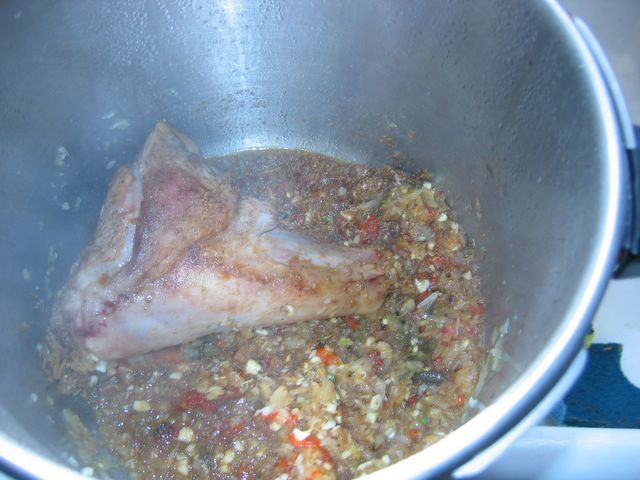
Browning the lamb shank along with the onions, garlic, spices, roasted bell peppers and jalapeno chiles.
When it was done, after a couple of hours in and out of the crock pot, I came to this conclusion--since the lamb and goat make a nice, rich brown sauce, I am going to ditch the white beans for either pintos or more exotic Anasazi beans; the posole and beans are both white and so there is no color contrast there. And the sun dried tomatoes--while flavorful, were too dark and raisin-like in appearance and texture for my taste. Instead of them, I will probably use a can of Muir Glen fire roasted tomatoes.
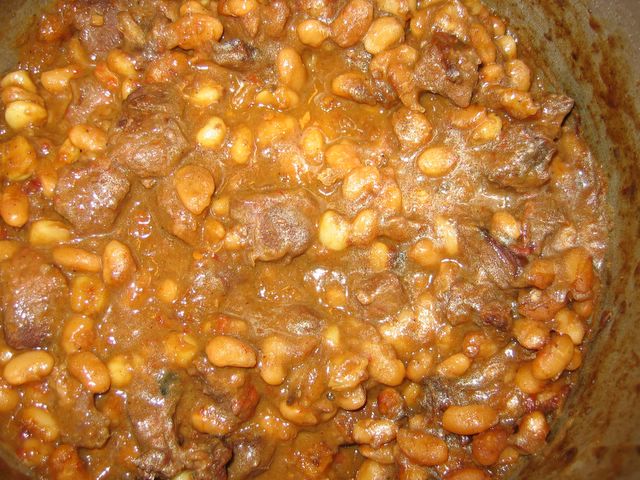
The mostly finished dish. I will post a picture of the completely finished dish tomorrow--it needs fresh tomatillos added as it heats up and fresh cilantro sprinkled over it before serving.
The chiles--roasted, frozen jalapenos I processed this fall, and chipotle en adobo worked admirably, especially since I paired them with frozen roasted red bell peppers. The tomatillos will add considerably to the color and texture possibilities as well as adding a sweet and sour note to the flavors. I may add a bit of frozen corn to give another color and flavor contrast.
All in all, I am pleased with Chupacabra Chili II: Culinary Bugaloo--it is extremely good, and with the changes I outlined above, will be a serious contender in the cook-off.
I have to make sure it is really good, as Zak is working right now on t-shirt designs for us to wear to the event.
More on the art tomorrow.
Goodnight, and I hope you had a Happy Chupacabra Sunday! I know that I did, that is, until my computer froze up and I lost most of this post and had to recreate it. Fun!
Friday, February 04, 2005
Scary Cookies
Two young girls baked cookies and tried to give them to a neighbor, but she was afraid because they knocked on the door after dark?
And then, not only does she not open the door to see who it is and accept the cookies, she flees her home and then has an anxiety attack that is so bad she thinks she is having a heart attack and goes to the ER?
And -then- when the girls 'fess up to the heinous crime of trying to give the woman home-baked cookies, and apologize for frightening her and her parents offer to pay the medical bill if she will sign a paper releasing them from any more liability, she -refuses- and takes them to court anyway?
And WINS?
Excuse me, but there is simply something wrong in the United States if a judge would award anything to this woman but a boot in the seat of her pants. I do not understand why the case wasn't tossed summarily out of court. It is ridiculous.
And it all happened because two girls decided to be charitable and make cookies for the neighbors. How dare they?
I'm glad that my neighbors are nowhere nearly so weird. They accept my gifts of baked goods not only with good grace, but with great glee.
They especially like these:
Raspberry Almond Crumb Bars
2 ½ cups all purpose flour (or 2 cups white and ½ cup whole wheat flours)
1 cup raw sugar
1 cup chopped almonds
1 cup softened butter
1 egg
1 tsp. almond extract
¼ tsp. ground ginger
½ tsp. ground cardamom
½ tsp. ground cinnamon
¾ cup seedless raspberry preserves
Combine all ingredients except preserves in mixing bowl and beat on low speed until mixture resembles coarse crumbs. Reserve 2 cups of crumb mixture.
Spread preserves in an even layer within ½ inch of edge.
Seriously, I hope that Lindsey Jo and Taylor do not lose their instincts for kindness and generosity because of this obviously greedy and disturbed self-centered woman. I really hope that they don't become cynical and lose their ability to engage in random acts of kindness. Such caring is rare in the world and I would hate to see it crushed by the small-hearted miserliness of a person who has been coddled by a dull-witted judge.
Meanwhile, I am fighting my urge to start a campaign to send the woman in question piles of chocolate chip cookies made with Exlaxx.
I'd never do it.
But boy is it a tempting thought.
Packing and Remembering
I have to start packing up parts of my kitchen.
We are moving sometime next month, and that means that we need to seriously start to pack.
In all honesty, I started the process months ago when I put most of our books in boxes.
Not my cookbooks of course. Just the other books. The cookbooks are still all on their shelves, dusted and happy. I couldn't pack those.
I might need them.
But books about gardening, or novels or literature or folklore or feminist theory or spirituality--we didn't need those.
Of course, I have already had to dig into a couple of boxes to retrieve something that Zak did indeed inform me that he needed in order to write an essay.
Oops.
So, anyway, I am eyeing my kitchen, knowing that I should pack away the things I will not be needing anytime in the next month, so I won't have to stay up for forty-eight hours before the moving van arrives and pack in a frenzy of stressed activity.
I know I should, but I don't want to.
Choosing what goes into boxes first is hard.
By all rights it should be simple. The fish poacher should go first. Because I have never used it, and I am not likely to poach a whole salmon just for Zak, myself and maybe the cats. Even if the cats hope for this, it is not likely to happen.
But it is so shiny. It doesn't want to be in a box. Besides, Zak's dad bought it for me as a gift when I graduated from culinary school.
Or the twenty-something quart stockpot. I am not going to be making beef stock for pho anytime soon. Not with only two people in the house. Nor am I going to be making jambalaya for a crowd--especially since the crowd lives where we will be moving to, not where we live now.
But I hate to do it. I always think about the first time I used the stockpot.
For our wedding feast. I made beef stew with Guinness stout. I catered the reception myself--with the exception of the cake. Never bake and decorate your own wedding cake, even if you are professional. It adds way too much strees to an already stressful event.
I am speaking from experience; I did it once, for my first wedding. Three tiers, frosting roses, festoons of icing. It was the first time I had ever done such a thing.
It is also nearly the last time I have done it.
I don't do wedding cakes anymore.
Anyway--I look at that stockpot and I think about Zak and I getting married and I don't want to stick it in a box.
Or Gram's pots and pans. A large set of copper-bottomed Revereware purchased by her daughters after they got jobs at the phone company in the 1940's. They gave them to her for Christmas., and she kept them until she went into a nursing home while I was in culinary school, in 1998. When they cleaned out her apartment, my Mom asked if I wanted anything and I asked for her soup pot. My aunt Sis, one of the two who had given it to Gram, said to just give them all to me.
So, when I use them, I think of all the meals Gram cooked and served in those, for her kids and grandkids. And when I think of putting them in a box, I get reluctant. They are full of love, and a lot of good cooking karma. They should be enshrined, not stuck in a box.
And her Fiestaware is in my cupboard, too. And the wooden spoon that was Grandma's and the antique tea set that Zak's grandfather brought from Japan, and the mooncake mold I bought from the Wok Shop in San Francisco on our honeymoon....
And I cannot do it. I hate to do it. I don't want to do it.
But it is too bad. The boxes go into the kitchen empty tomorrow.
And they will come out filled.
I swear it.
Wednesday, February 02, 2005
Thai Basil
Thai basil is one of them--sharper and more pungent than the more familiar European varieties, it never fails to shake the cobwebs from my mind and get my chi flowing.
When paired with the wickedly-hot wee Thai chiles, Thai basil can give an unforgettable culinary kick in the pants that is not only energizing, but addictive.
But in a good way.
Thai basil is a necessary ingredient in many Thai dishes, and while for years I was forced to substitute Italian Genovese basil for it, once I found a source for the correct herb and tasted the difference it made in my cooking, I never looked back. I determined that when we moved to a place where I could have a garden, I would grow my own basils and chile peppers, and never be bereft again.
Which is what I did. The spring before last I started my own basil and mint plants. I knew that there was no way I was going to be able to afford to put in plants from a nursery and still keep Zak and I in both Thai food and pesto--the amounts needed were too high. So, I invested in seed starting trays and a grow light and turned out spare bedroom into a plant nursery.
I ended up with well over one hundred basil plants of three different kinds: Thai basil, Genovese and Holy basil.
The variety I ended up growing of the Thai basil was Siam Queen, which is a beautiful, vigorous plant, bushy and upright in habit with dark green leaves that shade to purple near the flowering tips. The square stems (a sign that shows basil's relationship to mint--basil, like many other culinary herbs, is in the mint family) are also purple, as are the flowers, which are extremely popular with bees. The leaves, stems and flowers are all edible and are quite flavorful, though the thicker stems are too tough to be palatable. Among the three types of basil I grew that year, it was the most beautiful, and when it came time to transplant all of my baby plants into the garden, I ended up sprinkling among the roses, salvia and other perennials in the flower garden, as I ran out of room in the vegetable and herb patch.
They never failed to get attention from all of the visitors of the garden, whether they were people, bees, butterflies or hummingbirds.
And no matter how many Thai dishes I cooked that year, we were never short of basil to put in them.
Last year, I ended up with fewer basil plants; due to my mother having surgery in prime seed-starting time, I ended up not starting my baby plants. I bought ten plants of Siam Queen at a local nursery, but I had to carefully tend them and snip them in order to eke them out over the summer season.
It is coming close to time to think of dragging the seed starting stuff out of the basement and setting up a plant nursery, but since we are moving house in March and I am not sure what kind of sun exposure we will have in the new garden, I think I will resist the urge to sprinkle seeds into flats and watch hundreds of tiny plants sprout. I think it is best to see how much sun I will be getting and what kind of soil I will have to work with before throwing myself into midwifing a a huge family of tiny basils.
And once we move, if it looks like we will have a good spot for a basil patch, I can always head out to my favorite herb nursery ever and pick out some started plants. Then, next winter, around this time, I can indulge in my seed-starting passion, and watch as hundreds of little Siam Queens pop their first infant leaves above the soil.
Until then, I can assuage my longing by picking up a bunch of basil at the Asian market and putting together one of Zak's favorite Thai dishes--Spicy Chicken with Basil.
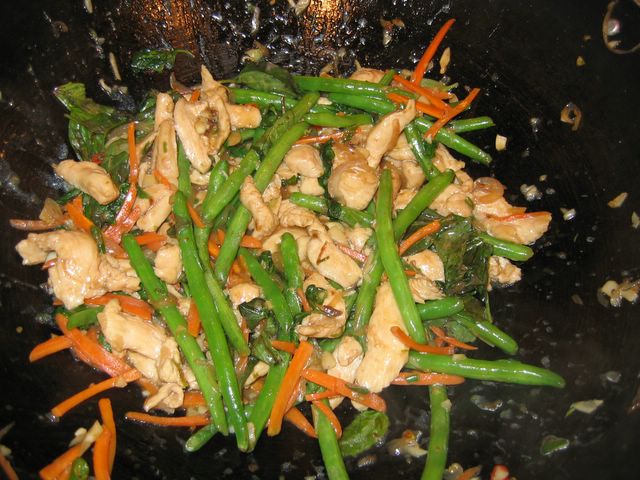
Chicken with Basil--a spicy Thai stir fry dish that features fiery chiles and sweet Thai basil with garlic and shallots.
Thai Chicken with Basil
1 lb. boneless skinless chicken breasts, cut into 1X1/2 slices
1 tbsp. cornstarch
1 tbsp. oyster sauce
3 tbsp. peanut oil
2 large shallots, sliced as thinly as you can manage
3-5 Thai bird chiles sliced thinly on the diagonal (or to taste--with me, more is better)
zest of one lime (If you can get fresh kaffir lime leaves, 3 of them cut chiffonade are best)
8 cloves garlic minced
fish sauce to taste*
½ lb. string beans, trimmed, washed, blanched and drained
½ cup carrots cut julienne
1 1/2 cups Thai basil leaves packed
½ cup holy basil leaves, packed (optional-if you can get them)
2 tbsp. oyster sauce, or to taste
juice of one small lime
1/3 cup unsalted chicken broth or stock
Toss cut chicken with cornstarch and oyster sauce.
Heat oil in wok until smoking. Add shallots, chiles and lime zest, and cook until the shallots begin to brown. Add garlic and cook until fragrant.
Add chicken, and push into a single layer and allow to cook without stirring for about one minute, or until chicken begins to brown. Stir, and then stir constantly, cooking until chicken is nearly all white, with only a bit of pink showing.
Add some fish sauce, and let it cook down, then add carrots and cook for one minute, stirring madly. Add green beans and cook for one more minute, stirring. Add the basil leaves and stir for another minute, allowing them to wilt.
Add a dash more fish sauce, a dollop (about a tablespoon is all I use, but some folks like more) oyster sauce and lime juice, boil until sauce cooks down (this takes about thirty-45 seconds, really). Add broth or stock and cook just until sauce is barely thickened by reduction, barely a minute. The basil should be wilted, the chicken glazed with a bit of browning but mostly white and tender, and the veggies crunchy-tender.
Serve over steamed jasmine rice.
*One more thing--about fish sauce--do not be afraid of it. I know it smells funky. Believe me, I know, but you cannot cook Thai food without it. Soy sauce is not a substitute. It isn't the same. Believe it or not, but the smell really does not indicate the beautiful, complex flavors it brings out in food. When it hits a hot wok it smells rather like someone left a sardine in their tennis shoe in a locker and let it putrify all summer. But the end result is nothing like that.
It seems to boost the natural flavors of other foods while adding its own subtleties that somehow do not have anything to do with fishiness. I don't quite know how it all works--maybe it is magic. But at any rate, don't leave it out unless you are allergic to fish or something.
And if you are having people over who are unitiated into the sacred mystery that is fish sauce, before you dash it into the hot wok, send them out of the kitchen, or you may frighten them out of eating dinner. Send them on an errand, out to pick up the newspaper, to walk the dog, to call their mother--anything, but do it. Trust me. I have had to do this with my Mom for years. She loves Thai food, but hates fish and I just know if she were to smell fish sauce, that would be the end. She would never eat pad thai again.
So, I always send her out for her last cigarette before dinner just before it is time to splorch the fish sauce in. It works like a charm.
Synchronicity
Then, I get up and look at the New York Times and lo and behold, I am not the only person in the world who is interested in the oddities in the lemon world. Apparently, growers in the US are taking up the cultivation of all sorts of different lemon varieties, including ones that are so sweet that even folks without a taste for the tang can eat them out of hand. There is even a great photograph of a really interesting variety with a green striped skin when it is immature, with fragrant pink flesh.
How neat is that.
Anyway, I understand that you have to register to read the article. If that gives you the heebie jeebies and you fear that spam will descend on your email box or Da Man will come and drag you away in the middle of the night because you are a food-obessessed weirdo who wants to take the world over one plate at a time just because you gave some information to the Times, frolic off to bugmenot and deal with your issues. Become unbugged and read that story.
And look at the pretty picture. Doesn't that just make you want to know what they taste like? Can you imagine a pale pink lemon sorbet that doesn't rely on food coloring to get that way? What about using some unripe ones to make little cups out of the skins in order to serve said sorbet.? Very pretty.
More later, probably on a completely different topic, because that is just how I am.
Tuesday, February 01, 2005
The Reason for the Season
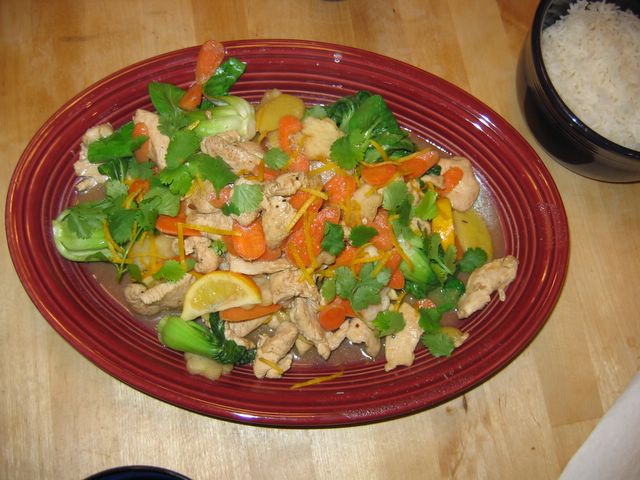
Meyer lemons add flavor, color and warmth to Winter Sunshine Chicken. The other ingredients include baby bok choi, baby carrots and jicama cut with fancy cutters.
I had a friend once who said, "February is the saddest month."
I credit her belief to the fact that she was living in Ohio at the time; February in Ohio, unless it is enlivened by a pretty snowfall, is a cold, grey, dreary month which will turn the most cheerful person into a frowning slug. Those of us who are not normally perky and upbeat find ourselves in danger of crawling under our beds and falling into a coma until spring comes and our friends drag us out and beat us in the head with brooms by way of awakening us to the rapture that is sunlight and fresh air.
It is a good thing that February is also the shortest month of the year as well, for were it not, more people would succumb to the grey ennui of endless winter. It is a time enlivened by nothing except St. Valentine's Day which is a horrid, commercial holiday which scars schoolgirls who get no silly valentine cards and which builds up expectation of rampant sexual congress to the point that no one can live up to the hype.
In short, there is nothing to look forward to in February but its end and the advent of March, which at least promises a hint, if not a full-blown manifestation of spring.
However, three years ago, Zak and I traveled to San Francisco in February and discovered something.
We discovered that there is a reason for the month of February to exist other than to keep the Hallmark Card company, chocolatiers, and Victoria's Secret in business.
They are called Meyer Lemons.
We discovered them growing in a friend's front yard: floral-scented orange-yellow spheres of pure distilled sunlight. Sweet and sour sauce in a convenient palm-sized package. Lemonade in its own biodegradable container.
I am told that they are too sour to eat out of hand. Pish. What a lie. I bit right into one and it was bliss on the tongue, a pleasant frisson of honey balanced with the electric tingle of citric acid. The peel had the scent of lemon balm in it, mixed with a bit of the terpine flavor of rosemary. It spoke to me of golden hills awash in sunlight, the heady scent of wildflowers and the steady hum of bumblebees.
I completely forgot it was February.
I was hooked.
We carried some home with us in our luggage, and I set to making the best lemon curd, lemon bars and lemonade we had ever tasted when we returned to the record snowfall which had trapped our housesitting friends while we were gone. (Let me note how surreal it is to go from a land where tulips, roses and camellias are blooming and trees are laden with fruit to a blizzard-swept landscape which had been simply barren, cold and leafless when we left. It was a shock to our systems. It was tempting to turn around and board another plane and fly back.) The parade of Meyer lemon goodies that danced out of my kitchen kept us going until the sunlight returned and the first robins bounded across our newly greening lawn.
I thought that would be the end of the Meyer lemon for me, but last year, just as winter had begun to have its way with my psyche and I was feeling the desire to creep under the nearest bit of furniture and take up the life of a dustbunny, I discovered a huge pile of Meyer lemons on sale at the local Wild Oats store.
For a not unreasonable price, I might add.
Needless to say, I gleefully filled a giant bag with pounds of them , clutched them to my bosom and trotted off to my kitchen, chortling the entire way.
Well, actually, I paid for them first, but you know what I mean.
And once again, golden delights poured from my saucepan and oven, and friends began bugging me for my recipes as I began flooding every social event with lemon bars, lemon pound cake, lemon icing and lemon-ginger flavored tea breads.
This year I noticed that I am not the only one in the frigid Midwest and East Coast who is Meyer lemon-crazed. Apparently, they are the new "in" thing. One article from Kansas goes so far as to suggest that we pathetic winter-tormented souls grow dwarf versions inside our houses.
All of this excitement must be amusing to all the folks in California who so take them for granted that they all but throw bagsful of them at people in their hurry to give them away and get rid of them.
That's okay. Let them give the beauties away or sell them for a pittance. We sunlight-deprived shivering wretches know them for the exquisite commodity that they are. We will pay high prices and hoard them and stroke them, and call them "my Precious" and whisper our love to them in the never-ending gloom that is February. And when we can't get the fruit itself, we will read about it, we will purchase vodka and olive oil flavored with it, and we will drink and cook and dream the dank cold away.
Hell, we may even buy little trees of our own and attempt to grow a bit of paradise in our homes. Desperation for a sign that the sun really is behind that grey curtain of sky does things to people. If the worst they do is force a little tree to live in a pot, it is a small price to pay.
This year, the lemons showed up a bit early at Wild Oats, and on Sunday, I found myself grabbing them up greedily, only there was some more competition, and the price was higher--a sure sign that these are the new "big thing."
That is okay. I am not too stingy with my Precious. I wouldn't begrudge fellow winter-oppressed zombies a hit of sunshine.
And in the spirit of fellowship with those who clutch sweet lemons and pray for the return of the sun, I share this recipe to showcase the golden goodness of Meyer lemons. Since Meyer lemons originally came from China, I decided to create a play on that Chinese take out standby, Lemon Chicken. This version, however, has nothing to do with breading, deep frying or that ubiquitous nuclear-yellow gloppy sauce whose provenance is unknown, and everything to do with sunshine and bold but light flavors.
I went with a very simple, Cantonese-style approach, inspired by two recipes: one from Deh ta-Hsiung in an out of print cookbook, and another from Grace Youngs The Wisdom of the Chinese Kitchen. The choice of vegetables and the addition of lemon oil to the marinade, however are my own touches.
In honor of the soul-saving properties of the Meyer lemons and the Chinese tradition of giving poetic names, I gave it a somewhat lyrical name, though you may be prosaic and call it simply, "Meyer Lemon Chicken." However, I am of the opinion that a pretty name makes a dish taste better.
On the other hand, what you call it after you make it in your kitchen is up to you.
Now, get out from under that bed and start cooking.
Winter Sunlight Chicken
Serves 4 for a traditional Chinese meal with several dishes, or 2 if this is the main dish.
Ingredients:
1 whole boneless skinless chicken breast, trimmed and sliced into thin rectangular slices
1 tsp. thin soy sauce
1 tsp. Shao Hsing wine
3 drops Boyajian lemon oil
1 ½ tbsp. cornstarch peanut oil for stir-frying
2 square chunk of fresh ginger, peeled and sliced thinly
1 Meyer lemon, cut longitudinally in half, then into four wedges from each half
2 tbsp. Shao Hsing wine
1 tbsp. thin soy sauce
½ cup carrots, peeled and cut into very thin diagonal slices
6 fresh water chestnuts, peeled and sliced into thin round slices *
juice and zest of two Meyer lemons
1 ½ tbsp. honey
1 tsp. cornstarch dissolved into 2 tsp. water
2 scallions, green parts only, cut into 1 long diagonal slices
½ cup whole cilantro leaves
Method:
Put chicken in a bowl, and toss with soy sauce, wine and lemon oil. Allow to marinate at least twenty minutes, while you cut up vegetables. Just before cooking, toss with cornstarch.
Heat wok until smoking. Heat peanut oil until smoking, and add ginger and lemon wedges. Be careful--damp lemon slices can cause splattering. Stir fry until ginger is golden brown and lemon is beginning to brown on edges and on skin. Remove to serving platter and set aside.
Add oil if needed, heat wok back up, add chicken, and stir to a single layer. Allow to brown on bottom side for about 1 minute, then stir and fry until nearly done--most pink spots should be gone. Add wine and allow alcohol to cook off while stirring and frying the chicken. Add soy sauce and stir and fry 30 seconds.
Add carrots and water chestnuts and stir fry until carrots are done. Pour in lemon juice and honey, then scrape into wok the ginger and lemon wedges. Stir until liquid comes to a boil.
Add cornstarch mixture and stir until liquid is slightly thickened.
Add scallion tops, and stir fry another 20 seconds. Take off heat, garnish with lemon zest and cilantro leaves and scoop onto serving platter.
Serve with steamed rice.
*If you cannot get fresh water chestnuts, use peeled, thinly sliced jicama. You can do as I did for the picture above and use fancy cutters to give them a pretty shape.


