

Saturday, April 30, 2005
Dissing the Dim Sum
So, two days ago, I wrote about food and politics in the US.
Today, I will write a bit about food and politics in China.
Currently in China, there are to big fracases going on that have the populace irritable. One is Japan's ascention to the UN Security Council, which, because of Japan's official minimization of the atrocities committed against the Chinese people in WWII, has folks a bit riled up, which is understandable. The second issue that looms large in China today is that there are some Chinese folks, particularly older folks in Hong Kong who are harshly critical of their own government--about the official statement on the subject of dim sum.
That's right, you heard me. Dim sum.
Dim sum is a tradition of eating small mouthfuls of exquisitely shaped dumplings, noodles, buns, and other little packets, bits and bites of food that are served in teahouses. This tradition is a big part of Chinese culture, particularly in the southern province of Canton, and in Hong Kong, and it is considered almost sacred by families, and particularly, by older men. Teahouses are where people gather to gossip, to visit with relatives and friends, to celebrate events and holidays, or just to have a nosh and some nice conversation.
Well, apparently, the Chinese government has issued a statement saying that some dim sum menu items are not particularly healthy for a person to consume in large quantities.
And it has ticked folks off.
The dim sum items in question tend to be deep fried or contain lard, which, as we all know, is probably not the best thing for a person to eat on a regular basis. Of course, the traditional Chinese diet is much healthier than the Western diet, based as it is on grains and vegetables, with a minimum of meat and saturated fats, and dim sum is a part of that diet.
However, dim sum has never been something that is eaten in large amounts every day.
But, the Chinese government has made a fairly innocuous statement saying that it might be a good idea for people to avoid the saturated fat and deep fried items and instead eat more vegetable-based items and ones that are steamed.
No mention has been made of closing dim sum restaurants or physically restraining people who insist upon eating this stuff. Just a gentle reminder that maybe people shouldn't eat it all the time.
And people are really riled up over the government telling them what to eat and what not to eat.
Now, if it were me, and I was in the Chinese government, I would probably lay off dissing the dim sum, and instead issue a warning about how hazardous American style fast food can be to one's health and well-being. Because, really, the food at teahouses usually starts out with recognizable ingredients, but the processed gloop that makes up McDonald's food has been shown to be deliterious to health both in formal studies and in the film, "SuperSize Me."
Considering how fast KFC and McDonald's are growing in popularity in China, I would say that the foods from those chains are probably putting more Chinese citizens at risk than the dim sum delicacies that are served in traditional teahouses.
Of course, not only is the health of China's people in danger--their tastebuds are at risk as well. And that is a greater threat, as far as I am concerned. I would hate to see the glories of Chinese cuisine tossed aside for the convenience of fast food. It would be horribly sad.
But that isn't a scientific fact; it is only my opinion.
Today, I will write a bit about food and politics in China.
Currently in China, there are to big fracases going on that have the populace irritable. One is Japan's ascention to the UN Security Council, which, because of Japan's official minimization of the atrocities committed against the Chinese people in WWII, has folks a bit riled up, which is understandable. The second issue that looms large in China today is that there are some Chinese folks, particularly older folks in Hong Kong who are harshly critical of their own government--about the official statement on the subject of dim sum.
That's right, you heard me. Dim sum.
Dim sum is a tradition of eating small mouthfuls of exquisitely shaped dumplings, noodles, buns, and other little packets, bits and bites of food that are served in teahouses. This tradition is a big part of Chinese culture, particularly in the southern province of Canton, and in Hong Kong, and it is considered almost sacred by families, and particularly, by older men. Teahouses are where people gather to gossip, to visit with relatives and friends, to celebrate events and holidays, or just to have a nosh and some nice conversation.
Well, apparently, the Chinese government has issued a statement saying that some dim sum menu items are not particularly healthy for a person to consume in large quantities.
And it has ticked folks off.
The dim sum items in question tend to be deep fried or contain lard, which, as we all know, is probably not the best thing for a person to eat on a regular basis. Of course, the traditional Chinese diet is much healthier than the Western diet, based as it is on grains and vegetables, with a minimum of meat and saturated fats, and dim sum is a part of that diet.
However, dim sum has never been something that is eaten in large amounts every day.
But, the Chinese government has made a fairly innocuous statement saying that it might be a good idea for people to avoid the saturated fat and deep fried items and instead eat more vegetable-based items and ones that are steamed.
No mention has been made of closing dim sum restaurants or physically restraining people who insist upon eating this stuff. Just a gentle reminder that maybe people shouldn't eat it all the time.
And people are really riled up over the government telling them what to eat and what not to eat.
Now, if it were me, and I was in the Chinese government, I would probably lay off dissing the dim sum, and instead issue a warning about how hazardous American style fast food can be to one's health and well-being. Because, really, the food at teahouses usually starts out with recognizable ingredients, but the processed gloop that makes up McDonald's food has been shown to be deliterious to health both in formal studies and in the film, "SuperSize Me."
Considering how fast KFC and McDonald's are growing in popularity in China, I would say that the foods from those chains are probably putting more Chinese citizens at risk than the dim sum delicacies that are served in traditional teahouses.
Of course, not only is the health of China's people in danger--their tastebuds are at risk as well. And that is a greater threat, as far as I am concerned. I would hate to see the glories of Chinese cuisine tossed aside for the convenience of fast food. It would be horribly sad.
But that isn't a scientific fact; it is only my opinion.
Thursday, April 28, 2005
Politics and Food: The Personal is Political
Kate, the fine author of one of my daily must-reads, The Accidental Hedonist, recently posted a link to a column by Mark Morford decrying the "food" and atmosphere that is found in the typical gigantic American supermarket. A reader responded with this quote: "What does republican have to do with this rant - albeit his point is an excellent one, why politicize it? The dems have taken lots of money from the Safeway/Vons/Albertsons of the world. Starbucks - the Safeway of the coffee industry - is all Dem. So not sure why you have to politicize this. Get over it."
Kate's thoughtful response links to another blog, which is all about US governmental food policy, written by Parke Wilde, a food economist.
My response, which is hopefully just as thoughtful, though it is also ironic is this:
Food is already politicized. The personal is political. If you don't like that stop eating. If you don't like what a blogger has to say about it, don't read that blog entry. (Notice I did not say "stop reading," though it was tempting as it would have had parallel sentence construction going, and I do like the elegance of that. However, I would never, ever, under any circumstances advocate that any being of any sort stop reading.)
And just to sort of top off my food and politics theme yesterday, Zak sent me a link to an article stating that the US Government, (at the recommendation of The National Acadamy of Sciences) might be changing the rules on how WIC operates in order to bring it closer to modern healthy nutritional guidelines.
What is WIC?
The acronym stands for Women, Infants and Children; it is a governmentally funded voucher program with which low income mothers can obtain nutritious food for themselves (particularly if they are nursing mothers), their babies and toddlers. Vouchers are provided for milk, juice, baby formula, eggs, cheese, cereals and dried beans. The proposed changes will provide vouchers for fresh fruits and vegetables--nutritionally superior foods which few low income families can afford--while also allowing for various calcium-rich foods such as yogurt, tofu and soy beverages to be purchased instead of whole milk. The new guidelines would also provide for the consumption of less cholesterol in the form of dairy products and eggs, in an effort to curb rising obesity rates among children.
The number of children who are touched by WIC is incredible. For a program that costs a bit over five billion dollars a year, it feeds over 8 million human beings in our country, most of them children. One half of all infants in our country and one quarter of all kids between the ages of one to four years are fed in part, through the WIC voucher system.
Any person with empathy can see how important this program is to low-income families with kids. But just in case a reader doesn't get it, let me make this bunch of political statistics personal:
Fourteen years ago, my daughter was one of those kids.
Nearly sixteen years ago, when I was pregnant with her, my husband lost his job, and I was unemployed and unemployable, in part, because minimum wage employers don't like to hire a visibly pregnant woman. (Of course, they didn't say that when they didn't hire me, that would be discrimination, but the truth was they didn't want to hire me and then lose me in six months when I gave birth, or even worse than that, have me get injured on the job and then sue them.)
With no income coming in and the savings account gone, we definately qualified as "low income."
It killed me to accept charity. But my mother-in-law rightly pointed out that I had been working and paying taxes since I was seventeen, and one of the things my tax dollars paid for was helping to take care of those who were the most vulnerable in our society--pregnant women, babies and toddlers. So, I signed up for WIC, and ended up on medical assistance for my baby's birth. I actually got very good medical care, but I learned quite quickly, how badly some women who use WIC vouchers or food stamps can get treated.
I also learned how nicely some of those women can get treated. I discovered that race matters when you are poor--grocery store clerks tended to be nicer to me than they were to black women using the exact same vouchers. I discovered that how you dress matters--I still dressed nicely, and looked more "middle-class," and saw that white women who were not dressed as well as I was tended to get treated badly by store clerks.
I also learned that the taxes that I pay every year go towards something that matters more than Homeland Security.
It goes toward helping ensure that mothers and children have a chance at being healthy.
So, when I read that article yesterday, I was happy to know that the WIC guidelines were going to change and grow with our nutritional understanding which has amassed over the past thirty years.
However, something niggled in the back of my mind and worried me, and for a few minutes, I couldn't figure out what it was.
And then I remembered.
The budget.
Under President Bush's new proposed budget, WIC is going to undergo drastic cutbacks.
The Center on Budget and Policy Priorities reports that the 2006 federal budget proposed by President Bush, targets WIC and other programs which are aimed at low income mothers and children for drastic cuts by 2010. For example, projected cuts to WIC show that by 2010, 670,000 fewer women and children will be able to be served by the program.
Yet, the US Census Bureau reports that the number of children under 18 who are in poverty is rising: from 2002-2003, the percentage of children in poverty rose from 16.7 percent to 17.6 percent.
Those 670,000 children are not faceless, nameless statistics. They are babies just like my daughter was. They are people. And they deserve to be fed.
It is very well that WIC's policy on what constitutes nutritious food may be changing to reflect changing nutritional guidelines, but without a budget, what good will this do? If there is no money to feed these children, what does it matter? Is this what compassionate conservatism is about?
The political is personal, and food and nutrition are political issues.
And it behooves those of us who care about food, who can write passionately and eloquently about the seductive flavor of a truffle, or the joy of baking a loaf of bread, to be educated about how our food is affected by governmental policy. It behooves us to not only speak to the needs of the wealthy few who can afford truffles, but also to write about the plight of those whose hunger is for nothing more exotic than a full belly and a hope for the future of their children.
The personal is political, and the political is personal. Don't ever forget that.
My daughter and millions of others like her will thank you for remembering.
Kate's thoughtful response links to another blog, which is all about US governmental food policy, written by Parke Wilde, a food economist.
My response, which is hopefully just as thoughtful, though it is also ironic is this:
Food is already politicized. The personal is political. If you don't like that stop eating. If you don't like what a blogger has to say about it, don't read that blog entry. (Notice I did not say "stop reading," though it was tempting as it would have had parallel sentence construction going, and I do like the elegance of that. However, I would never, ever, under any circumstances advocate that any being of any sort stop reading.)
And just to sort of top off my food and politics theme yesterday, Zak sent me a link to an article stating that the US Government, (at the recommendation of The National Acadamy of Sciences) might be changing the rules on how WIC operates in order to bring it closer to modern healthy nutritional guidelines.
What is WIC?
The acronym stands for Women, Infants and Children; it is a governmentally funded voucher program with which low income mothers can obtain nutritious food for themselves (particularly if they are nursing mothers), their babies and toddlers. Vouchers are provided for milk, juice, baby formula, eggs, cheese, cereals and dried beans. The proposed changes will provide vouchers for fresh fruits and vegetables--nutritionally superior foods which few low income families can afford--while also allowing for various calcium-rich foods such as yogurt, tofu and soy beverages to be purchased instead of whole milk. The new guidelines would also provide for the consumption of less cholesterol in the form of dairy products and eggs, in an effort to curb rising obesity rates among children.
The number of children who are touched by WIC is incredible. For a program that costs a bit over five billion dollars a year, it feeds over 8 million human beings in our country, most of them children. One half of all infants in our country and one quarter of all kids between the ages of one to four years are fed in part, through the WIC voucher system.
Any person with empathy can see how important this program is to low-income families with kids. But just in case a reader doesn't get it, let me make this bunch of political statistics personal:
Fourteen years ago, my daughter was one of those kids.
Nearly sixteen years ago, when I was pregnant with her, my husband lost his job, and I was unemployed and unemployable, in part, because minimum wage employers don't like to hire a visibly pregnant woman. (Of course, they didn't say that when they didn't hire me, that would be discrimination, but the truth was they didn't want to hire me and then lose me in six months when I gave birth, or even worse than that, have me get injured on the job and then sue them.)
With no income coming in and the savings account gone, we definately qualified as "low income."
It killed me to accept charity. But my mother-in-law rightly pointed out that I had been working and paying taxes since I was seventeen, and one of the things my tax dollars paid for was helping to take care of those who were the most vulnerable in our society--pregnant women, babies and toddlers. So, I signed up for WIC, and ended up on medical assistance for my baby's birth. I actually got very good medical care, but I learned quite quickly, how badly some women who use WIC vouchers or food stamps can get treated.
I also learned how nicely some of those women can get treated. I discovered that race matters when you are poor--grocery store clerks tended to be nicer to me than they were to black women using the exact same vouchers. I discovered that how you dress matters--I still dressed nicely, and looked more "middle-class," and saw that white women who were not dressed as well as I was tended to get treated badly by store clerks.
I also learned that the taxes that I pay every year go towards something that matters more than Homeland Security.
It goes toward helping ensure that mothers and children have a chance at being healthy.
So, when I read that article yesterday, I was happy to know that the WIC guidelines were going to change and grow with our nutritional understanding which has amassed over the past thirty years.
However, something niggled in the back of my mind and worried me, and for a few minutes, I couldn't figure out what it was.
And then I remembered.
The budget.
Under President Bush's new proposed budget, WIC is going to undergo drastic cutbacks.
The Center on Budget and Policy Priorities reports that the 2006 federal budget proposed by President Bush, targets WIC and other programs which are aimed at low income mothers and children for drastic cuts by 2010. For example, projected cuts to WIC show that by 2010, 670,000 fewer women and children will be able to be served by the program.
Yet, the US Census Bureau reports that the number of children under 18 who are in poverty is rising: from 2002-2003, the percentage of children in poverty rose from 16.7 percent to 17.6 percent.
Those 670,000 children are not faceless, nameless statistics. They are babies just like my daughter was. They are people. And they deserve to be fed.
It is very well that WIC's policy on what constitutes nutritious food may be changing to reflect changing nutritional guidelines, but without a budget, what good will this do? If there is no money to feed these children, what does it matter? Is this what compassionate conservatism is about?
The political is personal, and food and nutrition are political issues.
And it behooves those of us who care about food, who can write passionately and eloquently about the seductive flavor of a truffle, or the joy of baking a loaf of bread, to be educated about how our food is affected by governmental policy. It behooves us to not only speak to the needs of the wealthy few who can afford truffles, but also to write about the plight of those whose hunger is for nothing more exotic than a full belly and a hope for the future of their children.
The personal is political, and the political is personal. Don't ever forget that.
My daughter and millions of others like her will thank you for remembering.
Wednesday, April 27, 2005
A Baking Mood

Harvest Fruit Bread is filled with nuts, whole grains, seeds, cranberries and apples and is flavored with honey, cardamom and cinnamon. It goes very nicely with cream cheese blended with honey and walnuts.
A mood has come upon me.
A baking mood.
I am having the urge to fire up the oven and bake tasty delights.
I don't necessarily want to eat the tasty delights, I just want to bake them.
Okay, I want to eat some of them. But not all of them.
It all started with wanting to bake scones. I saw that Pau at FoodBlog had made some ginger rosemary scones that turned out really well in spite of a sticky dough which caused some consternation and frustration. I posted a comment about scones, having made many batches in my time, and then found myself wanting to bake them.
Actually, I was craving a scone, but one cannot bake a single scone. And if I bake an entire batch of them, I may not stop at eating one. And that is bad, because I make cream scones, so in addition to the butter and egg, there is cream. And I don't need to eat an entire batch of them. Neither does Zak, for that matter.
Now, I know the solution to the scones issue. I have friends in town, see, and I can call them and have them come over for scones.
Except, they all have jobs, and calling people at ten at night and telling them to come over so I can bake scones for them--well, let's say that is a bit much.
So, I gave up on the scones, and went to bed instead, resolving to bake some this weekend when the friends will likely gather to go see Hitchhiker's Guide when it opens. Scones, being a veddy British sort of thing, and my scones being utterly posh, would be a perfect before or after movie ritual nibble with a spot of tea.
So, no scones.
And brownies, too, are right out. Eating an entire pan of double chocolate brownies that have been flavored with espresso and chile powder right before bed is awful. Actually, eating an entire pan of them anytime is a recipe for having one's pancreas crawl up the esophagus and fling itself to the floor to expire in a twitching puddle of goo.
So, perhaps this is a weekend to ply my beloved people with both brownies and scones.
So, whatever can I bake?
But wait!
We got a shipment from King Arthur Flour yesterday, which included a package of potato flour that had mysteriously opened on its way here and spilled itself all through the box, the packing materials and everything, including my kitchen floor, which is now covered in powder which looks oddly like anthrax aerosol. But it also included many other goodies, which did not act up and spill out all over the place. Like thier "Harvest Grains Blend."
"Harvest Grains Blend" is a mixture of oat berries, wheat flakes, rye flakes, sunflower seeds, sesame seeds, millet, flaxseed and poppy seed, which you can add to any of your white or wheat bread recipes in order to make a bread that is full of seedy, nutty grainy goodness.
Whatever I put such an ingredient in would be made instantly wholesome and healthy. Unlike the cream scones and killer brownies.
Baking without guilt or fear for the fate of my internal organs!
So, I resolved to bake a loaf of bread. Bread is good. It is wholesome, and if it has some of that grain mixture in it, there is no way I could physically manage to eat an entire loaf even if I wanted to.
So, bread.
Unlike Zak, I adore breads that are chewy, nutty, and full of different whole grains. I do not like hockey puckwhole wheat bread, however, that is godawful dry and tastes just this side of sawdust. That sort of thing is nasty. But complex nutty-wheaty-grainy stuff--I love it.
I didn't feel like waiting overnight for a starter, so instead, I adapted the recipe on the package of the blend, changing many of the ingredients around. I don't much care for cornmeal in yeast breads--it makes it too gritty in my opinion, so that got left out. I used wheat germ instead to make up the dry volume that would have been cornmeal. And instead of using a half a cup of whole wheat flour, I simply used wheat germ, while I was at it. It was one less thing to measure.
I also used honey instead of sugar, in order to add moisture to the dough, and I added some cinnamon and cardamom just because I could.
In order to entice Zak to like the bread, and for more texture and flavor, I added dried apples and cranberries. And, in order to make the dough rise better and have a better texture, I added Lora Brody's Bread Dough Enhancer. It has malt, gluten and ascorbic acid, and help keep whole grain loaves from turning into neutron stars.
This is the first time I have used this product, so I am keeping my fingers crossed to see if it lives up to its reputation as being able to help whole wheat breads rise efficiently. It works in two ways: one, the added gluten helps the elasticity and strength of the dough so that more carbon dioxide bubbles from the action of the yeast can be trapped, resulting in a greater ability for the bread to rise higher. One of the problems with whole wheat flour is that it the wheat germ and bran particles interfere with gluten development, so that the protein molecules that make up gluten are not as able to unwind and stretch themselves out to produce a more efficient, stretchier dough.
The malt and ascorbic acid work by feeding the yeast. Yeast, as we all know, is a living critter, and like all critters, needs food, air, water and warmth to live and thrive. The malt and ascorbic acid give it things to feed off of other than just the sugar and starch present in the dough, so that they can go forth and multiply in great orgasmic numbers thus populating the dough with a huge colony of little fermentomats who are busily turning sugar into alcohol and pouring off carbon dioxide while they do it. The carbon dioxide, of course, being that which makes the dough rise.
Anyway, here is the recipe:
Harvest Fruit Bread
Ingredients:
2 1/2 cups all purpose flour
1/2 cup wheat germ
2/3 cup King Arthur Flour Harvest Grains Blend
1/2 cup dried apples and cranberries, mixed, roughly chopped (I used a little over 1/4 cup of apples, and a little under 1/4 cup of cranberries; you can vary the fruit as you like)
1/4 teaspoon ground cinnamon
1/8 teaspoon ground cardamom
1 1/2 teaspoon salt
2 teaspoons instant yeast
3 teaspoons Lora Brody Bread Dough Enhancer
4 teaspoons honey
1/2 cup milk
1/2-3/4 cup water
canola oil or oil spray
Method:
Combine all dry ingredients and mix thoroughly. Using smaller amount of water to start with, combine wet ingredients and add to dry ingredients. Using a dough hook and a stand mixer, mix together and then knead for about 10 minutes. Or do this by hand.
Coat inside of a second bowl with canola oil or use oil spray. Remove dough from work bowl of mixer, form into a ball, and put into oiled bowl. Turn once to coat, cover loosely with plastic wrap, and put in a warm place to rise about an hour and a half, or until double.
When dough is doubled, remove from bowl and carefully shape into a loaf, degassing as little as possible (in other words, don't punch down dough and let out as little carbon dioxide as you can. Grease a loaf pan, and carefully place into pan, spray top with canola oil, cover loosely with plastic wrap.
Allow to rise in a warm place until the dough has crowned aboutabout even with, or slightly over the rim of the pan. This will take about 1 1/2 hours. Preheat oven to 350 degrees and bake for 40-45 minutes. (If you have a convection oven, you may only need to bake for thirty minutes, as I did.) For the last ten minutes, if the bread is browning too rapidly, cover with a tent of aluminum foil.
The internal temperatre should register at 190 degrees. Remove from the oven, remove from the pan and allow it to completely cool on a wire rack. (Right. I am notorious for not letting a bread cool all the way before diving into it. But it really does taste better if you wait. Really. Some breads taste better if you let them sit overnight and eat them the next day. I know it is hard. But try, anyway.)
This was very nice spread with cream cheese blended with honey and walnuts.
It turned out really lovely; though the bread didn't rise high as a less grain-dense bread would, the texture was springy, and the crumb was tender. It was perfectly moist and the flavor was exceptional. It wasn't too sweet at all, and the grain mixture gave it a toothsome crunch that was very satisfying. I was afraid that there was too much fruit in it when I looked at the dough as it was rising, but it turned out to be fine.
I will have to try it toasted for breakfast tomorrow. If I can get my Amityville Toaster (yes, I am a Foamy fan, and yes, my toaster is red, but no, it doesn't have a devil face) to work. Damned thing is possessed; it matters not what setting I put the little knob which supposedly controls how toasted the bread gets, it is either underdone or burnt to a crisp. And it is brand new, too. A Kitchenaid, at that.
And now for something completely different: a kitten.

Our youngest cat, Gummitch, sleeping curled up with our two oldest cats.
I figured that the name of the blog is "Tigers and Strawberries." I had written about strawberries and posted a picture, but nothing about tigers. And since I am short of big scary tigers here at my house, I thought I would post a picture of a small, cuddly tiger.
Monday, April 25, 2005
Eating Bitter, Part Three: From India with Love

Stir-frying bitter melon with onions, garlic and ginger in preparation to add it to already cooked keema sookh.
Hey, so you knew I would have to do one more meal with bitter melon, right?
Because they are pretty perishable, I had to use up my store of them before they went to that great vegetable crisper in the sky. Or, more like, turned into compost in the vegetable crisper in the bottom of the Sub-Z in my kitchen.
So, on Saturday, I figured that I had plenty of leftovers from the Indian feastie beastie on Friday, so why not try and recreate that dish I ate all those years ago at my employer's home that consisted of fried bitter melon with ground lamb and spices?
I mean, I had leftover keema sookh, so why the hell not fry up some bitter melon and dump the leftover, previously cooked and spiced lamb and see what happens?
What happened was pretty tasty, but not as good as what I had long ago, probably because the spices were not geared toward a bitter vegetable.
And, Zak didn't much care for it; he said that the bitter melon tasted too much like its cousin, the cucumber which he will not, under any circumstances (other than as a Thai salad/relish thing with lots of ginger) eat and enjoy.
So, if I were to try Indian style bitter melon with lamb again, I would start it all from scratch, and use a totally different spice mixture than what I used in the recipe above.
The way I did it was I stir fried an onion, thinly sliced, until it was a medium brown in my cast iron wok. Then, I added julienned ginger, three Thai chiles sliced thinly on the diagonal, and four cloves of thinly sliced garlic. I stir fried it for about a minute more, then added two bitter melons that I had seeded and sliced into fairly thin half-moon shapes. I cooked this for about five minutes, letting the melon soften but not brown, while the onions darkened to the nice mahogany color that properly cooked onions should be for most Indian dishes.
Then, I dumped in the leftover keema sookh, prepared as per the recipe liked to above, and fried it until it all heated up and melded together.
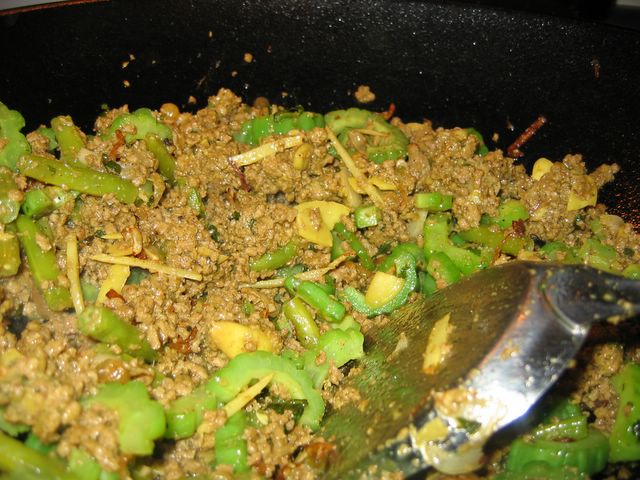
Keema sookh with bitter melon, also known as kerala. Since I was essentially utilizing leftover keema sookh, you can see that there are green beans included here. I wouldn't necessarily use them with the bitter melon; they were part of the original dish.
I served it all over steamed basmati rice.
In addition to using different spices (and I am still thinking on which ones I would use), I think I would also be certain to brown the bitter melon. As I recall, the melon I had with the minced lamb had been browned and this gave it a totally different characther that seemed to be lacking in this version.
All in all, I would try it again, but I think I prefer the vegetable cooked in the Cantonese way. Zak certainly likes the black bean and soy sauce seasoning better; when I cooked it that way last week, we were tussling over the last bits of bitter melon on the serving plate, whereas with this dish, he actively picked out the melon and avoided it after a time.
But, it was a worthy experiment--if nothing else, the photograph of the stir-frying looks really striking. That green is lovely reflected in the oil-slicked black iron wok.
Sunday, April 24, 2005
Vindaloo Voodoo
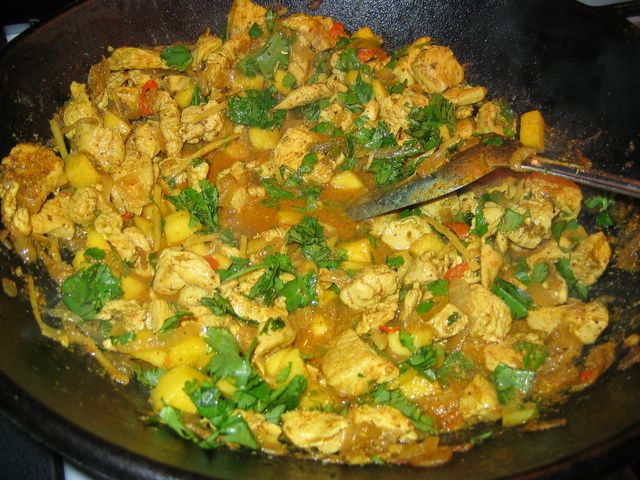
Chicken Vindaloo with Mangoes.
So, finally, I get to participate in a food blog event! Finally, I am settled enough to do it. Yes!
So, the theme of this time's "Is My Blog Burning" event, hosted by Foodgoat, is, "Orange You Hungry?" Participants are to post a recipe of something that comes out colored orange, which made me think of a favorite Indian dish: Chicken Vindaloo with Mangoes.
Now, mangoes are not supposed to go in the vindaloo, but what does that have to do with anything?. Potatoes seem to be a traditional vindaloo vegetable, but I always feel weird eating potatoes and rice in the same meal. I don't let that stop me from consuming Dum Aloo (stewed potatoes) with basmati pillau at an Indian restaurant buffet, but when I am home, doing the cooking, I do try to avoid that. Unless I am making Saag Aloo, but that is different. I am not sure why it is different, but it is. Maybe it is the greens that make it okay.
Anyway, back to vindaloo. Vindaloo is a curry dish that is from Goa, which was once a Portuguese colony on India's western coast. As such, it was originally made with pork, which is unusual for Indian dishes, as pork is not widely eaten anywhere else in India. It was the Portuguese who brought the pig along and elevated it to a culinary staple in Goa. Like many dishes common to southern India, vindaloo is highly spices with mustard seed and chiles, which the Portuguese also brought along with them. (The chiles, not the mustard seed.) Yes, chiles came to India only about five hundred years ago with the Portuguese colonials and traders. It was brought from the New World, where it was native.
It is hard to think of Indian food without the heat of chiles, but it is a recent addition to their spice repretoire. Mind you, they wasted no time incorporating all of the new foodstuffs that came along with traders from the Americas: chiles, tomatoes, potatoes, corn, and various beans. By this time, these foods are used so often, they are thought of as native, though it isn't the case.
What is native to India, however, is the mango. Here in the US, we probably only think that there is one kind of mango, but in India, there are countless varieties of them grown, and not all of them are eaten ripe as fruit. Many of them are picked green and processed as pickles. Some are cut into strips, dried, and ground into a powder, called "amchoor," which is used to give a sour flavor to some spice mixtures and dishes like channa masala. The ripe fruits are eaten out of hand, of course, and are used in desserts and sweet drinks, like the yogurt-based mango lassi, which is common in Indian restaurants in the US. Ripe fruits are also used in fresh and cooked chutneys, which are used as an accompianment to Indian meals, much like many Americans use salsa to go with entrees or as a dip.
I love mangoes.
I was first introduced to them by my Grandma who would bring boxes of them back from her trips to Florida to visit her sister. Grandma was a diabetic, and so she could never eat any of the delicious cakes and pies she baked every week for everyone else. But she could eat fruit, and mango was her favorite. She loved to peel them and eat them sitting out under the canopy of the huge locust tree beside the barn. The juice would run down her arms, but she would laugh and lick it off, and would cut pieces of it for me to share.
I wasn't supposed to eat the peel, but I liked to suck on it because I liked the resinous, pine-like flavor of it. To this day, I will suck on a piece of the peel when preparing mangoes, and when I do, it takes me back to memories of sitting on Grandma's lap under the blooming locust tree, surrounded by the honey-scent of its blossoms and the buzzing of bees, getting sticky mango juice in my hair and on my face.
My first taste of vindaloo came much later, when I lived in Columbia, Maryland. I ate it at Akbar, and it was love at first bite. I knew I had to learn to make it. Because I couldn't get good lamb all the time, I took to making it with chicken. It is good with chicken, but the richness of the lamb really made it a great dish, so I was trying to think of what to do to make the chicken vindaloo more special.
Mangoes were in season, and I had made a salsa with some of them. I thought about that spicy, sweet salsa with lime juice, and thought about the vindaloo--hot with ginger, mustard and chile, and sour with vinegar, and it clicked.
The cool, sweet juicy mango was just what the chicken vindaloo need to wake up and take off to the stratosphere.
So, to this day, when I make chicken vindaloo--I only do it during mango season.
Chicken Vindaloo with Mangoes
Ingredients:
2 tablespoons mustard seeds
1 tablespoon cumin seeds
1/2 teaspoon cardamom seeds
1 teaspoon coriander seeds
1 teaspoon fenugreek seeds
1 1/2 teaspoons black peppercorns
1/2 teaspoon ground cinnamon
2 teaspoons ground turmeric
1 teaspoon ground cayenne pepper (optional)
1 teaspoon ground sweet paprika
mustard oil or peanut oil for stir-frying
1 large onion, cut into paper-thin slices
2" cube ginger, cut into thin jullienne strips
5-6 fresh green or red Thai chiles, cut into thin slices on the diagonal (to taste)
5 cloves garlic, cut into thin slices
2 pounds boneless skinless chicken breasts, cut into 1" long thin strips
1/2-3/4 cup water or chicken broth
cider vinegar to taste
salt to taste
1 cup roughly chopped cilantro
2 fresh ripe mangoes, peeled and diced
Method:
Grind all whole spices in a spice grinder, coffee grinder or with a mortar and pestle, then mix with already ground spices. Set aside.
Heat wok (a wok-like pot called a karahi is used in India) over high heat and when smoking, add about 4 tablespoons of mustard or peanut oil. (Mustard oil gives the most authentic flavor.) When the oil is hot enough to shimmer in the wok, add onions and fry, stirring, until they are a dark golden color. Add ginger and chiles and stir fry until the onions are a medium brown. Add garlic. Be careful--once the chiles start to cook, their oil will get in the air--turn on your vent fan or open windows.
After garlic becomes fragrant, add spices, stir fry for about a minute, and then add chicken, stir fry until chicken is browned on all sides. Add water or chicken broth, turn down heat and simmer until chicken is cooked through and liquid is reduced by half. Add salt to taste, and just before serving add vinegar. (Vinegar boils away quickly; if you add it early in the cooking process, more will have to be added at the end.)
Stir in cilantro, and just before serving, stir in mango pieces, or scatter them over the serving platter. They should remain uncooked and cool and be a contrast to the very hot (both in heat and spice) chicken.
Saturday, April 23, 2005
Bean Cuisine II: Saag Masoor Dal

Masoor dal: picked over and washed, ready to be cooked. Unfortunately, the salmon-coral color does not survive the cooking process. The lentils dull down to a faded yellow color which is easily perked up by the addition of turmeric or other food-based coloring agents.
Or in English, Red Lentils with Greens.
Last night, we had Indian food to go with Zak's bread, and it was a stunning success. The lightly cardamom-scented bread went fabulously with our menu: Chicken Vindaloo with Mangoes, Red Lentil Dal with Greens, Keema Sookh (Dry cooked minced lamb with green beans) and Cucumber and Mint Raita.
In addition to being the first official dinner thing with the friends, last night was also the first time I cooked in the downstairs kitchen, because this is the first time since we moved in that the countertops are installed, the gas is on and everything is hooked up.
The good news is the dinner got cooked and I didn't even pull out one hair while doing it. The bad news is that the kitchen was designed badly, the particle board cabinets cannot safely hold most of my dishes and cookware without threatening to come out of the wall or break, the gas stove might have 3 BTU's to its name (Okay, I am exaggerating. Maybe it has 12...) and there is inadequate lighting.
The good news is that we are completely redoing the entire thing, except for the Sub Zero refrigerator.
The bad news is that we are completely redoing the entire thing, and it will be forever before I can cook downstairs comfortably.
In this case, the good news outweighs the bad, so I will simply hang tight and cook upstairs on my electric stove that actually gets hotter than the gas stove.
Anyway, as the folks were coming over and it was Indian food night, I decided to cook some more of my back stock of beans; I feel that most Indian meals are incomplete without a dal dish of some sort. My last bean night was last Saturday (yeah, it took me a while to blog about it), so it had roughly been a week since my last foray into leguminous cookery, so it seemed reasonable.
So, I dragged myself down to the basement to look at my stock of Indian dals. I had a lot, but I decided on masoor dal, or red lentils for several reasons. They are quick-cooking, they don't require soaking, they have a lovely, light flavor of their own and they cook up into a wonderful puree without needing my assistance or interference.
Up they came, and into the kitchen they went, where I sifted through them, picking out bits of lentil hull (massoor dal are small brown lentils that have been skinned to reveal the coral colored insides), straw, rock and other assorted debris. Then, I put them in a colander and rinsed them, and dropped them into a pot, covered them with water, and revved up the fire.
I grated a thumb-sized hunk of ginger into the pot using my microplane, and then ground up some fresh garam masala from fennel seeds, cumin, cinnamon, coriander, cloves, bay leaves and black pepper. I added a medium-sized pinch of the garam masala, and then a generous pinch of asafoetida to the pot, stirred and let the lentils alone while I started slicing a mountain of onions.
Ferula asafoetida, or in Hindi, hing, is a resinous spice that is used often in Indian bean cookery. It has a lot of uncomplimentary names, including "devil's dung," or "stinkasant," which derive in part from its ugly appearance: in its unground form, it looks like nothing more than a clod of dirt. Mostly, the unflattering names refer to its scent; it smells powerfully of garlic that is somewhat past its prime, though it also has a somewhat medicinal tang lingering in it.
A member of the family Apiaceae, which also contains parsley, dill, coriander, carrot, cumin, anise and celery, the resin of asafoetida is obtained by bleeding the thick, milky juice present in the stems of the plant. It dries into a dark mass which is then either sold as is, or is ground and then packed into air-tight containers.
I always buy mine ground, since the one time I ground up asafoetida, I got some on my hands and smelled less than grand for the rest of the day.
While it may not smell good to a lot of people (I generally don't mind it, myself) safoetida serves several functions in Indian cuisine. One, it is used in place of onion and garlic by very religiously observant Brahman; the two alliums are thought to ignite "the baser passions" and are thus avoided in cookery. Secondly, it is believed to help reduce the flatulence-causing potential of dried legumes.
Since I am not one to fear the ignition of baser passions, it is for its secondary properties that I use asafoetida; that, and the flavor it imparts to the lentils and beans it is cooked with. It gives an elusive fragrance and flavor that my palate identifies as essential "Indian," and so I like adding a small amount of it to any dal I make.
At any rate, after the addition of the asafoetida, the lentils are left to cook on medium heat, uncovered, until they are mostly done. The only thing that I do in the meantime to them, is I skim the foam that bubbles up to the top, and add salt halfway through the cooking process.
In the meantime, I go forward on preparing the greens and the tarka.
What is a tarka, you ask?
A tarka is a method of flavoring Indian dishes that involves heating vegetable oil (mustard oil is popular) or ghee (clarified butter that has been prepared in a way that gives it a nutty flavor) in a pan and cooking flavoring elements in it until everything is browned and sizzling. Then, the entire panful of hot fat and other goodies is poured into the dish and stirred, right before serving. The fragrance and flavor this imparts to a dish, particularly to dal, which can be somewhat bland otherwise, is amazing.
The tarka I prepared was based upon ghee with well-browned onions, with chile peppers, garlic and ramp bulbs. To that I added whole mustard and cumin seeds, and I finished it with about four cups of greens: roughly chopped spinach and ramp greens cut in a thin chiffonade.
When I use such a highly fragrant and flavorful tarka, I always underseason my dal to some extent, which is why I used such a minimum of seasonings in cooking the lentils. This process of minimal seasoning early in cooking and then using a strong tarka results in very fresh, vibrant flavors that burst in the mouth like a symphonic sensory overload. Everything mingles beautifully, and it is all deceptively simple to do.
Think about it. You cook some lentils, which you basically ignore, and then you brown some onions, garlic, chiles and spices in a good amount of hot fat and then when that is done, you add some greens, let them wilt and scrape it all into your lentils.
And it is done.
It is simple enough to make me feel like a lazy cook, or perhaps a magician every time I do it. It seems to be some sort of trickery or sleight of hand that produces so much flavor in a humble lentil dish.
The addition of greens was this week's innovation: I used spinach and the last of the ramp greens, because that is what I had around. Kale (especially lacinato kale) would have been good, as would mustard greens or collards. Plain spinach alone would have been too mild; it was the ramps that really punched up the flavor. I liked the contrast in color and texture that it made with the lentil puree and I really liked the garlicky fragrance that the ramp greens imparted to the dish.
I'd make it again, except I used up all the masoor dal in the house, and I am not yet allowed to buy more beans. It will have to wait again until next ramp season, I guess. By next spring, I might be able to purchase some more legumes with impunity.
Let's hope so, anyway.
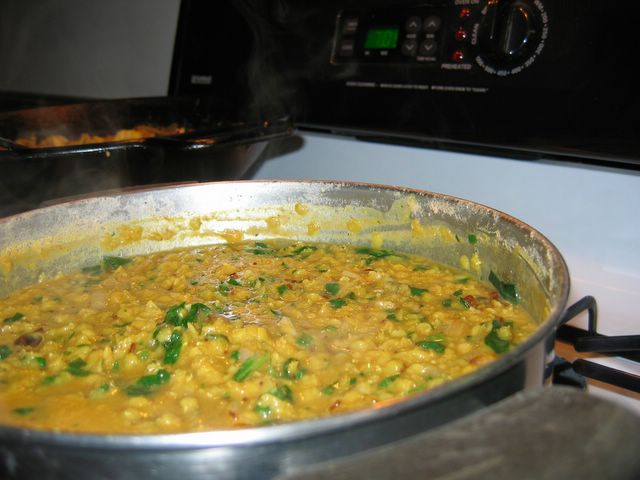
The finished dal. After adding the tarka with the greens, turn the heat down to low or remove from the heat to preserve the fresh color and flavor of the greens. Chicken vindaloo with mangoes is in the wok in the background.
Saag Masoor Dal
Ingredients:
1 pound red lentils, picked over, rinsed and drained
1 1/2" cube fresh ginger, peeled and grated
1/2 teaspoon ground garam masala (you can buy this pre-mixed and ground if you like)
1 big pinch ground asafoetida/hing
1 tablespoon ground turmeric
1/2 tablespoon ground sweet paprika (optional)
salt to taste
water as needed
3 tablespoons ghee
1 large onion, peeled and sliced paper-thin
4 cloves garlic, peeled and sliced paper-thin
1-3 fresh chiles, washed and sliced thinly on the diagonal (seeded if you like)
12 fresh ramp bulbs, washed, trimmed and sliced paper thin (optional--if no ramps available, use more garlic, or perhaps a single leek)
1 tablespoon whole mustard seeds
1 tablespoon whole cumin
3/4 pound fresh spinach or other greens, washed, dried and roughly chopped
2 cups fresh ramp greens, washed, dried and cut into a 1/4 inch chiffonade
Method:
After picking over, washing and draining lentils, put them in a pot with enough water to cover by 1 inch, along with the ginger, garam masala and asafoetida and bring to a boil on high heat. Turn down heat to medium, and simmer uncovered. Skim foam from the top of the lentils until it stops bubbling up, and when they are halfway cooked, add salt to taste. Add water as necessary until lentils completely soften and begin to break down.
Allow lentils to completely break down into a slightly lumpy puree; some of the lentils break down faster than others. This is good: it gives the dal more textural interest than a perfect puree would.
At this point, the lentils are a kind of pale, faded shade of yellow. To perk up the color, stir in the turmeric and if you wish, some paprika. This is a common practice in Indian cookery to give foods a more appetizing color.
To prepare the tarka, in a heavy skillet, melt ghee. Add onions, and a sprinkle of salt. Cook on medium heat, stirring constantly, until the onions are a dark golden color. At that point, add the chiles, garlic and ramp bulbs, and keep cooking (don't stop stirring) until the onions are a medium reddish brown, the chiles are browning on the edges and the garlic and ramps have turned golden. Add spices at this point, still stirring, and continue cooking until they become fragrant and the mustard seeds have started to pop. At this point, add all of the greens and stir to coat with the ghee, allowing them to wilt a bit.
As soon as the greens wilt, add them to the hot dal, and stir everthing together. Taste and correct for salt.
This dal is particularly good when served with yogurt or a raita, and of course, bread.
Friday, April 22, 2005
Once Upon a Time in China and America

"Stinky Ox Among Lilies." Or, to be blunt, bison and ramp stir-fry. The bison is amazingly tender and flavorful and the ramps mellow considerably in the high heat of the wok. It is a nice switch on a beef and garlic flavor profile.
This is a story.
About a wok, a hunk of buffalo meat and a handful of wild garlic.
In other words, a wok, a bison steak and some ramps walked into my kitchen, and the wok said, "Hey, guys, come over here and meet my friend, the stove." The bison steak and ramps looked at each other and said, "Why the hell not?"
And the rest, as they say is history. Okay, it only happened Wednsday night, so it isn't old enough to be history, but it at least makes for a good blog entry.
And the ramps and steak didn't walk in, I carried them.
In fact, the ramps, I dug up with my very own hands from the woods at our old place in Pataskala yesterday. They gave our car a nice fragrance as we drove home, and then I carried them up to the kitchen to clean them so I could put them in the fridge for the next evening's dinner.
These ramps are fairly mature, so they actually had bulblets at the end of their stems; these you have to clean very carefully. They have a papery membrane, like a less well-developed onion skin, loosely covering the bulbs, and this has to be removed. Then you rinse carefully, and pull or cut off the root end. To store them, I wrapped them in damp paper towels and put them in a loosely closed paper bag. They will keep for several days like that.

Here is a comparison between an uncleaned ramp bulb and a cleaned one. The dirt clings to the papery membrane that is similar to an onion skin. Cleaning is a simple matter of stripping off the membrane, breaking off the root end, and rinsing everything well. I generally wait until I am ready to use them before breaking off the roots.
I only cleaned the ones I was going to use the next day. The paper membrane helps keep them fresh, so I put the unwashed ones that were still coated in forest dirt in a second paper bag and closed it a bit more tightly and put them into the fridge as well. They will keep a couple of days longer that way. They are going to be featured in the Indian food extravaganza that is being cooked up later today in preparation for having friends over for the first "having friends over" thing in the new house.

Cleaned mature ramps showing the gradation of brilliant color: icy white bulblets, garnet stem and verdant leaves. All parts of the ramp are edible and very flavorful.
For now, let me talk about the ramps and bison fusion.
The bison meat was a sirloin steak that I trimmed and cut into thin strips for stir frying.
I decided that I wanted to very strongly feature the meat and ramps, so I kept the other seasonings fairly subtle. I thought of going totally Cantonese in style, but discarded that idea; I am still better at "winging it" in a more Sichuanese style, so I brought out the chiles and Sichuan peppercorns, though I was very careful to use them in a subtle fashion. I was careful to use only light soy sauce and Shao Hsing wine (unsalted--I found out that the local market carries it of drinking quality!) instead of using dark soy which is more usual with beef. I did not use any other condiments but a bit of shredded ginger.
For vegetables, I went with carrot, jicama and Shanghai bok choy. And of course, the greens of the ramps--I used roughly two cups of them which is enough to consider them a vegetable.
I used the bulbs and stems of the ramps minced in place of garlic, and I used a bit of onion cut into strips and ginger cut jullienne to round out the flavors. A drizzle of sesame oil finished everything off.
Zak suggested a name for this dish: "Strong-Scented Ox Among Lilies." I prefer "Stinky Ox Among Lilies." Saying "stinky" harkens to a favorite Chinese ingredient, "stinky tofu," and it satisfies my urge to give my dishes fun and funky names.
"Strong-scented" or "stinky,"refers not only to the fact that bison have a distinctive odor when you visit them up close (we went to a friend's bison ranch up in Massachussets a few years back) but also to the strong scent that the ramps have. Ox, of course, refers to the bison. Lilies refers to the ramps; all alliums, including ramps, onions, garlic, chives and leeks are members of the lily family.
So, the poetic name is full of double entendre and wordplay--a Zak's favorite sort of linguistic game.
It turned out well. As Dan Trout put it, "Oh, Barbara. It is ass-awful as usual. We'll have to eat all of the evidence just to protect your reputation." Thus stating his opinion, he tucked in and made good on his promise. What a trooper. I don't know what I would do without my friends!
The bison is remarkably tender and has a delicious flavor that is not gamey, but not exactly like beef, either. It is somewhat sweet, which makes it a good match for the ramps. And, as I noted above, the high heat of the wok seemed to bring out the sweetness in the ramps, so the entire dish was strongly flavored, but in a thoroughly pleasant way.
I believe it was a successful experiment in fusing Chinese technique and condiments with native American foodstuffs.
Wednesday, April 20, 2005
Bean Cuisine I: Country French Flageolet Stew
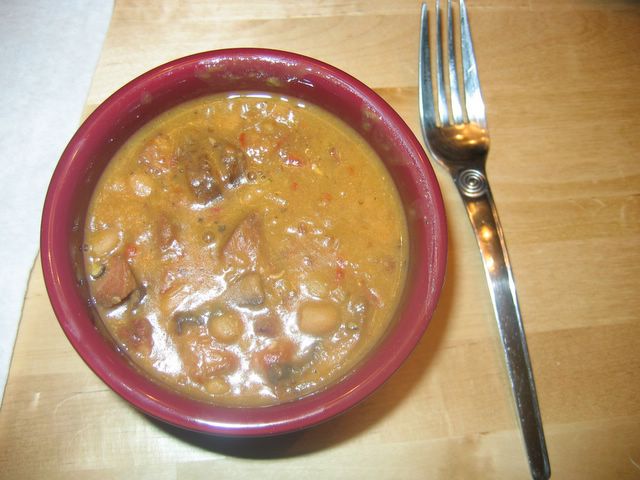
This is the first foray into inventing new ways to eat beans: flageolet beans with a country French flavor utilizing what was in my pantry.
So, I vowed as I was packing my pantry to create a new bean dish a week once I was settled, in order to pare down the collection of legumes lurking in my cabinets. Well, I am somewhat settled, and though the legumes are lurking not as planned in a pantry, but intsead are still in boxes in the basement, it does not matter. It is time, high time, to start consuming the wee dried beasties.
So, in order to make something delicious to go with Zak's latest boule of cardamom-scented bread, and in order to feed the in-laws who are really into hearty stews and soups, I dragged out a pound of flageolet and proceeded to dig around in the freezer and spice cabinet to see what I had that would go with them.
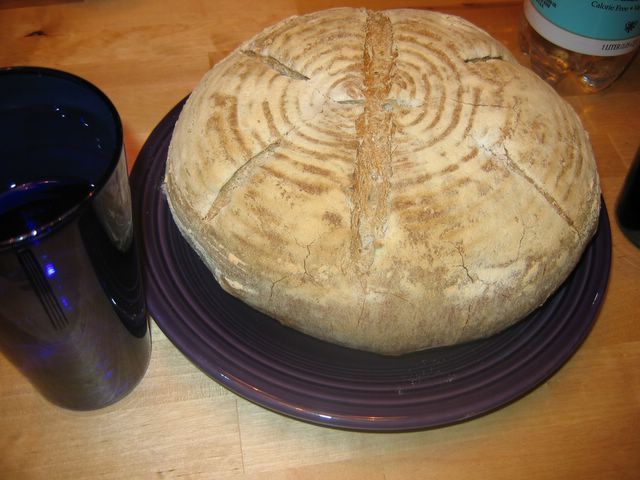
Zak's latest boule: a cardamom-scented bread. He was pleased with the slashings. He did not use a lame, but a special folding utility knife we bought at the hardware store--it is sharper than the lame and the cuts are cleaner.
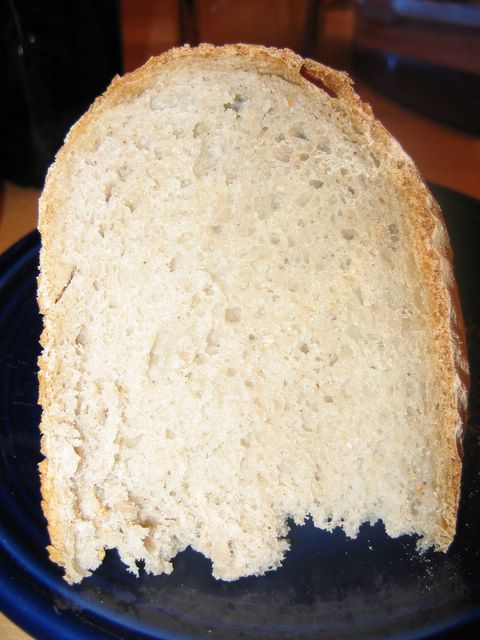
This version of the bread used only all-purpose flour and kamut. Here you can see how it results in a fine textured crumb. I prefer the versions with the bread flour in addition to the other flours; I like the chewier texture with the large irregular bubbles in the bread. I think it is more interesting, but Zak likes them both, so I guess we will alternate between versions.
While I had some delicious locally made spicy sausages and produced hickory smoked ham, I was lacking in duck and lamb, so there would be no real cassoulet. Which is fine: I felt no need to spend days making the dish. The idea is to use up beans, not exhaust myself cooking. Besides, I am supposed to be -creating- new dishes, not recreating authentic ones.
So, the spicy pork sausages and ham were in, the duck and lamb were out.
Leeks were abundant in the refrigerator, as were carrots. I had both fresh and dried mushrooms, dry red wine and plenty of sage, thyme, rosemary, lavender, and French basil. Most excellent. And green and black peppercorns. And bay leaves. So, all of those were pulled out and arrayed on the counter.
I also had some oil-cured sundried tomatoes. That sounded tasty to me, so out they came.
You will note a distinct absence of fresh garlic; Tessa's stomach reacts badly to garlic, so I decided to leave it out of the equation, even though my instinct is to put it in everything but desserts. With all of the leeks, there was no real need for the garlic, but if you cannot live without it, get on with your bad self and throw some in. Just don't invite Tessa over.
I cooked this in the crockpot, as we were going out all day. It turned out divine when cooked low and slow. Another way to do it would be in a covered casserole or Le Creuset dutch oven in a very low oven for a long time.
Here is the recipe:
Country French Flageolet and Pork Stew
Ingredients:
4 tablespoons olive oil
3 fresh leeks, sliced thinly, rinsed and dried
1 slice smoked ham, cut into cubes
1/2 pound spicy fresh pork sausages (I used locally produced "Cajun style" bratwursts"), removed from the casing and sliced
black pepper to taste
2 fresh portabello mushroom caps, gills removed, and cut in half then sliced thinly
6 Chinese black mushrooms, soaked in red wine, then squeezed out, stemmed and cut into quarters
1 teaspoon dried thyme
1 teaspoon dried rosemary
1/2 teaspoon celery seed, crushed
1/2 teaspoon dried rubbed sage
1 1/2 teaspoon dried basil
1 teaspoon red chile flakes
1 bay leaf
6 oil-packed sundried tomatoes, diced finely
wine from mushroom soaking and another 1/4 cup or so of it
1 pound flageolet beans picked over and rinsed, then drained
1 1/2 quarts chicken stock
1/2 cup baby carrots cut into round chunks
Method:
In a large saute pan or skillet, heat up oil until it is smoking. Add leeks, and saute until they begin to turn golden. Add ham chunks and sausage, then the portabello mushroom slices. Cook, stirring, until everything takes on a nice golden brown color and smells really good.
Add Chinese mushrooms, and all the herbs and spices, the bay leaf and the tomatoes. Cook another couple of minutes. Deglaze the pan with the wine from the mushroom soaking and some extra wine. If you want to add more than a 1/4 cup extra, that is fine with me--do what you need to do to make the dish really tasty. Have a sip of wine while you are at it. You have to make sure it is good, after all.
Allow alcohol to simmer off of the wine. Stand over it while it is cooking and breathe deeply. You have to make sure it smells right, after all.
When the steam coming off the dish no longer has a distillery scent to it, take it off the heat and dump it in the crock of a large crockpot. Add beans and broth. Put crock into heating base, turn heat up to desired temperature (depending on how fast you want it to cook) and put the lid on and walk away. Oh, and make sure the crock pot is plugged in. Someone in my family forgot to plug in the crock pot and then wondered why it didn't quite work right.
Come back about halfway through the cooking process. Add the carrot slices. Make sure you have enough liquid in there. If not, add some broth, some water or wine. Wine is best.
Put the lid back on and walk away and come back when it is done. Serve with a nice salad and a crusty bread.
When it is done, it is not pretty. The red wine messed up the pretty celadon color of the beans, and the entire thing is a rather orangish beige color. But it smells really good and has a lot of very distinct flavors and textures happening which come together into a really nice melange.
The fact that it was not pretty was mediated by the beautiful composed salad with the pansies and the beautiful bread.
I guess I should work on making up bean recipes that not only taste good, but look good, too. Hrm.
We'll see what I come up with this week.
Tuesday, April 19, 2005
Eating Bitter, Part Two: The Bitter Melon and Me

A poetic name for a lovely dish: Phoenix and Jade with Blossoms.
The very first time I tasted a bitter melon was at the home of the couple who were my very first personal chef clients. He was from Bangledesh, and she was from Pakistan, and they both loved bitter melon.
One evening, they had Zak and I to dinner and they served us various dishes, including one that was a heated up leftover. When it was passed to me, there was an apology and much head-shaking and hand-waving. "You probably won't like it, but if you want to taste it, we would be glad for you to. But it is very bitter, very strong, and most Americans really don't like it."
They didn't know the English word for it: they called it, "karela."
It had been cut into small half-moon shaped chunks and fried with minced lamb, onions, garlic, ginger, chiles and many spices, including black pepper, cumin and black cardamom. There was a lot of minced mint sprinkled over it.
It smelled really good, so of course, I had to try it.
As soon as I bit into it, I realized what it must have been. "Bitter melon," I said, as they watched me intently. I think they were waiting for me to make a face. Instead, I smiled, and had another big bite. "This is good," I said. "I've always wanted to try it, but had no idea how to cook it. They eat it a lot in China, you know," I said as I reached for the serving bowl to add more to my plate. I was surprised by having a heaping pile added to my plate, which I ate gleefully, much to the amusement and amazement of my hosts.
I figured Zak wouldn't like it, though, because it was so bitter. He declined to test my theory by tasting it, so I was certain that I was probably a mutant.
Because I assumed Zak wouldn't like them, I would eye the bitter melons in the Asian markets wistfully, but because I wasn't sure how to go about cooking them, and I thought it foolish to cook them just for myself, I would pass them by.
However, all of that changed a few months ago.
I wrote about our first dinner featuring bitter melon on this blog back in January when I described eating it at Shangrila in Columbus. I saw the words on the menu: "Chicken with Bitter Melon", and had to have it. When the waitress brought it out, she said to me, "Boy, you sure know what to order! That is my favorite dish on the menu out of everything and I eat it at least once a week. At least."
I had a bite, and it was love. I couldn't get enough of it.
Zak tasted it tentatively and pronounced the melon "interesting," but the chicken "fantastic." They were cooked with fermented black beans, and judging from the slightly silken texture of the bitter melon, it had been parboiled before being stir-fried. There were onions, and while I saw no evidence of ginger, the flavor was there, leading me to believe that a chunk of it had been allowed to brown in the oil, then was removed, leaving behind its essence.
The next time I got the dish, Zak had a couple more pieces of the melon. Then, the next time, he ate a half-dozen pieces. Then the fourth time, he was eating as much melon as chicken. (I have to admit to ordering the "Chicken with Black Beans" dish, which is the exact same thing without the melon once, but the sauce wasn't as good without the juice of the melon in it.)
He has been converted.
That time when we were there, the lady who owns the restaurant told us that bitter melon is very healthy for people and that she doesn't eat it, but drinks the juice of it every day for her health as a tonic. She said it controls blood sugar problems and is good for liver functioning.
I did a little research and found out that she was right--it is very good for you.
But of course, I was all about eating it because I liked the taste.
When we took Morganna to that restaurant, we figured she would love the chicken, but would not like the bitter melon.
She surprised us both with her enthusiastic consumption of a large quantity of bitter melon, along with chicken. She also ate a bunch of choy sum with garlic, tofu and pork soup and gai lan with beef, and was still able to down a small bowl of sweet warm tapioca with lychees. Oh, to be a growing teenager again!
So, what it comes down to is Zak and Morganna and I are a family of American mutants.
We like that which we are supposed to fear--bitter melon.
And now that we have moved away from Shangrila, I had to figure out how to cook it, because I am not driving an hour and a half each week just to eat bitter melon. The Asian market here in Athens carries it now and again, and when I am in Columbus, I can pick some up at the markets there that carry it all the time.
Which is what I did on Saturday.
We had gone with Zak's parents to Shangrila for lunch, then we dropped them off at the airport so they could fly home. After that, we did some shopping in Columbus, including a trip to the Asian market, at fifteen minutes before closing time.
I had ducked in the door, and beelined right for the produce section. In addition to the bitter melon, I wanted to pick up fresh water chestnuts if they had them, and some good Thai chiles. The chiles they had, the water chestnuts they did not. But they did have bitter melons, so I stood before the pile and made my selection. I sniffed them, squeezed gently and put six in my basket.
I was about to turn to go when I nearly ran smack-dab into the chest of a very tall Pakistani man, who demanded of me in a raspy, heavily accented voice, "Why do you get that?"
I blinked, and backed up, somewhat confused. I looked up, and then around to see his entire family: a wife in a lovely sari, and four kids, and a grandmother in a blue salwar-kameez, all of them staring at me with wide eyes.
I blinked and he picked up one of my melons and said, "How do you cook it?"
So, I said, "With fermented black beans, onions and chicken."
He smiled and nodded. "It is very good for you, very good. Healthy."
They were all smiling.
I smiled.
"In my country," he expounded, "We cut it up small, and fry it. Onions, garlic and ginger, all make it good."
I nodded. "With minced lamb, pepper, chiles and cumin, and black cardamom."
His smile widened and he nodded, "Good, good, yes, you know."
His wife smiled and patted my arm. "We have never seen a white American eat them. We thought none of you liked them."
I shrugged and said, "My husband and daughter like them, too."
The pater familias said, "Good, you will all be healthy, live a long time. Food is medicine, you know. Eat good food, it makes you strong."
Then he looked around and said, "They are closing the store--we should go."
Though, I was gratified to see him pounce on someone else's basket in the line and quiz him about what he was buying, how he would cook it. The man was Chinese, so I decided that it was just this family's way of making friends with everyone--looking at food and how it is cooked and trading recipes.
When I got to the cashier, she rang up my black mushrooms, chiles and then got to the bitter melon. As she weighed it, she smiled. "This is good as salad, in the summer. It cools you, and makes you healthy. You should try it that way."
When I got back to the car, it was dark, and our lunch from Shangrila had worn off so we went across the parking lot to our other favorite little Chinese restaurant, the Hometown Oriental Carry-Out and Deli. The owner came over and was glad to see us; she knew we had moved away and that we would be back only sporadically. When I told her that we had to stop at the market for bitter melon, she said, "Oh, that is the best in soup--very healthy. Have it at least once a week to make you have a good strong liver."
Everyone has a recipe for bitter melon, it seems.
Including me.
I based mine on one I found in Martin Yan's Yan Can Cook Cookbook that was for Beef with Bitter Melon, which looked like it approximated the flavor profile of my favorite dish from Shangrila.
I added ginger slivers and thinly sliced Thai chile. Though they are both Cantonese, Martin Yan and Ken Hom say that bitter melon is very good with chile; knowing as I do that the slight bitterness of lime oil is very good with chiles in Thai food, I decided that bitter and hot go together well. For a more Cantonese sort of dish, leave these two out and only use ginger juice or ginger oil in the chicken marinade, or cook a big hunk of fresh ginger in the stir frying oil until it browns, then remove it and stir fry as directed to get the flavor without the ginger itself.
Also, I followed Kasma Loha Unchit's advice and did not blanch or parboil the melon in any way. She believes you lose flavor in that way and she doesn't like the way it changes the texture. I have to agree with her; at this point after having it both ways, I prefer just stir frying it the way I did to the way it is done at Shangrila.
As for the garnish in the photographs--it is redbud blossoms. Redbud is a native American leguminous tree, with tiny purple flowers that have red stems and calyxes. The flowers are edible and have a sweet flavor that is a cross between a bean pod and a honeysuckle blossom. It is completely untraditional to use them, but the color was an amazing contrast with the brilliant green, and the flowers are in season, so of course, I had to do it.
I wanted to give it a poetic name, so I called it, "Phoenix and Jade with Blossoms." Chinese chicken dishes are often named for the phoenix of mythology, and of course, jade is in honor of the brilliant color of the stir-fried melon.
The blossoms are self explanatory; use whatever flowers or petals are in season and which will complement the colors in the dish.

The ingredients for the dish arrayed on the stove: for a more classically Cantonese flavor, leave out the ginger slivers and chiles.
Phoenix and Jade with Blossoms
Ingredients:
2 medium sized bitter melons
1 small onion cut into half, then into slices
1/2" cube fresh ginger cut into slivers
2 Thai chiles, cut into very thin diagonal slices
2 tablespoons fermented black beans
1 boneless skinless chicken breast cut into thin, narrow slices
1 teaspoon thin soy sauce
1 tablespoon cornstarch
1 teaspoon thin soy sauce
1 teaspoon sugar (optional)
1/4 cup chicken broth
edible flowers for garnish
3 tablespoons peanut oil
1/8 teaspoon sesame oil
Method:
Cut bitter melons in half longitudinally. Scrape out seeds and pithy interior. Slice diagonally into 1/4" half-moon shaped slices.
Marinate chicken in one teaspoon of soy sauce and cornstarch for at least fifteen minutes.
Heat wok and add peanut oil. When it is smoking hot, add onions, then ginger and chile and black beans. Stir and fry about two minutes, then add chicken, spreading it out to form a single layer on bottom of wok. Leave it for at least one minute to brown on the bottom, then stir fry until nearly done. Add bitter melon and continue stir frying for one minute. Add sugar and second teaspoon of soy sauce and stir frying about thirty seconds, then add broth and stir and fry, allowing liquid to reduce until it clings to the chicken and melon slices.
Drizzle sesame oil over and give one last good stir.
Pour onto platter and garnish with flowers.

A closeup of the dish shows the fantastic contrast in colors and textures. When redbuds are not in season, one could use violas, sweetheart rose petals or chive blossoms for the flower garnish.
Monday, April 18, 2005
Eating Bitter, Part One: An Introduction to the Bitter Melon

Still life with bitter melon, Thai chiles and a branch of redbud.
Bitter melon( Momordica charantia) is an extremely popular vegetable in all parts of Asia. Though it is eaten with great delight in India, China, Thailand and Japan, it looks rather like a diseased cucumber with its warty, gnarled skin. Indeed, it is a member of the cucurbita family from whence comes cucumbers, squash, melons and gourds.
Also known as bitter gourd, balsam pear, fu gua, and ku gua, the bitter melon is not well liked or known in Europe or the United States, probably because it lives up well to its name.
It is bitter.
However, bitterness is not the only flavor inherent to the vegetable. It has a very cooling astringency to it, and there is the slightest hint of sweetness to it, particularly when you are eating one of the lighter yellow-green specimins which is more mature than the very young darker green ones.
The bitter melon is grown in tropical areas, as it likes long, hot, humid summers. A very juicy vegetable, in the very complex system of Chinese medicine which is based in Taoist beliefs on the subject of life energy as well as scientific experimentation and observation, the bitter melon is seen as having a cooling effect on the body's chi, or energy system, and so is consumed in great quantity in the summer. In tropical Asia, it is prized not only for its cooling juices, but also for its less mystical medicinal qualities: the compound which makes it bitter is quinine, and so the vegetable is used in many countries to fight malaria. It has also been used successfully to cure adult onset diabetes, and scientists have found that an unknown compound present in the fruit will kill the HIV virus.
A nutritional powerhouse, bitter melon has high levels of iron, potassium, beta carotine, calcium and vitamin C; the vitamin C content is probably part of why it is used as remedy for the common cold in Chinese traditional medicine. It is also rich in phytochemicals and antioxidants, many of which have been found to have antibiotic and antimutagenic properties. Three compounds present in the plant have been found to be useful to lower blood sugar levels in patients suffering from non-insulin dependant diabetes.
So, in short, it may be funny-looking, and to some it may be bitter medicine indeed, but it is good for you.
However, just because something is good for you doesn't mean people will eat it.
It also has to taste good.
Bitter melon is an aquired taste. According to Kasma Loha Unchit, author of the wonderful Thai cookbooks, It Rains Fishes and Dancing Shrimp, while it is true that Asian people love bitter melon, it, too, is an aquired taste for them. Just as Thai children learn to love chile heat by trying it bit by bit, so too, is the taste for bitter melons learned over time.
Bitter melons are sold fresh in most large Asian markets. Choose one that is firm and shows no sogginess or bruised spots. The darker the green color of the skin, the more immature and thus more bitter the fruit will be. A paler, more yellowish green indicates a more mature fruit which will be less bitter. The fruits ripen to yellow with reddish streaks; some more mature fruits show reddish areas around and on the seeds.
In order to prepare them for eating, slice them in half longitudinally, and scrape out the seeds along with the spongy interior flesh. This is easily done with a regular teaspoon.

The interior of bitter melon is packed with large seeds suspended in spongy material. These need to be scraped away before the fruit is eaten.
The hollowed out halves can be stuffed with minced seasoned pork or lamb and steamed. Or, slice the fruits in whatever shape you wish.

The edible flesh is that which is left after the spongy matter and seeds are scraped out and discarded.
In order to remove some of the bitterness, they can be blanched for about a minute and a half in boiling salted water, then drained and put into ice water. Or they can be degorged by salting them and allowing the excess juice to drain away just as one does for eggplant; however, if you do choose this method be certain to rinse the fruit well before continuing your preparation, or they will be too salty in flavor.
Look for Eating Bitter, Part Two: Bitter Melon and Me, tomorrow for my favorite recipe using my new favorite vegetable.
I Scream...
So, thanks to Kris, the nameless ice cream with ginger and lavender now has a name: Creme Glace Chinoise. Kris; I would send you a pint of the ice cream in question as a tangible thank you, however, I fear it would melt by the time it got to you. By then, most of what makes it charming would be less than palatable.
More later.
More later.
Saturday, April 16, 2005
Ice Cream Fusion Reaction
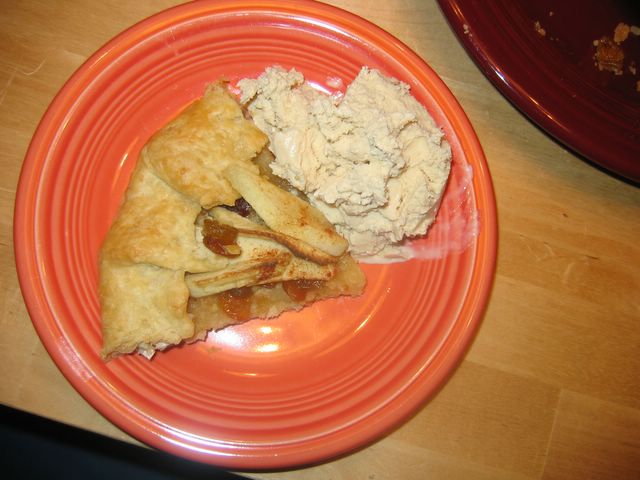
Lavender-ginger ice cream beside an apple galette with golden raisins and dried cranberries. This time, when I added the raisins, cranberries and almonds to the filling, I put them -under- the apples, rather than on top where they burned last time. This worked perfectly, I am pleased to report.
I don't often make desserts.
Mainly, that is because I prefer cooking to baking, but also, because most of the time when I cook, most people eat so much of the dinner that they seldom want dessert until the next day.
Which is fine if people are staying for the weekend, but not so good if they are only there for the evening.
But, now and again, I like to make a sweet thing, like a batch of brownies, a pan of shortbread, maybe some scones, or for really special occasions, such as cherry season, a pie. Or in the case of Meyer lemon season--lemon bars.
Ever since I learned how to make galettes for the raclette class I taught back in January, I have been into making them because they really are a simple, quick but foolproof casual dessert. Now that the step of making and rolling out pie crust doesn't intimidate me or give me hives, I actually think of galettes as fun. The simple nature of the fillings certainly appeal to my tendency to improvise, and since we were having an essentially country French dinner last night, I figured a galette was in order.
But, I felt that I wanted to do something more.
As lovely as galettes are, they can look rather nude on the serving plate, and since I adore my in-laws, I wanted to zing up the presentation. I was not into making a dessert sauce, like creme anglaise or a caramel-nut sort of dealiebob. Nor did I want to make whipped cream, as that is rather done and somewhat trite. While I could have run out and picked some violets and crystallized them, I was having pansy blossoms in the salad, so that would be a bit on the repetitive side.
But the flower idea kept haunting me, it being spring and all, so I went to my cupboard and found the dried lavender, and I got to thinking.
Lavender is often used in savory dishes in Provence, so why not use it in something to go with the galette?
Like, say, oh, homemade ice cream?
Oooh. Ice cream.
Yeah.
Tessa and Karl both -love- the frozen dairy products (as do I), so it was a natural.
Of course, I thought of this about four hours before dinner was to happen, so I didn't really plan ahead.
I knew where the ice cream maker was, as I had found it in my unpacking adventures two nights before. I knew where the rock salt was. So what if I didn't know if I had enough ingredients?
My ice cream maker is a Rival model I bought at Target about six years ago for the measley sum of eight dollars, because it was the end of the season, and they wanted to be rid of them. It is a tiny electric critter that makes two quarts, but hey, for eight bucks, who is going to argue?
So, I dragged it out, and looked in the instruction book for a vanilla ice cream recipe.
Now, even though it is only a two-quart model, all of the recipes in the little instruction booklet (which makes ice cream making sound a lot harder than it really is) that came in the box are for four quarts, which is not only excessive when I am talking about dessert for four people, but a physical impossiblity for my equipment. So, already, I am going to be improvising.
So, since I was already improvising and altering the recipe considerably by cutting it in half, and adding lavender to the mixture, I figured, why stop there? Why not make a few more tiny little changes?
Like why just flavor it with lavender and vanilla?
Why not add something else?
Like, oh, say, uh, ginger?
You just knew I would have to sneak some Chinese ingredient in there somehow, didn't you?
Well, yeah, I am that way.
I hadn't gotten to cook them Chinese food, so I figured I'd take my country French dinner and throw an Asian curve ball into the works and see what happened.
What happened was rather tasty: lavender and ginger go well together. Which is a good thing, because I wasn't satisfied with one form of ginger, but instead, used three different kinds of it, just for kicks.
I also ended up using a cup of whole milk sour cream in it, because I didn't have enough heavy cream and had no half and half like the recipe I was adapting used. It turned out to be an inspired choice; the tang was a welcome addition to the mix of flavors. I also lowered the amount of sugar called for and instead of regular granulated sugar, used evaporated cane juice, because it has a more complex flavor profile.
I have to admit, however, that I have not come up with a good name for the ice cream, so for the moment, it will have to be known quite simply as
Lavender-Ginger Ice Cream
Ingredients:
1 cup 1% milk
2 tablespoons dried lavender buds
1/2 teaspoon dried ginger
3/4 cup evaporated cane juice or sugar
2 tablespoons honey
pinch salt
1 tablespoon vanilla extract (I used Penzey's double strength)
2 cups heavy cream
1 cup sour cream
4 tablespoons finely minced crystallized ginger
1" cube fresh ginger, grated finely
Method:
Heat milk, lavender buds and ginger in a heavy bottomed saucepan on low heat for five minutes. Bring to a near boil to scald milk, remove from heat, and stir. Allow to sit and steep at least fifteen minutes. The longer you steep, the more lavender flavor you will extract.
Strain buds out of milk, and bring back to scalding temperature. Add sugar, honey, and salt, stir until dissolved. Add remaining ingredients, and whisk briskly to incorporate sour cream.
Pour into ice cream maker and freeze according to manufacturer's instructions. Makes about two quarts.
Friday, April 15, 2005
Flower Power

To commemorate the first day of the growing season, I served a salad with roasted spring beets, ripe pears, mixed greens, goat cheese and almonds garnished with a single pansy from my garden.
Zak and I made dinner for his parents tonight; he had to show off his new bread-baking skills, so I planned and made a meal around his spiced boule.
My first course was a salad of seasonal greens, roasted beets, anjou pears, strong, pepper-encrusted goat cheese and almonds with a very basic (four ingredients) balsamic vinaigrette. It is a simple salad, which I presented in an artistic composition on a plate. What made it special was the garnish of a single homegrown pansy blossom.
Flowers in or on food evoke strong reactions.
The first time I served my daughter, Morganna, a Thai red curry garnished with nasturtium blossoms, she recoiled and put the flowers to the side of the plate and utterly refused to eat them. "That is just too weird, Mom," she declared as Zak and I scarfed ours down and then gobbled hers up, too.
At our housewarming party for our first home, my father curled his lip at the melange of greens, fruits and flower petals in the salad bowl, and gingerly picked his salad so that it was free of daylilies and roses. He only tasted one at the insistence of Zak's grandfather's ladyfriend who prevailed upon her age and charm to shame my Dad into trying something new.
But it was obvious to me that he didn't like it.
Zak's parents had no such reticence to the pansies on the salad tonight. Tessa noted that it had been a long time since they had eaten flowers, while Karl popped his in his mouth and said that it tasted better than nasturtiums and went well with the beets. He also insisted, when I was photographing the salads before serving them, that I photograph his plate, "because it is the prettiest." So, now you know--the illustration above is a salad just minutes before being consumed by my father-in-law, the fearless gourmand.
I wonder why flowers disturb some diners so much. Is it because they are so pretty we hate to destroy them by eating them? If that is the case, then icing roses would never be snitched from birthday cakes, and no one would ever touch a gem-like fruit tart.
Is it because the colors are so vibrant, and are often ones which we do not associate with food? Perhaps that is part of it; I know that my father has problems with my propensity for eating and serving foods that while naturally colored, are not what most Americans think of as normal. Like cornbread made from blue cornmeal, or fully ripe but naturally green Green Zebra tomatoes. Or, worse yet, blue potatoes, which look quite unnaturally lavender in hue when mashed.
Is it a culinary taboo? Is it because we are warned against eating flowers as children, because so many of the lovely things are poisonous. Daffodils and hyacinths, though they look and smell divine, are poisonous, though they are not nearly as lethal as the lovely aconite and digitalis.
Is it because flowers are tokens that still have strong meanings for us? They are offerings we give to symbolize love at weddings and funerals. They once were offerings we gave to the gods--do we see them as something that we mere mortals should not eat because we are not worthy to consume such beauty as if it were simply another foodstuff?
For whatever reason, flowers have power, not just in the garden or our psyches, but on our plates, too.
And it felt pretty good to serve a single flower on each salad to my family on April 15th, which here in Ohio, is the official first day of the growing season.
And if you are interested, here is the recipe for the vinaigrette--which isn't so much a recipe as a guideline: Use one part good balsamic vinegar to three parts good olive oil. Add wildflower honey and aged tamari soy sauce to taste. Shake to combine, and serve. This salad dressing is good with any combination of greens, fruits, nuts, and vegetables, though I particularly like it with roasted beets, pears and good strong, creamy goat cheese.
Thursday, April 14, 2005
Plastic Not-So-Fantastic Strawberries
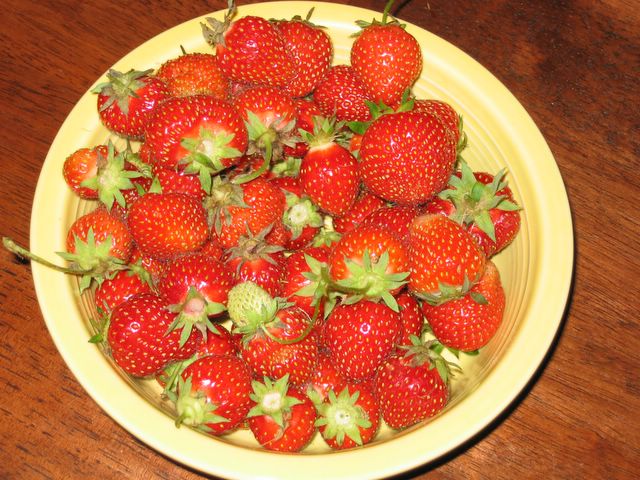
Really fresh and really local: strawberries from our first harvest last year. They were completely superior to the ones available in the grocery store in every respect.
Is it just me, or have the strawberries you get in the grocery store become prettier and less flavorful over the past few years?
They are large, they are red, they are shapely and fragrant, but the fresh strawberries that are flooding the stores here in Ohio, which are predominately grown in southern California, have little to no taste and are a bit on the crisp side, which is great when we are talking about apples, but not so enticing when it is a strawberry I have nearly broken a tooth on.
Last spring is when I noticed that they all smelled really, really good--like sunripened strawberries still in the field. Which is what seduced me into buying a pint of them.
That one pint scented my entire car (a Subaru Forester), which is not small, meaning that little pint of gigantic strawberries was either endowed with a great deal of natural sugars and flavor, or it was made by the Yankee Candle Company. (Which I call Stanky Candle, because walking past one of thier stores with its melange of overly-fragranced candles is a sort of olfactory purgative for me.)
When I got home, I ripped open the clear clamshell package and rinsed off a berry. The sweet scent poured out of the fruit and I all but drooled down my chest in anticipation.
However, when I bit into the overly crisp, but lovely crimson fruit, I was distinctly underwhelmed.
Actually, I was deflated.
It tasted vaguely like watered down, barely sweetened strawberry flavored Kool-Aid.
I thought it was an anomaly.
I tried another berry.
I was wrong.
They were horrible, and they could very well have been made by Stanky Candle, for they were insipid to the point of pointlessness.
Yet, the next day when I went to the store, they were all but sold out.
Which led me to believe that either I was a freak of nature and just couldn't taste the berries, or everyone else was getting duped along with me, or, everyone else happened to like crappy plastic flavorless berries that just happen to look and smell good.
Which led me to believe that the berries were bred to smell and look good, and ship well, but that the genetics for taste were somehow left out of the equation. Which works pretty well, if you think about it--once the grocery store has your money, what are you going to do about it? It isn't like the strawberries are rotten, they are just not good. But they aren't something you are going to get a refund on, right?
Zak agreed with me that they tasted like, well, nothing, really, and that maybe I wasn't just being paranoid about agribusiness trying to take over the food world and inundate us with worthless food items wrapped up in pretty packages with bright colors and nice smells in order to trick us into buying them. This article in the New York Times confirms my suspicions that flavor has been sacrificed by commercial breeders in pursuit of a better looking berry. It is all a big hoax, a sham, those "seasonal" California strawberries, all tarted up in scarlet and smelling good, tricking consumers into thinking that is what a strawberry is about.
And we fall for it, because we don't taste before we buy.
Well, that was the last pint of commercial berries I have bought, and I felt better for it. Besides, we had our own strawberry bed that produced a huge crop that year, such that for several weeks, we ate strawberries for breakfast every day. After the experience of going out into our front yard and eating fresh sunwarmed berries first thing in the morning, neither of us had the stomach to tolerate substandard faux-fresh fruit anymore.
So, this year, even though we don't have a strawberry patch in the new house (yet), I will not buy any strawberries until the season for local berries starts here in May and June. There is just no point, because a pretty berry without flavor is just not worth the dirt it was grown in.
Tuesday, April 12, 2005
Bison, Part II
I really should have put this link on my last post, but duh, I was writing quickly and was on my way out the door to do a thousand errands to prepare for the furniture that is coming tomorrow and the refrigerator that is coming tomorrow.
The refrigerator completes the suite of necessary items to make the upstairs teaching kitchen functional--it now has a working sink, stove and by tomorrow, a fridge. I will then be able to really start thinking of opening up for business and start teaching. As I already have students lined up and ready, and neighbors vowing to send more my way....I might should think about pricing and suchlike.
In the meantime, however, back to bison.
Here is a link to the National Bison Association website that gives a clickable map of local producers who are listed with the association, as well as mail order sellers of bison meat. The fact that the ranchers and sellers are members of the association is a good thing--they all have a code of ethics regarding how they raise their animals and there is some oversight on how they treat their customers, so I would feel confident working with any of the folks listed on that site. Of course, I urge you all to buy as locally as you can; it is always best to know your farmer when you can manage it. Not only is it good to know where your meat comes from, farmers and ranchers are right fine folks to talk with, and if you show an ounce of interest in what they do, they will give you a pound of knowledge and friendship in return.
I -was- going to stir fry some bison meat with ramps in a sort of Native American-Appalachian-Chinese fusion and report on it tomorrow night.
However, plans have changed.
Boy, have they changed.
Because not only do I have my daughter's bedroom furniture coming tomorrow, and a refrigerator, but the in-laws are arriving as well. Yes. In-laws. Whom I absolutely adore, and whom I was looking forward to seeing on Friday when my beloved Zak told me they were coming.
Only, apparently, he is unable to read email. They are coming tomorrow, and leaving on Saturday. Not coming on Friday and leaving on Monday.
Which is fine--just unexpected.
Which means we just spent the entire evening tearing through the house and turning it into a site of controlled chaos rather than just plain old godawful hellish chaos-on-a-stick.
And I still have to touch up my hair.
And Thursday, the new living room furniture is arriving. (Thank God the dining room furniture is being held up by the chairs having disappeared into limbo somewhere, so it won't be ready until next week. And thankfully, the contractors are still procrastinating and so are not going to descend in droves in the next couple of days to tear the house from stem to stern again. At least, I hope not.)
SO!
Look for a report on the Native-American-Appalachian-Chinese fusion bison dish next week, and hopefully, I will not die of excitement overload before then.
And between now and then, I will write other neat stuff. I promise.
Wish me luck!
The refrigerator completes the suite of necessary items to make the upstairs teaching kitchen functional--it now has a working sink, stove and by tomorrow, a fridge. I will then be able to really start thinking of opening up for business and start teaching. As I already have students lined up and ready, and neighbors vowing to send more my way....I might should think about pricing and suchlike.
In the meantime, however, back to bison.
Here is a link to the National Bison Association website that gives a clickable map of local producers who are listed with the association, as well as mail order sellers of bison meat. The fact that the ranchers and sellers are members of the association is a good thing--they all have a code of ethics regarding how they raise their animals and there is some oversight on how they treat their customers, so I would feel confident working with any of the folks listed on that site. Of course, I urge you all to buy as locally as you can; it is always best to know your farmer when you can manage it. Not only is it good to know where your meat comes from, farmers and ranchers are right fine folks to talk with, and if you show an ounce of interest in what they do, they will give you a pound of knowledge and friendship in return.
I -was- going to stir fry some bison meat with ramps in a sort of Native American-Appalachian-Chinese fusion and report on it tomorrow night.
However, plans have changed.
Boy, have they changed.
Because not only do I have my daughter's bedroom furniture coming tomorrow, and a refrigerator, but the in-laws are arriving as well. Yes. In-laws. Whom I absolutely adore, and whom I was looking forward to seeing on Friday when my beloved Zak told me they were coming.
Only, apparently, he is unable to read email. They are coming tomorrow, and leaving on Saturday. Not coming on Friday and leaving on Monday.
Which is fine--just unexpected.
Which means we just spent the entire evening tearing through the house and turning it into a site of controlled chaos rather than just plain old godawful hellish chaos-on-a-stick.
And I still have to touch up my hair.
And Thursday, the new living room furniture is arriving. (Thank God the dining room furniture is being held up by the chairs having disappeared into limbo somewhere, so it won't be ready until next week. And thankfully, the contractors are still procrastinating and so are not going to descend in droves in the next couple of days to tear the house from stem to stern again. At least, I hope not.)
SO!
Look for a report on the Native-American-Appalachian-Chinese fusion bison dish next week, and hopefully, I will not die of excitement overload before then.
And between now and then, I will write other neat stuff. I promise.
Wish me luck!
The Skinny on Bison
A long time ago, in a land not so far away, bison ruled the central plains. In great herds they roamed, grazing the prairie grasses in a web of interdependence between plant and mammal. The native tribes hunted them, and from their bodies came food, clothing, shelter, medicine, tools and household items. They were a gift from the Creator to the tribes, they were brothers, and a spirit in the form of White Buffalo Woman came to humanity and gave the sacred pipe ceremony as a means of communication between the Creator and humans.
And then, they were wiped out. Exterminated. Killed by white hunters with repeating rifles. Whole herds were felled, like clearcut forests, and the thunder of the plains went silent, and the grasses were plowed under and paved over and all was lost forever.
Or was it?
Bison were driven to the brink of extinction, but they have come back, helped along not only by environmentalists, but farmers.
Farmers who raise them, not as tame cattle, but as wild animals, and who sell thier meat, hides and horns to a steadily growing market.
Current estimates place the number of American Bison in North America between 270,000 and 350,000--a far cry from the pathetic 1,500 individuals left by the late 19th century. Most of these animals live on private ranches, according to the National Bison Association, though there are quite a few in public herds on protected ranges, such as Yellowstone National Park, and on Native American held lands.
Why are farmers and ranchers raising wild bison?
Mostly for their meat, though there is a steady market for the hide, hooves and horns as well.
Bison meat is nutrient dense and surprisingly low in fat. In each 100 gram serving of bison meat there is 2.74 grams of fat, as compared to the 10.15 grams of fat in the same sized serving of commercial beef or the 7.41 grams of fat in the equivalent serving of skinless chicken meat. It is high in protein and iron (which accounts for its darker color) and essential fatty acids. It is lower in cholesterol than beef or pork.
It also happens to taste quite good. Bison are range fed on native grasses and other browse plants, with hay supplements in the winter, and this leads to a naturally sweet flavor which is similar to beef, but slightly more complex. The texture of the meat is very fine and tender, provided it is cooked carefully.
There are two ways to cook bison meat--low and slow or hot and fast. Anything in the middle will gain you a very dry, tough, unpalatable cut of meat.
The lack of fat marbling in the meat means that it is best cooked moist heat, slowly. However, if you have a steak and want to grill it--it can be done (we just did it last night)-- provided that you cook it quickly and are careful not to overcook it. This means that you must know how to judge when a steak is done to your liking, or you can keep a good eye on the clock. I would suggest actually cooking a little less long than you would an equivalent beef steak--for example, the ribeyes we cooked last night were done after barely two minutes per side, when we cook beef ribeyes for at least three or four minutes per side.
I season bison similarly to beef; the seasonings I use for venison are too strong for bison, which, to my palate, does not have a characteristic "gamey" flavor at all. Last night, I simply rubbed the steaks with ground chipotle, salt, black pepper, dried thyme, a bit of cumin and garlic, and they turned out beautifully. The crust seared nicely and the interior was tender and well-flavored with just the rub. Nothing else was needed, though I can see that a bath in a dry sherry marinade would be a nice alternative.
My next mission is to stir fry bison and see what happens.
Maybe I will use ramps with it, too. Hrm...that could be very good.
And then, they were wiped out. Exterminated. Killed by white hunters with repeating rifles. Whole herds were felled, like clearcut forests, and the thunder of the plains went silent, and the grasses were plowed under and paved over and all was lost forever.
Or was it?
Bison were driven to the brink of extinction, but they have come back, helped along not only by environmentalists, but farmers.
Farmers who raise them, not as tame cattle, but as wild animals, and who sell thier meat, hides and horns to a steadily growing market.
Current estimates place the number of American Bison in North America between 270,000 and 350,000--a far cry from the pathetic 1,500 individuals left by the late 19th century. Most of these animals live on private ranches, according to the National Bison Association, though there are quite a few in public herds on protected ranges, such as Yellowstone National Park, and on Native American held lands.
Why are farmers and ranchers raising wild bison?
Mostly for their meat, though there is a steady market for the hide, hooves and horns as well.
Bison meat is nutrient dense and surprisingly low in fat. In each 100 gram serving of bison meat there is 2.74 grams of fat, as compared to the 10.15 grams of fat in the same sized serving of commercial beef or the 7.41 grams of fat in the equivalent serving of skinless chicken meat. It is high in protein and iron (which accounts for its darker color) and essential fatty acids. It is lower in cholesterol than beef or pork.
It also happens to taste quite good. Bison are range fed on native grasses and other browse plants, with hay supplements in the winter, and this leads to a naturally sweet flavor which is similar to beef, but slightly more complex. The texture of the meat is very fine and tender, provided it is cooked carefully.
There are two ways to cook bison meat--low and slow or hot and fast. Anything in the middle will gain you a very dry, tough, unpalatable cut of meat.
The lack of fat marbling in the meat means that it is best cooked moist heat, slowly. However, if you have a steak and want to grill it--it can be done (we just did it last night)-- provided that you cook it quickly and are careful not to overcook it. This means that you must know how to judge when a steak is done to your liking, or you can keep a good eye on the clock. I would suggest actually cooking a little less long than you would an equivalent beef steak--for example, the ribeyes we cooked last night were done after barely two minutes per side, when we cook beef ribeyes for at least three or four minutes per side.
I season bison similarly to beef; the seasonings I use for venison are too strong for bison, which, to my palate, does not have a characteristic "gamey" flavor at all. Last night, I simply rubbed the steaks with ground chipotle, salt, black pepper, dried thyme, a bit of cumin and garlic, and they turned out beautifully. The crust seared nicely and the interior was tender and well-flavored with just the rub. Nothing else was needed, though I can see that a bath in a dry sherry marinade would be a nice alternative.
My next mission is to stir fry bison and see what happens.
Maybe I will use ramps with it, too. Hrm...that could be very good.
Monday, April 11, 2005
Green Gold

The ramps are up, and my tastebuds are happy!
Spring is definitely here!
On Saturday, at the farmer's market, I came upon a nice young couple selling little bundles of freshly cut ramp greens as well as pesto made from ramps. Of course, I had to buy some, even though I knew I would be going out to our old house the next day to divide the perennials and bring some of them back to the new house.
I figured that if the ramps were up in Athens county, they likely were up in Licking as well; they are cold weather beasties, and the fact that Licking is a good bit north would play in their favor, rather than against them.

Detail of ramp leaves showing the brilliant spring green color and silken texture.
I was right. On Sunday, the first thing I did when I got out of the car was peer over the edge of the ravine in search of clumps of brilliant green lance-shaped leaves. I was not disappointed; clumps of green gold waited down in the bottomlands near the creek, half buried in last fall's leaf litter, thier violet and white roots cooled in the rich woodland soil.
So, I capered off with Zak to dig up irises, coral bells, foxglove, primroses, violets, bugleweed, forget me nots and foamflower from our huge perennial beds. (I am so going to miss that garden, but that is another story entirely.) But in the back of my mind, I kept giggling, "The ramps are up."
I ended up not gathering as many as I would have liked; we spent a longer amount of time digging up a huge amount of flower plants, and so I ended up just dashing down and carefully digging up a single clump. Which I promptly, upon dashing out of the car at the new house an hour and a half later, plunked down into the cool clay soil of the tiny strip of woods that borders our new house, in an attempt to try and establish them here.
I woke up this morning and checked on them. They are notoriously hard to transplant, but thus far, the leaves still stand, verdant and upright.
I still have many more plants to transplant today; hence the short post.
Last night, we had planned to cook on the grill, but we took too long with our digging up and transplanting mission; we were finishing our quick planting of the more tender plants last night in the dark and by the fitful light of the landscaping lamps. By that time, I realized that I had no idea where the grill brush was for the grill, and we were both too tired to go digging around in the huge number of boxes in the basement in the hopes of finding it.
So, I came up with plan number two:
Pasta.
I have been on a pasta kick, as you might well have guessed from my previous post about puttanesca. It is probably because it is springtime and I always head toward lighter fair as the days grow warmer. Besides, it is quick, and what we needed last night was something quick and simple, because we were both famished and tired from digging and planting.
So, I dug about in my freezer and came up with a treasure: the last batch of pesto from the late fall harvest of basil.
Every year, I plant a huge amount of basil in my yard and on my deck. That is because Zak and I adore pesto. He first had it in Italy back in the late 1980's, when he traveled there in college; I had it first when I read the recipe in Paula Wolfert's book, Mediterranean Cooking, and had to make it, because it sounded so delicious. Unlike my forays into Whorehouse Spaghetti (maybe I should give the recipe for that here someday?) I stuck pretty true to classical Genovese pesto, though I often left out the pine nuts because I couldn't always find them, and often the cheese was of a lesser quality because I was poor. But the basil and the garlic, those were always there in copious amounts.
So, each summer, I have planted enough basil to make one batch of pesto a week and one half batch for the freezer. At the end of the season, just before the first frosts of fall, I take up all the remaining basil plants and make a final batch which I divide up and put in the freezer. The bag I pulled out last night was from that last batch, and though it was frozen solid, its emerald color whispered sensual promises as I thawed it gently in warm water.
I took out a chicken breast from my stash, and cut it into small strips, then thinly sliced two shallots. I cut a small handful of ramp leaves into chiffonade, thrilling to the assault of its assertive fragrance as it permeated the air.
I set some olive oil on to heat in a skillet and some water to boil. I made up a simple salad of fresh greens from the farmer's market, and tossed it with some sherry vinegar based dressing I made last week, and then tossed the shallots in to cook. They cooked quickly, and I sprinkled them with red pepper flakes, then after dusting the chicken pieces with flour, tossed them in. I let them brown well, then deglazed the pan with sherry (I'd have used marsala if I'd had it, but I didn't so I improvised--and to be honest, it wasn't sherry I used, either. It was Shao Hsing wine, but no one I know can tell the difference, really), and let it all cook down until a deep mahogany colored sauce clung to the chicken. I then sprinkled it with half the chiffonade of ramps and let them wilt slightly.
Meanwhile I cooked the pasta and when it was done, I tossed it with half of the pesto. I put that into bowls, topped it with the chicken bits and sprinkled it with the lovely ramp chiffonade.
And voila--it was done. Spring and summer on a plate, otherwise known as Green Gold.
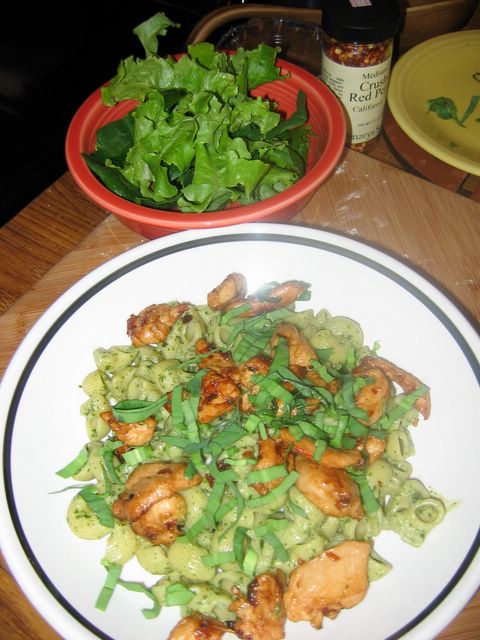
The finished dish; summer pesto from the freezer tossed with pasta, topped with sauteed chicken chunks with a chiffonade of ramps as a garnish.
Friday, April 08, 2005
Puttanesca: Fast Food for Fast Women
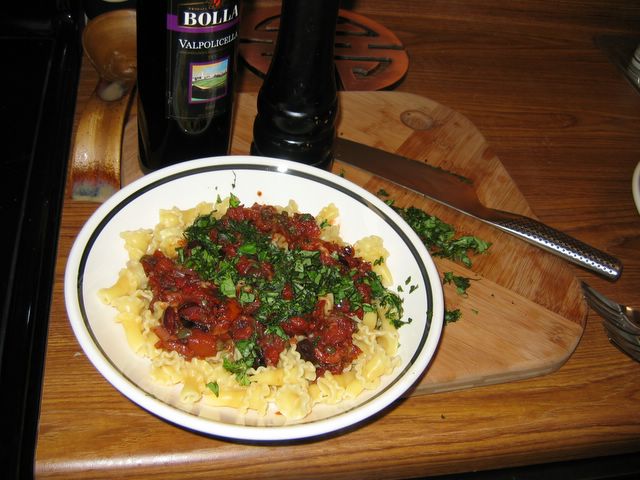
The finished dish of Puttanesca; it is best if you toss the pasta with the sauce in the pan, but I didn't remember that last night.
Puttanesca is a classic Neapolitan pasta sauce based on olives, tomatoes, capers and anchovies. The name comes from the Italian, "puttana," which means, "whore," and there are several different stories as to how and why the dish came by such a salacious name.
According to Paula Wolfert in her 1978 classic Mediterranean Cooking, one theory as to the origin of the name, "puttanesca" comes from the fact that the prostitutes in Naples would cook this pasta sauce as a "quick and lusty fortification," (yes, that is a direct quote which is seared upon my memory) which also enticed customers off of the street with the seductive scent of olives, garlic and anchovies cooking. Another theory she proposes is that it is the perfect dish for a respectable married woman who is engaged in an illicit affair between the hours of five and seven in the evening. She can put the sauce ingredients together to marinate, then frolic with her lover for a few hours before running off to heat up the sauce and serve it up to her hungry and cuckholded husband.
I have also heard that the reason it is named after prostitutes is that the ingredients are ones which are staple, and which are always available canned or preserved in some way. In the days when the brothels of Naples were state-run, there were only certain days and hours when the prostitutes were allowed to go out shopping for foodstuffs, so as to keep them from offending the respectable women in the marketplace. At these restricted hours, most of the fresh foods were gone, so the prostitutes became adept at making delicious sauces from those few items that were left in the markets.
I always was a bit skeptical of the idea that a whorehouse would need to entice customers with the smell of cooking, but now that I am a bit older, and I have had a bit more experience, and after taking into account we are talking about Italians here--folks who are all about food, sex, love and passion--I have rethought my position on the matter. There is indeed something distinctly seductive about puttanesca, something that fairly oozes sensuality, and makes one think naughty thoughts while cooking or eating it. The fragrance of it is lascivious and induces hunger on many levels, and the deep crimson sauce is inviting and velvety on the tongue.
Or, at least, it works that way with me.
Puttanesca first came to my attention when I was reading the afformentioned Paula Wolfert's Mediterranean Cooking, which was one of the first cookbooks I ever bought for myself, back when it came out in 1977. In 1977, I was in seventh grade, and I was first learning to cook, and was fascinated with Italian and Greek foods. The book is divided up not by courses or types of dish, but rather by main ingredient. In the olive section, I came upon puttanesca, and just reading her description of it knocked me out. I had a sudden, intense longing for it, and had to immediately give the recipe a try.
Unfortunately, due to my youthful ignorance and lack of money, the black olives I used were those giant, shiny flavorless canned critters that garnish the Taco Supreme at Taco Bell. The capers were about as flavorful and tender as BB's, and the anchovies offended everyone in the household.
But the idea of the pasta sauce still appealed to me, so I kept trying to make it. I stopped telling people that the anchovies were in it, thus avoiding offense, and eventually grew enough sense to use better black olives.
However, the capers were ditched in favor of green olives, and mushrooms were added. Along with chile flakes, red sweet peppers, and eventually, spicy Italian sausage.
This concoction I called "Whorehouse Spaghetti," and served it at the request of friends and family alike. It barely resembled a classic puttanesca anymore, and I figure that Paula Wolfert or Marcella Hazan would have my hide for using that name--hence the roughly translated moniker.
By whatever name, and from whatever inspiration, the sauce was a popular one, and I proudly served it a few years back to the members of a traveling Celtic rock band whom I hosted to dinner at my bookstore when they came through town. It was good enough to impress the Italian American member of the band, who asked for my recipe, and asked if he could serve it in his restaurant on the West Coast.
Of course, I said yes.
(I am apparently still remembered by the band as "The Whorehouse Spaghetti Lady in Ohio," which is a good thing, I suppose.)
However, as the years went on, I began to long for a simpler flavor and began paring away ingredients until my Whorehouse Spaghetti began to show its roots. It devolved back to its more primal form of puttanesca. I still make Whorehouse Spaghetti, especially in the colder months, but as the sun turns warmer, I long for lighter fare and find myself reaching for fewer ingredients.
In either incarnation, whether it is my own bastardized version or the Neapolitan original, Puttanesca is a full-bodied, bold sauce, vividly colored and lavishly perfumed.
Now that I think of it, that may be why it is named for prostitutes--it is unsubtle, vivacious, confrontational and alluring.
A wicked sauce for wicked women.
Or at least, women who are wicked at heart.
Puttanesca
Ingredients:
3-4 tablespoons olive oil
1 small onion, thinly sliced
4-5 cloves fresh garlic, minced
3 anchovy fillets, chopped finely or 1 1/2 teaspoons anchovy paste
1/2 pound pitted Kalamata olives, drained and chopped roughly
3 tablespoons capers, drained of brine and rinsed thoroughly, then drained again
1 teaspoon or to taste red chile flakes (optional)
generous lashings of freshly ground black pepper
1/2 roasted red sweet pepper, diced finely
1/4 cup dry red Italian wine
1 14 ounce can diced tomatoes with their juice (I use Muir Glen Fire Roasted Organic)
1 tablespoon tomato paste
approx. 1/4-1/2 cup pasta cooking water
handful of fresh basil leaves, minced
Method:
Heat olive oil on medium heat in a heavy bottomed skillet or pan. Add onion (I use shallots, instead, sometimes, because that is what I have--they work fine) and cook until softened and golden, stirring now and then. Add garlic and anchovy and continue cooking until garlic turns golden, the onions brown slighty and the anchovy fillets disintegrate. (If you are using anchovy paste, do not add at this point--add it after the olives and capers have cooked for about a minute.)
Add olives, capers, chile flakes and black pepper, and continue cooking until very fragrant, about three minutes. Add roasted red peppers and continue cooking until the roasted pepper darkens slightly and starts to fall apart. Add wine and allow alcohol to boil off. (Lean over and breathe deeply--it smells heavenly at this point.)

The onion, garlic, olives, capers and chile flakes cooking.
Add tomatoes and their juice after the alcohol has boiled away and turn heat down slightly and allow to cook until it thickens up and most of the liquid is boiled away. Add tomato paste and turn heat down to the lowest setting, just to keep it warm.
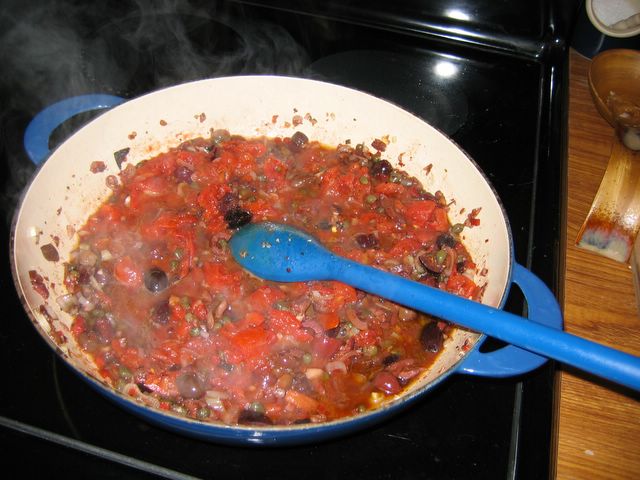
Be sure and reduce the sauce, removing most of the water from the dish. It should be a thick, rich sauce with a texture like velvet; the tomatoes should break down almost completely. Here is what the sauce looks like just after the tomatoes are added and it is still quite thin and overly chunky.
Start pasta boiling. When the starch is released, add a tiny bit of the cooking water to the sauce, and stir, rehydrating it. Add as much water as is needed to make the sauce fairly fluid, yet still thick and chunky, boiling away extra water if you add too much. (I learned this trick from an Italian chef in culinary school--he said that the starch in the pasta cooking water made the texture of the sauce smoother than just plain water.)
Drain pasta when it is al dente, and toss with the sauce in the pan, if you are serving all of it right away. If you made extra sauce, you can also serve it over the pasta in bowls, but it is best when it is all stirred together in the sauce pan over low heat. (If you made extra to put in the fridge or freezer for later, you can always remove the extra and pack it up, then put the pasta in the pan--too bad I didn't think about this last night when we were eating it.)
Add basil to pan, and toss to combine, then serve in deep bowls.
Notes:
Do not add salt. Not under any circumstances. None, nada, zip. You have plenty of salt in the brined capers and olives and in the anchovy. You need not add any more. Red chile is great, and black pepper is actively encouraged but no salt.
You can add good green olives to this dish, without harming it in any way. But don't add those overly brined, pimento-stuffed martini olive things. They just taste saltier and add nothing good. Find yourself a nice fruity green olive packed in olive oil and pit them and add those. Even Paula Wolfert likes the sauce better that way.
This sauce cooks quickly. Don't think you can make it better by cooking it longer. You can't. In fact, you will lose a lot of the fragrance if you cook it longer.
Only use fresh tomatoes if you can get home grown plum or romano tomatoes, ripened on the vine. Otherwise, use canned, which are better than those godawful plastic crispy red things in the grocery store masquerading as fresh tomatoes. Remember, the fast ladies of the night in Naples didn't use fresh tomatoes, so you don't have to either. This recipe is all about flavor and speed, and waiting for watery, flavorless "fresh" tomatoes to cook down into something resembling a sauce is not going to do anything good.
You are not supposed to have cheese with this. If you do have cheese, Marcella Hazan will probably appear at your shoulder, and smack you in the head with a wooden spoon, or some other terrible fate will befall you.
On the other hand, if you like cheese, as I do, then just make sure Marcella is not looking and sneak some, freshly grated real Parmesan if you please, and don't tell her I told you that you could do that. I would like to keep my skull intact, thank you.
Finally, this is supposed to be served with spaghetti. The dish is supposed to be Spaghetti alla Puttanesca. However, Zak is morally opposed to spaghetti on the religious grounds that it is messy and messy things make messes. So, I don't make it with spaghetti. I make it with neat shaped pasta like the flower-shaped campanelli, which has lots of flutes and folds that capture the chunky sauce bits and hold them so they all go in the mouth together.
But don't tell Marcella I do that, either.
Wednesday, April 06, 2005
Eat Drink Man Woman
I suppose it should come as no surprise that I adore Ang Lee's 1994 film, Eat Drink Man Woman.
If you like Chinese cooking and food, or if you are an aspiring Chinese cook, the opening sequence alone is worth the price of the DVD. Lee throws down and uses food as a metaphor for love; it seduces, entices, teases and teaches the audience. It is an implicit and explicit means by which the characters in the film--an extraordinary Taiwanese chef, and his three daughters--communicate with each other. It is the glue that holds the family together, and is the means of torture and salvation.
I just watched it again tonight with Zak, and it was, once again, a revelation. The opening scene involves the chef, Chu Sifu, cooking an elaborate Sunday supper for his three adult daughters, all of whom still live at home. The first time we watched the film, probably ten years ago in Athens, I remember being entranced by the very intimate look into the mysterious seeming processes of cooking a traditional Chinese festive meal. Then, while I watched, I had very little clue what was happening before my eyes, though I could guess at what a few of the procedures pertained to, such as inflating the duck's skin for a traditional Peking Duck.
Watching it tonight, not only could I identify ingredients and dishes as they were being cooked, I could describe techniques as they unfolded, and had actually tasted many of the flavors that were paraded on screen. Indeed, many of the techniques had been performed by my own hands, and I had instructed others in how to perform them--passing on the knowledge from hand to hand, as it were.
What had once been strange, is now familiar.
Flavors that once had been exotic and new are now as comforting as an old blanket.
Ang Lee has the gift of conveying a great deal of information and emotion with images, and as I watched his film tonight, I realized that it was all about love, and perhaps one of the reasons I understood and liked the film so much from the first time I saw it was because to me, food is love.
When we cook for each other, we love each other. Food is a visual, physical representation of my love. When I offer someone something to eat, I am giving them a piece of myself, my soul, my love, for them to take into themselves. When they eat and are satisfied, I am made happy.
My very first student is an old friend who grew up here in Athens. I decided to teach him and use him as a guinea pig to see if I was ready to teach, because when we met, he never ate anything but instant food from packages and boxes. Food was nothing to him but fuel to keep his body going, and his body was nothing much more than a vehicle to get his mind around. He was very much a man who lived in his own head, and little else that had to do with the body or with senses mattered to him. Over the years, he learned to get along with his body better, and he learned to experience food as something to be enjoyed, but still, his focus was very mental.
When he asked to learn to cook, I took him on, because, frankly, if I could teach a man whose main living space was his own mind to cook Chinese food and enjoy it, I could teach anyone.
So, I set myself a difficult task, and the two of us together, learned that he could learn, and I could teach. I taught him how to buy a wok, and how to pick out cleavers, and care for them, and then how to shop for ingredients. Then, I taught him how to cut--a very important lesson when it comes to stir frying, and Chinese cookery in general.
We worked together one evening a week, and he progressed quickly.
I was very proud of him, and I took quiet joy in his learning. Once he had practice with the cleaver, his hands could move with deft assurance, and his face would relax as he cut vegetables, and a rhythm developed in his gestures. He learned to move with the fluid grace that comes when body, mind and spirit work together.
So, we went back to Athens, my student, his wife and I, and I was telling our friends how good he had become at cooking with me. I offered for us to cook dinner for a few of the folks, so we could show them how well the lessons were coming.
It started as a simple affair of dinner for six. Nothing elaborate. But then six became eight became ten became twelve became sixteen or eighteen, I forget which. As the guest list swelled, I shrugged and thought nothing of it; having catered events for over one hundred while cooking essentially by myself before, I was not concerned with dinner for a mere handful of guests. We had two woks, three sets of bamboo steamers, four cleavers, the use of a large kitchen in a large house, and a well-stocked Asian grocery store nearby. What was there to fear?
We shopped, and while at the market, bought a fourth steamer set. The menu was to be hot and sour soup, steamed pork dumplings, vegetarian and traditional spring rolls and cold spicy Hunan noodles. When we went to the grocery store, I saw that there was no ground pork and was told that they did not grind it there because of some obscure (possibly nonexistent) health code violation. My friend and student was worried, but I was not--I simply bought pork loin and shoulder and told him I would mince it by hand with two cleavers, and it was a good opportunity for him to see that it can be done without a grinder or food processor.
We went to our friends' home and started cooking. There were, of course, crises. His wife, meaning to help, slipped with the cleaver, and cut open her finger, and was removed from the kitchen to be ministered to by someone with medical training. I made a huge amount of noise mincing the pork by hand on a heavy cutting board, using two cleavers in a strong rhythm that made some guests come in and stare in fascination. My student made the hot and sour soup.
Then, I prepared the filling for the dumplings, and he cooked the fillings for the spring rolls.
We served the soup first. I went out into the living room to announce that the soup was ready, and the crowd lined up and my friend, with shaking hands, ladled the soup into bowls as they filed by. His eyes were wide, and I looked closely and could see that he was utterly terrified; overwhelmed with fear, he plastered a smile on his face and moved like an automaton as he filled the bowls. I went to him, put a hand on his shoulder, and whispered in his ear, "All is well, you are doing fine, don't be afraid."
When they were all served and they sat down on the floor, cupping bowls in one hand, and sipping from spoons from the other, I filled a bowl and put it into his hands, but he ignored it. Instead, I saw that he was staring at the huge group, huddled around their bowls of the soup he had just made and given to them.
Silence had fallen over the formerly loud and raucous group. One by one, they tasted, and smiles broke out over their faces. The smiles were followed by accolades and praise, then more noisy sipping and slurping.
I turned to my friend, my first student, and found him looking at me with a wide and profound smile. His eyes shone and he whispered, "Now, I understand why you do this."
I raised one eyebrow and let him continue. "Why you cook for everyone all the time and why you hardly eat yourself. You don't need to eat, do you? Their love, their gratitude, that is enough for you to eat."
I smiled. He truly understood.
"Love is my food," I answered. "And food is my love."
He sipped his soup, then followed me back into the kitchen where we filled and pleated hundreds of tiny dumplings with ginger-fragrant pork in silence, satisfied. Behind us, vats of water heated, and we listened to the clink of spoon on bowl, and the quiet murmur of our friends eating in the other room.
If you like Chinese cooking and food, or if you are an aspiring Chinese cook, the opening sequence alone is worth the price of the DVD. Lee throws down and uses food as a metaphor for love; it seduces, entices, teases and teaches the audience. It is an implicit and explicit means by which the characters in the film--an extraordinary Taiwanese chef, and his three daughters--communicate with each other. It is the glue that holds the family together, and is the means of torture and salvation.
I just watched it again tonight with Zak, and it was, once again, a revelation. The opening scene involves the chef, Chu Sifu, cooking an elaborate Sunday supper for his three adult daughters, all of whom still live at home. The first time we watched the film, probably ten years ago in Athens, I remember being entranced by the very intimate look into the mysterious seeming processes of cooking a traditional Chinese festive meal. Then, while I watched, I had very little clue what was happening before my eyes, though I could guess at what a few of the procedures pertained to, such as inflating the duck's skin for a traditional Peking Duck.
Watching it tonight, not only could I identify ingredients and dishes as they were being cooked, I could describe techniques as they unfolded, and had actually tasted many of the flavors that were paraded on screen. Indeed, many of the techniques had been performed by my own hands, and I had instructed others in how to perform them--passing on the knowledge from hand to hand, as it were.
What had once been strange, is now familiar.
Flavors that once had been exotic and new are now as comforting as an old blanket.
Ang Lee has the gift of conveying a great deal of information and emotion with images, and as I watched his film tonight, I realized that it was all about love, and perhaps one of the reasons I understood and liked the film so much from the first time I saw it was because to me, food is love.
When we cook for each other, we love each other. Food is a visual, physical representation of my love. When I offer someone something to eat, I am giving them a piece of myself, my soul, my love, for them to take into themselves. When they eat and are satisfied, I am made happy.
My very first student is an old friend who grew up here in Athens. I decided to teach him and use him as a guinea pig to see if I was ready to teach, because when we met, he never ate anything but instant food from packages and boxes. Food was nothing to him but fuel to keep his body going, and his body was nothing much more than a vehicle to get his mind around. He was very much a man who lived in his own head, and little else that had to do with the body or with senses mattered to him. Over the years, he learned to get along with his body better, and he learned to experience food as something to be enjoyed, but still, his focus was very mental.
When he asked to learn to cook, I took him on, because, frankly, if I could teach a man whose main living space was his own mind to cook Chinese food and enjoy it, I could teach anyone.
So, I set myself a difficult task, and the two of us together, learned that he could learn, and I could teach. I taught him how to buy a wok, and how to pick out cleavers, and care for them, and then how to shop for ingredients. Then, I taught him how to cut--a very important lesson when it comes to stir frying, and Chinese cookery in general.
We worked together one evening a week, and he progressed quickly.
I was very proud of him, and I took quiet joy in his learning. Once he had practice with the cleaver, his hands could move with deft assurance, and his face would relax as he cut vegetables, and a rhythm developed in his gestures. He learned to move with the fluid grace that comes when body, mind and spirit work together.
So, we went back to Athens, my student, his wife and I, and I was telling our friends how good he had become at cooking with me. I offered for us to cook dinner for a few of the folks, so we could show them how well the lessons were coming.
It started as a simple affair of dinner for six. Nothing elaborate. But then six became eight became ten became twelve became sixteen or eighteen, I forget which. As the guest list swelled, I shrugged and thought nothing of it; having catered events for over one hundred while cooking essentially by myself before, I was not concerned with dinner for a mere handful of guests. We had two woks, three sets of bamboo steamers, four cleavers, the use of a large kitchen in a large house, and a well-stocked Asian grocery store nearby. What was there to fear?
We shopped, and while at the market, bought a fourth steamer set. The menu was to be hot and sour soup, steamed pork dumplings, vegetarian and traditional spring rolls and cold spicy Hunan noodles. When we went to the grocery store, I saw that there was no ground pork and was told that they did not grind it there because of some obscure (possibly nonexistent) health code violation. My friend and student was worried, but I was not--I simply bought pork loin and shoulder and told him I would mince it by hand with two cleavers, and it was a good opportunity for him to see that it can be done without a grinder or food processor.
We went to our friends' home and started cooking. There were, of course, crises. His wife, meaning to help, slipped with the cleaver, and cut open her finger, and was removed from the kitchen to be ministered to by someone with medical training. I made a huge amount of noise mincing the pork by hand on a heavy cutting board, using two cleavers in a strong rhythm that made some guests come in and stare in fascination. My student made the hot and sour soup.
Then, I prepared the filling for the dumplings, and he cooked the fillings for the spring rolls.
We served the soup first. I went out into the living room to announce that the soup was ready, and the crowd lined up and my friend, with shaking hands, ladled the soup into bowls as they filed by. His eyes were wide, and I looked closely and could see that he was utterly terrified; overwhelmed with fear, he plastered a smile on his face and moved like an automaton as he filled the bowls. I went to him, put a hand on his shoulder, and whispered in his ear, "All is well, you are doing fine, don't be afraid."
When they were all served and they sat down on the floor, cupping bowls in one hand, and sipping from spoons from the other, I filled a bowl and put it into his hands, but he ignored it. Instead, I saw that he was staring at the huge group, huddled around their bowls of the soup he had just made and given to them.
Silence had fallen over the formerly loud and raucous group. One by one, they tasted, and smiles broke out over their faces. The smiles were followed by accolades and praise, then more noisy sipping and slurping.
I turned to my friend, my first student, and found him looking at me with a wide and profound smile. His eyes shone and he whispered, "Now, I understand why you do this."
I raised one eyebrow and let him continue. "Why you cook for everyone all the time and why you hardly eat yourself. You don't need to eat, do you? Their love, their gratitude, that is enough for you to eat."
I smiled. He truly understood.
"Love is my food," I answered. "And food is my love."
He sipped his soup, then followed me back into the kitchen where we filled and pleated hundreds of tiny dumplings with ginger-fragrant pork in silence, satisfied. Behind us, vats of water heated, and we listened to the clink of spoon on bowl, and the quiet murmur of our friends eating in the other room.
Tuesday, April 05, 2005
Community Supported Agriculture

Produce from my organic garden last summer: tomatoes, chiles, tomatillos and basil. This could also represent part of a weekly share for a subscriber to a CSA.
CSA stands for "Community Supported Agriculture," and it refers to an innovative style of direct-marketing that brings farmers and consumers together in a visible web of interdependence. This results not only a beneficial economic and nutritional partnership between farmers and consumers, but it also creates bonds of community and friendship that transcend mere sustenance. In addition, it helps food consumers, who have grown up on the supermarket ethic of "all under one roof" shopping that stresses convenience over health, sustainability and taste, learn more about where their food comes from, how it is produced and how flavorful it can be to "eat with the seasons."
The CSA movement, which is growing across the US, started in Japan, thirty nine years ago, when a group of housewives and mothers who were concerned with the growing use of pesticides in their food and the increase in food importation, banded together and created a partnership with local farmers with the goal of supporting their ability to provide fresh vegetables and grains grown free of chemical pesticides and fertilizer. This program, called, "Teikei" poetically translates to, "the farmer's face on it," though a more literal translation is "cooperation" or "partnership."
The idea of a CSA, where community members pay a set price, up front, to a farmer at the beginning of the season, and then were given shares of the produce throughout the season, was brought to the US in 1984 by Jan Vander Tuin and Robyn Van En, who had run a CSA in Switzerland previously. The first CSA in the United States was in Massachusetts, and from there, the idea spread slowly, though in recent years, the number of CSAs in the nation has grown exponentially each year.
This growth is not surprising; more Americans are becoming aware of the unsustainable nature of the current petrochemical-based, factory farm food system which depends more and more upon food imports from other countries. In addition, interest and demand for organic produce is growing, and small, local farmers have stepped in to fill that niche. Finally, a lot of Americans are returning to the joys of eating fresh produce in season, having tired of the plasticene blandness of hothouse tomatoes and giant strawberries that look gorgeous and smell divine, but have all the sweetness and flavor of styrofoam.
There are many variations on the way that CSAs are run; some farms allow community subscribers to come to the farm and help in the work of raising the crops. Others have subscribers assist in the harvest, while others provide delivery service of each week's box of produce shares. Still others distribute from a central point once or twice a week, at the subscriber's convenience.
Athens Hills CSA (Green Edge Gardens), which I will enroll in hopefully tomorrow, has slightly different approach. For four hundred dollars, which you can pay in total up front, or through arranged installments, one is entitled to enough vegetables per week for two adults from June 18th through October 15th. Instead of a set box of whatever is harvested that week, members "shop" for their vegetable shares from the farmer's stand at the Farmer's Market; this system avoids members having to deal with a week when the share box contains nothing but okra, eggplant and zucchini. (All right, that would be fine with me, but Zak would not be so enthusiastic with such a week, and really there is only so much of those three vegetables I can eat by myself, luscious as they are.)
There are CSA's operating across the US, many of them near major metropolitan areas. To find one near you check out the websites for Local Harvest, Biodynamic Farming Association, and New Farm. An even more comprehensive list of CSA farms is generally available on the Robyn Van En Center site, however, at the moment, it is in the middle of technical difficulties.
Monday, April 04, 2005
The First Supper

The finished dish: Three Pepper Pork
Unable to bear another round of eating out, I pushed myself and got the upstairs kitchen mostly unpacked yesterday. I resolved to try the thick-cut boneless butterflied loin pork chop I bought at the Farmer's Market from Harmony Hollow Farms.
Saturday was a blustery, freezing cold day, with wind ripping through the Hocking River Valley, buffeting the few brave souls who came out to buy and sell at the Farmer's Market that morning. We made a quick pass through the market, then returned with cash, and beelined over to Rich Blaizer's stand, and took a good look at the pork he had for sale.
The pork was dark and rich looking, with creamy white fat marbled through the meat. It looked nothing like the pale, water-injected lean pork that is available in the grocery store that gave rise to the ad slogan "Pork--the Other White Meat." Instead, it looked much more like the pork I was raised eating in childhood, from hogs on my grandparents' farm.
When I asked Rich what kind of pigs he raised, his face lit up, and he said with a smile, "Durocs."
I nodded enthusiastically and said, "Good. Those are the ones my Grandpa raised." We then discussed the superior intelligence and foraging ability of the red-coated Duroc breed, which is very important when you let your pigs run in a pasture like Rich does. A lot of pigs have had the rooting instinct bred out of them, as it is inconvenient when you raise hogs in a confinement setting as most of the factory farm producers do. However, for pasture-raised free-range pigs, being able to root and forage is a necessary survival skill. Rich complained that other breeds would "starve themselves to death" in a pasture, whereas the Duroc was right at home.
Not only are Durocs smart pigs, they are tasty, too. I remembered the sweet flavor of my Grandpa's pork, and wondered if the pork chop from Harmony Hollow would match my memory of how pork should taste.
I was not disappointed. The meat was sweet, juicy and tender, though not mushy the way a lot of supermarket pork can be. It was firm, with a nice chew to it, without being in the least bit dry or tough. It was, all in all, a superlative piece of pig.
Instead of cooking it as a straight up pork chop, I cut it into thin slices, and used it in a stir-fry. (You know I had to use that wok, didn't you? I was having withdrawal symptoms from not using it.)
Instead of making a classic, recognizable Chinese dish, I improvised, using the vegetables I had on hand, including some bok choy I also purchased at the farmer's market. I seasoned it simply with Shao Hsing wine, thin soy sauce, sugar, chili garlic paste, black pepper and Sichuan peppercorn. Oh, and of course, I used the holy trinity of scallions, garlic and ginger.
I ended up calling it Three Pepper Pork, and will likely make it again--probably with some more of that nice free-range pig from Harmony Hollow.
Here is now it goes:
Three Pepper Pork
Ingredients:
1/4 pound pork loin chop cut into thin strips
1 tablespoon cornstarch
1 tablespoon Shao Hsing wine
1 tablespoon thin soy sauce
4 tablespoons peanut oil
3 scallions, cut into thin slices diagonally, white parts separated from the green
4 cloves of garlic, cut into thin slices
1" hunk of ginger, peeled and cut into thin slivers
1/2 teaspoon freshly ground Sichuan peppercorns
1 teaspoon freshly ground black pepper
1 teaspoon chili garlic paste
1 teaspoon thin soy sauce
handfull baby carrots cut jullienne
1/4 pound green beans strung and blanched
1 bunch baby bok choy cut into ribbons
1/8 cup chicken broth
Method:
Marinate the pork in the cornstarch, wine and soy sauce while preparing the vegetables.
Heat wok, add oil, and when it is smoking, add white part of scallions, garlic and ginger, and cook, stirring, until fragrant and beginning to show golden color; about one minute. Add peppercorns, pepper and chile garlic paste, stir fry about 30 seconds.
Drain excess marinade off pork; put meat in wok. Let sit in single layer on bottom of wok until browned--between 45 seconds to two minutes. As soon as it is brown and fragrant, begin to stir vigorously. Add soy sauce and any remaining marinade.
When meat is nearly done, add carrots, then blanched green beans. Keep stirring.
After about a minute, add bok choy, then the chicken broth. Reduce liquid until it coats food, and bok choy is very slightly wilted.
Serve immediately with steamed rice.

The new flat-top electric stove gets very hot, very quickly. It is quite easy to produce a good stir fry filled with the savor of wok hay.
Sunday, April 03, 2005
I Have Returned
And so, it was that on the seventh day, she did rest.
Or something to that effect.
If you consider carrying a new chest of drawers up three flights of stairs relaxing, I suppose you could say that I rested today.
At any rate, I am back. Sans photographs, but with Internet access, and that is a good thing. I also have the camera, but I am not so certain as to the location of the little picture card reading thingie that helps me get the pictures from the camera into the computer onto the blog, so we will have to do without illustrations for the time being.
How are we?
Well, we are here, present and accounted for, in our new home, all cats and dogs intact. (Here is Athens, Ohio, by the way.) My daughter helped us move over her Spring Break, which was terribly generous; she insisted upon being here for the big exciting time, which she discovered was a lot of work interspersed with long periods of intense boredom and ennui. We ended up moving not on the 28th as planned but the 29th--we awoke to torrential rain on the 28th and a long driveway filled with mud and water. We knew that even if they got the truck up the drive, it would never get out again once it was fully loaded. So, we postponed until the next day, which turned out to be uncharacteristically sunny and warm.
The move went fairly smoothly--all moves are fraught with peril and danger, of course, but no one was killed, maimed or lost upon the highway, though it was tempting to toss the cat who had to empty his bowels upon himself out the window. However, both my daughter and I fought off the temptation to fling him, and he is here, sunning himself on the deck as I write.
The main kitchen is still not finished, as is the main bathroom. I am unpacking as I can; Zak is busy putting together his desk and computer.
In all of this bustle, I have been itching to cook, and have been thwarted at every turn. We have been eating out mostly, but tonight, I am breaking that cycle and now that I have a stove and sufficient equipment unpacked in the upstairs kitchen, I am cooking.
We have been here only for about five days, all of them very busy with unpacking, cleaning, moving, hauling and other sundry domestic excitements, but already I have met up with some of the folks involved in making a sustainable food system for Athens county. We went to the farmer's market on Saturday and I met with a woman who is doing a CSA for the first time this year; I am calling tomorrow to sign up for it. My next post will be about CSA's, how they work and what they are about, and as I go through the process, I will write about it. I also met a man who raises free-range Duroc hogs;I bought a nice pork loin chop from him that I will be cooking tonight. I will let you know how it turns out, of course.
Today, we went out to a flea-market about thirty miles from here, and met another farmer. Not only does she raise Duroc hogs, and hickory smoke cures her own hams (and let me tell you, they are fantastic) she raises Piedmontese cattle--the fabled white cows of Tuscany. Needless to say, I picked up some ham, a bit of round and a bit of chuck from this lady, and will report upon how they cook and taste in a future post.
I intend to interview all of these folks, and write in depth articles on subjects relating to sustainable agriculture, rare breeds of farm animals, heirloom vegetables and local food economies, as I settle into the rhythym of living in Athens again.
So, that is it--I will be posting again soon--I just wanted to let folks know that I am still here, still eating, and will be back into cooking starting tonight.
Or something to that effect.
If you consider carrying a new chest of drawers up three flights of stairs relaxing, I suppose you could say that I rested today.
At any rate, I am back. Sans photographs, but with Internet access, and that is a good thing. I also have the camera, but I am not so certain as to the location of the little picture card reading thingie that helps me get the pictures from the camera into the computer onto the blog, so we will have to do without illustrations for the time being.
How are we?
Well, we are here, present and accounted for, in our new home, all cats and dogs intact. (Here is Athens, Ohio, by the way.) My daughter helped us move over her Spring Break, which was terribly generous; she insisted upon being here for the big exciting time, which she discovered was a lot of work interspersed with long periods of intense boredom and ennui. We ended up moving not on the 28th as planned but the 29th--we awoke to torrential rain on the 28th and a long driveway filled with mud and water. We knew that even if they got the truck up the drive, it would never get out again once it was fully loaded. So, we postponed until the next day, which turned out to be uncharacteristically sunny and warm.
The move went fairly smoothly--all moves are fraught with peril and danger, of course, but no one was killed, maimed or lost upon the highway, though it was tempting to toss the cat who had to empty his bowels upon himself out the window. However, both my daughter and I fought off the temptation to fling him, and he is here, sunning himself on the deck as I write.
The main kitchen is still not finished, as is the main bathroom. I am unpacking as I can; Zak is busy putting together his desk and computer.
In all of this bustle, I have been itching to cook, and have been thwarted at every turn. We have been eating out mostly, but tonight, I am breaking that cycle and now that I have a stove and sufficient equipment unpacked in the upstairs kitchen, I am cooking.
We have been here only for about five days, all of them very busy with unpacking, cleaning, moving, hauling and other sundry domestic excitements, but already I have met up with some of the folks involved in making a sustainable food system for Athens county. We went to the farmer's market on Saturday and I met with a woman who is doing a CSA for the first time this year; I am calling tomorrow to sign up for it. My next post will be about CSA's, how they work and what they are about, and as I go through the process, I will write about it. I also met a man who raises free-range Duroc hogs;I bought a nice pork loin chop from him that I will be cooking tonight. I will let you know how it turns out, of course.
Today, we went out to a flea-market about thirty miles from here, and met another farmer. Not only does she raise Duroc hogs, and hickory smoke cures her own hams (and let me tell you, they are fantastic) she raises Piedmontese cattle--the fabled white cows of Tuscany. Needless to say, I picked up some ham, a bit of round and a bit of chuck from this lady, and will report upon how they cook and taste in a future post.
I intend to interview all of these folks, and write in depth articles on subjects relating to sustainable agriculture, rare breeds of farm animals, heirloom vegetables and local food economies, as I settle into the rhythym of living in Athens again.
So, that is it--I will be posting again soon--I just wanted to let folks know that I am still here, still eating, and will be back into cooking starting tonight.

