
Cook Local, Eat Global
Sunday Breakfast, Fresh and Local
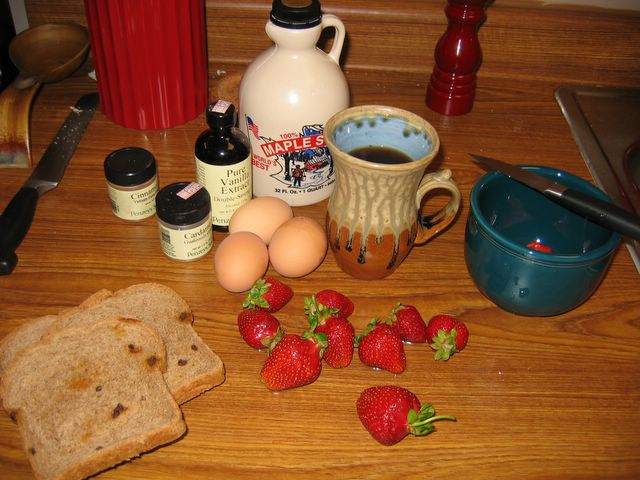
The ingredients for a mostly local, fresh Sunday breakfast.
As many of you know, I tend to emphasize eating a lot of fresh, locally produced foods. Not only are you getting something that tastes amazingly better than what you get at the grocery store, you are usually getting more nutritious food and you are helping to protect the environment and boosting the local economy as well. In addition, you can feel good about helping out a local farmer as well.
Last week, a fellow blogger named Jen from Life Begins at Thirty, began chronicling everything she ate in a day, noting where and how the food items were all produced in an effort to see how much her food intake matched her philosophy of eating local food. The results were interesting to follow, and as was her intention, it made me think about how differently Zak and I have been eating in recent years and how radically moving to Athens has changed our eating habits.
Witness the breakfast I cooked for Zak and I yesterday: the bacon, eggs, bread and strawberries were all locally produced and harvested. The spices, milk and coffee were not, and neither was the maple syrup, though I bought it a year ago when we were on vacation, directly from the man who had collected the sap and boiled it down.
The bacon came from Harmony Hollow Farms out on Terrell Road in Athens County, where Rich and Jane Blazier raise Duroc pigs in a free range set up. Allowing hogs to forage for their food not only makes for happier, healthier pigs, it makes for sweeter, firmer meat. The bacon itself was firm and meaty, and due to its careful hardwood smoking and curing, was not overly salty and was full of the sweet pork flavor accented with just the right amount of smokiness.
The strawberries came from a stand by the side of the road off in a parking lot of a gas station. Two young women sell them from a farm beside the Hocking River in Beverly, Ohio. These are raised conventionally, and some pesticides are used, but I’d rather have delicious local non-organic berries and wash them than awful organic berries from California that taste as good as cotton balls in my mouth. Besides, as the price of oil increases (and it will, and there is not a thing anyone can do about it), the cost of shipping those disgusting berries from one end of the country to the other will make them unreachably expensive in the next decade. Why pay more for something that isn’t even good in the first place?
The cinnamon currant bread (made with organic whole wheat) came from a cooperatively owned and run bakery here in Athens called Crumb’s Bakery. This co-op was started by a group of idealistic young folks more than a decade ago, and has become a local not only a feature in grocery stores locally, but has begun shipping products as far away as Columbus, Ohio. In addition to whole grain breads, Crumbs makes granola, pizzas, pasta, including tofu-based pasta, and crackers.
And finally, the eggs. Normally, I buy eggs at the farmer’s market from any one of a number of folks who sell chicken or duck eggs. But these eggs are special. I didn’t buy them–they were given to me by our friend Bryian who came driving up on his motorcycle with two dozen of them stashed carefully in his backpack. And how he came by them is a story in and of itself.
Bry runs a computer servicing company, and in addition to doing work for his paying clients, he donates time to various non-profit organizations. While he was working for the local AIDs Task Force, one of the folks there pointed out a huge bunch of eggs that had been donated the day before by an elderly woman who had brought them from her farm in Morgan County. They asked Bry to take some of the eggs with him, as there were more than they could use. He tried to refuse, but they pressed four dozen on him, and so, knowing that he couldn’t use all of them, he passed some along to me.
So, we have been eating a lot of eggs in the form of scrambled eggs and omelets, but mostly as french toast, or as it is called in French, “pain perdu”–“lost bread.” French toast is one of those dishes that is essentially frugal in nature, being as it is a method to use up bread that is too stale to eat alone. It is akin to bread pudding, another necessity born dish meant to make the best of an ingredient that is no longer fresh; both of these dishes take something essentially non-palatable and instead of just making it edible, raise it to the level of the sublime. I like dishes that do that–take scraps of nothing and turn it into something better than it was before. (Sausage is another example of taking oddments of something barely palatable like meat scraps and intestines, and making it taste better than can generally be imagined.)
Crumb’s currant bread is perfect for french toast because it tends to be somewhat dry in the first place, owing to the presence of only whole wheat flour, and because it is lightly sweet. It is also of a firm enough texture to stand being soaked in the egg mixture without becoming soggy or falling apart as many spongier breads will. The currants themselves are a nice touch–sweeter and softer than raisins, and tiny so they stay in place when the bread is sliced.
French Toast is also easily made, so much so that I feel silly giving you a recipe, but here is one, anyway. It is rather sketchy, as I don’t measure anything when I make it, so I am estimating amounts here.
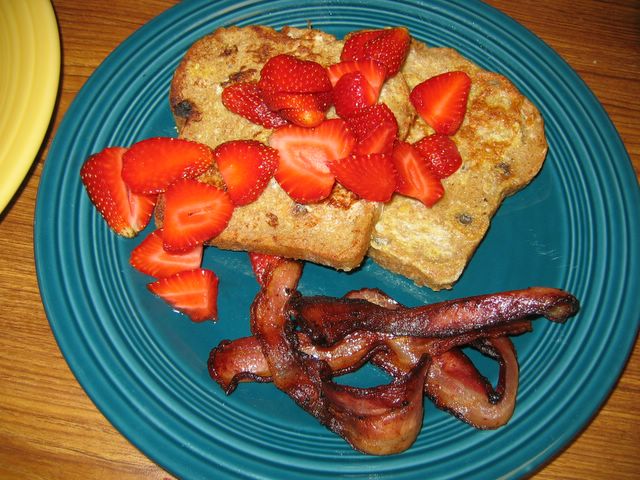
French toast with strawberries and bacon.
French Toast
Ingredients:
3 eggs, at room temperature
1/4 cup milk
1 teaspoon vanilla extract
1/8 teaspoon ground cardamom
1 tablespoon raw sugar or evaporated cane juice (optional)
dash cinnamon
6 slices stale bread
butter or canola cooking spray
Method:
Beat together eggs, milk, extract, spices and sugar until well combined. Heat oil or butter in pan over medium heat. Lay bread slices, one at a time in egg batter, and allow to soak very briefly, about thirty seconds total, turning once.
Fry, turning once, until bread is golden brown and fragrant. Serve with maple syrup and fresh fruit.
Notes:
Use a firm textured bread to make french toast–many store bought brands are too spongey and will fall apart when you try and soak the bread in the batter.
You can simulate stale bread by leaving how ever many slices you need out overnight.
You can hold french toast in a warm (170 degrees) oven for fifteen minutes or so while you finish cooking up enough for everyone. You can do the same thing with bacon, by the way. That is the secret to cooking breakfast for a crowd–a hot oven.
Fried apples are great with french toast in the fall. Fresh peaches are great in the summer, but not as good as strawberries.
The only gap I have found in the Athens food pyramid is a lack of local dairy products. I, personally, want to see if I can start producing goat cheese, but I need to look into the state laws governing dairies here in Ohio to see if it is worth my time attempting it. I know that they are extremely strict; I know of several folks at the farmer’s market who have herds of dairy goats but who cannot sell the milk because of these health codes. So, I will have to do some research and see what I can come up with myself, as I would very much like to start making local cheeses, as I see a market for them and I know how it is done.
Until then, I will continue my quest to eat locally, and I urge everyone to try and do the same. Not only is it good for the earth and your neighbors–it is good for you.
Strawberries, as God Intended
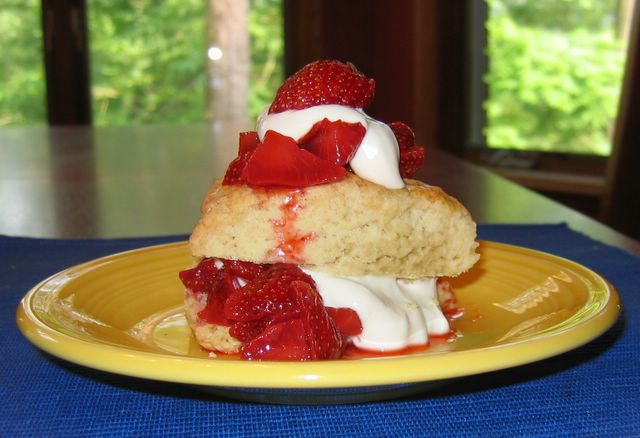
“Doubtless God could have made a better berry, but doubtless God ever did.”–William Butler 1600.
As you most likely noticed in yesterday’s photograph, I aquired some fresh, (just picked yesterday morning, in fact) locally grown strawberries, and I must tell you, they were a far cry from the plastic nubbins of nonsense that are sold in typical grocery stores. Not only are these fine beauties fragrant and brilliant crimson, they fairly burst with flavor when you bite them. The flesh yields to the teeth with tender grace without the slightest tendency to the swampy mush that berries will turn into if overripe or left to sit too long after picking. Honey sweet juice scented with floral delicacy rushes into the mouth, kissing the tongue with the promise of summer, while the faintest tang of acidity cleanses the palate and lingers as an aftertaste.
They are, in a word, delightful.
And so, I bought two quarts of them, just as I did last week.
And instead of eating them on top of french toast with maple syrup or folded into sour cream like we did last week, I decided I must do something more ambitious and jolly with them, and I knew just thing.
I had to make strawberry shortcake.
But, of course, it is foolish to make strawberry shortcake for only two people–it is rather a chore to bake the cakes and macerate the strawberries and then make some sort of creamy bit and then put it all together if only two people are going to be enjoy it. And I utterly refuse to purchase pound cake or worse, those little sponge cakelets with the divet in the center. Yes, I grew up eating those little squishy things, but I abhor them now; the little air pockets in the cakes fill up with strawberry juice and soon become soggy pink puddles of goo.
In a word: ugh.
No, I don’t like angelfood cake as a base for shortcake, either.
As far as I am concerned, strawberry shortcake is properly made with a slightly sweetened biscuit as the base, not a bit of spongy cake that is mostly air. Etymology and history are on my side in this case; according to Merriam-Webster, “shortcake” is “a dessert typically made with a very short baking powder biscuit…spread with fruit.” A “very short” biscuit is one made with shortening, meaning solid fat. In other words, the cake of a shortcake is a baking powder biscuit made with lots of solid fat. There is no mention over whether or not it should be sweetened, nor is there any about the presence of cream.
Historically speaking, however, strawberries and cream are a perfect pair, and have been eaten together in Europe probably ever since there were strawberries and cream available at the same time, which means at least as long as there have been people milking cows and goats and whatnot. There is a mention of how fond English ladies were of strawberries and cream in the writings of Henry IV’s physician dating to 1560, so it is obvious that the pairing of dreamy dairy products and berries has been classic for at least 445 years or so.
As for where the idea of pairing the biscuit with the berries comes from, I had always assumed it was a British innovation, but I may be wrong. It seems as though strawberry shortcake is a homegrown American invention that may have been inspired by a native American strawberry bread that was made from mashed wild berries (which were supposedly better than the European berries) mixed with a cornmeal dough, then baked on a hearthstone. The English colonists took the idea, and applied their knowledge of baking and used wheat flour, and a classic recipe was born. With the invention of baking powder in the nineteenth century, the dish took off and became wildly popular from the 1850’s on to the present day.
I am not sure when the spongecake abominations started to appear on grocery store shelves, nor am I going to waste the time to find out. I suspect it was an innovation of the 1950’s or 1960’s when mass-produced processed foods began to explode on the market and were eagerly adopted both by working mothers and stay-at-home housewives alike. It seems likely. I just know that I ate enough of those sodden sweets to last a lifetime and I refuse to eat any more.
So, where was I? Oh, yes–yesterday’s conundrum: I wanted to make shortcake, I had the ingredients, but didn’t want to make it for just two people. I was stewing on this problem when when the phone rang.
Zak answered it.
It was our dear friend Dan, who wanted to know if he could bring the new episodes of Dr. Who, downloaded from the Internet and burned to VCD for us to watch. Aha! An excuse! An excuse to make dinner and an excuse to make shortcake! And on top of it all, I get to see the new Dr., about whom Dan has been raving for the past several weeks or so.
So, the deal was made–he and Heather would come over, I would make dinner and then we would watch the good Dr. and all would be well. So, we bustled about, tidied up the house, beat the cathair off of the couch and I ran upstairs and started cutting up bits for Thai Basil Chicken.
Zak questioned the wisdom of pairing Thai Basil Chicken with strawberry shortcake.
“They won’t go together,” he said.
“Strawberry shortcake goes with everything,” I answered and returned to my slicing and dicing.
When they got there, I informed them that I was making strawberry shortcake for dessert, and there was great rejoicing.
And so it came to pass, that after dinner, I rolled up my sleeves, and proceeded to make dessert. It is quite easy, though it requires a bit more effort than simply opening packages of spongecake and shaking up a can of whipped cream.
I make cream scones as the shortcakes using a recipe that I adapted from one in a tiny volume called, Simply Scones by Leslie Weiner and Barbara Allbright. I confess to having only used one other recipe in the book besides the one for cream scones, but to my taste, those scones are the ones I measure all other scones against. They are the Ur-Scone in my culinary universe, and few others measure up to the velvety, melting crumb and the hauntingly delicate flavor of these scones.
But before you make the scones, you have to make the filling so that the berries have time to macerate and release their juices, and the cream has time to come to full flavor. Strawberries are related to roses, so I add a splash of rosewater to them while they sit and come to room temperature. It heightens the flavor of the berries while adding an elusive, seductive note to the fruit. And instead of using whipped cream, I follow the Eastern European tradition of using lightly sweetened sour cream. I learned this from Zak, whose mother always ate strawberries with sweetened sour cream; the idea probably was passed from her family who were Lithuanian.
At any rate, here is the recipe for my version of strawberry shortcake, which is guaranteed to knock the socks off of anyone who eats it.
Oh, and by the way, it -does- too go with Thai food, just like I said. There was not one complaint last night during dessert about it being too weird of a combination. So, not only will this recipe taste great–it goes with anything.
Every cook needs a dessert recipe that is that versatile.
Strawberry Shortcake
Ingredients:
1 quart fresh, local strawberries, hulled and sliced
raw sugar to taste
rosewater to taste
1/2 pint sour cream
1 1/2 tablespoons evaporated cane juice (Sucanat) or white sugar
2 cups all purpose flour
1/4 cup raw sugar
2 teaspoons baking powder
1/8 teaspoon ground cardamom
1/8 teaspoon salt
1/3 cup chilled butter, cut into small cubes
1/2 cup heavy cream
1 large egg
1 1/2 teaspoons vanilla extract (I use Penzey’s double strength vanilla extract for a heavy punch of flavor)
1 egg mixed with 1 teaspoon water for glaze
Method:
Preheat oven to 425 degrees F. Set a silpat on a baking sheet and spray it lightly with baking spray or butter it lightly. (If you don’t have a silpat, just lightly butter the baking sheet.)
Put berries in a bowl in a warm place and sprinkle with sugar and rosewater. Toss lightly and allow to sit undisturbed until they come to room temperature and the berries release their juices.
In another bowl, whisk together the sour cream and evaporated cane juice or sugar. Whisk until the sugar dissolves. Cover and refridgerate until it is time to assemble the shortcakes.
In a medium sized bowl, mix together all dry ingredients. Whisk together the cream, egg, and vanilla extract until well combined.
Sprinkle cubes of butter over the flour mixture and cut in with a pastry blender until mixture resembles coarse crumbs. Add the wet ingredients to the dry ingredients, mixing together until just combined.
With lightly floured hands, knead the mixture gently until it comes together into a single ball of dough. Lay it on the prepared baking sheet and pat it into a flat disk about 1″ thick.
With a bench knife or sharp chef’s knife, cut in half and each half into thirds until you have six roughly equal sized wedges. Pull the wedges slightly apart so that air can circulate between them.
Mix together second egg and water until well combined. Brush over the tops of the scones with this glaze and bake in preheated oven for 13-18 minutes, or until lightly browned.
When they are golden, take them out of the oven and cool slightly on a wire rack. When cool enough to handle, split scones in half. Place bottom half on a plate, top with a tablespoon or two of berries, and then a tablespoon and a half of cream. Place top of scone on top of cream, top with more berries and a dollup more of the cream.
If you wish, garnish with mint leaves or a strawberry fan.
Serves six.
Notes:
To cut a strawberry fan, choose a small, perfect berry. Leave the leafy top on. Starting at the tip and cutting toward the leaves, cut thin slices about 3/4 of the way through the berry, stopping all at the same point. When these slices are cut, lay the berry on a cutting board and lightly flatten it, fanning out the slices.
About the rosewater: I usually use about 2 teaspoons of it, but how much you use depends on what brand you use and how strong it is. I suggest Cortas brand.
About the sour cream: you can use lowfat, but full fat is better tasting–but which ever one you use, make sure to use a really good naturally produced brand without a lot of guar gum and other weirdo ingredients.
About the evaporated cane juice and raw sugar: I use the cane juice because it has a slightly more complex flavor and because it dissolves better in the sour cream. I use the raw sugar because I like the flavor of it better. If you want, you can substitute plain white sugar in the same amounts in this recipe.
Variation: For really sweet berries, you can be Italian and add a dash of really good balsamic vinegar to the maceration mixture. It really works, and tastes absolutely divine.
You can also use this recipe with blackberries to wonderful effect, including the use of rosewater. However, with blackberries, I use whipped cream to which I have added a bit of Irish Cream liquor.
An Embarrassment of Riches and a Richness of Embarrassment

The bounty from today’s excursion at the Athens Farmer’s Market. Clockwise from the bottom left: pencil-thin asparagus, baby Japanese turnips, smoked bacon, scallions, a locally grown hydroponic tomato, hardneck garlic, chicken breasts, basil, cilantro and fragrant strawberries, just picked this morning on a farm next to the Hocking River.
I have returned, again.
No, I have not beeen writing, though it is not for lack of trying. The RSI (Repeated Stress Injury) in my wrists has returned with a hideous vengeance, making it difficult to nigh on impossible for my to type for any period of time. It is not surprising–moving involves lots of use of arms and hands for packing, lifting, loading and carrying. Now that we are here, there is a lot more lifting loading and carrying in the unpacking department; furthermore, I have been washing down walls, painting, scrubbing and using screwdrivers, hammers and other impliments of construction and destruction, which leads to new repetative motions and load-bearing activities that my wrists, forearms, shoulders and back disagree with.
So, I have been icing my wrists, going to a new massage therapist and searching in vain for my wrist braces. I finally bought some more, knowing that if I do that and wear them, then the old ones will show up out of the blue, and I will feel foolish for plunking down the cash for a new set of them.
Such is life. So that is the richness of embarrassment. How about the embarrassment of riches?
We just came back from the farmer’s market with a lovely stash of local goodies to cook and consume. It is very fulfilling to get up early in the morning on Saturday, and wander over to see the crowds of people at the farmer’s market, all milling around, talking, laughing, eating and drinking, visiting and buying locally grown and produced vegetables, herbs, meats, eggs, honey, cider, fruits, and flowers. Folks buy bedding plants, vegetable starts, herbs and seeds for their gardens, and choose from an array of freshly baked goods like hearth breads, pies (rhubarb is in season now), scones, rolls and pretzels. One lady brings cookies to which I am addicted: she calls them Peanut Butter Slammers. I have to watch myself, or I would eat two of them a day–they are two big, tender peanut butter cookies sandwiched with a filling of peanut buttercream icing. Oh, they are sinfully delectable.
Luckily all of this lifting, loading, hefting, toting and going up and down the stairs in the new house has resulted in a loss of flab and a gain of muscle. Otherwise each bite of a Slammer would probably throw another pound or two of excess flesh upon my frame.
A trip to the Athens Farmer’s Market isn’t just a shopping excursion. There is a real community atmosphere at the market; there is always live music, bakers and and canners give out samples of their wares, there is an outdoor cafe where folks sit and have a nosh and drink coffee, and everywhere you look there are friends you know and friends you just haven’t met yet. It is just a happy place.
Today, in addition to picking up a delicious haul of ingredients for the coming week’s meals, we got to talk with some friends who had brought kittens from a stray they had taken in, and managed to adopt them out. I was buying asparagus from some wonderful Quaker farmers when Zak, who was munching contentedly on a blueberry scone heard the unmistakable sound of a wee kitten mewling. He saw a tiny white and orange kitten go by on someone’s shoulder. It turned out it was our friends Eli and Mikio, who had brought the last kittens of the litter to give them away at the market. While we stood and talked with them, a lady brought by the last of a litter of puppies a stray had whelped at her house.
Athens is a place where you can trust the folks you give a kitten to at the market to take care of that cat as it grows up. Not only are people committed to growing and eating good food, and working towards a sustainable local food economy, but they care about animals, kids and each other. Even though it happens in the parking lot of a mostly-empty strip mall, the farmer’s market is a relaxed sort of place where you can take the time to visit with neighbors while you shop for food–it is a far cry from the soulless environment of most huge grocery stores. You can visit with the farmers, ask them questions, and give them feedback about their produce. You can share recipes with strangers, and get gardening advice from the Master Gardeners from OSU’s Extension Program or from the gardeners who just happen to be milling around.
It is an amazing experience to see people come together and celebrate food and community, not only on a holiday, but once a week, in the spirit of friendship and local solidarity.
It is really good to be home.
Knives are Dangerous
This morning, I got up early, not because I intended to, but because I have been getting up early for the past four mornings. I have been impersonating a morning-person so that I could let the contractors into the house in order that they could finally finish their work; now my brain is trained to awaken at seven thirty, no matter what time I went to bed.
I was awake, though I did not want to be, so I decided to look in the New York Times, to see what is going on in the world outside of Athens, Ohio. I figured that I would find something that would disgust me enough that I would want to crawl back into bed as a means to avoid the world, thus ensuring that I might get enough sleep after staying up late working on a writing project.
I was not disappointed.
I found a story which was about yet another sign that the Apocalypse is nigh–or at least that is the studied opinion of none other than Anthony Bourdain, author of the best-selling memoir, Kitchen Confidential and executive chef at Les Halles.
For those who don’t want to read the actual news article, the gist of it is this: three British physicians wrote an editorial in the most recent edition of The British Medical Journal calling for a ban on the sale of long, pointed kitchen knives. This is because the rate of violent crime in the UK, including murders where kitchen knives have been used as weapons, has risen by 18 percent between 2003 and 2994. The authors insisted that knife manufacturers redesign their knives with rounded, blunt tips, because the pointed tip of the standard chef’s knife is a vestigial feature from less civilized ages when people speared their meat at the table.
Not only did they make the ridiculous claim that the sharp tips on chefs knives are essentially useless in the kitchen, they managed to get ten (unnamed in the New York Times article) UK chefs to back up their assertion. The chefs did however, say that while sharp tips were not necessary on long chef’s knives, they were useful on short knives.
Not surprisingly, Anthony Bourdain, whom one can always expect to have something colorful to say on any subject, weighed in with the opinion that the chef’s knife is an extension of a chef’s hands, and is not an object whose design should be controlled by bureaucrats
I have to agree with Bourdain on this one.
First of all, anyone who says that there is no reason for a chef’s knife to have a pointed tip either has never used one, or should not be using one. I would really like to know the names of these ten UK chefs so that I could find out what they do in a kitchen, because I suspect it has nothing to do with cooking. If they really believe that no long knife needs to have a pointed tip, then they need to go out and take a knife skills class in some reputable culinary school, because they have a buggered-up idea of how knives are used in the kitchen. The pointed tip on a chef’s knife is not there as an arbitrary feature because historically people speared their meat and ate it off the points of dirks. It is there to make the knife more versatile than a blunted tipped knife would be. Furthermore, the sharp tip is absolutely essentially on two other long-bladed kitchen knives–the boning knife and the filet knife, both of which come equipped with extremely sharp, long, slender, flexible blades, the tips of which come to a very fine, definite point.
It is true that the sharp tips on chef’s knives are not used in every cutting technique that a chef might use in his or her daily routine–the chef’s knife is primarily used to cut with the long edge of the blade. One does very little cutting on vegetables using the tip, though, I do find it useful in mincing garlic and finely dicing onions. However, when trimming or boning some meats, I find the sharp tip to be not only useful in expanding the agility of the knife, but it can keep me from having to reach out for the boning knife, especially if I am working on a chicken breast. For me, that means one less knife to wash in the middle of preparing dinner.
But even if we were to decide collectively that the pointy tip is not necessary on a chef’s knife, there is still the issue of a boning knives and filet knives to consider.
And consider it we must. One cannot effectively bone a chicken, a lamb chop or a leg of lamb without using the tip of a boning knife. The same goes with using the filet knife on fish: it is simply not possible, and because of that, I wonder of these ten chefs have ever used such a knife properly in their lives. Perhaps they are pastry chefs, or maybe they are vegetarians, because frankly, no cook who has ever prepared meat would make such a boneheaded comment.
The doctors who wrote the article would probably be appalled to see a good chef or butcher at work with a boning knife; there are techniques where one holds the knife like a dagger, with the edge of the knife perpendicular to the wrist. One leads with the tip of the knife, and makes cutting motions which are dependant upon the long, pointed, flexible tip, drawing it along the meat in order to separate it from the bone. At times, the angle of the knife blade is very close to the chef’s wrist–in fact, the motion for this sort of cutting is all in the wrist and the shoulder, and nimble manipulation is quite possible, in large part because of the design of the boning knife’s blade.
But beyond the necessity of having long bladed pointed knives in the kitchen, there is the fact that a short-bladed knife with a pointed tip is just as effective as a murder weapon as a long-bladed knife. One doesn’t need a ten inch chef’s knife to open up the carotid artery in a person; in fact, a surgically-sharp paring knife, with a blade under three inches long would not only work adequately for the job, but it would be superb at it, as the artery is not even three inches below the surface of the skin.
And even the ten chefs cited by the overly zealous doctors admitted that paring knives with points are useful in the kitchen. Not only do they peel vegetables, but they create precisely carved garnishes, for example.
In the end, the doctors’ opinion just doesn’t hold up to intense scrutiny. Actually, it doesn’t even hold up to lackadaisical scrutiny. (I haven’t even had coffee yet, and am poking holes in it.)
Yes, kitchen knives may have been used to commit sixteen fatal attacks and fifteen non-fatal attacks in the first couple of weeks of 2005 in the UK, but how many other times were they safely and non-violently used in the kitchens across that country in that same period of time?
How many cases of vehicular homicide occurred in that same time period? How many heavy blunt objects such as say, hammers, were used to kill people? How many fire pokers? How many household chemicals were used to poison people? How many nylon stockings were used to strangle someone?
Yet, there are not calls to ban hammers, fire pokers, household cleansers and panty hose.
It all comes down to this: if someone wants to kill someone else, they will find a way to do it. Human beings are incredibly creative when they are motivated by desperation, and unfortunately one of the things that we are really good at is coming up with ways to kill each other.
The reason that the violent crime rate is rising has nothing to do with kitchen knives, and everything to do with social issues. Banning the knives will do nothing to stem the violence–it will only change the form in which it occurs. It is so facile to believe that if we only take knives away from people, then there will be no more stabbings. But knives are not the problem.
People are the problem.
Yes, knives are dangerous tools, ones that can be used for both good and ill.
They can be used to create culinary works of art, or just put supper on the table. They can also be used to murder another human being. Such is the way of tools–seldom are they useful for only one purpose; however, just because they can be used for nefarious purposes does not negate the good that comes of using them properly.
Leave the kitchen knives of the world where they belong–in the hands of culinary professionals and home cooks, where they do much more good than harm.
Will Write For Food
I have returned from my partially enforced, partially voluntary writing hiatus, and thought it might be nice to warn my readers that I have a few ideas bubbling in the caudron of my mind for taking this blog in a few different directions from this entry forth.
I started this blog in large measure just as a means to get my writing chops up, and to give myself a semi-structured venue for my food writing. I have had fiction and articles published in a variety of print media over the years, but have not had the guts to submit any of my food writing to magazines or newspapers. Though I have flirted with the writing of a cookbook over the years, I haven’t yet found a hook that will help me narrow my focus into a subject that is both compelling and entertaining.
When I had to rush off unexpectedly to help my aunt cope with my uncle’s serious life-threatening illness, I was forced not only to abandon the momentum I had built up in my writing, but I had the time to take a good, hard look at what I was writing, why I was writing it and what I was capable of writing. I found that I had ceased to take what I was doing seriously enough to really be worthy of my goal of giving voice to some of the wisdom I had gleaned over the years, and so I have resolved to do better.
In light of that goal, I picked up and started reading Dianne Jacob’s excellent book, Will Write For Food, which is essentially a “how-to” book for aspiring food writers.
Now, I will admit that the best way to learn about writing isn’t to read books that are about writing, but to read good prose of any sort, and to write obsessively. Having a critical mind and an iron backbone helps as well; if one is serious about learning to write well, one needs to have the strength and discipline to take harsh criticism. If you cannot ruthlessly mow your sentences down like the Grim Reaper on a harvesting spree, then you shouldn’t think about really being a writer. If you cannot take the well-meant, but often stinging words of the editorial red pen, then you need to find another hobby.
I can withstand the stroke of an editor’s pen, no matter how painful the lashes might be. And I can push myself to rip apart my most carefully constructed paragraph in order to purge the dross and seek the one sentence or phrase of pure gold. I can start an essay and work on it for three days and then, realizing that it goes nowhere, can delete it out of existence with the stroke of a finger, and start over, and write it again until I get it right.
I can do these things, but I haven’t been.
I confess that I had become lazy, and while I was away, all of the momentum I had built up to keep writing leached away as I watched my uncle fight successfully for his life. What I had been writing dwindled into insignificance beside his heroic struggle.
And so, when I came home, I nearly gave up and deleted the blog and forgot about what I had set out to do in a fit of artistic angst.
I despise angst, especially when it is unnecessary. Being grief-stricken over the impending death of a loved one is not angst–that is something that everyone who loves a mortal being must face at least once in their lives. That is real, and true, and it is at the heart of what it means to be human. Kvetching over what exactly I am going to write about today is whining, pure and simple, and I refuse to allow myself to wallow in manufactured angst any longer.
So, I have confessed to you. I have been lazy, whiny and alltogether too angsty for my or anyone else’s own good. I have resolved to cease in this foolishness, and get back to what I set out to do, which is present the world with the best writing I can manage on the broad subject of food and all elements that touch upon that subject.
As I mentioned before–things are going to change around here.
For one thing, there probably will not be a long post every day. I will try to post shorter pieces once a day, just to let people know that I am still in my kitchen and at my keyboard, thinking, cooking and writing, but I cannot keep up the momentum of writing a huge post every day without the quality of my writing slipping.
I would rather present my readers with quality than quantity, so I will be presenting more longer pieces and series, carefully written and edited over a period of days, and sometimes weeks, in order to really give the world something worth reading. The first series will be a four-part series that will start in the next few days, and I hope that you will enjoy it. I will give a bit of a hint–it is about the architecture of world cuisines, and involves pillars.
With that, I wish you all a happy Saturday, and I hope that each of you live your lives to the fullest every second you walk upon our beloved planet.

Categories:
- Admin (rss) (55)
- Blogs and Blogging (rss) (81)
- Book Reviews: Cookbooks (rss) (43)
- Book Reviews: Non-Cookbook Food Books (rss) (38)
- Cats and Cat Blogging (rss) (47)
- Chinese Cooking Lessons (rss) (32)
- Culinary School Stories (rss) (18)
- Dairy Pruducts: Cultured and Barbaric (rss) (4)
- Documentary Filmmaking (rss) (1)
- Essays, Rants and Reflections (rss) (260)
- Fighting Hunger (rss) (12)
- Food and Kids (rss) (45)
- Food in the News (rss) (126)
- Food Media (rss) (98)
- Food Preservation (rss) (18)
- Food Safety (rss) (45)
- Gardening (rss) (30)
- Herbs and Herb Blogging (rss) (20)
- Holidays (rss) (50)
- Kat Blogging (rss) (22)
- Kitchen Science (rss) (36)
- Leftover Makeover (rss) (8)
- Life, the Universe and Everything (rss) (131)
- Local and Sustainable (rss) (227)
- Local Athens Food and Foodies (rss) (42)
- Meatless Mondays (rss) (32)
- Menu For Hope (rss) (5)
- Nutrition, Diet and Health (rss) (84)
- On The Farm (rss) (8)
- Recipes: Almost Vegetarian, Vegetarian and Vegan (rss) (294)
- Recipes: American Regional (rss) (37)
- Recipes: Appalachian Hillbilly (rss) (33)
- Recipes: Bread, Pasta, Grains (rss) (95)
- Recipes: Canning and Preserving (rss) (8)
- Recipes: Chinese (rss) (123)
- Recipes: Comfort Food (rss) (120)
- Recipes: Cookies (rss) (16)
- Recipes: Desserts (rss) (48)
- Recipes: French (rss) (25)
- Recipes: Fruits and Vegetables (rss) (302)
- Recipes: Greek, North African and Middle Eastern (rss) (31)
- Recipes: Indian (rss) (137)
- Recipes: Italian (rss) (42)
- Recipes: Japanese (rss) (7)
- Recipes: Jewish (rss) (4)
- Recipes: Korean (rss) (6)
- Recipes: Meat, Poultry and Fish (rss) (220)
- Recipes: Mexican/Native American/ Latin American/Caribb (rss) (27)
- Recipes: Original (rss) (108)
- Recipes: Thai (rss) (27)
- Recipes: Tofu (rss) (17)
- Recipes: US Regional (rss) (16)
- Recipes: Vietnamese (rss) (8)
- Restaurant Stories (rss) (28)
- Sewing, Quilting, Arts and Crafts (rss) (16)
- Simple Chinese Recipes (rss) (30)
- Slow Food and Heritage Foods (rss) (10)
- Spice Blogging (rss) (44)
- The Chinese Cookbook Project (rss) (14)
- The Chinese Pantry (rss) (39)
- The Documentary (rss) (2)
- The Kitchen Saga (rss) (17)
- The Locavore's Bookshelf (rss) (15)
- The Unsung Adventures of The Culinary Nerd (rss) (6)
- Tools and Toys (rss) (35)
- Uncategorized (rss) (10)
- With a Side of Politics (rss) (48)
Archives:
- August 2012 (9)
- July 2012 (12)
- September 2011 (3)
- August 2011 (7)
- July 2011 (8)
- June 2011 (16)
- May 2011 (17)
- April 2011 (11)
- December 2010 (9)
- November 2010 (5)
- February 2010 (1)
- December 2009 (5)
- November 2009 (7)
- October 2009 (10)
- September 2009 (16)
- August 2009 (14)
- July 2009 (14)
- June 2009 (7)
- May 2009 (17)
- April 2009 (10)
- March 2009 (25)
- February 2009 (13)
- January 2009 (10)
- December 2008 (5)
- November 2008 (5)
- October 2008 (6)
- September 2008 (13)
- August 2008 (8)
- July 2008 (11)
- June 2008 (18)
- May 2008 (13)
- April 2008 (14)
- March 2008 (16)
- February 2008 (17)
- January 2008 (19)
- December 2007 (25)
- November 2007 (18)
- October 2007 (24)
- September 2007 (16)
- August 2007 (15)
- July 2007 (15)
- June 2007 (10)
- May 2007 (14)
- April 2007 (16)
- March 2007 (17)
- February 2007 (20)
- January 2007 (13)
- November 2006 (1)
- October 2006 (8)
- September 2006 (14)
- August 2006 (25)
- July 2006 (30)
- June 2006 (28)
- May 2006 (34)
- April 2006 (29)
- March 2006 (24)
- February 2006 (30)
- January 2006 (38)
- December 2005 (40)
- November 2005 (37)
- October 2005 (32)
- September 2005 (25)
- August 2005 (30)
- July 2005 (28)
- June 2005 (21)
- May 2005 (8)
- April 2005 (22)
- March 2005 (17)
- February 2005 (29)
- January 2005 (10)
Search Site:
Links:
- Lily’s Wai Sek Hong
- 101 Cookbooks
- A cat in the kitchen
- A Veggie Venture
- Accidental Hedonist
- Cha Xiu Bao
- chez pim
- Chocolate & Zucchini
- Chopstick Cinema
- Chowhound.com
- Chubby Hubby
- Cook sister!
- Cooking with Amy
- da*xiang
- Eat Local Challenge
- Eating Liberally
- Ecocentric
- Eggbeater
- Epicurious
- Farmgirl Fare
- Fatfree Vegan
- Foodgoat
- ForkandBottle.com
- Green Olive Tree
- Hooked on Heat
- Jaden’s Steamy Kitchen
- Kalyn’s Kitchen
- Lucullian delights
- Mahanandi
- Matt Bites
- MeatHenge
- mmm-yoso!!!
- New York Times – Dining & Wine
- Pizza Goon
- Rasa Malaysia
- Ruhlman
- Sailu's Kitchen
- Serious Eats
- SF Gate: Food & Dining
- Simply Recipes
- Soul Fusion Kitchen
- Tastespotting
- The Amateur Gourmet
- The Cleaner Plate Club
- The Food Section
- The Grub Report
- thecookscottage
- U.S. Food Policy
- Wandering Chopsticks
- Washington Post Food and Dining
- Wasted Food
Meta:


Powered by WordPress. Graphics by Zak Kramer.
Design update by Daniel Trout.
Entries and comments feeds.