
Cook Local, Eat Global
Vindaloo Voodoo
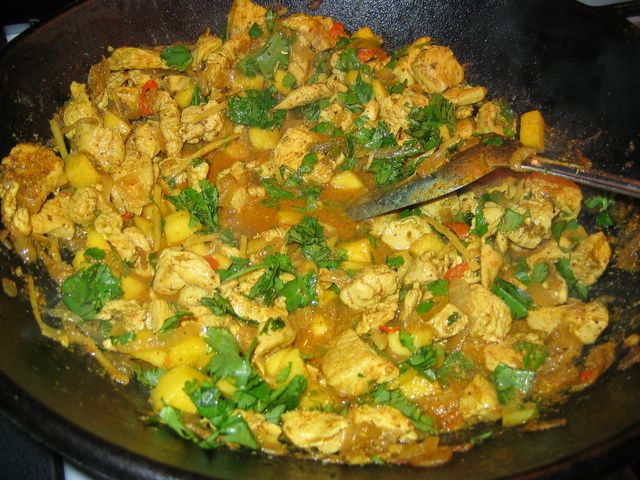
Chicken Vindaloo with Mangoes.
So, finally, I get to participate in a food blog event! Finally, I am settled enough to do it. Yes!
So, the theme of this time’s “Is My Blog Burning” event, hosted by Foodgoat, is, “Orange You Hungry?” Participants are to post a recipe of something that comes out colored orange, which made me think of a favorite Indian dish: Chicken Vindaloo with Mangoes.
Now, mangoes are not supposed to go in the vindaloo, but what does that have to do with anything?. Potatoes seem to be a traditional vindaloo vegetable, but I always feel weird eating potatoes and rice in the same meal. I don’t let that stop me from consuming Dum Aloo (stewed potatoes) with basmati pillau at an Indian restaurant buffet, but when I am home, doing the cooking, I do try to avoid that. Unless I am making Saag Aloo, but that is different. I am not sure why it is different, but it is. Maybe it is the greens that make it okay.
Anyway, back to vindaloo. Vindaloo is a curry dish that is from Goa, which was once a Portuguese colony on India’s western coast. As such, it was originally made with pork, which is unusual for Indian dishes, as pork is not widely eaten anywhere else in India. It was the Portuguese who brought the pig along and elevated it to a culinary staple in Goa. Like many dishes common to southern India, vindaloo is highly spices with mustard seed and chiles, which the Portuguese also brought along with them. (The chiles, not the mustard seed.) Yes, chiles came to India only about five hundred years ago with the Portuguese colonials and traders. It was brought from the New World, where it was native.
It is hard to think of Indian food without the heat of chiles, but it is a recent addition to their spice repretoire. Mind you, they wasted no time incorporating all of the new foodstuffs that came along with traders from the Americas: chiles, tomatoes, potatoes, corn, and various beans. By this time, these foods are used so often, they are thought of as native, though it isn’t the case.
What is native to India, however, is the mango. Here in the US, we probably only think that there is one kind of mango, but in India, there are countless varieties of them grown, and not all of them are eaten ripe as fruit. Many of them are picked green and processed as pickles. Some are cut into strips, dried, and ground into a powder, called “amchoor,” which is used to give a sour flavor to some spice mixtures and dishes like channa masala. The ripe fruits are eaten out of hand, of course, and are used in desserts and sweet drinks, like the yogurt-based mango lassi, which is common in Indian restaurants in the US. Ripe fruits are also used in fresh and cooked chutneys, which are used as an accompianment to Indian meals, much like many Americans use salsa to go with entrees or as a dip.
I love mangoes.
I was first introduced to them by my Grandma who would bring boxes of them back from her trips to Florida to visit her sister. Grandma was a diabetic, and so she could never eat any of the delicious cakes and pies she baked every week for everyone else. But she could eat fruit, and mango was her favorite. She loved to peel them and eat them sitting out under the canopy of the huge locust tree beside the barn. The juice would run down her arms, but she would laugh and lick it off, and would cut pieces of it for me to share.
I wasn’t supposed to eat the peel, but I liked to suck on it because I liked the resinous, pine-like flavor of it. To this day, I will suck on a piece of the peel when preparing mangoes, and when I do, it takes me back to memories of sitting on Grandma’s lap under the blooming locust tree, surrounded by the honey-scent of its blossoms and the buzzing of bees, getting sticky mango juice in my hair and on my face.
My first taste of vindaloo came much later, when I lived in Columbia, Maryland. I ate it at Akbar, and it was love at first bite. I knew I had to learn to make it. Because I couldn’t get good lamb all the time, I took to making it with chicken. It is good with chicken, but the richness of the lamb really made it a great dish, so I was trying to think of what to do to make the chicken vindaloo more special.
Mangoes were in season, and I had made a salsa with some of them. I thought about that spicy, sweet salsa with lime juice, and thought about the vindaloo–hot with ginger, mustard and chile, and sour with vinegar, and it clicked.
The cool, sweet juicy mango was just what the chicken vindaloo need to wake up and take off to the stratosphere.
So, to this day, when I make chicken vindaloo–I only do it during mango season.
Chicken Vindaloo with Mangoes
Ingredients:
2 tablespoons mustard seeds
1 tablespoon cumin seeds
1/2 teaspoon cardamom seeds
1 teaspoon coriander seeds
1 teaspoon fenugreek seeds
1 1/2 teaspoons black peppercorns
1/2 teaspoon ground cinnamon
2 teaspoons ground turmeric
1 teaspoon ground cayenne pepper (optional)
1 teaspoon ground sweet paprika
mustard oil or peanut oil for stir-frying
1 large onion, cut into paper-thin slices
2″ cube ginger, cut into thin jullienne strips
5-6 fresh green or red Thai chiles, cut into thin slices on the diagonal (to taste)
5 cloves garlic, cut into thin slices
2 pounds boneless skinless chicken breasts, cut into 1″ long thin strips
1/2-3/4 cup water or chicken broth
cider vinegar to taste
salt to taste
1 cup roughly chopped cilantro
2 fresh ripe mangoes, peeled and diced
Method:
Grind all whole spices in a spice grinder, coffee grinder or with a mortar and pestle, then mix with already ground spices. Set aside.
Heat wok (a wok-like pot called a karahi is used in India) over high heat and when smoking, add about 4 tablespoons of mustard or peanut oil. (Mustard oil gives the most authentic flavor.) When the oil is hot enough to shimmer in the wok, add onions and fry, stirring, until they are a dark golden color. Add ginger and chiles and stir fry until the onions are a medium brown. Add garlic. Be careful–once the chiles start to cook, their oil will get in the air–turn on your vent fan or open windows.
After garlic becomes fragrant, add spices, stir fry for about a minute, and then add chicken, stir fry until chicken is browned on all sides. Add water or chicken broth, turn down heat and simmer until chicken is cooked through and liquid is reduced by half. Add salt to taste, and just before serving add vinegar. (Vinegar boils away quickly; if you add it early in the cooking process, more will have to be added at the end.)
Stir in cilantro, and just before serving, stir in mango pieces, or scatter them over the serving platter. They should remain uncooked and cool and be a contrast to the very hot (both in heat and spice) chicken.
Bean Cuisine II: Saag Masoor Dal

Masoor dal: picked over and washed, ready to be cooked. Unfortunately, the salmon-coral color does not survive the cooking process. The lentils dull down to a faded yellow color which is easily perked up by the addition of turmeric or other food-based coloring agents.
Or in English, Red Lentils with Greens.
Last night, we had Indian food to go with Zak’s bread, and it was a stunning success. The lightly cardamom-scented bread went fabulously with our menu: Chicken Vindaloo with Mangoes, Red Lentil Dal with Greens, Keema Sookh (Dry cooked minced lamb with green beans) and Cucumber and Mint Raita.
In addition to being the first official dinner thing with the friends, last night was also the first time I cooked in the downstairs kitchen, because this is the first time since we moved in that the countertops are installed, the gas is on and everything is hooked up.
The good news is the dinner got cooked and I didn’t even pull out one hair while doing it. The bad news is that the kitchen was designed badly, the particle board cabinets cannot safely hold most of my dishes and cookware without threatening to come out of the wall or break, the gas stove might have 3 BTU’s to its name (Okay, I am exaggerating. Maybe it has 12…) and there is inadequate lighting.
The good news is that we are completely redoing the entire thing, except for the Sub Zero refrigerator.
The bad news is that we are completely redoing the entire thing, and it will be forever before I can cook downstairs comfortably.
In this case, the good news outweighs the bad, so I will simply hang tight and cook upstairs on my electric stove that actually gets hotter than the gas stove.
Anyway, as the folks were coming over and it was Indian food night, I decided to cook some more of my back stock of beans; I feel that most Indian meals are incomplete without a dal dish of some sort. My last bean night was last Saturday (yeah, it took me a while to blog about it), so it had roughly been a week since my last foray into leguminous cookery, so it seemed reasonable.
So, I dragged myself down to the basement to look at my stock of Indian dals. I had a lot, but I decided on masoor dal, or red lentils for several reasons. They are quick-cooking, they don’t require soaking, they have a lovely, light flavor of their own and they cook up into a wonderful puree without needing my assistance or interference.
Up they came, and into the kitchen they went, where I sifted through them, picking out bits of lentil hull (massoor dal are small brown lentils that have been skinned to reveal the coral colored insides), straw, rock and other assorted debris. Then, I put them in a colander and rinsed them, and dropped them into a pot, covered them with water, and revved up the fire.
I grated a thumb-sized hunk of ginger into the pot using my microplane, and then ground up some fresh garam masala from fennel seeds, cumin, cinnamon, coriander, cloves, bay leaves and black pepper. I added a medium-sized pinch of the garam masala, and then a generous pinch of asafoetida to the pot, stirred and let the lentils alone while I started slicing a mountain of onions.
Ferula asafoetida, or in Hindi, hing, is a resinous spice that is used often in Indian bean cookery. It has a lot of uncomplimentary names, including “devil’s dung,” or “stinkasant,” which derive in part from its ugly appearance: in its unground form, it looks like nothing more than a clod of dirt. Mostly, the unflattering names refer to its scent; it smells powerfully of garlic that is somewhat past its prime, though it also has a somewhat medicinal tang lingering in it.
A member of the family Apiaceae, which also contains parsley, dill, coriander, carrot, cumin, anise and celery, the resin of asafoetida is obtained by bleeding the thick, milky juice present in the stems of the plant. It dries into a dark mass which is then either sold as is, or is ground and then packed into air-tight containers.
I always buy mine ground, since the one time I ground up asafoetida, I got some on my hands and smelled less than grand for the rest of the day.
While it may not smell good to a lot of people (I generally don’t mind it, myself) safoetida serves several functions in Indian cuisine. One, it is used in place of onion and garlic by very religiously observant Brahman; the two alliums are thought to ignite “the baser passions” and are thus avoided in cookery. Secondly, it is believed to help reduce the flatulence-causing potential of dried legumes.
Since I am not one to fear the ignition of baser passions, it is for its secondary properties that I use asafoetida; that, and the flavor it imparts to the lentils and beans it is cooked with. It gives an elusive fragrance and flavor that my palate identifies as essential “Indian,” and so I like adding a small amount of it to any dal I make.
At any rate, after the addition of the asafoetida, the lentils are left to cook on medium heat, uncovered, until they are mostly done. The only thing that I do in the meantime to them, is I skim the foam that bubbles up to the top, and add salt halfway through the cooking process.
In the meantime, I go forward on preparing the greens and the tarka.
What is a tarka, you ask?
A tarka is a method of flavoring Indian dishes that involves heating vegetable oil (mustard oil is popular) or ghee (clarified butter that has been prepared in a way that gives it a nutty flavor) in a pan and cooking flavoring elements in it until everything is browned and sizzling. Then, the entire panful of hot fat and other goodies is poured into the dish and stirred, right before serving. The fragrance and flavor this imparts to a dish, particularly to dal, which can be somewhat bland otherwise, is amazing.
The tarka I prepared was based upon ghee with well-browned onions, with chile peppers, garlic and ramp bulbs. To that I added whole mustard and cumin seeds, and I finished it with about four cups of greens: roughly chopped spinach and ramp greens cut in a thin chiffonade.
When I use such a highly fragrant and flavorful tarka, I always underseason my dal to some extent, which is why I used such a minimum of seasonings in cooking the lentils. This process of minimal seasoning early in cooking and then using a strong tarka results in very fresh, vibrant flavors that burst in the mouth like a symphonic sensory overload. Everything mingles beautifully, and it is all deceptively simple to do.
Think about it. You cook some lentils, which you basically ignore, and then you brown some onions, garlic, chiles and spices in a good amount of hot fat and then when that is done, you add some greens, let them wilt and scrape it all into your lentils.
And it is done.
It is simple enough to make me feel like a lazy cook, or perhaps a magician every time I do it. It seems to be some sort of trickery or sleight of hand that produces so much flavor in a humble lentil dish.
The addition of greens was this week’s innovation: I used spinach and the last of the ramp greens, because that is what I had around. Kale (especially lacinato kale) would have been good, as would mustard greens or collards. Plain spinach alone would have been too mild; it was the ramps that really punched up the flavor. I liked the contrast in color and texture that it made with the lentil puree and I really liked the garlicky fragrance that the ramp greens imparted to the dish.
I’d make it again, except I used up all the masoor dal in the house, and I am not yet allowed to buy more beans. It will have to wait again until next ramp season, I guess. By next spring, I might be able to purchase some more legumes with impunity.
Let’s hope so, anyway.
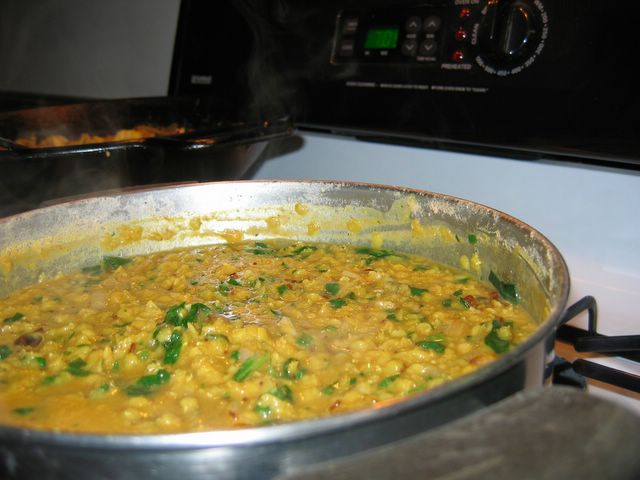
The finished dal. After adding the tarka with the greens, turn the heat down to low or remove from the heat to preserve the fresh color and flavor of the greens. Chicken vindaloo with mangoes is in the wok in the background.
Saag Masoor Dal
Ingredients:
1 pound red lentils, picked over, rinsed and drained
1 1/2″ cube fresh ginger, peeled and grated
1/2 teaspoon ground garam masala (you can buy this pre-mixed and ground if you like)
1 big pinch ground asafoetida/hing
1 tablespoon ground turmeric
1/2 tablespoon ground sweet paprika (optional)
salt to taste
water as needed
3 tablespoons ghee
1 large onion, peeled and sliced paper-thin
4 cloves garlic, peeled and sliced paper-thin
1-3 fresh chiles, washed and sliced thinly on the diagonal (seeded if you like)
12 fresh ramp bulbs, washed, trimmed and sliced paper thin (optional–if no ramps available, use more garlic, or perhaps a single leek)
1 tablespoon whole mustard seeds
1 tablespoon whole cumin
3/4 pound fresh spinach or other greens, washed, dried and roughly chopped
2 cups fresh ramp greens, washed, dried and cut into a 1/4 inch chiffonade
Method:
After picking over, washing and draining lentils, put them in a pot with enough water to cover by 1 inch, along with the ginger, garam masala and asafoetida and bring to a boil on high heat. Turn down heat to medium, and simmer uncovered. Skim foam from the top of the lentils until it stops bubbling up, and when they are halfway cooked, add salt to taste. Add water as necessary until lentils completely soften and begin to break down.
Allow lentils to completely break down into a slightly lumpy puree; some of the lentils break down faster than others. This is good: it gives the dal more textural interest than a perfect puree would.
At this point, the lentils are a kind of pale, faded shade of yellow. To perk up the color, stir in the turmeric and if you wish, some paprika. This is a common practice in Indian cookery to give foods a more appetizing color.
To prepare the tarka, in a heavy skillet, melt ghee. Add onions, and a sprinkle of salt. Cook on medium heat, stirring constantly, until the onions are a dark golden color. At that point, add the chiles, garlic and ramp bulbs, and keep cooking (don’t stop stirring) until the onions are a medium reddish brown, the chiles are browning on the edges and the garlic and ramps have turned golden. Add spices at this point, still stirring, and continue cooking until they become fragrant and the mustard seeds have started to pop. At this point, add all of the greens and stir to coat with the ghee, allowing them to wilt a bit.
As soon as the greens wilt, add them to the hot dal, and stir everthing together. Taste and correct for salt.
This dal is particularly good when served with yogurt or a raita, and of course, bread.
Once Upon a Time in China and America

“Stinky Ox Among Lilies.” Or, to be blunt, bison and ramp stir-fry. The bison is amazingly tender and flavorful and the ramps mellow considerably in the high heat of the wok. It is a nice switch on a beef and garlic flavor profile.
This is a story.
About a wok, a hunk of buffalo meat and a handful of wild garlic.
In other words, a wok, a bison steak and some ramps walked into my kitchen, and the wok said, “Hey, guys, come over here and meet my friend, the stove.” The bison steak and ramps looked at each other and said, “Why the hell not?”
And the rest, as they say is history. Okay, it only happened Wednsday night, so it isn’t old enough to be history, but it at least makes for a good blog entry.
And the ramps and steak didn’t walk in, I carried them.
In fact, the ramps, I dug up with my very own hands from the woods at our old place in Pataskala yesterday. They gave our car a nice fragrance as we drove home, and then I carried them up to the kitchen to clean them so I could put them in the fridge for the next evening’s dinner.
These ramps are fairly mature, so they actually had bulblets at the end of their stems; these you have to clean very carefully. They have a papery membrane, like a less well-developed onion skin, loosely covering the bulbs, and this has to be removed. Then you rinse carefully, and pull or cut off the root end. To store them, I wrapped them in damp paper towels and put them in a loosely closed paper bag. They will keep for several days like that.

Here is a comparison between an uncleaned ramp bulb and a cleaned one. The dirt clings to the papery membrane that is similar to an onion skin. Cleaning is a simple matter of stripping off the membrane, breaking off the root end, and rinsing everything well. I generally wait until I am ready to use them before breaking off the roots.
I only cleaned the ones I was going to use the next day. The paper membrane helps keep them fresh, so I put the unwashed ones that were still coated in forest dirt in a second paper bag and closed it a bit more tightly and put them into the fridge as well. They will keep a couple of days longer that way. They are going to be featured in the Indian food extravaganza that is being cooked up later today in preparation for having friends over for the first “having friends over” thing in the new house.

Cleaned mature ramps showing the gradation of brilliant color: icy white bulblets, garnet stem and verdant leaves. All parts of the ramp are edible and very flavorful.
For now, let me talk about the ramps and bison fusion.
The bison meat was a sirloin steak that I trimmed and cut into thin strips for stir frying.
I decided that I wanted to very strongly feature the meat and ramps, so I kept the other seasonings fairly subtle. I thought of going totally Cantonese in style, but discarded that idea; I am still better at “winging it” in a more Sichuanese style, so I brought out the chiles and Sichuan peppercorns, though I was very careful to use them in a subtle fashion. I was careful to use only light soy sauce and Shao Hsing wine (unsalted–I found out that the local market carries it of drinking quality!) instead of using dark soy which is more usual with beef. I did not use any other condiments but a bit of shredded ginger.
For vegetables, I went with carrot, jicama and Shanghai bok choy. And of course, the greens of the ramps–I used roughly two cups of them which is enough to consider them a vegetable.
I used the bulbs and stems of the ramps minced in place of garlic, and I used a bit of onion cut into strips and ginger cut jullienne to round out the flavors. A drizzle of sesame oil finished everything off.
Zak suggested a name for this dish: “Strong-Scented Ox Among Lilies.” I prefer “Stinky Ox Among Lilies.” Saying “stinky” harkens to a favorite Chinese ingredient, “stinky tofu,” and it satisfies my urge to give my dishes fun and funky names.
“Strong-scented” or “stinky,”refers not only to the fact that bison have a distinctive odor when you visit them up close (we went to a friend’s bison ranch up in Massachussets a few years back) but also to the strong scent that the ramps have. Ox, of course, refers to the bison. Lilies refers to the ramps; all alliums, including ramps, onions, garlic, chives and leeks are members of the lily family.
So, the poetic name is full of double entendre and wordplay–a Zak’s favorite sort of linguistic game.
It turned out well. As Dan Trout put it, “Oh, Barbara. It is ass-awful as usual. We’ll have to eat all of the evidence just to protect your reputation.” Thus stating his opinion, he tucked in and made good on his promise. What a trooper. I don’t know what I would do without my friends!
The bison is remarkably tender and has a delicious flavor that is not gamey, but not exactly like beef, either. It is somewhat sweet, which makes it a good match for the ramps. And, as I noted above, the high heat of the wok seemed to bring out the sweetness in the ramps, so the entire dish was strongly flavored, but in a thoroughly pleasant way.
I believe it was a successful experiment in fusing Chinese technique and condiments with native American foodstuffs.
Bean Cuisine I: Country French Flageolet Stew
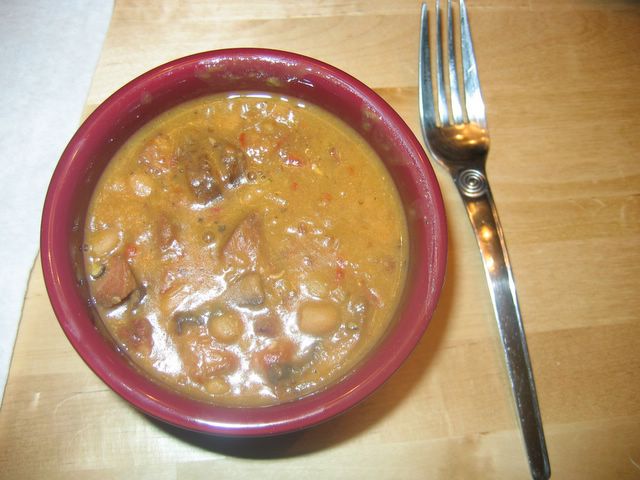
This is the first foray into inventing new ways to eat beans: flageolet beans with a country French flavor utilizing what was in my pantry.
So, I vowed as I was packing my pantry to create a new bean dish a week once I was settled, in order to pare down the collection of legumes lurking in my cabinets. Well, I am somewhat settled, and though the legumes are lurking not as planned in a pantry, but intsead are still in boxes in the basement, it does not matter. It is time, high time, to start consuming the wee dried beasties.
So, in order to make something delicious to go with Zak’s latest boule of cardamom-scented bread, and in order to feed the in-laws who are really into hearty stews and soups, I dragged out a pound of flageolet and proceeded to dig around in the freezer and spice cabinet to see what I had that would go with them.
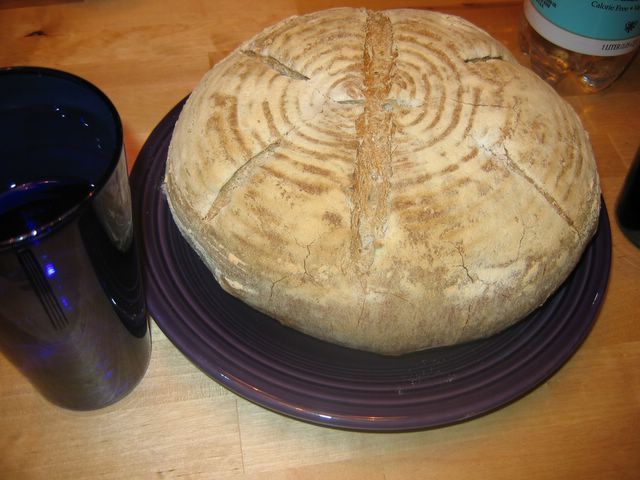
Zak’s latest boule: a cardamom-scented bread. He was pleased with the slashings. He did not use a lame, but a special folding utility knife we bought at the hardware store–it is sharper than the lame and the cuts are cleaner.
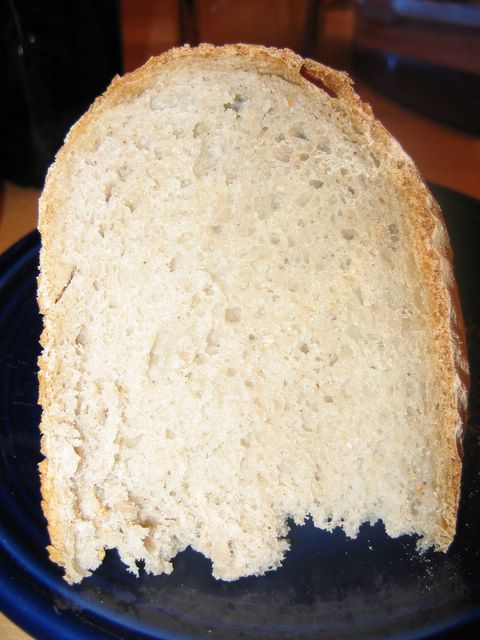
This version of the bread used only all-purpose flour and kamut. Here you can see how it results in a fine textured crumb. I prefer the versions with the bread flour in addition to the other flours; I like the chewier texture with the large irregular bubbles in the bread. I think it is more interesting, but Zak likes them both, so I guess we will alternate between versions.
While I had some delicious locally made spicy sausages and produced hickory smoked ham, I was lacking in duck and lamb, so there would be no real cassoulet. Which is fine: I felt no need to spend days making the dish. The idea is to use up beans, not exhaust myself cooking. Besides, I am supposed to be -creating- new dishes, not recreating authentic ones.
So, the spicy pork sausages and ham were in, the duck and lamb were out.
Leeks were abundant in the refrigerator, as were carrots. I had both fresh and dried mushrooms, dry red wine and plenty of sage, thyme, rosemary, lavender, and French basil. Most excellent. And green and black peppercorns. And bay leaves. So, all of those were pulled out and arrayed on the counter.
I also had some oil-cured sundried tomatoes. That sounded tasty to me, so out they came.
You will note a distinct absence of fresh garlic; Tessa’s stomach reacts badly to garlic, so I decided to leave it out of the equation, even though my instinct is to put it in everything but desserts. With all of the leeks, there was no real need for the garlic, but if you cannot live without it, get on with your bad self and throw some in. Just don’t invite Tessa over.
I cooked this in the crockpot, as we were going out all day. It turned out divine when cooked low and slow. Another way to do it would be in a covered casserole or Le Creuset dutch oven in a very low oven for a long time.
Here is the recipe:
Country French Flageolet and Pork Stew
Ingredients:
4 tablespoons olive oil
3 fresh leeks, sliced thinly, rinsed and dried
1 slice smoked ham, cut into cubes
1/2 pound spicy fresh pork sausages (I used locally produced “Cajun style” bratwursts”), removed from the casing and sliced
black pepper to taste
2 fresh portabello mushroom caps, gills removed, and cut in half then sliced thinly
6 Chinese black mushrooms, soaked in red wine, then squeezed out, stemmed and cut into quarters
1 teaspoon dried thyme
1 teaspoon dried rosemary
1/2 teaspoon celery seed, crushed
1/2 teaspoon dried rubbed sage
1 1/2 teaspoon dried basil
1 teaspoon red chile flakes
1 bay leaf
6 oil-packed sundried tomatoes, diced finely
wine from mushroom soaking and another 1/4 cup or so of it
1 pound flageolet beans picked over and rinsed, then drained
1 1/2 quarts chicken stock
1/2 cup baby carrots cut into round chunks
Method:
In a large saute pan or skillet, heat up oil until it is smoking. Add leeks, and saute until they begin to turn golden. Add ham chunks and sausage, then the portabello mushroom slices. Cook, stirring, until everything takes on a nice golden brown color and smells really good.
Add Chinese mushrooms, and all the herbs and spices, the bay leaf and the tomatoes. Cook another couple of minutes. Deglaze the pan with the wine from the mushroom soaking and some extra wine. If you want to add more than a 1/4 cup extra, that is fine with me–do what you need to do to make the dish really tasty. Have a sip of wine while you are at it. You have to make sure it is good, after all.
Allow alcohol to simmer off of the wine. Stand over it while it is cooking and breathe deeply. You have to make sure it smells right, after all.
When the steam coming off the dish no longer has a distillery scent to it, take it off the heat and dump it in the crock of a large crockpot. Add beans and broth. Put crock into heating base, turn heat up to desired temperature (depending on how fast you want it to cook) and put the lid on and walk away. Oh, and make sure the crock pot is plugged in. Someone in my family forgot to plug in the crock pot and then wondered why it didn’t quite work right.
Come back about halfway through the cooking process. Add the carrot slices. Make sure you have enough liquid in there. If not, add some broth, some water or wine. Wine is best.
Put the lid back on and walk away and come back when it is done. Serve with a nice salad and a crusty bread.
When it is done, it is not pretty. The red wine messed up the pretty celadon color of the beans, and the entire thing is a rather orangish beige color. But it smells really good and has a lot of very distinct flavors and textures happening which come together into a really nice melange.
The fact that it was not pretty was mediated by the beautiful composed salad with the pansies and the beautiful bread.
I guess I should work on making up bean recipes that not only taste good, but look good, too. Hrm.
We’ll see what I come up with this week.
Eating Bitter, Part Two: The Bitter Melon and Me

A poetic name for a lovely dish: Phoenix and Jade with Blossoms.
The very first time I tasted a bitter melon was at the home of the couple who were my very first personal chef clients. He was from Bangledesh, and she was from Pakistan, and they both loved bitter melon.
One evening, they had Zak and I to dinner and they served us various dishes, including one that was a heated up leftover. When it was passed to me, there was an apology and much head-shaking and hand-waving. “You probably won’t like it, but if you want to taste it, we would be glad for you to. But it is very bitter, very strong, and most Americans really don’t like it.”
They didn’t know the English word for it: they called it, “karela.”
It had been cut into small half-moon shaped chunks and fried with minced lamb, onions, garlic, ginger, chiles and many spices, including black pepper, cumin and black cardamom. There was a lot of minced mint sprinkled over it.
It smelled really good, so of course, I had to try it.
As soon as I bit into it, I realized what it must have been. “Bitter melon,” I said, as they watched me intently. I think they were waiting for me to make a face. Instead, I smiled, and had another big bite. “This is good,” I said. “I’ve always wanted to try it, but had no idea how to cook it. They eat it a lot in China, you know,” I said as I reached for the serving bowl to add more to my plate. I was surprised by having a heaping pile added to my plate, which I ate gleefully, much to the amusement and amazement of my hosts.
I figured Zak wouldn’t like it, though, because it was so bitter. He declined to test my theory by tasting it, so I was certain that I was probably a mutant.
Because I assumed Zak wouldn’t like them, I would eye the bitter melons in the Asian markets wistfully, but because I wasn’t sure how to go about cooking them, and I thought it foolish to cook them just for myself, I would pass them by.
However, all of that changed a few months ago.
I wrote about our first dinner featuring bitter melon on this blog back in January when I described eating it at Shangrila in Columbus. I saw the words on the menu: “Chicken with Bitter Melon”, and had to have it. When the waitress brought it out, she said to me, “Boy, you sure know what to order! That is my favorite dish on the menu out of everything and I eat it at least once a week. At least.”
I had a bite, and it was love. I couldn’t get enough of it.
Zak tasted it tentatively and pronounced the melon “interesting,” but the chicken “fantastic.” They were cooked with fermented black beans, and judging from the slightly silken texture of the bitter melon, it had been parboiled before being stir-fried. There were onions, and while I saw no evidence of ginger, the flavor was there, leading me to believe that a chunk of it had been allowed to brown in the oil, then was removed, leaving behind its essence.
The next time I got the dish, Zak had a couple more pieces of the melon. Then, the next time, he ate a half-dozen pieces. Then the fourth time, he was eating as much melon as chicken. (I have to admit to ordering the “Chicken with Black Beans” dish, which is the exact same thing without the melon once, but the sauce wasn’t as good without the juice of the melon in it.)
He has been converted.
That time when we were there, the lady who owns the restaurant told us that bitter melon is very healthy for people and that she doesn’t eat it, but drinks the juice of it every day for her health as a tonic. She said it controls blood sugar problems and is good for liver functioning.
I did a little research and found out that she was right–it is very good for you.
But of course, I was all about eating it because I liked the taste.
When we took Morganna to that restaurant, we figured she would love the chicken, but would not like the bitter melon.
She surprised us both with her enthusiastic consumption of a large quantity of bitter melon, along with chicken. She also ate a bunch of choy sum with garlic, tofu and pork soup and gai lan with beef, and was still able to down a small bowl of sweet warm tapioca with lychees. Oh, to be a growing teenager again!
So, what it comes down to is Zak and Morganna and I are a family of American mutants.
We like that which we are supposed to fear–bitter melon.
And now that we have moved away from Shangrila, I had to figure out how to cook it, because I am not driving an hour and a half each week just to eat bitter melon. The Asian market here in Athens carries it now and again, and when I am in Columbus, I can pick some up at the markets there that carry it all the time.
Which is what I did on Saturday.
We had gone with Zak’s parents to Shangrila for lunch, then we dropped them off at the airport so they could fly home. After that, we did some shopping in Columbus, including a trip to the Asian market, at fifteen minutes before closing time.
I had ducked in the door, and beelined right for the produce section. In addition to the bitter melon, I wanted to pick up fresh water chestnuts if they had them, and some good Thai chiles. The chiles they had, the water chestnuts they did not. But they did have bitter melons, so I stood before the pile and made my selection. I sniffed them, squeezed gently and put six in my basket.
I was about to turn to go when I nearly ran smack-dab into the chest of a very tall Pakistani man, who demanded of me in a raspy, heavily accented voice, “Why do you get that?”
I blinked, and backed up, somewhat confused. I looked up, and then around to see his entire family: a wife in a lovely sari, and four kids, and a grandmother in a blue salwar-kameez, all of them staring at me with wide eyes.
I blinked and he picked up one of my melons and said, “How do you cook it?”
So, I said, “With fermented black beans, onions and chicken.”
He smiled and nodded. “It is very good for you, very good. Healthy.”
They were all smiling.
I smiled.
“In my country,” he expounded, “We cut it up small, and fry it. Onions, garlic and ginger, all make it good.”
I nodded. “With minced lamb, pepper, chiles and cumin, and black cardamom.”
His smile widened and he nodded, “Good, good, yes, you know.”
His wife smiled and patted my arm. “We have never seen a white American eat them. We thought none of you liked them.”
I shrugged and said, “My husband and daughter like them, too.”
The pater familias said, “Good, you will all be healthy, live a long time. Food is medicine, you know. Eat good food, it makes you strong.”
Then he looked around and said, “They are closing the store–we should go.”
Though, I was gratified to see him pounce on someone else’s basket in the line and quiz him about what he was buying, how he would cook it. The man was Chinese, so I decided that it was just this family’s way of making friends with everyone–looking at food and how it is cooked and trading recipes.
When I got to the cashier, she rang up my black mushrooms, chiles and then got to the bitter melon. As she weighed it, she smiled. “This is good as salad, in the summer. It cools you, and makes you healthy. You should try it that way.”
When I got back to the car, it was dark, and our lunch from Shangrila had worn off so we went across the parking lot to our other favorite little Chinese restaurant, the Hometown Oriental Carry-Out and Deli. The owner came over and was glad to see us; she knew we had moved away and that we would be back only sporadically. When I told her that we had to stop at the market for bitter melon, she said, “Oh, that is the best in soup–very healthy. Have it at least once a week to make you have a good strong liver.”
Everyone has a recipe for bitter melon, it seems.
Including me.
I based mine on one I found in Martin Yan’s Yan Can Cook Cookbook that was for Beef with Bitter Melon, which looked like it approximated the flavor profile of my favorite dish from Shangrila.
I added ginger slivers and thinly sliced Thai chile. Though they are both Cantonese, Martin Yan and Ken Hom say that bitter melon is very good with chile; knowing as I do that the slight bitterness of lime oil is very good with chiles in Thai food, I decided that bitter and hot go together well. For a more Cantonese sort of dish, leave these two out and only use ginger juice or ginger oil in the chicken marinade, or cook a big hunk of fresh ginger in the stir frying oil until it browns, then remove it and stir fry as directed to get the flavor without the ginger itself.
Also, I followed Kasma Loha Unchit‘s advice and did not blanch or parboil the melon in any way. She believes you lose flavor in that way and she doesn’t like the way it changes the texture. I have to agree with her; at this point after having it both ways, I prefer just stir frying it the way I did to the way it is done at Shangrila.
As for the garnish in the photographs–it is redbud blossoms. Redbud is a native American leguminous tree, with tiny purple flowers that have red stems and calyxes. The flowers are edible and have a sweet flavor that is a cross between a bean pod and a honeysuckle blossom. It is completely untraditional to use them, but the color was an amazing contrast with the brilliant green, and the flowers are in season, so of course, I had to do it.
I wanted to give it a poetic name, so I called it, “Phoenix and Jade with Blossoms.” Chinese chicken dishes are often named for the phoenix of mythology, and of course, jade is in honor of the brilliant color of the stir-fried melon.
The blossoms are self explanatory; use whatever flowers or petals are in season and which will complement the colors in the dish.

The ingredients for the dish arrayed on the stove: for a more classically Cantonese flavor, leave out the ginger slivers and chiles.
Phoenix and Jade with Blossoms
Ingredients:
2 medium sized bitter melons
1 small onion cut into half, then into slices
1/2″ cube fresh ginger cut into slivers
2 Thai chiles, cut into very thin diagonal slices
2 tablespoons fermented black beans
1 boneless skinless chicken breast cut into thin, narrow slices
1 teaspoon thin soy sauce
1 tablespoon cornstarch
1 teaspoon thin soy sauce
1 teaspoon sugar (optional)
1/4 cup chicken broth
edible flowers for garnish
3 tablespoons peanut oil
1/8 teaspoon sesame oil
Method:
Cut bitter melons in half longitudinally. Scrape out seeds and pithy interior. Slice diagonally into 1/4″ half-moon shaped slices.
Marinate chicken in one teaspoon of soy sauce and cornstarch for at least fifteen minutes.
Heat wok and add peanut oil. When it is smoking hot, add onions, then ginger and chile and black beans. Stir and fry about two minutes, then add chicken, spreading it out to form a single layer on bottom of wok. Leave it for at least one minute to brown on the bottom, then stir fry until nearly done. Add bitter melon and continue stir frying for one minute. Add sugar and second teaspoon of soy sauce and stir frying about thirty seconds, then add broth and stir and fry, allowing liquid to reduce until it clings to the chicken and melon slices.
Drizzle sesame oil over and give one last good stir.
Pour onto platter and garnish with flowers.

A closeup of the dish shows the fantastic contrast in colors and textures. When redbuds are not in season, one could use violas, sweetheart rose petals or chive blossoms for the flower garnish.

Categories:
- Admin (rss) (55)
- Blogs and Blogging (rss) (81)
- Book Reviews: Cookbooks (rss) (43)
- Book Reviews: Non-Cookbook Food Books (rss) (38)
- Cats and Cat Blogging (rss) (47)
- Chinese Cooking Lessons (rss) (32)
- Culinary School Stories (rss) (18)
- Dairy Pruducts: Cultured and Barbaric (rss) (4)
- Documentary Filmmaking (rss) (1)
- Essays, Rants and Reflections (rss) (260)
- Fighting Hunger (rss) (12)
- Food and Kids (rss) (45)
- Food in the News (rss) (126)
- Food Media (rss) (98)
- Food Preservation (rss) (18)
- Food Safety (rss) (45)
- Gardening (rss) (30)
- Herbs and Herb Blogging (rss) (20)
- Holidays (rss) (50)
- Kat Blogging (rss) (22)
- Kitchen Science (rss) (36)
- Leftover Makeover (rss) (8)
- Life, the Universe and Everything (rss) (131)
- Local and Sustainable (rss) (227)
- Local Athens Food and Foodies (rss) (42)
- Meatless Mondays (rss) (32)
- Menu For Hope (rss) (5)
- Nutrition, Diet and Health (rss) (84)
- On The Farm (rss) (8)
- Recipes: Almost Vegetarian, Vegetarian and Vegan (rss) (294)
- Recipes: American Regional (rss) (37)
- Recipes: Appalachian Hillbilly (rss) (33)
- Recipes: Bread, Pasta, Grains (rss) (95)
- Recipes: Canning and Preserving (rss) (8)
- Recipes: Chinese (rss) (123)
- Recipes: Comfort Food (rss) (120)
- Recipes: Cookies (rss) (16)
- Recipes: Desserts (rss) (48)
- Recipes: French (rss) (25)
- Recipes: Fruits and Vegetables (rss) (302)
- Recipes: Greek, North African and Middle Eastern (rss) (31)
- Recipes: Indian (rss) (137)
- Recipes: Italian (rss) (42)
- Recipes: Japanese (rss) (7)
- Recipes: Jewish (rss) (4)
- Recipes: Korean (rss) (6)
- Recipes: Meat, Poultry and Fish (rss) (220)
- Recipes: Mexican/Native American/ Latin American/Caribb (rss) (27)
- Recipes: Original (rss) (108)
- Recipes: Thai (rss) (27)
- Recipes: Tofu (rss) (17)
- Recipes: US Regional (rss) (16)
- Recipes: Vietnamese (rss) (8)
- Restaurant Stories (rss) (28)
- Sewing, Quilting, Arts and Crafts (rss) (16)
- Simple Chinese Recipes (rss) (30)
- Slow Food and Heritage Foods (rss) (10)
- Spice Blogging (rss) (44)
- The Chinese Cookbook Project (rss) (14)
- The Chinese Pantry (rss) (39)
- The Documentary (rss) (2)
- The Kitchen Saga (rss) (17)
- The Locavore's Bookshelf (rss) (15)
- The Unsung Adventures of The Culinary Nerd (rss) (6)
- Tools and Toys (rss) (35)
- Uncategorized (rss) (10)
- With a Side of Politics (rss) (48)
Archives:
- August 2012 (9)
- July 2012 (12)
- September 2011 (3)
- August 2011 (7)
- July 2011 (8)
- June 2011 (16)
- May 2011 (17)
- April 2011 (11)
- December 2010 (9)
- November 2010 (5)
- February 2010 (1)
- December 2009 (5)
- November 2009 (7)
- October 2009 (10)
- September 2009 (16)
- August 2009 (14)
- July 2009 (14)
- June 2009 (7)
- May 2009 (17)
- April 2009 (10)
- March 2009 (25)
- February 2009 (13)
- January 2009 (10)
- December 2008 (5)
- November 2008 (5)
- October 2008 (6)
- September 2008 (13)
- August 2008 (8)
- July 2008 (11)
- June 2008 (18)
- May 2008 (13)
- April 2008 (14)
- March 2008 (16)
- February 2008 (17)
- January 2008 (19)
- December 2007 (25)
- November 2007 (18)
- October 2007 (24)
- September 2007 (16)
- August 2007 (15)
- July 2007 (15)
- June 2007 (10)
- May 2007 (14)
- April 2007 (16)
- March 2007 (17)
- February 2007 (20)
- January 2007 (13)
- November 2006 (1)
- October 2006 (8)
- September 2006 (14)
- August 2006 (25)
- July 2006 (30)
- June 2006 (28)
- May 2006 (34)
- April 2006 (29)
- March 2006 (24)
- February 2006 (30)
- January 2006 (38)
- December 2005 (40)
- November 2005 (37)
- October 2005 (32)
- September 2005 (25)
- August 2005 (30)
- July 2005 (28)
- June 2005 (21)
- May 2005 (8)
- April 2005 (22)
- March 2005 (17)
- February 2005 (29)
- January 2005 (10)
Search Site:
Links:
- Lily’s Wai Sek Hong
- 101 Cookbooks
- A cat in the kitchen
- A Veggie Venture
- Accidental Hedonist
- Cha Xiu Bao
- chez pim
- Chocolate & Zucchini
- Chopstick Cinema
- Chowhound.com
- Chubby Hubby
- Cook sister!
- Cooking with Amy
- da*xiang
- Eat Local Challenge
- Eating Liberally
- Ecocentric
- Eggbeater
- Epicurious
- Farmgirl Fare
- Fatfree Vegan
- Foodgoat
- ForkandBottle.com
- Green Olive Tree
- Hooked on Heat
- Jaden’s Steamy Kitchen
- Kalyn’s Kitchen
- Lucullian delights
- Mahanandi
- Matt Bites
- MeatHenge
- mmm-yoso!!!
- New York Times – Dining & Wine
- Pizza Goon
- Rasa Malaysia
- Ruhlman
- Sailu's Kitchen
- Serious Eats
- SF Gate: Food & Dining
- Simply Recipes
- Soul Fusion Kitchen
- Tastespotting
- The Amateur Gourmet
- The Cleaner Plate Club
- The Food Section
- The Grub Report
- thecookscottage
- U.S. Food Policy
- Wandering Chopsticks
- Washington Post Food and Dining
- Wasted Food
Meta:


Powered by WordPress. Graphics by Zak Kramer.
Design update by Daniel Trout.
Entries and comments feeds.