
Cook Local, Eat Global
Sweet Success
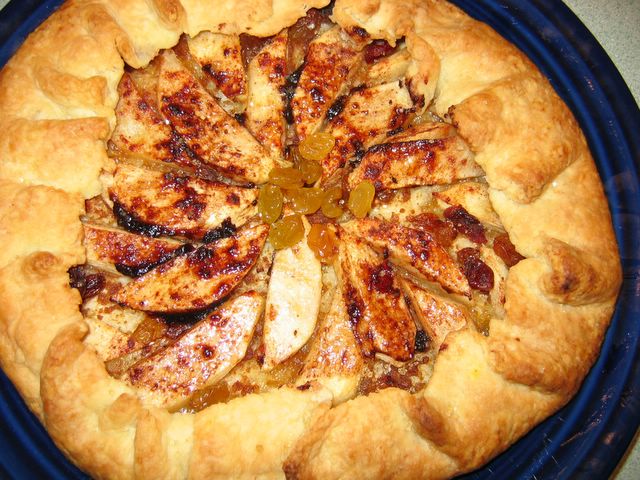
An apple raisin galette flavored with a bit of rose extract and wild berry glaze.
Faithful readers may remember my admission that I am fumble-fingered when it comes to pastry, and that I had vowed within this year to become better able to make pies that not only tasted good, but looked like something other than a map of Australia, or worse, like something a cow stepped in.
So, for Valentine’s Day, my least favorite of all holidays, I decided to celebrate by doing something that makes me nervous and jittery. No, not making a pie, going to the dentist. Yes, I had a dentist’s appointment yesterday, which made me an awful shrew to Zak. But, I was not so bad off as my friend Branwen–she had an appointment with her doctor to deal with two hernias. (Boy, we are two hot babes who know how to celebrate love and party hard, aren’t we?)
Well, after being twittish and skittish all day, I made it up to Zak by making a good dinner–ribeye steaks dry-rubbed with Turkish spices cooked in cast iron skillets on the stove, with fingerling potatoes sauteed in olive oil with fresh garlic, thyme and rosemary, a goat cheese and spinach salad, and a dessert. And for dessert, I determined to make a galette. My theory was that it was simple, it is one crust, I had apples on hand and it was relatively quick.
So–I made the dough:
1 tbsp. sugar
1/4 tsp. salt
1 sticks unsalted butter, cut into ½ inch pieces and chilled
1/3 cup ice water
I mixed the dry ingredients together in a medium sized bowl, and then used the pastry blender to cut the butter in. I worked it that way until there were pieces about the size of garden peas, and little crumbs.
I wanted to break some of the larger pieces into smaller ones, so I threw caution to the wind and did as I have watched Madeline Kamman do, and used my fingertips to rub the flour and butter together, squishing the butter into flakes. I am a firm believer that you must be bold to get anywhere in life and love–or the kitchen for that matter. One must be fearless to learn to cook well.
Then I poured in the water, and used my hands to mix it in well, then gather the dough into a reasonbly dry, flat disk. Zak held open a ziplock bag for me, and I slipped it in, pushed out the air and stuck in the fridge to firm up while I cooked potatoes.
Then came time to roll it out, and add the filling, which I improvised:
I crushed a handful of crisp cookies–a pastry chef I knew in culinary school liked to use biscotti crumbs, but I was fresh out of biscotti, so cookies it was. These go on the bottom of the galette to absorb excess juices to keep the bottom of the crust from turning soggy. Then I peeled and thinly sliced two Braeburn apples, because that is what I had. I got out a bit of cinnamon, some rose extract, a bit of dried ginger and some golden raisins.
I rolled out the dough–it was almost completely round! Only the edges were a bit ragged, and the shape was vaguely circular! It was amazing. I wish Morganna could have seen it.

A nearly circular pastry crust rolled out by myself–queen of rolling perfectly good dough into perfectly wretched disasters.
Then I sprinkled the crumbs in an even layer over the dough, leaving a two inch edge free of crumbs. Then the apples went on top in a concentric pinwheel design. I sprinkled raisins over it, then sprinkled cinnamon, ginger and about 1/2 tsp. of the rose extract over it all. I sprinkled probably 1 tsp. of raw sugar over it all, and then folded over the edge, pinching it all in one direction. I brushed the excessive flour off the edges, and carefully transferred the galette (with Zak’s help) to a silpat-lined baking sheet and popped it in a 400 degree oven for 45 minutes.
It came out very brown and fragrant–though I made a mistake with putting raisins in the exposed part of the tart. They browned too much, so I picked them off and sprinked new ones over it. I glazed it with melted wild berry preserves, and we ate it warm.
The crust was magnificently crisp and flaky and filled with a delicious browned butter aroma. The apples absorbed the flowery essence of the rose extract and the wild berries. The raisins added a depth and richness–those which were covered by the edge of the crust were quite protected and filled with sweetness.
Finally–a pie-like pastry made by moi that did not look ill in some way!
Fools for Pho
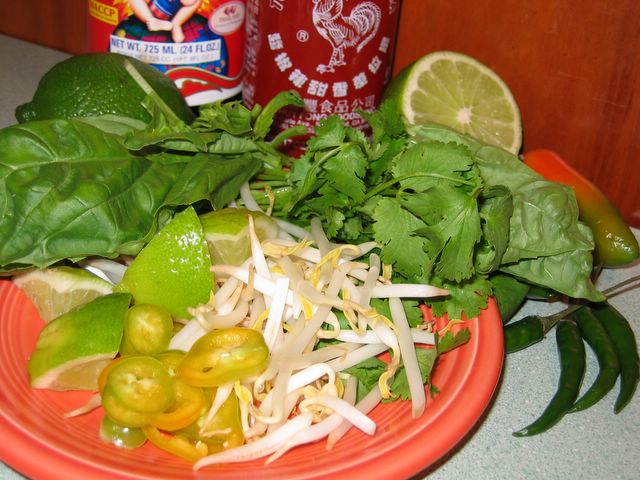
A plate of beautiful fresh vegetables meant to customize pho.
This is a love story. Like all love stories, it is about pursuit, frustration, elation and pain.
It is about obsession.
But it isn’t about my beloved husband, and how we came together.
It is about soup. It is about a soup which arouses argument and jealousy, obsession and devotion, lust and desire in more people than just myself and a few others.
It is about pho.
The idea to write about it came to me two days ago while I was having coffee and a leftover naan (made by Zak–his first breadmaking outing–a round of applause, please!) for breakfast. I came across this Washington Post article about a quest to learn how to make pho. I had to giggle, because it made me remember my experimentations in that area, which were made more piquant by the desperation born of someone who needed to understand it so she could teach it to others.
I used to teach culinary arts in Columbia Maryland through Howard County Parks and Recreations Adult Education program. I specialized in teaching Asian cuisines: Chinese, Thai and Indian, mostly, and I was surprised to find that many of my students were Asian American adults who had never learned to cook from their parents or grandparents, but who said that my food reminded them of what they had in childhood. Other students were Anglo-Americans who had worked for the government in the intelligence community or diplomatic corps, and so had traveled quite extensively and wanted to learn to recreate the foods that they had eaten in various Asian countries often decades ago.
Many of my students became regulars, and I ended up making friends with many of them. At the end of class, I always had to pass out an evaluation form which asked questions about what they learned, my teaching style, and what other classes the students would like to see me offer.
The single most requested class was on on pho bo–the sublime Vietnamese beef and rice noodle soup. It is a deceptively simple dish: pliant, pre-cooked rice noodles are nested in a large, warmed bowl, with one or more of the following–well-done beef slices, chewy beef tendon, and paper-thin slices of raw beef–placed on top. Then, boiling hot, clear amber-colored beef stock, fragrant with spices and the mysterious depth of nam plaa–fish sauce, is poured over it all, cooking any of the raw beef within seconds. A sprinkling of scallion tops and translucent onion slices are scattered over the bowl, which is presented with a platter of Thai basil, cilantro sprigs, fresh bean sprouts, jalapeno chile slices, and lime wedges, so the diner can customize the dish to their own taste. On the table is always a tall bottle of scarlet sriracha, hoisin sauce, and nuac cham– a spicy condiment of fish sauce, garlic, lime juice, sugar and fresh Thai chiles. These sauces allow further flavor possibilities, allowing individual diners to make as potently fiery or as soothingly mild dish as they prefer.
But, as I, and the Washington Post reporter discovered, pho may look simple, but it isn’t.
The backbone of the dish is the beef stock, which, while it may be based upon French culinary principles, does not taste like most European style beef stocks at all. And while, on the face of it, stocks are simple to make–you stick bones in water and simmer for a long time–there is really a lot more to it than that.
First of all, in order to make stock at home, you need a -really- large pot (anything less than twenty quarts is a waste of time, in my opinion–there is no sense in making only a little stock), which may or may not fit on your stove. And even if it does fit, your stove may or may not throw out enough BTU’s to adequately heat such a gigantic cooking vessel. And then, if you do have a pot and a stove that are adequate, you have to get beef bones. Good ones. Ones that are fresh. And that means that you have to have a butcher or grocer or a farmer whom you trust. If you are lucky, you can go to a large Asian market and talk with someone in the meat department and tell them that you are making pho, and they will know what to get for you, and usually, will give you advice on how to proceed. Of course, how they make pho may not be how the restaurant that you like makes pho, but as I discovered, there is apparently no one “right and proper” way to make pho–there are endless variants on the theme.
Once you have the pot, the stove and the bones, you have to go about making the stock.
Which you will find takes all day. In fact, that innocuous looking bowl of gorgeous soup takes about two days or so to make. It represents hours of work. Which, I suspect, is why most people go out and eat pho–at around six dollars a bowl it is a bloody bargain.
But, like the Post reporter, I was driven to learn how to make it, so I went out, and ate many bowls of the stuff, (it was a great sacrifice, I tell you) analyzed the flavors, and took notes. I shamelessly accosted cooks at the Asian markets, waitresses in restaurants and little elderly Asian ladies in parking lots to ask questions. I tool more notes, then read every Vietnamese cookbook I could get my hot little hands on in order to synthesize a recipe for pho.
Which I did. My recipe differs slightly from the one in the Post, but not by much. Instead of the sugar, mine uses parsnips–a touch I got from Nicole Routhier, whose mother always used parsnips for the subtle sweetness they added to the stock. I like that better than the sugar flavor–rock sugar is too easily overdone, whereas the parsnips add not only sweetness but an almost floral quality to the fragrance of the stock that you cannot get with rock sugar.
And then, I tested the recipes and refined them. In doing so, I remembered something I learned from culinary school–the early stages of making beef stock are a messy, smelly business.
Chicken stock smells good while it cooks, from the very beginning to its golden end.
Beef stock smells godawful until it is nearly done, and even then, the smells of the early stages are still hanging around, making a dank miasma of the atmosphere in not only the kitchen, but if you have inadequate ventilation, the entire house.
I persevered, bringing the bones to their first boil and then pouring out the water and washing the bones again, and then starting them over and diligently skimming the scum that rose to the top, and patiently watching to make certain that the liquid only simmered, never boiled, and skimming, and sweating, as the bone and marrow scent began to permeate my clothes, hair and my very skin.
For ten hours I cooked it until I ended up with a pale, and flavorful stock. I strained it and then refrigerated it and then the next day scraped most of the fat from the top and then brought it back to a simmer and added the spices and fish sauce, and simmered it a bit longer, then began cooking the noodles. I set up the condiments and then, sliced the half-frozen beef into shavings and presented it all to Zak.
It was really good, but not only was I exhausted, I smelled funny.
But I had a recipe I could teach to the class which my supervisor had told me was full and with a waiting list.
The day before I was to teach, I made another huge pot of stock, creating yet another cloud of stench in the house, and prepped the herbs and vegetables. On the day of class, I skimmed off most of the fat, flavored the stock with the spices, cooled it in order to transport it, and then packed all the food up. I packed some bones, and a small pot so I could demonstrate the early stages of stock-making, and went early to the classroom, so I could bring the finished stock to a simmer for presentation. By the time I was finished lugging all of this up the stairs, I was exhausted, and once again, felt like I smelled funny.
So, the students showed up, many of them regulars, and many others new faces. They were all fairly wriggling with excitement, because I was going to show them how to make pho.
So, I gave my talk about what I had learned, how I learned it and how many batches of pho I had made (quite a few) in order to figure out a good recipe for the beef stock. Then, I demonstrated the making of beef stock with some beef bones, parsnips, ginger and all that stuff. Predictably, when the water boiled the first time, the smell arose with the clouds of steam, and some folks in the front row curled their lips.
“Are those bones fresh?” a lady in the second row asked tentatively.
“Yes, they are, ma’am,” I answered. “Beef bones just smell that way when they first start cooking. That is just how they are. It is the blood and other impurities coming off and out of them. The good smells come later.”
People started to look decidedly less thrilled with the prospect of making pho.
Then, I showed them how you dumped the water out, washed the bones, the pot, the everything and started over and eyes widened and they began to understand why it is better just to go out and plunk down the six dollars when you had a craving. They looked at each other and said, “I had no idea it was so hard.”
Indeed.
Once I demonstrated the scum skimming, and told them how many times they had to do that over the next seven to ten hour period, I turned off the heat under the stinky pot, and put it outside the classroom door and shut the door to keep the smell out. I turned up the heat on the crystal clear heavenly-scented finished stock, and brought it to a boil, while I showed them how to cut paper thin slices of rare beef. The well done beef, I had already cut. There were no tendons–I forgot to pick some up, but of course, someone asked about them, so I told them that you cook them the same amount of time as the well-done beef, and you take them out around the same time.
Then, I started assembling small bowls of pho for twenty-five people.
While I was occupied with this, and people were lining up for tastes, and playing with the plates of condiments and garnishes and bottles of sriracha, which I call “the sacred rooster sauce,” I bantered back and forth with the students and learned that many of them had worked in Vietnam or had been stationed there at an embassy or who had gone there to adopt children. After everyone was served, silence fell, broken only by slurps and exclamations of satisfaction.
As they filed up for seconds, I opened the floor to questions. One extremely well-dressed, bejewelled and meticulously coifed woman raised her beautifully manicured hand and when I nodded to her, asked, “Is there any way to make pho more easily than this?”
To their credit, everyone else turned and looked at her as if she had just announced that she had come from the Planet Xenon and that she was sorry but we were all to be terminated in the next five minutes.
I bit my lip to keep from screaming, “If there was, don’t you think I would have taught you that?!” Instead, I gripped the edge of the stove, and smiled sweetly. “Not really, no,” I answered in my most polite voice.
She blinked and pursed her lips in a pout. “Well, why couldn’t you use canned beef broth?”
I took a deep breath through my nostrils and let it out slowly. “Because it wouldn’t taste right,” I said. The lady in the front who lived in Vietnam for five years while working in the US consulate looked back at her and shook her head, “And anyone who really loved pho would know–it would taste awful.”
The woman waved her fingers and shrugged. “Well, I just want to know if there is any way I can make this soup quick and easy? I mean, I don’t have time to spend standing over a smelly pot of bones and skimming crap off of it all day. Is there any shortcut I can use?”
I nodded, and said, “Yes.”
She leaned forwards, her face lit with eagerness.
“How?” she asked, her pen at the ready to take notes.
“There is a way to get pho in about fifteen minutes.”
My regular students started to smirk, but the woman simply gritted her teeth and all but spat out, “How?”
I smiled sweetly and shrugged. “Go out to your favorite pho joint, plunk down about six bucks, and like magic, a bowl of pho appears before you in ten to fifteen minutes.”
She was not amused, but everyone else was.
Needless to say, I never saw her again. But that was okay.
I never made pho at home again, either, nor did I teach the class again. The comments all mentioned how much work it was to make pho, and how they were unlikely to do it at home.
That said, here is my recipe for it. After we move to Athens, I will probably take up making it again, since there is no pho restaurant within a two hour drive of our new home.
Pho
Start this recipe two nights before you mean to serve it.
Stock Ingredients:
5 pounds beef bones with marrow (soup bones)
5 pounds oxtails
1 pound flank steak
1 pound beef tendon (optional)
2 lg. onions, unpeeled, halved and studded with 4 cloves each
3 unpeeled shallots
1 4” piece ginger, unpeeled
8 star anise pods
1 cinnamon stick
4 medium parsnips, cut into 2” chunks
2 tsp. salt
Garnishes:
1 pound beef sirloin
2 scallions, thinly sliced
¼ cup minced cilantro
2 medium onions, sliced paper thin
¼ cup chili sauce
1 pound ¼” wide rice sticks
½ cup fish sauce
freshly ground black pepper
Accompaniments:
2 cups fresh bean sprouts
3 Thai bird chilis, sliced thinly
2 limes cut into wedges
1 bunch fresh mint, stems removed
1 bunch Thai basil, stems removed
sriracha sauce
hoisin sauce
nuac cham*
Method:
Day One:
The night before you cook your pho, rinse the bones under cold running water, and soak overnight in a pot with enough water to cover in the fridge. (This will help the impurities to rise more quickly to the top of the stock and be skimmed away, which makes a prettier, clearer, tastier soup stock.)
The next morning, combine bones, oxtails, and flank steak in a large stockpot. Add COLD water to cover, and bring to a boil. Boil for ten minutes, then drain, rinsing the pot and the solid contents. Return the bones to the pot and add 6 quarts of water. Bring to a boil. Skim the scum that collects at the top of the pot, discarding it. Stir the bones at the bottom of the pot now and again to release more impurities. Skim the ugly stuff as it collects at the top of the pot. Continue until the foam ceases to rise. Add another three quarts of water, bring back to the boil and skim any remaining residue that rises. Turn down heat to the simmer.
Now that the stock is simmering, char the studded onions, shallots and ginger over a gas flame, or under your broiler until they darken and release their fragrance. Wrap onions, shallots, ginger and parsnips in cheesecloth and lower into the pot. Simmer for one hour.
Remove the flank steak from the pot. Reserve the meat, allowing the soup to simmer uncovered for at least four or five hours. Watch the liquid level: as it boils away, add fresh water to cover the bones.
For the last hour of simmering, add spices in a second cheesecloth bag. (If you like more spice flavor, add several hours before the stock is finished.
After stock has come to the desired strength, after at least seven to eight hours of simmering, strain and cool. Put into a covered container in the refrigerator overnight. It helps if you have a large refrigerator.
The Next Day:
Remove stock from refrigerator. Skim most of the solidified fat off the top. Strain back into clean stockpot and bring to a simmer.
Partially freeze the sirloin, then slice against the grain into paper thin slices: about 2”X2” square would be a good size. Slice the flank steak as thin as possible. Set aside.
In a small bowl, combine the scallions and cilantro, and half the sliced onions. Set aside. Place the remaining sliced onions in a bowl and stir in chili sauce, set aside.
Soak the rice sticks in warm water for thirty minutes. Drain and set aside.
Add fish sauce to the simmering stock and bring to a boil.
In another pot, bring 4 quarts of water to boil. Drop in drained noodles, and immediately drain them. Divide the noodles among 4 large soup bowls and top them with the sliced meats. Ladle the broth directly over the meat in each bowl (this cooks the raw meat) and garnish with the scallion mixture and freshly ground pepper. Serve with the chili onions and other accompaniments, so each diner can customize their bowls as they see fit.
This serves four generously, or six less generously. This is meant to be a full, hearty meal.
The Quick Method:
Go to your favorite pho restaurant. Order your favorite type of pho. When it comes, eat it, and be happy. Pay the nice waitress, and wander off, full of beefy goodness with no smell of beef bones in your hair or clothes.
The Riddle of Iron
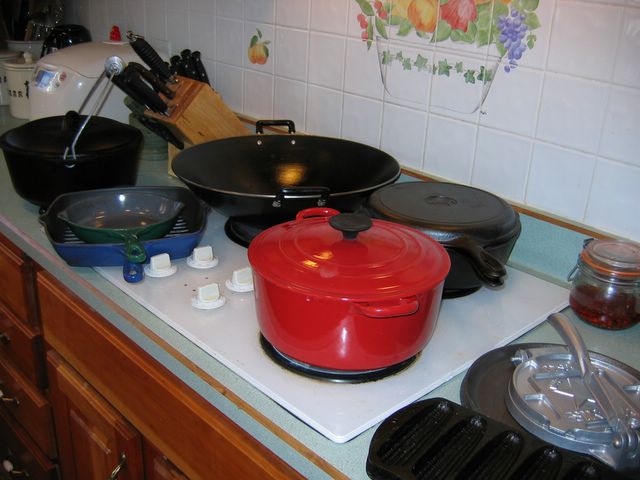
Some of my collection of cast iron cookware. The red Le Creuset dutch oven is about forty years old and was passed down from Zak’s Grandma to me. In the lower right hand corner are the cornstick pans, the comal and the tortilla press.
So, I was going through my cabinets earlier this week, and putting things into boxes, when I realized, that for all of my command of culinary techniques, for my insistence upon throwing French terms into my speaking and writing about food, for all that it is obvious that I attended culinary school by my insistence upon the neat and tidy set up of mise en place, I don’t really have a lot of high-end fancy pots and pans.
And the ones that I do have, I don’t use very often.
As mentioned previously, I have my Gram’s 1940’s Revereware copper-bottomed stainless steel set, which is pretty much what I use when I need to boil something, like pasta or rice or water for steamed vegetables or buns.
The rest of my kitchen is equipped with a mish-mash of pieces, some of which get used all of the time, while others are set aside for special moments when nothing but a whole salmon will do. (That moment will come–you will see. Actually, if it were up to me, I would have cooked one by now, but as Zak can take salmon or leave it, that leaves me to eat the entire salmon myself, which means I would have to channel my inner grizzly bear, which is dangerous on many levels. Along with the bear-sized appetite comes the bear-sized temper, and we don’t need that.)
What I noticed while digging through and packing some utensils and leaving others, was that I have a whole heck of a lot of cast iron, both bare black and clad in brilliant shades of enamel.
The Le Creuset was passed down to me by Zak’s grandmother who had become too frail to lift it. It was all too heavy for Zak’s sister to lift (she is a tiny elf-like lady), so it was passed on to me, sturdy wench that I am. Which is fine–I love the stuff. The Dutch oven comes out when it is time to make risotto, or a nice flageolet and lamb stew or even Sichuan red-cooked beef with turnips. Whatever I cook in it can come to the table, brightened by the warm crimson enamel which not only looks good, but keeps the cast iron easy to clean.
My tiny green Le Creuset skillet is mainly used for toasting spices such as cumin, coriander and Sichuan peppercorns. That seems like I don’t use it for much on the face of it, but the amount of spices that get used in my kitchen makes the wee green pan one that is nearly always in use. I also use it for toasting dried chiles, if I am only doing a few. If I am doing many, I go with yet another piece of cast iron, like the lid to the Lodge chicken fryer–which is a deep frying pan with a lid that doubles as a shallow crepe pan.
I have a great deal of Lodge Logic cast iron, as well as a few traditional pieces of Lodge that I seasoned myself.
I don’t know what kept the Lodge folks from figuring out that they would sell a lot more cast iron if folks who hadn’t grown up with it weren’t forced to season it, but they seem to be doing very well for themselves. All sorts of folks really like the stuff, including Alton Brown. A recent Chicago Tribune article detailed a contest of skillets where the author tested a bunch of different varieties in the kitchen, and liked the least expensive, the twelve-dollar Lodge pre-seasoned pan. All the pans were tested by caramelizing onions, frying an egg and sauteeing a chicken breast, and the cheap cast iron beat out the pricey All Clad and Calphalon at all three tasks.
Mind you–I, or any mountain mamma cook from the Appalachians could have told the author that would be the case, but then, there is nothing wrong with someone proving us right after all these years. We hillbillies have been passing down cast iron skillets and Dutch ovens from grandma to mother to daughter for hundreds of years, and we know that for all that it is inexpensive and it isn’t pretty, cast iron pans are the gold standard for Southern Applachian cooking.
Cast iron kicks ass. Period.
I like to use mine to cook steak in the winter when it is too cold to go out and grill. It is simple, really–I use a dry rub on the steak, heat up the cast iron until it starts turning grayish, and slap the meat down on the hot surface. I use the vent for this–lots of smoke erupts from the meat. I sear it nicely on one side, flip it over, and either continue cooking stovetop, or I pop it into a really hot oven to finish cooking. That is it. No mess. No drama. Just steak cooked with a really flavorful browned crust and a moist and juicy interior.
Almost as good as the steaks we cook over hardwood charcoal in the summer.
I have cast iron cornstick pans, for baking corn-cob shaped cornbreads. You heat them up in the oven, then carefully pour batter into the wells and bake them for about ten or fifteen minutes, and when they are done, you have the best corn muffins ever. They are golden crispy on the outside and tender on the inside. I like to make different batters with different colored cornmeal–I use yellow for the spicy muffins with bits of green and red chile pepper, blue for the sweet muffins flavored with cardamom and cinnamon, and red for cornbread flavored with bacon and onion slivers.
I have a cast iron comal for cooking tortillas, and a cast iron press for shaping them, both from Mexico. Since I started making my own corn tortillas, I have noticed that all of my Mexican and Tex Mex recipes taste better; the corn flavor in freshly made tortillas is so superior, I cannot imagine going back to the store bought kind.
Cast iron is a favored material for cooking vessels in the Far East, as well. As you know, I have two cast iron woks–one from China, which is the one I use every day, and another from Lodge that I am waiting until we move to break out and use. The Chinese one, which is traditional except for its flat bottom, which makes it much more usable on American stoves, came from The Wok Shop in San Francisco, and it works beautifully. I have been able to get it consistently hotter and keep it hotter than the carbon steel woks I used previously. The “wok hay,” or as I called it so unpoetically for years, “the wok taste” is very strong from this wok, and the speed and ease with which I can stir fry are incomparable. I will likely only use my carbon steel woks now and again after seasoning and cooking in the cast iron for a bit over a year now.
In Japan, sukiyaki and other nabemono dishes–simmered stews, essentially–are traditionally cooked in an iron pot with wooden lids that was hung over a fire or a brazier. I don’t have one of those, or one of the Chinese iron casseroles; I tend to use my regular iron and enamelled dutch ovens for the dishes that would require those pots. On the other hand, I probably wouldn’t refuse such a pot as a gift, if one should come my way. They are quite aesthetically pleasing in addition to being good conductors of heat.
In Japan, teapots are also made of cast iron. Tetsubin, as they are called, were used originally to boil water, but evolved into being used to brew tea as well. I think that they are beautiful works of art, and while I have yet to pick one up, I do love the graceful shapes and designs in which they are crafted. Someday, I mean to get one, but as yet, I still make tea in my old reliable glass teapots.
In addition to my lust for Asian cast iron kitchenware, I am dreaming of some pieces of enameled cast iron from Staub, particularly the teakettle and maybe a pretty green fondue set. Staub, a French company, makes enameled cast iron that is similar to Le Creuset in many respects, but also differs in design somewhat. The lids contain dimples or hobnail designs on the inside so that the condensation that collects there from the steam drips back into the food, keeping it moist. As I haven’t cooked with them side by side, I cannot really compare Staub and Le Creuset’s performance, but what I can tell you is that I like the colors of Staub better (the green is a nice forest color instead of the leprechaunish Le Creuset green, and they have purple–what else need I say?), and many of the designs have way more “oomph” than Le Creuset’s.
Interestingly, even Lodge is starting to dabble in the enameled cast iron market–just this winter, they released a few pieces including some apple-shaped pots that are clearly meant to compete with Le Creuset’s apple and vegetable shaped pots. Again, the Lodge designs are more aesthetic than the Le Creuset ones, though I am not certain that the electric lime green is an improvement over the “leprechaun frolicking in the clover” shade used by Le Creuset.
I guess that enameled cast iron is becoming more popular as people realize that they get many of the benefits of cooking in cast iron, with less of the worries about cleaning up and care that one gets with seasoned cast iron. I don’t think that taking care of bare cast iron is such a chore, but I know that a lot of people get squigy if you tell them that you never use soap on seasoned cast iron. I guess that they figure you are going to let bacteria grow or something. But if you heat up your cast iron as hot as you are need to to dry the wash water out of it, you needn’t worry about bacterial growth. If a bacteria can survive that, and then breed in an environment where it has nothing to feed on, then this is no ordinary bacteria and it is poised to take over the earth anyway. A little soap is not going to make much of a difference to such a critter.
So, in my kitchen, cast iron rules the roostIt it is often inexpensive (You can get Le Creuset cheaply by mail order at Caplan Duval–ooh, look, they are having a big sale–Damn. If I bought it now, I will only have to leave it in its box and not play with it…grrr) , it cooks like a dream and it will last more than a lifetime if it is properly cared for.
I intend to leave mine to my daughter and grandkids. When she gets around to having them, I mean. Not any time in the near future, though.
I’ll still be cooking in them for the next forty years or so. Or at least, so I hope.
Music in My Kitchen
Dagmar from A Cat in the Kitchen tagged me with this meme, so here we go:
What is the total amount of music files on your computer?
None. Nada, zip, zero. For all that I blog, and have been an admin or mod on various online communities and bbs’s and suchlike critters, for all that I participated in Usenet way back in the day and even MUSHed for several years, I am not a computer geek. I am rather a bit of a technophobe, if the truth be told. I don’t adore each new technological gadget that comes along related to the computer. My own computer would probably keel over and die if I tried to download music onto it–I mostly use for my writing. It is woefully inadequate in the memory department, which is something I should remedy soon.
The CD you last bought?
Okay, it is time for another confession.
I seldom am the one who buys CD’s in this house. Though I do love music and sing and tweedle along with music all the time, and have at various times played guitar and bass (and am picking the guitar back up and relearning), Zak is the music maven in the household. He has a better knowledge of exactly what is in our huge CD library than I do, especially when it comes to esoterica like his five bazillion shakuhachi (Japanese bamboo flute) CDs or the works of contemporary composter Steve Roach.
However, the last CD that I insisted we purchase is the soundtrack to the Zang Yimou film, The House of Flying Daggers. Composed by Shigeru Umebayashi, the music is sensitive, subtle and evokes the saturated colors of the film. The only part I dislike is the end theme, sung by Kathleen Battle who does have a lovely voice, but her over enunciation and operatic tremolo do not suit the simple melody of the love theme. (Okay, yeah, not only am I a food geek, but a music dweeb as well. And a film fangirl.)
What was the song you last listened to before reading this message?
I blush now to see what is in the CD player–the afformentioned soundtrack. I can’t compose anything seriously when there is music with lyrics that I can understand on–because I will sing with it, and thus all other words in my mind fly out of my ears. It is quite unproductive.
But that soundtrack is quite easy to write to.
Write down 5 songs you often listen to or that mean a lot to you.
I am listening to one of them now. Light things like this I can write when listening to songs with lyrics in languages I can understand. It is When I Go by Dave Carter and Tracy Grammer. I love most of the songs by these two fantastic folk musicians, but this one hit me in the heart and brought tears to my eyes the first time I heard it and it gives me shivers to this day. I would like to cover the song with Zak and some friends of mine, if we really do start a band after we move back to Athens.
Come, lonely hunter, chieftain and king
I will fly like the falcon when I go
Bear me my brother under your wing
I will strike fell like lightning when I go
I will bellow like the thunder drum, invoke the storm of war
A twisting pillar spun of dust and blood up from the prairie floor
I will sweep the foe before me like a gale out on the snow
And the wind will long recount the story, reverence and glory, when I go
Spring, spirit dancer, nimble and thin
I will leap like coyote when I go
Tireless entrancer, lend me your skin
I will run like the gray wolf when I go
I will climb the rise at daybreak, I will kiss the sky at noon
Raise my yearning voice at midnight to my mother in the moon
I will make the lay of long defeat and draw the chorus slow
I’ll send this message down the wire and hope that someone wise is listening when I go
Another one would be Sanvean by Lisa Gerrard, on her album, The Mirror Pool, her first solo album after being one half of the ideosyncratic duo, Dead Can Dance. There are no lyrics to share with you; Gerrard uses “vocables,” nonsense verbal sounds that give her song structure, but without lyrical content. It sounds like a language, but isn’t one, which allows the listener to attach meaning to the pure sound alone, without being hampered by words. This particular piece is my favorite of hers–its soaring melody is heartbreakingly romantic and beautiful in a tragic yet delicate way. It always makes me think of the epic power of love to both create and destroy, in the fashion of the goddesses of old who were both temptresses and warriors.
Kate Bush’s entire album, The Hounds of Love.
But, especially, The Jig of Life, because that is the song that Zak and I used to dance The Spiral Dance with our guests when we were married. It was my daughter, Morganna’s favorite song all through her childhood, which she called, “Big Music” before she knew its title. She’d demand I put it on the CD player and as the galloping rhythyms would catch her, she would whirl around the room, dancing on tiny feet, her eyes flashing with wild delight. The lyrics are part of a song cycle that describes life, death, rebirth and life again, and I cannot listen to them without thinking of the dance at our wedding, and the many dances with Morganna over the years.
Can’t you see where memories are kept bright?
Tripping on the water like a laughing girl.
Time in her eyes is spawning past life,
One with the ocean and the woman unfurled,
Holding all the love that waits for you here.
Catch us now for I am your future.
A kiss on the wind and we’ll make the land.
Come over here to where when lingers,
Waiting in this empty world,
Waiting for then, when the lifespray cools.
For now does ride in on the curl of the wave,
And you will dance with me in the sunlit pools.
We are of the going water and the gone.
We are of water in the holy land of water
And all that’s to come runs in
With the thrust on the strand.
It is hard to pick a single song by Loreena Mckinnett to mention, but I feel that I must say The Old Ways, from her album The Visit. It really is in a tie with the track All Soul’s Night, but the lyrics to the former song are a bit more poignant and laced with sorrow than the latter. Melancholic songs always tend to get to me.
As we cast our gaze on the tumbling sea
A vision came o’er me
Of thundering hooves and beating wings
In clouds above.
As you turned to go I heard you call my name,
You were like a bird in a cage spreading its wings to fly
The old ways are lost, you sang as you flew
And I wondered why.
I love Nick Cave’s work. He’s a hell of a songwriter and his resonant voice can go from languid to horrifying in a split second. I am very fond of his song, “Where the Wild Roses Grow,” which has all the hallmarks of a classic Applachian/Celtic ballad. He sings it with Kylie Minogue, and the first time I heard it, it planted a seed in my mind which came out as the first short story in what will hopefully be an anthology, called, “Wild Roses.” The tales will be a series of folktales set in a mythical turn of the century Applachia that never was–rather like the Brothers Grimm meet Eudora Welty and H. P. Lovecraft. (Did that hurt your head? I’m sorry if it did.)
There are many other musicians, bands and CD’s I didn’t mention. Garmarna, from Sweden, Gjallarhorn of Finland, I believe, are two of my favorite bands in all the world. However, it is hard for me to say which song is a favorite. In fact, I like a lot of Scandanavian folk music and folk-influenced musicians: Bukkene Bruse, Hedningarna and Loituma are three more favorites.
Other musicians I really like include Talvin Singh, Johnny Cash, Kodo, and Axiom of Choice.
And other favorite soundtracks include Howard Shore’s work on the Lord of the Rings trilogy of films, Basil Poledouris’ score for Conan the Barbarian and Tan Dun’s Crouching Tiger, Hidden Dragon soundtrack.
And of course the music of Zak. That is the soundtrack of my life–the music my husband and I make together. (Though we haven’t recorded together yet. Like many other things, it will have to wait until we move.)
There is a lot more I could list, but I will cease and desist for the nonce. You guys get the idea–I like a lot of music, from many different genres, styles and countries, and I will sing with all of them whether I know the words (or even if there are no words) or not.
I like to sing while I cook.
As for whom I shall tag–
Christina at The Thorngrove Table, because I want to know if she listens to medieval period music when she is cooking food of that time period.
My friends at Cracked Cauldron Spillings, because I bet that they listen to fun music while they cook up thier dreams.
And Alan at The Impetuous Epicure, because he such an intrepid experimenter and I want to know what kind of musical tastes he has.
Fish: Feast or Fast?
I realized that this year, Chinese New Year and Lent were on the same day.
I found this to be ironic. Lots of people feasting on symbolic foods meant to bring abundance and luck in the New Year, while others begin a fast in order to in order to do penance for humanity’s betrayal of Jesus.
Over at The Thorngrove Table, Christina wrote a great post about the observance of Lent in the medieval period, while Desmond Goh gives an overview of Chinese New Year customs in his blog.
The dichotomy struck me. It is Yin and Yang–the world in balance. Some eat, drink and are merry, while others abstain and meditate upon the coming joy of Christ’s resurrection and the meaning it has for their lives today.
One thing I noticed in my musing is that Chinese New Year and Lent do have a food tradition in common: the consumption of fish.
A whole steamed or poached fish is always served as part of a Chinese New Year’s Eve feast, with the head and tail intact. This symbolizes a good beginning and end to the new year. It is best to choose a fish which is still alive, swimming in a tank, and great care is taken to choose one which is spirited, for it will bring more good fortune into the new year than one which is listless and sluggish, or worse, already dead.
Fish is eaten in Chinese New Year because the sound of the word for fish, “yu” is a homophone for the word for wish in Cantonese, so it symbolizes a desire for all of your wishes to come true in the new year. The word for fish, “yu” also sounds like the word for abundance, so it is a wish for a surplus of good things to come into a family’s life.
There is even more depth to the symbolism of a whole fish served at the traditional New Year’s dinner. As Grace Young points out in her book, The Wisdom of the Chinese Kitchen, fish swim in pairs, and so can symbolize marital fidelity and harmony; a quick look at many traditional Chinese paintings will show a pair of carp swimming together in peaceful unity. Because fish lay many eggs, they are symbols of fertility, so they are wish for many children in a family.
For Catholics, fish is a substitute for meat, and is eaten on fast days, especially at Lent. In the aforementioned excellent blog entry over at Thorngrove, Christina outlines the history of why fish was substituted for meat during the Lenten season, so I won’t go into that. Suffice to say that Lent, which is about abstaining from pleasures, including those of the table, to muse upon the sacrifice Christ made for every human being. Fish became a substitute for meat, and because of that, it became symbolic of self-willed deprivation.
For myself, I have trouble seeing fish as symbolic of deprivation of pleasure–I love the stuff. I love it, that is when we are talking about real fish, not fish sticks–those God-awful creations of the frozen foodocrats are a blight upon the supermarket shelves and really do symbolize privation and want. I agree completely with Elesha Coffman writing in Christianity Today that being forced to eat fish sticks in the school cafeteria on Fridays during Lent instead of pizza is a trial for the schoolchild’s soul.
Later in that same article, Coffman notes that the use of fish in a spiritual fast was cause for great culinary creativity in the Medieval kitchen, and a French abbess is credited for the creation of the divine dish which I hesitate to categorize as “fish soup” called bouillabaisse. No one who tastes a well-crafted bouillabaisse could in any way call the dish a poor substitute for meat. In fact, were it myself, I’d take the fish soup and to heck with the meat.
That hardly seems penitent of me, but then, I was never Catholic and was barely raised Protestant, and am currently a heathen, so what do I know of it?
What I do find utterly fascinating is how fish can be considered the symbol of abundance and joy in one culture, and in another, be seen as a substitute for a preferred other food, and symbolic of personal sacrifice in the practice of a spiritual fast.
This dichotomy speaks clearly to the sacred function that food plays in cultures around the world and its centrality in the celebration or observance of holidays.
I am going to go out on a limb and say that there is probably no culture in the world which has a holiday in which food, by its presence or absence, does not take a central role in the rituals of that sacred time. I certainly can think of no such a holiday.
It is part of what draws me to the study of food–the meaning of it and its nature. It is a necessity for us to survive, yes, but it becomes so much more in every culture. It becomes a means of cementing family and communal bonds, a means of communication between human beings and the Divine.
It becomes a transmitter of culture–symbolism becomes very tightly wrapped in certain holiday foods, such that each mouthful brings with it layers of meaning that an eater can often only guess at. It becomes pleasure, treasure and art. It becomes something we do for fun, and something we do to escape reality, and something we do to remember our ancestors.
It becomes part of our expression of who and what we are.
So, at this moment, at this time when many people are feasting, and many others are fasting, when everyone is celebrating or observing the passage of time in ways that express who they are, I am in the midst of it all, filled with wonder to look upon this confluence of energies, and am content to observe, record and muse upon the meaning of it all.

Categories:
- Admin (rss) (55)
- Blogs and Blogging (rss) (81)
- Book Reviews: Cookbooks (rss) (43)
- Book Reviews: Non-Cookbook Food Books (rss) (38)
- Cats and Cat Blogging (rss) (47)
- Chinese Cooking Lessons (rss) (32)
- Culinary School Stories (rss) (18)
- Dairy Pruducts: Cultured and Barbaric (rss) (4)
- Documentary Filmmaking (rss) (1)
- Essays, Rants and Reflections (rss) (260)
- Fighting Hunger (rss) (12)
- Food and Kids (rss) (45)
- Food in the News (rss) (126)
- Food Media (rss) (98)
- Food Preservation (rss) (18)
- Food Safety (rss) (45)
- Gardening (rss) (30)
- Herbs and Herb Blogging (rss) (20)
- Holidays (rss) (50)
- Kat Blogging (rss) (22)
- Kitchen Science (rss) (36)
- Leftover Makeover (rss) (8)
- Life, the Universe and Everything (rss) (131)
- Local and Sustainable (rss) (227)
- Local Athens Food and Foodies (rss) (42)
- Meatless Mondays (rss) (32)
- Menu For Hope (rss) (5)
- Nutrition, Diet and Health (rss) (84)
- On The Farm (rss) (8)
- Recipes: Almost Vegetarian, Vegetarian and Vegan (rss) (294)
- Recipes: American Regional (rss) (37)
- Recipes: Appalachian Hillbilly (rss) (33)
- Recipes: Bread, Pasta, Grains (rss) (95)
- Recipes: Canning and Preserving (rss) (8)
- Recipes: Chinese (rss) (123)
- Recipes: Comfort Food (rss) (120)
- Recipes: Cookies (rss) (16)
- Recipes: Desserts (rss) (48)
- Recipes: French (rss) (25)
- Recipes: Fruits and Vegetables (rss) (302)
- Recipes: Greek, North African and Middle Eastern (rss) (31)
- Recipes: Indian (rss) (137)
- Recipes: Italian (rss) (42)
- Recipes: Japanese (rss) (7)
- Recipes: Jewish (rss) (4)
- Recipes: Korean (rss) (6)
- Recipes: Meat, Poultry and Fish (rss) (220)
- Recipes: Mexican/Native American/ Latin American/Caribb (rss) (27)
- Recipes: Original (rss) (108)
- Recipes: Thai (rss) (27)
- Recipes: Tofu (rss) (17)
- Recipes: US Regional (rss) (16)
- Recipes: Vietnamese (rss) (8)
- Restaurant Stories (rss) (28)
- Sewing, Quilting, Arts and Crafts (rss) (16)
- Simple Chinese Recipes (rss) (30)
- Slow Food and Heritage Foods (rss) (10)
- Spice Blogging (rss) (44)
- The Chinese Cookbook Project (rss) (14)
- The Chinese Pantry (rss) (39)
- The Documentary (rss) (2)
- The Kitchen Saga (rss) (17)
- The Locavore's Bookshelf (rss) (15)
- The Unsung Adventures of The Culinary Nerd (rss) (6)
- Tools and Toys (rss) (35)
- Uncategorized (rss) (10)
- With a Side of Politics (rss) (48)
Archives:
- August 2012 (9)
- July 2012 (12)
- September 2011 (3)
- August 2011 (7)
- July 2011 (8)
- June 2011 (16)
- May 2011 (17)
- April 2011 (11)
- December 2010 (9)
- November 2010 (5)
- February 2010 (1)
- December 2009 (5)
- November 2009 (7)
- October 2009 (10)
- September 2009 (16)
- August 2009 (14)
- July 2009 (14)
- June 2009 (7)
- May 2009 (17)
- April 2009 (10)
- March 2009 (25)
- February 2009 (13)
- January 2009 (10)
- December 2008 (5)
- November 2008 (5)
- October 2008 (6)
- September 2008 (13)
- August 2008 (8)
- July 2008 (11)
- June 2008 (18)
- May 2008 (13)
- April 2008 (14)
- March 2008 (16)
- February 2008 (17)
- January 2008 (19)
- December 2007 (25)
- November 2007 (18)
- October 2007 (24)
- September 2007 (16)
- August 2007 (15)
- July 2007 (15)
- June 2007 (10)
- May 2007 (14)
- April 2007 (16)
- March 2007 (17)
- February 2007 (20)
- January 2007 (13)
- November 2006 (1)
- October 2006 (8)
- September 2006 (14)
- August 2006 (25)
- July 2006 (30)
- June 2006 (28)
- May 2006 (34)
- April 2006 (29)
- March 2006 (24)
- February 2006 (30)
- January 2006 (38)
- December 2005 (40)
- November 2005 (37)
- October 2005 (32)
- September 2005 (25)
- August 2005 (30)
- July 2005 (28)
- June 2005 (21)
- May 2005 (8)
- April 2005 (22)
- March 2005 (17)
- February 2005 (29)
- January 2005 (10)
Search Site:
Links:
- Lily’s Wai Sek Hong
- 101 Cookbooks
- A cat in the kitchen
- A Veggie Venture
- Accidental Hedonist
- Cha Xiu Bao
- chez pim
- Chocolate & Zucchini
- Chopstick Cinema
- Chowhound.com
- Chubby Hubby
- Cook sister!
- Cooking with Amy
- da*xiang
- Eat Local Challenge
- Eating Liberally
- Ecocentric
- Eggbeater
- Epicurious
- Farmgirl Fare
- Fatfree Vegan
- Foodgoat
- ForkandBottle.com
- Green Olive Tree
- Hooked on Heat
- Jaden’s Steamy Kitchen
- Kalyn’s Kitchen
- Lucullian delights
- Mahanandi
- Matt Bites
- MeatHenge
- mmm-yoso!!!
- New York Times – Dining & Wine
- Pizza Goon
- Rasa Malaysia
- Ruhlman
- Sailu's Kitchen
- Serious Eats
- SF Gate: Food & Dining
- Simply Recipes
- Soul Fusion Kitchen
- Tastespotting
- The Amateur Gourmet
- The Cleaner Plate Club
- The Food Section
- The Grub Report
- thecookscottage
- U.S. Food Policy
- Wandering Chopsticks
- Washington Post Food and Dining
- Wasted Food
Meta:


Powered by WordPress. Graphics by Zak Kramer.
Design update by Daniel Trout.
Entries and comments feeds.