
Cook Local, Eat Global
A Menu for Hope, Part II
I’ve been asked by Pim to participate in the gift-giving drive for “A Menu for Hope,” the annual food blogging event for charity that is to benefit the victims of the earthquake that recently hit Kashmir.
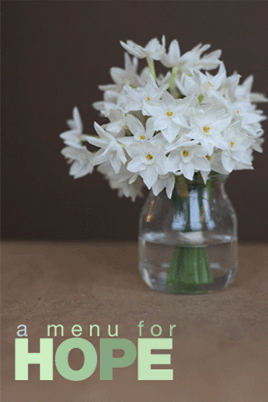
In order to encourage as much giving to the great cause of helping these unfortunate folks in Kashmir, various food bloggers are donating gifts to be raffled off with each five dollar donation.
The way it works is simple. When you log into the Menu For Hope donations page, you write in the comment section of the form which of the gifts from the bloggers you would like have a chance at winning, thus entering into the raffle for that gift. And yes, with each five dollar donation, you can enter the same raffle more than once, or enter a new one.
There are lots of goodies listed on Pim’s post, and more are coming with each hour.
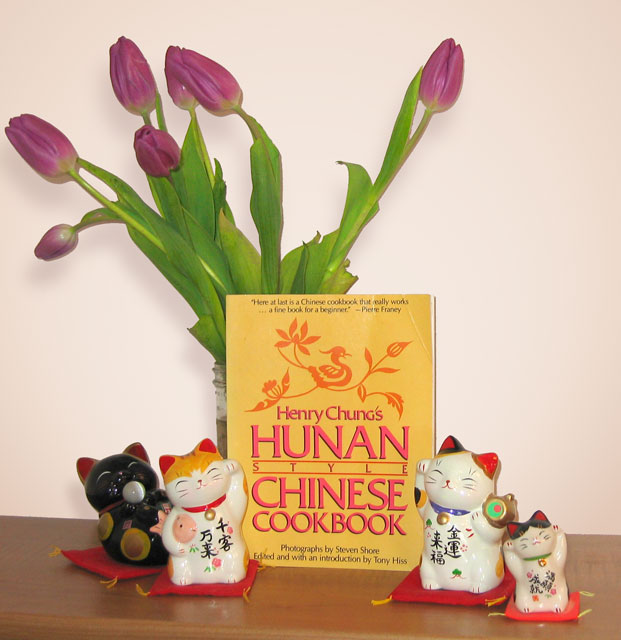
I personally am donating a copy of the out of print, and highly sought-after Henry Chung’s Hunan Style Chinese Cookbook. This copy is in good shape, though it has been cooked from, and it is autographed by the author himself–the celebrated man who opened the first great Hunan restaurant in the US which has been called by many writers “the best Chinese restaurant in the world.”
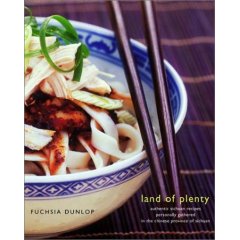
In addition, I am sending a brand new copy of Fucsia Dunlop’s excellent Sichuan cookbook, Land of Plenty. (Her Hunan cookbook is still in the works, or I would send that one along!) These two together represent two of my very favorite Chinese cookbooks and give a good taste of both the old and the new when it comes to Chinese cookbook publishing.
And, just to get the lucky winner started cooking the fiery flavors of China–I will also send along with the two books, a packet of Sichuan peppercorns and some dried Tien Tsin chilies.
If I could crawl into a box and ship myself to give a personal lesson or two, I would, but I fear the postage might be a bit pricey and the last time I checked, the US Postal Service frowns upon sending live humans through the mail.
2005 Food Blog Award Reminder
This is just a reminder to everyone that nominations for the 2005 Food Blog Awards are ongoing over at Accidental Hedonist until this Friday, December 16th.
Thank you to those who have nominated me in several categories, including Best Writing, Best New Blog and Best Post. I really do appreciate your support of my efforts here.
If you haven’t been over to check out the nominations, do so–it is amazing to see the number of people and blogs represented in the process.
And, if you haven’t nominated anyone–you have until Friday to do so! It is easy, just click on one of the links to the award categories in the nominations reminder and leave a comment nominating whichever blog and blogger you like. Leave a URL for the blog–it makes the judge’s lives a bit easier.
Thank you all.
A Menu for Hope
‘Tis the season to be giving, loving and kind.
In truth, I hope that everyone is always giving, loving and kind, but around this time of year, people seem to be reminded that such virtues are desireable personal qualities in themselves and others.
Pim, along with quite a few other well-known food bloggers, are coming together for the second annual food blogging charity event, “A Menu for Hope.” Last year’s event was to benefit the victims of the tsunami; this year, donations are being taken to help victims of the earthquake in the Kasmir region in the north of India and around Pakistan.
Although helping those in need is its own reward, Pim decided to sweeten the pot a bit this year and she and her compatriots have decided to set up raffle prizes for everyone who donates five dollars or more to the earthquake relief fund.
Read more about it here, and share a little love for the folks whose homes and lives have been devastated by the earthquake and its aftermath.
Thoughts on Kitchen Remodeling and Design
Before we undertook to redo the kitchen in this house, I did research.
Mostly this consisted of looking at kitchen design magazines.
And while looking at photographs of gorgeous kitchens from all over the world, I realized a few things about myself that I had never articulated before.
One of them was that I don’t like cold, antiseptic looking kitchens.
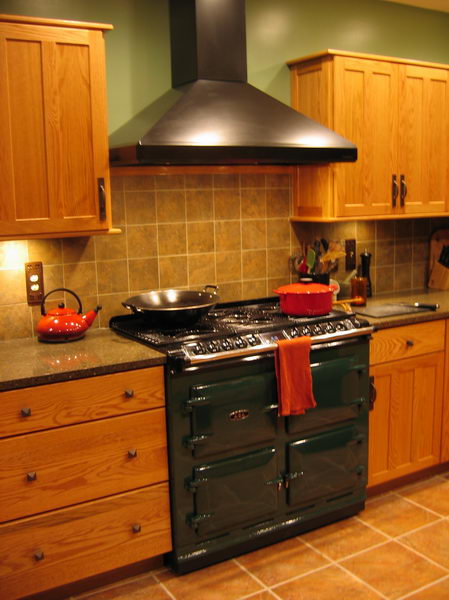
This realization hit me, as I was gabbling to Zak about my dislike for the new trend of consumer appliances wrapped in chrome and stainless steel. “Do people realize how hard that stuff is to keep clean?” I grumped. “Do they know what a pain it is to keep fingerprints off of it, how you have to polish it with special stuff?” He shrugged and shook his head and replied, “Probably not. They just probably like it because it makes their kitchen look professional.”
It was then that I realized why I didn’t like it.
It looked professional.
Stainless steel is a great material for a professional kitchen. It is easily sanitized and is durable. You can beat it, set things afire on it, hack bones apart on top of it, dress out a hundred pounds of still flopping fish until you are elbow deep in blood and guts, then after a few minutes work scraping and wiping, can make it look silvery and clean. You can pour bleach solutions over it and do it utterly no harm.
It also takes on fingerprints like crazy and gives a very cold, aseptic look to the room.
Which, psychologically is great in a professional kitchen, where temperatures and tempers rise up into the stratosphere daily. Having a kitchen that looks cool might trick some twitchy cooks into keeping cool heads.
But, in a home kitchen–where the hearth is still as sacred now as it was when Hestia ruled it–materials that look cold and clinical make me feel constricted and stiffed. Chilled. As in, frozen.
The kitchen is the heart of the home, and it is a place of nurturing and comfort. And to me–having a frozen heart in the home might lead to frozen hearts and minds in the people living there.
Now, mind you–I have seen some very modern, sleek, chrome, steel and blue glass kitchens that are to die for gorgeous–which means I can see why other people would like them. I can see people cooking there and being happy. But not me. To me–those colors and materials signify cold. And I don’t want my house or myself to have a cold heart.
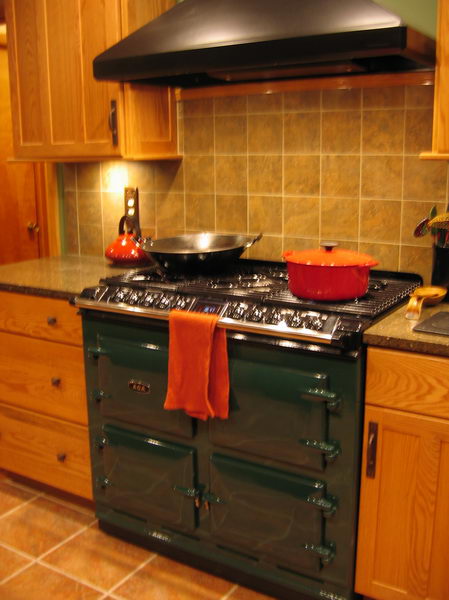
So, I realized early on in the design process–before we had even selected a designer and contractor–that I preferred a kitchen that psychologically read as “warm,” rather than “cold.”
So, what did this mean?
Well, it meant that the white cabinets that the kitchen was endowed with had to go. Mind you, having worked in many home kitchens as a personal chef, I had already come to the conclusion that I disliked all white kitchens and white cabinetry many years ago for the purely practical reason that if anything dripped or splattered, no matter how small or insignificant a spill it was, it showed up hideously. White also tends to make me feel cold, so there is a double strike against it in my own personal taste.
As I looked through design magazines, one thing was clear–I liked materials that looked as natural as possible. I tended to like natural wood vs.thermafoil, stone vs. formica, and tile vs. vinyl. I liked enamel vs. metallic finishes, and when I had to have metal, the new trend in oil rubbed bronze greatly appealed to my aesthetic sense. I tended to like as natural a finish on the woods as possible, too, so the grain was shown to advantage.
That is when I decided to take inspiration from nature, and thus the Forest Kitchen, as my kitchen has come to be known, was born.
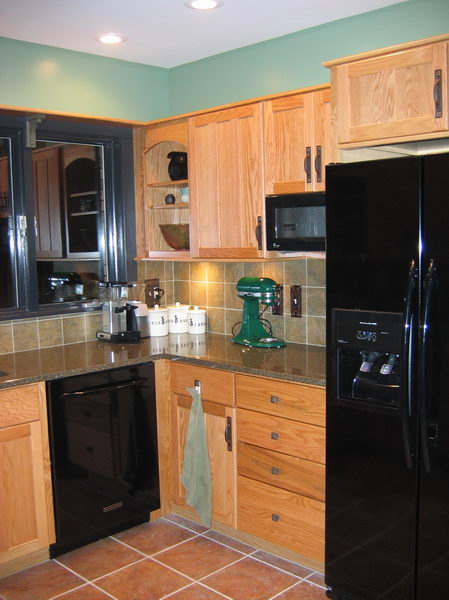
So, I learned a few things in undergoing this months long project of bringing the Forest Kitchen to life.
The first one is this, and it pertains not only to kitchen remodelling, but to one’s entire existence:
“Know Thyself.”
What I mean in this context is to know what you like. I mean, what you really like. I mean–really know what you want to work with, and live with and to have as a daily part of your existance for as long as you live in your home. It sounds simple, doesn’t it? But, it really isn’t really as easy as you might believe to really know your own taste and desire.
I say this because my original idea for the kitchen was extremely different than how it turned out.
I had wanted to go with a red, black and “white” (actually pale, natural maple, but have it read as white, instead of the light creamy wood tone that it is) color scheme for the kitchen. The black appliances are about all that remains from that thought process. I was going to go with glass doors on the cabinets with rice paper behind them to make them transluescent. I was going to have black-black granite countertops, and the tile floor was going to be imperial red, and some of the appliances were going to be laquer-red. I wanted to go with a Japanese decor theme.
At least, that is what I thought at first, and that was the picture I had in my head.
And truly, I am glad that the original contractor we had chosen turned out not to work with us. Because if he hadn’t dragged his feet so much on doing the design, and put us off for months and months, I wouldn’t have spent all of that time looking at magazines, websites, and design showrooms.
And I wouldn’t have had as long to live in the house and get a feel for the energy of the place.
I realize now, in looking back, that if I had gone with my original ideas, the room would never have looked as nice with the rest of the house as this one does. Also, I don’t think that I would have been as happy with that theme as the one we ended up creating by looking out the window and taking inspiration from what we saw.
It comes down to two things–I didn’t know my own heart and I didn’t know the house. I hadn’t lived in it long enough to decide.
So, we come to my second point–know your house.
That means, live in it for a while and get a feel for how it flows–how it breathes, how it exists in its space. Get a notion for the light that comes in, or not, through the windows. Take in the sights and sounds. Understand the house for how it is–not how you think it is.
Because, whether we realize it or not, whenever we move into a new place–we don’t really know it. No matter how many times you visit a house, you don’t know it until you live in it for a few months. Not even a few weeks will tell you what you need to know. You need the time to get into the rhythym of the rooms, to settle in and begin making a house a home, before you can really reasonably begin the huge undertaking that is redoing a kitchen.
My third bit of advice also sounds simple, but it isn’t, especially if you are anything like me.
Be patient.
This simple sentence covers many aspects of kitchen remodelling. Take the time to work out in your head, or on paper what you want. Write lists, make sketches, cut out pictures from magazines, prints stuff off of websites and take photographs at people’s houses and in design showrooms. Hell, take your camera to Lowe’s and Home Depot so you can get ideas and file them away. Collect paint chips obsessively, and bring them home to look at in various times of day from various parts of the kitchen.
Have a file of all of your stuff that you have packratted with you when you interview kitchen designers and contractors. Let them see what you have and then hear what they say.
And listen to them, please, and carefully and patiently take note of what they say.
If you are like me, you are as concerned with the practical workability of the kitchen as you are with aesthetics. If this is the case, you should aquaint yourself with the “work triangle;” this concept of kitchen design has remained pretty much unchanged since its inception in the early twentieth century, and with good reason–it works. It refers to the spacing of the three main work areas of the kitchen: the refrigerator, stove and sink. This is the primary work triangle, and you want to maintain the shape of a triangle, as much as possible, between these three areas as you design your kitchen. You can also have a secondary work triangle that includes sink, countertop and undercounter refrigerator as well–but this is for folks who have huge kitchen spaces that make mine look miniscule in comparison.
When you talk to a designer, let them tell you their ideas. If they come up with any plans that violate the concept of the work triangle in favor of aesthetic considerations, run away. They probably don’t cook, and will give you trouble when it comes to the more practical aspects of your kitchen.
A good designer will listen to you, and will be able to tell you what parts of your ideas will work, and what parts will not. They will know about the work triangle and will not ignore it, even if their client really wants to. More likely, they will explain it to them, and try to show them why it is an integral part of good kitchen design.A good designer or contractor will be able to take rather unformed ideas from the client and turn them into actual concrete plans, and they will be able to do it in a timely fashion.
However, while timely is good, it behooves one to be patient. Good design takes a little time.
Do not rush the designer unless he or she is really dragging his feet.
Once a plan is decided upon, then the details begin to become very important.
This is both fun and harrowing, and patience is necessary here again.
Patience, and diligent study. Learn everything you can about the materials you are choosing, before you make your final decision.
For instance, my large enamelled cast iron sink is beautiful, and I surely can scrub my wok hot off the stove in it without making a huge mess, but waterspots form on it very easily.
This aesthetic issue doesn’t bother me, because I expected it because we rented a home in Maryland that had a black enamelled sink, so I knew it would happen. But it might have bugged someone else to death.
I had thought about getting Corian countertops, but heard from friends and learned via research that it melts very easily, and mars much more easily than is advertised. So, I looked into granite, but found that the upkeep could be onerous. That is how I ended up with the engineered quartz countertops–they wear similarly to granite, they come in a great range of both naturalistic and futuristic colors, but it is simpler to care for than natural stone.
If I had simply gone with my first desire, not only would my kitchen not look as nice or work as well, I wouldn’t have been happy.
And there is nothing worse than spending money on something that is supposed to last decades, and then hating it.
It isn’t like buying an unflattering dress, and then taking it back. With a room remodel–you are stuck with it for a long time.
So those are my four bits of wisdom gleaned from my experience in remodelling the kitchen. To the dictum of know thyself, know your house, be patient, and learn as much as possible, I add a fifth and final element that will help you through the process.
Have fun.
And keep a sense of humor about you. If nothing else, the ability to laugh will save you on days when it seems like everything is going utterly and completely wrong.
And in any construction project of this size–those days will happen.
Often.
Late Weekend Cat Blogging: Kitten in the Middle

I have been remiss in my weekend cat blogging duties recently, so I am attempting to rectify the situation today, even if I am getting around to it a bit late.
That is because I have been moving stuff into the kitchen all day and preparing for the cookie and brownie making blitz that will come tomorrow. Morganna and three of her friends and I will be baking goodies for her choir performance on Tuesday. They are going to sell them to raise funds for new choir uniforms for next year.
It should be fun, if very–active and somewhat hectic.
Meanwhile–here is an action shot of the three youngest cats. Gummitch on the right, looks like he would just as soon snuggle down for a nap, but Lenier and Tatter seem intent upon mischief. Tatter looks like she is about to say something, but I am not sure what.
For more weekend cat blogging, go see Claire and Kiri at Eatstuff.

Categories:
- Admin (rss) (55)
- Blogs and Blogging (rss) (81)
- Book Reviews: Cookbooks (rss) (43)
- Book Reviews: Non-Cookbook Food Books (rss) (38)
- Cats and Cat Blogging (rss) (47)
- Chinese Cooking Lessons (rss) (32)
- Culinary School Stories (rss) (18)
- Dairy Pruducts: Cultured and Barbaric (rss) (4)
- Documentary Filmmaking (rss) (1)
- Essays, Rants and Reflections (rss) (260)
- Fighting Hunger (rss) (12)
- Food and Kids (rss) (45)
- Food in the News (rss) (126)
- Food Media (rss) (98)
- Food Preservation (rss) (18)
- Food Safety (rss) (45)
- Gardening (rss) (30)
- Herbs and Herb Blogging (rss) (20)
- Holidays (rss) (50)
- Kat Blogging (rss) (22)
- Kitchen Science (rss) (36)
- Leftover Makeover (rss) (8)
- Life, the Universe and Everything (rss) (131)
- Local and Sustainable (rss) (227)
- Local Athens Food and Foodies (rss) (42)
- Meatless Mondays (rss) (32)
- Menu For Hope (rss) (5)
- Nutrition, Diet and Health (rss) (84)
- On The Farm (rss) (8)
- Recipes: Almost Vegetarian, Vegetarian and Vegan (rss) (294)
- Recipes: American Regional (rss) (37)
- Recipes: Appalachian Hillbilly (rss) (33)
- Recipes: Bread, Pasta, Grains (rss) (95)
- Recipes: Canning and Preserving (rss) (8)
- Recipes: Chinese (rss) (123)
- Recipes: Comfort Food (rss) (120)
- Recipes: Cookies (rss) (16)
- Recipes: Desserts (rss) (48)
- Recipes: French (rss) (25)
- Recipes: Fruits and Vegetables (rss) (302)
- Recipes: Greek, North African and Middle Eastern (rss) (31)
- Recipes: Indian (rss) (137)
- Recipes: Italian (rss) (42)
- Recipes: Japanese (rss) (7)
- Recipes: Jewish (rss) (4)
- Recipes: Korean (rss) (6)
- Recipes: Meat, Poultry and Fish (rss) (220)
- Recipes: Mexican/Native American/ Latin American/Caribb (rss) (27)
- Recipes: Original (rss) (108)
- Recipes: Thai (rss) (27)
- Recipes: Tofu (rss) (17)
- Recipes: US Regional (rss) (16)
- Recipes: Vietnamese (rss) (8)
- Restaurant Stories (rss) (28)
- Sewing, Quilting, Arts and Crafts (rss) (16)
- Simple Chinese Recipes (rss) (30)
- Slow Food and Heritage Foods (rss) (10)
- Spice Blogging (rss) (44)
- The Chinese Cookbook Project (rss) (14)
- The Chinese Pantry (rss) (39)
- The Documentary (rss) (2)
- The Kitchen Saga (rss) (17)
- The Locavore's Bookshelf (rss) (15)
- The Unsung Adventures of The Culinary Nerd (rss) (6)
- Tools and Toys (rss) (35)
- Uncategorized (rss) (10)
- With a Side of Politics (rss) (48)
Archives:
- August 2012 (9)
- July 2012 (12)
- September 2011 (3)
- August 2011 (7)
- July 2011 (8)
- June 2011 (16)
- May 2011 (17)
- April 2011 (11)
- December 2010 (9)
- November 2010 (5)
- February 2010 (1)
- December 2009 (5)
- November 2009 (7)
- October 2009 (10)
- September 2009 (16)
- August 2009 (14)
- July 2009 (14)
- June 2009 (7)
- May 2009 (17)
- April 2009 (10)
- March 2009 (25)
- February 2009 (13)
- January 2009 (10)
- December 2008 (5)
- November 2008 (5)
- October 2008 (6)
- September 2008 (13)
- August 2008 (8)
- July 2008 (11)
- June 2008 (18)
- May 2008 (13)
- April 2008 (14)
- March 2008 (16)
- February 2008 (17)
- January 2008 (19)
- December 2007 (25)
- November 2007 (18)
- October 2007 (24)
- September 2007 (16)
- August 2007 (15)
- July 2007 (15)
- June 2007 (10)
- May 2007 (14)
- April 2007 (16)
- March 2007 (17)
- February 2007 (20)
- January 2007 (13)
- November 2006 (1)
- October 2006 (8)
- September 2006 (14)
- August 2006 (25)
- July 2006 (30)
- June 2006 (28)
- May 2006 (34)
- April 2006 (29)
- March 2006 (24)
- February 2006 (30)
- January 2006 (38)
- December 2005 (40)
- November 2005 (37)
- October 2005 (32)
- September 2005 (25)
- August 2005 (30)
- July 2005 (28)
- June 2005 (21)
- May 2005 (8)
- April 2005 (22)
- March 2005 (17)
- February 2005 (29)
- January 2005 (10)
Search Site:
Links:
- Lily’s Wai Sek Hong
- 101 Cookbooks
- A cat in the kitchen
- A Veggie Venture
- Accidental Hedonist
- Cha Xiu Bao
- chez pim
- Chocolate & Zucchini
- Chopstick Cinema
- Chowhound.com
- Chubby Hubby
- Cook sister!
- Cooking with Amy
- da*xiang
- Eat Local Challenge
- Eating Liberally
- Ecocentric
- Eggbeater
- Epicurious
- Farmgirl Fare
- Fatfree Vegan
- Foodgoat
- ForkandBottle.com
- Green Olive Tree
- Hooked on Heat
- Jaden’s Steamy Kitchen
- Kalyn’s Kitchen
- Lucullian delights
- Mahanandi
- Matt Bites
- MeatHenge
- mmm-yoso!!!
- New York Times – Dining & Wine
- Pizza Goon
- Rasa Malaysia
- Ruhlman
- Sailu's Kitchen
- Serious Eats
- SF Gate: Food & Dining
- Simply Recipes
- Soul Fusion Kitchen
- Tastespotting
- The Amateur Gourmet
- The Cleaner Plate Club
- The Food Section
- The Grub Report
- thecookscottage
- U.S. Food Policy
- Wandering Chopsticks
- Washington Post Food and Dining
- Wasted Food
Meta:


Powered by WordPress. Graphics by Zak Kramer.
Design update by Daniel Trout.
Entries and comments feeds.