
Cook Local, Eat Global
Sustainable, Local and Organic Food News
 Local Food New Focus on College Campuses
The number of college campus dining halls featuring locally grown, sustainable foods has grown to the point that even media giants like Time Magazine have started to take notice–in a recent article, Time reports that that 200 universities nationwide have started serving local foods–half of them since 2001.
In addition, 45 campuses have student-run farms that not only provide food to dining halls, but give students valuable experiences in learning how food is planted, grown and harvested.
Many of these new catering decisions seem to be instigated by rising student ecological awareness and demand for sustainable foods that not only are more nutritious, but which taste better and are more environmentally sound.
I think that the activism of younger Americans bodes well for the entire idea of supporting local, sustainable agriculture, and I am pleased to see that the movement has grown to the point where it is even being noticed by Time Magazine. This sort of wide coverage of the local food movement will do a lot to expose the average American to the concepts of eating seasonally and locally.
Organic Milk: What Exactly Does That Mean?
Meanwhile, back at the dairy farm, the New York Times takes on the issue of organic milk.
Apparently, organic milk is the “gateway” for many consumers into the realm of organic food. Lots of parents who won’t buy any other form of organic produce will pay a premium for organic milk, even though they may not know what the label “organic” entitles them to.
Apparently, it is this, and only this: “It comes from a cow whose milk production was not prompted by an artificial growth hormone, whose feed was not grown with pesticides and which had “access to pasture,” a term so vague it could mean that a cow might spend most of its milk-producing life confined to a feed lot eating grain and not grass.”
As for how much time cows spend in the pasture for their milk to still carry the USDA Certified Organic label is currently a topic for much heated discussion at the USDA and elsewhere.
But, while the government, farmers and dairy industry are arguing, Americans are still buying a lot of organic milk products: a 23% growth in the organic dairy industry is predicted in the next year.
That is a lot of milk; one wonders when demand will outstrip supply, driving already high prices even higher.
Director of Iowa State University’s Center for Sustainable Agriculture Forced to Resign
Fred Kirschenmann, director of ISU’s Leopold Center for Sustainable Agriculture, says he was forced to resign as director and take a lesser staff position because of a philosophical difference of opinion concerning the future of the center. He believed that the center’s energies should take on a more national focus, while Wendy Wintersteen, interim dean of the College of Agriculture, believed that the focus should be on helping only Iowa farmers.
The mission of the internationally-known Leopold Center is to study the negative effects of traditional, industrialized argricultural practices and research more ecologically sound alternatives.
A letter-writing campaign protesting this management change is currently being organized by local and national advocates of sustainable agriculture.
Read the full story here.
news media organic food sustainable local food
Weekend Cat Blogging: A Get-Well Wish for Clare!
Clare, the cat-loving lady behind the delicious blog, eatstuff, was in the hospital all this week after being bitten by her beloved cat, Kiri. The unfortunate incident that led to this hospitalization had to do with a dog running loose who scared Kiri while Clare was holding him; the poor boy was terrified and trying to get away from the dog to defend himself, and ended up hurting his favorite person in the world instead.
And the bites got infected, so, Clare has been laid up for quite some time, eating horrid hospital food and missing her kitty.
My kitties had heard about the theraputic value of laughter, so some of them decided that they should look as silly as possible, in order to make Clare laugh, so she will get better sooner.
So, here they are–at their best:
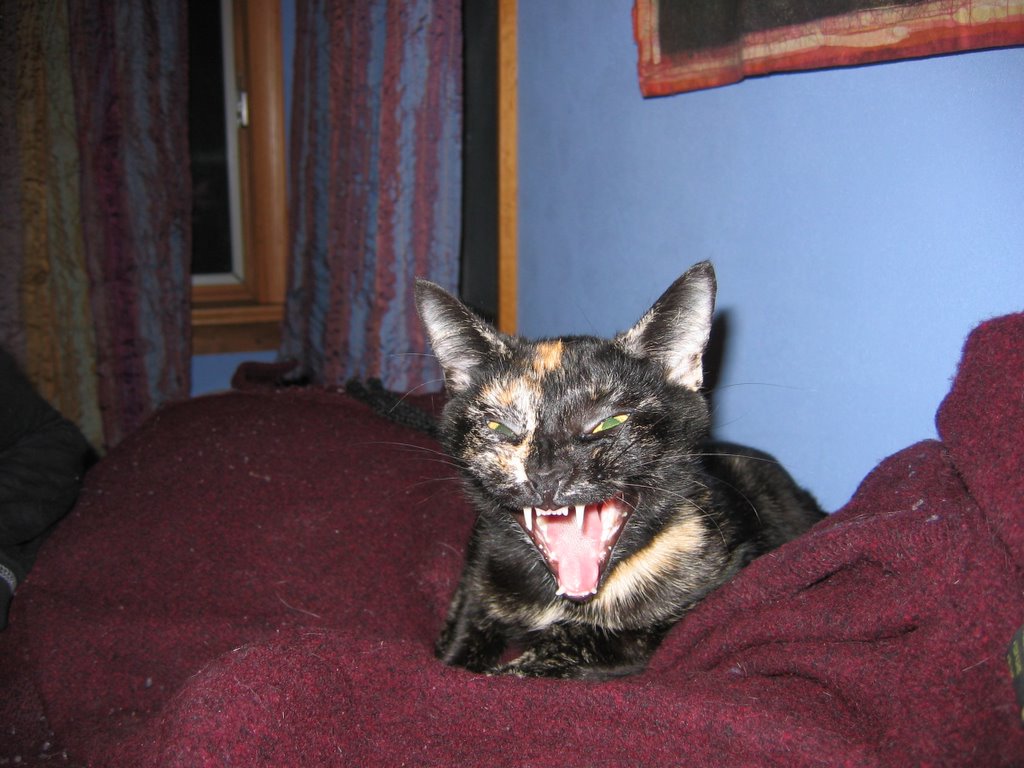 To the left, we have the new girl on the block–Dandelion–which, as we know, is likely to be here temporary name, until we discern more personality and give her a permanent name.
While she looks like she is some sort of minion of the Dark Lord doing her Gene Simmons impersonation in this picture, in truth, she was yawning. She is actually a very sweet and playful little cat who is getting along famously with everyone else, so much so that while we have more cats than we have had before, we also have more peace in the house.
Go figure.
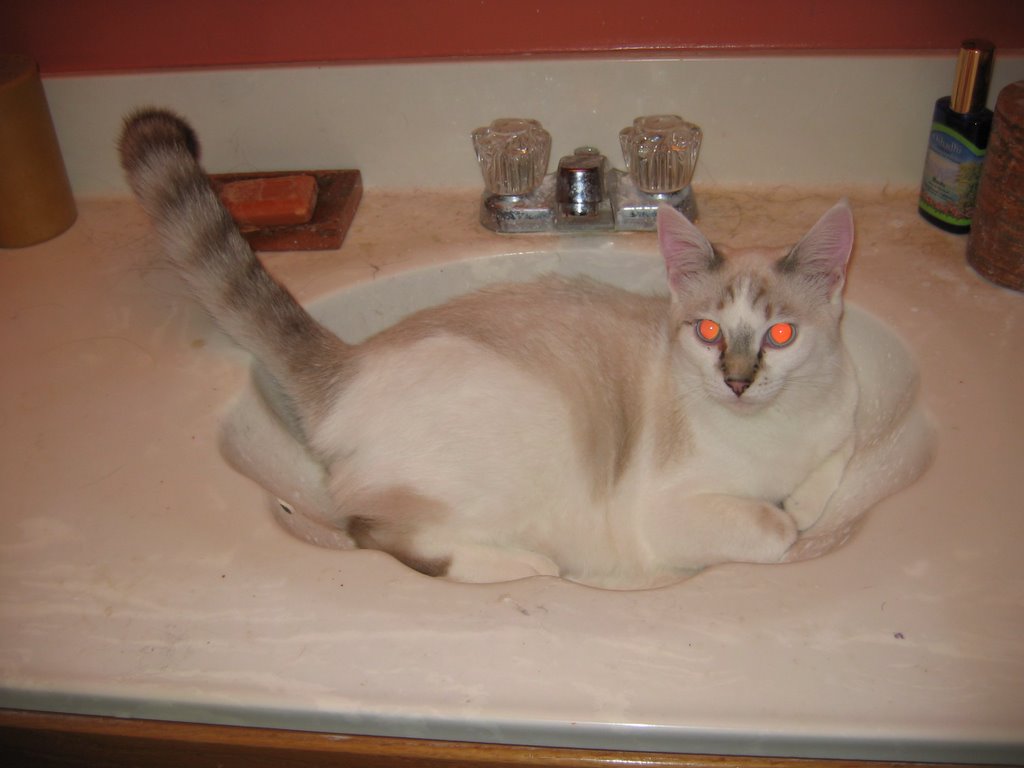 Lennier now has a new nesting spot. It is close to the sacred spigot from whence the spring of blessed water flows.
He lays there and waits for me to turn the water on, and then will let it pour over him.
He fell in the bathtub with me yesterday, and swam around, quite unconcerned, jumped out and then dried himself off, then jumped back up on the side of the tub and watched me finish washing my hair.
He really is an alien in a cat suit, I swear.
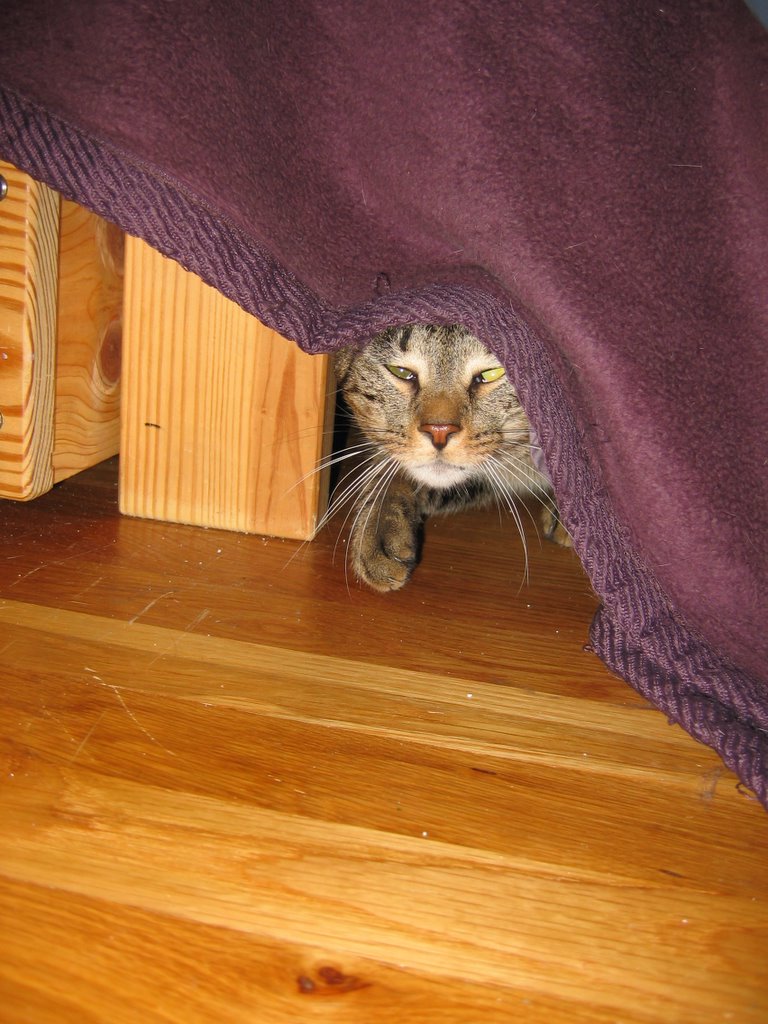
Here is Gummitch looking rather inebriated.
However, no catnip was involved in the creation of this picture–he was playing hide and seek with Dandelion, and was coaxed out of his hiding place by yours truly who called him repeatedly, with the camera focused and ready to get the shot.
I am not sure why his eyes look crossed, though. They just do. It may be that he is walking about in a constant daze–I believe that he is in love with Dandelion. He certainly acts smitten–he follows her around, is solicitous of her, he smacked Grimmy when she tried to bully them, and has been doing his best to look handsome and manly when Dandelion is near him. Which she nearly always is, because he is always near her.
Earless, he looks like some sort of long-nosed seal–or maybe a walrus–look at those whiskers.
So, if Gummitch is the Walrus, I guess that makes Lennier the Eggman.
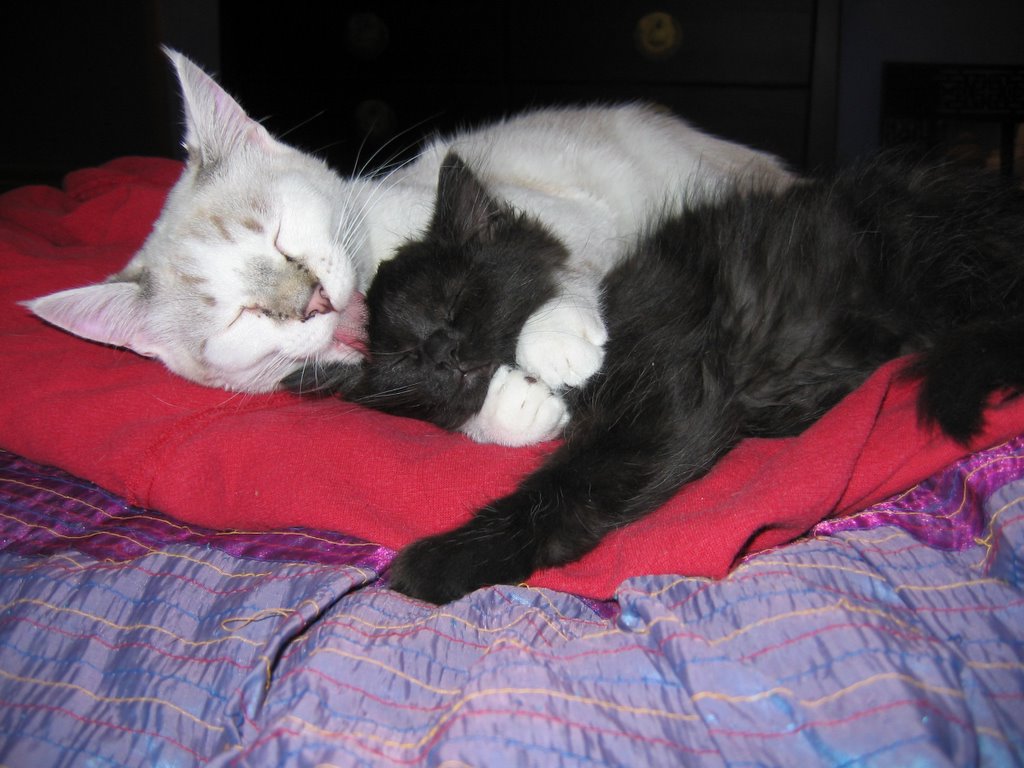 And speaking of Lennier, here he is again, taking such tender care of his bestest girlfriend, Tatterdemalion.
Look how gently he washes her.
And he is washing her, not trying to strangle her.
At least, I don’t think he is trying to squeeze the life from her.
😉
For more well-wishing to Clare from cats around the international blogosphere, check in with Foodie Farmgirl at Farmgirl Fare and Boo at Masak-Masak.
They are the generous and delightful hostesses of this very special edition of Weekend Cat Blogging.
So–Clare–my cats and I hope that you got at least a giggle from their antics, and that it will hope you get well soon–we’ve been worried about you.
Cookies and Friends
 Morganna’s friend Emma, the eternally bouncy, hopped up to me this afternoon and said, “We would like to make chocolate chip cookies, please,” then flashed a pixie-like smile.
How could I refuse?
Making spur-of-the-moment cookies with my best friend Diane, is one my most cherished memories of middle school and high school. We’d start in the afternoon, or if she was spending the night, after we’d watched umpteen episodes of Star Trek, and would make wretched messes in my mother’s kitchen, with much giggling, tasting of raw cookie dough and mismeasured ingredients.
 My mother always kept the stuff to make some sort of cookies around, so that Diane and I could dig through her cookbooks and file of hand-written, egg and dough-stained recipes and create something to fill our cravings for something sweet and filling.
Diane had little experience with electric mixers, so the first time we delved into cookie baking without my mother standing over us, she had lifted the beaters from the bowl while they were still running and flung a whirlwind of dough all over the kitchen.
I remember it took us hours to clean up every scrap of dough that night; I was worried Mom would freak out, but since it was Diane’s doing and she had never touched a mixer before in her life–well, when Mom saw it, she laughed. Then, we laughed, and spent what seemed like an eternity cleaning it all up.
There were even specks on the ceiling.
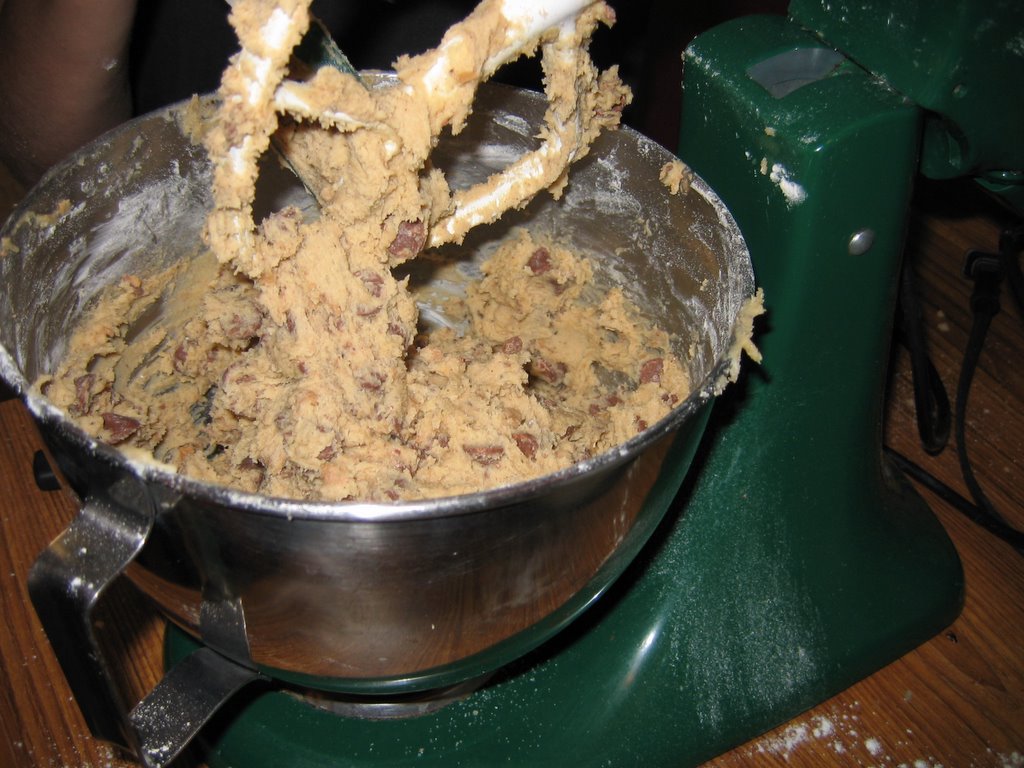
Luckily, I have a Kitchenaid, so Morganna and Emma didn’t have the chance to fling dough from here to eternity.
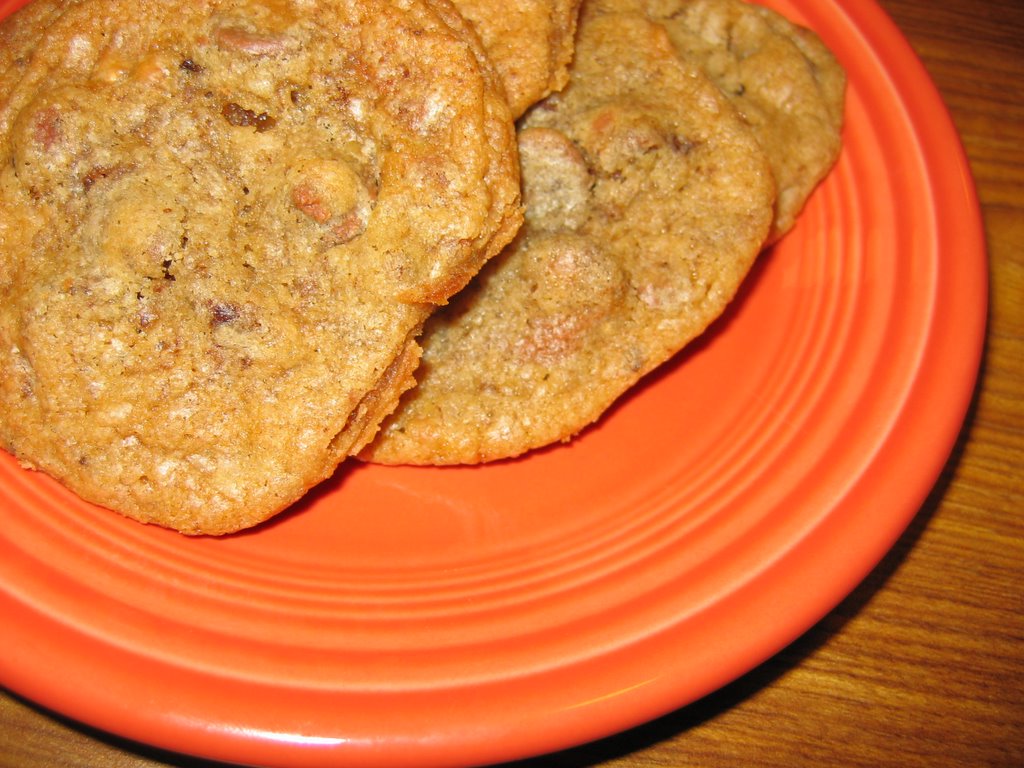
But, they certainly did eat their fill of it uncooked; Morganna is of the opinion that this version of chocolate chip cookies tastes just as good raw as it does baked.
 It is an adaptation of the classic Toll House recipe, which of course, is the version I grew up with. I changed it because Zak told me that he didn’t like chocolate chip cookies, and I couldn’t let that situation stand–how can anyone not like chocolate chip cookies?
So, I played with the recipe and added a few twists on the basic flavor. Generally, I use all brown sugar in these cookies, which results in a darker, chewier cookie, but in this batch, Morganna and Emma decided to follow the tradition of using half white sugar and half light brown.
The vanilla they used was double strength Penzey’s–in order to get the same effect with normal vanilla extract, use twice as much of it.
Because of the toffee bits in these cookies, they are crisp on the outside, and chewy on the inside, and they tend toward the fragile. Let them cool for at least two or three minutes on the cookie sheet before removing them to a rack. Otherwise, they are apt to fall apart or droop between the wires of the rack and deform into rather ugly sculptures. I also tend to take them out of the oven when they are slightly underdone, because I want them to finish baking on the sheet. This ensures that the centers stay chewy while the outer layer is still crisp. If you let them darken all the way, they will come out crunchy–it is the extra sugar from the toffee that seems to cause all of this finicky behavior.
It was good to watch the girls have fun baking together, and as you can see, it brought back memories of many hours spent in Mom’s little yellow kitchen with my best friend, making cookies that we always meant to take to school to share, but somehow we never had enough left. (Though, we did share with Mom and with Gram, up the street, and often the next door neighbors. We never ate all of them, though I think we tried once or twice.)
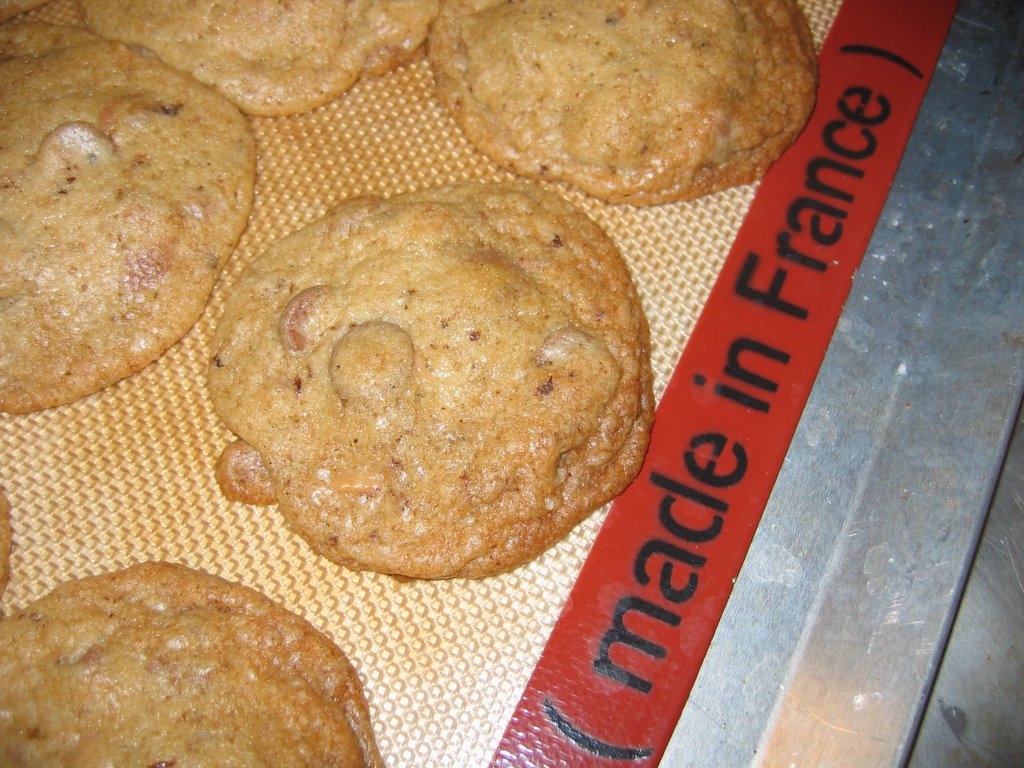 Toffee-Chocolate Chip Espresso Cookies
Ingredients:
2 1/4 cups all purpose flour
1 teaspoon baking soda
1 tablespoon espresso powder
1/2 teaspoon cinnamon
1 teaspoon salt
1 cup unsalted butter, softened
1 1/2 cups light brown sugar, packed
1 teaspoon double strength vanilla extract
2 eggs
1 12 ounce package milk chocolate morsels
4 ounces Heath (or other toffee bar) bits
Method:
Preheat oven to 375 degrees F.
Combine flour, baking soda, espresso powder, cinnamon and salt in a small bowl. In a mixing bowl, cream butter and sugar together until light and fluffy. Add vanilla, and the eggs, one at a time, beating to combine.
Gradually add flour mixture, beating thoroughly between additions, until all flour is used.
Mix in chocolate morsels and toffee bits, either by hand or with the mixer, depending on how well your mixer tolerates very stiff doughs.
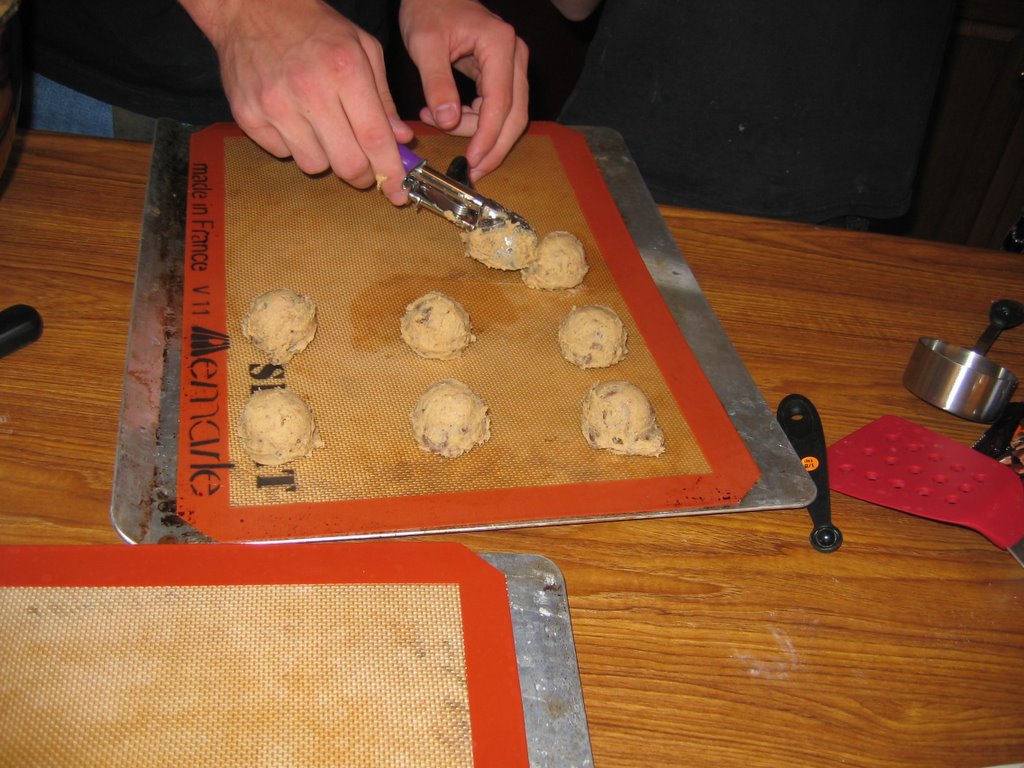
Scoop with a small cookie scoop onto cookie sheets lined with silpats, and bake for 10 minutes. Allow to sit on sheets for three minutes, then remove to racks to finish cooling.
recipes cookies chocolate food & drink
Book Review: Fashionable Food
 I have never been one to mind fashion.
When the preppy look was in at school, I was oblivious, and wore the wrong shoes, the wrong sweaters and the wrong jeans. I never wore a shirt with an alligator, and duck shoes (which I always thought were well-named as they made everyone look like they had huge feet and were waddling) never made it into my closet.
I never liked the popular bands, and all the teen idols that my peers were swooning over made me curl my lip, roll my eyes and pantomime gagging.
I just never understood fads–I was always on the outside looking in, trying to comprehend just what was so appealing about whatever the “in” thing of the moment was about.
So, one might find it a little odd that I had so much fun reading Sylvia Lovegren’s Fashionable Food: Seven Decades of Food Fads. Except, it isn’t odd at all; Lovegren examines each decade of food fads with the jaundiced eye of a cynical observer who is just as puzzled by human food behavior as I was by teen clothing and music choices.
Written with a sharp wit and a light touch, Fashionable Food takes the reader on a romp through the kitchens, restaurants, women’s magazines and other food media of the twentieth century, from the Roaring Twenties up through the mid-1990’s. Along the way, she takes us on a few side trips, where she explores the “exotic” cusines introduced by immigrants–primarily Chinese, Japanese and Italian–and examines how they slowly became imbedded into American food culture.
Sprinkled throughout the text are period menus and recipes, mostly culled from vintage women’s magazines and cookbooks; these visceral illustrations of the food follies of the past illuminate her prose in hilarious and often alarming ways.
For example, she prints a recipe (which I think I am going to have to make, just to see how hideous the result can be) for “Italian Spaghetti,” circa 1924, wherein the cook is instructed to “boil the spaghetti one hour in salted water.”
When I read that, I could feel my frontal lobe slam into my forehead.
Boil spaghetti for an hour?
What, did they make pasta out of lead in the 1920’s? Was wheat more muscular? Can spaghetti even retain a coherent shape if boiled that long?
The author doesn’t answer these questions, because she notes quite dryly that the “recipe has not been tested.”
There is a lot to fear in this book. If the thought of boiling spaghetti for an hour doesn’t strike enough terror into the heart of the reader, the amount of “dainty” foods discussed therein will.
Dainty.
I shudder just to type the damned word.
But, apparently, back in the 1920’s and 30’s, women liked dainty food. It made them feel–dainty–I guess.
Nothing, except perhaps a moose or an elephant loitering in my general vicinity is going to make me feel dainty. Certainly not such delicacies as bird’s nest salad, which consisted of balls of pastel-tinted cream cheese in iceberg lettuce nests. Nor anything having to do with marshmallows.
Speaking of marshmallows, as I was describing one recipe from the book–“Sweet Potato-Marshmallow Surprise” (which consists of mashed sweet potatoes wrapped around large marshmallows, then rolled in crushed cereal and baked)–Zak asked me when marshmallows were invented.
After having read about so many culinary depredations that involved those sticky, pillowy, tooth-achingly sweet confections recounted in Lovegren’s narrative, I quipped, “Too early in human history.”
After we finished laughing, I thought about it. While most of the book is concerned with the foolish food foibles of past eras, Lovegren doesn’t just focus on the negative; she also celebrates the positive. She has no qualms about praising a particular dish for being tasty even if it has fallen from favor. And while she rightly bemoans the preponderance of packaged convenience foods in American cookery as she chronicles the rise in its use through the century, she doesn’t hesitate to note that sometimes, some foods made with mixes or cans were not bad, and were perhaps even good.
What I found most interesting about the narrative was how long Americans have had a love affair with processed foods–it is not something that arose after World War II as many modern cooks might suppose. American cooks were taking advantage of boxed, canned and powdered foods long before the 1950’s, though indeed, that decade was the era of Poppy Cannon’s best-selling, The Can-Opener Cookbook.
The other point of interest was the staying power of some dishes–the inexplicable three decade long popularity of tomato aspic boggles the mind, while the perennial popularity of meatloaf–a staple of the Depression and wartime kitchens–comes as no surprise.
There is much to admire in the book, and it is a great deal of fun, but it also isn’t really a serious history, filled with footnotes and sprinkled with analysis. However, I don’t think that Fashionable Foods was ever meant to be a scholarly book–it was contrived to entertain the cooking enthusiast while giving them a taste of American food history.
My greatest criticism is about the recipes–far too many of them have been “adapted” by Lovegren to fit the nutritional awareness and tastes of current cooks. I think that changing these recipes at all violates the spirit of the book–the idea is to capture the flavor of the past as it was, not as we would wish it to be.
All in all, I had a great deal of fun reading Lovegren’s sometimes snarky prose, and so I will forgive her instinct to tweak the recipes she encountered in her research to fit modern sensibilities. It was enough that she made me laugh aloud and sigh with nostalgia, then blush with embarrassment and goggle in disbelief, that I won’t hold it against her that she changed some recipes, yet left that horrific injunction to “boil spaghetti one hour in salted water” intact.
Besides–I still have to try that recipe.
Just to see what will happen.
books book review food history food & drink
Kitchen Update: Cabinets, Part II
 Most of the carpentry on the cabinets is done; all that is left is to put knobs on a few more drawers.
Our kitchen designer ended up having to order more knobs, because when she got a look at the width of some of the drawers, she decided they would look and work better with two pulls rather than one.
To the right there, you can see the view to the window. The sink will be mounted under the window, with the dishwasher left in the space to the viewer’s right.
The range and vent hood go in there to the left.
 Now, here to the left is the area that will be my desk–the laptop is going to live there with all of my recipes on it. It will have internet hookup so I can research ingredients and recipes if I need to. Above, you can see one of the glass-fronted doors with the really pretty Arts and Crafts style mullions. In that cabinet, I will probably display some of my Fiesta serving pieces. (If you can remember back when I posted “before” pictures, this is the area where the much-reviled Fruit of the Looms lamp was hanging.)
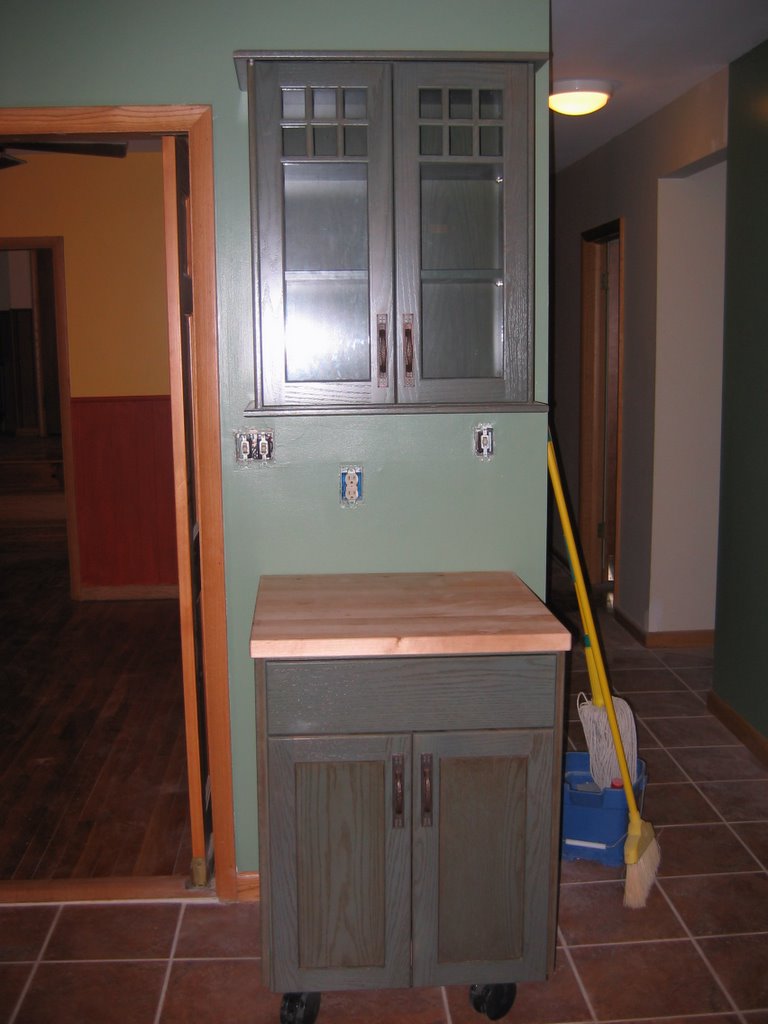 To the right is the wall opposite the desk–this is where the single glass-fronted cabinet was hanging.
Again, I will put Fiesta serving pieces and the like. Down below, I may keep baking necessities, though I am not certain yet. The butcher-block topped island has wheels, though, so it can be stored against the wall, but if I need a secondary work space near the sink or stove, I can wheel it out to where I want it.
You cannot see them in this picture, but to the right of that cabinet and island are the built in bookcases for the cookbooks.
 Here on the left is a view of the wall opposite the range–with the cabinetry that will cradle the refrigerator. The cabinets over the refrigerator go all the way back, so there is plenty of storage space there.
To the left of the refrigerator cubby is a shorter set of cabinets–a very small microwave will be undermounted there. I don’t use my microwave for anything but thawing, melting butter, melting chocolate and reheating leftovers, so I didn’t want to take up space with a large one.
You can tell from this picture, that on either side of the windows is an open cabinet with a rounded valance–I don’t yet know what I am going to put in there, but I have quite a few pretty Fiestaware pieces, so something will look nice in there!
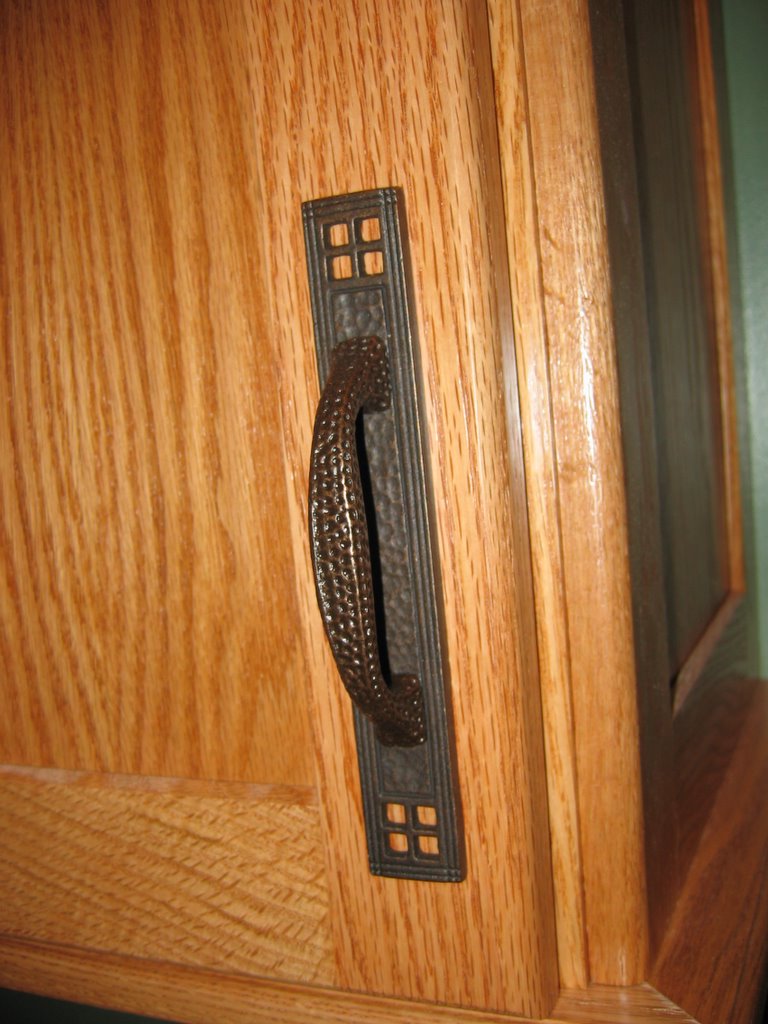
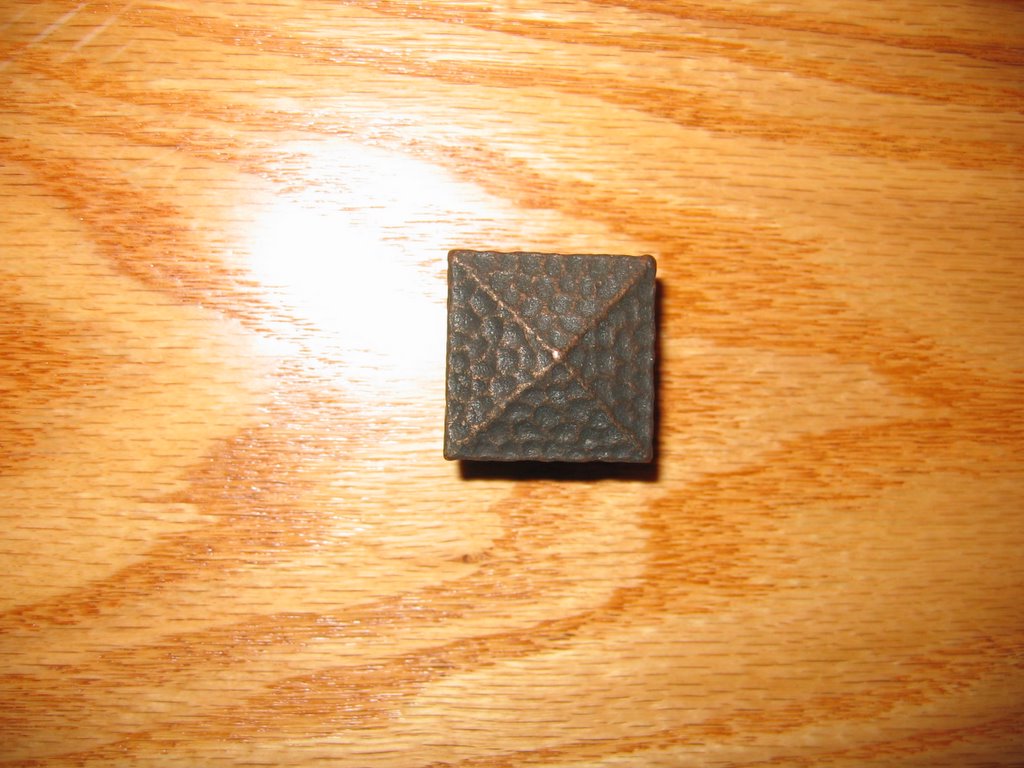 Finally, here are some closeups of the hardware for the cabinets. Below, you can see the handles we chose to be mounted vertically on the hanging cabinets, and to the right are the knobs for the drawers. Our designer told us that generally, people put knobs on cabinets and horizontally mounted handles on drawers, but we reversed the norm.
If you look at the handle/pull below, you can see why–the cut outs on the bronze repeat the motif of the mullions in the glass doors. The effect would not be as obvious if they were used horizontally on drawers on the base cabinetry as it is when used vertically on hanging cabinets.
So far, everything is looking beautiful, and I am amazed at how much storage capability I am going to have once the kitchen is done. The way the cabinets are finished on the top, I can place larger cooking utensils and serving pieces up there for display. They can be out of the way, yet still be decorative.
Right now, the man who is going to do the quartz countertop is measuring and making the template. The sink and faucets are in, but are still in their boxes–I will refrain from photographing them until they are installed.

Categories:
- Admin (rss) (55)
- Blogs and Blogging (rss) (81)
- Book Reviews: Cookbooks (rss) (43)
- Book Reviews: Non-Cookbook Food Books (rss) (38)
- Cats and Cat Blogging (rss) (47)
- Chinese Cooking Lessons (rss) (32)
- Culinary School Stories (rss) (18)
- Dairy Pruducts: Cultured and Barbaric (rss) (4)
- Documentary Filmmaking (rss) (1)
- Essays, Rants and Reflections (rss) (260)
- Fighting Hunger (rss) (12)
- Food and Kids (rss) (45)
- Food in the News (rss) (126)
- Food Media (rss) (98)
- Food Preservation (rss) (18)
- Food Safety (rss) (45)
- Gardening (rss) (30)
- Herbs and Herb Blogging (rss) (20)
- Holidays (rss) (50)
- Kat Blogging (rss) (22)
- Kitchen Science (rss) (36)
- Leftover Makeover (rss) (8)
- Life, the Universe and Everything (rss) (131)
- Local and Sustainable (rss) (227)
- Local Athens Food and Foodies (rss) (42)
- Meatless Mondays (rss) (32)
- Menu For Hope (rss) (5)
- Nutrition, Diet and Health (rss) (84)
- On The Farm (rss) (8)
- Recipes: Almost Vegetarian, Vegetarian and Vegan (rss) (294)
- Recipes: American Regional (rss) (37)
- Recipes: Appalachian Hillbilly (rss) (33)
- Recipes: Bread, Pasta, Grains (rss) (95)
- Recipes: Canning and Preserving (rss) (8)
- Recipes: Chinese (rss) (123)
- Recipes: Comfort Food (rss) (120)
- Recipes: Cookies (rss) (16)
- Recipes: Desserts (rss) (48)
- Recipes: French (rss) (25)
- Recipes: Fruits and Vegetables (rss) (302)
- Recipes: Greek, North African and Middle Eastern (rss) (31)
- Recipes: Indian (rss) (137)
- Recipes: Italian (rss) (42)
- Recipes: Japanese (rss) (7)
- Recipes: Jewish (rss) (4)
- Recipes: Korean (rss) (6)
- Recipes: Meat, Poultry and Fish (rss) (220)
- Recipes: Mexican/Native American/ Latin American/Caribb (rss) (27)
- Recipes: Original (rss) (108)
- Recipes: Thai (rss) (27)
- Recipes: Tofu (rss) (17)
- Recipes: US Regional (rss) (16)
- Recipes: Vietnamese (rss) (8)
- Restaurant Stories (rss) (28)
- Sewing, Quilting, Arts and Crafts (rss) (16)
- Simple Chinese Recipes (rss) (30)
- Slow Food and Heritage Foods (rss) (10)
- Spice Blogging (rss) (44)
- The Chinese Cookbook Project (rss) (14)
- The Chinese Pantry (rss) (39)
- The Documentary (rss) (2)
- The Kitchen Saga (rss) (17)
- The Locavore's Bookshelf (rss) (15)
- The Unsung Adventures of The Culinary Nerd (rss) (6)
- Tools and Toys (rss) (35)
- Uncategorized (rss) (10)
- With a Side of Politics (rss) (48)
Archives:
- August 2012 (9)
- July 2012 (12)
- September 2011 (3)
- August 2011 (7)
- July 2011 (8)
- June 2011 (16)
- May 2011 (17)
- April 2011 (11)
- December 2010 (9)
- November 2010 (5)
- February 2010 (1)
- December 2009 (5)
- November 2009 (7)
- October 2009 (10)
- September 2009 (16)
- August 2009 (14)
- July 2009 (14)
- June 2009 (7)
- May 2009 (17)
- April 2009 (10)
- March 2009 (25)
- February 2009 (13)
- January 2009 (10)
- December 2008 (5)
- November 2008 (5)
- October 2008 (6)
- September 2008 (13)
- August 2008 (8)
- July 2008 (11)
- June 2008 (18)
- May 2008 (13)
- April 2008 (14)
- March 2008 (16)
- February 2008 (17)
- January 2008 (19)
- December 2007 (25)
- November 2007 (18)
- October 2007 (24)
- September 2007 (16)
- August 2007 (15)
- July 2007 (15)
- June 2007 (10)
- May 2007 (14)
- April 2007 (16)
- March 2007 (17)
- February 2007 (20)
- January 2007 (13)
- November 2006 (1)
- October 2006 (8)
- September 2006 (14)
- August 2006 (25)
- July 2006 (30)
- June 2006 (28)
- May 2006 (34)
- April 2006 (29)
- March 2006 (24)
- February 2006 (30)
- January 2006 (38)
- December 2005 (40)
- November 2005 (37)
- October 2005 (32)
- September 2005 (25)
- August 2005 (30)
- July 2005 (28)
- June 2005 (21)
- May 2005 (8)
- April 2005 (22)
- March 2005 (17)
- February 2005 (29)
- January 2005 (10)
Search Site:
Links:
- Lily’s Wai Sek Hong
- 101 Cookbooks
- A cat in the kitchen
- A Veggie Venture
- Accidental Hedonist
- Cha Xiu Bao
- chez pim
- Chocolate & Zucchini
- Chopstick Cinema
- Chowhound.com
- Chubby Hubby
- Cook sister!
- Cooking with Amy
- da*xiang
- Eat Local Challenge
- Eating Liberally
- Ecocentric
- Eggbeater
- Epicurious
- Farmgirl Fare
- Fatfree Vegan
- Foodgoat
- ForkandBottle.com
- Green Olive Tree
- Hooked on Heat
- Jaden’s Steamy Kitchen
- Kalyn’s Kitchen
- Lucullian delights
- Mahanandi
- Matt Bites
- MeatHenge
- mmm-yoso!!!
- New York Times – Dining & Wine
- Pizza Goon
- Rasa Malaysia
- Ruhlman
- Sailu's Kitchen
- Serious Eats
- SF Gate: Food & Dining
- Simply Recipes
- Soul Fusion Kitchen
- Tastespotting
- The Amateur Gourmet
- The Cleaner Plate Club
- The Food Section
- The Grub Report
- thecookscottage
- U.S. Food Policy
- Wandering Chopsticks
- Washington Post Food and Dining
- Wasted Food
Meta:


Powered by WordPress. Graphics by Zak Kramer.
Design update by Daniel Trout.
Entries and comments feeds.