
Cook Local, Eat Global
What Does My Kitchen Look Like Now, Part II
 They started painting today; tomorrow or the next day, they will start putting in the cabinetry. You can see the color to the right there–a nice pale sage/moss green. It looks well with the golden oak woodwork and the reddish terra cotta tile floor.
Tomorrow, Dan and Heather will also take away the old kitchen appliances, cabinetry and countertops in a large rented truck. Dan stopped by just as I was dishing up supper to tell us this–I was scooping out the pork ribs into a serving bowl, heard his voice downstairs and started laughing.
I swear that my little brother can smell pork cooking from ten miles away; I don’t know how many times he has shared our supper because he happened by.
T’was no matter–I know he partakes of no pork at his house, out of respect for Heather’s Muslim beliefs–and besides, I always cook enough to feed a couple more people anyway. Just in case.
So, I dished up a fourth bowl of rice and though Dan manfully tried to refuse, he sat and had dinner anyway.
Which is just fine.
But wait–there is more!
I just found out that the stove which I had been told would take eight to ten weeks to get to us is in–sitting about at Clintonville Electric, just waiting for the range hood to come in, before everything is loaded on a truck and brought to us and installed.
It seems that the delay happened because another customer had ordered the same exact stove in the same exact British Racing Green that we had–a day or so before we had. And so, they took precidence, and the stove that was in the warehouse went to them.
However, they apparently cancelled that order days ago–and so–the stove is ours.
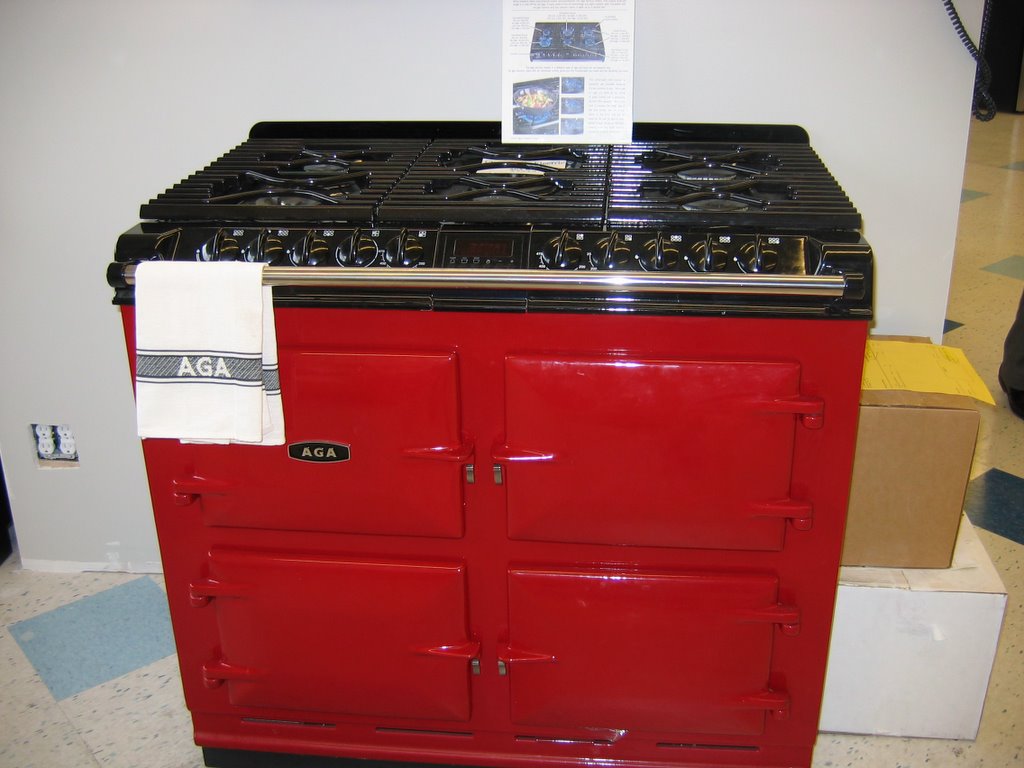 Here on the left, you can see what it will basically look like, save for the color. It is an AGA Six-Four, which is a dual-fuel range with a six-burner gas cooktop and four electric ovens–one warming oven, one broiler and one higher-heat oven and one lower heat oven.
The cooktop includes one burner that has 27,500 btus, which I cannot wait to set my wok on. I suspect that once I set my wok on it and start cooking I will never want to leave my spot in front of that burner.
It is a beauty. I can barely contain myself from vibrating apart with excitement as I anticipate cooking on it.
Things are coming together much faster on this kitchen than I had hoped.
I will keep everyone up to date as developments occur.
Country Folk Fusion: Pig and Greens
 I’ve expounded before, early on in the writing of this blog, about the propensity for Applachian country folk to love the pairing of pork with greens.
I have also made note of the Chinese folk’s love of greens and pork in a past posting, and have always wondered internally that perhaps pig meat and greens are a commonality that should be exploited in bringing folks from these disparate backgrounds together.
Because, in truth, it is possible that we are not so different after all.
Pigs were an important protein source for early settlers in the Applachian mountain region, because frankly, pigs can take care of themselves. Settlers would let their pigs forage in the woods, and pen them up only at night, or in some cases, only in cold weather. The pigs, big, wily omnivores that they are, took right good care of themselves–the only natural enemies they had were men and bear–and essentially provided a worry-free domestic meat source for the hardy folk who carved homes out of the densely wooded hills and valleys.
By the time that the Southern Applachian states were “tamed and civilized” to the point that there were roads, schools, and motor cars everywhere, pork was still revered and eaten as as staple meat because of the force of tradition, and its economic strength–even if you didn’t raise your own hogs, pork was cheap, and thus often on the table, and was considered an integral part of Appalachian foodways.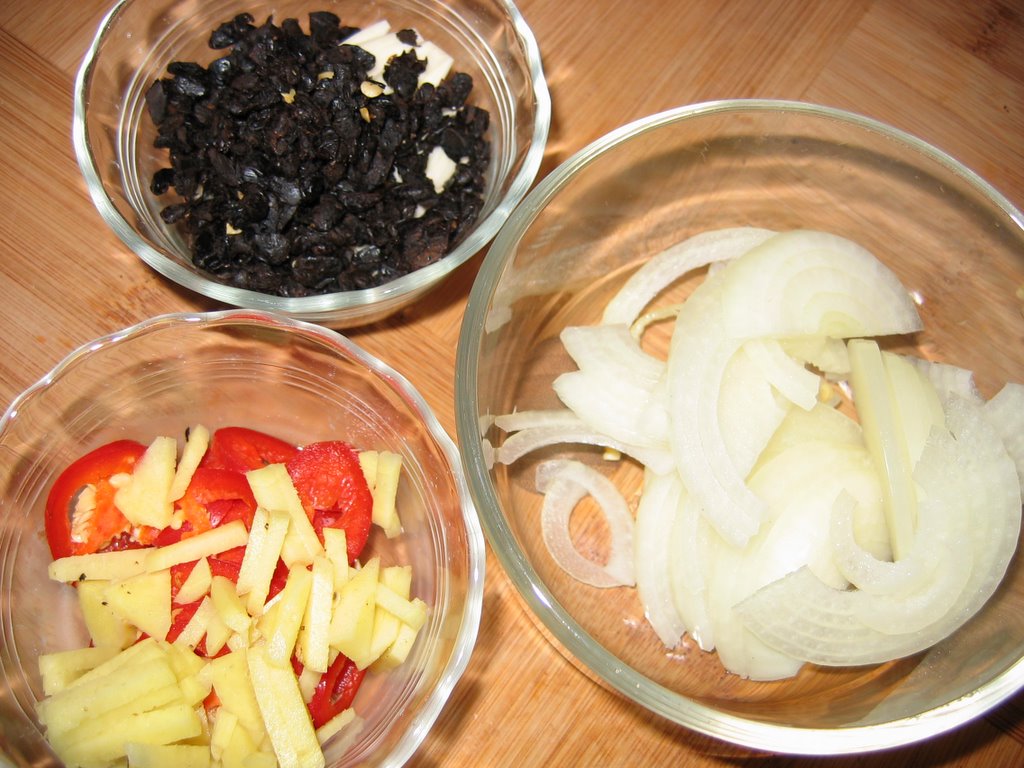
Strange as it may seem to those of us who grew up eating bacon in our green beans and ham hocks in our greens, the country folk in China feel the same way we do about our pigs.
Pork was and is still the traditional meat source in Chinese culture, in large part, again, because pigs are effecient in terms of feed ratio to meat output and because pigs were easy to raise. Their ability to thrive off of table and kitchen scraps made them a valuable part of the farm, and as a result, among all of the regional cuisines of China, there are seemingly endless ways to cook every part of the pig, including its snout, trotters and ears.
Not to mention its chitlin’s. (Small intestines, for those who don’t speak hick.)
I was reminded of this love affair with all things porcine, when I was leafing through Irene Kuo’s excellent book, Key to Chinese Cooking. A recipe for braised pork spareribs with fermented black beans and wine caught my eye. Fermented black beans are a favorite country Cantonese ingredient and are used to add a delicious savory tang to many dishes featuring pork.
As I read it, my mouth watered, and I remembered a favorite dish from childhood–my mother’s braised country ribs with turnips or potatoes.
It was a fantastic comfort food supper: thick, meaty country-style pork ribs were browned along with lots of onion slices, and then water, salt and pepper was added, and the mixture was cooked on low heat for a long time, until the meat was falling from the bones it was so tender. At that point, Mom would peel turnips and potatoes and add them to the cooking liquid. By the time they were soft, the gravy had begun to reduce, leaving Mom to have to add only a bit of artificial thickener like a flour slurry.
Considering the triumph of my careful fusion between French and Sichuan foods, I resolved to try out Irene Kuo’s recipe, only I was going to add some of those completely sweet and delish Japanese turnips when I was nearly finished cooking.
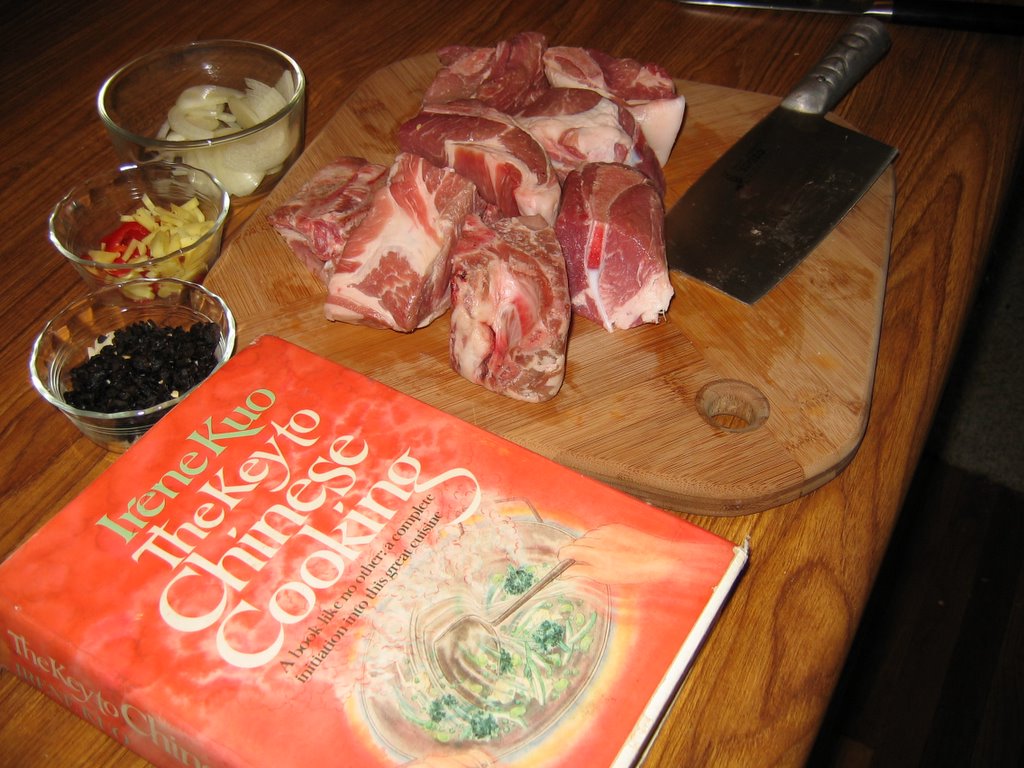 I also added onions to brown along with the ribs, just as my mother always did. The sweetness of caramelized onions perfectly enhances the natural sweetness of the pork.
Country style pork ribs are meatier and fattier than spare ribs; they are also huge–about six to seven inches long, two inches thick and two and a half inches wide. In order to have them sized for serving with chopsticks, I decided it would be prudent to chop them in half lengthwise–which I managed by employing my heaviest Chinese cleaver.
I set the ribs upright, so I was cutting down into the bone from the top, not across their longitudinal axis, and with a good, swift stroke, cut them clean in half. Hacking bones with a cleaver requires some strenth, care and willpower–there can be no hesitation. One simply gets on with it and does it, while keeping the free hand well away from the cutting surface.
After that, it was a simple matter of dusting the meat with flour, heating oil in my pressure cooker, and browning them thoroughly on every side, then taking them out and setting them on a plate while I browned the onions, chiles, and ginger, then added the garlic and chopped black beans and let them all cook until they were fragrant. I deglazed the p0t with Shaoxing wine, and put the ribs back in, added a bit of dark soy sauce and chicken broth to barely cover the meat and brought it to a boil.
I think locked the lid in place, turned the heat down and cooked until they were fork tender–about thirty minutes. After releasing the pressure, I opened the lid and added the peeled Japanese turnips that I had cut into bite-sized chunks, and let them cook in the rich sauce while it reduced. Just before serving, I thickened the sauce a bit with a cornstarch slurry.
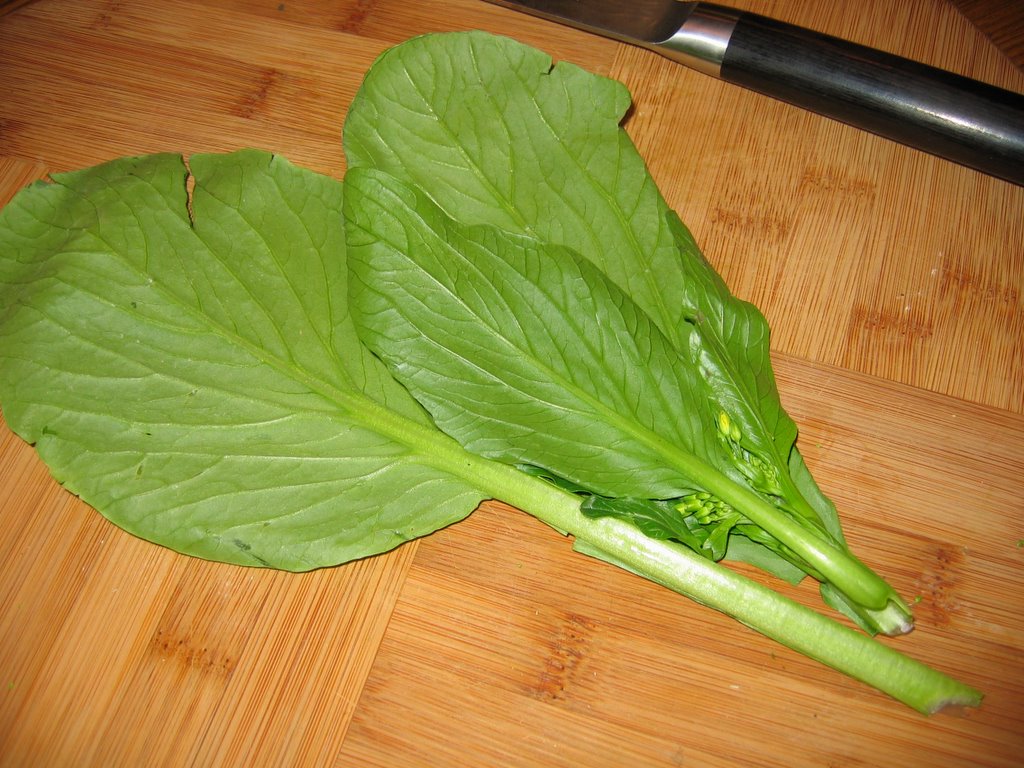 A perfect foil for the absolutely rich and meltingly tender meat is stir-fried crisp greens and fresh water chestnuts with garlic and ginger.
Choy sum, pictured to the right, looks bloody well like gai lan. It has the same leave structure, a similar stem structure and the same small yellow flower clusters. It looks so much like gai lan that if you are buying it packaged in plastic bags, and cannot really feel the stalks up or smell them, you may well not be able to tell the difference.
I know I didn’t–when I bought this bunch of choy sum, I thought for certain I was buying gai lan. In fact, was so certain of it, I was ready to cook it as gai lan last night, and it was only after I had prepped the seasoning and water chestnuts, and had opened the bag to wash the greens.
 As soon as I touched them, I knew that we didn’t have the dense-crisp, sweet, mustardy gai lan, but instead the more mildly flavored, watery-crisp, slightly tangy choy sum.
So, I grabbed some garlic and sliced it up and added it to the ginger, and put the oyster sauce back in the fridge. Its distinctly oceany tang would completely overwhelm the choy sum, even as it perfectly complements the more robust gai lan. For choy sum, I use just a whisper of soy sauce, a pinch of sugar and some chicken broth, along with the aromatics. Any other seasonings would probably overpower the flavor of the greens themselves.
In stir frying choy sum, one must be aware that it cooks down very quickly–the high water content of the green causes the structure of the green to collapse rapidly as the water escapes in hisses of steam as soon as the greens are put over high heat. This means that one must work quickly, and be prepared to remove the wok from the fire as soon as the greens look -almost- done. Not done–because it will continue to cook under its own residual heat–but nearly done.
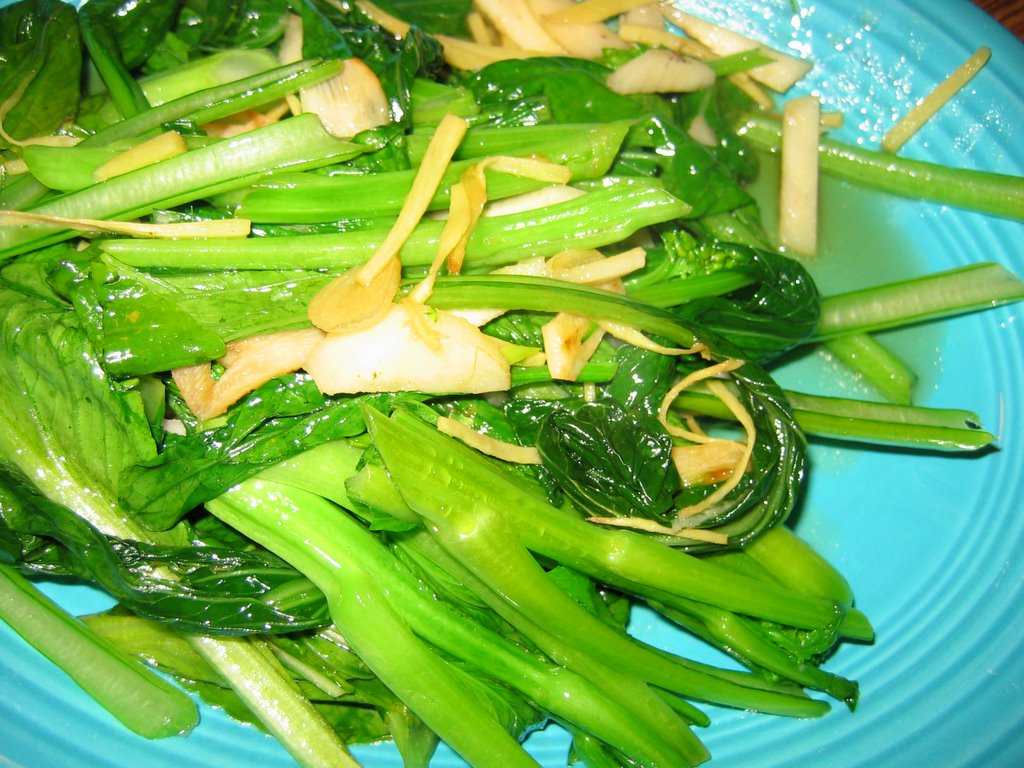 Stir Fried Choy Sum with Ginger and Garlic
Ingredients:
2 tablespoons peanut oil
1 1/2″ cube fresh ginger, peeled and sliced thinly, then shredded
4 garlic cloves, peeled and sliced thinly then shredded
1 pound choy sum, washed and dried thoroughly, bottom of stalks trimmed and discarded, with remainder of stems and leaves cut into 4″ lengths
fresh water chestnuts, peeled and shredded (optional)
1/2 teaspoon raw sugar
1 teaspoon thin soy sauce
1/4-scant 1/2 cup chicken broth
Method:
Heat wok until it smokes. Add oil and heat until it shimmers and is about to start smoking. Add ginger and garlic, stir fry until very fragrant, about forty seconds.
Add choy sum all at once, and stir fry very vigorously–water will escape from the greens immediately. Add remaining ingredients, including water chestnuts if you are using them, and stir and fry until the leaves are wilted and the stems are just starting to wilt.
Immediately remove from heat and scrape into a heated serving platter and serve right away.
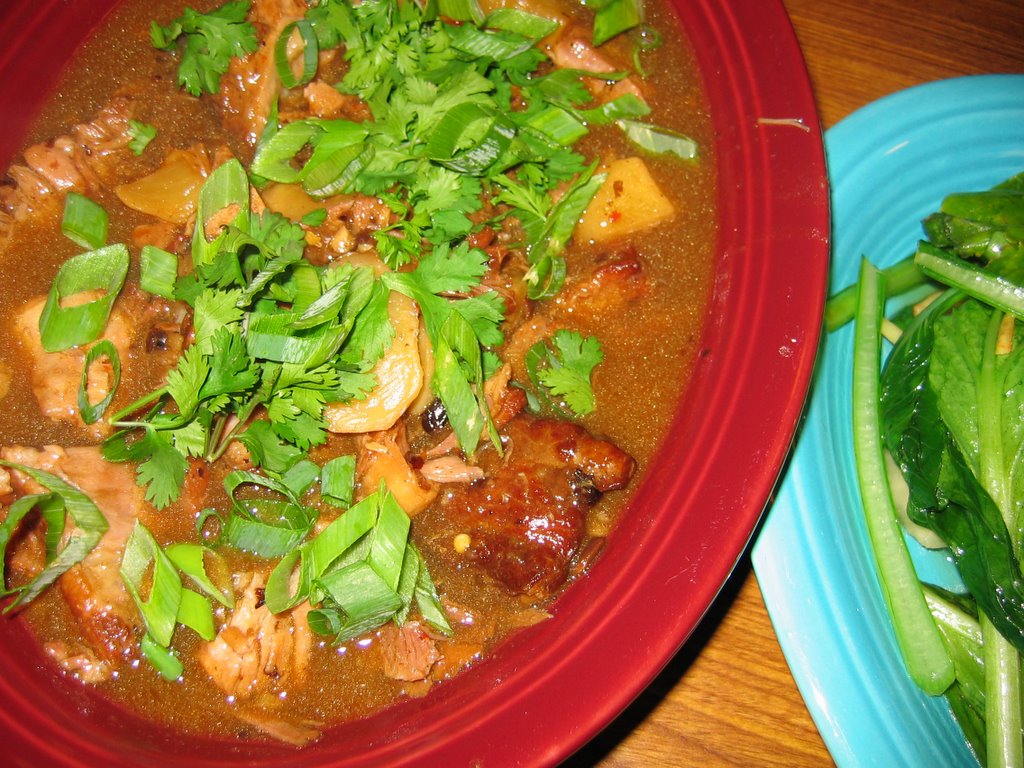 Braised Country Ribs with Fermented Black Beans and Chiles
Ingredients:
4 meaty thick country style pork ribs, cut in half crosswise
flour for dredging
2 tablespoons peanut oil
1 onion, sliced thinly
2 ripe jalapenos, thinly sliced
1″ cube fresh ginger, peeled and sliced thinly
5 cloves garlic, peeled and sliced thinly
2 1/2 tablespoons fermented black beans, roughly chopped
1/2 cup Shaoxing wine
1/2 quart chicken or vegetable broth
1 tablespoon dark soy sauce
4-5 medium sized Japanese turnips, peeled and cut into chunks
cornstarch slurry
1 scallion top sliced thinly on the bias
1/4 cup fresh cilantro roughly chopped
Method:
Dredge ribs in flour, coating it thinly. Shake off excess.
Heat oil in the bottom of pressure cooker or stovetop casserole or dutch oven. When it is nearly smoking, add ribs in a single layer, and allow them to brown deeply on that side, then turn them, repeating until all sides are golden brown. Do this in several batches as needed–if you crowd the pot it will lower the temperature too much and will make it harder to get that nice golden crust.
Remove the ribs and set them aside on a plate. Add onions to the pot, and stir, cooking until they turn a deep golden brown color. Add the ginger and chiles and continue cooking until onions are reddish brown. Add garlic and black beans and stir until fragrant.
Deglaze the pot with the wine, scraping up any browned bits left on the bottom. Add ribs back to the pot and add the chicken broth and soy sauce.
Bring to a boil. If using a pressure cooker, close lid, lock down and bring to full pressure. Turn down heat and cook at high pressure for about thirty minutes. If you are just using a regular pan, turn down the heat and cover the pot, and cook covered until the ribs are fork tender–it will probably take a couple of hours.
When the ribs are done, uncover the pot or pressure cooker and add turnips. Cook, uncovered, until turnips are fully tender, and the sauce has reduced slightly.
Thicken sauce with cornstarch slurry, and remove meat and turnips to a heated serving bowl, with plenty of sauce. (As you pull the meat out of the pot, many of the bones will fall free–this is fine and to be expected. You can purposefully remove the bones before serving–this makes it a little easier to pick up chunks of pork with chopsticks, though in truth most of the Chinese folks I know like to nibble on the bones of ribs and spareribs, so you can leave them, too.)
Just before serving, sprinkle with scallion tops and cilantro.
food recipes Chinese cooking pork ribs braised greens
Noodles as an Economic System
 When I went back to college, one of my dearest friends used to calculate the cost of everything by how many packages of ramen it could buy.
This was a winter when her funds were low, so every time a lightbulb burned out, or she needed to replace a tire, or purchase a bottle of Nyquil to get through the never-ending round of colds and flu, she would say, “And with the money I spent on that I could have bought thirty two and a half packages of ramen.”
Or however many packages it worked out to.
She was on the all-ramen diet. All ramen all the time.
She regaled us with the various ways she ate it, once she tired of eating it as a soup.
She ate the noodles raw, like chips, and dipped them in salsa.
She cooked them and drained them and put ketchup on them and called it “spaghetti.”
She crushed the raw noodles up and put salad dressing over them and tossed them with a few pathetic lettuce leaves.
And I even think she might have poured milk on them, doused them in sugar and called it cereal, but don’t quote me on that. I could be wrong.
But the fact remains, that while ramen are fat-laden and utterly horrific for one, while she was living on her “all ramen, all the time” diet, she lost weight.
And she didn’t even need to.
Well. I couldn’t have that–so, Zak and I started inviting her over, and making certain she would arrive at supper time. This took a bit of cleverness on our part, because if we were to invite her formally for supper, she would feel as if she should reciprocate or bring wine or something, and she couldn’t afford such niceities. So, we just “happened” to tell her to come over, and when she arrived, I just “happened” to be “late” putting “supper on the table,” and, “look,” I’d say–“there is plenty for three of us! And, oh, do sit down and eat, I will be most put out if you don’t, of course you can, look, see, I have already dished it up for you, and everything, and I’ll have to wash the plate anyway, so you might as well eat it.”
She always ate plenty, and helped wash up afterwards, and after a couple of weeks of this, she finally got suspicious and said, “You guys are doing this on purpose aren’t you?”
Well, when asked directly, one cannot lie to a friend, so we had to ‘fess up to it. And which point, she said, “Oh, you don’t have to, and I will pay you back somehow,” and before she could get really self-abasing, we made it clear that she need not worry, and that there was no need for payment, because her company and friendship is beyond price.
It was quite simple.
We had.
She had not.
So, we shared.
She stopped losing weight, and went on to have much less lean winters and now, I suspect would die rather than even look a bowl of ramen straight in the eye again.
And we all laugh about the noodle-based monetary system.
But, I cannot blame her.
Even if, when push comes to shove, I can make ramen taste like it started out as food.
And I did so just tonight, and I will tell you how I did it and why.
It is my and Zak’s twelfth anniversary.
(No, silly, I did -not- make ramen for our anniversary dinner. Sheesh. Read on.)
And so, we gallivanted off to spend the day in Columbus doing couple-like things together–which for us included shopping for food, shoes and Chinese movies.
For people like us who posess bad feet, sensible shoes and the aquisition thereof is the stuff of which great romance is made. One simply cannot be human, much less loving, if one’s feet are about to fall off in a most painful way. And of course, food shopping–is utterly erotic, what with the promise of all the goodies that will be made with the delightful ingredients we can pick up in “the big city.”
And Chinese movies–well, we are as passionate about them as we are about each other.
We did all of this, plus had ravishingly luscious sushi, before coming home to Morganna.
Ah–see–that is where the noodles come in.
 She graciously allowed us a day to be silly newlyweds again, instead of parental units, and stayed home. And though I fed her on freshly made waffles and bacon, and extracted a solemn promise from her that she would eat something nutritive during the day, she fenced a friend to a standstill, and then ate ice cream.
So, needless to say, when we waltzed in at eight o clock, she was ravenous. We showered her with her presents, (Japanese chocolates and Batz Maru goodies) and showed her the precious DVD’s we had brought, and showed off our new shoes and clothes, and she was properly excited and happy.
And then, her stomach growled, I sighted the empty carton of Ben & Jerry’s and it was all over.
“You didn’t eat anything but ice cream, did you?”
She shook her head, trying to look contrite and failing utterly.
“And now you are hungry for something with nutritional value, aren’t you?”
She nodded avidly.
So, upstairs to the kitchen I went, and broke out the ramen.
Ramen is one of the few convenience food items I will still use and eat now and again. I don’t use that “Top Ramen” crap you get in most American grocery stores–it tastes like sawdust and MSG with a side of salt and plastic for flavor. I use the Korean and Japanese brands, and add goodies to it to make it taste like real food.
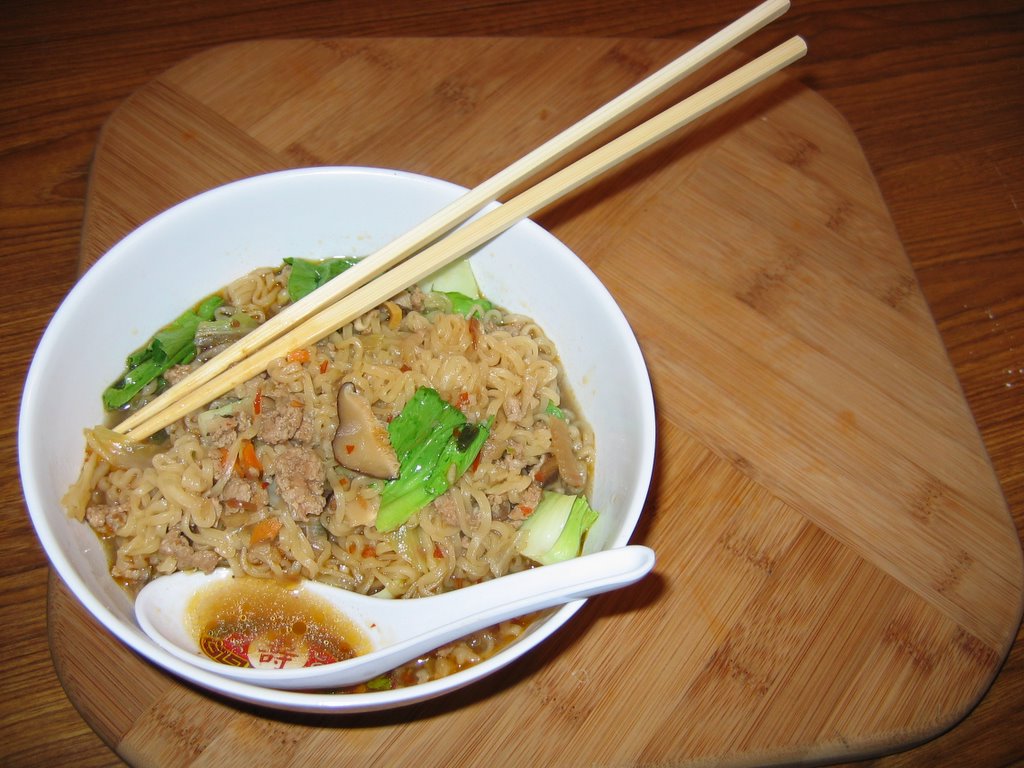
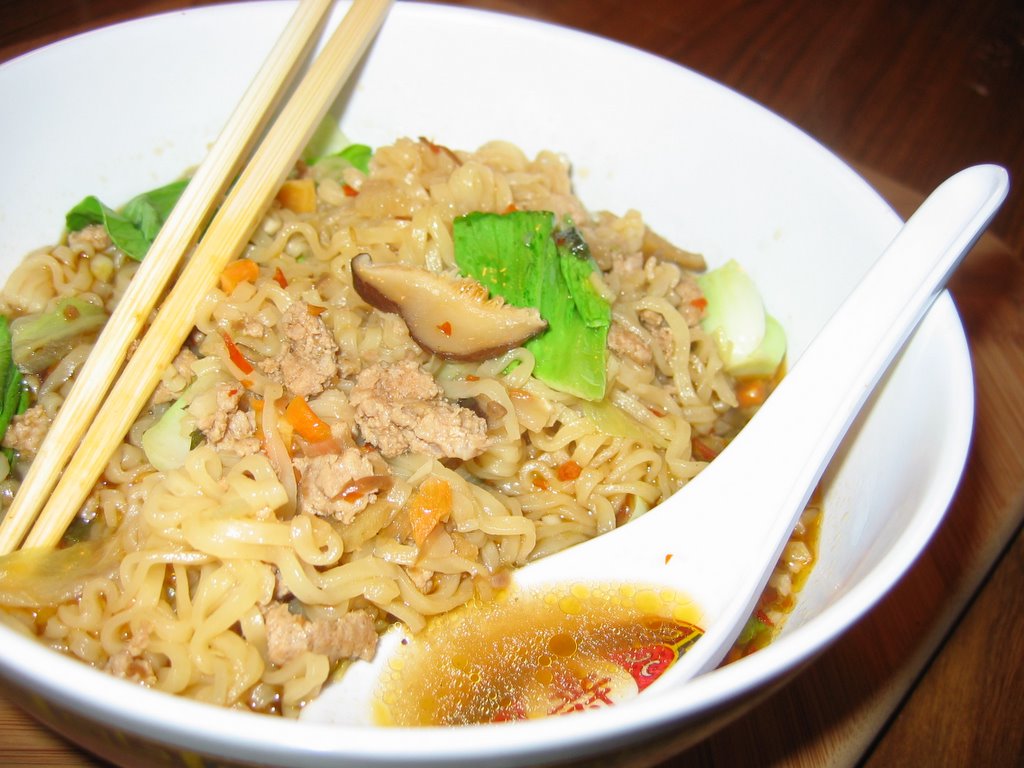
For example–tonight, I added to the cooking water chicken broth, leftover sauce from ja jiang mein which I had in the fridge, slivers of dried Chinese black mushrooms, a goodly slosh of Shaoxing wine and the two very lonely baby Shanghai bok choy which were not worth cooking on their own, and were thinking of wilting into a pathetic huddle at the bottom of the vegetable drawer.
A few slivers extra of garlic and ginger, and voila!
Within minutes, something hot, edible and with nutritive value appeared in a bowl and was gobbled up by the hungry girl who was too silly to cook the noodles on her own, even though I know she can do it herself–I have seen the proof of it with my own eyes.
But, in truth–I think she wanted me to do it.
It must taste better with a bit of Mom magic in it.
Weekend Cat Blogging: Happy Birthday Kiri!

All of my kitties were invited to Kiri’s Birthday Party at Eatstuff!
But look at them!

They are all lazy and slept in.
They didn’t put on party clothes, or bring presents or bake a cake!
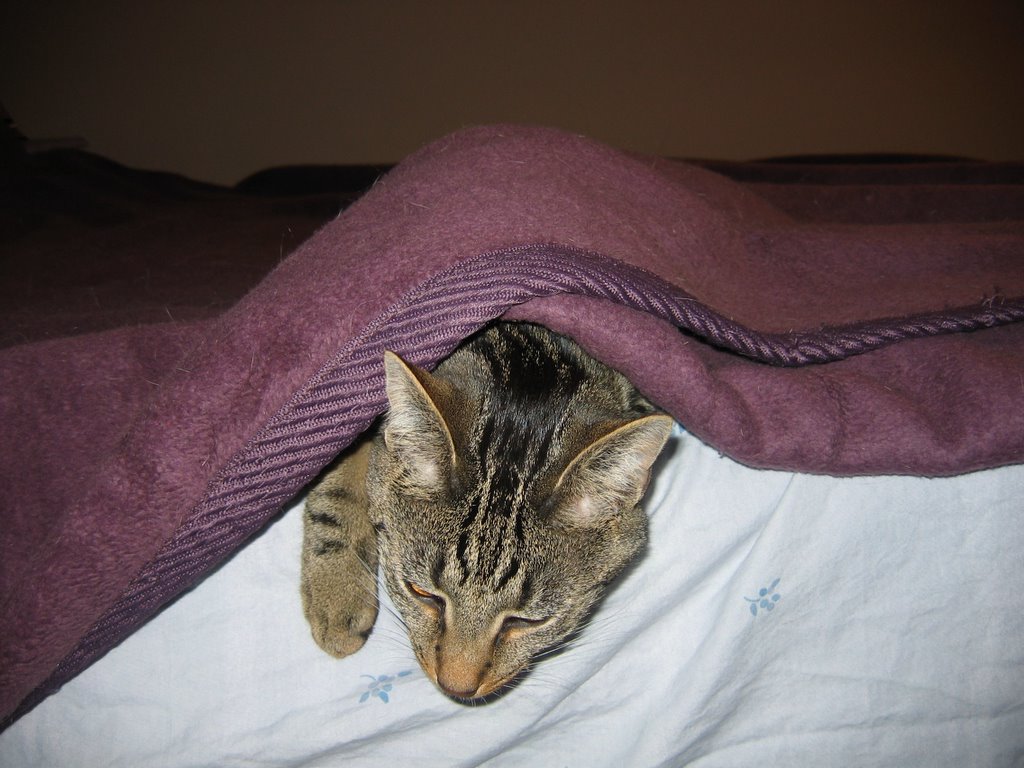
I have wicked, slothful kitties.
All they do is sleep.
.jpg)
And lounge around.
And nap.
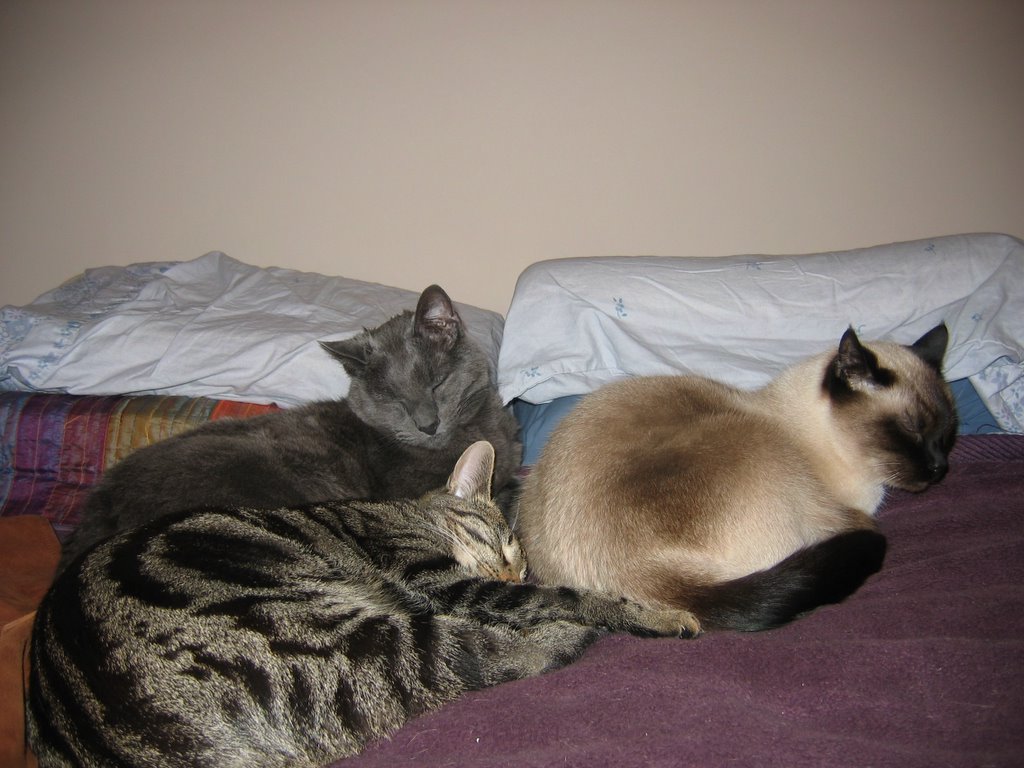
They are good at napping.
At least Grimalkin likes festivity. As you can see–she is under last year’s Christmas tree.

It was her favorite accessory.
At least one of our cats knows how to party.
Sort of.
Anyway–Happy Birthday, Kiri–you are a handsome boy, and I know that your Clare is proud!
The Kitchen Update: Lights, Walls and Infrastructure
 This is the second week of kitchen rennovation, and I thought I would post some photographs of the progress so far.
I know it doesn’t look like there has been much in the way of progress, but there has. For one thing, the walls, ceiling and floor are all intact, and the walls are ready for paint, tile and cabinetry.
My first excitement is the number of lights they installed in this kitchen. Look at all those can lights recessed into the ceiling. Look at that. Isn’t it beautiful? When we moved in, the only sources of light were the ugly fruit lamp which everyone universally hates, three cans over the sink, and the light under the microwave over the stove.
 All of you folks who read here who cook know that it is just not enough. Cooking in a dim room is like cooking in a cave; a dim kitchen is not ambiance, it is annoying.
Now, I have fourteen can lights installed, with undercabinet lights coming along when the cabinets are installed.
I need never fumble in the dark again.
I am ecstatic.
A lot of the improvements you cannot really see in these photographs–they happened under the drywall. They rewired everything, and apparently had a not too fun time doing it, considering the cursing that went on while they worked. But now we have plenty of juice coming in to power the stove (it is a dual fuel–gas cooktop, and four electric ovens below), the horrifyingly huge vent that the stove requires, the garbage disposal, which we did not have before, and all the other bells and whistles that the kitchen will possess. Next to that mop pictured above is where the stove will live and dominate the kitchen with its magnificent presence.
 What had been a gaping hole in the wall, exposing the guest room to scrutiny, is, as you can see to the left, now a niche into which bookshelves to hold most of the cookbook collection will go. The patch next to the door to the dining room there, where the glass fronted cabinet was hung, will have another glass-doored cabinet, and below it a cart with a butcher’s block top that can be wheeled away from there to be used as a kitchen island, or left in place to serve as a second prep area.
 The corner to the right is where a small desk area will be put, along with glass doored cabinets above, and drawers below. That is where the desktop will live, which will house, among other things, all of my recipes, so if I want one, I don’t have to print it out and waste paper in my office and carry it to the kitchen. I can call it up and read it from the screen. A telephone line is there as well, and look–lights above that don’t involve either the still extent ugly torchier or the hateful fruit lamp that tried to kill everyone who came near it.
 Finally, there is another view of the window area with the lights. I really like lights. They make me happy.
Here, I can tell you a bit more of the colors that the kitchen will have–the extent red tile floor is staying–it has streaks of black in it.
The window will have an exterior frame of moss green stained wood, with an interior frame painted a green so dark it registers as black. All of the appliances save the stove will be black–the hood will also be black enamel. A moss green shelf will go over the windows, and the walls behind the cabinets on the upper part of the room will be painted a paler moss green.
Below the cabinets, along the sink area and behind the stove will be tiled with a variagated tile that has reddish tones, green, moss, black and golden sandstone colors. The majority of the cabinetry is golden oak, and will have solid doors–about the color of the door to the dining room, and the floors throughout the house. The glass fronted cabinets on the other end of the kitchen where the desk and kitchen island will be are going to be the moss green stained oak.
The sink is undermounted beneath the quartz countertop which will be a warm color that incorporates flecks of green, the exact same red as the floor tile, gold and black veining. The sink is a single large black enamelled cast iron sink which is deep and wide enough to hold my stockpots and woks–no more balancing woks on two compartment sinks and scrubbing which sends water flying in all directions. Gah. None of that. The faucets will match the Arts and Crafts/Mission style bronze cabinet hardware, and are an antique-style bronze. They will be very pretty.
I will take more pictures as this takes shape, and might do an entire before/after thing when it is done.

Categories:
- Admin (rss) (55)
- Blogs and Blogging (rss) (81)
- Book Reviews: Cookbooks (rss) (43)
- Book Reviews: Non-Cookbook Food Books (rss) (38)
- Cats and Cat Blogging (rss) (47)
- Chinese Cooking Lessons (rss) (32)
- Culinary School Stories (rss) (18)
- Dairy Pruducts: Cultured and Barbaric (rss) (4)
- Documentary Filmmaking (rss) (1)
- Essays, Rants and Reflections (rss) (260)
- Fighting Hunger (rss) (12)
- Food and Kids (rss) (45)
- Food in the News (rss) (126)
- Food Media (rss) (98)
- Food Preservation (rss) (18)
- Food Safety (rss) (45)
- Gardening (rss) (30)
- Herbs and Herb Blogging (rss) (20)
- Holidays (rss) (50)
- Kat Blogging (rss) (22)
- Kitchen Science (rss) (36)
- Leftover Makeover (rss) (8)
- Life, the Universe and Everything (rss) (131)
- Local and Sustainable (rss) (227)
- Local Athens Food and Foodies (rss) (42)
- Meatless Mondays (rss) (32)
- Menu For Hope (rss) (5)
- Nutrition, Diet and Health (rss) (84)
- On The Farm (rss) (8)
- Recipes: Almost Vegetarian, Vegetarian and Vegan (rss) (294)
- Recipes: American Regional (rss) (37)
- Recipes: Appalachian Hillbilly (rss) (33)
- Recipes: Bread, Pasta, Grains (rss) (95)
- Recipes: Canning and Preserving (rss) (8)
- Recipes: Chinese (rss) (123)
- Recipes: Comfort Food (rss) (120)
- Recipes: Cookies (rss) (16)
- Recipes: Desserts (rss) (48)
- Recipes: French (rss) (25)
- Recipes: Fruits and Vegetables (rss) (302)
- Recipes: Greek, North African and Middle Eastern (rss) (31)
- Recipes: Indian (rss) (137)
- Recipes: Italian (rss) (42)
- Recipes: Japanese (rss) (7)
- Recipes: Jewish (rss) (4)
- Recipes: Korean (rss) (6)
- Recipes: Meat, Poultry and Fish (rss) (220)
- Recipes: Mexican/Native American/ Latin American/Caribb (rss) (27)
- Recipes: Original (rss) (108)
- Recipes: Thai (rss) (27)
- Recipes: Tofu (rss) (17)
- Recipes: US Regional (rss) (16)
- Recipes: Vietnamese (rss) (8)
- Restaurant Stories (rss) (28)
- Sewing, Quilting, Arts and Crafts (rss) (16)
- Simple Chinese Recipes (rss) (30)
- Slow Food and Heritage Foods (rss) (10)
- Spice Blogging (rss) (44)
- The Chinese Cookbook Project (rss) (14)
- The Chinese Pantry (rss) (39)
- The Documentary (rss) (2)
- The Kitchen Saga (rss) (17)
- The Locavore's Bookshelf (rss) (15)
- The Unsung Adventures of The Culinary Nerd (rss) (6)
- Tools and Toys (rss) (35)
- Uncategorized (rss) (10)
- With a Side of Politics (rss) (48)
Archives:
- August 2012 (9)
- July 2012 (12)
- September 2011 (3)
- August 2011 (7)
- July 2011 (8)
- June 2011 (16)
- May 2011 (17)
- April 2011 (11)
- December 2010 (9)
- November 2010 (5)
- February 2010 (1)
- December 2009 (5)
- November 2009 (7)
- October 2009 (10)
- September 2009 (16)
- August 2009 (14)
- July 2009 (14)
- June 2009 (7)
- May 2009 (17)
- April 2009 (10)
- March 2009 (25)
- February 2009 (13)
- January 2009 (10)
- December 2008 (5)
- November 2008 (5)
- October 2008 (6)
- September 2008 (13)
- August 2008 (8)
- July 2008 (11)
- June 2008 (18)
- May 2008 (13)
- April 2008 (14)
- March 2008 (16)
- February 2008 (17)
- January 2008 (19)
- December 2007 (25)
- November 2007 (18)
- October 2007 (24)
- September 2007 (16)
- August 2007 (15)
- July 2007 (15)
- June 2007 (10)
- May 2007 (14)
- April 2007 (16)
- March 2007 (17)
- February 2007 (20)
- January 2007 (13)
- November 2006 (1)
- October 2006 (8)
- September 2006 (14)
- August 2006 (25)
- July 2006 (30)
- June 2006 (28)
- May 2006 (34)
- April 2006 (29)
- March 2006 (24)
- February 2006 (30)
- January 2006 (38)
- December 2005 (40)
- November 2005 (37)
- October 2005 (32)
- September 2005 (25)
- August 2005 (30)
- July 2005 (28)
- June 2005 (21)
- May 2005 (8)
- April 2005 (22)
- March 2005 (17)
- February 2005 (29)
- January 2005 (10)
Search Site:
Links:
- Lily’s Wai Sek Hong
- 101 Cookbooks
- A cat in the kitchen
- A Veggie Venture
- Accidental Hedonist
- Cha Xiu Bao
- chez pim
- Chocolate & Zucchini
- Chopstick Cinema
- Chowhound.com
- Chubby Hubby
- Cook sister!
- Cooking with Amy
- da*xiang
- Eat Local Challenge
- Eating Liberally
- Ecocentric
- Eggbeater
- Epicurious
- Farmgirl Fare
- Fatfree Vegan
- Foodgoat
- ForkandBottle.com
- Green Olive Tree
- Hooked on Heat
- Jaden’s Steamy Kitchen
- Kalyn’s Kitchen
- Lucullian delights
- Mahanandi
- Matt Bites
- MeatHenge
- mmm-yoso!!!
- New York Times – Dining & Wine
- Pizza Goon
- Rasa Malaysia
- Ruhlman
- Sailu's Kitchen
- Serious Eats
- SF Gate: Food & Dining
- Simply Recipes
- Soul Fusion Kitchen
- Tastespotting
- The Amateur Gourmet
- The Cleaner Plate Club
- The Food Section
- The Grub Report
- thecookscottage
- U.S. Food Policy
- Wandering Chopsticks
- Washington Post Food and Dining
- Wasted Food
Meta:


Powered by WordPress. Graphics by Zak Kramer.
Design update by Daniel Trout.
Entries and comments feeds.