
Cook Local, Eat Global
And So, It Begins
 That’s a pretty dramatic opening, isn’t it?
Well, it is a pretty dramatic moment.
We are redoing our kitchen, and today, this very afternoon, the first tentative bangs and experimental crashes will begin on the destruction of the current edifices in place.
The only things in these photographs you see that will be the same by the time we are done are the windows and the tile floor, which we had installed before we moved in.
The rest will be gone, and made totally anew.
The cabinets are not very strong, and are not built according to what we need to store in them. We have heavy Fiestaware dishes (which are now currently taking up the upstairs kitchen that one day, hopefully quite soon, will become the Tigers and Strawberries Culinary Dojo) which have begun to cause the upper cabinets to sag away from the wall. This is not good. Therefore, we decided to go ahead and redo the kitchen sooner rather than later.
 The cabinets, countertop, sink and dishwasher are going to our good friends Dan and Heather who are hopefully buying a house this year and want to remodel their kitchen. As they have not managed to accumulate such estravagent amounts of culinary equipment over the years as I have, these cabinets will be perfect for them, and they will look so much nicer in their kitchen than the current older metal models.
Our new cabinets will be oak, done in moss glaze and honey-toned stain. Our first shipment of them comes in on October 7, so we are going to be cleaning out our garage in a frenzy this week.
The new stove will be ordered sometime in this coming week. It is a monster–a beautiful, amazing culinary machine–with one of its six burners capable of pouring out 20, 500BTUs of cooking power. A far cry from the wok stoves I have used professionally that are like volcanoes spewing 300, 000 BTU’s, but still–for a home range, that is the upper range of heat, and will make awesome stir fries full of wok hay.
 Some people say that if you love a woman, you give her pearls.
I say, if you love this woman, you give her BTU’s.
The current refrigerator is an older model Sub-Zero, which i do love, but which takes up huge amounts of space in the kitchen–space that could be better used for equipment storage.
We are replacing it with a more normal-sized counterdepth Kitchenaid, but we are keeping the Sub-Z–we are just going to put it over in the utility room and plug it in there. That way, when I do personal chef and catering work, or throw parties, I will have plenty of storage space for extra food.
The design is very pretty, and will very much maximize the space we have without being overly extravagent. We are also using the style of cabinets and colors to tie into the oak floors in the rest of our house and the Mission/Arts and Crafts/Asian styles we are using as the guiding principles of our decor.
 The main cabinet color–oak with honey spice stain–will call to mind the golden colors of the oak floors throughout the house. The moss-glazed pieces, British Racing Green stove, and green paint on the walls will call the green from the trees in the view out the window inside and carry over the theme of nature and earth into the room. The terra-cotta tile floor will be echoed in the tile backsplash behind the stove, and the speckles in the stone countertops. The drawer pulls and knobs will all be in copper, further extending the warm red tones of the tile, and we are going to go for a black sink, and black appliances (except for the stove) in order to echo the streaks of black that are in the tiles and the countertop. Black also will make the appliances other than the stove recede into the background, thus allowing the stove to take center stage.
As the destruction and construction take place, I will post further updates as they occur here–the trials and travails of having our kitchen redone should result in some amusing situations for all, I am certain.
Culinary Cross-Pollination
I know that I have spoken often about what a cultural mish-mash my own culinary background is. With one side of our family from Bavaria, Ireland and the Netherlands, and the other side a concatenation of British immigrants and Cherokee, with an influx of the Mediterranean, it is no wonder that my own formative experiences of food were varied enough to instill in me a never-ending curiosity and willingness to experiment in the kitchen.
This morning, after putting a final coat of paint on the door to my upstairs teaching kitchen (I was painting yesterday–hence–no post), I came downstairs to read the New York Times, and found this lovely article in the food section about kugel.
For those who are not familiar with kugel, it is a Jewish casserole that is from the Eastern European tradition, which is most often made with noodles or potatoes. It can be sweet and dairy-based, with creamy cheese, raisins and cinnamon, or it can be savory, with onions and black pepper. In kosher homes, it depends upon whether it is being served with a meat or milk meal–if it is a meat meal, then no dairy products are used in it; instead the kugel is bound with eggs. In non-kosher Jewish homes, however, dairy-based noodle kugels are often served at Rosh Hashana along with meat in a celebration of gustatory goodness that often includes matzoh ball soup, chopped chicken liver and smoked fish pate.
I first tasted kugel knowingly at my in-law’s home a couple of years ago at Rosh Hashana, and found it to be delightful–a lightly sweet, creamy noodle casserole or baked pudding that was intensely satisfying. However, I think that years and years before, during lunch at school, I had tasted some that a Jewish friend had brought in her lunchbox. She offered me a bite, and when I reacted favorably and asked what it was, she said, “It is just the way my Mom makes noodle casserole.”
The only noodle casseroles I had tasted before were the scary ones that involved tuna and canned cream of something or another soup, so I could really get behind the way Sally’s mother made noodle casserole. I wish she had told me it was kugel, though–then, I would have known what to order when I went into Jewish delis in later years.
What I found most interesting about the article, however, was the little fact that the legendary Mama Dip, the doyenne of southern soul food cookery, made several different kinds of kugel and served it to her family at holidays. Not only that, but she was going to include recipes for it in her new cookbook.
She had tasted kugel at interfaith suppers and so liked it that she asked how to make it. Then, she went home and started riffing off of it in her own kitchen, producing for her family a dish that no doubt will be passed down through the generations and become rooted in her grandchildren’s culture.
That is just beautiful to me.
We are very lucky to live in a free society that is made up of such a myriad of vibrant cultures and ethnicities, where people of different faiths and national origins can sit down and share meals together. When we eat dishes cooked from different cultures, we are sharing, viscerally, each other’s very selves, and in that way, bonds between people are created. The “us” and “them” mentality begins to vanish as we taste the product of each other’s work and ways of life. Boundaries are erased; differences become a joy of discovery, not a reason to mistrust.
At the table, we become one people.
“E pluribus unum.”
From many, one.
I am reminded of the Hungarian dishes that my Grandma whose family was a mixture of Germanic, Scots-Irish and Cherokee, used to make. She often served goulash and chicken paprikas at holiday dinners, along with the usual turkey, ham and roast duck or beef.
I remember asking her one time where she learned to make these dishes if no one in her family was of Hungarian descent.
She told me that during the war, there was a Hungarian immigrant family who had the farm next to Grandpa’s up in New York. And the husband worked in the munitions factories with Grandpa, and like Grandma and the kids, it was up to the mother and children to run the farm. She and Grandma, like many farm wives, met, and became friends. A morning or two a week, they would share coffee and cake after the children were on the schoolbus and the morning chores were done.
While they chatted, which was difficult at first, because the Hungarian lady didn’t know much English, they shared recipes. And the ones that Grandma liked best and remembered were for goulash and paprikas.
I asked Grandma what she taught her friend in return.
Yorkshire pudding and hot cross buns–two staples from British culinary tradition that had been taught to Grandma by her Welsh mother-in-law. Apparently, the Hungarian family loved those dishes and they entered their own family traditions, the way goulash and paprikas became part of our food traditions.
And so it goes–culinary cross-pollination. Cultures meet at the table, and bits of tradition go skipping off into other families; flavors born of distant lands weaving their way into the the lives and memories of those who once had been strangers, but now are friends and brothers.
It is yet another illustration of my central philosophy–food is love made manifest, and the more that we share it with one another, the more understanding and gentleness there will be in the world.
Peace is created at the table.
I feel very priviledged to live in a time and a place where sharing of food from different cultures can happen so easily; in an open society like the United States, we are very lucky to have neighbors from across the globe. In welcoming them and embracing them as our own, we are strengthening ourselves, our country and all of mankind.
We are truly becoming, from many tribes, one people.
Teaching Tarka
 My daughter, Morganna, is taking a class called “World Foods,” which is not surprising, because she aspires to follow in my footsteps and go into culinary arts as a career. The class, as near as I can tell, is a way to get kids to take Home Economics and learn about other cultures at the same time. It is a pretty hip and happenin’ kind of concept–you teach an important life skill–cooking–with emphasis on food safety and measurements and all those important things, while keeping kids interested by teaching them about the foods and cultures from around the world.
Anyway, each student in the class picks a country and then does a final research project on the cuisines of that country. They have to write a paper on the culture and cuisines, with emphasis on the history of the cuisine, how it developed, the holidays celebrated in that country and what foods are eaten on those holidays. They have to do an oral presentation as well, and cook a representative recipe from the country which everyone in the class gets to sample.
Morganna chose India, and so she has been reading my Indian cookbooks, and we started working together on teaching her about the spices and cooking traditions of the various regions.
Yesterday, I taught her the important technique of making a tarka, which is also spelled tadka.
A tarka is vegetable oil or ghee (butter which is clarified–in the clarification process, the milk solids are allowed to brown, imparting to the clarified butter a distinctive nutty aroma and flavor) which has been flavored with spices and aromatics, and which is poured, hot, into a dish. It is most often used in raitas and dals (raita is a yogurt-based relish dish; dal is a legume dish–both are staples in many Indian regional cuisines), but I have seen it used to flavor chicken recipes as well. As we all know, many spices and aromatic substances have constituents which are oil-soluable, and so not only does the fat add its own flavor and richness into whatever dish into which it is stirred, it also imparts incredible fragrance from the spices bathed within it.
 I think of tarka in a lot of ways as an Indian version of the Cajun roux–of course roux is primarily a thickening agent, but in the country cookery of the Cajuns it is a fat-based flavoring agent which adds depth and richness to every dish in which it is used. Unlike the Cajun recipes, however, which start out with the direction, “Well, first, you make a roux,” tarka is made at the last minute, right before the dish is served.
The operation of making a tarka is simple.
In a frying pan or wok, you melt a quantity of ghee or heat vegetable oil. Or, you can mix them. Not surprisingly, I prefer ghee, though I will admit that I generally mix it with vegetable oil in order to lower the amount of saturated fat in the recipe.
Then, you add onions, if you are using them, and cook them until they are golden brown. At that point, you may add whatever other aromatics, such as garlic, chiles and ginger, and whole spices. You continue cooking, stirring the entire time, until the onions are a deep reddish brown and smell quite nutty.
At that point, you simply scrape the contents of the pan into the pot where your other dish is cooking or waiting, and stir, then serve it forth.
It is a very simple way to create an extremely flavorful dal, and depending on what spices or aromatics you use, you can change the taste infinitely. For some dals, I use only mustard seed and whole cumin. For others, I might add fennel seed or ajwan. Most of the time, I use the onions, but sometimes I prefer to use only ginger. I always use chiles, but others never do.
Here is a very simple recipe for masoor dal–those are the pretty red-orange split, skinned lentils–that gets most of its flavor from tarka. I used to cook this one for my Pakistani clients all the time, and would change around the vegetables I added to the lentils. They enjoyed the variety and surprise of seeing which vegetables I used, but they always insisted that I use the same tarka, because they liked it so much.
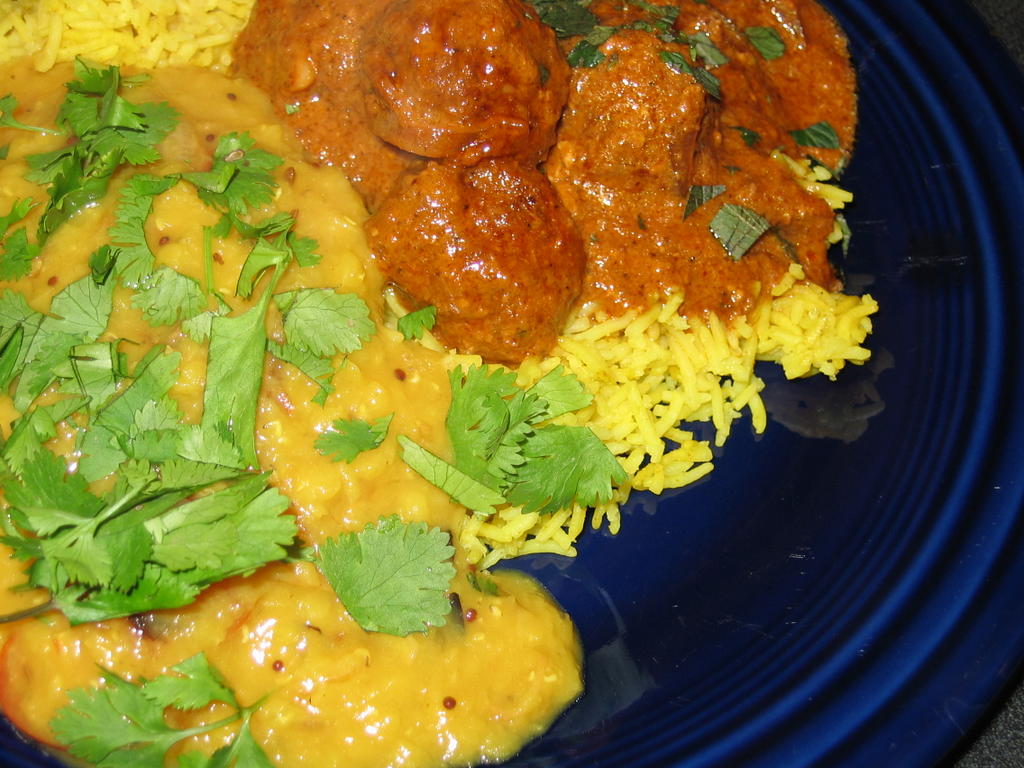 Masoor Dal Tarka with Tomatoes
Ingredients:
1 1/2 cups masoor dal, picked over and rinsed
water (or vegetable broth) to cover lentils
generous pinch asafoetida
salt to taste
1 cup very ripe cherry tomatoes, halved
1/4 cup ghee or vegetable oil or a combination of the two
1 large yellow onion, sliced very thinly
1-3 chile peppers (I used very ripe and hot jalapenos) thinly sliced
1″ cube fresh ginger, cut into fine julienne
4-6 cloves garlic, thinly sliced
1 tablespoon mustard seeds
1/2 tablespoon cumin seeds
handful roughly chopped cilantro
Method:
In a large saucepan, put masoor dal and enough water or vegetable broth to cover it by about three inches. Bring to a boil, turn down and simmer, uncovered. Add pinch of asafoetida and simmer until the lentils are cooked and the water has mostly boiled away. You should be left with a thick, moderately liquid yellow puree.
Add salt to taste. Stir in the tomatoes, and keep the lentils warm.
In a wok or frying pan, melt ghee over medium high heat. When it is hot, add onions, and cook, stirring, until they turn a nice golden brown. At this point, add the chiles, ginger, garlic and spices, and cook, stirring constantly, until the onions are reddish brown and the mustard seeds start to sizzle and pop. (Yes, they pop–kind of like miniature popcorn kernels.)
At this point, stir the tarka into the dal, and serve immediately, garnished with cilantro.
Notes:
Asafoetida is a spice traditionally used in the cooking of legumes in India. It is a resin, and to some, it has a foul odor. I find it to be pleasantly pungent, however, and do not see why others might be offended. It smells rather like browned onions in oil, and is, in fact, used by the Brahmin caste to flavor thier foods in lieu of garlic and onions, two foods which they feel ignite the baser passions of the body, and are thus not pure. I am not a Brahmin, so I use all asafoetida, onions and garlic, which may be overkill, but it sure does taste good.
Instead of, or in addition to tomatoes, you can use string beans, eggplant, mushrooms or summer squash. If you use summer squash, you can add it to the tarka, thinly sliced and browned to a deep color–this adds further flavor to the dish. Or, you can use shredded greens or spinach instead.
Vegetable broth adds a lot of flavor to this dish in a subtle way. Chicken broth is also good, and in fact, I used to add browned cubes of chicken to the dish to make a one-dish lunch for my client while I worked on other meals. She used to put basmati rice in the cooker, and then made me sit down and have lunch with her while curries simmered away on every burner of her stove, and casseroles and meatloaf baked in the oven. It really did make a very nice lunch, though I think I had as much fun with her company as I did with the food.
Herbs de Provence
 I don’t tend to use a lot of different spice blends; I tend to make my own, particularly when it comes to Indian, Mexican, Chinese and Thai foods.
But, sometimes I pick something up at Penzey’s because I like the smell of it, or it seems appealing in some way, or I end up getting it free with an order.
Herbs de Provence is one of those blends I picked up because I liked the way it smelled.
And because I do very little French style cookery, I was somewhat slow in using up the tiny jar I had of it.
Which is a shame, because it really is a nice blend of the sorts of herbs which are often used in southern French cookery: marjoram, summer savory, rosemary, thyme, fennel seeds, basil and lavender. It is full of fragrance that brings to mind fields of sunwarmed flowers–it smells green and golden, all at the same time.
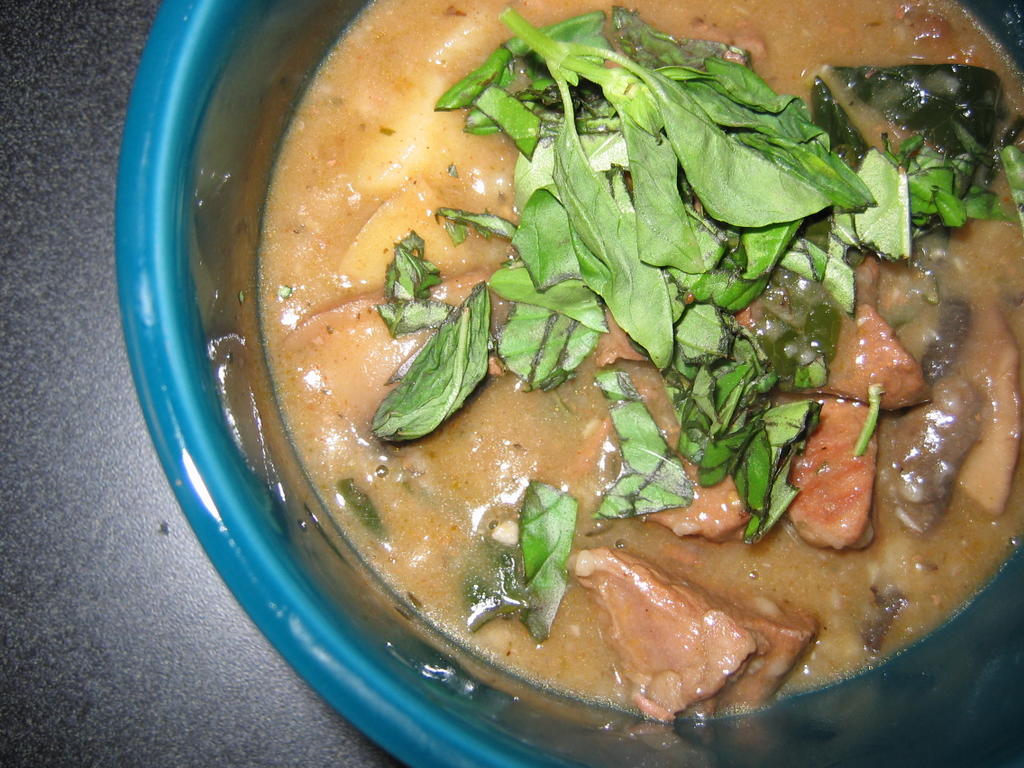
I made up for my underutilization of the herbs de Provence jar last week when Zak’s Dad and Grandpa were visiting; Grandpa cannot eat very spicy foods, so I took it upon myself to cook in a more European fashion than I generally do. I had two packages of lamb stew meat in the freezer, and pulled them out, determining to make a nice lamb stew.
Since our friend Kendra had mentioned coming to visit and she is allergic to onions, I determined to use elephant garlic, which looks like garlic, but is milder and is very closely related to leeks, and garlic as the main aromatic flavoring components. I had the last of a bottle of dry red wine, and on a whim, I pulled out the nearly empty jar of Herbs de Provence along with tarragon, celery seed, lavender, basil and half-sweet Hungarian paprika. From the garden, I brought fresh rosemary, basil and thyme.
I discovered that the combination of tarragon and lamb is absolutely heavenly–and a little dried tarragon goes a long way. It reinforced the fennel seed in the herbs mixture, and it helped boost the similar licorice-like flavor of the fresh basil. Its very green freshness really cut through the rich lamb broth and meat.
I also discovered that using thyme, rosemary and lavender together accentuates the similar flavors in those three herbs–that tangy, medicinal quality that I find to be so haunting. The dry red wine synergized with those herbs and the black pepper I added in copious amounts to the dish, and added a complex layer of fragrance to the broth.
No one missed the onions.
It really was a simply made dish: I browned the lamb in olive oil in my stewpot, and then added the minced up elephant garlic and garlic. As the alliums began to turn golden, I added the first round of dried herbs: Herbs de Provence, lavender, tarragon, basil and celery seed. As the color of the garlic deepened toward brown, I deglazed the pot with about a cup and a half of the dry red wine, and then added minced fresh thyme and rosemary (about a tablespoon of each) and the paprika and black pepper. After most of the alcohol boiled away, I added some chicken and vegetable broths and half-covered the pot, turned the heat down and allowed it to simmer and reduce for a couple of hours. Before I walked away, I threw in a couple of big handfuls of mixed sliced mushrooms–shiitake, portabello and white mushrooms, mostly, to simmer in the stew.
When the meat was fork tender, I added red and white baby potatoes that I scrubbed and cut into quarters and baby carrots, and allowed them to cook until the potatoes were meltingly soft and the carrots still had the tiniest bit of a crunch to them.
At which point, I made a roux from flour and olive oil, allowed it to brown slightly and thickened the broth with that, and roughly chopped a large handful of fresh basil leaves and blossoms.
After thickening it, I added about twelve leaves of lacinato kale, which I cut into thick ribbons, and allowed them to wilt into the stew.
I served the stew with a generous garnish of the fresh basil, and it really punched up the flavor; the stew was by turns tender and sweet, rich and dark and full of mysterious, flowery-herbal fragrance.
I will have to make it again–and this time, pay enough attention to how much of what I put in so I can write the recipe down more properly, as both Zak and his Dad said I had to make it again.
Next time, though, I think I will add some baby turnips to the vegetable mixture. Their sweetness will really go well with the fresh basil.
More Food, More News
 Chinese Food Gets Hyphenated
Everyone loves Chinese food, and now that sophisticated diners have gobbled their way through the regions of that vast country and had their fill of Cantonese, Sichuan, Hunan and Shanghaiese foods, folks are prowling, chopsticks at the ready, looking for something new.
And that something new is Chinese food with a hyphen.
Second-generation restaurants from within the Chinese diaspora are opening up in New York City which feature dishes influenced by the cuisines where immigrant Chinese settled and adapted thier cookery to local ingredients and flavors. Chinese-Indian restaurants feature chicken drumette lollipops fried pakora style; Chinese-West Indies restaurants star lo mein with spicy jerk chicken.
These cuisines all developed in the same way that Chinese-American food developed: when Chinese men, most of them not professional cooks, immigrated from Guangdong in the 19th century, they improvised Chinese style foods out of local ingredients.
It just so happens that a lot of these hyphenated hybrid dishes seem to have come from more fertile culinary traditions than the rather stale cookery of the 19th century US, so you end up with foods that sound more hip, more spicy and more interesting.
Hmmm.
Seems like a trip up to New York may be in my future. That jerk-chicken lo mein business sounds pretty darned good. (But before I go there, I really should head out to LA, where my brother in law tells me the best Chinese food–including Muslim Chinese food–in the world lives. He has promised me an eating tour of amazing LA Chinese eateries.)
More Schools Improve Lunch
The trend on presenting locally grown, vegetable-heavy menus in schools seems to be growing. In order to combat poor dietary choices that are leading to rising rates of obesity among youngsters, more elementary schools are lining up to get behind the ideals presented by chefs Alice Waters and Ann Cooper in the US and Jamie Oliver in the UK.
The Promise Acadamy, a small elementary school in Harlem, has changed the lunch menu from tater tots and burgers to swiss chard and whole wheat pasta, and the kids are liking it. The school is also offering cooking classes for kids and parents and a makeshift farmer’s market where parents can purchase fresh produce items that their kids have been eating at school.
Sustainable Table reports on schools in California, Washington, and Wisconsin which are beginning to feature healthier, locally grown menu items at lunch.
Good Nutrition Helps Promote Good Behavior?
This is the conclusion that a few researchers are coming to as they track the eating habits of troubled young people and prison inmates and note positive changes in behavior after nutrition is improved.
Any parent who has seen the effect sugar laden snacks and drinks have on placid kids, turning them into screaming wee beasties, should not be surprised.
And anyone who knows anything about brain chemistry and how many nutrients it takes to run the human brain (that big organ sucks up a great deal of our daily caloric intake to keep it running right) shouldn’t be surrpised, either.
Reports on such behavoral changes should lend support to the movement to help improve the foods served in typical American public schools. It shouldn’t be only about feeding as many kids as possible as cheaply as possible. The system should not serve the economics–the economics should serve the system.
It should be about feeding as many kids as well as possible, economically.
Besides, if these researchers are right–we could save a lot of money in law enforcement and prison facilities, if we just saw to feeding people well in the first place.
New Cattle Feed Rules to be Added by FDA
Y’all just knew I couldn’t do some food in the news without saying something about BSE. And well, since every time I check out BSE on Google News, there is at least some item listed, I feel justified in continuing my coverage.
Apparently, the FDA has gotten enough flack from the media and the public for their lackadaisical approach to curbing the possible spread of BSE to sluggishly move toward implimenting rules which closely follow the more stringent Canadian and European cattle feed regulations.
All I have to say about this is–what took you guys so bloody long? Geez.

Categories:
- Admin (rss) (55)
- Blogs and Blogging (rss) (81)
- Book Reviews: Cookbooks (rss) (43)
- Book Reviews: Non-Cookbook Food Books (rss) (38)
- Cats and Cat Blogging (rss) (47)
- Chinese Cooking Lessons (rss) (32)
- Culinary School Stories (rss) (18)
- Dairy Pruducts: Cultured and Barbaric (rss) (4)
- Documentary Filmmaking (rss) (1)
- Essays, Rants and Reflections (rss) (260)
- Fighting Hunger (rss) (12)
- Food and Kids (rss) (45)
- Food in the News (rss) (126)
- Food Media (rss) (98)
- Food Preservation (rss) (18)
- Food Safety (rss) (45)
- Gardening (rss) (30)
- Herbs and Herb Blogging (rss) (20)
- Holidays (rss) (50)
- Kat Blogging (rss) (22)
- Kitchen Science (rss) (36)
- Leftover Makeover (rss) (8)
- Life, the Universe and Everything (rss) (131)
- Local and Sustainable (rss) (227)
- Local Athens Food and Foodies (rss) (42)
- Meatless Mondays (rss) (32)
- Menu For Hope (rss) (5)
- Nutrition, Diet and Health (rss) (84)
- On The Farm (rss) (8)
- Recipes: Almost Vegetarian, Vegetarian and Vegan (rss) (294)
- Recipes: American Regional (rss) (37)
- Recipes: Appalachian Hillbilly (rss) (33)
- Recipes: Bread, Pasta, Grains (rss) (95)
- Recipes: Canning and Preserving (rss) (8)
- Recipes: Chinese (rss) (123)
- Recipes: Comfort Food (rss) (120)
- Recipes: Cookies (rss) (16)
- Recipes: Desserts (rss) (48)
- Recipes: French (rss) (25)
- Recipes: Fruits and Vegetables (rss) (302)
- Recipes: Greek, North African and Middle Eastern (rss) (31)
- Recipes: Indian (rss) (137)
- Recipes: Italian (rss) (42)
- Recipes: Japanese (rss) (7)
- Recipes: Jewish (rss) (4)
- Recipes: Korean (rss) (6)
- Recipes: Meat, Poultry and Fish (rss) (220)
- Recipes: Mexican/Native American/ Latin American/Caribb (rss) (27)
- Recipes: Original (rss) (108)
- Recipes: Thai (rss) (27)
- Recipes: Tofu (rss) (17)
- Recipes: US Regional (rss) (16)
- Recipes: Vietnamese (rss) (8)
- Restaurant Stories (rss) (28)
- Sewing, Quilting, Arts and Crafts (rss) (16)
- Simple Chinese Recipes (rss) (30)
- Slow Food and Heritage Foods (rss) (10)
- Spice Blogging (rss) (44)
- The Chinese Cookbook Project (rss) (14)
- The Chinese Pantry (rss) (39)
- The Documentary (rss) (2)
- The Kitchen Saga (rss) (17)
- The Locavore's Bookshelf (rss) (15)
- The Unsung Adventures of The Culinary Nerd (rss) (6)
- Tools and Toys (rss) (35)
- Uncategorized (rss) (10)
- With a Side of Politics (rss) (48)
Archives:
- August 2012 (9)
- July 2012 (12)
- September 2011 (3)
- August 2011 (7)
- July 2011 (8)
- June 2011 (16)
- May 2011 (17)
- April 2011 (11)
- December 2010 (9)
- November 2010 (5)
- February 2010 (1)
- December 2009 (5)
- November 2009 (7)
- October 2009 (10)
- September 2009 (16)
- August 2009 (14)
- July 2009 (14)
- June 2009 (7)
- May 2009 (17)
- April 2009 (10)
- March 2009 (25)
- February 2009 (13)
- January 2009 (10)
- December 2008 (5)
- November 2008 (5)
- October 2008 (6)
- September 2008 (13)
- August 2008 (8)
- July 2008 (11)
- June 2008 (18)
- May 2008 (13)
- April 2008 (14)
- March 2008 (16)
- February 2008 (17)
- January 2008 (19)
- December 2007 (25)
- November 2007 (18)
- October 2007 (24)
- September 2007 (16)
- August 2007 (15)
- July 2007 (15)
- June 2007 (10)
- May 2007 (14)
- April 2007 (16)
- March 2007 (17)
- February 2007 (20)
- January 2007 (13)
- November 2006 (1)
- October 2006 (8)
- September 2006 (14)
- August 2006 (25)
- July 2006 (30)
- June 2006 (28)
- May 2006 (34)
- April 2006 (29)
- March 2006 (24)
- February 2006 (30)
- January 2006 (38)
- December 2005 (40)
- November 2005 (37)
- October 2005 (32)
- September 2005 (25)
- August 2005 (30)
- July 2005 (28)
- June 2005 (21)
- May 2005 (8)
- April 2005 (22)
- March 2005 (17)
- February 2005 (29)
- January 2005 (10)
Search Site:
Links:
- Lily’s Wai Sek Hong
- 101 Cookbooks
- A cat in the kitchen
- A Veggie Venture
- Accidental Hedonist
- Cha Xiu Bao
- chez pim
- Chocolate & Zucchini
- Chopstick Cinema
- Chowhound.com
- Chubby Hubby
- Cook sister!
- Cooking with Amy
- da*xiang
- Eat Local Challenge
- Eating Liberally
- Ecocentric
- Eggbeater
- Epicurious
- Farmgirl Fare
- Fatfree Vegan
- Foodgoat
- ForkandBottle.com
- Green Olive Tree
- Hooked on Heat
- Jaden’s Steamy Kitchen
- Kalyn’s Kitchen
- Lucullian delights
- Mahanandi
- Matt Bites
- MeatHenge
- mmm-yoso!!!
- New York Times – Dining & Wine
- Pizza Goon
- Rasa Malaysia
- Ruhlman
- Sailu's Kitchen
- Serious Eats
- SF Gate: Food & Dining
- Simply Recipes
- Soul Fusion Kitchen
- Tastespotting
- The Amateur Gourmet
- The Cleaner Plate Club
- The Food Section
- The Grub Report
- thecookscottage
- U.S. Food Policy
- Wandering Chopsticks
- Washington Post Food and Dining
- Wasted Food
Meta:


Powered by WordPress. Graphics by Zak Kramer.
Design update by Daniel Trout.
Entries and comments feeds.