
Cook Local, Eat Global
Summer is a comin’ in

Summertime, and desserts are easy: Strawberry Rose ice cream with more strawberries on top. Homemade, low sugar and simple, that is, if you have an ice cream maker.
Okay, I know that technically, it isn’t summer yet. Summer doesn’t start until after the summer solstice, which is coming up in a couple of weeks or so.
But when it is ninety degrees out and the ground is dry from lack of rain, my body says it is summer.
And when it is summer, and it is hot outside, the last thing most normal people want to do is bake something for dessert.
My answer–invest in an ice cream maker, make ice cream and let people think you are the best and brightest genius on the block.
And since it is that time of year–make strawberry ice cream!
As you can see from the following illustrations, the process is pretty simple, with the bonus that it does not heat up the house.

You start with fresh, ripe berries, hopefully locally grown. Rinse them and let them drain completely, or dry them gently with paper towels.

Cut them up into small pieces (they do not have to look pretty), and sprinkle with sugar to taste (I used a couple of tablespoons) and allow to macerate until a lot of juice has been released.

Add rosewater and lemon juice to taste.
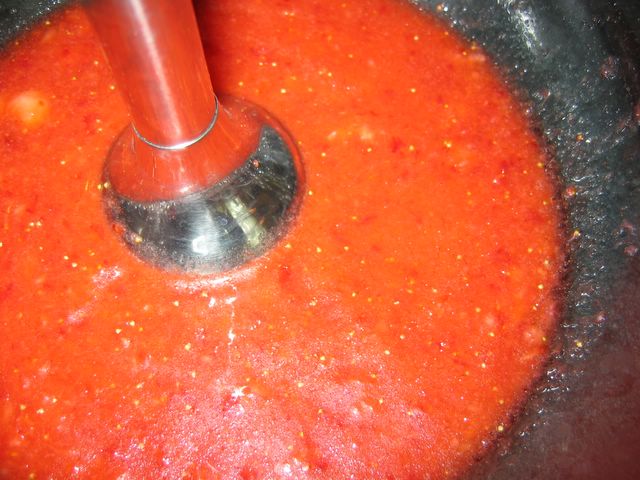
Puree two thirds of the berries; I like to use an immersion blender for this step.

Add dairy products with the immersion blender–here I used heavy cream and sour cream. Be careful not to introduce too much air into the mixture by keeping the active part of the blender completely submerged. After the dairy products are mixed in, you can stir the reserved one third of the berry mixture into the ice cream base, or do what I did and leave it out to use as a topping.
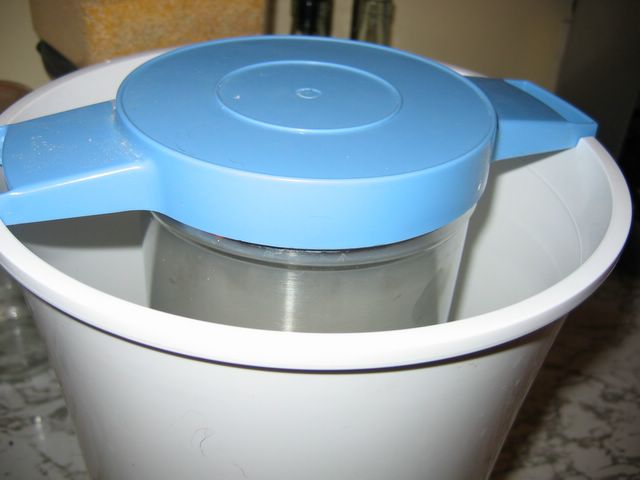
After you have the dairy products mixed in, you pour it into the ice cream maker’s mixing chamber, and then follow the manufacturer’s instructions.
As you can see, my ice cream maker is an electric version of the old fashioned hand-cranked kind that uses layers of crushed ice and salt in the plastic outer chamber. The inner chamber is metal and conducts the cold temperature from the ice into the ice cream mix. The motor is on the base, and the dasher, which churns the ice cream, is attached to the blue lid, and connects to the base through a piece in the metal chamber. The motor turns the dasher, and the dasher circulates the ice cream mixture, in order to evenly freeze it. The action of the dasher also incorporates some air into the mixture, which lightens the product, and the continual mixing prevents the formation of large ice crystals.
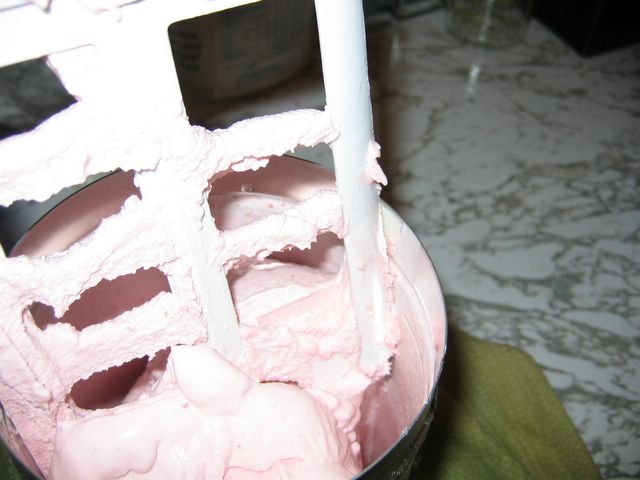
My ice cream maker’s motor stops as soon as the ice cream is finished freezing. At this point, I unplug the motor, lift out the freezing chamber, pull off the lid and pull out the dasher. The ice cream is the texture of soft serve ice cream at this point, and while you can eat it now, I like to pack it into a plastic container and seal it then put it into the freezer for a while to harden.
Here is the exact recipe I used to make the ice cream pictured above:
Strawberry Rose Ice Cream
Ingredients:
1 quart fresh, ripe strawberries at room temperature
3 tablespoons sugar
rosewater to taste
fresh lemon juice to taste
2 cups sour cream
1 cup heavy cream
Method:
Follow the instructions as pictured above! You can use more sugar if you like, but I prefer to use less sugar in the ice cream and serve it with a sweeter topping, like the reserved 1/3 of a quart of berries.
Mad About Mulberries

Here is what mulberries look like up close and personal.
Moving into a house is a voyage of discovery. Living in a thirty-something odd year old house for the first couple of months is like an archeological dig–you are always finding things. Stuff you didn’t know was there, and there is a surprise around every corner. You never know what you will find.
That is exciting. It is like two or three months or so of Christmas, especially when it comes to inheriting someone else’s yard and garden. Gifts just pop up out of the ground in a most delightful fashion every day.
Or they fall out of the sky and plonk one on the head.
That is how I discovered the mulberries.
I was walking down the driveway to cross the road and get the mail when something dropped out of a tree and plopped on top of my head.
I thought that I might have been hit by a fly-by dropping, but no, it rolled and then plunked onto the pavement right in front of my toes, then rolled down the slight incline. I watched it and saw that it was a reddish-purple berry and that many of its brethren had been squashed upon our driveway. Purple splotches stained the entire bottom half of the driveway. I picked up the wee fruit and blinked.
A mulberry.
I looked up, and saw a fruit-laden branch arching gracefully over the drive, just a foot or two above my head, toothy leaves dancing in the breeze.
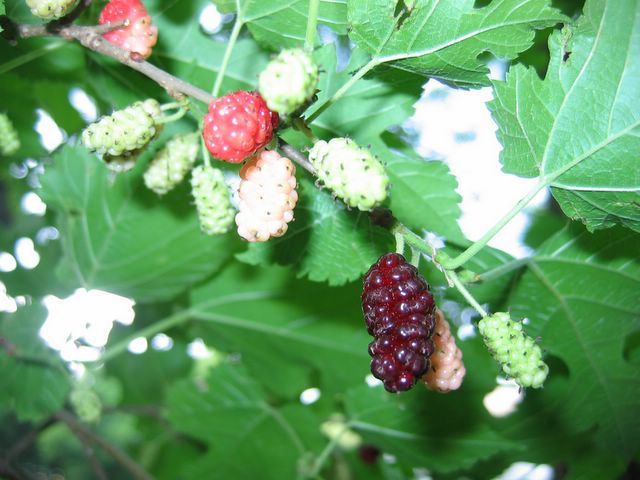
Surprise! I have a mulberry tree in my yard!
Further up the tree, a female cardinal was dining on the berries. She saw me looking up at her and flew away.
“Mulberries!” I did a little jig of happiness and reached up and picked a couple of them. The deep purple, almost black fully ripe ones were quite sweet, almost to the point of being insipid, but the reddish ones that were the exact color of the crayon entitled, “mulberry” in the old 64 box of Crayolas I grew up with were tart and sweet and firm and juicy. I picked a small handful and boogied inside to share them with Zak.
In the meantime, I forgot about the mail, but really, who gives a damned for bills and credit card offers when you have mulberries?
Zak obediently opened his mouth when I commanded and chewed the dark purple berry I popped in thoughtfully. “Kinda overly sweet,” he commented. He opened his mouth to say something else, and I tossed in one of the slightly underripe ones. He bit into it and his eyes flew open as the tartness played tag with his tastebuds.
“That,” he said as he swallowed, “Is more like it.”
I gave him the last one I had and smiled as he ate it.
“So, what are you going to do with them?” he asked.
What, indeed.
I had no bloody idea.
But, of course, one does not refuse a gift so gladly given by Mother Nature as a mulberry tree right there in the front yard at the end of your driveway. So, I had to do something.
But what?
I really didn’t want to go clambering up the tree in order to pick enough to make a tart or a pie; for one thing, my tree clambering skills are a bit on the nonexistant side these days, what with being creaky in the knees and whatnot. So, sweets were out. Salad was a possiblity, but I didn’t want salad.
What I wanted to cook and what I had planned to cook was Chinese food. Something to do with pork sirloin chops (from Bluescreek Farm, of course) that I had thawed, with some Shanghai bok choi and maybe some carrots. That was what I was planning on.
And says I to myself, “You know, they grow mulberries in China, don’t they?”
And a light went on in my head and I decided to do a sweet pork recipe with mulberries.
A quick search online showed that it likely wasn’t a traditional Cantonese practice to put some mulberries in a pork stir-fry, but that has never stopped me before. I did read, however, that mulberries were used as a liver tonic in traditional Chinese food cures, and that was good enough for me to give it a go.
So, I grabbed a bowl and went out and filled it with mulberries. I picked most of them off the two branches that I could reach, and some unblemished ones off the ground.
It seems that in the American South, farmers used to let hogs forage off of mulberries in the woods. It was a “harvest free” crop, because you just let the trees drop them, and the hogs wander along and gobble them up. It makes the pig’s meat apparently sweet and tender. Since there were no hogs about to eat up the berries, I took their place, and picked some up.
Chickens apparently like them, too, which stands to reason; I noticed as I was picking that there were nuthatches, titmice and cardinals all flitting up in the higher branches, eating berries with great merriment. Birds are very into mulberries, so I left lots of fruit on the ground for the doves and grackles and other ground-feeding avians.
So, I dashed inside and rinsed them, and plucked off the thread-like stems, which meant I stained my fingers with the lovely reddish purple juice, then fell to cutting and slicing while the rice cooker burbled in the corner, billowing forth periodic clouds of jasmine-rice scented steam.
Here is how I made the dish:
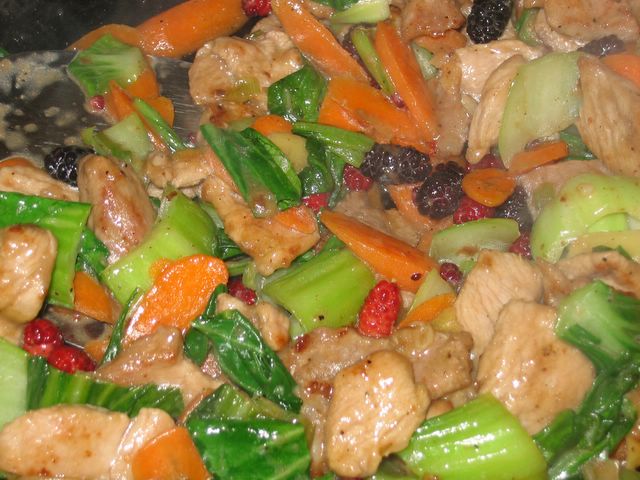
Mulberry Pork, just off the stove, still filled with wok hay–the essence or breath of the wok. I preferred the underripe berries in this dish–when I make it again, I will use only the sourer red ones.
Mulberry Pork
Ingredients:
1 pound lean pork, thinly sliced into strips about 1″ long and 1/2″ wide
2 tablespoons Shao Hsing wine
1/2 teaspoon thin soy sauce
2 tablespoons cornstarch
3 tablespoons peanut oil for stir frying
3 garlic cloves, peeled and thinly sliced
1 1/2″ chunk fresh ginger, peeled and thinly sliced
3 scallions, white part thinly sliced
freshly ground black pepper to taste
1 cup carrots peeled and sliced on the bias
1/2 cups Shanghai bok choi, trimmed and cut into 1″ slices
1/4 teaspoon salt
1/2 teaspoon sugar
1/4 cup chicken broth
1 tablespoon rice vinegar (optional–if you use mostly half-ripe mulberries, you won’t need it)
1 cup rinsed, stemmed mulberries
Method:
Toss pork with wine and soy sauce and cornstarch. Allow to marinate at room temperature for twenty minutes or so while you cut vegetables.
Heat wok until smoking on high heat. Add oil and allow to heat thirty seconds more, or until oil shimmers from convection. Add garlic, ginger and scallions, and stir and fry for about forty-five seconds to a minute, until very fragrant and golden. Add a few grindings of black pepper.
Add pork, arrange so it is all in one layer on the bottom of wok, and let sit and brown for about thirty-five to forty seconds. (If there is liquid standing in the marinating bowl, reserve it for later in the cooking process.) Stir fry vigorously until most of the outside is no longer pink. Add carrots and stir fry about a minute.
Add bok choi, and stir-fry until it begins to brighten in color and wilt ever so slightly. Add salt, sugar, broth and vinegar, and stir fry until liquid thickens into a sauce that clings to everything.
Add mulberries, and stir and fry for about forty five seconds more.
Serve with steamed rice and green tea with jasmine.
It turned out well, but I wish that I would have had some fresh water chestnuts to add to it. The crunch and sweetness would have been superb.
All in all, I think it was successful.
Next year, when I know that there will be mulberries, I think that I will attempt a mulberry sorbet. Maybe I can talk someone who is more adept at tree climbing than I am to take a basket up in their teeth and fetch us down enough berries to do something along those lines. That could be fun!
Breast is Best
Okay, I just read something that got me het up enough to get political in my food blog again. It is about the conflicting messages that nursing mothers are given when it comes to feeding their babies.
I got up this morning early to send a fax to my mother, and so, while the fax machine was whirring away, I sat down with tea and decided to read the New York Times online, and a headline catches my eye: “‘Lactivists’ Taking Their Cause, and Their Babies, to the Streets.”
The American College of Pediatrics urges all women to breastfeed their babies, because as we should all know by now, breastmilk is the best food for all human babies to have for the first year of their lives. Their bodies are made to digest it, mother’s bodies are made to make it–it seems to be a simple, logical process to decide to breastfeed one’s own child. And, according to this article, it is becoming an overwhelming choice for a majority of mothers: apparently, 70% of new mothers are nursing their babies at least for the first few weeks of life, which is a huge jump from the nearly 0% who were breastfeeding their kids thirty-nine years ago when I was born and the 50% of women doing so in 1990. (I am proud to say that I was one of those 50%.)
This is great! This is good news, not only from my perspective as a chef, and a woman interested in public nutrition, but from my perspective as a mother. I am glad to see more women getting the message that breastmilk is the single best food for infants and not only is nutritionally superior to both dairy and soy-based formulas, but also confers greater immune system strength to the child, through the influence of the mother’s immune system. No formula can do that, and the result is healthier babies who would require much less medical intervention.
The American College of Pediatrics estimates that if all women followed their guidelines and exclusively breastfed for the first six months of life and then continued to breastfeed in addition to supplementing with solid foods for six more months, health care costs for sick infants would be reduced by 3.6 billion dollars per year.
Doesn’t that sound good? Don’t we all want our babies to be healthy? Don’t we want every baby to be healthy, happy and well-fed?
Apparently not.
While 70% of new mothers are breastfeeding upon leaving the hospital, only 36% are still breastfeeding at six months, and 17% at twelve months. Only 14% are exclusively breastfeeding at 6 months.
Houston, we have a problem.
What is happening here? Why are few mothers able to stick with breast feeding, even when they know conclusively that it is the best nutritional choice they can make for their babies?
It isn’t a lack of knowledge or experience out there; in 1990, when I was breast-feeding my daughter, I was one of the lucky women who had female relatives who had breast-fed and could help me figure out how to do it effectively. My grandmother and mother-in-law both had experience breast feeding and could teach me how to go about it; contrary to popular belief, breast-feeding is not an instinctive skill among we higher primates. Gorillas, chimps and humans all learn to feed our babies by watching others go about it. (When a captive gorilla in a zoo kept having trouble feeding her babies, the zoo administrators found a lactating human mother to sit outside the enclosure and feed and care for her infant where the gorilla could observe her. When the gorilla had her next baby, she fed it like a pro.)
Most other women who were breast-feeding at that time, however, were hard-pressed to get good information. Few doctors and nurses were trained in the mechanics of human lactation, and while there were chapters of La Leche League in larger cities, it was difficult to find any books on the subject, save for a few copies of their Womanly Art of Breastfeeding, which while supportive, wasn’t that technically useful.
Today, there is a plethora of titles available to teach the techniques of breastfeeding to the increasing number of new mothers who want the best for their babies. A survey of some of the best include Bestfeeding, The Ultimate Breastfeeding Book of Answers and The Breastfeeding Book.
In addition to books, most hospitals have lactation consultants available on staff to answer questions and support new mothers in learning how to nurse their babies effectively. In addition, there is simply a larger pool of peers available who have breastfed or are breastfeeding, and there are support groups for lactating women in big cities, small towns and rural communties across the nation. And of course, there is the Internet, which is teeming with information and support on the subject of breastfeeding.
So, obviously, it isn’t a lack of information or medical support that is causing this drop-off in mothers who breastfeed. What is happening?
According to research by the FDA cited in the New York Times article, one of the greatest barriers to women continuing to breastfeed thier infants is the degree of embarrassment women feel about nursing. This factor was found to have more influence over women’s decision over whether or not to breastfeed than household income, maternity leave or employment status.
Women feel icky about it, in large part, because women are made to feel icky about our bodies in general, but our breasts in specific.
Why?
Because breasts, particularly in the United States, have been sexuallized to the point that women feel weird using them for thier primary function, which is feeding their babies.
And even if a woman herself doesn’t feel strange about putting her baby to her breast, there are plenty of Americans who will feel weird about it if they see her doing it, and will go out of their way to make her feel ashamed of doing the right thing for her baby. Women have been asked to go to the bathroom to feed their babies when they are in public places, because other people are uncomfortable watching them.
This is a ludicrous situation. Do you eat while sitting on a toilet? I didn’t think so. So why should a baby be sent to a room where defecation and urination happens, which are less than sanitary activities, in order to eat?
The answer, my friends is this: they shouldn’t.
And apparently, new mothers are tired of these mixed messages, and have taken to the streets over it, organizing “Nurse-ins” across the country in order to bring awareness to the fact that they are doing nothing wrong, dirty, shameful or disgusting and that there is no reason that they and their babies should be hidden away in their homes or a bathroom stall just because other people are made uncomfortable by the sight of babies eating in the way that nature intends them to.
In response, six states have passed legislation which require that women be allowed to nurse their babies in public without being harrassed or intimidated. Other states are following suit, while many corporations such as Starbucks and Burger King are making policy changes which allow nursing on premises without being asked to leave.
Perhaps, by 2010, Americans will have grown up enough to deal with the “horrifying” sight of women feeding babies that the Surgeon General’s Goal for Healthy People might be met wherein 75% of mothers nurse their babies at hospital discharge, 50% are still nursing at six months, and 25% are still nursing after a year.
Until then, let us all stand up for nursing mothers and babies and give them emotional support and positive reinforcement. If you see a mother being harrassed, stand up for her, and tell the harrasser to look away if the sight of a baby being fed bothers them so much. Write to your elected officials and tell them what you think about the issue. And if you have a baby of your own, breastfeed him or her for as long as you can, and if you need help learning how, ask for it without shame or embarrassment.
It takes a village to raise a child–and sometimes, it takes a village to help feed that child, too.
Cookbooks!

A small portion of my cookbook library, including most of the Asian cookbooks.
And so, Steph over at Da*xiang tapped me with this meme about cookbooks that seems to be floating about the food blogosphere, and like the good sport that I am, I decided to answer the questions, and in fact, even post a picture so folks could have visual proof about how obsessed I really am!
So, here goes nothing:
1. Total number of (cook) books I’ve owned:
Are you ready? Are you sure? Do you really want an answer to this question? Positive?
Okay, here goes. Sit down and take a deep breath, in through the nose, and let it out, slowly through the mouth.
Currently, at this moment, I own 403 books on subjects related to food. These include cookbooks, reference books, textbooks, and non-fiction books with essays on the subject of food and cookery. There are books on the history of food, nutritiuon, and books on all aspects of food preparation including preservation, brewery, fermentation, cheesemaking and winemaking. There are rare, out of print tomes and oddities of historical value, along with reprints of historically significant works.
In the recent past, that number probably was closer to 450 books. Just before moving, I weeded out the books I decided were not useful to me. Let us just say that Half-Price Books is my friend and ally.
Since I collect cookbooks on Chinese cuisine in English, particularly rare titles, those of historical significance and those which are out of print, the total number of cookbooks I own is constantly going up, not down.
I did not count any of the several file boxes worth of back issues of Fine Cooking Magazine, Cook’s Illustrated, Eating Well Magazine, Chocolatier, Vegetarian Times, Chile Pepper Magazine or any other magazines having to do with food. I have no idea how many of those I own.
Here is a photograph of one of the bookshelves of my books, showing most of my collection of Chinese and other Asian cookbooks.
Last (cook) book I bought:
I am giving two answers here, one for an out of print/used cookbook and one for a cookbook that I bought new.
The out of print book I most recently aquired would be Classic Deem Sum: Recipes from Yang Sing Restaurant, San Francisco by Henry Chan, Yukiko Haydock and Bob Haydock, published by Holt, Rinehart and Winston in 1985. The photographs and recipes for dim sum in this book are excellent, and I am amazed to see how much lard is mentioned as going into these delectable snacks. More recent books on the subject tend to downplay the role of lard in making dim sum specialities which are moist, rich and delicious.
The most recently purchased new cookbook would be one I just ordered from Amazon yesterday: American Farmstead Cheese: The Complete Guide to Making and Selling Artisan Cheeses by Paul Kindell et al. As I have not read it yet, I cannot really comment upon it, but I do hope it gives good instruction for making cheese as I want to try my hand at it.
Last (food) book I read:
I take it this means last non-cookbook food book I have read. That would be Best Food Writing 2004 edited by Holy Hughes. I enjoyed this book greatly, even if the editor decided she needed to take a cheap shot in her introduction at all the food bloggers who write not for money, but for the sheer joy of it. I particularly enjoyed Paul Bertolli’s essay, “Cooking is Always Trouble,” John Thorne’s “Conflicted About Casseroles.”
Five (cook) books that mean a lot to me:
Allright, here there will be two answers as well. I will give answers for cookbooks, and then books about food that are not cookbooks, but relate to cooking in some way. These are not in order of importance, rather, they are listed chronologically–in the order in which I encountered them.
The Cookbooks:
Mediterranean Cooking by Paula Wolfert–This was the first cookbook I ever bought for myself, (I was thirteen) and it introduced me to the wonderous world of fruity olive oil, tart lemons, ripe Roma tomatoes, anchovies and lots and lots of garlic. For a girl who grew up on hearty, but not overly seasoned farm fare and Appalachian cookery, this book was a key to an entirely different realm of flavors. Wolfert’s evocative prose led me towards the ideal of seeing food not only as bodily sustainence, but as a transmitter of human culture. The original book is out of print; Wolfert came out with a revised edition in 1994 which replaces many of the richer recipes with more low-fat versions that represent the “healthier” cooking styles of the region.
I prefer the original text, but then, I am biased being that it is my very first cookbook.
Alice’s Restaurant Cookbook by Alice May Brock–Yes, it is a cookbook written by that famous Alice from that famous song by Arlo Guthrie. I came across it when I first went to college back in the fall of 1983, in the stacks of the library at Marshall University. I checked the book out and kept it checked out for months. It became a touchstone for me, not because Alice’s recipes were so good, but because I loved the way she wrote and her philosophy of the kitchen, which is essentially this: cooking is love on a plate, and should be fun and playful as well as taste good. My favorite quote from the book, which is the entire text of chapter ten, which is entitled “Foreign Cookery,” is this:
“Don’t be intimidated by foreign cookery. Tomatoes and oregano make it Italian; wine and tarragon make it French. Sour cream makes it Russian; lemon and cinnamon make it Greek. Soy sauce makes it Chinese; garlic makes it good. Now you are an International Cook.”
Alice gave me the guts to just jump in and cook, even if I thought I didn’t know what I was doing. She taught me that sometimes bravado is more important than knowledge, and I am happy to have since found out that none other than Julia Child agreed with her. Though it is out of print, I am happy to say that you can pretty easily find copies of this book on Amazon used for a not too high price. Included in the back on a floppy bit of vinyl, is a recorded introduction by Arlo; mine has the little “record” intact, but I have never listened to it, being as I don’t have an old-fashioned turntable with a needle anymore.
An Invitation to Indian Cooking by Madhur Jaffrey–I first encountered this book at the public library in Huntington, West Virginia, and even though I had never tasted Indian food in my life, reading this book helped me get up the gumption to cook it anyway. The first dish I cooked following Madhur’s instructions was rogan gosht. I had no idea if I did it right, being as I had never tasted the dish in my life, but the result tasted fine to me, and my friends all ate it up with great glee and gusto, so I guessed that I did it right. Later on, I bought my own copy of it, and have cooked many dishes from its pages with great success. This one is still in print, with its orginal text intact.
It Rains Fishes: Legends, Traditions and the Joys of Thai Cooking by Kasma Loha-Unchit–I have lots of Thai cookbooks, and this is my favorite. Many have more recipes, but none of them capture the culture of Thai’s cooking traditions the way Kasma does. Illustrated with charming watercolor paintings, the text not only describes in full detail how to cook authentically Thai foods, it places these foods within their cultural context through the use of mythology, personal stories and folklore. The writing is very clear, but also poetically rendered, such that I imagine that Kasma is standing next to me, telling these stories as we cook together in a kitchen filled with the floral scent of lime leaves, the sharp pungency of shrimp paste and the sweet aroma of freshly grated coconut.
Land of Plenty by Fuchsia Dunlop–I have praised this book more than once in my blog, but I have to do it one more time. Fuchsia transcribed the flavors I held close in memory of Huy’s kitchen, and put them down in words that I could follow. Between her clear instruction and my memory for flavors, I have been able to recreate dishes that I often only tasted once at Huy’s table, and this is a gift beyond price to me. The dishes he cooked for us after hours–those are the essence to comfort for me now, because he did this for me at a time when I felt as if I was alone in all the world. I don’t know if he will ever understand how important that was to me then, but it was. And this book makes all of those memories come to life and dance on my tongue again.
Non-Cookbook Food Books
Larousse Gastronomique edited by Jenifer Harvey Lang–This should come as no surprise. It should also come as no surprise that I read about it in childhood, terribly distraught that I could not find a copy of it in West Virginia. I read copies of this encyclopedia of the culinary arts in college, however, in the reference section of the library, and later, right before going to culinary school, I bought my very own copy and read it cover to cover in a week. Yes, a week. Yes, I read fast. Yes, I am obsessed.
On Food and Cooking by Harold McGee–This book I read years before culinary school, when I first lived in Athens, Ohio. I had gone back to college to finish my degree, and found it in the cookbook section and proceeded to keep it checked out for a couple of months while I read it cover to cover two or three times. When I found a copy of it in a bookstore, I snatched it up. I recently replaced that dogeared copy with the new revised edition that just came out last year. This book completely explains the science behind cookery has probably been the most influential food book upon my psyche ever–even more so than Larousse. My cooking improved drastically once I began to grasp the physics and chemistry that are the basis of all culinary expression. Understanding these processes has also made me a better cooking teacher. I owe a lot to McGee.
Why We Eat What We Eat by Raymond Sokolov–This book is in part, a history describing the impact of the discovery of the foods of the New World had upon the cuisines of the earth. Sokolov’s thesis is that every cuisine around the globe was fundamentally changed with the discovery of the foodstuffs of the New World, and that once the culinary borrowing and trading back and forth between cultures on either side of the Atlantic began, the foods we recognize in our modern world began to develop. Chile peppers, potatoes, tomatoes, pumpkins and various squash, turkeys, wild rice, and cranberries are just some of the foods he discusses in this book that happened to get me into a spot of trouble in culinary school when I contradicted a chef who was trying to tell the class that potatoes were native to Ireland.
Of course, they are not–they are native to Peru, which I already happened to know, but it was fresh on my mind, because I had been in the midst of reading this book. To make a long story short–the chef did apologize to me the next day and he praised me for correcting him, though he apparently lost face in front of a few other chefs in the process. Ooops.
Perfection Salad and Something from the Oven by Laura Shapiro–These books are social histories on the subjects of food and women in the United States. The first book tells what could be an irritatingly boring story of the development of home economics as a profession and the rise of nutrition as an academic subject from the latter part of the nineteenth century through the middle of the twentieth. The second book picks up the tale in the 1950’s and shows how the rising status of women and technological advances in home appliances and food marketing began a revolution at the dinner table.
Both books are so well researched that they should be dry, dull and pedantic, but because Shapiro is such a facile and engaging writer, they read less like a textbook and more like a novel. They are full of characters, personalities and wit, unlike most social histories, and are not to be missed.
Which 5 people would you most like to see fill this out in their blog?
Dagmar at A Cat in the Kitchen
Alan at The Impetuous Epicure
Zarah Maria at Food and Thoughts
And Foodgoat and Ladygoat at Food Goat
Tag, folks, you’re it!
Sweet Seasonal Shoots
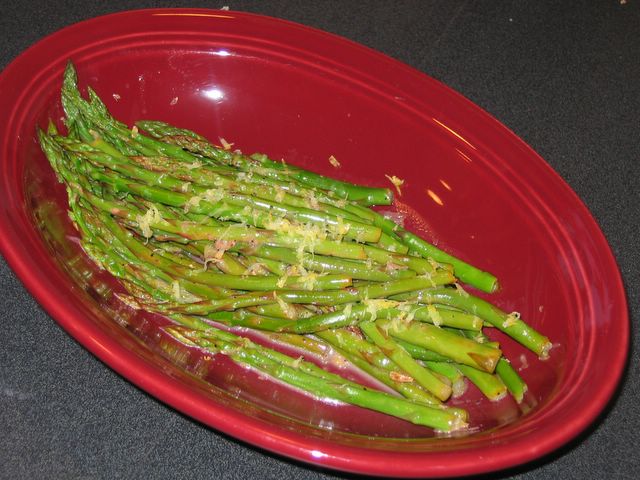
Best simply dressed: asparagus with a bit of butter, lemon juice, lemon zest and pepper is a seasonal treat.
Speaking of eating locally and in season, let’s talk about asparagus.
It is one of those foods that, when it is in season, I will gorge on. I am the same way with strawberries (as if you hadn’t noticed, since the last three photographs on this blog had strawberries featured in them), tomatoes and blackberries. So long as they are glutting the garden, I will be a glutton for them, eating them as often as three meals a day if I can get away with it.
Zak has become the same way with asparagus as I am; however, things were not always thus with us. He used to swear he hated asparagus.Then again, he barely ate green things at all, so it probably wasn’t what one could call an aversion to asparagus itself: he was just prejudiced against chlorophyll.
All of that changed a couple of years ago when I finally convinced him that he wanted to try asparagus. I had cooked it as I usually do: simmered in a tiny bit of water until barely tender, then drained and dressed with a tiny bit of melted butter, some lemon juice and salt, with a sprinkling of black pepper and lemon zest.
He tasted the first shoot, nipping it with much trepidation and hesitation from my fork. His eyes widened in surprise and he declared, “Hey, that’s pretty good.”
He then proceeded to eat half of what I had cooked for myself.
Which was allright, as I went right out the next day and bought two pounds more. And we ate all of it for dinner.
And that is what we do. When it is in season, especially when we can get it locally grown, we buy about two or three pounds of it at a time and eat it at least twice a week. By the time we start getting tired of it, it is no longer in season, and all that is left are the tough, mealy things imported from “somewhere else,” and we can move on to whichever new seasonal obsession is upon us.
Inevitably, when we eat large quantities of asparagus, the topic of urine comes up in conversation. This is not only because the two of us have the same sick sense of humor as a pair of twelve year olds who were raised watching “Beavis and Butthead” for twelve hours a day, but because it is a scientific fact that eating asparagus makes your pee smell funny.
It has to do with some sort of sulfur compound that is present in the asparagus along with healthy doses of folic acid, potassium, thiamin, fiber, and vitamins B6, A and C. There hasn’t been a ton of research on the subject, probably because there is no money in figuring out which harmless chemical in asparagus makes one’s urine smell objectionable (have you ever known anyone’s pee to smell good–I mean, really), and it isn’t exactly a burning question that needs answered. I’d much rather have organic chemists worrying about the effects of pesticides on human and animal neurology or something useful like that, than figuring out why asparagus tastes good but makes something go awry in the urinary tract.
But be that as it may, back to asparagus itself.
It is a member of the lily family, along with garlic, onions and leeks, and unlike most vegetable plants, is a perennial. One plants the crowns, or roots, in a specially prepared bed, and then mulches them and feeds and waters them for three years without harvesting a single shoot. Not one. Nope. None. Growing asparagus requires patience and willpower. Even more so than strawberries–you only have to wait a year to harvest them the first time. So anyone who grows asparagus gets tortured by having to watch lovely green shoots erupt from the soil, and climb toward the sky, then turn into a cloud of glorious lacy ferns without ever tasting one for three whole years.
That is the bad part of growing asparagus.
The good part is that once you plant a bed of it, and you let it establish a tidy mat of vigorous roots under those ferns for three years, you can harvest shoots by the tens of pounds for the next fifteen years. Yeah, that is right. If you can restrain yourself for three years, you get payoff for at least fifteen years. I say at least, because I know of some folks who have had the same patch of asparagus going for over twenty years.
That is pretty darned cool, in my book. Which is why, after we terrace our steeply inclined backyard into servicable garden space, I intend to plant an asparagus patch. I’m just going to interplant it with the flowers and decorative shrubbery–the ferns are quite lovely, and it is a well-established tradition in cottage gardening to mix together ornamental and edible plants. Besides, I like putting surprises in gardens, and what can be more surprising than walking along, admiring the water feature, then bending down and snapping off an asparagus stalk and munching it?
I find that asparagus is best cooked simply, and quickly. I know that the new fad for cooking it is roasting it, but I haven’t had good luck with it. So, generally, I simmer it in a tiny bit of salted water until it is barely tender, then either boil off the water or drain it. I melt butter in the pan, squeeze in lemon or lime juice, and sprinkle it with the zest of whichever citrus fruit I juiced, and give it a few good turns of the peppermill. I have been known to add lightly crushed pink peppercorns to the standard mixture, not only because they look quite pretty against the brilliant emerald stalks, but because the sweet flavor of them complements the asparagus quite well. A pinch of dried dill is nice as well, if you have some. Chive blossoms are nice, too, though Zak objects to them, as he isn’t enamored of the onion flavor.
There is a debate over whether the pencil-thin asparagus shoots are better or the finger-thick spears are superior. I think it depends on which texture you like and how much you enjoy peeling the bottom third of the stalk.
I prefer the tiny spears, because all you have to do is snap off a bit of the bottom end, and voila! They are ready to cook or eat out of hand. With the thicker spears, you have to either snap off a significant portion of the bottom because of toughness, or you have to snap off a smaller amount and peel the bottom third or so of the stalk.
That is a pain in the rear end, and I dislike doing it. And even peeled, I think that the rest of the more mature, larger asparagus is somewhat tough and stringy. It still tastes springtime fresh, but the texture is off. I tend to stick with the tiny asparagus for using in salads or cooking simply, and will sometimes use the thicker stuff to make cream of asparagus soup.
I make it sound like I am picky. That really isn’t the case. I will eat just about any fresh asparagus that I can get, and will do what I must to cook it properly.
We are about a third of the way through asparagus season around here, so we have probably several more weeks to gobble down countless pounds of the wee green shoots. As the supply dwindles, our appetites will probably be close to satiated; our palates will tire of the delicate green flavor sparked with the tang of lemon and smoothed with the velvet caress of butter, and will want for something new.
That is, until next spring, when once again, we will pounce upon any fresh asparagus we see and eat it until we feel as if we will burst in a glorious explosion of springtime goodness.

Categories:
- Admin (rss) (55)
- Blogs and Blogging (rss) (81)
- Book Reviews: Cookbooks (rss) (43)
- Book Reviews: Non-Cookbook Food Books (rss) (38)
- Cats and Cat Blogging (rss) (47)
- Chinese Cooking Lessons (rss) (32)
- Culinary School Stories (rss) (18)
- Dairy Pruducts: Cultured and Barbaric (rss) (4)
- Documentary Filmmaking (rss) (1)
- Essays, Rants and Reflections (rss) (260)
- Fighting Hunger (rss) (12)
- Food and Kids (rss) (45)
- Food in the News (rss) (126)
- Food Media (rss) (98)
- Food Preservation (rss) (18)
- Food Safety (rss) (45)
- Gardening (rss) (30)
- Herbs and Herb Blogging (rss) (20)
- Holidays (rss) (50)
- Kat Blogging (rss) (22)
- Kitchen Science (rss) (36)
- Leftover Makeover (rss) (8)
- Life, the Universe and Everything (rss) (131)
- Local and Sustainable (rss) (227)
- Local Athens Food and Foodies (rss) (42)
- Meatless Mondays (rss) (32)
- Menu For Hope (rss) (5)
- Nutrition, Diet and Health (rss) (84)
- On The Farm (rss) (8)
- Recipes: Almost Vegetarian, Vegetarian and Vegan (rss) (294)
- Recipes: American Regional (rss) (37)
- Recipes: Appalachian Hillbilly (rss) (33)
- Recipes: Bread, Pasta, Grains (rss) (95)
- Recipes: Canning and Preserving (rss) (8)
- Recipes: Chinese (rss) (123)
- Recipes: Comfort Food (rss) (120)
- Recipes: Cookies (rss) (16)
- Recipes: Desserts (rss) (48)
- Recipes: French (rss) (25)
- Recipes: Fruits and Vegetables (rss) (302)
- Recipes: Greek, North African and Middle Eastern (rss) (31)
- Recipes: Indian (rss) (137)
- Recipes: Italian (rss) (42)
- Recipes: Japanese (rss) (7)
- Recipes: Jewish (rss) (4)
- Recipes: Korean (rss) (6)
- Recipes: Meat, Poultry and Fish (rss) (220)
- Recipes: Mexican/Native American/ Latin American/Caribb (rss) (27)
- Recipes: Original (rss) (108)
- Recipes: Thai (rss) (27)
- Recipes: Tofu (rss) (17)
- Recipes: US Regional (rss) (16)
- Recipes: Vietnamese (rss) (8)
- Restaurant Stories (rss) (28)
- Sewing, Quilting, Arts and Crafts (rss) (16)
- Simple Chinese Recipes (rss) (30)
- Slow Food and Heritage Foods (rss) (10)
- Spice Blogging (rss) (44)
- The Chinese Cookbook Project (rss) (14)
- The Chinese Pantry (rss) (39)
- The Documentary (rss) (2)
- The Kitchen Saga (rss) (17)
- The Locavore's Bookshelf (rss) (15)
- The Unsung Adventures of The Culinary Nerd (rss) (6)
- Tools and Toys (rss) (35)
- Uncategorized (rss) (10)
- With a Side of Politics (rss) (48)
Archives:
- August 2012 (9)
- July 2012 (12)
- September 2011 (3)
- August 2011 (7)
- July 2011 (8)
- June 2011 (16)
- May 2011 (17)
- April 2011 (11)
- December 2010 (9)
- November 2010 (5)
- February 2010 (1)
- December 2009 (5)
- November 2009 (7)
- October 2009 (10)
- September 2009 (16)
- August 2009 (14)
- July 2009 (14)
- June 2009 (7)
- May 2009 (17)
- April 2009 (10)
- March 2009 (25)
- February 2009 (13)
- January 2009 (10)
- December 2008 (5)
- November 2008 (5)
- October 2008 (6)
- September 2008 (13)
- August 2008 (8)
- July 2008 (11)
- June 2008 (18)
- May 2008 (13)
- April 2008 (14)
- March 2008 (16)
- February 2008 (17)
- January 2008 (19)
- December 2007 (25)
- November 2007 (18)
- October 2007 (24)
- September 2007 (16)
- August 2007 (15)
- July 2007 (15)
- June 2007 (10)
- May 2007 (14)
- April 2007 (16)
- March 2007 (17)
- February 2007 (20)
- January 2007 (13)
- November 2006 (1)
- October 2006 (8)
- September 2006 (14)
- August 2006 (25)
- July 2006 (30)
- June 2006 (28)
- May 2006 (34)
- April 2006 (29)
- March 2006 (24)
- February 2006 (30)
- January 2006 (38)
- December 2005 (40)
- November 2005 (37)
- October 2005 (32)
- September 2005 (25)
- August 2005 (30)
- July 2005 (28)
- June 2005 (21)
- May 2005 (8)
- April 2005 (22)
- March 2005 (17)
- February 2005 (29)
- January 2005 (10)
Search Site:
Links:
- Lily’s Wai Sek Hong
- 101 Cookbooks
- A cat in the kitchen
- A Veggie Venture
- Accidental Hedonist
- Cha Xiu Bao
- chez pim
- Chocolate & Zucchini
- Chopstick Cinema
- Chowhound.com
- Chubby Hubby
- Cook sister!
- Cooking with Amy
- da*xiang
- Eat Local Challenge
- Eating Liberally
- Ecocentric
- Eggbeater
- Epicurious
- Farmgirl Fare
- Fatfree Vegan
- Foodgoat
- ForkandBottle.com
- Green Olive Tree
- Hooked on Heat
- Jaden’s Steamy Kitchen
- Kalyn’s Kitchen
- Lucullian delights
- Mahanandi
- Matt Bites
- MeatHenge
- mmm-yoso!!!
- New York Times – Dining & Wine
- Pizza Goon
- Rasa Malaysia
- Ruhlman
- Sailu's Kitchen
- Serious Eats
- SF Gate: Food & Dining
- Simply Recipes
- Soul Fusion Kitchen
- Tastespotting
- The Amateur Gourmet
- The Cleaner Plate Club
- The Food Section
- The Grub Report
- thecookscottage
- U.S. Food Policy
- Wandering Chopsticks
- Washington Post Food and Dining
- Wasted Food
Meta:


Powered by WordPress. Graphics by Zak Kramer.
Design update by Daniel Trout.
Entries and comments feeds.