
Cook Local, Eat Global
Eating Bitter, Part One: An Introduction to the Bitter Melon

Still life with bitter melon, Thai chiles and a branch of redbud.
Bitter melon( Momordica charantia) is an extremely popular vegetable in all parts of Asia. Though it is eaten with great delight in India, China, Thailand and Japan, it looks rather like a diseased cucumber with its warty, gnarled skin. Indeed, it is a member of the cucurbita family from whence comes cucumbers, squash, melons and gourds.
Also known as bitter gourd, balsam pear, fu gua, and ku gua, the bitter melon is not well liked or known in Europe or the United States, probably because it lives up well to its name.
It is bitter.
However, bitterness is not the only flavor inherent to the vegetable. It has a very cooling astringency to it, and there is the slightest hint of sweetness to it, particularly when you are eating one of the lighter yellow-green specimins which is more mature than the very young darker green ones.
The bitter melon is grown in tropical areas, as it likes long, hot, humid summers. A very juicy vegetable, in the very complex system of Chinese medicine which is based in Taoist beliefs on the subject of life energy as well as scientific experimentation and observation, the bitter melon is seen as having a cooling effect on the body’s chi, or energy system, and so is consumed in great quantity in the summer. In tropical Asia, it is prized not only for its cooling juices, but also for its less mystical medicinal qualities: the compound which makes it bitter is quinine, and so the vegetable is used in many countries to fight malaria. It has also been used successfully to cure adult onset diabetes, and scientists have found that an unknown compound present in the fruit will kill the HIV virus.
A nutritional powerhouse, bitter melon has high levels of iron, potassium, beta carotine, calcium and vitamin C; the vitamin C content is probably part of why it is used as remedy for the common cold in Chinese traditional medicine. It is also rich in phytochemicals and antioxidants, many of which have been found to have antibiotic and antimutagenic properties. Three compounds present in the plant have been found to be useful to lower blood sugar levels in patients suffering from non-insulin dependant diabetes.
So, in short, it may be funny-looking, and to some it may be bitter medicine indeed, but it is good for you.
However, just because something is good for you doesn’t mean people will eat it.
It also has to taste good.
Bitter melon is an aquired taste. According to Kasma Loha Unchit, author of the wonderful Thai cookbooks, It Rains Fishes and Dancing Shrimp, while it is true that Asian people love bitter melon, it, too, is an aquired taste for them. Just as Thai children learn to love chile heat by trying it bit by bit, so too, is the taste for bitter melons learned over time.
Bitter melons are sold fresh in most large Asian markets. Choose one that is firm and shows no sogginess or bruised spots. The darker the green color of the skin, the more immature and thus more bitter the fruit will be. A paler, more yellowish green indicates a more mature fruit which will be less bitter. The fruits ripen to yellow with reddish streaks; some more mature fruits show reddish areas around and on the seeds.
In order to prepare them for eating, slice them in half longitudinally, and scrape out the seeds along with the spongy interior flesh. This is easily done with a regular teaspoon.

The interior of bitter melon is packed with large seeds suspended in spongy material. These need to be scraped away before the fruit is eaten.
The hollowed out halves can be stuffed with minced seasoned pork or lamb and steamed. Or, slice the fruits in whatever shape you wish.

The edible flesh is that which is left after the spongy matter and seeds are scraped out and discarded.
In order to remove some of the bitterness, they can be blanched for about a minute and a half in boiling salted water, then drained and put into ice water. Or they can be degorged by salting them and allowing the excess juice to drain away just as one does for eggplant; however, if you do choose this method be certain to rinse the fruit well before continuing your preparation, or they will be too salty in flavor.
Look for Eating Bitter, Part Two: Bitter Melon and Me, tomorrow for my favorite recipe using my new favorite vegetable.
I Scream…
So, thanks to Kris, the nameless ice cream with ginger and lavender now has a name: Creme Glace Chinoise. Kris; I would send you a pint of the ice cream in question as a tangible thank you, however, I fear it would melt by the time it got to you. By then, most of what makes it charming would be less than palatable.
More later.
Ice Cream Fusion Reaction
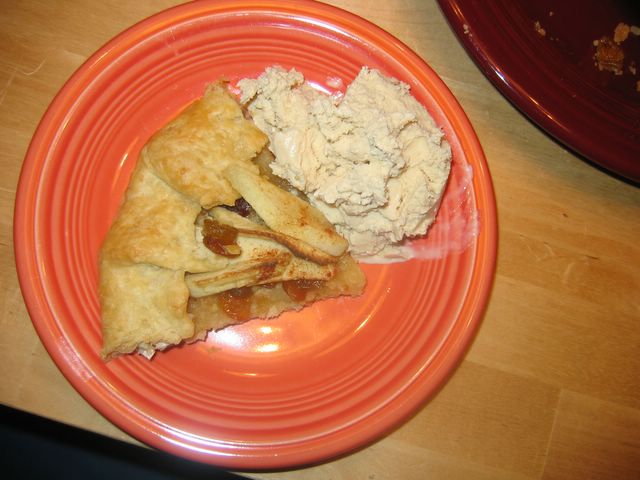
Lavender-ginger ice cream beside an apple galette with golden raisins and dried cranberries. This time, when I added the raisins, cranberries and almonds to the filling, I put them -under- the apples, rather than on top where they burned last time. This worked perfectly, I am pleased to report.
I don’t often make desserts.
Mainly, that is because I prefer cooking to baking, but also, because most of the time when I cook, most people eat so much of the dinner that they seldom want dessert until the next day.
Which is fine if people are staying for the weekend, but not so good if they are only there for the evening.
But, now and again, I like to make a sweet thing, like a batch of brownies, a pan of shortbread, maybe some scones, or for really special occasions, such as cherry season, a pie. Or in the case of Meyer lemon season–lemon bars.
Ever since I learned how to make galettes for the raclette class I taught back in January, I have been into making them because they really are a simple, quick but foolproof casual dessert. Now that the step of making and rolling out pie crust doesn’t intimidate me or give me hives, I actually think of galettes as fun. The simple nature of the fillings certainly appeal to my tendency to improvise, and since we were having an essentially country French dinner last night, I figured a galette was in order.
But, I felt that I wanted to do something more.
As lovely as galettes are, they can look rather nude on the serving plate, and since I adore my in-laws, I wanted to zing up the presentation. I was not into making a dessert sauce, like creme anglaise or a caramel-nut sort of dealiebob. Nor did I want to make whipped cream, as that is rather done and somewhat trite. While I could have run out and picked some violets and crystallized them, I was having pansy blossoms in the salad, so that would be a bit on the repetitive side.
But the flower idea kept haunting me, it being spring and all, so I went to my cupboard and found the dried lavender, and I got to thinking.
Lavender is often used in savory dishes in Provence, so why not use it in something to go with the galette?
Like, say, oh, homemade ice cream?
Oooh. Ice cream.
Yeah.
Tessa and Karl both -love- the frozen dairy products (as do I), so it was a natural.
Of course, I thought of this about four hours before dinner was to happen, so I didn’t really plan ahead.
I knew where the ice cream maker was, as I had found it in my unpacking adventures two nights before. I knew where the rock salt was. So what if I didn’t know if I had enough ingredients?
My ice cream maker is a Rival model I bought at Target about six years ago for the measley sum of eight dollars, because it was the end of the season, and they wanted to be rid of them. It is a tiny electric critter that makes two quarts, but hey, for eight bucks, who is going to argue?
So, I dragged it out, and looked in the instruction book for a vanilla ice cream recipe.
Now, even though it is only a two-quart model, all of the recipes in the little instruction booklet (which makes ice cream making sound a lot harder than it really is) that came in the box are for four quarts, which is not only excessive when I am talking about dessert for four people, but a physical impossiblity for my equipment. So, already, I am going to be improvising.
So, since I was already improvising and altering the recipe considerably by cutting it in half, and adding lavender to the mixture, I figured, why stop there? Why not make a few more tiny little changes?
Like why just flavor it with lavender and vanilla?
Why not add something else?
Like, oh, say, uh, ginger?
You just knew I would have to sneak some Chinese ingredient in there somehow, didn’t you?
Well, yeah, I am that way.
I hadn’t gotten to cook them Chinese food, so I figured I’d take my country French dinner and throw an Asian curve ball into the works and see what happened.
What happened was rather tasty: lavender and ginger go well together. Which is a good thing, because I wasn’t satisfied with one form of ginger, but instead, used three different kinds of it, just for kicks.
I also ended up using a cup of whole milk sour cream in it, because I didn’t have enough heavy cream and had no half and half like the recipe I was adapting used. It turned out to be an inspired choice; the tang was a welcome addition to the mix of flavors. I also lowered the amount of sugar called for and instead of regular granulated sugar, used evaporated cane juice, because it has a more complex flavor profile.
I have to admit, however, that I have not come up with a good name for the ice cream, so for the moment, it will have to be known quite simply as
Lavender-Ginger Ice Cream
Ingredients:
1 cup 1% milk
2 tablespoons dried lavender buds
1/2 teaspoon dried ginger
3/4 cup evaporated cane juice or sugar
2 tablespoons honey
pinch salt
1 tablespoon vanilla extract (I used Penzey’s double strength)
2 cups heavy cream
1 cup sour cream
4 tablespoons finely minced crystallized ginger
1″ cube fresh ginger, grated finely
Method:
Heat milk, lavender buds and ginger in a heavy bottomed saucepan on low heat for five minutes. Bring to a near boil to scald milk, remove from heat, and stir. Allow to sit and steep at least fifteen minutes. The longer you steep, the more lavender flavor you will extract.
Strain buds out of milk, and bring back to scalding temperature. Add sugar, honey, and salt, stir until dissolved. Add remaining ingredients, and whisk briskly to incorporate sour cream.
Pour into ice cream maker and freeze according to manufacturer’s instructions. Makes about two quarts.
Flower Power

To commemorate the first day of the growing season, I served a salad with roasted spring beets, ripe pears, mixed greens, goat cheese and almonds garnished with a single pansy from my garden.
Zak and I made dinner for his parents tonight; he had to show off his new bread-baking skills, so I planned and made a meal around his spiced boule.
My first course was a salad of seasonal greens, roasted beets, anjou pears, strong, pepper-encrusted goat cheese and almonds with a very basic (four ingredients) balsamic vinaigrette. It is a simple salad, which I presented in an artistic composition on a plate. What made it special was the garnish of a single homegrown pansy blossom.
Flowers in or on food evoke strong reactions.
The first time I served my daughter, Morganna, a Thai red curry garnished with nasturtium blossoms, she recoiled and put the flowers to the side of the plate and utterly refused to eat them. “That is just too weird, Mom,” she declared as Zak and I scarfed ours down and then gobbled hers up, too.
At our housewarming party for our first home, my father curled his lip at the melange of greens, fruits and flower petals in the salad bowl, and gingerly picked his salad so that it was free of daylilies and roses. He only tasted one at the insistence of Zak’s grandfather’s ladyfriend who prevailed upon her age and charm to shame my Dad into trying something new.
But it was obvious to me that he didn’t like it.
Zak’s parents had no such reticence to the pansies on the salad tonight. Tessa noted that it had been a long time since they had eaten flowers, while Karl popped his in his mouth and said that it tasted better than nasturtiums and went well with the beets. He also insisted, when I was photographing the salads before serving them, that I photograph his plate, “because it is the prettiest.” So, now you know–the illustration above is a salad just minutes before being consumed by my father-in-law, the fearless gourmand.
I wonder why flowers disturb some diners so much. Is it because they are so pretty we hate to destroy them by eating them? If that is the case, then icing roses would never be snitched from birthday cakes, and no one would ever touch a gem-like fruit tart.
Is it because the colors are so vibrant, and are often ones which we do not associate with food? Perhaps that is part of it; I know that my father has problems with my propensity for eating and serving foods that while naturally colored, are not what most Americans think of as normal. Like cornbread made from blue cornmeal, or fully ripe but naturally green Green Zebra tomatoes. Or, worse yet, blue potatoes, which look quite unnaturally lavender in hue when mashed.
Is it a culinary taboo? Is it because we are warned against eating flowers as children, because so many of the lovely things are poisonous. Daffodils and hyacinths, though they look and smell divine, are poisonous, though they are not nearly as lethal as the lovely aconite and digitalis.
Is it because flowers are tokens that still have strong meanings for us? They are offerings we give to symbolize love at weddings and funerals. They once were offerings we gave to the gods–do we see them as something that we mere mortals should not eat because we are not worthy to consume such beauty as if it were simply another foodstuff?
For whatever reason, flowers have power, not just in the garden or our psyches, but on our plates, too.
And it felt pretty good to serve a single flower on each salad to my family on April 15th, which here in Ohio, is the official first day of the growing season.
And if you are interested, here is the recipe for the vinaigrette–which isn’t so much a recipe as a guideline: Use one part good balsamic vinegar to three parts good olive oil. Add wildflower honey and aged tamari soy sauce to taste. Shake to combine, and serve. This salad dressing is good with any combination of greens, fruits, nuts, and vegetables, though I particularly like it with roasted beets, pears and good strong, creamy goat cheese.
Plastic Not-So-Fantastic Strawberries
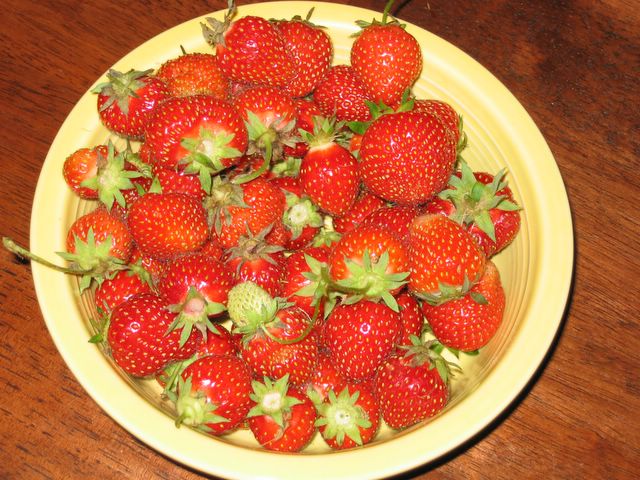
Really fresh and really local: strawberries from our first harvest last year. They were completely superior to the ones available in the grocery store in every respect.
Is it just me, or have the strawberries you get in the grocery store become prettier and less flavorful over the past few years?
They are large, they are red, they are shapely and fragrant, but the fresh strawberries that are flooding the stores here in Ohio, which are predominately grown in southern California, have little to no taste and are a bit on the crisp side, which is great when we are talking about apples, but not so enticing when it is a strawberry I have nearly broken a tooth on.
Last spring is when I noticed that they all smelled really, really good–like sunripened strawberries still in the field. Which is what seduced me into buying a pint of them.
That one pint scented my entire car (a Subaru Forester), which is not small, meaning that little pint of gigantic strawberries was either endowed with a great deal of natural sugars and flavor, or it was made by the Yankee Candle Company. (Which I call Stanky Candle, because walking past one of thier stores with its melange of overly-fragranced candles is a sort of olfactory purgative for me.)
When I got home, I ripped open the clear clamshell package and rinsed off a berry. The sweet scent poured out of the fruit and I all but drooled down my chest in anticipation.
However, when I bit into the overly crisp, but lovely crimson fruit, I was distinctly underwhelmed.
Actually, I was deflated.
It tasted vaguely like watered down, barely sweetened strawberry flavored Kool-Aid.
I thought it was an anomaly.
I tried another berry.
I was wrong.
They were horrible, and they could very well have been made by Stanky Candle, for they were insipid to the point of pointlessness.
Yet, the next day when I went to the store, they were all but sold out.
Which led me to believe that either I was a freak of nature and just couldn’t taste the berries, or everyone else was getting duped along with me, or, everyone else happened to like crappy plastic flavorless berries that just happen to look and smell good.
Which led me to believe that the berries were bred to smell and look good, and ship well, but that the genetics for taste were somehow left out of the equation. Which works pretty well, if you think about it–once the grocery store has your money, what are you going to do about it? It isn’t like the strawberries are rotten, they are just not good. But they aren’t something you are going to get a refund on, right?
Zak agreed with me that they tasted like, well, nothing, really, and that maybe I wasn’t just being paranoid about agribusiness trying to take over the food world and inundate us with worthless food items wrapped up in pretty packages with bright colors and nice smells in order to trick us into buying them. This article in the New York Times confirms my suspicions that flavor has been sacrificed by commercial breeders in pursuit of a better looking berry. It is all a big hoax, a sham, those “seasonal” California strawberries, all tarted up in scarlet and smelling good, tricking consumers into thinking that is what a strawberry is about.
And we fall for it, because we don’t taste before we buy.
Well, that was the last pint of commercial berries I have bought, and I felt better for it. Besides, we had our own strawberry bed that produced a huge crop that year, such that for several weeks, we ate strawberries for breakfast every day. After the experience of going out into our front yard and eating fresh sunwarmed berries first thing in the morning, neither of us had the stomach to tolerate substandard faux-fresh fruit anymore.
So, this year, even though we don’t have a strawberry patch in the new house (yet), I will not buy any strawberries until the season for local berries starts here in May and June. There is just no point, because a pretty berry without flavor is just not worth the dirt it was grown in.

Categories:
- Admin (rss) (55)
- Blogs and Blogging (rss) (81)
- Book Reviews: Cookbooks (rss) (43)
- Book Reviews: Non-Cookbook Food Books (rss) (38)
- Cats and Cat Blogging (rss) (47)
- Chinese Cooking Lessons (rss) (32)
- Culinary School Stories (rss) (18)
- Dairy Pruducts: Cultured and Barbaric (rss) (4)
- Documentary Filmmaking (rss) (1)
- Essays, Rants and Reflections (rss) (260)
- Fighting Hunger (rss) (12)
- Food and Kids (rss) (45)
- Food in the News (rss) (126)
- Food Media (rss) (98)
- Food Preservation (rss) (18)
- Food Safety (rss) (45)
- Gardening (rss) (30)
- Herbs and Herb Blogging (rss) (20)
- Holidays (rss) (50)
- Kat Blogging (rss) (22)
- Kitchen Science (rss) (36)
- Leftover Makeover (rss) (8)
- Life, the Universe and Everything (rss) (131)
- Local and Sustainable (rss) (227)
- Local Athens Food and Foodies (rss) (42)
- Meatless Mondays (rss) (32)
- Menu For Hope (rss) (5)
- Nutrition, Diet and Health (rss) (84)
- On The Farm (rss) (8)
- Recipes: Almost Vegetarian, Vegetarian and Vegan (rss) (294)
- Recipes: American Regional (rss) (37)
- Recipes: Appalachian Hillbilly (rss) (33)
- Recipes: Bread, Pasta, Grains (rss) (95)
- Recipes: Canning and Preserving (rss) (8)
- Recipes: Chinese (rss) (123)
- Recipes: Comfort Food (rss) (120)
- Recipes: Cookies (rss) (16)
- Recipes: Desserts (rss) (48)
- Recipes: French (rss) (25)
- Recipes: Fruits and Vegetables (rss) (302)
- Recipes: Greek, North African and Middle Eastern (rss) (31)
- Recipes: Indian (rss) (137)
- Recipes: Italian (rss) (42)
- Recipes: Japanese (rss) (7)
- Recipes: Jewish (rss) (4)
- Recipes: Korean (rss) (6)
- Recipes: Meat, Poultry and Fish (rss) (220)
- Recipes: Mexican/Native American/ Latin American/Caribb (rss) (27)
- Recipes: Original (rss) (108)
- Recipes: Thai (rss) (27)
- Recipes: Tofu (rss) (17)
- Recipes: US Regional (rss) (16)
- Recipes: Vietnamese (rss) (8)
- Restaurant Stories (rss) (28)
- Sewing, Quilting, Arts and Crafts (rss) (16)
- Simple Chinese Recipes (rss) (30)
- Slow Food and Heritage Foods (rss) (10)
- Spice Blogging (rss) (44)
- The Chinese Cookbook Project (rss) (14)
- The Chinese Pantry (rss) (39)
- The Documentary (rss) (2)
- The Kitchen Saga (rss) (17)
- The Locavore's Bookshelf (rss) (15)
- The Unsung Adventures of The Culinary Nerd (rss) (6)
- Tools and Toys (rss) (35)
- Uncategorized (rss) (10)
- With a Side of Politics (rss) (48)
Archives:
- August 2012 (9)
- July 2012 (12)
- September 2011 (3)
- August 2011 (7)
- July 2011 (8)
- June 2011 (16)
- May 2011 (17)
- April 2011 (11)
- December 2010 (9)
- November 2010 (5)
- February 2010 (1)
- December 2009 (5)
- November 2009 (7)
- October 2009 (10)
- September 2009 (16)
- August 2009 (14)
- July 2009 (14)
- June 2009 (7)
- May 2009 (17)
- April 2009 (10)
- March 2009 (25)
- February 2009 (13)
- January 2009 (10)
- December 2008 (5)
- November 2008 (5)
- October 2008 (6)
- September 2008 (13)
- August 2008 (8)
- July 2008 (11)
- June 2008 (18)
- May 2008 (13)
- April 2008 (14)
- March 2008 (16)
- February 2008 (17)
- January 2008 (19)
- December 2007 (25)
- November 2007 (18)
- October 2007 (24)
- September 2007 (16)
- August 2007 (15)
- July 2007 (15)
- June 2007 (10)
- May 2007 (14)
- April 2007 (16)
- March 2007 (17)
- February 2007 (20)
- January 2007 (13)
- November 2006 (1)
- October 2006 (8)
- September 2006 (14)
- August 2006 (25)
- July 2006 (30)
- June 2006 (28)
- May 2006 (34)
- April 2006 (29)
- March 2006 (24)
- February 2006 (30)
- January 2006 (38)
- December 2005 (40)
- November 2005 (37)
- October 2005 (32)
- September 2005 (25)
- August 2005 (30)
- July 2005 (28)
- June 2005 (21)
- May 2005 (8)
- April 2005 (22)
- March 2005 (17)
- February 2005 (29)
- January 2005 (10)
Search Site:
Links:
- Lily’s Wai Sek Hong
- 101 Cookbooks
- A cat in the kitchen
- A Veggie Venture
- Accidental Hedonist
- Cha Xiu Bao
- chez pim
- Chocolate & Zucchini
- Chopstick Cinema
- Chowhound.com
- Chubby Hubby
- Cook sister!
- Cooking with Amy
- da*xiang
- Eat Local Challenge
- Eating Liberally
- Ecocentric
- Eggbeater
- Epicurious
- Farmgirl Fare
- Fatfree Vegan
- Foodgoat
- ForkandBottle.com
- Green Olive Tree
- Hooked on Heat
- Jaden’s Steamy Kitchen
- Kalyn’s Kitchen
- Lucullian delights
- Mahanandi
- Matt Bites
- MeatHenge
- mmm-yoso!!!
- New York Times – Dining & Wine
- Pizza Goon
- Rasa Malaysia
- Ruhlman
- Sailu's Kitchen
- Serious Eats
- SF Gate: Food & Dining
- Simply Recipes
- Soul Fusion Kitchen
- Tastespotting
- The Amateur Gourmet
- The Cleaner Plate Club
- The Food Section
- The Grub Report
- thecookscottage
- U.S. Food Policy
- Wandering Chopsticks
- Washington Post Food and Dining
- Wasted Food
Meta:


Powered by WordPress. Graphics by Zak Kramer.
Design update by Daniel Trout.
Entries and comments feeds.