
Cook Local, Eat Global
Community Supported Agriculture

Produce from my organic garden last summer: tomatoes, chiles, tomatillos and basil. This could also represent part of a weekly share for a subscriber to a CSA.
CSA stands for “Community Supported Agriculture,” and it refers to an innovative style of direct-marketing that brings farmers and consumers together in a visible web of interdependence. This results not only a beneficial economic and nutritional partnership between farmers and consumers, but it also creates bonds of community and friendship that transcend mere sustenance. In addition, it helps food consumers, who have grown up on the supermarket ethic of “all under one roof” shopping that stresses convenience over health, sustainability and taste, learn more about where their food comes from, how it is produced and how flavorful it can be to “eat with the seasons.”
The CSA movement, which is growing across the US, started in Japan, thirty nine years ago, when a group of housewives and mothers who were concerned with the growing use of pesticides in their food and the increase in food importation, banded together and created a partnership with local farmers with the goal of supporting their ability to provide fresh vegetables and grains grown free of chemical pesticides and fertilizer. This program, called, “Teikei” poetically translates to, “the farmer’s face on it,” though a more literal translation is “cooperation” or “partnership.”
The idea of a CSA, where community members pay a set price, up front, to a farmer at the beginning of the season, and then were given shares of the produce throughout the season, was brought to the US in 1984 by Jan Vander Tuin and Robyn Van En, who had run a CSA in Switzerland previously. The first CSA in the United States was in Massachusetts, and from there, the idea spread slowly, though in recent years, the number of CSAs in the nation has grown exponentially each year.
This growth is not surprising; more Americans are becoming aware of the unsustainable nature of the current petrochemical-based, factory farm food system which depends more and more upon food imports from other countries. In addition, interest and demand for organic produce is growing, and small, local farmers have stepped in to fill that niche. Finally, a lot of Americans are returning to the joys of eating fresh produce in season, having tired of the plasticene blandness of hothouse tomatoes and giant strawberries that look gorgeous and smell divine, but have all the sweetness and flavor of styrofoam.
There are many variations on the way that CSAs are run; some farms allow community subscribers to come to the farm and help in the work of raising the crops. Others have subscribers assist in the harvest, while others provide delivery service of each week’s box of produce shares. Still others distribute from a central point once or twice a week, at the subscriber’s convenience.
Athens Hills CSA (Green Edge Gardens), which I will enroll in hopefully tomorrow, has slightly different approach. For four hundred dollars, which you can pay in total up front, or through arranged installments, one is entitled to enough vegetables per week for two adults from June 18th through October 15th. Instead of a set box of whatever is harvested that week, members “shop” for their vegetable shares from the farmer’s stand at the Farmer’s Market; this system avoids members having to deal with a week when the share box contains nothing but okra, eggplant and zucchini. (All right, that would be fine with me, but Zak would not be so enthusiastic with such a week, and really there is only so much of those three vegetables I can eat by myself, luscious as they are.)
There are CSA’s operating across the US, many of them near major metropolitan areas. To find one near you check out the websites for Local Harvest, Biodynamic Farming Association, and New Farm. An even more comprehensive list of CSA farms is generally available on the Robyn Van En Center site, however, at the moment, it is in the middle of technical difficulties.
The First Supper

The finished dish: Three Pepper Pork
Unable to bear another round of eating out, I pushed myself and got the upstairs kitchen mostly unpacked yesterday. I resolved to try the thick-cut boneless butterflied loin pork chop I bought at the Farmer’s Market from Harmony Hollow Farms.
Saturday was a blustery, freezing cold day, with wind ripping through the Hocking River Valley, buffeting the few brave souls who came out to buy and sell at the Farmer’s Market that morning. We made a quick pass through the market, then returned with cash, and beelined over to Rich Blaizer’s stand, and took a good look at the pork he had for sale.
The pork was dark and rich looking, with creamy white fat marbled through the meat. It looked nothing like the pale, water-injected lean pork that is available in the grocery store that gave rise to the ad slogan “Pork–the Other White Meat.” Instead, it looked much more like the pork I was raised eating in childhood, from hogs on my grandparents’ farm.
When I asked Rich what kind of pigs he raised, his face lit up, and he said with a smile, “Durocs.”
I nodded enthusiastically and said, “Good. Those are the ones my Grandpa raised.” We then discussed the superior intelligence and foraging ability of the red-coated Duroc breed, which is very important when you let your pigs run in a pasture like Rich does. A lot of pigs have had the rooting instinct bred out of them, as it is inconvenient when you raise hogs in a confinement setting as most of the factory farm producers do. However, for pasture-raised free-range pigs, being able to root and forage is a necessary survival skill. Rich complained that other breeds would “starve themselves to death” in a pasture, whereas the Duroc was right at home.
Not only are Durocs smart pigs, they are tasty, too. I remembered the sweet flavor of my Grandpa’s pork, and wondered if the pork chop from Harmony Hollow would match my memory of how pork should taste.
I was not disappointed. The meat was sweet, juicy and tender, though not mushy the way a lot of supermarket pork can be. It was firm, with a nice chew to it, without being in the least bit dry or tough. It was, all in all, a superlative piece of pig.
Instead of cooking it as a straight up pork chop, I cut it into thin slices, and used it in a stir-fry. (You know I had to use that wok, didn’t you? I was having withdrawal symptoms from not using it.)
Instead of making a classic, recognizable Chinese dish, I improvised, using the vegetables I had on hand, including some bok choy I also purchased at the farmer’s market. I seasoned it simply with Shao Hsing wine, thin soy sauce, sugar, chili garlic paste, black pepper and Sichuan peppercorn. Oh, and of course, I used the holy trinity of scallions, garlic and ginger.
I ended up calling it Three Pepper Pork, and will likely make it again–probably with some more of that nice free-range pig from Harmony Hollow.
Here is now it goes:
Three Pepper Pork
Ingredients:
1/4 pound pork loin chop cut into thin strips
1 tablespoon cornstarch
1 tablespoon Shao Hsing wine
1 tablespoon thin soy sauce
4 tablespoons peanut oil
3 scallions, cut into thin slices diagonally, white parts separated from the green
4 cloves of garlic, cut into thin slices
1″ hunk of ginger, peeled and cut into thin slivers
1/2 teaspoon freshly ground Sichuan peppercorns
1 teaspoon freshly ground black pepper
1 teaspoon chili garlic paste
1 teaspoon thin soy sauce
handfull baby carrots cut jullienne
1/4 pound green beans strung and blanched
1 bunch baby bok choy cut into ribbons
1/8 cup chicken broth
Method:
Marinate the pork in the cornstarch, wine and soy sauce while preparing the vegetables.
Heat wok, add oil, and when it is smoking, add white part of scallions, garlic and ginger, and cook, stirring, until fragrant and beginning to show golden color; about one minute. Add peppercorns, pepper and chile garlic paste, stir fry about 30 seconds.
Drain excess marinade off pork; put meat in wok. Let sit in single layer on bottom of wok until browned–between 45 seconds to two minutes. As soon as it is brown and fragrant, begin to stir vigorously. Add soy sauce and any remaining marinade.
When meat is nearly done, add carrots, then blanched green beans. Keep stirring.
After about a minute, add bok choy, then the chicken broth. Reduce liquid until it coats food, and bok choy is very slightly wilted.
Serve immediately with steamed rice.

The new flat-top electric stove gets very hot, very quickly. It is quite easy to produce a good stir fry filled with the savor of wok hay.
I Have Returned
And so, it was that on the seventh day, she did rest.
Or something to that effect.
If you consider carrying a new chest of drawers up three flights of stairs relaxing, I suppose you could say that I rested today.
At any rate, I am back. Sans photographs, but with Internet access, and that is a good thing. I also have the camera, but I am not so certain as to the location of the little picture card reading thingie that helps me get the pictures from the camera into the computer onto the blog, so we will have to do without illustrations for the time being.
How are we?
Well, we are here, present and accounted for, in our new home, all cats and dogs intact. (Here is Athens, Ohio, by the way.) My daughter helped us move over her Spring Break, which was terribly generous; she insisted upon being here for the big exciting time, which she discovered was a lot of work interspersed with long periods of intense boredom and ennui. We ended up moving not on the 28th as planned but the 29th–we awoke to torrential rain on the 28th and a long driveway filled with mud and water. We knew that even if they got the truck up the drive, it would never get out again once it was fully loaded. So, we postponed until the next day, which turned out to be uncharacteristically sunny and warm.
The move went fairly smoothly–all moves are fraught with peril and danger, of course, but no one was killed, maimed or lost upon the highway, though it was tempting to toss the cat who had to empty his bowels upon himself out the window. However, both my daughter and I fought off the temptation to fling him, and he is here, sunning himself on the deck as I write.
The main kitchen is still not finished, as is the main bathroom. I am unpacking as I can; Zak is busy putting together his desk and computer.
In all of this bustle, I have been itching to cook, and have been thwarted at every turn. We have been eating out mostly, but tonight, I am breaking that cycle and now that I have a stove and sufficient equipment unpacked in the upstairs kitchen, I am cooking.
We have been here only for about five days, all of them very busy with unpacking, cleaning, moving, hauling and other sundry domestic excitements, but already I have met up with some of the folks involved in making a sustainable food system for Athens county. We went to the farmer’s market on Saturday and I met with a woman who is doing a CSA for the first time this year; I am calling tomorrow to sign up for it. My next post will be about CSA’s, how they work and what they are about, and as I go through the process, I will write about it. I also met a man who raises free-range Duroc hogs;I bought a nice pork loin chop from him that I will be cooking tonight. I will let you know how it turns out, of course.
Today, we went out to a flea-market about thirty miles from here, and met another farmer. Not only does she raise Duroc hogs, and hickory smoke cures her own hams (and let me tell you, they are fantastic) she raises Piedmontese cattle–the fabled white cows of Tuscany. Needless to say, I picked up some ham, a bit of round and a bit of chuck from this lady, and will report upon how they cook and taste in a future post.
I intend to interview all of these folks, and write in depth articles on subjects relating to sustainable agriculture, rare breeds of farm animals, heirloom vegetables and local food economies, as I settle into the rhythym of living in Athens again.
So, that is it–I will be posting again soon–I just wanted to let folks know that I am still here, still eating, and will be back into cooking starting tonight.
Springtime, Downtime and a Taste of Things to Come

Spring has sprung here in my world, and with it comes a fresh breeze, a change of living spaces, and a new focus to my blog.
Hey, folks–it is a post that is not about food. Well, not entirely, anyway.
Spring is here and with it comes a fresh spurt of creative energy, a change in living quarters, a frenzy of new business opportunities and some really pretty crocus.
It is also bringing me to a place where I must pause in my blogging activity.
In all likelihood, we are taking my computer apart today and putting it in the back of the car and zooming off to transport it to Athens. Zak and I both hate letting movers touch things like computers and musical instruments, so we have been transporting such things in dribs and drabs for the past week or so.
So, as I will be sans computer, that means that we will be sans blog, at least until we move on Monday and get the laptop up and running around Thursday or so.
So, until then, look for radio silence on this page, but after the move and the return to cyberspace, I will start back my frenetic pace of blogging and will fill you all in on the status of my two, yes two, new kitchens, and how my new business ventures with said kitchens and whatnot are going.
And look for new, entertaining features about the food scene in Southeastern Ohio.
Yes. A food scene. In Appalachian Ohio. Yes. Such a thing exists. It does.
Do not be afraid. I will be there, holding your hand the entire way.
It is just my way of reminding the world that all of the good food out there does not just happen in big cities in the restaurants of celebrity chefs under glitzy lights and showmanship. It also happens in small towns, in farmer’s markets and under the hands of talented home cooks turned professional food producers.
So, until then, cook well, eat well, be well, and log off the computer now and again, go outside and smell the flowers. They sure are pretty.
What a Crock!
So, I bought this crockpot to use during the Chili Cookoff as a warming device.
I never really figured I’d cook in it much; I never much liked the way a lot of crockpot recipes turned out back in the day when they had little cutesy mushrooms screen printed on the sides in the ever so vogue shades of harvest gold and avocado.
On the other hand, I am moving and don’t have time to spend doing all the prep and cleanup from stir frying. And the idea of something that cooked itself while I slept, or packed or hauled stuff hither and yon had a certain appeal, as you can imagine.
So, I figured, what the hell, and put the behemoth thing on the counter and rummaged in the freezer for that big chunk of free range organic chuck I had stashed away. I had originally planned to use it for Sichuan beef with turnips, but I decided I would make a pot roast out of it instead, because that would be a bit more versatile when it came to reusing leftovers in other dishes.
So, out it came to thaw. While it was thawing, I dug around in the refrigerator to see what was in there. One parsnip that I didn’t use for the pea soup, and one and a half gigantic leeks, also left from that culinary endeavor, as well as a nice sprig of fresh rosemary. From dry storage came the handful of garlic cloves, and from the now nearly vacant spice cabinet came dried thyme, black pepper, chile flakes, kosher salt and you guessed it–Sichuan peppercorns. Oh, and a bay leaf.
From the now-decimated pantry came a bottle of Shao Hsing wine, and a handful of Chinese dried black mushrooms.
Of course I couldn’t make just a plain old pot roast; I had looked online for recipes using a crockpot, and had been nearly terrified into shoving the thing into a box and ordering out for pizza. If pizza delivered out here, I might have done it. But, as it didn’t, and I had a hunk of meat thawing, I persevered, though I had visions of the watery, lackluster meals from the mushroom-printed crockpots of yore in my head as I read along. I told myself that the principle of the crockpot was “low and slow” cooking which all of my training both as a cook and a chef told me was good.
But it was hard.
Most of the “recipes” I read were based on processed foods and boasted a minimum of ingredients. You know, stuff like Lipton Onion Soup Mix or a bottle of Kraft Italian dressing. None of them browned the meat first. Wine, other than that frightful salted crap from the grocery store, did not appear.
So, I decided to hell with it all, I would fake it, as I most often do.
I pulled out my trusty Le Creuset buffet pan, heated it up with some olive oil, and after dusting the beef with flour, I let it sear on all sides. Contrary to popular belief, this step does not “seal in the juices,” but rather, makes a nice brown crust, which produces a huge complex of flavors through a process called “maillard browning,” which is distinct from caramelization, which is the simple browning of sugar.
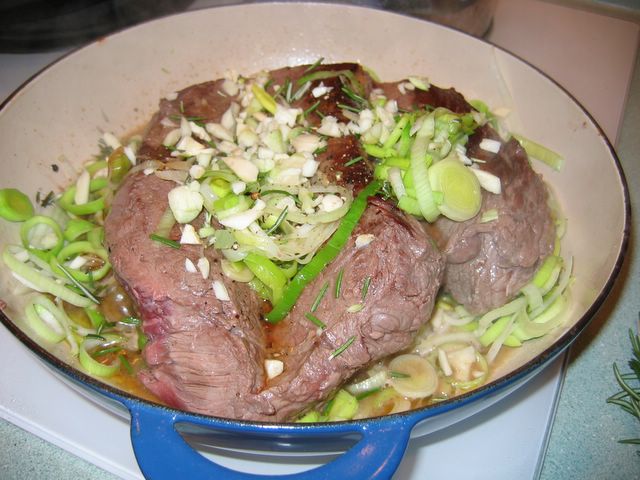
Browning the meat and leeks–a crucial step in creating a good braised meat in the crockpot.
The maillard browning reaction is what happens when a group of amino acids, proteins or peptides react with glycosidic hydroxyl sugars (both present in the food) under heat, resulting in a brown pigmentation and a great many changes in flavor. It is non-enzymatic, meaning it is not like when you cut an apple and leave it out; nothing is reacting to oxygen here–it all happens under heat. Nearly all foods show this reaction during cooking, and wise cooks employ it to build up savory, “meaty” or just plain good complexes of flavors.
In addition to making nice proteinish flavors, browning food makes it brown. Which is good, because brown is an appealing color for food; we tend to associate that color with the nice flavors that come about from browning. This rather obvious remark is to remind us that without browning meat, it has a tendency to look rather, well, grey. And while brown is a happy, appealing color for food, grey is not so much tasty-looking as kinda peaked and sickly.
Not a good color for food.
And the thing is, if you just stick meat into a basically clear liquid, like, oh, say, Italian dressing, it is not going to come out brown. It will be as grey as an unfriendly alien in your typical abduction scenario. In other words, it will be bloody unappealing.
So, there we are.
I browned the meat, added the sliced and washed and dried leeks,and let them brown. Then I took out the meat, and set it on a plate, added Shao Hsing wine and deglazed the pan, which is a fancy way of saying that I scraped up all the browned goodness that was stuck to the bottom of the pan and dissolved it into boiling liquid. Then I threw in about four cloves of minced up garlic, and let it simmer for about five minutes, until the leeks were a nice shade of brown.
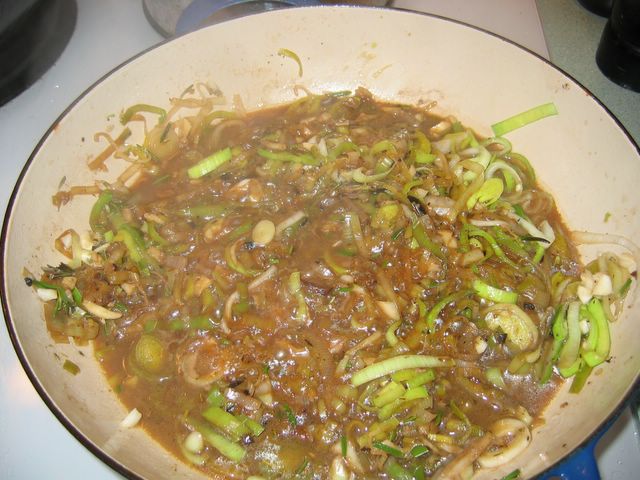
Waste not, want not: in deglazing the pan, you scrape up and dissolve all the little brown bits that are stuck on the bottom of the pan, which are filled with rich flavor and color.
And then, I put the meat into the crock and dumped the entire contents of the pan on top, then set it in the heating element, and added a quart of beef stock, a bay leaf, the finely ground Sichuan peppercorns and some fresh rosemary. I had already packed my peeler, so I scrubbed the parsnip and cut it into chunks and added it to the pot, put the temperature gauge on super-granny-low heat (the one that takes ten hours to cook), covered the pot and went off to bed.

The meat, leeks, mushrooms and parsnips in the pot before the beef broth is added.
I discovered something about crockpots.
When you cook while you sleep, the nice smells that the crockpots let out waft up the stairs and come get you. Like, the smell of the cooking beef woke me up. And made me hungry. This was not a good thing.
The next morning, I looked in on the beef, and found that the meat and the liquid had turned a dark reddish brown, and smelled maddeningly delectable. But the meat was still a little tough, so I set it to cook for about eight more hours.
Which it did. And the meat was done, and wonderful, but I needed to thicken the gravy. So, I turned it onto high heat and added flour dissolved in water; I didn’t feel that it was right to use roux and add more fat to the dish. I let it simmer for a while without the meat, then added it back in, and let it reduce for about another hour.
And then we ate it, with some garlic mashed potatoes, some of Zak’s bread and some salad.
Only, I was dim, and didn’t take a picture of the finished product before falling upon it in an famished feeding frenzy.
So, sue me: I am a bad food pornographer.
But we ate well.
And so the moral of the story is this: so long as you ignore the idiot ideas like putting bottles of Italian dressing or soup mix into the pot and ignoring the necessary step of browning the meat, and just treat the crockpot as if it is a very low burner or a slow oven, you will make absolutely fabulous food.
If you go for the three ingredient shortcut lackadaisical crap recipes, you will turn out the same watery dreck that haunts my childhood memories of the evil crockpots with the dancing mushroom screenprints.

Categories:
- Admin (rss) (55)
- Blogs and Blogging (rss) (81)
- Book Reviews: Cookbooks (rss) (43)
- Book Reviews: Non-Cookbook Food Books (rss) (38)
- Cats and Cat Blogging (rss) (47)
- Chinese Cooking Lessons (rss) (32)
- Culinary School Stories (rss) (18)
- Dairy Pruducts: Cultured and Barbaric (rss) (4)
- Documentary Filmmaking (rss) (1)
- Essays, Rants and Reflections (rss) (260)
- Fighting Hunger (rss) (12)
- Food and Kids (rss) (45)
- Food in the News (rss) (126)
- Food Media (rss) (98)
- Food Preservation (rss) (18)
- Food Safety (rss) (45)
- Gardening (rss) (30)
- Herbs and Herb Blogging (rss) (20)
- Holidays (rss) (50)
- Kat Blogging (rss) (22)
- Kitchen Science (rss) (36)
- Leftover Makeover (rss) (8)
- Life, the Universe and Everything (rss) (131)
- Local and Sustainable (rss) (227)
- Local Athens Food and Foodies (rss) (42)
- Meatless Mondays (rss) (32)
- Menu For Hope (rss) (5)
- Nutrition, Diet and Health (rss) (84)
- On The Farm (rss) (8)
- Recipes: Almost Vegetarian, Vegetarian and Vegan (rss) (294)
- Recipes: American Regional (rss) (37)
- Recipes: Appalachian Hillbilly (rss) (33)
- Recipes: Bread, Pasta, Grains (rss) (95)
- Recipes: Canning and Preserving (rss) (8)
- Recipes: Chinese (rss) (123)
- Recipes: Comfort Food (rss) (120)
- Recipes: Cookies (rss) (16)
- Recipes: Desserts (rss) (48)
- Recipes: French (rss) (25)
- Recipes: Fruits and Vegetables (rss) (302)
- Recipes: Greek, North African and Middle Eastern (rss) (31)
- Recipes: Indian (rss) (137)
- Recipes: Italian (rss) (42)
- Recipes: Japanese (rss) (7)
- Recipes: Jewish (rss) (4)
- Recipes: Korean (rss) (6)
- Recipes: Meat, Poultry and Fish (rss) (220)
- Recipes: Mexican/Native American/ Latin American/Caribb (rss) (27)
- Recipes: Original (rss) (108)
- Recipes: Thai (rss) (27)
- Recipes: Tofu (rss) (17)
- Recipes: US Regional (rss) (16)
- Recipes: Vietnamese (rss) (8)
- Restaurant Stories (rss) (28)
- Sewing, Quilting, Arts and Crafts (rss) (16)
- Simple Chinese Recipes (rss) (30)
- Slow Food and Heritage Foods (rss) (10)
- Spice Blogging (rss) (44)
- The Chinese Cookbook Project (rss) (14)
- The Chinese Pantry (rss) (39)
- The Documentary (rss) (2)
- The Kitchen Saga (rss) (17)
- The Locavore's Bookshelf (rss) (15)
- The Unsung Adventures of The Culinary Nerd (rss) (6)
- Tools and Toys (rss) (35)
- Uncategorized (rss) (10)
- With a Side of Politics (rss) (48)
Archives:
- August 2012 (9)
- July 2012 (12)
- September 2011 (3)
- August 2011 (7)
- July 2011 (8)
- June 2011 (16)
- May 2011 (17)
- April 2011 (11)
- December 2010 (9)
- November 2010 (5)
- February 2010 (1)
- December 2009 (5)
- November 2009 (7)
- October 2009 (10)
- September 2009 (16)
- August 2009 (14)
- July 2009 (14)
- June 2009 (7)
- May 2009 (17)
- April 2009 (10)
- March 2009 (25)
- February 2009 (13)
- January 2009 (10)
- December 2008 (5)
- November 2008 (5)
- October 2008 (6)
- September 2008 (13)
- August 2008 (8)
- July 2008 (11)
- June 2008 (18)
- May 2008 (13)
- April 2008 (14)
- March 2008 (16)
- February 2008 (17)
- January 2008 (19)
- December 2007 (25)
- November 2007 (18)
- October 2007 (24)
- September 2007 (16)
- August 2007 (15)
- July 2007 (15)
- June 2007 (10)
- May 2007 (14)
- April 2007 (16)
- March 2007 (17)
- February 2007 (20)
- January 2007 (13)
- November 2006 (1)
- October 2006 (8)
- September 2006 (14)
- August 2006 (25)
- July 2006 (30)
- June 2006 (28)
- May 2006 (34)
- April 2006 (29)
- March 2006 (24)
- February 2006 (30)
- January 2006 (38)
- December 2005 (40)
- November 2005 (37)
- October 2005 (32)
- September 2005 (25)
- August 2005 (30)
- July 2005 (28)
- June 2005 (21)
- May 2005 (8)
- April 2005 (22)
- March 2005 (17)
- February 2005 (29)
- January 2005 (10)
Search Site:
Links:
- Lily’s Wai Sek Hong
- 101 Cookbooks
- A cat in the kitchen
- A Veggie Venture
- Accidental Hedonist
- Cha Xiu Bao
- chez pim
- Chocolate & Zucchini
- Chopstick Cinema
- Chowhound.com
- Chubby Hubby
- Cook sister!
- Cooking with Amy
- da*xiang
- Eat Local Challenge
- Eating Liberally
- Ecocentric
- Eggbeater
- Epicurious
- Farmgirl Fare
- Fatfree Vegan
- Foodgoat
- ForkandBottle.com
- Green Olive Tree
- Hooked on Heat
- Jaden’s Steamy Kitchen
- Kalyn’s Kitchen
- Lucullian delights
- Mahanandi
- Matt Bites
- MeatHenge
- mmm-yoso!!!
- New York Times – Dining & Wine
- Pizza Goon
- Rasa Malaysia
- Ruhlman
- Sailu's Kitchen
- Serious Eats
- SF Gate: Food & Dining
- Simply Recipes
- Soul Fusion Kitchen
- Tastespotting
- The Amateur Gourmet
- The Cleaner Plate Club
- The Food Section
- The Grub Report
- thecookscottage
- U.S. Food Policy
- Wandering Chopsticks
- Washington Post Food and Dining
- Wasted Food
Meta:


Powered by WordPress. Graphics by Zak Kramer.
Design update by Daniel Trout.
Entries and comments feeds.