
Cook Local, Eat Global
Wok Words
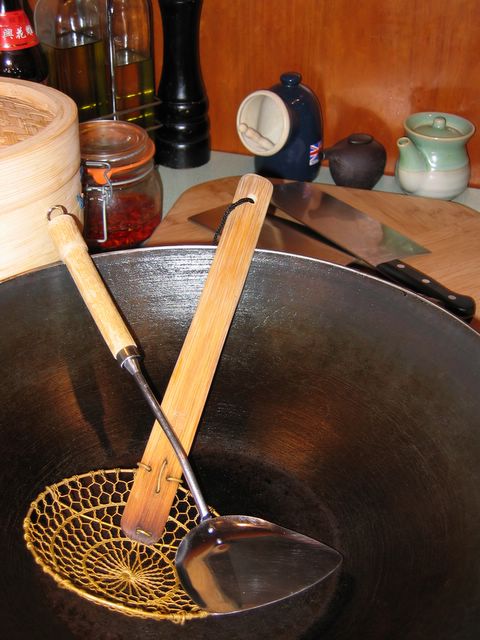
The cast iron wok surrounded by other Chinese cooking tools, including a bamboo steamer, bamboo cutting board, two cleavers, a wire and bamboo skimmer and the wok shovel.
Gong hay fat choy!
Or, in other words, happy new year!
Today is the first day of the Chinese year of the Rooster, and it is a good time to buy a wok. Buying kitchen utensils in the new year brings prosperity and luck to the kitchen. At least, it sounds good to me.
But don’t take it from me that it is a good time of year to buy a wok. Check out this New York Times article on the subject; apparently it really is a good time to purchase new kitchen goodies like woks. (Again, if registering to read the article torques your gizzard, try bugmenot, then read it anyway. I wouldn’t direct you there if it wasn’t good.)
I don’t need to buy a wok myself, mind you–I own four at this particular moment. Not that it would stop me from buying a nice hand-hammered one if I were browsing around in Tane Chan’s Wok Shop in San Francisco’s Chinatown, but I am not, so the wallet is safe. At least, for now. Though the article mentions some new iron contraption that lets you use a round bottomed wok on an American stove. It is supposed to be a great improvement over a wok ring, which keeps your wok too far from the heat–that is tempting.
Because then, I could -justify- having a beautifully made hand-hammered carbon steel wok.
Hmm. I must think on this.
At any rate, I use my woks for everything. I stir fry in them, of course, but I also deep fry in them. The shape of the wok means you use much less oil for deep frying than you do in a typical straight-sided pot or dutch oven. Indeed, deep fried foods like spring rolls are often the very first thing I cook in a wok after I season it, because the heat from the oil really opens up the pores in the metal and lets lots of the hot oil get in there. It hastens the natural patina process of continual seasoning that happens the more you use a carbon steel or cast iron wok.
I even scramble eggs in my woks. They cook faster and with less fuss in a wok than in any other pan. They are also fun to cook in a wok, which is really a substantial reason why I like cooking in them. It is fun.
My fifteen-year-old daughter was allowed to cook in my cast iron wok without me doing a lot in the way of assistance recently, and she took to it like crispy duck to a pancake. It was obvious to me that she had grown up watching my movements with using the wok, because she wasn’t clumsy at all with the wok shovel. (I cannot say the same for myself–there was that incident, long, long before she was born that I tried to help an inebriated friend make fried rice when I was equally inebriated. A lot of rice ended up flying through the air and landing on the floor. It wasn’t pretty. But the rice that stayed in the wok tasted really good.)
Upon tasting what she had cooked (the filling for char sui bai–steamed barbeque pork buns) and recognizing the presence of wok hay–the distinctive, but elusive flavor that comes from a hot wok, hot oil and properly dried food, was to jump up and down and dance around the room.
“It has wok hay!” she crowed as she pranced. Then she gobbled up another spoonful and boogied some more before declaring, “That was so much FUN! When can I do it again!”
She didn’t even mind cleaning the wok with the bamboo brush and hot water, then drying it on the stove, and rubbing a bit of oil over the hot surface to deepen the seasoning. “Can I make fried rice for breakfast tomorrow?” she pestered.
When I answered in the affirmative, she bounced some more and then capered off to stick her nose back into Grace Young’s The Breath of a Wok and digest more about the history, mystery and mastery of the Chinese kitchen.
Seasoning a new wok is really the only troublesome thing about owning one and it is so simple that I hesitate to call it a chore. A sidebar to the New York Times article gives Grace Young’s method which involves frying garlic chives in hot oil. I will have to try that on my next wok.
Did I say that?
Yes, I did. I know that I am going to get another wok or more in the future. I just know I am. Call me a wokaholic, I don’t care–I love the feel of them, the way they cook and the smell of them–yes, they have a smell. Well seasoned, or as the Chinese would say, “virtuous” woks have a smell to them–that is the essence of the breath of the wok–wok hay. My house often smells of it, especially in the winter when I cook with the windows closed. It is a scent that makes me comfortable and happy.
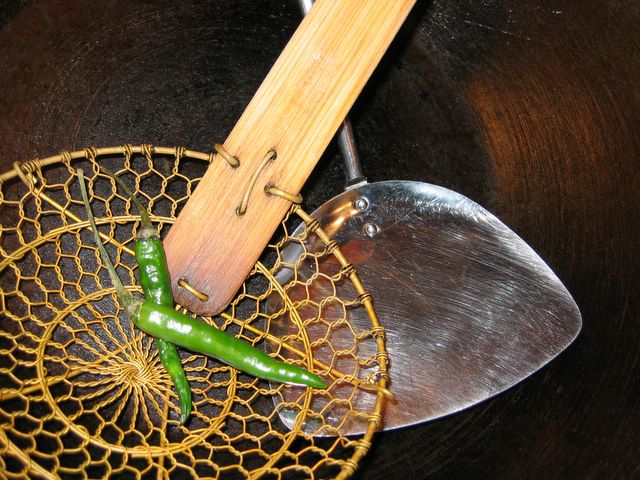
Closeup of wok shovel and bamboo and wire skimmer in the cast iron wok with two thai chile peppers for color.
When I taught Sichuan cooking a few weeks ago, as I was heating up my wok before putting the oil in, a student asked how I could tell if it was hot enough. I told her that the color of a cast iron wok will take on a slight greyish cast, that there may be a thin ribbon of smoke that will spiral out from the bottom of the wok, and that the wok will exhale, and you will be able to smell it.
So, they huddled around the stove and watched as I pointed out the signs. Just as I was about to point out the wafting wok hay, one very eager student nodded enthusiastically. “I can smell it! It smells–brown. And good.”
Indeed it does.
As I usually do when I teach newcomers how to cook Chinese, I spoke at length about woks, and how to use them, and why to use them. As usual, someone brought up Alton Brown’s assertion that one cannot effectively cook in a wok on an American stove, and I had to ask them if they would rather believe Brown, or their own senses. “How does the food taste?” I asked.
They couldn’t answer because they were too busy eating. Later someone said that her taste buds told her that Alton was on the wrong wavelength.
In conclusion, if you want to go out and buy a wok and bring some good new year luck and cooking karma into your kitchen, run right out and think of me while you do it. Pick up a cast iron or carbon steel one (avoid nonstick or stainless steel like the plague) season it, and then cook up a batch of spring rolls in it. Not only will you help along the seasoning of your wok, you will be symbolically bringing even more abundance and luck into your life by eating these traditional new year’s treats.
Spring rolls are eaten at the new year in China for two reasons. One, because they contain bamboo shoots, which are seasonal, and two, because they are shaped like old forms of Chinese gold money, which came in golden bars. My recipe is mostly traditional, except I add strips of lop cheong– sweet dry cured Chinese sausages. The rich chewy sweetness of them adds a lingering, caramelized note to the filling, which brings out the sweetness of the bamboo shoots and shrimp, while contrasting with the dark mystery of the black mushrooms.
Spring Rolls
Ingredients:
2 tbsp. peanut oil for stir frying
Cornstarch for dredging
2 tsp. fresh minced ginger
2 ounces fresh lean pork loin chop, sliced into thin strips, dredged lightly in cornstarch
3 links Chinese lop cheong pork sausage
1 large can shredded bamboo shoots
4 scallions, trimmed and cut into thin shreds
4 dried black mushrooms, rehydrated, and sliced thinly
6 fresh medium shrimp, peeled and deveined, then cut into small chunks, then dredged in cornstarch
1 tsp. sesame oil
1 tbsp. light soy sauce
1 tbsp.sugar
black pepper to taste
2 tbsp. Shao Hsing wine
1 pkg. spring roll skins (thawed, if frozen)
1 egg, beaten with 2 tbsp. water
Peanut oil as needed for deep frying (about 5 cups or so)
Method:
Cut sausage into diagonal slices, then into thin shreds, roughly the same size as the pork strips.
Rinse and drain the bamboo shoots at least twice in warm water to rid them of tinny taste. Pat dry.
Heat wok, adding 2 tbsp. of peanut oil. Stir fry ginger and scallions until fragrant. Add the pork and sausage, stir frying until the meat is cooked. Add bamboo shoots, mushroom and shrimp, then the sesame oil, soy sauce, sugar, pepper and wine. Remove from heat.
Allow filling to cool until you can handle it with fingers.
Wrap spring rolls: Place wrapper so one corner is pointed towards you, and place about 1 ½ tbsp. filling down near that corner, slightly off center perpendicular to the angle of the corner. Dip fingers in egg mixture, and rub along edges of skin on all four sides. Fold bottom corner over filling, then roll once. Fold in the left and right corners tighly, and roll, keeping wrapper tight around the filling. Add more egg wash along edges as needed. Wrap to the upper corner, and press down, sealing with plenty of egg wash.
Heat about five cups of oil in clean wok over high heat until nearly smoking. To tell if oil is hot enough, dip a bamboo chopstick or other utensil into wok. If bubbles form around chopstick and travel up breaking on the surface of the oil, the oil is ready. Cook spring rolls about 3 or four at a time, until golden and crispy. Drain on paper towels. Serve hot.
Variation:
Vegetable Filling for Spring Rolls: Leave out pork, sausage and shrimp. Add several extra mushrooms, and add jullienned baby carrots, celery and snow peas and lightly stir fry. Not traditional at all, but tasty.
Chinese Hot Mustard: Mix Chinese mustard powder with water, and allow to sit for at least two hours, or overnight to mellow.
Dipping sauces: Equal parts sugar, dark soy sauce, and rice vinegar mixed together. Add a small amount of sesame oil, and any or all of the following ingredients to taste: chili garlic paste, minced fresh ginger, minced garlic, minced scallion and freshly ground black pepper.
Kung Pao Creation Myth

The finished dish, still steaming hot in the wok. Note that there is not much sauce; what is there clings tightly to the ingredients, and does not pool in the wok.
We ate some of the chili last night. I made a mistake in forgetting that frozen chiles are much more hot than fresh or dried; I suspect that the really large ice crystals that form when the water in the cells of the fruit is frozen in a home freezer puncture all of the cell walls, thus releasing much more capsaicin than normally would be the case in normal cooking.
The upshot is that the two jalapenos and one chipotle were too many chiles for a large pot of chili. Which is not usually the case. Zak could barely eat it, and while I could eat it, I didn’t enjoy it at all; the flavors of all the other ingredients were overpowered by the chiles.
So, later in the week, another pot will be made, this time with roasted -fresh- peppers.
Zak made an interesting comment; he is able to eat much spicier Asian foods than Mexican; when I make Thai food or certain Sichuan dishes, they are actually much spicier than the chili was last night. Zak thinks it is because you eat rice with it, thus muting the heat; I think that is true, but it also has to do with the cooking method.
Most Mexican foods are stewed, which mingles flavors, while many Asian foods are stir-fried, which keeps flavors separate and distinct. Thus, there are many more discernable flavors going on in your average Thai or Chinese stir-fry than in your average Border cuisine such as chili, which has been simmered slowly for a long time.
Which leads me to the topic for today–Kung Pao Chicken.
Kung Pao Chicken is a perennial favorite at my dinner table; in fact, when my daughter, Morganna first broke out her new wok, it was the very first recipe she chose to cook in it, on her own, without help from Mom.
I am so proud of her.
I first fell under Kung Pao Chicken’s spell when I worked at Huy and Mei’s place; as is often the case, the first version I tasted is the one I wish to recreate in my kitchen. Huy made it very spicy, with many dried chili pepper pods scattered through the dish. He used celery and water chestnuts with the chicken, and there was a minimum of sauce clinging to the meat and vegetables, with no hoisin sauce in evidence. It was a very fiery, minimalist presentation.
After we moved to Athens, Ohio, I came to love a version created at my favorite Chinese restaurant there–China Fortune. They used a mysterious pale green vegetable that was tender-crisp and mildly flavored. Years later, when I was peeling broccoli stalks to add to cream of broccoli soup, I popped a sliver of it in my mouth and realized what those unidentified celedon-tinted vegetables were–peeled and sliced broccoli stalks. Ever frugral, the chef had used what many Americans throw away, along with onions, green bell peppers, celery and water chestnuts, to add further texture and flavor to the spicy chicken dish.
I have since used both broccoli stalks and kohlrabi to great effect as a vegetable in kung pao chicken dishes, though my favorite of all is fresh water chestnuts. These days, I use what I have and don’t fret about it–I think that most vegetables that are presented in the dish in the United States are not “traditional.” I am fairly certain that they exist as filler material; from what I can gather from my study the original dish, which hails most likely from Sichuan province, though Hunan province also claims it, the main ingredients are simply diced chicken breast and peanuts seasoned with dried chilis and Sichuan peppercorns.
As I cooked my version of Kung Pao a few days ago, I began to wonder about the origin of the dish. I had just recieved a copy of Henry Chung’s Hunan Style Chinese Cookbook, by the proprietor of what is popularly believed to be the first Hunan restaurant in the United States, “Henry’s Hunan” in San Francisco. As I was looking through this widely acclaimed out-of-print volume of recipes, I came across a recipe for Kung Pao chicken, along with the author’s assertion that it was named for a famous Hunan general, General Tso, because it was created by accident when his little son playfully threw a handful of dried peppers into the wok while the chef was cooking a dish of diced chicken. They singed and flavored the entire dish with the smoky fire of the peppers, but the General liked it so much that the dish became known by his official title, Gong Bao, or Kung Pao.
There is a real dearth of Hunan cookbooks printed in English (Fuchsia Dunlop is apparently working on one, bless her); Henry Chung’s is widely considered to be the best of them, so I have no reason to doubt his assertions. The minimalist approach of his recipe does seem quite in line with the authentic Sichuan recipes for the dish I have cooked and read from such authors as Dunlop and Ellen Shrecker, author of Mrs. Chiang’s Szechwan Cookbook, another out-of-print gem.
Dunlop adds Sichuan whole peppercorns to her version, which adds a fragrant touch, while Mrs. Chiang, Shrecker’s cook and inspiration, used both fresh and dried chile peppers in order to make a very incendiary version of the dish. All of these versions, however, focus on the three main ingredients: chicken, peanuts and chile peppers, even as they each tell different origin stories regarding the creation of the dish.
The generally accepted tale involves either a general or a public official of some sort who loved the fiery dish and so it came to have his name. It is not unusual for Chinese dishes to be named for the epicure whose sensitive criticism involving the dish was involved in the creation and refinement of the dish by the (usually) unnamed chef. Dunlop’s rendition of the tale names the man as a late Qing dynasty official (late 19th century), Ding Baozhen, who was the governor of Sichuan province. She gives three possible origins for the dish: one possibility is that it was brought by Ding’s cook from their home province of Guizhou, another is that he ate it in restaurants where he dressed as a commoner in order to experience the lives of his subjects, and another story relates that his chef invented it because the governor’s teeth were so bad that he couldn’t chew anything that wasn’t cut into a small dice or mince. (That seems highly unlikely, however, as peanuts, a necessary ingredient, are not easy to chew with weak teeth.)
She goes on to inform us that while the dish continues to be popular in China, during the Cultural Revolution, it was renamed by radicals to “Gong Bao Ji Ding,” (Fast Fried Chicken Cubes) or “Hu La Ji Ding,” (Chicken Cubes with Seared Chiles) in order to disquise its unpopular affiliation with an Imperial bureaucrat. (Page 238, Land of Plenty, Fuchsia Dunlop.)
An online source gives the following explanation:
“One of the most famous Chinese dishes and a perennial foreigner favorite is Kung Pao Chicken (gongbao jiding). This dish first became popular in Sichuan and its legendary origin is a good example of the willingness of Chinese chefs to improvise. According to the legend, this dish is named after Ding Baozhen, who served under the Qing dynasty (1644-1911) Emperor Xianfeng as the governor of Shandong province. One day he arrived East China’s home with asgroupsof friends, but his cook hadn’t prepared for guests, and had but a meager chicken breast and some vegetables in the kitchen. The cook diced the chicken//into//tiny bits, and fried it up with cucumber, peanuts, dried red peppers, sugar, onion, garlic, bits of ginger – sundry ingredients that had been lying around the bottom of the cupboard.
Ding Baozhen and his guests really enjoyed the improvised meal, so much so that it became a regular item on the menu. Eventually, Ding Baozhen was promoted to Governor General of Sichuan Province, and his cook went with him to Sichuan//where//he began experimenting with the local product, including hot broad bean sauce and Sichuan chili peppers. Soon the humble chicken dish was all the rage in the province. The people honored Ding Baozhen by naming the dish after his official name, Gongbao. The moral of this story: If you work hard at your craft, like Ding Baozhen’s chef, one day a dish will be named after your boss.”
Of course, my favorite part is the moral of the story. It is typical for dishes in many cuisines to be named in honor of someone else rather than the chef who created them. Think of the dessert, Pavlova, or Beef Wellington. No, the great dancer was not making fruit-filled meringue baskets on her day off, nor was the strategist of Waterloo down in the kitchen wrapping a tenderloin with pastry. Someone else did the creation; I suppose it is a testiment to the humility of chefs that they are content with making masterpieces that are remembered by other people’s names.
At any rate, though my intellectual curiousity is piqued by the idea of where Kung Pao Chicken came from and I will likely keep doing research to see what I can dig up, what matters most to me is the flavor. That is the heart of why the dish is so popular in both China and the United States–because it is a satisfying collection of contrasting colors, aromas, textures and flavors that come together into a glorious whole.
Here is my recipe for Kung Pao Chicken, as I cooked it last week. The vegetables are a matter of personal preference and availability. I happened to have jalapenos and baby carrots around that night, so that is what I used. If I had water chestnuts and kohlrabi sitting in the fridge, that is what I would have used. Just make sure and cut them so that they match the diced chicken in size and approximate shape.
This is an adaptation of several recipes, including both Dunlop and Mrs. Chiang’s recipes, as well as the recipes I have deconstructed from several restaurants. You will note that I added a teaspoon of hoisin sauce; while it is not traditional, as near as I can tell, many Chinese restaurants in the US add it to their Kung Pao. Zak likes the flavor, so I use just enough to give it the essence of hoisin without turning the dish into a sweet, gloppy, overly sauced mess.
You will also note that I grind the Sichuan peppercorns. That is because I adore the flavor, but I don’t like the texture of the whole ones in a stir-fried dish.
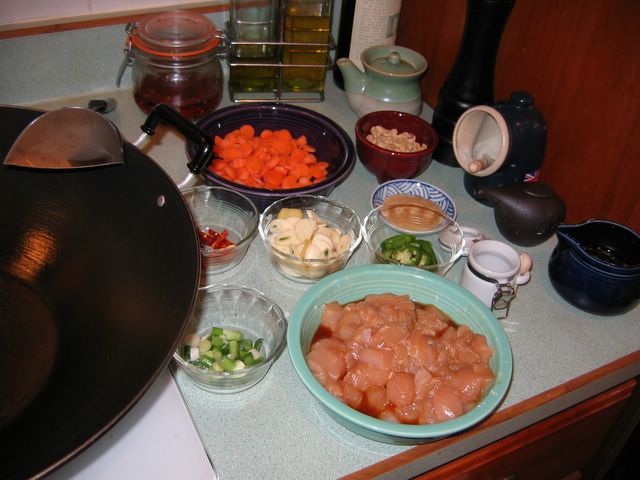
The ingredients for Kung Pao Chicken sit close at hand while the wok heats up.
Kung Pao Chicken
Sauce Ingredients:
2 tsp. raw or brown sugar
1 tsp. cornstarch
1 tsp. dark soy sauce
1 tsp. light soy sauce
3 tsp. Chinkiang black rice vinegar
1 tsp. hoisin sauce
1 tsp. toasted sesame oil
1 tbsp. chicken broth
Ingredients:
2 boneless, skinless chicken breasts cut into 1/2″ cubes
2 tsp. light soy sauce
1 1/2 tbsp. Shao Hsing wine or dry sherry
2 1/2 tsp. cornstarch
Peanut oil or canola oil for stir frying
1 tsp. freshly ground Sichuan peppercorns
6-10 dried red Chinese peppers*
4 cloves of garlic and an equal amount of fresh ginger, both peeled and thinly sliced
3 scallions, white and light green parts, sliced into chunks as long as their diameter (to match the chicken cubes)
1 or 2 jalapenos, cut into thick slices about the size of the chicken cubes
handful of baby carrots cut into round thick slices to match chicken cubes
2/3 cups dry roasted unsalted peanuts
Method:
Mix together sauce ingredients well and set aside. I like to use a small measuring cup for this, so I can tell how well mixed it is, and so it is easily poured into the wok when the time comes.
Mix together chicken and next three ingredients–set aside to marinate while you are cutting up vegetables.
Heat oil in the wok, and when it is nearly smoking, add Sichuan peppercorns and chiles. Stir and fry until very fragrant. Add chicken, and settle into a single layer on the bottom of the wok. Allow to begin browning without stirring–about 30 seconds to one minute. Stir and fry. Add garlic and ginger, and jalapenos if you are using them. Stir and fry until the chicken is nearly done.
Add carrots and stir and fry until chicken is done. Pour in sauce ingredients, bring to a boil, and cook until it clings to all ingredients. Add peanuts and toss to coat.
* I use Tien Tsin dried chilis from Penzey’s. They are wickedly hot little buggers, and I love them. To keep them fairly mild, use them whole. To make them a little hotter, snip them and sprinkle the seeds out, but expose the placental membranes where most of the capsaicin lives. For the hottest effect, snip them open and let the seeds fall into the wok and carry their heat all over the dish. If you are using fresh chiles as well, cut down on the number of the dried chiles. That is, unless you want to hurt your guests, in which case, use the maximum number of dried chiles with the seeds running loose and throw in four or five sliced jalapenos.
Chupacabra Part Two
As promised, here is a link to the art for the Chupacabra chili t-shirts we are having made through CafePress. The plan is to wear shirts to the Fiery Foods Festival and also give out postcards with the art on them to every person who tastes the chili. Each card will have a different number on it, along with the web address for Tigers and Strawberries along with an email address for me. I’ll post a random number chosen from the cards on the blog, and whoever has that postcard emails me or leaves a comment on the blog. They win a t-shirt of the size of their choice which we will order from Cafe Press and have sent to them.
Fun, huh?
Zak said I should get a Chupacabra Chili thong, however, I disagreed. I am not into the thong thing.
At any rate, I want to take this opportunity to thank Zak, the creator of not only the fantastic Chupacabra Chili art, but also the lovely tiger and strawberry images which grace my blog. He also did the pretty customizations of the background and the text and all of that. Without him, my blog would be boring indeed.
If you are interested in his art, or his music or comics or writings and whatnot, check out his website. And if you need any custom art, well, I bet he can handle it for you, though probably not until after we have moved and are settled in our new home, sometime in late March or early April.
Chupacabra Sunday
My Mom and Dad are big football fans, so I grew up watching the Super Bowl; Mom always made chili for supper, and we’d have friends over to watch with us. Mom’s chili is sort of your typical Americana ground beef and kidney beans affair, not at all spicy, but it tasted good and it was soul-stirringly hearty. Years later, I found out why it was so filling and thick–she used to put a stick of margarine in at the end. The thought of that much transfat, however, sends my arteries cringing in horror, so I don’t bother replicating that recipe.
Presently, however, due to the fact that I can take or leave football, and Zak doesn’t like it one iota, the two of us will forget for weeks that we even own a television, we don’t watch The Game.
So, there is no set menu for that particular Sunday even when we are aware enough to know which Sunday on which it falls.
This year, by odd chance, I got up on Super Bowl Sunday, trotted downstairs and started up a pot of chili.
Not just any chili, however.
Chupacabra Chili.
Before we go into what is Chupacrabra Chili and why the heck I bounced out of bed to make it if we are not having anyone over for Super Bowl Sunday, which we most certainly are not, let us talk about chili.
While at Johnson & Wales culinary, I had the task of helping to cook for various dorms at various times. My favorite was a grad student dorm that was located far from the main campus in downtown Providence, out in Warwick, near my apartment in seedy and unscenic Cranston. The kitchen was under the leadership of Chef Paul, a wonderful little man who was utterly laid back and unconcerned about any crisis. We never had to be yelled at, because we all liked him so much, we cooked our hearts out for him.
His teaching assistants, all students in the MA track of the culinary school, were equally laid back and fun. They were all younger than I, but were very respectful of my abilities and knowledge. Two of them were Yankee chile heads and adored spicy food, and another was a Latino who worked his heart out every day, and never ordered a student to do something that he wasn’t willing to do himself.
They discovered that not only could they give me my assignment and leave me alone and then find it finished to perfection at the time of service, they discovered that I worked very fast, and was well-versed in the art of chili making. They found out that I could make a good, fast pot of chili out of nearly any ingredients that were just sitting around in the walk-in or on the shelves. I was equally good at gumbos and stews, but since they liked chili it was usually chili they were having me make. If we were short an entree or a soup for lunch or dinner, one of them would come to me and say, “Barbara, can you make a pot of chili–we don’t care what kind.”
“How much time do I have?” was my usual reply as I reached for my knife case.
Usually it was three hours or more, but now and again, it was two hours or less. When it was a rush job, I usually utilized leftovers from the walk in and co-opted the service of Beth, my preferred working partner, the only other woman in our particular group rotation. Under my direction, the two of us could bang out pots of different kinds of chili in record time, and due to various techniques and some trickery, we usually manage to make it taste like it had cooked for hours.
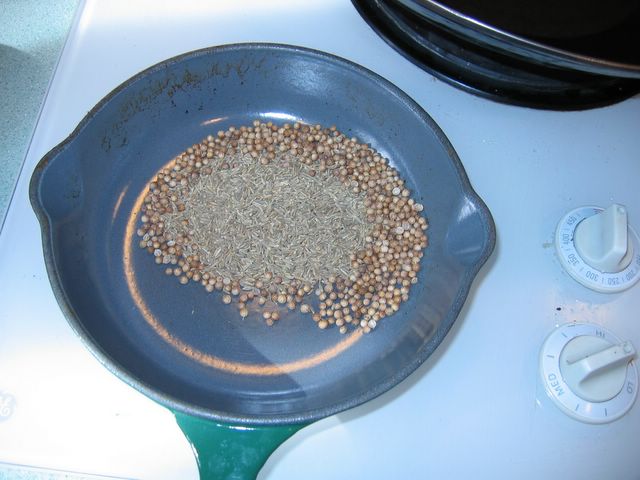
Toasting the cumin and coriander seeds in a small enamelled cast iron pan. Toasting the seeds brings the essential oils to the surface and makes them more fragrant while also creating a nutty flavor.
We became known as “The Chili Queens.” Which of course made me laugh, because way back in the 1880’s, it is said that Texas Red, the ur-chili, if you will, was, if not invented, popularized by women who would cook it and sell it on the plaza down in San Antonio. These ladies, all of whom apparently overflowed with personality, and some of whom were singers, were known as Chili Queens.
I wrote down a recipe for each of the many pots of chili we made, so in my collection I have something like 10 or 12 variants from that time period. There was the classic Texas Red that convinced the TA’s I knew from chili–stewing beef, chile peppers, both fresh and dried, cumin, onion, garlic, beer and some tomatoes, with a sprinkling of cilantro at the end. No beans, of course. If you put beans in chili in Texas and call it chili, they’ll hang you. Or at least call you a Yankee and laugh at you. Beans go on the side, if you must eat them with the sacred chili at all.
And then there was the classic Americana Chili that I based on the one I grew up with, though I dispensed with the margarine thickener. While I was cooking that recipe, Chef Paul told me that it used to be common in the food service industry to thicken that dish with peanut butter–it basically acts like instant roux and the chili is so strong you cannot taste the peanut flavor. However, when waiters failed to inform those with peanut allergies of its presence in the chili, there were tragic consequences. In one case Chef Paul knew of, a woman died.
That is even more of a horrifying thought than all the margarine I had unknowingly ingested at my mother’s table for years.
Needless to say, Beth and I did not put anything remotely peanut-like in any of our chilis. Though, I will ‘fess up to using zucchini in some vegetarian versions; the bland squash really picks up and carries the chile and cumin flavors without asserting any character of its own.
Everyone’s favorite innovation was my version of a white chili made with canellini beans, poblano and jalapeno chiles. Instead of chicken, I used cubed pork shoulder. I browned the onions in bacon fat, and then at the end added leftover roasted corn cut off the cob. That was a favorite of everyone, and it became the standard chili at my house, because Zak who didn’t adore Texas Red, would slurp down two bowls of the white pork chili with gusto and come back for more.
In honor of my Jewish husband’s love of the distinctly unkosher dish, I called it “Pale Treyfe,†though a quip from my brother-in-law gave it the better name: “Sacrilicious.â€
Through a twist of fate, the chili known as “Sacrilicious†became “Chupacabra Chili‖ a slightly more observant Jewish friend invited me to visit and I offered to bring the house chili, though I said I could substitute lamb for the pork. Intrigued, he said, “Sure–I want to try lamb chili.â€
So, I set out for Bluescreek Farms Meats in the North Market to pick up some lamb stew meat. When I got there, I saw that they had, in addition to delicious free-range organic lamb raised, some goat meat of the same quality. And I said, “I wonder what goat meat would taste like in chili?â€
So, I bought some and set to finding out.
Instead of cooking the cannellini beans with a ham hock as I usually did for the treyfe version, I used the bone from a leg of lamb I had roasted earlier that week, and since I had no lager beer, I used brown ale. For chiles, I roasted some poblanos and jalapenos as I usually do, and added some chipotle en adobo to replace the smoked flavor of the ham hock. I had a cob of grilled corn left over from the same dinner with the leg of lamb, so I cut the kernels off the cob and added that, and I had some fresh Green Zebra tomatoes laying around, so they went in at the very end to add a hint of acidity and lovely chunks of bright green goodness.
It turned out to be one of the best damned pots of chili I had ever made. The lamb and goat meat were rich and strongly flavored enough to stand up to the chili heat and all the cumin and coriander seeds, while the corn added a top note of sugary sweetness mixed with the smoky depth from the grill. The tomatoes were perfect, and everyone who tasted it wanted to know what I was going to call it.
The original name was Apocalypse Chili, which was a rather heretical joking reference to the bit in the Book of Revelation about how when Judgment Day comes, “He shall separate the sheep out from the goats.†However, I decided that was a bit too likely to offend someone, and so I named it instead after Zak’s favorite cryptozoological wee wicked beastie–the one, the only Goatsucking fiend! El Chupacabra.
So, why was I making this chili today?
It is a practice run for the North Market’s second annual Chili Cook off, which is coming up on February 19. I wanted to see if I could adapt the recipe to a winter cupboard–I have no fresh corn or tomatoes available, nor do I have a leftover lamb leg bone laying around. Rather than be bold and just make a batch the day before the contest and leave it all to chance and instinct, I decided to try my adaptation first and see what I thought.
I ended up replacing the fresh tomatoes with sun dried tomatoes and will then add fresh tomatillos about twenty minutes before serving it as I simmer it to heat it up tomorrow. The grilled corn was replaced by posole; while it lacks the honeyed sweetness of corn on the cob, it has an expansive, rich corn flavor and is wonderfully chewy. And for the leftover leg bones, Cheryl at Bluescreek sold me a lamb shank, which worked admirably.
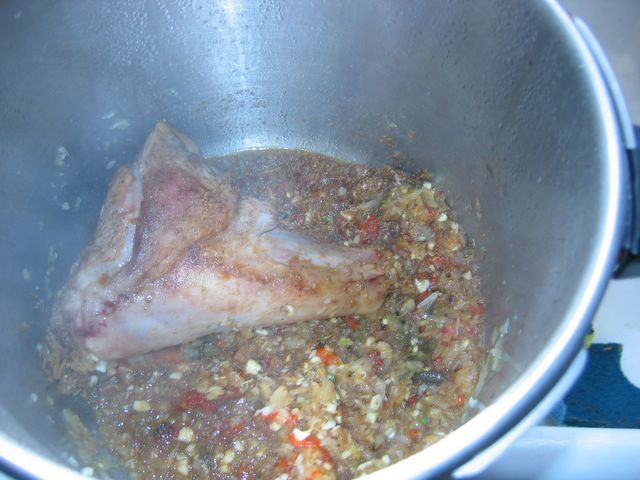
Browning the lamb shank along with the onions, garlic, spices, roasted bell peppers and jalapeno chiles.
When it was done, after a couple of hours in and out of the crock pot, I came to this conclusion–since the lamb and goat make a nice, rich brown sauce, I am going to ditch the white beans for either pintos or more exotic Anasazi beans; the posole and beans are both white and so there is no color contrast there. And the sun dried tomatoes–while flavorful, were too dark and raisin-like in appearance and texture for my taste. Instead of them, I will probably use a can of Muir Glen fire roasted tomatoes.
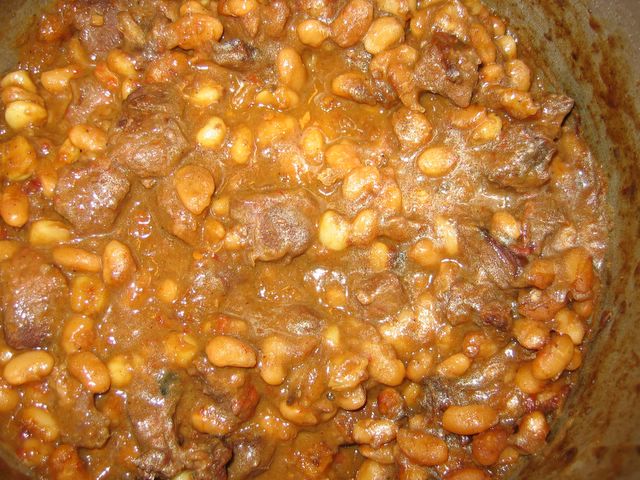
The mostly finished dish. I will post a picture of the completely finished dish tomorrow–it needs fresh tomatillos added as it heats up and fresh cilantro sprinkled over it before serving.
The chiles–roasted, frozen jalapenos I processed this fall, and chipotle en adobo worked admirably, especially since I paired them with frozen roasted red bell peppers. The tomatillos will add considerably to the color and texture possibilities as well as adding a sweet and sour note to the flavors. I may add a bit of frozen corn to give another color and flavor contrast.
All in all, I am pleased with Chupacabra Chili II: Culinary Bugaloo–it is extremely good, and with the changes I outlined above, will be a serious contender in the cook-off.
I have to make sure it is really good, as Zak is working right now on t-shirt designs for us to wear to the event.
More on the art tomorrow.
Goodnight, and I hope you had a Happy Chupacabra Sunday! I know that I did, that is, until my computer froze up and I lost most of this post and had to recreate it. Fun!
Scary Cookies
If this wasn’t a legitimate news outlet, I would be suspicious of this story.
Two young girls baked cookies and tried to give them to a neighbor, but she was afraid because they knocked on the door after dark?
And then, not only does she not open the door to see who it is and accept the cookies, she flees her home and then has an anxiety attack that is so bad she thinks she is having a heart attack and goes to the ER?
And -then- when the girls ‘fess up to the heinous crime of trying to give the woman home-baked cookies, and apologize for frightening her and her parents offer to pay the medical bill if she will sign a paper releasing them from any more liability, she -refuses- and takes them to court anyway?
And WINS?
Excuse me, but there is simply something wrong in the United States if a judge would award anything to this woman but a boot in the seat of her pants. I do not understand why the case wasn’t tossed summarily out of court. It is ridiculous.
And it all happened because two girls decided to be charitable and make cookies for the neighbors. How dare they?
I’m glad that my neighbors are nowhere nearly so weird. They accept my gifts of baked goods not only with good grace, but with great glee.
They especially like these:
Raspberry Almond Crumb Bars
2 ½ cups all purpose flour (or 2 cups white and ½ cup whole wheat flours)
1 cup raw sugar
1 cup chopped almonds
1 cup softened butter
1 egg
1 tsp. almond extract
¼ tsp. ground ginger
½ tsp. ground cardamom
½ tsp. ground cinnamon
¾ cup seedless raspberry preserves
Combine all ingredients except preserves in mixing bowl and beat on low speed until mixture resembles coarse crumbs. Reserve 2 cups of crumb mixture.
Spread preserves in an even layer within ½ inch of edge.
Seriously, I hope that Lindsey Jo and Taylor do not lose their instincts for kindness and generosity because of this obviously greedy and disturbed self-centered woman. I really hope that they don’t become cynical and lose their ability to engage in random acts of kindness. Such caring is rare in the world and I would hate to see it crushed by the small-hearted miserliness of a person who has been coddled by a dull-witted judge.
Meanwhile, I am fighting my urge to start a campaign to send the woman in question piles of chocolate chip cookies made with Exlaxx.
I’d never do it.
But boy is it a tempting thought.

Categories:
- Admin (rss) (55)
- Blogs and Blogging (rss) (81)
- Book Reviews: Cookbooks (rss) (43)
- Book Reviews: Non-Cookbook Food Books (rss) (38)
- Cats and Cat Blogging (rss) (47)
- Chinese Cooking Lessons (rss) (32)
- Culinary School Stories (rss) (18)
- Dairy Pruducts: Cultured and Barbaric (rss) (4)
- Documentary Filmmaking (rss) (1)
- Essays, Rants and Reflections (rss) (260)
- Fighting Hunger (rss) (12)
- Food and Kids (rss) (45)
- Food in the News (rss) (126)
- Food Media (rss) (98)
- Food Preservation (rss) (18)
- Food Safety (rss) (45)
- Gardening (rss) (30)
- Herbs and Herb Blogging (rss) (20)
- Holidays (rss) (50)
- Kat Blogging (rss) (22)
- Kitchen Science (rss) (36)
- Leftover Makeover (rss) (8)
- Life, the Universe and Everything (rss) (131)
- Local and Sustainable (rss) (227)
- Local Athens Food and Foodies (rss) (42)
- Meatless Mondays (rss) (32)
- Menu For Hope (rss) (5)
- Nutrition, Diet and Health (rss) (84)
- On The Farm (rss) (8)
- Recipes: Almost Vegetarian, Vegetarian and Vegan (rss) (294)
- Recipes: American Regional (rss) (37)
- Recipes: Appalachian Hillbilly (rss) (33)
- Recipes: Bread, Pasta, Grains (rss) (95)
- Recipes: Canning and Preserving (rss) (8)
- Recipes: Chinese (rss) (123)
- Recipes: Comfort Food (rss) (120)
- Recipes: Cookies (rss) (16)
- Recipes: Desserts (rss) (48)
- Recipes: French (rss) (25)
- Recipes: Fruits and Vegetables (rss) (302)
- Recipes: Greek, North African and Middle Eastern (rss) (31)
- Recipes: Indian (rss) (137)
- Recipes: Italian (rss) (42)
- Recipes: Japanese (rss) (7)
- Recipes: Jewish (rss) (4)
- Recipes: Korean (rss) (6)
- Recipes: Meat, Poultry and Fish (rss) (220)
- Recipes: Mexican/Native American/ Latin American/Caribb (rss) (27)
- Recipes: Original (rss) (108)
- Recipes: Thai (rss) (27)
- Recipes: Tofu (rss) (17)
- Recipes: US Regional (rss) (16)
- Recipes: Vietnamese (rss) (8)
- Restaurant Stories (rss) (28)
- Sewing, Quilting, Arts and Crafts (rss) (16)
- Simple Chinese Recipes (rss) (30)
- Slow Food and Heritage Foods (rss) (10)
- Spice Blogging (rss) (44)
- The Chinese Cookbook Project (rss) (14)
- The Chinese Pantry (rss) (39)
- The Documentary (rss) (2)
- The Kitchen Saga (rss) (17)
- The Locavore's Bookshelf (rss) (15)
- The Unsung Adventures of The Culinary Nerd (rss) (6)
- Tools and Toys (rss) (35)
- Uncategorized (rss) (10)
- With a Side of Politics (rss) (48)
Archives:
- August 2012 (9)
- July 2012 (12)
- September 2011 (3)
- August 2011 (7)
- July 2011 (8)
- June 2011 (16)
- May 2011 (17)
- April 2011 (11)
- December 2010 (9)
- November 2010 (5)
- February 2010 (1)
- December 2009 (5)
- November 2009 (7)
- October 2009 (10)
- September 2009 (16)
- August 2009 (14)
- July 2009 (14)
- June 2009 (7)
- May 2009 (17)
- April 2009 (10)
- March 2009 (25)
- February 2009 (13)
- January 2009 (10)
- December 2008 (5)
- November 2008 (5)
- October 2008 (6)
- September 2008 (13)
- August 2008 (8)
- July 2008 (11)
- June 2008 (18)
- May 2008 (13)
- April 2008 (14)
- March 2008 (16)
- February 2008 (17)
- January 2008 (19)
- December 2007 (25)
- November 2007 (18)
- October 2007 (24)
- September 2007 (16)
- August 2007 (15)
- July 2007 (15)
- June 2007 (10)
- May 2007 (14)
- April 2007 (16)
- March 2007 (17)
- February 2007 (20)
- January 2007 (13)
- November 2006 (1)
- October 2006 (8)
- September 2006 (14)
- August 2006 (25)
- July 2006 (30)
- June 2006 (28)
- May 2006 (34)
- April 2006 (29)
- March 2006 (24)
- February 2006 (30)
- January 2006 (38)
- December 2005 (40)
- November 2005 (37)
- October 2005 (32)
- September 2005 (25)
- August 2005 (30)
- July 2005 (28)
- June 2005 (21)
- May 2005 (8)
- April 2005 (22)
- March 2005 (17)
- February 2005 (29)
- January 2005 (10)
Search Site:
Links:
- Lily’s Wai Sek Hong
- 101 Cookbooks
- A cat in the kitchen
- A Veggie Venture
- Accidental Hedonist
- Cha Xiu Bao
- chez pim
- Chocolate & Zucchini
- Chopstick Cinema
- Chowhound.com
- Chubby Hubby
- Cook sister!
- Cooking with Amy
- da*xiang
- Eat Local Challenge
- Eating Liberally
- Ecocentric
- Eggbeater
- Epicurious
- Farmgirl Fare
- Fatfree Vegan
- Foodgoat
- ForkandBottle.com
- Green Olive Tree
- Hooked on Heat
- Jaden’s Steamy Kitchen
- Kalyn’s Kitchen
- Lucullian delights
- Mahanandi
- Matt Bites
- MeatHenge
- mmm-yoso!!!
- New York Times – Dining & Wine
- Pizza Goon
- Rasa Malaysia
- Ruhlman
- Sailu's Kitchen
- Serious Eats
- SF Gate: Food & Dining
- Simply Recipes
- Soul Fusion Kitchen
- Tastespotting
- The Amateur Gourmet
- The Cleaner Plate Club
- The Food Section
- The Grub Report
- thecookscottage
- U.S. Food Policy
- Wandering Chopsticks
- Washington Post Food and Dining
- Wasted Food
Meta:


Powered by WordPress. Graphics by Zak Kramer.
Design update by Daniel Trout.
Entries and comments feeds.