
Cook Local, Eat Global
A Little Food Art For Your Weekend
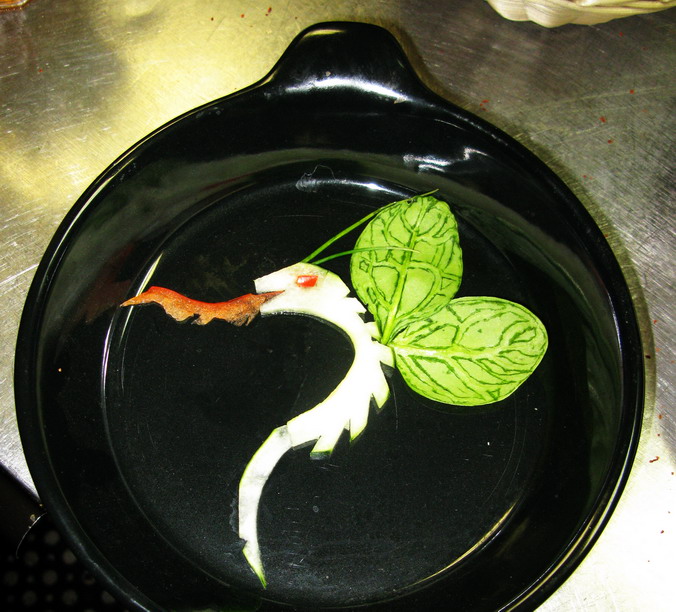
This little dragon was carved by Morganna last night in the kitchen at Salaam, before our rush of customers came in for dinner. She started playing with her paring knife and a spinach leaf, and ended up essentially tooling it as one would do leather, in order to put the three-dimensional veins on the wings, although she admitted that when she first started working with the spinach, she didn’t have the dragon in mind.
Now, the truth is, I have never seen anyone tool spinach leaves. I am not saying that no one has ever made a garnish from tooled spinach leaves–I just have never seen it done before. And I think it was pretty cool, especially considering that Morganna swears up and down that she doesn’t have patience to make fiddly things like carved garnishes and isn’t into it. (Mind you, she makes tomato lotus blossoms all the time for garnishes at Salaam, and last night asked for me to show her how to make tomato roses, but she doesn’t consider making those to be particularly fiddly.)
For someone who isn’t into doing fiddly stuff, the spinach leaves are pretty fantastic.
After the first spinach leaf was done, she did another, and then decided to carve the dragon out of two thin diagonal slices of seeded cucumber. A paper-thin slice of red bell pepper became the flames and the eye (she cut a hole in the dragon’s face for the eye, and then the pepper showed through when she laid the bell pepper under it.)
A pair of chive leaves made the dragon’s horns, and completed the little carving.
I think it would make a beautiful presentation on a big square black platter with sushi on it–like a dragon roll, perhaps? Of course, we don’t do sushi at Salaam, so I am trying to figure out a context where we could use a pretty vegetable carving like this on one of our platters.
Maybe my readers can come up with an idea?
A Simple Sauce For Two Different Baked Fish
I have always been partial to baked fish; ever since I made psari plaki for the first time as a poor college student in my first apartment, with fresh trout a fisherman friend had given me for free, I was hooked. I decided to make the psari plaki for the first time because there are only so many meals of breaded and fried trout one can eat, even as a penniless student. But, it being summer, with lots of fresh tomatoes to be found, along with cheap lemons, I decided to try one of the recipes in my Greek cookbook, and was glad I did.
Baking fish is a simple matter, but many things can go awry.
One can easily over-cook the fish, taking it from steamy-tender, flaky and delectable to dried-out, gummy and disgusting within the span of only a few minutes.
And that is always a shame. I so despise wasting a beautiful food like fish.
There are a few things one can do to make certain that this tragedy does not occur. The main one being of course, is to know exactly how long to cook your fish to perfection and not to deviate from that plan. Another helpful tip–under-cook your fish slightly and remove it from the oven early, then let it sit on the counter to finish cooking under its own heat while you prepare the rest of your meal. (This is the way I tend to do it–I cook the fish until it is barely done, remove it from the oven and then let it finish itself while I am busy with salads and the like.)
The fun thing about baked fish, other than its utter simplicity is that you can add so many delicious flavors to it depending on whatever sauces, aromatics, spices, vegetables and fruits you bake with it. You can completely change the character or a fish by simply changing the sauce.
Or as in the case of the two dishes shown here, you can keep the same sauce and change the vegetables that are baked with the fish.
The sauce I am presenting here is inspired by a Moroccan sauce used commonly on fish which is called chermoula. Chermoula is featured not only in the cookery of Morocco, but also Algeria and Tunisia, so as you can well imagine, there are many different interpretations of the sauce, but at its core, it is a mixture of lemon juice, olive oil, fresh herbs, garlic, salt and cumin.
The versions I have cooked and eaten at Restaurant Salaam and elsewhere usually include cilantro and perhaps parsley, with a fair amount of garlic but I determined I wanted to go in a different direction, and put the garlic front and center. I used a much greater proportion of garlic in my sauce, along with a large amount of freshly toasted cumin seeds ground finely, some Turkish kirmizi chili flakes, fresh parsley and a fair amount of harissa, the spicy roasted red pepper and chili sauce of Morocco.
Blended together in the food processor, this deep yellow sauce packs a walloping punch of flavor in each drop, but it somehow manages to stay delicate enough to enhance the delicate flavors of seafood without masking them.
As the kitchen staff at Salaam discovered, it makes an awesome dip for bread as well, as we all began snacking on the few ounces that were left the first time I used it for baking fish.
I also want to pan sear black peppercorn and coriander seed crusted lamb chops and then serve them in a pool of this liquid gold. I think that would be like eating bits of heaven right there.
But for now, let’s talk about how to use it with fish.
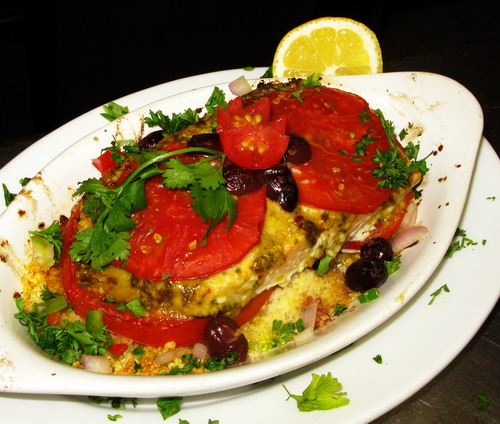
In the photograph above, I oiled the casserole with a bit of olive oil, then added about a half cup of cooked couscous. Then, I placed about two or three tablespoons of the prepared sauce over the couscous, then layered two thin slices of fresh local beefsteak tomato over it all. This I sprinkled with halved, pitted kalamata olives. A four ounce filet of wild-caught Alaskan salmon that had been marinated in the sauce for an hour was put on top, and then was covered with two more slices of tomato. A design of halved kalamata olives was placed on the top. This was baked in a 400 degree F. oven for about twelve to fifteen minutes, until the fish just flaked and the tomatoes were juicy and bubbly. For garnish, more minced parsley and a tomato lotus with a cilantro sprig made the baked dish look as splendid as it smelled and tasted. (We sold out of this very quickly.)
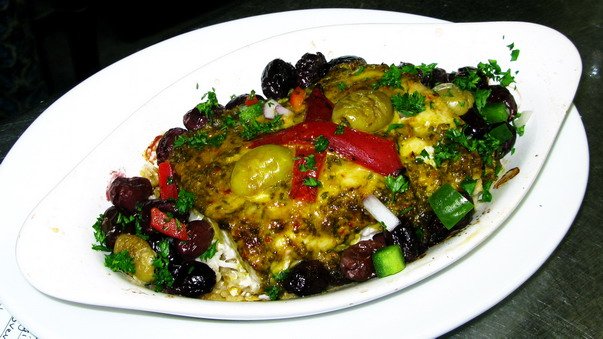
Now with in the photograph above, you see a more straightforward presentation of baked mahi-mahi using the chermoula-like sauce. Here, I marinated the fish filets for an hour in the sauce, and placed it directly above a layer of mixed pitted green and black olives. This I garnished with some slices of roasted red pepper and sliced kalamata olives.
Even though the two types of fish are quite different: salmon is oilier and more strongly flavored and mahi is a delicate, firm-fleshed white fish, they were both beautifully enhanced with this sauce. I cannot wait to try using this sauce with grilled shrimp or seared scallops!
So, without further ado, here is the recipe for a sauce which I have decided to call Sauce Salaam.
Sauce Salaam
Ingredients:
15 to 20 garlic cloves (this depends on how strong your garlic is and how big the cloves are….)
1 cup roughly chopped fresh parsley leaves
1/3 cup freshly squeezed lemon juice
1 cup peppery extra virgin olive oil
1 teaspoon cumin seeds toasted lightly in a heavy-bottomed pan and ground into a powder
1 1/2 tablespoons kirmizi or Aleppo pepper flakes
1 1/2 teaspoons harissa sauce or to taste
1/2 teaspoon sea salt
Method:
Put the garlic and parsley leaves in the bowl of a food processor and process until the two are minced finely.
Add the other ingredients and process until the oil and lemon juice are emulsified into a thick, fragrant dark yellow sauce.
(This can be kept in the refrigerator for up to a week. In addition to being tasty on fish and seafood, it makes a great dip for bread.)
Rice and Lamb Stuffed Pattypan Squash
I adore pattypan squash.
They are those round summer squashes that come in colors ranging from jade-green or cream to yellow to orange to dark green that have fluted or ridged edges and range in size from wee babies the size of a fifty-cent piece to ones that would easily fill a professional basketball player’s palm. Some of them look amusingly like UFOs–many of them are shaped like the classic 1950’s flying saucer, which always gives me a smile and a chuckle as I prepare to cook them.
What they all have in common is that they are sweet in flavor with a creamy-textured flesh that can be cooked in many different ways, all of them tasty, in my opinion. They can be roasted, sauteed, fried, grilled, and baked–just the way any other thin-skinned summer squash can, and while I love zucchini and yellow crookneck squashes plenty, I prefer the little pattypans because their flesh is firmer and less watery than that of their more familiar cousins.
What I like to do with the medium sized patty-pans–the ones that are large enough to fill my relatively large female palm, but still small in relation to a large man’s hand–is to cut off the tops, scoop out the flesh and set it aside. The shells, I then rub with olive oil and sprinkle with salt and roast lightly in the oven until they are just starting to get tender, but have not started to collapse.
Then, I concoct a stuffing, which includes the flesh of the squash, and cook it off. Then, in individual round casseroles that have been rubbed with olive oil, I place a mound of the stuffing mixture. Then, I sink one of the shells of the squash into the stuffing mound, and then fill that up with more stuffing. Cheese can go on top if you wish, or a sauce, and then, I bake the casseroles until everything is steamy-hot, with a bit of a crispy crust on the outside.
Sinking the hollowed squash shells into a mound of stuffing serves several purposes–it keeps the shell from drying out and shriveling up ior collapsing n the heat of the oven and it will also keep the squash upright and attractive while it bakes. It also gives a really hearty portion to each diner, and it allows an easy method to customize each portion as well–some people may be allergic to pine nuts or not want cheese, so those toppings can be left off easily if you are making each serving in its own dish.
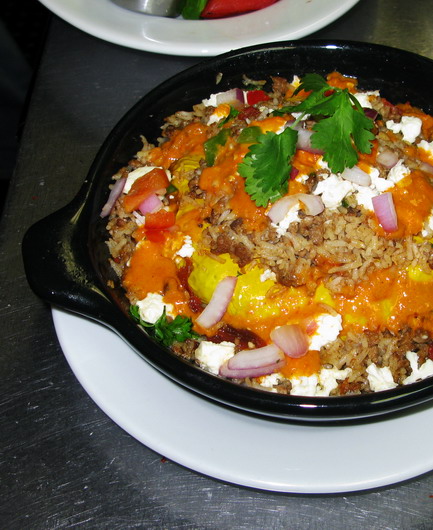
In a restaurant setting, it also makes for a pretty presentation, as you can see here. This version has a filling made with leftover cooked basmati rice, onions, garlic, kalamata olives, ground lamb, tomatoes, the squash flesh, fresh basil and some already cooked stewed eggplant and zucchini. The filling was topped with feta cheese, and after each squash casserole was baked, I ladled some roasted red pepper cream sauce over it to add color and moisture.
There are so many different variations possible for this recipe–instead of rice, you could use bulgar wheat, quinoa, bread crumbs or croutons. Meat can be replaced with dried or fresh shiitake mushrooms, portabello mushrooms or plain button mushrooms. Or, you can add beans, like black beans, navy beans or pintos, or lentils, instead of meat. Or, if you like meat, but don’t like lamb, ground turkey or beef could be used in its place, or any kind of sausage, fresh or smoked, could be added to the mixture. Pancetta or bacon would also be a tasty option.
As for vegetables and aromatics–the sky is the limit. I personally love using eggplant in these stuffings because it tends to add a velvety richness and if it is grilled or roasted, a delectable smokiness that is hard to beat. Sweet peppers, roasted and skinned or diced and sauteed also add flavor and color, while tomatoes add flavor, color and a rich juiciness that is perfect with the squash. Peas can add sweetness, greens can add sweetness and a lovely texture, and fresh herbs add fragrance and flavor. I like basil, but oregano, parsley, thyme and rosemary are all lovely in this as well. Onions and garlic are a must, as far as I am concerned, but the olives could be left out or replaced with pine nuts, or any kind of nuts or capers.
As for the cheese and sauce on top–both of them are completely optional. I think that feta cheese adds wonderful flavor, but unlike many other sorts of cheese, it doesn’t melt in a creamy way, so it adds no moisture. It can be blended with chevre in order to get that creamy texture, or chevre can be used in place of it, or it can be replaced with cheddar, gouda or any other hard cheese which melts well. It all depends on the flavor profile you are trying to create.
Sauce is not necessary, but in the restaurant, it added moisture, color and an extra layer of flavor that patrons expect. I made a simple sauce of pureed roasted red pepper, harissa sauce, roasted garlic and cream with salt to taste, but an eggplant-enriched bechamel or eggplant cream would serve the same purpose. If the flavor profile is Mexican, the stuffed squash could be topped with salsa either before or after baking, if it is Italian, a marinara sauce would be great. Just match your cheese and sauce toppings to the flavors of your stuffing, and you can create your own unique version of this dish.
The possible variants of this dish are limited only by your imagination and the contents of your pantry. I’d love to see folks take my Mediterranean version and use it as a springboard for their own Turkish, Indian, Mexican, Italian, and heck–even Chinese–versions. If you do come up with a different way to make this dish, email me and I will link to your version. The more the merrier.

Rice and Lamb Stuffed Pattypan Squash
Ingredients:
4 medium to large pattypan squash
4 tablespoons olive oil
2 cups thinly sliced onions
1/2 cup finely diced red sweet bell pepper
3 tablespoons minced garlic
1 pound ground lamb
1/2 cup milk (optional)
1 teaspoon cumin
1/4 teaspoon ground cinnamon
1 tablespoon Aleppo pepper flakes
1/4 cup finely chopped kalamata olives
2 cups diced fresh tomatoes
1/2 cup leftover stewed eggplant and zucchini or roasted eggplant puree (optional)
1/2 cup fresh minced basil
1 1/2 cups cooked leftover white or brown basmati rice
salt and pepper to taste
4 ounces crumbled feta cheese
3/4 cup pureed roasted red pepper (you can use canned or jarred roasted red peppers for this)
1 head roasted garlic cloves, mashed into a puree
1/4 cup heavy cream
1 teaspoon harissa sauce, or to taste
salt and pepper to taste
minced fresh parsley and basil for garnish
finely diced red bell pepper, green bell pepper and red onion for garnish
4 basil sprigs for garnish
Method:
Preheat oven to 400 degrees F.
Cut the tops off the squashes in a thin slice. Using a melon baller, scoop out the flesh, leaving a shell of flesh about 1/4-1/2 inch thick under the skin. Set aside the interior flesh and rub the shells inside and out with one tablespoon of olive oil. Sit on a parchment-lined baking sheet and put into the oven to roast for about ten minutes or so–just until the flesh of the shells has softened. Keep on eye on the squash and do not allow it to either dry out and shrivel or go soft and collapse.
Remove squash from oven and allow to cool until you can handle it.
While the squash is cooling, heat 3 tablespoons of olive oil in a heavy-bottomed skillet. Add onions, and cook, stirring, until they turn a dark golden color. Add the garlic and cook for another minute. Crumble the raw ground lamb into the pan, and then add the milk, if you are using it. Break up the clumps of meat and cook, stirring, until the meat turns brown and the milk has boiled away. Add the spices, olives, tomatoes and the optional eggplant and zucchini, as well as the reserved squash flesh. Cook, stirring, until most of the liquid has been released by the vegetables, and everything is deliciously aromatic
Add the basil and rice, and stir to combine. Add salt and pepper to taste.
As directed above, rub individual round casseroles with olive oil, then place a mound of stuffing in each of them. Sink the squashes into the mounds, letting the stuffing rise up around the outside of the squash shells in a ring. Fill the squashes with another mound of filling, and top both the filling in the squash and the ring of it surrounding the squash with crumbles of feta cheese.
Turn the heat of the oven down to 375 degrees, and then bake the filled squashes for about fifteen minutes, or until they are hot and the cheese is melted and slightly browned and bubbly.
To make the roasted red pepper cream sauce, while the squashes are baking, put the pureed red peppers, roasted garlic, cream and harissa in a small saucepan and bring to a simmer, stirring constantly. Let the sauce reduce until it coats the back of a spoon, and flavor with salt and pepper to taste.
To serve, drizzle a ring of sauce over the ring of stuffing around the outside of the squash, and over the top of the filling. Sprinkle with the fresh herbs and the diced vegetables, and if you like, top with a sprig of fresh basil. Serve immediately.
(If you want, you can use a larger baking dish, and put a layer of filling in it. Then, sink the squash into the bed of filling, and continue as directed. When you put all of the squashes in one casserole dish, it will have to bake slightly longer–probably twenty to twenty-five minutes, instead of fifteen, and you will probably need to use more cheese–six ounces instead of four should be fine.)
Where, Oh Where Has The Food Blogger Gone?

Oh, where, oh where can she be?
Well, the truth is, I have been here all along, just not posting.
It started with computer troubles, but those got cleared up in a day or so.
Then, I had a super-busy two weeks at work where I did all the dinner and lunch specials for those weeks, as well as produce ordering and the like, responsibilities that until then had not been entrusted to me. (Now they are, which is good, though I don’t have to make all of the specials every day anymore now that Hilary is back.)
Then Kat and I decided it was time to finally wean her. (When baby bites hard enough that I expected to see I needed stitches–I didn’t–she just bruised the heck out of me–it is time to stop.)
Then, Morganna is getting ready to move into the dorms in a couple of weeks, and so there is much shopping, packing, and digging around in the basement and closets for packed away stuff and the like.
And then, I had a nasty bout of insomnia which led to a nasty bout of chronic pain (I have a sleeping disorder that had to go untreated until Kat was weaned. Which she safely is now, so I can see about going back on my medication, so I might get some sleep again, and the chronic pain and joint inflammation might go away again!)
And then, I discovered that I liked mojitos.
And then, I discovered that I can no longer drink them as alcohol does not blend well with my anti-depressant.
Then, I found out that I have asthma. Not bad, just bad enough to be annoying.
Then, Zak has started to play flute and guitar out around town a lot–which is awesome, by the way, he is really quite talented–so I was busy going around to hear him play.
And then–oh, who knows what all.
Oh, yeah, I made a quilt for a friend who is moving away to Indiana as a goodbye present. (That would be the wall hanging shown at the beginning of this post.)
And, I was disappointed to find out that the two guys in Georgia who were claiming to have a freezer full of Sasquatch corpse were indeed hoaxing us all, as I expected they were from the beginning. Yet, I still had to hold out hope….
So, yeah, I was busy and so I took a big, unannounced vacation.
But, I am back, I promise, and you will be hearing more from me–at least three posts per week, as I have a bunch of recipes to share, stories to tell and pictures to post. (It isn’t that I haven’t been thinking of y’all, it is just that I have been crazy, crazy, crazy busy.)
Figs a l’Aziz: Poached Fig, Pomegranate and Blackberry Parfait

One of the most fun things about being a chef is the spontaneity required when it comes to making up specials: the challenge is to make dishes that utilize what is plentiful and in season, and combining these foods with pantry items to create flavors that are new and exciting to our guests.
And while I prefer to use locally grown and produced ingredients both at home and in the restaurant kitchen, there are some things which simply do not grow in Ohio, at least not now. (As the climate changes over the next several decades, this may change somewhat.) So, I have no problem incorporating some exotica into the menu of specials we put out every night at Salaam.
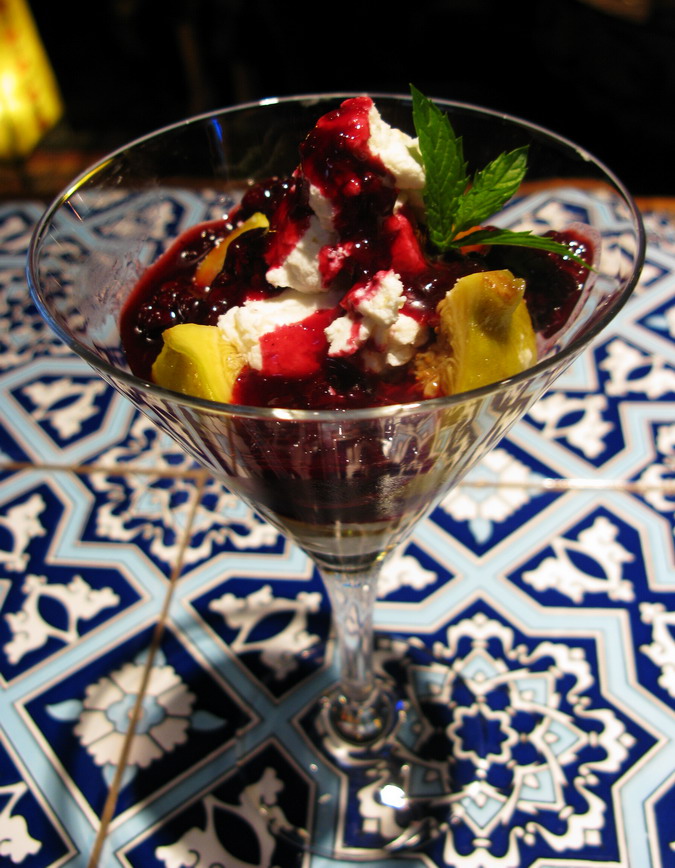
Last week, Mark surprised me with a case of twelve fresh Calimyrna figs and asked me to come up with something to do with them for the weekend. These figs were huge, nearly as big around as my palm is, and smelled like flower nectar, with velvety green-gold skins. They were gorgeous, and I really wanted to come up with a recipe that would truly place them in a setting that was worthy of them.
I didn’t grow up eating figs in any form other than the ubiquitous Fig Newtons, and it wasn’t until I was in my teens that I even had a taste of a fresh one, straight off of the tree in my great-aunt’s backyard in Merritt Island, Florida. I was amazed at how honey-sweet it was, its fragrance, which to me, was like a field of wildflowers. It made quite an impression on me, and since that time, I have eaten figs, mostly in restaurants, prepared in various forms. One favorite was roasted, then stuffed with a bite of creamy Gorgonzola and wrapped in prosciutto, presented with a honey-balsamic vinegar reduction, and to be certain, I considered making a similar presentation at Salaam.
But, the Calimyrna fig has a thicker skin and is drier on the inside that other types of figs, so I determined that a dry cooking method such as roasting was probably not the way to go. So, I gave up on the idea of an appetizer and decided to go with a poached fig dessert.
Poaching is the process of cooking fragile foods like eggs, fish, fruit and poultry at a low, bare simmer between the temperatures of 160-185 degrees F. Calimyrna figs are very fragile and perishable, so much so that even though they are delicious fresh, most of them are dried or used in confections, so since we had lucked into a dozen of these very rare fresh fruits, I was determined to cook them as gently as physically possible.
Most fruits are poached in a liquid containing fruit juices, sweet or dry wines, sugar or honey and an acidic component such as lemon juice. For these figs, I used mostly local honey from the Cantrells at the Farmer’s Market, paired with pomegranate molasses, with is nothing more than the boiled down, concentrated juice of pomegranates. I added just enough water to make a nice liquid that was thick enough to coat the back of a spoon, but also thin enough to still be fluid. I brought this mixture to a boil, and added about six cardamom pods, a one inch stick of cinnamon and five cloves. Then, I clapped a lid on the pot, turned the heat down and simmered it for about forty minutes, in order to give the spices plenty of time to add their flavors and aromas to the liquid.
Creamy, local chevre, with its sharp tang, I decided would be a perfect foil for the soft, honey-sweet figs; in order to give a slightly sweet flavor profile, I blended the softened cheese with a touch of honey and grated lemon zest. In order to keep the cheese soft and creamy, I also added a touch of heavy cream to the cheese mixture.
Finally, I wanted another local ingredient, and since blackberries are in season and plentiful, I decided on them. Their tartness went perfectly with the figs and lightly sweetened cheese, but just blackberry alone was too simple a flavor. So, I added some pomegranate juice and molasses to add depth and a pleasant crimson color, then after I thickened the sauce lightly with cornstarch, I finished it with a drizzle of rosewater, ending the sauce on a summery, floral note. The vivid red-violet color of the sauce contrasted perfectly with the green-golden figs.
Presenting the dessert in a clear martini glass gives it amazing visual appeal: it allows diners to clearly see every color of the layers perfectly. It also elevates the dessert, giving it height, which not only allows the diner to look at its beauty more fully, it also brings the subtle spice, honey, and floral aromas closer to their noses. Remember–we eat with our eyes first, and we sense flavor mostly with our noses, not our tongues. When you are dealing with delicate scents like these, it helps to elevate the food.
I was very pleased with how this dessert turned out–not only did I not have to fire up the oven, it turned out to be blissfully, sinfully sensual. It was gloriously decadent without being too heavy–perfect for a hot August evening.
Figs a l’Aziz
Ingredients:
2 cups honey
1/2 cup water
2 tablespoons pomegranate molasses
5 whole cloves
1″ stick Ceylon cinnamon
6 green cardamom pods
12 large fresh Calamyrna figs
10 ounces chevre, at room temperature
2 tablespoons finely grated lemon zest
1 tablespoon honey
3 tablespoons heavy cream
1 quart fresh blackberries
2 tablespoons sugar
1/2 cup pomegranate juice (I used Pom Wonderful, which you can buy at most grocery stores)
2 teaspoons pomegranate molasses
1 tablespoon cornstarch
2 tablespoons cold water or pomegranate juice
rosewater to taste (I used about a teaspoon)
Mint sprigs for garnish
Method:
Put honey, water, pomegranate molasses and spices together into a medium saucepan. Bring to a boil, cover, turn down heat and allow to simmer very slowly for thirty to forty minutes in order to extract the flavors of the spices. Turn off heat, cover and allow to sit for two hours.
Turn heat on under the saucepan and bring to a very, very slow simmer. Add figs, about three or four at a time–however many will fit in your pan without crowding them or piling them on top of each other. Cook figs for about six minutes, then using a slotted spoon, gently remove them and set them on a plate to cool. Repeat until all figs are cooked and are on the plate, cooling.
Strain spices from the poaching syrup, and allow to cool completely. Pack figs into a storage container gently, and pour syrup over them. Cover tightly and keep in the refrigerator until needed–up to two days.
Meanwhile, blend together the chevre, lemon zest, honey and cream until well blended. Beat lightly by hand or with a mixer in order to incorporate a small amount of air. Cover and keep in fridge until needed. Right before service, remove from fridge and allow to sit at room temperature so that the cheese can soften back up.
Now, make the blackberry sauce: Pick over berries and remove any bruised fruits and stem bits. Put into a saucepan and sprinkle with sugar. Once the liquid comes out of the blackberries, put on medium heat, and add pomegranate juice and molasses. Simmer until the juice is reduced slightly and fruits are softened. Bring to a boil.
Blend together the cornstarch with either water or pomegranate juice, and pour into the sauce. Stir until the sauce thickens, then remove from heat and add rosewater right away. Cool, and put into a tightly covered container until service–you can make this up to two days ahead, just like everything else.
To assemble the dessert, take about a tablespoon and a half of the chevre mixture, and roll lightly in a ball. Drizzle about two teaspoons of the syrup from the figs in the bottom of a martini glass, then place the chevre ball on top. Mash the cheese down lightly, and drizzle with a tiny string of fig syrup.
Take out one fig, cut off the pointed tip of the fig, and then gently cut the fig into four quarters, cutting from the top to the bottom of the fruit. Set these four pieces in the glass shaped like an open flower.
Make another, larger sized version of the cheese ball you made for the base, and place it into the center of the fig flower. Add a dollup of cheese on top of the chevre that is at the center of the fig in order to give the dessert and artfully composed, yet natural looking air.
Then drizzle with the blackberry sauce and crown the finished dessert with a sprig of mint.
Clean any excessive drips of syrup of sauce from the glass and repeat these steps as necessary to assemble all the desserts you need.

Categories:
- Admin (rss) (55)
- Blogs and Blogging (rss) (81)
- Book Reviews: Cookbooks (rss) (43)
- Book Reviews: Non-Cookbook Food Books (rss) (38)
- Cats and Cat Blogging (rss) (47)
- Chinese Cooking Lessons (rss) (32)
- Culinary School Stories (rss) (18)
- Dairy Pruducts: Cultured and Barbaric (rss) (4)
- Documentary Filmmaking (rss) (1)
- Essays, Rants and Reflections (rss) (260)
- Fighting Hunger (rss) (12)
- Food and Kids (rss) (45)
- Food in the News (rss) (126)
- Food Media (rss) (98)
- Food Preservation (rss) (18)
- Food Safety (rss) (45)
- Gardening (rss) (30)
- Herbs and Herb Blogging (rss) (20)
- Holidays (rss) (50)
- Kat Blogging (rss) (22)
- Kitchen Science (rss) (36)
- Leftover Makeover (rss) (8)
- Life, the Universe and Everything (rss) (131)
- Local and Sustainable (rss) (227)
- Local Athens Food and Foodies (rss) (42)
- Meatless Mondays (rss) (32)
- Menu For Hope (rss) (5)
- Nutrition, Diet and Health (rss) (84)
- On The Farm (rss) (8)
- Recipes: Almost Vegetarian, Vegetarian and Vegan (rss) (294)
- Recipes: American Regional (rss) (37)
- Recipes: Appalachian Hillbilly (rss) (33)
- Recipes: Bread, Pasta, Grains (rss) (95)
- Recipes: Canning and Preserving (rss) (8)
- Recipes: Chinese (rss) (123)
- Recipes: Comfort Food (rss) (120)
- Recipes: Cookies (rss) (16)
- Recipes: Desserts (rss) (48)
- Recipes: French (rss) (25)
- Recipes: Fruits and Vegetables (rss) (302)
- Recipes: Greek, North African and Middle Eastern (rss) (31)
- Recipes: Indian (rss) (137)
- Recipes: Italian (rss) (42)
- Recipes: Japanese (rss) (7)
- Recipes: Jewish (rss) (4)
- Recipes: Korean (rss) (6)
- Recipes: Meat, Poultry and Fish (rss) (220)
- Recipes: Mexican/Native American/ Latin American/Caribb (rss) (27)
- Recipes: Original (rss) (108)
- Recipes: Thai (rss) (27)
- Recipes: Tofu (rss) (17)
- Recipes: US Regional (rss) (16)
- Recipes: Vietnamese (rss) (8)
- Restaurant Stories (rss) (28)
- Sewing, Quilting, Arts and Crafts (rss) (16)
- Simple Chinese Recipes (rss) (30)
- Slow Food and Heritage Foods (rss) (10)
- Spice Blogging (rss) (44)
- The Chinese Cookbook Project (rss) (14)
- The Chinese Pantry (rss) (39)
- The Documentary (rss) (2)
- The Kitchen Saga (rss) (17)
- The Locavore's Bookshelf (rss) (15)
- The Unsung Adventures of The Culinary Nerd (rss) (6)
- Tools and Toys (rss) (35)
- Uncategorized (rss) (10)
- With a Side of Politics (rss) (48)
Archives:
- August 2012 (9)
- July 2012 (12)
- September 2011 (3)
- August 2011 (7)
- July 2011 (8)
- June 2011 (16)
- May 2011 (17)
- April 2011 (11)
- December 2010 (9)
- November 2010 (5)
- February 2010 (1)
- December 2009 (5)
- November 2009 (7)
- October 2009 (10)
- September 2009 (16)
- August 2009 (14)
- July 2009 (14)
- June 2009 (7)
- May 2009 (17)
- April 2009 (10)
- March 2009 (25)
- February 2009 (13)
- January 2009 (10)
- December 2008 (5)
- November 2008 (5)
- October 2008 (6)
- September 2008 (13)
- August 2008 (8)
- July 2008 (11)
- June 2008 (18)
- May 2008 (13)
- April 2008 (14)
- March 2008 (16)
- February 2008 (17)
- January 2008 (19)
- December 2007 (25)
- November 2007 (18)
- October 2007 (24)
- September 2007 (16)
- August 2007 (15)
- July 2007 (15)
- June 2007 (10)
- May 2007 (14)
- April 2007 (16)
- March 2007 (17)
- February 2007 (20)
- January 2007 (13)
- November 2006 (1)
- October 2006 (8)
- September 2006 (14)
- August 2006 (25)
- July 2006 (30)
- June 2006 (28)
- May 2006 (34)
- April 2006 (29)
- March 2006 (24)
- February 2006 (30)
- January 2006 (38)
- December 2005 (40)
- November 2005 (37)
- October 2005 (32)
- September 2005 (25)
- August 2005 (30)
- July 2005 (28)
- June 2005 (21)
- May 2005 (8)
- April 2005 (22)
- March 2005 (17)
- February 2005 (29)
- January 2005 (10)
Search Site:
Links:
- Lily’s Wai Sek Hong
- 101 Cookbooks
- A cat in the kitchen
- A Veggie Venture
- Accidental Hedonist
- Cha Xiu Bao
- chez pim
- Chocolate & Zucchini
- Chopstick Cinema
- Chowhound.com
- Chubby Hubby
- Cook sister!
- Cooking with Amy
- da*xiang
- Eat Local Challenge
- Eating Liberally
- Ecocentric
- Eggbeater
- Epicurious
- Farmgirl Fare
- Fatfree Vegan
- Foodgoat
- ForkandBottle.com
- Green Olive Tree
- Hooked on Heat
- Jaden’s Steamy Kitchen
- Kalyn’s Kitchen
- Lucullian delights
- Mahanandi
- Matt Bites
- MeatHenge
- mmm-yoso!!!
- New York Times – Dining & Wine
- Pizza Goon
- Rasa Malaysia
- Ruhlman
- Sailu's Kitchen
- Serious Eats
- SF Gate: Food & Dining
- Simply Recipes
- Soul Fusion Kitchen
- Tastespotting
- The Amateur Gourmet
- The Cleaner Plate Club
- The Food Section
- The Grub Report
- thecookscottage
- U.S. Food Policy
- Wandering Chopsticks
- Washington Post Food and Dining
- Wasted Food
Meta:


Powered by WordPress. Graphics by Zak Kramer.
Design update by Daniel Trout.
Entries and comments feeds.