
Cook Local, Eat Global
Persistent Herbicides in Commercial Compost = Stunted Vegetable Garden
The last time I had a large, in ground vegetable and flower garden would be back when I lived in Pataskala, Ohio, about seven years ago. When we amended the soil, since we didn’t know many farmers in the area–we had just moved there–we bought commercially composted manure, compost and top soil. And we put it on our soil, tilled it in and miracle of miracles, our plants were huge, happy and gorgeous. Our flower borders looked like an over-crowded English cottage garden, which suited the look of our home, which had a sort of fairytale “Good Witch of the Forest” feel to it. The vegetables we grew–tomatoes, tomatillos, chilies, sweet peppers and basil–were all crazy-huge and prolific. It was beautiful.
Here in Chez Zak and Barbara in Athens, most of our yard is too shady for vegetables, so until this year we’ve only grown vegetables and herbs in containers on our deck–which is the only place that gets enough light for growing such things. I’ve chronicled our success with this approach here on this blog, but this year, I wanted to do something bigger. I yearned to grow more of a variety of vegetables, and I wanted to grow strawberries like I had in Pataskala.
So, I joined the Westside Community Gardens here in Athens, and as noted here, started building raised bed boxes because raised beds are supposed to make your plants healthier, stronger and you can grow more food in smaller spaces than with conventional in ground row gardening.
Without a second thought, Zak, Morganna and I filled those raised bed boxes with commercially made compost, manure and topsoil, and started planting seeds.
My dear friend, Judi Winner warned me that she had read an article in Grit Magazine about persistent herbicide residues in commercially available compost and manure, but since we’d already filled the boxes and seeded them, there wasn’t anything to do but wait and see what happened.
What happened was strange, and it does point to some level of herbicide contamination, possibly from Clopyralid or the newest DuPont darling of the “I must have a green lawn with no clover, violets or dandelions in it set”, Imprelis. The contamination most likely came from the compost mixed with cow manure that came from a compost company based in West Virginia which I bought at either White’s Mill or Lowes here in town.
Before I talk about what happened and is happening in my garden, let’s look a bit at the two possible culprits for my abnormally growing vegetables.
Both of these herbicides are meant to control “broad-leafed lawn pests” such as clover, plantain, dandelion and wild violets. (I will try not to get sidetracked on a rant about the idiocy of considering a legume which fixes nitrogen from the atmosphere into the soil where other plants can use it such as clover a pest plant, not to mention how can you hate violets?) Neither of these chemicals pose a threat to human or animal life, which is in large part why they are (or in the case of clopyralid, were) used to create perfectly green, grass only turf in lawns, golf courses and pastures and why they are considered to be “safe.”
However, legumes, such as clover, peas, and beans, plants in the Solonaceae family, such as tomatoes, potatoes, eggplants and peppers, and plants in the Compositae family such as sunflowers, are all particularly sensitive to the effects of these herbicides. And since these herbicides can not only persist in grass clippings, hay or straw where they have been used and NOT break down under normal composting conditions, they can also be eaten by an animal and be excreted, unchanged, into their manure and urine, the contamination can come from multiple sources and thus, multiple concentrations in each bag of compost.
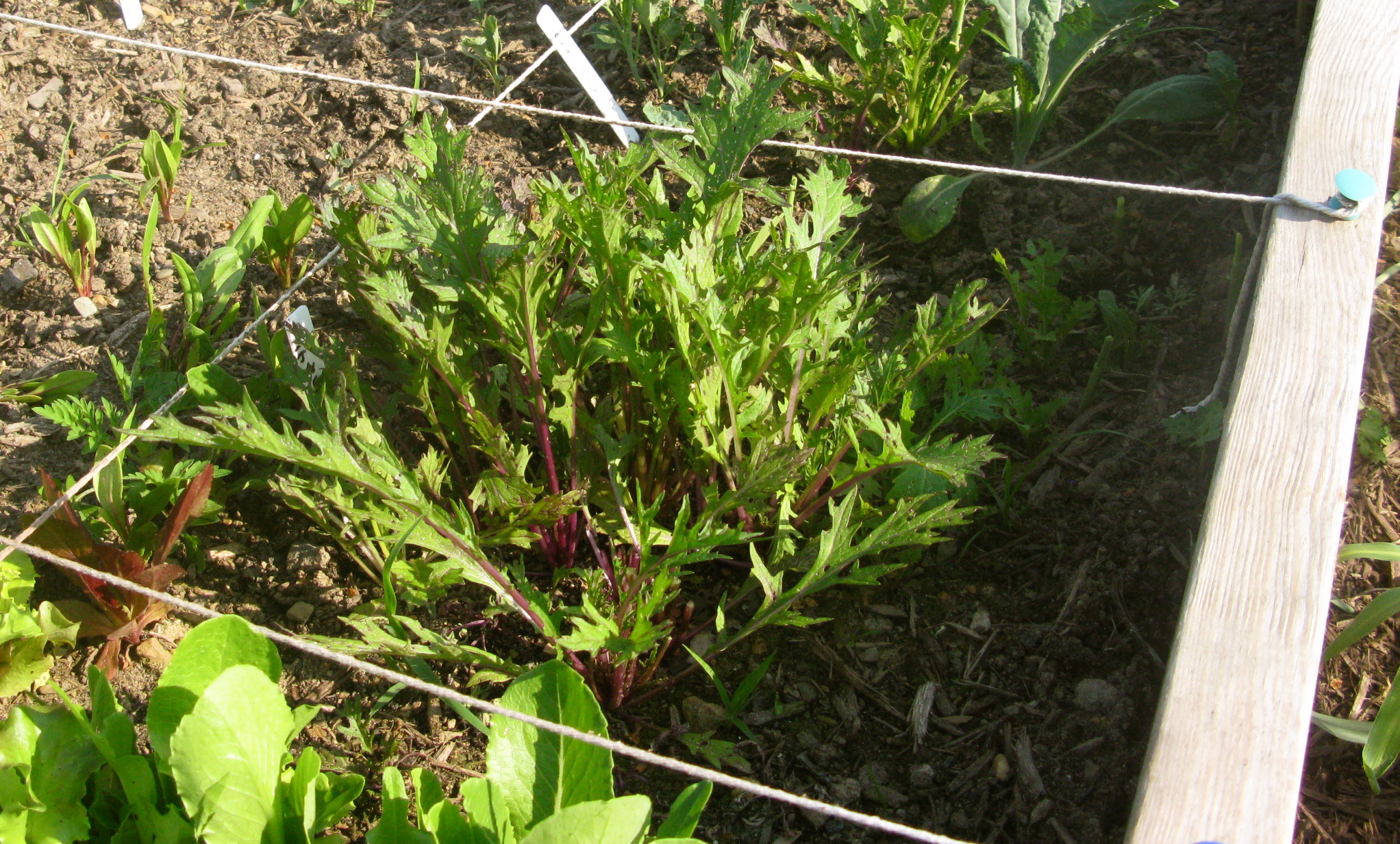
In my garden, I noted that very few of my brassicas sprouted and if they did, they did not grow, or they grew slowly. The only ones I’ve been successful with at all are lacinato kale and mizuna. Bok choy will not grow, nor will gai lan, turnips, or kohlrabi. The radishes grow slowly and strangely, often not forming proper root bulbs.
Right now, my bush haricot vert, which should by now be 18-25 inches tall and well, bushy, are single shoots, four to five inches tall and are now SETTING BLOOM. Also, these beans, which normally fix nitrogen from the atmosphere into their root systems with the help of a symbiotic bacterium, have all shown signs of nitrogen deficiency, which I had to correct with the application of blood meal.
My peas are strangely almost normal–they are stunted in growth in that they are about five inches shorter than they should be, and the petit pois are not as bushy with side shoots as they should be, but they are setting pods now and are also still loaded with blooms. They are not, however, as prolific as I think they should be.
My lettuces, which did sprout happily and did grow beautifully, still grew very slowly. To test and see if this is a normal, just slower rate of growth than I am used to, I seeded two containers filled with non-compost containing potting soil last week with lettuces in one, and spinach, bok choy, which absolutely would not grow in the garden, kale, which grew slowly, spinach which grew barely at all and chard which would not sprout, to see if it was the seeds.
It wasn’t. All of them have sprouted and are growing like gangbusters.
Strangely, my tomatoes are doing perfectly well as are my potatoes–both are blooming and healthy, with no signs of leaf deformation or other mutations in growth. None are stunted, BUT, my pepper plants are all stunted and are setting both blossom and fruit in smaller quantities on plants barely four inches tall.
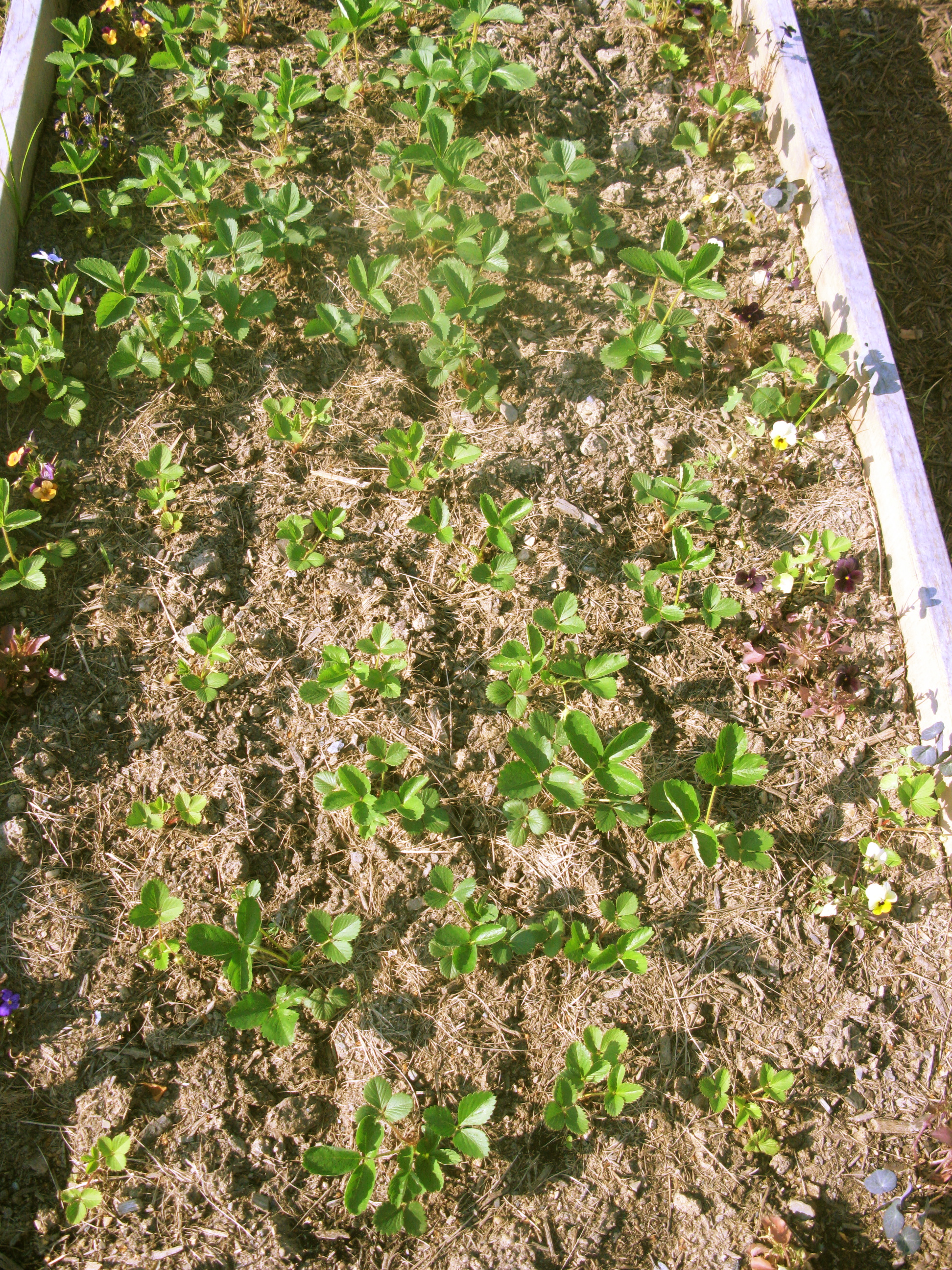
My bare root strawberry plants are growing very slowly and have not put out runners yet, as they should have by now.
It has got to be contaminants in the commercial compost and soil. In the garden right next door where Morganna tilled the earth as it was and seeded directly in the native soil, beans, squash, pumpkins, corn, potatoes, sunflowers and cucumbers, everything is growing at a prodigiously normal rate, which is to say–fast. The plants she put in as starts: tomatoes, peppers, onions, and eggplant, are all healthy and unstunted.
What am I going to do?
This fall, I’ve decided to dig out the dirt and compost we bought and lug it home in lawn and leaf bags. There, I will put it in an unused corner of our land to sit and think about itself. I may add dead leaves to it to see if I can get it to compost itself out and improve itself over a series of years before using it anywhere where I want anything to grow. Or, I could use it where grass is to grow since grass is specifically unaffected by these chemicals.
Then, I will take apart our raised bed boxes, and store them in the garage to be used another time.
I already have pre-composted manure promised to me by a young friend who has a barn to clean out once the quarter is over. That will go on top of the extant soil in my garden plot. That, the wood mulch, and the compost I am making here at the house, along with fallen leaves, and grass clippings from non treated grass which includes our entire hillside “yard,” will all be tilled into the rich soil that exists under my current raised bed boxes. A cover crop will be planted–likely buckwheat and clover–to grow over the winter.
I’ll have to transplant the strawberries before covering them with straw for the winter, and I do still plan to build a coldframe over part of the garden plot, but otherwise, I want to let the soil rest over the winter.
Then, in the spring, more manure from another friend who has rabbits, and another with goats, and the cover crop gets tilled under first thing in the spring, before planting season begins. And then, I will plant without the raised beds.
Let’s hope that much soil amendment works to undermine any last traces of herbicide that might have leached from my beds into the perfectly good floodplain loess that is native to that plot!
And next year, we will have a much more prolific, happy garden.
Of course, I’m disappointed that this year’s garden, even with my best intentions, is not growing as it should, and it seems that if I’d just left well enough alone and used a tiller and planted straight up in the dirt, I’d have done better. BUT, on the other hand, I’d have probably wanted to add soil amendments and having had no trouble with commercial compost and manure in the past, would have used them anyway. At least with this stuff contained a bit in the boxes, with cardboard laid between the native soil and the added, I have a chance to remove most of the contaminated dirt, and what is left can be easily diluted.
I’m disappointed, but it is all a learning experience. No doubt I will be an even better gardener after this experience, and by making this innocent mistake and blogging about it, I can get the word out to many more people to be very careful when it comes to compost and manure from commercial sources.
Here’s to next year’s garden!
Orlando, Florida, and Other “Enlightened” Cities Say, “Please Don’t Feed The Homeless.”
Or, at least not in large numbers, in downtown city parks near downtown city buildings. You know those awful homeless people, they clutter up the place and scare away the tourists. And if you feed them in city parks, you simply entice more of them to congregate there.
What happens in Orlando if you go against the city ordinance against feeding more than twenty-five homeless people at a time in a public park?
You go to jail. Go directly to jail, do not pass “Go,” do not collect two hundred dollars.
What do I think about this state of affairs?
I think that this law, and others like it are not only unjust, but immoral and downright un-American.
I’m also damned glad I don’t live in Florida, where it’s not only illegal to feed the poor, but whose governor just signed the most ridiculous law in the world, which bans wearing of baggy pants that show your underwear in public schools. You know, if I lived in Florida and was in the government, I might be more worried about the 10.8 percent unemployment rate and might be looking at legislation on a local and state level to do something about that instead of punishing altruism toward the impoverished and kids wearing baggy pants. But you see why I’m not a public official–I’m a compassionate, logical person who understands that it’s more important for people to have food in their bellies and jobs than pants that are pulled up to their armpits.
Yeah, get ready folks, I’m on a tear here. If you can’t abide a liberal looking at injustice and crying foul, then I highly suggest you just skip today’s post, because I am gonna call out the truth on people who pass laws like this. And it just might get you a little steamed.
So consider yourselves given fair warning.
So, what’s gotten me all riled up then?
Well, it seems that several cities around our once fair nation, confronted by the results of our flailing economy, which includes an influx of jobless and homeless people, have decided to wage war not only on these relatively helpless individuals, but also on those who would extend charity to them.
According to a report from CBS news in 2007, cities such as Dallas, Texas, Fort Myers, Fla., Gainesville, Fla., Wilmington, N.C., and Atlanta, George all have passed laws restricting or outright prohibiting the feeding of the homeless. Another law in Fairfax County, Va., prohibits the distribution of homemade meals and meals made in church kitchens to the homeless unless first approved by the county. This insidious law is said to be “protecting the homeless” from unsafe food, but really, it is restricting a citizen’s right to care for other citizens.
Las Vegas went even further by banning the giving of food to even ONE indigent person in any city park!
As you can see from the date of the above cited report, this war against the homeless in the US is not new. It’s been going on for years now, so why am I just now getting hot under the collar?
Because I just happened to read this news story published yesterday about three members of Food Not Bombs arrested in Orlando yesterday for violating the unjust law banning the feeding of over 25 homeless people at a time in the city park without a permit. Permits are only given to any group for two feeding days a year. TWO feeding days a year.
So, I guess for the rest of the 363 days, those homeless folks can just go eat cake or some such nonsense?
This law is unjust. This law goes against our rights to peacefully assemble, of free speech and freedom of religion.
This law is not only unjust it is downright immoral, and not just from a Christian perspective. It is immoral from a Buddhist, Muslim, Jewish, B’hai, Hindu and Neo Pagan perspective. It is immoral from a humanist perspective. It is immoral from a just plain old human rights perspective.
Oh, hell, I’m just going to spit it out–it’s evil, plain and simple.
Punishing people for being homeless is evil, pure and simple. Sure, some people might choose to be homeless or poor, (I generally do not believe this, but there are some studies that show that some mentally ill homeless people do not accept help even when offered) but in this economy, the vast majority of people who are hungry and homeless today are because of circumstances beyond their control. Penalizing them for trying to get by the best that they can is inhumane.
Penalizing citizens who would lend a helping hand to their fellow citizens is just as shamefully cruel, unjust and goes against what I believe to be the spirit of America.
What do I think should be done about laws like this?
In addition to challenging these laws in court the way that various groups such as the ACLU is doing, I think that a tactic that was used during the Civil Rights Movement should be employed.
Have you ever heard of the Freedom Riders? They were a group of black and white men and women, primarily college students, though there were ministers and older people involved as well, who challenged segregation in public interstate bus terminals which had been outlawed in the 1960 US Supreme Court decision Boynton vs. Virginia. Even though state laws that allowed segregation of these facilities had been outlawed by this ruling, in 1961, many southern states still enforced segregation in interstate bus facilities, going against federal mandate.
On May 4, 1961, the first Freedom Ride left Washington DC and was to arrive in New Orleans by May 17th. That first group of riders never did make it to their intended destination, because in Anniston, Alabama, on May 14th, Mother’s Day, the bus was attacked by a mob. Tires were slashed, and later, the bus was firebombed. When the Freedom Riders fled the burning bus, they were physically attacked and beaten, some with pipes and cudgels. The police did nothing to stop the mob, and in fact, did not arrive–just as they had conspired with the mob–until the mob had dispersed.
More violence came in Alabama, so the original Freedom Riders stopped their action and returned home. In response, new Freedom Riders, many of them from Nashville, Tennesse and led by a young woman named Diane Nash, started another freedom ride on May 17th. More violence occurred–obviously, I am condensing the events for brevity–and in Mississippi, the Freedom Riders were arrested and jailed at the Mississippi State Penitentiary, known as “Parchman Farm.”
The response among Civil Rights activists around the country was electric.
They began coming from all across the country, riding down to Mississippi in order to be arrested for violating an unjust and illegal law. They intended to, and did, fill all the local jails in Jackson, Mississippi, and Parchman Farm, and they did, thus bringing great visibility to their cause, and eliciting public support for the Civil Rights Movement.
What I propose to the moral citizens, and especially the Christians of Orlando Florida is this–violate this unjust law, and be arrested. Fill up the jails and gum up the judicial system until the city sees how worthless their law is. Cause unrest until the law is rescinded.
Engage in civil disobedience, just like the folks from Food Not Bombs have; it worked in the past and it can work in this case.
Kudos to Food Not Bombs for their resolve to continue to violate this law, and I hope and pray that others in Orlando demonstrate the same courage and charity you show.
I don’t think I have to worry about such a ridiculous and immoral law being passed here in Athens, but if it did, I know that I would be ready, willing and able to be arrested to stop injustice from being allowed in my home city. And I know for a fact that I would not be the only one to be lining up to fill the jail and courthouse in protest of such a law. Lots of folks here in Athens would do the same, and I believe that there are lots of people in Orlando Florida who know in their hearts that this is a terrible law, and one that is beneath them as human beings, and I trust that these moral citizens will arise and fight injustice in any ways, large or small, that they can.
Maybe I’m much too trusting of humanity’s good nature in this case, but I hope not. I hope that others are just as outraged by these laws as I am, and I hope more than just a handful of activists step up to the plate to get these laws changed.
Meatless Monday: Summer Squash Gratin with Herbs and Smoked Goat Cheddar
I love summer squash, and always have.
When I was a kid, I liked to pick the tiny ones from the garden and eat their creamy, lightly flavored flesh raw. I used to stick them in my pockets to carry on my farm adventures with me, along with a handful of raw green beans, some peas still in the pod, and whatever assortment of interesting rocks or acorns I had found that day. I always tried to keep the geological findings and the snacks in separate pockets, but sometimes I failed. Luckily, I never ate a rock, so all of my teeth are to this day intact.
But I also loved squashes cooked. My Grandma liked to fry large zucchini, and that was always delicious, especially if she used lard or bacon grease for the frying, which she usually did. The little yellow crooknecks and small zucchini she simmered in water, then drained them when they were tender and added butter, salt, pepper and sometimes parmesan cheese. (That cheese comes with a little “p” because it came out of a green can.)
When I was a pre-teen, the lady who lived next door to us taught us a new way to cook zucchini. She stewed it with onions, sweet peppers and tomatoes, and then she’d either eat it right away or put it up in jars using her pressure canner. We took a jar to Grandma, and she took to making stewed zucchini and tomatoes at least once a week in the summer–usually more than that, and she put up row after row of jars of it to be eaten cold or hot in the winter. Grandma’s innovation on that recipe was to add hot banana peppers to the melange, which added just enough zip to make the whole recipe sparkle.
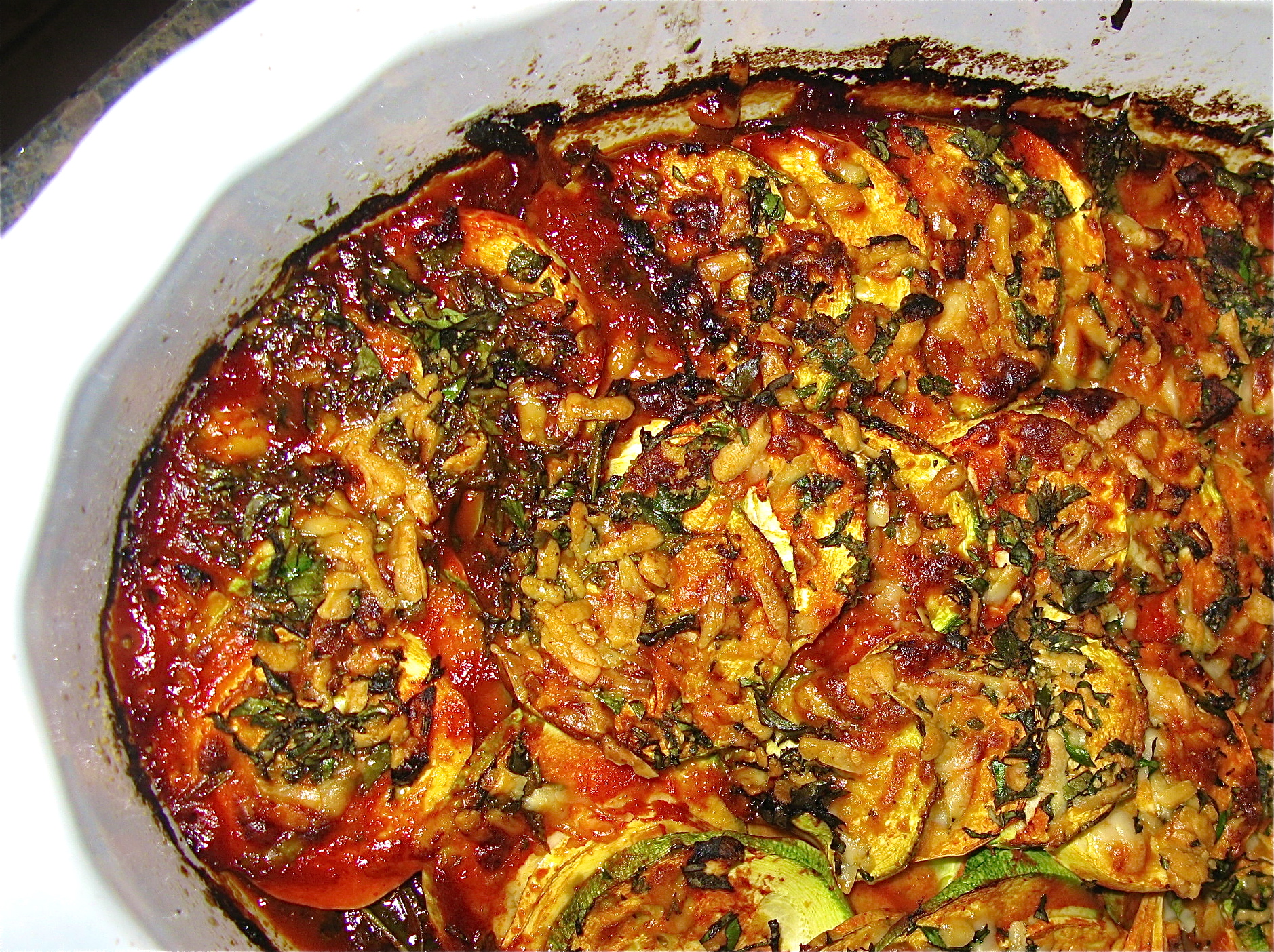
This recipe, while it contains elements of both the simply simmered squash and the stewed squash recipes mentioned above, uses a completely different technique. It is a gratin, so it is baked in a shallow pan (helpfully known as a gratin or gratin pan), with a minimum of liquid so that as the squash cooks and releases its water, the resulting sauce will cook down and become thick, not runny. And, this recipe is gilded by a topping of both finely grated Parmesan cheese and crumbles of an absolutely fabulous locally produced applewood smoked goat cheddar from Integration Acres.
Let me expound for a moment on the cheeses from Integration Acres, because they are really, really good. I’ve been eating their light, creamy and delightfully tangy chevre and cooking with it since they started making it in 2007. It is, quite simply, the best chevre I’ve ever tasted–it is creamy with none of the chalky texture that commercial chevre can often exhibit. The flavor is effervescent–it has the requisite goat milk tang without being overwhelmingly strong–and when it is combined with herbs, garlic or a bit of smoke, the chevre flavor is never lost. The combination of superior creaminess and sweet, tingly goat milk flavor makes for one of my favorite cheeses in the entire world. And I mean that–and believe me, this is high praise, because if I could be asked what single food I could NEVER give up in my life, it would be cheese. (Look, I used to get cheese in my Easter basket instead of chocolate once I was diagnosed with a chocolate allergy–and you know what–I was happier with the cheese!)
But chevre is just the beginning. Now, Michelle of Integration Acres is making a whole array of goat cheeses, including aged cheeses, both soft and hard. The cheese I used in this gratin is a phenomenal smoked goat cheddar called “Chase Cheddar,” after the road where their farm is located. Of all of their cheeses, including the chevre and their feta, which is also superior to any commercial feta I’ve ever had, I think this cheddar is my favorite. I’m a cheddar fanatic, so this is not surprising in the least–I adore a good aged cheddar, and if it is smoked with a delicate hand–in other words, not over-smoked–that makes it all that much better to me. This cheese is crumbly the way a good cheddar is, with an aroma that is equal parts aged cheese and applewood smoke. The flavor is subtle, complex and beguiling and I feel ever so lucky to live in the same community where this cheese is made so I can be assured to always have it around for snacking or cooking.
All of this said–you can use whatever good aged smoked cheddar you like in this gratin, but I implore you not to leave the cheddar out and just go with the Parmesan. The two cheeses combined really make the dish more than just the sum of its parts, and I think the flavors would flatten out if you used just one cheese.
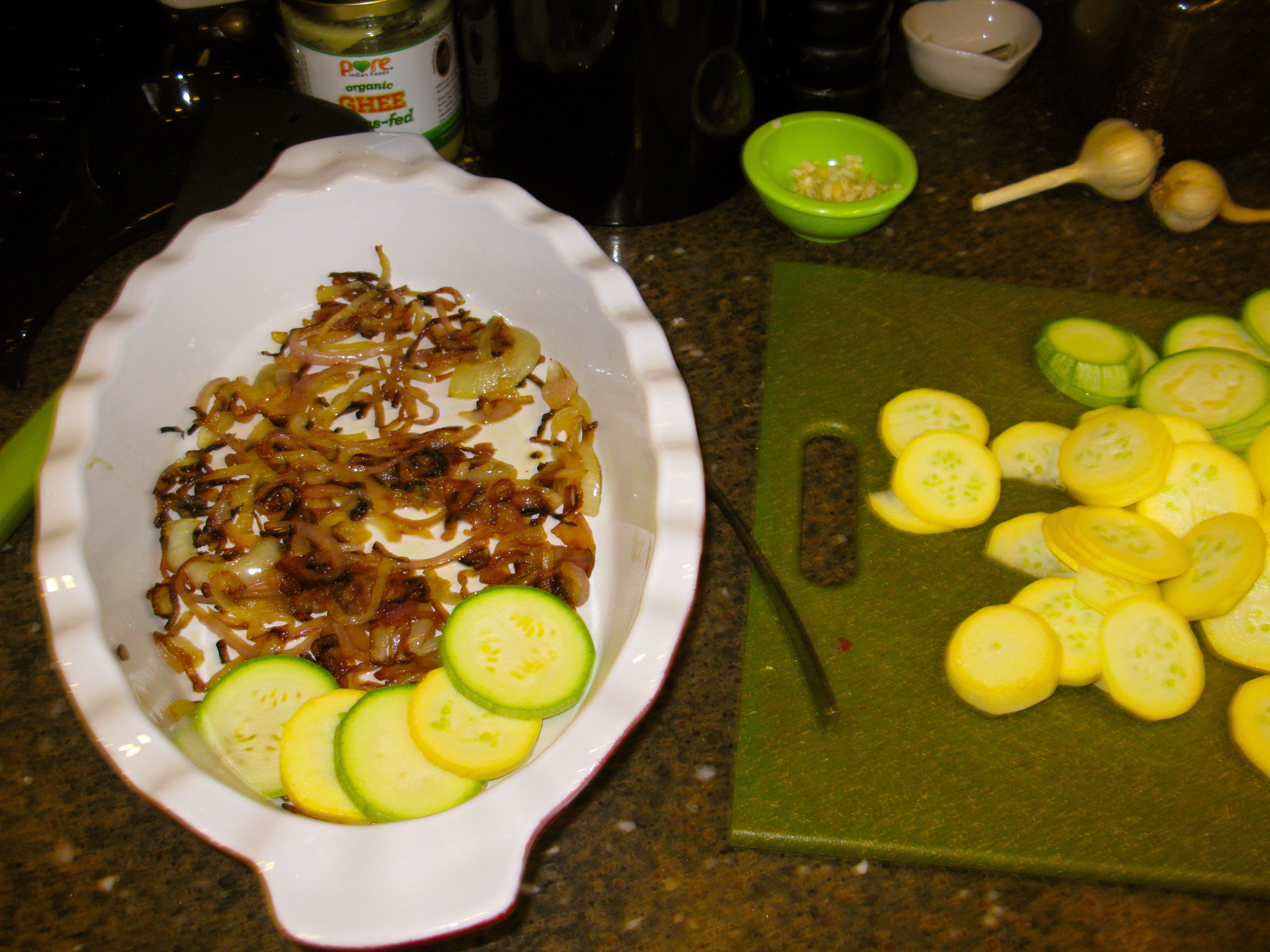
The gratin is put together simply–a thick layer of caramelized onions is spread over the bottom of a well-oiled gratin dish, and is then topped with thinly sliced summer squashes. (Less than 1/4 inch is what I mean by thinly–if you have problems doing this with a knife, try a mandoline, but be wary of the sharp blade! I’m weird–I don’t trust mandolines not to try and hack off my hands, so I can cut paper thin slices with my knives. Your mileage may vary.) I used a yellow zucchini and a pale green zucchini and alternated the colors, but you could easily use all the same squash or even more different ones, or you could use pattypan squashes instead of the cylindrical ones. It’s all up to you. Just be sure and cut them very thinly.
Oh, and when you start putting the slices into the gratin, don’t start along the edges like I did. I forgot that it is much easier to start in the center, about two and a half inches from the center, and make a row that goes straight down, stopping the same distance from the bottom edge, and then spiral outwards from there. Or, you can be like me and start at the edge and spiral inwards, tucking the inner slices under the outer ones. Or you can not be type A about it and lay them atop the outer layers and just get on with it. So, let me amend my statement about not doing it like I did–do it in a way that is aesthetically pleasing but works the way you want it to work and don’t worry so much about how it’s “supposed” to look.
Now, for the liquid.
You could use plain old tomato sauce or puree for the liquid, but I pulled out one of my secret ingredients–an 11 1/2 ounce can (soda size) of V-8 juice. Now, the truth is, if I had a juicer, I’d make my own mixture of vegetable juice to use in recipes such as this, but I don’t. So, instead of a plain tomato product, I used a little over 8 ounces of V-8–just enough to barely cover the squash along the edges of the dish and splash onto the center squashes without quite covering them. This is a measurement that is going to depend on the size of your gratin dish, which is why I give the measurement of 11 1/2 ounces, noting that you can use a little more or less of it. Anyway, I use V-8 because it gives a more complex flavor in the finished dish than plain tomato sauce or juice would, and the texture when it is finished cooking is very velvety and lush.
And then we come to the herbs. Use them fresh and use a lot of them, in whatever types and combinations you want. I used about 1/2 cup of mixed basil, oregano, flat leaf parsley, rosemary, thyme and lovage. They get sprinkled on top after the juice is added, and after two minced fresh garlic cloves are sprinkled on top. Then, the cheeses are sprinkled over–the finely grated Parmesan first, then the roughly grated or crumbled cheddar, and the whole thing is popped into a preheated 375 degree F oven, and baked for about 45 minutes, or until the squash slices are tender, the sauce is cooked down to a thick, deep red velvet, and the herbs and cheeses are browned and a bit crispy.
That’s all there is to it. It really sounds more complicated than it is to make. It would make a great vegetarian dinner paired with a rice pilaf and a mixed greens salad with fresh early summer carrots, radishes and raw turnips with a zippy lemon vinaigrette.
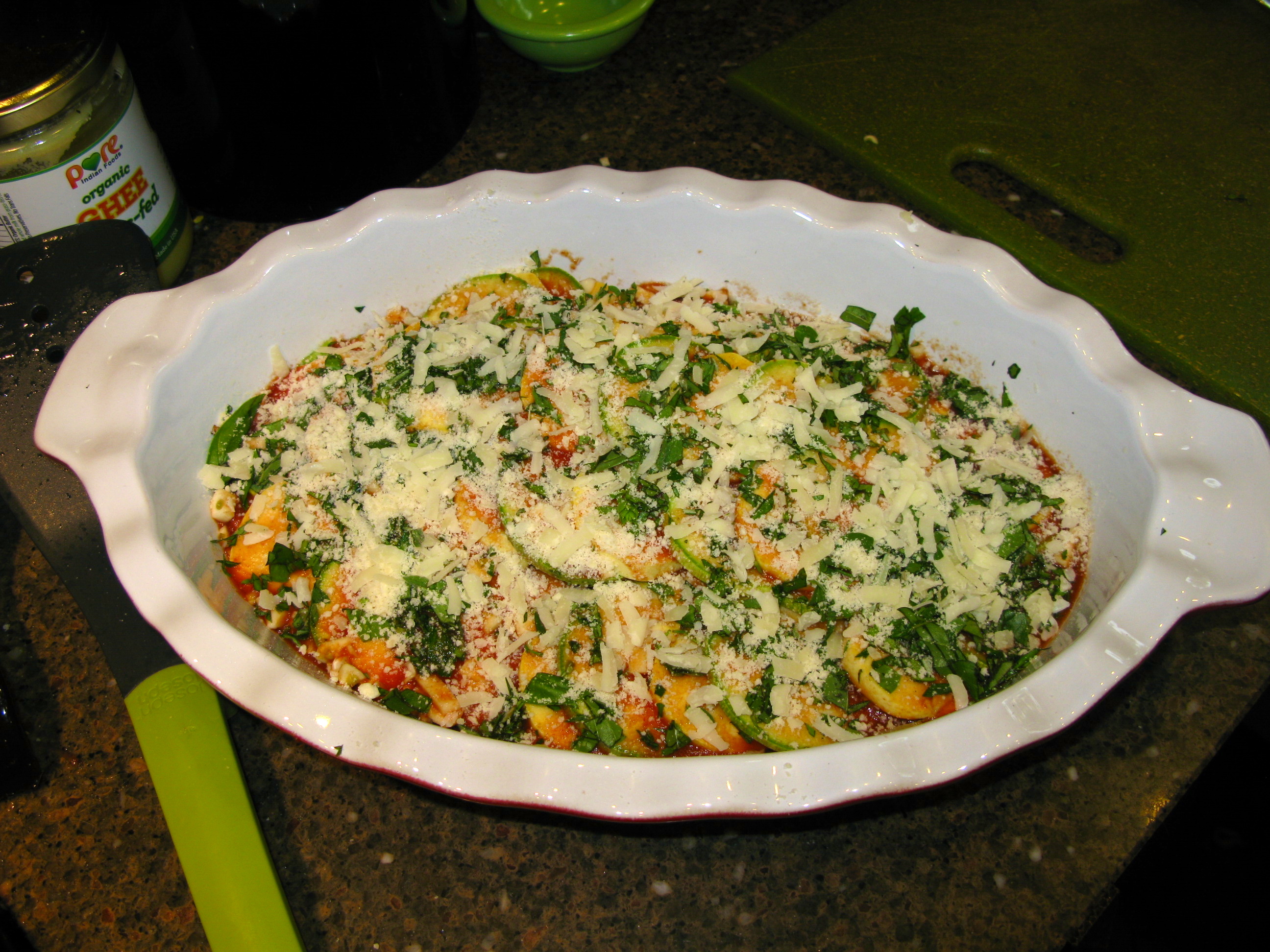
Summer Squash Gratin with Herbs and Smoked Goat Cheddar
Ingredients:
3 tablespoons olive oil
2 medium onions
1 teaspoon salt
2 medium sized cylindrical summer squashes, very thinly sliced (less than 1/4″ thick)
11 1/2 ounce can V-8 juice or equivalent amount of homemade vegetable juice, canned tomato sauce or puree
2 fresh garlic cloves, peeled and minced
1/2 cup fresh mixed herbs, roughly chopped
1/2 cup finely grated Parmesan cheese
1/2 cup roughly crumbled or grated aged, smoked goat cheddar (Integration Acres Chase Cheddar if you can get it!)
Method:
Preheat your oven to 375 degrees F.
Pour oil into a heavy bottomed skillet or saute pan and heat over medium heat. Add the onions, and sprinkle with the salt. Cook, stirring as needed, until the onions turn a deep golden reddish-brown–this should take about ten to fifteen minutes, depending on how much water and sugar are in your onions.
Oil a gratin or baking dish well with olive oil. Scrape the caramelized onions into the pan and spread them into an even layer.
Carefully layer your squash slices so they overlap slightly in a full layer over the entire gratin dish, covering the onions completely.
Pour the V-8, or tomato sauce or puree over the squash slices, making sure that you have enough liquid to barely cover at the edges and dampen the slices at the center of the dish. Sprinkle with the minced garlic, then the herbs. Sprinkle the Parmesan cheese evenly over the top then do the same with the cheddar.
Put the gratin in the oven and cook uncovered for about 45 to 50 minutes, or until the squash is tender, the liquid has reduced by half and clings to the vegetables, and the cheeses are melted and lightly browned and bubbly. If the cheeses look apt to burn before the squash is done, remove the pan and lightly cover it with a piece of foil, then continue cooking. If you have a convection oven like I do, the cooking will probably only take 35 to 40 minutes.
Serve immediately.
Hey, Mom! Where Does Our Milk Come From?

Well, if you drink cow milk, the simplest answer is that it comes from cows.
And, it is essentially correct.
But the real truth is that milk comes from what the cows eat.
And cows evolved to eat one thing and convert it into energy and milk and bone and blood and flesh better than any other food a cow could consume.
And that would be……what?
Corn?
Brrrrrrrththth. Wrong answer. You are the weakest link. Goodbye.
No, what cows are made to eat is this:

Grass.
Grass and clover and sweet melilot and other pasture-based forage plants. But, primarily, grass.
(Now, the biggest truth of all is that milk comes, like all food on our planet, from the sun, but we don’t need to go that far along the food chain to make a point, do we?)
Look how green and lush that pasture is. Look at the cow pictured above. Look at how clear her eyes are, how alert and curious she looks. Look at the sleekness of her body and at how clean she is.
She looks like that because she lives in a pasture, on grass, and spends her time walking and foraging up hill and down, to get her dinner and to go twice daily to the milking parlor. She is healthy, and from what I can tell, quite happy, because she is living the life that natural selection and human breeding intended her for. She is resilient, strong and part of a herd of 270 bovines–most of them cows–only eight are bulls–all of whom give the milk that Snowville Creamery minimally processes and puts into cartons and puts onto grocery shelves all over Ohio.
Today was the second annual open house and farm tour at Snowville Creamery, and curious folk from all around who are interested in the source of our foods came and got to see how the operation works, from the ground up, starting with the grasses in the pasture, to the cows, to the milking parlor and on to the processing facility. Of course, Zak, Kat and I had to go–and not only did we have fun, and not just because we got to pet an adorable calf, but we also learned about how pastured dairy operations not only are healthy for the cows and our milk, but for our environment as well.

Expect a full report in one of next week’s posts. Until then, enjoy the photos here that show where milk comes from, and what healthy dairy cattle look like. (And how cute they are as babies!)
Cooking on a Cedar Plank: Miso-Honey Glazed Salmon
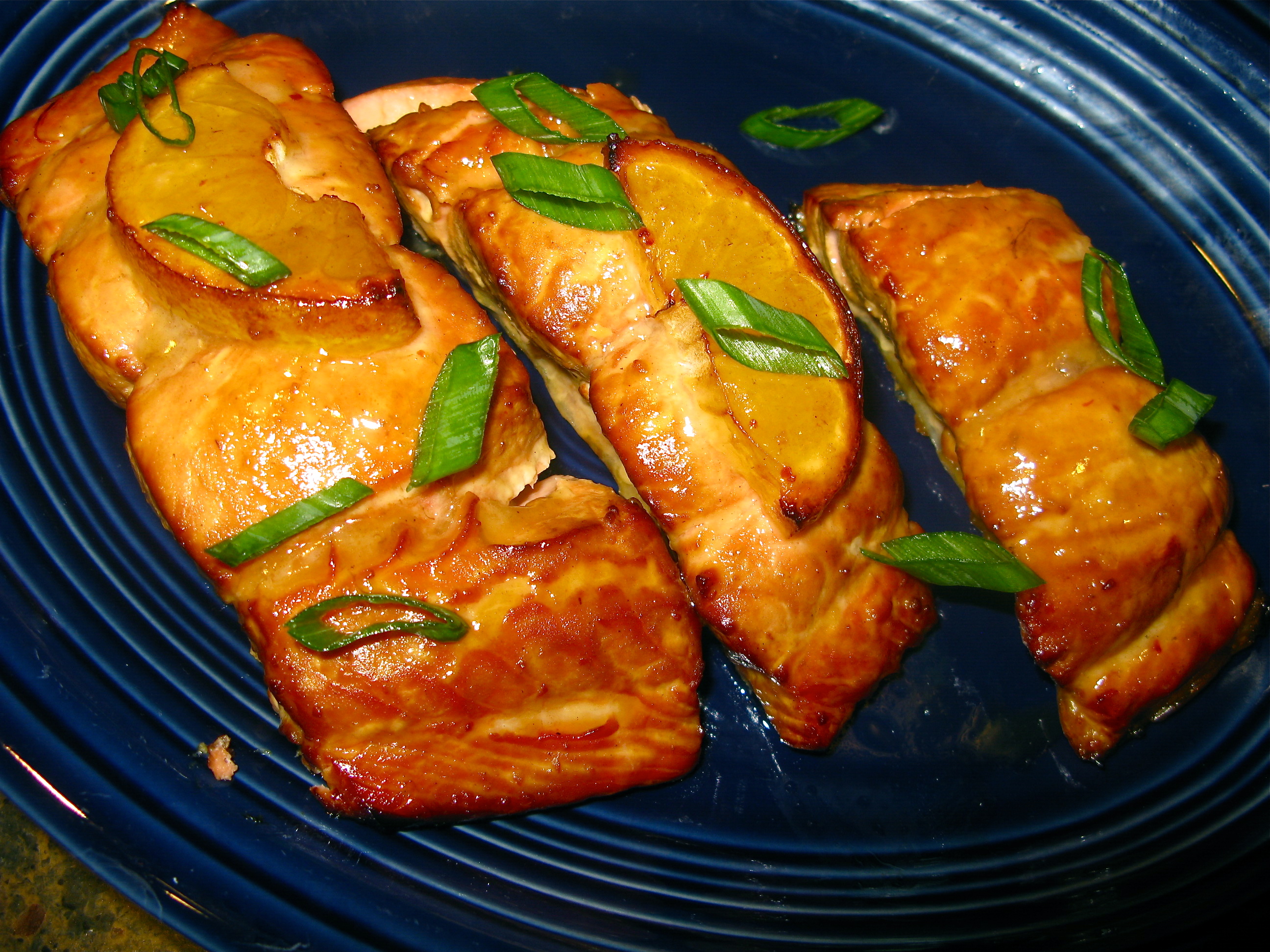
Cooking salmon on a grill is a great idea, but often, it sticks and does its level best to fall apart, and sometimes, the great tragedy of having half a hunk of delicious fish fall between the grates into the fire to be sacrificed to The Gods of Lost Dinners.
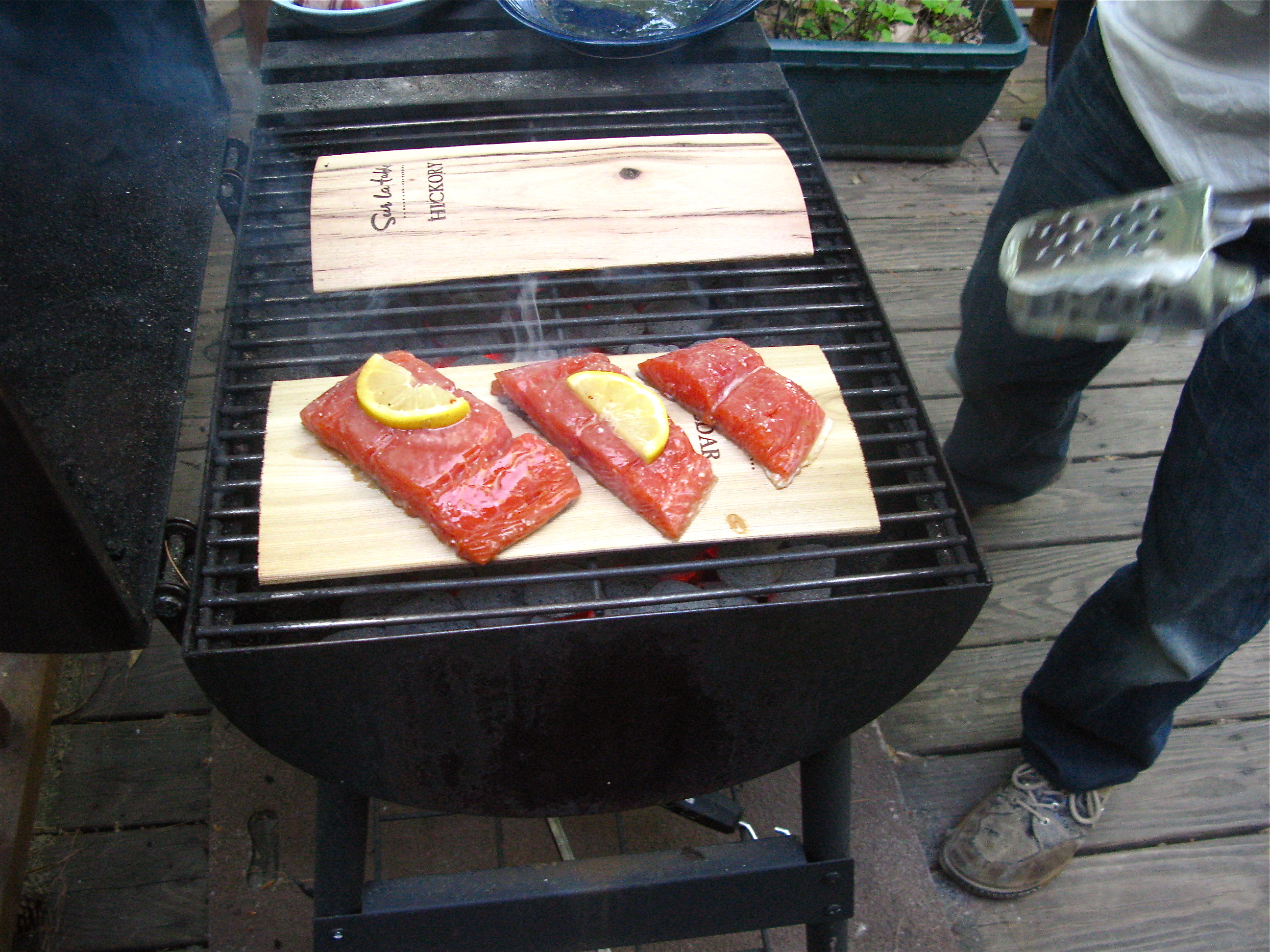
However, if you use an untreated wooden plank, such as cedar, that has been soaked in water for a few hours on top of your grill, then set the salmon filet on top of that, not only does the fish neither stick to the grill nor fall into the fire, it is saturated with the flavor and scent of cedar smoke.
And let me tell you, THAT’s something to yearn for.
But then, I yearn for salmon all the time. It’s one of my favorite foods. In fact, if there is such a thing as reincarnation, my greatest aspiration is to be reborn as a grizzly bear in Alaska.
The worry of being shot by a big game hunter, or worse, by Sarah Palin, would be completely offset by being able to wade into rushing cold water and catch my own salmon during the salmon run. Just think of being able to gorge on all of the sushi-grade raw salmon you could eat, while getting to play in cold, clear water at the same time.
Sure, you have to deal with the other bears, but there’s enough fish for everyone, and even the scuffles are as much in play as in earnest. It all sounds great to me.
And then, for dessert, there are wild blackberries.
Ah—that would be the life.
So, anyway, I love salmon, though I didn’t always think it was the best thing in the world. When I was a kid, my only exposure to salmon was in the form of salmon cakes made from the pink stuff from a can. Mom’s cats loved it when she made those, but not me–the smell of them made me queasy, and I could only choke down one cake and that was under duress. On salmon cake nights, I usually ate a lot of parsley potatoes and canned corn, which seemed to be the usual side dishes.
It wasn’t until I was a teenager and tasted properly cooked fresh salmon filet at a Red Lobster in Columbus, Ohio, that I realized that salmon was the best thing that ever swam, even better than rainbow trout or lake perch, my two former favorite fish ever.
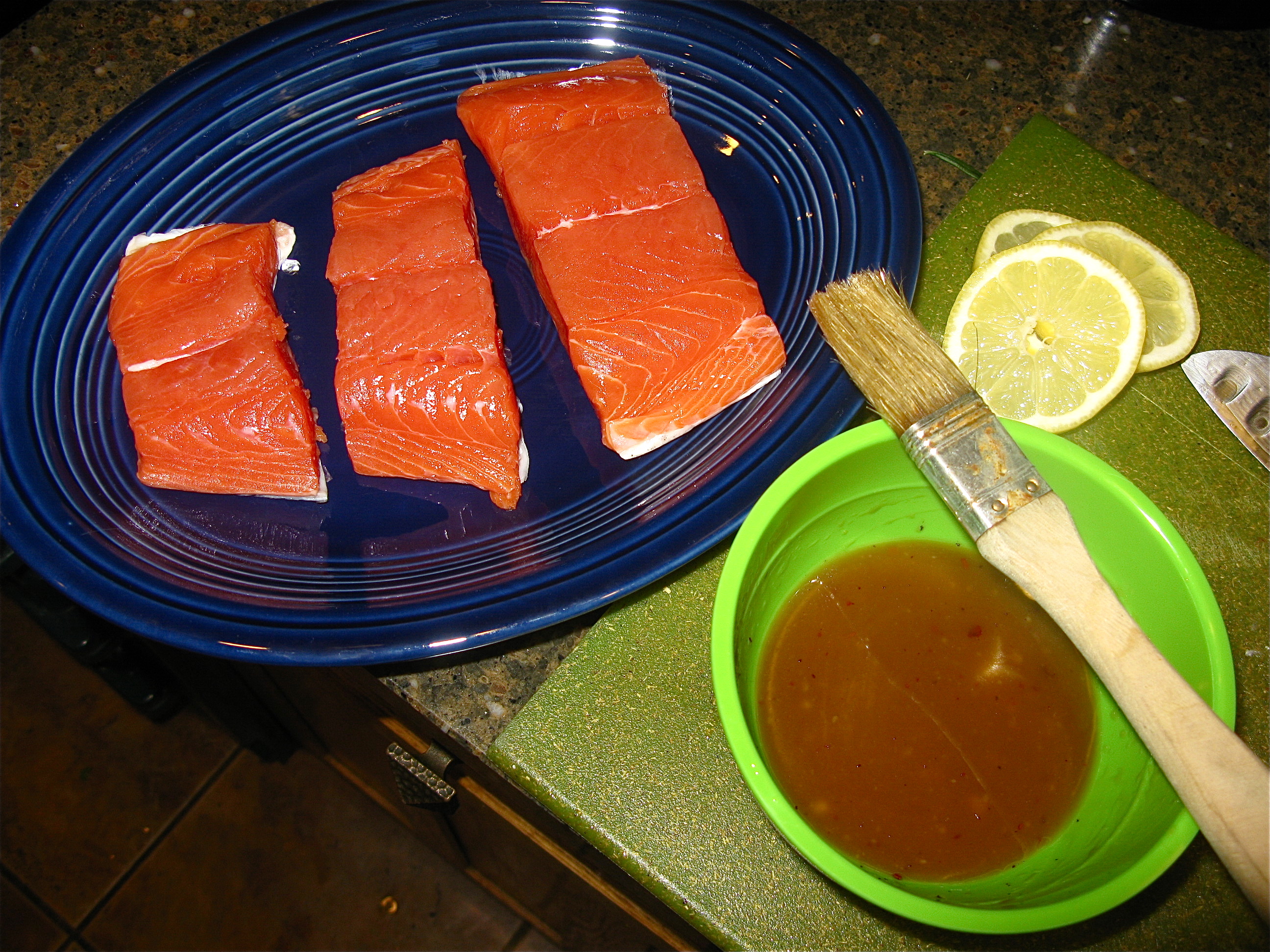
(Now that you know that my first taste of real salmon came from Red Lobster, I hope you won’t hold it against me.)
Anyway, now that we know my history when it comes to the best fish in the world, let’s talk about this recipe, shall we?
I decided that Japanese flavors would go really well with cedar smoke. I don’t know why I decided that; perhaps it’s because the Japanese use cedar in building some of their soaking tubs (another thing I love almost as much as salmon–a tub that I can soak up to my neck in without having to lay down and scrunch my knees up and still have them sticking up like two pale islands, cold and sad) and my brain paired cedar and water and salmon together in some bizarre word association game.
So, I made a glaze for the salmon from white (shiro) miso, which is a mild fermented soybean paste, mirin, a low-alcohol sweet rice wine, soy sauce toasted sesame oil, local honey and mild chili pepper flakes. The milder, less salty shiro miso is a great source of umami flavor–that savory taste that comes from naturally occurring glutamates, while the mirin and honey add sweetness. More umami kick as well as some salt comes from the soy sauce, while the sesame oil adds a nutty, fragrant top note. The chili is subtle, and very mild, since I used Aleppo pepper flakes, and could be left out altogether.
The only flavor note missing is something sour. This was provided by a lemon slice placed on top of each filet, which was then “glued” down to the fish with the thick, slightly sticky glaze.
If I’d had a bottle of yuzu juice handy, I’d have used that, but lacking that, lemons would have to do, and they performed admirably. Their fresh flavor brightened everything with a sparkling pure tingle as an endnote flavor.
Putting everything together was remarkably simple. I just had to soak the plank for three hours in warm water to prepare it for the grill. The salmon filet I simply cut into three portions, and whisked the glaze together. When the coals were ready (we used hardwood charcoal) and set up for direct grilling, we simply put the plank on the grill, closed it up and let it preheat and begin to smoke. Then, right before the filets were to go onto the plank, I placed the lemon slices on top of them and then brushed the fish and lemons thoroughly with the glaze. Then, carefully using a pair of tongs, we placed the fish on the plank, closed the lid and let it cook for six minutes.
We lifted the lid, gave the filets another brush of glaze and closed the grill up and cooked them for another seven minutes, until they were just done. I had bought the back half of a salmon side so the tail piece was thin and so was the most well done, though it was not dried out at all. That was Kat’s piece. The middle piece was done perfectly, flaky and moist–that was Zak’s piece.
Mine was the thicker piece from the middle of the fish–and was done perfectly to my liking–just a tiny bit “underdone” so that while it flakes, the flesh isn’t completely opaque–there is a tiny bit of roseate translucency to it, and the fish was juicy and sweet. Just the way I like it.
It turns out that grilling salmon filets on a cedar plank is a perfectly simple operation, and it is one that is well worth repeating. I can’t wait to see what kind of glaze I can come up with next time, though I am even more impatient to eat the salmon itself again, and to heck with the glaze! (Hrm. Maybe I should use blackberries and then have an ursine main course and dessert combined!)
Miso-Honey Glazed Salmon Cooked on a Cedar Plank
Ingredients:
1 cedar plank
1 slab of fresh skin on salmon filet (for three portions, I used 1/2 of a salmon side)
1 scant tablespoon shiro miso (Miso Master brand is my favorite)
1 teaspoon honey
1/4 teaspoon toasted sesame oil
2 tablespoons mirin
1 teaspoon Japanese style soy sauce (I used Bourbon Barrel Foods soy sauce)
pinch of mild chili flakes (optional)
3 half-round slices of lemon 1/4″ thick
juice from 1 lemon wedge
a few diagonally cut slices of scallion top for garnish
Method:
Soak the cedar plank in warm water for three hours.
Cut the fish into three portions–one Mamma bear sized, one Pappa bear sized (I will have you know that the Mamma bear size at our house is bigger than the Pappa bear size–just saying) and one Baby bear sized.
Whisk together all of the glaze ingredients, from the miso to the chili flakes, until it comes together into a thick, delectable-smelling amber brown liquid.
Prepare your charcoal and when it is ready, set your grill up for direct grilling, which basically means, spread your coals out in an even layer underneath the entire grill.
Place the plank carefully on the grill. Zak used tongs to do this. I suggest you do the same. Close the grill and allow the plank to preheat, watching for smoke to rise out of the vent in a steady stream. This tells you that the plank is ready to go.
Place the lemon slices on top of the filets and brush generously with the glaze. Using tongs, carefully place the filets on the plank, without allowing them to touch each other.
Close the grill lid and allow the salmon to cook undisturbed for six minutes.
Open the lid and brush on more glaze. Close the lid and let it cook for six to nine more minutes, depending on how well done you want your salmon to be. I suggest six more minutes if you want your thickest piece to be nice and moist and juicy and unctuous like mine was.
Open the lid once more and carefully transfer the salmon to a serving platter. The skin may stick in places and tear, but if you are gentle and patient, your filets will come off the cedar nicely shaped and pretty.
Set the salmon aside (I know its hard, but do it anyway. If I could manage it, so can you) and using a different set of tongs, remove the plank from the fire and set on a metal table or some other heat-proof surface to cool. If there are fish skin bits clinging to it, don’t try to remove them now. Wait until the wood cools and brush it off then. If the plank isn’t too burnt, you can use it again, probably several more times, even.
Squeeze the juice of one lemon wedge over all three filets and sprinkle with the finely sliced scallion top, then serve forth.
Serves one Mamma bear, one Pappa bear and one Baby bear and no Goldilockses.

Categories:
- Admin (rss) (55)
- Blogs and Blogging (rss) (81)
- Book Reviews: Cookbooks (rss) (43)
- Book Reviews: Non-Cookbook Food Books (rss) (38)
- Cats and Cat Blogging (rss) (47)
- Chinese Cooking Lessons (rss) (32)
- Culinary School Stories (rss) (18)
- Dairy Pruducts: Cultured and Barbaric (rss) (4)
- Documentary Filmmaking (rss) (1)
- Essays, Rants and Reflections (rss) (260)
- Fighting Hunger (rss) (12)
- Food and Kids (rss) (45)
- Food in the News (rss) (126)
- Food Media (rss) (98)
- Food Preservation (rss) (18)
- Food Safety (rss) (45)
- Gardening (rss) (30)
- Herbs and Herb Blogging (rss) (20)
- Holidays (rss) (50)
- Kat Blogging (rss) (22)
- Kitchen Science (rss) (36)
- Leftover Makeover (rss) (8)
- Life, the Universe and Everything (rss) (131)
- Local and Sustainable (rss) (227)
- Local Athens Food and Foodies (rss) (42)
- Meatless Mondays (rss) (32)
- Menu For Hope (rss) (5)
- Nutrition, Diet and Health (rss) (84)
- On The Farm (rss) (8)
- Recipes: Almost Vegetarian, Vegetarian and Vegan (rss) (294)
- Recipes: American Regional (rss) (37)
- Recipes: Appalachian Hillbilly (rss) (33)
- Recipes: Bread, Pasta, Grains (rss) (95)
- Recipes: Canning and Preserving (rss) (8)
- Recipes: Chinese (rss) (123)
- Recipes: Comfort Food (rss) (120)
- Recipes: Cookies (rss) (16)
- Recipes: Desserts (rss) (48)
- Recipes: French (rss) (25)
- Recipes: Fruits and Vegetables (rss) (302)
- Recipes: Greek, North African and Middle Eastern (rss) (31)
- Recipes: Indian (rss) (137)
- Recipes: Italian (rss) (42)
- Recipes: Japanese (rss) (7)
- Recipes: Jewish (rss) (4)
- Recipes: Korean (rss) (6)
- Recipes: Meat, Poultry and Fish (rss) (220)
- Recipes: Mexican/Native American/ Latin American/Caribb (rss) (27)
- Recipes: Original (rss) (108)
- Recipes: Thai (rss) (27)
- Recipes: Tofu (rss) (17)
- Recipes: US Regional (rss) (16)
- Recipes: Vietnamese (rss) (8)
- Restaurant Stories (rss) (28)
- Sewing, Quilting, Arts and Crafts (rss) (16)
- Simple Chinese Recipes (rss) (30)
- Slow Food and Heritage Foods (rss) (10)
- Spice Blogging (rss) (44)
- The Chinese Cookbook Project (rss) (14)
- The Chinese Pantry (rss) (39)
- The Documentary (rss) (2)
- The Kitchen Saga (rss) (17)
- The Locavore's Bookshelf (rss) (15)
- The Unsung Adventures of The Culinary Nerd (rss) (6)
- Tools and Toys (rss) (35)
- Uncategorized (rss) (10)
- With a Side of Politics (rss) (48)
Archives:
- August 2012 (9)
- July 2012 (12)
- September 2011 (3)
- August 2011 (7)
- July 2011 (8)
- June 2011 (16)
- May 2011 (17)
- April 2011 (11)
- December 2010 (9)
- November 2010 (5)
- February 2010 (1)
- December 2009 (5)
- November 2009 (7)
- October 2009 (10)
- September 2009 (16)
- August 2009 (14)
- July 2009 (14)
- June 2009 (7)
- May 2009 (17)
- April 2009 (10)
- March 2009 (25)
- February 2009 (13)
- January 2009 (10)
- December 2008 (5)
- November 2008 (5)
- October 2008 (6)
- September 2008 (13)
- August 2008 (8)
- July 2008 (11)
- June 2008 (18)
- May 2008 (13)
- April 2008 (14)
- March 2008 (16)
- February 2008 (17)
- January 2008 (19)
- December 2007 (25)
- November 2007 (18)
- October 2007 (24)
- September 2007 (16)
- August 2007 (15)
- July 2007 (15)
- June 2007 (10)
- May 2007 (14)
- April 2007 (16)
- March 2007 (17)
- February 2007 (20)
- January 2007 (13)
- November 2006 (1)
- October 2006 (8)
- September 2006 (14)
- August 2006 (25)
- July 2006 (30)
- June 2006 (28)
- May 2006 (34)
- April 2006 (29)
- March 2006 (24)
- February 2006 (30)
- January 2006 (38)
- December 2005 (40)
- November 2005 (37)
- October 2005 (32)
- September 2005 (25)
- August 2005 (30)
- July 2005 (28)
- June 2005 (21)
- May 2005 (8)
- April 2005 (22)
- March 2005 (17)
- February 2005 (29)
- January 2005 (10)
Search Site:
Links:
- Lily’s Wai Sek Hong
- 101 Cookbooks
- A cat in the kitchen
- A Veggie Venture
- Accidental Hedonist
- Cha Xiu Bao
- chez pim
- Chocolate & Zucchini
- Chopstick Cinema
- Chowhound.com
- Chubby Hubby
- Cook sister!
- Cooking with Amy
- da*xiang
- Eat Local Challenge
- Eating Liberally
- Ecocentric
- Eggbeater
- Epicurious
- Farmgirl Fare
- Fatfree Vegan
- Foodgoat
- ForkandBottle.com
- Green Olive Tree
- Hooked on Heat
- Jaden’s Steamy Kitchen
- Kalyn’s Kitchen
- Lucullian delights
- Mahanandi
- Matt Bites
- MeatHenge
- mmm-yoso!!!
- New York Times – Dining & Wine
- Pizza Goon
- Rasa Malaysia
- Ruhlman
- Sailu's Kitchen
- Serious Eats
- SF Gate: Food & Dining
- Simply Recipes
- Soul Fusion Kitchen
- Tastespotting
- The Amateur Gourmet
- The Cleaner Plate Club
- The Food Section
- The Grub Report
- thecookscottage
- U.S. Food Policy
- Wandering Chopsticks
- Washington Post Food and Dining
- Wasted Food
Meta:


Powered by WordPress. Graphics by Zak Kramer.
Design update by Daniel Trout.
Entries and comments feeds.