
Cook Local, Eat Global
Singing The Spice Road: Ginger-Mango Chicken
Surprises are a great deal of fun.
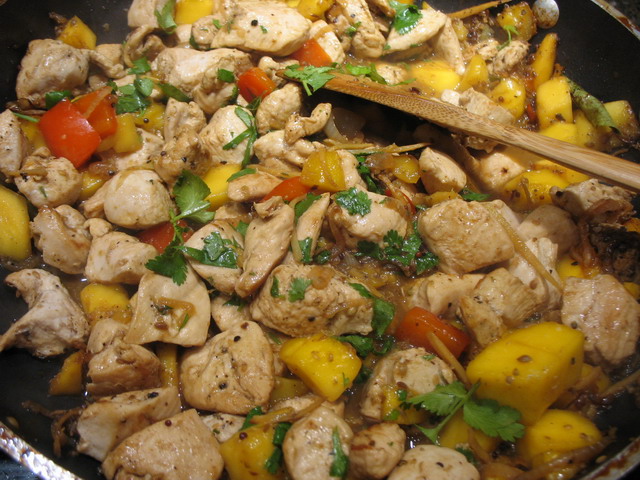
Especially when it comes to improvising dinner.
Morganna’s friend Donny was having supper with us on Friday, and I had planned to heat up some of the many leftovers we had from our vegetarian meal the night before: Dal Tarka Methi, Aloo Methi, Mattar Paneer and Sabz Kebab. There was plenty of food for four people, two of whom were growing teenagers.
As I was writing, thinking I should get up and put the rice in the rice cooker, the doorbell rang, and it was our friend Dan.
Whom we had invited to dinner for Saturday.
Except, he thought we had invited him for Friday.
So, of course, I welcomed him inside and told him not to worry–he could have dinner with me two nights in a row.
He only put up a bit of a fuss, trying to refuse, but I would have none of that. He was here, it was time to start supper, so stay he would.
But, of course, what that meant was I would have to improvise.
So I pulled out some chicken breasts from the freezer and started them thawing in the microwave, and then checked the pantry. I had lots of ginger, several mangoes, a red sweet pepper, red chiles, curry leaves, many spices, cilantro and lemons.
“No worries,” I thought to myself. “I will improvise a stir fried chicken with mangoes and ginger.”
Which is what I did.
Considering I had never made it before, and didn’t bother with a recipe, it turned out quite well, as I assumed it would, considering that I put mango chunks in my chicken vindaloo all the time.
I just needed to decide on a masala for the dish: I ended up blending black pepper, cinnamon, cloves, coriander and cardamom into a powder. I refrained from coloring it with turmeric; I wanted the yellow mango and red peppers to contrast with the pale chicken. I also added a small amount of whole cumin and mustard seeds, as I am exceedingly fond of those in combination with curry leaves.
The dish turned out to be very fragrant, and only moderately hot, owing to the only four Thai chiles I added to it. The heat that it did have came from the ginger and black pepper. I always find the heat of ginger to be of a fundamentally different quality than the heat of chiles; while it is quite warming, there is something watery about it, and sweet, which makes it seem almost cooling, in a very paradoxical way.
The ginger bite is tamed by the sweetness of the ripe mango. Mangoes are interesting fruits; to my taste, instead of the sugars being balanced completely with acid, there is also an undercurrent of muskiness to the fruit which gives its flavor a great deal of complexity. This muskiness is enhanced by the strong aroma of the curry leaves, which bring to mind fecund earth after a long, life-giving rain.
All together, the fragrant spices, herbs and fruits twine around the meatiness of the chicken, enveloping it in a harmonious chorus of flavors that sing of the long trail that spices once travelled from East to West.
And, it tastes good, too.
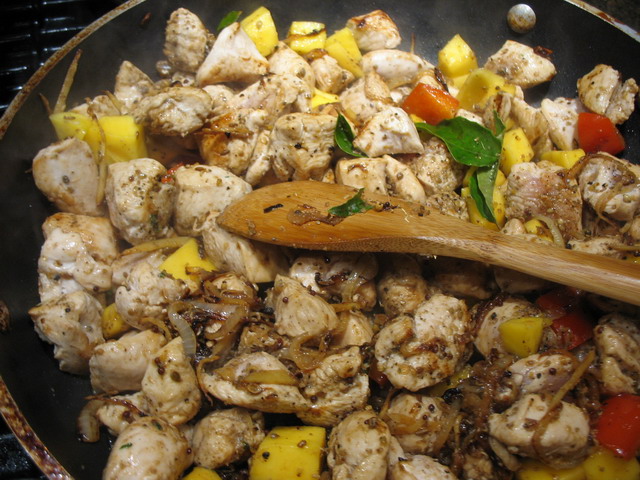
Ginger-Mango Chicken
Ingredients:
2 teaspoons coriander seeds
1/2 teaspoon black peppercorns
1/4 teaspoon cardamom seeds
4 cloves
1/8 teaspoon ground cinnamon
4 tablespoons peanut oil
1 small onion, thinly sliced
1″X2 1/2″ piece fresh ginger, peeled and cut jullienne
2-4 red Thai bird chiles, sliced thinly on the diagonal
1 teaspoon mustard seeds
1/2 teaspoon cumin seeds
1/2 medium sized red bell pepper, cleaned and cut into 1″ cubes
5-15 fresh curry leaves (this is to taste–I went easy myself because I didn’t know if Dan or Donny would like them)
1 1/2 pounds boneless skinless chicken breast, cut into 3/4″ cubes
2 fresh ripe mangoes, cut into 1/2″ cubes
Juice of three small lemons
large handful roughly chopped cilantro leaves
Method:
Toast first four ingredients in a small, heavy-bottomed skillet. When they brown slightly and become fragrant, pour into a spice grinder and allow to cool for several minutes. Grind them into a fine powder, and mix them with the cinnamon. Now you have garam masala.
Heat heavy-bottomed iron skillet or wok over high heat until it smokes. Add peanut oil and heat until it shimmers. Add onion, and stir fry until it turns dark golden. Add ginger, chiles and mustard and cumin. Continue stir frying until the onions are a deep reddish brown, and all are fragrant. (The mustard seeds will be popping like popcorn. Watch out for your eyes.)
Add the sweet pepper, and the curry leaves and stir fry until the leaves release their scent–about thirty seconds. Add the chicken and keep stirring, cooking until most of the pink is gone. Sprinkle with the garam masala, and add the mangoes. Keep cooking and stirring until the mangoes begin to release their juices. At this point, add a bit of water to the pan (no more than 1/4 cup) and let the chicken finish cooking in the liquid.
As soon as the liquid boils away, check the chicken for doneness. If it is done, squeeze the lemon juice into the pan, and sprinkle the cilantro over all, stirring it in until it wilts slightly.
Serve with steamed basmati rice or saffron pillau.
Note: This is really good reheated after it has been in the fridge for a couple of days. You just need to squeeze a bit more lemon juice on after heating it, and stir in some more cilantro. The curry leaf aroma really takes off on reheating.
Weekend Herb Blogging: Methi
Methi, also known in English as fenugreek greens, is a lovely plant.
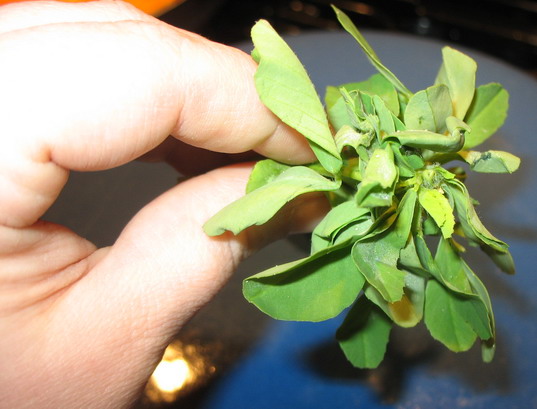
It has delicate ovoid leaves of a nice medium bluish green, dainty triangular flowers and grows in a mounding habit.
A legume, meaning it is of the same family of nitrogen-fixing plants as peas, beans, clovers, alfalfas and locust trees, methi has deliciously fragrant, slightly bitter leaves when fresh; when dried, these same leaves have the amazing scent of newly-mown hay. In fact, the English name, “fenugreek” comes from the Latin species name, foenum graecum, which means, “Greek hay.” This name comes from its use as an animal fodder in the ancient Mediiterranean region.
The leaves and thin stems can be used fresh as a vegetable or an herb in Indian cookery, depending on how much of it the cook uses. It is delicious cooked as spinach, but the flavor is much more assertive than the much more unassuming spinach. Used dried, the hay-scented leaves (sold as kasouri methi) are wonderful flavorings either for potatoes or dal, both of which benefit from being cooked with the fresh leaves as well.
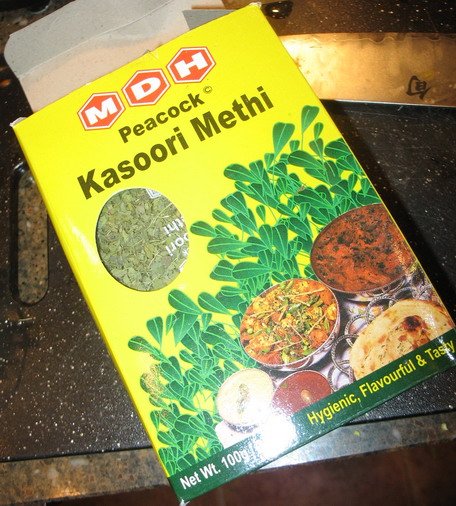
The dried seeds are used toasted and ground in many masala mixtures, and iin many Western curry powders. In fact, when Americans ask what spice is it that “smells like curry powder” I always tell them it is fenugreek, and when they smell it alone, I am almost always right. To most American and British palates who grew up eating curry powder, fenugreek is what makes curry taste and smell like curry.
Some Americans object to the smell of it; particularly considering that it seems to get into the body and seep a bit from the skin’s pores. This does not bother me. Fenugreek seeds are naturally somewhat antibacterial, and I like their earthy smell. After having ramps get into my skin from the inside out, I can only say that methi is a great improvement!
Aloo methi was my first experience with methi leaves. I ate the dish at Akbar’s in Columbia, Maryland, and it was a great surprise. They made it with dried leaves, and the flavor was addicting. Zak and I ate all of it, and he is not even that fond of fried potatoes. But these he loved, and could not get enough of them. Vowing to learn to make the dish, I scoured the local Indian markets for methi, and was thrilled to find large bouquets of them fresh.
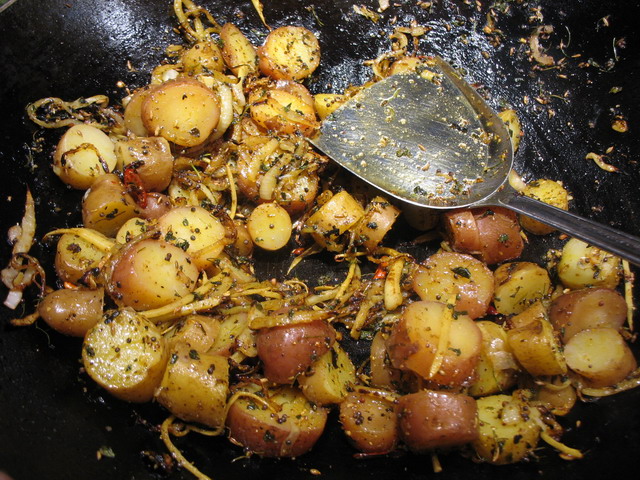
Snatching it up, I cooked it with potatoes and was sad to find that the flavor was good, but different. Fresh methi and kasouri methi carry two different aromas and flavors, I soon discovered, and so over the years, as I developed my aloo methi recipe, I changed it so that it uses methi in three different forms: fresh, dried and as toasted, ground seeds.
This results in a dish that is very intense with subtle layers of flavoring from the three very different versions of the same herb.
The amount of ginger and chiles is variable to one’s taste, but I always use a geat deal of deeply browned onions in the dish. While boiled, peeled and cubed potatoes are traditional, I like to boil whole fingerling potatoes in their jackets and then cut them into chunks, skin still on. Fingerling potatoes have a creamy texture that when boiled and then fried turns into a crispy outer coat, concealing a meltingly velvet interior.
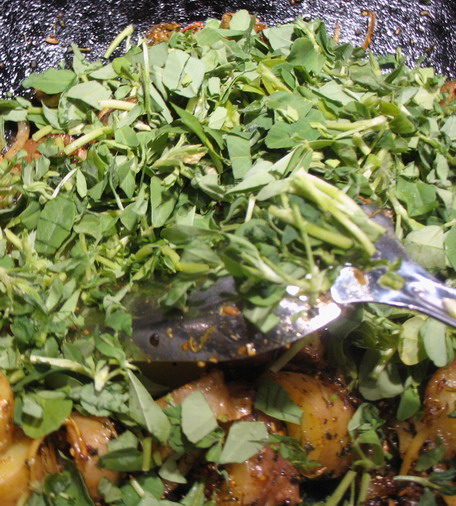
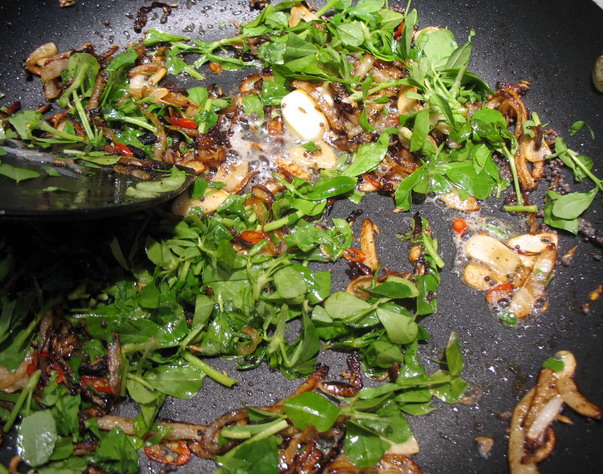
Aloo methi, however, is not the only dish that benefits from the addition of fresh and dried methi leaves. I am also exceedingly fond of dal tarka methi–a dal that has been flavored with a tarka of browned onions, garlic, chiles, mustard seeds, cumin seeds and a saute of fresh methi leaves. To add my characteristic “triple punch” of methi flavor, I also add a couple of tablespoonds of the dried herb to the lentils and beans as they cook, as well as using toasted ground seeds in the masala mixture that goes in at the beginning of the cooking process.
Methi is an herb that is well worth seeking out, particularly if one cooks a great deal of Indian food. It is good added to the spinach in palak paneer, it is good cooked in a mixture of greens in saag aloo and it is really very good in any dal. I am told that it is good with chicken, as well, but I have to admit to liking it so much with potatoes and dal, I have not tried it cooked with chicken yet. (Besides, curry leaves and chicken are a magical combination–one that I will highlight next week on my second venture into Weekend Herb Blogging.
But for now, to celebrate my first entry into Kalyn’s Weekend Herb Blogging event, I present not one, but two recipes featuring methi in three forms: my fingerling potato aloo methi and my dal tarka methi which is made of a combination of masoor dal–pink lentils, and split moong dal–split moong beans. (I like the combination of the two dals into one dish because masoor dal cooks into a smooth puree, which gives the dish body, while the moong beans keep their distinct shape as they cook, giving textural contrast.)
The aloo are good with roti, while I like the dal with steamed basmati for breakfast or lunch. Or dinner–it is one of my favorite foods. The dal is particularly nice with cucumber-tomato raita in the summer, too.
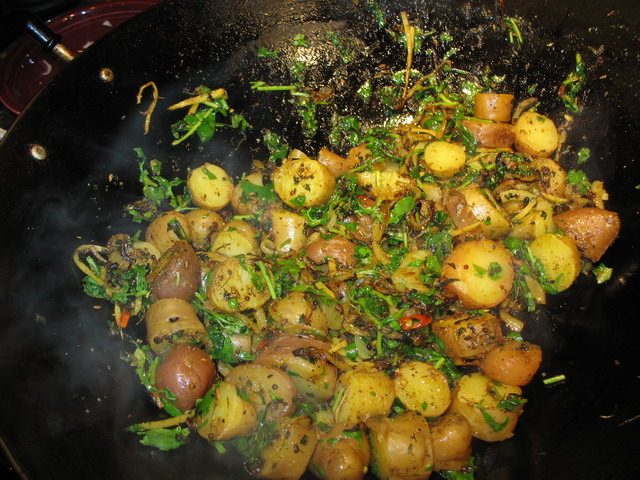
Aloo Methi
Ingredients:
1 teaspoon cumin seeds
1/2 teaspoon black peppercorns
1 tablespoon coriander seeds
1/2 teaspoon fenugreek seeds
2 cloves
1 teaspoon turmeric
4 tablespoons peanut oil
1 medium sized onion, thinly sliced
1/2 teaspoon salt
1″X2 1/2″ cube fresh ginger, peeled and julienned
3-6 red thai bird chiles, thinly sliced on the diagonal (to taste)
2 tablespoons dried methi leaves, soaked in water until rehydrated, then drained with the excess water squeezed out
2 teaspoons cumin seeds
1 1/2 teaspoons mustard seeds
1 pound fingerling potatoes, scrubbed well, boiled and then drained and cut into 3/4″ chunks
1 large bunch fenugreek greens, large stems discarded, washed well, drained dry and chopped roughly
salt to taste
Method:
Toast the first five ingredients in a small, heavy bottomed pan over medium heat until lightly browned and fragrant. Remove from pan, allow to cool, then grind into a powder. Add turmeric powder, and set aside.
Heat oil in a wok or heavy-bottomed skillet until it smokes. Add onion, and sprinkle with salt. Cook, stirring constantly, until onion is golden brown. Add ginger and chiles, and whole spices. Add soaked methi leaves. Continue cooking, stirring constantly, until onion is deep brown.
Add potatoes, and cook, stirring until the cut edges are browned, and everything is quite fragrant. Add fresh methi, and cook, tossing and stirring, until the leaves just wilt.
Salt to taste.
(Note: you can add a squeeze of lime or lemon juice to this dish for a new, tangy version.)
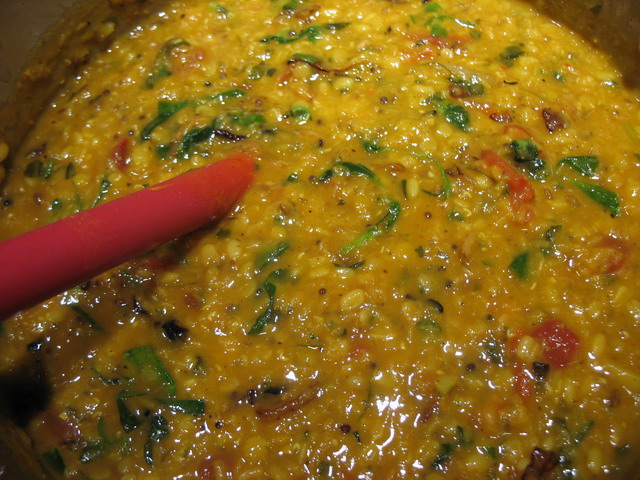
Dal Tarka Methi
Ingredients:
1 1/2 cups masoor dal
3/4 cup split moong dal
water as needed
1 bay leaf
1 big pinch asafoetida
2 tablespoons minced fresh ginger
1 tablespoon coriander seeds
1/4 teaspoon cardamom seeds
1/2 teaspoon fenugreek seeds
1/2 teaspoon black peppercorns
3 cloves
1 teaspoon turmeric
1 teaspoon paprika (all I had was smoked Spanish paprika, and it added a non-traditional, but delicious flavor)
1 can diced tomatoes (14 ounces), juice drained (I used Muir Glen Fire Roasted tomatoes)
2 tablespoons dried methi leaves
2 tablespoons butter or ghee
1 small onion, thinly sliced
3-5 red thai bird chiles, thinly sliced
3 cloves garlic, peeled and thinly sliced
1/2 tablespoon cumin seeds
1/2 tablespoon mustard seeds
1/2 large bunch fresh methi leaves, prepared as for aloo methi
salt to taste
Method:
Sort through dals, and discard any twigs, bits of rock, dirt or weird looking beans. Rinse well, and drain. Put into a medium sized heavy bottomed pot with enough water to cover by 1″. Add bay leaf, ginger and asafoetida. (It is said that these three will help prevent flatulence. I don’t know about that, but they do make the dal taste good–and really–the more dal you eat, the more accustomed to digesting it your body becomes.)
Bring to a boil, turn down heat and simmer.
Toast the coriander, cardamom, fenugreek and peppercorns as directed above, then grind. Add to the dal along with the turmeric and paprika. When the masoor dal has broken down, and the moong beans are just tender, add tomatoes and dried methi, and then cover pot, and turn heat off. Allow to sit, cooking in its own heat while you cook the tarka.
Heat butter or ghee in a heavy-bottomed pan, and cook onions until they are dark golden brown. Add chiles, garlic, cumin seeds and mustard seeds. Cook until onions are dark reddish and everything is very, very fragrant. Add methi greens, and cook until wilted.
Pour tarka into pot of dal, clap the lid back on, stir, turn heat back on, bring to a simmer. Bring lid up just a bit to taste–add salt as needed, and put lid back on.
Bring to the table, and lift the lid before family or guests and allow the steam from the tarka carry the delicious flavors to their noses.
What’s Up at The Paper Palate and The Well Fed Network
It has been a busy couple of weeks at The Paper Palate; in addition to the usual amount of writing and editing that is going on there, we have had some very newsworthy events occur which led to a great deal of extra writing.
But that is no matter: what matters is that we did our best to cover the happenings in the land of food as captured on the pages of newspapers and magazines.
Before I tell you what all I wote about, let me introduce you to our newest blogger at the Paper Palate, Cate O’Malley, who assigned herself the difficult task of covering the recent Cheese Sammich Massacree in a post entitled, “Food & Wine Article Cheeses Off Some Food Bloggers.”
Now we come to what I was writing.
First up, I noted that Cuisine, a lovely food magazine from New Zealand, won a gold medal at the 2006 Gourmet Voice Gourmet Media World Festival in Cannes, France. This is great news, because it might mean that those of us in the US might get a glimpse of that mag at our newstands soon.
A few days later a bit of controversy erupted when I posted about the fact that Relish, a food magazine which boasts to having the largest circulation of any food magazine that accepts advertising in the US on its debut issue, is offering advertisers editorial mention for money. Not only is that unethical, but it turns out that those very high circulation figures are somewhat misleading–Relish is not a newstand magazine; it is a monthly newspaper magazine insert along the lines of Parade. It is essentially piggybacking on the circulations of the newspapers who carry it. The controversy came about when a reader made an unsubstantiated claim in his comments that all magazines sell editorial space to advertisers.
The next day, I posted about the unexpected findings that low-fat diets do not seem to help protect women from breast cancer or heart disease, and pointed out several questions that the reporters at the big daily newspapers didn’t ask, but probably should have.
The news that a worker-owned cooperatively run fine dining restaurant has opened in New York City made headlines in Washington DC, in part because it is a novel concept to fine dining, and in part because the workers in question were formerly employed at Windows on the World, the restaurant that perished in the flames of 9/11. It is a really uplifting, heart-warming story, and it shows that the concept of worker-owned restaurants does not just belong to the granola-chewing Birkenstock-wearing crowd.
I already posted this here, but offer it again, in case any readers missed that Southern cookbook author Edna Lewis died.
Finally, on Wednesday, I wrote about NY Times food critic, Frank Bruni opening his own blog, “Diner’s Journal.”
Here’s what our other great writers at the Palate were tasting and writing about:
Christina Nevin presents a new twist on Caesar Salad from the UK food mag, Fresh.
Kate Hopkins tells us about Bon Appetit ducking the foie gras issue.
Beth F. just came back from Argentina, so she presented a recipe from the San Francisco Chronicle for picadillo, which she paired with the newly popular Argentinian wine, Malbec.
And, around the rest of the Well Fed Network:
Rosanne from The Spirit World tells us about the Japanese distilled liquor, Shochu.
Derrick at Growers and Grocers points us to a NY Times article on the future of GMO’s.
And finally, Helen Yee treats us to “Psychology in a Chocolate Box” at Sugar Saavy.
A Quick Note On the Differences Between Blogs and Old Media
Zak found this small piece in the NY Times today, about the distinctions between blogs and old media. While the main source for the news brief is David Sifry’s (the Technorati dude) blog entry: The State of the Blogosphere (Part II), it behooves the reader to look at Part I as well, which is filled with interesting statistics such as the fact that the blogosphere is doubling in size every five months, and it is now 60 times bigger than it was three years ago. Technorati is now tracking 27.2 million blogs, and about 1.2 million new blog posts per day.
There is a whole lot of writing going on.
Now, what does Sifry have to say about blogs vs. old media, or as bloggers tend to say, MSM (mainstream media)?
Well, when it comes to the big news of the day, MSM still has the upper hand, in that the large news sites such as the Washington Post, New York Times and CNN get linked to more often than the larger news blogs. (Not that the large news blogs are slouches, mind you–they have millions of readers and are certainly linked to all over the place.
But here is the reason why I posted this link today–the “Magic Middle” of niche publishing–that includes us food bloggers, if you haven’t figured that out.
Sifry says, “This realm of publishing, which I call “The Magic Middle” of the attention curve, highlights some of the most interesting and influential bloggers and publishers that are often writing about topics that are topical or niche, like Chocolate and Zucchini on food, Wi-fi Net News on Wireless networking, TechCrunch on Internet Companies, Blogging Baby on parenting, Yarn Harlot on knitting, or Stereogum on music – these are blogs that are interesting, topical, and influential, and in some cases are radically changing the economics of trade publishing.
At Technorati, we define this to be the bloggers who have from 20-1000 other people linking to them. As the chart above shows, there are about 155,000 people who fit in this group. And what is so interesting to me is how interesting, exciting, informative, and witty these blogs often are. I’ve noticed that often these blogs are more topical or focused on a niche area, like gardening, knitting, nanotech, mp3s or journalism and a great way to find them has been through Blog Finder.”
(emphasis mine)
I will leave the reader to mull over the implications of that statement for a while.
No Cheese, Thank You, Please
I was going to blog about a cheese sandwich as a means by which to humorously flip the bird at Peter Wells’ opinion on most of the food bloggers in the world, save the seven he praised in his article in the March 2006 Food & Wine. (Okay, if you want to get the subtleties of this post, click on the link and read his article, please. Otherwise, you are going to miss some of what I am talking about.)
But then, yesterday, I got too into cooking some Indian dishes I had not done before (sabz kofta, and mattar paneer–and yes, I will post about those in the next few days), so I forgot that yesterday was Cheese Sandwich Day.
So, I have no cheese to give my readers. Sorry. That is life.
But, I do have a few words on the matter of Wells’ article and his opinions.
First, I respect the fact that he has his opinion, just as I have mine. The beauty of the free press and the Internet is that we can all state our opinions freely, without fear of government reprisal (or at least, not too much fear), though we all have to understand that not everyone is going to agree with us all of the time. In fact, the stronger the opinion, the less likely we are to find those who agree with us.
In looking back at the article, I think Wells meant no malice in his words. I think he meant to point out good blogs to the readers of F&W, but it was the way he went about it that was so offensive and wrong-headed, and that is where he upset people.
I have two main quibbles with the column in question.
One, is that in order to prove his point about how badly some blogs are written and how boring they are, he took quotes out of context from various blogs, presenting them as examples of lame writing.
This is a lazy rhetorical tactic, and is, in itself, an example of bad writing. I know several editors who would mercilessly tear to pieces any argument constructed on the basis of out-of-context quotes. And rightly so.
The fact is, I could go through a bunch of Peter Wells’ writing and pull out sentences or phrases that are the epitome of lame, boring, pedantic, crap writing. I could do it with any writer, because anyone can do it with any writing. Writing style is not distilled into one single random sentence, nor is voice or passion or wit. These qualities of good writing are found in the way in which sentences are strung together into a whole essay, article, poem, play, book or speech.
Sure there are stand-out sentences that drip with style, that beg to be read aloud, that burn the brain like sips of brandy on the back of the throat.
But no writer’s work is made up soley of sentences like that.
Not Peter Wells’, not the bloggers’ he picked on, not mine, not M.F. K. Fisher’s, not anybody’s.
That is the first thing that still sticks in my craw over that article, and in large part, it sticks there because Wells is a much better writer than that. I’ve read his stuff. He’s good. But this piece just sounds tossed off and badly done.
The second thing that still cheeses me off is this statement from Wells: “First, a good blog needs to communicate passion, and a really good blog will make the reader feel passionate as well. This should be easy when the subject is food, but it does rule out cheese sandwiches. Listen up, bloggers: Nobody cares what you had for lunch today!“ (Emphasis mine.)
Okay, here’s the deal: that statement is just not true.
A look at any food blogger’s stats, like say, Kirk’s at Mmm-yoso! will put the lie to that. Kirk eats lunch a lot, and he talks about it all the time. He posts pictures of his lunches and dinners, at home and out, every day.
And guess what, Mr. Wells?
People read it. Every day. And comment on it. A lot.
Why?
Because people like Kirk.
He’s funny, he’s personable, and he’s real. And people like that about him. They can identify with him.
Not everyone who reads food blogs is a food blogger, so not only were food bloggers insulted, but so were readers of food blogs.
This is where I think he went awry–and this is where I think a lot of professional food writers for large newspapers and glossy magazines go wrong: they are writing for a particular audience that values particular things, and if one is not part of that audience, then one is not valued.
Food is universal, people. It is not “owned” by the gourmets, the foodies and the snobs of the world. Everybody eats, and apparently, lots of everybodies want to know what everybody else is eating.
Readers derive vicarious pleasure by knowing what Clotilde is cooking in Paris, what Chubby Hubby has going in Singapore, and what Josh is eating in Hong Kong.
This should come as no surprise to magazine writers like Wells; after all, he works for a magazine which is considered a “food and lifestyle” magazine. The magazines are not only about food, but are about selling lifestyles, images to their readers. A lot of their advertising revenue comes from luxury items, and are called “aspirational advertising” by the ad execs. Wells should know all about vicarious living through reading; his magazine caters to that wish all the time.
So do some blogs.
But for every blog that does that, there are blogs that cater to our very human desire to share our every day food with others. And even those bloggers who live in “glamorous” places, are mostly writing about their own, very real, very normal lives. It just so happens that to some, where they live is very exciting, because those folks don’t live there, and they feel as if their lives are very “common.”
But how common is common, really?
I never thought anyone would want to read what I have to say. I’m a hillbilly from West Virginia, for goodness sake: who wants to hear about what I do in my kitchen, when they could peek in on Paris, Delhi or London? I live in a small town in Ohio, and am about as common as common can be: I have a lot of cats, I have a sixteen year old kid and I read a lot. So what?
Well, apparently, “common” writing is still good writing, and we common folk are still pretty interesting to a bunch of other folk.
Besides, I would like to remind Wells, and the editors of the glossies who look down on “the common folk” that Food & Wine, Gourmet and Bon Appetit are not the food magazines with the highest circulation in the US.
The magazine with the highest circulation is Taste of Home, which consists primarily of recipes sent in by readers–home cooks from across the country. It accepts no advertising, because it doesn’t need to–it is completely reader-supported. It is a magazine built upon readers sharing information, much the same way food bloggers share information back and forth with their readers.
And its circulation figures blow the “big” food and lifestyle magazines, all of whom are ad-supported, out of the water.
What does this say?
Well, it tells me that there is a significant portion of food lovers in this country who might not care for opinions like Mr. Wells’ nor do they seem to care about what the publishing world’s arbiters of taste have to say about food.
They don’t care about lifestyles or “aspirational advertising.”
They just care about food that is good, and how to make it.
Some folks who read food blogs are like that too.
Some of us care about different things than Wells.
And that is okay–there is room enough in the world for us all.

Categories:
- Admin (rss) (55)
- Blogs and Blogging (rss) (81)
- Book Reviews: Cookbooks (rss) (43)
- Book Reviews: Non-Cookbook Food Books (rss) (38)
- Cats and Cat Blogging (rss) (47)
- Chinese Cooking Lessons (rss) (32)
- Culinary School Stories (rss) (18)
- Dairy Pruducts: Cultured and Barbaric (rss) (4)
- Documentary Filmmaking (rss) (1)
- Essays, Rants and Reflections (rss) (260)
- Fighting Hunger (rss) (12)
- Food and Kids (rss) (45)
- Food in the News (rss) (126)
- Food Media (rss) (98)
- Food Preservation (rss) (18)
- Food Safety (rss) (45)
- Gardening (rss) (30)
- Herbs and Herb Blogging (rss) (20)
- Holidays (rss) (50)
- Kat Blogging (rss) (22)
- Kitchen Science (rss) (36)
- Leftover Makeover (rss) (8)
- Life, the Universe and Everything (rss) (131)
- Local and Sustainable (rss) (227)
- Local Athens Food and Foodies (rss) (42)
- Meatless Mondays (rss) (32)
- Menu For Hope (rss) (5)
- Nutrition, Diet and Health (rss) (84)
- On The Farm (rss) (8)
- Recipes: Almost Vegetarian, Vegetarian and Vegan (rss) (294)
- Recipes: American Regional (rss) (37)
- Recipes: Appalachian Hillbilly (rss) (33)
- Recipes: Bread, Pasta, Grains (rss) (95)
- Recipes: Canning and Preserving (rss) (8)
- Recipes: Chinese (rss) (123)
- Recipes: Comfort Food (rss) (120)
- Recipes: Cookies (rss) (16)
- Recipes: Desserts (rss) (48)
- Recipes: French (rss) (25)
- Recipes: Fruits and Vegetables (rss) (302)
- Recipes: Greek, North African and Middle Eastern (rss) (31)
- Recipes: Indian (rss) (137)
- Recipes: Italian (rss) (42)
- Recipes: Japanese (rss) (7)
- Recipes: Jewish (rss) (4)
- Recipes: Korean (rss) (6)
- Recipes: Meat, Poultry and Fish (rss) (220)
- Recipes: Mexican/Native American/ Latin American/Caribb (rss) (27)
- Recipes: Original (rss) (108)
- Recipes: Thai (rss) (27)
- Recipes: Tofu (rss) (17)
- Recipes: US Regional (rss) (16)
- Recipes: Vietnamese (rss) (8)
- Restaurant Stories (rss) (28)
- Sewing, Quilting, Arts and Crafts (rss) (16)
- Simple Chinese Recipes (rss) (30)
- Slow Food and Heritage Foods (rss) (10)
- Spice Blogging (rss) (44)
- The Chinese Cookbook Project (rss) (14)
- The Chinese Pantry (rss) (39)
- The Documentary (rss) (2)
- The Kitchen Saga (rss) (17)
- The Locavore's Bookshelf (rss) (15)
- The Unsung Adventures of The Culinary Nerd (rss) (6)
- Tools and Toys (rss) (35)
- Uncategorized (rss) (10)
- With a Side of Politics (rss) (48)
Archives:
- August 2012 (9)
- July 2012 (12)
- September 2011 (3)
- August 2011 (7)
- July 2011 (8)
- June 2011 (16)
- May 2011 (17)
- April 2011 (11)
- December 2010 (9)
- November 2010 (5)
- February 2010 (1)
- December 2009 (5)
- November 2009 (7)
- October 2009 (10)
- September 2009 (16)
- August 2009 (14)
- July 2009 (14)
- June 2009 (7)
- May 2009 (17)
- April 2009 (10)
- March 2009 (25)
- February 2009 (13)
- January 2009 (10)
- December 2008 (5)
- November 2008 (5)
- October 2008 (6)
- September 2008 (13)
- August 2008 (8)
- July 2008 (11)
- June 2008 (18)
- May 2008 (13)
- April 2008 (14)
- March 2008 (16)
- February 2008 (17)
- January 2008 (19)
- December 2007 (25)
- November 2007 (18)
- October 2007 (24)
- September 2007 (16)
- August 2007 (15)
- July 2007 (15)
- June 2007 (10)
- May 2007 (14)
- April 2007 (16)
- March 2007 (17)
- February 2007 (20)
- January 2007 (13)
- November 2006 (1)
- October 2006 (8)
- September 2006 (14)
- August 2006 (25)
- July 2006 (30)
- June 2006 (28)
- May 2006 (34)
- April 2006 (29)
- March 2006 (24)
- February 2006 (30)
- January 2006 (38)
- December 2005 (40)
- November 2005 (37)
- October 2005 (32)
- September 2005 (25)
- August 2005 (30)
- July 2005 (28)
- June 2005 (21)
- May 2005 (8)
- April 2005 (22)
- March 2005 (17)
- February 2005 (29)
- January 2005 (10)
Search Site:
Links:
- Lily’s Wai Sek Hong
- 101 Cookbooks
- A cat in the kitchen
- A Veggie Venture
- Accidental Hedonist
- Cha Xiu Bao
- chez pim
- Chocolate & Zucchini
- Chopstick Cinema
- Chowhound.com
- Chubby Hubby
- Cook sister!
- Cooking with Amy
- da*xiang
- Eat Local Challenge
- Eating Liberally
- Ecocentric
- Eggbeater
- Epicurious
- Farmgirl Fare
- Fatfree Vegan
- Foodgoat
- ForkandBottle.com
- Green Olive Tree
- Hooked on Heat
- Jaden’s Steamy Kitchen
- Kalyn’s Kitchen
- Lucullian delights
- Mahanandi
- Matt Bites
- MeatHenge
- mmm-yoso!!!
- New York Times – Dining & Wine
- Pizza Goon
- Rasa Malaysia
- Ruhlman
- Sailu's Kitchen
- Serious Eats
- SF Gate: Food & Dining
- Simply Recipes
- Soul Fusion Kitchen
- Tastespotting
- The Amateur Gourmet
- The Cleaner Plate Club
- The Food Section
- The Grub Report
- thecookscottage
- U.S. Food Policy
- Wandering Chopsticks
- Washington Post Food and Dining
- Wasted Food
Meta:


Powered by WordPress. Graphics by Zak Kramer.
Design update by Daniel Trout.
Entries and comments feeds.