
Cook Local, Eat Global
Because I Was Asked..My Top Ten Favorite Foods
So, I was minding my own business, reading other people’s blogs, and not posting on my own, when I noticed over at Haverchuk, that Michael had twanged me with a meme.
And not just any meme, but a meme that is damned hard to answer.
He wants me to tell him what my ten favorite foods are.
I mean, first of all, what is meant by “food.”
Is a food a completed dish, or an ingredient? Is it something that grows on a tree, comes out of animal, swims in the water, what?
What is it?
If it is a completed dish, I don’t know how I would answer, so I decided that I was going to talk about my ten favorite food items in their purest light–as unformed ingredients.
And so, in no particular order, we come to the list.
Berries have been a passion of mine since childhood. I have always loved them, and I cannot easily choose a favorite among them. Blackberries come close to edging out strawberries, but then, when we grew strawberries in our front yard at our last house, there was nothing better than walking out the front door barefoot in the morning, and picking a handful of berries to go with the morning coffee. They were sweet and sunwarmed, filled with the fragrance of spring. Zak had never tasted anything like them. I love nothing more than to pair strawberries with rosewater (rosewater enhances all of the berries, in fact) in a sour-cream based ice cream. When they are in season, strawberries are my favorite food.
But then, blackberries come into season, and my fickle tongue longs for their wine-dark juices, and their sour-sweet kiss. As a child, I labored long afternoons picking gallon upon gallon of wild blackberries for my Grandma to make jelly, braving thorns, mosquitoes, poison ivy and copperheads. I never felt that the dangers were too great–those shimmering jars of jelly kept the flavor of high summer alive all the long grey days of winter.
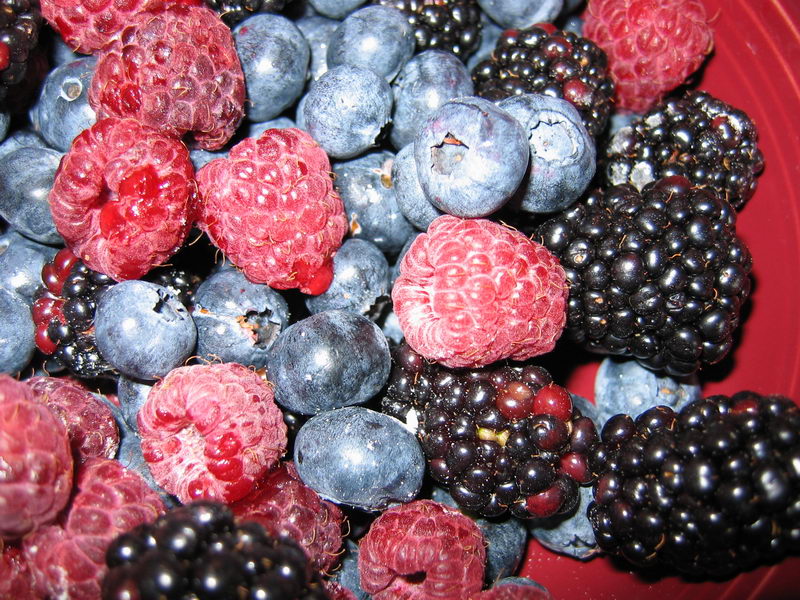
Blueberries, when truly ripe, are complex in flavor and call to mind the scent of violets, tinged with the sharp sour note of lemon. This summer, as I made batch after batch of blueberry scones and muffins and baked blueberry cherry pies, I came close to forgetting about the other berries.
When I am finally enamored fully of the charm of blueberries, along comes the delicate fairy princesses of the berries–raspberries. So sweet, so fragrant–like flowers, like trickling melodies, sweet and tart and blushing plump with lip-staining juice. These roseate beauties with their silvery sheen are best alone, though they are delicious in tarts with crusts as delicate and fragile as butterfly wings–a fitting cup to hold the sweetest primrose of the bramblefruits.
Cherries have always been my favorite fruit, favored even over all of the berries. Sour cherries, to be precise. I love to eat them raw, but they are best in pies, or in the fragrant and incredibly flavorful Persian dish, albalu polow–basmati rice cooked with tiny lamb meatballs, almonds and sour cherries. Their season is short, and there are few farmers who grow them, but to me, one pound of sour cherries is worth more than five pounds of dark sweet cherries. (Though, in truth–I like those, too.) I have never outgrown my childhood fascination and adoration for sour cherries, and I don’t think that I ever will–I believe that I will always love them, more than I love the flesh of fowl or beast, and I cannot say why that is. It must have been because I have always prized strong flavors over delicate ones, and sharp, sour flavors over sweet. (I used to drink pickle juice and eat lemons when I was little. I had to sneak it past my Mom, who was certain I was going to damage my stomach in some way, but I loved sour stuff to the point of even taking slugs of vinegar when she wasn’t looking.)
Tomatoes are a gift from God.
They quenched my thirst many late summer days, while working on fencelines or hoeing weeds from the potato patch. They would wait in the blazing sun, shaded by thier dull, toothy green leaves, softened by silvery fuzz, their scent calling me. I used to carry a salt shaker to the garden when I worked and when I got thirsty, I’d pick a tomato, dust it off on my shirt, bite it, and then sprinkle salt on it, then bite it again.
Sun-warmed juice would explode into cascading flavor, a waterfall of sweetness followed by the sharp teeth of sour that bit back at my tongue and the roof of my mouth.
I am allergic to tomatoes, but I eat them anyway. They sometimes make me break out around my lips into tiny hives. They stay for an hour or so and then fade back into my skin harmlessly. I remember in those days, the reaction was more severe, and my lips, cheeks and chin–anywhere that the juice dripped–would become inflamed with welts.
I ate them anyway, knowing that I could no more turn down the temptation of a tomato than God could keep Eve out of His tree.
I never saw being thrown out of Paradise as a curse or a punishment, either. I think that God made that tree for humans to partake of as a gift.
Just like those warm August tomatoes that quenched my thirst so long ago.
Bacon is one sort of flesh to which I cleave most strongly. I grew up eating bacon that my grandparents cured and smoked themselves. Thick cut slices of pig belly, streaked with deep reddish lean meat and creamy white fat, sweet with the flavor of maple sugar and brined in the bite of kosher salt, were my favorite breakfast on the farm. Of course, I never quite understood the irony of Grandma’s insistence upon using kosher salt in the brine for their bacon and hams, but now, knowing how much Zak adores good bacon, I giggle and think of his declaration that it would be “sacrilicoius.”
The bacon of my childhood spoiled me, and now I eat no bacon that isn’t thick-sliced and country style. Preferably raised on a local farm and smoked over hardwood. Those thin weirdly cherry red strips of bacon in the grocery store are not to be tolerated in my kitchen–not when there is pig fat that has been treated right and proper to be had.
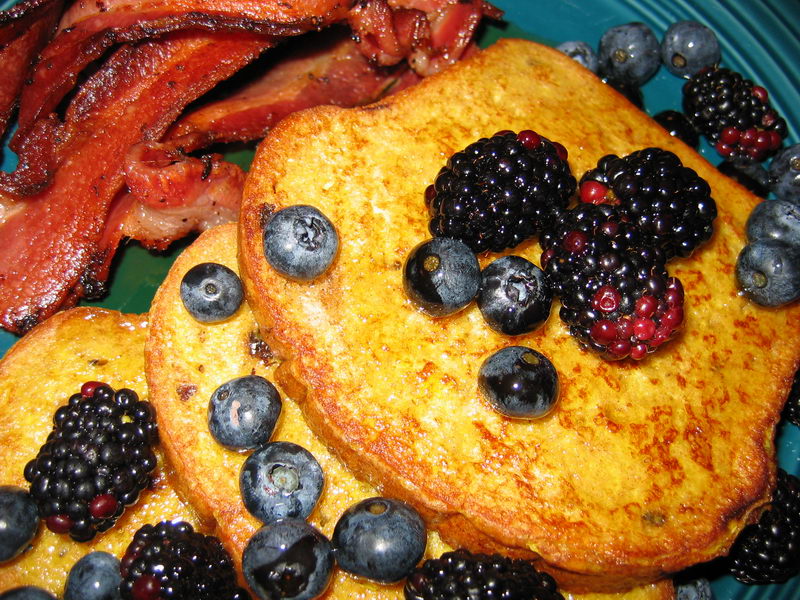
Nothing is better than blueberry pancakes with bacon than waffles with bacon. Unless it is french toast made from whole wheat currant bread with bacon and berries and local maple syrup. That is, indeed, a divine taste sensation.
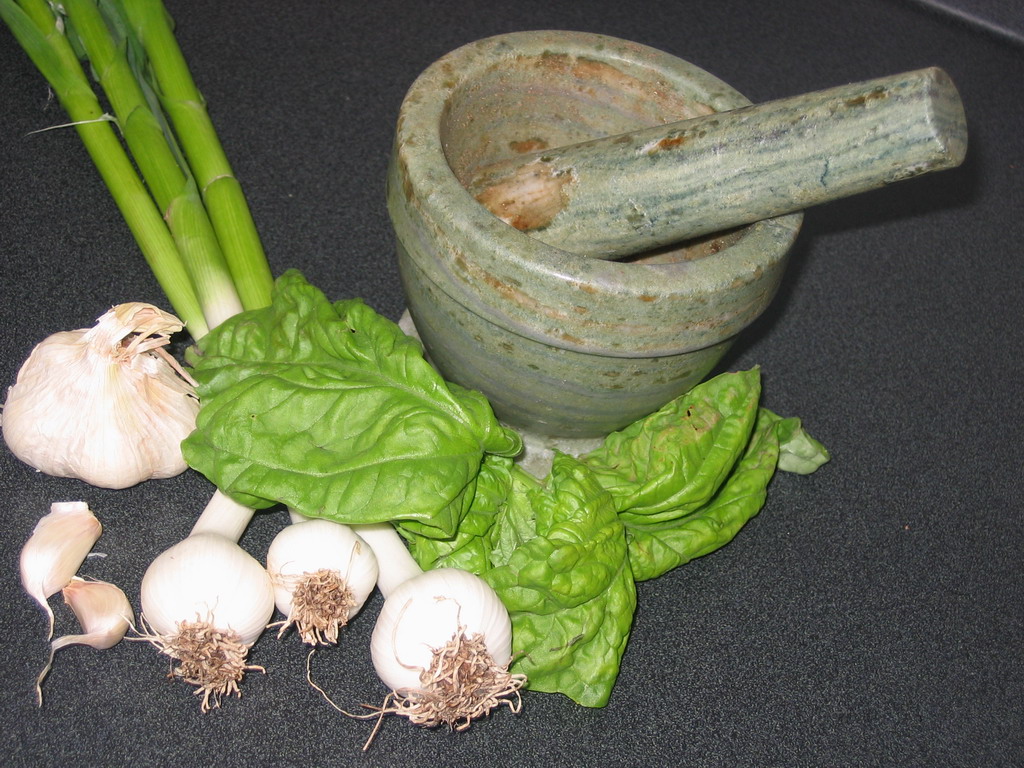
Garlic is another flavor I took to right away. It was love at first smell, then love at first taste, and finally, love at first sight. I grew familiar with garlic much later in life–few of my family used much of it in cooking. Aunt Nancy used some, being as she grew up in Providence, Rhode Island among the Italians and Portuguese, where the scent of garlic and herbs defined the neighborhood. To my young palate, the taste and smell of garlic were redolent of my Aunt Nancy. They reminded me of her, her warm laugh and her lovely cooking.
Morganna loved garlic from a much earlier age. I remember taking her with me into a Middle Eastern grocery store when she was a toddling two-year old with golden hair and dark brown eyes. I carried my purchases up to the counter, and set them down. She saw next to the counter, a large basket of fresh garlic, and quick as a rabbit lunging for lettuce, her hand darted into the basket and plucked out a huge head of garlic. She stuck her face right into it, breathed deeply and said, “Aaaah. Darlic. Mordanna love darlic. Darlic, darlic, darlic.” She then proceeded to half stick the head up her nose to sniff it again.
The proprietor of the store smiled hugely. “Do you really like garlic, little one?” he asked. “Oh, yes,” she replied, still sniffing loudly, the garlic pressed to her face. “Mordanna loves it. Makes everything Mamma makes taste dood.” (She had trouble pronouncing “g” at the time. She is much better now.)
I ended up buying that head of garlic and she carried it all the way home and then carried it all through the house, sniffing, as if she were an eighteenth century lady sniffing at her tussie-mussie.
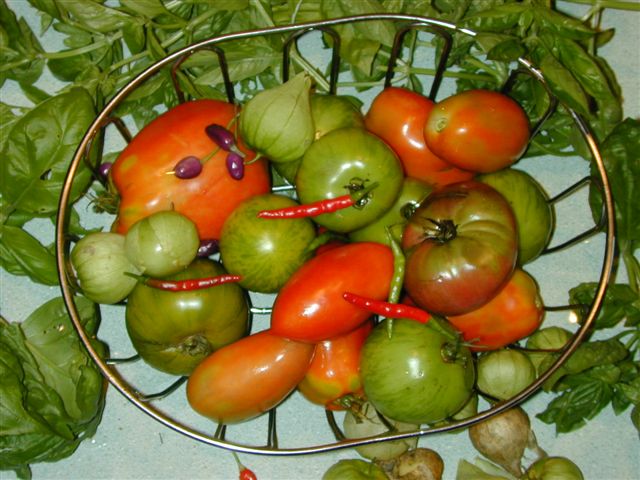
Chiles are also a fairly new obsession. I always liked spicy food, but I didn’t learn to love the chiles until I went to culinary school and came under the tutelage of the local Thai chef who truly taught me to appreciate the burning joy of capsaicin.
Now, I have over twelve varieties of dried chiles in the cupboard and six types frozen. I put them in nearly everything, including chocolate truffles and brownies. I even like them in ice cream. I am not quite addicted to the burning sensation they impart, but I cannot help but love the sizzle, the tingle, the boost of endorphins that comes with the dance of fire on the lips and tongue.
Chocolate , on the other hand, is an old obsession. As old as I am, older than I am–I think it comes to me through my father’s genes. The love of chocolate is strong on his side of the family, and some of us are even obsessed enough to try and make the ultimate fudge or the best truffle, or the greatest brownies in the world. It is something we all strive for–to unlock the dark mystery of chocolate.
We dream of it, we revel in it, we sing to it, it sings to us and through us and we use it to create masterpieces. It seduces us, and through us, it seduces others–I have a brownie recipe that has gotten me several wedding proposals.
I even accepted one of those proposals, though somewhat later than one might suppose.
And we are still married.
And, here is the kick of it–Zak doesn’t even usually like chocolate.
Ah, but what is an individual’s indifference to taste in the face of pure alchemy?
Oh, and here is the hell of it–I am allergic to chocolate, too.
But–I bet you could never guess this–I eat it anyway.
It doesn’t seem to do anything to me, so why worry?
Cheese has been another long-time gustatory soulmate for me. And yes–I am allergic to several cheeses which I absolutely adore, and one which I have grown to abhor.
But I have no one favorite cheese. There are too many delightful ones for me to choose one–it would be like choosing a favorite cat or child or exact shade of a color. It is impossible.
The creamy nutlike sweetness of Camembert, and the flaking salt sharpness of aged Chedder are equally worthy of praise. Emmentaler and Edam, Gouda and Gruyere, Haloumi and Havarti are all beautiful beyond compare. Sharp and tangy chevre crumbled over roasted beets is heavenly, while the milky richness of fresh mozzerella is beyond compare when paired with achingly ripe tomatoes and fresh basil with a drizzle of peppery olive oil.
The blue-veined cheeses are my bane–I love them, all of them, but I am allergic to the mold that gives them their lovely marble colors and distinctive flavors. And unlike my allergies to chocolate and tomatoes, which do little if anything at all, blue cheeses make me wretchedly ill, so much so that I do not indulge in my passion for them at all anymore. And I must also take care that any brie I eat does not have penicillium mold used in the rind–I am deathly allergic to that mold in particular.
The cheese that I abhor–the one that I am allergic to–Velveeta and its processed cheese food brethren. It, too, makes me beyond ill, so I avoid it. I no longer even crave it, thankfully.
Basil is an herb that I can eat as a vegetable and be happy.
It is sweet, it is spicy it is redolent of all that is green and good in this world. It is the grassy color of peridot and emeralds, I wish my eyes were the same color and its scent draws bees to swarm over its pale flowers, thier little furred backsides writhing in joy as they jostle to sip its licorice-tinged nectar. Butterflies love it, too–I have gone gathering great bouquets of basil in the garden–wedding-bouquet-sized bundles, and gone trailing a train of butterflies through the yard on my way to the kitchen to process it into pesto so I can freeze it for winter.
It pairs naturally with garlic, it swoons to be near olive oil, and it loves its heart-friend tomato with a passion that is enduring. It is equally at home with the fire of chiles and the salty funk of fish sauce, kissed with ginger and shallots.
It is my best beloved herb.
Finally, we come to salmon.
The king of fish and the fish of kings. The wisest creature in the world, according to the druids, there is no more flavorful a fish than the salmon.
In culinary school, I had to poach a whole salmon and present it “bellevue,” meaning, “dressed beautifully.” My partner and I shaped the lovely fish so he appeared to be leaping from the tray, and we decorated him with scales made of cucumber and radish.
No one touched him, because our classmates didn’t like salmon.
The only ones to partake of him were my chef and I–and we ate a pound or so each, but he was a large fish, so to my heartbreak, we ended up throwing most of him away.
What a waste.
I have often said, that I hope that after I die, I could be reborn as a grizzley bear.
There could be no better life.
Swimming in cold water (I prefer swimming in cold lakes, ponds, streams and oceans to nice warm beaches and heated swimming pools. I have no idea why. Maybe in my last life I was a bear), fishing and eating as much salmon as I could hold, then chasing it down with ripe blackberries.
That would be the life.
Barbara’s Cookbook Gift Guide
This post really isn’t self-serving.
It is simply a response to reading the holiday cookbook gift guides in the New York Times, the Washington Post and the San Francisco Chronicle.
In perusing the professionals’ lists, I saw quite a bit of overlap, particularly between the Times and the Post–to the point that I wonder whether or not they were guided by the same blitz of publication advertising and had not spent any time actually looking at the books. The Chronicle’s more eclectic list led me to believe that the author had actually stepped into a bookstore and done a bit of browsing before putting together her selections.
I mean, the other two lists were quite–well–predictable. A lot of old, comfortable names: Julia Child, Paula Wolfert, and Martha Stewart, along with typical chef’s tomes that are usually unuseable by mere mortals found their way into the gift guides. Very beautiful, photo-heavy works one is loathe to take into the kitchen, such as Jeffrey Alford and Naomi Duguid’s near art-bookMangoes and Curry Leaves also feature prominately.
I thought that maybe I should put together my own list of worthy cookbooks that maybe aren’t getting as much attention as they deserve in the conventional press. While I am at it, I’ll throw in a few books that are about food, but aren’t cookbooks per se, but instead focus on history, sociology or science.
Charcuterie: The Craft of Salting, Smoking and Curing
Michael Ruhlman and Brian Polcyn with a forward by Thomas Keller
Yep, right away, I go for something odd. This isn’t just a collection of recipes, it is an adventure in traditional ways of preserving meat. This is not a cookbook for folks who want instant gratification–the processes outlined in this book take hours, days, weeks or months, and if you screw up, you could kill someone with the result. (There is nothing more exhilerating than avoiding botulism.) The authors examine the dying art of traditional charcuterie–the making of fresh meat into something different and better–sausages, hams and bacon. (I bet anything that Dr. Biggles of Meathenge wants to get his hands on this book even more than I do, but if there was only one copy between the two of us, I’d arm wrestle him for it!)
Eating Korean: From Barbeque to Kimchi, Recipes From My Home
Cecilia Hae-Jin Lee
Here is a cookbook that combines the best of storytelling about food with precise, well-executed recipes. Lee gives the reader more than a glimpse of her past; she evokes the flavors, scents and colors of childhood through the memories of the dishes she presents in simple, yet elegant prose. Definately a book to read and cook from.
The Silver Spoon
Phaidon Press
I am not sure why this treasure only appeared on one of the afformentioned newspaper cookbook gift guide lists, but this massive tome promises to become a classic in the US, just as it has been in Italy for the past fifty years. This is the first time that this venerable cookbook, a fixture for generations of new Italian brides, has been translated into English, and the buzz in the food magazines is positive to the point that some of the authors sound fluttery with the vapors. There is good reason. Contained within the 1,264 pages are recipes from every region of Italy, collected back in the 1950’s. It is also apparently obsessively organized and cross-referenced to be as user friendly as such a gigantic volume needs to be. If someone on your list is a cook and loves Italian food, you cannot go wrong with this one. (Of course, everyone else in the English-speaking universe appears to want this book, so happy hunting!)
Curry: A Tale of Cooks and Conquerers
E.M. Collingham and Lizzie Collingham
This one doesn’t come out in the US until December 16th, but I have been drooling over it for months since I saw it on Amazon UK by lucky chance. It is a history of the development of Indian food with special emphasis upon religious, sociological, economic and cultural forces and how they combined to create such a diverse, complex web of culinary traditions. I can’t wait to get my hands on this one.
Cornbread Nation 3: Foods of the Mountain South
Ronny Lundy (editor)
This third in a series of Southern Foodways Alliance anthologies brings together poems, essays and stories about the food and culture (yes, culture, you heard me right) of the Applachian mountains. That’s where I am from, so of course, I am a mite curious to know whatall’s gonna be in that there book. It includes the lyrics to the Cornbread National Anthem, written by West Virginia singer/songwriter Tim O’Brian.
So–there are my top five picks for books that serious culinary nerds might want to find under some sacrificial pine tree on Yule.
What other books would y’all like to find tucked in a stocking come Christmas?
The AGA is Installed
After the dust has settled and the drama is done, our kitchen is fully functional.
All that is left to do is the cosmetic stuff, like putting on the outlet and switchplate covers–which came today and look fantastic and match the cabinet hardware perfectly.
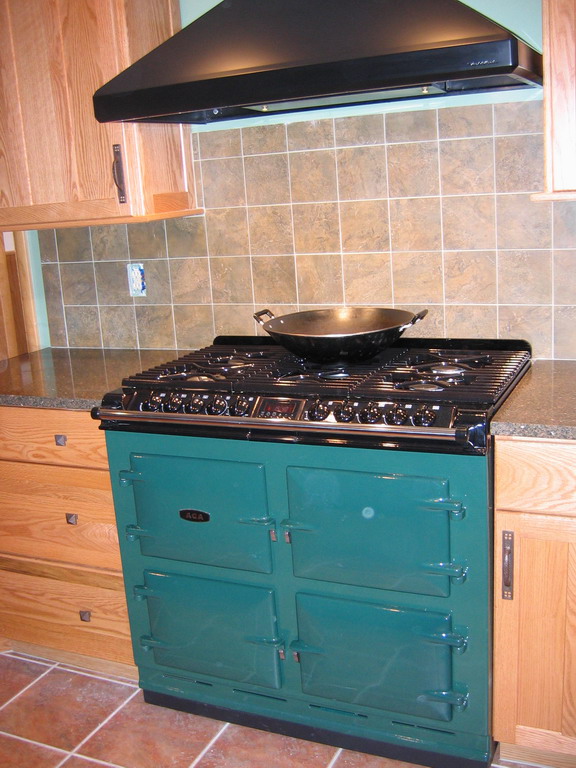
The still unnamed AGA is in place, hooked up and working. As you can see, Morganna has already brought the wok down to live in its new home. She is frothing at the mouth for me to finish this post so we can cook!
The refrigerator is in place and working, though they will have to move the water line behind it because while it is counter-depth, it doesn’t sit at that level because the water line is in the way.

The dishwasher is running its first, dish-free load so it can sanitize itself.
And–we have a heavy snowstorm heading our way, which could dump up to seven inches of snow on us.
Morganna is hopeful that there will be no school, to say the least.
To be honest, she is bouncing around like the EverReady bunny on crystal meth, chirping about the kitchen.
Look for new posts later tonight or tomorrow–shots of the wok and AGA in action!
Kitchen Drama
It had all been going so well. So smoothly, so…easy.
But, this morning when the installer came in, he said, “They didn’t leave enough room for your stove.”
It is off by a half inch.
So, they have to move the cabinets to the left of the stove over to the doorframe.
Then, take up the bullnose tiles on the end and place three regular tiles, cut about 1/4 inch narrower, in their place to make the tiles once again even with the countertop.
And, the hanging kit that was supposed to come with the microwave didn’t come.
So, yeah. Things have suddenly gotten all messy.
But, I have confidence that it will all work out fine.
Really.
Update:
The carpenter moved the cabinet, but the tiles look fine where they are.
However, there are going to have to be some partial tiles put in a row under the hood, and the microwave–or under the microwave, they need to put some trim or something.
But the stove will fit, once they have installed the hood.
I am so happy I got a counter-depth fridge, because it sticks out anyway, because of the water line behind it. Of course, I figure that the contractors could tell that, but, apparently not.
And the undercabinet lights were put in backwards from the plan so they look a bit odd.
Other than that–it is fine and I will be able to cook on the stove tonight. That is, if nothing else goes awry.
Which–it might.
Cast Iron Cookware and Soap
So, I was reading the New York Times today, for the first time in a while, and noticed that Mark Bittman has taken to using old-fashioned, cast iron skillets to cook in.
And that made me happy. Because I grew up with cast iron skillets that have been passed down from hand to hand over generations, and I said to myself, “Now see–a Yankee chef has figured out what hillbilly stump-jumpers and Cantonese popos have known for years–cast iron is the best material for most general cooking vessels.”
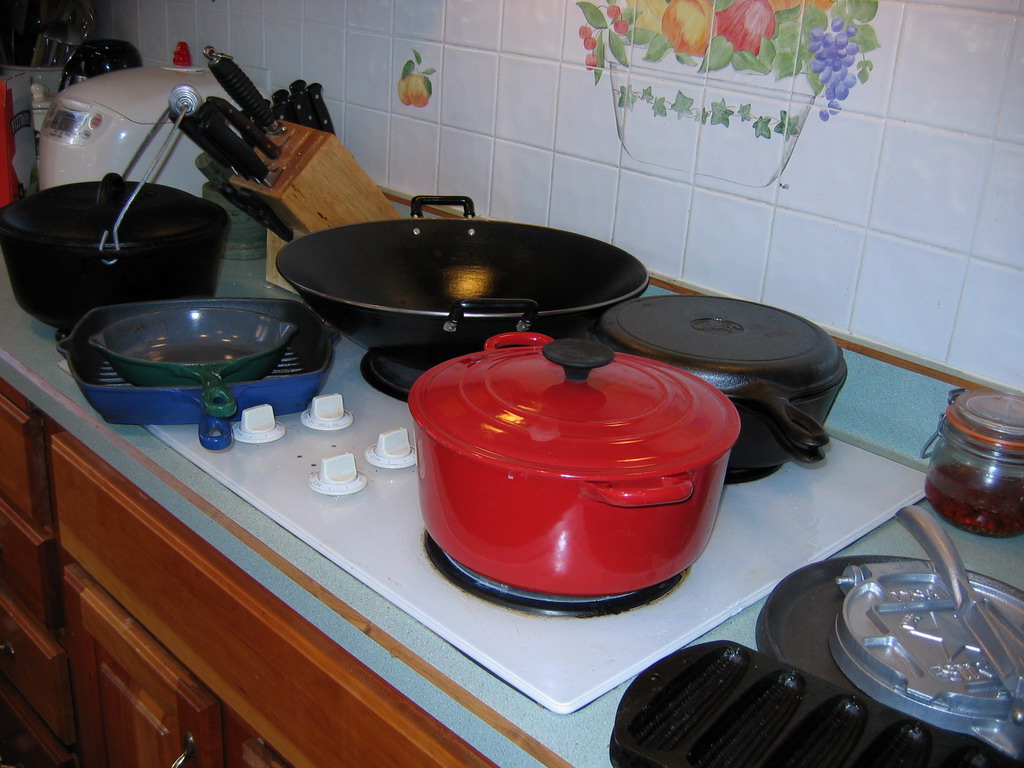
And he lists all the reasons why we cast-iron lovers praise the pots.
It heats up evenly, and holds the heat forever. You can heat up a cast iron skillet, take it off the burner, take a walk with the dog around the block and come back and the pan will still be warm and cosy.
This means, that once you get the pan heated through, and have browned your food, you can add liquid, and then turn the burner or oven down to granny-low, cover the pan, and let ‘er rip for a long time without using as much gas or electricity as you would to maintain a snice slow braise with any other material.
You can saute, pan-fry, deep-fry, stir-fry, simmer, braise and broil in it without any issues.
It is nearly indestructible.
It is inexpensive.
And, in a pinch, it can be used as a makeshift weapon in the defense of your person, your kin and your homestead. If revenuers or Imperial eunuch tax-collectors come to your kitchen and start trouble, you can end it right quick by taking up that cast iron skillet or wok and giving them a good whump on the head.
Believe me, that will drop the intruder without too much fuss, though I cannot say that the process would be mess-free.
The bodies do get to be a chore to hide, after a time.
Anyway, I was right there in the amen-corner with Bittman, nodding my head and saying, “Halleluja! Preach on, Brother Bittman,” until I came to this little sentence: “Despite many recommendations to the contrary, a little mild soap won’t tear off the seasoning.”
I near-bout fell over when I read that, and I could feel all of my hillbilly ancestresses keening from their graves.
Because the queens of the cast iron skillets and pots safeguarded their equipment by never allowing a drop of soap to come near them, and instead simply rinsed the cookware while it was still hot–that is the key–and then plopped it back on the stove to dry, then rubbed a little lard into it to give it a nice shine while it was still nice and warm. And then they put it away, often by hanging it on a wall, until the next day when they used it cook breakfast.
But the thing is–he is essentially correct–a little mild soap— and those are the key words there-mild soap–now and again, will not hurt a good seasoning on a cast iron pan.
But the thing is–most people don’t use mild soap on their pots and pans. Most people use dishwashing liquid, which is not soap, nor particularly mild.
It is detergent, which does play havoc with the seasoning layer on cast iron.
So, here is the deal–if you take up using a cast iron skillet or wok–I bless you for it. Once you get into the habit of taking good care of it, and washing it in hot water with a scrubber (not steel wool) as soon as you plate up the food and while it is still warm–you will have no trouble at all with it. I promise you.
And you can follow Bittman’s advice on how to season and maintain your cast iron–because his directions are the same ones I would give you, except he doesn’t seem to stipulate that you wash your pans while hot, which means he may not have figured that out yet.
But, please, unless you really do have some mild soap, like some vegetable oil based hand soap–Dr. Bonner’s is great(yeah, I know the religious philosophizing on the website and the soap packages is a bit odd, but the soap is vegetable based and quite mild)–sitting next to your kitchen sink–don’t follow his advice about using soap.
Because if you are like most Americans and have the dishwashing liquid–it isn’t soap, it isn’t mild and it will definately mess up the seasoning on your cast iron.

Categories:
- Admin (rss) (55)
- Blogs and Blogging (rss) (81)
- Book Reviews: Cookbooks (rss) (43)
- Book Reviews: Non-Cookbook Food Books (rss) (38)
- Cats and Cat Blogging (rss) (47)
- Chinese Cooking Lessons (rss) (32)
- Culinary School Stories (rss) (18)
- Dairy Pruducts: Cultured and Barbaric (rss) (4)
- Documentary Filmmaking (rss) (1)
- Essays, Rants and Reflections (rss) (260)
- Fighting Hunger (rss) (12)
- Food and Kids (rss) (45)
- Food in the News (rss) (126)
- Food Media (rss) (98)
- Food Preservation (rss) (18)
- Food Safety (rss) (45)
- Gardening (rss) (30)
- Herbs and Herb Blogging (rss) (20)
- Holidays (rss) (50)
- Kat Blogging (rss) (22)
- Kitchen Science (rss) (36)
- Leftover Makeover (rss) (8)
- Life, the Universe and Everything (rss) (131)
- Local and Sustainable (rss) (227)
- Local Athens Food and Foodies (rss) (42)
- Meatless Mondays (rss) (32)
- Menu For Hope (rss) (5)
- Nutrition, Diet and Health (rss) (84)
- On The Farm (rss) (8)
- Recipes: Almost Vegetarian, Vegetarian and Vegan (rss) (294)
- Recipes: American Regional (rss) (37)
- Recipes: Appalachian Hillbilly (rss) (33)
- Recipes: Bread, Pasta, Grains (rss) (95)
- Recipes: Canning and Preserving (rss) (8)
- Recipes: Chinese (rss) (123)
- Recipes: Comfort Food (rss) (120)
- Recipes: Cookies (rss) (16)
- Recipes: Desserts (rss) (48)
- Recipes: French (rss) (25)
- Recipes: Fruits and Vegetables (rss) (302)
- Recipes: Greek, North African and Middle Eastern (rss) (31)
- Recipes: Indian (rss) (137)
- Recipes: Italian (rss) (42)
- Recipes: Japanese (rss) (7)
- Recipes: Jewish (rss) (4)
- Recipes: Korean (rss) (6)
- Recipes: Meat, Poultry and Fish (rss) (220)
- Recipes: Mexican/Native American/ Latin American/Caribb (rss) (27)
- Recipes: Original (rss) (108)
- Recipes: Thai (rss) (27)
- Recipes: Tofu (rss) (17)
- Recipes: US Regional (rss) (16)
- Recipes: Vietnamese (rss) (8)
- Restaurant Stories (rss) (28)
- Sewing, Quilting, Arts and Crafts (rss) (16)
- Simple Chinese Recipes (rss) (30)
- Slow Food and Heritage Foods (rss) (10)
- Spice Blogging (rss) (44)
- The Chinese Cookbook Project (rss) (14)
- The Chinese Pantry (rss) (39)
- The Documentary (rss) (2)
- The Kitchen Saga (rss) (17)
- The Locavore's Bookshelf (rss) (15)
- The Unsung Adventures of The Culinary Nerd (rss) (6)
- Tools and Toys (rss) (35)
- Uncategorized (rss) (10)
- With a Side of Politics (rss) (48)
Archives:
- August 2012 (9)
- July 2012 (12)
- September 2011 (3)
- August 2011 (7)
- July 2011 (8)
- June 2011 (16)
- May 2011 (17)
- April 2011 (11)
- December 2010 (9)
- November 2010 (5)
- February 2010 (1)
- December 2009 (5)
- November 2009 (7)
- October 2009 (10)
- September 2009 (16)
- August 2009 (14)
- July 2009 (14)
- June 2009 (7)
- May 2009 (17)
- April 2009 (10)
- March 2009 (25)
- February 2009 (13)
- January 2009 (10)
- December 2008 (5)
- November 2008 (5)
- October 2008 (6)
- September 2008 (13)
- August 2008 (8)
- July 2008 (11)
- June 2008 (18)
- May 2008 (13)
- April 2008 (14)
- March 2008 (16)
- February 2008 (17)
- January 2008 (19)
- December 2007 (25)
- November 2007 (18)
- October 2007 (24)
- September 2007 (16)
- August 2007 (15)
- July 2007 (15)
- June 2007 (10)
- May 2007 (14)
- April 2007 (16)
- March 2007 (17)
- February 2007 (20)
- January 2007 (13)
- November 2006 (1)
- October 2006 (8)
- September 2006 (14)
- August 2006 (25)
- July 2006 (30)
- June 2006 (28)
- May 2006 (34)
- April 2006 (29)
- March 2006 (24)
- February 2006 (30)
- January 2006 (38)
- December 2005 (40)
- November 2005 (37)
- October 2005 (32)
- September 2005 (25)
- August 2005 (30)
- July 2005 (28)
- June 2005 (21)
- May 2005 (8)
- April 2005 (22)
- March 2005 (17)
- February 2005 (29)
- January 2005 (10)
Search Site:
Links:
- Lily’s Wai Sek Hong
- 101 Cookbooks
- A cat in the kitchen
- A Veggie Venture
- Accidental Hedonist
- Cha Xiu Bao
- chez pim
- Chocolate & Zucchini
- Chopstick Cinema
- Chowhound.com
- Chubby Hubby
- Cook sister!
- Cooking with Amy
- da*xiang
- Eat Local Challenge
- Eating Liberally
- Ecocentric
- Eggbeater
- Epicurious
- Farmgirl Fare
- Fatfree Vegan
- Foodgoat
- ForkandBottle.com
- Green Olive Tree
- Hooked on Heat
- Jaden’s Steamy Kitchen
- Kalyn’s Kitchen
- Lucullian delights
- Mahanandi
- Matt Bites
- MeatHenge
- mmm-yoso!!!
- New York Times – Dining & Wine
- Pizza Goon
- Rasa Malaysia
- Ruhlman
- Sailu's Kitchen
- Serious Eats
- SF Gate: Food & Dining
- Simply Recipes
- Soul Fusion Kitchen
- Tastespotting
- The Amateur Gourmet
- The Cleaner Plate Club
- The Food Section
- The Grub Report
- thecookscottage
- U.S. Food Policy
- Wandering Chopsticks
- Washington Post Food and Dining
- Wasted Food
Meta:


Powered by WordPress. Graphics by Zak Kramer.
Design update by Daniel Trout.
Entries and comments feeds.