
Cook Local, Eat Global
2005 Food Blog Award Nominations are Open
Hello, gentle readers. I just wanted to point everyone over to The Accidental Hedonist blog (if you don’t read it, you really are missing out on quality writing) where Kate is taking nominations for the 2005 Food Blog Awards. The awards started last year, and the winners were announced right around the time I started blogging back in January of this year.
From the list of winners, I have found writers, cooks and storytellers to admire and emulate.
From this year’s list of nominees, I am happy to say that I see a great many friends.
(I am also happy to see that some folks nominated me in a couple of different categories, which makes me pretty proud, too.)
So, high thee hence over to Kate’s place and check out the skinny on the awards, and if you feel moved to–nominate some folks who have worked hard to entertain and edify y’all over the past year.
Raw Food is Often Good Food
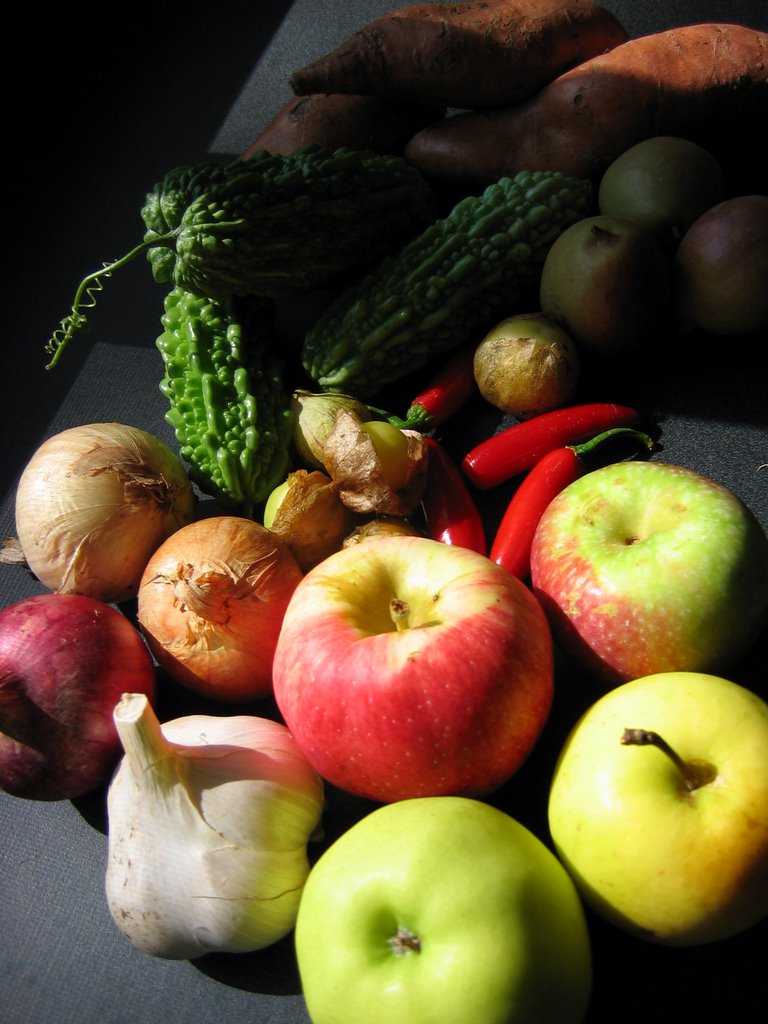 When I wrote my somewhat cranky and very fiery post last week about all that is wrong with the “raw food fad,” Alanna of A Veggie Venture and Kitchen Parade asked me if there was nothing redeeming about raw foods. She wanted to see me take on the other side of the issue and talk in favor of eating raw.
And I answered her comment in short form with my own commentary, but I thought that what I said could use with a bit of lengthening and explanation.
As I hoped to make clear in my original post, I don’t really care what people eat or don’t eat, as I generally believe that what we choose to put into our bodies is a very personal decision. It is a decision that can be based upon ethical considerations, religious beliefs, political activism, economics, health and nutritional awareness, convenience or just plain old hedonism. In fact, I am of the opinion that the decisions that people make about what to eat, how to eat it, when to eat it and why to eat it are very complex and are seldom made just on the basis of one of the factors I mentioned above, but instead come about as a result of a synthesis of any number of issues, all in a tangled web that boils down to what a person believes.
What people believe about themselves, food, their relationship with food, society, God, the environment, the economy, medicine, their bodies and thier health all factor into what a person chooses to ingest each moment of each day.
And the fact of the matter is–not everyone builds their belief upon rational thought. In fact, belief is often irrational in nature, and is based less on fact and more on emotion.
It has taken me most of my forty years of life to figure this out–most people are not rational in their formulation of self, the world and thier interactions in it.
Taking so long to figure this out has led to any number of difficulties, many of which are reflected in the original post, “Barbara vs. The Raw Food Fad.”
In short, when I run up against rampant illogic, irrationality and a tendency towards fundamentalist behavior, I get twitchy, then irritable, and finally, angry. I get angry, because I am of the belief that humanity is endowed with these big lumpy brains to do more than keep our ears widely set–we are meant to think. Else, why endanger our mothers’ pelvic arches all through the ages? In essence–to my eyes, it is an insult to every one of our foremothers who labored for hours to push our big heads out, and often died in the process, to not use the brains that are encased in our skulls.
And so, I go off now and again, on behalf of the foremothers, and you get rants like my outpouring of invective aimed at the raw foodist’s fantasy that cooked food is poisonous.
However, just because I get all het up over raw foodist’s baseless philosophy, doesn’t mean I think that raw food is without worth, that it is inherently bad or that people should not eat it.
 On the contrary, I think that a lot of people could do with eating more raw fruits and vegetables, though I think that extending that opinion to raw grains and nuts ground to glop is not quite as imperative.
There is much to be gained by partaking of raw fruits and vegetables on a regular basis. While some phytochemicals such as lycopene and caratenoids as found in tomatoes and carrots are more effectively absorbed by the human digestive system after they are cooked, in large part, many vitamins are depleted by cooking.
For example, vitamin B folate and vitamin C are both water-soluable and easily destroyed by heat, so in order to get the maximum amount from foods that contain them (green leafy vegetables and citrus fruits, for example) it helps to eat some of these foods raw. A salad of kohlrabi, endive, cabbage and broccoli, served raw with a lemon or lime juice based dressing, however, would provide the diner with a substantial amount of these two important nutrients. Add some red bell peppers to the mix, and the vitamin C count goes way up. (Both chile and bell peppers have high amounts of vitamin C in them–often more than even citrus fruits.)
In addition to providing ample vitamins and other micronutrients, raw vegetables and fruits also provide a great amount of fiber to the diet. Fiber is another necessary nutrient, though it doesn’t act by being absorbed into the body–in fact–its main function is served by it not being absorbable. There are two kinds of fiber present in foods–water soluable fiber, such as pectin, and water insoluable fiber, such wheat bran. Both kinds of fiber work to cleanse the human digestive system and keep the colon functioning properly; the consumption of high-fiber foods has been shown to help prevent colon cancer, diverticulitis and other diseases of the small and large intestines.
Raw apples, for example, contain within them both sorts of fiber–pectin, a water-soluable fiber-is present in the flesh of the fruit while the skin functions as water-insoluable fiber. Neither of these are affected by cooking, however, there are very few people who eat apples cooked in thier skins. (Here is also a good place to remind the reader that most of the vitamin content in an apple is present just under the skin of the fruit.)
I could go on about the virtues of eating raw fruits and vegetables for hours, but in truth, what it comes down to for me is this–they taste good. They provide a contrast in texture and flavor to cooked foods. They can refresh the palate between cooked courses, and they can be composed into visually stunning as well as intensely flavorful salads.
Chilled raw soups–essentially purees of raw fruits or vegetables–can make very cooling first courses in the oppressive heat of summer. Salsa cruda, raw salsa, made from vine ripened tomatoes redolent with fresh garlic, chiles and cilantro is an intense pleasure that no one should miss. Cucumbers lightly cured in a vinegar and water soak, chilled with ice cubes and seasoned with sweet Vidalia onions are a classic side dish on Southern tables. Salad dressings made from pureed fruits such as kiwi or mango spiked with citrus juices and chiles can take the place of oil-laden vinaigrettes.
The possibilities for serving raw foods go beyond the usual salad plate, and the one thing that I do appreciate about having been involved with my raw foodist clients is that I learned to shake my preconceptions of what raw foods could be and how they should be presented.
I learned to think outside the box.
Finally–I would be utterly remiss if I did not point out how much I adore sushi, which is in essence, raw fish served with cooked rice seasoned with sweetened vinegar. I find great beauty in the simplicity of nigiri–slices of raw or lightly cooked seafood presented atop hand-shaped balls of rice. The beauty is born not only of the myriad of subtle flavors presented in the food, but also in the knowledge that I am eating food that is low in fat, low in calories and has no added fat present in it from cooking it.
So, you see–there is good in raw foods. I am not a fundamentalist in the way I accused raw foodists of being. I see the value in the consumption of a variety of foods in various uncooked states, and I eat them and serve them quite often. I think that if the raw food diet fad accomplishes one good thing it will be this–it will get Americans, who eat way too much meat, fat, white flour and empty calories to eat more vegetables and fruits, and hopefully, enjoy them.
And, really, if that one good thing happens, who am I to argue with that?
[food] [raw foods] [society] [nutrition]
Kitchen Update: Plumbing and Grout!
 Sorry I haven’t posted since, uh, since–Thursday. Wow, it has been a few days. They passed in a blurr of pain and suffering, so I wasn’t too sure when the last time I wrote had been.
Morganna and I had some sort of vile stomach virus. (Are there any other kind of stomach viruses besides vile? I don’t think so. I think they are all pretty darned well disgusting, though I suppose some are more hideous than others.) So, instead of catering a party this weekend and cooking lots of neat stuff and writing about it, I was flat on my back, either trying to sleep the fever off or camped out in the bathroom wishing that I could just die and be done with.
So, I didn’t get to post these lovely pictures on Friday–because that is when both of us fell sick. (Zak, thus far, has been spared. We don’t know why the Gods favor him so, but Morganna and I are quite jealous.)
Anyway–here is what was done on Friday: as you can see to the right, I now have faucets and a sprayer for my gigantic sink. And you can also see, if you look closely, that the grout is done on the tile.
 To the left is a close-up of the faucet set. We chose the oiled bronze to match the bronze hardware on the cabinets. (I also ordered the bronze Arts & Crafts switchplate covers on Thursday–they should be in in about a week or so.)
We chose bronze because it is a nice, warm, natural looking color. I am not fond of yellow brass, and chrome was just too cool or cold looking to be right for the colors we chose for the kitchen. The entire idea was to give the feeling of bringing the woods that you can see outside the window inside the house, so that is why we have so many shades of green, brown and black in the room.
Being as we have gone with an Arts & Crafts Movement feeling and look for the room, and considering the very retro look of the AGA stove, both Zak and I felt that a vintage-looking set would be the best fit with the room, so we went with this lovely faucet set from Danze. I like the combination of straight lines and curves in this set–the old-fashioned cross-shaped tap handles contrast beautifully with the arching curve of the faucet itself.
 If you look at the picture to the right, you can see the graceful arcs of tree-limbs in the view from the windows–this is what I wanted to echo with that curved faucet. Those branches are broken up and bracketed by the straight columns of the window-frame–lines that are echoed in the cabinetry, while the branches themselves are called back to mind in the arcs and whorls of the heavy grain of the oak.
As for colors–the grout is a greenish grey–the exact color of lichen, which is also prevalent outside the window. The walls are a spring green, the green cabinets are the color of moss, and the wall tiles and countertops are variagated with all the colors of the room. The floor tile–it is the color of the red clay soil of southern Applachia–and it happens to bring out the reddish highlights in the oak cabinetry, and the reddish shade of the bronze. As for the black appliances and sink–they call to mind two minerals very important in southestern Ohio–coal and flint.
 However, as much as I adore the aesthetic considerations for the kitchen, I also am just as in love with practical mechanical aspects of it.
Friday, the Insinkerator garbage disposal and the water filtering system were installed under the sink, and they work perfectly.
I do tend to prefer composting kitchen scraps, and when the summer returns, will start another compost heap, but for the stuff that clings to plates and pots, I like a disposal. The former kitchen had no such amenity.
I do love living in Athens–the man who did the tile told me that he was good friends with the people who sold us this house and was telling them all about how we were redoing the kitchen. Ken said he might have to stop by just to see it. I told the tile expert to tell him I said that was fine, he was welcome, but that I hoped he would wait until everything was finished so he could see it to full effect.
On Monday, the under-cabinet lights should be installed and the power supply and gas line for the stove will likely be recessed into the wall, in preparation for the delivery and installation of the appliances on Tuesday and Wednsday.
And then, with the exceltion of little things like the switchplate covers and the telephone, the kitchen will be finished and ready to roll.
Now, if only I could stop being so damned dizzy so that I can cook us dinner tonight.
Maybe something bland and simple.
Like tofu, greens and rice.
More Cookies: Lavender Crescents
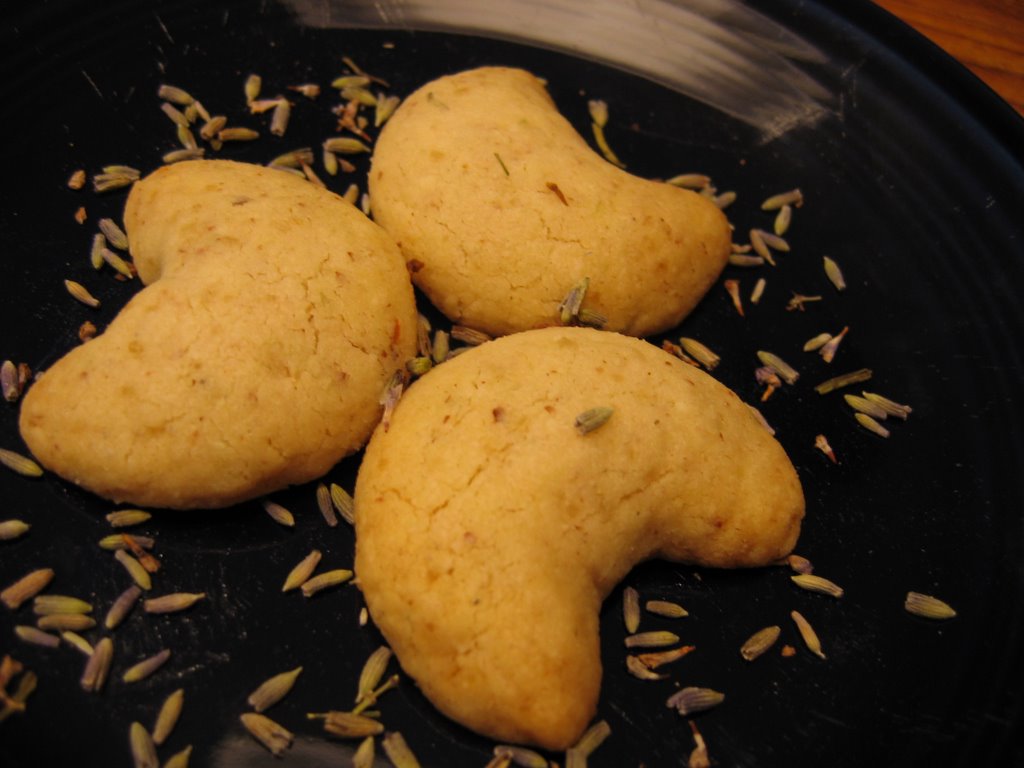 Anyone who has read this blog long enough to come across my rosewater-flavored Aphrodite Cakes and the much more recent Frostflowers, should be able to divine that I have a thing for cookies and confections with unusual flavorings.
Many of the flavors and scents that I favor come from spices, herbs or flowers.
One has to take great care with floral scents in cookery–it is easy to go overboard with them; the aroma of rose can take over the palate, giving the impression that one has just used a spritz of Glade air freshener as a breath spray.
But flowers have a long history in cookery, dating back to the ancient world. The Romans and Greeks used essences of flowers in their pasteries and in some savory dishes; the Persians were masters of using distilled flower waters in both meat dishes and desserts. In the Middle Ages, flowers were often eaten in conserves or preserves, and these were served along with roasted meat or fowl.
These ancient uses for floriferous ingredients were not really the inspiration for these cookies–to be honest, I first made these subtly flavored shortbreads as my own version of the “lembas,” or Elvish waybreads of J. R. R. Tolkien’s Lord of the Rings books. I decided to base them on shortbread because Zak told me that he always used to pretend that Walker’s Shortbread petticoat tails were lembas when he played at being an elf as a child.
I began thinking on it, and decided to surprise Morganna two Yules ago with some lembas of her very own. For her, I made them in leaf shapes, and then wrapped them in French paper leaves that are used to line cheese trays, much the way the lembas were wrapped in leaves in Peter Jackson’s films. In trying to decide what flavors I would use, I thought of what Lothlorien would smell like, and the first thing that came to mind was lavender. Then a subtle waft of powdered ginger and the sweetness of cardamom filled my thoughts, and I set to work.
Using a basic Scottish shortbread recipe, which contains only butter, salt, sugar and flour in it, I replaced some of the flour with ground almonds to give a bit of texture. Then, replaced some of the white sugar with raw sugar, because I like the way it gives crunch to pastries, and the tiniest hint of molasses is much more interesting than pure sweetness. Unlike brown sugar, however, it doesn’t darken the dough noticably.
The dried lavender buds came out of my garden, but if you lack a handy supply, you can order food-grade lavender buds through Penzey’s. Thiers are fresh, full of rich scent and have been sprayed with no pesticides.
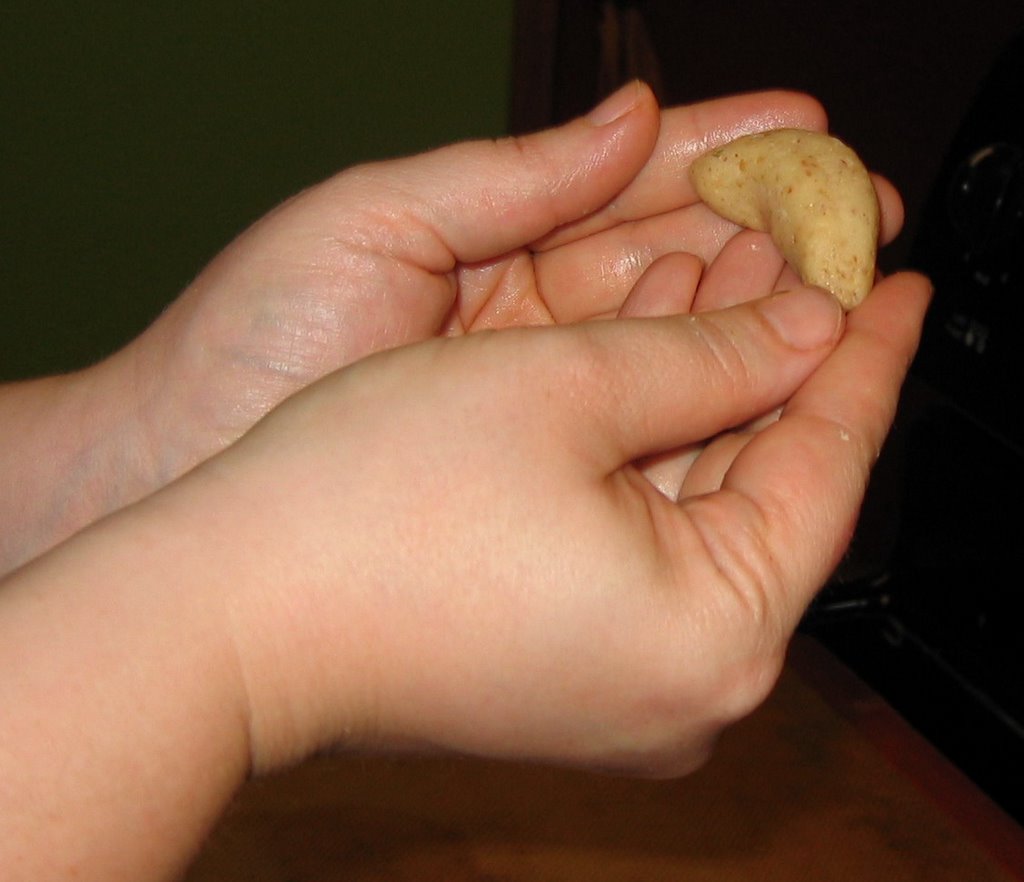 This batch of cookies, however, instead of being leaf-shaped lembas, are crescent shaped, in honor of a client whose birthday I am catering. Her name is Diana, and she wanted to do a lunar themed party, and I thought that little hand-sculpted crescent moons would look lovely on the sweet tray.
Happily, they are even simpler to shape than the leaves–there is no need to carve veins into the unbaked dough with a skewer, for example.
In this shape, they come together quickly and easily, and look graceful, especially when paired with round cookies.
If you want to make leaf-shapes and call them lembas, by all means do so. Roll each portion into a ball, then flatten it slightly. Draw one side out into a point, so that you have a flattened egg-shape. Bend this gracefully and elongate it slightly so that it looks like a willow or rose leaf, then with the pointed end of a skewer, carve a central vein and a few stylized veins off to the sides. Then, bake as directed.
 Lavender Crescents (aka Lembas)
Ingredients:
2 cups all-purpose flour (Or whole wheat pastry flour)
½ cup finely chopped/ground almonds (I used unblanched almond slices to start with, and pulsed them in my food chopper along with the lavender buds)
½ tsp. lavender buds, dried and ground finely
1/8 tsp. ground cardamom
1/8 tsp. ground ginger
1/3 cup raw sugar
1/8 cup white sugar
1 cup cool salted butter
Method:
Preheat oven to 300 degrees F.
Mix all ingredients except butter in food processor until well combined.
Cut butter into small pieces and distribute evenly over the flour mixture. Pulse repeatedly until the dough comes together.
Remove from workbowl, and bring together into ball. Using a cookie scoop, shape spare, level two tablespoon balls, then cut them in half with a sharp knife. Take each half and roll gently between the palms until they form a rough oval, then shape into a small rounded crescent shape. Set onto cookie sheet and flatten slightly. Turn the points of the crescent slightly inward.
Bake 25 minutes, until barely browned on the bottoms and edges.
Makes 40 cookies.
food recipes cookies shortbread lembas lavender
Kitchen Update: Tile!
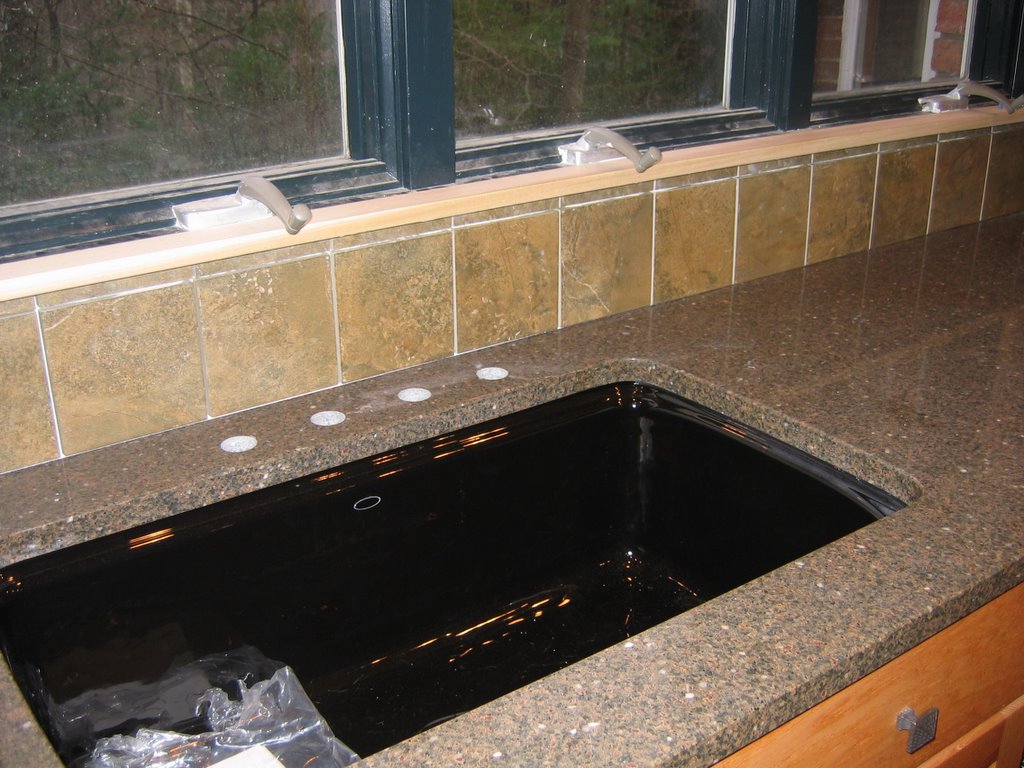 The tile is up, the tile is up! Early!
I am thrilled.
Tomorrow, the grouting will be done, the plumbing goes in, and the window frame gets painted. Undercabinet lights are going in tomorrow as well.
Tuesday, the appliances come in, and Wednsday, they will all, including the vent hood, be installed.
Which means–Wednsday night–we should have a functional kitchen. I have to get on the ball and order the switchplate covers.
Morganna is so thrilled–and I have to admit to being unbelievably excited myself.
Look for more pictures tomorrow evening!

Categories:
- Admin (rss) (55)
- Blogs and Blogging (rss) (81)
- Book Reviews: Cookbooks (rss) (43)
- Book Reviews: Non-Cookbook Food Books (rss) (38)
- Cats and Cat Blogging (rss) (47)
- Chinese Cooking Lessons (rss) (32)
- Culinary School Stories (rss) (18)
- Dairy Pruducts: Cultured and Barbaric (rss) (4)
- Documentary Filmmaking (rss) (1)
- Essays, Rants and Reflections (rss) (260)
- Fighting Hunger (rss) (12)
- Food and Kids (rss) (45)
- Food in the News (rss) (126)
- Food Media (rss) (98)
- Food Preservation (rss) (18)
- Food Safety (rss) (45)
- Gardening (rss) (30)
- Herbs and Herb Blogging (rss) (20)
- Holidays (rss) (50)
- Kat Blogging (rss) (22)
- Kitchen Science (rss) (36)
- Leftover Makeover (rss) (8)
- Life, the Universe and Everything (rss) (131)
- Local and Sustainable (rss) (227)
- Local Athens Food and Foodies (rss) (42)
- Meatless Mondays (rss) (32)
- Menu For Hope (rss) (5)
- Nutrition, Diet and Health (rss) (84)
- On The Farm (rss) (8)
- Recipes: Almost Vegetarian, Vegetarian and Vegan (rss) (294)
- Recipes: American Regional (rss) (37)
- Recipes: Appalachian Hillbilly (rss) (33)
- Recipes: Bread, Pasta, Grains (rss) (95)
- Recipes: Canning and Preserving (rss) (8)
- Recipes: Chinese (rss) (123)
- Recipes: Comfort Food (rss) (120)
- Recipes: Cookies (rss) (16)
- Recipes: Desserts (rss) (48)
- Recipes: French (rss) (25)
- Recipes: Fruits and Vegetables (rss) (302)
- Recipes: Greek, North African and Middle Eastern (rss) (31)
- Recipes: Indian (rss) (137)
- Recipes: Italian (rss) (42)
- Recipes: Japanese (rss) (7)
- Recipes: Jewish (rss) (4)
- Recipes: Korean (rss) (6)
- Recipes: Meat, Poultry and Fish (rss) (220)
- Recipes: Mexican/Native American/ Latin American/Caribb (rss) (27)
- Recipes: Original (rss) (108)
- Recipes: Thai (rss) (27)
- Recipes: Tofu (rss) (17)
- Recipes: US Regional (rss) (16)
- Recipes: Vietnamese (rss) (8)
- Restaurant Stories (rss) (28)
- Sewing, Quilting, Arts and Crafts (rss) (16)
- Simple Chinese Recipes (rss) (30)
- Slow Food and Heritage Foods (rss) (10)
- Spice Blogging (rss) (44)
- The Chinese Cookbook Project (rss) (14)
- The Chinese Pantry (rss) (39)
- The Documentary (rss) (2)
- The Kitchen Saga (rss) (17)
- The Locavore's Bookshelf (rss) (15)
- The Unsung Adventures of The Culinary Nerd (rss) (6)
- Tools and Toys (rss) (35)
- Uncategorized (rss) (10)
- With a Side of Politics (rss) (48)
Archives:
- August 2012 (9)
- July 2012 (12)
- September 2011 (3)
- August 2011 (7)
- July 2011 (8)
- June 2011 (16)
- May 2011 (17)
- April 2011 (11)
- December 2010 (9)
- November 2010 (5)
- February 2010 (1)
- December 2009 (5)
- November 2009 (7)
- October 2009 (10)
- September 2009 (16)
- August 2009 (14)
- July 2009 (14)
- June 2009 (7)
- May 2009 (17)
- April 2009 (10)
- March 2009 (25)
- February 2009 (13)
- January 2009 (10)
- December 2008 (5)
- November 2008 (5)
- October 2008 (6)
- September 2008 (13)
- August 2008 (8)
- July 2008 (11)
- June 2008 (18)
- May 2008 (13)
- April 2008 (14)
- March 2008 (16)
- February 2008 (17)
- January 2008 (19)
- December 2007 (25)
- November 2007 (18)
- October 2007 (24)
- September 2007 (16)
- August 2007 (15)
- July 2007 (15)
- June 2007 (10)
- May 2007 (14)
- April 2007 (16)
- March 2007 (17)
- February 2007 (20)
- January 2007 (13)
- November 2006 (1)
- October 2006 (8)
- September 2006 (14)
- August 2006 (25)
- July 2006 (30)
- June 2006 (28)
- May 2006 (34)
- April 2006 (29)
- March 2006 (24)
- February 2006 (30)
- January 2006 (38)
- December 2005 (40)
- November 2005 (37)
- October 2005 (32)
- September 2005 (25)
- August 2005 (30)
- July 2005 (28)
- June 2005 (21)
- May 2005 (8)
- April 2005 (22)
- March 2005 (17)
- February 2005 (29)
- January 2005 (10)
Search Site:
Links:
- Lily’s Wai Sek Hong
- 101 Cookbooks
- A cat in the kitchen
- A Veggie Venture
- Accidental Hedonist
- Cha Xiu Bao
- chez pim
- Chocolate & Zucchini
- Chopstick Cinema
- Chowhound.com
- Chubby Hubby
- Cook sister!
- Cooking with Amy
- da*xiang
- Eat Local Challenge
- Eating Liberally
- Ecocentric
- Eggbeater
- Epicurious
- Farmgirl Fare
- Fatfree Vegan
- Foodgoat
- ForkandBottle.com
- Green Olive Tree
- Hooked on Heat
- Jaden’s Steamy Kitchen
- Kalyn’s Kitchen
- Lucullian delights
- Mahanandi
- Matt Bites
- MeatHenge
- mmm-yoso!!!
- New York Times – Dining & Wine
- Pizza Goon
- Rasa Malaysia
- Ruhlman
- Sailu's Kitchen
- Serious Eats
- SF Gate: Food & Dining
- Simply Recipes
- Soul Fusion Kitchen
- Tastespotting
- The Amateur Gourmet
- The Cleaner Plate Club
- The Food Section
- The Grub Report
- thecookscottage
- U.S. Food Policy
- Wandering Chopsticks
- Washington Post Food and Dining
- Wasted Food
Meta:


Powered by WordPress. Graphics by Zak Kramer.
Design update by Daniel Trout.
Entries and comments feeds.