
Cook Local, Eat Global
Weekend Cat Blogging: True Kitty Confessions
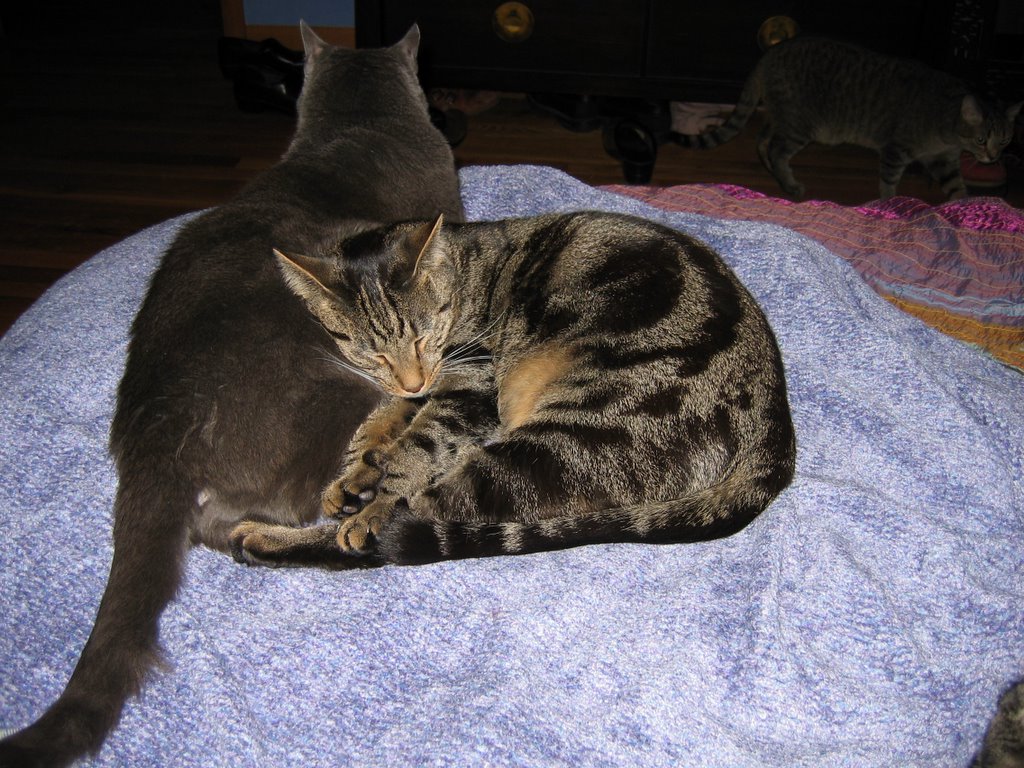 Now it is time for the kitties to make thier confessions.
Not all of them were willing to confess to anything today–Jack was under the bed, camping out in his JackCave, where he wears a cape and pretends to fight crime, and Tristan was busy hiding under the other bed, where dreamed of a parade of little Siamese catamites who would cater to his every little drag-queen whim.
But, the rest of them are present and accounted for and they promised that they would each present me with at least one confession to translate and transcribe for you here.
Ozy confesses that he is too cool to look at the camera, and instead, would rather present his backside for the world to peruse. “It’s my best side, anyway,” he says with great pride. “That’s because I am careful to keep my racing stripe clipped really close there, on that right flank. That way, I look unique and trendy.” (Translation: Ozy shaves the hair on one side of his flank. Why, we don’t know, but I am sure he thinks it makes him look stylish.)
Gummitch confesses that while he loves everyone in the entire world, it is just too much trouble to purr. “I love Mommy, and Daddy, and Ozy, and the little Kitten, and Tristan and that other kitten who got bigger, what is his name, oh, right, Lennier, and Jack, even if he is twitchy and weird, and Grimmy, even if she swipes at me, and I even liked Minna even though she hated me. But no matter how much I love everybody in the entire Universe, including those tall scary people who come to eat at Mommy’s table who I run from, even though I love them, I don’t purr loud because I don’t want to bother anyone, because bothering people isn’t loving and all I want to do is love everyone.” (Translation: Gummitch’s purr motor is apparently broken. He has the softest purr of any cat I have ever known. So, even while you pet him and cuddle him and love him and give him snacks, do not be surprised if you never hear him purr, because I believe that maybe he just can’t really.)
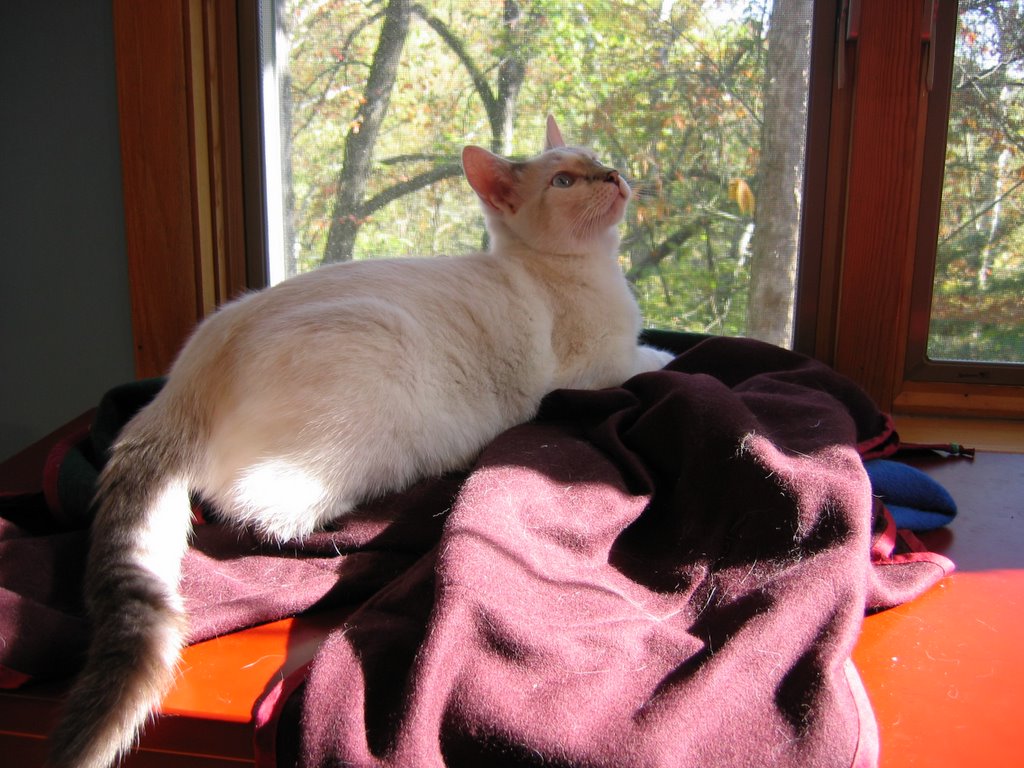 Lennier confesses that he is dreaming of water. Lots of water. Running water. Still water. Water in bowls, water in tubs, water in showers, falling from the sky, water on the floor, and on his paws and his head.
He says, while striking an elegant pose, “I am of water, and the holy land of water, and that’s to come runs in, to be the first among the strand.”
(Translation: Lennier is a big freak who cannot wait to jump into a bathtub after it has been vacated, and who will partake of a shower with a beloved human. He will lay down in one inch of standing water and will dunk his head under a very fast running faucet. The little bugger likes water, and has no clue that cats are supposed to be averse to the stuff. This is yet one more bit of proof that he is an alien in disguise, and not really a cat at all.)
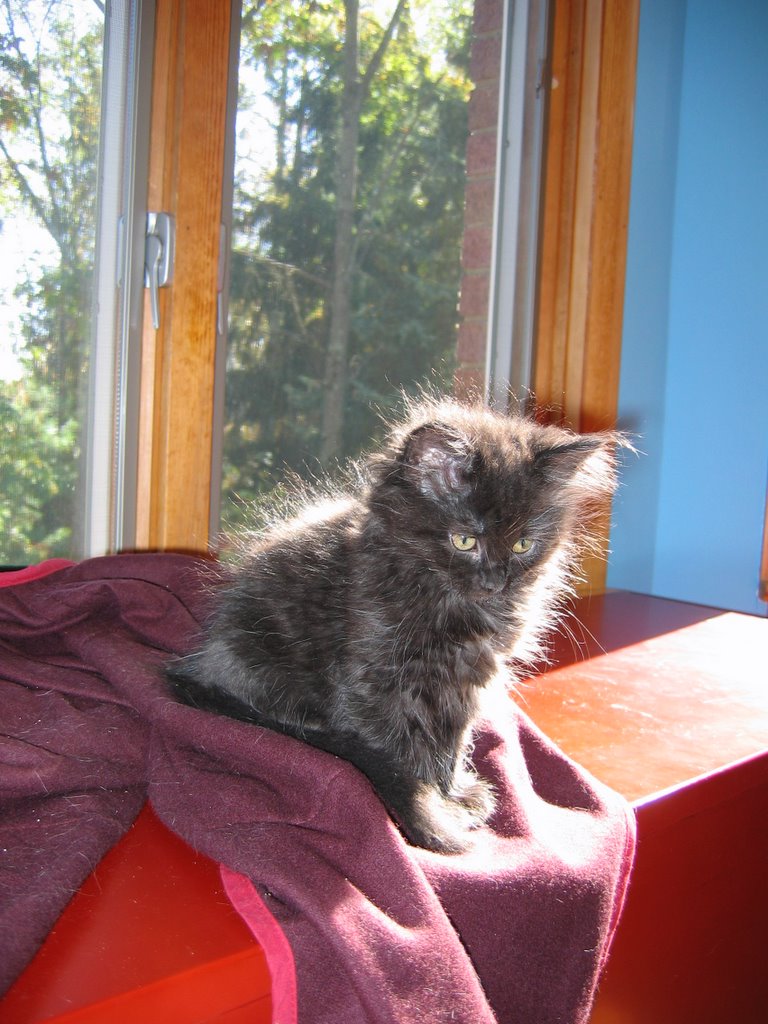 The kitten, who has finally grown into her final name (does anyone get the idea that we have a hard time giving cats names–Mei Mei is still her nickname, but Ari didn’t stick), which is Tatterdemalion, confesses to being a lesser minion of Satan.
“I am demon-spawn,” she thinks, as she plots what sort of mischief to dive into next. “It is my duty, as an imp, to execute the three “D’s:” destroy, defile and discombobulate.”
(Translation: She means what she says–while her head doesn’t spin around and she doesn’t vomit green jello, she does carry about her a whiff of brimstone and she does engage in amazing feats of levitation and deviltry which point to her rather less than savory origin.)
(Which is to say, she is a perfectly normal, active and hilarious kitten whom we adore.)
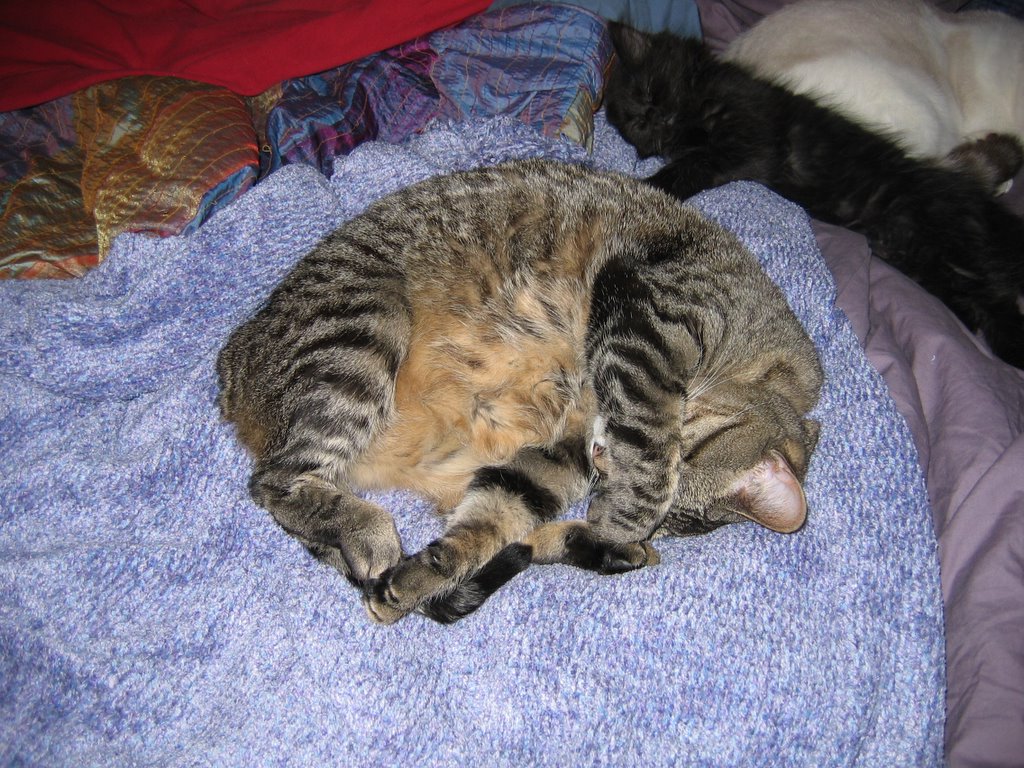 Grimalkin may look like she is hung over and strung out on catnip here, but she is really just taking a catnap.
She confesses that while she does feel very overwhelmed by her responsibilities as the eldest female cat of the household, the duties of which are onerous and difficult, she will strive to do her utmost to fulfill them with style, grace and courage.
As she accepts this mantle of mature responsibility, she says, “I just want everyone to know that I love everyone, especially my predecessor, whose soul rests in heaven now.”
(Translation: What she really means to say is, “I hated her and I am glad she is gone, even if it made Mom and Dad really sad. You see, I have made up for it with lots of extra antics, japes and larks, and I make them laugh more than they ever thought possible, so that means I am better than old whatshername who was just cranky and stuck-up.”)
Putting History in a Piecrust
 I have always loved old cookbooks, and cooking from them.
It is related to my belief that if I can cook and taste the flavors of a culture, I can come closer to understanding the people of that culture.
In cooking and eating foods that people ate hundreds, sometimes thousands, of years ago, I feel as if I can get an immediate sense of what it might have been like to live in the times and places where those foods were commonplace and beloved. It gives me a visceral lesson in the ways in which our ancestors lived, worked, played and ate. Knowing what sustained them, sustains me and my understanding of who they were.
Many ancient foods are still very popular today, though our ways of cooking with them and eating them may have changed over time.
However, there are exceptions; apple pies were popular in fifteenth century England, for example, and versions that the denizens of of the Tudor courts would have found recognizeable are still being baked in England and the United States to this day.
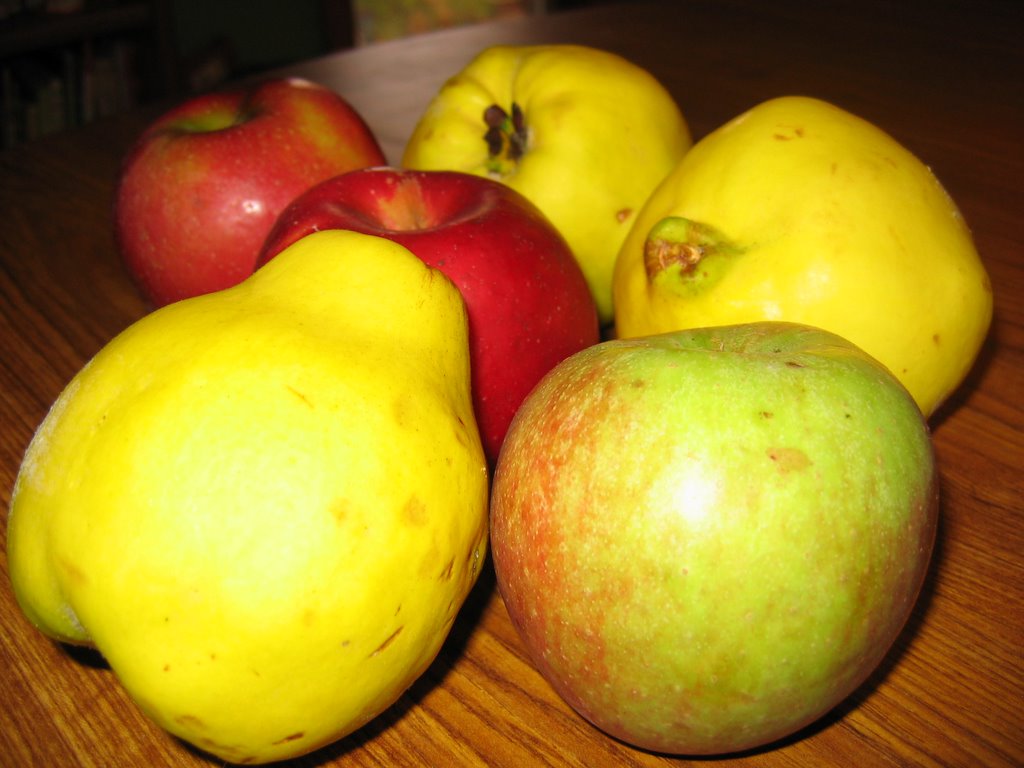
One addition to the apple pie that was commonplace in England, and especially in Colonial America, however, has regrettably fallen from favor since the eighteenth century: the quince.
Quinces are pome fruits, and are cousins to the pear and the apple. While pear slips are often grafted to hardier and smaller quince rootstock in commercial orchards, these two pomes are not kissing cousins–they will not cross-pollinate. Nor will the quince cross pollinate with the apple, however, these little twisty-branched trees are self-fertile, meaning, you should only need one tree to produce fruit.
And no wonder the apples and pears will not kiss their cousin; a quince look like nothing more than knobby, arthritic pears with a weight problem. Instead of the graceful wasp-waisted and voluptuous hipped profile of most pears, quinces balloon from their lumpy, assymetrical waists into a gourd-like shape which is not improved by their lightly fuzzy green-mottled yellow skin.
They are, in a word, ugly.
What they lack in looks, however, the quince makes up for in fragrance, flavor and cooking properties. A single ripe quince can easily scent an average sized room with a delicious, flowery, honey-like aroma. This fragrance survives being cooked, which is a very good thing; because of the rather rock-like nature and extreme acidic flavor of the average quince’s flesh, they are generally only eaten after being cooked, either into a jelly, a confection known as “quince cheese” or baked into a pie filling.
 Ah–pie filling–now we come to the crux of the issue.
The first time I ever heard of a quince, was at Monticello, the home of Thomas Jefferson. It was mentioned in his journals, where he wrote that it was often made into a most excellently flavored jelly, but that he had also had it added to apple pie, where it made a very good effect.
That visit happened back when I was about thirteen, and I remember walking under quince trees in the orchard as we toured the extensive gardens on the grounds. Having read that bit about quinces in Jefferson’s writings before I had come to see his home, I was thrilled to walk under the very trees he had mentioned, however, I was also saddened because it was high summer and all of the fruits looked like small green, mishappen apples.
So, I vowed that one day, I would come across a quince, and thus put it into an apple pie and see what happened.
And so, on Wednsday, when I was at the Farmer’s Market buying apples to use in a pie for dessert, one farmer had three baskets of very odd-looking yellow fruits. Before I could bother to read the sign, my hand shot out to scoop up one of the homely darlings, and hold it to my nose. I inhaled the scent of a field of wildflowers spiked with a cidery tang. My eyes lit up, and then I saw the sign which confirmed the knowledge that finally, at last, I held in my grasp a quince.
I held in my very own fingers, the golden apple which Paris gave “To the Fairest”–Aphrodite–and thus won Helen. (I wonder what Aphrodite wanted with such a funny looking sour fruit for–she doesn’t seem the baking or jelly-making sort.)
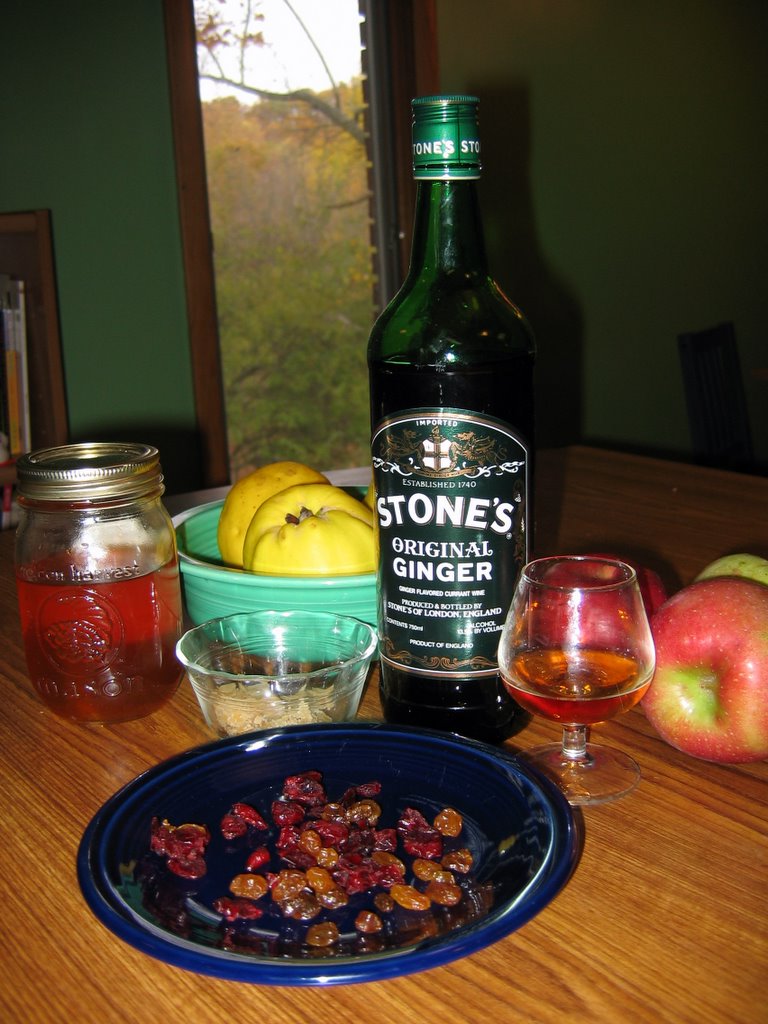
Of course I bought a basket of four of them and brought them home, where I resolved to put them in my apple pie. Because the fruit is so very sour (a fact which I confirmed as soon as I cut the first bit of peel and bit into it, whereupon tears sprung to my eyes), I decided to add a few more ingredients to balance the tartness. I added one quarter cup more of cider, more golden raisins and crystallized ginger, and to enhance the slight pinkish tint that the quince would give the filling, some dried cranberries.
I also decided to crack open the bottle of English ginger-steeped currant wine (Stone’s Original Ginger) which I had been unable to resist at the Asian market, and add a good dollup of that. It was an excellent choice; for one thing, Stone’s has a long history, with its recipe going back to 1740, and for another, the very sweet, gingery cordial perfectly balanced the flowery sour notes of the quince and the predominantly tart apples I had chosen.
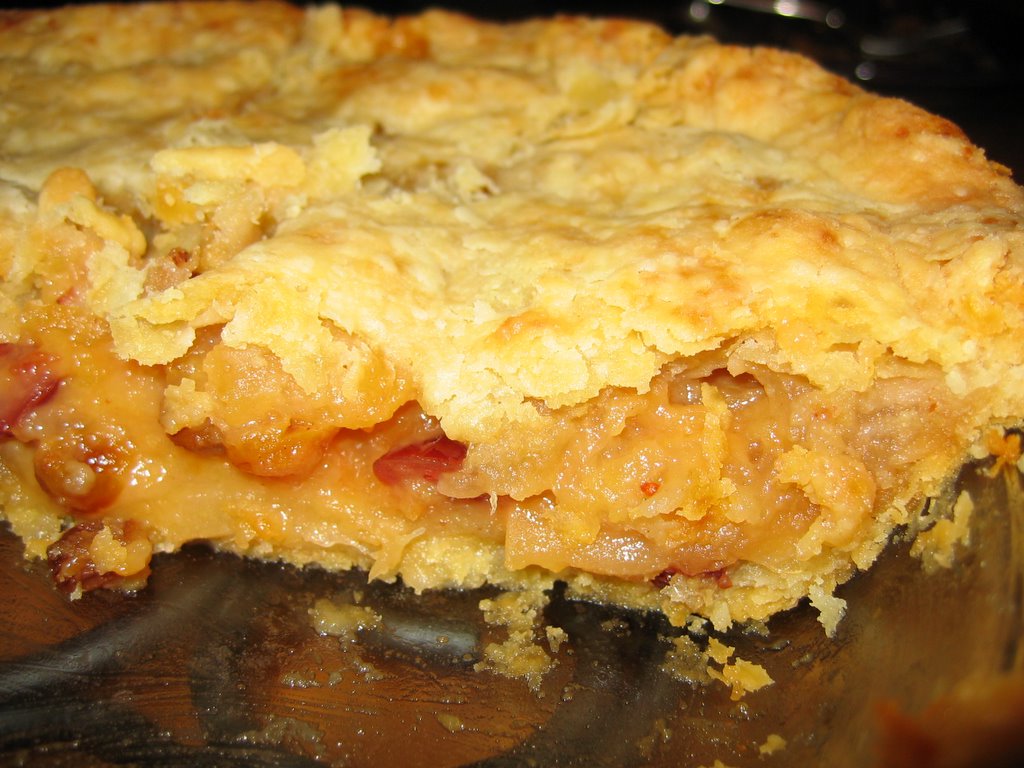
What I ended up with, by using my recipe for the Honey and Cider-Sweetened Apple Pie, was a pie with more depth of flavor than I thought was possible. Even though I used only two cups of chopped quince (a single large fruit) to seven and a half cups of apples, the fragrance, flavor and even the pale rosy tint of the quince came right through. The ginger wine supported the dried and crystallized ginger flavors while the apples still took center stage, with the raisins and cranberries playing supporting parts that made a beautifully harmonizing symphony of swirling tastes and textures in the mouth.
I think it was probably the best apple pie I have ever made, and it is certainly the best I have ever eaten; everyone who ate the pie agreed.
I think it is a shame that quinces aren’t utilized more often in modern cookery, because what they lack in outward beauty, they more than make up for with their inner magnificence.
 Eighteenth Century Quince-Apple Pie
Ingredients:
2 tablespoons butter
2 cups of peeled, sliced quince
1/4 cup apple cider
1/4 cup Stone’s Original Ginger
7 1/2 cups of peeled, sliced apples (use at least three different kinds of apples, and include two McIntoshes in the mixture)
3/4 cup apple cider
1/4 cup honey
1/4 cup Stone’s Original Ginger
3 tablespoons minced crystallized ginger
1/2 cup golden raisins
1/4 cup dried sweetened or unsweetened cranberries
2 tablespoons all purpose flour
1/2 teaspoon ground dry ginger
1/2 teaspoon ground cinnamon
pinch cardamom
pinch salt
Method:
Preheat oven to 375 degrees.
Start cooking the quince first: over medium heat, melt butter into a large saucepan or dutch oven; allow to brown slightly. Add quince and the first measures of cider and wine, and cook, stirring, until the quince begins to fall apart and turn pinkish.
Add apples, the second measures of cider and wine, honey, ginger, raisins and cranberries, and cook cook, stirring for about five minutes.
Put strainer over a smaller saucepan and drain apples, allowing cider, honey and juices to fall into pan. Set aside fruit mixture.
Cook, stirring, over medium high heat, until liquid reduces to 1/2 cup and thickens to a syrup that will coat your spoon. You will notice at this time that as soon as you remove the syrup from the heat and allow it to begin to cool, it will gel. This is what it is supposed to do. (with the added pectin of the quince, this mixture will gel very, very quickly. Watch it carefully so that it doesn’t burn or turn into gummy candy!)
Put apples in a bowl, and pour syrup over and stir together thoroughly. Add remaining ingredients and stir to combine.
Roll out dough as directed, and line a 9″ pie pan with the bottom crust. Pour apple filling in and top with second crust, as directed in pastry crust recipe.
Place in oven on center rack and bake for thirty minutes, then rotate pie pan 180 degrees. Continue to bake until crust is golden brown and the juices that eminate from the steam vents is thick and tawny gold in color–this will take anywhere from 35-45 minutes.
When pie is done, remove from oven and place on wire rack, and allow to cool to room temperature (or nearly so) before eating.
Note:
This is very good served with barely sweetened freshly whipped cream that has been flavored with Stone’s, with finely minced crystallized ginger sprinkled over the cream.
It tasted so good that way, we neglected to take photographs of it plated before we started scarfing it down.
food & drink apple pie recipes quince ginger
Kitchen Cabinets Unveiled
 Okay, the cabinets are not hung yet, but they did get carried up from our garage and unpacked today, and as you can see, they are very, very pretty.
They would have started installing them, except the man in charge of our kitchen construction was called out on an emergency job, and he couldn’t make it today. Our kitchen designer, Shawna, didn’t want a different person taking over–she wanted Tad to be the one to see the project through from the beginning to the end, so she sent some guys to just bring the cabinets up and unload them so that Tad and his crew could just start right in on Monday.
There on the left are the bookcases; they are going to go into that hole you could see in the wall next to that door behind them.
And you can also see how the colors are going to work together–the moss green cabinets are a glazed oak, and in the foreground, you can see the honey-stained oak as well, that will match the floors throughout the rest of the house, which are the same wood and color.
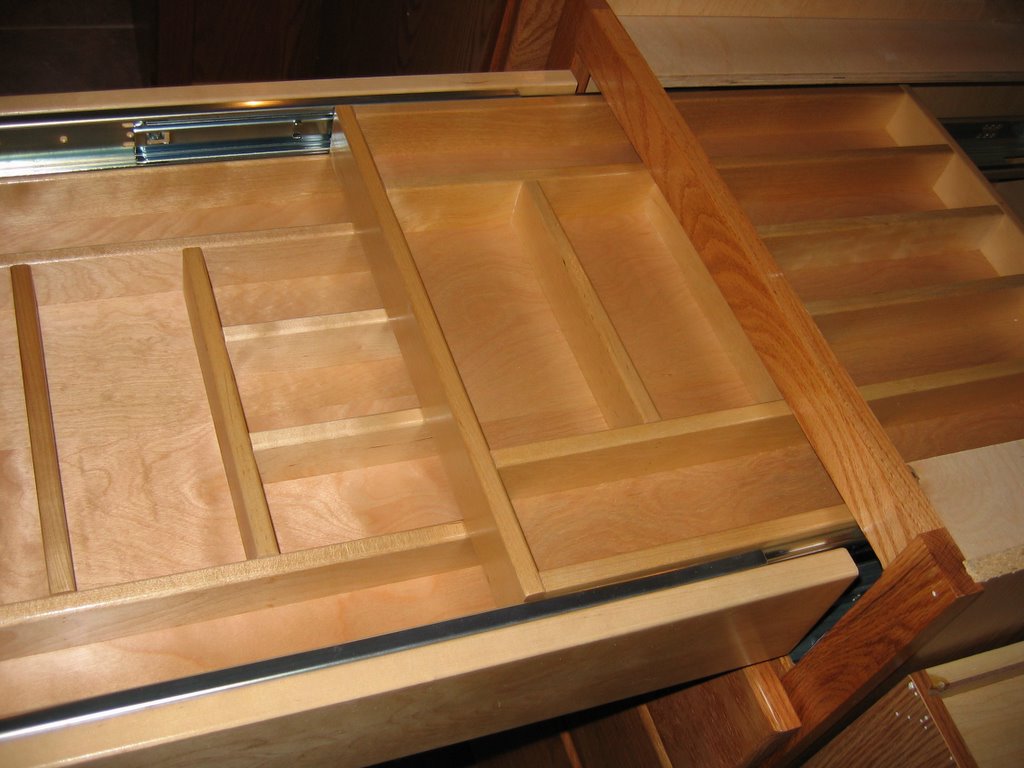 Here is the slideing compartment in the silverware drawer–you can see that we can stack two drawers worth of silverware in the space of one drawer’s worth–no wasted space. I really, really like that.
And the hardware is of really great quality–the action is very smooth.
BTW–the cabinets are made by KraftMaid, and the doors are mostly the solid wood you see here, though there are also some doors with glass doors, which are still packed carefully in boxes in the dining room, waiting to be put on the cabinets after they are hung. They look like this.
Here you can get a good look at the honey oak next to the wall paint and the floor, as well as get a nice glance at the shape of the doors themselves.
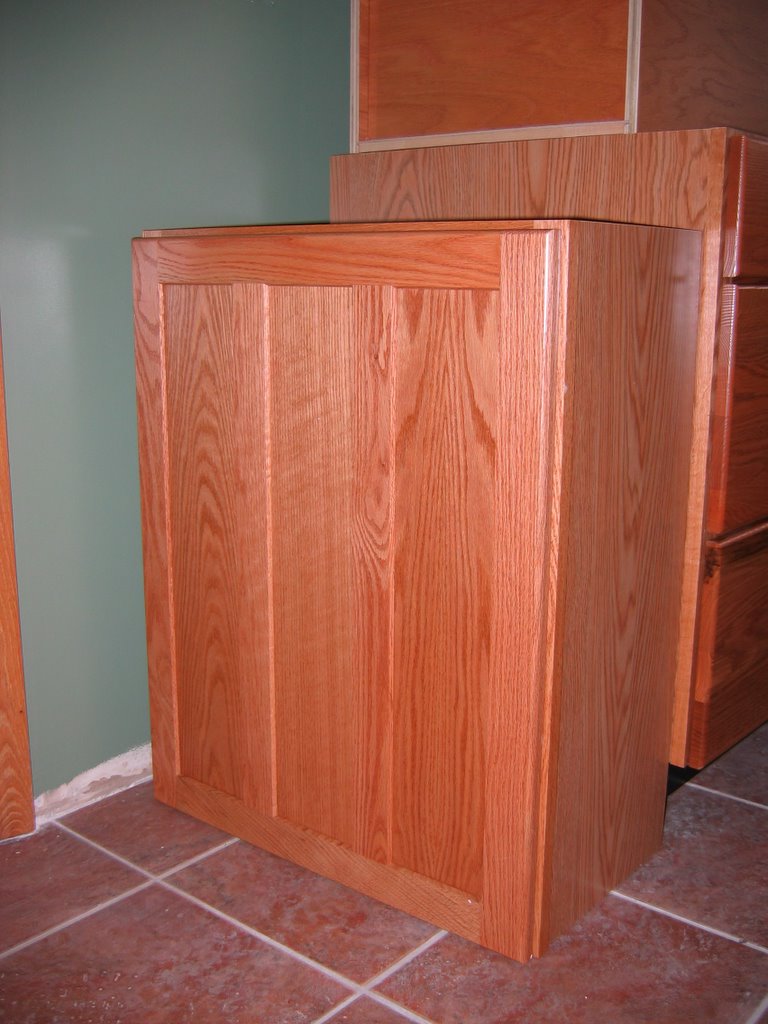 They are very simple; the decorative look we are going for in this room is Arts and Crafts, so the hardware is going to be really different–cast bronze in two different styles–knobs for the drawers and handles for the doors. When they have installed them, I will take photographs–the styles we chose are not on the website, that I can tell anyway.
So, that is the excitement for today. The entire world of our house seems to be covered in white fine dust, but the cabinets are here, they are soon to be installed in our walls, and then the countertop installer will come and measure for the counters, and the shape of the room will finally be apparent.
Then, the countertops go in, then the tile backsplash, then the appliances and finally, the vent hood and decorative accents.
It is coming along beautifully. I am so excited–it is so thrilling to see with my own eyes, the vision I had come into being.
True Kitchen Confessions
I am sure she didn’t mean to create a meme.
But, after reading Amy’s amusing (and somewhat familiar) culinary confessions over at Cooking With Amy, I decided that it might be a good idea for me to ‘fess up to a few things concerning my kitchen habits and cooking adventures.
Like Amy, I’ll invite others to post their own confessions as they feel moved to (rise up and testify brothers and sisters–can I hear an “amen?”) in the comments section; I understand it is quite cathartic.
Barbara’s True Kitchen Confessions:
As I mentioned on Amy’s comments, I like fried bologna sandwiches with onions and hot sauce. Or at least, the last time I had one I did. I haven’t eaten one in years because I don’t go out of my way to buy bologna, even the good kosher stuff with lots of garlic. That, and I don’t want Zak to divorce or disown me for how my breath smells afterwards.
I read cookbooks more than I cook from them. Why is this? Well, I think I may be constitutionally incapable of following any recipe exactly–this both caused problems and served me well in culinary school. Luckily, most of my chefs respected my experience and independent nature and let me go my own way, succeeding or failing on my own merits. (The fact that I nearly always succeeded probably helped.) Besides–when I do follow recipes from cookbooks exactly–I more often than not have a critical failure, and very often, I could see it coming and went against my instincts and followed the recipe anyway. And then, disaster, or at least a mess.
So why do I read the cookbooks–because they are fascinationg social documents that tell me much about how people live, eat, work, play and interact within a given culture. That, and while I may never cook exactly from them, I use cookbook recipes as springboards to create delicious food.
I have many cookbooks which I have never cooked from directly, but which I will not let go of because they are such good documents of social and personal history.
I talk to the food while I cook.
This too, caused some issues in culinary school, because the other students thought I was nuts. However, more than one chef instructure told them to leave me alone, because it obviously worked for me and the food, because the results were excellent. And more than one chef, I will notice, muttered to his ingredients while working with them.
It is akin to a Witch’s incantation over a brewing cauldron, I suspect.
Besides, if people think you are nuts, they won’t bug you, which is sometimes a precious thing in an overcrowded, very busy, bustling kitchen.
I will eat anything (except brains) once or twice before declaring I don’t like it. Even sea cucumber and jellyfish. (The former I don’t much care for and the latter I love.) Even scary-looking things have been happily tasted and generally, later, adored.
Any food item which is mucousy in texture is apt to engage my gag reflex, but I can overcome it if whatever it is tastes absolutely wonderful. Good sea urchin sushi (unagi) is a perfect example–the first time I had it, I didn’t realize it had the texture of raw egg yolk, and I had put the entire piece of sushi in my mouth. The owner of the sushi bar, who had suggested I try it was standing over me–and I dare not show that my throat was trying to reject it wholesale in front of her–I didn’t want to hurt her feelings. So I forced it down, and once it was down, analyzed the flavor–which was deeplypceanic with a tang of iodine. I decided I liked it, and ate the second piece with glee, and many smiles to the nice sushi bar lady.
I like to read culinary reference books for fun. You know, like The Oxford Companion to Food, Larousse Gastronomique and On Food and Cooking. Reading stuff that makes other people go to sleep while sipping good coffee is an evening’s high entertainment for me. No wonder the kids at culinary school gave me the nickname, “The Culinary Nerd,” a label which I wore proudly.
I’ll put chiles in anything, including brownies and chocolate truffles.
I’ll put garlic in nearly anything.
I will feed whosoever shows up at suppertime; there is almost always enough to go around, and if there isn’t, I will improvise. No one leaves my table hungry. No one, no way, no how.
I like working in soup kitchens and feel it is a holy mission to do so, and I think anyone who feeds the poor and hungry get more out of it than the people they serve, though in a less tangible way.
I hoard food. Where this comes from, I am not certain. Partially it is because of my farmer grandparents’ teachings of self-reliance and the necessity of having food “to fall back on.” Maybe it is because both sets of grandparents lived through the Depression. Maybe it was because my Dad was laid off for a year and we ate a hell of a lot of beans and it got monotonous. Maybe I just saw “Gone With the Wind” too many times, and Scarlett’s declaration, “As God as my witness, I swear I will never go hungry again!” became a part of my psyche. I don’t know, but I do tend to have an overstocked larder, and thus, almost always have something I can cook up at any given time into any given dish.
I have about eight different kinds of chile peppers in my freezer. There can never be too many chiles. End of story.
I do use some few packaged processed food items like ramen from time to time in order to make a quick meal or snack. I don’t feel guilty about it, either. Okay, well, not too guilty.
I am generally very frugal and try to use leftovers as creatively as possible. What we do not eat goes to our dogs, though I confess that I rather wish that they were hogs instead of dogs, because then, we could slaughter and eat them, and finish the food recycling circle.
My cats are terrible for getting up on tables and counters. I try to stop them from doing this to no avail, though in truth, they have been trained not to do in front of me. Which means that they mostly stay down on the floor when I am cooking, but if I should leave the room and not return promptly, they may ravage whatever is left in their reach. Therefore, I leave no foods out that they can get into.
I sometimes thaw things out by leaving them in warm water in the sink. I know it is bad, I should use cold water, but well, I do it anyway. This from a woman who made more than a 100% in her Food Safety class in culinary school. My chefs would be ashamed.
I do not always do the dishes right away, and sometimes my kitchen is a wreck.
I do not always wash my woks as soon as I empty them, and sometimes the seasoning suffers for it; however, I am getting better about washing them as I soon as I scrape the food onto the serving platter. I just nab a bite while it still has wok hay, scrub and slap the wok on the stove to dry. This actually is time saving; food is easier to clean off while the wok is still hot.
My refrigerator sometimes spawns science experiments, meaning sometimes things get forgotten and it turns into who knows what. Sometimes my refrigerator is downright scary and most of my chef-instructors would want to take a wooden spoon to me for it–things I would never do in a restaurant I will do at home. Oh, well.
I probably drink too much coffee.
I probably eat too much chocolate.
I should probably try and lose some weight, but am not likely to.
I keep meaning to write a cookbook, but never quite get around to it, because I don’t know what I would focus on. Any suggestions in this area are appreciated.
I love teaching other people how to cook, and love nothing more than to see a student excel at a new-found skill. It all comes down to the old proverb, “Give a man a fish and you feed him for a day; teach him to fish and you feed him for a lifetime.” In my universe, the proverb goes thusly, “Cook a man a meal and you feed him for a day, teach him to cook and you feed him and his family and friends for a lifetime.”
Rachel Ray’s media saturation and her voice work my nerves, but her basic mission, which is to reach out to the folks who don’t have time to cook elaborate meals and generally eat frozen crap or takeout and get them to cook for their families makes me admire her nonetheless. I can’t help it–I cannot knock a woman who holds that ideal central to herself–I cannot help but think we are kindred spirits. Even if she is so perky it hurts.
I don’t really like the Food Network anymore, and haven’t for a long time.
Emeril makes me grind my teeth because his personality is so grating, however I love Anthony Bourdain. He makes me laugh, and his personality, while arrogant, is more akin to my own. He isn’t bombastic, just plain-spoken and his incisive comments generally are spot-on.
I used to be anorexic. Being pregnant with Morganna cured me of this, but I always fear its return. Also–I hate to see bulemic and anorexic people hurt themselves in this way, and I go out of my way to speak out against such behaviors whenever I see them.
I don’t drink wine very often and know very little about it because I just don’t get into it. That is a hard one to admit–but there we are. I think it comes down to the fact that while I like some of it, and some of it tastes good, I just don’t see the big deal about studying up on it, because I don’t see a lot of difference in the flavors of it. Also, I have a skin condition known as rosacea which is triggered by drinking wine, so I just don’t bother very often. And why read about something that I can’t regularly drink for fear of turning my face into a big red explosion?
I don’t like food snobs. I don’t know how else to say it, but I came from the lower-middle class. And as a farmer’s granddaughter, I know perfectly well that folks who grow the food know damned good and well what good food tastes like, and eat just as well or better than a lot of folks who are much more well off. I don’t like declarations that this or that recipe is “the best” for any given item (which is why Cook’s Illustrated sometimes bugs the crap out of me), nor do I care for people who look down on those less fortunate for eating “crap,” when more often than not, it is all that person can afford. I do applaud those who try to make good quality food available to those who do not have much money, such as the farmers who take WIC coupons at our Farmer’s Market here in Athens.
I don’t like food writers who make unqualified claims or who don’t do enough research before making sweeping generalizations. That bugs me as much as food snobbery does.
I hate the taste of caviar, but I do like salmon roe.
Dom Perignon really does taste good, my rosacea be damned.
I adore raw fish and good quality raw beef, and will eat it when the opportunity presents, even if there is some risk of doing so. (Last night, when I trimmed the silverskin from the whole beef tenderloin, I ate some slivers of it raw. It was to die for, but hopefully not literally.)
I love tofu, but only as itself. I don’t very often like it masquerading as something else, like ice cream, hot dogs or turkey. Tofurky is not a good thing, in my opinion. It is scary.
The idea of meats cloned in a lab vat does not bother me, but genetically modified corn, which is wind-pollinated and thus can contaminate fields of organically grown, non-GMO corn, does piss me off to no end.
Luther Burbank is one of my heroes, as is Norman Borlaug. Don’t know who they are? Plant breeders, essentially, who have helped supply a lot of food to a lot of people. (No, I don’t think that all genetic monkeying with food is bad. I dislike knee-jerk fear of GMO’s.)
Julia Child is my own personal patron saint. Without her influence no one would be writing food blogs in America today. I firmly believe that without her, we would probably still be eating Campbell’s soup casseroles and following the lead of Poppy Cannon. Who is Poppy Cannon? Exactly.
Finally–I do wish we could really come together and feed everyone in the world. I know that it is horrendously idealistic of me, but there we are. I hate to see anyone go hungry.
Hacking a Dish From Memory: Mongolian Beef
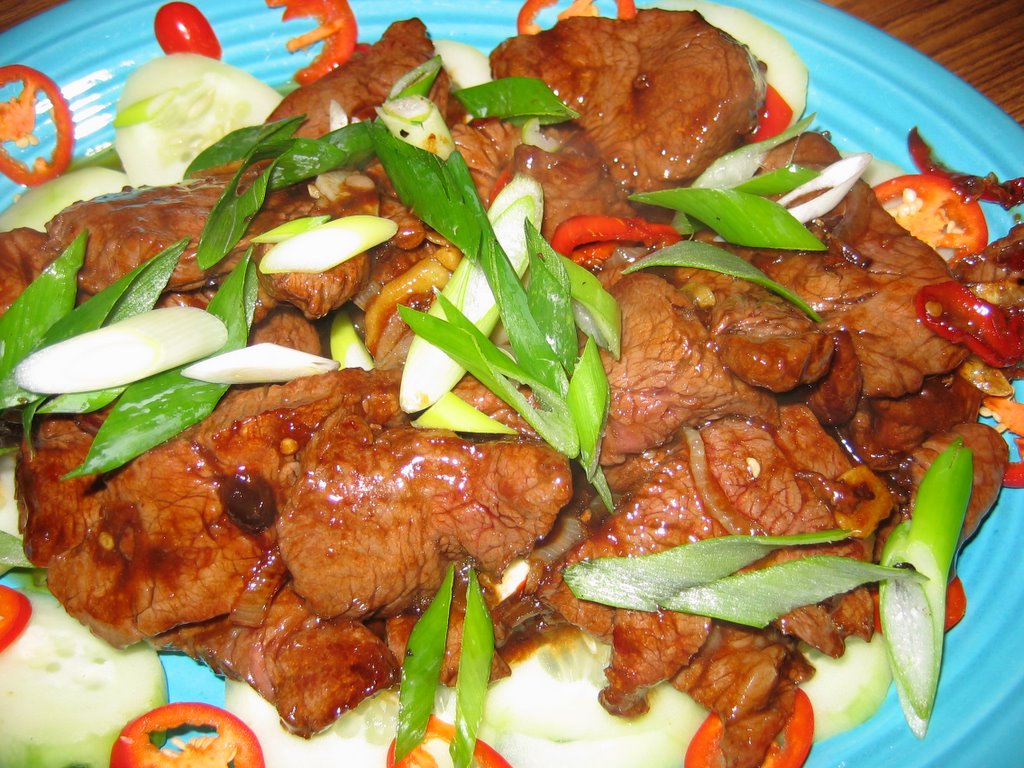 About a week ago, Kate at the Accidental Hedonist posted about the obsessive folks who attempt to perfectly recreate MacDonald’s foods at home, and she said, “Why?”
Well, I posted in favor of hacking recipes from restaurants, but not McDonalds. Never Mickey D’s–that I don’t get. Because if you want a Big Mac, go out and get one, dammit. By the time you spend all the money to try and find the “perfect” ingredients, then you will have spent more than it would cost to just buy one. Turning fast food into slow food is just weird.
But trying to recreate a dish you have had in a favorite restaurant is a sport. Or at least, it is to me. It is an exercise in patience, cunning, research skills, deductive reasoning and most importantly, taste memory.
Like the entree pictured above.
I haven’t tasted that dish in over a decade, but have longed for it every day of those years.
It was my favorite dish on the menu at the Chinese restaurant in Huntingon, West Virginia, where I worked as a waitress. It was one of the most expensive items on the menu and was an amazing combination of flavors, textures, complexity and simplicity. I sold a lot of orders of it to people who would ask what I liked best, and then who would become hooked on it after one bite and would order it over and over.
It was called on the China Garden menu, “Mongolian Beef,” and while it was certainly beef, I doubt seriously if it had anything to do with Mongolia. I have never found anything else on any other Chinese restaurant menu labelled “Mongolian” that tasted like this dish. I suspect that it was a dish that Huy made up himself and just labelled it with a name that he thought people would like. Or, that it was a dish that was similar to the stuff that other restaurants call Mongolian Beef, but that Huy’s sauce was just superior and his presentation was unusual.
And it was very different from the typical run of the mill Chinese restaurant food that one would expect to find in Huntington West Virginia (which was true for much of their menu). For one thing, it involved small medallions cut from the beef tenderloin. Very few Chinese places use such expensive cuts of beef. For another thing, the beef was presented over a bed of cold cucumber slices, with a sauce that was spicy and sweet, savory and brown, a little tangy and very, very flavorful, but without tasting obviously like any combination of Chinese sauces. It was garnished with scallions, but it also had slices of onion cooked in the wok to a browned “wok-hay” filled fragrance that would just make one’s mouth water.
When you ate it, the interplay between the crisp cucumbers and the meltingly tender, medium-rare beef with its perfectly seared crust was amazing. The sauce was a wonder–it clung perfectly to the steak, yet was generous enough and hot enough coming out of the wok to partially cook the cucumbers so that they had a velvety outside and a crunchy inner core. The cooked onions were a sweet background note while the scallions burst like a green and pungent symphony on the tongue.
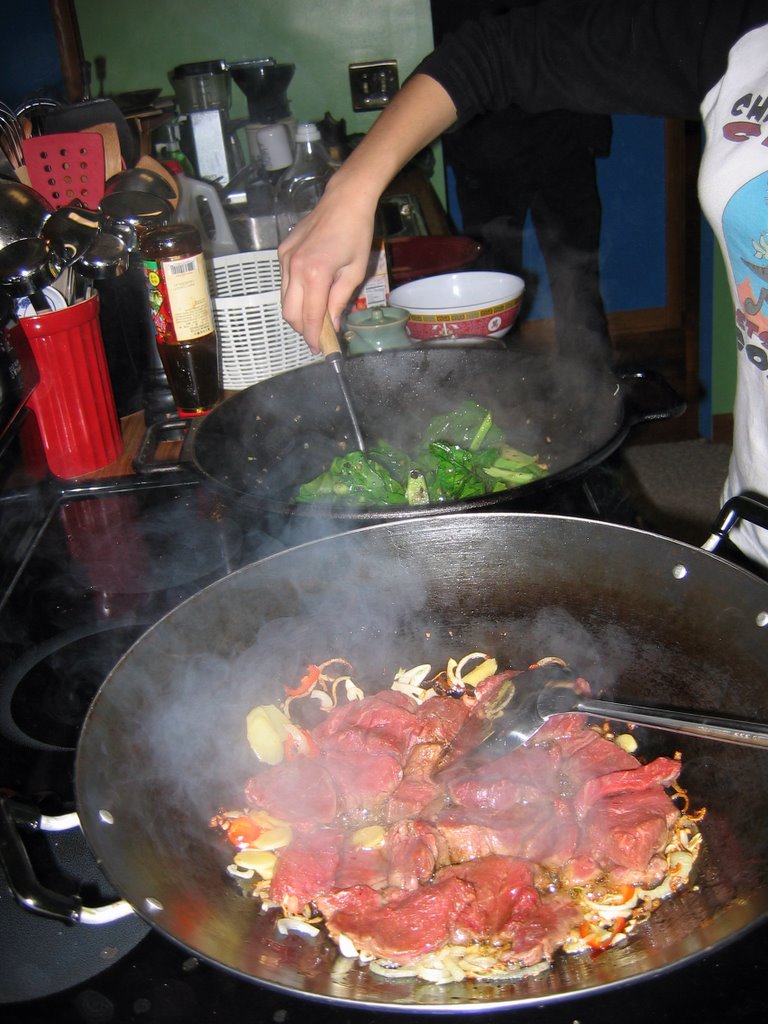 On our anniversary on Sunday, I decided that I was going to buy a tenderloin from Bluescreek Farms, roll up my sleeves and just cook the Mongolian Beef and stop fretting over it.
Part of the reason I decided to take the plunge now is because I found a couple of recipes in Grace Young’s The Breath of a Wok, and Ken Hom’s Easy Family Recipes from a Chinese American Childhood which had sauces in them that I had learned over the years would create much the same flavor complex as was present in the China Garden original dish. In addition, I had started cooking with bean sauce, and the flavor of it, as I licked it straight off of a spoon brought the “aha!” moment–it was a component of the mysterious brown sauce that enrobed Mongolian Beef so magnificently.
Taste memory is a very useful thing for a cook or chef to have or develop. I have a naturally good memory for flavors and scents, and for all that I have terrible allergies and sinus issues, I have a very sensitive nose and I am quite good at discerning flavors and scents, particularly when it comes to seasonings. This skill got honed when I learned how to cook Indian food; I trained myself by eating at a very good Indian restaurant often and then going home and tasting just bits of spices and then comparing those flavors to those in the dishes I had eaten and slowly began to understand how the spices created such symphonic bouquets in the mouth.
I have continued my training with my explorations of Chinese ingredients as well–I make a point now of picking unfamiliar sauces or condiments and bringing them home, then researching recipes that use them and then, before I break out the wok, I taste them straight from the bottle or jar.
When I did that with bean sauce the other day is when I had the final puzzle piece for the Mongolian Beef. It was the missing flavor element I had been looking for.
Or, at least, it was close enough.
So, we were having friends over tonight, and I decided that was what I was going to make, along with Hot and Sour Soup and Gai Lan with Waterchestnuts (which you can see Morganna cooking next to me in the background there–we cannot wait for the new stove which will have more room for two woks to be going at the same time). I figured that if I was going to buy an entire tenderloin, then we should share it with some folks rather than make utter pigs of ourselves.
As it was, while I cut the tenderloin into medallions, I was worried that there was too much beef, but it tasted so good that we ended up with only one little piece left. I stopped cutting at just the right place–we have a nice sized filet mignon sitting comfortably in the freezer, waiting for a rainy day.
So, what am I going to do now that I have that beloved favorite dish in my grasp?
Share it with you, of course.
Since I know that Huy has retired and the restaurant is no longer open, I feel as if I can do so without feeling guilty at all.
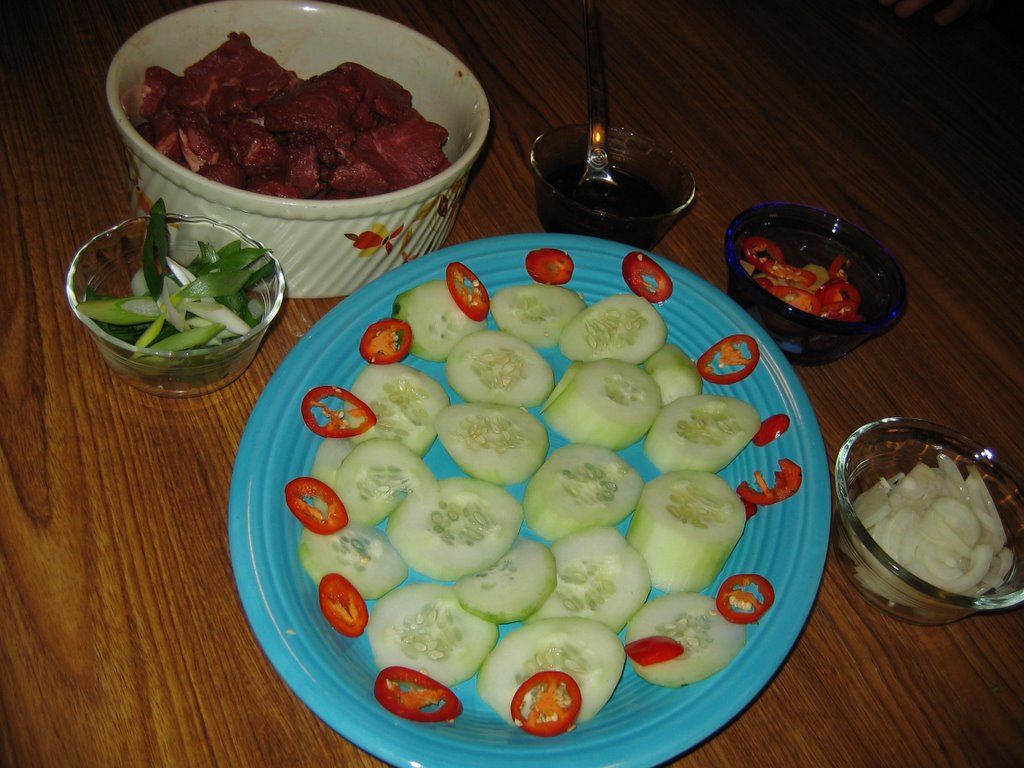 Mongolian Beef
Ingredients:
1 1/2 pounds beef tenderloin, silverskin trimmed
1 tablespoon thin soy sauce
1 tablespoon dark soy sauce
1 1/2 tablespoons cornstarch
1 cucumber peeled and sliced into 1/4″ thick diagonal slices
1 ripe jalapeno cut into thin diagonal slices
2 1/2 tablespoons peanut oil
1 medium onion cut in half and sliced thinly
1 1/2″ cube of ginger, peeled and thinly sliced
2 ripe jalapenos, sliced thinly on the diagonal
2 cloves garlic, peeled and thinly sliced
Sauce Ingredients:
(Mix together in a small bowl and have ready)
1 tablespoon hoisin sauce
2 tablespoons oyster sauce
1 1/2 tablespoons bean sauce
2 teaspoons raw sugar
1 teaspoon chili garlic sauce (or to taste)
2 teaspoons Shaoxing wine
1 teaspoon Chinkiang rice vinegar
1 scallion trimmed and cut into 1/2″ long diagonal slices
Method:
Cut tenderloin into 1/2″ thick medallions. Toss with two soy sauces and cornstarch and allow to marinate at least twenty minutes.
After cutting cucumber and first jalapeno, use them to completely line a serving platter, with the cucumber in the center, and the jalapeno as decoration along the edges as shown above.
Heat wok until it is smoking. Add peanut oil and heat until it shimmers. Add onion slices and stir fry until they turn golden. Add ginger, jalapeno and garlic to wok and stir and fry until garlic begins to turn golden.
Add meat in a single layer, and let sit undisturbed for at least one minute, or until the meat is seared well on the bottom. Begin stir frying with the goal of simply searing the outside of the meat, while the inside stays medium rare.
When meat is fully browned on the outside, add sauce ingredients all at once, and stir quickly until it thickens.
Pour immediately onto the platter over the cucumbers and sprinkle the scallion bits over the steak.
Serve right away with steamed rice and some sort of crunchy leafy green vegetable. Like Gai Lan.
food recipes Chinese cooking beef ginger

Categories:
- Admin (rss) (55)
- Blogs and Blogging (rss) (81)
- Book Reviews: Cookbooks (rss) (43)
- Book Reviews: Non-Cookbook Food Books (rss) (38)
- Cats and Cat Blogging (rss) (47)
- Chinese Cooking Lessons (rss) (32)
- Culinary School Stories (rss) (18)
- Dairy Pruducts: Cultured and Barbaric (rss) (4)
- Documentary Filmmaking (rss) (1)
- Essays, Rants and Reflections (rss) (260)
- Fighting Hunger (rss) (12)
- Food and Kids (rss) (45)
- Food in the News (rss) (126)
- Food Media (rss) (98)
- Food Preservation (rss) (18)
- Food Safety (rss) (45)
- Gardening (rss) (30)
- Herbs and Herb Blogging (rss) (20)
- Holidays (rss) (50)
- Kat Blogging (rss) (22)
- Kitchen Science (rss) (36)
- Leftover Makeover (rss) (8)
- Life, the Universe and Everything (rss) (131)
- Local and Sustainable (rss) (227)
- Local Athens Food and Foodies (rss) (42)
- Meatless Mondays (rss) (32)
- Menu For Hope (rss) (5)
- Nutrition, Diet and Health (rss) (84)
- On The Farm (rss) (8)
- Recipes: Almost Vegetarian, Vegetarian and Vegan (rss) (294)
- Recipes: American Regional (rss) (37)
- Recipes: Appalachian Hillbilly (rss) (33)
- Recipes: Bread, Pasta, Grains (rss) (95)
- Recipes: Canning and Preserving (rss) (8)
- Recipes: Chinese (rss) (123)
- Recipes: Comfort Food (rss) (120)
- Recipes: Cookies (rss) (16)
- Recipes: Desserts (rss) (48)
- Recipes: French (rss) (25)
- Recipes: Fruits and Vegetables (rss) (302)
- Recipes: Greek, North African and Middle Eastern (rss) (31)
- Recipes: Indian (rss) (137)
- Recipes: Italian (rss) (42)
- Recipes: Japanese (rss) (7)
- Recipes: Jewish (rss) (4)
- Recipes: Korean (rss) (6)
- Recipes: Meat, Poultry and Fish (rss) (220)
- Recipes: Mexican/Native American/ Latin American/Caribb (rss) (27)
- Recipes: Original (rss) (108)
- Recipes: Thai (rss) (27)
- Recipes: Tofu (rss) (17)
- Recipes: US Regional (rss) (16)
- Recipes: Vietnamese (rss) (8)
- Restaurant Stories (rss) (28)
- Sewing, Quilting, Arts and Crafts (rss) (16)
- Simple Chinese Recipes (rss) (30)
- Slow Food and Heritage Foods (rss) (10)
- Spice Blogging (rss) (44)
- The Chinese Cookbook Project (rss) (14)
- The Chinese Pantry (rss) (39)
- The Documentary (rss) (2)
- The Kitchen Saga (rss) (17)
- The Locavore's Bookshelf (rss) (15)
- The Unsung Adventures of The Culinary Nerd (rss) (6)
- Tools and Toys (rss) (35)
- Uncategorized (rss) (10)
- With a Side of Politics (rss) (48)
Archives:
- August 2012 (9)
- July 2012 (12)
- September 2011 (3)
- August 2011 (7)
- July 2011 (8)
- June 2011 (16)
- May 2011 (17)
- April 2011 (11)
- December 2010 (9)
- November 2010 (5)
- February 2010 (1)
- December 2009 (5)
- November 2009 (7)
- October 2009 (10)
- September 2009 (16)
- August 2009 (14)
- July 2009 (14)
- June 2009 (7)
- May 2009 (17)
- April 2009 (10)
- March 2009 (25)
- February 2009 (13)
- January 2009 (10)
- December 2008 (5)
- November 2008 (5)
- October 2008 (6)
- September 2008 (13)
- August 2008 (8)
- July 2008 (11)
- June 2008 (18)
- May 2008 (13)
- April 2008 (14)
- March 2008 (16)
- February 2008 (17)
- January 2008 (19)
- December 2007 (25)
- November 2007 (18)
- October 2007 (24)
- September 2007 (16)
- August 2007 (15)
- July 2007 (15)
- June 2007 (10)
- May 2007 (14)
- April 2007 (16)
- March 2007 (17)
- February 2007 (20)
- January 2007 (13)
- November 2006 (1)
- October 2006 (8)
- September 2006 (14)
- August 2006 (25)
- July 2006 (30)
- June 2006 (28)
- May 2006 (34)
- April 2006 (29)
- March 2006 (24)
- February 2006 (30)
- January 2006 (38)
- December 2005 (40)
- November 2005 (37)
- October 2005 (32)
- September 2005 (25)
- August 2005 (30)
- July 2005 (28)
- June 2005 (21)
- May 2005 (8)
- April 2005 (22)
- March 2005 (17)
- February 2005 (29)
- January 2005 (10)
Search Site:
Links:
- Lily’s Wai Sek Hong
- 101 Cookbooks
- A cat in the kitchen
- A Veggie Venture
- Accidental Hedonist
- Cha Xiu Bao
- chez pim
- Chocolate & Zucchini
- Chopstick Cinema
- Chowhound.com
- Chubby Hubby
- Cook sister!
- Cooking with Amy
- da*xiang
- Eat Local Challenge
- Eating Liberally
- Ecocentric
- Eggbeater
- Epicurious
- Farmgirl Fare
- Fatfree Vegan
- Foodgoat
- ForkandBottle.com
- Green Olive Tree
- Hooked on Heat
- Jaden’s Steamy Kitchen
- Kalyn’s Kitchen
- Lucullian delights
- Mahanandi
- Matt Bites
- MeatHenge
- mmm-yoso!!!
- New York Times – Dining & Wine
- Pizza Goon
- Rasa Malaysia
- Ruhlman
- Sailu's Kitchen
- Serious Eats
- SF Gate: Food & Dining
- Simply Recipes
- Soul Fusion Kitchen
- Tastespotting
- The Amateur Gourmet
- The Cleaner Plate Club
- The Food Section
- The Grub Report
- thecookscottage
- U.S. Food Policy
- Wandering Chopsticks
- Washington Post Food and Dining
- Wasted Food
Meta:


Powered by WordPress. Graphics by Zak Kramer.
Design update by Daniel Trout.
Entries and comments feeds.