
Cook Local, Eat Global
Those Darned Chemicals
You know, I get curious when I get a whiff that there is a bit of fuss going on over nothing.
Or if the fuss isn’t exactly over nothing, it is out of proportion with the cause of the ruckus.
After I read the article about the “thirty-eight synthetic chemicals” that the USDA is thinking of permanently allowing in processed foods labelled “USDA Certified Organic,” and found that while two of them are labelled by the USDA as “synthetic” they are created through partially natural processes or are chemically indistinguishable from naturally derived chemicals, I got to wondering about the other chemicals that a bunch of organic consumers are so het up about.
So, I looked all over Organic Consumer Association website to see if I could find a list of the thirty-eight offending synthetic food additives, and found nada.
Nothing.
Just general references to those pesky “thirty-eight synthetic chemicals.”
You know, it seems to me, that before one gets mad about something, one should have a clear understanding of exactly what it is one is tweaked over. It just seems responsible. So, I found it odd that the OCA didn’t have a list or a link to a list of these thirty-eight secret herbs and spices, I mean, chemicals, that are currently allowed in Certified Organic foods. I mean, if the OCA really wanted to educate consumers about what they are putting into their bodies, you’t think they’d put the list right out there, along with an explanation, in mostly plain English, of just what is so objectionable about all of those food additives.
But this is not the case.
So, I went to the USDA, and lo and behold, found a list of the food additives, both synthetic and non-synthetic, that are both allowed and disallowed in the processing of foods labelled as “USDA Certified Organic.”
And I decided to post the list of the “Black Thirty-Eight” (actually only thirty five, but who is keeping count besides me?) here, and then do a little research on what exactly these chemicals are, what they are used for, and how they are made. Just glancing at the list, I did see that many additives have very specific specifications on how and when they are used in the processing of organic foods, and in the cases of both synthetic and non-synthetic additives, it is obvious to me that some thought has gone into the decision-making process and at no time was carte blanche given to the food processors to just put whatever they want in foods labelled as “organic.”
In point of fact, several additives are allowed for use -only- in foods that are labelled, “made with organic ingredients,” which is not the same thing as “USDA Certified Organic,” which tells me that while the OCA may not agree with how the National Organic Standards Board has done its job, I feel that the board is doing its best to keep the federal organic label as meaningful, and yet make it possible for food processors to create diverse products for the growing consumer interest in organic goods.
Again, I say this: if the addition of these products disturbs anyone, then perhaps they should rethink their support for processed foods of any sort, and should only consume foods that come to them in as unprocessed a state as possible.
At any rate, here is the list of food additives. In a series of posts, I will go through each additive on the list, giving all the information I can find on the use of it in food processing, how it is derived, and any possible harmful side effects of it. This series will be posted over days–I have no idea how many days, and will be supplemented by my usual, more colorful and entertaining posts.
When I am done with my annotations, perhaps I will take a look at the non-synthetic food additives–the ones which are apparently okay with the OCA, and see what they are used for and from what they are derived.
If nothing else, this should remind me of the chemistry classes I took umpteen years ago, and why I found them to be so fascinating, if somewhat difficult.
Of great use to me in this research is a list of food additives on the Nutrition Data website,
and Wikipedia.
Enjoy.
The List:
alginates
ammonium bicarbonate
ammonium carbonate
ascorbic acid
calcium citrate
calcium hydroxide
calcium phosphates
carbion dioxide
chlorine
ethylene
glycerine
hydrogen peroxide
iron (ferrous sulfate)
lethicin, bleached
magnesium carbonate
magnesium chloride
magnesium stearate
mono- and diglycerides
nutrient minerals
nutrient vitamins
ozone
pectin, low-methoxy
phosphoric acid
potassium acid tartrate
potassium citrate
potassium hydroxide
potassium iodide
potassium phosphate
silicon dioxide
sodium citrate
sodium hydroxide
sodium phosphate
sulphur dioxide
tocopherols
xanthan gum
You will note that there are actually only thirty five chemicals on that list.
That is because a couple of the chemicals are listed twice, because they have been examined more than once and the regulations on them have changed slightly and the USDA makes note of that.
Apparently, reporters cannot figure that out.
Now that the list is out of the way, here are the first six synthetic chemical food additives that are currently and may be permanently allowed to be used in processing USDA certified organic food.
Annotated List of Allowable Food Additives:
Alginates are linear copolymers (a specific kind of polymer, or long chain of molecules made up from structural units and repeating units strung together by chemical bonds) which form gums or gels. Commercially, these are derived from algae or bacteria, both of which are naturally ocurring lifeforms. Alginates are used to thicken food products such as soups and salad dressings, and are used in the pharmaceutical industry in the production of antacids.
Ammonium bicarbonate has been covered in my previous post on the subject, but I want to note that the USDA has allowed its use -only- as a leavening agent–this use has been determined safe by the FDA. Similarly, the use of the related compound, ammonium carbonate in the production of organic food products has been limited to use as a leavening agent. Interestingly, ammonium carbonate used to be derived from organic compounds such as hair, urine and horn–hence the old name of “salt of hartshorn.”
Ascorbic acid, also known as vitamin C, is allowed to be used in any way in the production of organic foods. An antioxidant, ascorbic acid is used to help preserve processed foods and to boost the nutrient value of them; humans are one of the few animals incapable of producing our own vitamin c–a nutrient necessary to maintain life. It is found in many plant and animal sources including citrus fruits, peppers, tomatoes, broccoli, potatoes, papaya, calf liver, oysters and cod roe. It is synthesized from glucose–a natural sugar.
Calcium citrate is the calcium salt of citric acid. (A salt is a ionic compound composed of positively charged ions and negatively charged anions with a crystalline molecular structure which has a neutral charge.) It is used as a preservative, and because it is both sour and salty, as a flavor enhancer. Studies have shown that calcium citrate dietary supplements may be better absorbed by the body than calcium carbonate to prevent bone density loss. It also may increase aluminum toxicity in people with kidney problems.
Calcium hydroxide has been used in food processing for thousands of years by Native Americans who used it (sometimes in the form of wood ashes) in the production of posole, nixtamal or what we would now call masa. It is used to loosen and remove the outer hull of corn kernels, and in the process, renders more of the grain’s protein and vitamins available for absorbtion. This treatment of corn makes the grain more nutritious, allowing people to use it as a staple protein source. Without such treatment, those who eat corn as a staple food often develop the serious disease pellagra, which is a deficiency in niacin. It is still used to create posole or masa, and is also used in the production of sodas and some alcoholic beverages.
That is it for today. Look for a continuation of “Those Darned Chemicals” tomorrow, when you will hear Barbara say, “Doesn’t anyone study chemistry in college anymore?”
And then you will hear Zak say, “Are you still going on about those darned chemicals?”
And Morganna will say, “Mom, what’s for dinner?”
Food…and Cats in the News
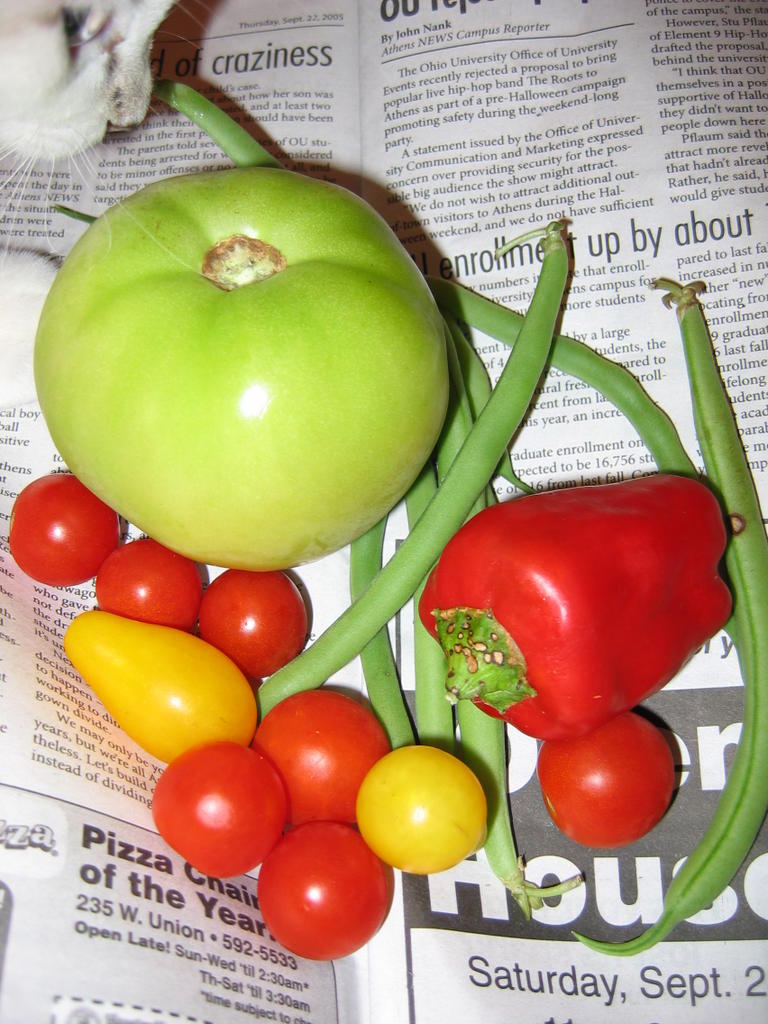 Coming Soon to a Grocery Store Near You: Cloned Cow
Scary huh? Cloned cow. Oooh. Spooky.
Well, not really, no. At least, not to me.
You know, there are reasons to get het up about factory farming. The maltreatment of animals, the unsanitary conditions of barns and slaughterhouses, the degradation of the environment due to poor waste managment–but should we really be upset about eating meat from a cow that was cloned?
Or more likely, eating meat from the offspring of a cow that was cloned?
Well industry officials and consumer groups warn that if the FDA does what is expected to do and permit the sale of meat from cloned cattle or the offspring of cloned cows in the US, that there may be a severe backlash from concerned consumers.
I am not certain why, except that the mere mention of the word, “clone,” brings up memories of George Lucas’ godawful movie, “Attack of the Clones.” (I still have PTSD from seeing that film. Eueesh.)
But be that as it may, apparently, some people are afraid of eating cloned meat. Again, I don’t really understand why–there are reasons to mistrust genetically modified organisms in our food supply, but being worried about cloned cows just strikes me as neo-luddite and weird.
However, considering the cost of cloning, and the possibility of a backlash, doesn’t it make sense for the beef industry to just say, “That’s nice,” and go on their merry way without cloning cows? They’ve been getting on fine without it so far–I haven’t noticed any beef shortages recently.
I mean, just because the FDA says they can sell cloned meat, doesn’t mean that they have to.
I think consumer mistrust in cloned cattle shows just how badly our public schools fall down when it comes to teaching science.
Okay, I will drop the subject before I start ranting about Intelligent Design and how it bloody well isn’t a theory, and if people actually knew the difference between a scientific theory and a philosophical construction, we wouldn’t even need to have that argument in the first place.
On to the next news item:
Synthetic Chemicals in Organic Food?
The FDA isn’t the only federal agency getting crap from consumers these days–the US Department of Agriculture has fomented a controversy by proposing an amendment to the rules governing the USDA Certified Organic labelling program that would allow foods which contain artificial ingredients such as ammonium bicarbonate, ethylene gas and xanthan gum, to still wear the USDA organic label. This time, the Organic Trade Association and the Organic Consumers Association are going head to head over the issue, with the OTA (which represents companies such as Kraft, Dole and Horizon) claiming that removing these food additives would hurt their bottom line, and the OTC claims that they are standing up against “corporate agribusinesses” which threaten to take over the organic food industry.
Now, here comes Barbara, the poopoohead skeptic again, pointing out what should be obvious: all of these ingredients go into processed foods that wear the organic label. If you want to avoid these sorts of ingredients, then avoid procesed foods. Ammonium bicarbonate is a leavening agent, ethylene gas is used to ripe fruit and xanthan gum is a thickening agent.
Let’s start with the leavener, shall we? What are leaveners? They make baked products rise. What kind of leaveners are there? There are organic ones, such as yeast, which is a living organism, and which works by fermenting alcohol from sugar which produces carbon dioxide bubbles which then leaven the baked good. There also are chemical ones such as baking powder, which is a base and an acid, which in the presence of moisture and heat, react explosively, producing carbon dioxide bubbles which leaven the baked product, making it light and fluffy and not hard and cardboardy.
I hate to tell these organic consumers this, but they probably have chemical leaveners in their cupboards and use them every time they bake whole grain bran muffins and organic granola nut oatmeal cookies. If they have baking powder in their homes, they have a chemical leavener that is not “natural.” From what I was taught in culinary school, ammonium bicarbonate isn’t even used that much in the food industry anymore, and according to various sources on the net–it is seldom used by food processors. Even if it is used, it is no more harmful than the stuff in the stuff we use at home.
On to ethylene gas: it is a naturally occuring plant hormone in gaseous form that is emitted by some fruits and vegetables as a byproduct of ripening which causes the ripening process to continue.
Have you ever bought bananas which were too green, and then put them in a paper bag, and closed it up, then went back in a couple of days to find ripe bananas? Or if you want it to happen in a day, you throw in apple in with them? Was it magic that made the bananas yellow?
No. It was ethylene doing what it is supposed to do, naturally. Without ethylene treatments, most bananas would not ripen, so there would be no yellow organically grown bananas for people to eat.
As for xanthan gum–what is it and how is it made? It is a polysaccuride produced by allowing sugar to be fermented by a bacterium called Xanthanomas campestris. And what is fermentation?
A natural process.
So, here is my issue with this issue, which, if we go by the three examples used by the author of the article, is really a non-issue. (Some of the other thirty-five food additives may indeed be less than desireable in organic foods.)
With the exception ammonium bicarbonate, the other two chemicals/food additives are naturally derived. So, what exactly is the problem?
If you don’t want these things used in processed foods that are labelled as organic, then come up with alternatives, stop eating processed foods or deal with runny yogurt, unripe bananas and cardboardy crackers and shut up. Bake your own crackers, for god’s sake, and you had better not use baking powder, because–horrors–it is not natural.
There are reasons to get irritated with the USDA over the organic labelling rules. Their willingness to allow the use of harmful pesticides or toxic sludge on organic farms comes to mind. But freaking out about ethylene gas (which is chemically the same whether it is emitted by an apple or created in a laboratory and sprayed over bananas) is ridiculous and makes folks who care about organic food look like a bunch of idiots.
Once again, I say this: if our science education in this country was a little bit better, we wouldn’t have these issues. Instead, we have consumers going off half-cocked on very little information and sometimes, just blatant superstition and suppositions.
Now, on to our “duh” newstory of the day:
Fried Fast Food Makes Kids Fat
Again, I say–well, duh.
Apparently, more and more kids are eating more and more meals outside of the home in fast food establishments where they eat lots of deep-fried stuff and lo, and behold–this is not making them slender.
These are the conclusions of a recent Harvard University study of the eating habits of more than 14, 000 US adolescents between the years of 1996 and 1999. During that time period the number of meals eaten outside of the home more than doubled, resulting in a higher body mass index for boys and a less varied and healthful diet for all participants.
The remedy suggested by the researchers: keep the kids home to eat, or failing that, teach them to eat more healthfully at fast food places by choosing a grilled chicken salad instead of a burger and fries.
There is a problem, of course, with that second idea.
Fast food restaurants specialize in making burgers and fries, not salads, and the former taste much better than the latter.
The likelihood of a kid picking a grilled chicken salad at McDonalds over a Quarter Pounder with Cheese and fries is about as great as my chance of having a torrid love affair with oh, I don’t know–Antonio Bandaras.
It ain’t gonna happen folks.
Here’s a little tidbit to prove that I am not only a cynical harpy, but also a soft-hearted sentamentalist:
Cats Rescued from Hurricanes Arrive in Oregon
Forty-one cats rescued from hurricanes Katrina and Rita, arrived safely in Oregon on Monday, where they will be put up for adoption. They are in the care of The Cat Adoption Team of Sherwood, Oregon, a non-profit, no-kill shelter and hospital with room to house 600 cats.
Over 6,000 animals have been rescued by volunteers cleaning up after the two devastating hurricanes, thus far.
See–there are good things in the world.
Arroz Gratinado
 Nearly every culture has a dish related to a casserole. If there are ovens for baking bread, then casseroles are certain to follow; they are simple to put together, they cook undisturbed while the cook is engaged in other things, and they can utilize leftovers and be made to stretch to feed umpteen-eleven people without the cook breaking a sweat.
In other words, they are homey, delicious foods that are very little trouble to make.
Arroz gratinado is a rice-based Mexican casserole, and next to lasagne, is my all-time favorite among oven-cooked dishes that can be made for a crowd. You can use leftovers in the making of it–in fact, I am pretty sure it came about because of leftovers. As I was telling Morganna it likely arose when somebody’s Abuela had leftover arroz rojo (red chile rice) and shredded meat, and wanted to do something new with it. Or maybe she had an extra guest or three coming to dinner and she wanted to add another dish to the menu without having to do too much extra work.
However it arose, arroz gratinado is a delicious dish.
I started making it at the request of a friend who had remembered eating it as a child at one of her Latina friend’s home. Apparently, every year for the girl’s birthday, her mother would make this dish for the party, and Nikki adored it. She had been reminded of it when she was at the grocery store and saw rice, beans and salsa in another shopper’s cart, and she described the dish to me and begged me to figure out how to make it. I couldn’t even look up a recipe for it, because she didn’t know the name of the dish.
A rough description isn’t much to go on, but I gave it my best shot.
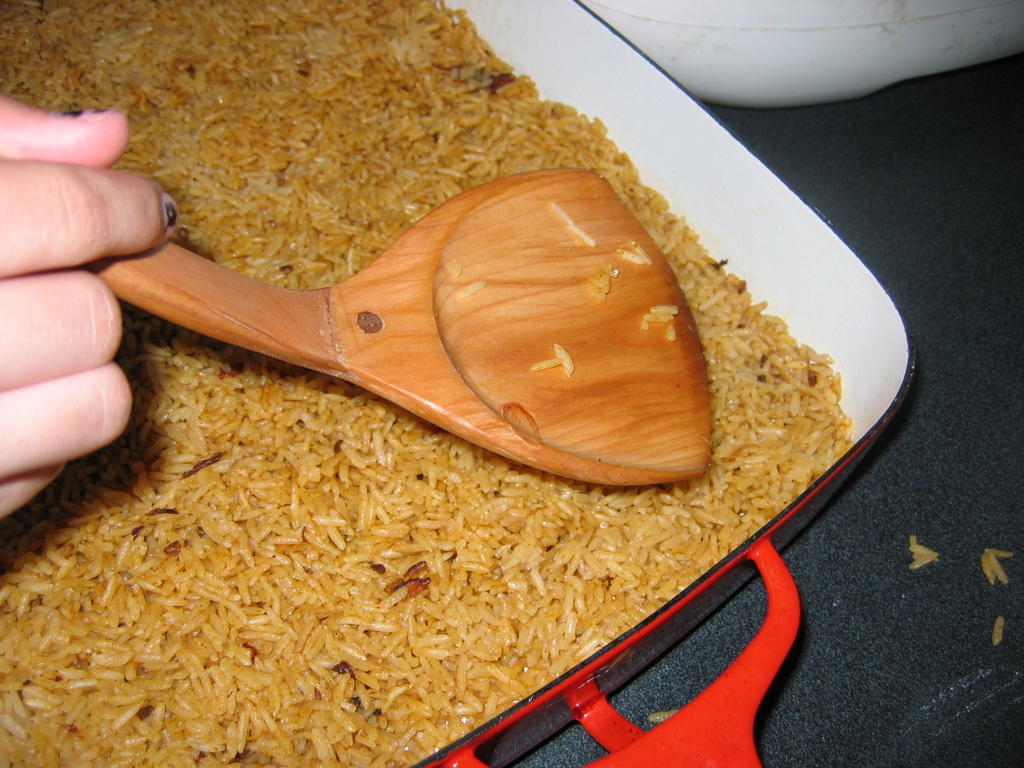 She told me that it involved tomato-flavored Mexican rice on the bottom, then shredded meat, tomato salsa, and then cheese melted on top with cilantro and scallions melted in the cheese, with refried beans served on the side.
How hard is that?
It turns out that it isn’t difficult at all–which is what is best about casseroles–even if there are a lot of steps and ingredients, they are generally simple to put together, and so comforting that they create taste memories that can last for years.
So, the first time I made it, I made a pot of Mexican red tomato rice, then made a batch of shredded beef, a pot of cooked roasted tomato and poblano salsa and some refried beans, then put all of it but the beans together.
As Nikki had promised, it is a magnificently delicious dish and is so soul warming, I have never had anyone dislike it. Of course, at this point, it still had no name–she just called it, “That Mexican Rice Casserole You Make.”
 Zak gave it our current unofficial name, which while descriptive and apt, is not appetizing. Because he would stir and mush his portion of refried beans into the rice casserole before eating the resulting unattractive glop, he named it, “Mash.”
Which is what we called it amongst ourselves for years. Among company, we called it “Mexican Rice Casserole,” which often made people wary that it might involve Ro-Tel tomatoes melted into Velveeta and taco meat over red rice baked to a state of crusty, gooey indifference, but once they tasted it, they loved it and always asked for the recipe.
It wasn’t until I picked up a copy of Rick Bayless’ Mexican Kitchen, that I found a real recipe for it and discovered its proper name, “arroz gratinado.” Finally! I was pretty psyched to see that Rck made it much the way I did, though I confess to having switched to making the rice now by cooking it in the broth generated by cooking the shredded meat, and I generally used a good quality jarred salsa, especially if I was pressed for time. And, since Zak insisted upon squishing his beans into it, I just added a layer of “refried” beans. They were not really fried, but were simply freshly cooked pinto beans mashed with some scallions, some bean broth and maybe a teaspoon of bacon fat to give them an unctuous texture.
 One could, I suppose, use canned refried beans, or dehydrated ones, but really, it is so simple to cook a pot of beans and then mash some or all of them into a rough puree, that I see no reason to resort to the instant stuff. Freshly cooked beans taste so much better, and while I can stand the dehydrated beans, I despise the canned ones–they taste like metallic mud to me.
Beans really are simple to cook, and if you have a pressure cooker, they are even easier and quicker than one can imagine. The rules are simple–soak them or not–whichever method makes you feel better. Cook them in a flavorful liquid, and if you are not a vegetarian, add some sort of smoked meat product, preferably pork: ham, ham bone, ham hock, bacon, bacon grease–whatever. You can use smoked turkey wings if you are worried about fat or are a Muslim. (I taught my Islamic personal chef clients how to cook Mexican beans using smoked turkey wings–they loved it.) If you are a vegetarian, chipotle chiles will give a subtle smokey taste, as will spanish smoked paprika or smoked tofu. Sauteed onion and garlic–one small onion and 1/2 head garlic, add a great deal of flavor. Make sure you have enough liquid to cover the beans by an inch or two, and then start simmering them. Don’t add salt at the beginning, add it once the bean skins split, and the beans start to soften. At that point, you can also add tomatoes, if you like.
And there you are. In a pressure cooker, it is usually twenty-five to forty five minutes to beans, on the stovetop alone, it usually takes four or five hours of simmering to cook unsoaked beans. Or stick them in the crock pot the night before or in the morning before work, and when you return, there are beans, ready to mash and turn into “refritos” for supper.
Yes, it is a bit more work than opening a can or pouring boiling water over bean flakes. But, it is certainly worth it in the long run. Besides–if you cook a whole pound of beans to make this casserole, you only need to mash half of them. In that case, you have half a pound of whole beans to make soup out of, to make beans and rice with, to add to enchiladas, or just to eat as is with cornbread. Two meals out of one dish.
That is something that every Abuela I have ever known could get behind.
 Arroz Gratinado
Ingredients:
2 cups raw long grain rice–I use jasmine
2 1/4 cups broth from cooking the shredded meat*
Canola oil spray or olive oil
1/2 pound (dry weight–before cooked) pinto beans, cooked and drained
3 scallions, sliced thinly
1/2 cup bean broth
1 teaspoon bacon fat or lard (optional)
1 pound cooked shredded meat
2 12-ounce jars high quality salsa
4 ounces shredded monterey jack or Chihuahua cheese
4 ounces shredded white extra sharp cheddar cheese
handful of minced cilantro and scallions
Method:
Preheat oven to 375 degrees
Using the broth you cooked the meat in (include any solid bits such as tomatoes, chiles, garlic or onion that are in the broth), cook the rice. *The amount given for the broth is the amount needed to cook jasmine rice in a rice cooker–follow your method of cooking long grain rice, and just use the same amount of broth you would use as water to get your rice to turn out right.
Put drained, cooked pinto beans in a bowl, and using a potato masher, mash them into a rough puree. I like to leave some bits of unmashed bean in there–it makes for a more interesting, chunky texture. Mix in the bean juice, scallion slices and optional bacon grease or lard with a wooden spoon until the puree is thick and pliable. (If it looks dry and clumpy, add more bean broth in tablespoon increments–you don’t want the texture to be too fluid, but you don’t want it to be chokingly dry, either.)
Spray the bottom of a 9″X13″ casserole dish (it should be at least two inches deep) with canola oil spray or rub liberally with olive oil.
Spread cooked rice in the bottom of the dish, and press down flat. Don’t pack it in super-tightly, just press it flat.
Sprinkle meat in an even layer over the rice, and pat down gently.
Spoon the bean puree over the meat layer in dollops; spread with the back of the spoon into a mostly even, thin layer of beans.
Pour salsa over all and spread evenly.
Sprinkle with cheese, and put in the oven. Bake until cheese melts and everything is warm and bubbly–20-35 minutes. In the last five minutes of baking, sprinkle the top with cilantro and scallions.
Notes:
You can use any kind of shredded meat you like in here, or if you are a vegetarian, leave it out and replace it with sauteed vegetables like sweet peppers and chiles, summer squashes, onions and garlic. Beef is traditional, but pork is really fine and tasty.
You can leave out the beans–they are only traditional in my house. Or, you can use whole beans sprinkled over the meat layer. Or you can use pureed black beans or whole ones.
You can add corn kernels over the bean layer. Grilled or roasted fresh corn cut from the cob is particularly nice.
You can make your own salsa for this.
You can leave out the salsa, and use heavy cream for a creamy version of the dish. If you do that, add corn and use whole beans instead of mashed ones, and flavor the cream with roasted garlic and poblano peppers. (In truth, I like the tomato salsa version best, and that is saying a lot coming from me–I adore cream. But in this dish, I like the tomatoes better.)
You can prepare it ahead of time and cover with foil and refrigerate it up to a day.
Leftovers can be cut into rectangles and be used to fill burritos for lunch. Just wrap it in a flour tortilla, and microwave on high for a couple of minutes. Nikki always said this stuff made the best damned burritos she’d ever had, and as they were one of her favorite foods, she had eaten a lot of them in her day.
This is a great dish for a crowd, but be aware that people like to eat a lot of it–it is really good. So, make a lot and don’t worry about leftovers–if there is too much for burritos the next day, then freeze it in individual portions and use them as your very own microwave frozen meals for nights when you don’t feel like cooking, but still want to eat something good.
Weekend Cat Blogging: Feline Photographic Assistance
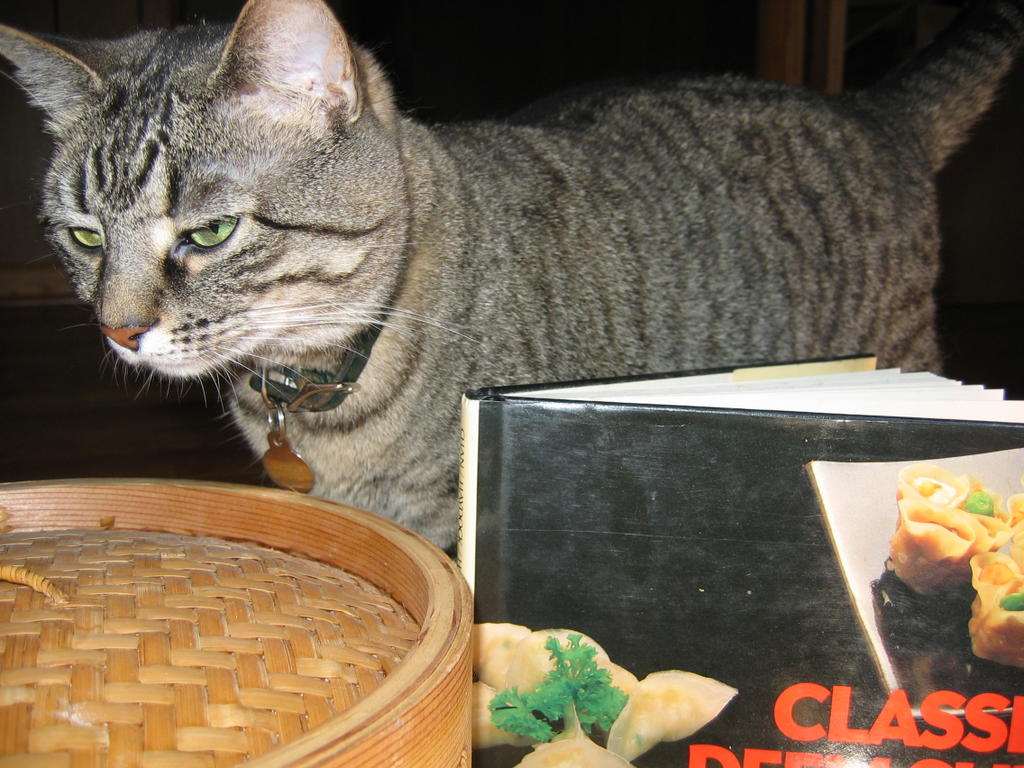 Anyone who reads my blog knows I take a lot of illustrative photographs. Generally, when I am doing photos that involve preparing food, I am safe from feline interlopers, because they know better than to jump up on counters and tables when I am working on food.
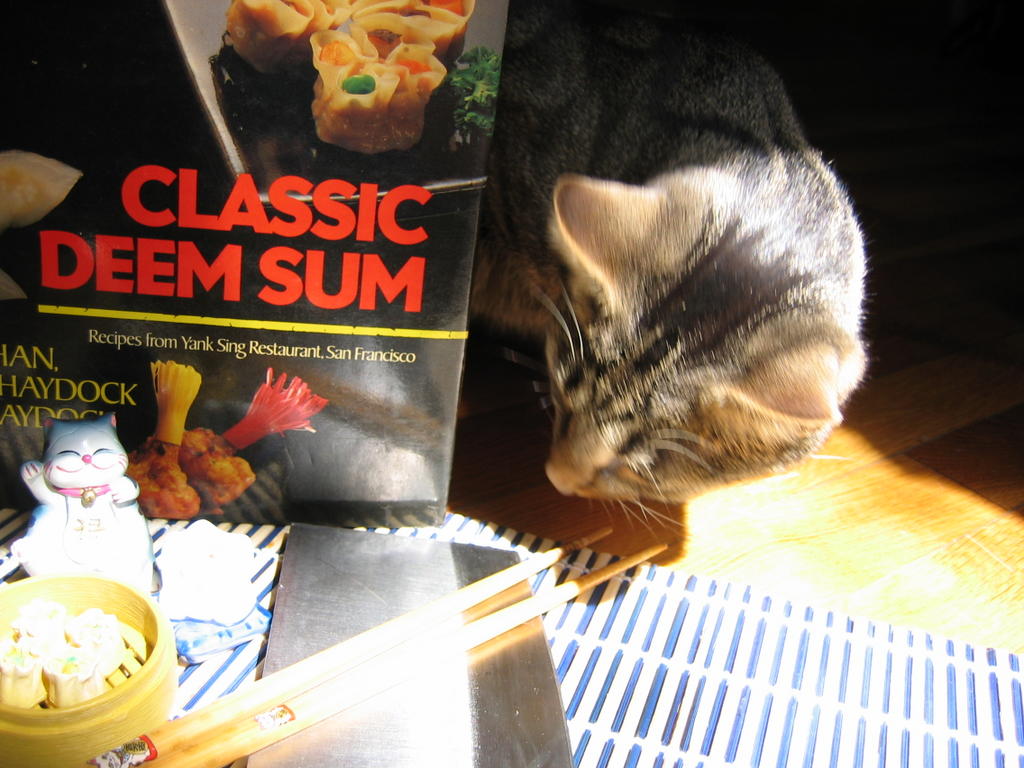
However, if I do a photo shoot that involves props like newspaper for my “Food in the News” posts or a shoot of a book cover for “The Chinese Cookbook Project,” there is always much curiousity, as you can see.
Above, you can see Grimalkin trying to figure out what it is I am doing with a bamboo steamer on and a book on the floor.
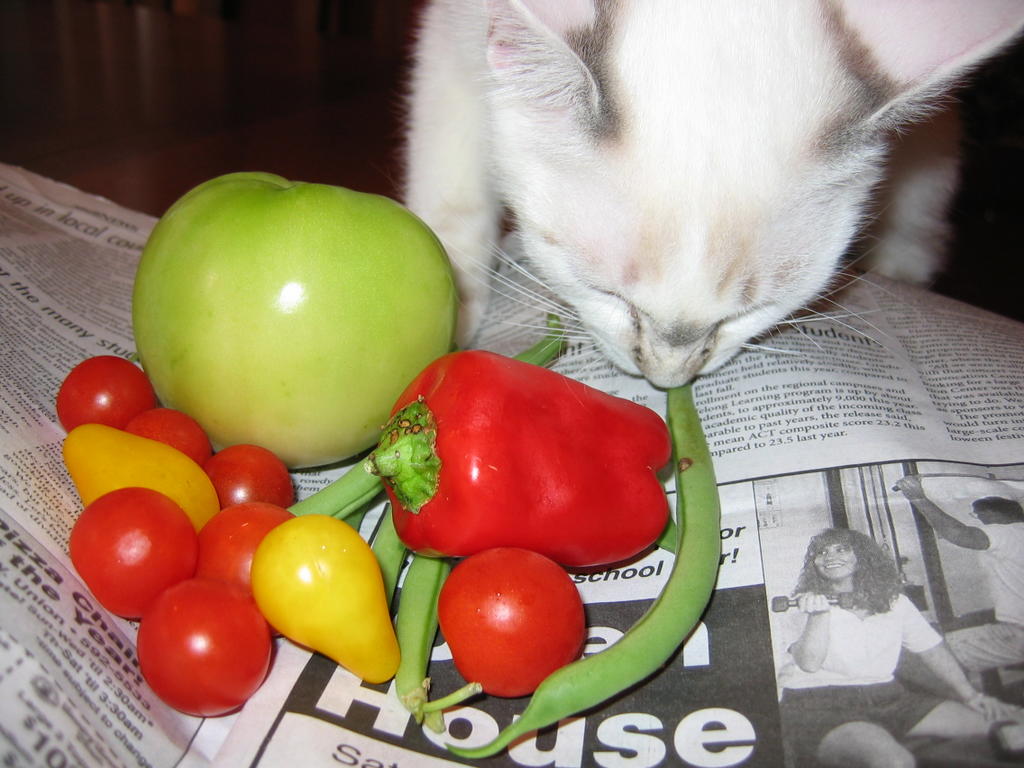
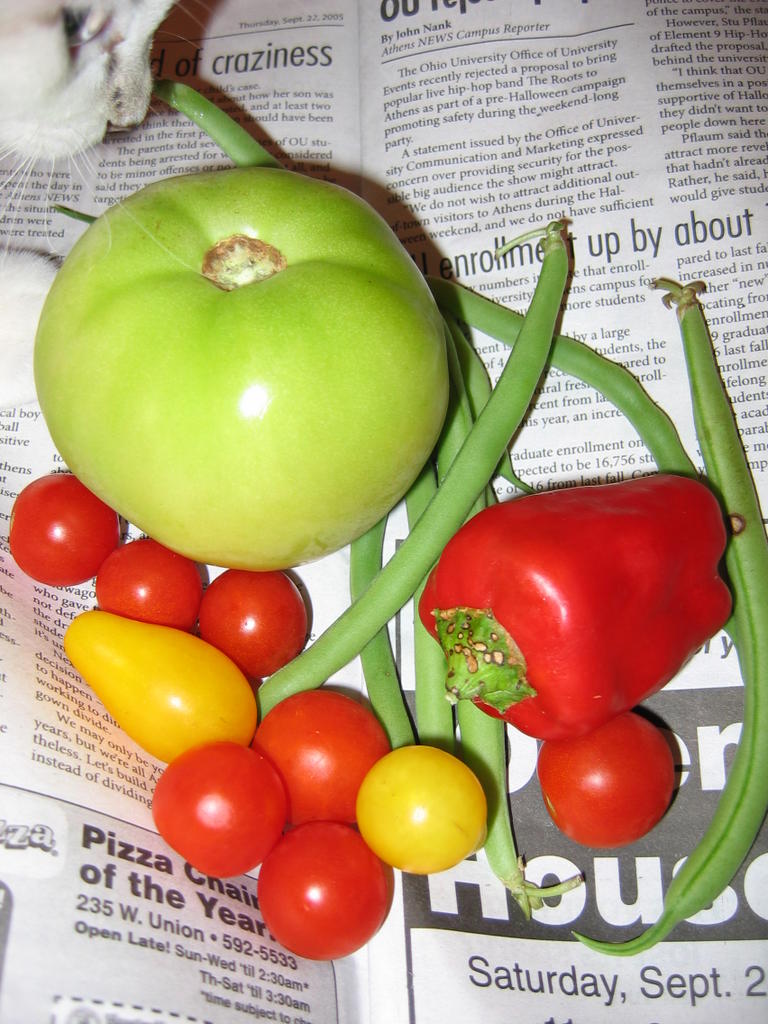 Next, we have Lennier’s little face peering into the frame of the last shoot I did for “Food in the News.”
Now, granted, he had to jump up on the dining room table to get there, but it was the rustle of newspaper that was too exciting to ignore.
And the scent of green beans. The little one apparently loves green beans, as you can see below, where he has nabbed one, and is about to jump off the table and run away with it in his mouth. He ate half of it, then batted the rest of it all over the dining room and kitchen floors.
He was, however, unimpressed with the tomatoes, exept in as much as the cherry tomatoes rolled nicely.
 It is always funny to see what cats will do in any given situation. Cats are the reason why Zak and I seldom watch television, and could actually go for about two or three years without television reception at all. We had cats, and with multiple cats, someone is always up to something, and it is nearly always entertaining.
I sometimes think that cats view humans the same way.
Below, Gummitch appears to be saying, “Wow. Look at all this stuff Mommy has set up on the floor. I wonder why she did that. Humans are so very, very weird. I wonder what it all means.”
(Note: I am now quite certain that cats get as much entertainment from the antics of humans as we get from feline shenanigans–our sewer is backed up, and the plumbers told us to flush our toilets after they had released the clogged drain, about four or five times apiece, in order to clean out the system. So, here I was, running up and down the stairs, flushing the four toilets in the house ten times apiece. Grimmy raced along to each bathroom with me, eyes wide, and tail quite erect, ears laid back in excitement. She watched the goings-on with great glee. I think she was trying to figure out what the hell I was up to.)
 For more weekend cat blogging, check out Claire’s Kiri destroying cardboard at Eatstuff.
Oreo’s tongue at The Countess.
Ayla at Heather’s Space having a bath.
Bella and Tasha practice Cat-fu at A Few of My Favorite Things.
Kittens for adoption at Masak-Masak!
Edith perching at Anne’s Food.
Lixue with love-eyes at Look Hunny, I Cooked.
Cleo’s sweet face at Le Sense du Gout.
Salsa taking in the sun at papilles et pupilles.
Grover Jay lookin’ spooky at Restaurant Widow.
Scapin et Zadig relaxing at Le blog de Juliette.
Kittaya feels the autumn chill at Mahanandi.
Patchy Cat is loved at Farmgirl Fare.
Agnes eyes a frittata at Kayaksoup.
Lyle napping in a fine and private place at Basic Juice.
Trina in a box and a stray beauty at Indy Foodie.
Tinker and a shadow at Middle Fork.
Cool Weather Chinese Greens: Gai Lan
 Autumn has crept into the kitchen, and brought with her succulent cool-weather greens. They tease and entice with a peppery tang or deep sweetness, and their colors range from the aventurine-pale to creamy jade to the deep verdant emerald of a forest in high summer.
Kale and collards, turnip and mustard greens are all the ones I grew up eating from the first whisper of a chill wind in September through the frosts of November and beyond into winter, but my favorite autumnal greens in recent years have been the ones originating in Asia.
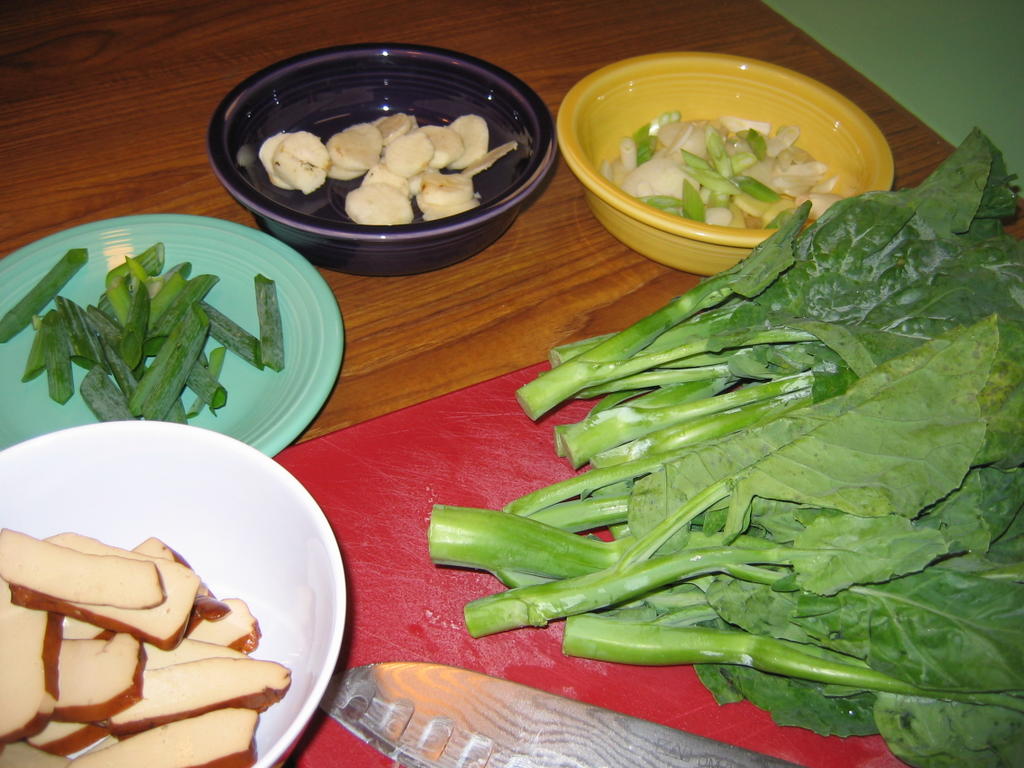 My favorite of them all is gai lan, also known as Chinese broccoli.
Gai lan is a thick-stemmed green with branches ending in wide ovoid dark-green leaves that wilt to a delicious velvety texture in the heat of a wok. The stems, when cooked properly, retain a great deal of crunch without being woody or stringy in the least, and the flavor of them is sweeter than any western-style broccoli I have ever tasted.

The truth is, I don’t much like most western broccoli–and when I have to eat it, I tend to eschew the blossom ends that most people like and eat the peeled thick stems which are crisp and juicy and taste almost as good as gai lan. To my taste, gai lan is superior in every way to the usual broccoli, and in addition, it is as filled with vitamins A, B, C and K, and it has high levels of folic acid, magnesium and calcium.
All in all, it is a great addition to one’s diet, and its mild, peppery-sweet flavor makes it easy to pair with other foods in stir fry dishes.
A classic Cantonese dish featuring gai lan is stir fried beef with gai lan–on most American Chinese restaurant menus, the variant is called Beef with Broccoli. Utilizing the more familiar broccoli, the Americanized version, is less interesting in flavor, relying heavily on oyster sauce, onion and sugar to make the thick, gloppy brown sauce that seems to go on anything with red meat on it in bad take-out places.
Using the more interesting gai lan brings life back to the dish; the sweetness of the stalks calls for the use Shao Hsing wine or sherry, while the tangier leaves beg to be paired with stong flavors like ginger or fermented black beans.
Oyster sauce, when used judiciously, adds a complexity to the dish that is lacking if it is left out; garlic complements the mustardy tinge to the greens well, and just a dash of sesame oil rounds everything out with a sublime fragrance.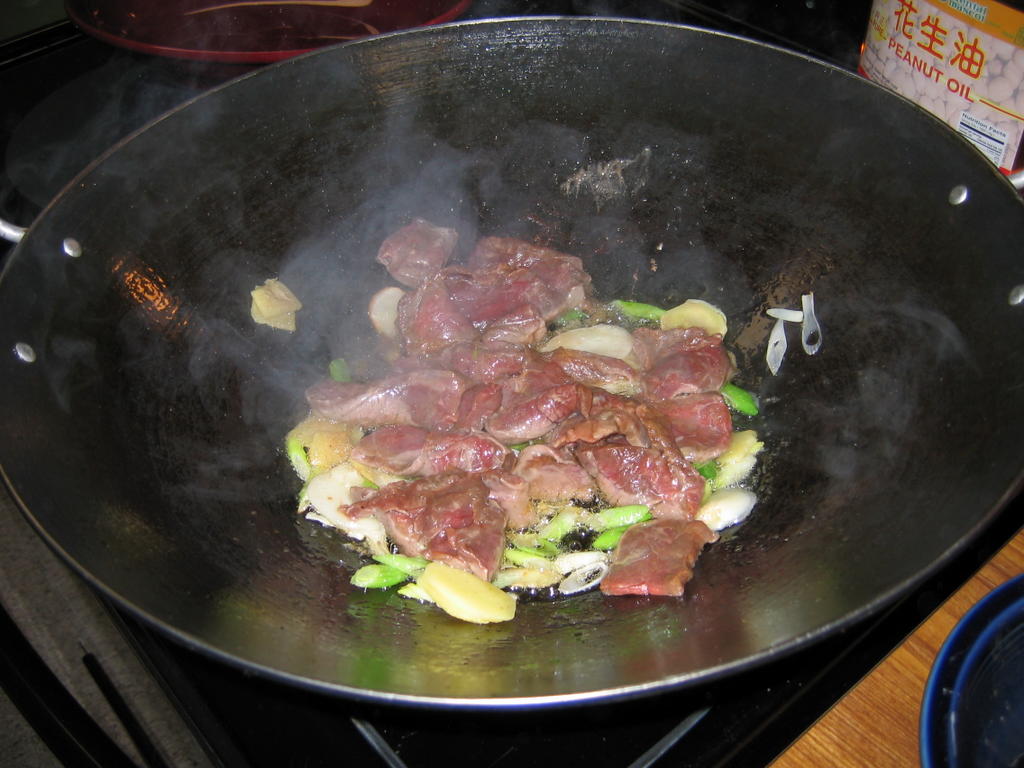 There is, of course, a problem with cooking gai lan–the lower stalks are very thick–about as thick as my thumb, while the leaf stalks and leaves are much thinner. If you cook the stalks long enough, the leaves have turned into droopy goo, and if you cook the leaves just until they have wilted into a velvety richness, the stalks are still on the overly crunchy side.
I solve this problem by cutting the smaller stalks with the leaves off of the larger stalks, and then cut the lower stalks on the bias into bite-sized pieces, as pictured above. Then, as I cook, I put the lower stalk pieces in long before I throw in the thinner leaf stalks. In this way, both parts of the green come out cooked to perfection: the thick stalks are still crunchy, but not tough, and the leaves are meltingly tender.
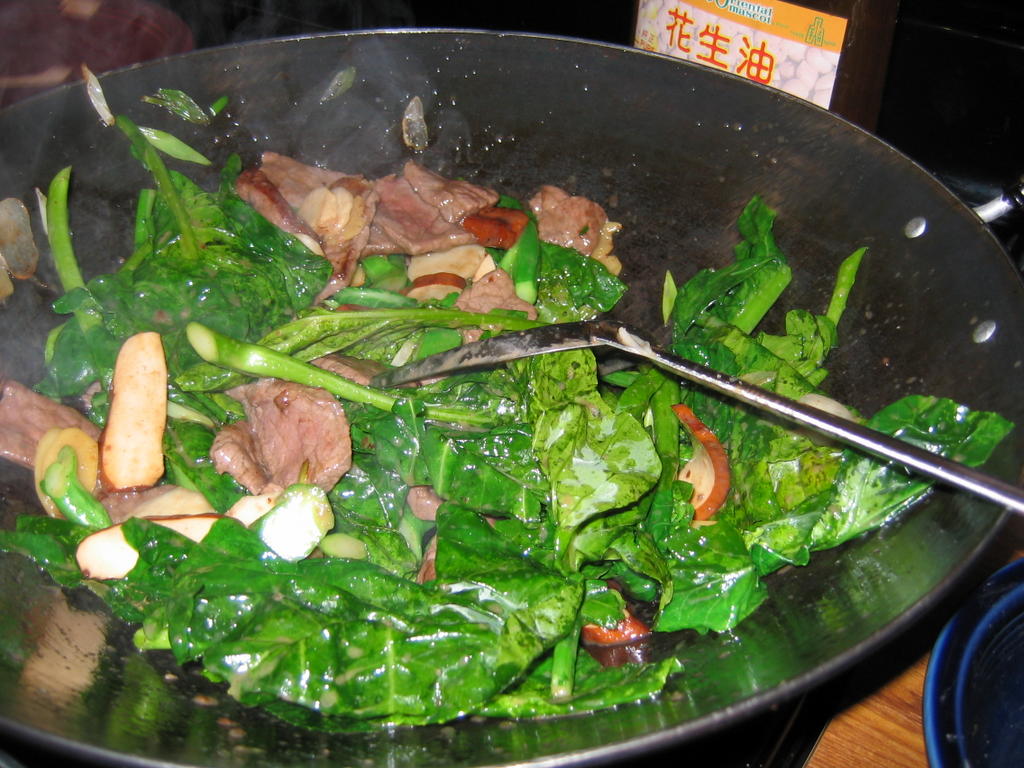 There are many choices of what to add into the dish for textural interest and added nutrition: carrots would add great color contrast and boost the sweetness of the jade-colored stalks. I like to use fresh water chestnuts when I can get them, however–they perform much the same function as carrots would, but have an even more unique texture and flavor. In some restaurants, the chefs add black mushrooms that have been rehydrated in a combination of water and wine–this adds a deep, dark richness to the dish that contrasts with the sharper flavor of the greens, while the unctious texture of the mushrooms contrasts with the tender chew of the beef.
Since I like to make the dish with more gai lan than beef, but I also have a growing girl in the house, I sometimes like to add slices of pressed, sliced tofu to the dish to give it another protein source without adding any fat or an obtrusive flavor. I just put it in right after the beef, and cook them together so that the beef flavor marries with the tofu.
There are probably as many different ways to put this dish together as there are Chinese cooks–the above mentioned ones are just a few thoughts to give people inspirations. The recipe I give is not definitive–it is the one that my family and I like, and is cobbled together from various sources–mostly, from my remembrances of the way in which the dish is cooked in my two favorite Chinese restaurants ever. I probably will use some fermented black beans the next time I cook it, and some onion slices instead of scallions, but until then, I am satisfied with this way of cooking one of the most delicious greens of the early autumn season.
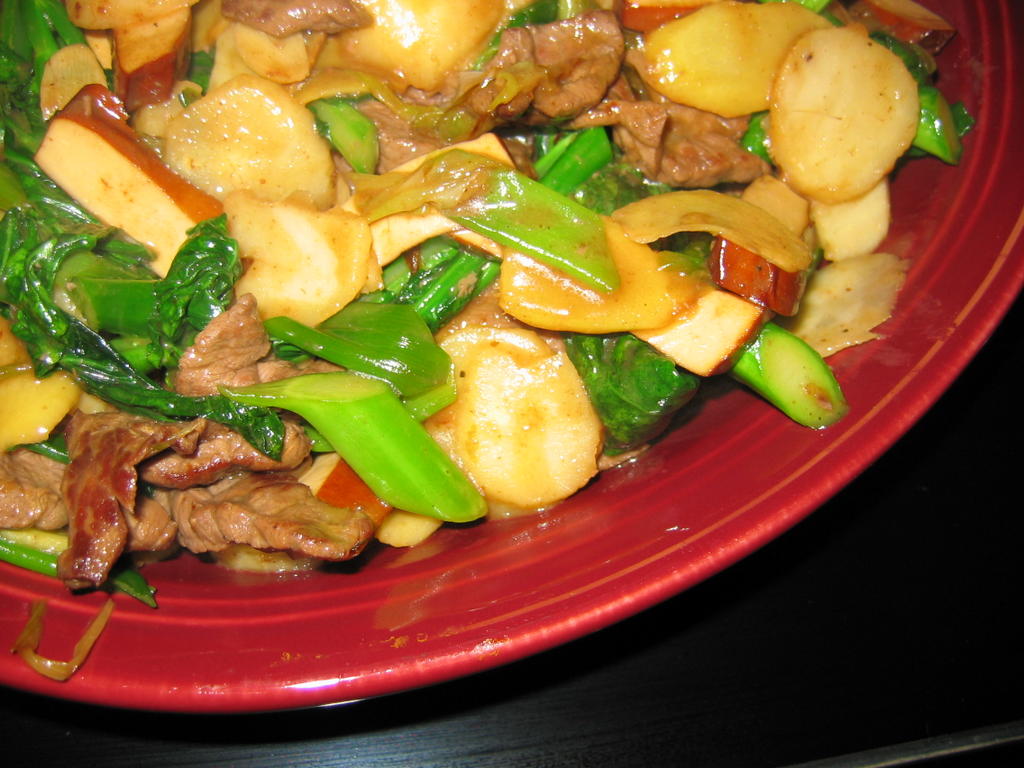 Gai Lan with Beef
Ingredients:
3/4 pound tender, lean beef steak, like top sirloin, cut against the grain into 1″X2″ strips, 1/4″ thick
1/4 teaspoon freshly ground black pepper (optional)
1 teaspoon light soy sauce
2 tablespoon Shao Hsing wine or dry sherry
2 tablespoons cornstarch
3 tablespoons peanut or canola oil
2 cloves garlic, peeled and sliced thinly
3 scallions (white and light green parts) sliced thinly on the bias
1 1/2″ cube fresh ginger, peeled and sliced thinly
3 ounces spiced dry tofu, cut into thin slices about the same size as the beef
1 1/2 pounds gai lan, bottoms of stalks trimmed off, thick stalks cut into bite sized pieces (leave thin stalks and leaves whole, and reserve)
on the bias
1/2 teaspoon-1 teaspoon sugar (optional)
5 fresh water chestnuts, peeled and sliced thinly (optional)
3 scallion tops, cut on the bias into 1″ lengths
the leaves and thin stalks of the gai lan
1/4 cup chicken broth
1 teaspoon soy sauce
2 tablespoons oyster sauce
1/4 teaspoon sesame oil
Method:
Mix together beef, pepper, soy sauce, wine and cornstarch, and allow to marinate at least twenty minutes–I like to do this while I prepare the rest of the ingredients.
Heat wok until it smokes, add oil, and heat until it bubbles. Add garlic, scallions and ginger, and stir fry until quite fragrant–about forty seconds. Add beef, reserving any liquid marinade left in the bowl, and spread into a single layer in the bottom of the wok. Add the tofu on top, and leave the meat undisturbed for about a minute, allowing it to brown well on the bottom, then stir fry briskly.
When most of the red is gone from the beef, add the thick gai lan stalk pieces and stir fry about one minute, sprinkling the sugar over all, if you use it.
Add the water chestnuts and the scallion tops, then the gai lan leaves. Stir to combine, then pour the broth over the leaves, and stir briskly, letting the combination of boiling broth, steam and hot oil begin the process of wilting the leaves. Keep stirring–and be patient–the leaves take about two minutes to fully wilt.
After the leaves have begun wilting, add soy sauce, oyster sauce and any reserved marinade. Stir and fry until the leaves have become tender, but are not completely limp and yucky-looking. Remove from the heat, and stir in the sesame oil.

Categories:
- Admin (rss) (55)
- Blogs and Blogging (rss) (81)
- Book Reviews: Cookbooks (rss) (43)
- Book Reviews: Non-Cookbook Food Books (rss) (38)
- Cats and Cat Blogging (rss) (47)
- Chinese Cooking Lessons (rss) (32)
- Culinary School Stories (rss) (18)
- Dairy Pruducts: Cultured and Barbaric (rss) (4)
- Documentary Filmmaking (rss) (1)
- Essays, Rants and Reflections (rss) (260)
- Fighting Hunger (rss) (12)
- Food and Kids (rss) (45)
- Food in the News (rss) (126)
- Food Media (rss) (98)
- Food Preservation (rss) (18)
- Food Safety (rss) (45)
- Gardening (rss) (30)
- Herbs and Herb Blogging (rss) (20)
- Holidays (rss) (50)
- Kat Blogging (rss) (22)
- Kitchen Science (rss) (36)
- Leftover Makeover (rss) (8)
- Life, the Universe and Everything (rss) (131)
- Local and Sustainable (rss) (227)
- Local Athens Food and Foodies (rss) (42)
- Meatless Mondays (rss) (32)
- Menu For Hope (rss) (5)
- Nutrition, Diet and Health (rss) (84)
- On The Farm (rss) (8)
- Recipes: Almost Vegetarian, Vegetarian and Vegan (rss) (294)
- Recipes: American Regional (rss) (37)
- Recipes: Appalachian Hillbilly (rss) (33)
- Recipes: Bread, Pasta, Grains (rss) (95)
- Recipes: Canning and Preserving (rss) (8)
- Recipes: Chinese (rss) (123)
- Recipes: Comfort Food (rss) (120)
- Recipes: Cookies (rss) (16)
- Recipes: Desserts (rss) (48)
- Recipes: French (rss) (25)
- Recipes: Fruits and Vegetables (rss) (302)
- Recipes: Greek, North African and Middle Eastern (rss) (31)
- Recipes: Indian (rss) (137)
- Recipes: Italian (rss) (42)
- Recipes: Japanese (rss) (7)
- Recipes: Jewish (rss) (4)
- Recipes: Korean (rss) (6)
- Recipes: Meat, Poultry and Fish (rss) (220)
- Recipes: Mexican/Native American/ Latin American/Caribb (rss) (27)
- Recipes: Original (rss) (108)
- Recipes: Thai (rss) (27)
- Recipes: Tofu (rss) (17)
- Recipes: US Regional (rss) (16)
- Recipes: Vietnamese (rss) (8)
- Restaurant Stories (rss) (28)
- Sewing, Quilting, Arts and Crafts (rss) (16)
- Simple Chinese Recipes (rss) (30)
- Slow Food and Heritage Foods (rss) (10)
- Spice Blogging (rss) (44)
- The Chinese Cookbook Project (rss) (14)
- The Chinese Pantry (rss) (39)
- The Documentary (rss) (2)
- The Kitchen Saga (rss) (17)
- The Locavore's Bookshelf (rss) (15)
- The Unsung Adventures of The Culinary Nerd (rss) (6)
- Tools and Toys (rss) (35)
- Uncategorized (rss) (10)
- With a Side of Politics (rss) (48)
Archives:
- August 2012 (9)
- July 2012 (12)
- September 2011 (3)
- August 2011 (7)
- July 2011 (8)
- June 2011 (16)
- May 2011 (17)
- April 2011 (11)
- December 2010 (9)
- November 2010 (5)
- February 2010 (1)
- December 2009 (5)
- November 2009 (7)
- October 2009 (10)
- September 2009 (16)
- August 2009 (14)
- July 2009 (14)
- June 2009 (7)
- May 2009 (17)
- April 2009 (10)
- March 2009 (25)
- February 2009 (13)
- January 2009 (10)
- December 2008 (5)
- November 2008 (5)
- October 2008 (6)
- September 2008 (13)
- August 2008 (8)
- July 2008 (11)
- June 2008 (18)
- May 2008 (13)
- April 2008 (14)
- March 2008 (16)
- February 2008 (17)
- January 2008 (19)
- December 2007 (25)
- November 2007 (18)
- October 2007 (24)
- September 2007 (16)
- August 2007 (15)
- July 2007 (15)
- June 2007 (10)
- May 2007 (14)
- April 2007 (16)
- March 2007 (17)
- February 2007 (20)
- January 2007 (13)
- November 2006 (1)
- October 2006 (8)
- September 2006 (14)
- August 2006 (25)
- July 2006 (30)
- June 2006 (28)
- May 2006 (34)
- April 2006 (29)
- March 2006 (24)
- February 2006 (30)
- January 2006 (38)
- December 2005 (40)
- November 2005 (37)
- October 2005 (32)
- September 2005 (25)
- August 2005 (30)
- July 2005 (28)
- June 2005 (21)
- May 2005 (8)
- April 2005 (22)
- March 2005 (17)
- February 2005 (29)
- January 2005 (10)
Search Site:
Links:
- Lily’s Wai Sek Hong
- 101 Cookbooks
- A cat in the kitchen
- A Veggie Venture
- Accidental Hedonist
- Cha Xiu Bao
- chez pim
- Chocolate & Zucchini
- Chopstick Cinema
- Chowhound.com
- Chubby Hubby
- Cook sister!
- Cooking with Amy
- da*xiang
- Eat Local Challenge
- Eating Liberally
- Ecocentric
- Eggbeater
- Epicurious
- Farmgirl Fare
- Fatfree Vegan
- Foodgoat
- ForkandBottle.com
- Green Olive Tree
- Hooked on Heat
- Jaden’s Steamy Kitchen
- Kalyn’s Kitchen
- Lucullian delights
- Mahanandi
- Matt Bites
- MeatHenge
- mmm-yoso!!!
- New York Times – Dining & Wine
- Pizza Goon
- Rasa Malaysia
- Ruhlman
- Sailu's Kitchen
- Serious Eats
- SF Gate: Food & Dining
- Simply Recipes
- Soul Fusion Kitchen
- Tastespotting
- The Amateur Gourmet
- The Cleaner Plate Club
- The Food Section
- The Grub Report
- thecookscottage
- U.S. Food Policy
- Wandering Chopsticks
- Washington Post Food and Dining
- Wasted Food
Meta:


Powered by WordPress. Graphics by Zak Kramer.
Design update by Daniel Trout.
Entries and comments feeds.