
Cook Local, Eat Global
Bison, Part II
I really should have put this link on my last post, but duh, I was writing quickly and was on my way out the door to do a thousand errands to prepare for the furniture that is coming tomorrow and the refrigerator that is coming tomorrow.
The refrigerator completes the suite of necessary items to make the upstairs teaching kitchen functional–it now has a working sink, stove and by tomorrow, a fridge. I will then be able to really start thinking of opening up for business and start teaching. As I already have students lined up and ready, and neighbors vowing to send more my way….I might should think about pricing and suchlike.
In the meantime, however, back to bison.
Here is a link to the National Bison Association website that gives a clickable map of local producers who are listed with the association, as well as mail order sellers of bison meat. The fact that the ranchers and sellers are members of the association is a good thing–they all have a code of ethics regarding how they raise their animals and there is some oversight on how they treat their customers, so I would feel confident working with any of the folks listed on that site. Of course, I urge you all to buy as locally as you can; it is always best to know your farmer when you can manage it. Not only is it good to know where your meat comes from, farmers and ranchers are right fine folks to talk with, and if you show an ounce of interest in what they do, they will give you a pound of knowledge and friendship in return.
I -was- going to stir fry some bison meat with ramps in a sort of Native American-Appalachian-Chinese fusion and report on it tomorrow night.
However, plans have changed.
Boy, have they changed.
Because not only do I have my daughter’s bedroom furniture coming tomorrow, and a refrigerator, but the in-laws are arriving as well. Yes. In-laws. Whom I absolutely adore, and whom I was looking forward to seeing on Friday when my beloved Zak told me they were coming.
Only, apparently, he is unable to read email. They are coming tomorrow, and leaving on Saturday. Not coming on Friday and leaving on Monday.
Which is fine–just unexpected.
Which means we just spent the entire evening tearing through the house and turning it into a site of controlled chaos rather than just plain old godawful hellish chaos-on-a-stick.
And I still have to touch up my hair.
And Thursday, the new living room furniture is arriving. (Thank God the dining room furniture is being held up by the chairs having disappeared into limbo somewhere, so it won’t be ready until next week. And thankfully, the contractors are still procrastinating and so are not going to descend in droves in the next couple of days to tear the house from stem to stern again. At least, I hope not.)
SO!
Look for a report on the Native-American-Appalachian-Chinese fusion bison dish next week, and hopefully, I will not die of excitement overload before then.
And between now and then, I will write other neat stuff. I promise.
Wish me luck!
The Skinny on Bison
A long time ago, in a land not so far away, bison ruled the central plains. In great herds they roamed, grazing the prairie grasses in a web of interdependence between plant and mammal. The native tribes hunted them, and from their bodies came food, clothing, shelter, medicine, tools and household items. They were a gift from the Creator to the tribes, they were brothers, and a spirit in the form of White Buffalo Woman came to humanity and gave the sacred pipe ceremony as a means of communication between the Creator and humans.
And then, they were wiped out. Exterminated. Killed by white hunters with repeating rifles. Whole herds were felled, like clearcut forests, and the thunder of the plains went silent, and the grasses were plowed under and paved over and all was lost forever.
Or was it?
Bison were driven to the brink of extinction, but they have come back, helped along not only by environmentalists, but farmers.
Farmers who raise them, not as tame cattle, but as wild animals, and who sell thier meat, hides and horns to a steadily growing market.
Current estimates place the number of American Bison in North America between 270,000 and 350,000–a far cry from the pathetic 1,500 individuals left by the late 19th century. Most of these animals live on private ranches, according to the National Bison Association, though there are quite a few in public herds on protected ranges, such as Yellowstone National Park, and on Native American held lands.
Why are farmers and ranchers raising wild bison?
Mostly for their meat, though there is a steady market for the hide, hooves and horns as well.
Bison meat is nutrient dense and surprisingly low in fat. In each 100 gram serving of bison meat there is 2.74 grams of fat, as compared to the 10.15 grams of fat in the same sized serving of commercial beef or the 7.41 grams of fat in the equivalent serving of skinless chicken meat. It is high in protein and iron (which accounts for its darker color) and essential fatty acids. It is lower in cholesterol than beef or pork.
It also happens to taste quite good. Bison are range fed on native grasses and other browse plants, with hay supplements in the winter, and this leads to a naturally sweet flavor which is similar to beef, but slightly more complex. The texture of the meat is very fine and tender, provided it is cooked carefully.
There are two ways to cook bison meat–low and slow or hot and fast. Anything in the middle will gain you a very dry, tough, unpalatable cut of meat.
The lack of fat marbling in the meat means that it is best cooked moist heat, slowly. However, if you have a steak and want to grill it–it can be done (we just did it last night)– provided that you cook it quickly and are careful not to overcook it. This means that you must know how to judge when a steak is done to your liking, or you can keep a good eye on the clock. I would suggest actually cooking a little less long than you would an equivalent beef steak–for example, the ribeyes we cooked last night were done after barely two minutes per side, when we cook beef ribeyes for at least three or four minutes per side.
I season bison similarly to beef; the seasonings I use for venison are too strong for bison, which, to my palate, does not have a characteristic “gamey” flavor at all. Last night, I simply rubbed the steaks with ground chipotle, salt, black pepper, dried thyme, a bit of cumin and garlic, and they turned out beautifully. The crust seared nicely and the interior was tender and well-flavored with just the rub. Nothing else was needed, though I can see that a bath in a dry sherry marinade would be a nice alternative.
My next mission is to stir fry bison and see what happens.
Maybe I will use ramps with it, too. Hrm…that could be very good.
Green Gold

The ramps are up, and my tastebuds are happy!
Spring is definitely here!
On Saturday, at the farmer’s market, I came upon a nice young couple selling little bundles of freshly cut ramp greens as well as pesto made from ramps. Of course, I had to buy some, even though I knew I would be going out to our old house the next day to divide the perennials and bring some of them back to the new house.
I figured that if the ramps were up in Athens county, they likely were up in Licking as well; they are cold weather beasties, and the fact that Licking is a good bit north would play in their favor, rather than against them.

Detail of ramp leaves showing the brilliant spring green color and silken texture.
I was right. On Sunday, the first thing I did when I got out of the car was peer over the edge of the ravine in search of clumps of brilliant green lance-shaped leaves. I was not disappointed; clumps of green gold waited down in the bottomlands near the creek, half buried in last fall’s leaf litter, thier violet and white roots cooled in the rich woodland soil.
So, I capered off with Zak to dig up irises, coral bells, foxglove, primroses, violets, bugleweed, forget me nots and foamflower from our huge perennial beds. (I am so going to miss that garden, but that is another story entirely.) But in the back of my mind, I kept giggling, “The ramps are up.”
I ended up not gathering as many as I would have liked; we spent a longer amount of time digging up a huge amount of flower plants, and so I ended up just dashing down and carefully digging up a single clump. Which I promptly, upon dashing out of the car at the new house an hour and a half later, plunked down into the cool clay soil of the tiny strip of woods that borders our new house, in an attempt to try and establish them here.
I woke up this morning and checked on them. They are notoriously hard to transplant, but thus far, the leaves still stand, verdant and upright.
I still have many more plants to transplant today; hence the short post.
Last night, we had planned to cook on the grill, but we took too long with our digging up and transplanting mission; we were finishing our quick planting of the more tender plants last night in the dark and by the fitful light of the landscaping lamps. By that time, I realized that I had no idea where the grill brush was for the grill, and we were both too tired to go digging around in the huge number of boxes in the basement in the hopes of finding it.
So, I came up with plan number two:
Pasta.
I have been on a pasta kick, as you might well have guessed from my previous post about puttanesca. It is probably because it is springtime and I always head toward lighter fair as the days grow warmer. Besides, it is quick, and what we needed last night was something quick and simple, because we were both famished and tired from digging and planting.
So, I dug about in my freezer and came up with a treasure: the last batch of pesto from the late fall harvest of basil.
Every year, I plant a huge amount of basil in my yard and on my deck. That is because Zak and I adore pesto. He first had it in Italy back in the late 1980’s, when he traveled there in college; I had it first when I read the recipe in Paula Wolfert’s book, Mediterranean Cooking, and had to make it, because it sounded so delicious. Unlike my forays into Whorehouse Spaghetti (maybe I should give the recipe for that here someday?) I stuck pretty true to classical Genovese pesto, though I often left out the pine nuts because I couldn’t always find them, and often the cheese was of a lesser quality because I was poor. But the basil and the garlic, those were always there in copious amounts.
So, each summer, I have planted enough basil to make one batch of pesto a week and one half batch for the freezer. At the end of the season, just before the first frosts of fall, I take up all the remaining basil plants and make a final batch which I divide up and put in the freezer. The bag I pulled out last night was from that last batch, and though it was frozen solid, its emerald color whispered sensual promises as I thawed it gently in warm water.
I took out a chicken breast from my stash, and cut it into small strips, then thinly sliced two shallots. I cut a small handful of ramp leaves into chiffonade, thrilling to the assault of its assertive fragrance as it permeated the air.
I set some olive oil on to heat in a skillet and some water to boil. I made up a simple salad of fresh greens from the farmer’s market, and tossed it with some sherry vinegar based dressing I made last week, and then tossed the shallots in to cook. They cooked quickly, and I sprinkled them with red pepper flakes, then after dusting the chicken pieces with flour, tossed them in. I let them brown well, then deglazed the pan with sherry (I’d have used marsala if I’d had it, but I didn’t so I improvised–and to be honest, it wasn’t sherry I used, either. It was Shao Hsing wine, but no one I know can tell the difference, really), and let it all cook down until a deep mahogany colored sauce clung to the chicken. I then sprinkled it with half the chiffonade of ramps and let them wilt slightly.
Meanwhile I cooked the pasta and when it was done, I tossed it with half of the pesto. I put that into bowls, topped it with the chicken bits and sprinkled it with the lovely ramp chiffonade.
And voila–it was done. Spring and summer on a plate, otherwise known as Green Gold.
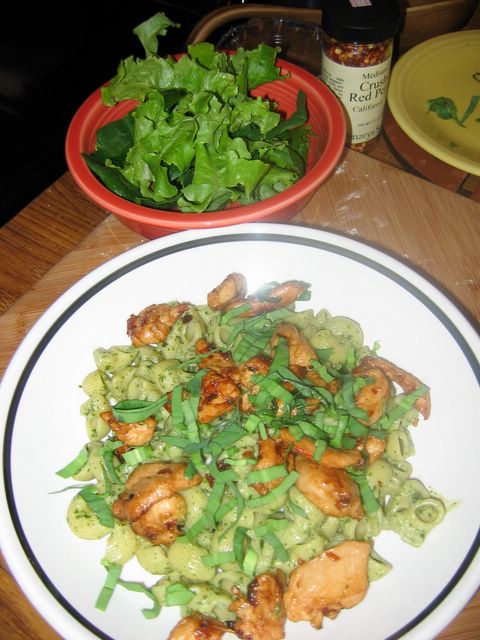
The finished dish; summer pesto from the freezer tossed with pasta, topped with sauteed chicken chunks with a chiffonade of ramps as a garnish.
Puttanesca: Fast Food for Fast Women
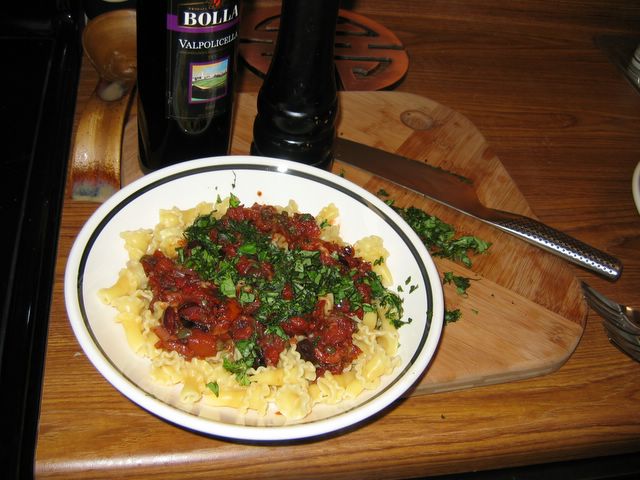
The finished dish of Puttanesca; it is best if you toss the pasta with the sauce in the pan, but I didn’t remember that last night.
Puttanesca is a classic Neapolitan pasta sauce based on olives, tomatoes, capers and anchovies. The name comes from the Italian, “puttana,” which means, “whore,” and there are several different stories as to how and why the dish came by such a salacious name.
According to Paula Wolfert in her 1978 classic Mediterranean Cooking, one theory as to the origin of the name, “puttanesca” comes from the fact that the prostitutes in Naples would cook this pasta sauce as a “quick and lusty fortification,” (yes, that is a direct quote which is seared upon my memory) which also enticed customers off of the street with the seductive scent of olives, garlic and anchovies cooking. Another theory she proposes is that it is the perfect dish for a respectable married woman who is engaged in an illicit affair between the hours of five and seven in the evening. She can put the sauce ingredients together to marinate, then frolic with her lover for a few hours before running off to heat up the sauce and serve it up to her hungry and cuckholded husband.
I have also heard that the reason it is named after prostitutes is that the ingredients are ones which are staple, and which are always available canned or preserved in some way. In the days when the brothels of Naples were state-run, there were only certain days and hours when the prostitutes were allowed to go out shopping for foodstuffs, so as to keep them from offending the respectable women in the marketplace. At these restricted hours, most of the fresh foods were gone, so the prostitutes became adept at making delicious sauces from those few items that were left in the markets.
I always was a bit skeptical of the idea that a whorehouse would need to entice customers with the smell of cooking, but now that I am a bit older, and I have had a bit more experience, and after taking into account we are talking about Italians here–folks who are all about food, sex, love and passion–I have rethought my position on the matter. There is indeed something distinctly seductive about puttanesca, something that fairly oozes sensuality, and makes one think naughty thoughts while cooking or eating it. The fragrance of it is lascivious and induces hunger on many levels, and the deep crimson sauce is inviting and velvety on the tongue.
Or, at least, it works that way with me.
Puttanesca first came to my attention when I was reading the afformentioned Paula Wolfert’s Mediterranean Cooking, which was one of the first cookbooks I ever bought for myself, back when it came out in 1977. In 1977, I was in seventh grade, and I was first learning to cook, and was fascinated with Italian and Greek foods. The book is divided up not by courses or types of dish, but rather by main ingredient. In the olive section, I came upon puttanesca, and just reading her description of it knocked me out. I had a sudden, intense longing for it, and had to immediately give the recipe a try.
Unfortunately, due to my youthful ignorance and lack of money, the black olives I used were those giant, shiny flavorless canned critters that garnish the Taco Supreme at Taco Bell. The capers were about as flavorful and tender as BB’s, and the anchovies offended everyone in the household.
But the idea of the pasta sauce still appealed to me, so I kept trying to make it. I stopped telling people that the anchovies were in it, thus avoiding offense, and eventually grew enough sense to use better black olives.
However, the capers were ditched in favor of green olives, and mushrooms were added. Along with chile flakes, red sweet peppers, and eventually, spicy Italian sausage.
This concoction I called “Whorehouse Spaghetti,” and served it at the request of friends and family alike. It barely resembled a classic puttanesca anymore, and I figure that Paula Wolfert or Marcella Hazan would have my hide for using that name–hence the roughly translated moniker.
By whatever name, and from whatever inspiration, the sauce was a popular one, and I proudly served it a few years back to the members of a traveling Celtic rock band whom I hosted to dinner at my bookstore when they came through town. It was good enough to impress the Italian American member of the band, who asked for my recipe, and asked if he could serve it in his restaurant on the West Coast.
Of course, I said yes.
(I am apparently still remembered by the band as “The Whorehouse Spaghetti Lady in Ohio,” which is a good thing, I suppose.)
However, as the years went on, I began to long for a simpler flavor and began paring away ingredients until my Whorehouse Spaghetti began to show its roots. It devolved back to its more primal form of puttanesca. I still make Whorehouse Spaghetti, especially in the colder months, but as the sun turns warmer, I long for lighter fare and find myself reaching for fewer ingredients.
In either incarnation, whether it is my own bastardized version or the Neapolitan original, Puttanesca is a full-bodied, bold sauce, vividly colored and lavishly perfumed.
Now that I think of it, that may be why it is named for prostitutes–it is unsubtle, vivacious, confrontational and alluring.
A wicked sauce for wicked women.
Or at least, women who are wicked at heart.
Puttanesca
Ingredients:
3-4 tablespoons olive oil
1 small onion, thinly sliced
4-5 cloves fresh garlic, minced
3 anchovy fillets, chopped finely or 1 1/2 teaspoons anchovy paste
1/2 pound pitted Kalamata olives, drained and chopped roughly
3 tablespoons capers, drained of brine and rinsed thoroughly, then drained again
1 teaspoon or to taste red chile flakes (optional)
generous lashings of freshly ground black pepper
1/2 roasted red sweet pepper, diced finely
1/4 cup dry red Italian wine
1 14 ounce can diced tomatoes with their juice (I use Muir Glen Fire Roasted Organic)
1 tablespoon tomato paste
approx. 1/4-1/2 cup pasta cooking water
handful of fresh basil leaves, minced
Method:
Heat olive oil on medium heat in a heavy bottomed skillet or pan. Add onion (I use shallots, instead, sometimes, because that is what I have–they work fine) and cook until softened and golden, stirring now and then. Add garlic and anchovy and continue cooking until garlic turns golden, the onions brown slighty and the anchovy fillets disintegrate. (If you are using anchovy paste, do not add at this point–add it after the olives and capers have cooked for about a minute.)
Add olives, capers, chile flakes and black pepper, and continue cooking until very fragrant, about three minutes. Add roasted red peppers and continue cooking until the roasted pepper darkens slightly and starts to fall apart. Add wine and allow alcohol to boil off. (Lean over and breathe deeply–it smells heavenly at this point.)

The onion, garlic, olives, capers and chile flakes cooking.
Add tomatoes and their juice after the alcohol has boiled away and turn heat down slightly and allow to cook until it thickens up and most of the liquid is boiled away. Add tomato paste and turn heat down to the lowest setting, just to keep it warm.
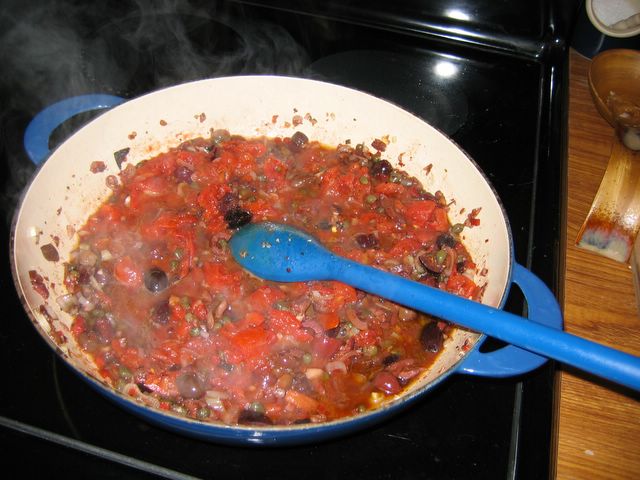
Be sure and reduce the sauce, removing most of the water from the dish. It should be a thick, rich sauce with a texture like velvet; the tomatoes should break down almost completely. Here is what the sauce looks like just after the tomatoes are added and it is still quite thin and overly chunky.
Start pasta boiling. When the starch is released, add a tiny bit of the cooking water to the sauce, and stir, rehydrating it. Add as much water as is needed to make the sauce fairly fluid, yet still thick and chunky, boiling away extra water if you add too much. (I learned this trick from an Italian chef in culinary school–he said that the starch in the pasta cooking water made the texture of the sauce smoother than just plain water.)
Drain pasta when it is al dente, and toss with the sauce in the pan, if you are serving all of it right away. If you made extra sauce, you can also serve it over the pasta in bowls, but it is best when it is all stirred together in the sauce pan over low heat. (If you made extra to put in the fridge or freezer for later, you can always remove the extra and pack it up, then put the pasta in the pan–too bad I didn’t think about this last night when we were eating it.)
Add basil to pan, and toss to combine, then serve in deep bowls.
Notes:
Do not add salt. Not under any circumstances. None, nada, zip. You have plenty of salt in the brined capers and olives and in the anchovy. You need not add any more. Red chile is great, and black pepper is actively encouraged but no salt.
You can add good green olives to this dish, without harming it in any way. But don’t add those overly brined, pimento-stuffed martini olive things. They just taste saltier and add nothing good. Find yourself a nice fruity green olive packed in olive oil and pit them and add those. Even Paula Wolfert likes the sauce better that way.
This sauce cooks quickly. Don’t think you can make it better by cooking it longer. You can’t. In fact, you will lose a lot of the fragrance if you cook it longer.
Only use fresh tomatoes if you can get home grown plum or romano tomatoes, ripened on the vine. Otherwise, use canned, which are better than those godawful plastic crispy red things in the grocery store masquerading as fresh tomatoes. Remember, the fast ladies of the night in Naples didn’t use fresh tomatoes, so you don’t have to either. This recipe is all about flavor and speed, and waiting for watery, flavorless “fresh” tomatoes to cook down into something resembling a sauce is not going to do anything good.
You are not supposed to have cheese with this. If you do have cheese, Marcella Hazan will probably appear at your shoulder, and smack you in the head with a wooden spoon, or some other terrible fate will befall you.
On the other hand, if you like cheese, as I do, then just make sure Marcella is not looking and sneak some, freshly grated real Parmesan if you please, and don’t tell her I told you that you could do that. I would like to keep my skull intact, thank you.
Finally, this is supposed to be served with spaghetti. The dish is supposed to be Spaghetti alla Puttanesca. However, Zak is morally opposed to spaghetti on the religious grounds that it is messy and messy things make messes. So, I don’t make it with spaghetti. I make it with neat shaped pasta like the flower-shaped campanelli, which has lots of flutes and folds that capture the chunky sauce bits and hold them so they all go in the mouth together.
But don’t tell Marcella I do that, either.
Eat Drink Man Woman
I suppose it should come as no surprise that I adore Ang Lee’s 1994 film, Eat Drink Man Woman.
If you like Chinese cooking and food, or if you are an aspiring Chinese cook, the opening sequence alone is worth the price of the DVD. Lee throws down and uses food as a metaphor for love; it seduces, entices, teases and teaches the audience. It is an implicit and explicit means by which the characters in the film–an extraordinary Taiwanese chef, and his three daughters–communicate with each other. It is the glue that holds the family together, and is the means of torture and salvation.
I just watched it again tonight with Zak, and it was, once again, a revelation. The opening scene involves the chef, Chu Sifu, cooking an elaborate Sunday supper for his three adult daughters, all of whom still live at home. The first time we watched the film, probably ten years ago in Athens, I remember being entranced by the very intimate look into the mysterious seeming processes of cooking a traditional Chinese festive meal. Then, while I watched, I had very little clue what was happening before my eyes, though I could guess at what a few of the procedures pertained to, such as inflating the duck’s skin for a traditional Peking Duck.
Watching it tonight, not only could I identify ingredients and dishes as they were being cooked, I could describe techniques as they unfolded, and had actually tasted many of the flavors that were paraded on screen. Indeed, many of the techniques had been performed by my own hands, and I had instructed others in how to perform them–passing on the knowledge from hand to hand, as it were.
What had once been strange, is now familiar.
Flavors that once had been exotic and new are now as comforting as an old blanket.
Ang Lee has the gift of conveying a great deal of information and emotion with images, and as I watched his film tonight, I realized that it was all about love, and perhaps one of the reasons I understood and liked the film so much from the first time I saw it was because to me, food is love.
When we cook for each other, we love each other. Food is a visual, physical representation of my love. When I offer someone something to eat, I am giving them a piece of myself, my soul, my love, for them to take into themselves. When they eat and are satisfied, I am made happy.
My very first student is an old friend who grew up here in Athens. I decided to teach him and use him as a guinea pig to see if I was ready to teach, because when we met, he never ate anything but instant food from packages and boxes. Food was nothing to him but fuel to keep his body going, and his body was nothing much more than a vehicle to get his mind around. He was very much a man who lived in his own head, and little else that had to do with the body or with senses mattered to him. Over the years, he learned to get along with his body better, and he learned to experience food as something to be enjoyed, but still, his focus was very mental.
When he asked to learn to cook, I took him on, because, frankly, if I could teach a man whose main living space was his own mind to cook Chinese food and enjoy it, I could teach anyone.
So, I set myself a difficult task, and the two of us together, learned that he could learn, and I could teach. I taught him how to buy a wok, and how to pick out cleavers, and care for them, and then how to shop for ingredients. Then, I taught him how to cut–a very important lesson when it comes to stir frying, and Chinese cookery in general.
We worked together one evening a week, and he progressed quickly.
I was very proud of him, and I took quiet joy in his learning. Once he had practice with the cleaver, his hands could move with deft assurance, and his face would relax as he cut vegetables, and a rhythm developed in his gestures. He learned to move with the fluid grace that comes when body, mind and spirit work together.
So, we went back to Athens, my student, his wife and I, and I was telling our friends how good he had become at cooking with me. I offered for us to cook dinner for a few of the folks, so we could show them how well the lessons were coming.
It started as a simple affair of dinner for six. Nothing elaborate. But then six became eight became ten became twelve became sixteen or eighteen, I forget which. As the guest list swelled, I shrugged and thought nothing of it; having catered events for over one hundred while cooking essentially by myself before, I was not concerned with dinner for a mere handful of guests. We had two woks, three sets of bamboo steamers, four cleavers, the use of a large kitchen in a large house, and a well-stocked Asian grocery store nearby. What was there to fear?
We shopped, and while at the market, bought a fourth steamer set. The menu was to be hot and sour soup, steamed pork dumplings, vegetarian and traditional spring rolls and cold spicy Hunan noodles. When we went to the grocery store, I saw that there was no ground pork and was told that they did not grind it there because of some obscure (possibly nonexistent) health code violation. My friend and student was worried, but I was not–I simply bought pork loin and shoulder and told him I would mince it by hand with two cleavers, and it was a good opportunity for him to see that it can be done without a grinder or food processor.
We went to our friends’ home and started cooking. There were, of course, crises. His wife, meaning to help, slipped with the cleaver, and cut open her finger, and was removed from the kitchen to be ministered to by someone with medical training. I made a huge amount of noise mincing the pork by hand on a heavy cutting board, using two cleavers in a strong rhythm that made some guests come in and stare in fascination. My student made the hot and sour soup.
Then, I prepared the filling for the dumplings, and he cooked the fillings for the spring rolls.
We served the soup first. I went out into the living room to announce that the soup was ready, and the crowd lined up and my friend, with shaking hands, ladled the soup into bowls as they filed by. His eyes were wide, and I looked closely and could see that he was utterly terrified; overwhelmed with fear, he plastered a smile on his face and moved like an automaton as he filled the bowls. I went to him, put a hand on his shoulder, and whispered in his ear, “All is well, you are doing fine, don’t be afraid.”
When they were all served and they sat down on the floor, cupping bowls in one hand, and sipping from spoons from the other, I filled a bowl and put it into his hands, but he ignored it. Instead, I saw that he was staring at the huge group, huddled around their bowls of the soup he had just made and given to them.
Silence had fallen over the formerly loud and raucous group. One by one, they tasted, and smiles broke out over their faces. The smiles were followed by accolades and praise, then more noisy sipping and slurping.
I turned to my friend, my first student, and found him looking at me with a wide and profound smile. His eyes shone and he whispered, “Now, I understand why you do this.”
I raised one eyebrow and let him continue. “Why you cook for everyone all the time and why you hardly eat yourself. You don’t need to eat, do you? Their love, their gratitude, that is enough for you to eat.”
I smiled. He truly understood.
“Love is my food,” I answered. “And food is my love.”
He sipped his soup, then followed me back into the kitchen where we filled and pleated hundreds of tiny dumplings with ginger-fragrant pork in silence, satisfied. Behind us, vats of water heated, and we listened to the clink of spoon on bowl, and the quiet murmur of our friends eating in the other room.

Categories:
- Admin (rss) (55)
- Blogs and Blogging (rss) (81)
- Book Reviews: Cookbooks (rss) (43)
- Book Reviews: Non-Cookbook Food Books (rss) (38)
- Cats and Cat Blogging (rss) (47)
- Chinese Cooking Lessons (rss) (32)
- Culinary School Stories (rss) (18)
- Dairy Pruducts: Cultured and Barbaric (rss) (4)
- Documentary Filmmaking (rss) (1)
- Essays, Rants and Reflections (rss) (260)
- Fighting Hunger (rss) (12)
- Food and Kids (rss) (45)
- Food in the News (rss) (126)
- Food Media (rss) (98)
- Food Preservation (rss) (18)
- Food Safety (rss) (45)
- Gardening (rss) (30)
- Herbs and Herb Blogging (rss) (20)
- Holidays (rss) (50)
- Kat Blogging (rss) (22)
- Kitchen Science (rss) (36)
- Leftover Makeover (rss) (8)
- Life, the Universe and Everything (rss) (131)
- Local and Sustainable (rss) (227)
- Local Athens Food and Foodies (rss) (42)
- Meatless Mondays (rss) (32)
- Menu For Hope (rss) (5)
- Nutrition, Diet and Health (rss) (84)
- On The Farm (rss) (8)
- Recipes: Almost Vegetarian, Vegetarian and Vegan (rss) (294)
- Recipes: American Regional (rss) (37)
- Recipes: Appalachian Hillbilly (rss) (33)
- Recipes: Bread, Pasta, Grains (rss) (95)
- Recipes: Canning and Preserving (rss) (8)
- Recipes: Chinese (rss) (123)
- Recipes: Comfort Food (rss) (120)
- Recipes: Cookies (rss) (16)
- Recipes: Desserts (rss) (48)
- Recipes: French (rss) (25)
- Recipes: Fruits and Vegetables (rss) (302)
- Recipes: Greek, North African and Middle Eastern (rss) (31)
- Recipes: Indian (rss) (137)
- Recipes: Italian (rss) (42)
- Recipes: Japanese (rss) (7)
- Recipes: Jewish (rss) (4)
- Recipes: Korean (rss) (6)
- Recipes: Meat, Poultry and Fish (rss) (220)
- Recipes: Mexican/Native American/ Latin American/Caribb (rss) (27)
- Recipes: Original (rss) (108)
- Recipes: Thai (rss) (27)
- Recipes: Tofu (rss) (17)
- Recipes: US Regional (rss) (16)
- Recipes: Vietnamese (rss) (8)
- Restaurant Stories (rss) (28)
- Sewing, Quilting, Arts and Crafts (rss) (16)
- Simple Chinese Recipes (rss) (30)
- Slow Food and Heritage Foods (rss) (10)
- Spice Blogging (rss) (44)
- The Chinese Cookbook Project (rss) (14)
- The Chinese Pantry (rss) (39)
- The Documentary (rss) (2)
- The Kitchen Saga (rss) (17)
- The Locavore's Bookshelf (rss) (15)
- The Unsung Adventures of The Culinary Nerd (rss) (6)
- Tools and Toys (rss) (35)
- Uncategorized (rss) (10)
- With a Side of Politics (rss) (48)
Archives:
- August 2012 (9)
- July 2012 (12)
- September 2011 (3)
- August 2011 (7)
- July 2011 (8)
- June 2011 (16)
- May 2011 (17)
- April 2011 (11)
- December 2010 (9)
- November 2010 (5)
- February 2010 (1)
- December 2009 (5)
- November 2009 (7)
- October 2009 (10)
- September 2009 (16)
- August 2009 (14)
- July 2009 (14)
- June 2009 (7)
- May 2009 (17)
- April 2009 (10)
- March 2009 (25)
- February 2009 (13)
- January 2009 (10)
- December 2008 (5)
- November 2008 (5)
- October 2008 (6)
- September 2008 (13)
- August 2008 (8)
- July 2008 (11)
- June 2008 (18)
- May 2008 (13)
- April 2008 (14)
- March 2008 (16)
- February 2008 (17)
- January 2008 (19)
- December 2007 (25)
- November 2007 (18)
- October 2007 (24)
- September 2007 (16)
- August 2007 (15)
- July 2007 (15)
- June 2007 (10)
- May 2007 (14)
- April 2007 (16)
- March 2007 (17)
- February 2007 (20)
- January 2007 (13)
- November 2006 (1)
- October 2006 (8)
- September 2006 (14)
- August 2006 (25)
- July 2006 (30)
- June 2006 (28)
- May 2006 (34)
- April 2006 (29)
- March 2006 (24)
- February 2006 (30)
- January 2006 (38)
- December 2005 (40)
- November 2005 (37)
- October 2005 (32)
- September 2005 (25)
- August 2005 (30)
- July 2005 (28)
- June 2005 (21)
- May 2005 (8)
- April 2005 (22)
- March 2005 (17)
- February 2005 (29)
- January 2005 (10)
Search Site:
Links:
- Lily’s Wai Sek Hong
- 101 Cookbooks
- A cat in the kitchen
- A Veggie Venture
- Accidental Hedonist
- Cha Xiu Bao
- chez pim
- Chocolate & Zucchini
- Chopstick Cinema
- Chowhound.com
- Chubby Hubby
- Cook sister!
- Cooking with Amy
- da*xiang
- Eat Local Challenge
- Eating Liberally
- Ecocentric
- Eggbeater
- Epicurious
- Farmgirl Fare
- Fatfree Vegan
- Foodgoat
- ForkandBottle.com
- Green Olive Tree
- Hooked on Heat
- Jaden’s Steamy Kitchen
- Kalyn’s Kitchen
- Lucullian delights
- Mahanandi
- Matt Bites
- MeatHenge
- mmm-yoso!!!
- New York Times – Dining & Wine
- Pizza Goon
- Rasa Malaysia
- Ruhlman
- Sailu's Kitchen
- Serious Eats
- SF Gate: Food & Dining
- Simply Recipes
- Soul Fusion Kitchen
- Tastespotting
- The Amateur Gourmet
- The Cleaner Plate Club
- The Food Section
- The Grub Report
- thecookscottage
- U.S. Food Policy
- Wandering Chopsticks
- Washington Post Food and Dining
- Wasted Food
Meta:


Powered by WordPress. Graphics by Zak Kramer.
Design update by Daniel Trout.
Entries and comments feeds.