
Cook Local, Eat Global
Boxes, Boxes Everywhere
And so, it is like this, you see.
In two weeks, we are moving. And before we move, we have to do stuff like pack, distasteful though it is. And we have to do about eighty-eleven other things, like order our new sofa and chairs for the living room (the current couch is too large to fit in any of the rooms of the new house) and see if we can find enough boxes to pack our bazillions of books in, and clean up our continual messes, and go out and get enough cat carriers for all of our critters.
While, of course, keeping food on the table and not going insane.
We’re doing great with the food on the table–Zak has been baking bread (and has finally taken up keeping notes on what he does with each loaf so he can remember and replicate the process–I am quite proud of him) and I have, as you know, making pot after pot of nurturing soups.
As for not going insane, this blog helps with that. I get naturally twitchy if I have to cook in a jumbled, chaotic kitchen day after day. I always was naturally a reasonably orderly cook, but having the mantra of mise en place beaten into my head in culinary school has made me even more neurotically inclined toward a clealiness in the kitchen than before. And our kitchen, right now, is not anything resembling orderly.
Most of my pots and pans are packed away. My baking things, too. It is coming onto time to start thinking of packing my huge cabinet of spices away, leaving only a skeleton crew behind–chiles, Sichuan peppercorns, black pepper, salt, thyme, rosemary and sage. I think, I hope, I can pack the rest. Well, maybe not. What about the holy trinity of Indian food: cumin, coriander and cardamom?
And the rice. I should pack it all away except for the jasmine. And maybe the basmati.
All of my cookbooks are in boxes, now, though my last box of Chinese cookbooks is left open. I have a couple of them which I am not finished reading yet. For Zak, I have out two bread baking books, and I found a dessert recipe book hiding downstairs last night, and I have some tomes of food and women’s history that are lying about because I am still reading them, snatching free time from the jaws of the box monster.
My cookbooks are my friends. They are comforting, lined up neatly in their shelves, and sometimes, I am apt to just pull one out to read a few pages. I do that especially with Julia Child; her voice comes through her writing and is extremely comforting. Madeline Kamman’s books do that to me, too. “And now, we will have a reading from the gospel of Saint Julia, 1:21–“Never apologize.”
However, Saint Julia is stuck in a box somewhere in the vicinity of my living room, taped up in the dark with her compatriots, and her voice is silenced, except in memory.
At any rate, if my updates cease to be as regular at some point in the next few weeks, which is likely, you will know why.
I am living in land of boxes. Boxes, boxes, everywhere, and no vodka to drink.
Until I have to stop writing, though, I do have a few good entries lined up.
Stay tuned.
Split Pea Soup: It’s Ugly
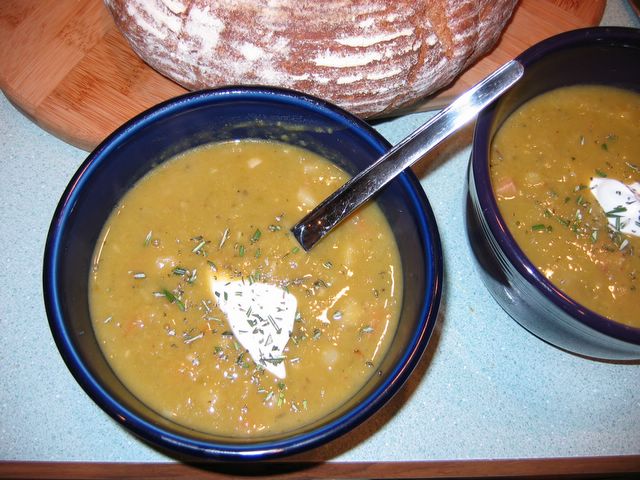
There is no way around it: split pea soup is frightfully unattractive. However, it tastes divine, and is a frugal dish that anyone can make.
But it sure does taste good.
It seems I am making a lot of soups recently. I think it started with Zak and I having the flu. This fomented the making of the Shiksa Ball Soup, which has unnatural curative powers. Then, I had a craving for Hot and Sour Soup, and I had the ingredients, so whoop! What do you know, I made some of that, and ate it for about four days. And then, last night, Zak was in a bread making mood again, so I had to figure out what to make to go with his cardamom-flavored boule.
An earthy lamb stew with flageolet would have been nice, but I had no lamb.
Beef stew would have worked well, but alas, the freezer was empty of beef.
Clam chowder I wasn’t in the mood for.
I had the inspired thought of north Indian masoor dal–those beautiful, hulled, split pink or red lentils (which are nothing but brown lentils stripped naked) which cook up into a nice yellow puree. I cook mine with some turmeric, ginger and garlic, then season it with a fiery tarka at the end. A tarka is made of spices and sometimes onions or chiles cooked in ghee or oil, then stirred into a dish just before serving to fill it with fragrance and delightful flavor. I tend to make my tarka with very browned onions, golden-fried garlic, fresh chiles, whole cumin and mustard seeds.
Sometimes I put chicken in the dal, but more likely, I add vegetables, like green beans or squash or eggplant.
As delightful as that seemed to me, Zak vetoed it. He is not so passionate about masoor dal tarka as I am, I suppose. I could probably eat such a thing nearly every day with joy, but he is not as fond of it.
So, then, playfully, I suggested split pea soup, and he agreed.
Which I found odd, because split pea soup is very like masoor dal. It is green starchy peas, hulled and split that cook up into an olive-colored puree. They are sweeter than dal tarka; theh may be starchy peas, but there is still a bit of sugar in them.
I think the main attraction to the split pea soup for Zak was the ham. We get ours from the same farmers who provide us with delicious free range organic beef, lamb, goat and the ever-sacred and beloved pork. They cure and smoke the hams themselves and they are meaty, without added water and preservatives. Delectable and filled with smoky richness, having a ham hock and maybe a slice of ham in the refrigerator or freezer from our beloved farmers is like having money in the bank.
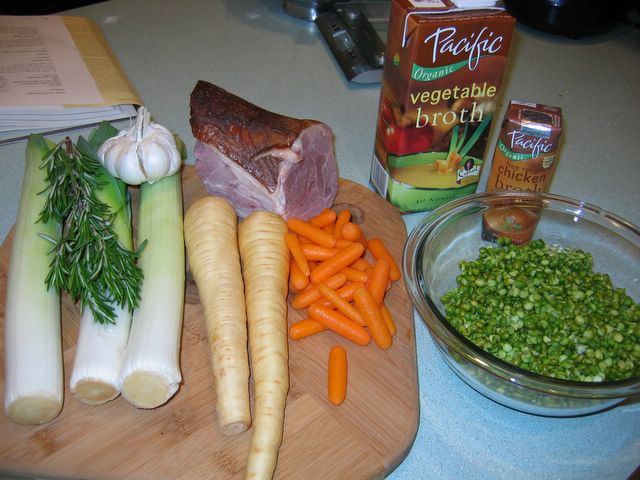
The ingredients for split pea soup. Notice the meaty ham hock: the reason for Zak’s love of split pea soup.
And, so, I set forth to make split pea soup.
It starts, as many of my soups and stews do, with leeks. Sliced thinly, and rinsed several times, they go into the pot with some garlic and olive oil to sweat. I am not looking to brown them, I only want them to release their juices and flavors. After the leeks wilt, the heat goes up, and into the pot goes the ham hock, to brown a bit on each side.
Then, in goes some sherry, though I have to confess I used Chinese Shao Hsing wine, as I was out of sherry. My theory is this–if Chinese cookbooks suggest that you can substitute dry sherry for Shao Hsing, then the reverse must be true. I have done it many times to no ill effect, either on my food or myself and none are the wiser. Except now everyone who reads this blog to whom I have admitted my tricksy substitutions.
Thyme, sage, celery seed (I use celery seed instead of celery simply because Zak is not fond of the texture of celery. The seed has all of the flavor and no mushy-stringy-squishy objectionable mouthfeel) and liberal lashings of black pepper go in next, along with cubes of ham. Then the vegetable and chicken broths, and the peas.
One can add a sprinkling of chile flakes at this time, but I seldom do. It can be jarring in pea soup to have a jolt of capsiacin heat. I do admit, however, to adding a sprinkle of chile flakes to my own serving of it once it is done, now and again.
I bring it to a boil, then turn the heat down, cover the pot and it simmers.
At this point, I cut up some baby carrots I had into thick diagonal slices, and peeled and diced a parsnip.
For those who have never eaten a parsnip, you should try one.
It is a member of the family Umbelliferae, which makes it a cousin to the more commonly known carrot. It is also related to dill, fennel, caraway, parsley, coriander, cumin, angelica, celery and hemlock. While all other members in that list I mentioned are wonderfully flavorful, I highly suggest you leave that last one alone, as it is indeed what was used to do in Socrates back in the day for the heinous crime of teaching the youth of Athens think critically.
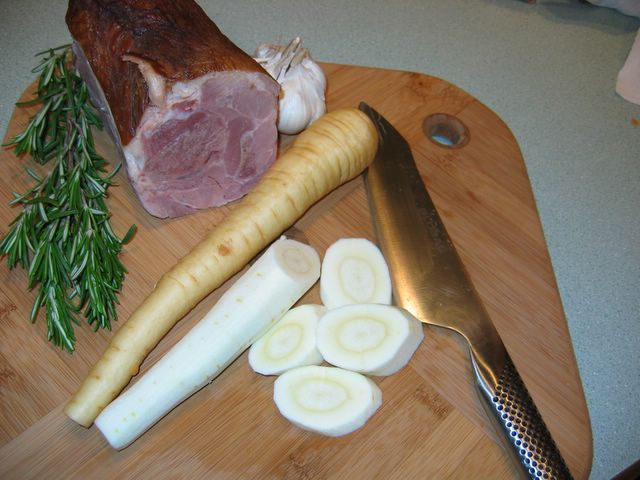
A parsnip in its natural state, along with one peeled and sliced. Notice the structural similarity to carrots; the flavors are similar as well, though the textures are quite different.
The carrot and parsnip are the two members of that plant family which are commonly grown for their edible roots, but the parsnip has been overshadowed by its more gaily colored and sweeter cousin. Parsnips are quite good for you, being endowed with an impressive amount of folic acid, potassium and calcium, along with smaller amounts of the B complex vitamins, vitamin C and iron. They have a decent amount of fiber in them, too, but they cook up to a nice, smooth, starchy texture. They are sweet, like carrots, but not overwelmingly so–there is a floral, herby green fragrance to parsnips that carrots lack.
They can be cooked in any way one would use a potato: in gratin, roasted, baked, boiled and mashed, (rather like turnips), made into cream soups, and the like. I like adding them into mixed vegetable soups and stews, which is my way of sneaking a new vegetable past inexperienced diners. I do it at the domestic violence shelter all the time, and most of the women have been surprised at how good “Barbara’s Weird Vegetables” taste.
I like them in pea soup–they are sweet, but more complexly flavored than carrots, which adds another level of flavor to the entire dish.
At any rate, once the peas start breaking down into their puree, I added the carrots and parsnip, and the soup was done when the peas turned themselves into a thick “cream” soup.
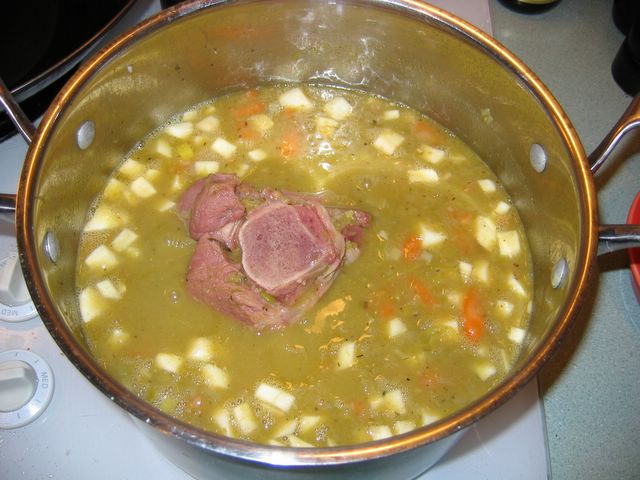
The soup just after adding the carrots and parsnips. The characteristic sickly green color has already begun to take prominence.
At which point, I added about a tablespoon of fresh, finely minced rosemary and called it done. I served it with a teaspoon of sour cream and another sprinkling of the minced rosemary, alongside Zak’s cardamom bread.
It really wasn’t a pretty meal, what with the rather sallow green complexion the soup ends up with and all, but it was hot, fragrant and comforting, with a deep smokiness from the ham and a lingering sweetness from the peas, carrots and parsnips.
The flavor deepens when you keep it for a few days in the fridge; though the song says you can keep it for nine days, I never do. It doesn’t last so long. The ham makes sure of that for us.
What the Hell Does Authentic Mean, Anyway?
While eating leftover hot and sour soup for breakfast this morning, (it really is good, you should try it) I mused over something I read while researching soup recipes the other day.
I was looking at various hot and sour soup recipes, trying to see if any chefs used Sichuan peppercorns, galangal and lemongrass in their recipes as I do in mine. While looking through my books, I found one author who stated that it is absolutely impossible to make an authentic hot and sour soup in the United States, because one must go without the crucial ingredient of coagulated duck’s blood (Ellen Schrecker, Mrs. Chiang’s Szechwan Cookbook, page 264.) Indeed, in looking through Lee Hwa Lin’s Chinese Cuisine: Szechwan Style, put out by the Wei Chuan Cooking School in Taiwan, the hot and sour soup recipe definitely features duck’s blood, as the fifth ingredient, in fact, right there on page 83.
Fuchsia Dunlop tells us on page 329 of Land of Plenty that hot and sour soup is a banquet dish which uses many different expensive ingredients such as a certain kind of pig tendon and sea cucumber, which relies upon black pepper for its heat. While Fuchsia makes no mention of the duck’s blood, a photograph in Ken Hom’s The Taste of China clearly shows cubes of the duck’s blood, which he calls “blood sausage,” paired with fresh chili peppers, which he tells us is destined to be made into hot and sour soup. Martin Yan, in Martin Yan’s Culinary Journey Through China, also ignores the “fact” that black pepper is always used to spice up the soup and uses chili sauce instead, while also throwing in some lemongrass, just for fun.
Deh-Ta Hsiung’s Chinese Regional Cooking lists no duck blood in the recipe, nor makes any mention of black pepper being the traditional “heating element” in the dish, (which nearly every other author declares is the case), but instead uses Sichuan peppercorns exclusively to give the soup heat. Barbara Tropp, on page 450 of The Modern Art of Chinese Cooking, presents a Chinese Muslim version of the soup, which does indeed use black pepper as the hot part of the hot and sour, but which eschews pork, pork broth and duck blood in favor of beef and chicken broth. She declares this version to be the best version of the soup she ever tasted.
All of this contradictory information brings up the question of what exactly does it mean to make an “authentic” hot and sour soup?
What the hell does “authentic” mean, anyway? Is it authentic if it does not have duck blood? Is it authentic if it is vegetarian? Is it authentic if it tastes like the hot and sour soup you grew up eating in your neighborhood Chinese restaurant? Is it authentic if it is made by someone from China? Is it authentic if it is made with chile peppers and no black pepper? What about Sichuan peppercorns?
The dictionary definition of authentic which I think most people would argue is the correct one to deal with when we are talking about food is the second definition, which is, “conforming to an original so as to reproduce essential features.”
Houston, there is a problem.
The problem with that definition when it comes to hot and sour soup is this: how do we determine what the “original” version of the soup is? Do we look for the first recorded version of it? Fine. Do we look for the first recorded version of it in Chinese? How about English, as I don’t speak Chinese, much less read it? And, well, even if I -did- read it, how do we know that the first “written” recipe is the “correct” one? What if the chef who invented it didn’t write it down, but it was passed down orally, and then changed before it was written down. Or, what if the person who wrote it down changed it?
That is why I think that particular definition for “authentic” is a rather shaky one to use in relation to food.
Authenticity, when it comes to food, is a concept that I wrestle with all the damned time. I wrestle with it because when it comes to cooking ethnic cuisine, there is a great deal of emphasis placed on making food that conforms to expectations of flavor that is generally thought of as belonging with a particular ethnic culture. There are certain flavors or ingredients that can be jarring when introduced into ethnic dishes, which take these dishes completely out of their origins. On the other hand, there are flavors which do the exact opposite–they can raise a dish to the sublime, and accurately reflect the cuisine while still showing an individual cook’s own personal innovation.
Stubbornly striving for authenticity can lead to the idea that cuisine is static, that there is one “true recipe” for any given dish, which is simply untrue. Every chef and every home cook takes a recipe and makes it her or his own, and it is these personal touches which enliven a cuisine and make it “real.” It is innovation as much as tradition that keeps a cuisine alive and vital.
People seem to have an idea of what Chinese food is that I sometimes think is based more on the past than on the present. In reading about his tour through China in the 1990’s, I am struck by Ken Hom’s admission of surprise that many foods he had thought of as foreign to China such as corn and potatoes, were widely integrated into Chinese cuisine. He also tells of the great diversity of foods that he ate in his travels including a Mongolian-influenced dish of pan-fried goat cheese which he had north of Beijing! He also noted that tomatoes, which had only been introduced to China about one hundred years ago, were enthusiastically eaten and enjoyed all over the country, and had been integrated so thoroughly into the cuisine that it seemed as if they had always been there. (I highly recommend his book, The Taste of China, which, though it is out of print, is widely available used on Amazon and elsewhere.)
Chinese food is more than we think it is.
So, looking at it that way, is Martin Yan’s hot and sour soup less authentic than other chef’s because he adds lemongrass? Is Deh-Ta Hsiung wrong to use Sichuan peppercorn rather than the more standard black pepper? Did I go to far in adding galangal?
I don’t think so–I think that rigidly stating that the only truly authentic hot and sour soup in the world has duck blood in it and certainly not lemongrass is promoting food snobbery and is ultimately detrimental to the understanding that cuisines develop and grow over time. The food that is made by a Sichuanese chef who has immigrated to Huntington, West Virginia, is never going to taste exactly the same as the food a Sichuanese chef makes in Chengdu, because even if the same condiments are used, the basic ingredients are going to come from a different place, and thus have different flavors.
I think that striving blindly for authenticity is a red herring when it comes to cookery, but I also do not advocate the fad for fusion cuisine where ingredients are thrown together willy-nilly without any seeming sense or reason. Often ingredients are combined with no knowledge of or respect for the traditions of their use in the cuisines from which they are taken, and the result is an unfocused mishmash of jarring flavors. This leads to food that is lacking in depth, character and cultural relevance.
I believe that the most successful fusions come from someone who has studied the culinary traditions of various cultures enough to know how ingredients are used and can then adapt them to other uses. It is easier to comfortably and successfully combine flavors and ingredients into coherent dishes when one understands the traditional uses of these ingredients and can find cultural similarity and work within that context.
The fifth definition of “authentic” in Merriam-Webster, “true to one’s personality or character,” is the one most suited when discussing food.
If a dish is true to the spirit of the cuisine, then it is authentic.
If a hot and sour soup is both hot and sour, and is firmly based within the spirit of Chinese cooking, then it doesn’t matter if it has duck blood, sea cucumber, pork, beef, chiles, black pepper, lemongrass or Sichuan peppercorns in it or not.
What matters is that it is true to the spirit of Chinese cookery.
Now, of course, the next question is–how does one determine what the spirit of Chinese cookery is?
When I figure it out, I will be sure and tell you.
For now, I guess we will all have to fumble around and answer that question for ourselves.
A Show of Hands
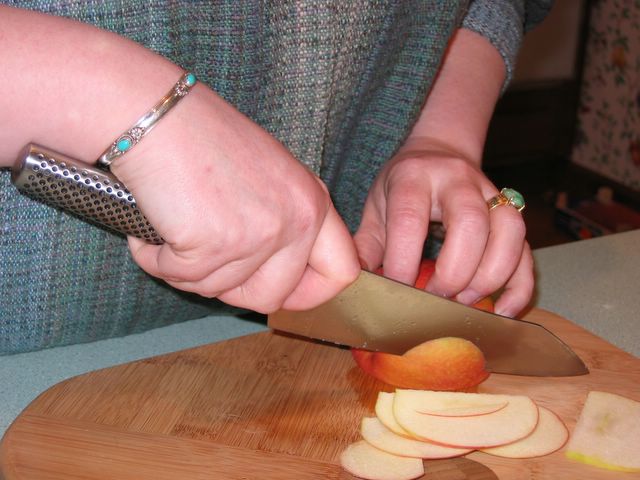
The greatest tool for any cook is her own hands.
I have been reading cookbooks for years–ever since I learned to read, in fact. Before that, I used to drag down my mother’s copy of The New Better Homes and Gardens Cookbook and her Betty Crocker’s Picture Cookbook, and look at the pictures. They were both illustrated with color and black and white photographs, not only of the finished dishes, but of the various steps of many recipes being carried out with nonchalant grace by a pair of beautifully manicured female hands.
We never saw any more of the nameless cook in the photographs than her hands and sometimes her flowered-apron covered torso. The hand model was never identified in the books, and I always wondered about her. Who was she? Did she really cook? In the Betty Crocker cookbook, I wondered if she was Betty herself, though when I asked Mom, she told me that Betty Crocker was a made up person, a fictional character, just like the Cat in the Hat. (Which of course, made me imagine Betty and the Cat having a conversation, which took my brain off into a realm of oddness from which it has never returned.)
So, I wondered who those hands belonged to.
They were awfully pretty. Unadorned by rings, watches or bracelets, the hands had lovely tapered fingernails painted a perfect porcelain pink. They were slender-fingered and endowed with an artless beauty, slender and pale like lilies.
I noticed how clean they were, too. They were unsmudged, unblemished. No sign of the small burns or cuts that my mother often bore on her hands from cooking or canning. The forearms were diminutive, lacking the sharply defined muscles Mom’s arms. There were never splatters of tomato sauce or smears of chocolate in evidence.
They were the hands of a lady, not a cook, I realized later, while I was reading Louisa May Alcott’s Little Women. That is when I understood that the woman behind those hands was probably not a cook, and it really brought home to me how artificial those photographs were. How unrealistic it was to see a perfectly clean countertop along with beautifully kept hands and a disembodied ruffled apron engaged in beating egg whites by hand to make meringue.
Cooking is messy, and as Meg in Little Women learned, cook’s hands are not white, languid and unblemished. They are scarred, bruised, calloused and usually endowed with short, sometimes ragged, fingernails.
They bear the brunt of all the dangers a kitchen offers: fire, boiling oil, steam, sharp knives, caustic chemicals, and materials which can stain clothes and skin.
They are marvels, though, the hands of a cook. They bring into being art. They give us sustenance. They have the strength to knead stiff bread dough, and the delicacy to hand paint egg whites on violet blossoms and crystallize them with super fine sugar.
They manipulate utensils with power and purpose. A chef’s knife or cleaver is as sharp as a rapier, but it is not an instrument meant for killing. It is meant to render ingredients into shapes fit for cooking and eating, and wielded in the hands of a master, the knife becomes a paintbrush, a pen, a chisel–a tool which allows the artist to bring her conception, her vision, into being.
Hands are not everything a cook needs in the kitchen. All senses are necessary to cookery, but the hands carry a great load of the work that goes into making simple breakfasts or elaborate feasts.
Rich or poor, pale or dusky, round and short-fingered or long and slender, the hands of a cook are a beautiful sight, no matter how scarred, nicked, bruised or scraped they are. They are a pleasure to watch in their work; they move together with measured rhythm like dancers.
I used to be mesmerized by watching my female relatives cook. I learned to divine personality from the way thier hands moved as they went about the tasks of preparing dinner. Mom’s hands moved brusquely, in a completely businesslike fashion. She wasted no motion, nor did she let her fingers linger long in one place. She didn’t really like to cook; she would rather have been outside doing yard work or building something than be stuck in the hot kitchen, and her hands gave her desires away.
In contrast, Gram’s hands trailed lovingly over the food as she worked with it. She taught me to make roast leg of lamb; as she rubbed the herbs, salt and pepper over the outside of the meat, her long fingers skimmed along gently, but firmly, as if she were massaging an ailing child. She took her time in every motion; she stirred languidly, and tended to pat her biscuits as she laid them on the baking pan, as one would pat a good dog on the head.
Grandma’s hands were strong. I remember watching how the muscles of her forearm would bulge as she kneaded bread dough beneath her broad palms. Her cedar-colored skin was thin and papery and as soft as parchment, and I would watch, fascinated, as she bent pastry dough effortlessly to her will, touching it with feathery strokes, so as to keep it light and flaky.
She always told me that it is through a cook’s hands that her energy entered the food she made. She told me that was how love was put into food, by touching it while you cook, and that any cook who was afraid to dirty her hands would never make food full of love.
Aunt Judy’s hands are beautiful, as liltingly graceful as birds. They flutter over her food in gestures quick as butterflies’ wings, and she is known to dip a long, slender finger into a bubbling pot to take a quick taste. Her food is like her art, and like herself, lovely, delicate, but with a core of vitality which speaks of tenacity and strength.
To this day, I always watch a cook or chef’s hands. Every good cook has a pair of hands that tell a story by their looks and movements.
What kind of story would your hands tell, if I watched them, I wonder?
Chinese Fast Food
There are some days when I get involved in writing, working or gardening, and I forget that I have to cook dinner until the sun is going down, my stomach is growling and Zak is about to perish from lack of caloric intake.
In these times, I am glad that we have a Chinese deli in downtown Columbus, where I can purchase an item that will save me from just making peanut butter and jelly sandwiches or reaching for a jar of pasta sauce.
What is this paragon of foods that helps me put dinner on the table in fifteen minutes or less?
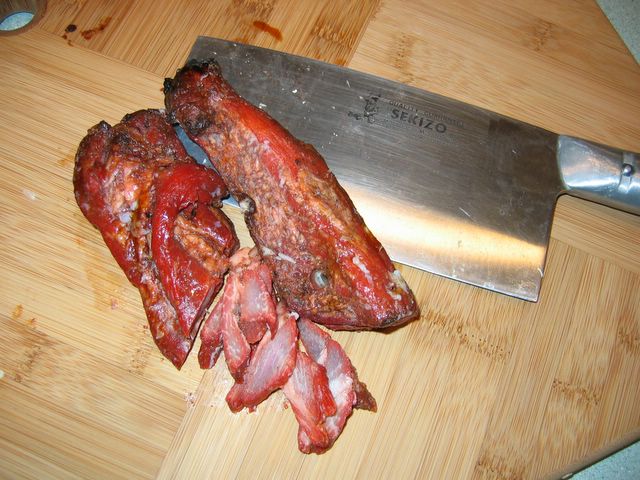
Cantonese style barbecue pork–char sui–from a grocery store or deli can become the basis of very quick meals at home.
Zak’s favorite food is char sui. I swear, he would never have been able to keep kosher; his love of pork rivals that of mine, and I am a hillbilly born and bred, raised on all manner of pig products from the time I could toddle.
And I am grateful for his passion, because if I keep a steady supply of char sui in the freezer or refrigerator, I can throw down and whip up dinner in less time than it would take us to gather ourselves and go off to the nearest fast food outlet. And it is cheaper, too, and usually quite nutritious. Even if I didn’t have sense enough to start rice in the rice cooker earlier I usually have a batch of leftover rice that I can either fry or reheat.
All it takes is few minutes of cutting, some pantry items and a wok.
I always have some sort of greens in the fridge, along with the pork, which is great, because as we know, pigs and greens were meant for each other. One of my favorites these days is Shanghai bok choi: a smaller, curvaceous relative of the more familiar upstanding white stalked and forest-green leafy vegetable. I find that it is more flavorful, with a sweeter more toothsome crunch and just a hint of mustard-green pepperiness.
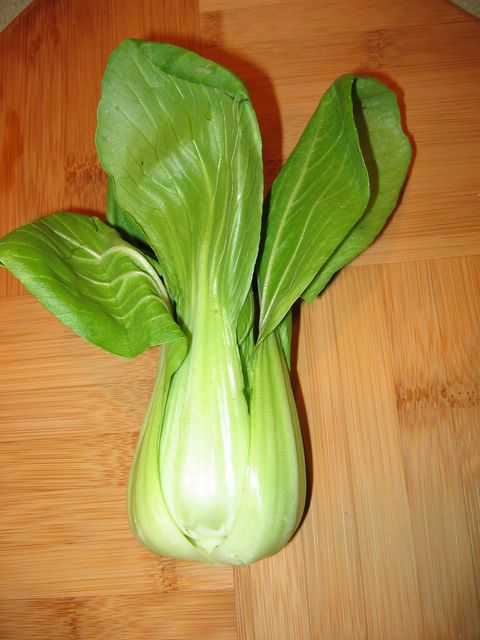
Shanghai bok choi is smaller than regular bok choi and has a gorgeous jade green color. I find that it is also sweeter and crisper than its larger cousin.
I cut it up crosswise into slices about 3/4 of an inch wide, rinse them and then dry them in a salad spinner. I then towel off any remaining dampness, so that the leaves stir fry, not steam.
The pork I cut into 1/4 inch thick slices, against the grain.
I also slice 2 or 3 cloves of garlic thinly, and mince up about a tablespoon of fresh ginger.
And if I have them, I will peel and slice fresh water chestnuts, because, well, I will put them into near about anything, and they improve it.
All of this cutting takes me about five minutes or so. Maybe eight, if I am really tired and had a long day.
Then, I heat up the wok, add the oil and toss in the garlic and ginger. As soon as the smell wafts up in a billow of steam, in goes the pork.
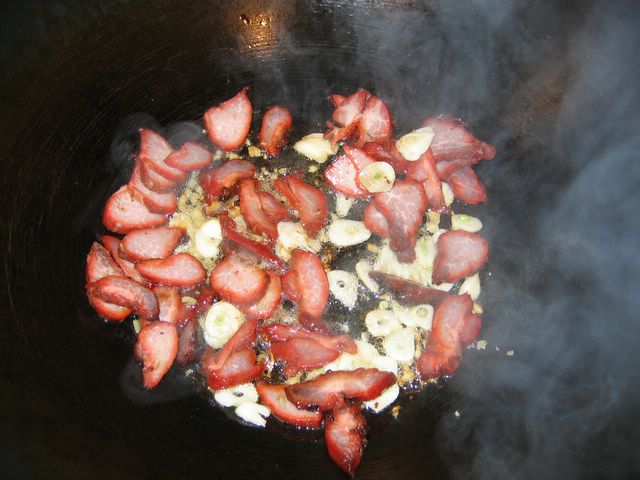
After adding the pork, let it sit on the bottom of the wok with the garlic and ginger, so that it browns well.
While I leave the pork to brown, I mix up some dark soy sauce with either raw sugar syrup or honey. How much of each? I don’t know, it depends on how much pork and greens I am cooking. But the total amount tends to be about 2 or 3 tablespoons worth. More soy sauce than sweetener, as the char sui sauce on the pork is sweet. Then, after that is mixed, I run back to the wok and start tossing and stirring madly.
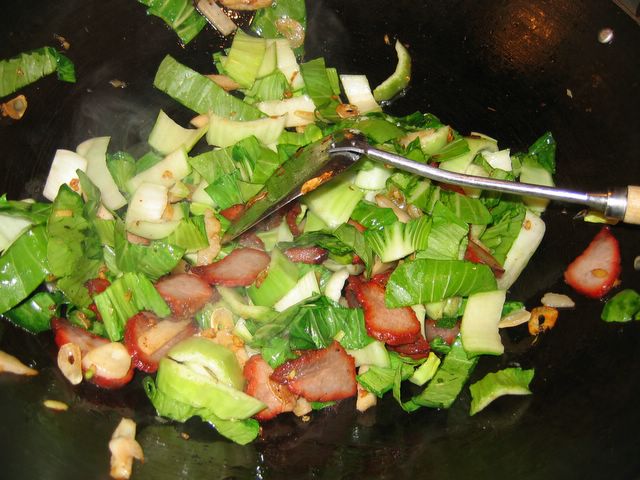
Add the bok choy after the pork has browned on the edges and the garlic is golden in color.
After the bok choi goes in, if I have water chestnuts, in they go too. Carrots could go in now, too, or bamboo shoots. Water chestnuts are best, though.
Can you tell that I am biased?
After the greens begin to give up their juices and wilt, in goes the sweetened soy sauce, and I stir and stir, letting the soy sauce reduce into a thick sauce. I pull the wok off the heat and drizzle a tiny bit of sesame oil over all, and give it a last good turn with the wok shovel.
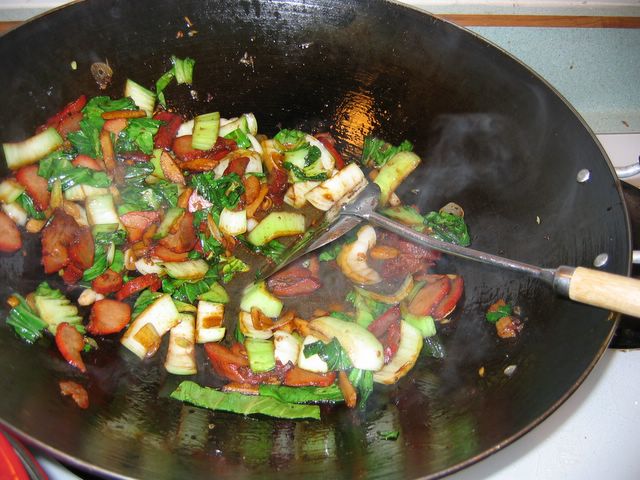
The finished dish; the entire preparation and cooking process takes about ten or fifteen minutes start to finish. That is faster than it takes me to get to the nearest fast food joint and order a greaseburger.
And so it is done. I serve it up over rice, with tea and we call it dinner.
Char sui and greens are really versatile. I could make fried rice with the same ingredients. Or pork lo mein. Or instead of serving this recipe over rice, I could make pan fried noodle cakes (If I happened to have cold cooked noodles in the fridge that is–and sometimes I do) and pour the topping over it. Or I could make an omelet, Chinese style, with the pork and the greens and serve that over eggs with some of my chile garlic oil.
All of these things are possibilities for fast dinners, though they are all predicated on not allowing Zak to get his fingers on the pork when I am not looking. Because he will take it out of the fridge and eat it up cold, and then where would be when it came to dinner time?
Probably eating peanut butter and jelly.

Categories:
- Admin (rss) (55)
- Blogs and Blogging (rss) (81)
- Book Reviews: Cookbooks (rss) (43)
- Book Reviews: Non-Cookbook Food Books (rss) (38)
- Cats and Cat Blogging (rss) (47)
- Chinese Cooking Lessons (rss) (32)
- Culinary School Stories (rss) (18)
- Dairy Pruducts: Cultured and Barbaric (rss) (4)
- Documentary Filmmaking (rss) (1)
- Essays, Rants and Reflections (rss) (260)
- Fighting Hunger (rss) (12)
- Food and Kids (rss) (45)
- Food in the News (rss) (126)
- Food Media (rss) (98)
- Food Preservation (rss) (18)
- Food Safety (rss) (45)
- Gardening (rss) (30)
- Herbs and Herb Blogging (rss) (20)
- Holidays (rss) (50)
- Kat Blogging (rss) (22)
- Kitchen Science (rss) (36)
- Leftover Makeover (rss) (8)
- Life, the Universe and Everything (rss) (131)
- Local and Sustainable (rss) (227)
- Local Athens Food and Foodies (rss) (42)
- Meatless Mondays (rss) (32)
- Menu For Hope (rss) (5)
- Nutrition, Diet and Health (rss) (84)
- On The Farm (rss) (8)
- Recipes: Almost Vegetarian, Vegetarian and Vegan (rss) (294)
- Recipes: American Regional (rss) (37)
- Recipes: Appalachian Hillbilly (rss) (33)
- Recipes: Bread, Pasta, Grains (rss) (95)
- Recipes: Canning and Preserving (rss) (8)
- Recipes: Chinese (rss) (123)
- Recipes: Comfort Food (rss) (120)
- Recipes: Cookies (rss) (16)
- Recipes: Desserts (rss) (48)
- Recipes: French (rss) (25)
- Recipes: Fruits and Vegetables (rss) (302)
- Recipes: Greek, North African and Middle Eastern (rss) (31)
- Recipes: Indian (rss) (137)
- Recipes: Italian (rss) (42)
- Recipes: Japanese (rss) (7)
- Recipes: Jewish (rss) (4)
- Recipes: Korean (rss) (6)
- Recipes: Meat, Poultry and Fish (rss) (220)
- Recipes: Mexican/Native American/ Latin American/Caribb (rss) (27)
- Recipes: Original (rss) (108)
- Recipes: Thai (rss) (27)
- Recipes: Tofu (rss) (17)
- Recipes: US Regional (rss) (16)
- Recipes: Vietnamese (rss) (8)
- Restaurant Stories (rss) (28)
- Sewing, Quilting, Arts and Crafts (rss) (16)
- Simple Chinese Recipes (rss) (30)
- Slow Food and Heritage Foods (rss) (10)
- Spice Blogging (rss) (44)
- The Chinese Cookbook Project (rss) (14)
- The Chinese Pantry (rss) (39)
- The Documentary (rss) (2)
- The Kitchen Saga (rss) (17)
- The Locavore's Bookshelf (rss) (15)
- The Unsung Adventures of The Culinary Nerd (rss) (6)
- Tools and Toys (rss) (35)
- Uncategorized (rss) (10)
- With a Side of Politics (rss) (48)
Archives:
- August 2012 (9)
- July 2012 (12)
- September 2011 (3)
- August 2011 (7)
- July 2011 (8)
- June 2011 (16)
- May 2011 (17)
- April 2011 (11)
- December 2010 (9)
- November 2010 (5)
- February 2010 (1)
- December 2009 (5)
- November 2009 (7)
- October 2009 (10)
- September 2009 (16)
- August 2009 (14)
- July 2009 (14)
- June 2009 (7)
- May 2009 (17)
- April 2009 (10)
- March 2009 (25)
- February 2009 (13)
- January 2009 (10)
- December 2008 (5)
- November 2008 (5)
- October 2008 (6)
- September 2008 (13)
- August 2008 (8)
- July 2008 (11)
- June 2008 (18)
- May 2008 (13)
- April 2008 (14)
- March 2008 (16)
- February 2008 (17)
- January 2008 (19)
- December 2007 (25)
- November 2007 (18)
- October 2007 (24)
- September 2007 (16)
- August 2007 (15)
- July 2007 (15)
- June 2007 (10)
- May 2007 (14)
- April 2007 (16)
- March 2007 (17)
- February 2007 (20)
- January 2007 (13)
- November 2006 (1)
- October 2006 (8)
- September 2006 (14)
- August 2006 (25)
- July 2006 (30)
- June 2006 (28)
- May 2006 (34)
- April 2006 (29)
- March 2006 (24)
- February 2006 (30)
- January 2006 (38)
- December 2005 (40)
- November 2005 (37)
- October 2005 (32)
- September 2005 (25)
- August 2005 (30)
- July 2005 (28)
- June 2005 (21)
- May 2005 (8)
- April 2005 (22)
- March 2005 (17)
- February 2005 (29)
- January 2005 (10)
Search Site:
Links:
- Lily’s Wai Sek Hong
- 101 Cookbooks
- A cat in the kitchen
- A Veggie Venture
- Accidental Hedonist
- Cha Xiu Bao
- chez pim
- Chocolate & Zucchini
- Chopstick Cinema
- Chowhound.com
- Chubby Hubby
- Cook sister!
- Cooking with Amy
- da*xiang
- Eat Local Challenge
- Eating Liberally
- Ecocentric
- Eggbeater
- Epicurious
- Farmgirl Fare
- Fatfree Vegan
- Foodgoat
- ForkandBottle.com
- Green Olive Tree
- Hooked on Heat
- Jaden’s Steamy Kitchen
- Kalyn’s Kitchen
- Lucullian delights
- Mahanandi
- Matt Bites
- MeatHenge
- mmm-yoso!!!
- New York Times – Dining & Wine
- Pizza Goon
- Rasa Malaysia
- Ruhlman
- Sailu's Kitchen
- Serious Eats
- SF Gate: Food & Dining
- Simply Recipes
- Soul Fusion Kitchen
- Tastespotting
- The Amateur Gourmet
- The Cleaner Plate Club
- The Food Section
- The Grub Report
- thecookscottage
- U.S. Food Policy
- Wandering Chopsticks
- Washington Post Food and Dining
- Wasted Food
Meta:


Powered by WordPress. Graphics by Zak Kramer.
Design update by Daniel Trout.
Entries and comments feeds.