
Cook Local, Eat Global
Fishing for Fish Sauce

Back when I wrote my post about the Thai Pesto Noodles I put together in a successful experiment, one reader commented that I never really explained much about fish sauce, nor mentioned which brand or brands I used at home. And while I did link to a very old post of mine, an exhortation to my readers on the glories of fish sauce, (Don’t Fear The Fish Sauce), that post really didn’t talk about which brands of that umami-laden sauce i used in my own kitchen, or the qualities that I found admirable in a fish sauce.
So, now I am writing just such a post.
I’ve been cooking Thai food for about seventeen or eighteen years now. (Good grief, it really has been that long….dang!) And, in the beginning, when I made my first, very tentative explorations of Thai cuisine, guided by some inadequate cookbooks and a very strong taste memory from the restaurants in Miami that Zak and his family frequented, I pretty much used whatever fish sauce I could get my neophyte’s grubby paws on.
And while I made pretty good Thai food back then, it cannot hold a candle to the dishes I make now; this is in part, because I make my own curry pastes, but it is also because the quality of my ingredients has risen. Many more brands of Thai ingredients are available now than there were nearly twenty years ago, and they are more widely available. Thanks to the Internet, which I lacked back in the day, I can even get fresh lime leaves, galangal, chilies and lemongrass shipped to my doorstep, along with any brand of fish sauce I should care to use.
So, what brands of fish sauce do I prefer, and why?
My number one, all-time favorite all-purpose Thai fish sauce is Golden Boy, which I use for everything. I use it cooked in curries, stir fries and raw in dipping sauces and dressings, and it is always delicious. If you look at the illustration above, you can see that it is a lovely amber color, very clear and light. It also has the freshest, least objectionably “fishy” odor of any fish sauce available in the US, which I find is very helpful when I am teaching Thai cooking to people who have never come across fish sauce as an ingredient before. Don’t get me wrong–Golden Boy, when drizzled into a very hot wok still sends forth a billowing cloud of fish-scented steam, but it isn’t particularly bad. In fact, I think it smells rather good, and most of my dinner guests and family agree.
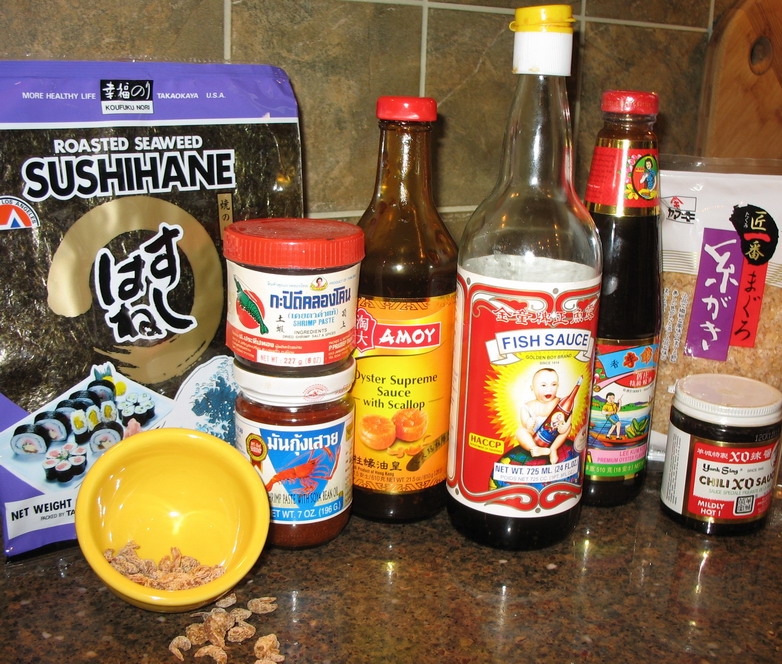
It also has a very balanced flavor, strong on the umami, not too salty, with a slightly sweet finish. In my experience, Golden Boy is the least salty tasting fish sauce available in the US. There is absolutely no hint of bitterness to it, though I have read reviews which have said so. I have never detected it, and I trust myself to have a pretty darned good sense of taste.
Golden Boy is pretty easily available, at least on the East Coast and in the Midwest, though I have heard that it isn’t as easy to find on the West Coast. However, there are many online grocery stores that stock it, including my personal favorite, Import Food.
Look for the cute little grinning baby boy on the label, cradling a bottle of fish sauce on his lap with one hand and making a thumbs-up sign with his other.
Oh, one more thing–it is a beast to unseal. The plastic shrink seal on the lid is simple, you just cut that like you do any other shrink-plastic seal. It is the seal under the lid that gives some folks fits. It is a solid plastic raised disc that you take a sharp paring knife to, sawing back and forth on it until the disc flies off and you are left with a nice, smooth, small hole in the bottle lid with a fold-down, locking cap to keep the precious stuff from evaporating. (It also keeps any wayward cats who may wander your home from jumping up on the counter and knocking the bottle to the floor where it can spill and they can imbibe until they are soused on fermented fish squeezings.)
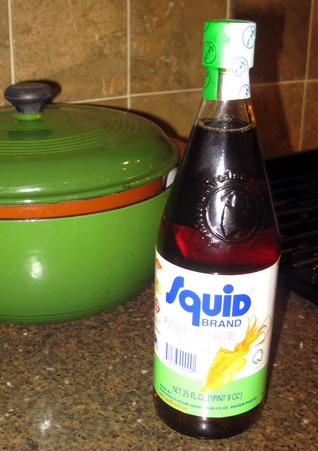
I also use Squid Brand which has a stronger, but still pleasant fish flavor, and which is a tiny bit darker in color than Golden Boy. I prefer to use it cooked in curries and soups and some very spicy stir-fried dishes, but I won’t use it raw in dipping sauces and dressings. It is a little more salty than Golden Boy and the more pronounced fish flavor, while it is great in curries, is a little overpowering when used raw.
You can see the true color of Squid Brand by looking at the lightest bit of the bottle in the photograph, just above the label. It is slightly reddish and more of a dark honey color than the more golden amber color of Golden Boy. I suspect it is not aged as long as Golden Boy, but I don’t know that for certain. What I do know, is that squid is not used in making the sauce, any more than babies go into Golden Boy. They both are made with anchovy extract, salt and sugar, though water is listed as the first ingredient in Squid Brand, which makes me think that my assumption that it is not fermented as long as my favorite brand might just be correct.
It is easy to recognize Squid Brand–it not only has a squid right on the green and white label, it also has a cute squid embossed right into the glass of the bottle.
It also opens quite easily, unlike Golden Boy, which requires a steady strong hand and a bit of cutlery and patience. You just tear off the shrink plastic seal and pop the top up and there you are! It also seals up wonderfully well–better than Golden Boy, in fact, such that I might possibly feel safe enough transporting an already opened bottle of it across town in my car.
I doubt it, though. Having once gotten a bit of fish sauce spilled into my first car, I can attest that the smell, which may not be bad in the bottle, is really bad in car upholstery, especially in the summer.
And it doesn’t really ever come out. It fades over time, and you will forget about it, until the next summer, when on the first ninety-five degree day, you open your car door to be attacked and overwhelmed by the unwelcome odor of long dead and unburied wee fishies. (This is why I always tell people that if they want to cook Thai at someone else’s house and they need to take fish sauce, take a new, sealed up bottle and then leave it there. If you can’t do that, I advocate sealing the bottle with duct tape, then wrapping it in plastic, then sealing it up in a big ziplock bag. Even then, I suggest praying to the Kitchen God the entire time you drive, lest any bizarre and unnatural event occur which would release the thrice-sealed fish sauce into your unsuspecting car seats.)
Now, there is a fish sauce I have not tried which I am going to try and find the next time I go to Columbus.
I want to try Tra Chang Golden Label Brand. It is highly rated by Import Food, and so I am curious to see if it is as good as they say, or if I will stick with my Golden Boy.
Now, what brands do I suggest you not use?
Well, in general, let me say this: if it comes in a plastic bottle don’t buy it.
I have tasted fish sauce bottled in plastic that tasted like, well, fishy plastic.
Ick.
Need I say more about that?
Thai Kitchen brand fish sauce, which you can find in many supermarkets, is not one I would recommend. For one thing, it is very expensive for the tiny bottle, and for another, it has a very salty flavor and a very strong fishy smell. I am not certain it is naturally fermented, but it is certainly not worth the amount of money you pay for it in your usual supermarket. It is much better to order a good brand from online or make the effort to shop in an Asian market for your Thai ingredients than to use the overpriced produces from Thai Kitchen. (This goes for everything they make, by the way–their coconut milk is always at least fifty to ninety cents more per can than the better tasting Chaokoh and Mae Ploy I get at the Asian market.)
Thai Kitchen was the very first fish sauce I used, in large part, because it was the only one I could get in West Virginia way back in the dark days before the Internet could bring anything to your doorstep via mail order. And I have to say, while it did make my food taste sort of Thai, it also made it taste very salty, and that was not good. Thai food is about balance in flavor and too salty does not a balanced dish make.
Also, back in the day, I used to use Three Crabs Brand fish sauce, but stopped using it when I discovered Golden Boy. It is okay, but instead of being made with just anchovy extract, salt and sugar like the other brands it also has water, fructose and hydrolyzed wheat protein in it. I suspect that this accounts for the rather odd, slightly too sweet flavor it has which I now find off-putting.
However, I will say that a lot of people love Three Crabs Brand and swear by it, so if you want, try it and see if you like it. To my taste, it is both too salty and too sweet, without enough of the savory, meaty, delicious and addictive umami kick from the fish that is most of the point of fish sauce in the first place.
So there is my little treatise on which brands of fish sauce I prefer to use in my kitchen. They are all Thai–and I have to admit I use them not only in Thai food, but also in my Vietnamese dishes, always to delicious effect.
And, like many other cooks, I have found that sometimes fish sauce can give a lift to dishes from all over the world by giving them a good jolt of umami along with a dash of salt. Soups stews and especially Italian pasta sauces can really benefit from a little shake of fish sauce at some point in the cooking process.
I have yet to try using fish sauce in a dessert, though it may happen some day.
You never know.
Voting on Issue 2 In Ohio
I have long been pondering the case of Issue 2: a ballot initiative meant to make an amendment to the Ohio Constitution which would create a board of professionals appointed by the governor and the legislature, to make policy and oversee the humane treatment of animals in Ohio farms, as well as making and implementing Ohio agricultural policy in general.
This all came about because the representatives of the Humane Society of the United States came to the Ohio Legislature and stated their intention to put up a ballot initiative that would allow the state’s voters to decide on issues such as the size of battery cages for hens in large egg-laying operations and the use of small, confining gestation crates for pregnant sows in large pig farms.
So, in an attempt to forestall the possibility of a ballot initiative being placed before Ohio voters to change agricultural law by the HSUS, a proposal was made and passed by both the Ohio House and Senate and was supported by Governor Strickland, to create a board of 13 unelected bureaucrats who would wield a great deal of power in creating agriculture policy, but which would have seemingly very little legislative or executive branch oversight.
Here is the exact wording of Issue 2 as it will appear on the Ohio ballot on November 3, 2009:
This proposed amendment would:
1. Require the state to create the Livestock Care Standards Board to prescribe standards for
animal care and well-being that endeavor to maintain food safety, encourage locally
grown and raised food, and protect Ohio farms and families.2. Authorize this bipartisan board of thirteen members to consider factors that include, but
are not limited to, agricultural best management practices for such care and well-being,
biosecurity, disease prevention, animal morbidity and mortality data, food safety
practices, and the protection of local, affordable food supplies for consumers when
establishing and implementing standards.3. Provide that the board shall be comprised of thirteen Ohio residents including
representatives of Ohio family farms, farming organizations, food safety experts,
veterinarians, consumers, the dean of the agriculture department at an Ohio college or
university and a county humane society representative.4. Authorize the Ohio department that regulates agriculture to administer and enforce the
standards established by the board, subject to the authority of the General Assembly.
This proposed amendment has been the subject of vigorous debate in both urban and rural communities throughout Ohio–which is a good thing. I believe that voters should -never- consider amending their state’s constitution without a lot of rigorous thought and healthy debate, because amending the constitution is NO SMALL MATTER. The Constitution is -the- guiding legal document for either a country or state, and changes to it should never, ever be taken lightly. Change should come only after thorough investigation of the matter at hand, because once a document such as a state constitution is amended, it is very difficult to change back.
If my Ohio readers don’t want to take my word for it, how about listening to one of our Ohio State Supreme Court Justices on the issue. Ohio Supreme Court Justice Maureen O’Connor went on the record to say that Issue 2 is an “inappropriate use” of the Ohio Constitution, and then went on to clarify her position by stating that “the state constitution is a ‘much bigger document’ that should not be amended to include policy decisions, such as livestock care, that are best left to lawmakers.”
The League of Women Voters of Ohio agrees with Justice O’Connor; they voted to not support the passage of Issue 2 on the following grounds: “Passage of Issue 2 would amend the Ohio Constitution to create the Ohio Livestock Standards Board and set forth its composition and duties. The LWV-Ohio board voted to OPPOSE passage of this issue because the amendment contains too much specificity to be in the Ohio Constitution. The League’s opposition is based on its state position that the Ohio Constitution should be a clearly stated body of fundamental principles.”
The Ohio Farmers Union also opposes passage of Issue 2 for similar reasons:
The “Livestock Care Standards Board†would set a dangerous precedent by creating a permanent place for special interests in the constitution. This Board would have unchecked power over all Ohio policies related to animals in agriculture, and could radically shift livestock standards in any direction. Agricultural policy should be determined through an open, democratic process, vested in the state-run department of agriculture, not through a politically appointed board heavily influenced by big industry. Ohioans should reject this proposal to keep integrity in Ohio’s constitution and to keep corporate agribusiness accountable.
The Ohio Ecological Food & Farm Association also urges voting against Issue 2 on these grounds:
Issue 2 would create a Livestock Care Standards Board, stacked with Big Ag and factory farm supporters, which would have sweeping authority to make decisions related to farms and food in Ohio that would have the force of law. The Board would have largely unchecked power to override any act by the Ohio Department of Agriculture and the Ohio Assembly.
Issue 2 will create a Livestock Care Standards Board with no accountability to voters. Their decisions will be final. There is no further review or evaluation of the standard, no established forum for public comment, and no ability to appeal their decisions.
So, let me tell you what I think.
I agree with Ohio Supreme Court Justice Maureen O’Connor, the League of Women Voters, The Ohio Farmers Union and the Ohio Ecological Food & Farm Association: farm policy, especially vaguely worded farm policy, should not be written into the Ohio State Constitution.
Policies governing agricultural practices–practices which are changing and evolving over time–should be legislated through the normal, democratic process that includes voter input, debate in both houses of our legislature, and then should be put before the governor to be signed into law and vetoed. That way, the voters, which includes farmers and every Ohioan who cares about the food they eat, the water they drink and the air they breathe, can have a say in what kind of agricultural practices we all find acceptable and healthy.
Issue 2, as written, goes against the principles of democratic lawmaking procedure, as as such, is a bad legal precedent to set.
So, I will be voting against it on November 3, and I ask those of you who care about how laws and policies are made in our state and our country, to do the same.
Finally–A Diagnosis
Okay, after several weeks of testing and lots of speculation, I finally have a diagnosis for my upper right quadrant abdominal pains: biliary dyskinesia.
Which means, in plain English, that while my gallbladder is technically functional, it causes me intermittent pain when it contracts and squeezes bile into the small intestine. It is a progressive disorder (which has been little-studied; no one really knows what causes it) which means that it is going to get worse over time. There are the rare patients who have an acute attack that then goes away, but I have a feeling I am not one of those.
The only sure treatment is laproscopic removal of the gallbladder–but, because it is not likely to go gangrenous, rupture or cause peritonitis or anything like that, the way that bad gallstones can, there is no urgent need to get the surgery done as soon as possible. In other words, I can have it done when it is convenient for me.
My surgeon thinks it is possible, though not likely, that I could make it through the Thanksgiving and Christmas holiday festive eating occasions without more pain that will get progressively worse, so I may do it before then, or between the holidays.
We shall see.
I am just glad that it is nothing worse than this.
Why Does Lou Dobbs Hate Vegetables?
OK, that is a sensationalist headline. I’m sure Lou Dobbs, the controversial CNN commentator who doesn’t much care for illegal immigrants doesn’t actually hate vegetables.
A more accurate headline would be, “Why Does Lou Dobbs See a Conspiracy In The Lunch Trays of The Baltimore City School System?”
But it just isn’t as catchy, so I’ll stick with the original.
What the heck am I talking about here, I am sure some of you are wondering.
It’s like this: The Baltimore City School System has instituted a Meatless Mondays policy and, even though CNN could not find any parents in Baltimore who were against having their kids eat more vegetables and fruits during school, the whole thing is obviously a conspiracy to turn kids into socialist vegan heathens or something.
Never mind that the whole idea came about as a way to promote healthier eating habits among children. Never mind that having kids eat more vegetables might do something to curb the epidemic of childhood obesity that is supposedly running rampant in our country. Oh, and don’t notice that vegetarian chili and grilled cheese sandwiches are cheaper than even the crap-quality meat that is scraped off of the meatpacking companies floors and is sold to school systems. Yeah, and never mind that our country is deep in a recession and nearly every school system in the US is strapped for cash.
Dobbs ignores all of these inconvenient facts and decides that the school system is pushing a political agenda just because PETA gave them one of their Proggy Awards for being the most progressive school system in the country because of their Meatless Monday policy.
I don’t know if you know this, Mr. Dobbs, but blaming the recipient of an award for having a political agenda just because the organization giving the award does have an agenda, is pretty twisted and screwed up logic. Yes, PETA has an a very definite agenda, but just because they recognize the Baltimore school system for being progressive does not mean that the aforementioned school system has the same agenda.
Watch the clip and then tell me the reporting isn’t slanted and bizarre:
I love the little banner on the bottom that reads, “The Food Police?” while the Baltimore school officials are on the screen. That is so–slanted.
And who does CNN get to talk about how it is a bad idea for any school system to do this?
A spokesperson for the American Meat Institute, a trade organization of meat packers and processors. Is this an unbiased source? Um, no. And did you notice that the reporter also was careful to point out that the spokesperson was also is a mother of two children? Why is this mentioned? Does CNN regularly tell us how many kids every spokesperson they have on their shows is blessed with? No.
No, they mentioned that mother of two children bit so as to make the viewer think that this woman is speaking more as a concerned mother than as a paid shill for the meat packing industry, an industry, which, by the way, keeps selling meat tainted with E. coli to the public, including to schools. You know, the very same industry that lobbies against tighter food safety regulations and more mandated health inspections.
You know, those trustworthy creeps.
And what does this paragon of unbiased information have to tell us? What does she say?
She points out at the end of her statement that 75 percent of American schoolchildren are deficient in protein, and for many of them the only protein they eat is what is in their school lunches.
Um, yeah.
Has no one ever pointed out to this highly credible and well-paid spokesperson and concerned mother of two that beans, grains, nuts, and dairy products such as cheese and milk all contain protein? So, the truth is that the kids we see in this news segment who are eating the vegetarian chili with rice or the grilled cheese sandwiches are not being deprived of protein as the American Meat Institute would have you believe. They are actually eating plenty of protein.
It just happens to come from somewhere other than meat.
And then, Dobbs goes on to talk about how the Meatless Monday policy is a “political storm in the making” and insinuates that it is meant to indoctrinate kids into the shadowy world of progressive socialist vegetable-eating, tree-hugging evil-doers.
Look, Mr. Dobbs, it is like this.
Kids should eat more vegetables. You know this, and I know this. The mom interviewed in your news story whose kids actually go to school in Baltimore knows this, and frankly, the American Meat Institute mother of two knows it, too.
And I think, sir, that you know this isn’t some ploy to turn all of the children in America into vegetarians, one school lunch at a time.
But you have to get het up about something and get your viewers upset so they will keep watching you.
But really, the truth is, there are people of all political stripes all over the world who eat very little meat, or who are cutting down on meat, or who eat no meat at all.
And there are plenty of socialists who eat meat. Go to France if you don’t believe me and watch them chow down on some cassoulet, boeuf bourguignon, and foie gras, goodness sake.
And for that matter, plenty of us progressives eat meat, too–just not meat from confined animal feeding operations like the ones that the American Meat Institute favors.
Eating more vegetables is not going to hurt the kids, Lou. It isn’t a vast left-wing conspiracy that is out to turn the nation’s children into elitist arugula-loving activists.
It is really just what the principal and the nutritional director from the Baltimore school system say it is–a way to help kids eat healthier while saving the schools some cash.
Stop hating on the veggies, man and chill out.
Because, dude, just because some kids in Baltimore are eating no meat for lunch one day a week doesn’t mean that PETA is coming to pry your Big Mac out of your cold, dead hands.
Yes, I’m Doing a Restaurant Review: Kiser’s BBQ Shack

Now, y’all know I don’t do restaurant reviews.
Originally, it was because it wouldn’t be fair, me working in a local restaurant and all, to review other local restaurants–I could hardly be considered to be an unbiased taster.
And, there is the fact that, while I eat out often enough, especially at places I like, to be able to sample reasonably large chunks of the menu and also to get a feel on how the service is on different nights, I just don’t want to be a restaurant reviewer. It isn’t my bag–I love to cook, write about food and teach folks serious culinary techniques, not write critical pieces about local eateries where not only am I known to all and sundry, but I am friends with most of the folks who run these places. I don’t want to cause hurt feelings or upset anyone–if I had any complaints, I would never put them in a review–I usually would just talk to the folks at the restaurant, but still–I could step on some toes and I don’t want to do that.
I like the restaurant folks here in Athens too much to do that.
So, yeah, you get the picture. I don’t do restaurant reviews, and never intended to do them in this blog.
But, I am breaking my own rule here, and I’ll tell you why:
I love me some good, slow-cooked smoked barbecue, and there is a nice place that just opened up here in town where they do it right.
It’s called Kiser’s BBQ Shack, and it is located at 1002 East State Street–inside the Market On State.
The decor is simple, with a sweet country-style mural depicting the bank of the Hocking River as it winds through Athens, and booths constructed like park-benches or porch swings, to carry on that picnic on the riverbank, park-like feel. In the front, near the counter where you place your orders, there are actual park benches for folks to wait for their to-go orders: a regular-sized one and a little one for the kids. Kat loves that bench, and insists on sitting there while we wait for our order to come up, even if we are going to eat in the restaurant.
The menu is straightforward and to the point: there is meat, meat, meat and meat. So, I will say this up front–vegetarians will probably not be dining here very often. If a vegetarian does happen to wander in with a meat-loving friend, I have to say the coleslaw is really good and the potato salad is pretty good (though it can’t hold a candle to my Mamma’s at least, when she feels like making it), but vegetarians, beware of the delectable stewed beans–they have lots of local smoked sausage in them. On the other hand, the hand-cut , fried in peanut oil rench fries are the earthy essence of a potato, so that will make up for it, and they use local vegetables in their salads and make a mean home-made ranch dressing.
But let’s go back to the meat, because that is really what a barbecue restaurant is all about.
Every day, you have your choice of dry or wet ribs, (dry ribs are rubbed with spices and smoked, then served with sauce on the side, wet ribs are smoked with several brushings of barbecue sauce and are served drippy with the stuff), chopped pork, smoked chicken (by the half or the whole) and hot smoked Italian sausages. Each of these meats comes with your choice of three sauces–my favorite is the sweet and spicy. I have to tell you that the first time I tried the sauce, I wasn’t sure. The first taste that hits is the sweet. Then, the sour comes up from behind, bringing with it a tinge of cinnamon, and just when I was thinking to myself, “All right, people, where is that spicy you were talking about,” chili heat overtakes the tongue, and the tastes start tingling and dancing around in the mouth, doing a merry two-step with the amazing savor of rich, smokey meat. After that, I was hooked.
Now, the ribs are delicious. Zak can attest to that, since he eats them every chance he gets. They are meaty and tender and juicy, with just the right ratio of spice and sauce to compliment the meat without covering it. And the chopped pork is wonderful–a pork barbecue sandwich messy with sauce and slaw is one of my favorite things in the world. And the chicken is mighty fine–some of the juiciest, sweetest chicken you can imagine–and the truth is, smoked chicken can be a dry and sad thing indeed. But not at Kiser’s–they do the birds proud. And the sausages are delicious.
But the menu item I love, crave and wait for–because it is only available twice a week–is the beef brisket–pictured above. (Ain’t it pretty?)
I love me some beef brisket. Cut into thick slices, Texas style–brisket is the best of the best as far as I am concerned. Tender, juicy and full of the very nature of cow, I eat brisket sans sauce and with reverence.
And I say this as a woman whose first restaurant job was in a place that switched over from serving Italian food to being an upscale palace of barbecue. The chef was from Texas, and she brought in this huge smoker that took up a large chunk of the front of the restaurant, and trained the staff on how to tend it, and all day, every day, that smoker made our whole neighborhood smell of hickory and oak. And when they opened the door to take meat out or put meat in–the neighborhood was bathed in the scent of perfectly cooked meat, fragrant with smoke and spice. (It is no wonder that my Mom’s outside cat hovered around this restaurant’s back door all the time. I’d worked there for a week when I wandered out to the walk in outside to find him being fed scraps by the sous chef. Turns out he’d be hanging around for months.)
Anyway, it was there that I was inducted into the church of brisket by an authentic Texas Barbecue Queen–she knew how to cook it all low and slow, and she made a convert for life. I’ve ever since been chasing the barbecue.
Well, back to the present.
Kiser’s also runs specials, like their beer-soaked smoked bratwursts, served on a bun with sauteed onions and peppers and whatever barbecue sauce you fancy. Now that was a good one–I was supposed to share that with Zak, but I think he only got one bite.
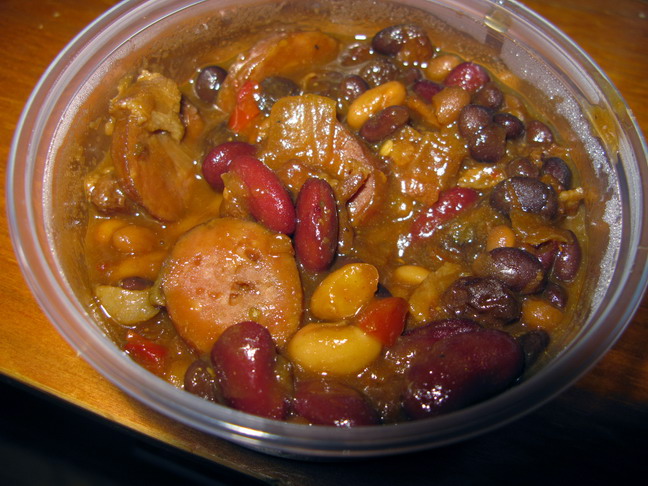
Oh, and their beans. I mentioned them before, but I want to talk about them more in depth. These are like no barbecued or baked beans you have ever had before. For one thing, they use a mixture of navy, black, kidney and pinto beans in their recipe, which flies right in the face of tradition. And they are flavored with lots of spices, including a bit of cinnamon and chili pepper. There’s a good amount of sweetness to the beans, but they are also redolent of smoke courtesy of the Italian sausage slices cooked in them, and there is a tang of vinegar to make a graceful top note in the melange of flavors. My favorite thing about them, though, is the clever use of raisins, which are cooked along with the beans and sausage. They simmer long enough to soften and at first, they look just like a bean, but then you bite into them and you get a burst of sweetness and it is like, “What is this honey-like thing I am eating?” And then you realize it is a raisin and it works perfectly in the dish and you just want to take your hat off to the chef, but that would necessitate putting down your spoon, so you just keep eating.
Now, the folks at Kiser’s also offer grilled burgers and chicken, and I am sure they are really good, but I have to admit, I haven’t tried them yet. I was going to for this review, and I should have, but every time I go in, I smell the smoke and I cave in and just go for the ‘cue. So, I will have to maybe amend this post later on after I have finally tasted a burger or grilled chicken sandwich just so I can comment on it. (They also have desserts that sound great, like home-baked brownies, but I have never left room for sweets when I eat there. Why do that when there are beans and barbecue to be had?)
I also want to make mention of the fact that I have been told that they source their vegetables locally, as well as all of their sausages. Currently, their meats are not local, because the large amounts of very specific cuts are just not possible for them to purchase from local farmers at this time.
However, this is one of the most ecologically conscious restaurants I have ever frequented, where they use biodegradable and compostible utensils and serving ware. The paper towels are recycled, and they use nearly indestructible metal baking pans to serve their dine-in guests instead of plastic ones that can be subject to many mishaps in the kitchen and which will easily find their way into a landfill.
The restaurant is open from Monday to Saturday 11 am to 9 pm, and Sunday noon to 6 pm for both dine in and carry out.
They also deliver–you can call them at 595-RIBS and place an order, and they will cheerfully bring it to your door.
I know, because our house was their first delivery.
Now, I have to stop writing, because I am about to start fasting for a medical procedure and I don’t want to be torturing myself with thoughts of all the barbecue I am not currently eating, but could be. Otherwise, I could probably go on and on and on about the beautiful food offered at Kiser’s.

Categories:
- Admin (rss) (55)
- Blogs and Blogging (rss) (81)
- Book Reviews: Cookbooks (rss) (43)
- Book Reviews: Non-Cookbook Food Books (rss) (38)
- Cats and Cat Blogging (rss) (47)
- Chinese Cooking Lessons (rss) (32)
- Culinary School Stories (rss) (18)
- Dairy Pruducts: Cultured and Barbaric (rss) (4)
- Documentary Filmmaking (rss) (1)
- Essays, Rants and Reflections (rss) (260)
- Fighting Hunger (rss) (12)
- Food and Kids (rss) (45)
- Food in the News (rss) (126)
- Food Media (rss) (98)
- Food Preservation (rss) (18)
- Food Safety (rss) (45)
- Gardening (rss) (30)
- Herbs and Herb Blogging (rss) (20)
- Holidays (rss) (50)
- Kat Blogging (rss) (22)
- Kitchen Science (rss) (36)
- Leftover Makeover (rss) (8)
- Life, the Universe and Everything (rss) (131)
- Local and Sustainable (rss) (227)
- Local Athens Food and Foodies (rss) (42)
- Meatless Mondays (rss) (32)
- Menu For Hope (rss) (5)
- Nutrition, Diet and Health (rss) (84)
- On The Farm (rss) (8)
- Recipes: Almost Vegetarian, Vegetarian and Vegan (rss) (294)
- Recipes: American Regional (rss) (37)
- Recipes: Appalachian Hillbilly (rss) (33)
- Recipes: Bread, Pasta, Grains (rss) (95)
- Recipes: Canning and Preserving (rss) (8)
- Recipes: Chinese (rss) (123)
- Recipes: Comfort Food (rss) (120)
- Recipes: Cookies (rss) (16)
- Recipes: Desserts (rss) (48)
- Recipes: French (rss) (25)
- Recipes: Fruits and Vegetables (rss) (302)
- Recipes: Greek, North African and Middle Eastern (rss) (31)
- Recipes: Indian (rss) (137)
- Recipes: Italian (rss) (42)
- Recipes: Japanese (rss) (7)
- Recipes: Jewish (rss) (4)
- Recipes: Korean (rss) (6)
- Recipes: Meat, Poultry and Fish (rss) (220)
- Recipes: Mexican/Native American/ Latin American/Caribb (rss) (27)
- Recipes: Original (rss) (108)
- Recipes: Thai (rss) (27)
- Recipes: Tofu (rss) (17)
- Recipes: US Regional (rss) (16)
- Recipes: Vietnamese (rss) (8)
- Restaurant Stories (rss) (28)
- Sewing, Quilting, Arts and Crafts (rss) (16)
- Simple Chinese Recipes (rss) (30)
- Slow Food and Heritage Foods (rss) (10)
- Spice Blogging (rss) (44)
- The Chinese Cookbook Project (rss) (14)
- The Chinese Pantry (rss) (39)
- The Documentary (rss) (2)
- The Kitchen Saga (rss) (17)
- The Locavore's Bookshelf (rss) (15)
- The Unsung Adventures of The Culinary Nerd (rss) (6)
- Tools and Toys (rss) (35)
- Uncategorized (rss) (10)
- With a Side of Politics (rss) (48)
Archives:
- August 2012 (9)
- July 2012 (12)
- September 2011 (3)
- August 2011 (7)
- July 2011 (8)
- June 2011 (16)
- May 2011 (17)
- April 2011 (11)
- December 2010 (9)
- November 2010 (5)
- February 2010 (1)
- December 2009 (5)
- November 2009 (7)
- October 2009 (10)
- September 2009 (16)
- August 2009 (14)
- July 2009 (14)
- June 2009 (7)
- May 2009 (17)
- April 2009 (10)
- March 2009 (25)
- February 2009 (13)
- January 2009 (10)
- December 2008 (5)
- November 2008 (5)
- October 2008 (6)
- September 2008 (13)
- August 2008 (8)
- July 2008 (11)
- June 2008 (18)
- May 2008 (13)
- April 2008 (14)
- March 2008 (16)
- February 2008 (17)
- January 2008 (19)
- December 2007 (25)
- November 2007 (18)
- October 2007 (24)
- September 2007 (16)
- August 2007 (15)
- July 2007 (15)
- June 2007 (10)
- May 2007 (14)
- April 2007 (16)
- March 2007 (17)
- February 2007 (20)
- January 2007 (13)
- November 2006 (1)
- October 2006 (8)
- September 2006 (14)
- August 2006 (25)
- July 2006 (30)
- June 2006 (28)
- May 2006 (34)
- April 2006 (29)
- March 2006 (24)
- February 2006 (30)
- January 2006 (38)
- December 2005 (40)
- November 2005 (37)
- October 2005 (32)
- September 2005 (25)
- August 2005 (30)
- July 2005 (28)
- June 2005 (21)
- May 2005 (8)
- April 2005 (22)
- March 2005 (17)
- February 2005 (29)
- January 2005 (10)
Search Site:
Links:
- Lily’s Wai Sek Hong
- 101 Cookbooks
- A cat in the kitchen
- A Veggie Venture
- Accidental Hedonist
- Cha Xiu Bao
- chez pim
- Chocolate & Zucchini
- Chopstick Cinema
- Chowhound.com
- Chubby Hubby
- Cook sister!
- Cooking with Amy
- da*xiang
- Eat Local Challenge
- Eating Liberally
- Ecocentric
- Eggbeater
- Epicurious
- Farmgirl Fare
- Fatfree Vegan
- Foodgoat
- ForkandBottle.com
- Green Olive Tree
- Hooked on Heat
- Jaden’s Steamy Kitchen
- Kalyn’s Kitchen
- Lucullian delights
- Mahanandi
- Matt Bites
- MeatHenge
- mmm-yoso!!!
- New York Times – Dining & Wine
- Pizza Goon
- Rasa Malaysia
- Ruhlman
- Sailu's Kitchen
- Serious Eats
- SF Gate: Food & Dining
- Simply Recipes
- Soul Fusion Kitchen
- Tastespotting
- The Amateur Gourmet
- The Cleaner Plate Club
- The Food Section
- The Grub Report
- thecookscottage
- U.S. Food Policy
- Wandering Chopsticks
- Washington Post Food and Dining
- Wasted Food
Meta:


Powered by WordPress. Graphics by Zak Kramer.
Design update by Daniel Trout.
Entries and comments feeds.