
Cook Local, Eat Global
I Have Returned….For Real This Time

First of all, I want to thank everyone who has posted here, emailed me, stopped me on the street or called me on the phone to extend best wishes and the hopes that all is well with my family and myself. My readers are among the best people in the world–caring, curious, interested, intelligent, compassionate, kind and creative, and, luckily, patient.
Secondly, I want to apologize for my recent silence. Long-time readers probably noted that my posts had begun to dwindle from a hearty gush of verbiage to a steady stream to a bare trickle over the past few months, so I am sure that some of you were not particularly surprised by my sudden absence in the blogosphere. The reasons for my absence are simple, really, but are not ones I want to go into publicly–I don’t think it is proper to go into what exactly happened to cause me to go silent. Suffice to say that what has been on my mind for the past six weeks when it comes to food, cooking, restaurants and recipes is not appropriate for me to opine upon publicly. I just don’t roll that way. (Although, if one is curious, and one sends an email, and one asks nicely, one might get a private answer to further enlighten one–especially if one is a long-time reader or internet friend.)
Basically, I had to make a hard decision, one that affected how I felt about food while I was making it, and which potentially would affect how I felt about food in the immediate future, and I didn’t want to give an expose on my thoughts while I was thinking them.
The astute among you have probably divined the nature of the decision, but for those who don’t know me as well as all that, I decided to stop working at Restaurant Salaam, and have instead decided to focus my time and energy on my family and other projects, including this vastly neglected blog. It was a hard decision, and in poring over the facts and assumptions in my head as I prepared to make my decision, I had to keep it all to myself, for many, many reasons, especially professional ones.
Now that we have the not fun stuff out of the way, let me tell you a bit about what has been going on in my life that is more positive!
As you can see from the photograph above, which I posted for Kat’s internet family of virtual aunties and uncles, Kat has started eating apples on her own. That is her first one–she just plucked it up from the fruit basket graciously sent to us by Dan’s parents over the holidays, and took a big old bite from it. And, as you can see, as she chomped, munched and crunched her way through the crispy fruit, she had a great time. There was much lip-smacking, finger-licking and teeth bearing involved in the process.
She is finally learning to talk, although her expressive language (that means talking–her receptive language skills, which relate to how much she understands and comprehends–is above average for her age) is significantly delayed. This is a cause of concern, and we are currently working to get her in with the best local speech therapist available, who comes highly recommended by just about every professional we talk with on the issue. Just this week, Kat’s speech has improved greatly–words are starting to come out perfectly and clearly, and she has started using more of them, even in combination, which she had not done before. She also knows her letters–which makes me think at times that she will learn to read before she effectively learns to speak!
But we are being patient, reading up on the issue, taking her out to play with other kids, talking and reading with her and doing all the stuff we should be doing. It is just–well, it is frustrating, especially for her. But, we are confident that she will get there, especially with two parents around more often than not, both working with her at every opportunity..
Morganna is doing great–she started her second quarter of college a few weeks ago and is having a lot of fun in her classes. She is still working as a line cook at Salaam, which she loves doing, and she is happy, especially now that her best friend from childhood has decided to move here to Athens.
Zak is doing great–he has taken up learning how to fingerpick acoustic guitar and after a month sounds like he has been at it for about a year. He is planning on returning to playing out in public again, which is great for him, not only because it is fun, but because he even gets paying gigs now and again.
As for me–I have gone back to cooking and enjoying it at home again. I had stopped really liking food for a while, and while I still don’t eat as much as I once did and have lost over twenty pounds in the past six months or so, my passion for culinary arts is re-awakening. I also have been busy sewing gifts for my family and friends–for the past holiday season, I have completed a queen sized rag quilt, a throw sized quilt, about fifteen aprons, a case for Zak’s Japanese bamboo flute (shakuhachi), a set of patchworked and embroidered placemats, a doll quilt, mattress and pillow set for Kat and have started assorted other projects. I am looking into starting an Etsy shop to sell my aprons and other kitchen-themed quilted items, and as soon as that happens, I will let readers here know about it. In the meantime, if there is interest, I will post photos of the holiday projects here to show people what I have been up to while also being wrapped in my self-imposed cocoon of silence.
So, there you have it. The news of my and my family’s whereabouts, health and well-being.
I have some original recipes to share with you coming, so look for them in the near future.
Blessings and thanks to everyone who has asked about us–and I hope that everyone of you had a great holiday season.
Making Aprons
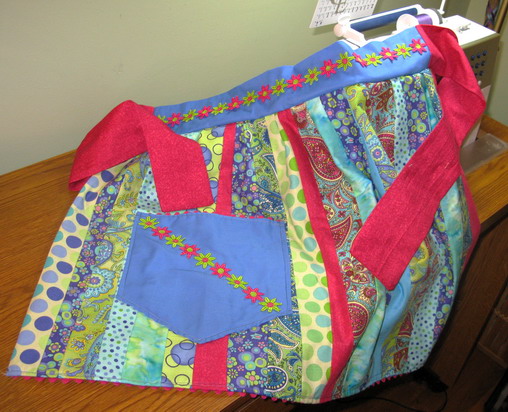
Last year, I wrote a post singing the praises of vintage and new aprons which were worn by home cooks–our Grandmas, Moms, Aunts and which were at one time ubiquitous in the American kitchen. The apron revival I wrote about then is still going strong, and there are more and more people making new aprons that look old, and new aprons that look contemporary and new aprons made from old fabric, and so on, so forth and on and on.
National Tie One On Day was celebrated for the third year in a row a week ago today, on Thanksgiving, and local independent fabric stores and quilt shops participated in the event by holding apron “sew-ins” where sewers and quilters gathered to make aprons to donate to women’s shelters and other charitable organizations.
And, this year, I finally got off my duff and started making aprons myself.
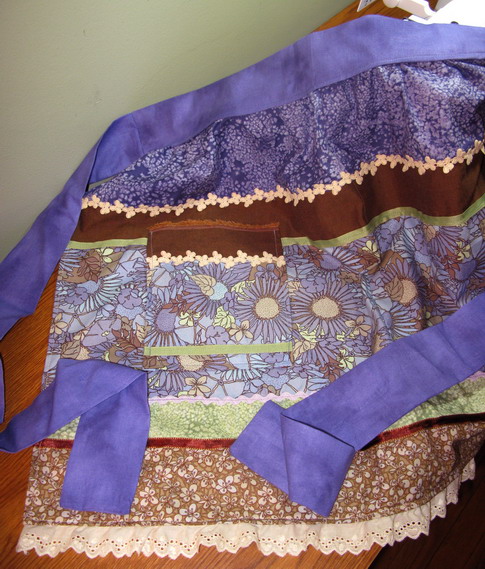
I am making a whole passel of them as gifts for friends and co-workers (none of whom read this blog–except you, Hilarie–and you I can trust to keep mum about my plans), with each apron’s fabric, trim, design and colors chosen to reflect the personality of the recipient. I am very proud of the results–I have most of them finished at this point, and wanted to share pictures of them with you all here today.
Most of these aprons were made without patterns, and all but two of them are lined. The first apron pictured here was made by piecing asymmetrical strips of fabric into long rectangles, and then cutting the two halves of the apron skirt out of those rectangles. I lined the skirt with the same fabric that I used for the waistband and pocket, and then made soft pleats in the skirt before sewing it to the waistband in order to create fullness and swing in the skirt, since the recipient is a very slender woman who is very energetic. That way, the skirt will swing around her hips as she races around the dining room at top speed. The colors and trim suit her energetic, bubbly personality.
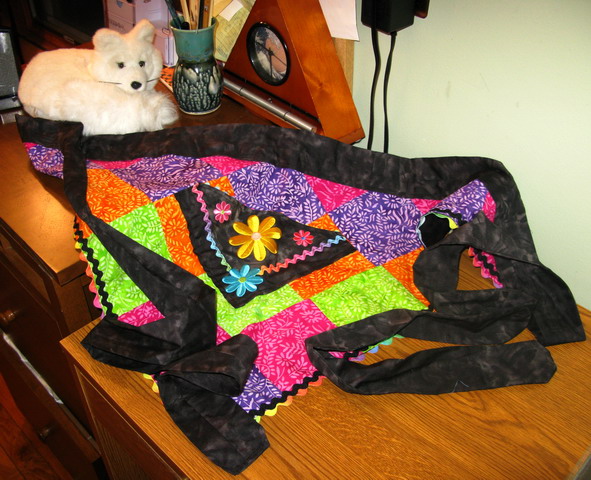
The second apron pictured above is actually the first one I made. The vibrantly colored batiks that make up the triangular skirt of the apron that I think of as the “boho gypsy hippie-queen apron” were bought as a packet of pre-cut squares called “charm squares” in the fascinating cultural subset of quilters and quilting stores. These time-saving pre-cut fabrics can be combined in a variety of projects, and are a good way to put a quick apron together. Once again, I made this apron without a pattern, and lined it completely with the black fabric that I used for the waistband, ties and pocket.
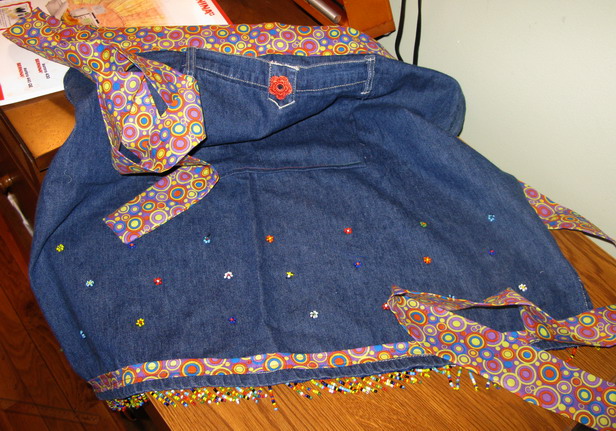
The third apron is one I made from an old skirt that while it was now too big to wear, I didn’t have the heart to get rid of. The beaded fringe and little bead flowers are part of the original skirt, but the center pocket I made out of the center back waistband and panel of the skirt using the existing belt loops as a design element. The little orange crocheted applique on the pocket was made in India and has a round mirror in the center–I picked up packets of these on sale at Walmart, if you can believe it.The fabric I used for the new waistband and trim at the hem I picked up without knowing what I was going to use it for–I just knew it would look cool somewhere. It fit the colors and themes of this project so perfectly, that it looks like it was an apron and not a recycled skirt all along.
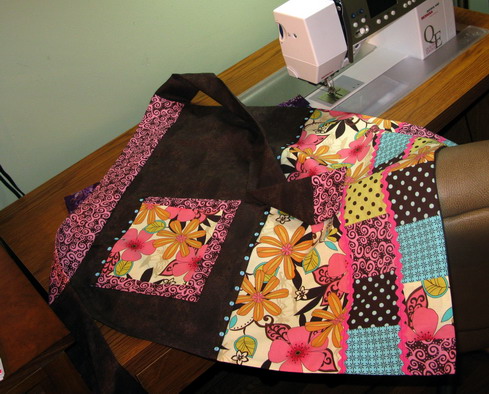
The fabric for this long “bistro-length”, flat (not pleated or gathered) apron is another set of pre-cuts I bought a year or so ago, with no idea at all what I was going to do with it. This packet was a set of what quilters call “fat quarters”–which are quarter-yards cut from half-yard pieces across the width of the fabric, not the length, so that larger, more usable pieces are made than you get if you just cut a quarter yard from the length of a bolt. (Fabric is wrapped up in bolts for display in fabric stores, and usually, it is measured out directly from the bolt. A quarter-yard cut from the bolt is a piece eight inches by the width of the fabric, which is usually forty four inches. In contrast, a fat quarter measures eighteen inches by twenty-two–a much more useful piece of material for quilting–and apron-making.
Anyway, I saw those really pretty fabrics and had to have them, though I had no clue what to do with them. Later, after I figured out I was going to make an apron for one of our belly-dancers with it, I bought that pretty brown print to be the main body of the apron, and was really pleased by how it came out. I am making a similar apron for myself, probably after the holidays, using the same kind of design, but in different colors with reproduction vintage fabrics.
I bought the fabrics for this apron specifically to use for an apron for this one specific person. I had a vision in my head of exactly what I wanted it to look like, and I found a bunch of fat quarters bundled together that were perfect, though I added the salt-dyed green and violet blue and the variegated lavender fabric from my own stash. This apron, which is inspired by a pattern I have had for years, is one of only two which are not lined. (The other is the one recycled from an old skirt, pictured above.) I didn’t line this one, because I wanted it to have a lighter, more airy feel, so I ended up finishing all of the seams with zigzag stitches to keep them from raveling in the wash.
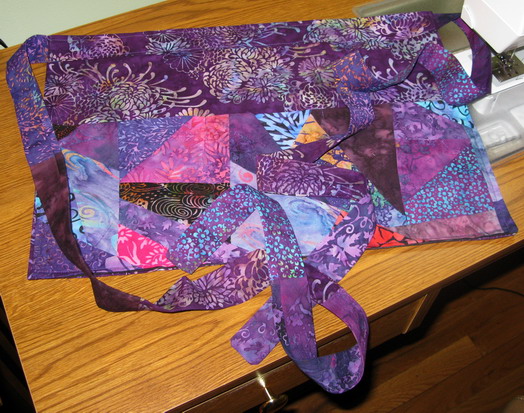
This one I just finished last night, and I patterned it off of a typical short server apron that has three pockets that span most of the front of the apron. In this version, the crazyquilted panel is the pocket–I made it by making the panel first, then cutting it to the proper size and shape and lining it with black hand-dyed fabric–the very same fabric I used for the back lining of the apron. The front skirt of the apron, and the waistband are made from a batik in the pattern of Asian chrysanthemums that I had bought for Zak’s crazyquilted Buddha wallhanging I made for him earlier this year, but it turned out not to fit the theme. I am glad that it found a home in this project, which is for someone who always wears deep, rich colors, and who always looks elegant.
The rest of the batiks are scrap bits leftover from other projects including Zak’s wallhanging, Kat’s quilt and Morganna’s quilt which I made her for Christmas this year. (And yes, I gave it to her already, so I can post photos of it later this week or next.)
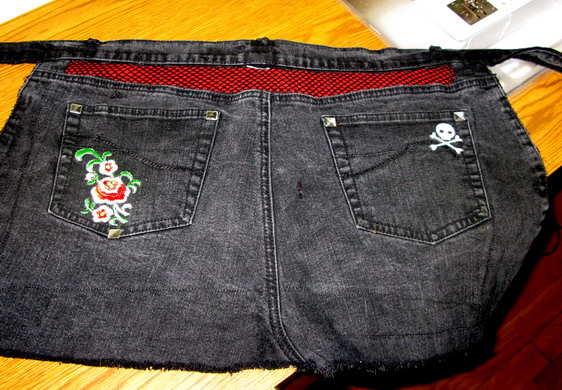
This is the punk rock apron I made for our waitress whose nickname is “rock star.” She’s a musician who describes herself as a punk-rock cowgirl, and she wears thriftstore makeovers in a style which I once heard described as “the disheveled rock-star look.”
I made it from an old pair of my jeans which had holes and which were quite too large for me (I’ve lost a lot of weight over the past few months, and am still losing), which I took apart and re-tooled. The fishnet panel where the back yoke would be is real fishnet from an old pair of my fishnet pantyhose that were too stretched out that I stitched to a backing of red fabric bonded with fusible web interfacing to a piece of the black denim. This panel makes a deep, wide pocket in the apron, so it has that huge pocket, plus the existing two back patch pockets. It can hold lots of goodies, including lots of tips! The rest of the decorations I added using iron-on appliques. I don’t have an embroidery machine.
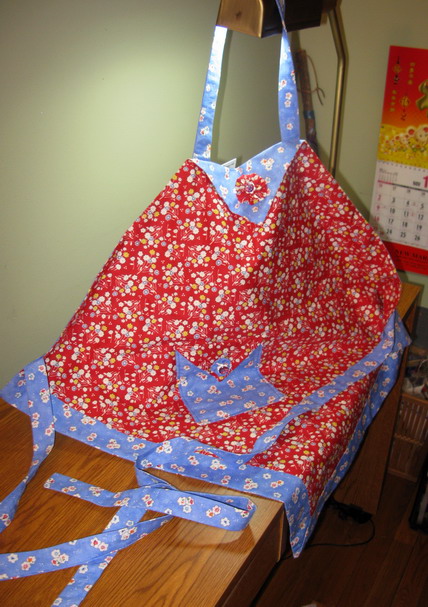
This one is for a sweet lady who does dishes with us on the weekends. I did use a pattern for this apron, though I have to say that if I wrote recipes the way a lot of people write instructions for their patterns, everyone would hate my blog! Morganna and I picked out two cheerful reproduction 1930’s prints for this apron, and I made rosettes, called yoyo’s, which were popular in quiltmaking back then, to trim the folded over bits on the bib and the pocket. Then I stacked a white flower-shaped button with a red and blue sparkling glass button to trim the center of the fabric rosettes. The result is very cheery and pretty, which describes out dish-washing friend perfectly.
This last apron is so beloved by Kat that every time she sees it, she insists upon wearing it, so I have to tuck, tie and fold it to fit her, but she loves it. So, I am making a version for her to give her for the holiday. I’ll post a picture of it, when it it is done.
So, here they are–my first crop of aprons.
I am very proud of them–and I am not sure what to do after I am done gifting everyone I know with an apron.
Zak says I should start an Etsy store and sell them from this website–I’ll think about that. It might be fun.
Holiday Week Woes Update
Fear not.
Morganna’s ultrasound, like her CT scan, turned out perfectly normal. Her white cell count is still not elevated, and her pain is gone, as is her general malaise and nausea.
She is, in a word, fine.
When the ER doctor suggested it was a virus, I was skeptical, but Morganna’s regular doctor said there was a virus that almost exactly mimicked appendicitis, and it could be that she had it. There had been cases of it reported at the hospital and in his practice, so it was a possibility.
It looks like that is the case, because Sunday night. Zak started showing symptoms–the exact same ones Morganna did. He is okay now–for whatever reason, it seems to be cycling through him faster than it did with her.
And–last night, both Kat and I started having stomach pains. Neither of ours stayed in the lower right quadrant of the abdomen, and since appendixes do not go traveling around the body cavity, I am pretty sure it is just this weirdo virus.
I just wish I could remember the name of it. No one has a fever, but is is really painful. It feels like it felt when I had two duodenal ulcers about twelve years ago, but it flares up with pain more intense than that.
Weird.
At least it seems to go away semi-quickly.
Salmon Baked With Yogurt and Coriander Chutney

I know that salmon is not native to India.
It is a cold-water fish, native to the northern Pacific, northern Atlantic and the chill rivers where they spawn.
But, it is an awfully tasty fish, and we happened to have quite a few fillets of it in the freezer at Restaurant Salaam, and I needed to do something with it. And, as all of the dinner specials that weekend had an Indian theme, I thought to myself, “You know, the folks in Northern India do a good bit of coating meats and fish in yogurt and either grilling it or cooking it in a tandoor. So, I wonder what it would taste like if I treated salmon that way and baked it?”
Yogurt really doesn’t necessarily sound like it would taste good with salmon. I know that it isn’t the first thing that comes to my mind when I think of the pale pink fish. But when you factor in Indian spices, and you realize that the yogurt keeps the fish deliciously moist, then your mind starts to expand with the possibilities.
Because as much as I love salmon, there are a few problems with cooking it. While it is an oily fish, it can dry out quite easily, and that is not a good thing. Dry fish is sad fish, and sad fish makes for sad diners.
And sad diners make everyone sad.
So, in order to alleviate unneeded, unwanted sorrow in the dining room, I am against overcooking or otherwise abusing innocent salmon fillets. The truth is, I am against abusing any fish anywhere, because they are such a delicious, and usually, healthy food to eat, but some people, having eaten badly cooked fish in the past, think they don’t like it. And that makes me sad–so, I set out to change people’s minds, and get them to try fish that isn’t dried out, icky or otherwise unpalatable.
So, back to the yogurt thing.
Yogurt, when used as a marinade for meat, where the meat is coated and allowed to sit in the fridge overnight, acts as a tenderizer. The lactic acid in the yogurt helps denature the protein molecules on the surface of the meat, making chicken or seafood velvety in texture. Lamb marinated in this way is not only tender, but filled with rich flavor that no other marinade can impart.
Knowing as I do that in India, seafood is often marinated in yogurt to tenderize it (shellfish in particular, though never overnight–that would over-tenderize the little guys and give the flesh a mushy texture which is less than appealing), I decided to try the trick with salmon. Not only would I marinate the fillets in yogurt, I would also bake them coated completely in the creamy stuff, which effectively buffers the fish from the dry, hot air of the oven and seals in the natural juices and flavors.
At least, that is what I theorized would happen. I wasn’t quite sure what would happen, really–this is called cooking by the seat of the pants, and since I am such a geek and read about food obsessively and experiment continually, I have a broad data bank in my head for my instincts to work from. So, when I get these seat-of-the-pants ideas, I am almost always right, although it isn’t luck that steers me correctly–it is because I have squirreled away every tidbit about food and cooking from everywhere around the world in my brain to the point that I may not remember exactly where I read something, but I do remember reading it, even if the memory is on a subconscious level.
Anyway, what flavors would I add to the yogurt. Plain yogurt and salmon is not an appealing combination, so I decided I wanted something that I knew would be good with fish, and that would add moisture, have a smooth texture and turn the yogurt into a sauce that would be nice soaked into the basmati rice I was going to be placing under the fish as a side starch.
Coriander chutney, also known at my house and now at Restaurant Salaam as simply, “green” fit the bill.
It also has the virtue of being very fast and easy to make, especially if one employs a food processor.
So, I whipped up some “green” in our faithful whiz-bang food processor, and mixed it up in a ratio of 1:1 with strained Greek-style yogurt, then stirred in some finely diced red onion and an extra squeeze of lime juice, and bathed the salmon fillets in it, coating them with the pale jade-colored mixture. When I set up the individual baking casseroles, I made sure to add extra sauce, coating the fish and the rice completely in it before adding a handful of halved cherry tomatoes to the sides of the fish, atop the sauce. (This added contrasting color and a great flavor–cooking cherry tomatoes in a convection oven on high heat like we do at Salaam results in a velvety texture and concentrates the naturally sweet flavor of the little fruits.)
How did it turn out?
Well enough for me to write about it!
Truthfully, lots of guests raved about the dish, asking how it was made and why the salmon was so tender and juicy. I credited the genius of the Northern Indian cooks who first used yogurt as a marinade generations ago for the idea.
Here it is–a really easy, delicious salmon dish that is pretty much guaranteed not to dry out or taste fishy, with many thanks to the traditional cooks in India whose cuisines gave me the idea for this dish.
(That said, I want to take this opportunity to write, even though I try not to get political on this blog, a wish for peace in India. I know that the attacks in Mumbai last week were not the first nor will they likely be the last terrorist attacks in India, but I also know that everyone I have ever known who is either from India, or lives in India, or is of Indian descent, has been a most loving, compassionate and wonderful person. Every last one of them. So, my heartfelt wishes for a peace goes out to all the people of India, and all the others who were hurt by this tragic attack. Perhaps our prayers from around the world can be felt and help soften the pain and suffering in Mumbai and beyond.)
Salmon Baked in Yogurt and Coriander Chutney
Ingredients:
2 cups cilantro leaves and stems, roughly chopped
1 cup fresh mint leaves and stems, roughly chopped
5 cloves garlic, peeled and roughly chopped
1-5 green red thai chili, stem removed (Use as many as you like for the heat you like.)
1 1/2″ cube fresh ginger, peeled and sliced
zest of one lime or lemon
1/3 cup lime juice
pinch ground cumin
1/4 teaspoon ground coriander
2 teaspoons Aleppo pepper flakes
1 tablespoon canola oil
salt to taste (at least one teaspoon)
2 3/4 cups strained Greek-style yogurt (Fage is a good brand)
1/2 cup finely diced red onion
8 salmon fillets (wild caught Pacific salmon is the best here)
canola oil as needed to oil baking pans
3 cups cooked and cooled steamed basmati rice (this is a good way to use leftover rice–or basmati pillau, if you have that)
1 cup washed and halved fresh cherry tomatoes
Fresh cilantro sprigs, lime slices and finely diced red onion as garnish
Method:
Preheat oven to 375 degrees F.
Put the ingredients from the cilantro to the salt into the bowl of a food processor with the all-purpose blade and process into a finely chopped, fairly dry green paste. Scrape into a mixing bowl and add the yogurt and red onion, and whisk together until a smooth, pale jade green sauce flecked with purple bits of onion is formed.
Clean your salmon fillets–check for pin bones and remove them with your fingers, tweezers or a pair of pliers. Remove any stray scales, rinse the fish and pat it dry. Layer the fish into a baking pan and pour two-thirds of the yogurt and chutney sauce over it, being certain to coat all of the fish with the marinade. Allow it to sit refrigerated for a half hour.
Meanwhile, lightly oil another baking dish or individual casseroles with a bit of canola oil, and place rice in thin layer of the bottom of the pan(s). Drizzle reserved 1/3 of the sauce over the rice, covering as much of it as possible.
Lay the fish out on top of the rice, so that the fish is not overlapping. Pour the marinade from the bowl over the fish so it is completely covered in the sauce. (This is easier to do in individual casserole dishes, frankly. If you don’t have them make a double batch of the sauce to make certain to have enough to use in whatever size baking dish you have that will fit the fish.)
Sprinkle the tomatoes around the fish, covering any rice that is not covered by the fish fillets.
Bake, uncovered, for about ten-fifteen minutes, or until the internal temperature of the fish fillets registers between 120 degrees F and 140 degrees F, or until the fish flakes easily. (It all depends on how done you like your fish.)
Sprinkle cooked fish with diced red onion, and artfully garnish with sprigs of cilantro and twists of lime, then serve it forth while it is still hot and tasty.
Chicken With Gai Lan
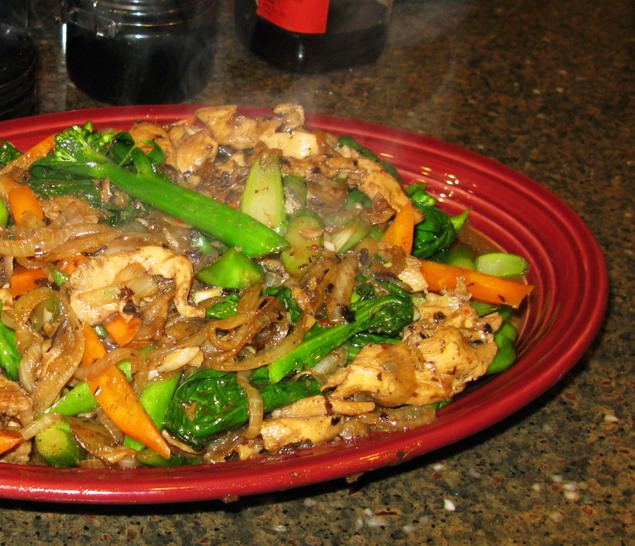
Gai lan, as regular readers probably already know, is one of my favorite vegetables. Often known in English as either Chinese broccoli or Chinese kale, this green has thick, crisp stems and fleshy leaves, and has a unique, sweet flavor that is only barely akin to the tastes of either of its American vegetable cognates. Don’t get me wrong, I love both broccoli and kale, which have been two of my favorite vegetables since childhood, but to me, gai lan is vastly superior to both in terms of both texture and taste.
And, what is even better, is that gai lan is a cold-weather vegetable, which means, it is in season now. And, as I have discovered while growing it on our deck, it gets sweeter after a good frost, just like my beloved kale.
So, I have been taking every chance I can to harvest my little stand of it from my deck garden, so I can add it to the weekly stir-fry.
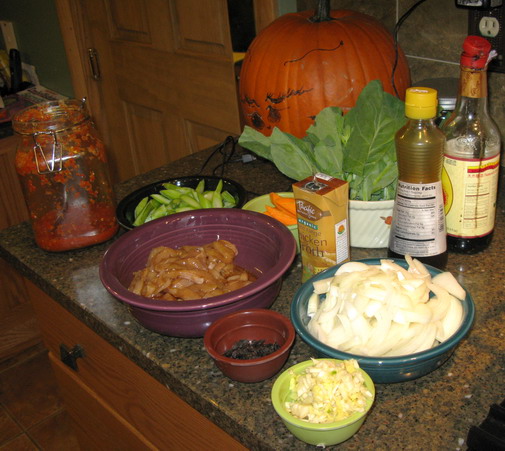
Normally, I prefer to cook gai lan with beef, which is a classic Cantonese combination, but I have also found it to be delicious with tofu or pork. This time around, I made it with chicken, because Kat was having a growth spurt and has been craving protein, and chicken is her favorite meat. (I can always tell when she is growing–Kat will turn her nose up at fruits, rice, crackers and even cookies, and instead inhale eggs, cheese and meats of every kind.)
Besides, I had fresh chicken from Bridlewood Acres Farm, here in Athens, and their hens are delicious, free-range birds. Their eggs are the best, too, with deep golden yolks, rich with vitamins and flavor. I also had some really sweet organic carrots from Shade River Farm, so It was only natural that I chose to add them to the dish.
I do want to say one thing–I know that a lot of people object to eating locally during the winter, because they think that there are no vegetables to eat at that time, but I disagree. In late November, we still have plenty of different delicious vegetables in our Farmer’s Market. Beets, turnips, daikon, carrots, parsnips, sweet potatoes, potatoes, pumpkins, a zillion different kinds of winter squashes, onions, garlic, leeks, dried beans, pole beans, broccoli, cauliflower, cabbages, bok choi, tatsoi, mizuna, kale, collards, mustard greens and a huge variety of salad greens are all over the market, and one grower who has greenhouses even has tomatoes and sweet bell peppers. No, it is nothing like the varied plethora of produce we have in the summer months, but there are still plenty of great foods that make for a varied, flavorful and healthy diet.
I do understand that we are lucky here in Athens to have a good climate where a lot of vegetables can be grown year-round, and we are blessed by a really strong, vibrant farm economy, but one of the great things about eating locally for me, has been learning new ways to cook seasonal vegetables, not only in the summer, but all year round, and I hope that my experiences might inspire others to try some new foods if they get the chance.
Anyway, this dish of chicken and gai lan with carrots is a really good, light but satisfying meal for a late autumn, early winter supper, and I am happy to report that everyone, including Kat, loved it.

Chicken with Gai Lan
Ingredients:
1 pound boneless, skinless chicken breast or chicken thighs cut into thin 1″X1/2″ slices
1 tablespoon Shao Hsing wine or sherry
1 tablespoon light soy sauce
2 tablespoons cornstarch
3 tablespoons canola or peanut oil
1 1/2 cups thinly sliced onions
1 tablespoon fermented black soybeans
1 1/2″ cube fresh ginger, peeled and minced
3 cloves garlic, peeled and minced
2 tablespoons light soy sauce
1 tablespoon Shao Hsing wine or sherry
1 large carrot, peeled and thinly sliced into diagonal, oval-shaped slices (about 1/8″ thick)
1 pound gai lan, bottoms of stems trimmed and thick stems sliced thinly on the diagonal, thin stems and leaves cut into bite-sized pieces
1/2 cup chicken broth or stock
1/2 teaspoon toasted sesame oil
Method:
Toss chicken meat with the first measures of wine or sherry and soy sauce. Sprinkle with cornstarch, then toss with your hands to coat the chicken pieces thoroughly.
Heat wok until a thin ribbon of smoke coils up from the hot metal. Add oil, and allow to heat for about another thirty seconds. Add onions, and cook, stirring, until they turn golden and translucent. Add soybeans and ginger, and keep stirring for thirty seconds. Add chicken, and spead out over the bottom of the wok in a single layer. Sprinkle the garlic on top of the chicken and allow the chicken to cook undisturbed for a minute or until the meat browns well on the side touching the wok. Start stirring and cook until most of the pink is gone. Add soy sauce and wine and cook, stirring for thirty more seconds.
Add carrots and thick stem slices of gai lan and cook, stirring until the chicken has no pink showing the vegetables are tender–about one minute. Add the broth or stock and the thin stem and leaf pieces of gai lan, and cook, stirring until the gail lan leaves wilt, and the sauce reduces to a nice, thick brown glaze–about another minute.
Remove from heat and drizzle with sesame oil and serve immediately with steamed rice.

Categories:
- Admin (rss) (55)
- Blogs and Blogging (rss) (81)
- Book Reviews: Cookbooks (rss) (43)
- Book Reviews: Non-Cookbook Food Books (rss) (38)
- Cats and Cat Blogging (rss) (47)
- Chinese Cooking Lessons (rss) (32)
- Culinary School Stories (rss) (18)
- Dairy Pruducts: Cultured and Barbaric (rss) (4)
- Documentary Filmmaking (rss) (1)
- Essays, Rants and Reflections (rss) (260)
- Fighting Hunger (rss) (12)
- Food and Kids (rss) (45)
- Food in the News (rss) (126)
- Food Media (rss) (98)
- Food Preservation (rss) (18)
- Food Safety (rss) (45)
- Gardening (rss) (30)
- Herbs and Herb Blogging (rss) (20)
- Holidays (rss) (50)
- Kat Blogging (rss) (22)
- Kitchen Science (rss) (36)
- Leftover Makeover (rss) (8)
- Life, the Universe and Everything (rss) (131)
- Local and Sustainable (rss) (227)
- Local Athens Food and Foodies (rss) (42)
- Meatless Mondays (rss) (32)
- Menu For Hope (rss) (5)
- Nutrition, Diet and Health (rss) (84)
- On The Farm (rss) (8)
- Recipes: Almost Vegetarian, Vegetarian and Vegan (rss) (294)
- Recipes: American Regional (rss) (37)
- Recipes: Appalachian Hillbilly (rss) (33)
- Recipes: Bread, Pasta, Grains (rss) (95)
- Recipes: Canning and Preserving (rss) (8)
- Recipes: Chinese (rss) (123)
- Recipes: Comfort Food (rss) (120)
- Recipes: Cookies (rss) (16)
- Recipes: Desserts (rss) (48)
- Recipes: French (rss) (25)
- Recipes: Fruits and Vegetables (rss) (302)
- Recipes: Greek, North African and Middle Eastern (rss) (31)
- Recipes: Indian (rss) (137)
- Recipes: Italian (rss) (42)
- Recipes: Japanese (rss) (7)
- Recipes: Jewish (rss) (4)
- Recipes: Korean (rss) (6)
- Recipes: Meat, Poultry and Fish (rss) (220)
- Recipes: Mexican/Native American/ Latin American/Caribb (rss) (27)
- Recipes: Original (rss) (108)
- Recipes: Thai (rss) (27)
- Recipes: Tofu (rss) (17)
- Recipes: US Regional (rss) (16)
- Recipes: Vietnamese (rss) (8)
- Restaurant Stories (rss) (28)
- Sewing, Quilting, Arts and Crafts (rss) (16)
- Simple Chinese Recipes (rss) (30)
- Slow Food and Heritage Foods (rss) (10)
- Spice Blogging (rss) (44)
- The Chinese Cookbook Project (rss) (14)
- The Chinese Pantry (rss) (39)
- The Documentary (rss) (2)
- The Kitchen Saga (rss) (17)
- The Locavore's Bookshelf (rss) (15)
- The Unsung Adventures of The Culinary Nerd (rss) (6)
- Tools and Toys (rss) (35)
- Uncategorized (rss) (10)
- With a Side of Politics (rss) (48)
Archives:
- August 2012 (9)
- July 2012 (12)
- September 2011 (3)
- August 2011 (7)
- July 2011 (8)
- June 2011 (16)
- May 2011 (17)
- April 2011 (11)
- December 2010 (9)
- November 2010 (5)
- February 2010 (1)
- December 2009 (5)
- November 2009 (7)
- October 2009 (10)
- September 2009 (16)
- August 2009 (14)
- July 2009 (14)
- June 2009 (7)
- May 2009 (17)
- April 2009 (10)
- March 2009 (25)
- February 2009 (13)
- January 2009 (10)
- December 2008 (5)
- November 2008 (5)
- October 2008 (6)
- September 2008 (13)
- August 2008 (8)
- July 2008 (11)
- June 2008 (18)
- May 2008 (13)
- April 2008 (14)
- March 2008 (16)
- February 2008 (17)
- January 2008 (19)
- December 2007 (25)
- November 2007 (18)
- October 2007 (24)
- September 2007 (16)
- August 2007 (15)
- July 2007 (15)
- June 2007 (10)
- May 2007 (14)
- April 2007 (16)
- March 2007 (17)
- February 2007 (20)
- January 2007 (13)
- November 2006 (1)
- October 2006 (8)
- September 2006 (14)
- August 2006 (25)
- July 2006 (30)
- June 2006 (28)
- May 2006 (34)
- April 2006 (29)
- March 2006 (24)
- February 2006 (30)
- January 2006 (38)
- December 2005 (40)
- November 2005 (37)
- October 2005 (32)
- September 2005 (25)
- August 2005 (30)
- July 2005 (28)
- June 2005 (21)
- May 2005 (8)
- April 2005 (22)
- March 2005 (17)
- February 2005 (29)
- January 2005 (10)
Search Site:
Links:
- Lily’s Wai Sek Hong
- 101 Cookbooks
- A cat in the kitchen
- A Veggie Venture
- Accidental Hedonist
- Cha Xiu Bao
- chez pim
- Chocolate & Zucchini
- Chopstick Cinema
- Chowhound.com
- Chubby Hubby
- Cook sister!
- Cooking with Amy
- da*xiang
- Eat Local Challenge
- Eating Liberally
- Ecocentric
- Eggbeater
- Epicurious
- Farmgirl Fare
- Fatfree Vegan
- Foodgoat
- ForkandBottle.com
- Green Olive Tree
- Hooked on Heat
- Jaden’s Steamy Kitchen
- Kalyn’s Kitchen
- Lucullian delights
- Mahanandi
- Matt Bites
- MeatHenge
- mmm-yoso!!!
- New York Times – Dining & Wine
- Pizza Goon
- Rasa Malaysia
- Ruhlman
- Sailu's Kitchen
- Serious Eats
- SF Gate: Food & Dining
- Simply Recipes
- Soul Fusion Kitchen
- Tastespotting
- The Amateur Gourmet
- The Cleaner Plate Club
- The Food Section
- The Grub Report
- thecookscottage
- U.S. Food Policy
- Wandering Chopsticks
- Washington Post Food and Dining
- Wasted Food
Meta:


Powered by WordPress. Graphics by Zak Kramer.
Design update by Daniel Trout.
Entries and comments feeds.