
Cook Local, Eat Global
How To Eat Locally Without Doing the Work Involved
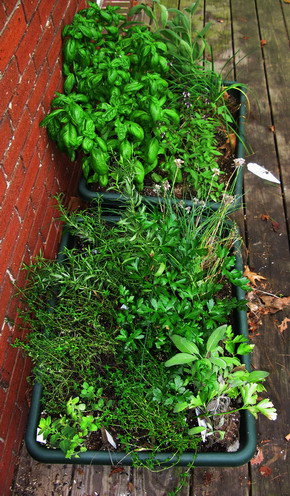
So, the New York Times had this article a few days ago, which I found out about thanks to Tessa, my Mom-in-Law, about the different little service-industry businesses which are growing up to cater to folks who want to eat local foods without having to grow them, go to the market for them or in some cases, even bother with cooking them.
The article, entitled, “A Locally Grown Diet With Fuss But No Muss,” outlines the various different ways that affluent people can jump on the locavore bandwagon without getting their hands dirty. Various enterprising gardeners, cooks, chefs, farmers and caterers have started offering services to the public that allow people to eat farm fresh foods without bothering with the farm, or the farmer’s market and in some cases, without even entering the kitchen.
Michael Ruhlman, author of The Making of a Chef (and many other good books besides) posted about the front page article and asked of his readers, what they thought the impact on our society would be as the locavore movement becomes more mainstream (as it has done increasingly over the past three or four years). He wanted to hear what other folks thought about the trend–was it driven by forces that would give it longevity in our fast-moving, attention deficit disorder cultural climate, or was it all just a fashionable whimsy which will have its fifteen minutes of fame only to suffer a swift and painful demise, exiting our consciousness with not a bang, but a whimper?
Ruhlman asks a fair question, and rather than clog up his comments section with an essay, I figured I’d ruminate on the subject here.
I think that generally speaking, the mainstreaming of the practice of eating locally grown food is a good thing. It certainly has done a lot to boost local economies, especially in rural areas like Athens, Ohio, where we lack lots of sources of employment and income for our residents. The idea of local eating has done a lot to highlight the good that is done in our communities by small farmers, and has helped people to understand that when they spend money in their communities by turning their backs on large corporations and supporting smaller businesses, that money tends to stay in the community.
In other words, when you shop at Wal-Mart, other than supporting the local employees salaries, you are not doing a lot to support your own local economy–the lion’s share of your shopping dollar goes back to Wal-Mart headquarters and helps to pay CEO salaries and the like. And you can just bet that those CEO’s in Wal-Mart land are not exactly traveling back to your little community and spending that money you gave them on any businesses in your neighborhood. Whereas, if you give money to a local small business operator, like, say, a farmer, that money tends to in turn, be spent within your own community.
I not only care about the national economy, I care about it on the local level, and whatever I can do to help make that smaller economy more robust and healthy, I will make it a point to run right out and do it.
I also believe that locally grown food tastes better and because it wasn’t picked and kept in a refrigerated truck, warehouse, distribution center, or grocery store produce department for weeks, it is more nutritious that the stuff at the supermarket.
While some may fault me and call me an elitist for saying that I give enough of a damned about taste to pay more money for it, I think that they wrong.
How the hell can I be an elitist when I eat the way I grew up eating as a lower-middle-class farm girl? My grandparents and parents were not rich, but we ate the tastiest food of anyone I knew, in large part, because it was fresher that what came from the store.
Yes, it costs more now–but as demand rises, and more farmers and producers step into the market to supply that demand, the prices will FALL, and thus that so-called elitist food will fall in price, and thus become affordable to more people. (Hey, I do remember a few things from those economics classes from umpteen years ago in college! Who’d have thought I would?) One could say that by buying local food now because I have the money to spend on it, I am helping to ensure that the price will fall so that others may partake of it later. (It isn’t like I am buying boutique food–I am just buying farm-fresh products.)
In addition, there are programs in place on both a state and national level that help offset the cost of local produce for low income families and those on fixed incomes like the elderly or those with disabilities. I suspect that as local food moves farther into the mainstream, these programs will grow in number, and that is also a very good thing. I think that everyone deserves to eat fresh, nutritious food that supports their local economy and ecosystem.
Do I even need to mention food safety issues, in light of recent salmonella outbreaks from tomatoes and jalapeños where no source of contamination has ever been successfully tracked down, though hundreds of people have fallen ill? In a local food system, these outbreaks would not only be easier to trace after the fact, they would be easier to contain, and the damage to public health would be lessened.
I also think that as conventional food prices rise, we are going to see a lot more people attempting to grow at least some of their own food, in an effort to reduce food bills and to boost their family’s nutrition.
Once again, I think that this is a good thing. I’d love to see every lawn in America either dug up and replaced with a combination kitchen/ornamental garden, or used to graze small livestock.
It isn’t just because I hate lawns and think that they use up way more resources than they are worth in the form of gasoline, pesticides, petroleum-based fertilizers, time and personal energy, nor is it just that I find large expanses of perfectly manicured green grass to be monotonous and boring to the eye. It isn’t even that as a chef and the granddaughter of farmers that I hate to see perfectly good arable land wasted.
It is because having a multitude of different kinds of plants in an area is not only better for your table, better for the aesthetics of a landscape, and better for the soil, it is better for all the other creatures who share the earth with us. Birds, butterflies, bees, chipmunks and squirrels have to eat, too, you know. And, yes, so do slugs, snails and Japanese beetles, but I reserve the right to remove them from my garden when they eat enough to damage my own food supply.
I think that gardens don’t just grow plants and food, they grow communities. And I think that Americans could use a good shot of community in our culture right about now. Here in Athens, where the community garden allotments have grown exponentially this year as folks return to growing some of their own food, you see neighbors chatting and sharing knowledge over their hoes and shovels in ways that remind me of my childhood. Part of it is indeed because Athens is a pretty special small town and the folks here are awfully nice, but I think that helping each other grow food creates a bond that is healthy for our psyches.
There are lots of reasons that I think that local eating is both good for us and is here to stay, but I won’t go on about all of them now, because I want to talk more about the New York Times article, because some commenters on Ruhlman’s blog went on about how silly it was to pay people to, for example, dig up your yard, and build and tend a kitchen garden in its place for you, from seedlings to harvest.
I don’t think that it is silly at all.
There are several legitimate reasons why someone might pay a gardener to dig up their yard and replace it with a kitchen garden.
1. Lots of people love gardens, but have no bloody idea of how to garden, and they don’t have the time to learn. So, if they have the money, why should they not pay someone who is an expert to build and tend their garden for them. Not only does this employ a local gardener and boost the local economy, it also gets rid of more lawn and gets fresh food to one more family. (Besides, I suspect that folks who do hire gardeners this way end up learning enough about gardening that if they have time, they can do some tending and harvesting themselves. Maybe even some propagation and planting.)
2. Some folks love to garden, but have physical disabilities that impair their ability to dig up tons of soil and move it around, so they hire a gardener to do the heavy work that they cannot do. Some elderly folks just cannot get down on their knees like they used to, and some people have found that it is really hard to run a rototiller or wield a spade from a wheelchair, so why should they not hire someone to do the parts of gardening that they cannot, while also reaping the benefits of having a garden–fresh air, sunshine, and delicious, home grown produce?
3. Some people have more money than they have time because they work jobs which preclude them from doing the work that is necessary to tend a garden, yet they still want one anyway. Why should they not hire someone to do the work which they do not have time to do? (Or is it wrong for busy people with money but no time to hire folks to clean their houses, too? I bet some professional house cleaners might disagree with that–just as professional gardeners might disagree that hiring themselves out to garden for others is frivolous or silly. Once again, we are supporting the local economy.)
As for the personal chefs, the caterers and the takeout businesses who use local ingredients for their clients–why is that any sillier or more frivolous than having a personal chef, caterer or patronizing a takeout business in the first place?
And why is it wrongheaded for a city-dweller to buy a share of a cow on a farm outside of city limits? Or a pig, or whatever? How is it any different than the practice that some suburban, urban and city dwellers have done for years, of buying all or part of a steer from a local farmer, and having the wrapped and frozen meat delivered after the animal is taken to the slaughterhouse? (Clue–it isn’t any different, or wrongheaded–it just has a clever name–“cows pooling” these days.)
The thing is–none of this locavore business is new. It is, quite simply, how most Americans ate before WWII. Sure, staple items, like flour, coffee, sugar, pasta and rice, came from elsewhere, as did luxuries like bananas (and citrus fruit for those not in their growing regions), but by and large, much of the food people ate, the meat, dairy, eggs, fruits and vegetables, came from farms nearby. People tended to grow some of their own food, particularly during WWI, the Great Depression and WWII, because it helped cut costs to do so.
Now I am not saying we need to go completely back to the old ways of doing things. Agriculture on a large scale does some things right–the growing of grains, for example. But, what I am saying is that because eating locally isn’t really that new of an idea, people will catch on to it more readily. My own parents, for example, remember what pre-Confined Animal Feeding Operation chicken and pork tasted like, and when they taste local chicken and pork, they are returned to the way food used to be, and they want that flavor again, and again.
I think that a lot of people are like that–they want to taste what food used to be like, even if they are not old enough to remember it in the first place, and that is why I think that the locavore movement is here to stay.
(Thank you, Michael, for asking such a good question–otherwise, I might have just posted a link to the New York Times piece with minimal commentary. This was much more fun to write, and hopefully to read, too.)
News, News, News
I’ve been busy, busy, busy.
And last week, our internet connection was down, down, down.
So, I could not post, post, post.
But then the internet came back on, and we had the busiest weekend at Salaam of the past several months, so I was tired, tired, tired. (Tired, but smiling–I live for crazy-busy nights. It’s the best feeling–riding the wave, getting the food out, moving, my brain and hands moving at a blur. It’s a great adrenaline rush.)
But I have news, news news.
Yes.
It is official–Hilarie and Mark, the owners of Restaurant Salaam, signed a lease on a new building, and work has begun on renovating the space to turn it into our new home. Yes, Salaam is moving, into a building which has never housed a restaurant, so we are constructing the kitchen from the ground up, to our specifications.
So, I can use what I know about how food, bus tubs, servers, cooks and everyone else should flow in and out of a kitchen to full advantage by helping Hil design the whole area. It will be quite a showpiece, very exciting, and our cooking capabilities will increase exponentially. I am not joking.
And all I wanted was a proper stove–you guys don’t understand–Hilarie and I and the rest of the cooks have been putting out tons of food from a kitchen that has no stove.
We cook on a two burner hot plate.
Now, we will have all sorts of equipment to cook on, not just a stove, but a grill, ovens, a wok burner–maybe even a chef’s table.
Pretty soon we will begin on menu development, and I’ll need to start thinking of recipes for specials, and training our cooks to use the new equipment.
This is so exciting!
I promise to post pictures, updates and news as the project progresses, and when we have our grand re-opening, I promise to put digital cameras into several folks’ hands so I can share the flavor of the event with everyone right here.
So that is why I haven’t posted as much–there has been a lot going on.
(In addition, Kat is walking all the time, and I finished another quilt–I’ll post pictures later, and am now quilting another one–pictures of that one this weekend!)
Thai Chicken Salad With Peanut Chili Dressing
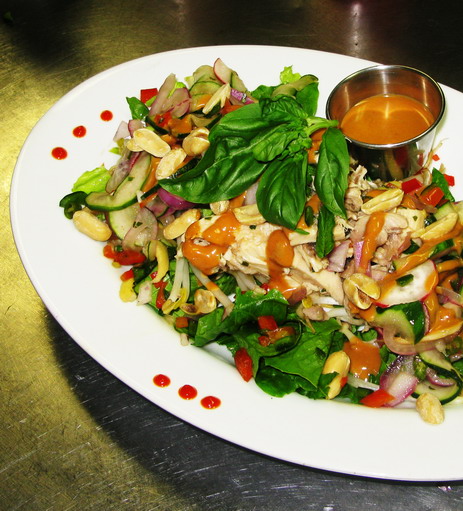
While at work, rolling up some Thai-Vietnamese summer rolls–those delicious, fresh, light appetizers made from rice paper wrappers filled with crisp bean sprouts, fragrant herbs, earthy bean sprouts, rice noodles, and for non-vegetarians, shrimp, I came up with an idea for a nice, cooling salad to run as a dinner special later.
It came about like this–I had made a spicy peanut sauce for dipping the rolls, and included some lovely Thai marinated cucumber and red onion salad with each order of rolls, just to give a different flavor and texture to the appetizer. And I happened to have a bite of summer roll dipped in the peanut sauce then popped a bit of cucumber which was marinated in a dressing made of lime juice, palm sugar, fish sauce, fresh ginger, mint, Thai basil, and Thai bird chilies.
(Before we continue, let’s talk a bit about palm sugar. It is made from the sap of the coconut palm, and it has a sticky, half-liquid texture. Sold in jars in Asian markets, it is used a great deal in Thai cookery. It has a subtle flavor–like the way a nice sweet flower smells, but without the tooth-aching sweetness that cane sugar has. You can use raw sugar to substitute for it, but I would try the palm sugar anyway. I like it better, and it isn’t hard to find, nor is it too expensive.)
The two flavors and textures went off in my mouth like an firecracker. The sweet, hot and sour cuke was icy yet filled with the heat of the chilies and ginger, while the creamy, sweet and earthy peanut sauce tamed the flames. I thought about it and decided that I needed to use those two flavors in a chicken salad, and soon.
So, Tuesday, today, I set out to put my idea into action.
I made the same lime and fish sauce based marinade as I had done for the red onions and cucumbers on Saturday, and this time, I tossed two different salads in it. One was composed of paper-thin cucumber slices and red onion slices as before, but with the addition of see-through slices of radish. The other was made from poached, shredded and chilled chicken. These went into the refrigerator to chill down to a delectable, nearly frozen temperature, while I put together the dipping sauce turned salad dressing.
This peanut sauce is simplicity itself–it consists of four ingredients, but the finished product is so tasty, everyone who tastes it will think you are a culinary genius. And, really, there is no reason to disabuse them of that belief. Just smile and accept the accolades that will pour out to you from satisfied eaters.
All you have to do is take equal parts hoisin sauce, and natural peanut butter–that being peanut butter with nothing but peanuts and salt in it, and blend them together with a tiny amount of rice vinegar–about 1/4 cup per two cups each of the hoisin and peanut butter. Then, you add sriracha sauce to taste, and thin it all out with water until it is the right consistency for a salad dressing–liquidy, but not runny, in other words.
For crunch and a crisp, earthy flavor, I added ice cold romaine lettuce and mung bean sprouts, and for a garnish, a sprinkling of peanuts and a sprig of Thai basil.
It turned out to be an amazingly refreshing light entree salad for the hot, dry late July days of Southeastern Ohio.
But I bet it would be good any time, and anywhere that you are faced with a day that is too hot to bother with either cooking or eating.
And it is all easy.
And–it is pretty low in fat. The only fat you get is from the chicken, which if you start with poached boneless, skinless breasts, will be negligible, and the peanut butter. And if you use natural peanut butter, it will be the plain old monounsaturated peanut oil that is in peanuts, which is actually good for you. There is a lot of fiber and vitamins in this salad, so not only is it good–it is good for you, in many ways.
Yet, it tastes both refreshing and sinful at the same time.
What is not to like?
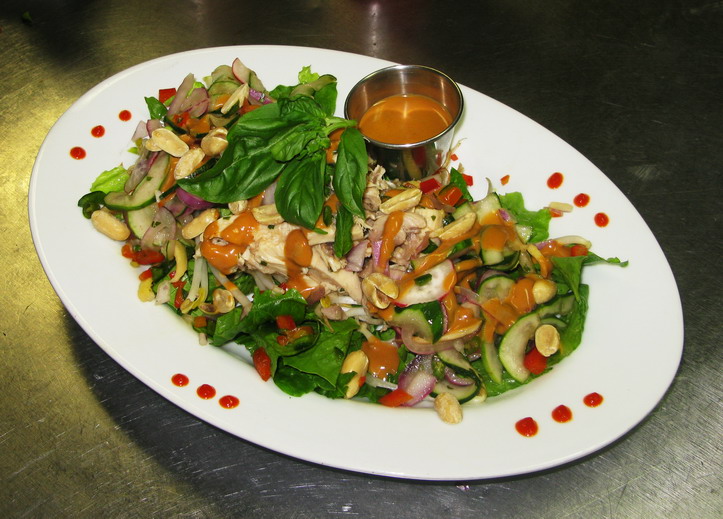
Thai Chicken Salad With Peanut Chili Dressing
Ingredients:
1/2 cup freshly squeezed lime juice
1 1/2 to 2 tablespoons–to taste–palm sugar or raw cane sugar
1/3 cup fish sauce–use Golden Boy or Squid brand for the best flavor
2-7 thinly sliced Thai bird chilies–to taste
2″ cube fresh young ginger, peeled and sliced in very thin jullienne
1/8 cup finely minced fresh Thai basil
2 tablespoons finely minced fresh mint
3 large cucumbers, well scrubbed
1 large red onion, peeled and thinly sliced
10 sweet red radishes, tops and bottoms sliced away and cut into paper-thin slices
1 pound poached chicken, shredded and well chilled
1/2 cup natural peanut butter
1/2 cup hoisin sauce
1 tablespoon rice vinegar
Sriracha sauce to taste
1 large head romaine lettuce, washed, dried and cut into thin strips
2 cups really fresh mung bean sprouts, rinsed and dried
1/3 cup really good roasted, salted peanuts
4 sprigs of fresh Thai basil
Method:
Mix together the first seven ingredients, and stir until the palm sugar dissolves. Taste for seasoning–you may like it sweeter or hotter. Adjust accordingly–the flavors should be a perfect balance between sweet, hot, sour and salty.
Split this marinade in half and put into two medium sized bowls.
Slice the cucumbers in half longitudinally, and scrape out the seeds with a teaspoon. Slice them paper thin into little half-moons, and put them, the red onions and radishes into one of the bowls of marinade, and toss to combine. Cover tightly and put in the fridge to get it ice cold.
Take the shredded poached chicken and toss in the other bowl of marinade, then cover tightly and put in the fridge. While these are chilling, put the next four ingredients, from the peanut butter to the sriracha sauce, into a food processor or blender and blend until combined. Taste and adjust as needed–add more vinegar for more tang, and more sriracha for more heat. For more sweetness, add a spoonful of hoisin sauce, and for more peanuttiness, add the peanut butter. When the flavor is the way you like it, turn the machine on and blend in water while it is running, a little at a time, to get the dressing to a pourable consistency. Go slowly–you don’t want it to be too thin!
When the vegetables and chicken are very cold, split up the sliced lettuce into four equal portions and layer them onto the bottom of serving plates.
Sprinkle equal amounts of bean sprouts over the lettuce, then put a layer of the marinated vegetables over that. Top the vegetables with a dollup of chicken on each plate, and then drizzle with the dressing. Sprinkle peanuts over everything and garnish with a sprig of basil, and serve some extra peanut dressing on the side.
Serves four for a light lunch or dinner.
How Local Can You Realistically Go?

I want you to look at that delicious bowl of pasta pictured here.
This is what I tossed together for dinner tonight, because it was quick, easy and nutritious, and all of the ingredients except the pasta, olive oil, salt, Parmesan cheese and Aleppo pepper were local.
Very local, in fact–everything else was grown right here in Athens county.
The onions, squash and garlic came from Rich Tomsu’s organic farm. Shade River farm supplied the organic sweet pepper, tomato and fennel. Green Edge Gardens, another organic farm, grew the fresh shiitakes, and the absolutely delicious chicken breast (one, shared between four people and a baby) came from Bridlewood Acres. Oh, and the chevre was made by Chris Schmiel of Integration Acres, and the spot of cream that went into the sauce came from Snowville Creamery, which is one county over from us in Meigs county.
And the wedding bouquet-sized bundle of basil that got turned into pesto came from up on my deck. I have so much of growing so lushly up there I swear you’d never know I cut any.
So, what is my point, other than bragging about how grand it is to live in Athens, Ohio in the summer where you can get amazingly fresh, delicious, organic food?
Well, it is this. With all the local goodies I listed above, we ate organic pasta.
From somewhere else. (And I have no idea where–it is a product of the USA, but there is no telling where the wheat was grown. Probably in several different states.)
And ounce for ounce, we ate just as much pasta as we did everything else.
So truly, while we can eat like kings on the local bounty here in Athens, there are still significant gaps in our food supply–it is difficult to impossible to find locally grown staples such as grains and grain products and dried beans. This is not only a problem here in Athens–it is endemic to the way in which the United States food supply works. Staples tend to be grown in large farms which practice monoculture, with each staple being grown wherever the climate is best for it, and then it is shipped all over the country, and the world, for that matter, after they are harvested and processed.
But a pair of farmers here in Athens wants to study the feasibility of growing staple grains and legumes here in Athens county, and the USDA has given them a grant to do just that.
Brandon Jaeger and Michelle Ajamian are using a grant from the Sustainable Agriculture Research and Education (SARE) project of the U.S. Department of Agriculture (USDA), to test the feasibility of growing staple crops such as grains and beans in southeast Ohio.
According to the Athens News’ front page feature story, the first crops to be tested during the next two growing seasons include buckwheat, millet, amaranth and quinoa, plus azuki beans, a highly nutritious Asian type of legume, and flour corn. Both the beans and corn are growing this year, and the pair plan to sell the corn to The Village Bakery where it will be ground and made into fresh tortillas.
I applaud Jaeger and Ajamian’s work, and I hope that they have good results and high yields in their test plots. I’d love to be able to buy locally grown grains and beans myself, and I am hoping that what they discover with these varieties will be applicable to the growing of more familiar staple crops such as wheat, oats and any number of native dried bean varieties.
In fact, the only flaw I can see in their plan, is that while I love quinoa and azuki beans myself, I hardly think it is likely that a bunch of Athenians switching from eating pasta made from wheat and refried beans made from pintos or black beans to the more esoteric varieties these farmers are testing. Sure, the adventurous vegetarians, vegans and hippies among us will dive in with gusto, but the more conventional sorts will likely pass these offerings by, no matter how nutritious they are.
For one thing, not many people know how to cook quinoa, amaranth, or millet.
Cornmeal, we know from, but millet–to most Appalachians, that stuff is birdseed.
And, local these grains and beans might be, but I know that I won’t give up my rice or my red beans for anyone, because, well–I like them too darned much. (And the likelihood of anyone successfully growing rice in Athens county is pretty low, so I figure that one of my non-local foods is just going to have to be rice.)
But the point is, as much as I love trying new things and being an adventurous cook, I doubt I would ever, unless forced into it, switch from eating wheat, rice and corn-based foods to the lesser known grains listed above.
I might integrate these ingredients into my pantry, but they would be additions, not substitutions, for the staple items already in place.
My solution is this–in addition to trying out the new and different staple foods, why not continue the experiment with more familiar grains and beans?
I know for a fact that wheat grows pretty well in Ohio, and I figure that since our second largest cash crop in this state is soybeans, why not try to grow some pinto beans, black turtle beans or red beans. Horticultural beans grow beautifully here, and they dry perfectly, as do Christmas limas–I still have some in my pantry grown by a local farmer last year, so why not give other, more familiar legumes a shot, too?
That said, I wish these intrepid farmers luck and a grand harvest. I hope that they do find a combination of staple grains and beans we can grow easily here in southeastern Ohio, ones that are not only nutritious and delicious, but also familiar enough to the average eater and cook to give them a try.
Oh, and look for a recipe for the pasta dish above tomorrow!
The Miracle of Green
I thought that we were going to be able to terrace the back yard into a workable garden space this year; alas, however, the intractable slope remains intact. The French drains that keep the water run-off from turning our grassy hill into a mudslide have collapsed, resulting in a bog at the top of the hill. So, we are having new drainage installed, as is everyone else who lives at the top of this hill–the neighbors on both sides are having it done, as well as folks up the hill a ways further. It has been a very wet spring and summer, and so it makes sense to deal with the drainage issues.
So, once again, I am gardening exclusively on our deck. However, instead of my usual mixture of decorative and food plants, this time around, I am growing only food, and am surprised at the amount of plants I can grow on the deck.
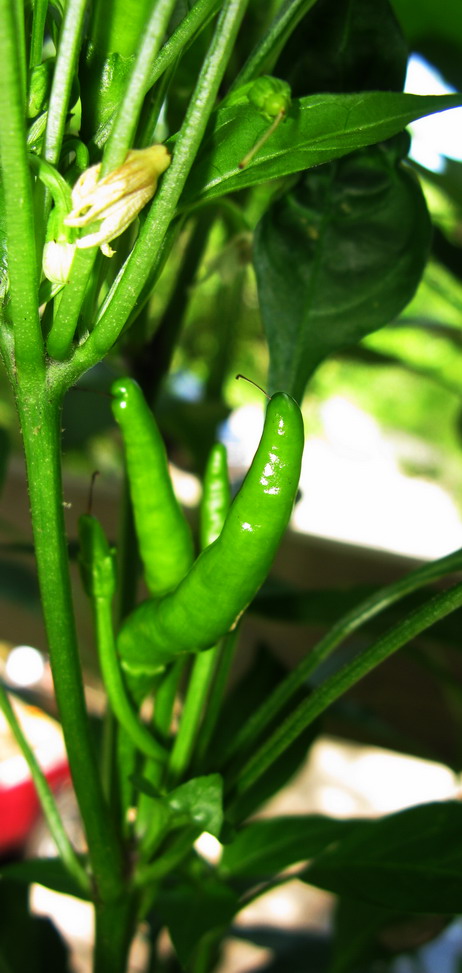
I have a dozen Thai chili plants, forty basil plants of various sorts–four different varieties in total, a handful of different herb plants, seven large tomato plants, and about forty gai lan plants poking their little sprouty selves up out of the dirt. Last week, I also sowed about twenty methi plants, a bunch of cilantro seed, a potful of mizuna and around the gai lan, which is in a whiskey barrel planter (cut in half longitudinally and set on its side in a cradle which keeps it from rocking), I have sown a lot of baby Shanghai bok choi seeds. I also have ordered another large planter to sow with more gai lan and baby bok choi.
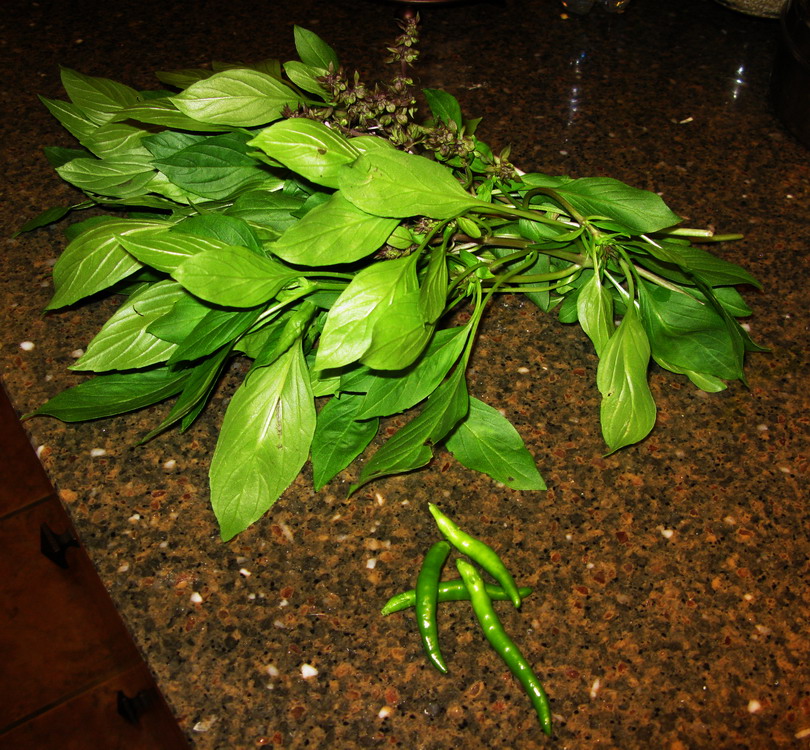
I am amazed at how prolific the garden is, and last night, I took the first harvest from it–a huge bouquet of Siam Queen Thai basil and five Thai bird chilies, which I used in my favorite summer dish: Spicy Thai Basil Chicken. Tomorrow night when I come home from work, I will harvest a big bouquet of Italian basil and make pesto, the first of many batches from my own garden.
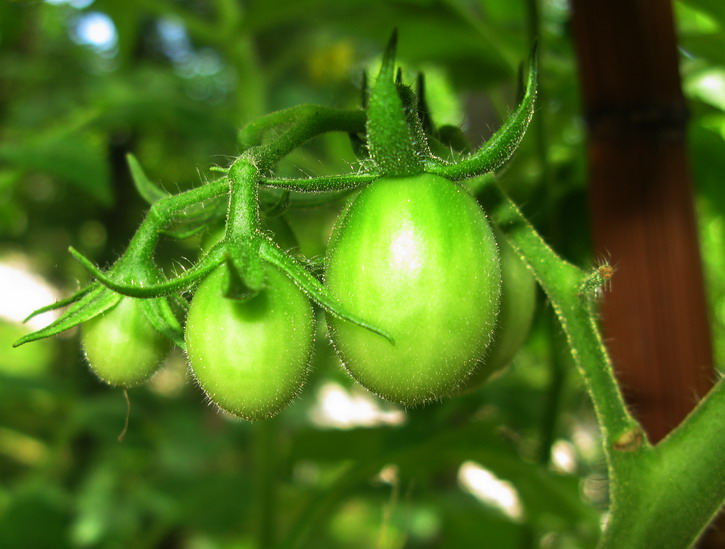
There are dozens of clusters of tiny green tomatoes, looking like jade beads, dangling from the five-foot high (and still growing) tomato vines. Kat and I watch them greedily, waiting for them to ripen. There are four different varieties of grape/cherry tomatoes–a green one, a black one, a yellow one and a red and yellow striped one, and then there are three roma type paste tomatoes, called San Marzano. The vines of the plants are amazingly strong–stronger than the ones I planted last year–I planted these tomatoes very deeply in the planter, so that roots grew out of the stems I buried in the compost, peat moss and soil mixture in the self-watering planter. This practice, which I read about last year, creates a stronger, more wide-reaching root system which helps to anchor the plant well and also helps the plant survive drought better, although, unlike last year, this year, lack of rain hardly seems to be the problem. (We’ll see how August goes–that is usually the driest month in our part of Ohio.)
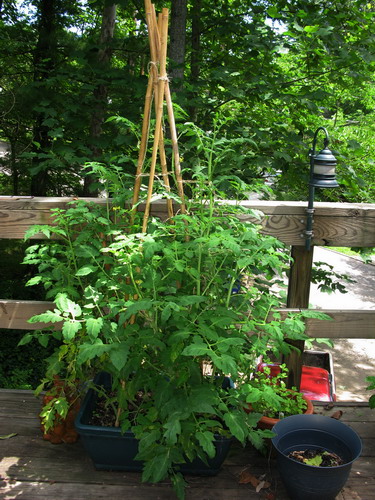
It is always amazing to me how well compost and other organic fertilizers, such as livestock manure and fish, bone or blood meal, feed plants and help them to grow strong and healthy. I overcrowd my plants in the garden–the kindest way to put it is that I garden intensively, though truthfully, it is not just that I admire and emulate the work of John Jeavons, but because I am lazy and hate mulching and weeding. The thing is, if you crowd your plants together in a container or even in the ground itself, the plants grow together and their leaves form a perfect canopy, shading the roots, which not only discourages the growth of weeds (weed seeds are triggered to sprout by the sun), but helps to retain water. It isn’t as efficient as mulching, but then mulch isn’t always the be-all and end-all of gardening–it can harbor mice, slugs, mold and other plant killers. In very wet weather like we have been having, it can trap too much water, leading to root rot and worse, so this year, I don’t feel quite so lazy about going mulch-free.
Right now, my favorite bit of the garden is the half of a whiskey barrel that is serving as a seedbed for gai lan, baby bok choi and methi.
I got tired of not being able to get farmers around here to grow these vegetables consistently, so I decided to up and do it myself. Why not? I had the whiskey barrel empty–it usually harbored a garden of coleus plants–and I had some seeds. The fenugreek (methi) seeds I had were from the Indian market, and they were meant to be ground up and used as a spice. Instead, I soaked them for twenty-four hours, then laid the mushy seeds on damp paper towels, then covered them in another layer of damp paper towels and set them on a cookie sheet in a sunny window for about four days, dampening the towels twice daily. On the third day, I took the top towel off and let the sprouts which were springing forth grow upward toward the light.
The next day, I transferred the strongest sprouts, of which there were around forty or so, to the whiskey barrel and to various pots. The soil was light and friable, amended well with compost, manure and fish meal, and so far, even though right after I planted the tiny things, we had a huge thunderstorm with heavy downpours, the methi plant babies are going strong, putting out roots and working on making true leaves.
The gai lan has already started putting out true leaves, and I will have to thin it soon. But I am still waiting for the cilantro, bok choi and mizuna to sprout.
I can’t wait to see how well they do.
I promise to continue to blog about my green miracles on the deck as they grow and as I harvest, as well as chronicling the delicacies I make from them.
In the meantime, for those who want to grow their own Asian vegetables, you can get seeds for many varieties of greens, roots and herbs from Evergreen Seeds. They ship quickly and their prices are great.

Categories:
- Admin (rss) (55)
- Blogs and Blogging (rss) (81)
- Book Reviews: Cookbooks (rss) (43)
- Book Reviews: Non-Cookbook Food Books (rss) (38)
- Cats and Cat Blogging (rss) (47)
- Chinese Cooking Lessons (rss) (32)
- Culinary School Stories (rss) (18)
- Dairy Pruducts: Cultured and Barbaric (rss) (4)
- Documentary Filmmaking (rss) (1)
- Essays, Rants and Reflections (rss) (260)
- Fighting Hunger (rss) (12)
- Food and Kids (rss) (45)
- Food in the News (rss) (126)
- Food Media (rss) (98)
- Food Preservation (rss) (18)
- Food Safety (rss) (45)
- Gardening (rss) (30)
- Herbs and Herb Blogging (rss) (20)
- Holidays (rss) (50)
- Kat Blogging (rss) (22)
- Kitchen Science (rss) (36)
- Leftover Makeover (rss) (8)
- Life, the Universe and Everything (rss) (131)
- Local and Sustainable (rss) (227)
- Local Athens Food and Foodies (rss) (42)
- Meatless Mondays (rss) (32)
- Menu For Hope (rss) (5)
- Nutrition, Diet and Health (rss) (84)
- On The Farm (rss) (8)
- Recipes: Almost Vegetarian, Vegetarian and Vegan (rss) (294)
- Recipes: American Regional (rss) (37)
- Recipes: Appalachian Hillbilly (rss) (33)
- Recipes: Bread, Pasta, Grains (rss) (95)
- Recipes: Canning and Preserving (rss) (8)
- Recipes: Chinese (rss) (123)
- Recipes: Comfort Food (rss) (120)
- Recipes: Cookies (rss) (16)
- Recipes: Desserts (rss) (48)
- Recipes: French (rss) (25)
- Recipes: Fruits and Vegetables (rss) (302)
- Recipes: Greek, North African and Middle Eastern (rss) (31)
- Recipes: Indian (rss) (137)
- Recipes: Italian (rss) (42)
- Recipes: Japanese (rss) (7)
- Recipes: Jewish (rss) (4)
- Recipes: Korean (rss) (6)
- Recipes: Meat, Poultry and Fish (rss) (220)
- Recipes: Mexican/Native American/ Latin American/Caribb (rss) (27)
- Recipes: Original (rss) (108)
- Recipes: Thai (rss) (27)
- Recipes: Tofu (rss) (17)
- Recipes: US Regional (rss) (16)
- Recipes: Vietnamese (rss) (8)
- Restaurant Stories (rss) (28)
- Sewing, Quilting, Arts and Crafts (rss) (16)
- Simple Chinese Recipes (rss) (30)
- Slow Food and Heritage Foods (rss) (10)
- Spice Blogging (rss) (44)
- The Chinese Cookbook Project (rss) (14)
- The Chinese Pantry (rss) (39)
- The Documentary (rss) (2)
- The Kitchen Saga (rss) (17)
- The Locavore's Bookshelf (rss) (15)
- The Unsung Adventures of The Culinary Nerd (rss) (6)
- Tools and Toys (rss) (35)
- Uncategorized (rss) (10)
- With a Side of Politics (rss) (48)
Archives:
- August 2012 (9)
- July 2012 (12)
- September 2011 (3)
- August 2011 (7)
- July 2011 (8)
- June 2011 (16)
- May 2011 (17)
- April 2011 (11)
- December 2010 (9)
- November 2010 (5)
- February 2010 (1)
- December 2009 (5)
- November 2009 (7)
- October 2009 (10)
- September 2009 (16)
- August 2009 (14)
- July 2009 (14)
- June 2009 (7)
- May 2009 (17)
- April 2009 (10)
- March 2009 (25)
- February 2009 (13)
- January 2009 (10)
- December 2008 (5)
- November 2008 (5)
- October 2008 (6)
- September 2008 (13)
- August 2008 (8)
- July 2008 (11)
- June 2008 (18)
- May 2008 (13)
- April 2008 (14)
- March 2008 (16)
- February 2008 (17)
- January 2008 (19)
- December 2007 (25)
- November 2007 (18)
- October 2007 (24)
- September 2007 (16)
- August 2007 (15)
- July 2007 (15)
- June 2007 (10)
- May 2007 (14)
- April 2007 (16)
- March 2007 (17)
- February 2007 (20)
- January 2007 (13)
- November 2006 (1)
- October 2006 (8)
- September 2006 (14)
- August 2006 (25)
- July 2006 (30)
- June 2006 (28)
- May 2006 (34)
- April 2006 (29)
- March 2006 (24)
- February 2006 (30)
- January 2006 (38)
- December 2005 (40)
- November 2005 (37)
- October 2005 (32)
- September 2005 (25)
- August 2005 (30)
- July 2005 (28)
- June 2005 (21)
- May 2005 (8)
- April 2005 (22)
- March 2005 (17)
- February 2005 (29)
- January 2005 (10)
Search Site:
Links:
- Lily’s Wai Sek Hong
- 101 Cookbooks
- A cat in the kitchen
- A Veggie Venture
- Accidental Hedonist
- Cha Xiu Bao
- chez pim
- Chocolate & Zucchini
- Chopstick Cinema
- Chowhound.com
- Chubby Hubby
- Cook sister!
- Cooking with Amy
- da*xiang
- Eat Local Challenge
- Eating Liberally
- Ecocentric
- Eggbeater
- Epicurious
- Farmgirl Fare
- Fatfree Vegan
- Foodgoat
- ForkandBottle.com
- Green Olive Tree
- Hooked on Heat
- Jaden’s Steamy Kitchen
- Kalyn’s Kitchen
- Lucullian delights
- Mahanandi
- Matt Bites
- MeatHenge
- mmm-yoso!!!
- New York Times – Dining & Wine
- Pizza Goon
- Rasa Malaysia
- Ruhlman
- Sailu's Kitchen
- Serious Eats
- SF Gate: Food & Dining
- Simply Recipes
- Soul Fusion Kitchen
- Tastespotting
- The Amateur Gourmet
- The Cleaner Plate Club
- The Food Section
- The Grub Report
- thecookscottage
- U.S. Food Policy
- Wandering Chopsticks
- Washington Post Food and Dining
- Wasted Food
Meta:


Powered by WordPress. Graphics by Zak Kramer.
Design update by Daniel Trout.
Entries and comments feeds.