
Cook Local, Eat Global
Garlic Scapes And Spiced Dry Tofu Stir Fry

My favorite way to prepare garlic scapes is to stir fry them.
And, as far as I am concerned, their perfect partner in the wok is spiced dry tofu.
Here’s why: the scapes have the same wonderful crisp but tender texture that very young green beans have, and are blessed with a similar verdant grassy flavor scented strongly with the divine aroma of garlic. This texture contrasts with the smooth and chewy texture of the tofu, with the added benefit that both foodstuffs easily pick up the flavors of whatever aromatics and condiments the cook adds to the hot wok.
It is just too delicious–and–the dark green of the scapes deepens and brightens in the wok to a brilliant emerald which looks lovely with the pale tan and dark brown tofu.
This time around, I added to the wok an early head of broccoli, small and very sweet, as well as two frozen red jalapeno chilies, which added further texture and flavor contrast. (Not to mention extra vitamins and minerals!) I also had a small piece of pork loin left over in the fridge which I added, but the truth is, I prefer this recipe vegan, and that is how I am writing it.

This is an easy, simple supper for about three adults and one baby.
You could add fresh or dried, rehydrated shiitake mushrooms, or carrots, or sweet bell peppers to this recipe as well, but I think I would have been happy just adding more garlic scapes. (I didn’t have any more, or they would have gone into the wok–I promise!)
This recipe could also be simplified by leaving out the cilantro, the broccoli, and adding more garlic scapes. You could also use green beans instead of garlic scapes, but if you do that, add more minced or sliced garlic to the recipe to make up for the loss in garlic fragrance.
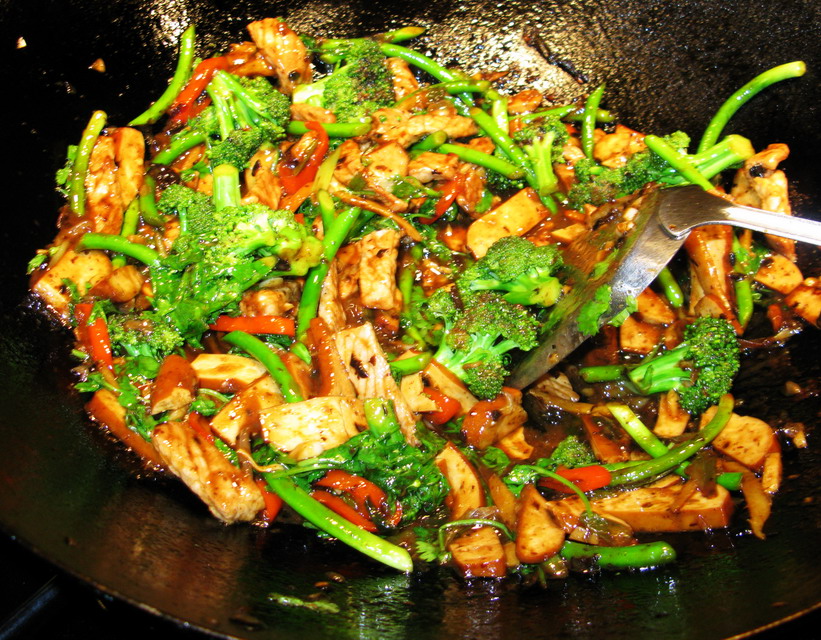
Stir Fried Garlic Scapes and Spiced Dry Tofu
Ingredients:
4 tablespoons peanut or canola oil
1/2 cup scallions, white and pale green parts only, thinly sliced on the diagonal
1 tablespoon fermented black beans
1″ square piece fresh ginger, peeled and cut julienne
1-2 red jalapeno chilies, thinly sliced on the diagonal
3 cloves fresh garlic, minced
8 ounces spiced dry tofu, thinly sliced on the diagonal
8 ounces broccoli florets, cut into small pieces
5 ounces garlic scapes, bubils and “whiskers” trimmed off and discarded, stalks cut into 2 inch long pieces
1 tablespoon Shao Hsing wine
1/4 teaspoon raw sugar
2 tablespoons dark soy sauce
4 tablespoons vegetable broth with 1 teaspoon of cornstarch dissolved in it
1/4 teaspoon toasted sesame oil
Method:
Heat wok over high heat until a thin ribbon of smoke dances up from the surface. Add peanut or canola oil and allow to heat until it shimmers–about thirty seconds. Add scallions, black beans and ginger and stir fry for about thirty seconds. Add chilies, garlic and tofu, and cook, stirring constantly, for about a minute. Add broccoli, and cook, stirring continually, until the broccoli browns lightly on the edges.
Add the garlic scapes, and stir fry about thirty seconds. Add the wine and sugar, and cook off the alcohol–about thirty seconds, then add the soy sauce, chicken broth and sesame oil, stirring for about thirty seconds more, or at least until the sauce thickens and clings to the vegetables and tofu.
Serve with steamed jasmine rice.
How Green Was My Garlic (Scapes)
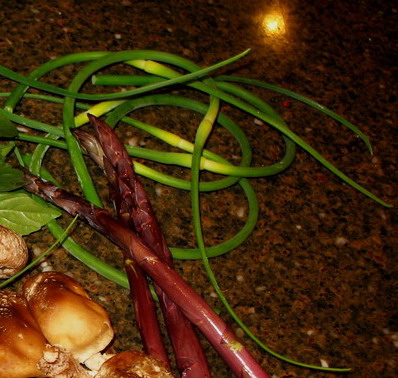
Sometimes I cannot get enough of garlic; I think it is probably my favorite member of the allium family. I use more onions by weight in my cooking than I do garlic, but that is partially because garlic manages to pack a healthy wallop of flavor in a very small package, compared to onions, so I don’t -need- to use as much of it. That said, I admit that I use a lot more garlic than a lot of people I know. I have been known to use entire heads of it at a time for a single meal, sometimes, in a single dish. Since I grew up in a household where one head of garlic was kept and used over a period of weeks–well, you get the idea.
I like garlic.
A lot.
The coolest thing about living in a town surrounded by farms, though, is that I have learned how to cook and eat garlic in many more forms than I might otherwise have experienced. There is green garlic, which is nothing but young garlic shoots, which you chop or slice up and eat from the root to the top of the leaf. It is filled not only with garlic’s characteristic bite, but also a sweet verdant taste that is reminiscent of chives. Green elephant garlic is amazing–the size and shape of leeks, with a similar flavor kicked up several notches by the redolent garlic scent. Then there is young garlic–this is immature heads harvested early when the baby cloves are filled with milky juice which is both pungent and sugary. The green parts of young garlic are also edible, but they aren’t as tender as green garlic, so I tend to add them to long-cooked dishes.
My favorite unconventional garlic bit, however, are the scapes–the slender, swan-necked, graceful shoots that emerge in early summer from hardneck varieties of garlic. These shoots which curl so much that they can form perfect spirally circles, carry seed-like reproductive parts called bulbils–essentially, little tiny garlic cloves–and if they are left on the plant, the scapes will drain energy away from the plant, because it is essentially putting all of its strength into going to seed and reproducing itself. In order to get the plant to put its energy into making nice fat garlic heads or bulbs, the grower cuts off these scapes.
And, since these graceful little shoots have a mild garlic flavor and the texture of very young bush green beans, they make a mighty fine vegetable in their own right.
Now that I know about garlic scapes, I wait for them eagerly every summer, and snatch them up gleefully, and cook and eat them until we are all tired of them–just like I do with asparagus. Last night, after work, I cooked them in a stir fry with the first broccoli of the season, fresh purple scallions, some pressed spiced tofu, some pork, fresh garlic, green garlic and ginger, and some chilies, fermented black beans and ground bean sauce for flavor. At the end, I tossed in an entire bunch of cilantro, because–well, just because I had it.
All of the vegetables and meat were local; only the tofu, the rice and condiments came from someplace other than Athens county.
And that was a good feeling.
What was also a good feeling was getting to watch Kat and Cordelia play with a young garlic stalk that had fallen to the floor.
That was entertaining–almost like dinner and a movie. Except this happened while I was cooking the dinner, so it wasn’t quite as relaxing as the typical sort of date scenario. But it was still fun, nonetheless.

The funny thing is that both Kat and Cordelia love garlic.
When I came home from the market yesterday morning, and set down my tote bags, Delia came running, along with the other cats.
This is not unusual, since I always bring the kitties home fresh catnip bouquets, but Delia went right past the huge bundle of the nip and burrowed right into the bag that had the fresh young garlic in it. She dragged out a stalk, and dashed off with it. When I caught up to her, she was chewing the ends off the leaves, purring mightily.

The other cats, being normal, were tearing apart the catnip, rolling around with leaves hanging from their mouths.
But not Delia. She was all about the garlic, and when I made dinner that night, hours later, she started pestering me not when I pulled out the pork, but when I took the young garlic and garlic scapes from the fridge and started cutting them. I ended up giving her the green top of one of the garlics to play with, which ended up with Kat taking over the game.
Which was okay–it was very amusing not only to the cook, the baby and the cat, but also to everyone else who had gathered in the kitchen to keep me company while I cooked.
So, back to garlic scapes–how do I cook them?
I treat them like young, firm green beans–I saute them or stir fry them. I prefer stir frying them, and have done them in a Thai style, but I think I like them cooked Chinese style the best. I also use them in pasta sauces where they stand in for green beans, and add their own subtle garlic fragrance to the dish.
To prepare them, I cut them into 1″ lengths up to the bulbils. The bulbils and the long, thin “whisker” that emerges from them I discard. The whisker is too tough to eat. and sometimes so is the bulbil. Then, I suppose you could blanch them, but I prefer to saute or stir fry them, as I noted above. I love using them as a vegetable, because people cannot tell what they are, that is, unless they have eaten garlic scapes at my house previously. I cook them just until they become tender and the green brightens. If you cook them until they are soft, their texture suffers, and the green dulls and looks sullen. I only cook them until they are tender-crisp, just like I do green beans.
Garlic scapes are great in any context in which one would use green beans. (Except maybe that mushroom soup and greek bean casserole thing. Garlic scapes probably would not be good in that. Although, one could use such a dish as the basis for a gratin of garlic scapes and creamy mushroom sauce. With breadcrumbs and crispy fried onions on top, I bet that would be out of sight.
While they are in season for the next week or so, look for several recipes that use my beloved garlic scapes. (Maybe even a gratin with mushrooms–we do have lots of local mushrooms coming in these days!)
And you will probably see lots of pictures of Kat and Delia playing with garlic bits and pieces as I cook, just because those two are cute beyond words.
Pork & Nail Polish: Two Great Tastes?
So, I was on Salon the other day, reading Broadsheet, which is their blog on women’s issues, when my eye was drawn by the headline: “How do you sell a pork chop to a woman?”
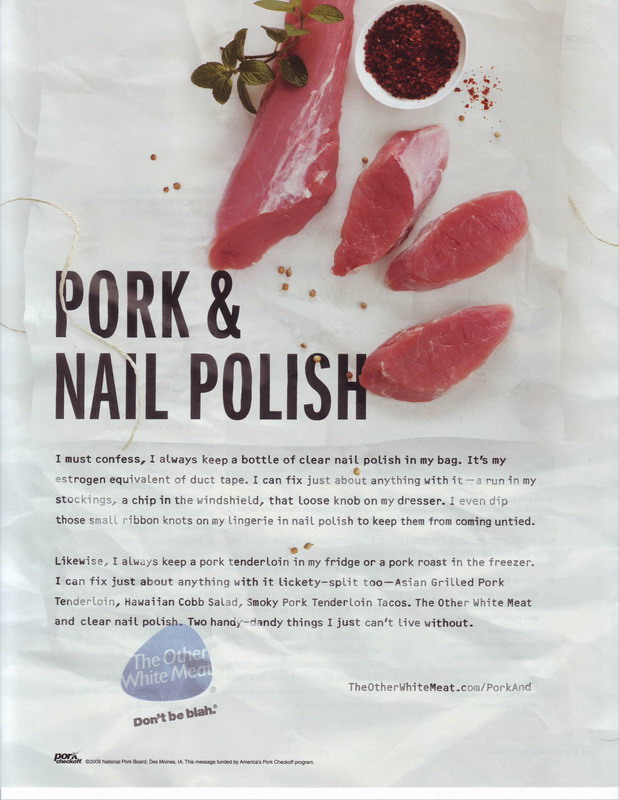
I clicked on the link to Copyranter’s coverage of an ad that appears in the current issue of Martha Stewart Living (and probably in other women’s magazines) and was completely confused.
Yes, it does indeed say Pork & Nail Polish right there, in big print. The juxtaposition of words is–unique, to say the least.
And the pork tenderloin cutlets sliced and arranged to look vaguely like manicured fingernails–well, let’s say that nothing in this ad is appetizing to me in the least.
It becomes more surreal if you read the ad copy, which is written in a first person, confessional style. The breezy narrative begins with this faux-girlfriend revelation:
“I must confess, I always keep a bottle of clear nail polish in my bag,” the copy starts. “It’s my estrogen equivalent of duct tape. I can fix just about anything with it — a run in my stockings, a chip in the windshield, that loose knob on my dresser. I even dip those small ribbon knots on my lingerie in nail polish to keep them from coming untied.”
All right. Fine. At least there is no mention of using nail polish as a glaze to keep your grilled pork chop nice and shiny. That had me worried–and queasy–but if all we are talking about is a femmy MacGyver sort of thing, I can deal with that.

I guess that would mean that we are going to talk about home repairs using pork? (Hopefully we are not going to talk about lingerie repairs with pork. I can only imagine the following: “I must confess that I save the bones from my pork chops and then if my bra hook falls apart in the wash, I can just carve a new one out of bone….” How very One Million Years BC.)
But no. The ad copy continues:
“Likewise, I always keep a pork tenderloin in my fridge or a pork roast in the freezer.I can fix just about anything with it lickety-split, too–Asian Grilled Pork Tenderloin, Hawaiian Cobb Salad, Smoky Pork Tenderloin Tacos. The Other White Meat and clear nail polish. Two handy-dandy things I just can’t live without.”
So, I guess it is supposed to be a clever “play on words” sort of thing to use the word “fix” to mean “repair” in one context, and then meaning to “prepare” in another context.
But, I have news for whoever put this ad together.
It doesn’t work.
I am not about to go out and buy pork because of this. I am not going to want to buy pork because of it. In fact, I am more likely not to buy pork because this is just so dumb on so many levels. It isn’t clever. It isn’t well-written–what is up with the 1950’s style confession and the use of out-dated slang words like “lickety-split” and “handy-dandy?” This ad isn’t retro-hip, it is dim-witted and squaresville, daddy-o.
This ad is definitely crossing and whoever came up with it is Herbert.
I’m just happy that feminine deodorant spray was not included in the “confession.”
That would have just been too much to bear.
From 660 Curries: Khoya Muttar Gosht–Creamy Lamb Curry With Peas
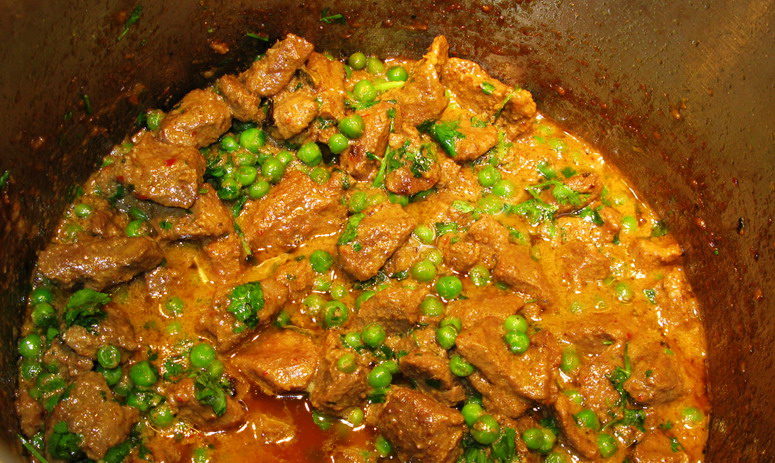
When I was a kid, I used to hate peas.
It had to do with eating them from a can–they taste so utterly vile and wretched that way that I cannot blame my younger self for despising them.
And then, even when the peas were fresh or frozen, through most of my childhood, they were overcooked. To this day, I cannot even abide the smell of overcooked peas.
The only way I would eat them when I was a kid was raw, straight from the vine.
Now, of course, that I am an adult and can avoid canned peas and cook whatever wee green legume that comes my way as little as I want to, I adore them. They are sugary sweet and filled with the verdant breath of spring. They pop in your mouth when you bite them, unlike the sad olive drab little canned things that just lay there and squish against your teeth, extruding mushy innards in an unappetizing drizzle of goo.
So, now that I like them, I keep trying to find new ways to prepare them, new dishes to add them to and have found that I particularly love them in curries.
Which is why I chose this curry–Creamy Lamb Curry with Peas as the first recipe to test from 660 Curries.
This is an easy dish, where the lamb is marinated in yogurt mixed with ground chilies, turmeric and a paste made from fresh ginger and garlic for a period of time. Then, onions are cooked in oil, with whole spices, and the lamb is added, marinade and all, to cook until it releases its juices. Then, it braises in its own juice until it is nearly done. Then milk solids or cream are added, along with peas, and the dish is cooked to an intensely flavored, creamy, rich finish.

The original recipe specifies the use of khoya, which is milk solids. It is what you get when you boil milk, stirring the whole time, over medium heat, until all of the water boils away–only the solid fat, protein and sugar are left. Khoya is the basis for the northern Indian milk-fudge sweet called barfi or burfi. It is made from milk solids, sugar and usually ground up nuts and flavorings.
Making khoya is easy, but when I tested this recipe, I didn’t really have the time or inclination to spend a half hour simmering the water out of milk, so I used the author-suggested substitute–heavy cream. The next time I make this recipe, I will make the khoya, photograph the process and post about it, because as he says, khoya is a great way to enrich a creamy sauce without all of the fat of heavy cream.
The only other change made in the ingredients is I added about four cardamom pods, and used more peas–1/2 cup more to be precise. I also used a pressure cooker, because I am impatient. However, I will give the instructions as written by the author for those who do not have a pressure cooker.

One interesting thing I noted about this recipe is that Iyer specifies that the cook use red onions. He seems to specify the use only of red onions in his dishes–he says that in India, red onions are preferred, but I wonder if that is a regional preference on his part. The northern Indian and Pakistani cooks I learned from preferred yellow onions, saying that red onions were too juicy and sweet to cook with. They saved red onions for raw garnish, chutneys and the like, or used them barely cooked for their color, while yellow onions, well browned, contributed the flavor base to the dish.

Khoya Muttar Gosht
Ingredients:
2 tablespoons yogurt (I used strained Greek yogurt)
2 tablespoons fresh ginger ground into a paste
1 tablespoon fresh garlic ground into a paste
2 teaspoons ground Kashmiri chilies (or 1/2 teaspoon ground cayenne and 1 1/2 teaspoons Aleppo pepper flakes ground to a powder)
1/2 teaspoon ground turmeric
1 1/2 pounds lamb leg and shoulder meat, fat trimmed and cut into 1″ cubes
2 tablespoons canola oil
1 teaspoon whole cloves
3 3″ long cinnamon sticks
2 fresh or dried bay leaves
4 green cardamom pods
1 1/2 cups thinly sliced red onion
1/3 cup heavy whipping cream or khoya
1 1/2 teaspoons kosher or coarse sea salt
2 1/2 cups frozen green peas, unthawed
handful roughly chopped cilantro leaves for garnish (optional)
Method
Mix together the yogurt, ginger and garlic pastes, the chilies and turmeric in a medium sized bowl. Add the lamb and toss well to coat. Cover and refrigerate for at least thirty minutes to overnight in order to allow the flavors to perfume the meat. Do not leave longer than overnight as the yogurt will tenderize the meat and you do not want the meat overtenderized and mushy.
Heat the oil in a large, heavy-bottomed dutch oven or soup pot over medium high heat. Add the whole spices, and cook, stirring until they sizzle, crackle and release their fragrance–about thirty seconds. Add the onion and cook until it is softened, stirring constantly. Keep cooking until it lightly browns. Add the meat and the marinade, and cook, stirring, until the meat starts to release its juices. At this point, it is essentially braising in yogurt and its own juices. This will take ten to fifteen minutes. If you use the whole milk solids, add them with 1 cup of water. If you use cream, just pour in the cream and about 1/4 cup of water. Add the salt. Bring to a boil.
Turn heat down and simmer, covered until the lamb is tender–about twenty to twenty-five minutes.
Stir in the peas, cover the pan and turn off heat. Let pan sit covered off heat for five minutes to barely cook the peas–this way they retain their brilliant color.
Serve over rice with a garnish of cilantro leaves if you like.
Book Review: 660 Curries
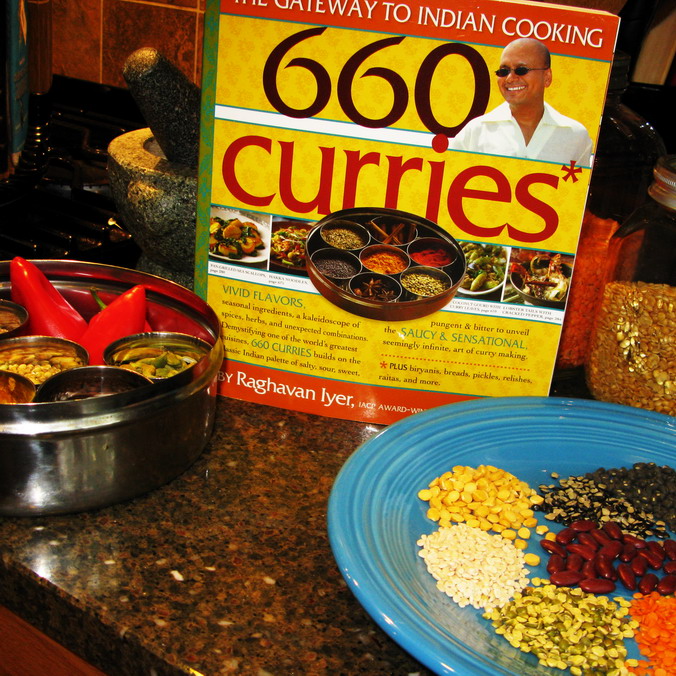
Why did I pick up 660 Curries, even though I have over thirty or so Indian cookbooks already, many of them outlining various regional cuisines?
I have to admit that I bought it because the author, Raghavan Iyer, a former chef, was named IACP (International Association Culinary Professionals) 2004 Teacher of the Year. IACP’s standards are high for their award recipients, so I was pretty certain that all of the recipes would not only be well-written and tested, there would likely be a wealth of information on ingredients, techniques and the culinary cultures of India.
I was not disappointed.
What I was not expecting was the fun-loving, expansive personality that Iyer’s prose depicted. While the book weighs in at 807 pages and very much looks like a textbook, this is no dry treatise on Indian food. Every chapter is opened with an essay introducing the topic at hand which sparkles with wit and charm. Reading this book provides a glimpse into exactly why Iyer won the honor of being 2004’s Teacher of the Year–classes taught by him must be fun affairs, filled with lots of information, encouragement and exciting new techniques, aromas and flavors, as Iyer channels his knowledge and love of all of the foods of India in a stream of clear instruction to his students.
Let me put it this way–not only was I informed in reading this cookbook, I laughed out loud more than once. Note for example, his introduction for the recipe on page 47 for dahi chaat–crispy shells stuffed with potatoes and chickpeas:
“Here’s the deal with this layered chaat: As soon as they are ready, grab one and pop it in your mouth in one fell swoop. Don’t look at it, don’t admire its beauty, don’t take a bite from it, don’t ponder what’s in it, don’t be afraid that it won’t fit in your dainty little mouth (open wide, and in it with go). Why? Because the moment the sauces start pooling at the bottom of the poori, (which is within seconds), they will soften it and the inner wall will cave in, making for a messy experience….”
Very few cookbooks make me giggle, much less laugh. They may be filled with great instructions, amazing recipes, and exciting narratives, but seldom do they hold any comedic value.
What are the recipes in this book like?
They are an incredibly varied lot–collected from every corner of India, reflecting every regional variation. Chapters are divided into main ingredients for the curries, including appetizer curries, poultry, game & egg curries, beef, lamb & pork curries, fish & seafood curries, paneer curries, legume curries, and vegetable curries, along with chapters on contemporary (or fusion) curries, biryani curries, and curry cohorts–or other dishes to go with the curries. There is also a chapter on spice blends and pastes, and information on the basic flavor components of curries, as well as conversion charts, a glossary of ingredients and mail order sources for spices and legumes.
Just leafing through the book right after it came in the mail, I was astounded at the number of recipes that I had never seen before, and I instantly started planning meals around several truly delicious sounding curries. Even though Iyer has both meat-based and vegetarian curries in his book–the meat recipes do not outweigh the vegetable-based ones, as is the case with many cookbooks that are written with the American or British audience in mind. There are just as many vegetarian curries here as meat curries, and they all sound delectable–I can’t wait to try a great many of them. (Zak quipped when he saw the book, “Oh, look–660 curries–and I bet we will be eating out of that book for the next three years!” Not that he minds–he could just tell by the way my nose sank into the book and refused to surface that I was going to be cooking a great many recipes from it.)
The way the book is put together is also physically attractive–it has 16 full-color pages of sumptuous photographs in the beginning of the book, including one for each chapter. I think that these would have been better if they had been sprinkled throughout the book, but I can also see the wisdom of grouping them together so they can be easily found. The rest of the book is set in three colors with the text in an easily read black font with titles, drop caps and sidebars in a nice-curry red orange. Each recipe title is presented in English surrounded with an orange box in a Hindi-styled English font, with a translation in Hindi beneath in smaller black letters in the same decorative, but still easily read font. Each page is edged on the outer edge with a delicate, lacy decorative border.
Look for recipes I tried out from this book and tested in the next few posts this week and next–this book is so delicious I really wanted to give my readers a taste of it right away.


Categories:
- Admin (rss) (55)
- Blogs and Blogging (rss) (81)
- Book Reviews: Cookbooks (rss) (43)
- Book Reviews: Non-Cookbook Food Books (rss) (38)
- Cats and Cat Blogging (rss) (47)
- Chinese Cooking Lessons (rss) (32)
- Culinary School Stories (rss) (18)
- Dairy Pruducts: Cultured and Barbaric (rss) (4)
- Documentary Filmmaking (rss) (1)
- Essays, Rants and Reflections (rss) (260)
- Fighting Hunger (rss) (12)
- Food and Kids (rss) (45)
- Food in the News (rss) (126)
- Food Media (rss) (98)
- Food Preservation (rss) (18)
- Food Safety (rss) (45)
- Gardening (rss) (30)
- Herbs and Herb Blogging (rss) (20)
- Holidays (rss) (50)
- Kat Blogging (rss) (22)
- Kitchen Science (rss) (36)
- Leftover Makeover (rss) (8)
- Life, the Universe and Everything (rss) (131)
- Local and Sustainable (rss) (227)
- Local Athens Food and Foodies (rss) (42)
- Meatless Mondays (rss) (32)
- Menu For Hope (rss) (5)
- Nutrition, Diet and Health (rss) (84)
- On The Farm (rss) (8)
- Recipes: Almost Vegetarian, Vegetarian and Vegan (rss) (294)
- Recipes: American Regional (rss) (37)
- Recipes: Appalachian Hillbilly (rss) (33)
- Recipes: Bread, Pasta, Grains (rss) (95)
- Recipes: Canning and Preserving (rss) (8)
- Recipes: Chinese (rss) (123)
- Recipes: Comfort Food (rss) (120)
- Recipes: Cookies (rss) (16)
- Recipes: Desserts (rss) (48)
- Recipes: French (rss) (25)
- Recipes: Fruits and Vegetables (rss) (302)
- Recipes: Greek, North African and Middle Eastern (rss) (31)
- Recipes: Indian (rss) (137)
- Recipes: Italian (rss) (42)
- Recipes: Japanese (rss) (7)
- Recipes: Jewish (rss) (4)
- Recipes: Korean (rss) (6)
- Recipes: Meat, Poultry and Fish (rss) (220)
- Recipes: Mexican/Native American/ Latin American/Caribb (rss) (27)
- Recipes: Original (rss) (108)
- Recipes: Thai (rss) (27)
- Recipes: Tofu (rss) (17)
- Recipes: US Regional (rss) (16)
- Recipes: Vietnamese (rss) (8)
- Restaurant Stories (rss) (28)
- Sewing, Quilting, Arts and Crafts (rss) (16)
- Simple Chinese Recipes (rss) (30)
- Slow Food and Heritage Foods (rss) (10)
- Spice Blogging (rss) (44)
- The Chinese Cookbook Project (rss) (14)
- The Chinese Pantry (rss) (39)
- The Documentary (rss) (2)
- The Kitchen Saga (rss) (17)
- The Locavore's Bookshelf (rss) (15)
- The Unsung Adventures of The Culinary Nerd (rss) (6)
- Tools and Toys (rss) (35)
- Uncategorized (rss) (10)
- With a Side of Politics (rss) (48)
Archives:
- August 2012 (9)
- July 2012 (12)
- September 2011 (3)
- August 2011 (7)
- July 2011 (8)
- June 2011 (16)
- May 2011 (17)
- April 2011 (11)
- December 2010 (9)
- November 2010 (5)
- February 2010 (1)
- December 2009 (5)
- November 2009 (7)
- October 2009 (10)
- September 2009 (16)
- August 2009 (14)
- July 2009 (14)
- June 2009 (7)
- May 2009 (17)
- April 2009 (10)
- March 2009 (25)
- February 2009 (13)
- January 2009 (10)
- December 2008 (5)
- November 2008 (5)
- October 2008 (6)
- September 2008 (13)
- August 2008 (8)
- July 2008 (11)
- June 2008 (18)
- May 2008 (13)
- April 2008 (14)
- March 2008 (16)
- February 2008 (17)
- January 2008 (19)
- December 2007 (25)
- November 2007 (18)
- October 2007 (24)
- September 2007 (16)
- August 2007 (15)
- July 2007 (15)
- June 2007 (10)
- May 2007 (14)
- April 2007 (16)
- March 2007 (17)
- February 2007 (20)
- January 2007 (13)
- November 2006 (1)
- October 2006 (8)
- September 2006 (14)
- August 2006 (25)
- July 2006 (30)
- June 2006 (28)
- May 2006 (34)
- April 2006 (29)
- March 2006 (24)
- February 2006 (30)
- January 2006 (38)
- December 2005 (40)
- November 2005 (37)
- October 2005 (32)
- September 2005 (25)
- August 2005 (30)
- July 2005 (28)
- June 2005 (21)
- May 2005 (8)
- April 2005 (22)
- March 2005 (17)
- February 2005 (29)
- January 2005 (10)
Search Site:
Links:
- Lily’s Wai Sek Hong
- 101 Cookbooks
- A cat in the kitchen
- A Veggie Venture
- Accidental Hedonist
- Cha Xiu Bao
- chez pim
- Chocolate & Zucchini
- Chopstick Cinema
- Chowhound.com
- Chubby Hubby
- Cook sister!
- Cooking with Amy
- da*xiang
- Eat Local Challenge
- Eating Liberally
- Ecocentric
- Eggbeater
- Epicurious
- Farmgirl Fare
- Fatfree Vegan
- Foodgoat
- ForkandBottle.com
- Green Olive Tree
- Hooked on Heat
- Jaden’s Steamy Kitchen
- Kalyn’s Kitchen
- Lucullian delights
- Mahanandi
- Matt Bites
- MeatHenge
- mmm-yoso!!!
- New York Times – Dining & Wine
- Pizza Goon
- Rasa Malaysia
- Ruhlman
- Sailu's Kitchen
- Serious Eats
- SF Gate: Food & Dining
- Simply Recipes
- Soul Fusion Kitchen
- Tastespotting
- The Amateur Gourmet
- The Cleaner Plate Club
- The Food Section
- The Grub Report
- thecookscottage
- U.S. Food Policy
- Wandering Chopsticks
- Washington Post Food and Dining
- Wasted Food
Meta:


Powered by WordPress. Graphics by Zak Kramer.
Design update by Daniel Trout.
Entries and comments feeds.