
Cook Local, Eat Global
Lamb Shahi Korma: A Rich Royal Dish
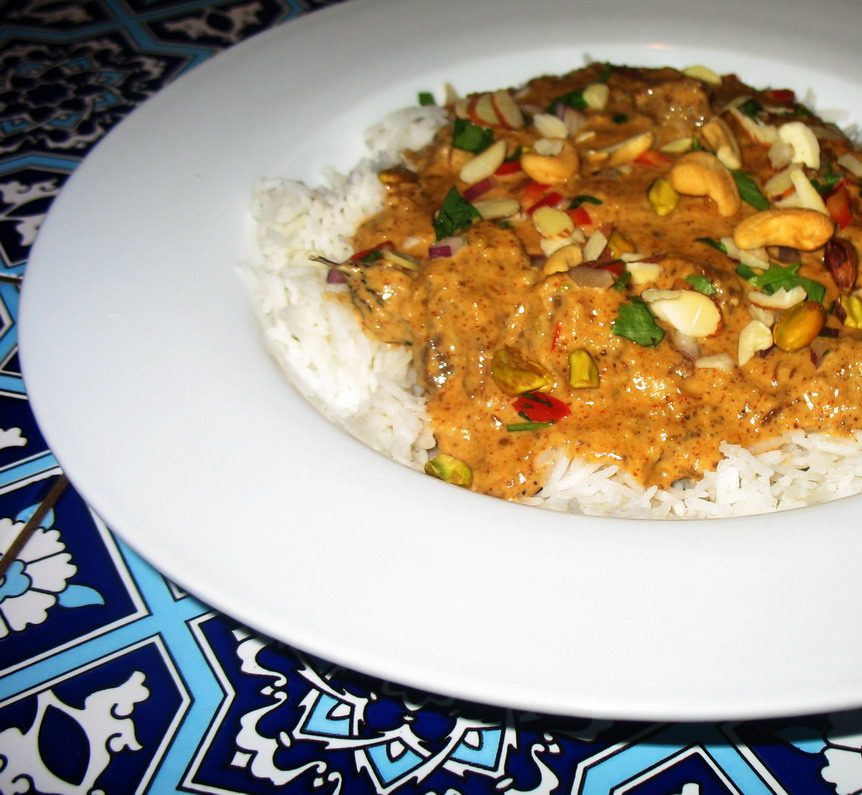
First things first: Lamb Shahi Korma is -not- diet food.
It is not low calorie.
It is not an everyday dish.
But what it is us an utterly sinfully delectable dish of lamb braised in spices, then cooked with a velvety sauce that is fragrant with spices and thick with toasted, ground nuts. It is the most wicked of curries, not because it is hot with chilies, but because it is so utterly, divinely rich.
It is a dish with its roots in the courts of the Mogul Emperors of northern India, and it reflects the royal tastes of the richest, most powerful rulers of that period.
It is something that I make and eat maybe once or twice a year, because if I ate this more often, well, it would be wretched for my waistline, but when I make it, it always disappears. There are never any leftovers, because it is so good, I once had a woman say that if she thought that no one would look askance at her, she would pick up her plate, stick her face right into it and lick it clean, it was so good.
And it is that good.
The sauce is thick and unctuous with cream, yogurt and ground nuts, and subtly scented with sweet spices, and the lamb is falling-apart tender, and filled with its own unique, mildly gamy taste. Garnished with toasted nuts, chopped cilantro and a fine dice of red onion, and red sweet bell pepper, which adds another dimension of flavor and crunch to the dish, Lamb Shahi Korma is a classic that is perfect for holiday celebrations, weddings and any other special events, because it can be made in large quantities, and it can be made ahead of time, then warmed back up just before serving.
In fact, I think that the sauce is only made better by being made a few days in advance. Letting it sit tightly covered in the refrigerator only gives the spices and toasted ground nuts time to become friendly with each other and meld together into a unified, undefinable flavor that is infinitely complex, since it becomes nearly impossible for all but the most discriminating diner to unravel the aromas of each individual spice from each other.
It simply becomes amazingly delicious, and a perfect dish to eat during a celebration of love and unity, because all of the elements of the dish come together into a seamless, perfect whole, giving it a perfect symbolic resonance to the occasion.
That is my kind of dish.
How is it made? Well, in the old days, it was a very laborious process, because not only did the spices have to be ground by hand, but the nuts had be shelled, then toasted, and then ground in large mortars and pestles by hand. The meat was cooked separately, simmered until it was about to fall off the bones, and then it was cut from the bones by hand, and the lamb broth was skimmed of fat and cooled, to be used as the basis of the sauce, which was spiced carefully with onions browned deeply, then ground into a fragrant paste, a paste of wet and dry spices, then enriched first by the addition of first the ground nuts, then cream, and then yogurt, to add a delicate tang which perfectly balanced the very rich ingredients.
Then, the meat was added to the sauce, and allowed to simmer for good long time, until everything was tender, perfectly spiced and fragrant.
Now, we have access to a few shortcuts, like a pressure cooker to cook the meat, and the availability of pre-made nut butters. I like to use both toasted cashew and toasted almond nut butter, although you can use only one if you like. I still take the time to brown my onions very deeply, however, because such long, slow cooking of the onions brings out their nutty and sweet character and removes every bit of sulfurous bite that they posses in their raw state. They also add to the delicate brown color of the sauce, which is nice, because I don’t really like the look of a very pale, nearly white lamb korma. It just doesn’t look as appetizing to me as the brown-tinted kormas colored with caramelized onions do.
I know that this ingredient list is long. That is just how Shahi Korma is–remember it is a dish that came from the royal kitchens of some of the most powerful, wealthy rulers in the world, and back then, there were folks whose jobs were just to grind spices, mix masalas, and grind up nuts into pastes, not to mention the head cooks, the sauce makers, the grill masters who cooked the game and fowl that came from the royal family’s hunting expeditions and the sweet makers. This is a complex dish, and while I know you won’t have all of these expert helpers in your kitchen, you have to be thankful that we at least have access to electric spice grinders, food processors, gas stoves and refrigerators.
Besides, this is a once a year, special occasion dish. And for once a year events, such a complicated dish is worth it.
I promise.
Lamb Shahi Korma
Ingredients:
2 tablespoons canola oil
1 pound boned leg of lamb, trimmed of excess fat and cut into 1″ cubes
1 pound boned lamb shoulder, trimmed of excess fat and cut into 1″ cubes
2 bay leaves
1 stick cinnamon
1 black cardamom pod
3 whole cloves
water as needed
4 tablespoons canola oil
4 cups thinly sliced peeled yellow onions
1 teaspoon salt
2″ cube fresh peeled ginger
6 cloves peeled garlic
1″ stick cinnamon
6 whole cloves
1 teaspoon black peppercorns
2 dried Indian chilies
6 whole green cardamom pods with seeds
1 teaspoon fennel seeds
2 teaspoons Aleppo pepper flakes
1/2 teaspoon cumin seeds
2 teaspoons coriander seeds
1 cup toasted almond butter
1 cup toasted cashew butter
2 teaspoons ground turmeric
2 teaspoons paprika
1 cup heavy cream
1 cup full fat yogurt with the fat stirred thoroughly into the yogurt
salt to taste
toasted sliced almonds, cashew halves and pistachios for garnish
roughly chopped cilantro and mint for garnish
very finely diced red onion and sweet bell pepper for garnish
Method:
Heat canola oil in the bottom of a pressure cooker or Dutch oven on medium high heat. Pat lamb meat dry with a paper towel, and add them to the pot and brown them on add sides. Add the spices and enough water to cover the meat by one inch. If you are using a pressure cooker, bring to a boil, lock the lid into place on highest pressure setting. Bring to pressure, and turn heat down and cook on high pressure for twenty-five minutes. Allow pressure to release naturally, and open the lid of the cooker. Make certain that the lamb is tender. Remove the lamb from the broth, and set it aside. Put the broth, either in the pressure cooker, or another container, into the refrigerator, so that the fat will congeal on the top of the liquid–it makes it easier to remove most of it. (This portion of the recipe can be done a day or two before you serve it. Just refrigerate the meat and the broth separately.)
If you do not have a pressure cooker, cook the meat until it is tender, but not totally falling apart tender. You want it to still be a bit stiff so that it won’t totally fall apart when you cook it in the sauce later.
In a deep Dutch Oven, put the second measure of canola oil, and heat it on medium high heat. Add the onions, and spread them out into as thin a layer as possible, and sprinkle the salt evenly over them. Cook, stirring until the onions turn a deep reddish brown. When they are done, scrape them out of the pot into the bowl of a spice grinder or blender. Add to them the ginger, garlic, and spices, and grind into a thick paste.
Skim most of the fat from the lamb broth and strain it to remove the whole spices. Discard the spices.
Put the pot you cooked the onions in back on the stove on medium heat and deglaze with one cup of the lamb broth. Add the spice paste, and cook, stirring, until it is fragrant. Add the nut butters, and continue cooking, stirring, for another couple of minutes. Stir about two cups of lamb broth, and simmer to reduce by half. Add the cream, and the lamb, and cook, stirring, until the lamb is heated and the sauce is thick. Add the yogurt, in two tablespoon increments, stirring thoroughly between each addition. Allow each addition of the yogurt to incorporate fully into the sauce before adding the next addition.
After the yogurt is added, you can hold the korma at serving temperature (141 degrees F) for several hours before serving to let the flavors meld, or you could cool it, and store it in the refrigerator for a day or two before reheating it to serve. In either case, it will taste lovely, though I prefer to make it a day ahead so that it goes beyond lovely into sublime.
Serve over plain basmati rice, garnished with a sprinkling of the toasted nuts, some roughly chopped herbs and if you like, the very finely diced onion and pepper for added color and crunch.
This recipe serves 8 people as part of a full Indian meal–12 if it is part of a full Indian feast with six to eight more dishes.
Dad Went Home Today
I just wanted to give the good news that Dad went home from the hospital today around six pm, and he finally ate some dinner, and gets to sleep in his own living room (he is going to sleep in his reclining chair rather than his bed, because he needs to be propped up), much to his great relief and joy.
And much to Mom’s relief, mine, Morganna’s and everyone else’s.
And much to the joy of his kitty, Nimrod, and their dog, Topsy.
I am so glad he is home.
And Mom let me know that she has been looking through the cookbooks I gave her and the notes I wrote for her on healthy cooking.
I am happy that all has turned out well.
Thank you to everyone who sent good thoughts, wishes and prayers. My family and I really appreciate them.
A Persian Classic: Koresh e Fesenjan–Done My Way

Koresh e fesenjan is a famous Persian dish where chicken is poached, and then smothered in a sauce consisting primarily of pomegranate juice or molasses and walnuts, with a few spices, primarily cinnamon and pepper, added. The chicken with the rich, thick deep mahogany brown sauce, is served over rice, with a sprinkling of fresh pomegranate seeds and walnut bits over it as garnish.
It sounds fantastic, and I remember making it years ago for Zak and I–right after I started writing this blog, in fact–with the plan of presenting the recipe here–but, well, we hated it.
It was -too- rich.
Even with lots and lots of rice to tame it, the sauce was too intensely flavored, even though I followed the directions to the recipe faithfully. It was just too much–and that says a lot, because both Zak and I love strong flavors.
So, I never got around to writing about it, in large part because I never made it again.
That is, until I started working at Salaam.
Hilarie asked me to make it one night for a dinner special, then confided to me that she never much cared for the dish herself, but that other folks liked it.
I admitted to her that I had made it in the past and not liked it either then said, “Do I have to follow the traditional recipe?”
And she said, “No–just make it taste good.”
And so, I did.
I did a bit of research online and found a few different recipes for it that added other ingredients, like tomato paste, roasted pureed eggplant and garlic, and I thought about it a good bit.
The flavor that I objected to was the intensely sour richness of the pomegranate molasses–it was too heavy, and I couldn’t taste the chicken when it was so strong. I also thought that the flavor was too one-dimensional–with just the pomegranate molasses dominating, it led to a very flat tasting dish, and no one wants a dinner special that tastes flat. Dinner specials should be well-rounded with flavors and textures that knock your socks off.
So, I decided to change the recipe considerably, and in the process, made it taste smoky, tangy, sweet, rich, delicately spicy and creamy on the tongue, all at the same time. The chicken is evident as a flavor as well, since I poach it in chicken stock and add that to the sauce, while the sweetness comes from deeply caramelized onions and garlic, a dab of tomato paste, as well as a drizzle of honey. I kept the cinnamon, and added a bit of cumin, and a tiny bit of chile sauce, just to liven things up a bit. The smoky note comes from grilled eggplant pulp. And finally, to smooth it all out, I added heavy cream and pureed the sauce to a velvety texture with an immersion blender.
The end result is a dish which may not be traditional Koresh e Fesenjan, but it tastes utterly fantastic.
Many home cooks may consider it a bit more work than they would want to undertake except for special dinner parties, but I think the flavor is truly worth it, and this is why:
One night, a week after making the fesenjan for the second time, while I was taking out the trash at Salaam, I overheard one young woman talking to another in the alley beside our restaurant. She said, “Omigod, have you eaten at this place? It is so amazingly good, like I had this dish–it was called something weird, but it was Persian, and it was chicken in this sauce of pomegranate and walnuts and it was the best thing I have ever eaten, like ever.”
I smiled to myself and wandered back to the kitchen, pleased to have given such pleasure to someone I didn’t even know.
Koresh e Fesenjan
Ingredients:
1 pound boneless skinless chicken breasts
1 pound boneless skinless chicken thighs
1 1/2 quarts chicken stock or low-salt chicken broth
1 medium to large eggplant
3 tablespoons olive oil
3 cups thinly sliced yellow onions
6 cloves garlic, peeled and minced
1/4 teaspoon cinnamon
1/4 teaspoon ground cumin
1 pinch ground cloves
2 cups shelled walnut pieces, ground finely in a food processor
1 tablespoon honey
1 teaspoon hot sauce
1/2 cup tomato paste
1 bottle pomegranate molasses (eight to ten ounces)
3/4 cup heavy cream
salt to taste
fresh pomegranate seeds, walnut pieces and finely minced fresh Italian flat-leaf parsley for garnish
Method:
Put chicken pieces into chicken stock or broth, and bring to a simmer. Simmer, covered, until chicken is just done. Remove chicken from pot and allow to cool until you can just handle it, then tear it into bite sized pieces.
Preheat broiler. Wash the eggplant, then dry it. Oil the skin well and pierce in several places with the tip of a knife. Place on a rack in a baking pan and roast it under the broiler, turning it often, until the skin is charred and the flesh is soft. Remove from the broiler and set in a metal or glass bowl, and cover with plastic wrap to allow it to steam. When it is cool enough to handle, cut the stem end off and peel. Mash the flesh through a fine-meshed sieve to remove seeds, discarding seeds and juice. You should get between 1-1 1/2 cups of pulp from the eggplant. Set pulp aside, and discard the rest.
Meanwhile, simmer the stock or broth to reduce it until there is about a cup and a half of it left.
In a heavy bottomed Dutch oven or stockpot, heat oil over medium heat. Add onions, and cook, stirring, until they are deep golden brown. Add garlic and spices, and cook until the garlic is golden and the onions are deep reddish brown, stirring as needed. Add walnuts and cook, stirring, for about four to five more minutes, until the walnuts brown lightly. Add the honey, hot sauce, tomato paste, pomegranate molasses, eggplant pulp and chicken broth or stock. Cook for about five minutes, stirring constantly, adding water in very small amounts if needed to keep it from sticking.
Using an immersion blender, puree the sauce and blend in the cream. Add salt to taste, and correct seasoning as needed.
Bring to a slow simmer, add chicken pieces, and allow to warm to serving temperature.
Serve over rice, and sprinkle each serving with a generous amount of fresh pomegranate seeds, walnut bits and parsley.
This is really good served with a salad of fruit, cheese, and greens with a pomegranate vinaigrette.
Fish Baked With Green Chutney

In this case, it is mahi-mahi, but I like it made with salmon, too.
(Salmon is cool, because the color contrasts so nicely–pink fish and green chutney give a technicolor, Bollywood feel to the dish, which I find to be amusing.)
I got the idea for this dish years and years ago, back when I first started working as a personal chef. My first clients were from Pakistan and Bangladesh, and they really liked fish. The original recipe came from Madhur Jaffrey’s Quick and Easy Indian Cooking, a really wonderful cookbook that helped me learn how to make great curries without spending all day in the kitchen. (The secret: use a pressure cooker.) My client’s mother was very impressed with the fish and was surprised to find that I was an American, not an Indian, the dish tasted so good to her.
This is a very, very simple dish to do, and is nice to make for a multi-course meal or feast where it is combined with other, more involved dishes like biryani, malai kofta or any number of long-cooked curries, because it tastes complicated, but gives the cook a break on the work.
All you need to do is make a green chutney, then coat the fish in it and bake it until the fish flakes. For Salaam, I put each portion of fish–about six ounces–in a casserole dish on top of a bed of basmati rice pilau with browned onions, garlic and chopped cilantro. This not only added a starch element to the dish, it elevated the fish a bit so that the bottom of it didn’t get soggy–the extra chutney and fish juices dripped down into the bed of pilau and flavored it, but the bottom of the fish remained flaky and flavorful, not squishy and gross. I think that making a rice pilau, or even just putting plain cooked basmati, or basmati cooked in chicken or vegetable broth rather than water, and using it to line the baking dish would make a fine presentation of the dish at home or a dinner party as well.
You could use any recipe for green chutney you like, but I personally like this one–it has lots of vibrant flavors, and is quite brilliant in color. After being cooked, it darkens in color, but is still an impressively deep green, with flecks of red chilies and tiny diced bits of red onion, which of course, are not red, but are violet. Lemon or lime zest and juice add citrus tang, and fresh herbs, garlic, and ginger add the bulk of the zesty flavor.
Baked Fish with Green Chutney
Ingredients:
2 cups cilantro leaves and stems, roughly chopped
1 cup fresh mint leaves and stems, roughly chopped
5 cloves garlic, peeled and roughly chopped
1-5 green red thai chili, stem removed (Use as many as you like for the heat you like.)
1 1/2″ cube fresh ginger, peeled and sliced
zest of one lime or lemon
1/4 cup lemon or lime juice
pinch ground cumin
1/4 teaspoon ground coriander
2 teaspoons Aleppo pepper flakes
1 tablespoon canola oil
salt to taste
1/4 cup finely diced red onion
4-6 mahi mahi or salmon filets
2 cups cooked basmati rice or basmati pillau
canola oil
lemon or lime slices, halved cherry or grape tomatoes, red onion rings and cilantro and mint leaves for garnish
Method:
Preheat oven to 350 degrees F.
Take the first 11 ingredients, (up to the tablespoon of canola oil) and grind into a fine, green paste in a food processor or grinder. Add salt to taste.
Mix in the diced onion, and set chutney aside. Examine the fish for bones and remove any you find. If you wish, remove the skin from the salmon, though it helps to keep the fish intact during cooking.
Rub the bottom and sides of a baking dish with the canola oil, and put the rice or pilau in the bottom of it in a smooth layer. Pack in lightly.
Coat the fish fillets with the chutney and lay on top of the rice. Cover loosely with foil and bake for ten minutes. Remove foil and cook until done–until the internal temperature is 125-140 degrees F, depending on how well done you prefer your fish to be, or until it flakes.
Garnish as you like with thin lemon or lime slices, cherry or grape tomato halves, onion rings and whole or roughly chopped cilantro and mint leaves and serve immediately. (If you want, you can sprinkle the cherry or grape tomato halves between the fish fillets and use them to cover the bare spots on the rice to keep them from drying out. The baked tomatoes taste quite yummy.)
Dad’s Surgery Went Well
Another quick update, which I tried to write last night, but the wireless internet at the hotel was acting wonky, so I never got to do the post.
Dad came through the surgery fine. They fractured his sternum when they cut it and used the spreaders–so he has extra wire to hold it together, and that will hurt even more than normal. He apparently woke up yesterday after the surgery, but when we were there, he wasn’t awake.
This morning, when Morganna and I went to see him, he was awake, and in considerable pain–which is not at all surprising. He was worried about his right hand–it tingled and was numb, but it was most likely because of the amount of fluid built up in it–he has no signs of having had a stroke during surgery–everything else on that side of his body works fine. He is lucid, and has lost none of his black sense of humor and irony.
Right after we left, the nurse took out the central chest tube–the one that was draining the area around his heart. This is good, because it will allow him to breathe more easily. The nurse also said that he is probably going to be moved from ICU today or tomorrow, which is excellent.
He told the surgeon that he had killed him, and Dr. Khan just laughed.
Later today, he was up in a chair, and even stood up briefly–with each hour, his color improves and he gets stronger.
I think that once Dad starts to really heal, he will feel much better, because he won’t have to worry about having a heart attack or stroke constantly.
Four of the six cookbooks I ordered for healthful cooking to give to Mom and Dad came today. Two more are coming next week, so they will be stocked up on ideas for good meals. It looks like I need to go through their cupboards and get rid of the crap they’ve been eating. Both of them are borderline diabetic, so they need to stop eating so much refined flour and sugar, in addition to all of the processed foods and transfats.
That should be fun.

Categories:
- Admin (rss) (55)
- Blogs and Blogging (rss) (81)
- Book Reviews: Cookbooks (rss) (43)
- Book Reviews: Non-Cookbook Food Books (rss) (38)
- Cats and Cat Blogging (rss) (47)
- Chinese Cooking Lessons (rss) (32)
- Culinary School Stories (rss) (18)
- Dairy Pruducts: Cultured and Barbaric (rss) (4)
- Documentary Filmmaking (rss) (1)
- Essays, Rants and Reflections (rss) (260)
- Fighting Hunger (rss) (12)
- Food and Kids (rss) (45)
- Food in the News (rss) (126)
- Food Media (rss) (98)
- Food Preservation (rss) (18)
- Food Safety (rss) (45)
- Gardening (rss) (30)
- Herbs and Herb Blogging (rss) (20)
- Holidays (rss) (50)
- Kat Blogging (rss) (22)
- Kitchen Science (rss) (36)
- Leftover Makeover (rss) (8)
- Life, the Universe and Everything (rss) (131)
- Local and Sustainable (rss) (227)
- Local Athens Food and Foodies (rss) (42)
- Meatless Mondays (rss) (32)
- Menu For Hope (rss) (5)
- Nutrition, Diet and Health (rss) (84)
- On The Farm (rss) (8)
- Recipes: Almost Vegetarian, Vegetarian and Vegan (rss) (294)
- Recipes: American Regional (rss) (37)
- Recipes: Appalachian Hillbilly (rss) (33)
- Recipes: Bread, Pasta, Grains (rss) (95)
- Recipes: Canning and Preserving (rss) (8)
- Recipes: Chinese (rss) (123)
- Recipes: Comfort Food (rss) (120)
- Recipes: Cookies (rss) (16)
- Recipes: Desserts (rss) (48)
- Recipes: French (rss) (25)
- Recipes: Fruits and Vegetables (rss) (302)
- Recipes: Greek, North African and Middle Eastern (rss) (31)
- Recipes: Indian (rss) (137)
- Recipes: Italian (rss) (42)
- Recipes: Japanese (rss) (7)
- Recipes: Jewish (rss) (4)
- Recipes: Korean (rss) (6)
- Recipes: Meat, Poultry and Fish (rss) (220)
- Recipes: Mexican/Native American/ Latin American/Caribb (rss) (27)
- Recipes: Original (rss) (108)
- Recipes: Thai (rss) (27)
- Recipes: Tofu (rss) (17)
- Recipes: US Regional (rss) (16)
- Recipes: Vietnamese (rss) (8)
- Restaurant Stories (rss) (28)
- Sewing, Quilting, Arts and Crafts (rss) (16)
- Simple Chinese Recipes (rss) (30)
- Slow Food and Heritage Foods (rss) (10)
- Spice Blogging (rss) (44)
- The Chinese Cookbook Project (rss) (14)
- The Chinese Pantry (rss) (39)
- The Documentary (rss) (2)
- The Kitchen Saga (rss) (17)
- The Locavore's Bookshelf (rss) (15)
- The Unsung Adventures of The Culinary Nerd (rss) (6)
- Tools and Toys (rss) (35)
- Uncategorized (rss) (10)
- With a Side of Politics (rss) (48)
Archives:
- August 2012 (9)
- July 2012 (12)
- September 2011 (3)
- August 2011 (7)
- July 2011 (8)
- June 2011 (16)
- May 2011 (17)
- April 2011 (11)
- December 2010 (9)
- November 2010 (5)
- February 2010 (1)
- December 2009 (5)
- November 2009 (7)
- October 2009 (10)
- September 2009 (16)
- August 2009 (14)
- July 2009 (14)
- June 2009 (7)
- May 2009 (17)
- April 2009 (10)
- March 2009 (25)
- February 2009 (13)
- January 2009 (10)
- December 2008 (5)
- November 2008 (5)
- October 2008 (6)
- September 2008 (13)
- August 2008 (8)
- July 2008 (11)
- June 2008 (18)
- May 2008 (13)
- April 2008 (14)
- March 2008 (16)
- February 2008 (17)
- January 2008 (19)
- December 2007 (25)
- November 2007 (18)
- October 2007 (24)
- September 2007 (16)
- August 2007 (15)
- July 2007 (15)
- June 2007 (10)
- May 2007 (14)
- April 2007 (16)
- March 2007 (17)
- February 2007 (20)
- January 2007 (13)
- November 2006 (1)
- October 2006 (8)
- September 2006 (14)
- August 2006 (25)
- July 2006 (30)
- June 2006 (28)
- May 2006 (34)
- April 2006 (29)
- March 2006 (24)
- February 2006 (30)
- January 2006 (38)
- December 2005 (40)
- November 2005 (37)
- October 2005 (32)
- September 2005 (25)
- August 2005 (30)
- July 2005 (28)
- June 2005 (21)
- May 2005 (8)
- April 2005 (22)
- March 2005 (17)
- February 2005 (29)
- January 2005 (10)
Search Site:
Links:
- Lily’s Wai Sek Hong
- 101 Cookbooks
- A cat in the kitchen
- A Veggie Venture
- Accidental Hedonist
- Cha Xiu Bao
- chez pim
- Chocolate & Zucchini
- Chopstick Cinema
- Chowhound.com
- Chubby Hubby
- Cook sister!
- Cooking with Amy
- da*xiang
- Eat Local Challenge
- Eating Liberally
- Ecocentric
- Eggbeater
- Epicurious
- Farmgirl Fare
- Fatfree Vegan
- Foodgoat
- ForkandBottle.com
- Green Olive Tree
- Hooked on Heat
- Jaden’s Steamy Kitchen
- Kalyn’s Kitchen
- Lucullian delights
- Mahanandi
- Matt Bites
- MeatHenge
- mmm-yoso!!!
- New York Times – Dining & Wine
- Pizza Goon
- Rasa Malaysia
- Ruhlman
- Sailu's Kitchen
- Serious Eats
- SF Gate: Food & Dining
- Simply Recipes
- Soul Fusion Kitchen
- Tastespotting
- The Amateur Gourmet
- The Cleaner Plate Club
- The Food Section
- The Grub Report
- thecookscottage
- U.S. Food Policy
- Wandering Chopsticks
- Washington Post Food and Dining
- Wasted Food
Meta:


Powered by WordPress. Graphics by Zak Kramer.
Design update by Daniel Trout.
Entries and comments feeds.