
Cook Local, Eat Global
How To Be A Good Dinner Guest (And Get Invited Back)
So I was cruising around the net, and reading blogs the other day and on Slashfood, I found a link to this Seattle Times article: Non appetit: Dietary restrictions can complicate social dining.
Basically, it is about the fact that because of greater prevalance in food allergies and awareness of diseases such as celiac in the US, and the growing number of people on various versions of a vegetarian diet, hosting or attending a dinner party has become an experience fraught with no small amount of issues and anxieties.
For hosts, it used to be about choosing the perfect mixture of guests, a sock-em-dead menu with the perfect wine(s) and a scrummy dessert. Now, other factors have come into play which make an already complicated social event a little bit more difficult.
From my perspective as someone who cooks for people a lot, I have a philosophy, and it is a simple one: I cannot please everyone all the time.
When it comes to health issues like food allergies, I -will not- play games or monkey around. That was beaten into my head in culinary school–that if a server comes to you and tells you that someone at table 11A has a food allergy, you -damned well- had best pay attention and if you cannot be certain that your food doesn’t contain a speck of whatever it is that they can’t eat, you’d best tell that server to hightail it on back to the table and tell the guest to please not order that item, because no cook anywhere, wants to be responsible for killing someone. And that is how dire some food allergies are. They can kill. End of story.
I don’t mess with that. So, if I am cooking for someone for whom I have not cooked in the past, I always ask, “Are there any foods you are allergic to?”
I also will not mess with celiac disease, which is essentially a genetically-linked disorder that is a severe form of gluten intolerance. I have a friend who has it, and I have watched her suffer for over a decade through incorrect diagnoses, poor health, and not being able to tolerate or eat anything. Now that she has the correct diagnosis, and is healther than she has been in years now that she avoids gluten, I will be damned if I feed her something that is going to make her sick. Celiac disease is the same thing as a food allergy in my book–not to be questioned by a host, or ignored, but to be taken seriously, because it is related to health.
I also will not mess with religious prohibitions.
I have a Muslim friend, and she will obviously not eat pork or drink alcohol. No problem. When she comes over, I will cook pork, but only if I am cooking other things that she can eat. She isn’t so strict that she will not eat from a kitchen where pork has been cooked. When she comes to eat, I make my pie crusts with butter instead of butter and lard. No big deal. It is still good, and she can eat, and we are all happy. End of story.
If a friend is a vegetarian, I make vegetarian options. No worries.
But.
There comes a point when it all gets to be too weird, too much or too strange, and I will throw my hands up in the air and say, “Screw it,” and probably never ask a person back.
If someone is on a low-cholesterol diet, or they are avoiding fat or salt or they are on Atkins or whatever weight loss plan, or they only want to eat organic foods, or local or sustainable foods (though, in truth the latter is not a problem at my house) and I am giving a big party and they are coming–and they give me the list of things they avoid that while it may be for their health, it isn’t a case where eating the restricted items will kill them–I will not be as likely to honor their requests.
I also don’t tend to honor simple food dislikes, either. “I don’t eat red meat because its icky,” or “I don’t like mushrooms” will not fly very far in my house, especially if I am already making concessions for people who have real food problems which will either kill them or get them in the bad graces of God.
I mean, look, I know that both Zak and Dan don’t much like mushrooms (Zak is of the belief that because mushrooms grow in poop, and poop is unclean, that therefore mushrooms are also unclean), but the rest of us do, so I -will- put them in a pasta dish, and they both will pick them out and toss them into everyone else’s bowls as they eat.
No harm, no foul.
And neither of them whines about it in the least. (Okay, they do whine now and again, but mostly in a kidding way. It is certainly not meant to be taken seriously, and I never do.)
But if I had invited someone over who only wants to eat sustainably raised organic food or whatever, (someone quoted in the Seattle Times story was like that) and nothing I cooked was that, and so they wouldn’t eat–yeah, I would be offended. That would be rude. I also think it would be rude of them to tell me their preferences before they accept the invitation, too, because, as far as I am concerned, preferences do not have to be honored, while truly dire restrictions do.
One meal of non-organic food will not kill anyone.
One meal of something with some fat in it will not destroy a person’s cholesterol count. One meal that includes carbs will not jeopardize someone’s success at losing weight the Atkins way. Picking around a food that one doesn’t like has never caused a person lasting harm.
However, acting like a spoiled brat who won’t eat this or that, or making demands on a host that are unreasonable, might ensure that one is not invited back for dinner again.
There are solutions to these problems. There are ways to be a good guest, even if you really can eat barely anything because if you do you will swell up and die for real.
If you really are that allergic to everything, and you explain it gently to your host, and then offer to bring a dish or two that you -know- you can eat, you will go a long way toward gaining their respect and eternal gratitute. Some hosts might be offended (and if they are, they are the ones acting like spoiled brats, and maybe you shouldn’t accept that invitation anyway) , but not me. That tells me that you are serious about your food issue and will take responsibility for it, and that makes me happy. That gets you invited back.
If one wants to invite a bunch of people who all have various health issues, religious dietary restrictions, lifestyle choices and food preferences, then one -could- instead of having a formal dinner party, make it a potluck. Then, everyone brings at least one thing that they and their family can eat, so that no one goes hungry. Of course, one runs the risk that no one can or will eat each other’s food, but well, that is probably better than having the host tear out her hair and run sobbing from a kitchen which she has set on fire in a screaming fit of despair.
But with me, I am cool with it. When I have a lot of people over, and I am cognizant of all of the deadly food problems, I usually just make an extremely varied menu that is wide-ranging enough that pretty much everyone has something that they can eat and enjoy on the table.
And if there are a couple of people picking bits of this or that out of something and setting it aside, I don’t sweat it. That is okay. They will live.
And really, if I hear any complaints about not liking this or that or another thing, I will generally ignore it, and perhaps make a note never to invite that person again.
But I rarely have that problem anyway.
Maybe it is because I hang out with people who don’t assume that they are such the center of the universe that a person inviting them over for dinner has to cater to their every food neurosis or whim, no matter how trivial it is.
Yeah, I think that is why I have never had that problem: I only hang out with cool people who know how to act when they go over to another person’s home.
(Which of course, makes me wonder about everyone else in the world–where did they grow up that making trivial dinner demands on a host is considered okay?)
“The Spice Is Right” VI Theme: Back To School
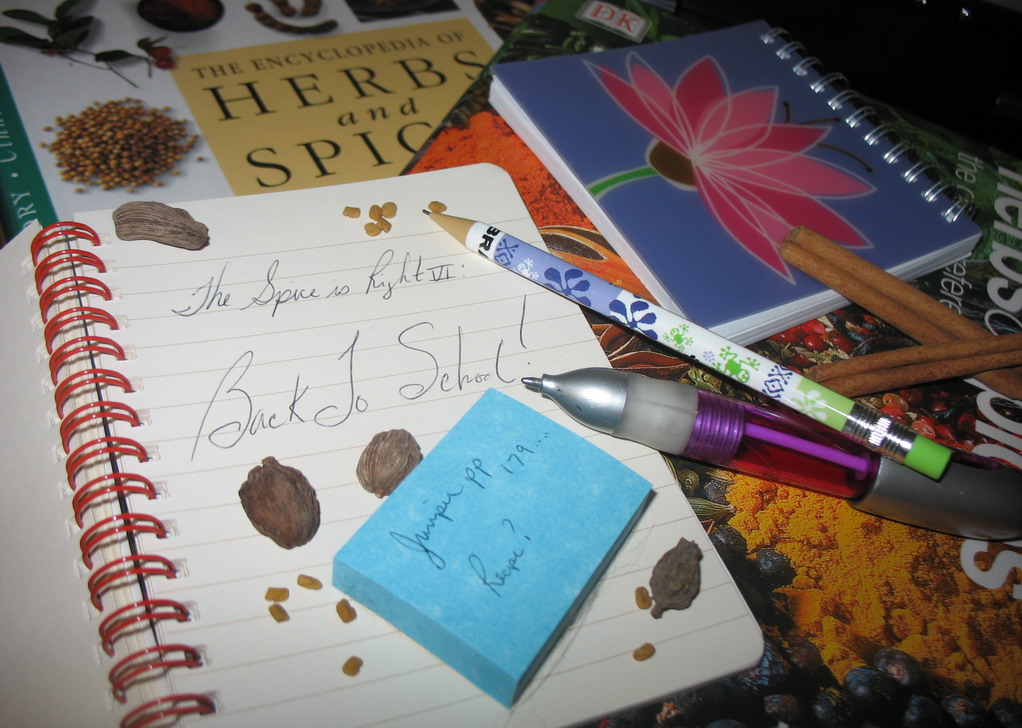
I was always an odd child. The fading end of August and the beginning of September were always one of my favorite times of year. Not the favorite–the favorite was deep autumn, in October, when the air is crisp with chilling winds, the sky is a blazing blue that perfectly sets off the fiery leaves, and the scent of woodsmoke wafts from newly cleaned chimneys.
By why did I always like this time of year, when the mournful song of cicadas signaled that summer was dying, and autumn was creeping upon the landscape?
Because it also meant that school was about to start. (And the heat of summer was in its decline.)
I told you I was weird.
I loved going back to school: I loved the excitement of new teachers, new shoes, new jeans, new books to read and the sight of new school supplies set up in regimented rows on my desk. I looked forward to seeing my friends again, and even my old enemies, who, it seemed after three months away from picking on me, usually forgot that we were enemies at all, and were nicer to me.
I loved the scent of new crayons, new pencils and new reams of notebook paper. I always put a new ribbon in my typewriter (an ancient Royal made of enamelled cast iron from the 1930’s, but they still made ribbons for it up to the 1980’s!), and laid in a supply of correction fluid, which smelled better to me than perfume.
In honor of those strange, geeky memories of childhood, I suggest that going back to school is something we all periodically need to do. Learning is for everyone, not just kids, and I like to see adults stretch themselves now and again, and pick up something new and learn about it. Whether that means someone decides to attend graduate school after the kids have grown, or just takes a knitting class for fun, or picks up a book on cake decorating, buys the tools and jumps into piping roses for the heck of it doesn’t matter.
What matters is that learning is a lifelong occupation, because if we stop learning, we stop growing.
What does this have to do with “The Spice is Right?”
Well, here is the deal.
I would like each of the participants to pick a spice that they have either never used, or know very little about, and learn about it. Find out what it is used for, where it is from, who originated its use, what its main culinary uses are, if it is used medicinally or aromatically, and what the folkloric and mythic connotations, if any, are.
And then, write us a post about the spice, reporting what you have learned, and feature it in a recipe that you have never cooked before, preferably one that is from a different cultural or ethnic background than yourself.
As always, send me an email with the URL of your post, the name of your blog and yourself and any unposted photograph you might want me to use on or before September 15th at midnight EST, and I will be glad to post it along with the other entries in the roundup post(s) in the next few days.
After next month, I am taking a hiatus from “The Spice is Right,” in order to give birth to little Kat and then get back into the groove of having a newborn around. (It has been sixteen years and some months, after all!) But, the event is not going away–it is just changing venues. Danielle, the fantastic blogger of Habeas Brulee, generously offered to host for the months of October and November while I am recovering, so after September, look for “The Spice is Right” at her blog. She has emailed me ideas for themes and she has some good thoughts on the subject, so I think that she will be setting some fun and interesting challenges for you all. (And me–I may still particpate, just not host!)
If anyone else is interested, and I remember that a few of you were, I think I am also going to bow out of hosting in December as well, to give myself a three-month “maternity leave” to get my act together. So, if anyone else would like to host the month of December, please email me and let me know. All you have to do is come up with a theme for that month, and post about it on your blog, and if you remember (I didn’t remember to this month), post about it on IMBB and the Food Blog S’cool Calendar to publicize it. I will also make a post here each month pointing people to the host blog as well.
I once again want to thank everyone for your support of this event as participants, and now as hosts. I plan on hosting again starting in the new year in January, but I really appreciate how much everyone is helping out until then.
The Spice Is Right V: Fresh and Local Roundup
It is that time of the month again–time to reveal to the world what my food blogging friends have come up with to play the game of “The Spice is Right.” This month, our theme is “Fresh and Local,” and the idea is to take a spice that local to wherever our participants are, and pair it with some of the fresh, local bounty of the farms of their own area.
I know that this is a particularly hard challenge; most true spices, (as defined as the aromatic bark, root, rhizome, seed, fruit or flower of a plant, often dried, used to flavor other food) are not exactly thick on the ground anywhere else by the Spice Islands and India. Thus, quite a few bloggers have stretched the spice definition to include herbs, which are the aromatic leaves (fresh or dried) used to flavor other foods. This is fine with me–I knew that folks were going to have to work a bit harder on these entries, and I do not mind. This time around, I am much more interested to see what is locally fresh and in season around the world than following the letter of the challenge.
But enough of the boring stuff! Let’s get into the meat of this post, where I talk about what everyone around the world has cooked up for us to enjoy in words and pictures.
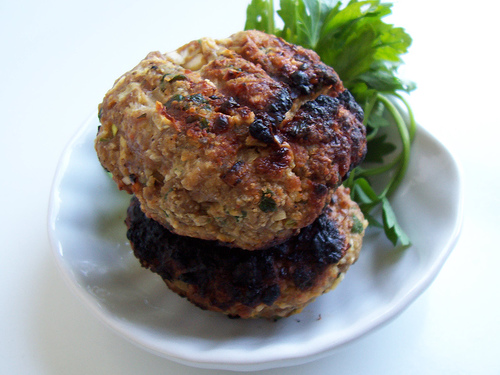
Meena, my good friend of Hooked on Heat, gets the Early-Bird Award for this edition of “The Spice is Right;” two days after I announced the theme, she had mailed me her entry. What is it? Spicy Lamb Burgers cooked on the grill, and boy do they look nummy. I make a similarly spiced ground lamb kebab from India called “Chappli Kebab” that people like to eat rolled in whole wheat pita, and dressed with fresh tomatoes, green chutney and a spicy yogurt sauce–but I have to give Meena’s version, served on buns a try, too. I can almost smell the delightful hardwood charcoal fragrance wafting from the beautiful photo she sent in, and I can taste my tongue dancing with the flavor of locally grown green chiles and garlic. Thank you for a great post, Meena, and I can’t wait to fire up our grill and see how these taste here in Athens!
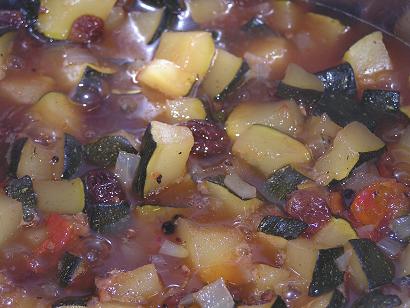
Isis, who lives and blogs Yambalaya from France, not only made something fresh and local for this challenge, but she canned it, thus preserving it for the long blustery winter days ahead. Now that is thinking ahead to eat locally all year around! Her Courgette Chutney looks delicious and is chock full of produce from her very own garden, and is filled with native French herbs and spices, such as estragon (tarragon) and coriander seeds. Unfortunately, her chile peppers were not ready to go into this batch of chutney, but she promises that her very own home grown spice will go in the next batch sometime this month. Courgette, by the way, is the French word for zucchini, and no offense to the Italians, from whence the more familiar English term comes, I think courgette sounds prettier. Isis–thanks for a lovely entry, and keep on cooking!
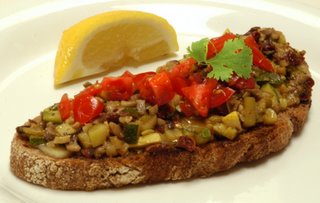
Christine, of Christine Cooks Vegetarian has sent in a lovely post that evokes the scent of Hatch Green Chiles of New Mexico. What does she use these beautiful verdant gems in? Does she make posole, a native New Mexican stew of lime-treated corn? No. Does she make a bean-filled chili? Nope. How about Chiles Rellenos? Nada. No, Christine goes her own way and instead of going with something inherently New Mexican for her entry, she takes inspiration from Italy and uses all of the local goodies that desert agriculture offers: chiles, garlic, tomatoes and cheese, and turns it into Southwest Crostini! “Crostini” means “little toasts” in Italian, and she presents us a toasted, open faced sandwich of cheese, tomatoes, chiles, squash, herbs and avocadoes. Dang, but they look and sound fantastic–Chrstine–thank you for a wonderful entry, even if you made me hungry while I wrote about it!
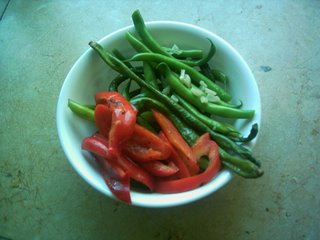
Hadar, who blogs Vegetable Adventures from Tel Aviv, and who I am honored to call “Little Sister,” has given us a very simple recipe that highlights the natural flavors of the vegetables in it in her post, “Vegetables, Olive Oil and Peace.” Every ingredient in Green Beans and Roasted Red Peppers With Garlic is local to Israel, (except, perhaps, the optional balsamic vinegar) particularly the olive oil which is from trees over a hundred years old. The resulting dish is filled with the flavors of the Mediterranean, and the hope and prayer for peace in the region, and soon. It is a lovely dish, and reminds us all that sometimes, the very best flavors are not the most complex, but instead, the most simple. Thank you, Hadar, for touching us all.
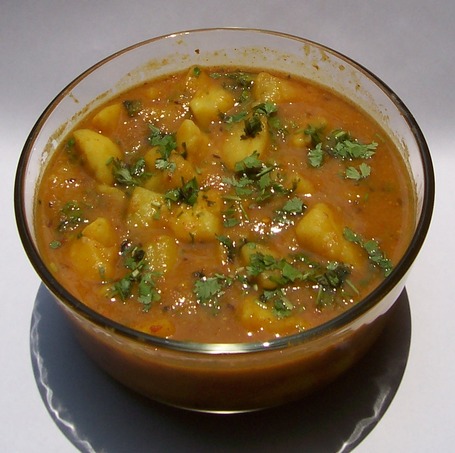
I want to introduce everyone to Anita, a brand new blogger and very articulate writer who offers us A Mad Tea Party (ah, it appears that she is also a fan of one of my favorite books from childhood!) from the great and growing city of Dehli. In her post, “Simple Potato Curry,” she gives us a glimpse into how life is changing in her home city, the traditional ways of using a sill-batta–a grinding stone–for grinding wet curries in smaller, non-urban communities, as well as giving us a recipe that not only looks lovely, but sounds amazing in its description. There is so much history in her post and I can almost taste the potato curry by reading about it and looking at the photographs–thank you for a great debut entry, Vinyas, and I hope to see more from you in the months to come!
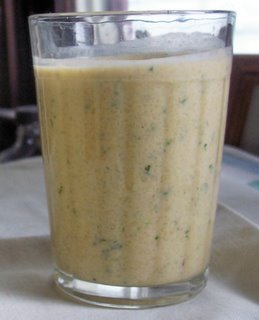
Lucette, the lady who brings us Cooking Vintage from Cleveland, has cooked up a really interesting sounding cool-you-off-and-warm-you-up soup for us this time around, using local ingredients and a recipe inspired by the work of another blogger, “The Serendipitous Chef.” Fiery Cool Cucumber Soup has everything I would want in a summer dish: it is cooling, it has chiles and lots of garlic, herbs and spices in it. Oh, and it has yogurt–one of my favorite dairy foods in all the world. Her local spice comes from her own garden: coriander seeds, harvested from her own cilantro plants, which she grows along with other herbs and garlic in her yard. A woman after my own heart! She also gives us an overview of interesting and entertaining facts about cilantro/coriander in her post as well, making it not only tasty, but educational, too. The best of both worlds, Lucette–thank you!
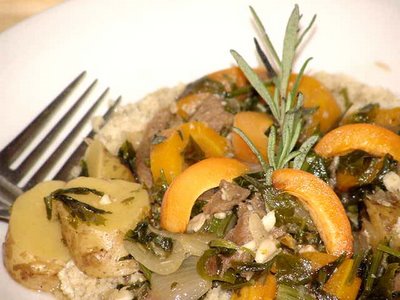
Debi, of Dejamo’s Distracted, admits that she got so distracted by the “local” part of the challenge, that she forgot about the “spice” portion of specifications, and so, ended up using totally non-local black peppercorns, and local rosemary, which is an herb, but not a spice. My response–it is fine, dandy and okay, because her Lamb and Apricot Stew looks and sounds to die for. And, as she recounts in her post how much fun she had sourcing the local ingredients from her greenmarket, I cannot help but be happy that I sent her on her errands, because not only did she have fun with her hunting and gathering, she put together a dinner using some of her favorite ingredients. That is all okay by me, Debi–thank you for such a gorgeous-looking and sounding entry.
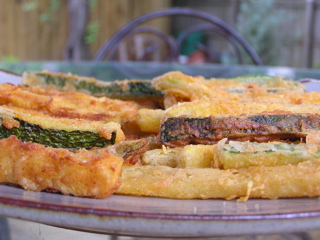
Jennifer, the South Louisiana blogger behind The Weekly Dish, has got a fine and tasty representative of the spicy South Louisiana cuisine that is rightly hailed as delicious all over the world to show us this month. Even though it was hot and steamy and messy and sweaty work, she brings us a recipe for Fried Zucchini, which, for years, was about the only way my Dad would willingly eat a green summer squash. Now, mind you, the way that Jennifer makes it is far tastier sounding than the version I grew up with that was seasoned only with salt and pepper. Hers is spiced with local Louisiana cayenne and paprika–hot and sweet red peppers, and the batter is flavored with tangy buttermilk. Mmmm. I can smell the crispy browned crust and the cayenne now! Thank you, Jennifer, and I am glad you found all the sweaty messy work worth it when you sat down to eat!
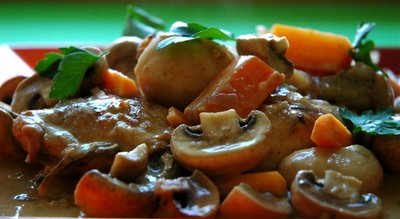
Meeta, the blogger behind the lovely photography and recipes of German food blog, What’s For Lunch, Honey?, is a woman after my own heart. She declares up front in her entry that she loves Thai food. Well, I can’t blame her for that–Thai food is some of the best on the planet. What does she bring us? A chicken curry with a coconut-peanut satay sauce: Coq au Coco. For the local spice, she cheated a tiny wee bit and used her own homegrown cilantro leaves, an herb, instead of a spice, but that is okay. It was a difficult challenge this time around, so we are bending the rules. Besides, who can resist this dish? So colorful with so many veggies and chicken, with lots of flavors running wild over the palate. Thank you Meeta–and I look forward to seeing what other goodies you come up with to share with us in the next few months!
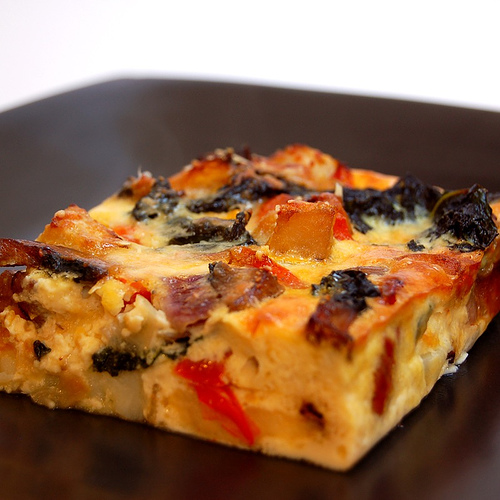
Haalo, the adventurous cook and writer of Cook (almost) Anything Once is from Australia, which means that while we northern hemisphere folks are rolling in summer’s bounty, she is not quite as fortunate. But, even though it is winter, it is still Australia, and so there are lots of wonderful winter vegetables in evidence, and she uses them to good effect in conjunction with a native Australian spice, Mountain Pepper. As I understand it, it is from the same genus of tree that produces Sichuan Peppercorns and Sansho pepper in Japan, but it is a different species. The fruits of the tree are used, as are the dried and crushed leaves–and this is the part that Haalo used in her knock-down gorgous Roasted Vegetable Frittata. A frittata is kind of like an Italian tortilla–meaning the Spanish egg dish, not the Mexican/Native American flatbread, and is a great way to make a stunning and tasty brunch or supper dish. I bet the mountain pepper leaves really sparkled in it, too! Thanks, Haalo–that sounds fantastic!
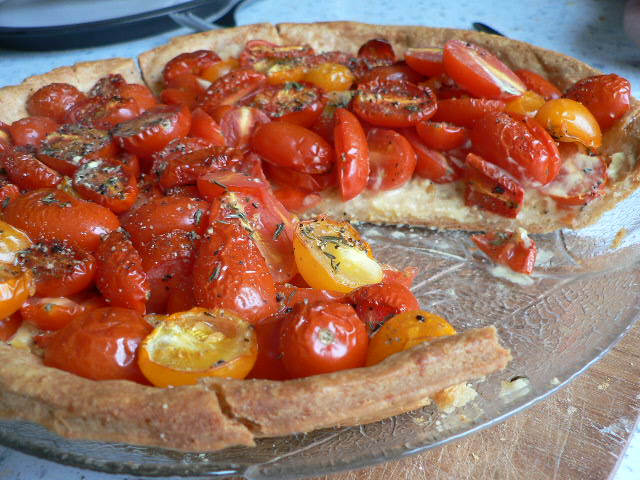
Ulrike, living and blogging in Northern Germany where she writes the excellent Kuchenlatein, went all out in her quest for fresh, local ingredients. She used her own homegrown thyme and tomatoes in her offering, and she sourced local dairy products and flour as well. All of these lovely ingredients went together to make an absolutely jewel-like Tomato Tart With Cheese Crust. Look at how pretty it is! And not only that, but it sounds mouthwateringly delicious and very full of fresh flavors. In addition to the recipe, Ulrike gives us step by step photo guidance on how to blind-bake the tart crust, and shows us pics of how her garden grows, including a peek at her happy garden gnome at his post where he guards her prolific tomato plants! Thank you, Ulrike, for sharing a generous glimpse of your life and home with our readers!

Elizabeth, the Canadian gardener and blogger who brings us Blog From Our Kitchen, featured what I was going to feature, if my cilantro plants had not bolted and then been drowned by heavy rains last month: fresh coriander seeds. Coriander, as some of you know, is a seed that is often used in Indian curries, but is also used in Western baking and in Mexican dishes. What some may not know, it is the seed of the cilantro plant, and if you let your cilantro bloom into pretty lacy umbrels of frothy white flowers, it will produce seeds that if you don’t gather them, will sow themselves in your garden, and thus, become self-perpetuating. I like that about cilantro. What you also may not know is that you can eat the seeds green, before they ripe and dry out. What did Elizabeth make for us with her coriander seeds? A summer treat: Corn on the Cob with Lime and Garam Masala–one of my very own favorites! Thanks, Elizabeth, and I look forward to seeing what you bring us next time around!
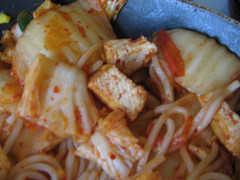
Emily, the author of Brooklynmili, went all out with the definition of “fresh and local” and procured all of her foodstuffs for her entry from within the foodshed of New York City. Everything in it was from within 117 miles of the city, with most of the foodstuffs being made within a handful of miles of her home. What does she bring to the table? Something beautiful indeed–Kimchee Stirfry. A concoction of noodles, kimchee, fresh tomatoes from her garden, farm fresh eggs and local tofu, the dish is a sight to behold, and I suspect, has a flavor to stir the soul and senses. Thank you for a great entry, Emily, and I look forward to more goodies from you in the future!
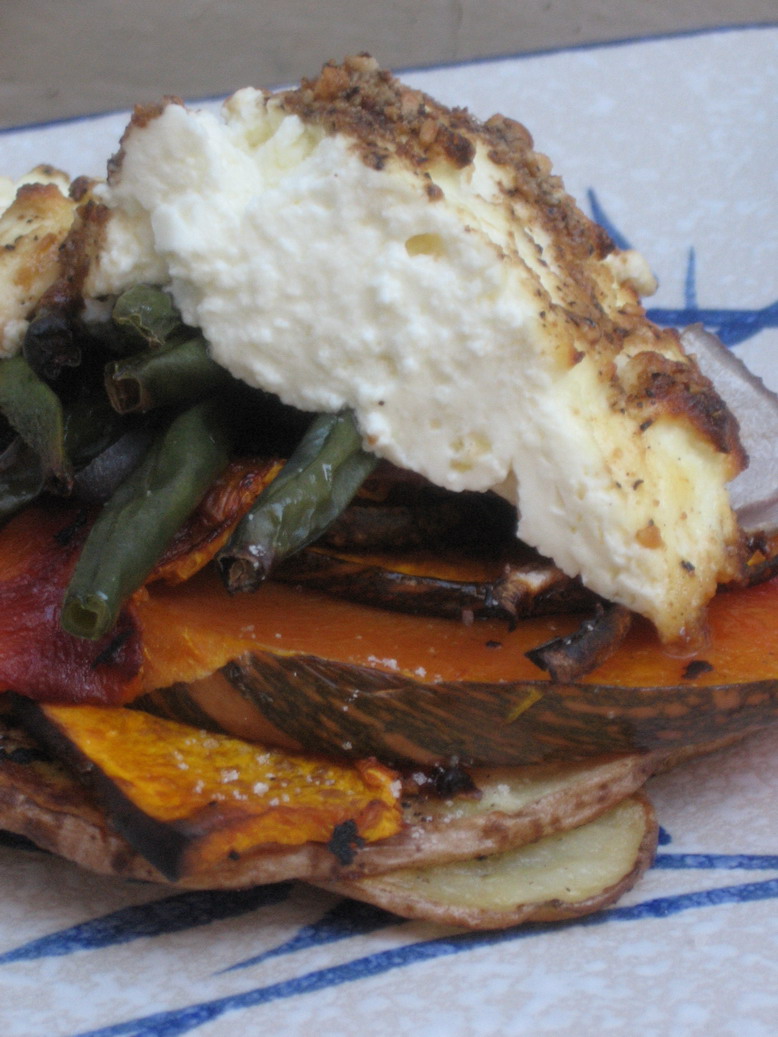
Kathryn brings a lot of her expertise as a nutritionist and herbalist to her Australian food blog, Limes & Lycopene, and I find it gives her writing a unique voice that is always fun to read. Here she tells us about a unique Australian bush spice–wattleseeds. What a great name! She tells us that it has an interesting flavor, somewhere between dark chocolate, coffee and hazelnuts, and it is most often used in sweet recipes. However, she used it in a spice blend that included sesame seeds and cashew nuts, and used it to flavor baked ricotta cheese that was used to top roasted vegetables in a recipe called Baked Wattleseed Ricotta Stack. It looks and sounds delicious, Kathryn, thank you so much for sharing it with us! Now, we just need to know if we can get wattleseeds where we live!
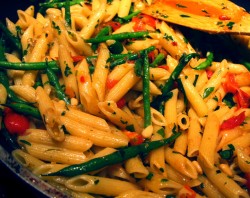
And finally, we come to my fresh and local posts. Yes, I did two recipes, each one with mostly local ingredients. First up, is a quick pasta saute featuring my own homegrown chiles as the spice, and homegrown tomatoes and basil mixed with garlic, onion and haricot verts from the farmer’s market. I call it by the unglamorous, but accurate name of Penne With Haricot Vert, Tomatoes and Caramelized Onions, but even if it isn’t fancy, it -tastes- fancy and that is what matters.
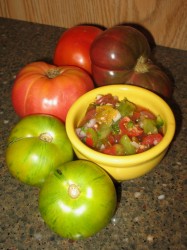
And my second offering, posted just a couple of days ago is a version of pico de gallo–a fresh, uncooked salsa from Mexico, that I made, once again, with my own homegrown chiles, and a plethora of locally harvested vegetables, especially heirloom tomatoes in a range of colors and flavors. In reference to its brilliant colors, I named it fancifully, Macaw Pico, and it tastes amazing on fresh goat cheese quesadillas made with corn tortillas.
That’s it for this month’s “Spice is Right!” As always, I want to thank the food bloggers who have come together this month from all over the world to share the bounty of their local areas in a plethora of creative and spicy recipes.
Tomorrow look for a post describing next month’s theme, and a discussion of the fate of event over the next few months while I am busy giving birth and caring for a newborn. Until then, goodnight and good cooking!
Kids’ Food In The News
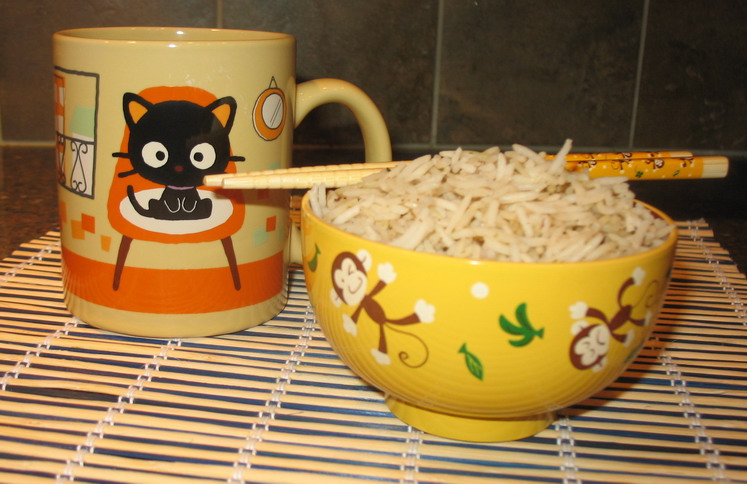
Zak decided, what with our imminent status as the parents of a newborn, that he should read up on what is going on in the world of parenting. So, he subscribed to an email newsletter about parenting from The Washington Post, and thus found out that one of the things that parents are concerned about is feeding their kids.
You know, back in the dinosaur days when I was a kid, (the late sixties and early seventies) it didn’t seem that parents fretted quite so much over what to feed their kids, mostly because their kids ate what the parents ate.
I mean, yeah, we all were bottle-fed (with a few exceptions), and most of us were weaned on baby food from jars (though not an insignificant number of us also were given mashed up adult food, too), but after that, we ate what Mom and Dad and the rest of the family ate. There didn’t seem to be as many concessions made to “kids’ tastes” as there seems to be now.
There were no Lunchables, microwavable Kraft Mac n Cheez (like that powdered stuff is hard to make in its original form) or Chicken Nuggets, Fingers or Stix, and we kids ate vegetables other than french fries and ketchup. Parents didn’t seem to do as much catering to their kids, treating the home kitchen like a restaurant, with kids eating a separate dinner from the adults.
And, near as I can tell, we middle-aged folks seemed to grow up okay.
So, anyway, I have this thing about Kids’ Food. I think it is an invention of clever marketing drones and fast food emporia which have managed to get parents caught up in the idea that kids need or want to eat differently than adults. I also think that this has been detrimental to the nutrition of kids, too–fried Chicken Nug/Fing/Stix, fried potatoes and boxed Mac N Cheez are not exactly loaded with healthy vitamins, minerals and good carbs. Far from it. They are loaded with fat, salt, fat, bad carbs, some more salt, some sugar, and weird nuclear orange cheez powder, oh, yeah, and a lot of fat. This is not a nutritious diet for anyone.
Oh, and whatver happened to kids drinking milk? What is up with most kids drinking soda nowadays? When did that happen? When I was growing up, soda was a treat, and milk and water were the drinks du jour. Milk gives kids calcium to grow nice strong bones, (and fat to grow nice smart brains), but soda gives them what? Phosphorus, which makes for nice brittle bones (it leaches out calcium) and lots of sugar for nice decayed teeth and mushy bodies.
So–Kids’ Food.
I don’t believe in it.
But whether I believe in it or not, lots of other people do, and marketers are giving folks what they seem to want.
And this isn’t just an American obsession–folks all over the world seem to be taking issue with how kids in their countries are eating.
Let’s take a look at some news about kids and food:
Nick, Disney and Sesame Street Characters Start Marketing Fruit and Veg to Kids
This news is kinda old, really, but it was in that Washington Post Parenting Newsletter thingie Zak forwarded to me. Apparently, instead of just using trademarked characters like Dora the Explorer and SpongeBob Squarepants (can anyone explain to me why this cartoon is popular?), to feed kids bad food, kids network Nickleodeon has made a deal with various fruit and vegetable growers and distributors to use them to get kids to eat organic edamame, fresh cherries, pears and apples, and other healthy edibles.
I guess this is better than making Spongebob canned pasta shapes and Dora sugar cereal, but it is still weird. It is still marketing food directly to kids, using cartoon characters from shows that kids haven’t quite figured out aren’t real and aren’t their friends. (Yet another reason to eschew TV for wee kids, as if we needed any more.) I don’t much like the idea of marketing food or really, anything else to kids, because kids are vulnerable and cannot make anything resembling wise decisions based upon any kind of judgement. TV is real to a lot of kids, so they aren’t equipped to really tell the difference between a show for entertainment and an ad, and well–that is really kind of, oh, not fair.
But I shouldn’t just rag on Nick for this, since Disney has made a deal with Krogers to market “healthy” foods to kids that include fruit, yogurt, and other breakfast items. (Do you know how much high fructose corn syrup is in most yogurt products? No? Take a look at some of them, and then come back and tell me how healthy that really is for kids.)
Eventually, other products to be introduced will include cheese, character-shaped frozen and canned pasta; fresh and frozen meals; cut vegetables with dip; and snacks including granola bars, fruits cups and apple sauce. (Once again–how “healthy” are these foods, really? Canned pastas are usually full of high fructose corn syrup, fat and sodium. Dips for cut vegetables usually are fat laden, and granola bars are mostly sugar, high fructose corn syrup and fat.)
I really hope that parents read the labels on these new cartoon foods and not just take these companies’ words on the fact that these foods are “healthy.”
Some Kids May Be Genetically Predisposed To Find Veggies A “Bitter Pill”
This story, also linked via the Washington Post parenting newsletter, I found to be both interesting and frustrating.
It is interesting, because researchers have found a gene that in some variations might make some people, especially kids “supertasters” who can detect very small amounts of bitter compounds in water. When kids in a recent study were tested the same way, the ones who tended not to like vegetables such as cucumber, broccoli and olives, showed evidence of being similarly endowed with a super sensitive variant of that gene.
See, that is cool, and I can see the evolutionary advantage of such a gene, since a lot of plants with bitter compounds have poisonous alkaloids in them, some of which are deadly even in very small concentrations.
What frustrated me, however, was the ways in which parents were advised to treat kids who kept refusing to eat vegetables. Along with the sound advice to offer vegetables that kids don’t like cooked rather than raw (this removes many of the bitter compounds), and suggesting tasty sauces and dips to go with the vegetables (even though the scientists noted this was probably not the most healthy way to get kids to eat veggies), the researchers said for parents not to “impose thier own tastes upon their kids.”
However, most pediatricians and nutritionists say that kids’ food preferences are formed very early on–perhaps as early as the first two years of life (now researchers are saying that food tastes may even be formed earlier, within the womb during the last trimester of pregnancy). This is part of the reason why nutritionists and pediatricians tell parents to keep offering foods, particularly vegetables to kids, even after they reject them once, twice, three, or ten times. What I have heard and read over and over is this: “keep trying.”
Cook it differently, serve it raw, make it into soup, stew or souffle, but eventually, most pediatricians believe that you can get most kids to eat a variety of foods if you keep modelling the behavior of eating it (that means you need to eat it and enjoy it and let the kid see that) and keep getting the kid to taste it.
Hence, why I was frustrated with the statement “don’t impose your tastes on your kid, because they may not be having the same taste experience you are having.”
Mom’s Diet Obsessions Can Be Unhealthy for Kids
I read the headline in the Washington Post and heard a big “duh!” in my head.
But I also heard another sound. The sound of a double standard, “damned-if-you-do-damned-if-you-don’t” blame the parent for everything media statement that hit my brain like a crate of SlimFast.
Kids are supposedly obese, right? I mean, we keep hearing about that, right? (Even babies are obese these days.)
So, shouldn’t parents model good behavior and go on diets?
Nope, because if Moms obsess about their own weight, this can lead to their daughters modelling similar behavior and ending up with eating disorders and low self-esteem?
Do you see why I am irritable with this news story? Sure, it is true that if Mom is weird about her weight, her daughters are going to pick up on it, but I find it ironic that reporters on the one hand keep talking about the dangers of obesity, how Americans are all getting fatter, and how kids are going to have lower life expectancies from it, and then, criticize women for trying to lose weight and foster dieting as a method of weight loss for thier kids.
Isn’t that a little bit like saying, “Don’t be fat–but, don’t be weird about not being fat. I mean, don’t be obsessed with not being fat to the point that you, like, make your kids crazy. But for god’s sake, you don’t want them to die, do you? So, don’t let them be fat. But don’t diet. Because if you do that you are a BAD MOTHER!”
Yeesh.
Lunch Box Inspections Allow Teachers To Become Food Police
And, now, just to prove that it isn’t just Americans who are starting to obsess over fat kids, here is a story from Australia, where teachers are apparently inspecting kids’ lunches from home and rejecting some of the foods parents have packed.
Chocolate birthday cake is bad.
But plain vanilla cake, without much if any icing, is okay. (But I bet there are still eggs, butter, sugar and white flour in vanilla cake…hrm.)
Basically, school teachers are going through kids’ lunchboxes and taking out what they think is inappropriate for kids to eat and say that they are “educating parents” about what an appropriate diet for the kids is.
Actually, what I think they are doing is pissing parents off. At least, that is how I would feel if I was a parent who sent my kid to school with food and had it sent back as “inappropriate.” Especially if it wasn’t. I mean, what if they took away Thai coconut milk curry because it was “too high in fat.” Or if a food fundamentalist vegan teacher decided that chicken wasn’t appropriate?
Talk about a “nanny state!”
So, in closing–what is a parent to do about feeding their own kids?
Should we ignore television ads, and cartoon spokespersons and make up our minds about what is healthy?
Should we fix separate meals for kids?
Should we diet?
And for goodness sake–should we let teachers snoop around in our kids’ lunch boxes?
My feeling is this–there should be no such thing as “Kids’ Food.”
There should just be food that kids eat. And it should be healthy (but we should let them have a bit of chocolate cake with icing now and again, too, because food is also about joy), and we should protect our children equally from food marketing and food fundamentalists.
I am sure that my readers are going to enjoy listening to me rant on this topic for years, as Kat grows, and eats or doesn’t eat whatever it is her loving parents give her….
Until then, though, happy reading and eating.
The Spice is Right Reminder: Fresh and Local
This is just a quickie reminder that tomorrow at midnight is the deadline for this month’s edition of “The Spice is Right.”
This month’s theme is “Fresh and Local.”
For more information, click here.

Categories:
- Admin (rss) (55)
- Blogs and Blogging (rss) (81)
- Book Reviews: Cookbooks (rss) (43)
- Book Reviews: Non-Cookbook Food Books (rss) (38)
- Cats and Cat Blogging (rss) (47)
- Chinese Cooking Lessons (rss) (32)
- Culinary School Stories (rss) (18)
- Dairy Pruducts: Cultured and Barbaric (rss) (4)
- Documentary Filmmaking (rss) (1)
- Essays, Rants and Reflections (rss) (260)
- Fighting Hunger (rss) (12)
- Food and Kids (rss) (45)
- Food in the News (rss) (126)
- Food Media (rss) (98)
- Food Preservation (rss) (18)
- Food Safety (rss) (45)
- Gardening (rss) (30)
- Herbs and Herb Blogging (rss) (20)
- Holidays (rss) (50)
- Kat Blogging (rss) (22)
- Kitchen Science (rss) (36)
- Leftover Makeover (rss) (8)
- Life, the Universe and Everything (rss) (131)
- Local and Sustainable (rss) (227)
- Local Athens Food and Foodies (rss) (42)
- Meatless Mondays (rss) (32)
- Menu For Hope (rss) (5)
- Nutrition, Diet and Health (rss) (84)
- On The Farm (rss) (8)
- Recipes: Almost Vegetarian, Vegetarian and Vegan (rss) (294)
- Recipes: American Regional (rss) (37)
- Recipes: Appalachian Hillbilly (rss) (33)
- Recipes: Bread, Pasta, Grains (rss) (95)
- Recipes: Canning and Preserving (rss) (8)
- Recipes: Chinese (rss) (123)
- Recipes: Comfort Food (rss) (120)
- Recipes: Cookies (rss) (16)
- Recipes: Desserts (rss) (48)
- Recipes: French (rss) (25)
- Recipes: Fruits and Vegetables (rss) (302)
- Recipes: Greek, North African and Middle Eastern (rss) (31)
- Recipes: Indian (rss) (137)
- Recipes: Italian (rss) (42)
- Recipes: Japanese (rss) (7)
- Recipes: Jewish (rss) (4)
- Recipes: Korean (rss) (6)
- Recipes: Meat, Poultry and Fish (rss) (220)
- Recipes: Mexican/Native American/ Latin American/Caribb (rss) (27)
- Recipes: Original (rss) (108)
- Recipes: Thai (rss) (27)
- Recipes: Tofu (rss) (17)
- Recipes: US Regional (rss) (16)
- Recipes: Vietnamese (rss) (8)
- Restaurant Stories (rss) (28)
- Sewing, Quilting, Arts and Crafts (rss) (16)
- Simple Chinese Recipes (rss) (30)
- Slow Food and Heritage Foods (rss) (10)
- Spice Blogging (rss) (44)
- The Chinese Cookbook Project (rss) (14)
- The Chinese Pantry (rss) (39)
- The Documentary (rss) (2)
- The Kitchen Saga (rss) (17)
- The Locavore's Bookshelf (rss) (15)
- The Unsung Adventures of The Culinary Nerd (rss) (6)
- Tools and Toys (rss) (35)
- Uncategorized (rss) (10)
- With a Side of Politics (rss) (48)
Archives:
- August 2012 (9)
- July 2012 (12)
- September 2011 (3)
- August 2011 (7)
- July 2011 (8)
- June 2011 (16)
- May 2011 (17)
- April 2011 (11)
- December 2010 (9)
- November 2010 (5)
- February 2010 (1)
- December 2009 (5)
- November 2009 (7)
- October 2009 (10)
- September 2009 (16)
- August 2009 (14)
- July 2009 (14)
- June 2009 (7)
- May 2009 (17)
- April 2009 (10)
- March 2009 (25)
- February 2009 (13)
- January 2009 (10)
- December 2008 (5)
- November 2008 (5)
- October 2008 (6)
- September 2008 (13)
- August 2008 (8)
- July 2008 (11)
- June 2008 (18)
- May 2008 (13)
- April 2008 (14)
- March 2008 (16)
- February 2008 (17)
- January 2008 (19)
- December 2007 (25)
- November 2007 (18)
- October 2007 (24)
- September 2007 (16)
- August 2007 (15)
- July 2007 (15)
- June 2007 (10)
- May 2007 (14)
- April 2007 (16)
- March 2007 (17)
- February 2007 (20)
- January 2007 (13)
- November 2006 (1)
- October 2006 (8)
- September 2006 (14)
- August 2006 (25)
- July 2006 (30)
- June 2006 (28)
- May 2006 (34)
- April 2006 (29)
- March 2006 (24)
- February 2006 (30)
- January 2006 (38)
- December 2005 (40)
- November 2005 (37)
- October 2005 (32)
- September 2005 (25)
- August 2005 (30)
- July 2005 (28)
- June 2005 (21)
- May 2005 (8)
- April 2005 (22)
- March 2005 (17)
- February 2005 (29)
- January 2005 (10)
Search Site:
Links:
- Lily’s Wai Sek Hong
- 101 Cookbooks
- A cat in the kitchen
- A Veggie Venture
- Accidental Hedonist
- Cha Xiu Bao
- chez pim
- Chocolate & Zucchini
- Chopstick Cinema
- Chowhound.com
- Chubby Hubby
- Cook sister!
- Cooking with Amy
- da*xiang
- Eat Local Challenge
- Eating Liberally
- Ecocentric
- Eggbeater
- Epicurious
- Farmgirl Fare
- Fatfree Vegan
- Foodgoat
- ForkandBottle.com
- Green Olive Tree
- Hooked on Heat
- Jaden’s Steamy Kitchen
- Kalyn’s Kitchen
- Lucullian delights
- Mahanandi
- Matt Bites
- MeatHenge
- mmm-yoso!!!
- New York Times – Dining & Wine
- Pizza Goon
- Rasa Malaysia
- Ruhlman
- Sailu's Kitchen
- Serious Eats
- SF Gate: Food & Dining
- Simply Recipes
- Soul Fusion Kitchen
- Tastespotting
- The Amateur Gourmet
- The Cleaner Plate Club
- The Food Section
- The Grub Report
- thecookscottage
- U.S. Food Policy
- Wandering Chopsticks
- Washington Post Food and Dining
- Wasted Food
Meta:


Powered by WordPress. Graphics by Zak Kramer.
Design update by Daniel Trout.
Entries and comments feeds.