
Cook Local, Eat Global
Food, And Athens, In The News
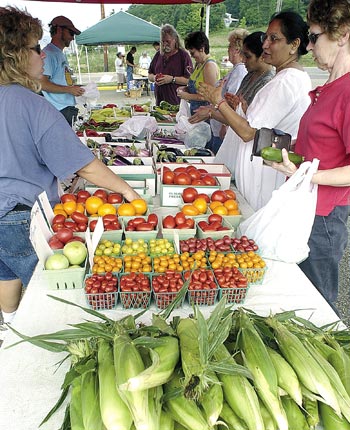
Athens Rated as One of the 12 Great Places You’ve Never Heard Of
So, we were out having breakfast Monday, and came across the cover story in the Athens News, our highly loved biweekly tabloid newspaper: “Athens gets high ranking for its quality of life — and obscurity.”
It seems that The Mother Earth News staff decided to go around the US and find twelve smaller, relatively unknown communities where there is a high quality of life, low cost of living, and is populated by a lot of folks who live the ideals of sustainability. The results were condensed into this article.
It is neat to have Athens recognized by the highest-circulating environmental magazine in the US (1.4 million readers), and the reasons they cite for liking Athens are quite reasonable and valid: they were impressed by the lack of extremes in the weather (uh, except we are in the middle of a heatwave at the moment, with heat index ratings of around 106 F) and the fact that there is a strong local foods movement and many farmers who make a completely local, year round farmer’s market possible. They also cite Ohio University as a source of cultural events and interesting bookstores, and a local community kitchen run by ACEnet, which allows food producers to start up small businesses.
And, of course, they mentioned the beauty of the rolling Appalachian hills and the fact that our town is surrounded with lovely state parks where fishing, hiking, kayaking and canoeing are the order of the day.
I was fascinated to see Ithaca, New York, was also on the list. Why? Because when Zak and I went there for his stepbrother’s graduation, I remember walking around and saying, “This place is cool. It feels like Athens….”
Baby Food Goes Upscale
Okay, now, I have to say this:
What is so damned hard about pureeing a portion of your own dinner for your baby?
Is it really -that- time consuming?
Now that is out of my system, I can tell you what I am crabbing about. I am crabbing about these boutique, upscale baby food companies that are selling pureed asparagus risotto, minted new peas and baby vegetable korma with coconut milk that I read about in the New York Times.
There are even personal chefs who specialize in freshly made baby food.
So, that is fine, really–I mean, I am all about giving babies and toddlers and little kids real food to eat–because I think that crap from the jars is about nasty and probably predisposes kids to liking bland food, which would be a horrible fate for any kid in my house, but why do you need to have a personal chef do that? I mean, get a food mill, or a Sumeet or even a really good blender, and puree some of your own dinner for goodness sake! How hard is that?
I mean, I can see buying some of the frozen stuff that they are selling at Whole Foods, but how hard is it to make your own frozen baby food at home, for less money, and you can control the ingredients yourself? Is it really that taxing? Is it?
Am I weird for thinking this is weird? Am I a freak for intending to feed Kat with pureed versions of what we eat around here and freezing some of it for later in little ice cube trays? Am I just an overachieving Mom or are these folks lazy or do I just not get it?
Maybe I don’t get it.
Tomato Tasting Vocabulary
The New York Times Dining & Wine section is just full of goodness this week. In addition to the gourmet baby food article, there was this gem about food scientist and professor emerita, Ann C. Noble, putting on a tomato tasting along the lines of a wine tasting, so she can develop a vocabulary for folks to use to describe the complex flavors of heirloom tomatoes.
Noble is best known as the developer of a device called “The Wine Aroma Wheel,” which is tool meant to help wine afficianados develop a more useful and descriptive vocabulary to describe the complex aromas and flavors of wine.
She aims to create a similar wheel to help folks describe the flavors of heirloom tomatoes.
Participants were asked to smell the tomatoes, which were pureed and set into petri-dish topped wine-glasses (with headspace to allow the aromas to concentrate under the petri dishes, which sealed them in), then taste them silently, and write down their impressions, even if they seemed silly or ridiculous.
Brandywine, one of my favorite tomatoes, and a consistently popular heirloom, was described by one taster as being like stinky feet, while another said it smelled like Fritos. A third said it was, “ripe, like chocolate.”
Other tomatoes were described as smelling like jeans that had been worn to play football in the grass, and pond water.
Now, I don’t know about y’all, but tomatoes that smell of feet, Fritos, sweaty, grass-stained jeans and pond water are somehow not very appealing to me.
I think Dr. Noble has a long row to hoe with this project. I see a lot more tomato tastings in her future, perhaps with different participants.
That is it for Food in the News this time around–until next time, good reading and good eating to y’all!
Note: Photo credit–The Athens News
The Locavore’s Bookshelf: Real Food
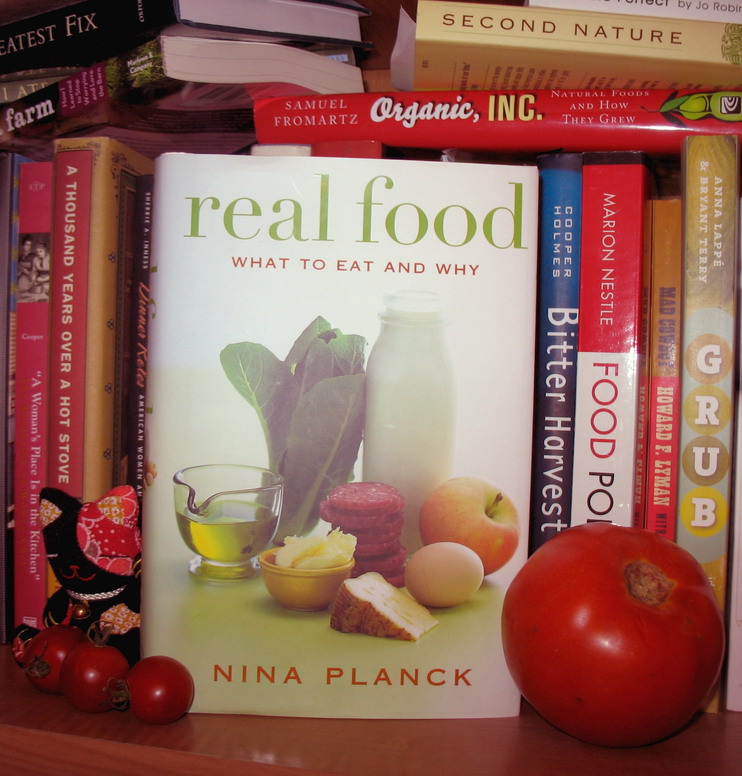
Reading Nina Planck’s Real Food: What to Eat and Why was an exercise in both elation and frustration.
On the one hand, I was thrilled to read my own intuitive (and educated) trust in whole, natural foods ably articulated by a facile writer who makes a good case that a lot of conventional nutritional wisdom is not only not wise, but often, patently false.
On the other hand, I was also often frustrated by Planck’s tendency to overlook or undervalue regular exercise as a component to good health, as well as her inexplicable moments where she either forgot to cite a source for her fact, or she simply presents her opinion as fact.
Generally, I think that Real Food is a well-written and engaging look at -why- a diet based on natural, whole, traditional foods is healther for us than the industrially processed foods and fast foods that have proliferated like mushrooms after a rainstorm in the American diet since World War II. Parts of it are really entertaining and fun to read, especially when Planck talks about growing up on a vegetable farm in rural Virginia; much of her experience parallels my own in helping out on my grandparents’ farm in West Virginia. Her descriptions of how her family ate closely resembled my childhood meals to the point that I felt that some passages could have been written by myself or one of my cousins.
And, when Planck martials up her facts and has them lined up like little soldiers at attention, her arguments hit the target with a resounding and satisfying thud. Her chapters on fats and cholesterol are among the most convincingly written in the book, and rightfully so, for it is in those pages that she skewers the popular nutritional wisdom that saturated animal fats are evil, cholesterol is the enemy and margarine and Crisco are health foods that will save humanity from the horrors of butter and lard. When going up against such “known” nutritional and health claims as these, it behooves Planck to get her facts straight up and cite each and every study she possibly can which support her opinions.
And she does a damned fine job of it, too.
But other chapters are not so carefully written.
For example, when she talks about the wholesome nature of milk in the human diet, she mentions how healthy the Masai of East Africa are, when their diets are high in saturated animal fats from grassfed beef, beef blood and milk, which makes up the majority of their caloric intake.
She postulates that it is because of the chemical differences in the composition of the fats that come from raising cattle on grass that is the primary cause of the extremely good health of the Masai.
That may be; I am well aware of the evidence to support the position that beef and milk from grass-fed animals is significantly different and arguably much healthier for humans to consume than the meat and milk from cows fed grains, antibiotics and animal by-products. (Which is a nice way to say ground up feathers, chicken shit, blood and bones.)
However, the first thing that leapt to mind when she mentioned the Masai was this: the average tribal cow-herder such as a Masai male, gets more exercise in a -single day- than most American male desk jockeys get in a week or even a month. And, as far as I am concerned, that fact cannot be over-emphasized. Human beings evolved to move around and be active, not to be sedentary couch potatoes, and I suspect that it is just as much the activity level of the average Masai that is the cause of their lack of heart disease as it is the quality of their traditional diet.
To be fair, she does mention physical activity levels, as well as genetic factors when she talks about the seeming paradox that many traditional peoples seem to be able to eat diets that consist sometimes, of up to 56% of their calories coming from saturated fat, and yet they still have low incidences of obesity and heart disease. But, although these factors are mentioned, they are given shorter shrift than I think is necessary; her points about nutrition and diet are still valid. I just think that she damages her points by seeming to ignore the simple fact that a lot of the obesity problems in the US seem to be related to recent reductions in overall activity level among most Americans.
All in all, it is a good book; it is interesting, useful and well-written. Its flaws, while they bothered me, are really minor in the grand scheme of things. The message, while it was perhaps not stated perfectly, is still extremely valuable: eating a diet consisting of processed industrial foods, including trans-fats from margarine and partially hydrogenated vegetable shortening, too much sugar and refined flour is really not good for anyone.
Whereas, eating a varied diet consisting of whole foods such as seasonal (preferably locally grown) fruits and vegetables, wild caught fish and seafood, whole grains, legumes, whole milk, butter, cheese, fermented foods, olive oil, lard, pastured meats and eggs, and minimally refined sugars, is much better for humans.
While I don’t agree with every statement that Planck makes, I have to say that I do agree with her overall premise.
Real foods are good foods.
Eat them, and be not only healthy, but happy, because they taste really good–much better than the processed industrial foods that litter up the majority of our grocery store aisles.
A Thai-Indian Curry: Kaeng Kari Gai
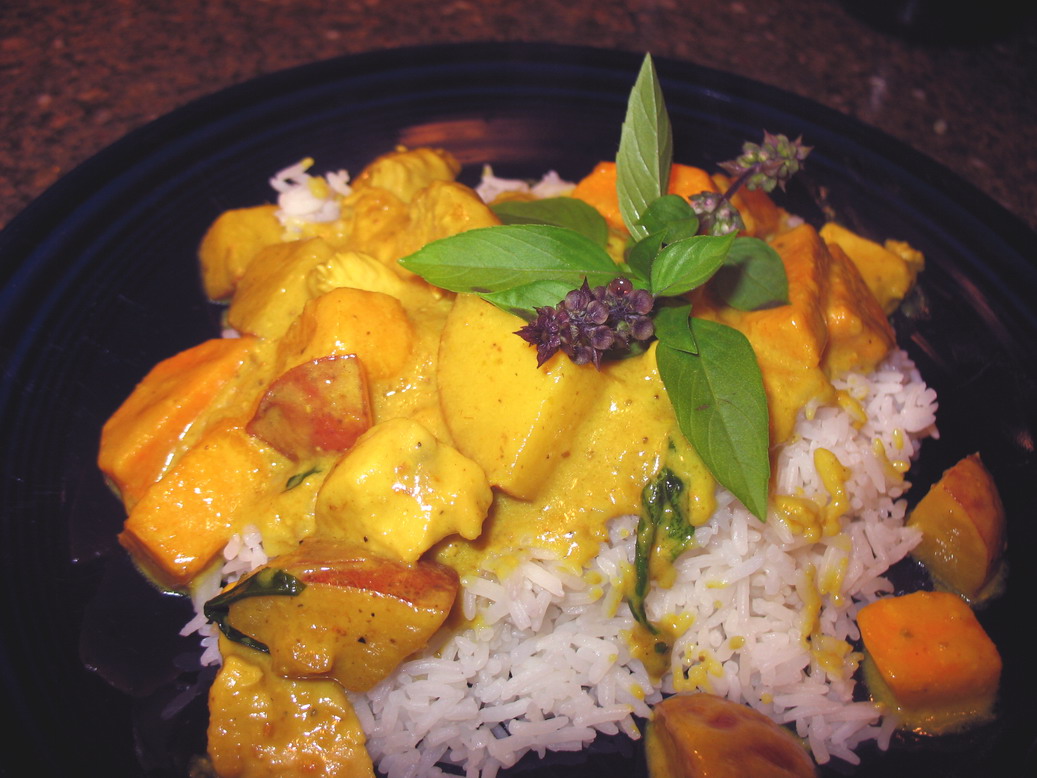
The history of Thai curry making is a subject that is still being written. There are many theories as to the origins of Thai curries, but no one knows if one or all of them are true; I suspect that the development of Thai curries has had a great many influences, and that there is no one point of origin that can be pinned down.
Many people are of the opinion that Thai curries were a development of Indian curries; at one time, I believed such a thing myself. But now, as I do more research, and taste more Indian and Thai foods, I have become a bit more skeptical on that point. The flavors of Indian curries, both of the south and the north, are substantially different than the curries of Thailand, to the point that while I -do- believe that the two dishes are related, I no longer believe that the progression of curry from India to Thailand took place in as linear and direct a form as once I did.
What I -do- think happened is that the Thai had already started making coconut-milk based stews, long before the Arab and Indian traders began bringing dried spices to their shores. And these stews, which some say originated among the Mon, the original inhabitants of Thailand, Cambodia and Burma, then had new ingredients added to them when these traders brought forth their wares. When the chile pepper was brought in the 16th century by the Portuguese, it became part of the seasoning pastes used to flavor these stews, which came to be known as kaeng, or curries.
The use of fresh herbs, of shrimp paste and of fish sauce in Thai curries are part of what distinguishes them from Indian curries. Also, the Indians use a much wider array of dried spices, ground into powders; they too, make curry pastes out of fresh ingredients such as chiles, ginger, garlic and onion, but the range of fresh “wet” ingredients used by the Indians to flavor their curries is more limited.
In Thailand, herbs such as cilantro, or Thai basi, are used, and in the case of cilantro, not just the leaves are used, but also the stems and roots.Kaffir lime leaves and zest, lemongrass stalks, greater and lesser galangal rhizomes, fresh turmeric rhizomes, shallots, fresh or roaste, and the usual ginger, garlic, chiles and onions, are all utilized in varying proportions and combinations to flavor curry pastes. Sometimes, a small amount of dried spices, such as white peppercorns, coriander, cumin and cardamom, are used, but the proportion is very tiny when compared to the amounts of dry spices used in Indian curries.
So, then–we see that Thai and Indian curries are two very different beasties, with distinctive flavors that are not easily confused.
But what of this Thai-named Thai-Indian curry: Kaeng Kari Gai? Where is it from? What is it like?
I found the recipe for it in Su-Mei Yu’s excellent cookbook, Cracking the Coconut. Yu, of Chinese descent but raised in Thailand, said that this particular curry was a favorite of her family when she was growing up, and she gives a recipe for the curry paste and a curry using it, but she does not really state if it is a Thai innovation using commercial Indian curry powder, if it was a creation of her family’s cook, if it is traditional, or if it is a modern fusion.
All I know is this: it tastes very, very good.
It makes a vibrant yellow curry that is fragrant with both wet Thai ingredients and dry Indian spices, that is rich in coconut milk and redolent with the sweetness of mango and the tart edge of lemon.
I changed the recipe considerably, I have to admit, in part because I fitted it to the ingredients I had, in part because I didn’t want to use packaged curry powder because it contained a considerable amount of black pepper, to which I am allergic, and because I felt like it. I cooked Yu’s recipe to my own taste–which is what I am told all good Thai cooks do.
Besides–I wanted to really go for a good fusion between India and Thailand–I wanted to put ingredients in that would recall the Indian subcontinent, while the curry itself still rang with the song of Thailand. When Yu mentioned that this curry is sometimes made with pineapple in it; I knew I didn’t have any pineapple sitting in the fridge, but I had just bought some very ripe, sweet-smelling mangoes. Mangoes always make me think of India, so in addition to the new potatoes and the last of the sweet potatoes I stored over winter, I decided to add a mango for added sweetness and a lush, fruity texture and flavor.
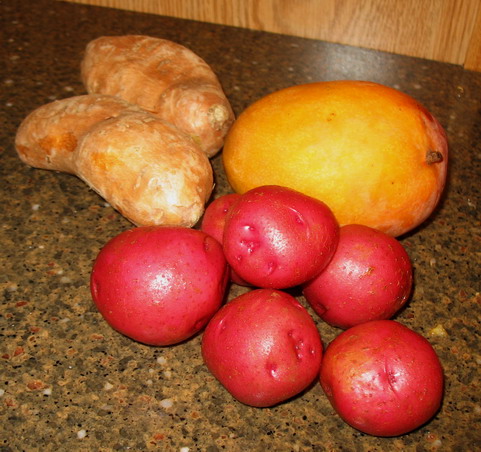
You will notice that the curry paste includes an unusual set of ingredients: oven roasted garlic, shallots and ginger. The roasting of these ingredients–which I suspect was done in the coals of a banked fire in earlier times–is meant to tame their harshness and bring out their sweet natures. I think it also recalls the deep browning process that these ingredients undergo in the making of Indian curries.
There are also some very distinctly Thai ingredients in the curry paste, but fewer than I am used to. There is no galangal, but there is lemongrass and shrimp paste. No cilantro stems or roots, but there is fresh turmeric. (There is also dried turmeric, which I added as part of my home-made mixture of “curry powder;” this combination of both fresh and dried turmeric resulted in a beautiful brilliant saffron-yellow color for the curry, as well as a nearly indescribable fresh, antiseptic flavor that is characteristic of turmeric.) The heat comes from fresh Thai bird chiles, all red, orange or yellow to help boost the yellow color of the curry.
Yu did not specify the use of any acidic component; however, to my taste the curry was flat without it. So, at the end, I added the juice of one lemon to perk up the flavors and make them dance on the palate. She also did not garnish with an herb, but instead used deeply browned, crispy shallot pieces at the end as a textural and flavor contrast. However, since I had used my last two shallots for the curry paste, I decided to use some of my very exuberantly growing Thai basil plants. Thier sharp, anise-like flavor deeply complimented the richness of the coconut-milk based curry, and gave a further Thai fillip to a dish that straddles two cultures.
So, how did it taste?
Quite good, although, Zak was uncertain. He said that it was the least distinctive of the Thai curries that I have made and that he has tasted all through his growing up years. And, that is probably because of the large amount of Indian spices that it contains; I can only imagine that using commercial curry powder instead of making my own, would contribute further to that “generic” curry flavor that Zak mildly complained of. However, though he said it was less distinctive, he ate two plates full of it, with jasmine rice as did Morganna and myself. Her verdict was an unreserved “It’s tasty,” while I found it to be quite good, especially with the sweet potatoes and mangoes blending well into the whole.
I could definately see making this as a vegetable-based curry by adding summer squash chunks, and red sweet bell pepper, and leaving out the chicken altogether. Or, it could be replaced by extra firm tofu with no problem.
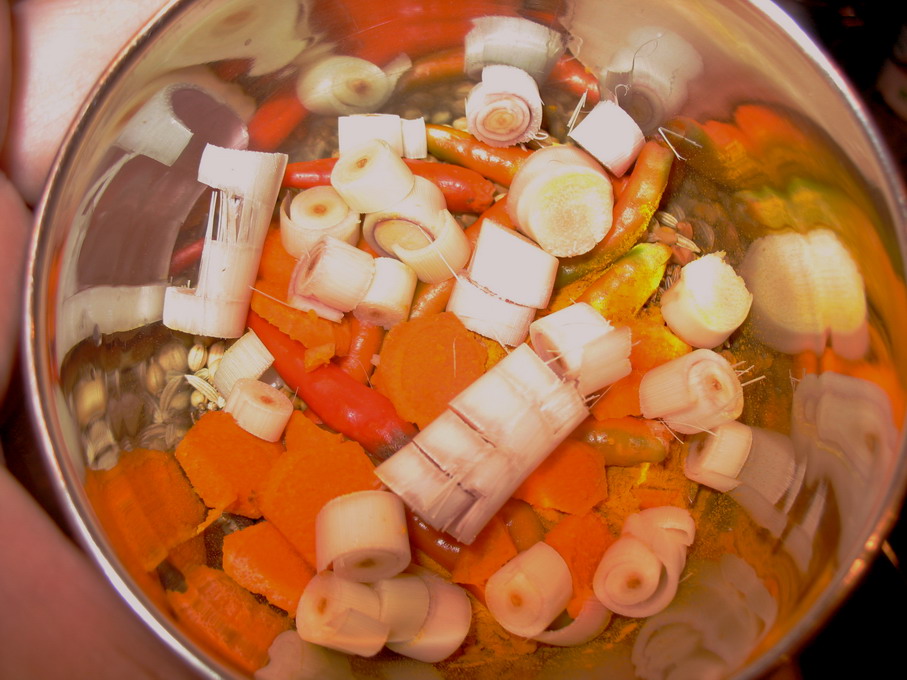
Kaeng Kari Paste
Ingredients:
2 heads garlic
2 large shallots
1″ cube fresh ginger
1 tablespoon peanut or coconut oil (melt the coconut oil)
1 tablespoon coriander seeds
1/2 teaspoon cumin seeds
1/2 teaspoon white peppercorns or grains of paradise
1/2 teaspoon fenugreek seeds
5 whole cloves
1/4 teaspoon cardamom seeds (removed from pod)
1/4 teaspoon fennel seeds
1/4 teaspoon ground cinnamon
2 teaspoons ground turmeric
1 teaspoon sea or kosher salt
10 fresh Thai bird chiles, red, orange or yellow, stemmed
2 stalks lemongrass, outer leaves and hard, dried bits removed, cut into thin slices
2″ chunk fresh turmeric, peeled and sliced (or 2 teaspoons ground turmeric powder)
1 teaspoon fermented shrimp paste
Method:
Preheat oven to 400 degrees F. Remove the loose papery outer husks from the garlic heads and the shallots (leave one layer of tight papery husk to the shallots), then cut off the pointed tops, exposing the flesh of the garlic and shallots. Place upright in a square of foil big enough to wrap loosely up and around the garlic and shallots, and place ginger piece in with them. Drizzle with the oil, and wrap loosely in the foil, then place in glass baking dish. Place in ovena nd roast for 30-40 minutes, or until everything is soft, toasty, brown and smelling very good.
While garlic, shallots and ginger are roasting, in a heavy-bottomed pan over medium heat, toast the coriander seeds until they are fragrant. Put into the grinding jar of Sumeet or spice grinder or mortar. Do the same with the cumin, the cloves, the fenugreek, fennel seeds and the cardamom.
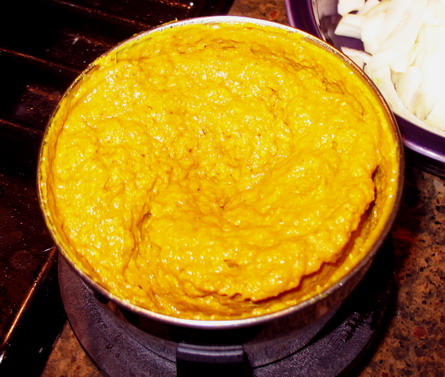
Place all the other ingredients into jar of Sumeet or grinder When garlic, shallots and ginger are fully roasted, remove from oven and allow to cool until they can be handled safely. Squeeze flesh of garlic and shallots from the papery husks into grinder jar, and peel ginge rand slice into grinder jar.
Process all together into a thick, brilliant yellow and somewhat fluid paste. Set aside until it is to be used, or seal into a tight-lidded jar and refrigerate for up to a week until it is to be used.
Note: If you want to use commercial curry powder instead of all of the spices, leave out the fenugreek, cloves, cardamom, fennel, cinnamon and 2 teaspoons ground turmeric and instead use 1/2-1 tablespoon of curry powder.
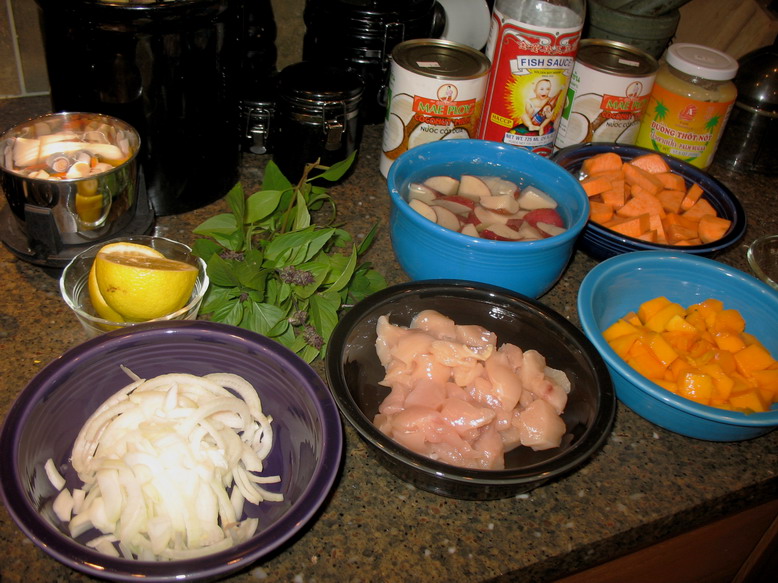
Kaeng Kari Gai
Ingredients:
1 tablespoon coconut oil or coconut cream from the top of the coconut milk cans
1 medium yellow onion, peeled and thinly sliced
1 batch Kaeng Kari paste
2 cans Mae Ploy brand coconut milk
1 tablespoon palm or raw sugar
fish sauce to taste (I used about four tablespoons, I think)
3/4 pound red new potatoes, well scrubbed and cut into 4ths or 8ths, depending on the side of the potato
1/2 pound sweet potatoes, peeled, halved longwise and cut into 1/2 thick slices
1 whole boneless, skinless chicken breast, cut into 1/2″ cubes
1 fresh mango, peeled and cut int 1/2″ cubes
juice of 1 lemon
1 cup fresh Thai basil leaves
3-5 Thai bird chiles, red or yellow, or 1 green Indian chile, sliced thinly–optional
Method:
In a heavy-bottomed, wide mouthed pan, heat coconut oil or cream on medium heat. Add yellow onion, and cook, stirring, until it becomes golden brown in color. Add curry paste, and cook, stirring, until it is very fragrant–about two minutes.
Add coconut milk and sugar and stir until well combined. Taste. Add fish sauce to taste, balancing flavor between the spices, the chile heat, sweetness and salt.
When it tastes right, bring to a rapid simmer, and add potatoes. Cover, and cook until potatoes are very nearly done. Add sweet potatoes, stir, and allow to cook for about two more minutes. Add chicken pieces, and stir, then cover.
Cook until the chicken is just done and the sweet potatoes are softened, but still firm enough to hold their shape and the potatoes are done. This should take at the most, ten minutes.
Add the mango, stir in. Add the lemon juice and basil leaves, stir and allow to cook one minute longer to wilt the basil leaves.
If desired, you may sprinkle thinly sliced chiles over the top of the dish–it is a fairly mild curry, so you may want that extra jolt of heat at the end.
A Salad of A Different Color
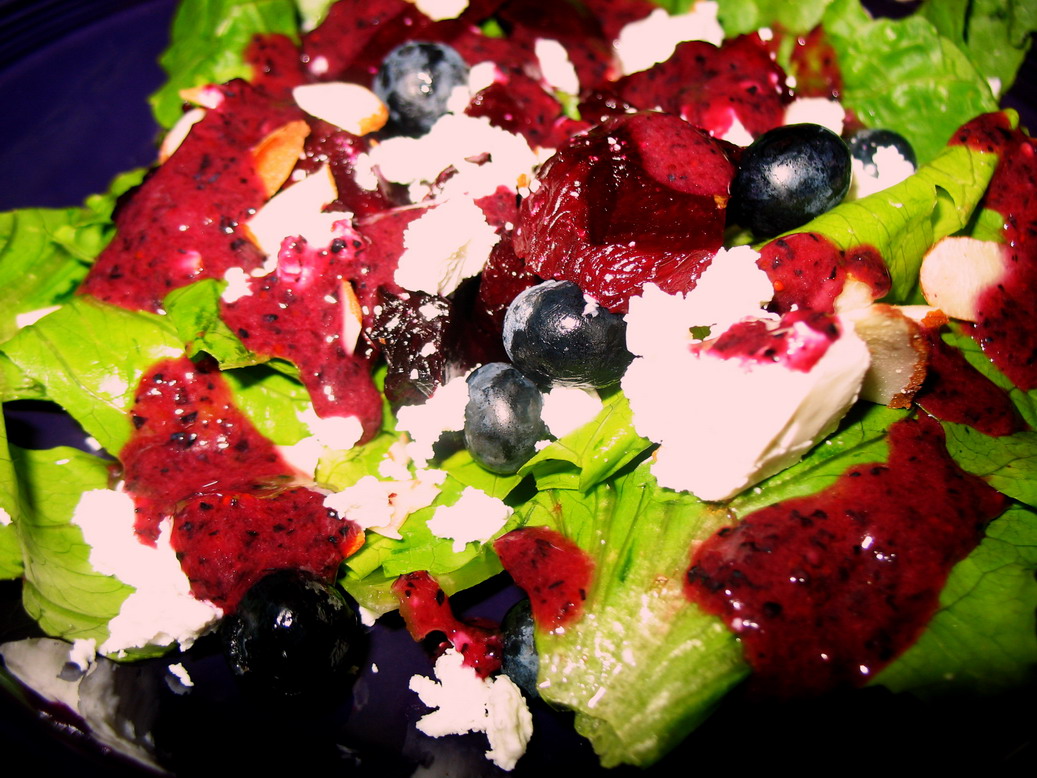
Salads are most usually green.
I mean, green salads, with lettuce and other salad greens, are generally green. Hence, the name, “green salad.”
But, even though my favorite color is green, and thus it is the dominant color in both my kitchen and my office, I get tired of it. I get bored and want to change it up a bit.
Sometimes, I want something in my other favorite color: purple.
And for that, I turn to various fruits and vegetables which have been colored by those most lovely of natural food colorants: anthocyanins.
In this case, I turned to baby beets, which I roasted with some olive oil, then peeled, sliced and chilled, and blueberries, which I both pureed into a fruit-based vinagrette, and used au naturale, as a garnish.
I could have used reddish-colored lettuce in the bowl as well, but I like the fact that green and violet are complimentary colors and look ever so vibrant when paired together. And they do–just look at how the colors pop out of the bowl and zing the eyes!
They also happen to taste nice together.
For a bit of a contrast in flavor and texture, I sprinkled in some sliced almonds and some nuggets of soft chevre. That way I had a lot of textures to please the tongue: crisp lettuce, creamy cheese, buttery soft beets, popping blueberries, and crunchy almonds.
Most importantly–how did it taste?
Lovely, I thought. (Morganna disagrees. When she tasted a slice of beet, she made the patented “disgusted Snoopy noise” that those of us who grew up watching “Peanuts” holiday specials on television are quite familiar with.)
The sweet and tart blueberries perfectly complimented the earthy sweetness of the roasted beets, while the tangy goat cheese made a nice contrast to the sweet flavors. The lettuce and almonds were fairly neutral, adding mostly a crispy-crunchy element to the overall texture of the salad without adding much in the way of flavor.
I had to resist the urge to call this dish “anthocyanin salad,” however, and thus settled for a more prosiac, yet equally descriptive name. The first choice was just too nerdy, even for me.
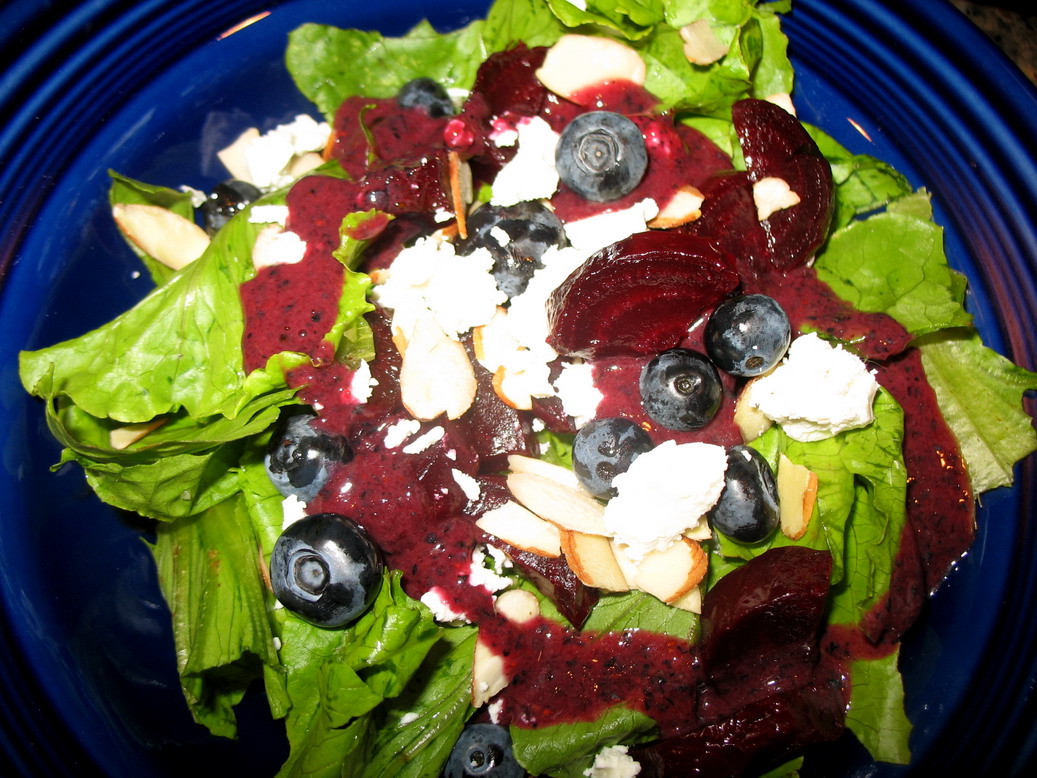
Roasted Beet and Chevre Salad with Blueberry Vinaigrette
Ingredients for Salad:
1/2 pound baby beets, scrubbed well, trimmed of roots and tops, coated with olive oil and roasted at 425 degrees F until tender
1 head romaine lettuce, trimmed, washed, dried and torn into bite-sized pieces
1 handful fresh blueberries, rinsed and dried
1 handful sliced almonds
3 ounces chevre, crumbled into nuggets
Method:
Peel cooled beets, and cut into half longways. Cut into 1/4″ thick slices.
Arrange torn lettuce leaves into individual salad bowls or plates.
Add a mound of sliced beets to the center of lettuce leaves.
Sprinkle with blueberries, almonds and cheese.
Dress with blueberry vinagrette in drizzled spiral.
Ingredients for Blueberry Vinagrette:
1/2 pint fresh blueberries, rinsed and dried
2 tablespoons olive oil
2 tablespoons rice wine vinegar
1 teaspoon sea salt or kosher salt
freshly ground black pepper to taste
Method:
Put into a mini food processor or blender and puree. Voila. It is done. The cool thing about fruit vinagrettes is that the fruit pulp acts as a natural emulsifier, keeping the oil and vinegar in a perfect suspension for much longer than is usual.
But, just to be sure, put into a clean jar with a tight-fitting lid and shake well just before serving.
Fresh And Local Ingredients Make Summer Pasta Special

I am lucky to live where I do.
Many city dwellers would be confused to hear me say that; after all, I live in a very small town in the middle of a rural Appalachian Ohio county that has a high unemployment rate and all of the attendant problems which that entails.
However, I am lucky to live in a place with such a thriving local food community that I can go to my farmer’s market twice a week and pick out some of the freshest, tastiest produce imaginable, and bring it home in order to make healthy, low-cost meals for my family.
I am also lucky to have the ability to grow some small percentage of my own food: right now that ability is limited to my deck garden, but I am able to grow most of my own herbs, some chiles and a good amount of cherry and miniature plum tomatoes.
On nights like tonight, I am able to combine the foods and seasonings I grow with produce from the farmer’s market with some staples from the grocery store and make a meal that is amazingly fresh, delicious and full of vitamins, minerals and all of those good things that we want our food to possess.

Tonight, I combined some haricot vert–those slender, graceful French princesses of the green bean world–that I picked up from the market yesterday with onions and garlic from the same farmer, added my own miniature plum tomatoes, chiles and fresh herbs, then included olive oil, lemon zest and juice, dry sherry, pine nuts, parmesan cheese and pasta from the grocery store and came up with a really light dish that is perfect for a hot summer night.
Haricot vert are beautiful little beans–very sweet and delicate in flavor, tender little twigs of verdant goodness. Their texture is tender, too–they overcook easily, so instead of pre-blanching them, I decided to saute them in the pan along with the other ingredients of the pasta sauce. This way, not only were they less likely to become overcooked and rubbery, they picked up the intense flavor of the caramelized onions, garlic, chile and lemon zest, which perfectly complimented the green grassiness of the beans.
When I saw them at the farmer’s stand, I exclaimed with joy, “Haricot vert!” laughing with delight. The farmer smiled broadly and said, “Yep–they are good little things–they’ll spoil you for other beans.” As he measured them out and took my money, though, he confided, “You know, they are a lot of work–picking enough to fill a pint or quart basket takes a lot longer than picking regular beans. They are -so- small!”
Well, yes, they are troublesome, and thus are more expensive than regular green beans, but the farmer is right–they will spoil the palate for regular beans in a heartbeat. Once you have tasted them properly cooked, their flavor and texture will haunt your tastebuds forever more, until you can have them again. After the terracing is done, if I grow beans in the backyard, it is likely to be these pretty little ones.
When I prepare them for cooking, you will notice I leave the tails on and do not string them. That is because there is no string to speak of, and the pointy little tails look elegant on the end of the beans. I do “top” them, though–snapping off any remaining stem on the top edge of the bean, so as to avoid the tough stalk there. I also left them whole–they are very attractive when presented that way, and they echo the shape of the penne perfectly. Presenting regular string beans this way, even the so-called “stringless” varieties is not as prudent a choice. They always look coarse, and often there are tough stringy bits that ruin the experience of eating the beans–one should not eat and floss one’s teeth at the same time.
It just should not be done.

In deference to my training in Chinese cooking, when I cut up the small plum tomatoes, I cut them in a similar shape to the beans and penne–I cut them in half longways, then slice each half into long, skinny thirds. This keeps the dish looking pretty, and it helps expose more of the flesh of the tomatoes to the heat of the pan so that they melt partway into the sauce. I could have skinned the tomatoes by blanching them briefly in boiling water then plunging them into ice water, but truthfully, I wanted some of them to melt into the sauce, and others of them to remain distinct. The tomato skins of the ones that melted did not bother me, or Zak, but if they would bother you, feel free to peel the tomatoes first.
As for the seasonings–the chile, garlic, onions and herbs–all of them are locally grown, here in Athens county. The herbs and chiles were so local as to come from my deck garden, where three kinds of basil, two kinds of sage, several rosemaries, oregano, Italian parsley, tarragon, thyme, chiles and tomatoes thrive in great abundance. The onions and garlic come from the farmer’s market, and as a consequence, have a very strong, very clear flavor. Really fresh hardneck garlic such as what is grown here has a much better, more nuanced flavor than that softneck garlic that is stored for months and sold in the grocery store. I find that when I use it, I can use less of it, because it is so fresh. The same goes for the onions.
Since this impromptu pasta dish contains local spices (garlic, onion and chile) and herbs, and is based heavily on local produce, it is my entry for The Spice is Right V: Fresh and Local. I have received a few other entries, all of which look and sound delicious, so I look forward to hearing from participants around the world, to see what is fresh and local in their regions and in their kitchens.

Penne With Haricot Vert, Tomatoes and Caramelized Onions
Ingredients:
3 tablespoons olive oil
2 small or 1 medium yellow onions, cut in half, peeled and thinly sliced
generous pinch salt
zest of 1 lemon, minced
2 small, very hot chile peppers, such as Thai bird chiles, minced (or, to taste)
2 tablespoons raw pine nuts (optional–but they really -are- good in this)
1/4 cup dry sherry, divided into two halves
3 cloves garlic, peeled and minced
1 teaspoon butter, optional
1/2 pint haricot vert, topped, but with the tails left on, rinsed and thoroughly dried
1 cup small plum, pear or cherry tomatoes, cut into thin quarters or sixths
juice of 1 lemon
3/4 pound penne pasta, cooked al dente and drained
1/2 cup mixed minced fresh herbs (I used Greek columnar basil, Greek oregano, Blue Lady rosemary, and Italian parsley)
1/4 cup freshly shredded parmesan cheese (plus extra to garnish or for diners to add on their own)
Method:
Heat olive oil in a wide, deep skillet on medium flame. Add onions, and sprinkle with salt, and cook, stirring until they go medium brown and limp. Add lemon zest, chile, and pine nuts, and keep cooking, stirring, until the lemon zest and pine nuts brown slightly.
Add half of the sherry, and the garlic and cook, stirring, until the alcohol evaporates and the garlic is fragrant. Add butter, if you are going to use it at this time and allow it to melt.
Add haricot vert, and cook, stirring, until they deepen in color slightly. Add tomatoes, and second half of sherry, the lemon juice and cook, stirring until tomatoes just begin to break down.
Add penne and half of the herbs, and the cheese. Cook, stirring, to incorporate the pasta and sauce thoroughly. At this time the haricot should be tender-crisp, the onions should be dark brown and fully caramelized, the pine nuts should be toasted, the cheese should be melting and making everything cling to the pasta. (If your pasta seems too dry at this point, you can do several things. Add a tiny sloosh –about 1/8 of a cup– of the starch-laden pasta cooking water, a tiny bit more of sherry or some more lemon juice. However, if your tomatoes are juicy, this should not be a problem.) When this happens, taste for salt, correct seasoning if necessary, stir in the rest of the herbs and turn into a warmed serving bowl and sprinkle again with some extra parmesan cheese.
This is a great light supper with a fresh salad tossed with either a lemon-olive oil dressing or a balsamic vinagrette.

Categories:
- Admin (rss) (55)
- Blogs and Blogging (rss) (81)
- Book Reviews: Cookbooks (rss) (43)
- Book Reviews: Non-Cookbook Food Books (rss) (38)
- Cats and Cat Blogging (rss) (47)
- Chinese Cooking Lessons (rss) (32)
- Culinary School Stories (rss) (18)
- Dairy Pruducts: Cultured and Barbaric (rss) (4)
- Documentary Filmmaking (rss) (1)
- Essays, Rants and Reflections (rss) (260)
- Fighting Hunger (rss) (12)
- Food and Kids (rss) (45)
- Food in the News (rss) (126)
- Food Media (rss) (98)
- Food Preservation (rss) (18)
- Food Safety (rss) (45)
- Gardening (rss) (30)
- Herbs and Herb Blogging (rss) (20)
- Holidays (rss) (50)
- Kat Blogging (rss) (22)
- Kitchen Science (rss) (36)
- Leftover Makeover (rss) (8)
- Life, the Universe and Everything (rss) (131)
- Local and Sustainable (rss) (227)
- Local Athens Food and Foodies (rss) (42)
- Meatless Mondays (rss) (32)
- Menu For Hope (rss) (5)
- Nutrition, Diet and Health (rss) (84)
- On The Farm (rss) (8)
- Recipes: Almost Vegetarian, Vegetarian and Vegan (rss) (294)
- Recipes: American Regional (rss) (37)
- Recipes: Appalachian Hillbilly (rss) (33)
- Recipes: Bread, Pasta, Grains (rss) (95)
- Recipes: Canning and Preserving (rss) (8)
- Recipes: Chinese (rss) (123)
- Recipes: Comfort Food (rss) (120)
- Recipes: Cookies (rss) (16)
- Recipes: Desserts (rss) (48)
- Recipes: French (rss) (25)
- Recipes: Fruits and Vegetables (rss) (302)
- Recipes: Greek, North African and Middle Eastern (rss) (31)
- Recipes: Indian (rss) (137)
- Recipes: Italian (rss) (42)
- Recipes: Japanese (rss) (7)
- Recipes: Jewish (rss) (4)
- Recipes: Korean (rss) (6)
- Recipes: Meat, Poultry and Fish (rss) (220)
- Recipes: Mexican/Native American/ Latin American/Caribb (rss) (27)
- Recipes: Original (rss) (108)
- Recipes: Thai (rss) (27)
- Recipes: Tofu (rss) (17)
- Recipes: US Regional (rss) (16)
- Recipes: Vietnamese (rss) (8)
- Restaurant Stories (rss) (28)
- Sewing, Quilting, Arts and Crafts (rss) (16)
- Simple Chinese Recipes (rss) (30)
- Slow Food and Heritage Foods (rss) (10)
- Spice Blogging (rss) (44)
- The Chinese Cookbook Project (rss) (14)
- The Chinese Pantry (rss) (39)
- The Documentary (rss) (2)
- The Kitchen Saga (rss) (17)
- The Locavore's Bookshelf (rss) (15)
- The Unsung Adventures of The Culinary Nerd (rss) (6)
- Tools and Toys (rss) (35)
- Uncategorized (rss) (10)
- With a Side of Politics (rss) (48)
Archives:
- August 2012 (9)
- July 2012 (12)
- September 2011 (3)
- August 2011 (7)
- July 2011 (8)
- June 2011 (16)
- May 2011 (17)
- April 2011 (11)
- December 2010 (9)
- November 2010 (5)
- February 2010 (1)
- December 2009 (5)
- November 2009 (7)
- October 2009 (10)
- September 2009 (16)
- August 2009 (14)
- July 2009 (14)
- June 2009 (7)
- May 2009 (17)
- April 2009 (10)
- March 2009 (25)
- February 2009 (13)
- January 2009 (10)
- December 2008 (5)
- November 2008 (5)
- October 2008 (6)
- September 2008 (13)
- August 2008 (8)
- July 2008 (11)
- June 2008 (18)
- May 2008 (13)
- April 2008 (14)
- March 2008 (16)
- February 2008 (17)
- January 2008 (19)
- December 2007 (25)
- November 2007 (18)
- October 2007 (24)
- September 2007 (16)
- August 2007 (15)
- July 2007 (15)
- June 2007 (10)
- May 2007 (14)
- April 2007 (16)
- March 2007 (17)
- February 2007 (20)
- January 2007 (13)
- November 2006 (1)
- October 2006 (8)
- September 2006 (14)
- August 2006 (25)
- July 2006 (30)
- June 2006 (28)
- May 2006 (34)
- April 2006 (29)
- March 2006 (24)
- February 2006 (30)
- January 2006 (38)
- December 2005 (40)
- November 2005 (37)
- October 2005 (32)
- September 2005 (25)
- August 2005 (30)
- July 2005 (28)
- June 2005 (21)
- May 2005 (8)
- April 2005 (22)
- March 2005 (17)
- February 2005 (29)
- January 2005 (10)
Search Site:
Links:
- Lily’s Wai Sek Hong
- 101 Cookbooks
- A cat in the kitchen
- A Veggie Venture
- Accidental Hedonist
- Cha Xiu Bao
- chez pim
- Chocolate & Zucchini
- Chopstick Cinema
- Chowhound.com
- Chubby Hubby
- Cook sister!
- Cooking with Amy
- da*xiang
- Eat Local Challenge
- Eating Liberally
- Ecocentric
- Eggbeater
- Epicurious
- Farmgirl Fare
- Fatfree Vegan
- Foodgoat
- ForkandBottle.com
- Green Olive Tree
- Hooked on Heat
- Jaden’s Steamy Kitchen
- Kalyn’s Kitchen
- Lucullian delights
- Mahanandi
- Matt Bites
- MeatHenge
- mmm-yoso!!!
- New York Times – Dining & Wine
- Pizza Goon
- Rasa Malaysia
- Ruhlman
- Sailu's Kitchen
- Serious Eats
- SF Gate: Food & Dining
- Simply Recipes
- Soul Fusion Kitchen
- Tastespotting
- The Amateur Gourmet
- The Cleaner Plate Club
- The Food Section
- The Grub Report
- thecookscottage
- U.S. Food Policy
- Wandering Chopsticks
- Washington Post Food and Dining
- Wasted Food
Meta:


Powered by WordPress. Graphics by Zak Kramer.
Design update by Daniel Trout.
Entries and comments feeds.