
Cook Local, Eat Global
Anthony Bourdain Watches Beirut Die On Salon.com
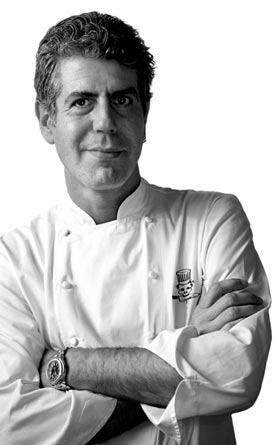
As our very own Accidental Hedonist, Kate, reported a while back, chef Anthony Bourdain was in Beirut, Lebanon, with his crew, preparing to do a show bringing to Americans the sights, scents and tastes of a thoroughly cosmopolitan, beautiful city reborn from the ashes of a civil war.
The show never was filmed, because on the first day they were there, two Israeli soldiers were kidnapped by Hezbollah operatives.
After that, the few glimpses he and his crew saw of a beautiful country went straight to hell.
Today, on Salon.com, you can read the full story, told by Bourdain himself, of how it was to watch a beautiful city, filled with gracious people (and not a few supporters of Hezbollah, whom some of those gracious people called “assholes”) die another death. If you are not a Salon subscriber, you can usually avail yourself ofa free day pass by watching an ad. The ads are short, and not too boring and after that, you can read whatever you like. Today, I highly suggest you make Bourdain’s “Watching Beirut Die” a priority read.
It made me cry.
More than once.
For many reasons.
(It also made me chortle darkly for several reasons, not the least of which is that after Morganna reads this piece, her “celebrity crush” on Bourdain will likely only deepen–leave it to the child of the Culinary Nerd to hero-worship a chef.)
And thank you to reader, Meredith, for pointing out this Washington Post transcript of a live online question and answer session with Bourdain that took place this Wednsday, July 26th. It was a chance for readers to ask the burning questions they have always wanted to ask Bourdain, and for Tony to answer in his inimitable way.
Bhindi Masala
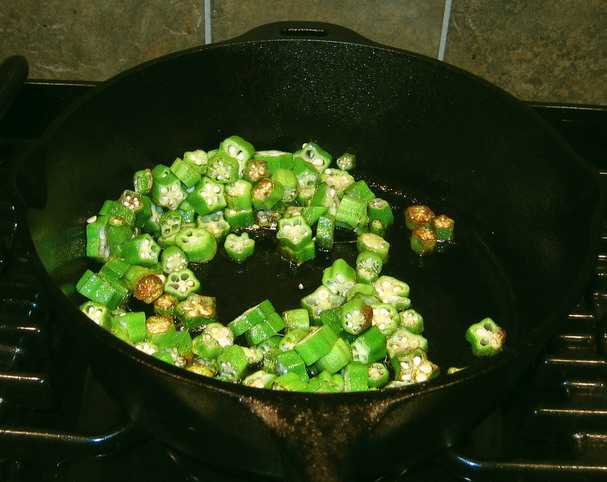
I got up early today, even though this would have been my first chance to sleep late in over a week, and went to the farmer’s market.
And boy am I glad that I did. Not only was I able to rebuild my stock of lettuces, garlic, onions and potatoes, (all of which I used up before we left for DC), I was also able to pick up some blueberries and some very amazing blackberries, but I also found something that caused me to go into an intense craving: okra.
A lot of folks don’t like okra, but I am not one of them. Which is odd, because one of the few food textures that I really object to is a slimy, mucilaginous one. And okra can very much be slippery and sticky.

But, I have found that I like it three ways: in gumbo, the spicier the better, battered in cornmeal and fried in bacon grease, which is the way I grew up eating it, Southerner that I am, and cooked with tomatoes, onions, garlic, and spices, the Indian way.
And looking at those pretty green pods, I had a sudden and powerful hankering for bhindi masala, the way it is cooked at Shere e Punjabi in Columbus. (That translates to “Tiger of Punjab,” which is a very cool name for a restaurant, in my opnion.)
Of course, I have never made bhindi masala, so that complicated things somewhat.
But not much. I never let little things like that get in my way.
Okra is an interesting plant. Related to marsh mallows and hollyhocks, it is a pretty plant that originated in Africa, most likely Ethiopia. The part that is eaten is the young seed pod, and it secretes a very thick, somewhat slimy juice. I have found, however, that cooked the Indian way, the slime factor is reduced greatly, just as frying it in cornmeal seems to manage. With gumbo, the juice is used to thicken the soup, so it comes in handy, and if you put enough seafood, tomatoes, spices and chiles in the soup, and serve it over rice, I have found that I don’t really care about the sliminess at all.
It is filled with both soluble and insoluble dietary fiber, it is loaded with vitamins C and A, and has B complex vitamins, iron and calcium as well. (Cooking it in a cast iron pot as I did boosts the iron level up even furthur.) It is also very low in calories, and when cooked the Indian way, tastes divine. If you have never tried it, or only had it boiled into a slithery cthuloid mess and thus think it is nasty, give it a shot cooked as a masala. It is much, much better this way, and really does make a great side dish along with rice, kheema sookh and raita.
I also want to mention that I used some of what we call in our house Indira’s Magic Powder in this dish. Indira, of course, is the lovely writer of Mahanandi–one of the best food blogs out there, hands down. She sent me this seasoning powder, which she calls me “Dalia Powder,” in the mail, and I have found that it makes any vegetable dish taste special. It is made of roasted chickpeas (dalia), dry coconut, , dried red chiles, dried garlic, cumin and salt all ground together into a orange-colored powder that is, as far as I am concerned, magical in its ability to transform any vegetable curry into something fantastic. It thickens the curry and adds amazing fragrance and flavor to the dish. If you want the exact recipe, Indira posted it here. I bet she could market it in this country, though, and I think she could–but only if she calls it “Indira’s Magic Powder.”
Because, as far as I am concerned–it is magic. And it took my okra masala and pushed it right over the edge from pretty good to downright amazing. It didn’t really taste like the way they make it at Shere e Punjabi, but that is okay, because it tasted better. And I have Indira to thank for that.
If you don’t have access to dalia powder, sprinkle a bit of garam masala on the dish at the end of cooking.
Bhindi Masala
Ingredients:
4 tablespoons canola or peanut oil
1 pint fresh okra, rinsed, top and bottom trimmed away, and sliced into 1/4″ thick slices
Spice Mixture:
1 1/2″ cube fresh ginger, peeled and sliced
1″ piece fresh turmeric root, peeled and sliced (substitute 1 teaspoon dried turmeric if you cannot get fresh)
3 cloves garlic, peeled and thinly sliced
2 unseeded green chiles, sliced
1 teaspoon cumin seeds
2 teaspoons coriander seeds
1/2 teaspoon fenugreek seeds
1/2 teaspoon mustard seeds
1 teaspoon salt
1 large yellow onion, peeled and thinly sliced
1 hot green chili, unseeded, sliced
1 cup halved red and yellow cherry tomatoes
1/2 cup water
1 teaspoon dalia powder (also known as Indira’s Magic Powder–if you cannot get it or do not know how to make it, use some garam masala instead–probably to taste–not quite as much as I used of the dalia powder–more of a sprinkle.)
Method:
Heat the oil over medium heat in a cast iron skillet and drop in the sliced okra. It will sputter and sizzle and spit; this is because of the moisture in the okra. If you have a splatter screen or shield, I suggest using it to cover the dish while the okra fries. If not, be prepared to clean your stovetop well after this exercise.
Cook, stirring now and again, until much of the okra has crisped and browned, and is emitting a wonderful, nutty aroma.
Remove the okra from the oil, and drain on paper towels.
While the okra is cooking, grind the ingredients of the spice mixture to a fine paste.
Put the onions in the oil, and cook, stirring until they turn golden brown. Add sliced chile, and continually stirring, cook until the onions are deep dark reddish brown.
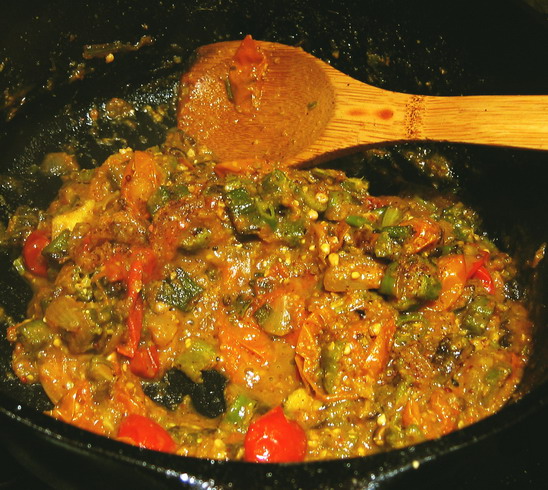
Add spice paste, and cook, stirring until it is fragrant–about one minute. Add okra back to pan, and cook, stirring for another minute.
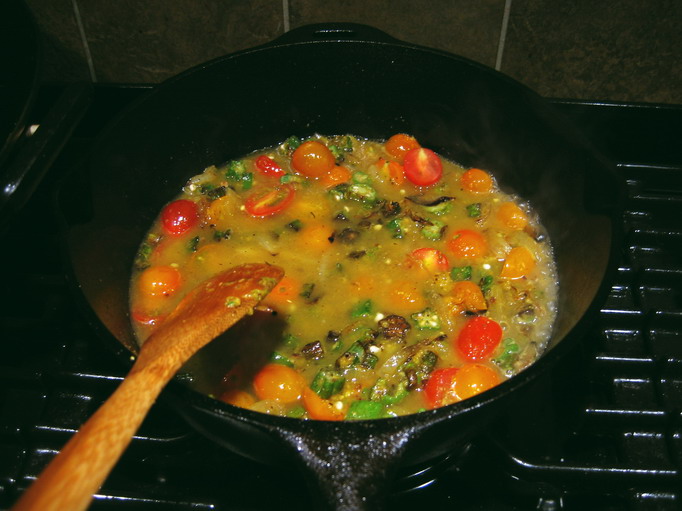
Add tomatoes and water, and stir to combine. Turn heat down to low and cook, stirring now and then, until most of the water has evaporated, leaving behind a thick, yellowish curry of melted tomatoes and browned okra and onions.
Sprinkle with dalia powder or garam masala and mix in roughly chopped cilantro. Serve immediately with rice, raita and whatever other dishes you like–for vegetarians, a dal would be great, for us, we had kheema sookh.
Thai Tomato Basil Salad
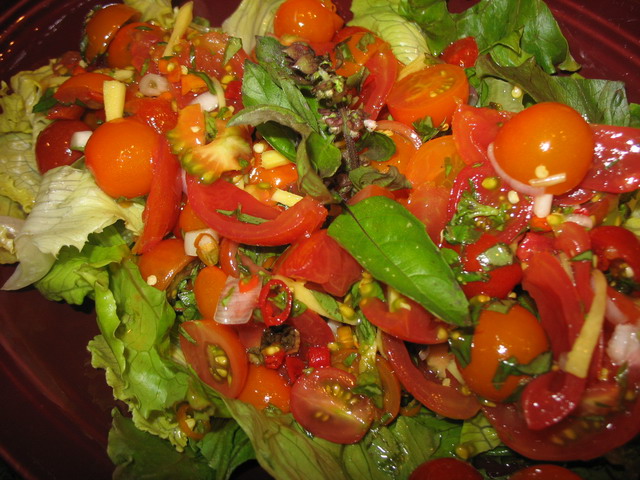
This is not a traditional Thai dish.
But, it tastes so good, it doesn’t really matter. And really–I suspect that real live Thai folks would like it, and would make it, if they had the ingredients readily available. So, even though it came from my own culinary imagination, I still call it, “Thai.”
It is based upon a fairly traditional Thai way with cucumbers, so it isn’t completely my own innovation. But, that is the way of culinary innovation and inspiration. It comes from a cook making something traditional, glancing over at a pile of other ingredients and saying to herself, “Hey–I wonder what those would taste like this way?”
Well, I can wonder no more. Zak liked this salad, as did Morganna, myself and a handful of our friends. I made it the night before we left to go to DC, in order to use up the rest of the tomatoes, Thai basil and lettuce from our CSA box so they wouldn’t get wasted–which, I think is a perfectly natural thing to do. The leftovers we sent home with Howie and Karen, who were watching our house, cats and dogs while we were gone. (Along with fried rice and curry leftovers–that way, Karen wouldn’t have to cook for a few days.)
The flavors of this salad are very strong: there is the acidic fruitiness of the tomatoes, mixed liberally with the sweet and sour notes of the dressing, the smoky saltiy tang of the fish sauce, the incendiary heat of the chiles, the soaring anise scent of the basil and the sharp zing of the ginger and lime zest. (If you have lime leaves instead, they can replace the lime zest: simply cut two leaves into very fine chiffonade.)
One could add cucumbers to this salad, and perhaps some sweet red or green bell peppers, but then, I don’t think that either Morganna or Zak would like it quite so much. Neither of them is fond of either green bell peppers or cucumbers, and they don’t much like red sweet peppers, either.
I used both red and yellow cherry tomatoes in this salad, cut into wedges, but it would be just as easy to use sliced tomatoes. When the multi-colored heirloom tomatoes come into season, imagine slices of Green Zebra, Cherokee Purple, Mr. Stripey, Brandywine and Black Krim, marinated in the dressing and arranged over a bed of lettuce leaves and sprinkled with minced basil, then garnished with sprigs of Thai basil with the dark purple blooms intact. It sure does paint a pretty picture in the mind–I will have to make this again when they are in season, and photograph it, so y’all can see what I am thinking about….
If you want to make it ahead of time, marinate the tomatoes in the dressing for up to a day, adding half of the basil to the tomatoes. Then, just before serving, spread a platter with washed, dried and chilled lettuce, then pour the tomatoes and dressing in a mound in the center, and then sprinkle with the rest of the basil leaves, either minced or cut into a chiffonade. That way, you get a great flavor and texture on the tomatoes, but your lettuce stays crisp and you get the fresh basil sprinkled over everything as a beautiful contrast to the shimmering tomato wedges.
Thai Tomato Basil Salad
Ingredients:
1 pint red cherry tomatoes, washed, dried and quartered
1 pint yellow cherry or pear tomatoes, washed, dried and quartered
3 green Thai chiles, sliced thinly on the bias (or to taste–three gives a very strong, smoky hit of heat–you might like less or more)
1/2″ cube ginger, peeled and cut into a very fine julienne
1 white or purple scallion, trimmed, washed dried and sliced thinly on bias, white or purple and light green parts only
1 tablespoon lime zest
juice of 2 medium sized limes–about 1/4 cup
1/8 cup rice vinegar
3 tablespoons fish sauce–or to taste (I use Golden Boy brand)
raw or palm sugar to taste (about 1 tablespoon is sufficient for me, but others like it sweeter)
pinch of sea salt or kosher salt to taste
1 head romaine lettuce, washed, dried, outer leaves discarded, and bottom trimmed, leafves torn into bite sized pieces
1/2 cup minced fresh Thai basil leaves
Method:
Toss together tomatoes, chiles, ginger, scallions and lime zest in a medium-sized bowl.
Mix together the rest of the ingredients except the lettuce and basil leaves. I like to put it all into a jar that will hold it and then shake it until it is well combined. When it is perfectly mixed, pour it over the tomatoes, and mix well.
Cover and either leave at room temperature or refrigerate for two hours, or leave in the fridge overnight. (At this point, if you want a strong basil flavor, you can mix half the amount of basil leaves, freshly minced, into the tomato and dressing mixture.
When ready to serve, line a platter with the lettuce leaves. Spoon out tomatoes with a slotted spoon, and form into a glistening pile or mountain of tomato bits. Drizzle dressing over the tomatoes and the lettuce, then sprinkle Thai basil over everything.
Garnish with fresh sprigs of Thai basil with dark purple blossoms.
The Culinary Nerd Takes Her Friends Shopping
Here is the final installment of the tale of the Culinary Nerd and her friends gallivanting in the Baltimore/DC area.
First, I want to apologize for not contacting either the bloggers out in that area, or the folks whom I have not seen there in ages; I didn’t want to further complicate the visit, which already included six intrepid explorers, all in a rented minivan, all of whom had their own needs, wishes and places to go and people to see, by adding yet more people and visiting to the venture. The other reason I didn’t end up contacting anyone was because in the heat (it was over 98 degrees F. through most of our visit) and in my sixth month of pregnancy at the age of 40–I get tired ever so easily, and so I didn’t want to overtax myself with a lot of activity. Walking around the Smithsonian’s museums was about as much excitement as I could take, and even that got to be very, very wearing. So much so that I think I am out of the travelling game until after little Kat is born and is big enough to go off with Mamma and Daddy to see the world. (I hate to admit to weakness, you know. It pains me to do it, but it would pain me more to push myself beyond my physical capabilities. Besides, Zak and Morganna would become quite cross, and then all of my friends would help them tie me to the couch or something. And then, I wouldn’t get to cook anymore, and then, I would be really, really sad.)
So.
Do not think I wasn’t loving you if I didn’t contact you and make a date to meet you. It will happen, at a later date, preferably when it isn’t hotter than the hinges of hell, and I am not carrying around an extra wiggly internal burden whose name is Kat, but who most often these days gets called, “Thumper.”
For obvious reasons.
But wait! I am supposed to be talking about shopping.
Oooh. Shopping.
Every Culinary Nerd likes to shop. Its just that we have kind of more esoteric shopping needs than those that are usually satisfied by The Gap, Target, or Pier 1.
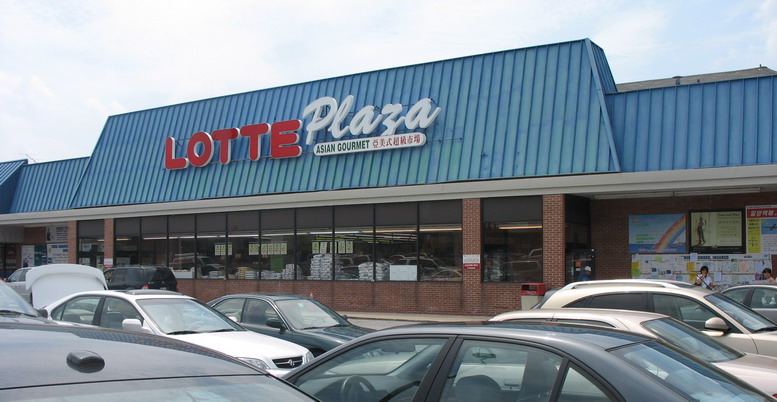
And there is a place in Ellicott City which this Culinary Nerd misses intensely: The Lotte Plaza Gourmet Asian Supermarket.
There you see it, at the beginning of this post–an Asian market that is the size of an American supermarket, which my friends quickly dubbed, “Korean Krogers.” And, really, it is an apt name.
Lotte is a chain of supermarkets originating in Korea, and I know that it has outlets all over the metro DC area, as well as in the upper part of the East Coast. I wish like crazy it would penetrate into America’s heartland, too, but I suspect I must wait a very long time for that to happen. But, when I am in the Columbia, Maryland/Baltimore/DC area, I have to stop by at this temple of Asian food goodness and remember all the tours I used to lead for Howard County Parks and Recreation at the place.
And while I am at it stock up on some of the most fresh Asian produce imaginable. And maybe buy a couple of gallons of kimchee. and gaze in wonder at the many varieties of very fresh fish and seafood in the seafood department. And pick up some neato-keen serving platters, plates and bowls in the housewares department.
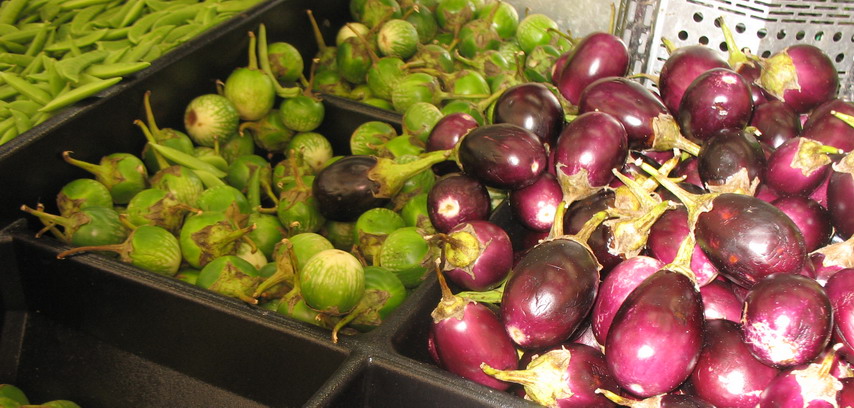
I am sorry I didn’t take many photographs; I was trying to be inobtrusive on a crowded Saturday morning at the peak shopping time. I didn’t want to worry, upset or otherwise annoy the hordes of shoppers from every country in Asia, many countries in Latin America, and some scattered few Anglo-Americans. (Though, to be honest, most of those shoppers came in with me.) So, there are a mere handful of pictures here: not nearly enough to convey the amazing bounty on display in this huge and bustling shopper’s paradise.
Words are hard-pressed to convey the amount of extremely fresh fruits, vegetables and herbs that are available in the huge temple to vegetatation that they call the produce section. And the prices! Oh–so inexpensive. And they have -everything-. Fresh tamarind, durian (no, I didn’t buy one–I had friends in the minivan, and I would like them to remain friends), Asian pears, lemongrass that was among the freshest I have ever seen (and yes, I bought some of that), lotus root, water chestnuts, and sigh–two kinds of bitter melon (no–I didn’t buy those either, as they cause uterine contractions).
As for kimchee, there is an entire refrigerated AISLE of it, which I could not photograph, because it was jammed with shoppers alll picking their own favorites in jars from a mere 12 ounces to two gallons. It was beautiful.
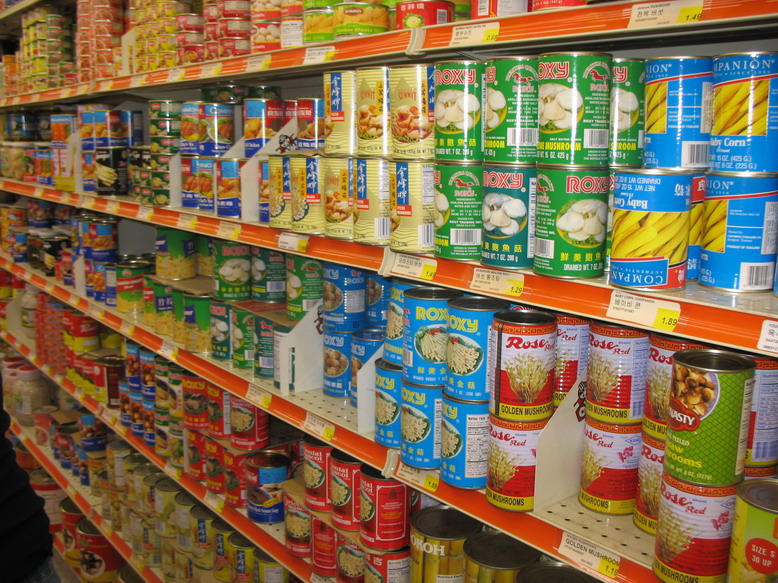
The canned goods stretch for several aisles: the sauces and condiments for three. Noodles take up two aisles, and then there is the meat section, which is filled with mysteries such as gallons of cow and pig blood, pig uterous and chicken feet. (I didn’t buy the feet, because I get those free from a local farmer here in Athens.)
The whole experience can quickly become overwhelming, especially at busy times. There is the gigantic fish and seafood aisle where squid, beltfish, (they look like mini-oarfish–thirty-foot long giants of the deep), monkfish and shrimp with their heads on all rest on beds of ice. (The Maryland blue crabs, which I would have bought normally, in order to bring them home and make green curry with were not on ice, and were mostly dead, not lively and cantakerous. They smelled bad–a bad sign, and I noticed that not one shopper stopped to pick any out.)
The overwhelming nature of the Korean Krogers is part of why I started teaching one of my most popular culinary arts classes for Howard County Parks and Recreation when we lived there. I taught a series of Asian cooking classes–Thai, Chinese and Indian–but I also taught a tour of Lotte Plaza. The class size was limited to twenty people, I taught it every season, and every time, it was filled with students and had a waiting list of at least fifteen to twenty more people hoping the other students would cancel.
The manager of the store loved us, and would set up tasting stations, and have guys in the produce section bring out new and unusual produce items for us to examine, and would set up the fish department folks to be doing something interesting like cleaning squid, so they could demonstrate to my students. (I also got to step up and clean some squid myself–which was fun, and the fish guys were really happy that I even knew what I was doing!) One time, myself and my students were featured in a local television ad they were filming that same night.
Most of the students were cool, but every now and then, I would have a problematic person, and would have to diplomatically reign in behavior which I found to be offensive. Some people would make judgemental comments about the pig’s uteri in the meat department, and there was the night that the refrigerated case filled with gallon jugs of blood became an issue. I had to explain quite firmly those times that it was not our place to judge what others choose to eat and not eat, because it was part of their culture which is not better or worse than our own–simply different. I also pointed out that Europeans ate blood-based foods as well, such as the German blood sausage or the English black pudding.
Most of the time, however, it was fun, but not nearly as much fun as it was introducing my friends to the store. We had a great time looking, shopping, and people-watching. Tom, the anthropologist, had a stellar time observing the shoppers and what went into their carts, Heather was amazed at the produce prices and Zak and Dan were just fascinated by the spectacle of it all. And for Morganna–it was a return to a place of her childhood, as she visited this place often with me when she was younger and came to see us in Maryland.
She also liked shopping at the little Sanrio store that shares a space with the grocery plaza, and of course, we -all- were fascinated by the little refrigeration unit that was specifically designed to ferment and store varieties of kimchee over in the appliance section.

After such a lot of walking, we were a might bit peckish, so we paid for our purchases, and walked across the parking lot to La Boulangerie, which despite its French name, is a Korean bakery. Again, it was crowded, so I took no pictures of the inside, but let me say–the buns, breads, rolls, cookies, doughnuts and cakes inside are all beautifully made and are a perfect balance between Eastern ingredients and Western traditions. Red bean paste filled doughnuts sprinkled with cinnamon sugar were sold next to sweet potato filled breads. Sweet Portuguese style bread rolls filled with luscious but not too sweet buttercream tempted while crispy-tender almond cookies beckoned from a basket beside the register.
It was all good.
The visit to the Lotte Plaza and La Boulangerie was a feast for the senses, and a trip well worth taking, and in the future, worth repeating. If you live anywhere near Ellicott City and you like to cook and eat Asian foods, it is worth your while to take an afternoon to go down and check out all the goodness available to you there. It really is an amazing sight to see so many unusual vegetables, fruits and herbs all stacked together in perfect rows and pyramids, little of it available anywhere else, and all at great prices.
The Butterfly Effect Meme
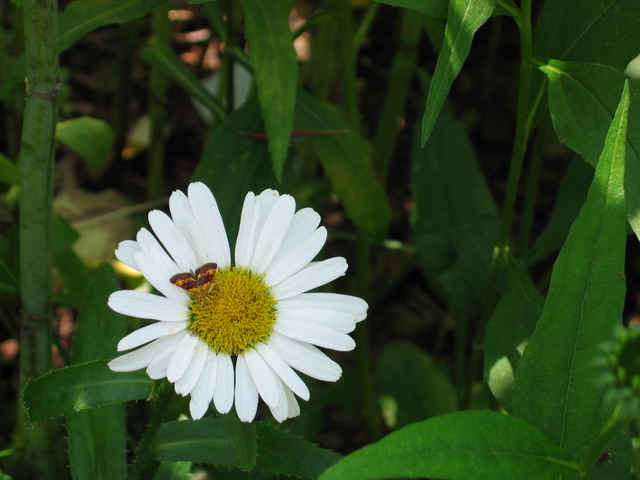
Memes are a fun little game to play in the foodblogosphere, especially when they are creative ones that ask unusual or interesting questions.
Tana Butler of Small Farms tagged me with a meme entitled “The Butterfly Effect,” which was started by Dan at Salt Shaker, because he always wanted to participate in a meme, but no one had tagged him yet. In the creative spirit of food blogging, he decided to start his own meme, and get others in on the game.
The point of this meme is about defining moments in food, where an ingredient, a dish, a meal, a cookbook or book about food, a food personality and another person in my life reached out and touched me, changing my viewpoint or world forever. When Dan wrote started this, he really emphasized that he wanted to hear about the “aha” moments, the ones that really signal a change in heart, a change of mind, a lightningbolt moment when my perspective on food, or life in general, was made forever different.
When it comes to ingredients, I have to admit to having difficulty coming up with a cogent answer. Which single ingredient really changed my life? Out of the hundreds, perhaps thousands of ingredients I have experimented with and worked steadily with over the years, which one has really made me sit up and take notice and has changed the way I cooked forever?
I think, when I come right down to it, it has to be a combination of several ingredients that changed my perspective on food and cooking forever.
Fresh garlic and fresh herbs, combined together into my first forays into authentic Italian food have to be the answer. I first experimented with real Italian food when I was in high school, and it was a big departure for me. The food I had grown up eating had a minimum of seasoning; my mother would buy two heads of garlic at a time, in little paper boxes, and they would be used up, if we were lucky, within two months. Fresh herbs were even less in evidence: they were unheard of until I started growing them in pots on our doorstep.
However, when I finally got the greenlight from my mother to start trying to cook “real” Italian food, I combined these ingredients and it was amazing to me, the difference that these true, real, fresh ingredients made in the making of a simple pasta sauce. It was a fundamental change in the way I had seen most of my family members cook, and it really changed the way I wanted food to taste. It was one of the first chances I had to taste really robust flavors, and I didn’t want to ever stop tasting them after that.
So, I kept cooking with fresh garlic and herbs and haven’t stopped since.
As for a single dish–that is equally difficult. I think that Chicken with Garlic Sauce or perhaps, Tom Kha Gai would qualify for a dish that changed my life forever. In both cases, the flavors were so good from the first taste, that I knew I didn’t ever want to live without these dishes, and that necessitated that I learn how to make them. And so, I was pushed to jump into learning to cook Chinese and Thai food by leaping into the matter, feet first and try, try, try, to recreate the flavors I had experienced in restaurants. These flavors were revelations to my palate, because both dishes are perfectly balanced with flavors that are hot, sour, salty, sweet and savory. Both of them perfectly illustrated the aesthetic emphasis upon balance that exist in Asian cuisines, and they gave me a pinnacle to strive towards.
As for a meal that changed my life–I would have to say that the first time I dined in a really nice restaurant with Zak’s family was an experience that blew my mind and really taught me that food was a pleasure beyond sustainence and that it is something to be celebrated and savored as an end in and of itself. It was a Spanish restaurant in Miami, Florida, and the dinner took place over hours and many courses, and the wine and sangria flowed like fountains of joy, while the food was both delicate and robust, subtle and sublime, yet filling. There was nothing delicate about the portions, though they were not immense, yet, the seasoning was delicate and deftly done. There was art on every plate and it was so much fun to taste each other’s dishes and discuss how they were done, and what probably went into each sauce to give it that special flavor.
I believe I will remember that night for the rest of my life–not only because it was so wonderful, and such a new experience for me, but because I gently stabbed my future-father-in-law in the hand with my fork when he tried to cadge a bite of my venison steak with blackberry sauce without asking! That action incited much laughter and teasing, and I have to admit that Karl took it well, though it was a terrible faux pas on my part. Of course, the best part was how much fun we were having–there were no real faux pas or social gaffes at that table, as the emphasis was not only on enjoying our food and drink, but also our company and each other. There was a lot of laughter that evening.

A cookbook that really changed my life would be Harold McGee’s On Food and Cooking, which I read from the library several times after it first came out, and when I decided that I was going to attend culinary school, I bought a copy of it and Larousse, and read them both again, cover to cover. McGee’s scientific analysis of the physical and chemical changes wrought by cooking gave my already scientifically-bent mind a way to look at the hows and whys of cooking, which are as important as the whats.
Of course, McGee’s book isn’t really a cookbook per se, so perhaps I should also make mention of one of the first cookbooks I bought for myself: Paula Wolfert’s Mediterranean Cooking. This book I picked up while I was stil in middle school, before I had really been allowed to cook much in Mom’s kitchen beyond cookies and cakes. It is a compendium of recipe sand stories about the foods of the Mediterranean region and is divided into chapters by ingredient, including olive oil, olives, lemons, garlic, tomatoes, and wine. Something about the book, which was on sale at a local bookstore, appealed to me–I think it was the stories she told about each ingredient and each recipe that attracted me. I do remember that it is the cookbook that inspired me to start growing my own fresh herbs and to use more garlic than I had grown up with in my cooking. I still have that book, and have cooked with it many times, particularly when I was younger, always with delicious results.
And I still like to read the stories, though the pages are splattered with tomatos and are fragrant with garlic and herbs.
I don’t think that anyone should be surprised to find that the food personality who has influenced me the most is Julia Child. The mere fact that I call her “Saint Julia” and consider my visit to her kitchen at the Smithsonian to be a holy pilgrimage should tell everyone that I hold Julia in great esteem.
But why?
I think I admire her because of her methodical nature, and her real ability to teach. I know she is my inspiration when it comes to teaching, because not only was she a thorough, no-nonsense teacher, she was also vibrantly enthusiastic about cooking and food, and was able to convey that in both her prose and her on-screen work. Her thrill for cooking was infectious, and I still find myself, years later, watching the DVD collections of her old shows and smiling, feeling energized to rush out into the kitchen and whip up something fantastic and delectable.
I also think that she is probably one of the most pivotal persons in American gastronomy, because I firmly believe that without her influence in teaching Americans how to cook and eat, we might still be stuck back in the horrible food of the 1950’s where canned cream of crab soup and sherry sprinkled with minced parsley passed as a “gourmet” dish.
Mind you, we are still a fast food nation, and we still have folks eating from cans and boxes, but I think that without the influence and teaching of Julia and those who have followed her, American food would be in worse shape than it is now, and there might not even be a whole bunch of food bloggers out on the ‘net, cooking, teaching, and writing about food like mad today.
As for a person in my life who has influenced me–well, as regular readers know, I was blessed with two grandmothers who were phenominal cooks. From my mother’s mother, I learned the growing of food from seed to plate, and how to treat it along the way, both in the garden or farmyard and the kitchen, in order to take advantage of it at its peak of freshness. From my father’s mother, I learned frugality and how to do more with less, and also how to be methodical in the kitchen, and take my time, and observe the cooking process. She taught me to use my senses, all of them, as I cooked, so that I would not be hampered by having to follow recipes exactly.
I also have aunts on both sides of the family who are great cooks: Aunt Nancy and Aunt Judy. (There are more–my family loves good food, but these are the folks who were the strongest influences on me.) Aunt Nancy encouraged my budding use of garlic and herbs by saying, “Oh, you did it right–it smells like my old neighborhood in Providence” when I cooked my first real Italian dishes. (She grew up in a primarily Italian and Portuguese neighborhood in Providence, RI.) Aunt Judy, a disciple of Saint Julia, taught me to be creative and not worry overmuch about food, and to try things that seemed too hard to master. She taught me to be fearless in the name of flavor.
But, I also want to give homage to an often unsung hero in my culinary background.
Zak, my husband, who is my only failure as a cooking teacher (do not try to teach someone to cook when you are hungry and are trying to put dinner on the table–especially if that person is a shy and nervous student–it is a recipe for disaster) , but who has been my willing guinea pig for new recipes for years. He also is the one to introduce me to Thai food, and has been supportive of every one of my cooking endeavors, from my decision to attend culinary school to my explorations of Indian food to my food blogging hobby. (In fact, the food blog was his idea and he pushed me to pursue it. He was right, of course.)
He is a great critic, and he has become knowledgable enough about food in order to discuss it intelligently. He’s been my best friend and partner along for the ride on most of my culinary adventures, and what’s more he not only supports my nerdish tendencies–he encourages them.
So there we have it–The Butterfly Effect.
(Oh, and one more thing–about the photographs–they were taken about three years ago in our old garden in Pataskala.)

Categories:
- Admin (rss) (55)
- Blogs and Blogging (rss) (81)
- Book Reviews: Cookbooks (rss) (43)
- Book Reviews: Non-Cookbook Food Books (rss) (38)
- Cats and Cat Blogging (rss) (47)
- Chinese Cooking Lessons (rss) (32)
- Culinary School Stories (rss) (18)
- Dairy Pruducts: Cultured and Barbaric (rss) (4)
- Documentary Filmmaking (rss) (1)
- Essays, Rants and Reflections (rss) (260)
- Fighting Hunger (rss) (12)
- Food and Kids (rss) (45)
- Food in the News (rss) (126)
- Food Media (rss) (98)
- Food Preservation (rss) (18)
- Food Safety (rss) (45)
- Gardening (rss) (30)
- Herbs and Herb Blogging (rss) (20)
- Holidays (rss) (50)
- Kat Blogging (rss) (22)
- Kitchen Science (rss) (36)
- Leftover Makeover (rss) (8)
- Life, the Universe and Everything (rss) (131)
- Local and Sustainable (rss) (227)
- Local Athens Food and Foodies (rss) (42)
- Meatless Mondays (rss) (32)
- Menu For Hope (rss) (5)
- Nutrition, Diet and Health (rss) (84)
- On The Farm (rss) (8)
- Recipes: Almost Vegetarian, Vegetarian and Vegan (rss) (294)
- Recipes: American Regional (rss) (37)
- Recipes: Appalachian Hillbilly (rss) (33)
- Recipes: Bread, Pasta, Grains (rss) (95)
- Recipes: Canning and Preserving (rss) (8)
- Recipes: Chinese (rss) (123)
- Recipes: Comfort Food (rss) (120)
- Recipes: Cookies (rss) (16)
- Recipes: Desserts (rss) (48)
- Recipes: French (rss) (25)
- Recipes: Fruits and Vegetables (rss) (302)
- Recipes: Greek, North African and Middle Eastern (rss) (31)
- Recipes: Indian (rss) (137)
- Recipes: Italian (rss) (42)
- Recipes: Japanese (rss) (7)
- Recipes: Jewish (rss) (4)
- Recipes: Korean (rss) (6)
- Recipes: Meat, Poultry and Fish (rss) (220)
- Recipes: Mexican/Native American/ Latin American/Caribb (rss) (27)
- Recipes: Original (rss) (108)
- Recipes: Thai (rss) (27)
- Recipes: Tofu (rss) (17)
- Recipes: US Regional (rss) (16)
- Recipes: Vietnamese (rss) (8)
- Restaurant Stories (rss) (28)
- Sewing, Quilting, Arts and Crafts (rss) (16)
- Simple Chinese Recipes (rss) (30)
- Slow Food and Heritage Foods (rss) (10)
- Spice Blogging (rss) (44)
- The Chinese Cookbook Project (rss) (14)
- The Chinese Pantry (rss) (39)
- The Documentary (rss) (2)
- The Kitchen Saga (rss) (17)
- The Locavore's Bookshelf (rss) (15)
- The Unsung Adventures of The Culinary Nerd (rss) (6)
- Tools and Toys (rss) (35)
- Uncategorized (rss) (10)
- With a Side of Politics (rss) (48)
Archives:
- August 2012 (9)
- July 2012 (12)
- September 2011 (3)
- August 2011 (7)
- July 2011 (8)
- June 2011 (16)
- May 2011 (17)
- April 2011 (11)
- December 2010 (9)
- November 2010 (5)
- February 2010 (1)
- December 2009 (5)
- November 2009 (7)
- October 2009 (10)
- September 2009 (16)
- August 2009 (14)
- July 2009 (14)
- June 2009 (7)
- May 2009 (17)
- April 2009 (10)
- March 2009 (25)
- February 2009 (13)
- January 2009 (10)
- December 2008 (5)
- November 2008 (5)
- October 2008 (6)
- September 2008 (13)
- August 2008 (8)
- July 2008 (11)
- June 2008 (18)
- May 2008 (13)
- April 2008 (14)
- March 2008 (16)
- February 2008 (17)
- January 2008 (19)
- December 2007 (25)
- November 2007 (18)
- October 2007 (24)
- September 2007 (16)
- August 2007 (15)
- July 2007 (15)
- June 2007 (10)
- May 2007 (14)
- April 2007 (16)
- March 2007 (17)
- February 2007 (20)
- January 2007 (13)
- November 2006 (1)
- October 2006 (8)
- September 2006 (14)
- August 2006 (25)
- July 2006 (30)
- June 2006 (28)
- May 2006 (34)
- April 2006 (29)
- March 2006 (24)
- February 2006 (30)
- January 2006 (38)
- December 2005 (40)
- November 2005 (37)
- October 2005 (32)
- September 2005 (25)
- August 2005 (30)
- July 2005 (28)
- June 2005 (21)
- May 2005 (8)
- April 2005 (22)
- March 2005 (17)
- February 2005 (29)
- January 2005 (10)
Search Site:
Links:
- Lily’s Wai Sek Hong
- 101 Cookbooks
- A cat in the kitchen
- A Veggie Venture
- Accidental Hedonist
- Cha Xiu Bao
- chez pim
- Chocolate & Zucchini
- Chopstick Cinema
- Chowhound.com
- Chubby Hubby
- Cook sister!
- Cooking with Amy
- da*xiang
- Eat Local Challenge
- Eating Liberally
- Ecocentric
- Eggbeater
- Epicurious
- Farmgirl Fare
- Fatfree Vegan
- Foodgoat
- ForkandBottle.com
- Green Olive Tree
- Hooked on Heat
- Jaden’s Steamy Kitchen
- Kalyn’s Kitchen
- Lucullian delights
- Mahanandi
- Matt Bites
- MeatHenge
- mmm-yoso!!!
- New York Times – Dining & Wine
- Pizza Goon
- Rasa Malaysia
- Ruhlman
- Sailu's Kitchen
- Serious Eats
- SF Gate: Food & Dining
- Simply Recipes
- Soul Fusion Kitchen
- Tastespotting
- The Amateur Gourmet
- The Cleaner Plate Club
- The Food Section
- The Grub Report
- thecookscottage
- U.S. Food Policy
- Wandering Chopsticks
- Washington Post Food and Dining
- Wasted Food
Meta:


Powered by WordPress. Graphics by Zak Kramer.
Design update by Daniel Trout.
Entries and comments feeds.