
Cook Local, Eat Global
Simple Pasta Supper for a Tired Cook
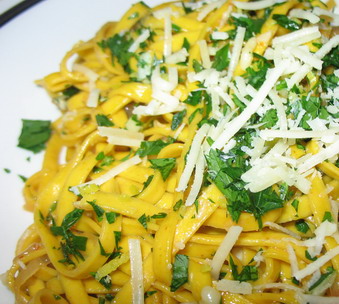
We were naughty yesterday.
Instead of staying home and doing the cleaning and organizing we had planned to do, we went out to the Mountain State Arts & Crafts Fair in Ripley, West Virginia, where we walked about in the very intense heat, drank lemonade, ate roasted corn, and shopped among some of our favorite artists.
We came home with a relatively small number of pretties, but several of them I have to show to you.

These three lovelies are mugs by our favorite potter, Bill Meadows, whose mugs we started collecting about three years ago. Now, every time we go to a craft show where he exhibits, we wind up bringing home an average of about three of his pieces. The photograph really doesn’t do justice to the variagation in the colors in his glaze, but you can see how fluid and organic the shapes he works with are.
The other pretty we brought home is a lazy-susan for our dining room table. It is all pieced out of different woods, with cedar, black walnut and oak predominating, and it looks really nice on our oak dining room table, as you can see. I can’t wait until a cat climbs up on it and falls asleep–we can sneak up and give the lazy susan a spin and watch the cat dive for cover. Perhaps that will keep them -off- of the table better than any of our other gambits so far.
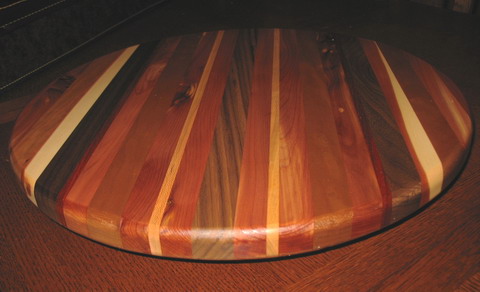
But, after a day wandering in the heat and eating very little (but drinking very much–I remembered to drink water and lemonade in copious amounts to keep myself and little Kat hydrated), we came home, cooled off and finally got hungry.
Of course, by that time, I was really tired, so I really didn’t want to cook anything. But, it was too late to eat out–every place was closed. (The perils of living in a very small town are thus: if you want to eat late, you cook.)
Besides, we were hungry, but not super-hungry. Not enough to want to even think about eating any meat. But hungrier than just a salad would satisfy.
What to do?
Make a quick pasta dish, that’s what!
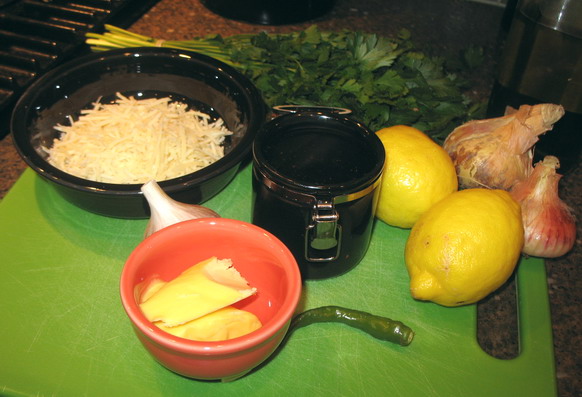
This recipe I found on the back cover of the July 2006 issue of Fine Cooking Magazine when it came in the mail, and it has been lodged in my memory since. I -knew- I would have to make it sometime when I was hungry, but not in the mood for anything heavy. With the huge bundle of Italian flat leaf parsley that came in the Athens Hills CSA box this time around, I had all of the ingredients on hand. (Speaking of ingredients, look at how yellow the butter is in that
picture–if I had any doubts about how the Hartzler Family Dairy feeds their cattle in the summer, they are wiped away now. Butter that yellow is the result of pasturing your dairy cattle in the summer–the brilliant color comes from the beta carotene in the grass.)
Of course, I messed with it a bit. I put a little less than half the butter suggested into the recipe, and it is a good thing, too. The sauce was still a bit on the greasy side for both Zak and I, though it had a phenominal flavor. I used more lemon zest and garlic than called for in the gremolata, and I added some sherry. Though, if I had some marsala, I would have used that to keep it all Italian, but one makes do with what one has.
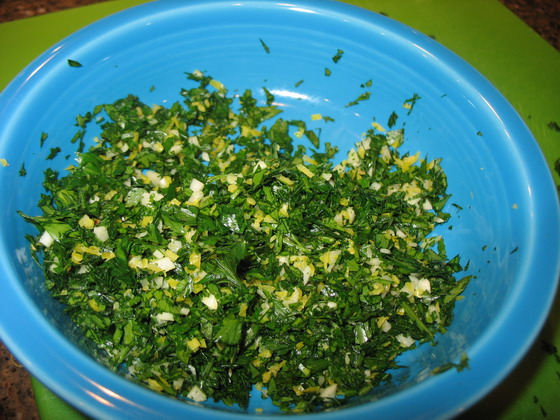
And as for the gremolata–what is that? It is a simple mixture of fresh Italian parsley, raw garlic and lemon zest that is minced up and used as a garnish or relish. It is traditionally served with osso bucco, but it really boosts the flavor of this simple pasta sauce that is based in caramelized onions and some fresh chile and dried chile flakes.
Instead of regular old plain linguine, I used the locally produced Rossi Pasta saffron linguine which added color and a little fillip of flavor to the dish, resulting in a really fine late night supper that was simple to make and easy to eat. With some salad dressed with a lemony vinagrette on the side, it was truly a comforting meal–light, wholesome and yet very, very satisfying. I will definately be making it again.
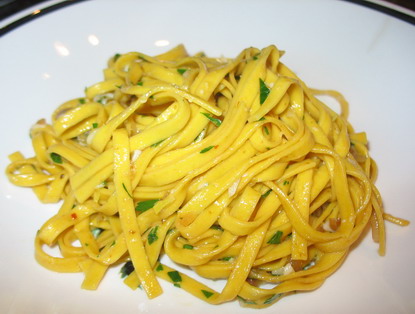
Saffron Linguine With Caramelized Onions and Gremolata
Ingredients:
1/2 cup roughly minced Italian parsley
1 large garlic clove, peeled and minced
2 tablespoons minced fresh lemon zest
2 tablespoons olive oil
1 large or 2 medium yellow onions, very thinly sliced
1/2 teaspoon crushed red pepper flakes (I used Aleppo Pepper for its mild bite)
pinch kosher salt
1/3 cup sherry or marsala wine
1 fresh small green chile–serrano or whatever type you prefer–I used a Pakistani kind I bought at the farmer’s market last year and froze–unseeded and minced
a scant 4 tablespoons butter (barely 1/4 cup)
3 tablespoons fresh lemon juice
12 ounces dried saffron linguine (Rossi is the best)
1/2 cup grated Pecorino-Romano
Method:
Put a heavy pot full of well-salted water on to boil.
Make gremolata: mix together the flat leaf parsley, the garlic and lemon zest until well combined. Set aside.
Heat olive oil on medium heat in a saute pan. Add onion, pepper flakes and pinch of salt, and saute until the onion is golden colored and wilting. Add sherry, allow alcohol to boil off and then reduce the resulting liquid until the pan is nearly dry and the onions are a deep, rich reddish brown and are beginning to break down.
Add fresh or frozen chile and saute one more minute. Take pan from heat and add butter in small pieces and swirl pan over heat while it melts to incorporate butter into onions.
Add lemon juice, stir well to combine and put burner down on granny low and keep sauce warm.
Cook the pasta according to directions–if you use Rossi Pasta, do not overcook–it cooks in about three minutes. Cook to al dente, drain, and put pasta pot back on heat. Boil off any remaning water, turn heat down to medium, add onion sauce and pasta to pot and combine, tossing with tongs. Add 2/3 of cheese and a tablespoon or two of gremolata and keep tossing over heat until pasta, sauce and cheese are all well combined.
Serve with remaining cheese and gremolata at the table for each person to sprinkle on their pasta to their taste.
I think this would be great with chicken marsala and some cooked greens–I will have to try that out and report back.
A Minor Miracle: Dad Likes Guacamole and Vegetarian Enchiladas!
You know, life hands us surprises sometimes that we do not expect. Sometimes they are unpleasant ones, but often, I have found myself on the receiving end of surprises that warm my heart, and that makes life just that much better.
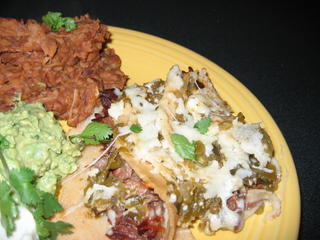
Two such surprises happened to me this past week, and I am still all warm inside because of them.
The first one happened when I asked Dad what he would like me to make for his birthday dinner, which we would bring to him, as we had to bring Morganna to Charleston anyway, to drop her off with her best friends from there so she could go to the beach with them. I expected he’d say, “Oh, a steak is great, just make me a nice ribeye.” Or maybe he’d ask for roasted lamb, something he hasn’t had in years because my Mom won’t cook it. Or fried rabbit–another favorite that Mom absolutely will not cook.
No. He asked me for Mexican food.
I blinked, and said, “Enchiladas are okay?”
And he said, “Yeah, that sounds good. It isn’t too hard is it?”
Enchiladas are an all-day event around here because I make the sauces, the sides, the fillings and the tortillas from scratch, but heck–I was so thrilled that he asked for them that I lied and said, “It is no trouble at all.” Because it is an all-day event, I seldom make them just for Morganna, Zak and I to eat, but instead make them for friends and family. That way, all of the work is well worthwhile, because we don’t end up with huge amounts of leftovers to weary the palate.
The fact that he asked for Mexican food at all was a surprise, especially in light of the fact that he said, “I haven’t eaten much of it, but what I have, I have liked.”
The big surprise came later, yesterday, in fact, when Zak, Morganna and I decended on his and Mom’s kitchen, with my tubs of sauce, fillings, refried beans and assorted ingredients, and then proceeded to take over and begin a tortilla-making production line. In addition to making the tortillas and rolling the enchiladas by hand, I also made a bowl of quacamole to go with the enchiladas, and I never expected Dad to not only watch the process from beginning to end, and ask questions about avocados. Nor did I expect it when he took a chunk of plain avocado and tasted it, and declared it, “Tasted like something I’ve eaten before, but I’ve no idea what.”
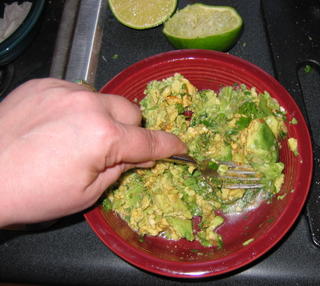
At that moment, I nearly asked him who he was and what he had done with my father, but I kept my peace, and kept mashing up avocado with fresh garlic, lime juice, chipotle, cilantro, salt and a pinch of ground cumin. He hung over my shoulder and said, “That smells awfully good.” (For a recipe for my guacamole, check out this link, from around this time last year.)
Well, by the time the enchiladas were in the oven ( I made two different pans of them–Enchiladas Colorado–red sauced enchiladas filled with shredded pork, cheese, cilantro and scallions, and a pan of Vegetarian Enchiladas Verde–the recipe for which follows shortly), he was sniffing around the kitchen declaring that everything smelled pretty good, and he sat down and waited for everything to be done.
Let me explain exactly why this abnormal behavior from my father.
First of all, he likes good food, but he is a suspicious eater at times who is reluctant to try new things. Whenever my mother attempted culinary experimentation when I was growing up, he squelched that by being very critical of any innovation that involved too much flavor. He particularly is suspicious of ethnic foods of all sorts, though he generally reserves especial vigilance against Chinese, Thai and Indian foods, mostly because they all look so strange to him that he is instantly suspicious of them all. (That, and he doesn’t like the smell and taste of bottled curry powder from the grocery store and doesn’t believe me when I tell him that Indian people don’t much care for it, either, and that is is no more Indian than I am.)
And while I have seen him eat Mexican food and like it, he is not adventurous in what he chooses to try. He likes burritos, and tacos, but everything tends toward the more Tex-Mex sorts of foods that are familiar even to folks from West Virginia. When Mom has offered him guacamole to taste from her plate in the past he has rejected it roundly with a snort of, “I ain’t eatin’ that green stuff. It looks nasty.”
Well, you could have knocked me over with a feather when we all sat down to supper last night, and not only did he taste the half teaspoon of guacamole he had put on his plate, he liked it so much, he took a heaping helping of about a quarter cup or so of it to go with the Vegetarian Enchiladas Verde he especially liked. Not only that, but he praised every last bit of dinner, which he ate with great gusto, over and over, as if he had never tasted such wonderful food, and he told me that I was right, the fresh tortillas -did- taste better than store-bought.
I am still amazed.
Apprently old dogs really -can- learn new tricks.
Over dessert, which was a lemon pound cake with raspberries that I had also made and brought along, I told him that for his 69th birthday next year, I was going to go all out and make him an Indian feast. “Allright,” he said. “If you tell me I will like Indian food, I reckon I believe you.”
Of course, the promise of a three-layer birthday cake made with white cake, lemon curd filling, and vanilla icing coated in coconut probably didn’t hurt. It is his favorite cake–Gram made it for him for his birthday every year and it was the only time they ever ate it. Of course, I have to make him one, now that I recollect that is his favorite. (And, of course, I am going to have to put some cardamom into the cake, you know, just to make it a little more special and to make it fit better with the Indian feast…..)
As for the vegetarian enchiladas verde–I am very pleased with how they worked out. I improvised the filling because I had two ears of grilled corn leftover from last week, and about a cup and a half of black beans I had cooked Cuban style sitting around. I had some chard, too, so rather than make some shredded chicken and have two meat enchiladas, I decided to make a vegetarian option. Besides, I have been in a vegetable mood–something that happens to me in the summer when it is hot and I barely want to eat. This summer eating pattern has also combined with my inability to tolerate much meat when I am pregnant to make me much more into cooking and eating dishes that are heavier in vegetables and grains than meat.
The improvised filling turned out to taste superb with my usual salsa verde with a mixture of sharp cheddar cheese and shredded Queso Quesadilla that I found at the Krogers. I will definately be making these enchiladas again and again.
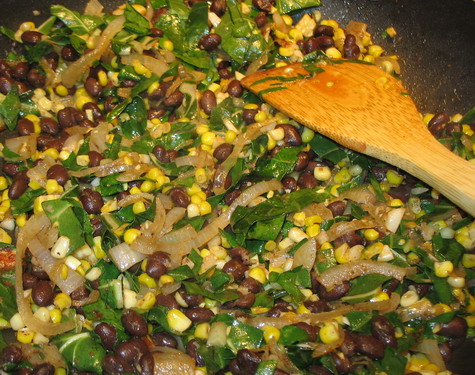
Vegetarian Enchiladas Verde
Ingredients:
2 tablespoons olive oil
1 large onion, thinly sliced
4 cloves fresh garlic, minced
pinch dried ground cumin or adobo seasoning
2 ears leftover grilled corn on the cob, or about one cup of fresh (or frozen) corn kernels (grilled corn tastes best here)
1 1/2 cups drained cooked black beans, or canned, drained black beans
2 tablespoons dry sherry
2 cups chard leaves, cut into a thin chiffonade
dried ground chipotle chile to taste (I used a very tiny bit–maybe about 1/8-1/4 teaspoon here–because my parents don’t eat a lot of hot foods; you could also use minced chipotle en adobo in whatever amount you like instead.)
salt (and pepper) to taste
1/2 teaspoon olive oil
Batch of homemade tortillas, kept warm (for recipe and instructions go here) or a package of storebought corn tortillas
Batch of enchilada verde sauce, kept warm (for recipe for both colorado and verde salsa, go here)
2 cups mixed sharp cheddar cheese and queso quesadilla
1 cup roughly chopped fresh cilantro
1 cup sliced scallions, white and green parts
Method:
Preheat oven to 375 degrees F.
Heat olive oil in a heavy bottomed skillet on medium-high heat. Add onion and saute untill soft and golden brown in color. Add garlic and pinch of cumin or adobo seasoning, and continue cooking until the garlic is softened and fragrant–about two minutes.
Add corn and beans and keep sauteeing until quite fragrant–another couple of minutes. (Cook corn longer if it is not grilled or frozen–you can saute raw corn in olive oil until it starts to caramelize–this adds extra flavor that mimics the flavor of grilled corn.) Add sherry and allow alcohol to boil off, stirring quickly.
Add chard, and chipotle, and allow chard to wilt and brighten in color, but do not cook until it dulls in color and becomes quite limp and slimy looking. Just barely cook it. Add salt and pepper to taste.
Remove from heat and allow to cool until you can handle it with bare fingers.
Use olive oil to grease a baking dish. Drizzle some sauce into the dish and use it to coat the bottom.
Dip tortillas, one at a time, in sauce coating both sides. Lay on a flat surface, and run a line of grated cheese, then the filling, with a sprinkling of cilantro and scallions on top, across the center of the tortilla. Roll into a thick cigar shape and lay it seam side down in the bottom of the pan. Repeat until pan is full, and start a new pan if you have enough tortillas, filling and sauce to keep going.
When tortillas are used up, ladle enough salsa verde over the tops of the rolled enchiladas to coat the surfaces well without making them soggy. (Use your judgement here, I trust you.) Sprinkle the tops with more of the shredded cheese, then some cilantro and scallion and bake for about 25 minutes in the preheated oven, or until everything is bubbly and melty and good.
Serve with guacamole and refried beans on the side. (Don’t used canned beans. Just don’t–they suck. I make mine from scratch–and that reminds me–I should post a recipe for them someday soon.)
News About Food
Amish Farmer Fights Ohio State Law Regarding Raw Milk
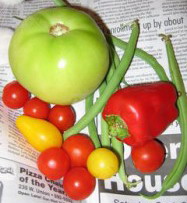
Even though Lancaster County, Pennsylvania gets all the press when it comes to the Amish folk, Holmes County, Ohio has the largest Amish community in the country situated in it. And apparently, there is a feisty Amish farmer there who has decided to take on the rather draconian Ohio state dairy laws under which it is not only illegal to sell unpasturized milk, but it is also illegal to simply give it away.
According to the AP story in the Akron Beacon Journal, the farmer, Arlie Stutzman, is claiming that the law goes against his religious beliefs because it keeps him from sharing the milk that he and his cows produce. Says Stulzman, “”While I can and I have food, I’ll share it. “Do unto others what you would have others do unto you.”
Stulzman’s liscense to sell butter and cheese was revoked after an undercover agent in a very nearly unheard-of “milk sting” paid him $2.00 for a jug of raw milk. The state later reinstated the liscense, but Ohio Department of Agriculture regulators want the judge to specifically state that Stulzman may never sell or give away raw milk again.
An interesting case. What I cannot help but think is that Stulzman sold that jug of milk for too little money. I mean, if you are going to get hauled into court over it, why not charge more?
I am on the fence with this issue. While I generally think that if people want to buy raw milk, they should be able to, the laws on pasteurization were put into place for a very good reason–to protect the consumers from tuberculosis and other infectious diseases which could be spread through tainted milk.
However, at this point, I suspect that the laws are enforced not so much to protect the consumer (if that were the case, we might actually have some regulations in place and enforced that protected us more effectively from e coli and BSE in our beef supply) but rather, to protect the large dairy industry which doesn’t want competition from smaller producers.
But, I admit–I could just be cynical about it.
FWIW–I bet Stulzman never expected to see his story in newspapers across the world, but it is. This AP story has gone far and wide appearing in the UK and South Africa, as well as in the New York Times.
Keep up the good fight, Arlie.
The Ethics of Eating Lobster and Foie Gras
New York Times restaurant critic Frank Bruni and Michael Pollan weigh in on the issue of Whole Foods refusing to sell live lobsters and the current bans on foie gras in communities across the US in light of the ethical considerations of eating both luxury food items.
Not surprisingly, Pollan points out that the plight of lobsters and the birds force fed to produce foie gras is nothing compared to the suffering that happens in a feedlot to produce the millions of pounds of meat that most Americans eat.
“Foie gras and lobster are not at the heart of the real tough issues of animal welfare, which are feed lots and pigs and cattle and chickens and how billions of animals are treated,” said Michael Pollan, author of “The Omnivore’s Dilemma,” which traces the messy back stories of our meals. “On the other hand, the fact that we’re having this conversation at all — that we’re talking about ethics in relation to what we’re eating every day — strikes me as a very healthy thing,” he said last week.”
Bruni wonders if the reason that lobster and foie gras have been targeted is because they are both luxury items that very few Americans can afford to eat regularly anyway.
Even though I agree with Pollan’s point that worrying about lobsters and force-fed waterfowl is silly when compared with the huge amount of suffering that pigs, cows and chickens undergow in the clutches of the industrial model of agriculture, I agree even more heartily with his view that it is a good sign that Americans are willing to start talking about the ethics of eating.
Even if they seem to be going about it bass-akwards.
Whole Grain Baking Gets a Facelift
For those who hate whole wheat bread because it is heavy, cardboardy with a bitter, acrid flavor, there is hope on the horizon.
This fall, King Arthur Flour is coming out with a new book on baking with whole grains that should prove to be an interesting addition to the cookbook collections of those of us who want to eat more whole grains without sacrificing taste in our baked goods.
According to an article in the Boston Globe, the road to publication for the simply titled Whole Grain Baking was a long and winding one that required much work, creativity and experimentation in the test kitchens of the King Arthur Bakery. Co-author Susan Reid and the others who worked on the cookbook focused on contradicting the stereotypes of whole grain baking. “I call it punishment food,” Reid says. “You know, all those hippie nasty desserts that people remember from Mom’s days in the ’60s.”
Instead, the authors promise to present delectable desserts and breads, like the one pictured on the cover of the book: a raspberry-lemon layer cake baked with whole wheat pastry flour and iced with lemon buttercream.
I’m hooked already, and am waiting impatiently for the book to come out this fall. (Of course, by then, I will probably have a newborn either on the way or present and accounted for, so the last thing I will want to be doing is baking cakes, but–I can look at the recipes and pictures and dream, can’t it?)
The Locavore’s Bookshelf: The Omnivore’s Dilemma
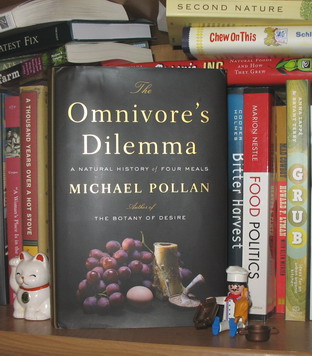
Everyone is reading Michael Pollan’s The Omnivore’s Dilemma: A Naturaly History of Four Meals, and talking about it.
And, everywhere you go in the media, Michael Pollan is there, talking about the ethics of eating.
It seems that I cannot open a newspaper, magazine or look at a blog without Pollan’s name, book, byline or photograph jumping up at me.
Which is fine, because I think it is great that The Omnivore’s Dilemma has taken off like this; the US agribusiness industry has needed a metaphorical “shot across their bow” from an eloquent ethicist for a long time now, and I am happy to see that Pollan has managed that verbal barrage as gracefully and as enthusiastically as he has.
The fact that there are news stories and radio interviews and sections of Time Magazine devoted to the issue of where our food comes from, and how it is treated before it gets to us has started a public dialogue that is long overdue; Americans for years have not known what went into the food supply, and have, in my opinion, sorely needed to know. Most people do not like the idea of animals suffering, and while -I- have known for years what the horrors of a feedlot and slaughterhouse are, and what risks they pose to public and environmental health, I also know that I am a weirdo who has been reading up on the subject via non-popular literature and research for years. My reading has led me to giving up on feedlot meat entirely -years ago- in favor of locally raised, pastured meats,.
What thrills me about the popularity of Pollan and his book is that he is bringing what I have known about for since, like, ever, to the populace at large, and doing it in a way that keeps the readers interested and fascinated while still pummelling their brains with fact upon fact upon fact, all written with wit and style to spare.
But, Barbara, what did you think of the book itself?
Well, it’s like this.
Pollan presented very little new information to me in the form of raw facts. As I said, I have been reading up on this stuff and doing research on it for, oh, twenty-something odd years. Yeah, I -am- obsessed. But, even with my twenty-year-old obsession, Pollan -still- managed to present some gemlike facts I had not run across before, and those gleamed like beacons and were squirrelled away into my mind to be hoarded along with my other facts, ready for the next argument I get into over industrialized farming.
However, while the information itself wasn’t news to me–it didn’t matter. I still stayed rivetted to every page, fascinated with the way that Pollan wove all of that information into a narrative that managed to be both factual and personal, interesting and compelling, while still conveying a great deal of raw data. He can manage to write about some of the most dry facts in the world and make them fascinating reading. I swear, he could compose a grocery list that was fun to read.
And while I found his chapters on corn got to be a bit long and somewhat dry, he made up for it in his later chapters about Joel Salatin’s Polyface Farm and his experiences hunting for mushrooms and wild boar out in Northern California. Here, Pollan’s “let’s make it personal and tell a story” style of reporting really shone, and it was great fun to follow him on his adventures as he lived and worked on a farm, and tramped through the woods. I especially enjoyed the passages where Pollan described how it felt to take part in butchering chickens (my least favorite animal to butcher, frankly) and to shoot and field dress a wild boar. (Yes, the insides of pigs smell bad.)
I really appreciated his insights as a city person, stretching himself and his personal boundaries as he sought to experience three meals fully: one taken from the industrialized farms that provides the majority of American food, one from a sustainable-agriculture grass-based farm, and one gleaned from the wild through hunting and foraging. His inner monologue as he went through these experiences and recorded them, and his thoughts and feelings were instructive, illustrative, and just damned funny, too.
So, yes–I really liked the book, and I highly recommend that everyone should read it, whether you are interested in eating locally or not.
Because, frankly, if you are not interested in it before you read it–I have a feeling you will be -after- you read it.
In An Experimental Mood: Blueberry Muffins
Summer fruits tend to inspire a flurry of baking at my house.
Now that I am pregnant, they inspire not only a flurry of baking, but a flurry of grazing, as cold, simple breakfasts such as plain fruit is about all I can handle in the summer heat. (I went out to the farmers market today, and nearly fainted from the heat by the time I got home; I have been inside ever since.)
But along with this summer’s large amount of baking and grazing, comes a desire to experiment.
I have a recipe for blueberry muffins from Cook’s Illustrated that I have been wanting to try, because, as you know, it is “The Best” blueberry muffin recipe, ever, because, well, the editors and authors of the magazine say it is. But, in point of fact, the recipe sounded pretty tasty, though I have to admit to being somewhat dismayed by the amount of fat present in the muffins: the recipe includes an egg, four tablespoons of melted butter and ten ounces of sour cream, along with, in my opinion, not enough blueberries (1 1/2 cups).
I wondered if I could boost the health profile of the muffins a wee bit by subbing some of the sour cream with Greek-style yogurt, and by substituting half of the all-purpose flour with some of King Arthur Flour’s White Whole Wheat Flour. And, of course, by using freshly picked organic berries, and more of them, because, dammit–there needed to be more.
And while I was at it, I decided to try out one of my newest kitchen gadgety things–Sur la Table’s Silicups.
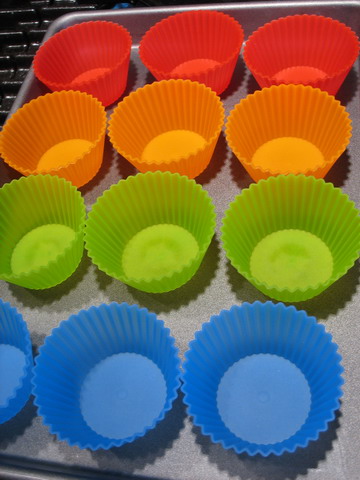
Silicups, for all that they sound like “Sillycups” are not silly, but quite ingenious: they are silicone muffin cups that are not only reusable, but which will release from the muffins without the use of extra grease, butter or other lubricant. They also come in rainbow-brilliant colors (and pastels, if you are into those, which I am -not-), are simple to wash (dishwasher safe) and don’t require you to use a muffin pan with them. They can just sit on a cookie sheet happily.
I bought the silicups a while back, but hadn’t yet gotten around to baking with them, because I really prefer muffins to cupcakes. Cupcakes–well, maybe when our Kat is in school and needs to take a treat for her birthday, I might make cupcakes, but really, until then, probably not. No one in our household much cares for them, really. They can dry out easily, and often they are more trouble to make than a single large cake. So, the silicups had to wait until I had fresh fruit and the yen for muffins.
How did they work?
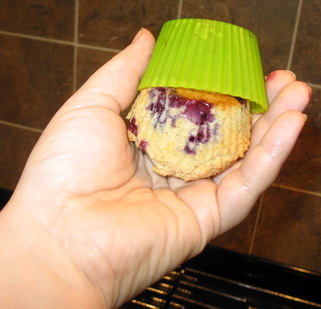
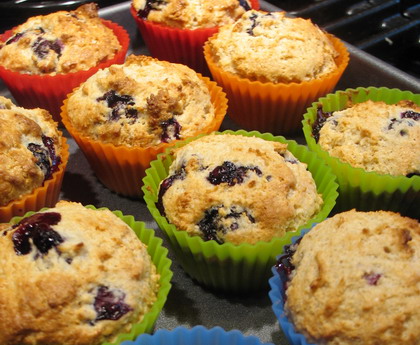
You can see for yourself that the silicone releases perfectly as advertised–all I had to do to get the muffins to drop out of the cups was invert them and give a wee squeeze to the outside edges, and pop! The muffin would drop into my waiting hand without any difficulty whatsoever. I suppose that I could have left them in the cups for serving–the bright colors are cheery and pretty, but I -had- to see if the muffins really did come out as easily as advertised.
As for the recipe–how was it?
Well, never having made the original as written, I cannot speak for it from experience, but my thought is that it was probably a little bland. All of the flavoring items–the spices and lemon zest–were my own additions. And to my taste, they really added a lot to the recipe. As for the white whole wheat flour–you could not detect it at all. It completely lacks the slight bitter edge to the flavor that typical whole wheat flour has. The muffins turned out to be quite tender as well. The next time I make this recipe, I may replace 75% of the flour with the white whole wheat and see what happens, but I suspect that I will be using this flour often in my future baking.
As for the sour cream and yogurt–the next time, I will use all yogurt. As it turned out, I couldn’t replace the 50% of the sour cream in the recipe with yogurt–I ran out of yogurt–but I think that with the thicker Greek style yogurt, there will be very little sacrifice in texture and flavor by using it instead of the sour cream. I ended up also subbing half the sugar required in the recipe with raw sugar; next time, I will use all raw sugar and in fact, probably reduce the amount of sugar somewhat. I don’t think it is necessary. (The dipping of the finished muffins in butter and then in sugar and cinnamon is a nice touch–I liked the crunchy topping, but the raw sugar made the muffins less pretty than they would have been had I used white sugar.)
And the fruit? Well, the original recipe called for frozen fruit–probably so it could be made year-round–and called specifically for wild blueberries. I used fresh, locally grown cultivated berries, and I added an extra 1/4 cup of them to the batter, which I determined was strong and thick enough to hold more fruit.
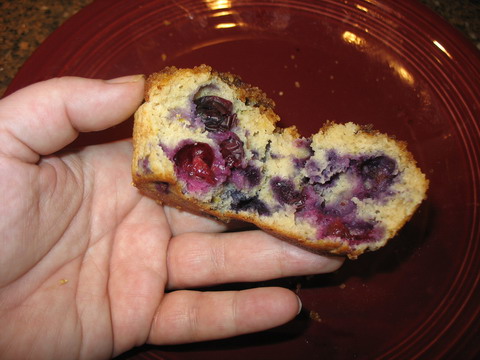
As you can see–the muffins turned out to be loaded with fruit–and in my universe, where muffins are primarily about fruit, that is an excellent and beautiful thing.
The only other thing I can think of that would improve these muffins would be to use a mixture of different berries instead of just blueberries. Imagine strawberries, raspberries, blueberries and sour cherries, for example. Or maybe just a mixture of sweet and sour cherries. Ooh. Maybe I will make some of those for tomorrow morning’s breakfast.
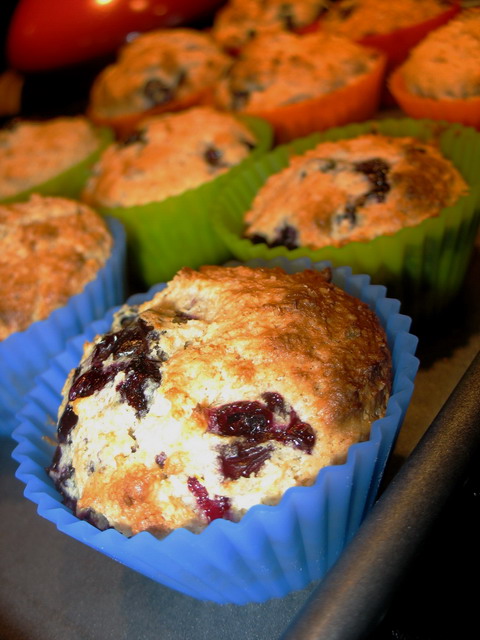
Blueberry Muffins with Cinnamon-Sugar Topping
Ingredients:
1 cup all purpose flour
1 cup white whole wheat flour
1 tablespoon baking powder
1/4 teaspoon ground ginger
1/4 teaspoon ground cardamom
1/8 teaspoon cinnamon
zest of one lemon
1/2 teaspoon salt
1 large egg
1/2 cup sugar
1/2 cup raw sugar
4 tablespoons butter, melted and slightly cooled
3/4 cup sour cream
1/2 cup Greek-style yogurt
1 3/4 cups fresh blueberries, rinsed and thoroughly dried
1/4 cup raw sugar
1/4 teaspoon cinnamon
3 tablespoons melted butter
Method:
Preheat oven to 350 degrees F. Line up silicups on baking sheet, or spray standard muffin tin with nonstick baking spray.
Whisk together dry ingredients, including lemon zest in a very large bowl.
In another bowl, whisk egg until well beaten. Add sugar and whisk well until thick and well combined–about thirty seconds. Add melted butter in two or three additions, whisking well between. Add sour cream and yogurt and whisk until well combined. Do not overbeat once sour cream and yogurt are added.
Add berries to dry ingredients and toss to combine. Fold in sour cream mixture until batter comes well together. The batter will be very thick–do not beat or overmix.
Use an ice cream scoop to portion batter into silicups or muffin tin. (The silicups are probably smaller than the muffin tin cups–you will have enough dough left over if you use silicups to bake in a mini loaf pan.)
Bake until light golden brown and toothpick inserted into center of muffin comes out clean–about 25 minutes. (With a convection oven like mine–it will take between 15 and 20 minutes.)
Allow muffins to cool five minutes, then release from cups or pan. While cooling, mix together the sugar and cinnamon. Dip tops of still warm muffins in butter, and then in the sugar and cinnamon mixture, then allow to cool on a wire rack until just barely warm.

Categories:
- Admin (rss) (55)
- Blogs and Blogging (rss) (81)
- Book Reviews: Cookbooks (rss) (43)
- Book Reviews: Non-Cookbook Food Books (rss) (38)
- Cats and Cat Blogging (rss) (47)
- Chinese Cooking Lessons (rss) (32)
- Culinary School Stories (rss) (18)
- Dairy Pruducts: Cultured and Barbaric (rss) (4)
- Documentary Filmmaking (rss) (1)
- Essays, Rants and Reflections (rss) (260)
- Fighting Hunger (rss) (12)
- Food and Kids (rss) (45)
- Food in the News (rss) (126)
- Food Media (rss) (98)
- Food Preservation (rss) (18)
- Food Safety (rss) (45)
- Gardening (rss) (30)
- Herbs and Herb Blogging (rss) (20)
- Holidays (rss) (50)
- Kat Blogging (rss) (22)
- Kitchen Science (rss) (36)
- Leftover Makeover (rss) (8)
- Life, the Universe and Everything (rss) (131)
- Local and Sustainable (rss) (227)
- Local Athens Food and Foodies (rss) (42)
- Meatless Mondays (rss) (32)
- Menu For Hope (rss) (5)
- Nutrition, Diet and Health (rss) (84)
- On The Farm (rss) (8)
- Recipes: Almost Vegetarian, Vegetarian and Vegan (rss) (294)
- Recipes: American Regional (rss) (37)
- Recipes: Appalachian Hillbilly (rss) (33)
- Recipes: Bread, Pasta, Grains (rss) (95)
- Recipes: Canning and Preserving (rss) (8)
- Recipes: Chinese (rss) (123)
- Recipes: Comfort Food (rss) (120)
- Recipes: Cookies (rss) (16)
- Recipes: Desserts (rss) (48)
- Recipes: French (rss) (25)
- Recipes: Fruits and Vegetables (rss) (302)
- Recipes: Greek, North African and Middle Eastern (rss) (31)
- Recipes: Indian (rss) (137)
- Recipes: Italian (rss) (42)
- Recipes: Japanese (rss) (7)
- Recipes: Jewish (rss) (4)
- Recipes: Korean (rss) (6)
- Recipes: Meat, Poultry and Fish (rss) (220)
- Recipes: Mexican/Native American/ Latin American/Caribb (rss) (27)
- Recipes: Original (rss) (108)
- Recipes: Thai (rss) (27)
- Recipes: Tofu (rss) (17)
- Recipes: US Regional (rss) (16)
- Recipes: Vietnamese (rss) (8)
- Restaurant Stories (rss) (28)
- Sewing, Quilting, Arts and Crafts (rss) (16)
- Simple Chinese Recipes (rss) (30)
- Slow Food and Heritage Foods (rss) (10)
- Spice Blogging (rss) (44)
- The Chinese Cookbook Project (rss) (14)
- The Chinese Pantry (rss) (39)
- The Documentary (rss) (2)
- The Kitchen Saga (rss) (17)
- The Locavore's Bookshelf (rss) (15)
- The Unsung Adventures of The Culinary Nerd (rss) (6)
- Tools and Toys (rss) (35)
- Uncategorized (rss) (10)
- With a Side of Politics (rss) (48)
Archives:
- August 2012 (9)
- July 2012 (12)
- September 2011 (3)
- August 2011 (7)
- July 2011 (8)
- June 2011 (16)
- May 2011 (17)
- April 2011 (11)
- December 2010 (9)
- November 2010 (5)
- February 2010 (1)
- December 2009 (5)
- November 2009 (7)
- October 2009 (10)
- September 2009 (16)
- August 2009 (14)
- July 2009 (14)
- June 2009 (7)
- May 2009 (17)
- April 2009 (10)
- March 2009 (25)
- February 2009 (13)
- January 2009 (10)
- December 2008 (5)
- November 2008 (5)
- October 2008 (6)
- September 2008 (13)
- August 2008 (8)
- July 2008 (11)
- June 2008 (18)
- May 2008 (13)
- April 2008 (14)
- March 2008 (16)
- February 2008 (17)
- January 2008 (19)
- December 2007 (25)
- November 2007 (18)
- October 2007 (24)
- September 2007 (16)
- August 2007 (15)
- July 2007 (15)
- June 2007 (10)
- May 2007 (14)
- April 2007 (16)
- March 2007 (17)
- February 2007 (20)
- January 2007 (13)
- November 2006 (1)
- October 2006 (8)
- September 2006 (14)
- August 2006 (25)
- July 2006 (30)
- June 2006 (28)
- May 2006 (34)
- April 2006 (29)
- March 2006 (24)
- February 2006 (30)
- January 2006 (38)
- December 2005 (40)
- November 2005 (37)
- October 2005 (32)
- September 2005 (25)
- August 2005 (30)
- July 2005 (28)
- June 2005 (21)
- May 2005 (8)
- April 2005 (22)
- March 2005 (17)
- February 2005 (29)
- January 2005 (10)
Search Site:
Links:
- Lily’s Wai Sek Hong
- 101 Cookbooks
- A cat in the kitchen
- A Veggie Venture
- Accidental Hedonist
- Cha Xiu Bao
- chez pim
- Chocolate & Zucchini
- Chopstick Cinema
- Chowhound.com
- Chubby Hubby
- Cook sister!
- Cooking with Amy
- da*xiang
- Eat Local Challenge
- Eating Liberally
- Ecocentric
- Eggbeater
- Epicurious
- Farmgirl Fare
- Fatfree Vegan
- Foodgoat
- ForkandBottle.com
- Green Olive Tree
- Hooked on Heat
- Jaden’s Steamy Kitchen
- Kalyn’s Kitchen
- Lucullian delights
- Mahanandi
- Matt Bites
- MeatHenge
- mmm-yoso!!!
- New York Times – Dining & Wine
- Pizza Goon
- Rasa Malaysia
- Ruhlman
- Sailu's Kitchen
- Serious Eats
- SF Gate: Food & Dining
- Simply Recipes
- Soul Fusion Kitchen
- Tastespotting
- The Amateur Gourmet
- The Cleaner Plate Club
- The Food Section
- The Grub Report
- thecookscottage
- U.S. Food Policy
- Wandering Chopsticks
- Washington Post Food and Dining
- Wasted Food
Meta:


Powered by WordPress. Graphics by Zak Kramer.
Design update by Daniel Trout.
Entries and comments feeds.