
Cook Local, Eat Global
Coming Home To Eat: Cooking For Myself and My Family
As most readers are aware, we were away for most of last week, visiting Washington DC. We went primarily to view the exhibition of the works of Hokusai at the Sackler Gallery at the Smithsonian, but we also ended up wandering around to many of the other museums, including the new Museum of the American Indian.
We had a great time, and we did eat a lot of really good food; we primarily ate at all of our favorite haunts from when we lived in Columbia, Maryland about four years ago. We ate the superlative Indian food of Akbar, we had king crab rolls to die for at Sushi King, and in Baltimore, we ate crab at The Backfin, and some damned fine kebabs and naan at Kebab Hut in Towson.
But somewhere around the fifth day, I found my palate growing weary, and all I wanted to do was come home and cook.
That is when I realized how used to cooking for us I had become. It is also, after all of the waiters at our favorite restaurants -remembered us- that I understood how much we had eaten out when we lived in Maryland. For one thing, we both worked long hours there, and I was busy cooking for lots of other people, and for another thing–it was easy. There was so much superlative food around us, that it was no hardship to go out for dinner a couple or three nights a week.
And the food at those restaurants was still just as wonderful as we remembered it, but…my palate grew weary of it very quickly.
I just wanted a plate of something simple. Some rice and stir fry maybe. Or some pasta.
Sunday as Morganna and I cruised the aisles at the grocery store, shopping for the chicken, greens and pasta in lemon cream sauce, she spontaneously hugged me and said, “I am sure glad we’re home and you can cook dinner again. I missed your food.”
So, that is what I have been doing since I have been back. Cooking, cheerfully, and with great joy, because I know that no matter how far we wander and what wonders we ingest while we are gone–it is the food from my kitchen that calls us home every time.
Since I have been back, I have been craving pasta and vegetables something fierce. I get this way at the end of winter, when the season argues with spring over who will have sway over the world. The sun shines and the breezes are warm one day, and the next, the sky is grey and snow spits from pendulous clouds.
At times like this, I succumb to the temptation of organic produce from California. I try not to–I try to eat local, but I saw those eggplants and they called to me. With a vengeance, they called, and before I could say, “sustainable,” they were in a plastic bag and in my cart.
Oh, well. We are not all perfect.
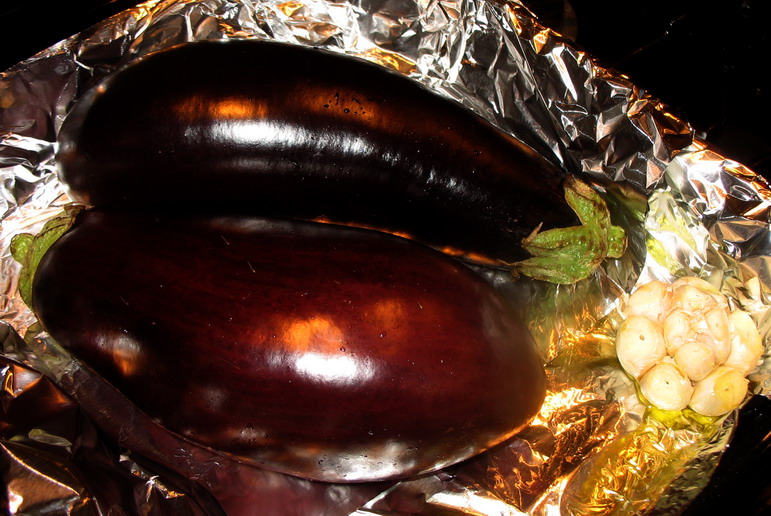
I was thinking of making baba ganoush, but I still wanted pasta. I had glanced at a book that I hadn’t opened for years, The Top One Hundred Pasta Sauces, by Diane Seed, to check the proportions to the lemon cream sauce (which I changed utterly–2 cups of heavy cream is way too much) and my eyes had lit upon a pasta sauce that featured roasted eggplant and walnuts: “Spaghetti con Melanzane e Noci.”
The author stated that the recipe was from Sicily, which is where eggplants first were grown in Italy. They were brought there by the Arabs who controlled that island for centuries, and as I read the recipe, I noted a certain similarity in the ingredients and techniques to the foods of the Middle East.It consisted of the mashed flesh of roasted eggplants, finely chopped walnuts, the mashed yolks of boiled eggs, olive oil, salt and pepper and a quantity of simple Italian tomato sauce.
The use of the egg yolks to enrich the dish did not appeal to me; I decided to use a very small amount of cream instead–about one third of a cup. I also decided that since I was going to be roasting the eggplant anyway, I would roast a head of garlic at the same time and blend the mashed garlic cloves into the pulp of the eggplant. (My mind was still on baba ganoush, I think.)
And, I had some homemade marinara sauce in the freezer that I could use for the tomato sauce, so I thought I was good to go.
And I was.
The roasting eggplant and garlic smelled divine–sweet and haunting, with just a tinge of smokiness from the skins of the eggplant.
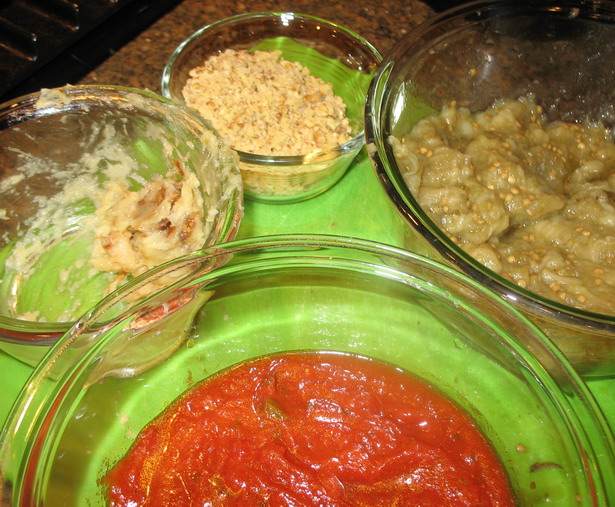
The marinara I already knew was good, because I had made it at the peak of tomato season last year, when the romas were plentiful and filled with the ripe sunwarmed juice and flesh that make the best sauces in the world. I thawed it out and set aside about a cup and a half of it into a bowl to go into the sauce, while I minced up the walnuts which I had previously toasted in the oven. These had a dark golden scent, redolent of the woodlands in autumn.
The sauce was simple to put together once the garlic and eggplants were roasted, a process which took about thirty-five minutes.
I let them cool, then cut the eggplants in half and scraped the flesh into a bowl, squashing it into a good thick puree by hand with a potato masher. The garlic cloves were similarly treated, though I used the back of a teaspoon to get at them–a potato masher would have been overkill. I noted when I looked at the eggplant and garlic that without the tomato sauce, the color of the dish would be a rather grotesque grey green–not attractive at all, but I hoped that the addition of the brilliant red tomato would not render the end result a muddy brown.
I need not have worried.
The process was simple: I heated up olive oil, and dumped the eggplant and garlic purees together with the walnuts into a saute pan, and stirred to combine them. They bubbled merrily as I let the excess water escape the eggplant pulp. After most of the water was gone, I added the marinara sauce, and stirred it in; the color changed from greenish grey to a dark rose color. With the addition of cream, it became a soft brick red color, and thickened to a wonderfully dense, clingy sauce.
I tasted it, and corrected the seasoning with salt and pepper, but found the flavor to still be somewhat flat.
Harkening back to the Arabic roots of the dish, and remembering the effect that pomegranate molasses had on my baba ganoush the summer before, I ran to the cupboard, dug out the bottle and added a teaspoon.
It was perfect. It added a smoky, tangy zing that finished the sauce and make it soar.
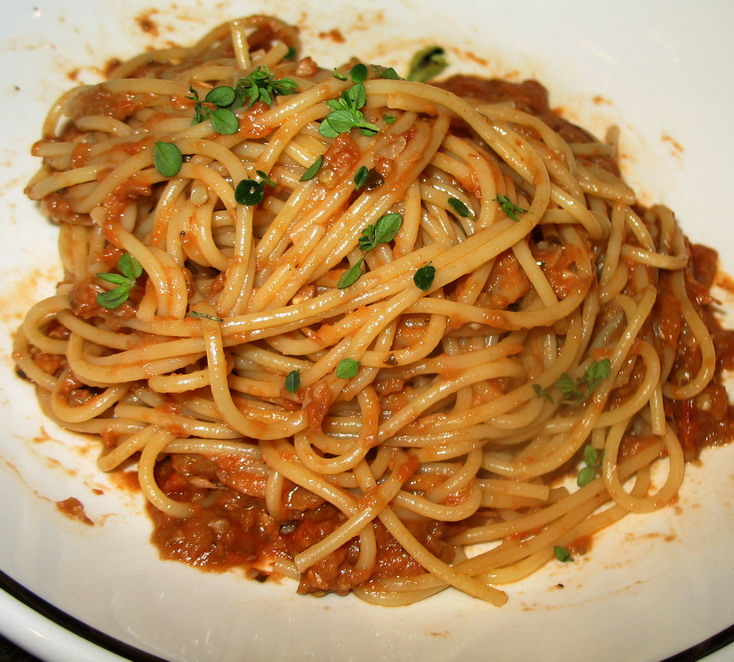
A small amount of the sauce tossed and twirled in with hot, al dente spaghetti was a revelation. Garlicy-rich, and filled with the creamy goodness of eggplant, the dish was both simple and complex. The walnuts added a bit of crunch to it, and their dark flavor supported the eggplant perfectly, while the pomegranate molasses melded with the tomato sauce into a fruity-tangy note that just made me want to weep, because it tasted just like summer.
I can’t wait to make this again when eggplants and tomatoes are in season, that is all I have to say!
Spaghetti With Creamed Eggplants and Walnuts
Ingredients:
2 large eggplants, roasted, the flesh scraped out and mashed (enough to make about 2 cups of roasted eggplant pulp)
1 head garlic, roasted and mashed
1 tablespoon olive oil
scant 1/2 cup finely chopped toasted walnuts
1 1/2 cups homemade marinara sauce
1/3 cup heavy cream
1 teaspoon pomegranate molasses
salt and pepper to taste
fresh herbs for garnish (I used lemon thyme leaves–minced basil or Italian parsley would be very good, too. Or mint….)
Method:
Mix together the eggplant puree with the mashed garlic cloves.
Heat olive oil in a saute pan over medium heat and add eggplant mixture. Stirring constantly, allow to start to bubble. Stir in walnuts and continue cooking, until the eggplant dries out somewhat–about four to five minutes.
Add marinara sauce, and stir well, and allow to reduce slightly. About a minute.
Stir in cream, and pomegranate molasses, then salt and pepper to taste.
Toss well with spaghetti–this sauce is very thick and concentrated, so you may need a bit of the pasta cooking water to thin it slightly. There is enough in this recipe to dress about a pound of spaghetti.
Sprinkle with fresh herbs as a garnish before serving.
Note: Grated cheese does not traditionally go with this dish. I don’t think it would taste right, so I didn’t even think to try it. Serves four for a main course, six for a pasta course.
Are You a Good Foodie, Or a Bad Foodie?
So, I was cruising through Slashfood this morning and came upon this post by Sarah Gim entitled, “You can’t be a foodie and not like…”, and it got me to thinking. (Gim references a post at Matt Bites, which I hadn’t read yesterday, but which I read today, which also is lively and interesting–I both agree and disagree with his points.)

The whole premise of the post is that Gim doesn’t really like caviar, foie gras or organ meats, and so, does she deserve to be called a foodie?
Of course, this calls into question exactly what a “foodie” is; Gim like me, dislikes the term intensely, but uses it anyway for lack of a better word to describe a lover of food and of culture and material related to food. “Gourmet” used to cover that area, but it got ditched because of the inevitable aura of snobbery attached to its useage; now, inevitably, the diminutitve, dismissive term, “foodie” is acrueing connotations of snobbishness.
So, the question for today is this: can you be a foodie if you don’t like things like caviar, foie gras or innards? Does aversion, based either upon ethical or personal aesthetics exclude a person from the “foodie” club?
Before I go into my answer, let us look at the three foods chosen by Gim to make her point–three things that she personally dislikes intensely. Caviar and foie gras both are luxury foods. They are foods that have a cultural meaning attached to them that bespeaks richness, wealth, and indulgence. They are not, by any stretch of the imagination, everyday foods–even for rich folks.
By contrast, innards, or as she more delicately put it, “other animal internal organs,” while they can be part of the culture of “haute cuisine” meaning the food of the upper classes in various European and Asian countries (note–I am not using “haute cuisine” in the most proper, French useage of the term–yes, I know what it means in that context, but bear with me), in the US, they are most often looked upon as “poor people’s food.” Tripe, tongue, chittlin’s liver and onions and kidneys all are considered to be the foods of the lower socio-economic classes in this country, because, well, organ meats are cheap. And plentiful, because not very darned many people here eat them.
These two very different categories of food–the luxury foods of the very rich, and the necessity foods of the very poor are odd company, if you think about it. I grew up eating liver and such, and not much caring for it, but I ate it because it was cheap, it was what was for dinner and it was good for me. I certainly would never have dreamed that being able to eat and even like such things would put someone on the level of a gourmet who dined on caviar and foie gras. (Though, of course, foie gras is just fancy bird liver….)
Why are these things grouped together, first of all?
I suspect it has to do with two strands of thought. One, is the populist leanings of today’s foodies who want to be conversant with every ethnic food in the entire world, and so they will go out of their way to eat whatever is on the menu, including tongue tacos (which I am sure are quite good–tongue has a great flavor), soy-braised chicken feet (those are good), and uni, which is the uncooked gonads of sea urchins, eaten as sushi (which, when it is good, is good, but when it is bad, is godawful.) I have a lot of sympathy with this adventurous attitude toward food, in large part, because it is one that I personally share. I will try anything once, often twice, just to make sure. There are a few exceptions to this general rule, however–I will not eat grey matter because of my nervousness surrounding prion diseases. Sorry–the idea of my brain turning into a lacy network of holes while I lose my mind and die does put a bit of a damper on my culinary inquisitiveness, so no cow brains for me, thank you.
The other strand of thought on the organ meats has to do with the longstanding traditions of eating these meats extent in other countries around the world. These meats are seeing an upsurge in popularity right now among the fooderati, with chefs such as Fergus Henderson leading the charge, and so in order to seem sophisticated, a foodie “should” evince a liking for such foods as sweetbreads, brains or kidneys.
And here is where the whole thing starts to stick in my craw.
As soon as someone starts telling me I “should” do something or like something or want something or be something, I instantly dig my heels in and shake my head.
Why -should- anyone be required to eat and like something that they don’t like, just so they can be called something that sounds foolish, like “foodie?” It doesn’t make any sense.
And as for caviar, foie gras and other luxury foods like truffles–does one have to be a monied individual in order to be a “true” foodie?
I mean–are we snobs, or aren’t we?
Are we going to eat what the Italians call “cucina povera–” which translates as “poor food–” which is what they call the offal dishes in recognition of the true provenance of these now upscale foods, or are we going to eat that which is considered the “creme de la creme” of eating–the haute cuisine of the past ages? And how exactly, does the eating of these foods confer upon a person “foodiehood?”
Here’s the deal: it doesn’t.
Food does not a foodie make.
A foodie simply exists, and spends inordinant amounts of time cooking, eating, or thinking about, writing about, dreaming about or otherwise obsessing over food. What food they cook, eat, think about, write about and dream about is immaterial. It is the obsession that makes a foodie, not what exactly they obsess over.
I am an inclusionist, not an exclusionist. I don’t like people who try to exclude others, as if being a food-obsessed geek is some kind of special club that only “certain people” can join.
I have news for these people: everybody eats.
And if you think about what you eat, if you talk about it, wonder about it, dream about it, write about it, compose music inspired by it, make art to express your feelings about it, if you wake up from a dream about the cake your Grandma made for your fifth birthday which you haven’t tasted for years–guess what?
Not only are you human, you are most likely a foodie.
Not a snob.
A foodie.
(And yeah, I still hate that word. It is a diminutive that sounds dismissive and goofy. Rather like “trekkie,” another word that has been used to describe me which I abhor. However, the word, “foodie” is applicable, so I will bear it for now.)
Making up “rules” for foodism is just, well, it is plain old silly. And it is -so- utterly snobby. To say things like, “if you were a true foodie, you would like caviar,” is just so full of bunk. My grandmothers would both qualify as foodies, and neither of them ever tasted caviar, because they couldn’t afford it. And frankly, I don’t think that either of them would like it, but I tell you what–they both could wax poetic over what constituted the best tomato in the world. They both were passionate about growing tomatoes, and cooking and eating, and a good bit of the talk that went on in their kitchens was not only storytelling and gossip, but discussions and arguments over food–that, to me, qualifies them both as foodies.
If you sit at dinner, and discuss the finer points of what you are eating and compare it to other versions of that same food you have eaten in the past, you are a foodie. It doesn’t matter if you are talking about pate de foie gras or chopped chicken liver. Or boudin blanc or hot dogs–if you talk argue about it with your family, y’all are a bunch of foodies.
You may not know it, but you are.
This whole idea of having to like certain things in order to be a foodie is just backwards, too.
I mean, I thought that foodies, in order to discuss food intelligently, had to have discernment. That means that they have to have personal -tastes-. Tastes are nothing but personal likes and dislikes. If we are going to think, talk and write critically about food, then should we not develop our powers of discernment? Shouldn’t we feel free to say that we like or dislike some food, no matter what the prevailing opinion of the fooderati are on the subject?
Meaning, if we have honestly tried caviar and found that it tastes like salty, oily, fishy little nodules, then, isn’t that our opinion, and should we not have the right to express it?
Because, here is the thing–I have had the opportunity, because I went to culinary arts school, to taste the finest caviar. And I did. And I didn’t like it, not even the stuff that retailed at something ungodly like $500.00 an ounce. I found it to be heavy, oily, and way too salty. I didn’t think it was nasty or anything, but I couldn’t see why people went on about the stuff–it was just, well, not all that.
What I did like was salmon roe, which was no big shock to me, because I eat it with sushi all the time. I cleaned that up at seven in the morning on the day of our tasting. The chef instructor thought I was nuts, and finally said that I must have “plebian tastes.” Chef Aukstolis, who had been present at the champagne tasting the night before and had seen me sipping the Dom Perignon heartily and with great glee, disagreed and said, “Nobody who likes Dom Perignon has plebian tastes; she just knows what she likes and doesn’t like. There is nothing wrong with that.”
There you have it. There is nothing wrong with having your own taste, your own opinion about food and expressing same.
Not everyone likes the same things. That is fine–that is what makes life so interesting, the varied cuisines of the world so diverse, and it gives foodies lots of things to talk about and argue over.
What I think is important to do as foodies is to be open-minded about food. To try new things, even if we think we won’t like them, and to honestly report upon our experiences so that others can profit by them. In being open-minded about food, I want foodies to really -think- about what we eat, why we eat it, and how we eat it. I want us to be mindful eaters, and spread the word, and get others to be mindful.
We are what we eat, after all, whether we are eating caviar or tofu, and I want us all to remember that, and ponder it, and find the meaning it.
And then share it.
Because there is nothing better than sharing food, unless it is sharing the idea of food with others.
IMBB 24: Made It In 30 Minutes
When the Too Many Chefs threw down the gauntlet for this month’s IMBB, I couldn’t help but take up the challenge.
Cook a meal, with as much of it being from scratch as possible, within thirty minutes, a la Rachael Ray.
One of the charges book reviewers often level at Ray’s cookbooks is that they cannot manage to make the recipes within thirty minutes as promised. I think that is partly because people are not used to cooking efficiently. It isn’t that hard to put a meal on the table that is decent and doesn’t include convenience foods, so long as the cook is in good practice with kitchen prep, understands the necessity of organization and is endowed with a good sense of timing.
All of these things require practice.
It used to take me forever to cook anything.
Then, I went to culinary school, and learned how to do everything faster, simpler, and with less fuss and mess than I ever thought was possible before. I learned the importance of mise en place–a French term which means, “everything in its place.” It refers to having every bit of prep work done and the ingredients organized before cooking starts. I also learned how to move smoothly and efficiently from one part of the kitchen to the other, to set up my workplace so that there is a flow to my movements, and to make use of as little equipment as possible, in order to save on cleanup later.
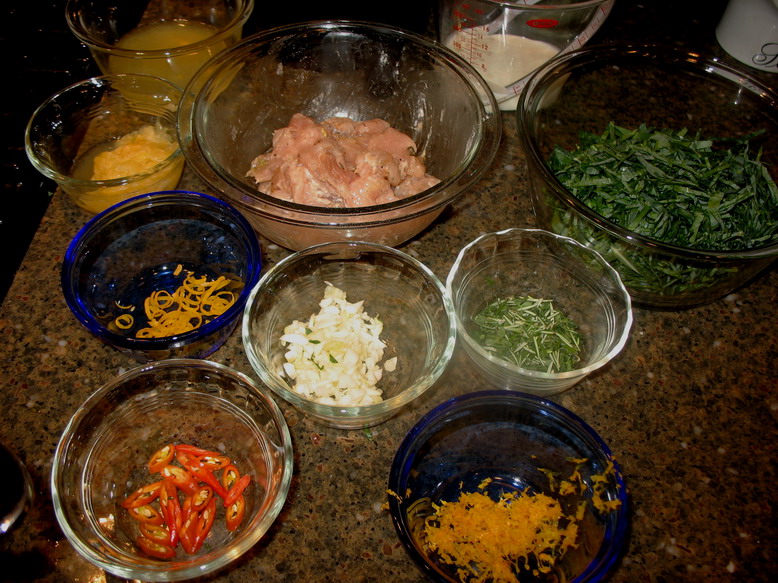
So, in order to fulfill the requirements of this challenge, I created a recipe that uses a minimum of ingredients, utensils and most importantly, time.
It is a recipe based on a lemon cream pasta sauce that I learned from the book, The Top One Hundred Pasta Sauces by Diane Seed, years and years ago. The original recipe was much different; it included ham, dried chile flakes, and much more heavy cream than is truly necessary–two cups worth. My version is lighter, and more flavorful, because I use fresh chile, one more garlic clove, I leave out the ham entirely, and I add sherry. The flavor of the sauce comes from the lemon zest and pulp, in addition to lemon juice, and from the fresh herbs that I add in two stages: in this version, I used lemon thyme and rosemary to grand effect. The lemon thyme echoed the lemon flavor and the rosemary complemented it.
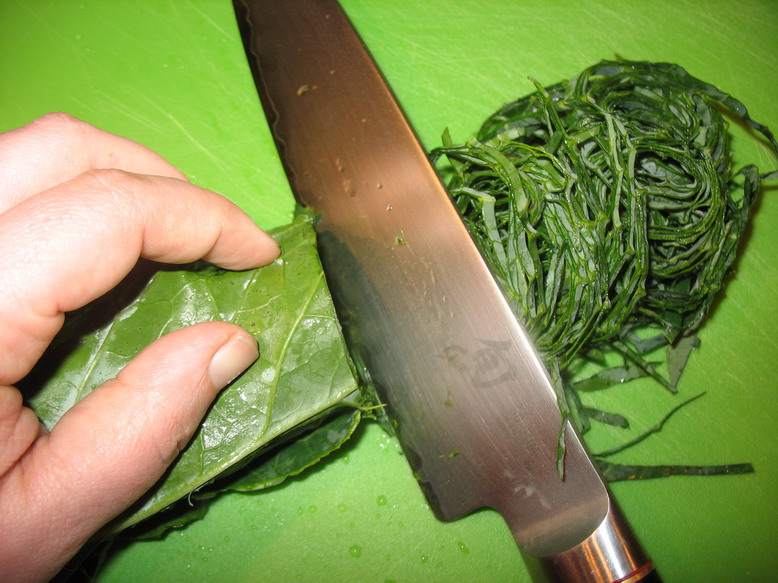
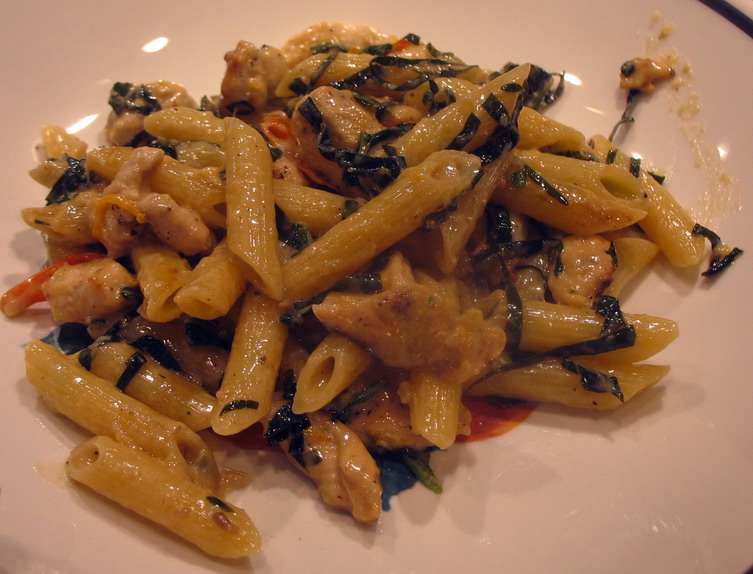
Since I had them (thank you, Michelle!) I used the juice, zest and pulp of one Meyer lemon instead of the components of regular grocery store lemons. This evening, I paired the Meyer lemon sauce with penne, and sauteed slivers of chicken with a chiffonade of collard greens for a light-tasting, yet filling seasonal dish. Looking at the pictures, one might assume that the chiffonade would take forever to cut–it being tiny green ribbons less than one quarter of an inch thick. However, the secret is, to take the big central ribs out of the leaves after you have washed them,lay them out flat, roll them up tightly and cut them into slivers from the “log” that you have made. They fall away, magically unfurling into perfect verdant ribbons.
The prep time was minimal–cutting up the chicken and cooking the pasta took the longest time of anything. Everything else was a breeze.
Enjoy!
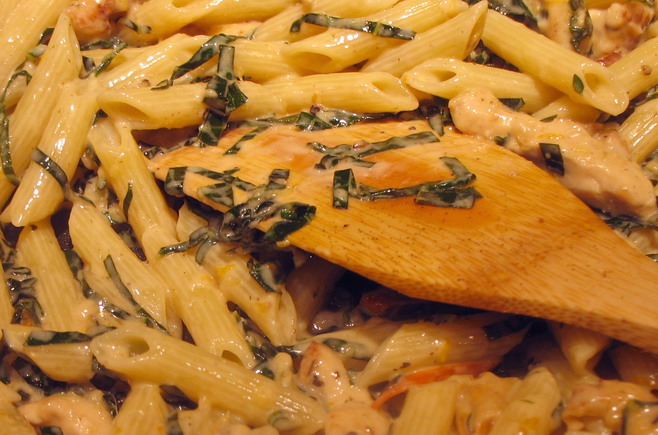
Penne with Sauteed Chicken and Collard Greens in a Meyer Lemon Cream Sauce
Ingredients:
1 boneless skinless chicken breast, trimmed and cut into 1/4″ wide by 1″ long slivers 1/4″ thick
1 tablespoon sherry
1/4 teaspoon powdered dried rosemary
1 teaspoon Fox Point Seasoning from Penzey’s
1/2 tablespoon freshly cracked black pepper
2 tablespoons all purpose flour
EVOO (you all know what that is, right? Extra Virgin Olive Oil!) twice around the pan (about two tablespoons and a half)
1 clove garlic, minced
1 chile pepper (I used a fairly mild one–use your judgement or leave it out) cut into thin diagonal slivers
1 tablespoon fresh herbs–I used lemon thyme and rosemary–use what you like or have
2 cups collard green leaves cut into a very thin chiffonade (about 1/8 of an inch thick) (That is about four really large leaves)
3/4 pound penne pasta
1 tablespoon EVOO (I know you know what it is now, I said it once, I won’t say it again.)
1 clove garlic
zest from a large Meyer lemon (The one I used was bigger than my fist and heavy–filled with juice if yours are smaller, use two)
pulp from 1/2 Meyer lemon–this is easily removed by cutting it in half, removing the peel by hand, and then squishing it out of segment membranes with your fingers. Do this over a bowl to catch the juice
2 tablespoons sherry
Juice from the rest of the lemon (this added up to about 1/3 cup of Meyer lemon juice–I even measured it)
1/3 cup heavy cream
salt and pepper to taste
1/4 cup reserved pasta cooking water–just scoop it out before you drain the pasta, and hold it in reserve–you probably won’t use it all–I only used about 2 tablespoons of it, but you might need more.
1 tablespoon fresh herbs–again, I used the lemon thyme and rosemary–you use what you like
Method:
Start boiling water for the pasta. Add salt.
Toss your chicken with the sherry, seasonings and flour. The flour will help make the chicken brown nicely and will help give the sauce body.
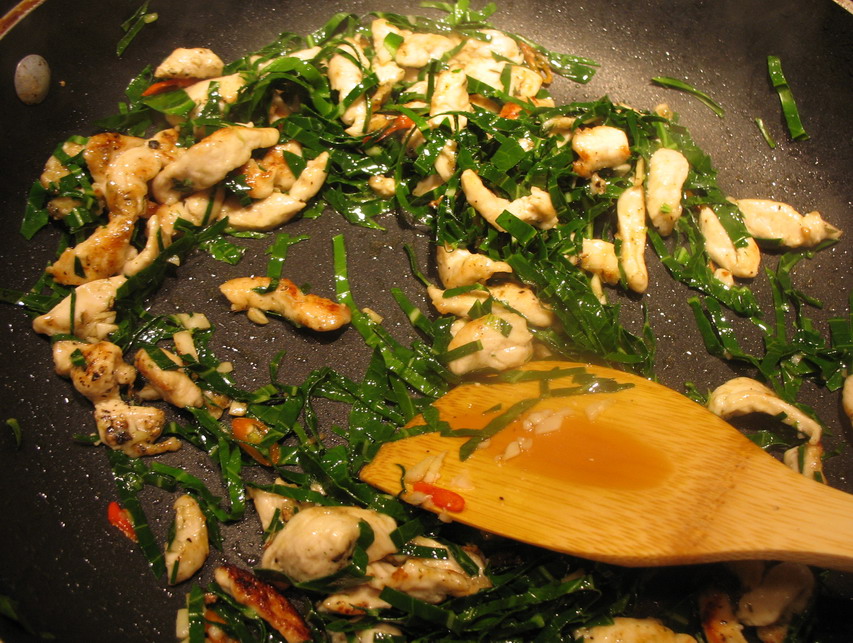
Heat the first amount of EVOO in a saute pan. When it is hot, add the chicken, breaking it up and spreading it into a single layer on the bottom of the pan. Have your heat on high. When it browns on the first side, start stirring it, and turning it over. Add first garlic clove and the chile and keep stirring until the chicken is nearly done–it should be well browned and most of the pink should be gone. Add the herbs and the chiffonade of collards, and stir briskly until the collards turn emerald green and wilt gracefully. They will shrink up a bit in the pan. Sprinkle a bit of salt (about a half teaspoon or so) and some freshly ground black pepper over it all.
Put your pasta into the boiling water. Set the timer for the desired doneness–mine takes about eight minutes.
Scrape the contents of the pan into the bowl you had the greens in. Put it back on the fire, put the second amount of olive oil in and add the garlic. Cook until it is starting to turn golden. Add the lemon zest and cook stirring until the garlic is golden and fragrant. Add sherry and cook off alcohol. Add lemon pulp and the lemon juice and cook down, stirring, for about five minutes. Add the cream and stir until combined. Reduce until quite thick. Season to taste with salt and freshly ground pepper.
Put chicken and greens back into pan, in the sauce. Take out a ladleful of pasta boiling water, put it into the bowl that held the cream, and leave it. Stir in the chicken and greens into the sauce, drain the pasta. Add pasta to the pan, along with however much of the pasta cooking liquid is necessary to thin the sauce. You just want it to coat the pasta, greens and chicken–you do not want it to be drowning in the sauce. That is why there is so little sauce.
Sprinkle the fresh herbs into the sauce and serve in warmed bowls.
Notes: For vegetarians, change out the chicken for mushrooms.
This is a very strong-flavored sauce. You don’t need much; in fact, if you are one of those people who likes pasta swimming in sauce, I challenge you to try this dish and see if it isn’t really good with just enough sauce to coat everything and make it all very tasty.
The trick of thinning the sauce with pasta water I learned from an old Italian chef in culinary school. The starch in the water helps make the sauce adhere to the pasta, he said, and, I also think it helps keep the water from thinning the sauce -too- much.
There it is–28 minutes from start to finish. I used a lot of prep bowls, a zester, a juicer, a cutting board, a knife, a pot for pasta and the saute pan. Not too much to clean up. The trick is to know what you are doing, do it efficiently, and keep your burners on high. On high, mine can cook this sauce and reduce it within ten minutes flat. That left me plenty of time to prep and saute the main ingredients. As for the prep–cut the chicken when it is partly frozen and it goes faster. The time you take to cut it into precise small pieces is made up for in the speed with which it cooks.
Zak and Morganna loved it, I am happy to say, as did I.
What I loved the most was it was easy to make, and fast.
Tagged with: IMBB24 + 30Minutes
Going on Vacation
You will notice that I just posted three posts in rapid succession.
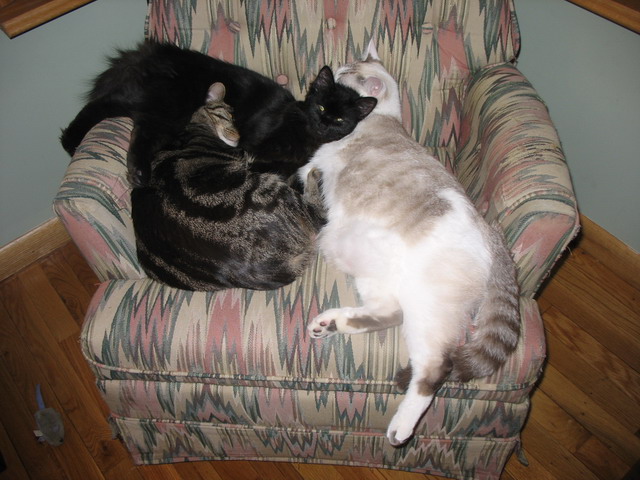
That is because we are going away for a few days to Washington, DC, to go see some exhibits at the Smithsonian, and to hang out in our old stamping grounds, see good friends and eat good food.
I wanted to leave you all with a little bit to read while I was gone!
Until we get back, Tatter, Lennier and Gummitch promise to hold down the blog, and look cute.
See you on Sunday!
Food Blogs Featured in Dublin Sunday Business Post
Not every reporter is snarky to food bloggers.
I just wanted to say that, because the journalist who interviewed me for her column in the Dublin Sunday Business Post, was the nicest lady, and she wrote a very nice overview of food blogs in general, and bloggers who are becoming published authors in specific.
You can read her column here.
And you will notice, there is not a cheese sandwich in sight.

Categories:
- Admin (rss) (55)
- Blogs and Blogging (rss) (81)
- Book Reviews: Cookbooks (rss) (43)
- Book Reviews: Non-Cookbook Food Books (rss) (38)
- Cats and Cat Blogging (rss) (47)
- Chinese Cooking Lessons (rss) (32)
- Culinary School Stories (rss) (18)
- Dairy Pruducts: Cultured and Barbaric (rss) (4)
- Documentary Filmmaking (rss) (1)
- Essays, Rants and Reflections (rss) (260)
- Fighting Hunger (rss) (12)
- Food and Kids (rss) (45)
- Food in the News (rss) (126)
- Food Media (rss) (98)
- Food Preservation (rss) (18)
- Food Safety (rss) (45)
- Gardening (rss) (30)
- Herbs and Herb Blogging (rss) (20)
- Holidays (rss) (50)
- Kat Blogging (rss) (22)
- Kitchen Science (rss) (36)
- Leftover Makeover (rss) (8)
- Life, the Universe and Everything (rss) (131)
- Local and Sustainable (rss) (227)
- Local Athens Food and Foodies (rss) (42)
- Meatless Mondays (rss) (32)
- Menu For Hope (rss) (5)
- Nutrition, Diet and Health (rss) (84)
- On The Farm (rss) (8)
- Recipes: Almost Vegetarian, Vegetarian and Vegan (rss) (294)
- Recipes: American Regional (rss) (37)
- Recipes: Appalachian Hillbilly (rss) (33)
- Recipes: Bread, Pasta, Grains (rss) (95)
- Recipes: Canning and Preserving (rss) (8)
- Recipes: Chinese (rss) (123)
- Recipes: Comfort Food (rss) (120)
- Recipes: Cookies (rss) (16)
- Recipes: Desserts (rss) (48)
- Recipes: French (rss) (25)
- Recipes: Fruits and Vegetables (rss) (302)
- Recipes: Greek, North African and Middle Eastern (rss) (31)
- Recipes: Indian (rss) (137)
- Recipes: Italian (rss) (42)
- Recipes: Japanese (rss) (7)
- Recipes: Jewish (rss) (4)
- Recipes: Korean (rss) (6)
- Recipes: Meat, Poultry and Fish (rss) (220)
- Recipes: Mexican/Native American/ Latin American/Caribb (rss) (27)
- Recipes: Original (rss) (108)
- Recipes: Thai (rss) (27)
- Recipes: Tofu (rss) (17)
- Recipes: US Regional (rss) (16)
- Recipes: Vietnamese (rss) (8)
- Restaurant Stories (rss) (28)
- Sewing, Quilting, Arts and Crafts (rss) (16)
- Simple Chinese Recipes (rss) (30)
- Slow Food and Heritage Foods (rss) (10)
- Spice Blogging (rss) (44)
- The Chinese Cookbook Project (rss) (14)
- The Chinese Pantry (rss) (39)
- The Documentary (rss) (2)
- The Kitchen Saga (rss) (17)
- The Locavore's Bookshelf (rss) (15)
- The Unsung Adventures of The Culinary Nerd (rss) (6)
- Tools and Toys (rss) (35)
- Uncategorized (rss) (10)
- With a Side of Politics (rss) (48)
Archives:
- August 2012 (9)
- July 2012 (12)
- September 2011 (3)
- August 2011 (7)
- July 2011 (8)
- June 2011 (16)
- May 2011 (17)
- April 2011 (11)
- December 2010 (9)
- November 2010 (5)
- February 2010 (1)
- December 2009 (5)
- November 2009 (7)
- October 2009 (10)
- September 2009 (16)
- August 2009 (14)
- July 2009 (14)
- June 2009 (7)
- May 2009 (17)
- April 2009 (10)
- March 2009 (25)
- February 2009 (13)
- January 2009 (10)
- December 2008 (5)
- November 2008 (5)
- October 2008 (6)
- September 2008 (13)
- August 2008 (8)
- July 2008 (11)
- June 2008 (18)
- May 2008 (13)
- April 2008 (14)
- March 2008 (16)
- February 2008 (17)
- January 2008 (19)
- December 2007 (25)
- November 2007 (18)
- October 2007 (24)
- September 2007 (16)
- August 2007 (15)
- July 2007 (15)
- June 2007 (10)
- May 2007 (14)
- April 2007 (16)
- March 2007 (17)
- February 2007 (20)
- January 2007 (13)
- November 2006 (1)
- October 2006 (8)
- September 2006 (14)
- August 2006 (25)
- July 2006 (30)
- June 2006 (28)
- May 2006 (34)
- April 2006 (29)
- March 2006 (24)
- February 2006 (30)
- January 2006 (38)
- December 2005 (40)
- November 2005 (37)
- October 2005 (32)
- September 2005 (25)
- August 2005 (30)
- July 2005 (28)
- June 2005 (21)
- May 2005 (8)
- April 2005 (22)
- March 2005 (17)
- February 2005 (29)
- January 2005 (10)
Search Site:
Links:
- Lily’s Wai Sek Hong
- 101 Cookbooks
- A cat in the kitchen
- A Veggie Venture
- Accidental Hedonist
- Cha Xiu Bao
- chez pim
- Chocolate & Zucchini
- Chopstick Cinema
- Chowhound.com
- Chubby Hubby
- Cook sister!
- Cooking with Amy
- da*xiang
- Eat Local Challenge
- Eating Liberally
- Ecocentric
- Eggbeater
- Epicurious
- Farmgirl Fare
- Fatfree Vegan
- Foodgoat
- ForkandBottle.com
- Green Olive Tree
- Hooked on Heat
- Jaden’s Steamy Kitchen
- Kalyn’s Kitchen
- Lucullian delights
- Mahanandi
- Matt Bites
- MeatHenge
- mmm-yoso!!!
- New York Times – Dining & Wine
- Pizza Goon
- Rasa Malaysia
- Ruhlman
- Sailu's Kitchen
- Serious Eats
- SF Gate: Food & Dining
- Simply Recipes
- Soul Fusion Kitchen
- Tastespotting
- The Amateur Gourmet
- The Cleaner Plate Club
- The Food Section
- The Grub Report
- thecookscottage
- U.S. Food Policy
- Wandering Chopsticks
- Washington Post Food and Dining
- Wasted Food
Meta:


Powered by WordPress. Graphics by Zak Kramer.
Design update by Daniel Trout.
Entries and comments feeds.