
Cook Local, Eat Global
Net Outage
We’re having internet issues here at Chez Umami. As a result, blogging may be a bit delayed until we can get them resolved. Thanks for your patience.
From The Fifth Taste: Hillbilly DeLuxe Dinner
Alright, it’s true: multiple award-winning chef Bradley Ogden, the originator of this dish did not call it Hillbilly DeLuxe Dinner. That right there is my very own nomenclature. But, I figured that since I fiddled with his recipe, which I found in The Fifth Taste, to the point of substituting no less than five ingredients and adding several others out of the blue, that I could call it whatever I pleased. And whether he likes it or not, his “Roast Pork Shoulder with White Beans, Smoked Bacon and Kale,” is nothing less than a big mess of southern Applachian comfort food in a pot.
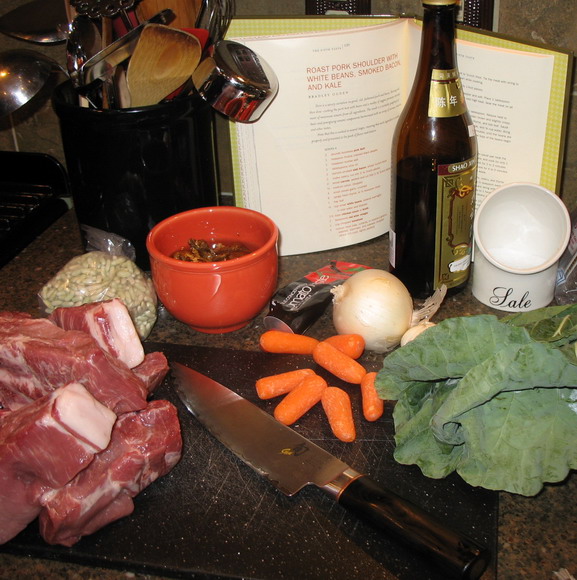
Besides, my name has more of a ring to it. It is tantalizing. It runs trippingly off the tongue.
And it makes me giggle, which is, as we know, the most important part of any recipe name in my house. (Remember that Garlic Booger Chicken I told you about? See what I mean?)
I reckoned that as I was revewing The Fifth Taste, I should give one of its recipes a try, (besides which, I had made a New Year’s Resolution to use my cookbooks more in the the way they are meant to be used instead of as pure inspiration) and so I dug through the book with the help of Morganna and Zak, to pick one that sounded good. I had struck out until I turned to Chef Ogden’s recipe, when Morganna’s finger snaked out and stabbed the page with authority. “That one!”
I looked at Zak. He nodded. “It sounds good, except for that kale business, but I’m sure you can do something that will make the kale edible.”
It was decided, so I pranced off to read the recipe, scout out the pantry and make a shopping list. As I looked at the recipe, I realized that it qualified as “comfort food,” so I decided to kill three birds with one stone and enter this into January’s Weekend Cookbook Challenge. So there we are–a recipe from a cookbook that I reviewed, and it fits the theme of a challenge. Excellent.
Now, I have to tell you that this time, I did not have any thought in my head of changing anything in the recipe. It was circumstances that forced me into it. Yes, circumstances. Like, when I went to the Bluescreek stall at the North Market, they didn’t have any pork shoulder left, but they had five of the thickest, juiciest looking pork country ribs you can imagine.
And then, when I went to buy kale, there was none, so I had to buy collards instead.
Now the beans were a willful change. Chef Ogden specified white beans, but not which kind. I was at the North Market, so I picked up a pound of flageolet beans. I know that they are kind of celedon colored, but when they cook, they cook up the same pale beige that white beans do, so there.
Of course, I didn’t buy bacon, because I thought I had some, but I didn’t, because we ate all of it. But not to worry–I had in my refrigerator the secret weapon of all Mountain Mamma cooking–a mason jar of bacon grease. Bacon grease is an insurance policy in the kitchen–nearly any dish can be improved upon by its addition, it’s cheap, and it contains the essence of bacon. How can that be bad? (Okay, so it clogs the arteries–but you don’t eat it with a spoon you goober, so why worry?)
Needless to say, by the time I actually cooked this dish last night, I had already changed it all around. That’s okay–once I actually read the instructions, they included all of those fussy, wasteful, silly-assed chef steps that I learned in culinary school that I never do at home, and am not going to start now, just to make glorified redneck food. Besides, I didn’t have several hours in which to play fussy games with some pork, beans and greens, so I made use of the pressure cooker in addition to my Le Creuset buffet casserole, so now that I think on it, I really made it differently.
And how did it turn out?
Deliciously–amazingly so, in fact. Part of it was that Ogden chose no-fail ingredients: pork, beans, bacon and greens are all umami-filled bringers of delight and joy, especially to those who grew up on hillbilly food.
Without further ado, I now present, a recipe inspired by Bradley Ogden’s “Roast Pork Shoulder With White Beans, Smoked Bacon and Kale from The Fifth Taste:
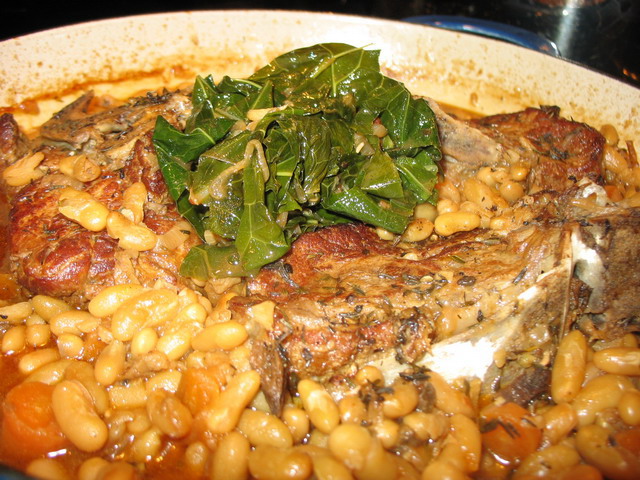
Hillbilly DeLuxe Dinner
Ingredients:
3 thick country style pork ribs (about 2 pounds)
2 tablespoons olive oil
salt and freshly ground black pepper to taste
1 tablespoon bacon grease
1 medium onion, roughly chopped
1 handful dried porcini mushrooms, rehydrated in 1 cup water, squeezed out and roughly chopped
1/2 teaspoon celery seed
1 cup sliced carrots
1 teaspoon dried thyme
4 cloves garlic, minced
1 bay leaf
1/2 pound flageolet beans, soaked 1 hour in hot water, then drained
1/2 cup sherry (or, as I used Shao Hsing wine)
2 cups chicken broth
2 tablespoons tomato paste
1 tablespoon bacon grease
1 large shallot, thinly sliced
1/2 chipotle en adobo, minced
3 garlic cloves, minced
10 ounces collard greens, washed, thick ribs removed, and cut into thick (1″) ribbons
2 tablespoons balsamic vinegar
Method:
Preheat oven to 375 degrees.
Using a cast iron casserole or dutch oven, heat olive oil on medium high heat. Pat ribs dry with paper towel, and sear well on all sides until golden brown and quite fragrant. Set aside on a plate, and set casserole aside as well.
In pressure cooker, heat bacon grease, and add olive oil and pork fat from casserole. Add onion, mushrooms, celery seed and carrots and cook, stirring, until onions are golden. Add thyme, garlic and bay leaf, and continue cooking for one more minute. Turn heat down to low.
Bring casserole back on heat, and add sherry, deglazing all the browned bits off the bottom of it. Pour resulting umami-filled liquid into pressure cooker, along with the mushroom soaking liquid (Be sure to leave last bit of that liquid in the bowl, as it will contain grit from the mushrooms and is not appetizing), beans and chicken broth. Add ribs, and any accumulated juices from where they have been sitting, into the pot. Bring to a boil, cover pot, lock it and bring to full pressure. Turn heat down to low, and cook on full pressure for twenty-seven minutes.
Quick release pressure. At this point, meat should be fork tender and beans should be done. Using a slotted spoon or skimmer, bring the beans and meat out of pressure cooker, and lay into casserole. Take out one and a half cups of cooking liquid from pressure cooker and whisk into it the tomato paste, then pour it into the casserole. Cover and put into oven to bake for about twenty minutes.
Take remaining liquid from pressure cooker and reserve–it should be around a cup or a cup and a half.
Put remaining bacon grease into pressure cooker, melt, then cook shallots, chile and garlic until very fragrant and golden. Deglaze pan with cooking liquid and bring to a boil. Put greens on top of boiling liquid, cover with lid, lock down, and bring to full pressure. Turn down heat and cook for five minutes under full pressure.
Release pressure and add balsamic vinegar.
To serve, bring meat and beans out of oven, and garnish with a mound of greens in the middle. Each diner gets a rib and as many beans and greens as they like. (Which means Morganna and I get more greens, because Zak is silly and doesn’t like them.)
Umami profile of the dish: The original recipe listed the meat, bacon, carrots, beans, broth, red wine vinegar and tomatoes as having umami. In my version, not only does the meat have umami, but there are bones involved which boosts the umami content of the dish considerably. I also had mushrooms, mushroom soaking liquid, carrots, bacon grease, broth, carrots, tomato paste, sherry or Shao Hsing, and balsamic vinegar. I also count collards as being an umami ingredient–when they are cooked this way, they release a lot of amino acids when they are cooked in this fashion. The cooking broth in the greens is extremely tasty and thick, and we ended up serving it drizzled over the entire dish.
Book Review: The Fifth Taste
It has been a while since I have actually reviewed a book here, so I thought I would redress the situation with one of the cookbooks I received as a gift during the Generic Winter Holiday celebration.

My regular readers are probably aready a bit familiar with this work, as they have been reading my series of posts on the subject of umami, or the fifth basic taste. Written by David and Anna Kasabian, The Fifth Taste: Cooking With Umami, is a very good introduction to the scientific basis for quantifying umami as a basic taste, with simplified explanations of the chemistry and physiology involved that are enlightening, but not overly complicated.
In truth, I mainly was glad to have the book for the opening chapters alone: the history of umami, the recent scientific findings that confirmed that it was one of the basic tastes that the human tongue can discern, the revelation that umami was the flavor of amino acids, and the listing of ingredients that feature umami were all of great value to me. These chapters take up the first 33 pages of the book; most of the rest of the slender volume (296 pages altogether) is taken up by an extensive index, a list of ingredient sources, a profile of the chefs who contributed recipes and of course, the recipes that make up the meat of the book.
What I found most interesting about the book is that while the authors list countless Asian ingredients as great sources of umami, very few of the recipes, even including the chefs’ contributions, really looked to Asian culinary traditions for inspiration. Nor, generally, were Asian umami ingredients used to flavor Western-style foods–primarily, the recipes contained ingredients such as tomatoes, beans, red wines, anchovies, mushrooms and corn. Over and over, these same ingredients were repeated in the recipes, while fish sauce, which is touted in the first chapter as probably the richest source of umami, is relegated to only a handful of recipes.
In truth, while I value the general information in the opening chapters, I was not overly impressed with the quality or range of recipes in the rest of the book. Chefs such as Daniel Boulud, Rick Bayless, Mary Sue Milliken, Susan Feniger and Nobuyuki Matsuhisa all contributed recipes, and while many of them looked quite good, none of them particularly impressed me as anything new, earth-shattering or even that they particularly were created in order to boost the umami flavors to the maximum level.
They mostly seemed thrown together, rather in a hurry, and tacked on as an afterthought, in order to supplement and pad the rather limited amount of information present in the book.
That said, I did enjoy and eagerly devour the information on umami that the book presented, even as I was disappointed by the recipes, and I have since cooked several dishes where I added small amounts of umami-containing ingredients to see if it boosted the overall flavor profile of the dish.
Indeed, it did.
And for that, I do have the authors to thank, because it was their slender volume which opened my eyes to the possibilities of umami.
All in all, I am glad I have the book, and I feel that I can recommend it to all folks who like to geek about and research obscure topics in food. While umami is presently an obscure topic and this book is probably the first cookbook devoted entirely to the subject, I do not think it will be the last. I am curious, of course, to see what future research into the fifth taste will bring us, but until then, I will keep tinkering away with my Asian umami ingredients, and see what wonders I can cook up on my own.
Stir Fry Technique: Ten Steps to Better Wok Cookery
Last week, I received an email from a reader that made me stop and think. She asked a simple question, and in answering it, I realized I should make the whole thing public, because it is the kind of question that other people may be pondering when they read my recipes.
Persimmon of Notageek wrote: “I’ve noticed that, in stir-fry recipes on your weblog, you usually put cornstarch in the marinade at the same time as the meat. I know the cornstarch thickens the marinade into a sauce when you dump it on the heat, but what does it do for the meat in that marinating interval?
I, you see, am trying to not eat corn, as I get a rash. I have tapioca stach and arrowroot in my cabinet. Will
either suffice?”
I will answer the second question regarding the tapioca and arrowroot first, and then go into my long, and rather rambling answer to the first question, which evolved into a deconstruction of the stir frying technique that I repeat in most of my recipes. I think it might help readers to understand the whys behind this technique so that they can more easily replicate the hows.
Regarding tapioca starch and arrowroot–yes, they can be used instead of cornstarch in all of my recipes. They perform the exact same function, however, in my experience, they are stronger binders, so you use -less- of them both in marinades and as thickeners. I would use about half as much of either of them as I would use cornstarch. Therefore, if you substitute either of them in one of my recipes, use half the amount directed for cornstarch.
Now, as to the first part of the question, I realized that though I have repeated the method that I use to stir fry umpteen-eleven times with each recipe I post, nowhere have I ever really truly explained it all, beginning to end. So that, when someone looks at my directions to “toss meat with soy sauce, wine and cornstarch, then allow to marinate for at least twenty minutes,” they may follow those instructions, but they may never really know what function the cornstarch fulfills in the recipe. Extrapolating from the cornstarch mystery, I realized that there are likely oddities to my method that also may stump other readers, so I might as well slow down and record exactly what I am doing and why so that everyone is on the same page with me when they go to recreate my recipes.
So, from beginning to end, here is my explanation of my method of stir frying, which tends to differ in a few respects from the instructions one is apt to get in the average Chinese cookbook.
Step one: Cut your ingredients into equivalent-sized and shaped pieces.
This rule is quite effectively stated in all good Chinese cookbooks. In order for the food to cook evenly, quickly and aesthetically, the pieces must all be as close in shape and size as possible. If you examine photographs of my completed stir-fried dishes, you will note that most ingredients have been cut into similar shapes and sizes, as much as is possible given that vegetables and meats do not come in neat geometric shapes. I won’t go into long explanations on how to manage the art of cutting for Chinese stir fry–that is an entire series of posts in and themselves, but I do want to emphasize the importance of cutting into shapes that will cook quickly.
Back when Morganna made her umami chicken stir fry, she cut the chicken into very large cubes, which is inefficient when it comes to stir frying. In order to get them to cook evenly without drying out, we ended up searing the outside of the chicken in the typical stir-fry method, then adding liquid and allowing the chicken to simmer, or braise quickly to finish cooking the interior. This noticably affected the taste of the final dish–the sauce was bland, as it had been watered down by the use of more wine and broth than is usual. When I pointed out that if she had cut her chicken into smaller, thinner bits, the extra liquid would never have been added, Morganna’s eyes lit up with understanding as to why I tend to cut my meats into very thin slices or shreds. (Every step of a stir-fry is affected by every other step. In order to adjust for large chunks of meat, the sauce making is adapted, and can suffer.)
Step two: Marinate your meat or tofu in a mixture that includes cornstarch.
This step is the one that tripped Persimmon up. She understood the thickening property of cornstarch, and knew that somehow this action was in play when it came to using it in the marinade (especially since very few of my recipes have cornstarch added in a later step), but she could not fathom why it was used with the meat before it was cooked.
The main reason I add cornstarch to the marinade is because it holds the liquid of the marinade onto the meat–it makes it clingy. If you marinate meat with cornstarch in addition to the liquids, when you go to cook the meat, you will note that there is very little liquid left in the bowl after the meat is put into the wok. That is because most of it is clinging to the surface of the meat.
What happens to the liquid and cornstarch that sticks to the surface of the meat is one of the great secrets to building deep flavor in a very quickly cooked dish like a stir-fry. Much of it browns when it comes into contact with the wok, and helps brown the surface of the meat, thus adding to the flavor profile of the dish. And, through various other processes that I will outline in later steps, it helps thicken the sauce as it is formed through the cooking of the stir-fry. (I do not typically add a pre-mixture of sauce ingredients near the end of the stir-frying process. Generally, I add liquid ingredients during the course of the stir fry and allow them to thicken by the process of reduction or evaporation during the natural cooking process. This leads to a dish that has less sauce, but the sauce that there is clings tightly to the food, leading to a more beautiful appearance and is more highly and intensely flavored than a sauce that is simply poured in and allowed to thicken at the end of cooking.)
Step Three: Have all ingredients ready and lined up beside the wok, before you heat the wok.
I won’t belabor this point–it is pretty straightforward. Stir frying goes quickly, so have everything cut, measured and put into prep bowls near your wok so you don’t end up running around like a chicken with its head cut off while the food in your wok burns.
Step Four: Heat your wok until it begins to smoke, then add the oil and heat it until it nearly smokes.
This is only if you have a cast iron or carbon steel wok. If you have a nonstick wok, do not do this or you will ruin your wok. Only heat non-stick surfaces with oil or liquid in them. Assuming you have the cast iron or carbon steel wok, what you want to do is put it on your burner and get it as hot as you can. For most American stoves, flat bottomed woks work wonders, coming perfectly into contact with the heat source. Allow it to heat until the wok “exhales.” This is when the scent of the hot, seasoned wok is released by the metal of the wok–it is the scent known in Cantonese as “wok hay.” Until I knew the Cantonese term, I called it, in elegantly, “Wok smell.” Now I call it “the breath of the wok.” As soon as you can smell the wok hay, and see the pale ribbons of smoke rising from the hot metal, pour in your oil, and wait for it to heat up until it is nearly smoking. It will shimmer with convection currents when it is ready and the wok hay will intensify.
Step Five: Add your aromatic ingredients, in the order specified in the recipe and cook for a minute or two until they are fragrant and cooked to the point specified in the recipe.
This, again, is fairly self-explanatory. Aromatic ingredients include onions, garlic, ginger, shallots, scallions, chiles, chile flakes, spices (whole or ground) and ingredients such as dried shrimp or fermented black beans. The purpose of adding these intensely flavored and scented ingredients first is so that their essence can fully permeate the cooking oil and add their strong flavors to the food as it is cooked. This is the first step in the flavor-building process that continues throughout the cooking of an excellent stir-fried dish.
Step Six: Add the meat, settle it into a single layer in the bottom of the wok and leave it there for about a minute or so to begin to brown deeply on the surface touching the wok.
This step is essential to the home cook being able to recreate the special flavor of a wok hay-filled dish that is cooked in a restaurant. Home stoves do not put out the huge amounts of heat that Chinese restaurant stoves do. The heat of a wok stove and the use of large amounts of oil are most of what contributes to the special, undefinable flavor and fragrance of Chinese restaurant food that most people long to recreate. It is the flavor of the well-seasoned, very hot wok that you are smelling and tasting. You can come very close to recreating this at home, even if you do not have a stove with as many BTU’s as mine. I discovered this technique by accident–I was once stir frying a dish, and the phone rang. As I was expecting a call, I answered it, but did not move the wok off the stove. I had a regular flat-topped electric stove, and had just put the meat in. I thus, left it to cook unsupervised. When I realized what I had done, I caught the wok in the nick of time and started stirring the meat madly–it had only browned on one side. When Zak and I ate–the dish was superb and tasted like it came from a restaurant. Years later, when Grace Young’s book, The Breath of a Wok came out, she described the exact same technique as one she learned from her parents, both excellent Cantonese home cooks, and I realized I waonto something. When I later met Grace and shared notes with her, she agreed that no other Chinese cookbook author had ever instructed thier readers to cook in this way, which leads to people creating stir fries that do not taste right.
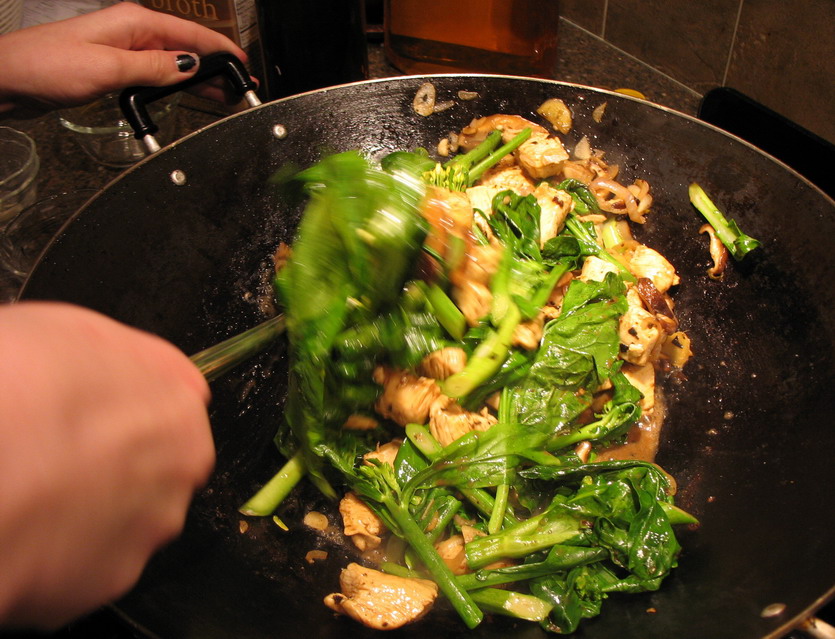
This is the most important step. Put the meat into the wok, slide it into a single layer on the bottom of the wok, and leave it alone. Do not stir it. Do not touch it. Leave it alone for around 45 seconds to 1 1/2 minutes–until you smell the meat and cornstarch marinade begin to brown. At that time, stir fry as normal, until the meat is mostly done–it has cooked 2/3 of the way–2/3 of the surface has changed color to the color of cooked meat. You will note at this time, some small amounts of the marinade have stuck to the wok and begun to brown. Do not worry–it is supposed to do that, and you will take care of that in the next step.
Step Seven: Add soy sauce, wine or some combination of the two to the wok and deglaze the cornstarch marinade, and toss the meat to season it.
This is where you begin building the flavor of the sauce and you deepen the color and flavor of the meat. Soy sauce added at this point, in a small amount, will color the meat and deglaze the browned bits in the wok, thus creating a bit of liquid that is enough to season the dish, but not enough to change the cooking method to steaming or braising. You can use soy sauce alone, wine alone, or a mixture of the two at this point. You can also add sugar at this point, if required to in the recipe, again, allowing the sauce time to build its flavor profile bit by bit.
Step Eight: Add vegetables, in the order of how long they will take to cook, and stir fry.
This step continues the cooking process of the meat, and allows the vegetables to cook as much as they need to. Use your judgement as to how long the vegetables will take to cook and add the ones that take longest (carrots, for instance, or the thicker stems of gai lan) first, and the ones that barely need to cook (water chestnuts or snow peas) at the last.
Step Nine: Add broth, any other sauce ingredients such as oyster sauce, hoisin or vinegar, stir fry until sauce thickens and clings to the pieces of food in the wok.
This is where you finalize the flavor of the sauce and mix the ingredients thoroughly together. The amount of broth, if you use it, depends upon what you are cooking. If you are cooking gai lan leaves and want them to wilt, you use a bit more broth than usual, and allow the steam of it boiling away as it reduces to cook the leaves, making them wilt to a velvety texture. If you are not cooking anything leafy, then you use less broth–if you use any at all. At this point, after this step, you can remove the wok from the heat.
Step Ten: Add garnishes, and any last minute flavoring items like spices or sesame oil, put into a warmed serving plate and serve.
This is the final step where the last bits of flavor and color are added to give extra mouth and eye appeal to the dish. After this, all that is left is to wash the wok.
There it is–â€Barbara’s Way of the Wok in Ten Mostly Easy Steps.†I hope that it might have answered a few questions people might have had regarding my recipes, and I hope it might make the entire process a bit clearer in the future when you approach the art of stir-frying. It isn’t all you need to know about stir frying by a long shot–but it is a good start. I came across most of this on my own, through trial and error, but a lot of it I learned in dribs and drabs from various, mostly out of print cookbooks. The sort of stir fry you will make out of using this method is one that has a sauce that is highly flavored from multiple reductions and a single deglazing. The sauce will not be plentiful, but will instead glaze the food ingredients and cling tightly to them–but the intense flavor more than makes up for a lack of sauce. This is the way a lot of Chinese homestyle cooking is done, with very little, but very flavorful sauces.
Keeping Up With The Paper Palate
For those of you who missed my announcement a couple of weeks ago, I have been editing and writing for the newly-launched Well Fed Network, which is, as far as we know, the first blog network made up of only food-oriented blogs. The blog which I have been editing and writing for has been The Paper Palate, which covers food magazines and the dining and wine pages in major newspapers as well as any food coverage in any other print media we come across that is interesting.
I figured that I would post an update on my own blog here, so those who haven’t been keeping up with The Paper Palate can catch the writing I have been doing for that blog here.
Though, really, there are some great writers on Well Fed, so you should check them all out.
Anyway, on January 5, I posted a response to a very snarky feature story about niche food blogs that appeared in the LA Times, wherein I asked the pointed question: “LA Times: Why Snark At Food Bloggers?”
Then on the 9th, I came across a story in the Washington Post about the laws and ethics concerning recipes and copyright. Considering it was an issue that affected all food bloggers, I wrote a post concerning it: “Recipes and Copyright.” (Yeah, I didn’t feel like getting creative with the title.)
After finding that the inflight magazine for Southwest Airlines, Spirit, had Rachael Ray on the cover of this month’s issue, I had to find out why. It turns out that she came in last in thier list of the top ten current TV chefs, but she was the prettiest, so she got the cover. I decided to give my list of the top ten TV chefs of the past, then ask which one was pretty enough for the cover of my imaginary magazine.
Finally, on Friday, I covered a human interest story that is making its way through the press like wildfire about the little baker in Italy who put big McDonald’s out of business with bread as his weapon. Of course, the truth is, this happened two years ago, so it isn’t exactly timely, but that isn’t bothering the press of the world, so I am not sure why it should bug me so much.
As I said, there are a lot of other good writers on the Well Fed Network, so check out some of these posts:
Anthony Silverbrow takes on the Food Fraud story from the UK, and thinks it sounds fabricated.
Courtney tells us about a researcher who sits in Starbucks all day and calls it research.
Derrick Schneider tells us about the fate of foie gras in Washington State, then gives us the run down on some common misconceptions about the endangered luxury item.

Categories:
- Admin (rss) (55)
- Blogs and Blogging (rss) (81)
- Book Reviews: Cookbooks (rss) (43)
- Book Reviews: Non-Cookbook Food Books (rss) (38)
- Cats and Cat Blogging (rss) (47)
- Chinese Cooking Lessons (rss) (32)
- Culinary School Stories (rss) (18)
- Dairy Pruducts: Cultured and Barbaric (rss) (4)
- Documentary Filmmaking (rss) (1)
- Essays, Rants and Reflections (rss) (260)
- Fighting Hunger (rss) (12)
- Food and Kids (rss) (45)
- Food in the News (rss) (126)
- Food Media (rss) (98)
- Food Preservation (rss) (18)
- Food Safety (rss) (45)
- Gardening (rss) (30)
- Herbs and Herb Blogging (rss) (20)
- Holidays (rss) (50)
- Kat Blogging (rss) (22)
- Kitchen Science (rss) (36)
- Leftover Makeover (rss) (8)
- Life, the Universe and Everything (rss) (131)
- Local and Sustainable (rss) (227)
- Local Athens Food and Foodies (rss) (42)
- Meatless Mondays (rss) (32)
- Menu For Hope (rss) (5)
- Nutrition, Diet and Health (rss) (84)
- On The Farm (rss) (8)
- Recipes: Almost Vegetarian, Vegetarian and Vegan (rss) (294)
- Recipes: American Regional (rss) (37)
- Recipes: Appalachian Hillbilly (rss) (33)
- Recipes: Bread, Pasta, Grains (rss) (95)
- Recipes: Canning and Preserving (rss) (8)
- Recipes: Chinese (rss) (123)
- Recipes: Comfort Food (rss) (120)
- Recipes: Cookies (rss) (16)
- Recipes: Desserts (rss) (48)
- Recipes: French (rss) (25)
- Recipes: Fruits and Vegetables (rss) (302)
- Recipes: Greek, North African and Middle Eastern (rss) (31)
- Recipes: Indian (rss) (137)
- Recipes: Italian (rss) (42)
- Recipes: Japanese (rss) (7)
- Recipes: Jewish (rss) (4)
- Recipes: Korean (rss) (6)
- Recipes: Meat, Poultry and Fish (rss) (220)
- Recipes: Mexican/Native American/ Latin American/Caribb (rss) (27)
- Recipes: Original (rss) (108)
- Recipes: Thai (rss) (27)
- Recipes: Tofu (rss) (17)
- Recipes: US Regional (rss) (16)
- Recipes: Vietnamese (rss) (8)
- Restaurant Stories (rss) (28)
- Sewing, Quilting, Arts and Crafts (rss) (16)
- Simple Chinese Recipes (rss) (30)
- Slow Food and Heritage Foods (rss) (10)
- Spice Blogging (rss) (44)
- The Chinese Cookbook Project (rss) (14)
- The Chinese Pantry (rss) (39)
- The Documentary (rss) (2)
- The Kitchen Saga (rss) (17)
- The Locavore's Bookshelf (rss) (15)
- The Unsung Adventures of The Culinary Nerd (rss) (6)
- Tools and Toys (rss) (35)
- Uncategorized (rss) (10)
- With a Side of Politics (rss) (48)
Archives:
- August 2012 (9)
- July 2012 (12)
- September 2011 (3)
- August 2011 (7)
- July 2011 (8)
- June 2011 (16)
- May 2011 (17)
- April 2011 (11)
- December 2010 (9)
- November 2010 (5)
- February 2010 (1)
- December 2009 (5)
- November 2009 (7)
- October 2009 (10)
- September 2009 (16)
- August 2009 (14)
- July 2009 (14)
- June 2009 (7)
- May 2009 (17)
- April 2009 (10)
- March 2009 (25)
- February 2009 (13)
- January 2009 (10)
- December 2008 (5)
- November 2008 (5)
- October 2008 (6)
- September 2008 (13)
- August 2008 (8)
- July 2008 (11)
- June 2008 (18)
- May 2008 (13)
- April 2008 (14)
- March 2008 (16)
- February 2008 (17)
- January 2008 (19)
- December 2007 (25)
- November 2007 (18)
- October 2007 (24)
- September 2007 (16)
- August 2007 (15)
- July 2007 (15)
- June 2007 (10)
- May 2007 (14)
- April 2007 (16)
- March 2007 (17)
- February 2007 (20)
- January 2007 (13)
- November 2006 (1)
- October 2006 (8)
- September 2006 (14)
- August 2006 (25)
- July 2006 (30)
- June 2006 (28)
- May 2006 (34)
- April 2006 (29)
- March 2006 (24)
- February 2006 (30)
- January 2006 (38)
- December 2005 (40)
- November 2005 (37)
- October 2005 (32)
- September 2005 (25)
- August 2005 (30)
- July 2005 (28)
- June 2005 (21)
- May 2005 (8)
- April 2005 (22)
- March 2005 (17)
- February 2005 (29)
- January 2005 (10)
Search Site:
Links:
- Lily’s Wai Sek Hong
- 101 Cookbooks
- A cat in the kitchen
- A Veggie Venture
- Accidental Hedonist
- Cha Xiu Bao
- chez pim
- Chocolate & Zucchini
- Chopstick Cinema
- Chowhound.com
- Chubby Hubby
- Cook sister!
- Cooking with Amy
- da*xiang
- Eat Local Challenge
- Eating Liberally
- Ecocentric
- Eggbeater
- Epicurious
- Farmgirl Fare
- Fatfree Vegan
- Foodgoat
- ForkandBottle.com
- Green Olive Tree
- Hooked on Heat
- Jaden’s Steamy Kitchen
- Kalyn’s Kitchen
- Lucullian delights
- Mahanandi
- Matt Bites
- MeatHenge
- mmm-yoso!!!
- New York Times – Dining & Wine
- Pizza Goon
- Rasa Malaysia
- Ruhlman
- Sailu's Kitchen
- Serious Eats
- SF Gate: Food & Dining
- Simply Recipes
- Soul Fusion Kitchen
- Tastespotting
- The Amateur Gourmet
- The Cleaner Plate Club
- The Food Section
- The Grub Report
- thecookscottage
- U.S. Food Policy
- Wandering Chopsticks
- Washington Post Food and Dining
- Wasted Food
Meta:


Powered by WordPress. Graphics by Zak Kramer.
Design update by Daniel Trout.
Entries and comments feeds.