
Cook Local, Eat Global
Do You Know Umami?
When we were growing up, there learned that there were four basic tastes: salt, sweet, sour and bitter. We were told that our taste buds had special taste receptors in particular zones on our tongues that detected these four tastes and that all other components of flavor came from our olfactory sense–the sense of smell.
Well, it turns out that what we learned in middle school about tastes, our tongues and noses, was not quite complete or correct.
There is a fifth basic taste.

It is called “umami,” and a Japanese scientist named Kitunae Ikeda isolated one compound which contibutes this taste back in 1908. Working with a seaweed broth, he isolated the amino acid, glutamate, as one of the sources for the taste which is described as “meaty, rich, savory and satisfying.” Glutamate itself was already a known substance, having been discovered in 1866 by a German chemist named Dr. Karl Ritthausen who discovered it while studying gluten in wheat.
“Umami” itself is a compound Japanese word, from the root words, “umai” meaning “delicious,” and “mi,” meaning “essence,” and while it is often used to describe the flavor enhancing ability of the salt form of glutamate, ,monosodium glutamate, that is not the only proper context for its useage.
In fact, researchers have found that umami accurately describes the flavor of many amino acids and proteins. In 2000, researchers at the University of Miami discovered the taste receptor for umami, which essentially proves that umami is a basic taste, for which humans had evolved a hunger. This receptor, named “taste-mGluR4” responds not only to glutamate, but in greater and lesser degrees, to every other amino acid and nucelotide.
Considering the myriad of uses to which amino acids are put in the human body, it is no wonder we are programmed to enjoy their flavors. Amino acids are necessary in building muscles, enzymes and other chemicals necessary to bodily function.
So, what does all of this mean to cooks?
Does this mean we need to study chemistry and put MSG in everything?
No.
It means we just need to look at what foods have large supplies of naturally occurring glutamates and amino acids and combine them with the principles we already know of good cooking, to help us make our dishes even more delicious.
It isn’t like any of these ingredients are new or anything.
People all over the world have been cooking with glutamate and amino acid rich foods for thousands of years.
Take a look at the foods surrounding the new cookbook, The Fifth Taste, above, and think about how many of them you have in your kitchen right now. If you are like me, you probably have plenty of umami sitting in your cupboards, refrigerators, shelves and countertops, just waiting to add goodness to your next meal. A quick glance at my illustration should identify soy sauce, nori, dried and fresh shiitake mushrooms, red wine, truffle oil, parmesan cheese, sun dried tomatoes and tomato paste.
Every serious cook in the world is bound to have one or two of those ingredients in their kitchen at any given time. The concatenation of jars, bottles, tubes, packages and loose items above are just what I pulled off my shelves this morning when I went on a mission to find good examples of umami-rich foods.
Over the next few days, look for posts specifically listing and identifying umami rich foods from both the East and the West, recipes featuring my favorite flavor and a review of the new cookbook, The Fifth Taste: Cooking With Umami by David and Anna Kasabian.
The upshot of all of this is, if you don’t know umami now, you will by the time I am finished with you.
Introducing The Well Fed Network
Remember when I posted about six weeks ago, asking what food magazines people liked to read?
Well, there was a reason for that.
But, I couldn’t tell y’all at the time, so I kept my mouth shut and just asked my question and went on my merry little secretive way, behind the scenes, whiling away the days, working on a project which has finally been unveiled.
The Well Fed Network is a group of food blogs, linked together (hence, “networked”) for the purpose of bringing high quality, edited content to readers. Kate of The Accidental Hedonist brought me on board as an editor, and I am working on one of the first four blogs to be released by the Network, The Paper Palate, which covers food magazines and food and dining sections of major newspapers.
It suddenly all comes clear, doesn’t it?
But that is not all–there are three other fine blogs so far appearing on the Well Fed Network. There is Growers and Grocers, edited by Derrick of An Obsession with Food, which covers just what it says it does: food from the farmer to the checkout line.
For news and views of what to drink, how to drink it and when to drink it, check out The Spirit World, edited by Brenda Pederson of Culinary Fool.
Satisfying sweet tooths everywhere, Cynthia Meyers, the blogger behind Food Migration, presents Sugar Saavy, which covers the realm of chocolate, confections and candy.
There will be more. As Kate explains, there will eventually be 40 blogs included in the Well Fed Network, on a myriad of food-related topics, so stay tuned, and look sharp, because there are a lot of good writers and editors cooking up something new in the food blogosphere this year.
Now, just to give you a taste of what we have been up to over at The Paper Palate, here are a few samples of our work.
First up, check out what I have to say about Rachael Ray’s new magazine.
Reid of Ono Kine Grindz tests a chicken recipe from last month’s issue of Food & Wine, and pronounces the results quite flavorful.
Courtney bakes a batch of Chow’s Intense Brownies, but finds the flavor oddly lacking, so she returns to her family’s ancestral brownie recipe.
And finally, after reading Nora Ephram’s New York Times Op Ed piece, “The Lost Strudel” I mused upon a beloved confection from my childhood I will never taste again: my Grandma’s black walnut cookies.
I know this is a lot of information to digest in a single post, but I could think of no other way to ‘fess up to what I have been up to recently, while giving all of the editors and writers their due.
Email me or post on The Paper Palate, or here, and let me know what you think of what we have done so far, and where we might go in the future. It is all new, we are learning as we go, and having fun while we do it.
I hope we manage to entertain plenty of readers along the way.
Mutable Noodles: Pad Thai
There is no single definative pad thai recipe.
Any Thai cookbook worth consulting will tell you that.

Pad thai, probably the most well-known and loved Thai dish in the United States, is a street-stall food that is infinately variable in flavor, ingredients and condiments. The one constant is that it involves a very hot wok, chiles and either pre-soaked dry rice noodles or fresh, pliable rice noodles.
Su-Mei Yu, author of Cracking The Coconut: Authentic Thai Home Cooking says (on page 298) “Over the past several years, I’ve learned to make padd thai from vendors at different stalls all over Thailand and appreciate its versatility. Each version is slightly different, and each is wonderful. Padd thai is a dish dictated soley by the wishes of the customers….”
“I have read reviews of Bay Area Thai restaurants that rate them by the quality of thier pad thai; this is amusing to me, because it is like judging fine American restaurants by the quality of their hamburgers,” writes Kasma Loha Unchit in It Rains Fishes (page 199). She later notes that while many American Thai restaurants serve the dish doused in ketchup, she eschews that popular condiment and instead advises the use of semi-sweet black Thai soy sauce.
Victor Sodsook writes in True Thai, that “Everybody loves phat Thai. Many Americans have told me that their first taste of this sweet and sour, spicy peanutty noodle stir fry is what got them hooked on Thai cuisine…Phat Thai is always customized to suit your taste” (page 114).
Because the one thing that Thai cookbook authors seem to agree on is that there is no one correct way to make pad thai, I have come up with a theory, and it goes thus: there are as many versions of pad thai as there are people who cook Thai food in the world.
There are also a couple of corollaries to this theory. The first one is that often, it is the very first pad thai that one eats which imprints itself upon the diner’s mind and tastebuds as -the- best, foremost and ultimate pad thai, and for the rest of their lives, the eater will seek pad thai that tastes just like that first bowl. This search is often in vain, because as we now have come to understand, there are as many versions of pad thai as there are Thai cook.
The second corollary is that I have personally, very seldom, met a serving of pad thai that I have not liked.
There are exceptions to that second corollary. I don’t tend to like overly sweet pad thai, nor am I fond of the ones that taste of ketchup. But, if you leave out the excess sugar and ketchup, I pretty much don’t care what else goes in.
Eggs? Great. Shrimp? Primo. Mushrooms? Right on. Pressed tofu? Love it. Chicken? Oh, yeah. Bean sprouts? Can I have more? Fresh chiles? Super. Dried chile flakes? Wonderful. Chile sauce with the rooster on the bottle? Oh, hell yes, pass me some of that good shit, and I’ll put some more in, thank you.
I like it with chewy noodles. I like it with softer noodles. I like it doused in crushed peanuts, or just lightly sprinkled with them. I like it with cilantro, and I love it with Thai basil. Tamarind is great, and so is lime juice, but I think, best of all, is a little of both.
Fish sauce–well, it always has fish sauce, but the first version I had also had oyster sauce in it, too, so when I make it, oyster sauce always shows up at the end of the cooking process.
I guess that my main point in all of this is to get folks to realize that there is no one “right” way to make pad thai. There are thousands of “right” ways, all of them pretty darned good.
And, for those who have faithfully read this far in my declaration of love for the rice noodles–here is how I make pad thai, when I make it this way. It may not be the way anyone else makes it, and it changes depending on what ingredients I have on hand and who is going to be eating it with me, but the basics are pretty much the same every time.
Unless, of course, I change them.
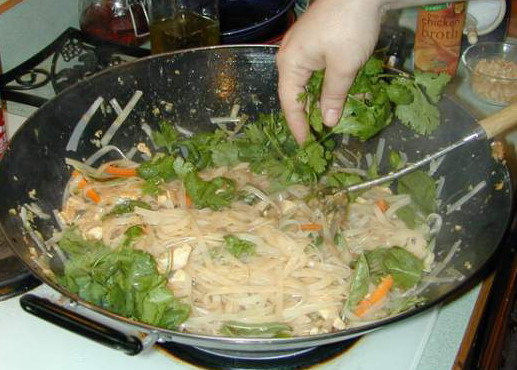
Barbara’s Ever-Changing Pad Thai
Ingredients:
3 tablespoons peanut oil
1 2†cube of fresh ginger, peeled and sliced
5 large cloves fresh garlic, peeled
3-5 shallots, peeled and cut into halves
2 Thai dragon chiles, or 3-5 Thai bird chiles (this is all to taste)
1/4-1 teaspoon red chile flakes (optional)
1 boneless, skinless chicken breast, sliced paper thin
1 tablespoon fish sauce
1/2 tablespoon cornstarch6-10 fresh shiitake mushrooms, stems removed, caps thinly sliced
1 pkg 1/4″ thick rice noodles, soaked in warm water until softened, and drained
Fish sauce
1/2 cup chicken broth
1 1/2 tablespoons tamarind concentrate
1-3 teaspoons raw sugar or palm sugar–to taste
3 tbsp. oyster sauce (Amoy Premium with Scallops is -really- stellar in this)
zest and juice of one lime
1 bunch holy basil or regular basil, leaves removed from stems
½ bunch cilantro, leaves removed from stems
1 bunch scallion tops (green part) cut diagonally into 1†pieces
1/2 cup unsalted roasted peanuts, lightly crushed
Method:
In a food processor, grind ginger, garlic, chiles, chile flakes and shallots into a paste. (The Sumeet grinder rocks at this function.)
Toss and marinate chicken in fish sauce and cornstarch for at least twenty minutes.
Heat wok large enough to hold everything. When it is smoking, add oil, heat for a few more seconds, then add paste, and stir and fry about one minute. Add chicken and stir and fry until the most of the pink is gone. Add mushrooms, then fish sauce to taste.
Add rice noodles, and a bit more oil of necessary. Stir and fry until the noodles become a bit limp, watching that they don’t stick too much to the bottom. Add more fish sauce, the broth and tamarind concentrate, and simmer a bit, stirring the noodles until they soften nicely.
Add the oyster sauce stirring to combine.
Add juice of lime, lime zest and herbs, stirring just until herbs and scallion tops wilt.
Sprinkle with peanuts, stir once more and serve.
Winner of the Menu for Hope II Raffle
Pim announced the raffle winners for the Menu for Hope II raffle yesterday.
Wendy Schaffer is the lucky winner of my donation: a copy each of Fuchsia Dunlop’s Land of Plenty Sichuan cookbook and Henry Chung’s Hunan Style Chinese Cookbook.
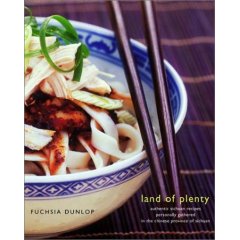
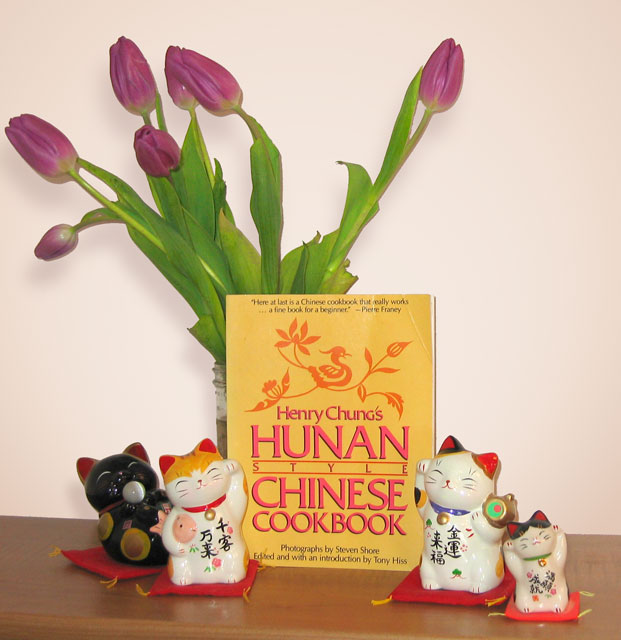
So, the next step is yours, Wendy. In order for me to send these lovely books off along with a packet of Sichuan peppercorns and some Tien Tsin chiles, I need your mailing information. Give me a holler here on the blog, or email me so I can get your goodies to you, and thank you so much for helping the food blogging community raise over seventeen thousand dollars for the victims of the Kashmir earthquake.
Culinary Cultural Appropriation
This post could have a subtitle: “Getting Over Myself.”
Indeed, it is likely that I could have simply called it “Getting Over Myself” in the first place.
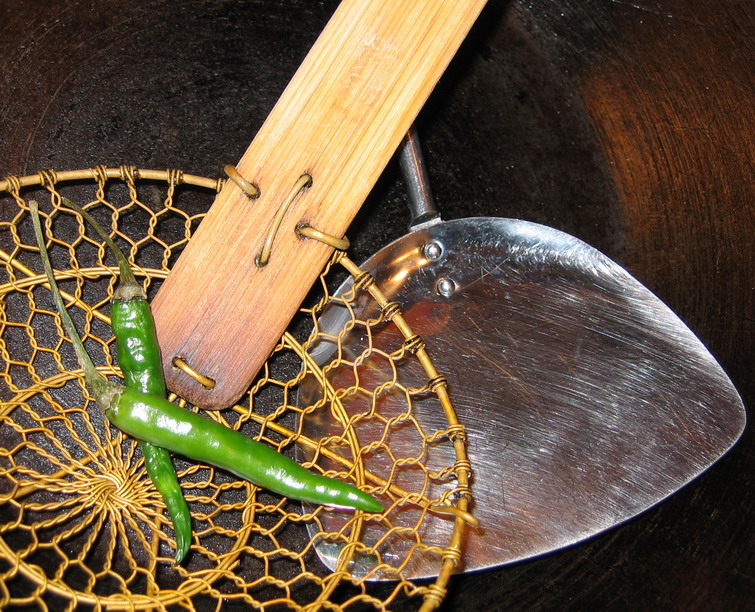
In the past, in fact, just as recently as a few months ago, I felt odd about posting about my explorations on Chinese food, including recipes that I had developed by working out of various out of print cookbooks. I have always felt somewhat odd teaching Chinese, Thai and Indian cooking, in large part because I am not a part of any of those cultures.
I will never forget the first publicly offered class I taught in Columbia, Maryland. I was teaching how to make various dim sum specialties, including steamed dumplings, potstickers, and spring rolls, and I was intensely nervous. I puttered around the high school home economics classroom where the class was to take place, finishing up the last of my prep work. I heard brisk footsteps clicking up the hallway, and I looked up just in time to see my first student pop in the door.
She was a tiny, smiling Chinese-American woman.
She stopped in her tracks, blinked and then blurted out, “You’re not Chinese.”
I swallowed hard, nodded slowly and said. “Nope. But you are.”
She came up more slowly to me, her head tipped to one side. “I mean,” she said, “Fisher is not exactly a Chinese name, but I thought, maybe, hey, maybe she’s married an American.” She blinked right in front of me, and smiled. “But you are definately not Chinese at all.”
“Nope, not at all.” I guestured at my red hair and green eyes and shrugged. “One cannot look much more gwailo than I do,” I quipped with a wink and a lopsided grin.
To my delight, she smiled and giggled. “Yeah, redheaded Chinese women are not exactly thick on the ground, are they?”
Then, we shook hands and I explained exactly how I learned how to cook Chinese food. I explained about my experiences working in a Chinese restaurant years before, and how I had become fascinated with the homestyle food the employees ate after hours, and had applied myself to learning as much as I could about Chinese food through strict study, trial and error, tasting as much good Chinese food as possible and trading recipes with Asian friends and faculty in culinary school.
By that time, other students had begun to trickle in, and a significant minority of them were Chinese or Asian American of some derivation. So, as I introduced myself before starting class, I included my experiences in learning Chinese cookery by way of explaining my status as cooking instructor.
At the end of class, as I cleaned up the kitchen, three of the Chinese-American students came forward, including my very first student, and thanked me graciously for the class and complimented my cooking. All of them said that at first, upon seeing that I was not Chinese, they were wary, but after they listened to my instruction and more importantly, tasted the results, they were convinced that they should take as many classes as I offered.
And they did. One of them finally told me that she was very happy to learn to cook dishes like her grandmother had cooked, but which she had, as a young teen and adult, neglected to learn before her grandmother died.
Understanding that the fruits of my obsession with Chinese cooking and food had become important links to some of my students’ past and formerly neglected culture settled over me like a cloak, and I felt a very strong sense of responsibility. As the years have passed this feeling of responsibility has strengthened to the point that when I learn especially rare or old recipes, I feel compelled to share them with others, as a way of preserving knowlege that might otherwise be lost.
I think that any loss of culture is a very sad thing, and so, I rush to preserve that which is endangered by the hustle and bustle of modern Western lifestyles where cookery is not valued as once it was, and the time spent on it is often devalued by the larger popular media culture.
One thing that I have been happy to hear from readers, especially Asian readers, is that I have become inspirational to them. When a reader tells me that they are inspired to learn more about Chinese cooking, my resolve to continue my study of Asian culinary arts is strengthened further. I often recieve emails or comments on how my fearless experimentation and study in Chinese food has caused readers to step into their own kitchens and once again, try the cooking they grew up with.
Every time I hear these things, I smile, because I believe that if I my passion for Chinese food can change the lives of just a couple of people, then my writing is accomplishing something good in the world. If by my words, pictures and instruction, I can interest others in exploring their own culinary traditions, then, I have served a greater purpose than just writing for the love of it.
I didn’t realize, however, that it was only white folks like myself who worry about cultural appropriation.
I am very sensitive to cultural appropriation because I am in part, of Native American descent (along with a lot of German, English, Irish and a touch of French and Dutch for good measure) , and have made study of Native American history and culture.

The story of the Native Peoples of North America is one of cultural and physical genocide, broken treaties, hostilities, and now, with the popularity of New Age philosophies and religions, shameless cultural appropriation. It is nearly impossible to make a serious study of Native history without becoming sensitized to the issue of cultural appropriation, which has to do with members of the dominant culture adopting aspects of Native culture, particularly in the realm of spirituality and religion, music and dress, without respect for the wishes or feelings of those people whose culture is being stolen or misrepresented. It is particularly bad in the New Age spiritual communities where white pretenders will sell their services, spiritual practices and crafts, which are often mishmashes of very twisted and confused bits and pieces of Native culture stolen and made shallow. These New Age practitioners make large amounts of money by selling to a gullible public stolen or fictitious practices that are supposedly Native American traditions handed down from “the ancestors.”
I generally do not look Native American; too many of the German and English genes were expressed to do much but give me very high cheekbones and eyes that have slight epicanthic folds. This complicates my involvement with Native American culture–I always worry that I am not “Indian” enough to lay claim to any feelings on issues regarding Native Americans, and so when I attend powwows or listen to white people talk about Native issues, I always feel as if I am not able to really speak with any authority regarding Native American experience.
You can imagine, then, how I sometimes feel when I teach Chinese or Thai cooking. For all that I am of Native descent, yet do not feel “Indian enough” to lay true claim to that experience, how dare I set myself to teach Chinese cooking when I am not Chinese at all?
Or Thai.
A post that I found on Notageek.org opened my eyes to members of the Chinese-American community who have similar feelings to my own in regards to cooking, culture and appropriation. The author of the post, who credits reading my blog to her learning how to cook Chinese food well, says she often doesn’t feel “Chinese enough,” as she, too, is of mixed descent. And, like my on again, off again inhibitions on teaching Asian cooking due to my own feelings of not being Asian at all, she felt hindered in her ability to learn to cook and enjoy Chinese food.
She says, “But if a hillbilly gal can cook Chinese food well and unapologetically, there is no need for me to be a shrinking violet either.”
Knowing that I had helped a kindred spirit stand up and own her own culture, and her own abilities in the kitchen made me very happy. I hadn’t really thought about Asian-Americans of mixed descent having the similar feelings that we of mixed Native blood had regarding participation in our cultural heritage, but now, I realize that I should have understood this. Whenever there is a cultural diaspora, as there has been with Chinese culture in the West, there will be people who are to differing degrees, of Chinese extraction. And thus, their relationship to Chinese culture will be complex.
Cultural appropriation is also a complex issue, and one that has no black or white rules. What is obviously culturally insensitive and inappropriate in one context is considered, if not perfectly proper, then, acceptable, in other contexts. When we live in a culture like the post-modern, primarily urban United States, where intermarriage between cultures is becoming a norm, blended families celebrating and passing on different cultural traditions are going to exist. This is bound to change not only the mainstream media-centered culture of the United States, but it is also going to go in the opposite direction and make changes to the minority cultures which come together to make up the larger culture.
When I look at it that way, and realize that I have been very careful in my research and kitchen experimentations with Chinese food to present what I have learned in as respectful and positive a light as possible, then I begin to let go of my fear that I am simply exoticizing Chinese cooking and culture and appropriating it.
In letting go of this fear, I hope that I can further my goal to help more people become aware of the beauty and complexity of Chinese food culture as it exists currently in the United States and elsewhere.
And, if, along the way, I help some folks reclaim their own food culture, well, then–my work has all been toward the good.

Categories:
- Admin (rss) (55)
- Blogs and Blogging (rss) (81)
- Book Reviews: Cookbooks (rss) (43)
- Book Reviews: Non-Cookbook Food Books (rss) (38)
- Cats and Cat Blogging (rss) (47)
- Chinese Cooking Lessons (rss) (32)
- Culinary School Stories (rss) (18)
- Dairy Pruducts: Cultured and Barbaric (rss) (4)
- Documentary Filmmaking (rss) (1)
- Essays, Rants and Reflections (rss) (260)
- Fighting Hunger (rss) (12)
- Food and Kids (rss) (45)
- Food in the News (rss) (126)
- Food Media (rss) (98)
- Food Preservation (rss) (18)
- Food Safety (rss) (45)
- Gardening (rss) (30)
- Herbs and Herb Blogging (rss) (20)
- Holidays (rss) (50)
- Kat Blogging (rss) (22)
- Kitchen Science (rss) (36)
- Leftover Makeover (rss) (8)
- Life, the Universe and Everything (rss) (131)
- Local and Sustainable (rss) (227)
- Local Athens Food and Foodies (rss) (42)
- Meatless Mondays (rss) (32)
- Menu For Hope (rss) (5)
- Nutrition, Diet and Health (rss) (84)
- On The Farm (rss) (8)
- Recipes: Almost Vegetarian, Vegetarian and Vegan (rss) (294)
- Recipes: American Regional (rss) (37)
- Recipes: Appalachian Hillbilly (rss) (33)
- Recipes: Bread, Pasta, Grains (rss) (95)
- Recipes: Canning and Preserving (rss) (8)
- Recipes: Chinese (rss) (123)
- Recipes: Comfort Food (rss) (120)
- Recipes: Cookies (rss) (16)
- Recipes: Desserts (rss) (48)
- Recipes: French (rss) (25)
- Recipes: Fruits and Vegetables (rss) (302)
- Recipes: Greek, North African and Middle Eastern (rss) (31)
- Recipes: Indian (rss) (137)
- Recipes: Italian (rss) (42)
- Recipes: Japanese (rss) (7)
- Recipes: Jewish (rss) (4)
- Recipes: Korean (rss) (6)
- Recipes: Meat, Poultry and Fish (rss) (220)
- Recipes: Mexican/Native American/ Latin American/Caribb (rss) (27)
- Recipes: Original (rss) (108)
- Recipes: Thai (rss) (27)
- Recipes: Tofu (rss) (17)
- Recipes: US Regional (rss) (16)
- Recipes: Vietnamese (rss) (8)
- Restaurant Stories (rss) (28)
- Sewing, Quilting, Arts and Crafts (rss) (16)
- Simple Chinese Recipes (rss) (30)
- Slow Food and Heritage Foods (rss) (10)
- Spice Blogging (rss) (44)
- The Chinese Cookbook Project (rss) (14)
- The Chinese Pantry (rss) (39)
- The Documentary (rss) (2)
- The Kitchen Saga (rss) (17)
- The Locavore's Bookshelf (rss) (15)
- The Unsung Adventures of The Culinary Nerd (rss) (6)
- Tools and Toys (rss) (35)
- Uncategorized (rss) (10)
- With a Side of Politics (rss) (48)
Archives:
- August 2012 (9)
- July 2012 (12)
- September 2011 (3)
- August 2011 (7)
- July 2011 (8)
- June 2011 (16)
- May 2011 (17)
- April 2011 (11)
- December 2010 (9)
- November 2010 (5)
- February 2010 (1)
- December 2009 (5)
- November 2009 (7)
- October 2009 (10)
- September 2009 (16)
- August 2009 (14)
- July 2009 (14)
- June 2009 (7)
- May 2009 (17)
- April 2009 (10)
- March 2009 (25)
- February 2009 (13)
- January 2009 (10)
- December 2008 (5)
- November 2008 (5)
- October 2008 (6)
- September 2008 (13)
- August 2008 (8)
- July 2008 (11)
- June 2008 (18)
- May 2008 (13)
- April 2008 (14)
- March 2008 (16)
- February 2008 (17)
- January 2008 (19)
- December 2007 (25)
- November 2007 (18)
- October 2007 (24)
- September 2007 (16)
- August 2007 (15)
- July 2007 (15)
- June 2007 (10)
- May 2007 (14)
- April 2007 (16)
- March 2007 (17)
- February 2007 (20)
- January 2007 (13)
- November 2006 (1)
- October 2006 (8)
- September 2006 (14)
- August 2006 (25)
- July 2006 (30)
- June 2006 (28)
- May 2006 (34)
- April 2006 (29)
- March 2006 (24)
- February 2006 (30)
- January 2006 (38)
- December 2005 (40)
- November 2005 (37)
- October 2005 (32)
- September 2005 (25)
- August 2005 (30)
- July 2005 (28)
- June 2005 (21)
- May 2005 (8)
- April 2005 (22)
- March 2005 (17)
- February 2005 (29)
- January 2005 (10)
Search Site:
Links:
- Lily’s Wai Sek Hong
- 101 Cookbooks
- A cat in the kitchen
- A Veggie Venture
- Accidental Hedonist
- Cha Xiu Bao
- chez pim
- Chocolate & Zucchini
- Chopstick Cinema
- Chowhound.com
- Chubby Hubby
- Cook sister!
- Cooking with Amy
- da*xiang
- Eat Local Challenge
- Eating Liberally
- Ecocentric
- Eggbeater
- Epicurious
- Farmgirl Fare
- Fatfree Vegan
- Foodgoat
- ForkandBottle.com
- Green Olive Tree
- Hooked on Heat
- Jaden’s Steamy Kitchen
- Kalyn’s Kitchen
- Lucullian delights
- Mahanandi
- Matt Bites
- MeatHenge
- mmm-yoso!!!
- New York Times – Dining & Wine
- Pizza Goon
- Rasa Malaysia
- Ruhlman
- Sailu's Kitchen
- Serious Eats
- SF Gate: Food & Dining
- Simply Recipes
- Soul Fusion Kitchen
- Tastespotting
- The Amateur Gourmet
- The Cleaner Plate Club
- The Food Section
- The Grub Report
- thecookscottage
- U.S. Food Policy
- Wandering Chopsticks
- Washington Post Food and Dining
- Wasted Food
Meta:


Powered by WordPress. Graphics by Zak Kramer.
Design update by Daniel Trout.
Entries and comments feeds.