
Cook Local, Eat Global
Lamb, Gai Lan and Three Peppers
Once I discovered that stir fried lamb flank steak is delicious when I made the Beijing Stir Fried Lamb, Leeks and Cilantro, I knew I would have to experiment with the concept again.
And since I had another three quarters of a pound of the little steaks in my freezer, and about one half pound gai lan in the refrigerator, the pairing seemed inevitable.
Actually, I figured that the strong, somewhat bitter quality of this particular bunch of gai lan would be a nice counterpoint to the sweet richness of lamb.
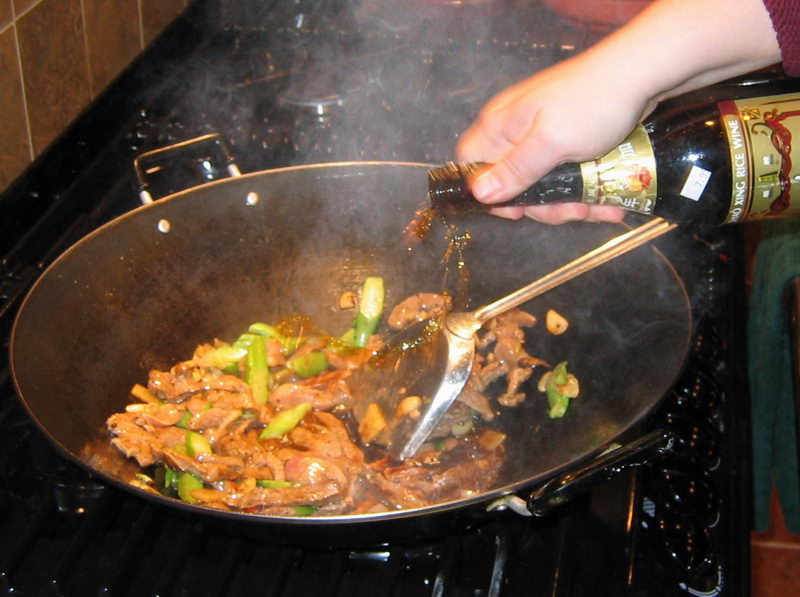
The gai lan was particularly pungent and reminiscent of mustard, so I decided to add a good bit of Shao Hsing wine to the stir fry to help tame the greens and boost the lamb’s sweet flavors. Sichuan peppercorns, black pepper and chile were added as well–I decided to make a Sichuanese sort of medley of very strong flavors rather than go the Cantonese route of allowing one or two strong flavors to dominate in a singular balance.
Knowing as I did that vinegar is a good counterpoint to bitter flavors–I grew up using cider vinegar to dress cooked kale, after all–I used about a teaspoon and a half of it in the marinade for the lamb. I added a teaspoon of hoisin sauce while the lamb cooked to boost the sweetness of the dish while adding complexity and a deep, dark richness to the sauce. Sugar alone will only bring simple sweetness to the flavor, while hoisin sauce adds a mysterious note that is pleasant, but difficult to place, especially if the cook is restrained in its use.
(By the way, hoisin sauce and chiangking vinegar feature in many versions of the famous Kung Pao Jiding.)
When it was done, I had to admit to liking this dish quite well, but I think that I prefer the lamb with leeks. Zak and Morganna both disagreed, however, as neither of them are as fond of leeks as I am. However, I liked the purer, clearer flavors of that dish, even though I thought the Sichuan peppercorns really made the lamb with gai lan pretty exceptional.
So–I will be making something akin to this again–maybe I will compromise and add some gai lan and Sichuan peppercorns to the original leek and lamb recipe and see if I can please everyone that way.
If not–well, there are two very hot burners on the stove, and I have more than one wok. Maybe I can cook one version for myself and Morganna can cook one for her and Zak.
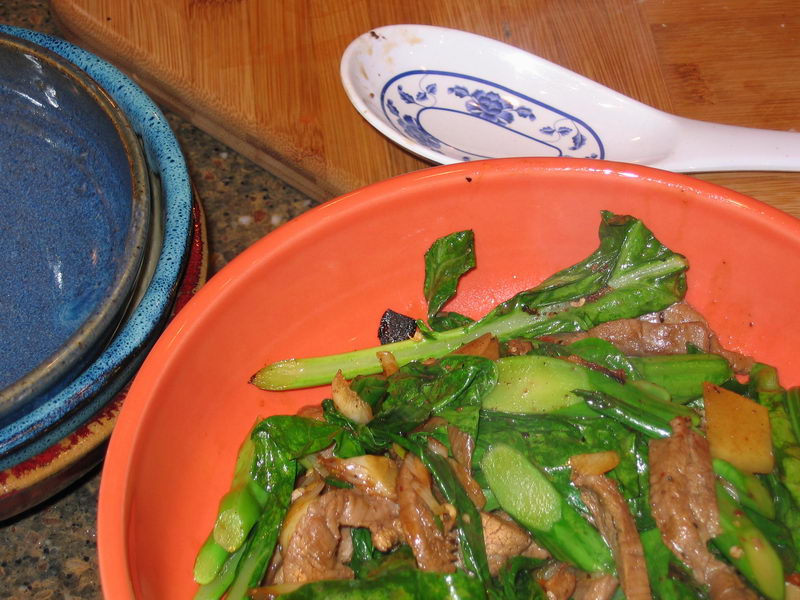
Lamb and Gai Lan with Three Peppers
Ingredients:
3/4 pound lamb flank steaks, silverskin removed and cut into 1/4″ wide strips
1 teaspoon dark soy sauce
1 1/2 teaspoons chiangking vinegar
1 1/2 tablespoons cornstarch
3 tablespoons peanut oil
1/2 teaspoon Sichuan peppercorns, toasted, ground
1/4 teaspoon freshly ground black pepper
2 fresh ripe red jalapeno peppers (or to taste)
3 cloves garlic, sliced thinly
1/2″ cube fresh ginger, peeled and thinly sliced
2 tablespoons Shao Hsing wine
1/2 pound gai lan, washed–leaves and small stems trimmed, and large stems cut into thin slices
1 teaspoon hoisin sauce
2 tablespoons chicken broth
Method:
Toss lamb with soy sauce, vinegar and cornstarch. Marinate for at least twenty minutes.
Heat wok until it smokes. Add oil and heat until it shimmers in the pan. Add sichuan peppercorns, pepper, chiles, garlic, ginger, and stir fry until very fragrant–about thirty to forty seconds. Add meat, reserving any liquid that is left in the bowl. Spread into a single layer on the bottom of the wok and allow to brown for about forty to forty-five seconds, then stir fry briskly.
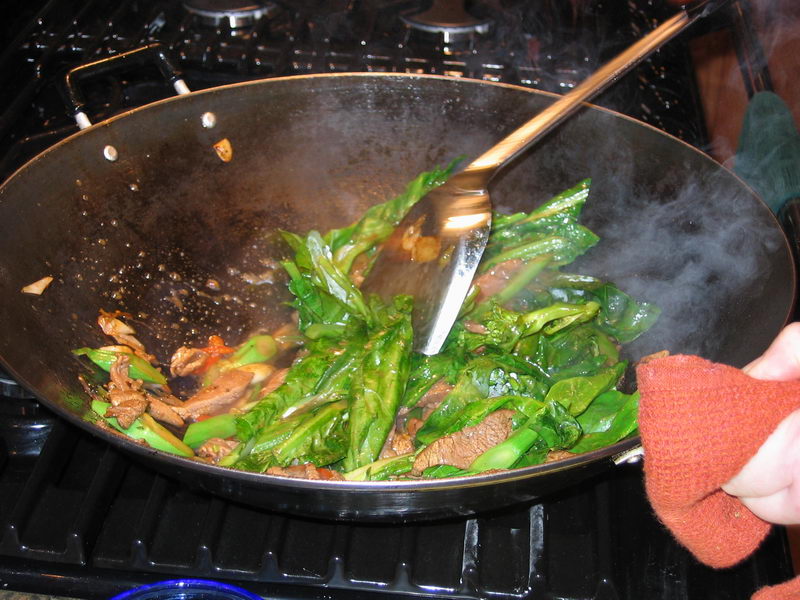
As a bit of the marinade ingredients begin to stick to the wok and brown, add Shao Hsing wine and deglaze the wok, then toss in gai lan stems. Keep stir frying for about forty more seconds, add the leaves of the gai lan and the hoisin sauce and chicken broth and continue stir frying until leaves grow limp and darken to a rich, shiny green, and the sauce reduces and clings tightly to the meat and greens.
Dry Frying Illustrated
I really like my new stove.
It allows me to properly dry fry string beans without taking for bloody ever about it.
That is so terribly cool.
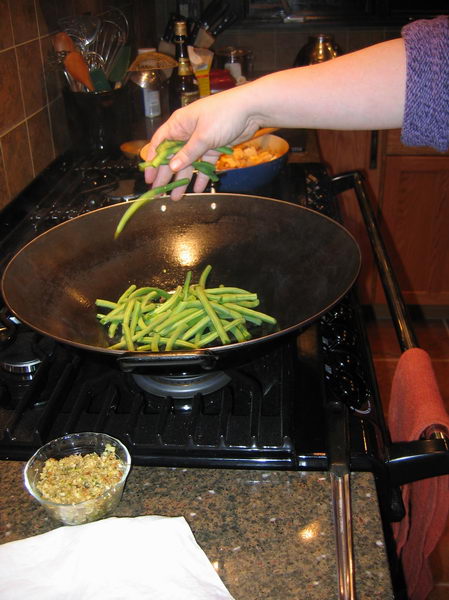
Dry-frying (gan bian) is one of six uniquely Sichuanese cooking techniques that Fuscia Dunlop covers in her cookbook, Land of Plenty. It involves food cut into slivers or thin strips stirred continually in a wok with a very small amount of oil over a medium high flame until the food is dried out slightly, browned in places and is quite fragrant. This technique imparts an interesting texture to foods, and contributes a great amount of “wok hay” or “breath of the wok” to the dish. Seasonings are added late in the cooking process, often with a bit extra oil, and are cooked for a relatively shorter period of time.
“Four Seasons String Beans” is a classic dry fried dish that is often seen on menus in many American Chinese restaurants. They are also called Sichuan String Bean or Spicy String Beans with Minced Pork. They are one of my very favorite “cai” dish to go with “fan.” Fan is rice–and cai are what you eat with rice to flavor it a bit.
Since the seasonings for the string beans are quite strong, you need only a little bit of it to flavor a lot of rice. I season my beans with minced pork, ginger, garlic, fresh chile, Sichuan preserved vegetable and soaked dried shrimp.
To make it, I grind or mince up the seasonings all together–and I will cheat and use my small food processor to accomplish this if my carpal tunnel syndrome is acting up–and leave them in a bowl together. I have my beans strung and with just the ends snapped off, and I put the pork into a bowl by itself. I like to use 3/4 of a pound of beans to 1/4 pound of pork.
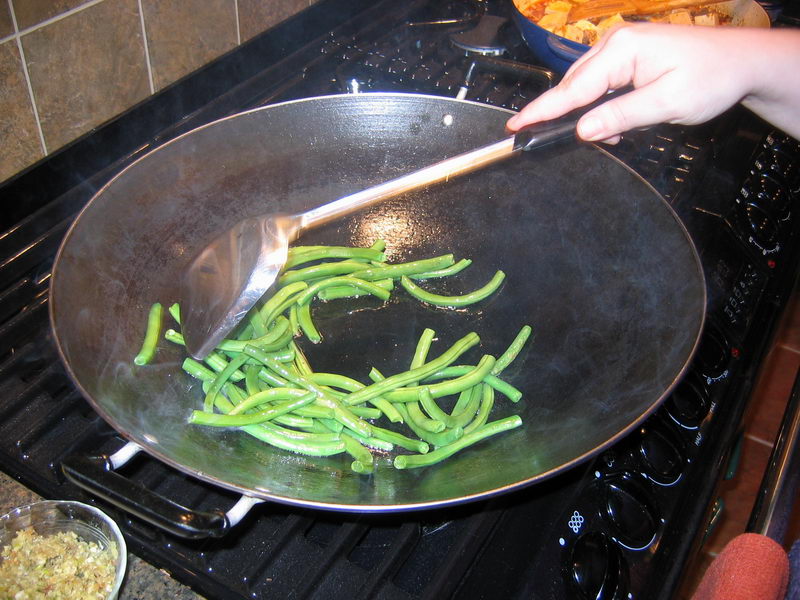
Then, I heat up the wok and wait until it smokes, then add barely a tablespoon or two of peanut oil. When the peanut oil smokes, in go the beans. It is very important after rinsing beans to dry them thoroughly before putting them into the wok with smoking hot oil. That is, unless you want your forearms and possibly your face speckled with little freckle-sized burn marks.
Yes, I am speaking from direct, painful and irksome experience.
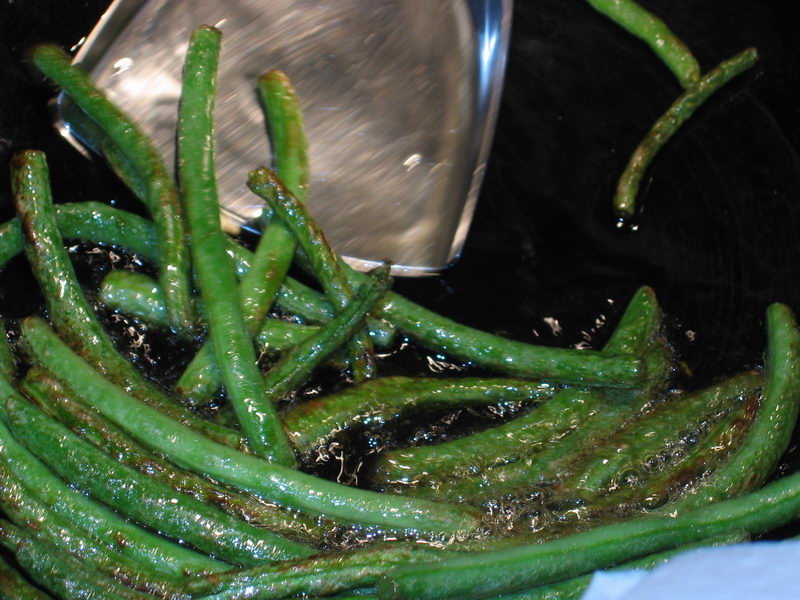
At this point, you stir and toss and stir and toss the beans until they begin to shrivel up, dry out and get some browned spots developing on their skins. What happens is the water cooks out slowly and the flavor of the beans is enhanced as the water is shed as steam. It changes the texture greatly as well–instead of being crisp like properly stir-fried beans, these are chewy and tender without being mushy and boring.
Many restaurants attain the same texture in a much shorter period of time by dunking the beans into a deep fryer for a couple of minutes. I do not recommend doing this at home, however, as deep frying is a messy, smelly business and if all you want is a few beans to eat with your rice–why take the trouble to heat that much oil, cook it and then strain and rebottle the oil for future use? Or, worse, just throw it away? Not only is it a waste of time and energy to deep fry these beans at home–it is unnecessary and adds a lot of extra calories to the dish. So–do like me and dry fry.
Once the beans are fully fried, I drain them on paper towels and let them rest while I dump my bowl of seasonings into the wok, and turn the heat up full blast and start stir frying like mad. After only about thirty seconds, in goes the minced pork, and with a lot of noisy chopping motions with the wok shovel, I brown the meat until nearly all of the pink is gone, and then back into the wok go the beans, along with a drizzle of thin soy sauce. With a few more tosses and stirs, the dish is finished, and I give it a tiny drop or two of sesame oil.
That is all there is to it. It is a simple technique that can be used on beef, bitter melon, eggplant or string beans to great effect.I did it on my other stoves, and it worked fine, but it took sometimes ten to nearly fifteen minutes to accomplish because of the low amount of heat that the stoves generated. With my new stove, the dish is very fast to cook–about eight minutes from beginning to end–not counting prep time of course.
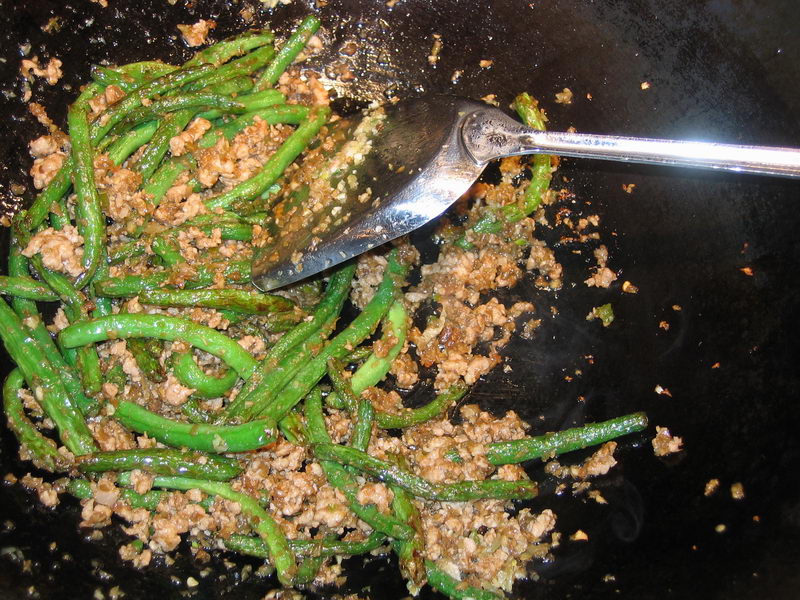
Sichuan Dry Fried Green Beans
Ingredients:
2 tablespoons peanut oil
3/4 pound green beans, stringed, with ends snapped off, rinsed and dried
1/2 tablespoon tiny dried shrimp, soaked and minced
3 cloves fresh garlic, peeled and minced
1″ cube fresh ginger, peeled and minced
1 or 2 fresh Thai bird chiles, minced
3 tablespoons Sichuan preserved vegetable (radish), rinsed and minced
1/4 pound minced pork
1 tablespoon thin soy sauce
2-3 drops sesame oil
Method:
Heat wok on medium high heat until it smokes. Add peanut oil, and heat until it is nearly smoking.
Drop in green beans–make sure they are dry! Stir and fry until the beans dry out, shrivel slightly and begin to char to a dark brown in spots. Remove when they are quite wrinkled and somewhat charred, and drain on paper towels.
Crank heat up to high and add all minced seasonings except pork. Stir and fry thirty seconds until very fragrant. Add minced pork, and stir with a chopping motion with the wok shovel to break it apart. Cook this way until almost all of the pink is gone–put beans back into wok. Stir and fry for ten seconds to blend, then add soy sauce and continue stir frying until all pink is gone.
Remove from heat, stir in sesame oil.
Shopping for Foodies
The title to this post coud be “Why I Like Sur La Table better than Williams-Sonoma,” but it isn’t, because in truth, I prefer a different kind of cookware store altogether than either of the afformentioned choices.
I like eccentric, locally-owned places with crowded shelves that bow under the weight of so much cast iron, you could melt it all down and make a battleship. I like to see gadgets hanging in untidy array against a far wall, with banneton and baskets dangling from rafters. I like places that are so filled with color and cookware in glorious array in a cramped space that one fears to move too quickly, lest one knock over a teetering tower of obscurely shaped specialty copper pans and engulf the little lady who is examining a larding needle with great intensity.
Such places do exist outside of my imagination: The Kitchen Emporium in Westerly, Rhode Island is one such dream shop for culinary adventurers.
Another sort of independantly owned kitchen shop that I like is one that is beautifully appointed, with an eclectic selection of only the best of the best cookware and serving pieces, with cutlery displayed like sabres in a wall case and artistically arranged merchandise that is as functional as it is beautiful. When stepping into that sort of shop, one should not be surprised to see local chefs in their whites perusing a selection of peppermills or testing the edge of a folded-steel santoku from a master knife maker in Japan.
In Columbus, in the Short North neighborhood, there is such a shop. The Cookware Sorcerer stands among art galleries and specialty boutiques, and is something of a gallery itself. Stepping into it, I cannot help but feel my voice lighten as I whisper, fingers lightly caressing hobnailed tetsubin and smooth butcher blocks from John Boos.
But, unless you are lucky enough to have a shop like one of these near you, the most likely places one is to go to find specialty cooking items (other than the Internet!) is a local Sur la Table or Williams-Sonoma. And while you are bound to get better prices by shopping the ‘net, sometimes, one needs to look at the glaze on a stoneware garlic keeper with one’s own eyes, or feel the heft of a cast iron skillet, or test drive a chef’s knife with a carrot to know its balance and handling before making an investment in one’s own or a friend’s kitchen arsenal.
Yesterday was a day for such shopping, and since we were in the neighborhood, I stopped by at Sur la Table. Here is where I have to admit to my utter and complete preference for Sur la Table over Williams-Sonoma, and also inform readers that I am an independant contractor who teaches cooking classes through Sur la Table’s culinary program.
I do want to make it clear that the reason that I prefer Sur la Table has nothing to do with the fact that they sometimes pay me money to teach people how to cook Asian food. Rather, it is the other way around–I have never applied to teach at Williams Sonoma, because I prefer the atmosphere at Sur la Table.
Why do I like Sur la Table, which is, after all, a chain, rather akin to Williams-Sonoma, when once I used to worship at the altar of the Williams-Sonoma digest-sized catalog, sighing at the illustrations of chef’s knives and tart pans?
It comes down to several things, really.
First of all, is diversity. Sur la Table sells more of a variety of different, interesting things than Williams-Sonoma does. I don’t cook just American regional or French or Italian food. I tend to cook mostly Asian food, and because of that, most of what Williams-Sonoma is geared toward is way out of my realm of interest. If there are not woks, cleavers and bamboo steamers hanging about, I am not likely to be as interested in any given shop. In addition, I like to look at obscure items like tagines, aebelskiver pans, springerle molds and chocolate forks.
Williams-Sonoma just doesn’t carry all of these bizarre items, while Sur la Table does. And while the store is quite neat and tidy, its sheer volume of merchandise gives it a hint of the cluttered, overstuffed feeling that my dream kitchen shops (such as the Wok Shop in San Francisco’s Chinatown) have. There is just something in me that is made giddy by the attractions of precariously balanced cooking utensils that have the look of medieval Inquisitor’s tools.
Maybe it is because I am a packrat by nature and am not overly fastidious when it comes to tidyness, but for some reason, I like to see a wide array of somewhat jumbled merchandise, rather than a meticulously displayed modest selection.
Something about Williams-Sonoma is too clean and perfect to really get me interested. There is a very limited palette of color and style in the shop, and everything seems to scream, “Stuff that Yuppies Will Love.” Everything is neat as a pin and perfectly polished and the folks I see shopping in there don’t look like they cook very often. They are too perfectly coiffed and manicured to make me believe that they actually like to get down and dirty with their food.
And then there are the employees–the folks at Williams-Sonoma are rarely genuinely friendly. (There are exceptions–there was a Williams-Sonoma shop in Cranston, Rhode Island where the employees were great foodies, and very warm. They were fonts of information and were great to talk with.) Here in Ohio, there is a certain snootiness to the air of the Williams-Sonoma employee, and a need to explain everything to everyone, whether or not they need an explanation or not. I have also noted a lack of knowledge on the part of the employees here regarding the operation of and the use of various of the gadgets and appliances they are selling.
The folks who work at the Columbus Sur la Table, however, are very friendly and extremely knowledgeable. They are each and every one of them foodies to the core, and if they don’t know something about a bit of merchandise, they will run off and find someone who does, and when they answer questions, it is never with a superior air, but rather with the genuine desire to pelase.
Pricewise–I find the two to be similar, though the prices at Williams-Sonoma are pretty much universally higher. And while I can often get a better price for any given item at Sur la Table online, once shipping is calcuated in, as well as the wait, the price no longer seems so much of an issue.
So there we are–this is why I like Sur la Table better than Williams-Sonoma.
But the truth is–I prefer any number of the independant cook’s shops even better, and prefer to browse and shop in such places when I can.
There just isn’t one near me.
Weekend Cat Blogging: Seven Little Kitties….
sleeping in the bed, and the little one said, “Roll over! Roll over!”
So they all rolled over and one fell out, there were six in the bed and the little one said, “Roll over! Roll over!”

There were five in the bed….you get the idea.
I don’t know how many of you know that counting song–it starts at ten, and it is usually bunnies, but in my house, it starts at seven and it is kitties.

Of course, the way the song ends is, “There was one in the bed, and the little one said, “Goodnight!”
However, there is seldom ever only one kitty in my bed.
There is always at least two.

And while my kitties have you here, looking at their cute fluffiness, they want me to remind you of the folks in Kashmir who lost homes and loved ones in the earthquake. They’d very much like it if you stopped by at Chez Pim and click on one of the links to her Menu for Hope campaign to raise funds through UNICEF for these folks. So far, the campaign has raised over $6,500 dollars , and more food bloggers are participating every day. Pim had some technical difficulties, but she is back and better than ever, so my kitties tell me (they get up and read the Internet before I do–or at least, they get up and sit at and on my desk before I do).
From the North of India: Korma
One of my chiefest joys in teaching cookery is that I can help foster cultural awareness and understanding for people from different lands in my students. In the process of opening their palates to new flavors, one has a chance to open the eager taster’s minds as well, to new and different ideals and philosophies.
I take this chance whenever it is presented to me.
Morganna has been following in my footsteps; this semester in school, she took a class called “World Foods,” which is a clever way to get kids to take Home Economics and learn to cook by presenting basic culinary skills in the context of learning a variety of international foods. Each semester, the students pick the ten countries they most want to learn about, and then ten different menus are presented in the course of the class, with each menu presented within the cultural context of the country. Students learn about the geography, dominant religions, holidays, agriculture, economic system and some of the history of each nation they study, and then they split up into teams and cook dishes representative of that country.
In addition, each student chose a country to do an in depth project on that included a research paper, oral presentation with visual aids, and a dish typical of the country to share.
Morganna chose to do India, and the dish she decided to prepare and present was Chicken Biryani.
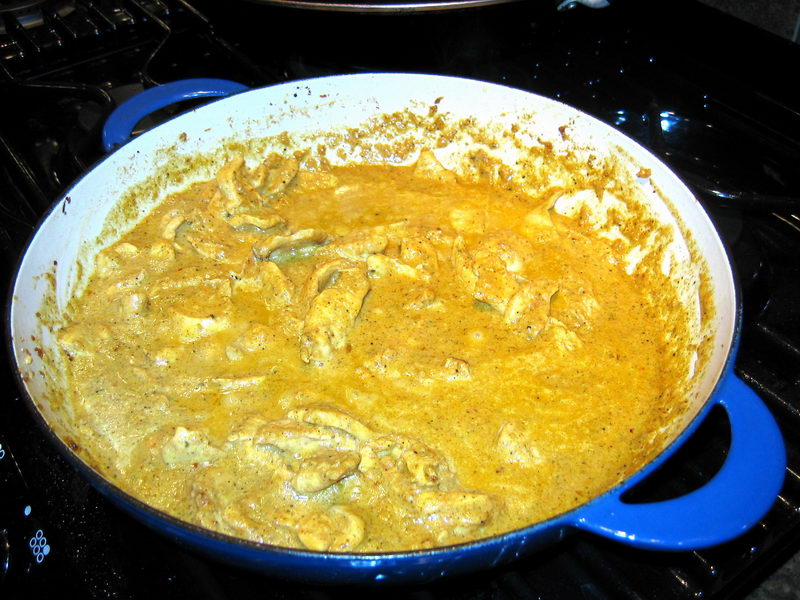
However, in order to cook a biryani, which is a dish which consists of meat and rice cooked together, one must first make a korma, which is a rich dish of meat, fowl or vegetables braised in a creamy sauce based on ground nuts or dairy products such as yogurt or cream, or a combination of any of the three. Once the korma is made, the traditional and proper means of making a biryani is to partially cook basmati rice in boiling water, drain it, and then layer it in a casserole with the korma and sprinklings of saffron-tinted and flavored milk. Then the casserole is tightly covered and cooked in a very slow oven until it is done.
Biryani, and for that matter, kormas, are dishes based on the very fancy and rich cookery of the Mogul courts. The Mogul Empire was established in northern India during the sixteenth century by Babur, a descendant of the fourteenth century Mongolian leader, Tamerlane. This empire flourished until the British overthrew them in 1857, though in truth, the power of the emperors had been in decline for a period of over one hundred years prior.
Under Mogul rule, art, architecture, literature, music, and all manner of cultural pursuits, including cookery advanced and flourished. This is the time period when Persian influences were brought into the Indian cookery tradition of the north, influences which can often be traced linguistically. For example, the word, “pillau,” which is used to denote a flavored rice dish, comes directly from Farsi, the language of Persia.
Persian influences on Indian cuisine include the use of fresh and dried fruits, nuts, ground spices and extensive use of dairy products in non-sweet dishes, particularly those including meat. (This does not meant that these ingredients are not used in sweet dishes at all–it is merely that I am pointing out that a hallmark of Persian influence is the use of these ingredients in savory meat-based dishes.)
I learned to make korma from cookbooks and from eating the excellent versions of korma to be had at Akbar in Columbia Maryland. I used my developing ability to unravel the flavors of various Indian spices to good effect every time we ate at Akbar, and I found that my korma improved every time I adjusted it to more closely resemble that which I had eaten at that restaurant.
I further refined it upon the instruction of my Pakistani personal chef client’s mother, and it was under her influence that my ability to make korma imroved by leaps and bounds. She was a very generous lady and was very happy to tell me how she cooked the dishes I ate at her home and her daughter’s home. When she tasted my efforts, she never stinted on praise and criticism, and itis through these discussions that I found myself growing more facile in Indian cooking techniques.
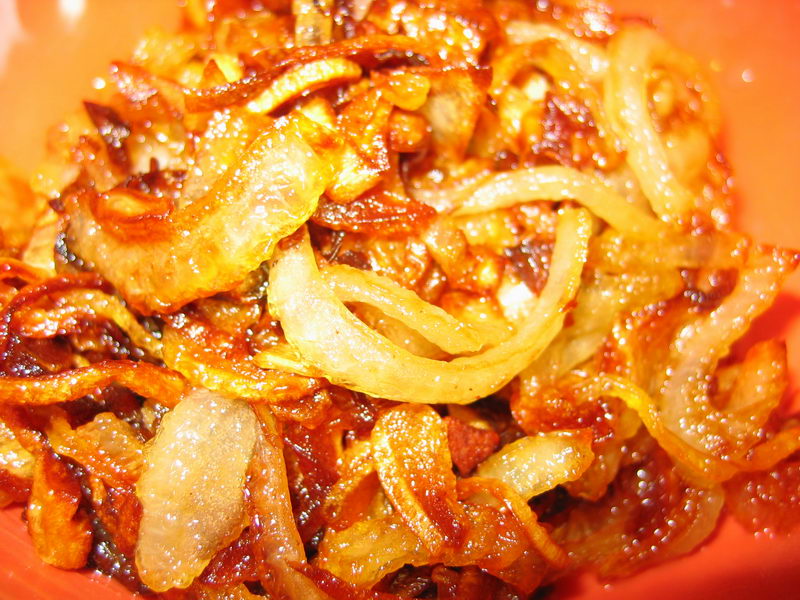
The one thing she praised effusively was my willingness and ability to deeply brown onions; she said that the one flavor that many Americans trying to learn Indian cooking tend to lose is the essential quality that is imparted to various dishes by perfectly browned, deep reddish-colored onions. She said that without these onions as a flavor base, many Americans make Indian food that turns out insipid and pale, lacking in character and strength.
So, every time I cook Indian food with Morganna, I am emphasize the importance of the completely browned onions, and she is learning to be tireless in standing over a pot of thinly sliced onions, stirring ceaselessly until they reduce down to a double handful of meltingly soft russet striings. For the korma, these are scraped from the pan, and added to the spices, garlic and ginger, to be ground into a paste. It is important to allow the cooking oil and ghee to drain from the onions before you grind them, because I use the highly flavored oil to cook the slivers of chicken. Doing this maximizes the browned onion flavor of the dish.
As we were cooking last night, Heather (who, with Dan, has just returned from the UK where they ate a lot of very good curries!) asked how I manage to cook the yogurt in the korma such that the yogurt does not separate and curdle into a mess.
There are several important points to consider in adding the yogurt to the dish. The first is to use only full-fat yogurt. If you use low fat, or even worse, nonfat yogurt, you run much more of a risk of the yogurt breaking down and curdling. The second is to mix the cream layer that is at the top of the full fat yogurt thoroughly into the the container, and then, gradually adding the yogurt to the dish, allowing it to cook down until it clings to the meat before adding a little more of the yogurt.
I add it in two tablespoon increments, until eight tablespoons total are used. Then, I add the heavy cream and allow it to simmer briefly to reduce the sauce to the clinging thickness that I find most appetizing.
Many korma include ground nuts as an enrichment to the sauce; cashews or almonds are most popular. Some restaurants use the nuts strictly as a garnish, sprinkling them over the finished dish. Sliced almonds scattered with fresh or dried rose petals or fresh pomegranate seeds are particularly pretty. Minced mint or cilantro leaves are also attractive. I know that my clients liked it when I presented korma with a sprinkling of freshly browned onions, cooked until barely crisp, along with roasted cashew halves.
However, since we were making this dish for a group of people whose food allergies we did not know, we left the nuts out of the recipe.
Chicken Korma
Ingredients:
2 tablespoons ghee or butter
1 tablespoon canola oil
1 large onion, thinly sliced
1/8 teaspoon salt
3 large garlic cloves, thinly sliced
1†cube fresh ginger, peeled and sliced thinly
1 tablespoon cumin seed
2 tablespoons coriander
3 whole cloves
¼ teaspoon ground cinnamon
1 teaspoon whole black peppercorns
1 bay leaf
½ small dried pakistani chile pepper (or to taste)
¼ teaspoon cardamom seeds
¼ teaspoon turmeric
½ teaspoon paprika
1 pound boneless skinless chicken breast, cut into thin slices 1â€X2â€x1/4â€
8 tablespoons full fat yogurt
1/3 cup heavy cream
salt to taste
toasted sliced almonds for garnish if desired
Method:
Heat oil and ghee in low, wide, heavy bottomed pan. Add onion, and salt, and cook, stirring constantly on medium heat until onions are dark reddish brown. Remove from heat and drain onions, leaving cooking fat in pan. Put onions into spice grinder, blender or food processor with spices, garlic and ginger and process into a smooth, dark brown paste.
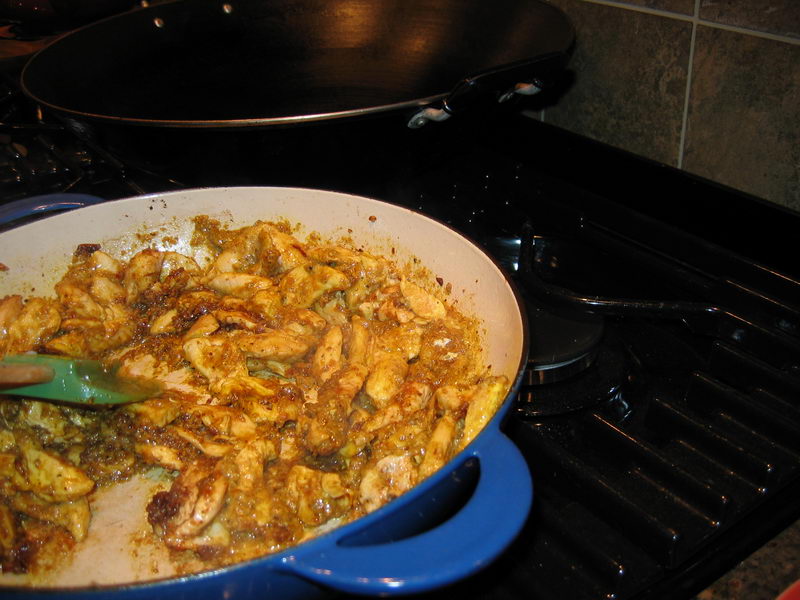
Heat oil and ghee in pan again, and when it is nearly smoking add chicken slices and spice paste, and cook, stirring, until most of the pink is gone from the chicken.
Add the yogurt, two tablespoons at a time, allowing it to cook down until it thickly coats the chicken, then add the next two tablespoons, and continue this process until it is all used up. Add the cream, and cook until the chicken is just done.
Add salt to taste.
Now on to the secret of a fast and easy biryani that is not in the least bit authentic, but it is the way my client’s mother and aunt told me. Instead of taking the half cooked chicken korma, and half cooked rice and putting them together with saffron milk and extra water into a casserole and baking it in a slow oven while, “Praying that everything gets done at the same time” as they said, one could simply cook the rice seperately with saffron, in a rice cooker, and then blend it with the korma after both are cooked, then garnish the dish lavishly as one would do for a real biryani. They said that when they wanted the taste of a biryani, but lacked the time and energy to cook it by the proper method, they would take this shortcut and that most people in their family could not tell the difference.
Whether you take this shortcut or not is up to you, however, I have to admit to using it last night when we made “biryani” for Morganna’s classmates. I might have insisted on the traditional method if I had not just cooked dinner, but as I was already tired, I cheated and used the easy method taught by my Pakistani friends.

Categories:
- Admin (rss) (55)
- Blogs and Blogging (rss) (81)
- Book Reviews: Cookbooks (rss) (43)
- Book Reviews: Non-Cookbook Food Books (rss) (38)
- Cats and Cat Blogging (rss) (47)
- Chinese Cooking Lessons (rss) (32)
- Culinary School Stories (rss) (18)
- Dairy Pruducts: Cultured and Barbaric (rss) (4)
- Documentary Filmmaking (rss) (1)
- Essays, Rants and Reflections (rss) (260)
- Fighting Hunger (rss) (12)
- Food and Kids (rss) (45)
- Food in the News (rss) (126)
- Food Media (rss) (98)
- Food Preservation (rss) (18)
- Food Safety (rss) (45)
- Gardening (rss) (30)
- Herbs and Herb Blogging (rss) (20)
- Holidays (rss) (50)
- Kat Blogging (rss) (22)
- Kitchen Science (rss) (36)
- Leftover Makeover (rss) (8)
- Life, the Universe and Everything (rss) (131)
- Local and Sustainable (rss) (227)
- Local Athens Food and Foodies (rss) (42)
- Meatless Mondays (rss) (32)
- Menu For Hope (rss) (5)
- Nutrition, Diet and Health (rss) (84)
- On The Farm (rss) (8)
- Recipes: Almost Vegetarian, Vegetarian and Vegan (rss) (294)
- Recipes: American Regional (rss) (37)
- Recipes: Appalachian Hillbilly (rss) (33)
- Recipes: Bread, Pasta, Grains (rss) (95)
- Recipes: Canning and Preserving (rss) (8)
- Recipes: Chinese (rss) (123)
- Recipes: Comfort Food (rss) (120)
- Recipes: Cookies (rss) (16)
- Recipes: Desserts (rss) (48)
- Recipes: French (rss) (25)
- Recipes: Fruits and Vegetables (rss) (302)
- Recipes: Greek, North African and Middle Eastern (rss) (31)
- Recipes: Indian (rss) (137)
- Recipes: Italian (rss) (42)
- Recipes: Japanese (rss) (7)
- Recipes: Jewish (rss) (4)
- Recipes: Korean (rss) (6)
- Recipes: Meat, Poultry and Fish (rss) (220)
- Recipes: Mexican/Native American/ Latin American/Caribb (rss) (27)
- Recipes: Original (rss) (108)
- Recipes: Thai (rss) (27)
- Recipes: Tofu (rss) (17)
- Recipes: US Regional (rss) (16)
- Recipes: Vietnamese (rss) (8)
- Restaurant Stories (rss) (28)
- Sewing, Quilting, Arts and Crafts (rss) (16)
- Simple Chinese Recipes (rss) (30)
- Slow Food and Heritage Foods (rss) (10)
- Spice Blogging (rss) (44)
- The Chinese Cookbook Project (rss) (14)
- The Chinese Pantry (rss) (39)
- The Documentary (rss) (2)
- The Kitchen Saga (rss) (17)
- The Locavore's Bookshelf (rss) (15)
- The Unsung Adventures of The Culinary Nerd (rss) (6)
- Tools and Toys (rss) (35)
- Uncategorized (rss) (10)
- With a Side of Politics (rss) (48)
Archives:
- August 2012 (9)
- July 2012 (12)
- September 2011 (3)
- August 2011 (7)
- July 2011 (8)
- June 2011 (16)
- May 2011 (17)
- April 2011 (11)
- December 2010 (9)
- November 2010 (5)
- February 2010 (1)
- December 2009 (5)
- November 2009 (7)
- October 2009 (10)
- September 2009 (16)
- August 2009 (14)
- July 2009 (14)
- June 2009 (7)
- May 2009 (17)
- April 2009 (10)
- March 2009 (25)
- February 2009 (13)
- January 2009 (10)
- December 2008 (5)
- November 2008 (5)
- October 2008 (6)
- September 2008 (13)
- August 2008 (8)
- July 2008 (11)
- June 2008 (18)
- May 2008 (13)
- April 2008 (14)
- March 2008 (16)
- February 2008 (17)
- January 2008 (19)
- December 2007 (25)
- November 2007 (18)
- October 2007 (24)
- September 2007 (16)
- August 2007 (15)
- July 2007 (15)
- June 2007 (10)
- May 2007 (14)
- April 2007 (16)
- March 2007 (17)
- February 2007 (20)
- January 2007 (13)
- November 2006 (1)
- October 2006 (8)
- September 2006 (14)
- August 2006 (25)
- July 2006 (30)
- June 2006 (28)
- May 2006 (34)
- April 2006 (29)
- March 2006 (24)
- February 2006 (30)
- January 2006 (38)
- December 2005 (40)
- November 2005 (37)
- October 2005 (32)
- September 2005 (25)
- August 2005 (30)
- July 2005 (28)
- June 2005 (21)
- May 2005 (8)
- April 2005 (22)
- March 2005 (17)
- February 2005 (29)
- January 2005 (10)
Search Site:
Links:
- Lily’s Wai Sek Hong
- 101 Cookbooks
- A cat in the kitchen
- A Veggie Venture
- Accidental Hedonist
- Cha Xiu Bao
- chez pim
- Chocolate & Zucchini
- Chopstick Cinema
- Chowhound.com
- Chubby Hubby
- Cook sister!
- Cooking with Amy
- da*xiang
- Eat Local Challenge
- Eating Liberally
- Ecocentric
- Eggbeater
- Epicurious
- Farmgirl Fare
- Fatfree Vegan
- Foodgoat
- ForkandBottle.com
- Green Olive Tree
- Hooked on Heat
- Jaden’s Steamy Kitchen
- Kalyn’s Kitchen
- Lucullian delights
- Mahanandi
- Matt Bites
- MeatHenge
- mmm-yoso!!!
- New York Times – Dining & Wine
- Pizza Goon
- Rasa Malaysia
- Ruhlman
- Sailu's Kitchen
- Serious Eats
- SF Gate: Food & Dining
- Simply Recipes
- Soul Fusion Kitchen
- Tastespotting
- The Amateur Gourmet
- The Cleaner Plate Club
- The Food Section
- The Grub Report
- thecookscottage
- U.S. Food Policy
- Wandering Chopsticks
- Washington Post Food and Dining
- Wasted Food
Meta:


Powered by WordPress. Graphics by Zak Kramer.
Design update by Daniel Trout.
Entries and comments feeds.