
Cook Local, Eat Global
Beijing Stir Fried Lamb, Leeks and Cilantro
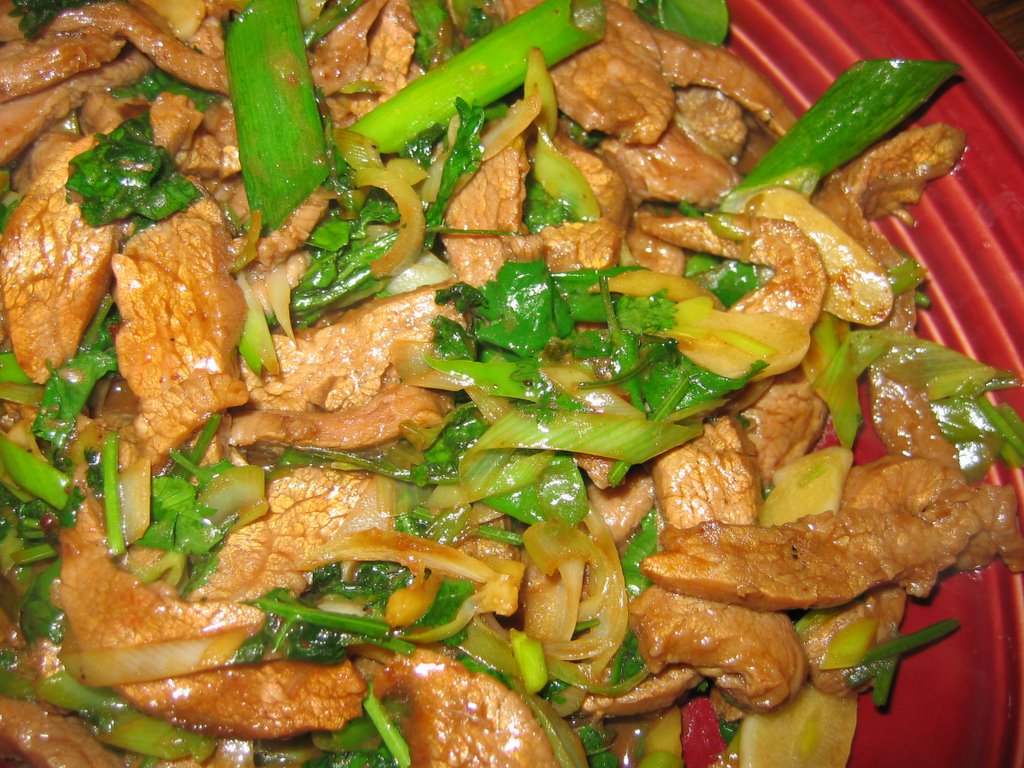 Jump onto the irony train with me here, and let’s go travelling north and east, to Beijing, China.
(If you don’t know why we are on the irony train, then read the post right before this one. If you’ve read it, you are up to speed with me, so let’s go to the dining car and get comfy, shall we?)
I remember when I got my first tastes of really good, really homestyle Chinese food. It was when I worked at the fabled China Garden Restaurant, way, way back in the day, in Huntington, West Virginia.
Huy, the chef, had made an amazing red-braised dish with pork, and I said to him, “You know, this would be delicious on lamb. Or, maybe venison.” And his wife, Mei, shook her head and said, “Lamb? Oh, it is too strong-flavored. You like lamb?”
I nodded. Granted, I was one of the only people I knew growing up who ate lamb who wasn’t Greek, but our family, because they had owned a slaughterhouse and meat-market, and were recent European immigrants, had a tradition of eating lamb. By the time I came around, the meat-market and slaughterhouse were long gone, but the tradition and taste for lamb was well-ingrained. “Yeah, I love lamb. We didn’t eat it all the time, it was too expensive, but it is my favorite meat.”
Mei shook her head and said, “It is too strong–it smells funny. Most Chinese don’t like it. “
One of the younger cooks piped up with, “In the north, in Beijing, and farther north, they eat sheep meat. Only there. And in the far west.”
I read about it and found that he was correct. In Beijing and the northern parts of the country, because of the influence of the Mongolians and the prevalance of Muslims, mutton and lamb are widely eaten, and in a variety of ways. It is grilled, braised, stir fried and is made into a communal cooking and dining experience known as “Mongolian Hot Pot.” It is also used in steamed dumplings and other specialities.
Most folks from southern China, however, really dislike lamb, and do not eat it. My best friend in culinary school, a Singaporan Chinese of Cantonese descent, Nee Wee, really hated lamb. When we had to cook it, he refused to taste it, waving his hand in front of his nose and declaring it to be, “stinky meat.” He would wrinkle his face up whenever I tried to get him to eat it, and shudder.
But the memory of Huy’s wonderful braised dish and my idea that lamb would taste good cooked Chinese style stuck with me for a very long time. Later, in my cookbook-diving I found a few simple recipes for Beijing style stir-fried lamb, and the idea struck my fancy.
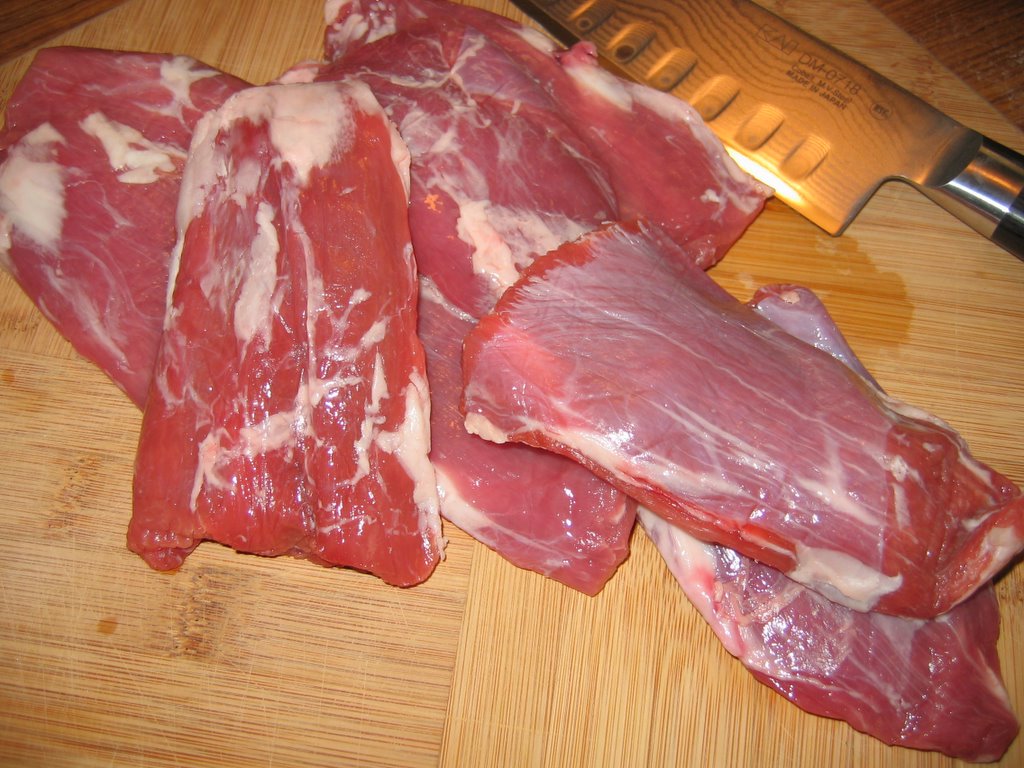 These recipes called for boneless leg of lamb, but when I mentioned to Cheryl at Bluescreek Farms in the North Market that I wanted lamb to stir fry, she smiled and said, “I have just the thing in the freezer.”
She dug around and pulled out lamb flank steaks–pictured to the left.
They are small, of course, being as a lamb is considerably smaller than a cow, but they are the exact same cut of meat, as we see in a beef flank steak. The muscle is structured exactly the same way; it is almost perfectly rectangular, lean, with just a bit of fat on the outside, with muscle fibers making an obvious grain longitudinally. All of the factors that make beef flank steak perfect for stir frying are present in the lamb version, with one big difference.
Because it comes from a younger animal, the meat is that much more tender.
 Of course, I bought several pounds of the little steaks, and stuck them in my freezer to wait until I had decided how I was going to tackle the idea of stir-fried lamb.
This week, I decided that Wednsday was the day to attempt my experiment (long before I heard of Jamie Oliver’s lamb kerfluffle), so I thawed the lamb flank steaks overnight in the fridge.
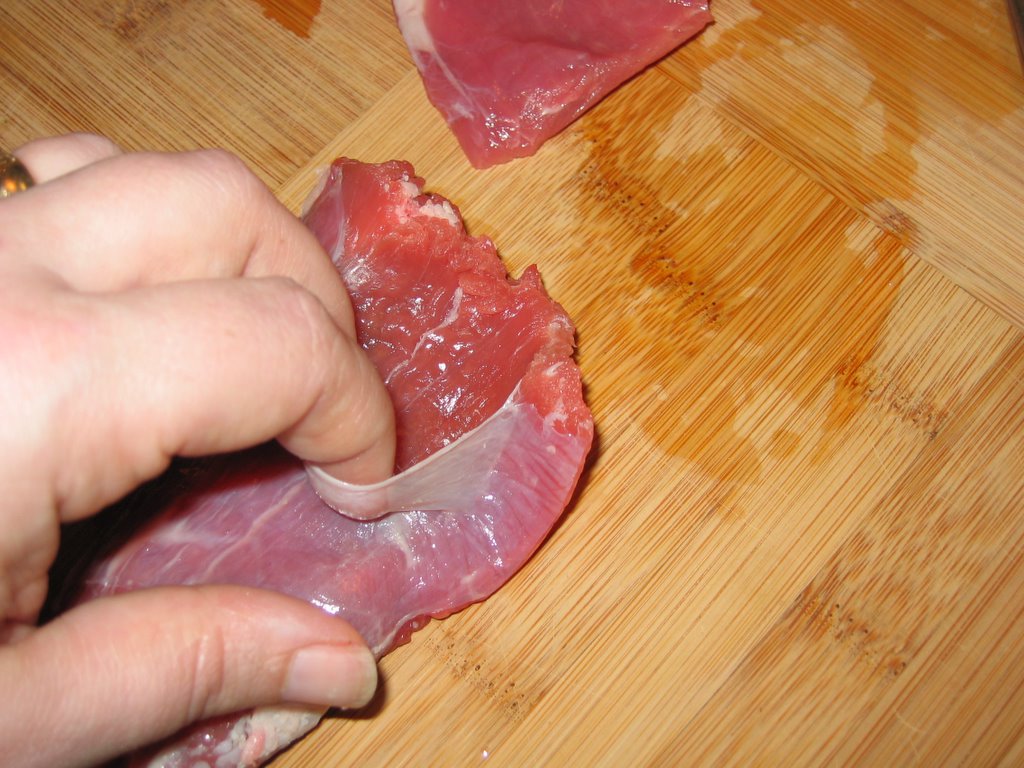
Like their larger beef counterparts, lamb flank steaks come with a bit of silverskin–it is just a membrane, probably made of collagen, over one side of the meat. As you can see to the right, it is quickly and easily removed by just prying it off with your fingers. The larger bits of fat I trimmed off before slicing the steaks carefully-across the grain, not with it-into very thin slices. (This is standard practice in cutting flank steak for stir-fry–always cut it across the grain. If you cut with the grain, the long muscle fibers will be very tough, however if you cross-cut it, the meat turns out to be very tender.)
 As for recipes, I found three to work from, and ended up synthesizing them into one fairly pared-down version. The books I used were Irene Kuo’s The Key to Chinese Cooking, Martin Yan’s Culinary Journey Through China and the Wei Chuan Cooking School’s Chinese Cuisine: Beijing Style by Lee Hwa Lin.
One thing all the recipes had in common was the pairing of lamb with highly-flavored aromatic ingredients, particularly scallions, garlic and Sichuan peppercorns. Both Kuo and Yan remarked that such strong flavorings countered the characteristic very strong native flavor of the lamb itself. I decided to follow in this path, but instead of the scallions, I used very small young leeks, which were fresh and delicious at the farmer’s market that morning. In addition, I noted that one recipe in the Wei Chuan book used cilantro and ginger with the lamb, so I incorporated those seasonings to the dish as well.
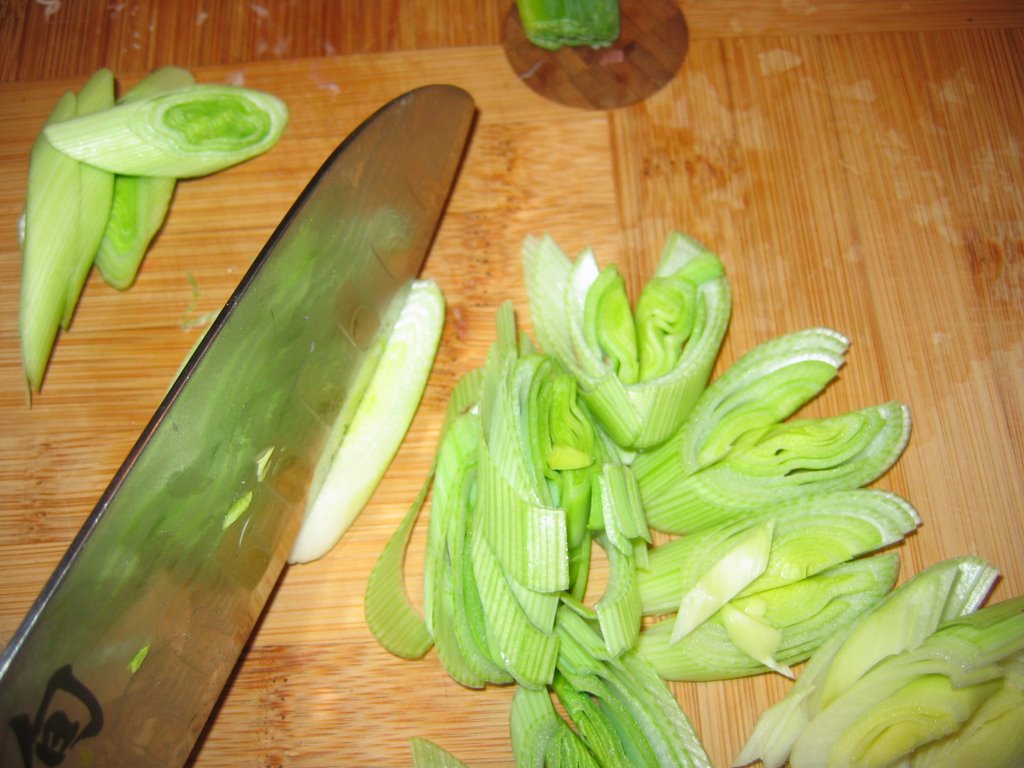
In order to cut the leeks in a way that was similar to the meat, I cut them into thin slices diagonally, then cut those slices in half longitudinally, as shown above. The garlic I sliced very thinly, and the ginger I cut into thin slices and then jullienned.
 Dark soy sauce was cited by both Kuo and Yan, while Lin simply noted soy sauce. All three recipes used Shaoxing rice wine; I then chose to use dark soy sauce and the wine. Vinegar was present both in Kuo’s and Yan’s recipes. She stipulated cider vinegar–probably because her book came out in the 1970’s before many Chinese ingredients were commonly available in the US, while Yan calls for Chianking vinegar. They both noted that the sour flavor brings out the best in the lamb’s nature; knowing that a touch of sour will lighten the richness of meat gravies and braising liquids–a trick I learned from a French chef–I decided to follow their lead and include vinegar.
Yan was the only author to use hoisin sauce and chile garlic sauce–I decided to ditch both of those ingredients, because I feared that they would complicate the sauce too much and add too many layers of flavor and end up muddying it up.
The one ingredient that was used by all three authors that I did not was sesame oil–instead of adding another separate flavor, instead, at the end of cooking, I added a second, small amount of Sichuan peppercorn. Layering one flavor twice kept the recipe even more simple and uncluttered–besides–I really like the fragrance that Sichuan peppercorn imparts to a dish.
I also love sesame oil, but sometimes it can be very overpowering, and instead, I wanted the natural flavors of the lamb to be enhanced and the flowery aroma of the Sichuan peppercorn to “float” over the rich scents of the meat, cilantro and leeks.
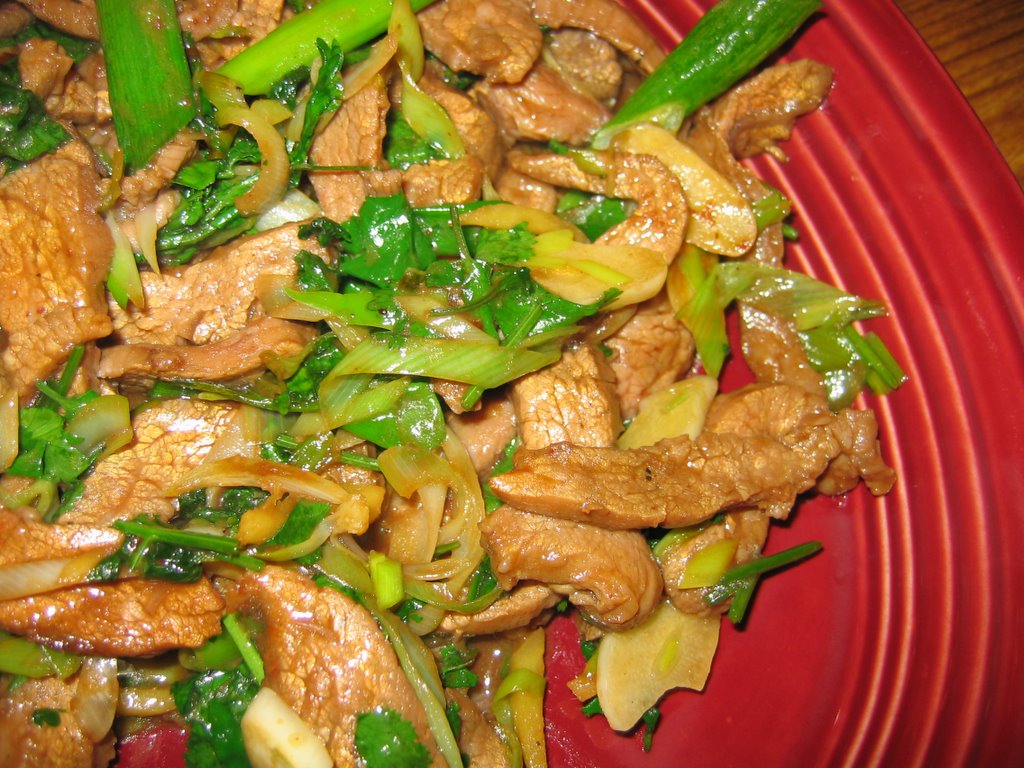
In the end, I think that the version I put together captured the spirit of the original recipes, and I have to say, it was damned good. I will be making it again–very little of it was left over after Morganna and Zak and I got to it. Some folks may think that lamb is “stinky meat,” but I really believe that when cooked in this recipe, it showcases some of the best of Chinese cookery. It is an essentially simple recipe that relies on fresh ingredients and strong clear flavors. However, the tastes do all mingle in a mysterious way that makes the sauce itself difficult to define. It is not sweet, nor obviously sour, but instead is just sparkling with the natural flavor of the lamb that is beautifully enhanced by the sharpness of the Sichuan peppercorn. The leeks bring out the lamb’s sweetness and the cilantro brings a lovely fresh note of green earthiness.
Definately, it was worth the wait to find the lamb flank steaks and to research the recipe.
I cannot wait to make it again!
 Beijing Stir-Fried Lamb With Leeks and Cilantro
Ingredients:
1 lb. lamb flank steaks, membrane removed and trimmed of excess fat
1 teaspoon roasted ground Sichuan peppercorns
2 tablespoons dark soy sauce
2 tablespoons Shaoxing wine
1 1/2 tablespoons cornstarch
4 small leeks, root ends trimmed, and cleaned then dried
4 cloves garlic, peeled and thinly sliced
1″ cube fresh garlic, peeled, and jullienned
1 bunch cilantro, washed, dried and coarsely chopped (optional–if you dislike cilantro, leave it out and use one more leek.)
4 tablespoons peanut or canola oil
1 teaspoon sugar
1 tablespoon dark soy sauce
1 tablespoon Shaoxing wine
1 tablespoon Chianking vinegar (Chinese black vinegar–you can substitute balsamic, if you must)
2 pinches roasted ground Sichuan peppercorns
 Method:
Cut lamb flank steak into thin slices across the grain.
Toss with the Sichuan peppercorns, soy sauce, wine and cornstarch. Allow to marinate while preparing other ingredients.
Cut the leeks (white and pale green parts only) into thin diagonal slices (about 1/4″ thick) and then cut these longitudinally in half to give narrow, curling ribbons of jade green and white. Put in a bowl with the garlic and ginger.
Mix together sugar, soy sauce, wine and vinegar in a small bowl and set aside.
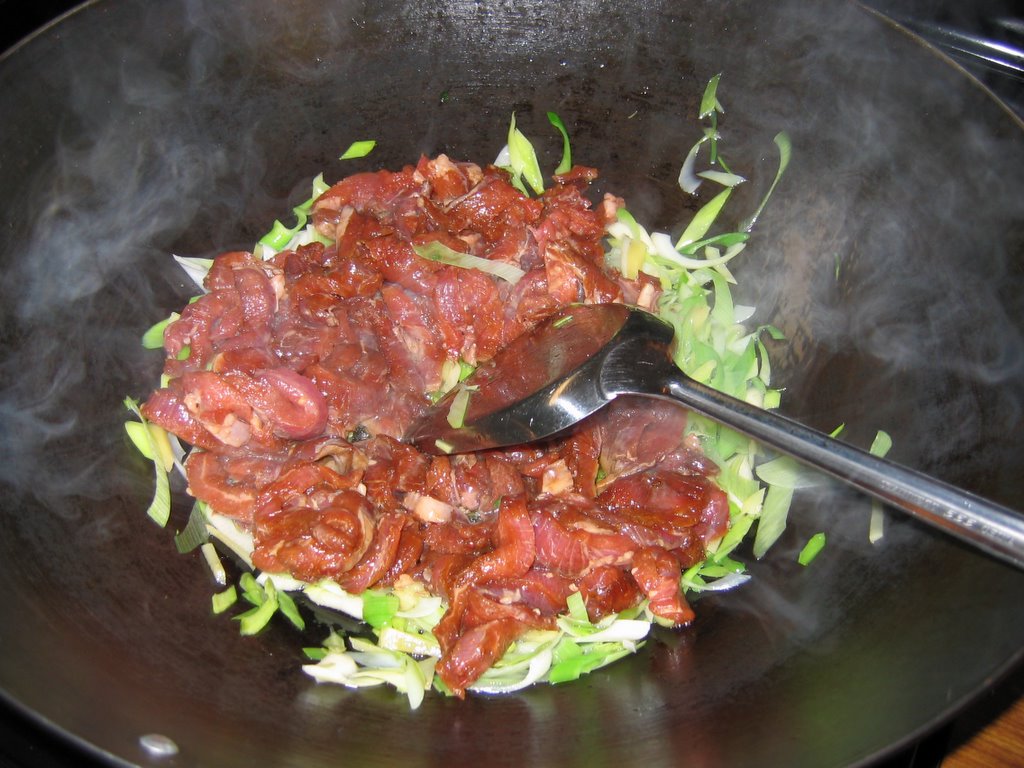
Heat wok until it is smoking, add oil, and heat until it shimmers. Add leeks, garlic and ginger, and stir fry until very fragrant about one minute.
Add strips of lamb, and carefully arrange in a single layer against the bottom of the wok and allow to brown undisturbed–about one and a half or two minutes. Once it starts to brown, start stirring vigorously.
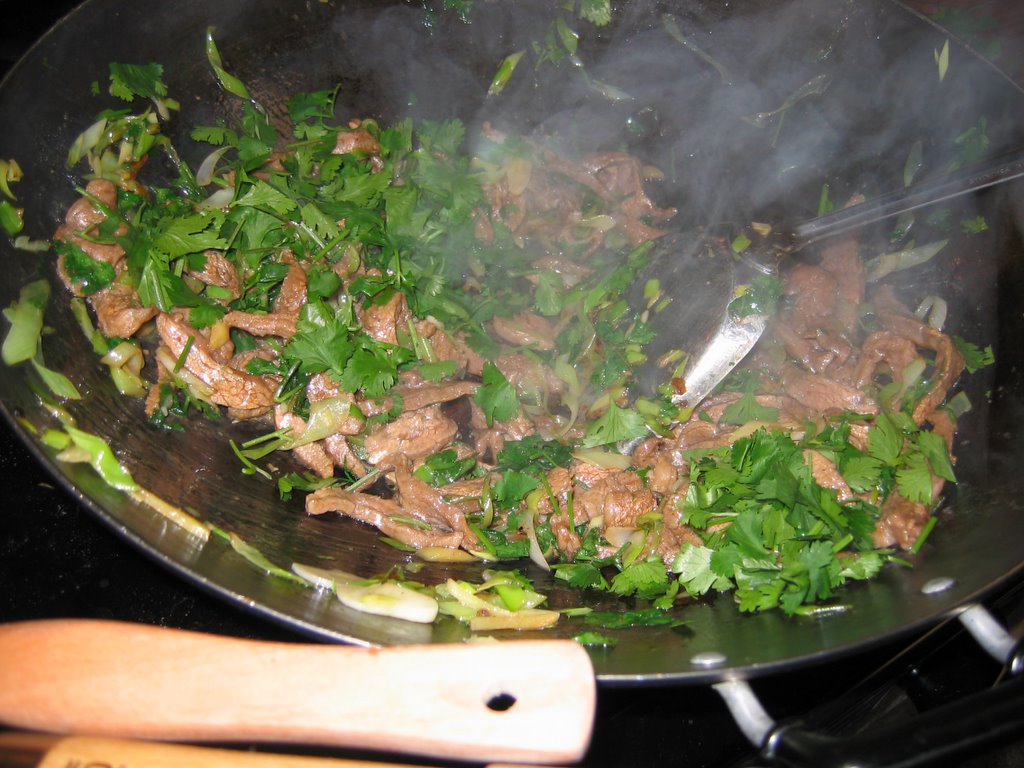
When most of the pink is gone on the meat, add the cilantro, and continue stir frying. As soon as the meat is just about fully browned, add the sauce, and stir fry until it thickens–about thirty seconds.
Pour into heated platter and sprinkle with two pinches of the roasted, ground Sichuan peppercorns.
Serve immediately with steamed rice and some sort of stir fried, braised or steamed greens.
Food Recipes Chinese cooking Lamb
Jamie Oliver Spills the Blood of a Lamb, Film at Eleven
 So, Kate of the Accidental Hedonist scooped me on this bit of controversy, but since it is an issue near and dear to my heart, I figured I’d post about the flurry of shock and outrage across the pond over an episode of superstar chef Jamie Oliver’s new show where he slaughters a lamb on camera.
This way, instead of boiling into a rant that will have me frothing at the mouth and gibbering incoherently on her blog, I could jump up and down about the stupid hypocrisy of the human race in the comfort of my own damned blog.
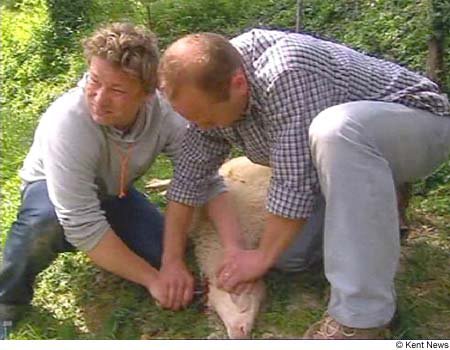
Anyway, there is that monster Jamie Oliver, off to the left, in a still from the show (courtesy of Kent News), doing the heinous deed of slitting the wooly critter’s throat, with the help of a more experienced sheep-killer–his host and the patriarch of a country Italian farm family who gave Oliver the honor of slaughtering the lamb for a feast.
Note that Mr. Oliver’s head is turned away–he is just the picture of the bloodthirsty sort who enjoys frightening children and shocking their mummies and daddies.
It is obvious to me that he did not relish the experience, but he managed it, and I must applaud his brave words before setting out to give Britain a taste of real reality TV. He said, “It’s a beautiful creature, but it is tasty and we are top of the food chain. A chef who has cooked 2,000 sheep should kill at least one, otherwise you’re a fake.”
Not surprisingly, lots of people are het up over the entire issue. The website for the Daily Mail has around 315 comments following their story on Oliver’s experience with the lamb. A good many of them are evincing great shock and dismay at this bloody bit of video.
Even though there was a warning of graphic content on the show before it aired, people are complaining that their children are going to be scarred for life because they saw the truth of where their little lamb chops come from. To be fair, the Times ran a signed column by Martin Samuel yesterday that defended Oliver’s action, saying that all he did was show a bit of gritty reality to his viewers, and that anyone who is upset by it should check their grocery trolleys to see if there is any meat lurking therein. Because if there is, they are glass house dwellers who might want to set those stones back down.
And though she usually holds little truck with Oliver, Clarissa Dickson-Wright, the yet living member of the infamous “Two Fat Ladies,” came out strongly in support of the episode, saying, “If I had my way, it would be shown at 6 pm when as many children as possible were watching.”
Now, I am certain that any readers who have been following along with me for a while are going to know where I will be standing in this food-fight.
I am right there next to Oliver, just where any woman who got fed up with whiny meat-eaters and penned an essay entitled, “Meat Comes from Animals, Deal With It Or Eat Vegetables,” should be.
I don’t see the problem. He participated in a traditional killing of an animal for the purpose of eating it, and broke no laws in doing so. The animal was conscious–well, guess what folks–animals who are killed and made kosher or halal are also conscious when they are killed, because by Judaic and Muslim law, they must be killed by a single clean knife-stroke to the throat, and the heart must still be beating so that the blood can all be pumped out of the body quickly.
You don’t like that?
Well, now, saying that people cannot do that is telling them how to worship, isn’t it? And here in the United States, we have laws against telling people how to relate to God.
So–if it is alright for Jews and Muslims–why is it wrong for Oliver and his hosts, the friendly farm family in Italy?
In fact–why is it wrong at all to hold an animal down and quickly cut it’s throat, but it is okay to string hundreds of them up, stun them with electrical shocks , and then cut their throats? Don’t you think that cows that are strung up while still alive aren’t terrified and in pain? Believe me–cows are big animals and do not like to be strung up by their hind legs.
Well, guess what? That is how cattle are killed in slaughterhouses all over the world. But because they are “stunned” after they have been strung up–that is more humane?
I have said it before, I will say it again.
If you are going to eat meat–recognize that death is involved, and honor the animals who die for you by recognizing their sacrifice. Look it in the eye. Know what you are doing when you bite into that lambchop.
Or bloody well don’t bite into it at all.
Now, I have to go–I have some lamb flank steaks to slice up and marinate for my Beijing Lamb and Leek Stir Fry.
(No, really–that is what is planned for dinner tonight. Coincidence, or fate–you be the judge.)
Confessions on the Subject of Books
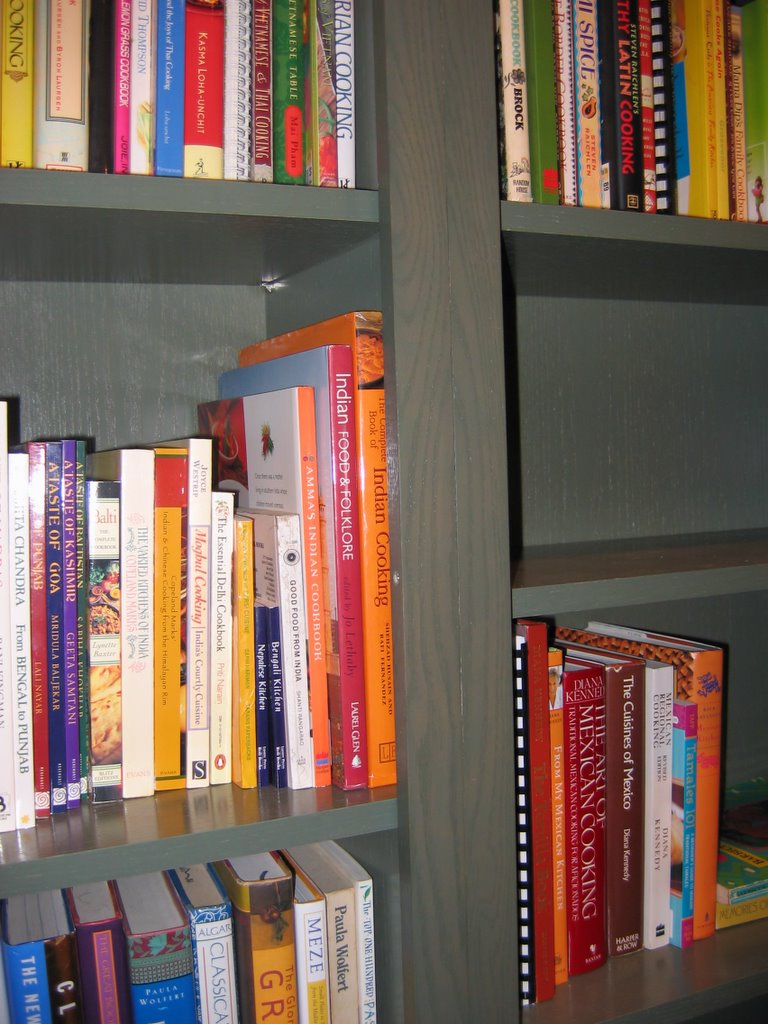 I know that I have already done a post on the subject of Kitchen Confessions, but I suspect that I hardly owned up to half of my oddities, questionable habits, strange tastes, shameful secrets and bizarro beliefs in the realm of all things culinary.
And while, in that post, I did touch upon the fact that I rarely cook directly from a cookbook (meaning, that I cook the recipe as written without changing anything) and when I do there are usually semi-disasterous consequences, I really only touched the surface of my peculiarities involving books.
So, here I am, entering the confessional once more.
I am almost compulsive when it comes to collecting books.
I have a huge number of books, on a great many topics, and I find it hard to get rid of them once I read them. Instead of getting rid of them, I tend to hold onto them, forming a personal reference library that rivals most people’s I know.
However, I did do the unthinkable, before we moved into this house, and went through our books, including my cookbooks, and got rid of a huge number of them–about eighteen large boxes full in all ended up at Half-Price Books, along with about eight boxes of assorted CD’s, DVD’s and videotapes.
But even after being weeded out, I have so many books that a friend once said as she looked at our living room after we had started packing, and said, “Without books, your house looks barren–they are a major decorative theme in your house.”
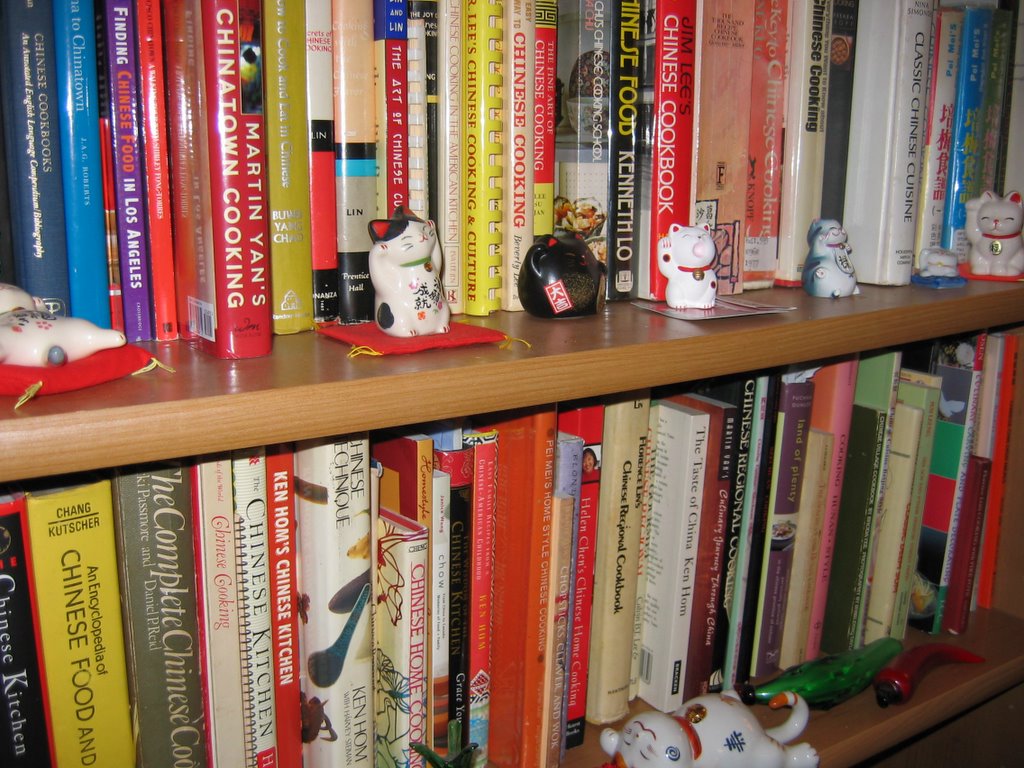 Did this process of finally going through my books and ridding myself of the dross stop me from purchasing more books after we moved?
Not at all. If anything, it has only encouraged my bad habits, as it means I have more room for more books.
No–just yesterday, I received two used books, both on subjects culinary, though neither were cookbooks: one was an anthology on the subject of Chinese food in North America, and the other was a food history book. Then, after lunch downtown, I picked up a bargain book at a bookstore–a biography of T. E. Lawrence–one of my own personal heroes of the past. (I note that just so y’all know that I don’t just read about food. If I did just read about food, I would be worried that I suffered from obsessive compulsive disorder, which I don’t think I do, though some of my past posts, on the subjects of spices and beans might give steadfast readers ideas to the contrary.)
What do I do with all of these books, one might ask?
Well, the short, rather obvious answer is that I read them.
And I do read them.
Well, most of them, I do read. Some, I skim. Others I pick through, because they are reference books, and some, I am ashamed to say, have only received a cursory glance, because they are part of a completist’s collection, and contain very little new information. (There are quite a few of those in the Chinese cookbook collection, but not too many.)
As for the cookbooks–if I cook from very few of them, why are they there?
That is a great question, and one which I do have an answer for.
The short, rather snippy answer is that I read them, which, again, I do, but that is hardly a complete explanation of their pride of place in my kitchen.
I may not cook from them directly, in the ideal sense of following a recipe from beginning to end unchanged, but I do gain a great deal of inspiration from them. I learn from them–if not specific recipes, techniques and ways of doing things that I cannot easily learn in any other way.
For example, I taught myself many years ago how to decorate cakes by reading books on the subject over and over, until by the time I picked up a decorating bag filled with icing, I was already able to see the motions I needed to do with my hands in my head. This meant that I began turning out beautifully piped garlands and flowers much sooner than most people, even though I had never taken a class in the subject.
I also use my cookbooks to help me teach others how to cook.
Seeing how others explain a technique or recipe or bit of food history in prose has given me a better ability to communicate my skills to others in a classroom setting. Julia Child’s obsessive grasp of detail and the ability to write about a subject so thoroughly has infinately helped me teach the complexities of Chinese food to students, even though she was writing about French food. It is from her that I learned the value of being conversational and approachable in my writing and speaking, but to also be fluent in noticing details of how food should look, taste, feel and smell so that I can give students these pointers to understanding whatever technique I am teaching. (Even though I cook very little Italian food, Marcella Hazan’s very detailed and witty explanations of how things are done have similarly helped me in teaching Asian cuisines to non-Asians.)
In a less rational and sensible way, however, the cookbooks are my friends. They contain the voices of authors whom I may have never met (though I gazed once upon Julia Child from afar and cooked something that she herself ingested while I was in culinary school), but who, through their prose, have become close to me, and meaningful to my kitchen journeys. I feel somewhat better, just knowing that behind me, in the bookcase on the wall, Julia Child is there, watching me work at the stove, and that Grace Zia Chu’s words are just a few paces from my fingertips. They are my muses, my angels, my saintly guardians of the temple which is my kitchen.
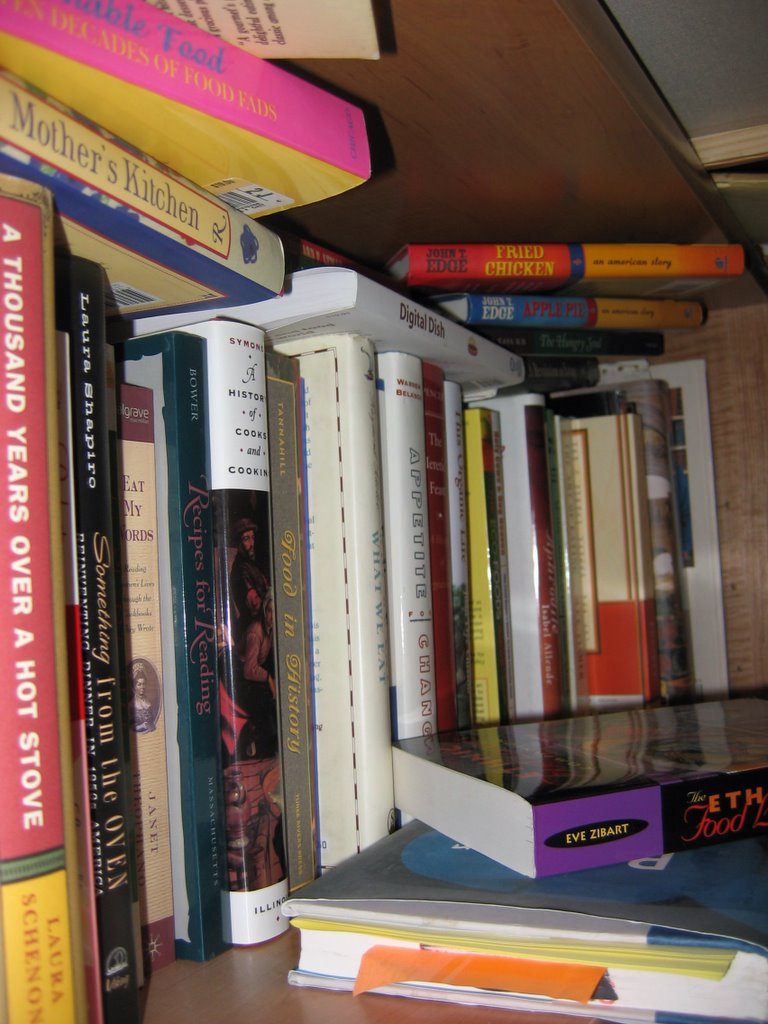 I think that is part of why cookbooks in particular are difficult for me to let go of. They represent the collected knowledge of whole cultures and families, and to turn my head away from that seems like a rejection of values that I find most akin to mine–values of hospitality, sharing, fellowship and love.
I have to confess to having nearly as many food-related non-cookbooks as I have cookbooks, and I value them just as much, or perhaps even more than my cookbooks. These take the form of food memoirs, food histories, sociology, women’s history, agricultural histories, socio-political treatises, food politics, and agricultural techniques, and plain old essays on the joys of cookery, eating, food and drink.
The shelves that house this portion of my book collection are overstuffed and sagging, and I have read many more of these tomes than I have reviewed here in my blog.
And this is where I come to another confession: I keep meaning to write more book reviews, and I keep ending up not doing it.
Why?
I am not entirely certain, though it probably has to do with the rather unfocused nature of Tigers & Strawberries. It is a food blog, to be certain, but because of my own eclectic magpie personality (meaning, I like bits and pieces of everything and get caught up in whatever interests me at the moment, and thus that is what I will write about), there is no real focus on what it is all about. I mean, sure I mostly cook Asian foods, so there is an obvious slant in that direction, as I post about various recipes and cookbooks related to Chinese food, with forays now and again into Japanese, Thai and Indian cuisines.
But it isn’t just about Asian food, because just when I have gone a couple of weeks of posting about nothing other than Chinese food, I turn around and write about Shepherd’s Pie and chocolate chip cookies. It isn’t just about recipes, because I write about books. It isn’t just about sustainable or organic food, because then I will write about food additives. It isn’t just about food news or reviews, because then, I will turn around and write about foraging wild foods or specific ingredients or spices.
I suppose that like my book collection, which is wide-ranging and eclectic in nature, so my blog is a reflection of my own self. I am interested in everything, so everything ends up on my bookshelves and in my blog.
I guess that is fine–I will keep collecting books, and post about them here and there, when I get around to it. I will keep reading and writing and let my kitchen angels in the form of cookbooks watch my back while I go about my culinary adventures, and hopefully, it will all be as interesting to others as it is to me.
That said–has anyone read any good cookbooks lately?
I have a few spaces left on my new shelves….
Kitchen Update: Bookcases!
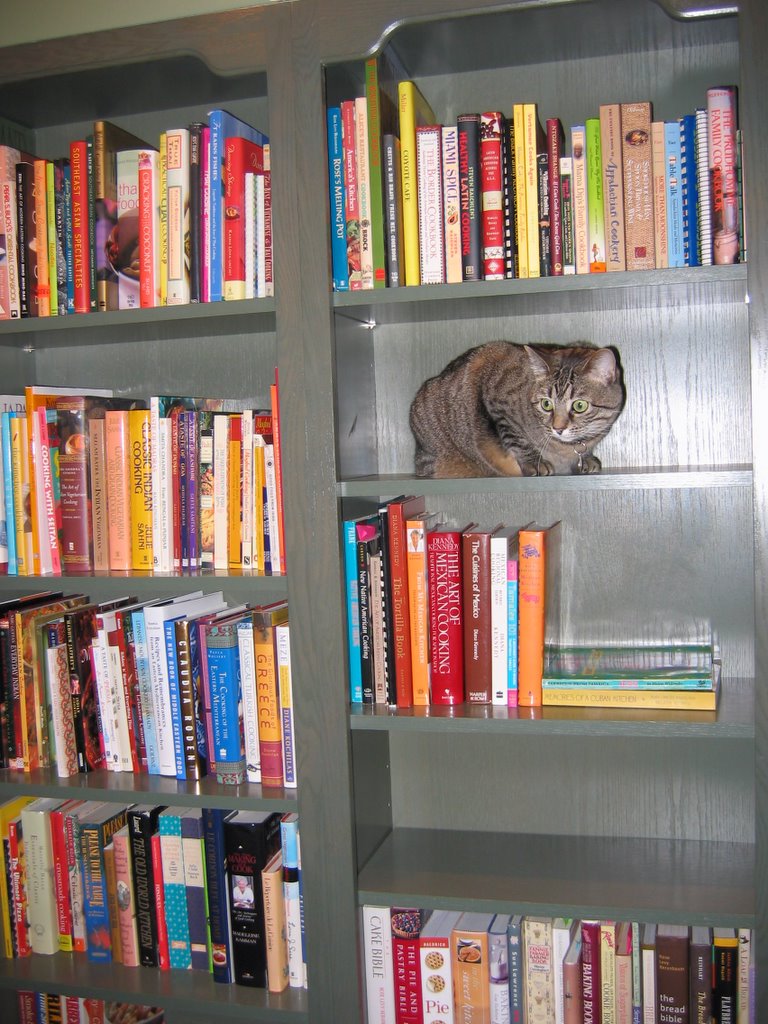 So I have moved the majority of the cookbooks into their new home in the built-in bookshelves in the kitchen.
As you can see, Grimalkin has moved in as well, and approves of the open spaces. I approve of them too, however, for a different reason.
Whereas she is always on the lookout for a new place to occupy, preferably high above the floor where she can survey her domain and choose likely feline targets to dive bomb, I am always thrilled when I can have room for more books.
However, I have to admit that not all of the cookbooks are in those cases, so appearances are decieving.
I still have the culinary reference and food literature books in my office, mainly because they are more often used at my desk than in the kitchen. While Larousse does have recipes, I generally use it to look up details of culinary history or to find out the classical method of producing a certain dish than I use it to cook from. Also, all of my books on food history, some of which may or may not have recipes, are in my office, as they, too, are of more use in my writing than in my cookery.
A second chunk of the collection is in the upstairs kitchen: my entire collection of Chinese cookbooks and books on Chinese food and culture. Since much of what I will be teaching is Chinese food, it makes a great deal fo sense to keep them up there, though they are threatening to overrun the bookcase I have set aside for them. Probably what I will do is bring down a handful of them to the downstairs kitchen–these being the ones I actually cook from, and leave the rest upstairs, but who knows–it may pay to leave them all upstairs.
I haven’t decided yet.
While I may be indecisive, Grimmy seems to have the issue well in hand. I am not allowed to fill up all of the shelves, she tells me (in rather definate and plaintive meows) as she has far too much fun lurking in the empty shelves.
I suspect that her lurking will be for a limited time only. Such an avid reader and collector of cookbooks am I that I cannot imagine that she will have shelter there for long.
Shepherd’s Pie-It May Be Ugly, But it Tastes Good
 Sometimes when the chill November winds blow, and the sky is a granite grey, the soul simply cries out for the warmth of a classic casserole.
This is especially true when I have a whole bunch of hungry teens in the house who may or may not have patience for my usual offerings of authentic Chinese, Thai or Indian dishes complete with fermented black beans, fiery chiles or bitter melon.
Having Morganna’s friends to visit gives me an excuse to whip up something simple from fairly familiar ingredients in a form which is different than the usual.
 Shepherd’s pie fits the bill fantastically.
A traditional British dish of either minced lamb or shredded leftover roast in gravy, and topped with mashed potatoes that is then baked in the oven, shepherd’s pie is among the plainest of plain foods.
However, at my house, “plain” and “simple” does not mean “bland” and “boring.” Other cooks may content themselves with just throwing together some ground meat and making a gravy, then topping it with barely seasoned mashed potatoes and baking it, but I am constitutionally incapable of following such a course. It is not in my nature to take perfectly lovely ingredients such as ground lamb and red potatoes and then toss them into an unseasoned glop and set it before family and friends. I might as well throw it down the drain, or to the dogs, though my dogs, if presented by unseasoned food, would probably turn up their noses and look at me as if I had betrayed them hideously.
There is no reason shepherd’s pie cannot be a well-seasoned, delicious dish, and in fact, considering what it ends up looking like–as Morganna so baldly, yet eloquently puts it–“it looks like cat barf”–it absolutely must taste wonderful. (Though when Morganna made her habitual comment about the ugliness of shepherd’s pie, one of her friends noted quite sensibly, “It has meat, potatoes and corn. How can it be bad?” He gets invited back to dinner often.)
So, my recipe contains all sorts of things that one will not often find in any traditional recipe. A great number of leeks or onions, and garlic season the meat along with an array of herbs, chipotle chiles and smoked paprika. I boil garlic cloves in with the potatoes, and then mash the two together along with sour cream and butter, then season the mash further with chives and other herbs. Finally, I add vegetables into the minced meat mixture that taste good in a lamb stew–carrots, mushrooms and corn most often, though I have also added kale, parsnips and turnips fairly often to good effect.
The result is a one-dish meal that only requires a salad and beverage to be complete. It is infinately variable–you can put whatever vegetables you like in it, and instead of ground lamb, you can use ground beef (though I am told by my British friends that such a dish is known as “cotter’s pie”) or even leftover pot roast or braised lamb for the meat filling. You can season it as much or as little as you like; some days when it is cold and snowy, I like to put a lot of chipotle en adobo in the filling, and make it almost like a chili dish.
The one thing I will insist upon, though, is the garlic cloves boiled and mashed with the potatoes. That is necessary, at least at my house. Whether or not you peel your potatoes, or use milk and butter or cream or sour cream or yogurt in the mashing is up to you–but do please try the garlic. Boiling the garlic softens the flavor and makes the garlic cloves very creamy and the flavor of the potatoes is very warm and comforting with the garlic.
 Shepherd’s Pie
Ingredients:
3-4 pounds red potatoes, scrubbed
1 head garlic, peeled
1 teaspoon salt
3 tablespoons olive oil
1 large onion, peeled and thinly sliced
6 fresh mushrooms, cleaned and thinly sliced
4 cloves garlic, peeled and minced
1 chipotle en adobo, minced
1 teaspoon dried thyme
1/2 teaspoon dried powdered rosemary
1/2 teaspoon smoked Spanish paprika
1/4 teaspoon celery seed, lightly crushed
1/4 cup dry red wine
salt and freshly ground pepper to taste
1 pound ground lamb
1 cup milk
1/2 quart chicken broth or stock
flour or roux as needed to thicken gravy
3 tablespoons butter
1/4 cup sour cream
fresh chives
fresh or dried chervil or thyme
salt and pepper to taste
Method:
Peel potatoes or not as you wish–if you do not, scrub them extra carefully. Cut them into cubes and boil in pot with the one head of peeled whole garlic cloves and the teaspoon salt. Boil until tender.
Heat olive oil in a heavy frying pan and saute onions until they are golden brown. Add mushrooms, and cook until tender. Add garlic and all seasonings, and stir until quite fragrant. Add wine, boil off alcohol. Add lamb, and milk, and break up lamb. Cook, stirring, until lamb is browned and most of the milk has boiled away. (This is a trick I learned from an Italian chef–you get a very tender, smooth minced meat sauce this way–something about the proteins in the milk combining with the meat helps it break apart very finely.)
When the milk is boiled away, add the chicken broth or stock, and bring to a simmer. (At this point, you can add carrot slices, finely diced turnips and/or frozen corn kernels–cook until the vegetables are as tender as you like them, then go on to the next step.)
Thicken with flour or roux to a nice thick, bubbling gravy. Taste and correct seasoning as needed with salt and pepper. Heat oven to 375 degrees F.
Oil a casserole dish lightly, and pour the thickened meat filling into the bottom of the dish.
Drain the potatoes, and mash with the butter and sour cream. Salt and pepper to taste, then add chives and herbs.
Spoon potatoes over the meat and spread them evenly to the edge of the casserole dish. You can try to make decorative peaks and valleys or something, but really–it is no big deal. (I do know that one can use a piping bag to pipe rosette designs in the mashed potatoes, but I think that is silly. This is a homey dish–we are not cooking for the Queen of England here.)
Put in the oven, uncovered and bake for 20-30 minutes, until the meat filling is bubbly and the potatoes are starting to brown on top. (If you want your potatoes really browned, you can brush them with a bit of egg wash and put under the broiler, but again, that is gilding the lily.)
Notes:
You can make this ahead and cover it and freeze it or put it in the fridge. If you freeze it, do not thaw–just bake for 45-50 minutes, or until done.
Do play with the seasonings. You can add vegetables or not as you see fit. You could do a vegetarian version of this with mixed wild and domestic mushrooms as the main attraction of the filling–portabellos, shiitake, oyster, field mushrooms and dried porcini cooked with leeks, garlic, wine and some nice root vegetables like carrots and parsnips would be lovely. You can make this with ground beef or veal as well. It is an infinately malleable basic recipe.
This reheats fine in either the microwave or the oven.
food recipes lamb British cooking

Categories:
- Admin (rss) (55)
- Blogs and Blogging (rss) (81)
- Book Reviews: Cookbooks (rss) (43)
- Book Reviews: Non-Cookbook Food Books (rss) (38)
- Cats and Cat Blogging (rss) (47)
- Chinese Cooking Lessons (rss) (32)
- Culinary School Stories (rss) (18)
- Dairy Pruducts: Cultured and Barbaric (rss) (4)
- Documentary Filmmaking (rss) (1)
- Essays, Rants and Reflections (rss) (260)
- Fighting Hunger (rss) (12)
- Food and Kids (rss) (45)
- Food in the News (rss) (126)
- Food Media (rss) (98)
- Food Preservation (rss) (18)
- Food Safety (rss) (45)
- Gardening (rss) (30)
- Herbs and Herb Blogging (rss) (20)
- Holidays (rss) (50)
- Kat Blogging (rss) (22)
- Kitchen Science (rss) (36)
- Leftover Makeover (rss) (8)
- Life, the Universe and Everything (rss) (131)
- Local and Sustainable (rss) (227)
- Local Athens Food and Foodies (rss) (42)
- Meatless Mondays (rss) (32)
- Menu For Hope (rss) (5)
- Nutrition, Diet and Health (rss) (84)
- On The Farm (rss) (8)
- Recipes: Almost Vegetarian, Vegetarian and Vegan (rss) (294)
- Recipes: American Regional (rss) (37)
- Recipes: Appalachian Hillbilly (rss) (33)
- Recipes: Bread, Pasta, Grains (rss) (95)
- Recipes: Canning and Preserving (rss) (8)
- Recipes: Chinese (rss) (123)
- Recipes: Comfort Food (rss) (120)
- Recipes: Cookies (rss) (16)
- Recipes: Desserts (rss) (48)
- Recipes: French (rss) (25)
- Recipes: Fruits and Vegetables (rss) (302)
- Recipes: Greek, North African and Middle Eastern (rss) (31)
- Recipes: Indian (rss) (137)
- Recipes: Italian (rss) (42)
- Recipes: Japanese (rss) (7)
- Recipes: Jewish (rss) (4)
- Recipes: Korean (rss) (6)
- Recipes: Meat, Poultry and Fish (rss) (220)
- Recipes: Mexican/Native American/ Latin American/Caribb (rss) (27)
- Recipes: Original (rss) (108)
- Recipes: Thai (rss) (27)
- Recipes: Tofu (rss) (17)
- Recipes: US Regional (rss) (16)
- Recipes: Vietnamese (rss) (8)
- Restaurant Stories (rss) (28)
- Sewing, Quilting, Arts and Crafts (rss) (16)
- Simple Chinese Recipes (rss) (30)
- Slow Food and Heritage Foods (rss) (10)
- Spice Blogging (rss) (44)
- The Chinese Cookbook Project (rss) (14)
- The Chinese Pantry (rss) (39)
- The Documentary (rss) (2)
- The Kitchen Saga (rss) (17)
- The Locavore's Bookshelf (rss) (15)
- The Unsung Adventures of The Culinary Nerd (rss) (6)
- Tools and Toys (rss) (35)
- Uncategorized (rss) (10)
- With a Side of Politics (rss) (48)
Archives:
- August 2012 (9)
- July 2012 (12)
- September 2011 (3)
- August 2011 (7)
- July 2011 (8)
- June 2011 (16)
- May 2011 (17)
- April 2011 (11)
- December 2010 (9)
- November 2010 (5)
- February 2010 (1)
- December 2009 (5)
- November 2009 (7)
- October 2009 (10)
- September 2009 (16)
- August 2009 (14)
- July 2009 (14)
- June 2009 (7)
- May 2009 (17)
- April 2009 (10)
- March 2009 (25)
- February 2009 (13)
- January 2009 (10)
- December 2008 (5)
- November 2008 (5)
- October 2008 (6)
- September 2008 (13)
- August 2008 (8)
- July 2008 (11)
- June 2008 (18)
- May 2008 (13)
- April 2008 (14)
- March 2008 (16)
- February 2008 (17)
- January 2008 (19)
- December 2007 (25)
- November 2007 (18)
- October 2007 (24)
- September 2007 (16)
- August 2007 (15)
- July 2007 (15)
- June 2007 (10)
- May 2007 (14)
- April 2007 (16)
- March 2007 (17)
- February 2007 (20)
- January 2007 (13)
- November 2006 (1)
- October 2006 (8)
- September 2006 (14)
- August 2006 (25)
- July 2006 (30)
- June 2006 (28)
- May 2006 (34)
- April 2006 (29)
- March 2006 (24)
- February 2006 (30)
- January 2006 (38)
- December 2005 (40)
- November 2005 (37)
- October 2005 (32)
- September 2005 (25)
- August 2005 (30)
- July 2005 (28)
- June 2005 (21)
- May 2005 (8)
- April 2005 (22)
- March 2005 (17)
- February 2005 (29)
- January 2005 (10)
Search Site:
Links:
- Lily’s Wai Sek Hong
- 101 Cookbooks
- A cat in the kitchen
- A Veggie Venture
- Accidental Hedonist
- Cha Xiu Bao
- chez pim
- Chocolate & Zucchini
- Chopstick Cinema
- Chowhound.com
- Chubby Hubby
- Cook sister!
- Cooking with Amy
- da*xiang
- Eat Local Challenge
- Eating Liberally
- Ecocentric
- Eggbeater
- Epicurious
- Farmgirl Fare
- Fatfree Vegan
- Foodgoat
- ForkandBottle.com
- Green Olive Tree
- Hooked on Heat
- Jaden’s Steamy Kitchen
- Kalyn’s Kitchen
- Lucullian delights
- Mahanandi
- Matt Bites
- MeatHenge
- mmm-yoso!!!
- New York Times – Dining & Wine
- Pizza Goon
- Rasa Malaysia
- Ruhlman
- Sailu's Kitchen
- Serious Eats
- SF Gate: Food & Dining
- Simply Recipes
- Soul Fusion Kitchen
- Tastespotting
- The Amateur Gourmet
- The Cleaner Plate Club
- The Food Section
- The Grub Report
- thecookscottage
- U.S. Food Policy
- Wandering Chopsticks
- Washington Post Food and Dining
- Wasted Food
Meta:


Powered by WordPress. Graphics by Zak Kramer.
Design update by Daniel Trout.
Entries and comments feeds.