
Cook Local, Eat Global
The Chinese Cookbook Project VII: Not a Cookbook, But…
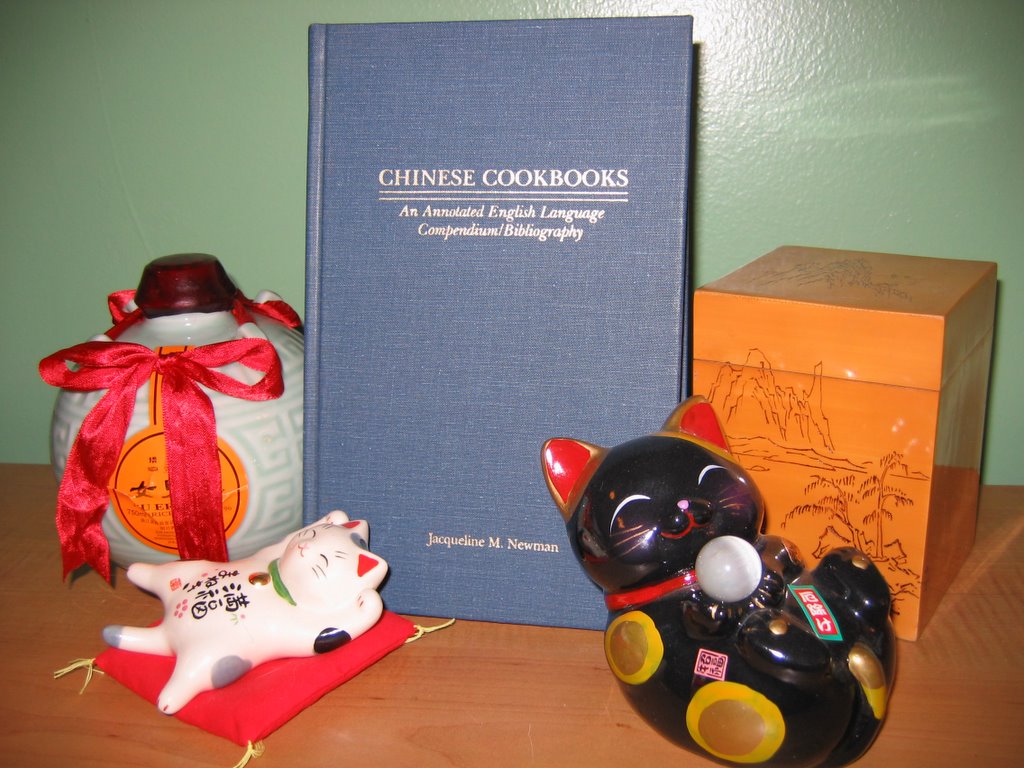 A minority of the books I am gathering in my Chinese cookbook collection are not actually cookbooks, but touch on some aspect of Chinese food culture. I have historical treatises, translations of old Chinese works on the subject, books about learning to read Chinese characters that involve food, and pictorial reference works on ingredients and dim sum.
However, the most important book I have picked up for this collection that isn’t specifically a cookbook is Jacqueline M. Newman’s Chinese Cookbooks: An Annotated English Language Compendium/Bibliography. Published in 1987, this work is sadly not only out of print, but exceedingly rare on the used book market, in large part because it was put out by Garland Publishing as a social science reference book. Most copies of it are thus to be found in libraries and private reference collections, and so when they do appear on the market, it is rare to find a copy for less than seventy-five dollars or so.
I lucked out when I found a copy of it on ebay about a month and a half ago–signed by the author–for under twenty dollars. Needless to say, it is sitting on my desk as I type.
What is so special about this book?
Well, Jacqueline Newman, herself a collector of Chinese cookbooks, and a professor of Family, Nutrition and Exercise Sciences at Queens College, CUNY, and as such, she recognized the emerging importance of the study of cookery in the social sciences. She put this compendium together as a tool for anyone undertaking to study the history and development of the Chinese cookbook in English. This study is important for many reasons: for one thing, it shows how food traditions change over time among an immigrant population, it shows how immigrant cultural identity is often influenced by and affects food culture in general, and it can trace the amount of acceptance of Chinese foodways among the larger culture and how it changes over time.
Cookbooks do not just teach us how to cook. Even if they are confined to a bare description of dishes and cooking techniques (which is not true of most cookbooks), these details can teach a careful scholar a great deal about the author of the book and the cultural milieu from whence it was written. When the author gives cultural details and personal stories as backgrounds for the recipes, the amount of information the cookbook conveys rises exponentially.
In compiling her compendium and annotated bibliography, Newman recognized the importance of cookbooks, and essentially put together a valuable research tool.
Newman has been a scholar of Chinese cookery for many years and has written other books on the subject as well; most recently, she penned the excellent reference work, Food Culture in China, a volume of the Greenwood Press’ “Food Culture Around the World” series. She also has edited the critically acclaimed and always interesting magazine on Chinese food and culture, “Flavor and Fortune.” In the pages of that magazine and many others, including professional journals, she has published a plethora of works on the subject of Chinese food with topics ranging from history, cookery and culture, to cookbooks and medicine.
In addition to being an author, Newman has served on the board of directors of several national and international organizations related to food and cookery, including The James Beard Foundation and the American Institute of Food and Wine. She has also served as a judge on the Chinese Restaurant News’ committee to rank the top 100 Chinese restaurants in the United States in 2004.
But back to the book itself–while it isn’t a cookbook, I have found it to be quite useful in my pursuit of a my goal of collecting the important works of Chinese cookbooks written in English; Newman’s insights have been quite useful, particularly as they pertain to the earlier works, many of which are rare and difficult to find. It is also good to have an idea of the exact contents of a book before deciding whether to purchase it or bid on it sight unseen; while ebay sellers provide photographs of the covers of books, they are often quite sketchy as to the contents. In the sense that I can get a mental picture fixed in my mind of the contents of a book, I can better judge whether I wish to aquire it or not, or if it is likely to contain useful information in my never-ending quest to understand the complexities and subtleties of Chinese cuisine.
books book review Chinese cookbooks food history
Well Dressed Pork, Tofu and Gai Lan
 Remember that naked post I made a few days ago about the recipe for gai lan stir fried with pork and pressed tofu, and how bummed I was that the batteries for the camera were dead so I had no pictures?
Well, I made it again today, and this time the camera was working! And, even more exciting, I refined the recipe a little, so you get a second look at the recipe itself.
Which is cool–because I actually like this second version even better.
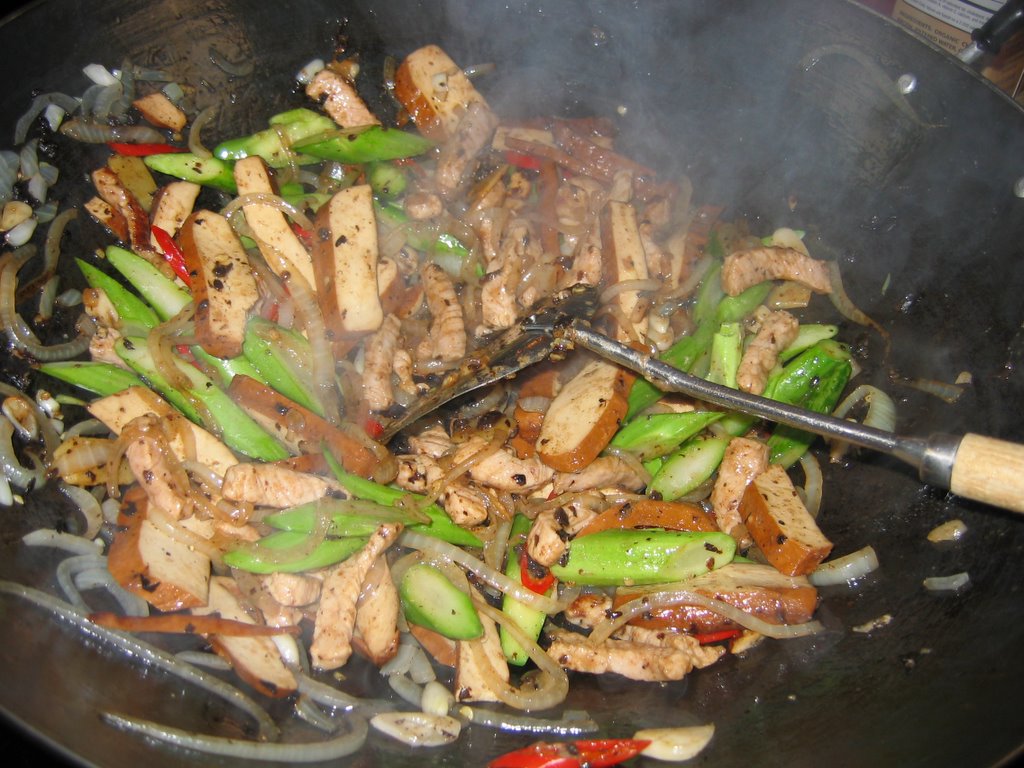 I added some bean sauce and oyster sauce to the recipe, and took out the Sichuan peppercorns. I also added about a half a teaspoon more of sugar, which I mixed in with the two thick sauces that were added at the end, in addition to the sugar that was put into the pork marinade.
And finally, I used dark soy sauce instead of thin soy sauce to marinate the pork and to cook with.
This results in a dish with a darker, thicker, heavier sauce; in hindsight, (or is that hindtaste–no, that sounds awful) I should have also added a splash of chianking vinegar to offset the extra sugar.
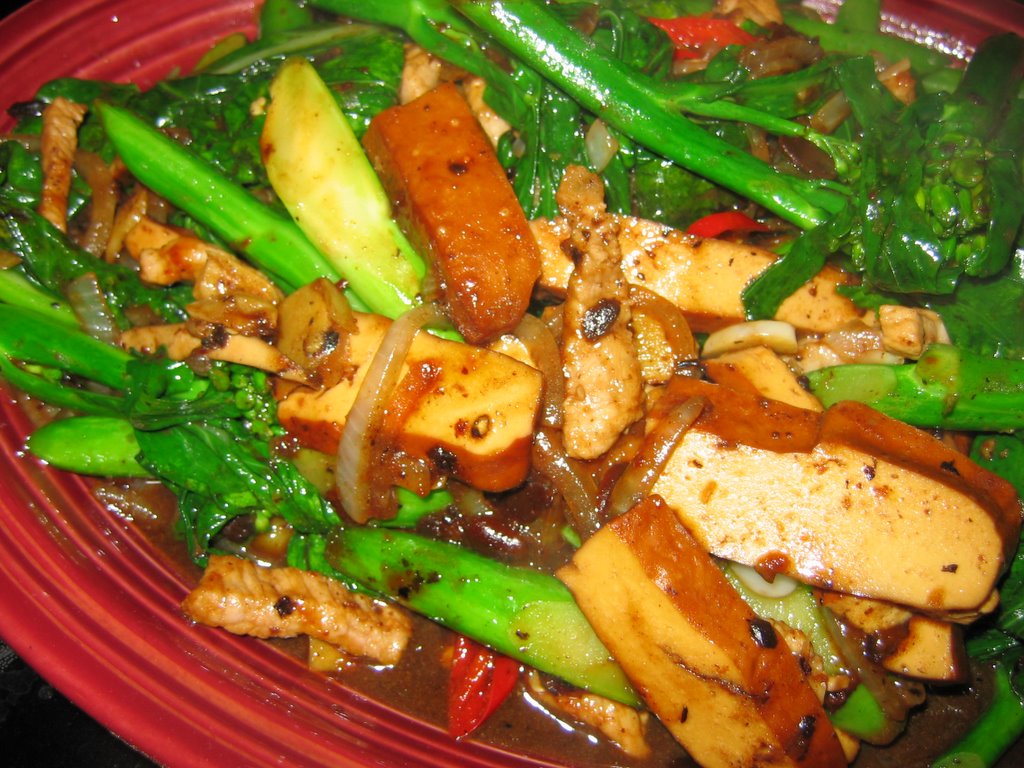 In any case, both versions of the recipe are quite good, but in different ways. The first one is zingier, with lots of dancing heat from the chiles and Sichuan peppercorns, while the second version is much darker and sweeter, full of mysterious flavors that resist identification.
That is one of the things I have discovered I like about the bean sauce–it defies the palate. It teases the diner. It gives a definate, savory, sort of meaty flavor, and yet it is nothing that is easily identifiable, unless the person is very familiar with bean sauce. But even so, if used judiciously, a teaspoon or so at a time, it really punches up the flavor of a Chinese sauce and is very, very hard to single out. Paired with oyster sauce–a classic pairing with gai lan, by the way–and it is a one-two punch that can really push a dish over the top.
I do like having two different ways to cook the same basic main ingredients; versatility in the kitchen keeps boredom away from the dining room.
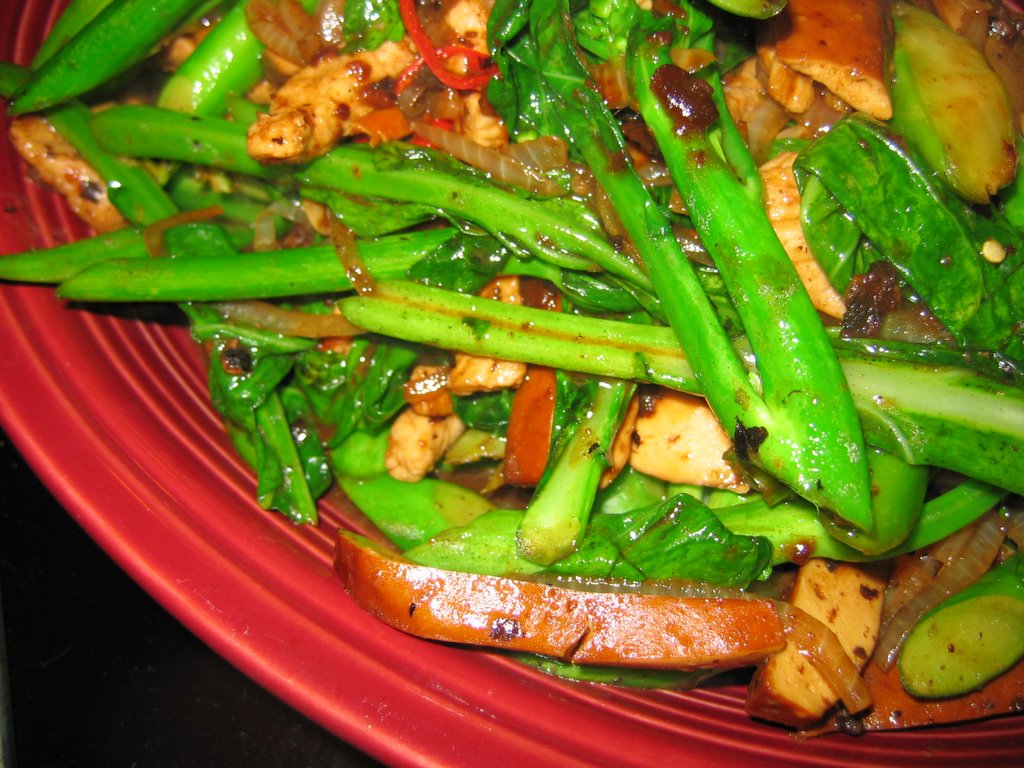 Well-Dressed Pork, Tofu and Gai Lan
Ingredients:
2 small, but thickly cut pork loin chops, sliced into thin shreds–about 1 1/2″x 1/2″
1 1/2 tablespoons Shaoxing wine, or sherry
1 tablespoon cornstarch
1 teaspoon brown or raw sugar
1 teaspoon dark soy sauce
3 tablespoons peanut oil
1 large onion, peeled and thinly sliced
1 heaping tablespoon fermented black beans, mashed
5 cloves garlic, peeled and sliced thinly
1/2″ cube fresh ginger, peeled and thinly sliced
2 red jalapeno chiles, thinly sliced on the diagonal
1/2 teaspoon fresh coarsely cracked black peppercorns (optional)
1 8 ounce package thick cut dry spiced tofu, cut on the diagonal into thin shreds
1-2 tablespoons dark soy sauce
1 tablespoon Shaoxing wine
1 pound gai lan, washed and trimmed
1/4 cup chicken broth
2 tablespoons bean sauce
1/2 teaspoon brown or raw sugar
1 tablespoon oyster sauce
1 teaspoon chiangking vinegar (mix the last four ingredients in a small bowl and have ready by the wok)
Method:
Mix together pork slices, wine, cornstarch, sugar and first amount of dark soy sauce, and set aside to marinate for at least twenty minutes. (You can do this while you prepare all the other ingredients for cooking.)
To prepare the gai lan–trim the bottom bit of the stalks where it was cut from the roots, and discard. After washing, dry thoroughly in a salad spinner. Cut off large leaves, and then cut them into 3-4″ lengths. Cut off any thick stems–thicker than 1/2″ or so–and if the peel is very tough, peel them. Then cut these thick stems diagonally into slices.
Heat up your wok, when it releases its breath in a wisp of white smoke, then add peanut oil and allow it to heat for a minute, until it shimmers from the convection currents. Add onion, and stir and fry until they wilt and turn distinctly golden.
Add the ginger, garlic, chile and black beans all at once (with the black peppercorns if you are using them), and stir and fry until the whole is very fragrant. (At this point is usually when the stomach starts to growl–I swear that nothing is better than the smell of garlic, onions and fermented black beans cooking.) This should take about one minute.
Add the meat, reserving any liquid marinade that isn’t clinging to the meat. Spread the meat into a single layer on the bottom of the wok, and let it sit, undisturbed until you can smell it browning–because of the sugar in the marinade this is faster than usual. At that point, start stirring and frying. Add tofu, and keep stirring and frying until most of the pink is gone from the meat. Add the extra marinade, if there is any, the soy sauce and the Shaoxing, and if there is any browned bits in the bottom of the wok, scrape them up.
Add the gai lan stem slices, and stir and fry for about a minute or two. Spread the gai lan leaves over all, and add the chicken broth, then stir vigorously but carefully. The idea is to get the already cooked stuff up on top of the gai lan and get it down into the wok where the leaves will wilt into a velvety-sweet texture and be coated by the sauce. After the leaves begin to show signs of wilting add the contents of the little bowl of bean sauce, sugar and oyster sauce, and stir to combine well.
The dish is done when the leaves have wilted and gone from a dull dark green to a vibrant, glossy dark green. The sauce should be thick and cling to the ingredients very tightly.
Remove from heat and slide into a warmed serving platter.
Note to Vegetarians and Others Who Do Not Consume Pork:
This would be really good with just the tofu and gai lan, or if you want, you can have tofu, gai lan and either fresh mushrooms or reconstituted dried black Chinese mushrooms. If you use the dried mushrooms, you can use 1/4 cup of the soaking liquid in place of the chicken broth, or you could use vegetable broth.
food recipes Chinese cooking pork tofu
Kitchen Update: Cabinets!
 About one half of the cabinets are hung and installed!
Oh, it is exciting to leave the house, with the kitchen being a mess of unpacked cabinetry and come home to see it all taking shape.
There on the left you see the right side of the windows. There is an open cabinet, then the larger cabient, then the half cabinet–under that will be my microwave–and then on the extreme right is the enclosure with small cabinets overhead for the refrigerator.
 Now in the picture on the right, we have the other side of the room–again, an open cabinet, then two larger, covered cabinets.
All of the base cabinets have pull outs–the one up above is in what would normally be a dead space where you couldn’t utilize the area because of the dishwasher that is going in beside it. However, there is a very clever series of pull-outs that utilize all of that space, including that corner.
The corner cabinet on the right over there has lazy susan shelves.
 Here on the left again, you can see the enclosure for the refrigerator, and beyond it, the honey-colored oak door to the kitchen that goes into the dining room–that was already in the house–I am just happy that the woods match so well.
I also like how there is room to display/store larger items up on the top of the cabinets–that is excellent. I had that in my old kitchen in Pataskala, and I really, really liked that look. It was homey, and it gave me a chance to put some of my odder looking stuff out where it could be seen, but wasn’t taking up useful space.
 There on the right are the windows, and the cabinets there. You can see the blank spot where the dishwasher will go and to the left of that–the whole space on top will be taken up by an undermounted black cast iron sink–one big, deep sink, with no partitions. That way, I can wash my woks and stockpots easily.
 Finally, there is the corner where the built in bookcases are living. I felt bad for the guys who were putting those in–they were really tight to fit, but they got them. There will be oak baseboards that go straight across the bottom there.
Tomorrow, I expect they will finish with the cabinets and then install the hardware on them. I will definately photograph those–they are very, very pretty, and quite functional. And I will post pictures of the pullouts on the base cabinets.
After this–they will have the space measured for the countertop and it will be installed, then the tile backsplash, under-cabinet lights and appliances and vent hood.
And then, it will be finished.
This is just too exciting to watch. It is like a drama unfolding!
An American Classic, Sans Box: Macaroni and Cheese

As I admitted in my recent post, “True Kitchen Confessions,” I will, now and again, use packaged convenience foods when I need to whip up a super-quick snack or meal.
And I will resort, now and again, to the boxed macaroni and cheese, though never Kraft, and not often–and–in my defense, I never do it without adding shredded up real cheese to the sauce.
Which, of course, begs the question of why I bother with the boxed stuff in the first place?
The truth is, I resort to it so I can avoid making a bechamel sauce.
Bechamel. The very name of it makes me shudder.
My mother used to use bechamel (though she never used the French name–that would be too fancy–it was just “white sauce”) to make scalloped potatoes and potatoes au gratin, and potato soup and chipped beef on toast–and to be honest, I never liked it. There was something just so damned cloying about it–it was like warm clotty milk on my tongue. She never really flavored it beyond salt and pepper, which was likely the reason I disliked it; any child whose preferred teething food was raw scallions is not apt to like a flavorless milky sauce.
So, I started off on the wrong foot when it came to bechamel, one of the six great “mother sauces” of the French tradition, the sauce from whence comes the sauces mornay, soubise, cardinal and nantua. (The six leading, or “mother” sauces of French cuisine are the basic building-blocks of a sauce repretoire; from each of these simple sauces, many other sauces are derived by the addition of other ingredients; these sauces are sauce espagnole, demi-glace, tomato sauce, bechamel, veloute, and hollandaise.)
I continued my adversarial relationship with bechamel when I attended culinary school. There, in my stocks and sauces class, I discovered that I not only disliked the flavor and texture of bechamel, but that it was my mortal enemy.
When I went into the class, I could make mayonnaise by hand with my eyes closed. I could make tomato sauce without breaking a sweat and I knew the names and compositions of all of the mother sauces and feared neither veloute nor hollandaise. But when it came to making the humble bechamel, I stumbled, much to the amazement of my beloved Chef Aukstolis and the rest of the class.
It came about because I followed the recipe, instead of my instinct, again. The recipe instructed me to “temper” some of the warm milk into the roux, and then mix that into the simmering milk, and whisk until combined and thickened.
Now, my way of thickening a cream soup (I still avoided bechamel at all costs, mind you–but a cream soup is much the same idea), involved bringing the soup to a bare boil, and making the roux fresh and having it at a boil as well, and then dumping the roux in and whisking like mad. I never got lumps that way (except for the bits of potato or broccoli that were supposed to be giving the soup texture) and it was fast.
Well, the recipe was assuming that either my roux would be cool or my milk. But neither were–they were both bubbling away happily. So, when I went against my instinct, and ladled hot milk into the hot roux, it made a godawful weird mess. When I then mixed this mess into the boiling milk, it made lumps that no amount of whisking would break apart. Chef Aukstolis stood at my elbow and shook his head. “What is that?” he bellowed.
“Lumpy bechamel,” I answered heartily, though I wanted to crawl away and die.
“Bechamel is not lumpy,” he declared. “Strain it through a chinoise mousseline and start over.”
My shoulders slumped, and I spent another hour straining and scraping, then cleaning the chinoise, and then making another bechamel under the hawk’s eyes of my chef. And once again, he told me to follow the instructions–which I did–and once more, made an unholy mess.
He snorted. People were watching me–the woman who could whisk up hollandaise perfectly every time without breaking a sweat, the woman who had, in her previous class, made forty small souffle by hand, and who had argued with her chef about how to fry okra–and not only survived, but was proven -right- here she was, falling down with bechamel on her face, while everyone else was making gallon after gallon of the stultifying bland sauce.
“What is wrong with you?!” Aukstolis growled.
“Bechamel hates me, and I hate it,” I answered with a catch in my throat, as I scurried away to scour pots, something that I knew I could do without making an utter failure of myself. Besides, if I started crying, the tears wouldn’t hurt the dishwater.
Chef Aukstolis was my favorite chef, even if he did assign bechamel to me for my practical final for the class. When he told me, I deflated and everyone in the class giggled. But, I squared my shoulders, and, following the instructions to “temper” the milk and roux, I once again made milk soup with lumpy goo dumplings. Chef Aukstolis watched me, shaking his head. He saw me strain it, and when he tasted it, he said, “There are supposed to be no lumps in bechamel.”
“I know,” I murmurred meekly, bowing my head in defeat.
He snorted, and turned away, and I slumped off, my practical done. Since I couldn’t help anyone else, I slunk back over to the dish sink and started scrubbing. If I’d a tail, it would have been drooping between my legs.
I tried really hard not to sniffle.
Fifteen minutes later, Aukstolis was bellowing for me and had a gallon of milk in his hand. He shoved it at me, and shoved me (gently) to the stove. “I just got a call from the French kitchen upstairs. They are about to serve in fifteen minutes and the bechamel got scorched. They need a gallon, right now! Go!”
I melted the butter in record time and brought the milk to a boil. I whisked in the flour and brought the roux blonde to a brisk bubble and ignored the injunction to “temper” the two, and dumped the pot of roux into the pot of milk. I whisked like mad, my heart racing, as I stared at the clock.
Aukstolis growled from the door. “You have two minutes, Fisher, to save the French kitchen!”
I nodded, and kept my mind on the whisking, and prayed to Saint Escoffier to guide my hands, and watched as the milk thickened into a a smooth, velvety sauce.
I nearly wept with joy.
I poured the sauce into a cambro (a brand of plastic container used for storage in the restaurant industry), and ran up to Aukstolis. “Where do I take it?” I asked.
He whipped a virgin tasting spoon from behind his back and tasted it. His eyes lit up and he smiled, like the dawn breaking over a great mountain, and squeezed my shoulder in his ham-sized hand. “You did it, kid. I knew you could. Congratulations. You got an A on your practical.”
I blinked. “You mean?”
He nodded. “I knew that if you believed that someone really needed the sauce right now, you would not let them down. I knew you could do it–you just had a block in your mind against bechamel.”
Chef Aukstolis should have been a shrink. He played upon my “Big Damned Hero” complex and got me to make bechamel sauce–in less than fifteen minutes, from start to finish.
I looked dumbly at the sauce in my hands, while the rest of the class broke out into applause. “So, I don’t have to run this up to Chef Deitrich?”
Aukstolis shook his head. “No, but you can if you want to. I bet he can use it for something today–let someone else scrub those pots for a while. You’ve earned a five minute break.”
So, off I scurried, my heart flying ahead of my feet. When I reported to Chef Deitrich, he took the bechamel with good grace, tasted it and nodded. “I see you finally succeeded.” (Yes, the chefs gossiped all the time about the students) He patted my shoulder. “Good girl, now, run along. I will put this to good use.”
I felt as if I had conquered a nation, when in truth, all I had done was make a gallon of white sauce.
So, now and again, when I don’t feel like making roux and boiling milk, I will use Annies Organic Macaroni and Cheese stuff, but to me, that isn’t really proper macaroni and cheese. It is a pale substitute for the real thing, which must contain bechamel, and come out of an oven, bubbling, with crispy browned edges of piping hot melty cheese. It must contain at least three cheeses, though as far as I am concerned, you can add up to five different kinds and not jump the shark on this dish. And it should have a bit of heavy cream, you know, just because it makes it better.
I also add other stuff, like herbs, garlic, chiles, spices and sometimes some shreds of bacon or ham, because well, there just isn’t enough fat in the dish to start out with. But, as I usually eat it in small portions with a huge salad for dinner, I don’t feel too bad about the richness of it all.
To me–that is really what macaroni and cheese is all about–a homey, comforting casserole that is all about ooey-gooey cheesy richness that should make your arteries clog just looking at it. It is a special every-now-and-then sort of treat, and the only boxes required is the one that the pasta comes in and the box grater that I use to shred the cheese, otherwise known as “the knucklebuster.”
I don’t really have a recipe for real macaroni and cheese, because I have never used a recipe to make it. I just haul off and make it with what is on hand and in whatever amount goes with the number of diners who will be consuming it. But, even though there isn’t a recipe, I can tell you how it goes, just so you can try to make it, too.
First, melt a tiny bit of butter in a saucepan large enough to make however much bechamel you will need to moisten your pasta. Meanwhile, start your pasta water boiling, and pick your pasta shape. I like penne myself, or medium sized shells.
In that melted butter, saute a bit of minced up garlic, shallot, diced onion, minced chipotle, minced sundried tomato, roasted red pepper, or whatever flavoring you want to add to the dish. Saute them to the desired degree of doneness. Add the same amount of milk as you want bechamel, and bring to a simmer. In a small frying pan, make roux. This is accomplished by melting butter and adding an equal to slightly larger amount of flour, and cooking, stirring constantly until the flour stops smelling raw–about three minutes.
Bring your milk to a boil, and while your roux is still bubbling, whisk it in, and keep whisking until your milk turns into a thick, rich bechamel sauce. Add a dollup of heavy cream, and a suirt of dijon mustard if you want and keep warm.
Grate up at least three kinds of cheese. I like to use a nice white aged New York or Vermont cheddar–very sharp–along with either edam or gouda, and some parmesan. Not the green can stuff–but you don’t have to use the real Italian stuff, either–just use some domestic parmesan that comes cut in a wedge. If you want to add more cheeses, be my guest, have fun and go wild–havarti is nice, as is jarlsburg.
How much cheese? Well, that depends on how much bechamel and how much pasta. By the way, start cooking that pasta. Raw pasta makes really awful macaroni and cheese. And heat up your oven to 375 degrees.
So, what to do with the cheese? Remember that warm bechamel? Well, stir in about half of your cheese gradually, stirring constantly until it melts. Congratulations, you now have mornay sauce. Isn’t that fancy? Keep it warm. (You can enrich it with sherry and some minced fresh herbs, but some would say that is gilding the lily and less is more. I say, more is more.)
Now, your add ins–you can add slivers of cold cooked ham, crumbles of cooked bacon, sauteed mushrooms, barely blanched fresh broccoli–that is really good, btw, fresh tomato slices–use your imagination. Have them ready, or just make it plain. Plain is also good, but remember–too much is always better than not enough.
Your pasta is cooked, so drain it. Don’t overcook it–baked pasta dishes with already soggy pasta are depressing. You aren’t cooking for your toothless Great Uncle Martin are you? No–well, then you want your pasta to have a bit of tooth to it.
Take your baking dish and spray it with canola oil spray or some such to keep the stuff from sticking. Cover the bottom with a thin layer of mornay sauce and sprinkle in a good layer of pasta. Sprinkle in any add-ins and a little layer of the un-melted cheese, then pour on the mornay. Continue this layering business until you end up with mornay, and a good heavy layer of cheese on top. Parmesan on top will give a nice crispy crusty bit that is just delightful.
Slap that casserole in the oven, and let it bake for about twenty to thirty-five minutes, or until it is bubbly-hot, and browned on the edges and in places on the top. In the last five minutes of baking, you can add a sprinkle of some freshly minced herbs such as chervil, thyme, chives or parsley, but you don’t have to.
There.
Even though it contains the dreaded bechamel, real macaroni and cheese is simple.
You don’t need that box. Throw it out–step up to the plate–and make something really, really good for supper.
food & drink culinary school cheese
Organic Food in the News
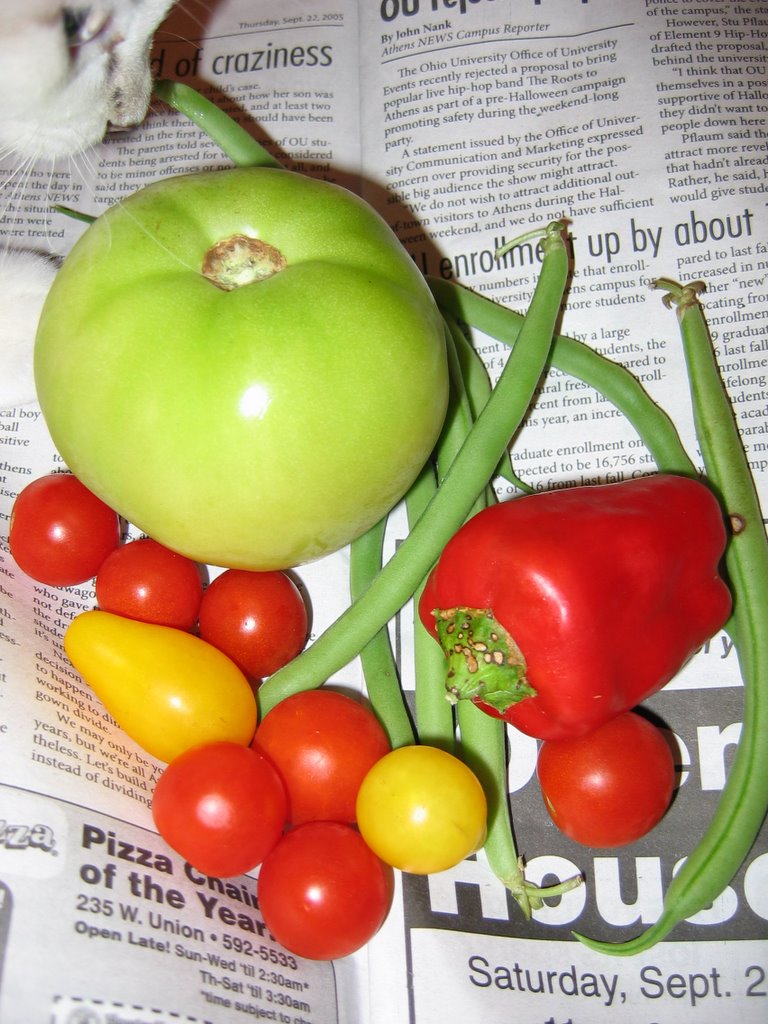 The recent kerfluffle between the Organic Consumers Association and the Organic Trade Association over how to go about strengthening standards for the USDA Certified Organic label has spawned a spate of recent news articles and editorials.
Here are a few highlights:
Two days ago, the New York Times editorial board gave their opinion on the use of synthetic chemicals in organic food. Not surprisingly, they are against the use of synthetic chemicals in the making of processed organic food, but more importantly, they stand f0r the use of very strict standards for any product which is called, “organic.”
The editorial strongly states that:
“‘Organic’ is not merely a label, a variable seal of approval at the end of the processing chain. It means a way of raising crops and livestock that is better for the soil, the animals, the farmers and the consumers themselves – a radical change, in other words, from conventional agriculture. Unless consumers can be certain that those standards are strictly upheld, “organic” will become meaningless.”
A more nuanced and carefully drawn article entitled, “‘What is Organic?’ Powerful Players Want a Say” appeared in the New York Times on November 1st. The author of this article takes pains to present as many sides to this issue as possible, and even admits that most of the thirty-eight synethic chemicals are “relatively harmless ingredients like baking powder, pectin, ascorbic acid and carbon dioxide.” However, a source for the article slames the use of synthetics with “unpronouncable names” on food-contact surfaces.
Sadly the reporter makes no mention of what those unpronounceable chemicals are doing on the food contact surfaces of processing facilities. These are sanitizers, meant to clean the surfaces and keep them free of bacteria and other contaiminants which can cause foodborne illnesses.
The article does make one thing clear–the demand from American consumers for organic foods (at hopefully lower prices) does create a problem for those who attempt to fulfill this market need; in order to produce enough organically grown processed foods, there are choices to be made–should producers make decisions that keep costs high, but keep to the spirit of the organic movement, or should they attempt to lower costs, even if that means that they bend the letter of the rules that govern the production of organic foods?
Newsday gets into the organic act by printing an Associated Press article about parents who are troubled about pesticide residue in thier kids’ food turning to organic foods in record numbers.
Gerber, a leading baby food manufacterer, is producing its own line of organic baby foods under the Tender Harvest label, while Earth’s Best baby foods, which is commonly found at Whole Foods and Wild Oats markets, just jumped into the mainstream by landing a distribution deal with Toys R Us and Babies R Us.
Many parents cite a recent goverment-funded study that shows that the pesticide levels in the bodies of children plummetted after they were switched to an organic diet, to bolster their decision to feed thier kids organic food.
The organic food processing industry has responded to this market growth by expanding the number and kinds of processed snack foods that wear the USDA Certified Organic label.
“Snacks are a priority for Susan Guegan, 44, a mother of four boys in Boulder, Colo. Guegan made their food from scratch when they were babies. Now she buys organic versions of the cookies and hot dogs they ask for.
“They love Oreos,” she said. “They’ll say, `Can we get this?’ I’m like, `Can you read me the ingredients?’ They’ll laugh and try to say some of them. I’ll say, `You can put that back.'” “
What is my take on all of this?
American consumers cannot have everything when it comes to organic foods.
On the one hand, they want organic food because they percieve it as safer, particularly for thier kids to eat. I cannot help but agree that I don’t want pesticides, which are after all, nerve-toxins, in my daughter’s food.
However, at the same time, they demand more and more -processed- organic food items such as ready-to-eat cereals, snack-foods, frozen entrees, instant macaroni and cheese, among others, all of which require some amount of food additives in the form of stabilizers, humectants, gelling agents, and leaveners, so that the products have a decent shelf life and are palatable.
They want hormone-free milk from happy cows, and grass-fed beef and free-range chicken and hot dogs made from pigs who ate organic corn.
And they want it all, right now.
Oh, and they want it cheaply.
But, unfortunately, the world doesn’t work that way, and capitalism doesn’t work that way, and therein lies the issue:
American consumers cannot have it all.
If they want organic food that has no synthetic or non-synthetic chemicals in it, then they should buy only whole foods and minimally processed foods, preferably from local sources whom they can know and trust to produce high quality safe food.
If they want milk of the same caliber, then they need to research the issues surrounding the production of organic milk, and make their choices accordingly. (And good luck to anyone seeking raw milk in most of the United States.)
If they want organic versions of snack foods and pre-packaged convenience foods, then, they should be aware that chemical food additives come along with the deal because, well, let’s face it–cheese does not naturally come in dry, powdered form that can be turned into cheese sauce with the addition of butter and milk, and nor is bread meant to have a shelf life of over one week.
If they want their organic foods to be less expensive, they have to understand that larger and larger agribusiness corporations are going to jump into the game and demand and likely get market share, because it is easier for them to produce large amounts of processed food cheaply than it is for smaller Mom and Pop organizations.
I think that part of the tension that is happening here is that the organic movement was originally one of idealogy and is an outgrowth of the counterculture. Organic business pioneers were firmly entrenched in the counter-cultural ideals of individualism, independence and commitment to growing and producing organic food no matter what the cost, because they believed in it. Many early organic consumers were the same way–in fact, many of the early organic consumers, noting a lack of organic processed foods, began making them for themselves at home, and then went on to become entrepeneurs and produced foods for others. They started out as do-it-yourselfers who grew their own gardens, milked their own goats and raised their own chickens, all in the name of a healthier food supply and a stronger environment.
Today’s organic consumer is not a do-it-yourselfer. They likely have not dabbled in growing their own food, they haven’t visited a farm, and very often have no clue what “sustainable” means when it comes to food, but they do know one thing–they want organic food, and they want it now. And they want it to come to them in their grocery stores, and they want it to be just like the products they are used to buying, only better, and by the way–could it please be cheaper?
Of course, not every consumer who buys organic products fits my description.
But judging by the things I read in the media, I fear that more and more of the folks who demand organics are ignorant of the ideals that started the organic movement. I hope very much that I am wrong, because if that is the case–I fear that “organic” will cease to be relevant when it comes to a philosophy of sustainable, environmentally sound agriculture, and will simply become a marketing tool that plays on consumer’s fears regarding our food supply.
food & drink organic food food additives news

Categories:
- Admin (rss) (55)
- Blogs and Blogging (rss) (81)
- Book Reviews: Cookbooks (rss) (43)
- Book Reviews: Non-Cookbook Food Books (rss) (38)
- Cats and Cat Blogging (rss) (47)
- Chinese Cooking Lessons (rss) (32)
- Culinary School Stories (rss) (18)
- Dairy Pruducts: Cultured and Barbaric (rss) (4)
- Documentary Filmmaking (rss) (1)
- Essays, Rants and Reflections (rss) (260)
- Fighting Hunger (rss) (12)
- Food and Kids (rss) (45)
- Food in the News (rss) (126)
- Food Media (rss) (98)
- Food Preservation (rss) (18)
- Food Safety (rss) (45)
- Gardening (rss) (30)
- Herbs and Herb Blogging (rss) (20)
- Holidays (rss) (50)
- Kat Blogging (rss) (22)
- Kitchen Science (rss) (36)
- Leftover Makeover (rss) (8)
- Life, the Universe and Everything (rss) (131)
- Local and Sustainable (rss) (227)
- Local Athens Food and Foodies (rss) (42)
- Meatless Mondays (rss) (32)
- Menu For Hope (rss) (5)
- Nutrition, Diet and Health (rss) (84)
- On The Farm (rss) (8)
- Recipes: Almost Vegetarian, Vegetarian and Vegan (rss) (294)
- Recipes: American Regional (rss) (37)
- Recipes: Appalachian Hillbilly (rss) (33)
- Recipes: Bread, Pasta, Grains (rss) (95)
- Recipes: Canning and Preserving (rss) (8)
- Recipes: Chinese (rss) (123)
- Recipes: Comfort Food (rss) (120)
- Recipes: Cookies (rss) (16)
- Recipes: Desserts (rss) (48)
- Recipes: French (rss) (25)
- Recipes: Fruits and Vegetables (rss) (302)
- Recipes: Greek, North African and Middle Eastern (rss) (31)
- Recipes: Indian (rss) (137)
- Recipes: Italian (rss) (42)
- Recipes: Japanese (rss) (7)
- Recipes: Jewish (rss) (4)
- Recipes: Korean (rss) (6)
- Recipes: Meat, Poultry and Fish (rss) (220)
- Recipes: Mexican/Native American/ Latin American/Caribb (rss) (27)
- Recipes: Original (rss) (108)
- Recipes: Thai (rss) (27)
- Recipes: Tofu (rss) (17)
- Recipes: US Regional (rss) (16)
- Recipes: Vietnamese (rss) (8)
- Restaurant Stories (rss) (28)
- Sewing, Quilting, Arts and Crafts (rss) (16)
- Simple Chinese Recipes (rss) (30)
- Slow Food and Heritage Foods (rss) (10)
- Spice Blogging (rss) (44)
- The Chinese Cookbook Project (rss) (14)
- The Chinese Pantry (rss) (39)
- The Documentary (rss) (2)
- The Kitchen Saga (rss) (17)
- The Locavore's Bookshelf (rss) (15)
- The Unsung Adventures of The Culinary Nerd (rss) (6)
- Tools and Toys (rss) (35)
- Uncategorized (rss) (10)
- With a Side of Politics (rss) (48)
Archives:
- August 2012 (9)
- July 2012 (12)
- September 2011 (3)
- August 2011 (7)
- July 2011 (8)
- June 2011 (16)
- May 2011 (17)
- April 2011 (11)
- December 2010 (9)
- November 2010 (5)
- February 2010 (1)
- December 2009 (5)
- November 2009 (7)
- October 2009 (10)
- September 2009 (16)
- August 2009 (14)
- July 2009 (14)
- June 2009 (7)
- May 2009 (17)
- April 2009 (10)
- March 2009 (25)
- February 2009 (13)
- January 2009 (10)
- December 2008 (5)
- November 2008 (5)
- October 2008 (6)
- September 2008 (13)
- August 2008 (8)
- July 2008 (11)
- June 2008 (18)
- May 2008 (13)
- April 2008 (14)
- March 2008 (16)
- February 2008 (17)
- January 2008 (19)
- December 2007 (25)
- November 2007 (18)
- October 2007 (24)
- September 2007 (16)
- August 2007 (15)
- July 2007 (15)
- June 2007 (10)
- May 2007 (14)
- April 2007 (16)
- March 2007 (17)
- February 2007 (20)
- January 2007 (13)
- November 2006 (1)
- October 2006 (8)
- September 2006 (14)
- August 2006 (25)
- July 2006 (30)
- June 2006 (28)
- May 2006 (34)
- April 2006 (29)
- March 2006 (24)
- February 2006 (30)
- January 2006 (38)
- December 2005 (40)
- November 2005 (37)
- October 2005 (32)
- September 2005 (25)
- August 2005 (30)
- July 2005 (28)
- June 2005 (21)
- May 2005 (8)
- April 2005 (22)
- March 2005 (17)
- February 2005 (29)
- January 2005 (10)
Search Site:
Links:
- Lily’s Wai Sek Hong
- 101 Cookbooks
- A cat in the kitchen
- A Veggie Venture
- Accidental Hedonist
- Cha Xiu Bao
- chez pim
- Chocolate & Zucchini
- Chopstick Cinema
- Chowhound.com
- Chubby Hubby
- Cook sister!
- Cooking with Amy
- da*xiang
- Eat Local Challenge
- Eating Liberally
- Ecocentric
- Eggbeater
- Epicurious
- Farmgirl Fare
- Fatfree Vegan
- Foodgoat
- ForkandBottle.com
- Green Olive Tree
- Hooked on Heat
- Jaden’s Steamy Kitchen
- Kalyn’s Kitchen
- Lucullian delights
- Mahanandi
- Matt Bites
- MeatHenge
- mmm-yoso!!!
- New York Times – Dining & Wine
- Pizza Goon
- Rasa Malaysia
- Ruhlman
- Sailu's Kitchen
- Serious Eats
- SF Gate: Food & Dining
- Simply Recipes
- Soul Fusion Kitchen
- Tastespotting
- The Amateur Gourmet
- The Cleaner Plate Club
- The Food Section
- The Grub Report
- thecookscottage
- U.S. Food Policy
- Wandering Chopsticks
- Washington Post Food and Dining
- Wasted Food
Meta:


Powered by WordPress. Graphics by Zak Kramer.
Design update by Daniel Trout.
Entries and comments feeds.