
Cook Local, Eat Global
Weekend Cat Blogging: An Introduction to Mei-Mei Ari
 We still miss Minnaloushe; nothing will change that except time and work. And no one will replace her in our hearts, especially not Zak’s. She was a wonderful little cat.
But, I have been doing better for days–the kitchen excitement and the writing has kept me from moping excessively, except that yesterday, we got a card from MedVet–a sympathy card.
I have gotten sympathy cards before from vets, and once again, I am impressed with the vets and techs who work at MedVet–their personal notes were so sweet and touching, that I choked up.
But what made me cry is that they sent us inked paw-prints from Minna to remember her by. I was in my office, which is right off the kitchen, and started bawling like a baby, and had to grab up the mail and go scurrying upstairs to hide from the workmen, because I hate to cry in front of people.
Besides, upstairs was where all of our other cats were, and I could hold them and pet them and be comforted by them.
Upstairs is also where little Ari is.
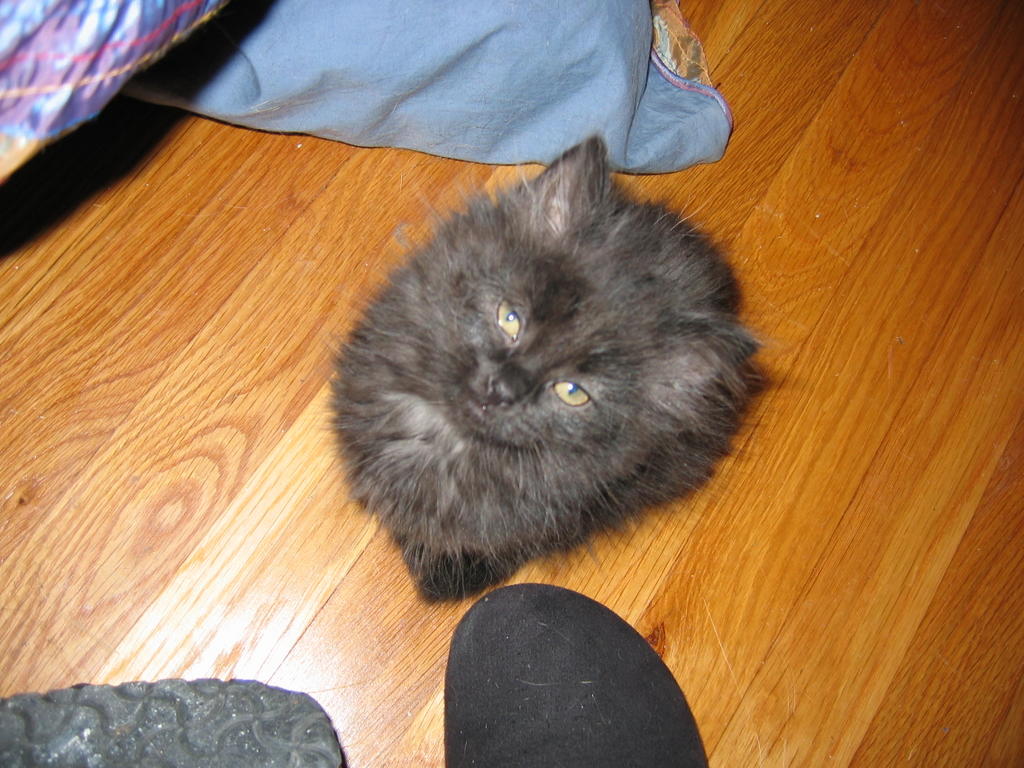
The little spriggan, ragamuffin kitten above–that is Ari–the Lioness. She can sit in the palm of my hand, but fears neither man nor beast.
How she came to our house so soon is this: Tuesday, we had to go to Columbus to order a ventilator hood for the new stove, and while we were there, we resolved to visit our old vet in Pataskala, and tell her about Minna. And, as Zak said, “To look at the kittens. Just in case. I don’t want a cat, but just in case.”
Dr, Schwab was very sad to hear about Minna, but knowing us as she did, she said, “Come, come to the back–here is a cat who was dropped off just now, and you will be the first to see her.”
Zak had been saying he wanted a tortoiseshell cat for years, and back in the exam room was a lovely female tortoiseshell, and her kittens. She looked up at us with a peacefully accepting look, and purred when we petted her. Zak was besotted, and named her Dandelion on the spot.
We will pick her up in about three weeks, after they have fed her up and gotten her back on her feet. The poor thing is underweight from feeding her babies and not being provided with adequate nutrition, and she looks like she is only nine months old herself.
 But Dandelion doesn’t explain Ari, does it?
Ari was there, too–and she came galloping up to us and jumped right into our hearts.
So, she came home right away.
And she is a wild little thing.
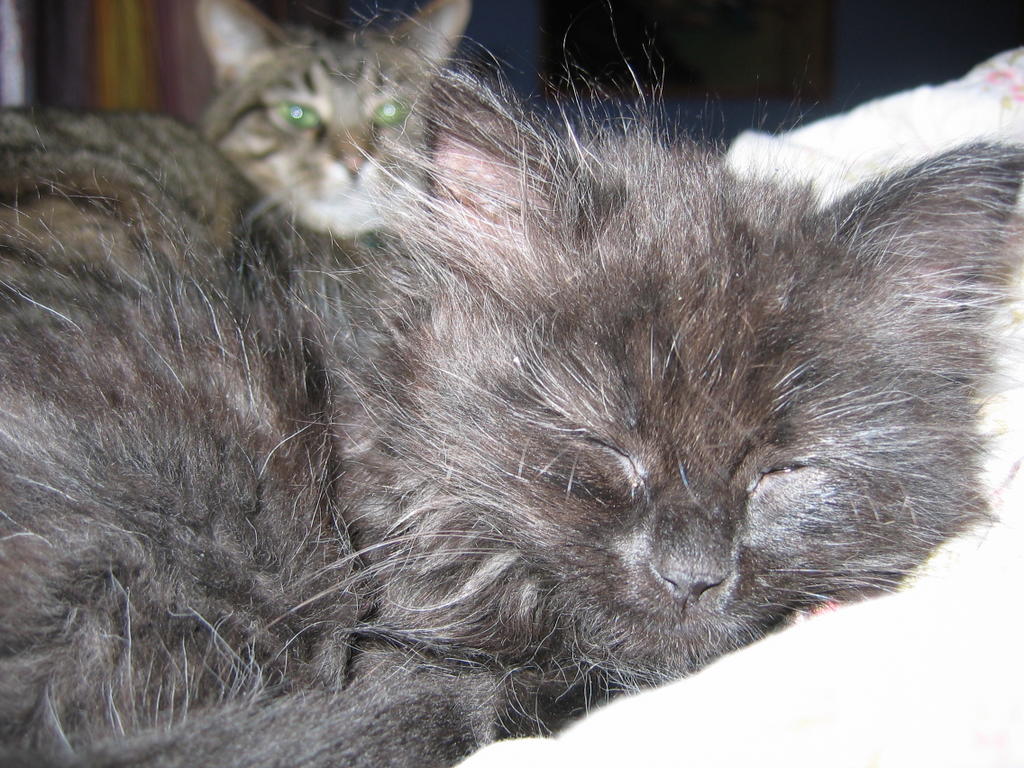
As you can see to the right, Grimalkin was not happy at first–see her balefully glare over Ari’s shoulder while the kitten peacefully sleeps?
Well, yesterday, I caught Grimmy playing with her, so I know Grimmy is getting over it. All of the boys love Ari, and play with her and sleep next to her, and Gummitch washes her from head to toe and treats her like the baby she is.
 Grimalkin is still not happy with having to stay upstairs while the work goes apace with the kitchen, but she will get over it.
For more cat blogging–check out
Kiri as a baby at Eatstuff. (Clare at Eatstuff hosts every week and will have many more links to more kitties.)
Glinda in a kitty sling at Anne’s Food.
Kittens and an umbrella at Masak-Masak
The handsome, striped Tigger at Look, Hunny I Cooked.
The newly named Bowser at A Cat in the Kitchen.
Lovely Trina at Indy Food.
Maneki Neko at Le carnats de submarie.
Sugar High Friday #13: The Dark Side
 It is my birthday.
I am forty years old today.
And what better way to celebrate than to enter a blogging event: my very first Sugar High Friday?
This one is hosted by Kelli at Lovescool, where she asks us to turn to the dark side–of chocolate, I mean. She asks that we do something new and different with what is a common baking ingredient: dark chocolate.
Well, that is right up my alley–I don’t bake often (those of you who have followed my pie adventures are probably shaking your head and saying, “liar, liar, pants on fire,” but bear with me) but when I do, I like to do the unexpected.
Like making an apple pie with hardly any sugar.
Or putting duck sauce in cookies.
Or icing delicate vanilla cakes with rosewater.
So, what to do, what to do?
I didn’t really feel like baking on my birthday, but neither did I feel like making fudge, so, what could I come up with that is simple, but infinitely malleable?
 Truffles, of course.
But not just any truffles.
Russet Divinity and Dark Mystery Truffles.
What are truffles?
At their simplest, truffles are a French confections made of a cream-based ganache, sometimes flavored with liquors, spices or fruits and either dipped in tempered chocolate, or rolled in cocoa, powdered sugar or ground nuts. They are named after their resemblance to the coveted and delicious underground fungus which is so much a part of French cookery.
The next question is–what is ganache?
According to my beloved Larousse Gastronomique, ganache is an emulsified mixture of chocolate and heavy cream, sometimes enriched with egg yolks and butter, which was invented around 1850 at the Patisserie Siraudin in Paris. It is used to fill, frost or glaze cakes and pasteries, and is the basis for chocolate truffles, a confection which became a Christmas tradition in France.
 Now that we know what I am talking about, let’s talk about how to make them.
First of all, pick out a good chocolate. Since Kelli stipulated dark chocolate, the choices are narrowed down a bit–dark chocolates have no milk added to them, and not nearly as much sugar as is found in milk chocolates. Two types of dark chocolate are excellent for truffle making– semi-sweet and bittersweet. Semi sweet has more sugar and nearly always less cocoa butter than bittersweet; this affects the flavor of your truffle, especially if you do not add any sugar to the mixture. (And I never do add sugar.)
Couveture is the best quality chocolate, with a high percentage of both chocolate liquor (pure, roasted ground chocolate beans) and added cocoa butter (the fat extracted from the cocoa bean). Many brands of couveture have more than 70 percent cocoa solids in them, which makes for a richer, more nuanced chocolate flavor.
Couveture is what is best to use for tempering and dipping confections; it has superior flavor, gloss, color and snap; for truffles, one can use couveture, but it isn’t necessary.
I used what I had around the house–Scharffen-Berger Bittersweet, which is 70 percent cacao, and Scharffen-Berger Semi-sweet, which is 62 percent cacao. Usually, I make my Aztec Gold brownies with a mixture of these two chocolates, using more of the bittersweet. (This is pre-Hershey buyout Scharffen-Berger. I don’t know if the quality is still the same as it was when I bought this chocolate.)
Today, I did a fifty-fifty mixture of the two, in large part, because I know that neither Zak nor Morganna particularly love really dark chocolate.
Truffles are really simple. There are two ways to make them. Both require that you chop the chocolate finely before beginning–but I never chop the chocolate. Chopping chocolate with a chef’s knife is seriously messy business–I don’t care what they show you in the movie, “Chocolat.” Instead, I usually grate it, either by hand with a box grater or in a food processor. The food processor is faster and safer–my family didn’t call box graters “knucklebusters” for nothing.
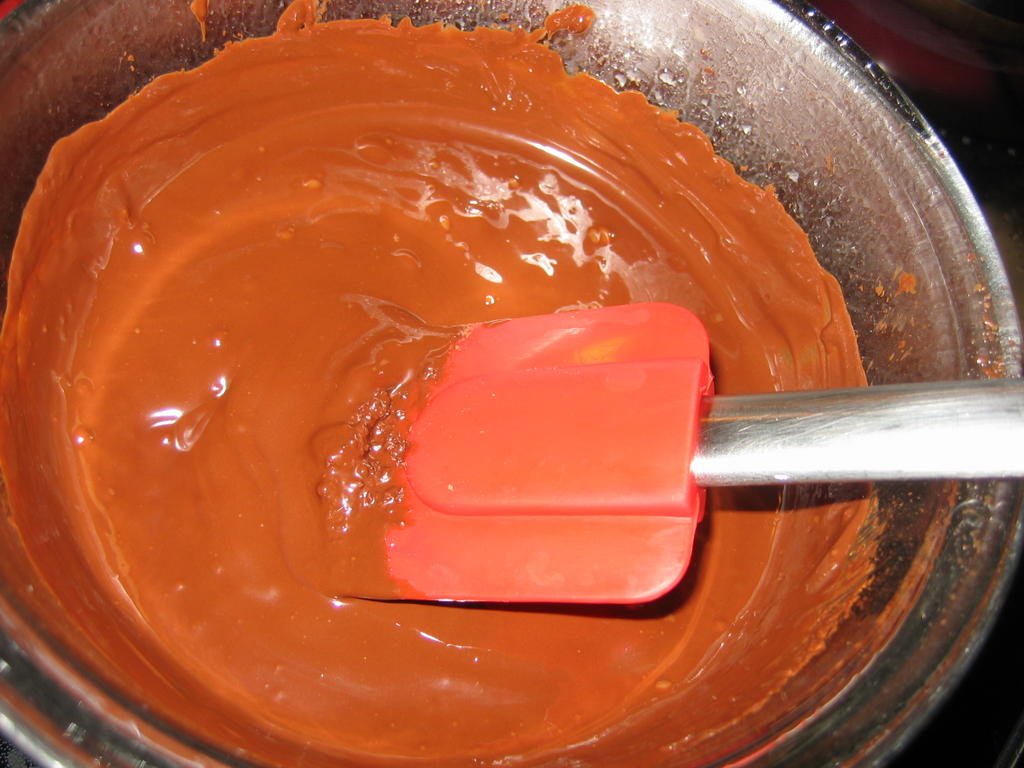
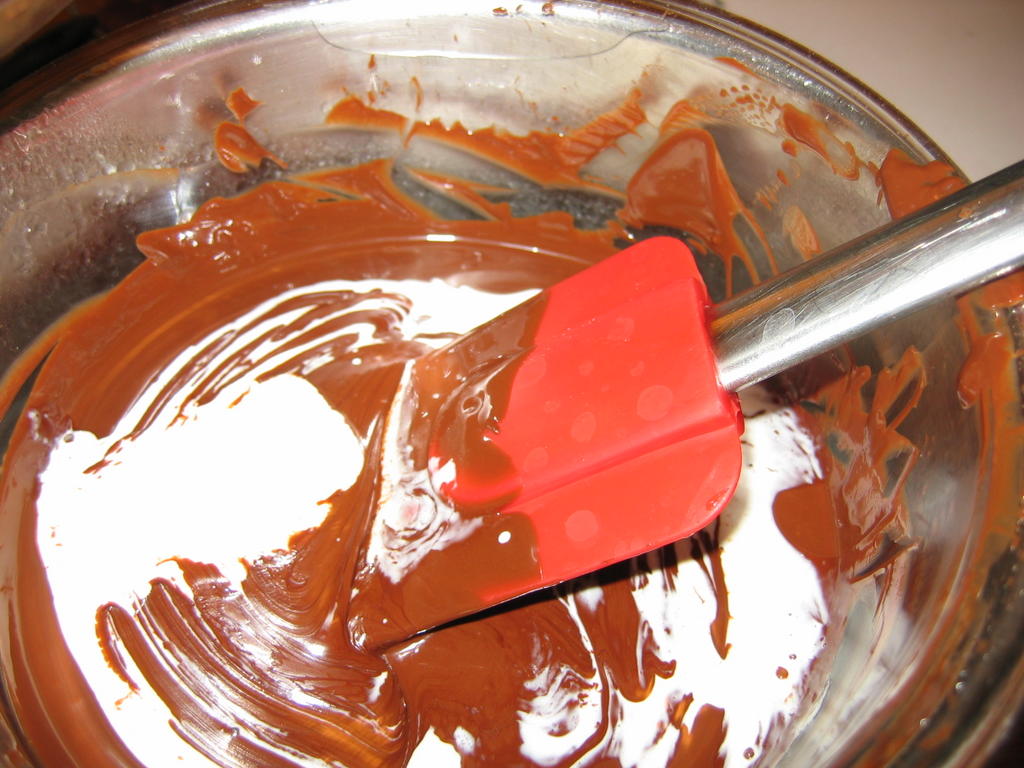
Once is it chopped, you either melt the chocolate in a glass bowl over a hot water bath or you let it sit in a glass bowl and pour boiling cream over it, and mix them together. The heat of the cream melts the chocolate and it emulsifies. Or, in if you melt your chocolate in the beginning, you can bring the cream to a boil, cool it slightly, and stir it into your already melted chocolate.
In either case, you must do two things lest you ruin your chocolate. One–you must not get water in your chocolate, or it will seize up and refuse to melt or cooperate. And two–if you are going to use any liquor to flavor your truffles, (rum is a favorite), you must wait until the cream and chocolate are emulsified before adding it, lest you end up with seized up, hard crunchy nasty chocolate.
 So far, it sounds like I am doing a standard truffle–I have spent so much time talking chocolate, I haven’t really gotten to the creative twist that makes these truffles Russet Divinities and Dark Mysteries. All we have gotten to is a bunch of nattering about cocoa solid percentages, and dire warnings about chocolate with seizures.
Well, be patient–I am getting to that.
In the opening photograph, you can see my ingredients laid out–including two glasses of some sort of liquid and two powders.
Those are the secret special ingredients that make my truffles into Divinities and Mysteries.
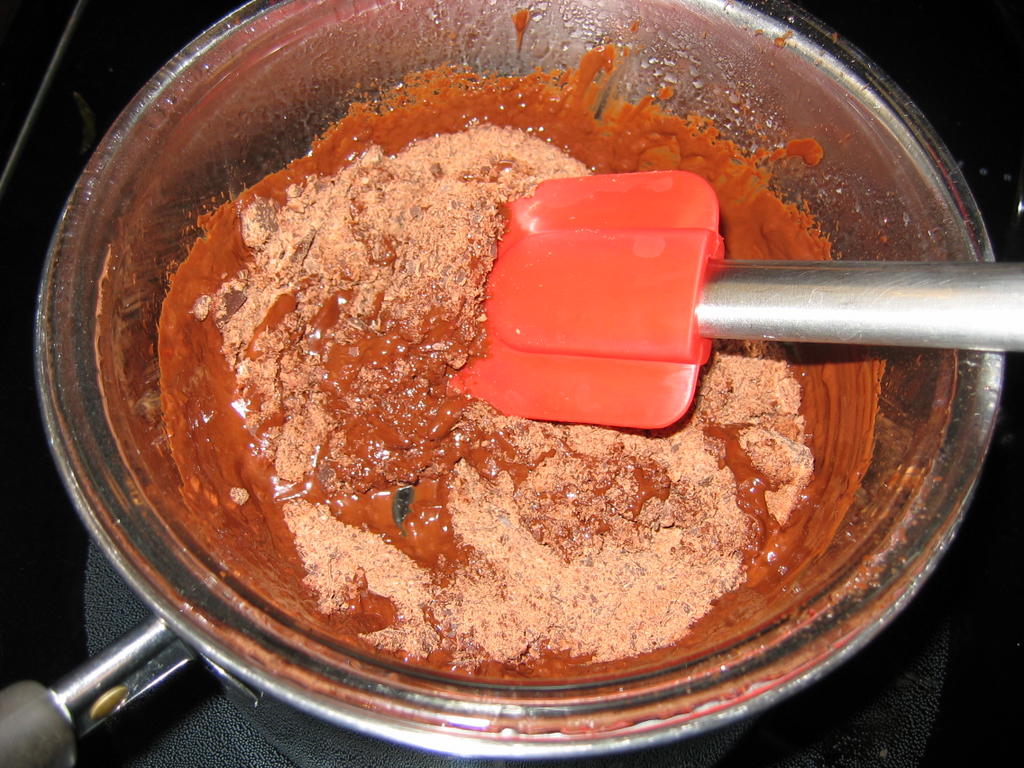
I essentially made one batch of ganache and after the cream and chocolate were emulsified, I scooped one half of the ganache into a second clean, warmed glass bowl and then added the secret ingredients with a steady hand and a swift wrist.
Into the ganacheI had designated to become Russet Divinities, I stirred one tablespoon of ground chipotle chile and one scant tablespoon of Kalua and a few drops of double-strength Penzey’s vanilla extract. The rest of the ganache became a Dark Mystery with the addition of a tablespoon of Chambord, one teaspoon of finely ground mixed white and black peppercorns, and a couple of drops of Boyajian Natural Raspberry Flavoring.
Then, both bowls were covered tightly with plastic wrap and taken downstairs to chill enough to firm up down in the Sub-Zero downstairs, which is much colder than the upstairs, rather crowded refrigerator.
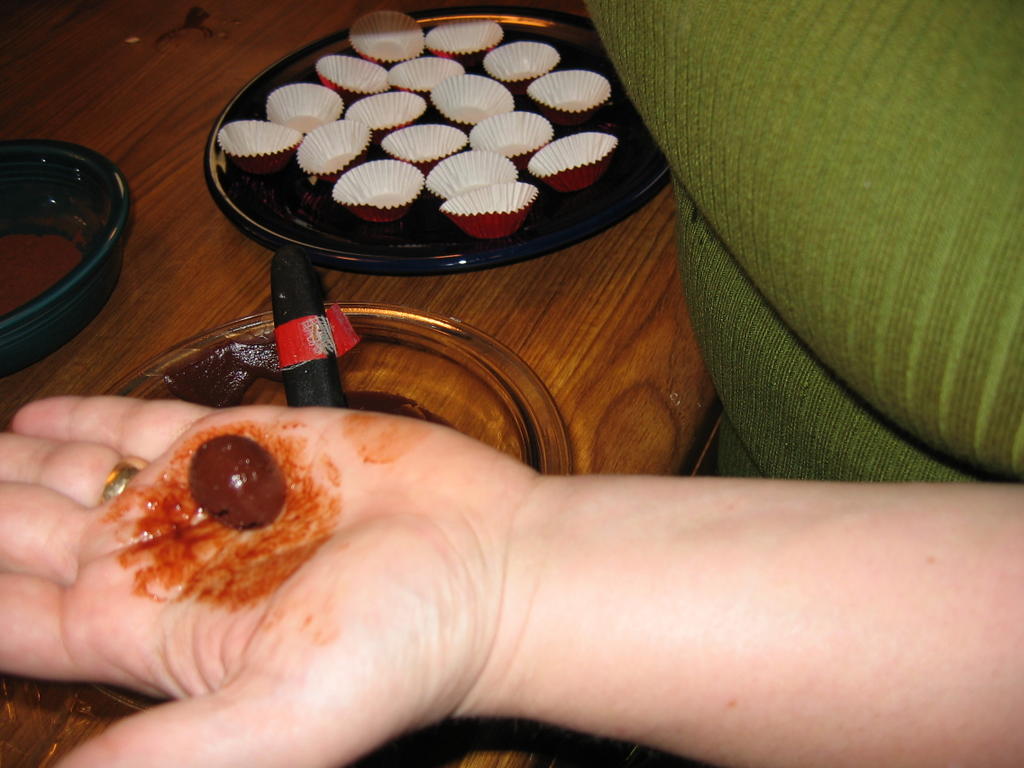
Once that was done, and the ganache was cooled to a nice solid, it was a simple matter of shaping and coating them.
Simple, but messy that is.
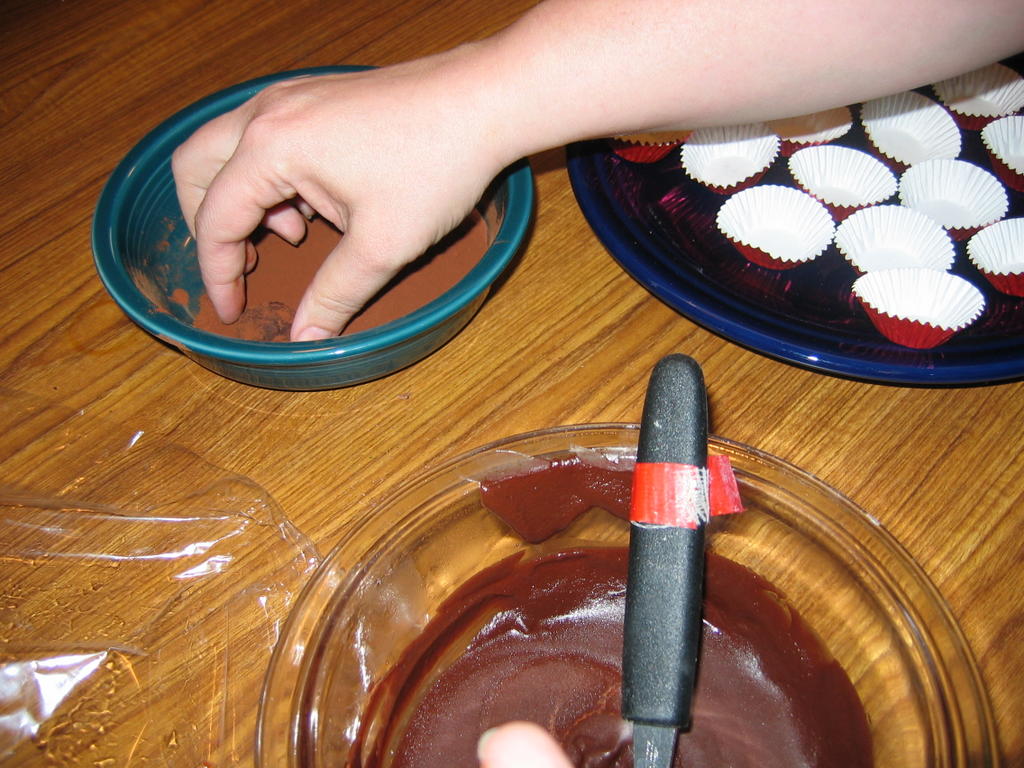
Morganna helped, and while fussing about the amount of velvety chocolate goo that was swiftly coating her palms, said, “Why the hell didn’t they show them making these in ‘Chocolat?'” The answer, of course, is self-evident–while some may find the idea of Juliet Binoche coated in sticky chocolate erotic, many others would be turned off by the messiness of the entire process. So, instead we saw lots of shots of her stirring melted couveture languidly to the beat of the soundtrack, or chastely dipping creme centers or wrapping already made chocolates and tying them with golden ribbons.
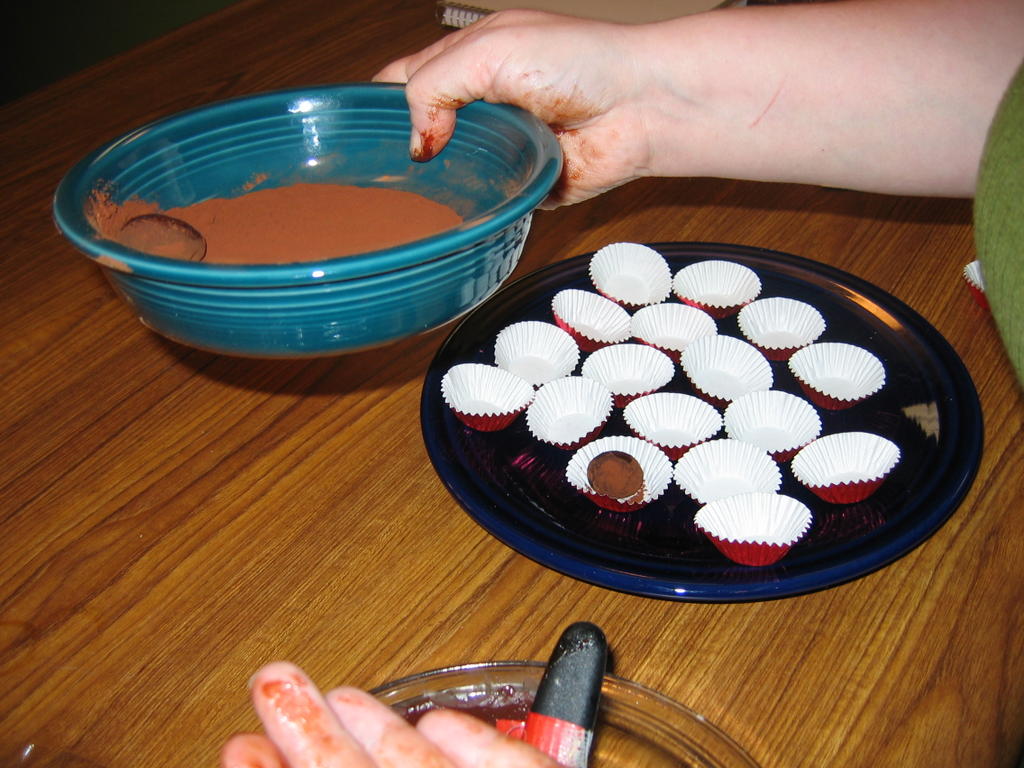
However, her tune changed after she tasted them, particularly the spicy little “Russet Divinities.”
“Mom,” she asked as she licked paprika-spiced cocoa from her fingers. “Can we open a chocolaterie?” She popped another Russet Divinity into the bowl bowl that held the mixture of smoked Spanish paprika and American-style cocoa. “It would be fun, and I bet we could make a killing on truffles alone, especially at Christmastime.”
As I rolled the last bit of ganache between my chocolate-slicked palms, I considered the possibility. I have to admit that it is tempting. One silly pipe-dream my Aunt Judy (the person who popped the first truffle in my mouth when I was a child) and I had for many years was of opening a combination patisserie-chocolaterie together, and selling dainty desserts and confections to those who had the taste for such fine things but no patience or will to make them on their own.
I will consider it. Athens doesn’t have a place that makes really stellar confections, and it would be very fun to make up new and different combinations to flavor truffles.
I bet you are wondering how they turned out?
They are an awfully good birthday present, I must say that. Not only are my hands soft and delightfully scented from having been coated with cocoa butter, but tje lingering flavor of chiles, coffee, raspberry and black pepper are haunting.
We all preferred the Russet Divinities, for what it is worth. In large part, that is because we all like chile peppers over raspberries. However, I think that if I added some raspberry puree to the mixture, and a bit more black pepper, the Dark Mysteries will catch up to the Russet Divinities in flavor.
All in all–it was a successful experiment, and here is the recipe:
 Russet Divinities and Dark Mysteries
Ingredients:
8 ounces premium dark chocolate
5 liquid ounces heavy cream
Russet Divinity Flavoring:
1/2 tablespoon ground chipotle chile
1 scant tablespoon Kalua
3 drops Penzey’s double strength vanilla extract
1/4 cup smoked Spanish paprika
1/4 cup non-Dutch process cocoa
Dark Mystery Flavoring:
1 teaspoon finely ground mixture of black and white peppercorns
1 tablespoon Chambord
3 drops Boyajian natural raspberry flavoring
1/3 cup Dutch process cocoa
Method:
Finely grate chocolate in a food processor. Put it into a perfectly dry glass bowl, and set bowl over a pot of simmering water, making certain that water does not touch the bottom of the bowl, and does not get inside the bowl. Stir often until it is melted and turn the heat off, but leave the bowl over the water as you wait for the cream to boil.
Bring cream to a boil in a separate pan. When it boils bring it off heat, and swirl it in the pan for about a minute or two to cool it slightly. Keeping chocolate over the water (though if the chocolate is still liquid, you do not need heat under the pan of water–the steam will be enough to keep it liquid), slowly pour the cream into the chocolate in three stages, stirring all the while. Make certain to completely incorporate the cream after each stage, before adding more. (Some people use a whisk for this, but I use a silicon scraper–whisks cool the chocolate down too much and make it more finicky to play with for my nerves.)
After cream and chocolate are emulsified, scrape half of it into another glass bowl that has been warmed in the microwave or over another pot of water.
Into each bowl of ganache, add the dry flavoring (chile pepper or peppercorns) first, stirring until incorporated, then the liquid ingriedients. (Add the vanilla to the Kalua and the raspberry flavoring to the Chambord before pouring them into the chocolate.) Pour the liquor in a steady stream, while stirring constantly until it is fully incorporated into the emulsion.
Immediately cover tightly with plastic wrap and refrigerate for about an hour and a half, or until it solidifies.
For the Russet Divinities, mix together the cocoa and paprika in a small bowl and put the dutch cocoa in a separate bowl.
Using a small melon-baller, portion out half-teaspoon or so bits of ganache–it is easiest if one person does this, while the other digs the ganache out of the melon scoop with a finger, and carefully rolls it a few times between her palms until it is mostly round. Do not get OCD about it–the lumps are part of their charm.
Put each truffle separately into the appropriate bowl of coating, and swirl the bowl around a few times to coat it. It is easiest if the scooping person does this, because they do not have chocolate all over her their hands.
Set truffles into candy cups. Store in a tightly covered container in the refrigerator, unless you keep your house very cold.
Enjoy.
Note: I have to give credit to Sarah Patton for the name, “Russet Divinity.” She used to teasingly call me that back in college, because I had red hair.
What Does My Kitchen Look Like Now?
 Aptly enough, it looks like a construction site.
I haven’t gotten really good pictures of it looking like a war zone, but you can see it now, sans flimsy cabinetry, 1BTU gas stove (we joked that it had 1BTU that it shared among all four burners), sink, dishwasher and the Sub Zero.
Oddly, Zak pointed out that it looked smaller than it did with stuff in it.
Oh, and that soffit is now gone. Which is great, because that opens up more room for cabinetry.
The truck is blocking our street, and they are offloading said cabinetry into our garage right now.
 In the rain, but hey–rain is better than sleet.
And, to the right, you can see the hole they cut into the wall to put in the built-in bookcases for the cookbook collection.
All of this the day before my birthday.
That is a heck of a birthday present!
I took a picture of the Sub-Zero’s new home–the laundry/utility room. They had a hell of a time moving the thing, but it forced me to take everything out and clean it, so no harm was done. And none of the guys was hurt or maimed in the moving of it–the thing is monstrous.
I am wondering if the lack of it is part of what is making the kitchen look smaller.
As more things happen, I will photograph and record them here.
Stewing in Fusion
 I’m weird.
Although I am always improvising and “winging it” when it comes to cooking, I don’t much like the idea of “fusion food.”
Part of the reason I am not into culinary fusions is because I have had a lot of dishes that should have been called “confusion food.” Stuff that just seemed to be thrown together without any sense of cultural awareness or understanding because it looked or sounded good.
Looking good is not the same thing as tasting good, and for my money I’d rather eat a dish of something that looked like it came out of a retching dog and tasted just this side of heaven than a cunningly constructed tower of colorful comestibles endowed with jarring flavors that do not go together well.
This could be taken as a simple prejudice against fusion cuisine, but that is not the case.
For one thing, I think that a case could be made that some national cuisines are fusions between the food products and cooking techniques of more than one culture that have come together harmoniously. Northern Indian cookery, Northern Mexican cookery and the cuisine of Thailand are three examples of very complex culinary traditions that gain a great deal of vivacity from the fact that these countries are home to more than one cultural or ethnic group.
For example, Northern Indian foods still reflect the tastes of the Persian Mogul emperors with their emphasis on rich dairy based sauces thickened and further enriched with ground nuts, the pairing of savory with sweet in the form of meats cooked with dried fruits such as golden raisins, and the making of biryani, a rice and meat dish that is very like a Persian pillau. (They have pillau as well, in Northern India.) Thailand, on the other hand, has been a culinary crossroads for centuries, and its many cuisines reflect this background in a perfect marriage of Chinese wok cookery, the Indian emphasis on spices and curries, and the native abundance of seafood, herbs, fruits and vegetables.
In order to make a good fusion between two cuisines, one should take care to understand both cuisines and their cultural backgrounds. In this way, the cook can find the commonalities between the cooking traditions, and use those similarities to bind the fusion dish into a coherent, flavorful and realistic representation of food that is rooted in something other than a chef’s ego. It helps give the dish depth and context that a lot of fusion foods seem to lack. Innovation is always up to the moment, but it should taste as if it has centuries of tradition behind it.
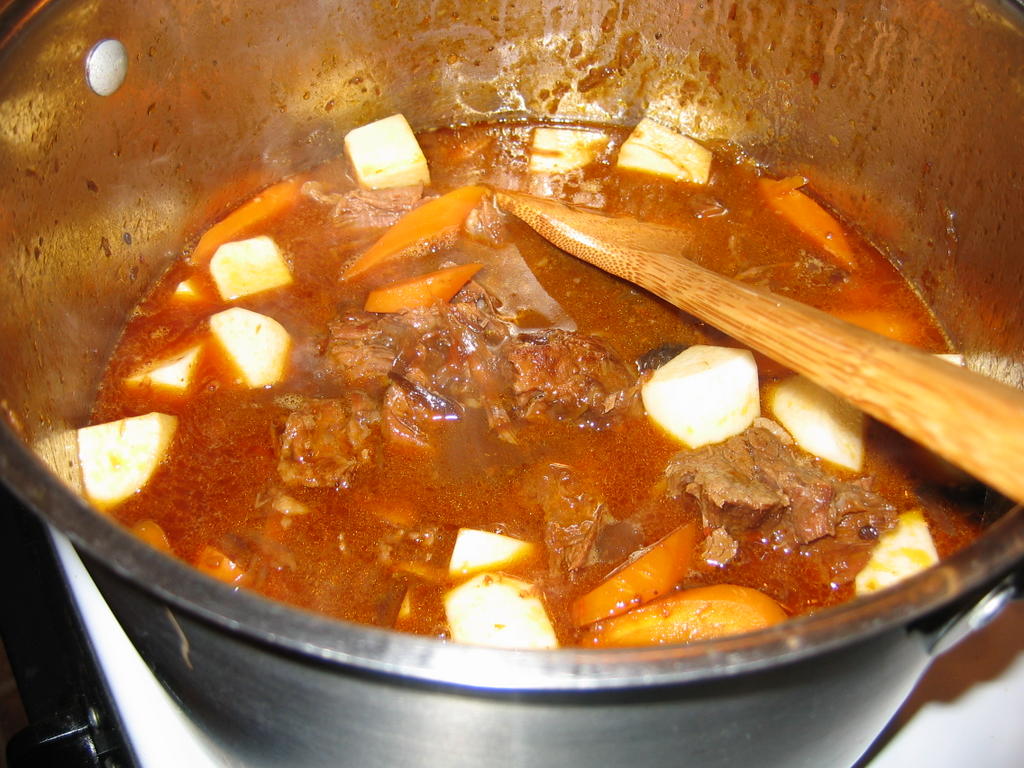
 The other night, I had a chunk of dry aged blade beef chuck that I wanted use to make Sichuan Beef with Turnips–a traditional braised dish that features the fire of broad-bean chile paste and ginger married to the smoky tang of black cardamom and the icy tingle of Sichuan peppercorn.
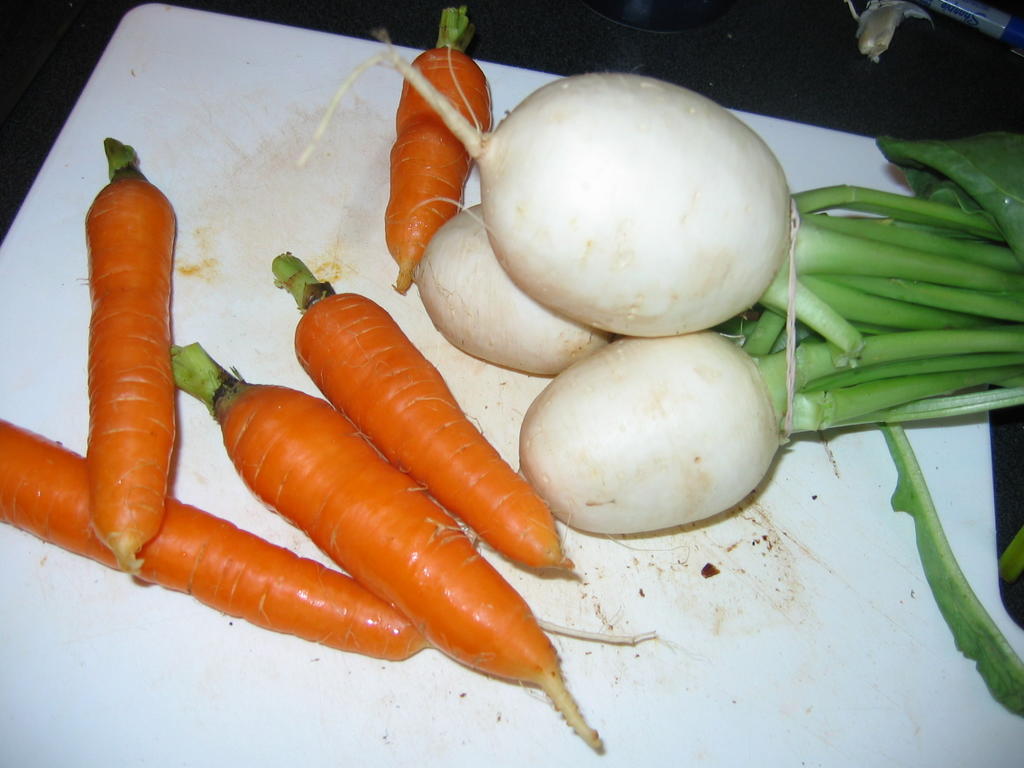
However, I noticed that I didn’t really have enough broad bean paste and I did have a bunch of leeks that were going to wither away into a disreputable heap of mushy leaves if I didn’t use them. I also lacked Chinese turnips, which are my favorites to use in the dish, but I had picked up at the farmer’s market a bunch of lovely Japanese turnips and gorgeous carrots.
 I looked at the mostly full bottle of Shao Hsing wine and shrugged my shoulders. I decided to use the leeks, carrots and turnips, and what spices and bean pastes I had, and using French braising techniques, create a stew that had the basic flavors of the Sichuanese original, but tweaked with the sweetness of browned leeks and fresh carrots.
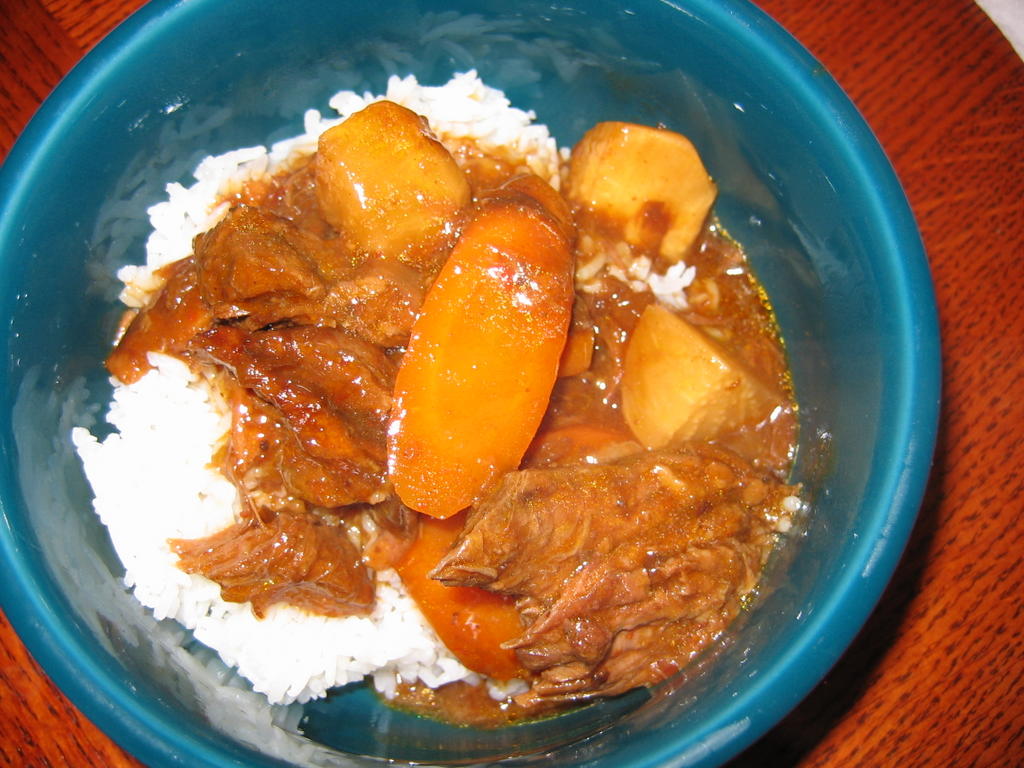
I am glad I made that decision; it turned out to be the right one. The stew turned out to be fabulous, and it had just the right blend of the richness of a French beef braised in wine and the tingling heat of a Sichuan dish meant to cool the body by causing the diner to sweat.
I had ready access to very fresh black cardamom, called cao guo by the Chinese. The large, somewhat shaggy looking pods are strongly scented, and have a smoky, almost medicinal tang to them. They are used in the cookery of Northern India, but in very sparing amounts. The only Chinese recipes I have ever seen which use them are long-cooked braised or stewed dishes, and then they are most often used in Sichuanese cooking. Here, they are also used in sparing amounts, usually only one or two per large pot of food.
Like many other ingredients in Chinese cookery, the cao guo is considered to have medicinal properties. It is considered to be a warming food, which is good for the spleen.
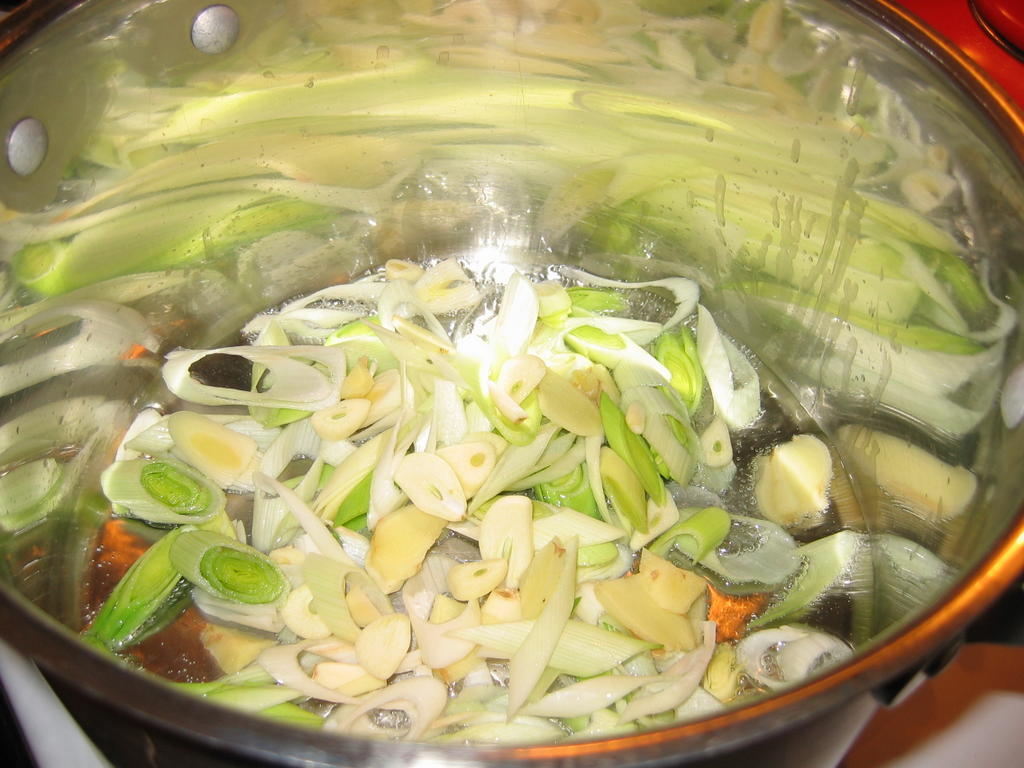
 I decided that since it was a large piece of beef, I would use two black cardamom pods, and instead of the Sichuan peppercorn, I would use a mixture of black and white pepper. I left out the usual star anise that creates a background sweetness for the traditional stew, and instead, browned leeks that I had cut diagonally into slices that the Chinese call “horse-ear slices,” and browned them in a bit of canola oil.
Instead of blanching the beef as is done in the traditional Chinese fashion, I dusted it with flour and ground white and black pepper, and browned it along with the leeks, then added diagonally sliced chilies and thinly sliced garlic and ginger.
 While I left the beef to form a nice brown crust, the mingled scents of the aromatics wafted through the kitchen in a cloud of wraith-like steam, which brought my four-footed helpers at a gallop. They danced under my feet in waves, purring and rubbing, forcing me to dodge them and nudge them out of the way as I dug around in the refrigerator for the broad bean chile paste.
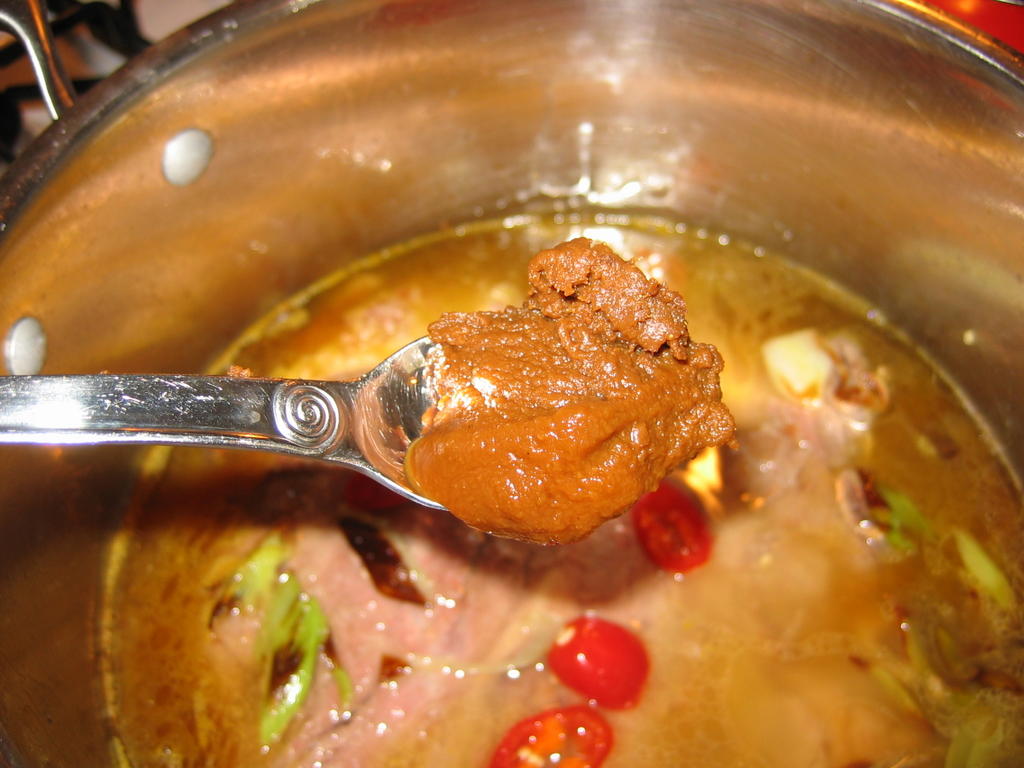
I came up with a lonely jar with about two tablespoons huddled listlessly in the bottom; the recipe usually calls for four or five tablespoons.
If it was just heat that was contributed by the paste, I wouldn’t worry about it, but the fermented beans add a great deal of depth to the braising liquid. They are full of the components that create the flavor known to the Japanese as “umami:” a savory, meaty, dark flavor that is particularly luscious in a stew.
So, I dug out some plain ground bean paste which is made from fermented soybeans, and used a couple of tablespoons of that as well as wine and beef broth to deglaze the brown crust that had formed at the bottom of the pot.
 Chinese black mushrooms, which are nothing but dried shiitake mushrooms, also are packed with “umami,” so I added those to the stew. And, of course, I used the soaking liquid–in this case, more wine–in order to maximize the musky-woodsy flavor of the mushrooms.
All of these ingredients simmered together for a couple of hours before I peeled, cut and added the carrots and turnips.
The Japanese turnips were so crisp and juicy that I had a hard time not gobbling them down raw myself while I was peeling them. The snow-white globes amazingly sweet with just a hint of icy bite that gave them a shivery-wintery quality that went perfectly with the carrots more mundane, earthy-autumnal sweetness.
The marriage between Chinese flavors and French technique and ingredients worked well, despite my usual misgivings about culinary fusions. At least there is precedent; both Ming Tsai and Susanna Foo deftly balance their Chinese culinary heritage with French techniques and ingredients, resulting in food that somehow manages to be both exquisitely light yet full-bodied and deep.
Led by their stellar example, and by the reactions of both Zak and Morganna, I will continue mine the rich veins of the two most influential pillars of cuisine in the world–Chinese and French culinary arts, and report back as the work continues. I don’t know what will come of my experimentations, but they are bound to be better than the flirtatious attempt at Thai tacos I made many years ago on the premise that Mexican and Thai food both featured garlic, cilantro, lime and chile, and both cuisines had a common love of street foods and snacks.
That premise wasn’t enough to support a successful fusion, to say the least. In fact, I think it was one of the worst meals I have ever made. I am comforted by the fact that it was years ago, however, when I was younger, more foolish. and possesed of judgement impaired by a bit more beer than was strictly necessary for kitchen duty.
This Chinese/French invention, though it was forced by necessity, is at least informed by extensive study and understanding of both cuisines and traditions, and as such, will hopefully prove to be a more fruitful pursuit.
 Boeuf Braisee a la Chinois
Ingredients:
3 large leeks, white and light green parts sliced thinly on the diagonal
5 tablespoons canola oil
3 pound beef chuck roast
3 tablespoons flour
freshly ground black and white pepper to taste
2 fresh ripe jalapenos thinly sliced diagonally
3 cloves garlic, peeled and thinly sliced
1 1/2″ chunk fresh ginger, peeled, thinly sliced
2 black cardamom pods
1 cup Shao Hsing wine or dry sherry
2 tablespoons chile broad bean paste
2 tablespoons fermented ground bean paste
1 teaspoon honey
1 quart beef stock or broth
6 Chinese black mushrooms, soaked in 1/2 cup Shao Hsing wine and 1/2 cup hot water
5 medium carrots, peeled and sliced diagonally 1/4″ thick
3 large sweet turnips, peeled and cut into 3/4″ dice
fresh cilantro for garnish
Method:
Rinse leek slices very well: put them in a large bowl, and soak in a lot of cold water to cover. Swish leeks around, then lift out and put in colander. Pour water out, rinse bowl, put leeks back in, cover with water, repeat steps at least three times. (Do not pour the water out over the leeks and drain them directly in the colander. This would just let the grit and dirt settle back on the leeks–which is quite counterproductive.)
Drain the leeks until completely dry on paper towels.
Heat oil in a heavy bottomed pot until it is nearly smoking. Add leeks, and allow to begin browning.
Season beef on both sides with liberal amounts of freshly ground white and black pepper, then dust well with flour. Put into pot on top of leeks, and allow to brown until a nice crust is formed. Turn beef over, and sprinkle the chile, garlic, ginger and cardamom over and around it. Brown beef on all sides, then remove to a plate and set aside.
Deglaze pan with wine, scraping up all browned bits from the bottom of the pot. Add bean pastes and beef stock or broth and put beef back into the pot.
Remove mushrooms from soaking liquid, and squeeze out excess water. Carefully cut off and discard stems, and cut each mushroom into quarters. Add mushrooms to pot, and carefully add all but the last little bit of the soaking liquid–that will have any bits of grit or dirt from the mushrooms in it.
Cover pot, bring to a boil, turn down heat and allow to simmer until beef is nearly fork tender. (By nearly fork tender I mean, a meat fork will go easily into the meat, but when you lift it, the meat will not slide off easily.)
Add vegeables, and remove lid, to allow liquid to reduce. Cook until meat is fully fork tender–a fork will insert easily, and then, when lifted, will slide right out of the meat. At this point, the carrots should be just tender and the turnips meltingly soft and sweet without being mushy.
By this point, the leeks will have broken down and the braising liquid will have reduced considerably; however, if you like you may add roux, or a cornstarch or flour slurry in order to thicken the juices further.
With meat fork, break up meat into serving sized chunks. Serve over steamed rice or with plain steamed buns, and garnish with cilantro, if you have it. (I think you can see from the photograph that I was out of cilantro.)
Preparing for the Onslaught
 We were in Columbus today, so we could purchase the last bit of kitchen equipment we needed for the rennovation–a ventilator hood. The stove I am getting (in five to nine weeks, instead of the four to six they originally quoted me) requires more ventilation power than the one I had picked out, so we needed to go back to the place we got our appliances and order a different hood.
But then, Minna got sick, and so we kept putting it off and putting it off. Today, Morganna went to the last soccer game of the season after school, so we headed off to Columbus.
While we were in the process of buying said hood, we got a call from the kitchen designer asking if the contractors could come tomorrow to start tearing out the old kitchen.
Not even twenty-four hours notice.
Of course, I said yes, because a lot of the stuff had already been moved upstairs. But, still–it is a pain in the rear end, so we rushed home and have been, for the past three hours, running about like nutballs moving stuff, picking up Morganna, getting the cats squared away upstairs and locked up in the second floor, and feeding the dogs, doing laundry and every other thing we could think of to do.
They are tearing everything out and somehow, someway, it will get to Dan and Heather’s house, where when they buy the place, it can help them rennovate their kitchen.
Everything, that is, except for the ugly hanging light pictured above.
That is promised to someone else. Someone who has a special purpose in mind for it.
Someone who has hit his head on it more times than I can count.
(It is so low that I have hit my head on it–and I am not tall. Banging one’s head on it and then ducking back to avoid it gets light in the eyes–and then, looking up at the stained glass fruit is really surreal. Rather like being interrogated by the Fruit of the Loom guys.)
Anyway–Bry gets the lamp.
I believe he will take it out in the woods and use it for target practice.
I just hope I get one little shot in myself, as I rather loathe the thing.
However, there is a silver lining–I have been so busy today and this evening, that I haven’t had a chance to mope over Minnaloushe’s absence. That is good–when I am grieving, I can be an utter lump, sitting about in a daze. It is better to do something, to keep the body and mind active–that way, when I think about Minna–I think about happier times, and it isn’t so crushingly sad.
Then, I found out that Morganna’s boyfriend is coming for dinner tomorrow–which, truly, is fine–I was planning on stir-fried pork and green beans anyway–I will just add some mushrooms, carrots and maybe some greens and call it something new. He’s a nice boy–maybe he can help me move my cookbooks and cookbook shelf upstairs while he is here….hrm. Maybe he should come to dinner more often. (Actually, he and his Mom are invited to dinner on Saturday, anyway.)
There is more–and of course, I will post pictures of the destruction and construction as the project goes along, as well as descriptions of the adventures that happen along.
And, we have good kitty news, but that can wait for another post.
Yes, I am going to keep all of you in suspense.

Categories:
- Admin (rss) (55)
- Blogs and Blogging (rss) (81)
- Book Reviews: Cookbooks (rss) (43)
- Book Reviews: Non-Cookbook Food Books (rss) (38)
- Cats and Cat Blogging (rss) (47)
- Chinese Cooking Lessons (rss) (32)
- Culinary School Stories (rss) (18)
- Dairy Pruducts: Cultured and Barbaric (rss) (4)
- Documentary Filmmaking (rss) (1)
- Essays, Rants and Reflections (rss) (260)
- Fighting Hunger (rss) (12)
- Food and Kids (rss) (45)
- Food in the News (rss) (126)
- Food Media (rss) (98)
- Food Preservation (rss) (18)
- Food Safety (rss) (45)
- Gardening (rss) (30)
- Herbs and Herb Blogging (rss) (20)
- Holidays (rss) (50)
- Kat Blogging (rss) (22)
- Kitchen Science (rss) (36)
- Leftover Makeover (rss) (8)
- Life, the Universe and Everything (rss) (131)
- Local and Sustainable (rss) (227)
- Local Athens Food and Foodies (rss) (42)
- Meatless Mondays (rss) (32)
- Menu For Hope (rss) (5)
- Nutrition, Diet and Health (rss) (84)
- On The Farm (rss) (8)
- Recipes: Almost Vegetarian, Vegetarian and Vegan (rss) (294)
- Recipes: American Regional (rss) (37)
- Recipes: Appalachian Hillbilly (rss) (33)
- Recipes: Bread, Pasta, Grains (rss) (95)
- Recipes: Canning and Preserving (rss) (8)
- Recipes: Chinese (rss) (123)
- Recipes: Comfort Food (rss) (120)
- Recipes: Cookies (rss) (16)
- Recipes: Desserts (rss) (48)
- Recipes: French (rss) (25)
- Recipes: Fruits and Vegetables (rss) (302)
- Recipes: Greek, North African and Middle Eastern (rss) (31)
- Recipes: Indian (rss) (137)
- Recipes: Italian (rss) (42)
- Recipes: Japanese (rss) (7)
- Recipes: Jewish (rss) (4)
- Recipes: Korean (rss) (6)
- Recipes: Meat, Poultry and Fish (rss) (220)
- Recipes: Mexican/Native American/ Latin American/Caribb (rss) (27)
- Recipes: Original (rss) (108)
- Recipes: Thai (rss) (27)
- Recipes: Tofu (rss) (17)
- Recipes: US Regional (rss) (16)
- Recipes: Vietnamese (rss) (8)
- Restaurant Stories (rss) (28)
- Sewing, Quilting, Arts and Crafts (rss) (16)
- Simple Chinese Recipes (rss) (30)
- Slow Food and Heritage Foods (rss) (10)
- Spice Blogging (rss) (44)
- The Chinese Cookbook Project (rss) (14)
- The Chinese Pantry (rss) (39)
- The Documentary (rss) (2)
- The Kitchen Saga (rss) (17)
- The Locavore's Bookshelf (rss) (15)
- The Unsung Adventures of The Culinary Nerd (rss) (6)
- Tools and Toys (rss) (35)
- Uncategorized (rss) (10)
- With a Side of Politics (rss) (48)
Archives:
- August 2012 (9)
- July 2012 (12)
- September 2011 (3)
- August 2011 (7)
- July 2011 (8)
- June 2011 (16)
- May 2011 (17)
- April 2011 (11)
- December 2010 (9)
- November 2010 (5)
- February 2010 (1)
- December 2009 (5)
- November 2009 (7)
- October 2009 (10)
- September 2009 (16)
- August 2009 (14)
- July 2009 (14)
- June 2009 (7)
- May 2009 (17)
- April 2009 (10)
- March 2009 (25)
- February 2009 (13)
- January 2009 (10)
- December 2008 (5)
- November 2008 (5)
- October 2008 (6)
- September 2008 (13)
- August 2008 (8)
- July 2008 (11)
- June 2008 (18)
- May 2008 (13)
- April 2008 (14)
- March 2008 (16)
- February 2008 (17)
- January 2008 (19)
- December 2007 (25)
- November 2007 (18)
- October 2007 (24)
- September 2007 (16)
- August 2007 (15)
- July 2007 (15)
- June 2007 (10)
- May 2007 (14)
- April 2007 (16)
- March 2007 (17)
- February 2007 (20)
- January 2007 (13)
- November 2006 (1)
- October 2006 (8)
- September 2006 (14)
- August 2006 (25)
- July 2006 (30)
- June 2006 (28)
- May 2006 (34)
- April 2006 (29)
- March 2006 (24)
- February 2006 (30)
- January 2006 (38)
- December 2005 (40)
- November 2005 (37)
- October 2005 (32)
- September 2005 (25)
- August 2005 (30)
- July 2005 (28)
- June 2005 (21)
- May 2005 (8)
- April 2005 (22)
- March 2005 (17)
- February 2005 (29)
- January 2005 (10)
Search Site:
Links:
- Lily’s Wai Sek Hong
- 101 Cookbooks
- A cat in the kitchen
- A Veggie Venture
- Accidental Hedonist
- Cha Xiu Bao
- chez pim
- Chocolate & Zucchini
- Chopstick Cinema
- Chowhound.com
- Chubby Hubby
- Cook sister!
- Cooking with Amy
- da*xiang
- Eat Local Challenge
- Eating Liberally
- Ecocentric
- Eggbeater
- Epicurious
- Farmgirl Fare
- Fatfree Vegan
- Foodgoat
- ForkandBottle.com
- Green Olive Tree
- Hooked on Heat
- Jaden’s Steamy Kitchen
- Kalyn’s Kitchen
- Lucullian delights
- Mahanandi
- Matt Bites
- MeatHenge
- mmm-yoso!!!
- New York Times – Dining & Wine
- Pizza Goon
- Rasa Malaysia
- Ruhlman
- Sailu's Kitchen
- Serious Eats
- SF Gate: Food & Dining
- Simply Recipes
- Soul Fusion Kitchen
- Tastespotting
- The Amateur Gourmet
- The Cleaner Plate Club
- The Food Section
- The Grub Report
- thecookscottage
- U.S. Food Policy
- Wandering Chopsticks
- Washington Post Food and Dining
- Wasted Food
Meta:


Powered by WordPress. Graphics by Zak Kramer.
Design update by Daniel Trout.
Entries and comments feeds.