
Cook Local, Eat Global
Whispered Secrets of a Kitchen Tantrika

A batch of Aphrodite Cakes decoratively piled under a cake dome. The cake dome is to protect them from rapacious felines, friends and family who cannot wait until after dinner to taste them.
So, a reader asked if my cookies were orgasmic, and I promised to answer in the next few days or so.
They were delectable, as always. They were seductive, enticing, teasing little bites of bliss.
I always feel weird writing about my own food and talking about how good it is; such behavior is perilously close to bragging and bragging was something I was taught not to do as a child. It is tacky to boast, it is unseemly and only people with low self esteem and no sense of class brag, or at least, so I was led to believe as a child. Now, of course, I recognize this as the root of my utter inability to do my own PR as a chef, personal chef, caterer or instructor, much less as a plain old cook, so it is something I try to sidestep in my life these days.
I decided a while back that if I just report the facts about my cooking ability and my food, it isn’t bragging–it is merely telling the truth.
So, the truth about the Aphrodite Cakes is this: the are decadance in cookie form and they do cause oral orgasm upon ingestion. Only one person out of the hundreds who have tried them has not liked them, and that had more to do with his limited taste than anything to do with the cookies. He barely liked anything at all, so I discount his rather strong negative reaction.
Everyone else loves them, without fail, and will eat inordinate amounts of them.
Last Sunday, I used them in my presentation to the local Unitarian Fellowship on the subject of “The Sacred Table: Food and Spirituality,” to great effect. Not only did everyone get into the fun and sensual pleasure of feeding each other wee roseate bits of heaven, but the cookies garnered me requests for catering: one wedding and a big birthday party, as well as a possible contract to cater for some Ohio University employees.
Maybe, instead of talking about how good my food is, which still makes me blush, I should just pass out those cookies, and wait for people to fall at my feet and beg me to cook for them.
Sounds like a plan.
Photographs of the wee delights do not do them justice: they are tiny, pastel things which look somewhat washed out on the screen. When they are seen in natural light, they are unassuming and very innocent looking– ivory cookie bases topped with rosettes of creamy pink icing. But when you pick them up, and raise them to your lips, their scent gives them away as the breath of roses tickles the nostrils and whispers naughty thoughts into the olfactory centers of the brain.
When you bite into them, the tender domed cookie melts on the tongue, releasing the butter and vanilla cloaked in their hearts, while the icing dissolves, jolting the senses with the sweet kiss of rosewater, evoking sunwarmed summer skin, the laughter of a lover and the fleeting touch of trailing fingertips.
These cookies are potent.
I wrote an article about them entitled “Whispered Secrets of a Kitchen Tantrika” that was published a couple of summers ago in SageWoman magazine, and am reprinting it here for everyone to read, as it not only describes the origin story of these wicked morsels, but a good chunk of my own kitchen philosophy is contained therein.
Whispered Secrets of a Kitchen Tantrika
Some flavors haunt you, like a ghost of a half-remembered dream, hidden in a dusty, dark corner of your mind. Amidst the cobwebs and skittering shadow creatures live golden nuggets of crystalline sensation live, waiting to be discovered, dusted off and brought to life upon your tongue.
An unabashed sensualist, when I am in the kitchen working my alchemy, I continually seek to bring memories to life for people, to give them flavors that inspire the closed eyes, and the reverent rolling of the tongue that presages a whispered, wordless utterance of awe. Like Tita, the main character of Laura Esquivel’s novel, “Like Water for Chocolate,†I know that cooking is essentially a sacred act, and an intimate one. In making food for others to consume, I am giving part of myself to them, which, when they eat it, joins with them, and becomes a part of them, forever. With food, I can make love to the entire world, if I so wish, and never be considered a slut for it.
When I cook, I want it to be an act of kitchen tantra.
So, as a kitchen tantrika, a seductress and enchantress of the cookstove, there are a few flavors which I will use in order to induce the voluptuous pleasure that falling in love gives the human psyche. I think of these flavors as an extension of my own energy, as elixirs and philters which help transfer my life-giving force into a physical form which seeps into another person by way of their lips, tongue and tastebuds. These flavors are like my signature, and are very personal to me.
I am told by other alchemists of the culinary arts that I should hide my secrets, keep my flavor riches to myself, and cloak my magicks in mystery. To these assertions, I shrug and say, “Even if others use my flavors, they will not taste exactly as they do in my hands.†This has proven to be true, for even accurately reproduced recipes transcribed from my hand, and recreated by perfectly competent cooks have not resulted in a dish exactly like mine. That is because the energy is different, even if the flavors are the same, and not every cook knows the way to imbue every dish with their essential nature, such that they give a bit of their spirit away with each bite. Nor should they.
My Gram, a very wise old woman indeed, once told me that the saying, “Too many cooks spoil the broth,†did not only refer to the fact that if too many people work on one project, they will not agree. She said it also meant that too many people’s energy put into one thing, in this case, food, would make that thing confusing, and not focused or well directed. In the case of the broth, it might not taste good, because it would have the conflicting energy of disagreeing cooks in it.
What flavors, then, do I have in my palette, that I save for those moments when I want to entice, beguile and tantalize the senses?
There are several, but one of my favorites is the essence of rose: also known as rosewater.
Roses have been known as the Queen of Flowers, and a symbol of love and sensuality for thousands of years. Roses were one of the symbolic flowers of Aphrodite; the other was the lily. Interestingly, when the Virgin Mary came along, she took on much of the symbolic content of the mythos of Aphrodite, including the roses and lilies. I find that fascinating, that what had once symbolized sensuality and carnality, had become a symbol of purity and innocence.
But, be that as it may, the rose has emblematic of love and sensuality for a very long time. Think of it, the velvety petals, cupped and softly unfurling around a secret center, the intoxicating fragrance, both honey-sweet and musky: how could the rose -not- be seen as a potent avatar of love and beauty?
Rosewater is the distilled essence of roses, known as attar of rose, combined in minute amounts (for it is one of the most expensive botanical products in the world) with pure, distilled water. It is clear, and ranges in scent from light and sweet to heady and intoxicating. The brands made in Persia (Iran), Lebanon and India are among the most strongly scented, while some of the brands made in the United States and France are very sweet, and more light in fragrance.
Whatever can one flavor with roses one might ask? Well, it would do one a bit of good to know, first of all, that the use of rose petals, rose water and attar of roses in cookery has a long and noble history, dating back to the Greeks in the West and the Persians in the East, and likely they both got the idea at the same time, while they were at war with each other, during the age of Alexander the Great.
Rose petals have been candied and used as decoration for thousands of years, but roses have better uses than as a garnish. They have been made into sauces, jellies, preserves, liquors, and fillings for cakes. Rosewater and essences have flavored dairy products, drinks, primitive and refined sorbets and sherbets, pastries, main dishes and more for as long as mankind has been growing roses.
With a pedigree like that, you can bet that I wasn’t about to be shy with the use of rosewater. It is one of my “secrets†in my arsenal of flavors which are meant to induce diners to shed their dignity and become unabashed voluptuaries. And I have to say, every time I use rosewater, people know that there is -something- special in there, but they seldom guess what it is.
I mostly use it in conjunction with fruit. I find that it adds a breath of freshness, a spring-like innocence that belies a flagrant sensual nature that lies underneath the surface. It adds depth to a fruit salad, when combined with a dash of champagne. It is particularly effective when combined with its kin, the bramblefruits: raspberries and blackberries. Because they are cousins to roses, these fruits really shine when they are kissed with the essence of the Queen of Flowers. Rosewater is subtle with these fruits, sliding into the flavor mix like a nymph sinking into water, until she is but a shimmer beneath the surface: you know it is there, but you cannot tell what it is. It is only a flowery scent, a flicker of something familiar that is just maddening to the senses, but that cannot be grasped: the nymph dances laughingly beyond the satyr’s reach.
Last year, my friends, the very friendly and very healthy hippie organic farmers at the farmer’s market, had a banner crop of blackberries, so they were selling these plump, shining beauties for next to nothing. These berries were so soft, so yielding and so full of sugar, that you could barely pick them up without bruising them and being stained with roseate juice. Just driving home with them filled my car with a miasma of sweetness, and when I brought them into the house, my kitchen smelled like the very tumescent essence of summer Herself.
I ate some by themselves, but I also decided to create a fitting frame for these lovely wonders. I baked a batch of sweet cream scones, a very rich and short pastry that is still moist, due to the addition of cream. They are not overly sweet however, because they did not need to be: the berries were dripping with fructose by themselves. I took some of the berries, the prettiest, and left them whole. The others, I macerated with just a touch of sugar to get them to release their juices, a squeezing of lemon juice to balance the sweetness with a note of acid, a goodly dollop of Chambord to add richness, and a few crystalline drops of rosewater to deepen the flavors.
I split the scones while they were barely warm, and spooned macerated berries over the first layer, then laid a spoonful of softly whipped, barely sweetened cream over it. I capped it with the top of the scone, added another spoonful of berries and juice, then the cream, and topped it all with three whole, perfect berries.
Then, I served them, and watched the reactions. Ah, the eyes closed, and the corners of the mouths tipped up in soft smiles, and the inarticulate vocalizations began. Rosewater had done it again.
Rosewater is also very friendly with strawberries. There is something just special about the scent of strawberries anyway, that brings to mind a sun-warmed afternoon, with breezes carrying the scent of early summer blossoms to your nostrils. If you add a bit of rosewater to that, it carries one’s senses over the top, and there is no turning back from the fact that magic is taking place right there, inside your mouth.
For some friends from Pakistan and Bangladesh, I made an ice cream that included strawberries, cardamom (another of my secrets), a bit of vanilla and a smidgen of rosewater. They come from a culture which uses rosewater in cooking, but they were confounded by the flavor. It was indefinable, indescribable, and very, very intoxicating. They said that it almost tasted a bit sinful, it was so good.
My best use of rosewater came about as an offering for the wedding of two friends of mine. They were having a very sedate Pagan wedding: sedate in that they had Christians from the family coming and they didn’t want to upset them. But, they had a Pagan minister marry them, outdoors, in a very non-traditional wedding. But no God or Goddess was invoked, so, since they had me catering the affair, I decided to create a dish in order to invoke Aphrodite, and invite Her into their union.
The limitation was that it had to be something small, as it was an hors d’oeuvres buffet.
That let out most fruit preparations, like compotes, or salads. I could make individual tuile cups, and fill them with fruit, but that would be too strenuous a job. I thought of making meringues in the shape of swans and flavored with rosewater, but that, too, was too much work, considering that I was making a wedding cake topper in the form of a Norman castle with five towers out of sugar cubes and royal icing already. Besides which, southeastern Ohio is one of the most humid places on the planet, and meringues do not appreciate humidity. I could imagine an entire flotilla of graceful, airy, crisp swans turning into rubber as the moisture in the air attacked them and made their graceful S-curved necks droop until they looked like little indefinable globs of goo.
My sanity would not allow for me to make eighty individual swan-shaped meringues which were doomed to an early demise, rose flavored or not. If I were fool enough to attempt such a thing, I would have gone screaming down the street, pulling my hair out by the roots.
So, I thought. And puzzled. No petits fours, as I was making a large tiered cake, with a bloody castle on top. No fruits. No little swans to die prematurely, in a most unromantic fashion. I briefly thought of inoculating strawberries with a rosewater-filled syringe, then dipping them in chocolate, but that struck me as a bit difficult to control, and the use of the medical equipment in the process made it feel ever so unromantic and not Aphroditeish at all.
Finally, I hit upon it.
Cookies.
I could make cookies, and top them with icing flavored with rosewater, and tinted palest pink. I already had a cookie recipe handed down from my great-great grandmother by way of my dear Aunt Emma. This recipe had come all the way from Bavaria from before the days of Kaiser Wilhelm, and was a family heirloom. The cookies were white, tender, akin to shortbread, but much more soft and inviting. They were iced with a plain confectioner’s sugar icing that Aunt Emma said was always tinted pink with food coloring, though she remembered that her mother used beet juice.
So, I began to bake. The cookies were simple, the formula was already there. It was the icing that was crucial. I wanted it to be sweet, but not too sweet. I finally ended up making a cream cheese buttercream style icing which was flavored only with rosewater. No vanilla. And, I tinted it pink.
Instead of using a spatula to cover the cookie with a thin crust of icing as Aunt Emma used to do, I used a piping bag and a star tip, and made rosettes. Zak helpfully pointed out that they looked rather like perky little pale pink nipples on the tops of ivory colored breasts, and I shrugged and said, “Well, they are Aphrodite cookies after all.â€
I let him taste one.
His eyes closed, and his mouth moved very slowly, as he savored it. Inarticulate utterings came next, and I knew I had done it right.
Those cookies are my best creation, bar none, for they never fail to induce a similar reaction. The cookie base is delicate and soft, yielding and sweet, but it is the dairy-rich icing that melts so willingly, embracing the tongue in a rush of summer-sweet flavor that is the grace note. They are, indeed, sinful delights, fully deserving to carry the name of the Golden Goddess of Love.
I have made them for every wedding I have ever catered, and have never failed to garner compliments. I made them several times when I was in culinary school, to the delight of my chefs and instructors.
My table service instructor took one bite, closed his eyes, went, “Mmmph,†then swallowed and paused. He opened his eyes, and said, “Roses. You put a garden full of roses into two bites of cookie. Hold on.†He ran out of the room, and got my advisor, Chef Rainer. He dragged him in, and said, “Rainer, you gotta taste this. Here.â€
Chef Rainer, who is also from Bavaria, took a bite, and had a bit of a swoon. He finished it, opened his eyes, and said, in his accented baritone “It is like going to Church. It is better than communion. What do you call it?†I said, “Aphrodite’s Cakes.†And he smiled, and said, “Which would you rather eat, Christ, or Aphrodite?â€
Aphrodite Cakes
Cookie Ingredients:
1 cup butter, softened
1 ½ cups powdered sugar
1 lg. egg
1 tsp. vanilla extract
2 ½ cups flour, sifted
2 tsp. baking powder
¼ tsp. salt
Icing Ingredients:
½ stick butter
4 ounces light cream cheese
1 pound powdered sugar
3 tbsp. heavy cream
2 tsp. rosewater (or to taste)
food coloring as needed to tint icing pale pink (I use Wilton paste coloring in burgundy, with only the amount you get by dipping a toothpick into the jar then dragging said toothpick through the butter or cream cheese.)
Method:
Preheat oven to 350 degrees.
Cream together butter and sugar, add egg and vanilla and beat well.
Sift together flour and remaining ingredients and gradually add to sugar mixture, beating until well combined.
Roll into 1†balls and flatten slightly unto an ungreased cookie sheet.
Bake ten minutes; do not brown. (If you have a convection oven as I do, you only need to bake for eight minutes.)
Allow to cool a minute on the baking sheet, then carefully transfer to wire rack to finish cooling completely.
To make the icing, blend together butter and cream cheese, then blend in the powdered sugar. Add rosewater and enough cream to bring it to a spreadable consistency.
Add food coloring to tint it pale pink, and pipe rosettes onto the cooled cookies.
Tandoori Chicken of a Different Color

Sindhi Elaichi Murgh–verdant with cilantro and redolent of the sweetness of cardamom and sparked with chile and black pepper, this Indian grilled chicken kebab is superior in flavor to most of the tandoori chicken I have had in restaurants.
I adore the foods of India. Most of my experience has been with the foods of northern India, Pakistan and Bangladesh, but there has hardly been more than a couple of dishes I have encountered from the Indian subcontinent which did not appeal to me. The vast majority of the them I have tasted or cooked have been no less than divine revelations of flavor, texture and color dancing a whirlwind in my mouth.
Heather asked last Saturday that I cook Indian food for her this week, and so I resolved to do so. But it is hot outside, and I didn’t want to heat up the kitchen overmuch with lots of braising and simmering, I decided to employ the huge edifice of our large steel smoker/grill creature that lives on the upper deck. With the use of hardwood lump charcoal, it can come close to the infernal temperatures that are stoked inside Indian tandoors–huge clay, wood-fired outdoor ovens which are used to quickly cook meat, fowl and bread.
Tandoori chicken is a staple of Indian restaurants here in the United States, but I have to admit to not loving it as much as I could. I adore good, smoky, barbequed or grilled chicken, but only if it is done correctly, meaning, it had best not be dried out, chewy or filled with all the character and flavor of sawdust. Unfortunately, the red-dyed chicken parts I have eaten in many Indian restaurants under the name “tandoori chicken” fall into the category of badly done grilled chicken. It is often desert-dry, with a mealy, cottony texture and the flavor is listless on the tongue. The yogurt marinade often tastes simply like sour milk, and the spicing is usually non-existant.
Not wanting to recreate such an untoothsome morsel, I nevertheless wanted to make a good grilled chicken dish, knowing as I do how wonderful the Canaan Hill Farm birds are here. So, faced with this dilemma, I dug around in my cookbooks for inspiration, and in Smita Chandra’s Indian Grill: The Art of Tandoori Cooking At Home, I found my salvation: Sindhi Elachi Murgh.
While the province of Sindh no longer lies within the political borders of India (it is part of Pakistan), apparently, migrants from the region have travelled all over the Indian subcontinent taking their cookery with them. And what cookery it is, judging from this one recipe I adapted. While yesterday was my first time cooking it, everyone eating last night assured me that it was not the last time I would be serving this tandoori chicken of a different color.
It is simply chicken breast pieces marinated in a yogurt based sauce which is green with cilantro and chile and fragrant with cardamom and black pepper. That is it. (The original recipe included fresh tomato in the marinade, but knowing the tastes of my crowd, I left them out–and I am glad I did. The color of the marinade–a vivid green–would not have been enhanced by the addition of the tomato. In place of the tomato, I added lemon zest–a salutory combination of flavors and colors.) The meat is then strung on skewers and grilled over a very hot fire, very quickly, searing the dairy based marinade onto the chicken and sealing in the juices.
Since my daughter was here this weekend, she was available to help prepare the dish, and she was involved in every step of the process. From making the marinade, which involved the use of the Sumeet to grind the spices and the cilantro, to boning out the chicken breasts, to threading the meat onto skewers, she was with me every step of the way. In fact, this was the first time she ever saw anyone bone out chicken breasts and after watching me intently and asking questions during the first three breast halves, she did the fourth one herself with minimal coaching from me. I was impressed with how steady and deft her hands were using the boning knife, especially since it was her first experience with it.
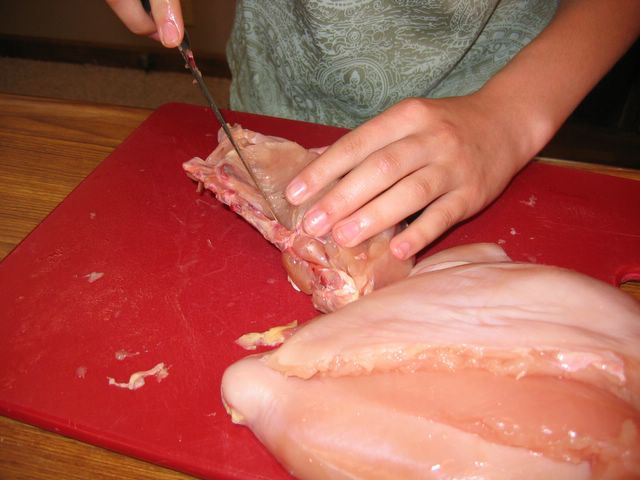
Here is Morganna boning out her first chicken breast. See how she follows the ribs, simply cutting the connective tissue with the tip of the knife while peeling the flesh away with her fingers.
We served cucumber raita, cilantro chutney, minced chiles, lime and lemon wedges, and finely diced red onion as side dishes, along with the chappli kebab (ground lamb patties), a salad of mixed greens, fresh strawberries, goat cheese, almonds and a pomegranate molasses vinaigrette, and an almond and golden raisin basmati rice pillau.
It turned out to be a memorable feast.
I cooked enough to have leftovers, or so I thought. There was nothing left but a small amount of salad, a tiny bowl of rice and a bit of the cilantro chutney.
I take it as a testimony to the power of Indian food–I suspect that no matter how much I made for this meal, most of it would have been gone by the end, it all tasted so good.

Pictured with a myriad of side dishes, from left to right: cilantro chutney, lime and lemon wedges, minced chiles, red onions, cucumber raita, and sugar snap peas stir fried with lemon juice, lemon zest and cardamom.
Sindhi Elaichi Murgh
Serves 8
Ingredients:
8 tablespoons whole milk yogurt
4o whole green cardamom pods
2 teaspoons whole black peppercorns
salt to taste
1 teaspoon coriander seeds
2 cups packed fresh cilantro leaves and upper stems, washed and drained well
1 green serrano chile
zest of one lemon
2 whole chicken breasts (four halves) skinned, boned and cut into 1 inch cubes
Method:
In a large bowl, whisk yogurt until smooth.
In a blender or a spice grinder such as the Sumeet, grind the spices, chile and cilantro into a smooth, dark green paste. Add lemon zest if you remove it using a zester that cuts into fine strips. If you use a microplane grater, you don’t have to grind the zest any further.
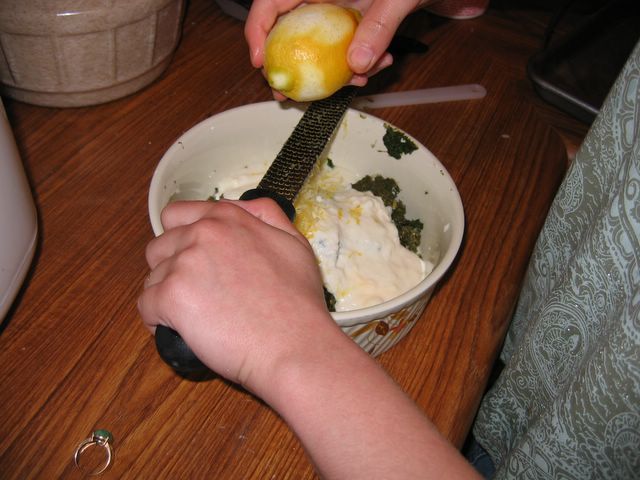
My daughter Morganna zests a lemon using a Microplane grater. The Microplane makes such fine flakes of zest that it doesn’t need to be ground with the other spices.
Mix the spice paste, salt and zest into the yogurt and blend thoroughly. Marinate the chicken chunks in it for at least one or two hours.
Thread the chicken chunks and skewers and cook over a hot fire, turning often so that they do not burn. They will cook in about eight to twelve minutes, depending on the heat of your fire. (On my grill which was up to 375 degrees, they cooked in about nine minutes.)
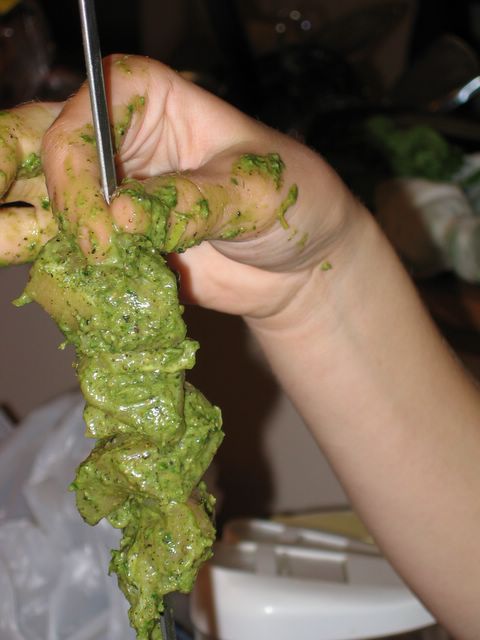
Here she threads the chicken onto the skewers. Look how vibrantly green the marinade is!
Serve with lemon wedges, raita and other goodies on the side.
CSA Today
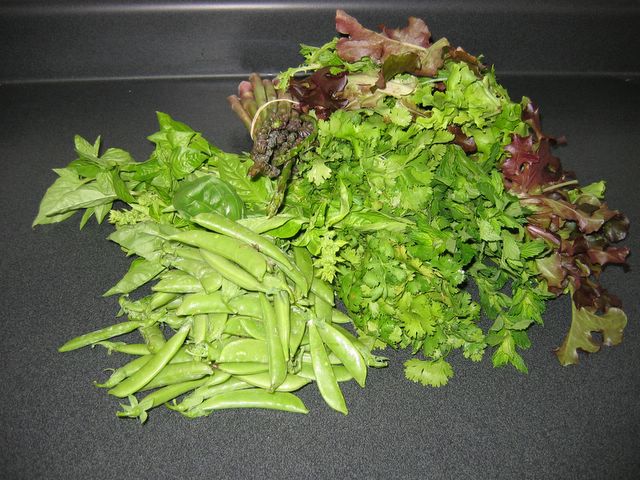
Green goodness: a pile of goodies from the Athens Hills CSA. Salad mix includes red and green oak leaf lettuces and mizuna, among other good things. Also pictured are a big bunch of basil, a bunch of spearmint and lots of cilantro, a pile of sugar snap peas and a bunch of asparagus.
So today was the opening weekend of the CSA season, and my first bag of goodies was chosen bright and early at the Athens Hills CSA booth at the farmer’s market. This is their first year selling the CSA way, and I am pleased to be a charter member of the program. Instead of the way that a lot of CSA’s work where you get a set box of whatever is being harvested that week, the folks at Athens Hills lets the member choose what they get, so if you happen to despise chard, you are safe from ever having to eat it. I think that this is a great way to structure the CSA thing–it allows the buyer to have say in their diet within the parameters of what is in season.
The farmers send out an email on Thursdays letting folks know what will be available on market day, so you can plan ahead for what you want and need. That is a really nice idea, as it lets those who are into menu planning to really dig in and think ahead, while for those who are like me and cook what looks good on a given day, it gives us something to look forward to browsing.
I picked out piles of herbs today because tonight, we are having friends over to celebrate the end of the quarter at Ohio University, the beginning of summer in Athens, which is a laid-back, relaxed affair what with most of the college students gone, the arrival of my daughter, Morganna, as she transitions between her father’s home and my own, and the bon voyage to Heather, who is off on Monday to go study at a university in Lebanon for a couple of months.
Since Heather is the one who is travelling, she got to pick the cuisine I’d cook from to honor her. Last year, when she was on her way to Indonesia (Heather is a world traveller and explorer extraordinaire), she asked me to send her off with lasagne, knowing that she would not have a chance at eating anything Italianesque for months. This year, she asked for Indian food.
So, to say goodbye to Heather, hello to Morganna and summer, congratulations to those of us who have finished another quarter of school, I decided to have Zak fire up the grill and we’d throw on Seekh Kebabs, and Murgh Elachi Kebabs. The lamb and chicken are marinating right now, but I still have to put together the cucumber mint raita, the pomegranate molasses salad dressing to go with the greens and strawberry salad, and I have to string the snap peas for the snap pea, lemon and cardamom stir fry.
For dessert, which was promised to Heather’s husband, the intrepid Digital Media professor of OU, Dan, and to Zak, we are having the ever popular and famed Aphrodite Cookies, which are also known as Barbara’s Little Boobie Cookies, Rosewater Cookies and Orgasm Cookies. I’ll be posting about all of the menu items over the next week, have no fear, and I promise to explain the names behind those cookies as well as posting a recipe and an article I wrote about them that was published in SageWoman magazine last summer.
So, since I have lots of folks to feed today, I’d best get on the ball and get cooking!
Pasta Primavera
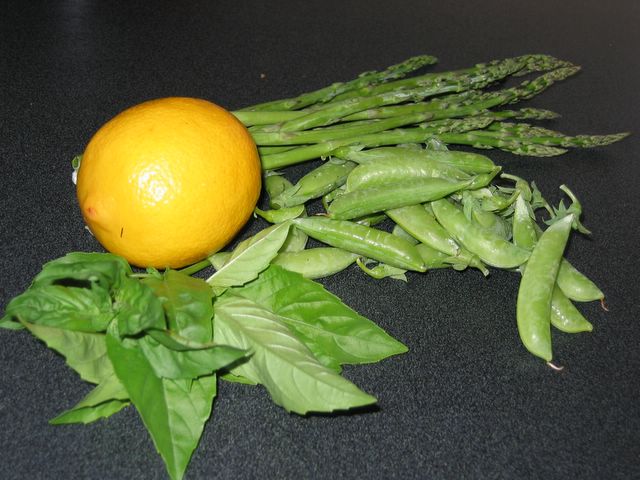
The ingredients for my lemon pasta primavera. Everything except the lemon is locally grown.
It all begins at the farmer’s market Saturday morning.
The sun was bright, the air was warm and breezy, and the parking lot upon which the tents and awnings had been staked was filled with a teeming throng of shoppers, people-watchers, buskers and strollers. Kids laughed and babies squealed, grandmothers sniffed huge bouquets of flowers and fathers gave tastes of honey to their children, while mothers stood around, shading their babies from the sun, and discussing which type of cloth diaper system they favored.
Music from South American flutes trilled and soared over the waterfall of language and the galloping rhythym of calloused hands thumping the goathide skin of a djembe put a dance in the steps of young and old as the river of people ebbed and flowed through the market.
Stepping boldly into the fray, Zak and I began our weekly excursion, with no thought in our minds except procuring foodstuffs for a dinner to go with the promised Strawberry Rose ice cream that night.
First, I stopped at Canaan Valley Farms, and picked up a frozen chicken breast, and passed the time of day with the dear farmer whose chicken is so delicious.
Let me tell you about his chicken.
The meat is firm and velvety to the touch, not slimy and mushy. Even Bell and Evans organically raised free range poultry has a rubbery texture that slithers under my fingertips as I cut it up for cooking. This usually comes from the addition of water in the form of injected saline that is part of standard poultry packing these days. It plumps the meat and makes for a higher price for the buyer, who is paying for extra water, and it supposedly tenderizes the bird. What it does is it makes the meat slimy and unpalatable to the point where I usually wear latex gloves when I work with chicken.
This is not the case with the truly fresh, truly pasture fed birds that I get at the farmer’s market. They are a pleasure to bone out and cut up. There is no slick residue left on my hands and touching the meat and skin doesn’t make my skin crawl.
It is an honest prelude to the succulent moistness of the meat and the truly light and fresh flavor it delivers to every dish I have cooked in it. So far I have used it in Thai Spicy Basil Chicken, Chicken with Bitter Melon and now, I planned on using it in whatever I cooked for Saturday’s dinner.
Moving on, I decided on making a version of Pasta Primavera with shiitake, chicken and asparagus, with a cream sauce based in lemon.
Pasta Primavera is meant to be cooked with springtime vegetables, and is a celebration of the sweet green things after a winter of dried and canned foods. I figured that since I could always get the shittake and I knew exactly where to get pencil-thin asparagus, that I could add whatever baby spring vegetables I happened to find. Tiny carrots or scallions or maybe morels, if anyone had any for sale.
I headed for Art and Peggy Gish’s awning, for they are purveyors of very fine tiny asparagus that has the freshest flavor imaginable. As I sauntered up the table, I spied not only the asparagus, but quarts of freshly picked sugar snap peas! Plump lime green pods sat in little baskets, thier skins stretched tightly over the pearly peas within, they shimmered faintly in the sunlight.
Grinning like a possum at Art, I indicated the peas and asparagus. “A quart of the peas and two pounds of asparagus, please,” I said. He smiled and busied himself with weighing out the produce while visions of sugar snap peas in pasta primavera danced in my head.
At my final stop, Athens Hills CSA/Green Edge Gardens, I picked up salad greens, microgreens, and a lovely bunch of basil. The snappy licorice-edged green basil scent wafted up from my bags as we headed back to the car, and drove back home.
Later that day, I began work on the pasta primavera, which went something like this:
Lemon Pasta Primavera
Ingredients:
Olive oil as needed for saute
1/2 pound pencil thin asparagus spears, bottoms trimmed and cut into 1″ lengths
1/2 pound sugar snap peas, strung and rinsed
1 small red onion, peeled, cut in half and thinly sliced
1/4 pound fresh shiitake mushrooms, stems removed, caps thinly sliced
1 1/2 chicken breasts, skinned boned and cut into thin strips about 1″ long and 1/4″ wide
1/4 cup flour
1/4 teaspoon. turmeric
salt and pepper to taste
3 small heads fresh hardneck garlic (or four fat cloves of regular softneck garlic), peeled and minced
1/4 cup sherry or dry white wine
1/4-1/2 cup chicken broth or stock
Juice of two lemons
2-3 drops lemon oil (optional)
1/2 cup heavy cream
1 1/2 pounds of pasta, cooked al dente
zest from two lemons
Handful of fresh basil leaves, cut into chiffonade
Method:
In a large saute pan, heat a small amount of olive oil. Add asparagus, snap peas and sliced purple onions, and stir fry until colors deepen and vegetables tenderize slightly. Remove from heat immediately and place in a bowl, and set aside.
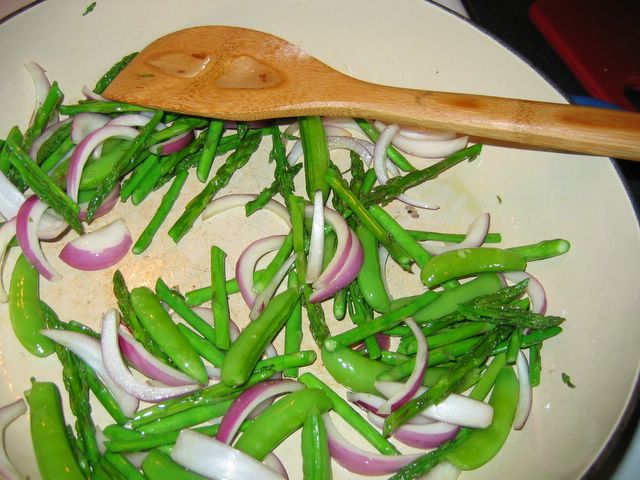
Saute the vegetables very lightly for this dish. You want to retain the fresh colors, flavors and aroma of them as much as possible.
Add enough oil to pan in order to saute the mushrooms and chicken. Heat up and add mushrooms. Mix flour, turmeric and salt and pepper, then toss chicken strips in this mixture. Add to pan and stir fry until chicken begins to brown and some flour begins to stick to the bottom of the pan and brown. Add the garlic and cook until quite fragrant, stirring constantly: about two minutes.
Deglaze pan with sherry or wine. Scrape up all the browned bits. As the wine reduces and the pan becomes nearly dry again, add the broth or stock and reduce, continually stirring and scraping the browned bits at the bottom of the pan.
Add the lemon juice and lemon oil, then the cream. Reduce until it coats the back of a spoon.
Add reserved vegetables to sauce, toss with cooked pasta of your choice.
Remove from heat and garnish with lemon zest and basil.

The little bit of turmeric I use in the flour mixture used to coat the chicken pieces gives the sauce a slight yellowish tint, which conveys the visual appeal of the lemon juice and oil in the dish.
Notes:
This recipe serves a small army of people, or six to eight folks, especially if you have a nice salad to go with it and a great dessert.
This is great with penne rigante. I learned from cooking Chinese food to always match the shapes of meat and vegetables that I cut in a dish–when I cook Italian style pasta, I follow the Chinese aesthetic of putting similar sized and shaped pasta with the sauce ingredients. I think it looks prettier this way.
Lemon is not traditional in pasta primavera, as I recall. Actually, I am not sure of primavera is a traditional sauce in the first place, as Italian foods are not my speciality, but, I do know that spring vegetables are great in pasta, and I love lemon cream sauces created by reduction. So, somewhere in my mind the two fused and become a part of my standard springtime pasta feasts.
The lemon oil that I use is pure lemon oil made by Boyajian. It is not necessary, but it really pumps up the lemon flavor a great deal. It is made of the essential oil that is present in the lemon zest.
Baby artichokes might be nice in this. Rapini might also be good. Fresh, shelled garden peas are nice, but I like the sugar snaps even better. Fennel might taste nice.
Chive flowers would be an outstanding garnish. However, I don’t have any chives to use for this purpose.
Nasturtium blossoms look nice in this dish, too.
The Empire Strikes Back
I find it to be so interesting that local control and individual freedom are upheld as patriotic, core American values by talking heads in our country until issues like gay marriage, the USA PATIOT act and local control of the food supply come into focus.
Then, suddenly, we have Constitutional amendments, pleas to keep the Patriot Act up and running, and laws that favor corporate farming interests over local governments’ rights to ensure the safety of the food supply start flying.
Here is a report on efforts by the Big Food industry to wrest control from local governments on issues of food and farm safety, biodiversity and public health.
And for all those who don’t read Parke Wilde’s excellent blog, US Food Policy, (and you should read it daily; it is a great roundup of news) here is a link to a story about a likely case of BSE (Mad Cow Disease) in a downer beef cow in the US.
“Downers,”when referring to cattle are not depressant drugs, they are cows who are unable to walk when they get to the slaughterhouse. Currently, many downer cows are killed and put into the food supply; this goes against all rational and sane policy. Cows that are too sick to walk are not, in my opinion, safe to be eaten.
And before someone tells me I am talking out of my bum, here are a few facts about my background: I grew up with grandparents who raised beef cattle, I am the great granddaughter of a butcher who owned a local slaughterhouse and managed it very well, I have a degree in culinary arts which includes extensive training in food safety issues, and I once was a zoology major with an eye towards veterinary science. I have studied the issues of food, health, animal husbandry, and animal disease my entire life. You want to think I am a wild-eyed left-wing freak, go right ahead.
But don’t bother to tell me I don’t know what I am talking about.
Because I do.
These two news stories once again tell me that we need to be concerned about our local food supplies. We need to be active in the politics that determine where our food comes from, how it is grown, how it is treated at harvest and how it is distributed. We need to be concerned because if we are not–who will be? Our government seems content to deregulate the food industry and give free reign to corporate interests.
My answer for all of this?
One–arm yourself with knowledge. Inform yourself on the issue. Read about the issue, not just in the local paper, but online. Read any one or all of these books, in order to get an idea of what I am talking about when I blather on about a sustainable local food supply: This Organic Life: Confessions of a Suburban Homesteader by Joan Dye Gussow, Food Politics: How the Food Industry Influences Nutrition and Health by Marion Nestle, The Eco-Foods Guide by Cynthia Barstow, Bitter Harvest, by Ann Cooper and Lisa Holmes, Holy Cows & Hog Heaven: The Food Buyers Guide to Farm Friendly Food by Joel Salatin, and Coming Home to Eat: The Pleasures and Politics of Local Foods by Gary Paul Nabhan.
Check out Eating Well Magazine, which includes information on these issues as well as a good round up of the latest nutritional research. They also feature some really creative, flavorful recipes for healthy food that doesn’t look or taste like low-fat glop.
Two–once you have some grounding in this issue, start getting involved in the poltiical process. Write to your elected officials on the local, state and federal level. Let them know what you think, and how you feel, and keep at it. Make a hobby of them. Eventually, you may find that you get correspondance in return, and if enough people do this, they may start changing the way they cast their votes.
Three–try and buy as much locally produced food as you can, and urge others to do the same. Start a food co-op. Meet local farmers and try to help them start a CSA program. Support restaurants that rely on local food producers with your food dollars. Shop at a farmer’s market in your town or city.
Four–educate others. Talk to your family and friends, neighbors and kids. Do workshops or presentations in schools, in churches and on campuses. Try not to stand on a corner and yell your message out to the passing crowd while holding a badly spelled placard–that generally gets you classified as a loon and means your message, no matter how noble or logical, will fall on deaf ears. But get the word out in email, on message boards, and in person, in whatever sensible way you can.
Five–Learn to grow some portion of your own food. Even if it is just a pot of herbs on your doorstep or in your windowsill, do it. Take some small measure of responsibility for the growth of your own food and learn how it is done. There is nothing better than the sense of accomplishment that growing your own food brings.
Six–watch out for Mad Cows. (I hear tell they run in packs.)
Okay, I was being silly on number six, but really–there are practical things we can do to take responsibility for our own food, and I would like to see more people becoming aware of these issues and doing something about them. If nothing else comes from my writing here at Tigers and Strawberries, I will be satisfied if more people start questioning the status quo of our huge, unwielding and oil-dependant food system.
So, that is your assignment for the day.
Get to work.

Categories:
- Admin (rss) (55)
- Blogs and Blogging (rss) (81)
- Book Reviews: Cookbooks (rss) (43)
- Book Reviews: Non-Cookbook Food Books (rss) (38)
- Cats and Cat Blogging (rss) (47)
- Chinese Cooking Lessons (rss) (32)
- Culinary School Stories (rss) (18)
- Dairy Pruducts: Cultured and Barbaric (rss) (4)
- Documentary Filmmaking (rss) (1)
- Essays, Rants and Reflections (rss) (260)
- Fighting Hunger (rss) (12)
- Food and Kids (rss) (45)
- Food in the News (rss) (126)
- Food Media (rss) (98)
- Food Preservation (rss) (18)
- Food Safety (rss) (45)
- Gardening (rss) (30)
- Herbs and Herb Blogging (rss) (20)
- Holidays (rss) (50)
- Kat Blogging (rss) (22)
- Kitchen Science (rss) (36)
- Leftover Makeover (rss) (8)
- Life, the Universe and Everything (rss) (131)
- Local and Sustainable (rss) (227)
- Local Athens Food and Foodies (rss) (42)
- Meatless Mondays (rss) (32)
- Menu For Hope (rss) (5)
- Nutrition, Diet and Health (rss) (84)
- On The Farm (rss) (8)
- Recipes: Almost Vegetarian, Vegetarian and Vegan (rss) (294)
- Recipes: American Regional (rss) (37)
- Recipes: Appalachian Hillbilly (rss) (33)
- Recipes: Bread, Pasta, Grains (rss) (95)
- Recipes: Canning and Preserving (rss) (8)
- Recipes: Chinese (rss) (123)
- Recipes: Comfort Food (rss) (120)
- Recipes: Cookies (rss) (16)
- Recipes: Desserts (rss) (48)
- Recipes: French (rss) (25)
- Recipes: Fruits and Vegetables (rss) (302)
- Recipes: Greek, North African and Middle Eastern (rss) (31)
- Recipes: Indian (rss) (137)
- Recipes: Italian (rss) (42)
- Recipes: Japanese (rss) (7)
- Recipes: Jewish (rss) (4)
- Recipes: Korean (rss) (6)
- Recipes: Meat, Poultry and Fish (rss) (220)
- Recipes: Mexican/Native American/ Latin American/Caribb (rss) (27)
- Recipes: Original (rss) (108)
- Recipes: Thai (rss) (27)
- Recipes: Tofu (rss) (17)
- Recipes: US Regional (rss) (16)
- Recipes: Vietnamese (rss) (8)
- Restaurant Stories (rss) (28)
- Sewing, Quilting, Arts and Crafts (rss) (16)
- Simple Chinese Recipes (rss) (30)
- Slow Food and Heritage Foods (rss) (10)
- Spice Blogging (rss) (44)
- The Chinese Cookbook Project (rss) (14)
- The Chinese Pantry (rss) (39)
- The Documentary (rss) (2)
- The Kitchen Saga (rss) (17)
- The Locavore's Bookshelf (rss) (15)
- The Unsung Adventures of The Culinary Nerd (rss) (6)
- Tools and Toys (rss) (35)
- Uncategorized (rss) (10)
- With a Side of Politics (rss) (48)
Archives:
- August 2012 (9)
- July 2012 (12)
- September 2011 (3)
- August 2011 (7)
- July 2011 (8)
- June 2011 (16)
- May 2011 (17)
- April 2011 (11)
- December 2010 (9)
- November 2010 (5)
- February 2010 (1)
- December 2009 (5)
- November 2009 (7)
- October 2009 (10)
- September 2009 (16)
- August 2009 (14)
- July 2009 (14)
- June 2009 (7)
- May 2009 (17)
- April 2009 (10)
- March 2009 (25)
- February 2009 (13)
- January 2009 (10)
- December 2008 (5)
- November 2008 (5)
- October 2008 (6)
- September 2008 (13)
- August 2008 (8)
- July 2008 (11)
- June 2008 (18)
- May 2008 (13)
- April 2008 (14)
- March 2008 (16)
- February 2008 (17)
- January 2008 (19)
- December 2007 (25)
- November 2007 (18)
- October 2007 (24)
- September 2007 (16)
- August 2007 (15)
- July 2007 (15)
- June 2007 (10)
- May 2007 (14)
- April 2007 (16)
- March 2007 (17)
- February 2007 (20)
- January 2007 (13)
- November 2006 (1)
- October 2006 (8)
- September 2006 (14)
- August 2006 (25)
- July 2006 (30)
- June 2006 (28)
- May 2006 (34)
- April 2006 (29)
- March 2006 (24)
- February 2006 (30)
- January 2006 (38)
- December 2005 (40)
- November 2005 (37)
- October 2005 (32)
- September 2005 (25)
- August 2005 (30)
- July 2005 (28)
- June 2005 (21)
- May 2005 (8)
- April 2005 (22)
- March 2005 (17)
- February 2005 (29)
- January 2005 (10)
Search Site:
Links:
- Lily’s Wai Sek Hong
- 101 Cookbooks
- A cat in the kitchen
- A Veggie Venture
- Accidental Hedonist
- Cha Xiu Bao
- chez pim
- Chocolate & Zucchini
- Chopstick Cinema
- Chowhound.com
- Chubby Hubby
- Cook sister!
- Cooking with Amy
- da*xiang
- Eat Local Challenge
- Eating Liberally
- Ecocentric
- Eggbeater
- Epicurious
- Farmgirl Fare
- Fatfree Vegan
- Foodgoat
- ForkandBottle.com
- Green Olive Tree
- Hooked on Heat
- Jaden’s Steamy Kitchen
- Kalyn’s Kitchen
- Lucullian delights
- Mahanandi
- Matt Bites
- MeatHenge
- mmm-yoso!!!
- New York Times – Dining & Wine
- Pizza Goon
- Rasa Malaysia
- Ruhlman
- Sailu's Kitchen
- Serious Eats
- SF Gate: Food & Dining
- Simply Recipes
- Soul Fusion Kitchen
- Tastespotting
- The Amateur Gourmet
- The Cleaner Plate Club
- The Food Section
- The Grub Report
- thecookscottage
- U.S. Food Policy
- Wandering Chopsticks
- Washington Post Food and Dining
- Wasted Food
Meta:


Powered by WordPress. Graphics by Zak Kramer.
Design update by Daniel Trout.
Entries and comments feeds.