
Cook Local, Eat Global
Creating Kofta
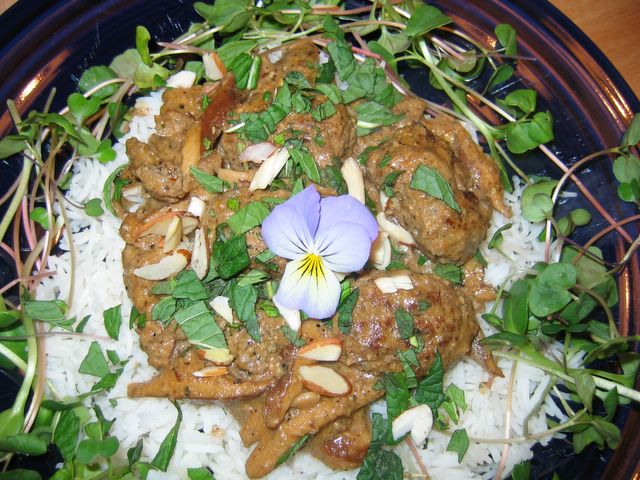
Kashmiri kofta, all dressed up on a plate. Basmati rice is the foundation, then the kofta, mushrooms and sauce go over. I used the microgreens to edge the plate, and then sprinkled the minced mint and sliced almonds over the kofta. And of course, I finished it all with a viola. Because, I could.
So, we went to the Farmer’s Market yesterday, even though it was pissing rain and we both have some sort of influenza crud which is making us both feel, well, cruddy.
Zak’s motivation was the Pie Lady, who it turns out wasn’t there.
My motivation was some good fresh produce.
I ended up coming home with a huge handful of fresh spearmint, a bundle of microgreens, eggs, and a big bag of fresh shiitake mushooms.
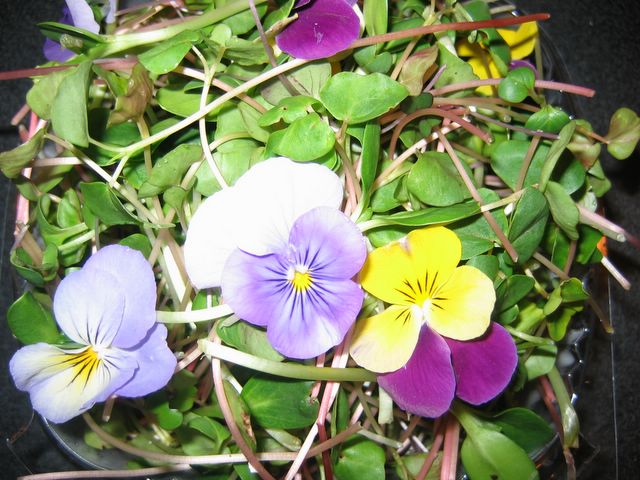
Microgreens from the nice lady from Green Edge Gardens who sells at the farmer’s market. I think that “microgreen” is a new way of saying “sprout.” I suppose it sounds more modern and less dirt-worshipper than the old term. There are radish, sunflower, buckwheat and cabbage babies in there. Oh, and as you can see, violas. Not only is this mixture beautiful, it is flavorful.
At home, I had my last bit of the Bluescreek Farms ground lamb.
And I had yogurt and cream.
I had to make Kashmiri Kofta.
I just had to.
Kashmir has been much in the press recently because currently India and Pakistan are having a territorial dispute over the region, and there have been some very tense moments in the past few years because of this. As of yesterday, Pakistani officials have declared that they seek a peaceful resolution to the problem, which I hope is how it goes down, as the sectarian violence there is not good for anyone.
A mountainous region in the extreme north of India, Kashmir is known for extreme natural beauty and a cuisine that is rich in dairy products, especially yogurt and cream. The land is fertile, and many crops are grown in the upland fields and valleys, with a great emphasis placed on fruit and nut orchards and wheat. Saffron crocus is grown in the fields of Pampore, and in the autumn, the land is carpeted by the pale lavender flowers open to the sky. Wild mushrooms and herbs grow in the forested hills and are gathered and used in many dishes.
The richness of Kashmiri cuisine comes in large part from the influence of the Mogul Emperors who came from Persia and conquered the region centuries ago. The Persian tradition of using flowers and flower essences, milk and cream, nuts and fruits in cookery have strongly influenced the cuisine of the region and to this day, many traditional dishes are ones that were first served in Imperial courts.
Lamb is a preferred meat in this region which is peopled by Hindus and Muslims both. It is cooked in many ways, but one of my favorites is kofta.
A kofta is a meatball, or a ball meant to resemble a meatball. (There is a Kashmiri dish called “malai kofta” that consists of balls made of minced vegetables bound together with chickpea flour, also known as besan. These balls are fried and then cooked in curry sauces, often ones that are based on nuts and cream, and are delicious served with rice or bread.)
I used to make kofta quite often for my clients, and I based the recipe I used last night on what I used to cook for them. I never used mushrooms in it, though I think that they would have liked it if I had thought to do it; both of them loved mushrooms. I found that the addition of the mushrooms gave a deeper flavor to the dish and really made it resemble Stroganoff.
The kofta are tender, and delicate–there is no binder present in the meat, so when frying them, you have to be very gentle with them. Once you add them to the sauce so they can finish cooking at a simmer, you have to stir carefully so that they don’t break up.
Shiitake mushrooms are what I had to use in this, but I think that morel mushrooms would be fantastic, or chanterelles, or better yet, a mixture of many different kinds of wild mushroom. If you have nothing else, I bet that plain button mushrooms or crimini would be good, too.
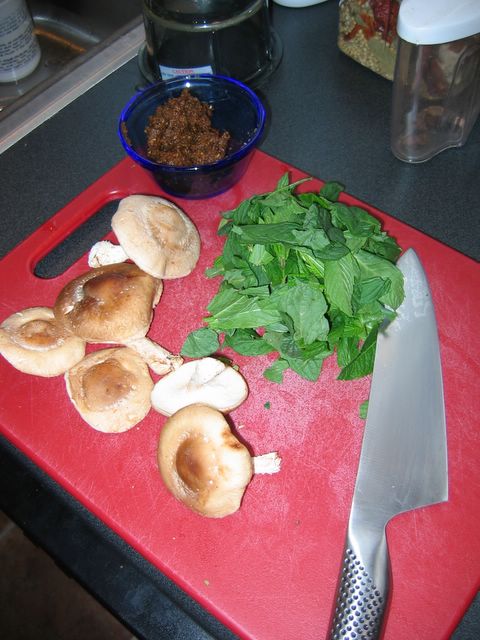
Fresh shiitake and spearmint. The paste in the small bowl in the corner of the cutting board is the curry paste for the sauce. The dark reddish color comes from the very deeply browned onions.
I used my Sumeet Multi-grind to make the curry pastes; if you do not have such a beastie (which I highly suggest you purchase if you make a lot of Indian, Thai and/or Mexican foods–it is invaluable for all three of those cuisines), then use a blender, but add a bit of water to get the mixture to grind finely enough. A food processor will work as a third choice. Or, you can use a food processor and then put the mixture in a mortar and pestle and finish smoothing out the paste.
But really, nothing compares to the Sumeet for making a smooth paste out of a mixture of wet and dry ingredients in under a minute. It really is amazing.
Kashmiri Kofta
Ingredients for the Kofta:
1 pound ground lamb
1 clove of garlic
1″ piece of fresh ginger, peeled and sliced thinly
1 green Thai chile
1/2 teaspoon black peppercorns
1 pinch asafoetida/hing
3 black cardamom pods
1/4 teaspoon green cardamom seeds
4 teaspoons coriander seeds
1 teaspoon black cumin seeds (kala jeera)
1/4 teaspoon cumin seeds
1 pinch dried crushed Pakistani chile pepper
1/2 teaspoon salt
1 tablespoon sliced almonds
2 tablespoons golden raisins
1/4 cup fresh spearmint leaves
ghee or mustard oil as needed to fry kofta and mushrooms
1/2 pound fresh shiitake mushrooms, stems removed and sliced thinly
Ingredients for the Sauce:
1 medium yellow onion, thinly sliced
1 tablespoon ghee or mustard oil
3 cloves garlic
1/2″ piece fresh ginger, peeled and sliced
1 green Thai chile
1 1/2 teaspoons black peppercorns
2 teaspoons coriander seeds
1 teaspoon kala jeera
2 black cardamom pods
1 teaspoon cumin seeds
1 pinch crushed Pakistani chile
1/4 cup skim or 1% milk
1 cup plain full fat yogurt
1/8-1/4 cup cream
1/4 cup golden raisins
salt to taste
handful of fresh mint, minced, for garnish
handful of sliced almonds, for garnish
microgreens (sprouts) and fresh edible flowers, for garnish
Method:
Put the ground lamb in a medium sized bowl. Take the remaining ingredients for the kofta, up to and including the spearmint leaves, and grind it as finely as you can by whatever method you possess. After it is ground, add it all to the meat, and mix together thoroughly with your hands, mashing and squishing it all into a fine, fine, mixture.
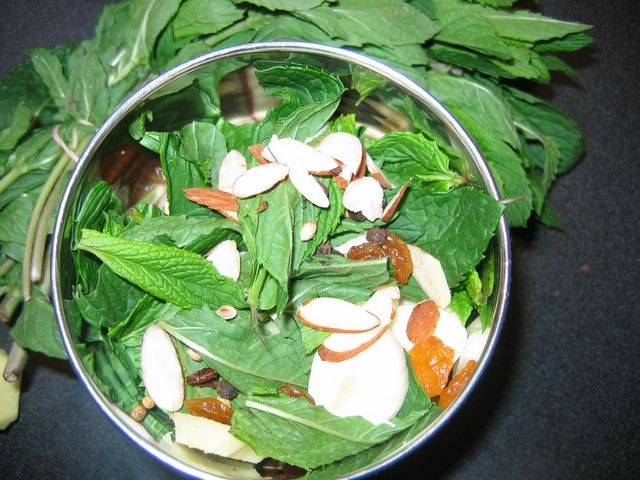
The ingredients for the seasoning paste that is mixed into the lamb to make the koftas in the workbowl of my Sumeet prior to being ground up.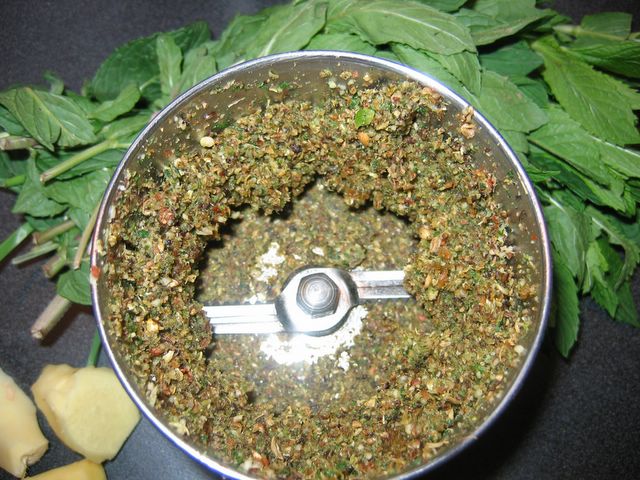
Here are the same ingredients after less than a minute of grinding. I love the Sumeet.
Using a tablespoon measure or cookie scoop, take level tablespoons of the kofta mixture and form them into football or egg-shaped little balls by gently shaping and smoothing them with your hands. Do not compact the meatballs overmuch; they should be light and tender in texture. If there are any seams or cracks on the outside of them, smooth them gently out with your fingers; the more seamless they are, the less likely they are to crumble apart during cooking.

This is the size and shape the kofta should be when you form them. I used a one tablespoon cookie-scoop to get them all to be the same size–that way they look nicer and they cook more evenly.
Set the kofta aside and heat ghee or mustard oil in a heavy, wide-bottomed pan. When it is very hot, add the thinly sliced onions and stirring constantly, cook them until they are a very dark mahogany color. Be very careful near the end of the cooking time–the onions can go from dark mahogany to burnt and black within seconds. As soon as the dark color is reached, scrape the onions out into a waiting bowl. Combine the garlic and the rest of the ingredients up to and including the Pakistani chile in the workbowl of your blender or food processor or whatever other device you are using to grind up the curry pastes. Add the onions, and process until a very smooth, dark reddish paste results.
Clean out your pan, add ghee or mustard oil, and heat up again. Add kofta and brown over medium heat on all sides. Turn the meatballs gently with a spoon or fork by rolling them. Don’t try to scoop them up and turn them over; this will break them up. As soon as they are brown on all sides, remove them to drain on paper towels. Add mushroom slices to pan and allow them to brown slightly in the combined ghee/oil and lamb fat. When this is done, remove mushrooms and set aside with kofta.
If there is more fat than is needed to just barely coat the bottom of the pan, remove excess. Heat pan with its scant amount of oil and then add the reddish curry paste. Stir and fry until it is very fragrant, about a minute and a half. Add milk and deglaze the pan, scraping up all the browned bits. Add yogurt and cream, then kofta and mushrooms and turn heat to low. Add raisins. Simmer for about twenty minutes. After it has simmered, turn the heat up to medium and cook, stirring gently to keep from breaking up kofta, for about ten minutes to reduce the sauce until it will coat the back of a spoon.
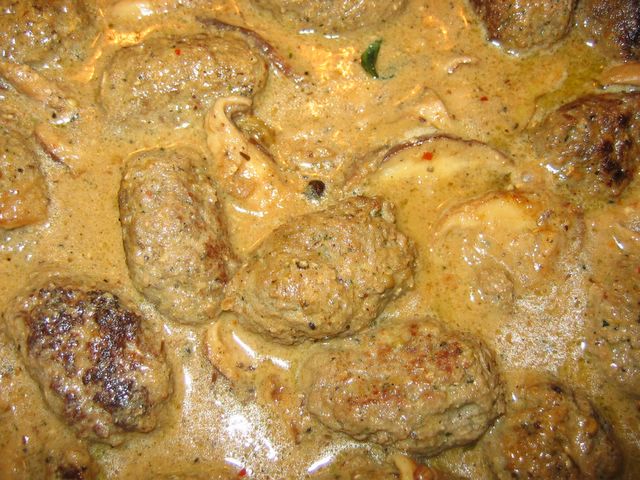
The finished kofta and mushrooms in the sauce; the brown color comes from the dark brown onions which have been cooked, then ground into the spice paste and cooked again.
Garnish with mint and almonds and serve with basmati rice or naan.
Dissing the Dim Sum
So, two days ago, I wrote about food and politics in the US.
Today, I will write a bit about food and politics in China.
Currently in China, there are to big fracases going on that have the populace irritable. One is Japan’s ascention to the UN Security Council, which, because of Japan’s official minimization of the atrocities committed against the Chinese people in WWII, has folks a bit riled up, which is understandable. The second issue that looms large in China today is that there are some Chinese folks, particularly older folks in Hong Kong who are harshly critical of their own government–about the official statement on the subject of dim sum.
That’s right, you heard me. Dim sum.
Dim sum is a tradition of eating small mouthfuls of exquisitely shaped dumplings, noodles, buns, and other little packets, bits and bites of food that are served in teahouses. This tradition is a big part of Chinese culture, particularly in the southern province of Canton, and in Hong Kong, and it is considered almost sacred by families, and particularly, by older men. Teahouses are where people gather to gossip, to visit with relatives and friends, to celebrate events and holidays, or just to have a nosh and some nice conversation.
Well, apparently, the Chinese government has issued a statement saying that some dim sum menu items are not particularly healthy for a person to consume in large quantities.
And it has ticked folks off.
The dim sum items in question tend to be deep fried or contain lard, which, as we all know, is probably not the best thing for a person to eat on a regular basis. Of course, the traditional Chinese diet is much healthier than the Western diet, based as it is on grains and vegetables, with a minimum of meat and saturated fats, and dim sum is a part of that diet.
However, dim sum has never been something that is eaten in large amounts every day.
But, the Chinese government has made a fairly innocuous statement saying that it might be a good idea for people to avoid the saturated fat and deep fried items and instead eat more vegetable-based items and ones that are steamed.
No mention has been made of closing dim sum restaurants or physically restraining people who insist upon eating this stuff. Just a gentle reminder that maybe people shouldn’t eat it all the time.
And people are really riled up over the government telling them what to eat and what not to eat.
Now, if it were me, and I was in the Chinese government, I would probably lay off dissing the dim sum, and instead issue a warning about how hazardous American style fast food can be to one’s health and well-being. Because, really, the food at teahouses usually starts out with recognizable ingredients, but the processed gloop that makes up McDonald’s food has been shown to be deliterious to health both in formal studies and in the film, “SuperSize Me.”
Considering how fast KFC and McDonald’s are growing in popularity in China, I would say that the foods from those chains are probably putting more Chinese citizens at risk than the dim sum delicacies that are served in traditional teahouses.
Of course, not only is the health of China’s people in danger–their tastebuds are at risk as well. And that is a greater threat, as far as I am concerned. I would hate to see the glories of Chinese cuisine tossed aside for the convenience of fast food. It would be horribly sad.
But that isn’t a scientific fact; it is only my opinion.
Politics and Food: The Personal is Political
Kate, the fine author of one of my daily must-reads, The Accidental Hedonist, recently posted a link to a column by Mark Morford decrying the “food” and atmosphere that is found in the typical gigantic American supermarket. A reader responded with this quote: “What does republican have to do with this rant – albeit his point is an excellent one, why politicize it? The dems have taken lots of money from the Safeway/Vons/Albertsons of the world. Starbucks – the Safeway of the coffee industry – is all Dem. So not sure why you have to politicize this. Get over it.”
Kate’s thoughtful response links to another blog, which is all about US governmental food policy, written by Parke Wilde, a food economist.
My response, which is hopefully just as thoughtful, though it is also ironic is this:
Food is already politicized. The personal is political. If you don’t like that stop eating. If you don’t like what a blogger has to say about it, don’t read that blog entry. (Notice I did not say “stop reading,” though it was tempting as it would have had parallel sentence construction going, and I do like the elegance of that. However, I would never, ever, under any circumstances advocate that any being of any sort stop reading.)
And just to sort of top off my food and politics theme yesterday, Zak sent me a link to an article stating that the US Government, (at the recommendation of The National Acadamy of Sciences) might be changing the rules on how WIC operates in order to bring it closer to modern healthy nutritional guidelines.
What is WIC?
The acronym stands for Women, Infants and Children; it is a governmentally funded voucher program with which low income mothers can obtain nutritious food for themselves (particularly if they are nursing mothers), their babies and toddlers. Vouchers are provided for milk, juice, baby formula, eggs, cheese, cereals and dried beans. The proposed changes will provide vouchers for fresh fruits and vegetables–nutritionally superior foods which few low income families can afford–while also allowing for various calcium-rich foods such as yogurt, tofu and soy beverages to be purchased instead of whole milk. The new guidelines would also provide for the consumption of less cholesterol in the form of dairy products and eggs, in an effort to curb rising obesity rates among children.
The number of children who are touched by WIC is incredible. For a program that costs a bit over five billion dollars a year, it feeds over 8 million human beings in our country, most of them children. One half of all infants in our country and one quarter of all kids between the ages of one to four years are fed in part, through the WIC voucher system.
Any person with empathy can see how important this program is to low-income families with kids. But just in case a reader doesn’t get it, let me make this bunch of political statistics personal:
Fourteen years ago, my daughter was one of those kids.
Nearly sixteen years ago, when I was pregnant with her, my husband lost his job, and I was unemployed and unemployable, in part, because minimum wage employers don’t like to hire a visibly pregnant woman. (Of course, they didn’t say that when they didn’t hire me, that would be discrimination, but the truth was they didn’t want to hire me and then lose me in six months when I gave birth, or even worse than that, have me get injured on the job and then sue them.)
With no income coming in and the savings account gone, we definately qualified as “low income.”
It killed me to accept charity. But my mother-in-law rightly pointed out that I had been working and paying taxes since I was seventeen, and one of the things my tax dollars paid for was helping to take care of those who were the most vulnerable in our society–pregnant women, babies and toddlers. So, I signed up for WIC, and ended up on medical assistance for my baby’s birth. I actually got very good medical care, but I learned quite quickly, how badly some women who use WIC vouchers or food stamps can get treated.
I also learned how nicely some of those women can get treated. I discovered that race matters when you are poor–grocery store clerks tended to be nicer to me than they were to black women using the exact same vouchers. I discovered that how you dress matters–I still dressed nicely, and looked more “middle-class,” and saw that white women who were not dressed as well as I was tended to get treated badly by store clerks.
I also learned that the taxes that I pay every year go towards something that matters more than Homeland Security.
It goes toward helping ensure that mothers and children have a chance at being healthy.
So, when I read that article yesterday, I was happy to know that the WIC guidelines were going to change and grow with our nutritional understanding which has amassed over the past thirty years.
However, something niggled in the back of my mind and worried me, and for a few minutes, I couldn’t figure out what it was.
And then I remembered.
The budget.
Under President Bush’s new proposed budget, WIC is going to undergo drastic cutbacks.
The Center on Budget and Policy Priorities reports that the 2006 federal budget proposed by President Bush, targets WIC and other programs which are aimed at low income mothers and children for drastic cuts by 2010. For example, projected cuts to WIC show that by 2010, 670,000 fewer women and children will be able to be served by the program.
Yet, the US Census Bureau reports that the number of children under 18 who are in poverty is rising: from 2002-2003, the percentage of children in poverty rose from 16.7 percent to 17.6 percent.
Those 670,000 children are not faceless, nameless statistics. They are babies just like my daughter was. They are people. And they deserve to be fed.
It is very well that WIC’s policy on what constitutes nutritious food may be changing to reflect changing nutritional guidelines, but without a budget, what good will this do? If there is no money to feed these children, what does it matter? Is this what compassionate conservatism is about?
The political is personal, and food and nutrition are political issues.
And it behooves those of us who care about food, who can write passionately and eloquently about the seductive flavor of a truffle, or the joy of baking a loaf of bread, to be educated about how our food is affected by governmental policy. It behooves us to not only speak to the needs of the wealthy few who can afford truffles, but also to write about the plight of those whose hunger is for nothing more exotic than a full belly and a hope for the future of their children.
The personal is political, and the political is personal. Don’t ever forget that.
My daughter and millions of others like her will thank you for remembering.
A Baking Mood

Harvest Fruit Bread is filled with nuts, whole grains, seeds, cranberries and apples and is flavored with honey, cardamom and cinnamon. It goes very nicely with cream cheese blended with honey and walnuts.
A mood has come upon me.
A baking mood.
I am having the urge to fire up the oven and bake tasty delights.
I don’t necessarily want to eat the tasty delights, I just want to bake them.
Okay, I want to eat some of them. But not all of them.
It all started with wanting to bake scones. I saw that Pau at FoodBlog had made some ginger rosemary scones that turned out really well in spite of a sticky dough which caused some consternation and frustration. I posted a comment about scones, having made many batches in my time, and then found myself wanting to bake them.
Actually, I was craving a scone, but one cannot bake a single scone. And if I bake an entire batch of them, I may not stop at eating one. And that is bad, because I make cream scones, so in addition to the butter and egg, there is cream. And I don’t need to eat an entire batch of them. Neither does Zak, for that matter.
Now, I know the solution to the scones issue. I have friends in town, see, and I can call them and have them come over for scones.
Except, they all have jobs, and calling people at ten at night and telling them to come over so I can bake scones for them–well, let’s say that is a bit much.
So, I gave up on the scones, and went to bed instead, resolving to bake some this weekend when the friends will likely gather to go see Hitchhiker’s Guide when it opens. Scones, being a veddy British sort of thing, and my scones being utterly posh, would be a perfect before or after movie ritual nibble with a spot of tea.
So, no scones.
And brownies, too, are right out. Eating an entire pan of double chocolate brownies that have been flavored with espresso and chile powder right before bed is awful. Actually, eating an entire pan of them anytime is a recipe for having one’s pancreas crawl up the esophagus and fling itself to the floor to expire in a twitching puddle of goo.
So, perhaps this is a weekend to ply my beloved people with both brownies and scones.
So, whatever can I bake?
But wait!
We got a shipment from King Arthur Flour yesterday, which included a package of potato flour that had mysteriously opened on its way here and spilled itself all through the box, the packing materials and everything, including my kitchen floor, which is now covered in powder which looks oddly like anthrax aerosol. But it also included many other goodies, which did not act up and spill out all over the place. Like thier “Harvest Grains Blend.”
“Harvest Grains Blend” is a mixture of oat berries, wheat flakes, rye flakes, sunflower seeds, sesame seeds, millet, flaxseed and poppy seed, which you can add to any of your white or wheat bread recipes in order to make a bread that is full of seedy, nutty grainy goodness.
Whatever I put such an ingredient in would be made instantly wholesome and healthy. Unlike the cream scones and killer brownies.
Baking without guilt or fear for the fate of my internal organs!
So, I resolved to bake a loaf of bread. Bread is good. It is wholesome, and if it has some of that grain mixture in it, there is no way I could physically manage to eat an entire loaf even if I wanted to.
So, bread.
Unlike Zak, I adore breads that are chewy, nutty, and full of different whole grains. I do not like hockey puckwhole wheat bread, however, that is godawful dry and tastes just this side of sawdust. That sort of thing is nasty. But complex nutty-wheaty-grainy stuff–I love it.
I didn’t feel like waiting overnight for a starter, so instead, I adapted the recipe on the package of the blend, changing many of the ingredients around. I don’t much care for cornmeal in yeast breads–it makes it too gritty in my opinion, so that got left out. I used wheat germ instead to make up the dry volume that would have been cornmeal. And instead of using a half a cup of whole wheat flour, I simply used wheat germ, while I was at it. It was one less thing to measure.
I also used honey instead of sugar, in order to add moisture to the dough, and I added some cinnamon and cardamom just because I could.
In order to entice Zak to like the bread, and for more texture and flavor, I added dried apples and cranberries. And, in order to make the dough rise better and have a better texture, I added Lora Brody’s Bread Dough Enhancer. It has malt, gluten and ascorbic acid, and help keep whole grain loaves from turning into neutron stars.
This is the first time I have used this product, so I am keeping my fingers crossed to see if it lives up to its reputation as being able to help whole wheat breads rise efficiently. It works in two ways: one, the added gluten helps the elasticity and strength of the dough so that more carbon dioxide bubbles from the action of the yeast can be trapped, resulting in a greater ability for the bread to rise higher. One of the problems with whole wheat flour is that it the wheat germ and bran particles interfere with gluten development, so that the protein molecules that make up gluten are not as able to unwind and stretch themselves out to produce a more efficient, stretchier dough.
The malt and ascorbic acid work by feeding the yeast. Yeast, as we all know, is a living critter, and like all critters, needs food, air, water and warmth to live and thrive. The malt and ascorbic acid give it things to feed off of other than just the sugar and starch present in the dough, so that they can go forth and multiply in great orgasmic numbers thus populating the dough with a huge colony of little fermentomats who are busily turning sugar into alcohol and pouring off carbon dioxide while they do it. The carbon dioxide, of course, being that which makes the dough rise.
Anyway, here is the recipe:
Harvest Fruit Bread
Ingredients:
2 1/2 cups all purpose flour
1/2 cup wheat germ
2/3 cup King Arthur Flour Harvest Grains Blend
1/2 cup dried apples and cranberries, mixed, roughly chopped (I used a little over 1/4 cup of apples, and a little under 1/4 cup of cranberries; you can vary the fruit as you like)
1/4 teaspoon ground cinnamon
1/8 teaspoon ground cardamom
1 1/2 teaspoon salt
2 teaspoons instant yeast
3 teaspoons Lora Brody Bread Dough Enhancer
4 teaspoons honey
1/2 cup milk
1/2-3/4 cup water
canola oil or oil spray
Method:
Combine all dry ingredients and mix thoroughly. Using smaller amount of water to start with, combine wet ingredients and add to dry ingredients. Using a dough hook and a stand mixer, mix together and then knead for about 10 minutes. Or do this by hand.
Coat inside of a second bowl with canola oil or use oil spray. Remove dough from work bowl of mixer, form into a ball, and put into oiled bowl. Turn once to coat, cover loosely with plastic wrap, and put in a warm place to rise about an hour and a half, or until double.
When dough is doubled, remove from bowl and carefully shape into a loaf, degassing as little as possible (in other words, don’t punch down dough and let out as little carbon dioxide as you can. Grease a loaf pan, and carefully place into pan, spray top with canola oil, cover loosely with plastic wrap.
Allow to rise in a warm place until the dough has crowned aboutabout even with, or slightly over the rim of the pan. This will take about 1 1/2 hours. Preheat oven to 350 degrees and bake for 40-45 minutes. (If you have a convection oven, you may only need to bake for thirty minutes, as I did.) For the last ten minutes, if the bread is browning too rapidly, cover with a tent of aluminum foil.
The internal temperatre should register at 190 degrees. Remove from the oven, remove from the pan and allow it to completely cool on a wire rack. (Right. I am notorious for not letting a bread cool all the way before diving into it. But it really does taste better if you wait. Really. Some breads taste better if you let them sit overnight and eat them the next day. I know it is hard. But try, anyway.)
This was very nice spread with cream cheese blended with honey and walnuts.
It turned out really lovely; though the bread didn’t rise high as a less grain-dense bread would, the texture was springy, and the crumb was tender. It was perfectly moist and the flavor was exceptional. It wasn’t too sweet at all, and the grain mixture gave it a toothsome crunch that was very satisfying. I was afraid that there was too much fruit in it when I looked at the dough as it was rising, but it turned out to be fine.
I will have to try it toasted for breakfast tomorrow. If I can get my Amityville Toaster (yes, I am a Foamy fan, and yes, my toaster is red, but no, it doesn’t have a devil face) to work. Damned thing is possessed; it matters not what setting I put the little knob which supposedly controls how toasted the bread gets, it is either underdone or burnt to a crisp. And it is brand new, too. A Kitchenaid, at that.
And now for something completely different: a kitten.

Our youngest cat, Gummitch, sleeping curled up with our two oldest cats.
I figured that the name of the blog is “Tigers and Strawberries.” I had written about strawberries and posted a picture, but nothing about tigers. And since I am short of big scary tigers here at my house, I thought I would post a picture of a small, cuddly tiger.
Eating Bitter, Part Three: From India with Love

Stir-frying bitter melon with onions, garlic and ginger in preparation to add it to already cooked keema sookh.
Hey, so you knew I would have to do one more meal with bitter melon, right?
Because they are pretty perishable, I had to use up my store of them before they went to that great vegetable crisper in the sky. Or, more like, turned into compost in the vegetable crisper in the bottom of the Sub-Z in my kitchen.
So, on Saturday, I figured that I had plenty of leftovers from the Indian feastie beastie on Friday, so why not try and recreate that dish I ate all those years ago at my employer’s home that consisted of fried bitter melon with ground lamb and spices?
I mean, I had leftover keema sookh, so why the hell not fry up some bitter melon and dump the leftover, previously cooked and spiced lamb and see what happens?
What happened was pretty tasty, but not as good as what I had long ago, probably because the spices were not geared toward a bitter vegetable.
And, Zak didn’t much care for it; he said that the bitter melon tasted too much like its cousin, the cucumber which he will not, under any circumstances (other than as a Thai salad/relish thing with lots of ginger) eat and enjoy.
So, if I were to try Indian style bitter melon with lamb again, I would start it all from scratch, and use a totally different spice mixture than what I used in the recipe above.
The way I did it was I stir fried an onion, thinly sliced, until it was a medium brown in my cast iron wok. Then, I added julienned ginger, three Thai chiles sliced thinly on the diagonal, and four cloves of thinly sliced garlic. I stir fried it for about a minute more, then added two bitter melons that I had seeded and sliced into fairly thin half-moon shapes. I cooked this for about five minutes, letting the melon soften but not brown, while the onions darkened to the nice mahogany color that properly cooked onions should be for most Indian dishes.
Then, I dumped in the leftover keema sookh, prepared as per the recipe liked to above, and fried it until it all heated up and melded together.
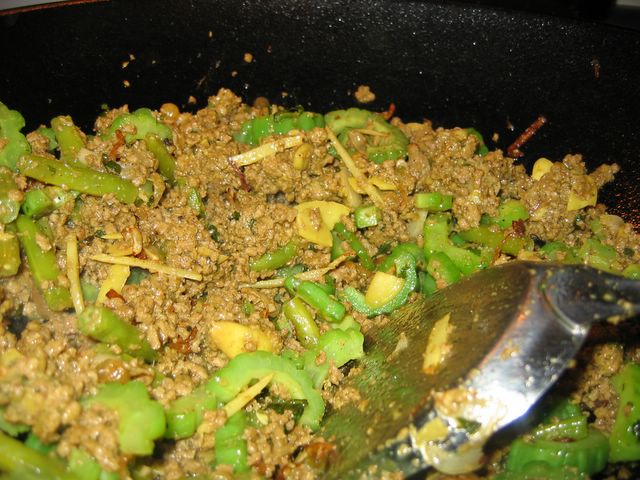
Keema sookh with bitter melon, also known as kerala. Since I was essentially utilizing leftover keema sookh, you can see that there are green beans included here. I wouldn’t necessarily use them with the bitter melon; they were part of the original dish.
I served it all over steamed basmati rice.
In addition to using different spices (and I am still thinking on which ones I would use), I think I would also be certain to brown the bitter melon. As I recall, the melon I had with the minced lamb had been browned and this gave it a totally different characther that seemed to be lacking in this version.
All in all, I would try it again, but I think I prefer the vegetable cooked in the Cantonese way. Zak certainly likes the black bean and soy sauce seasoning better; when I cooked it that way last week, we were tussling over the last bits of bitter melon on the serving plate, whereas with this dish, he actively picked out the melon and avoided it after a time.
But, it was a worthy experiment–if nothing else, the photograph of the stir-frying looks really striking. That green is lovely reflected in the oil-slicked black iron wok.

Categories:
- Admin (rss) (55)
- Blogs and Blogging (rss) (81)
- Book Reviews: Cookbooks (rss) (43)
- Book Reviews: Non-Cookbook Food Books (rss) (38)
- Cats and Cat Blogging (rss) (47)
- Chinese Cooking Lessons (rss) (32)
- Culinary School Stories (rss) (18)
- Dairy Pruducts: Cultured and Barbaric (rss) (4)
- Documentary Filmmaking (rss) (1)
- Essays, Rants and Reflections (rss) (260)
- Fighting Hunger (rss) (12)
- Food and Kids (rss) (45)
- Food in the News (rss) (126)
- Food Media (rss) (98)
- Food Preservation (rss) (18)
- Food Safety (rss) (45)
- Gardening (rss) (30)
- Herbs and Herb Blogging (rss) (20)
- Holidays (rss) (50)
- Kat Blogging (rss) (22)
- Kitchen Science (rss) (36)
- Leftover Makeover (rss) (8)
- Life, the Universe and Everything (rss) (131)
- Local and Sustainable (rss) (227)
- Local Athens Food and Foodies (rss) (42)
- Meatless Mondays (rss) (32)
- Menu For Hope (rss) (5)
- Nutrition, Diet and Health (rss) (84)
- On The Farm (rss) (8)
- Recipes: Almost Vegetarian, Vegetarian and Vegan (rss) (294)
- Recipes: American Regional (rss) (37)
- Recipes: Appalachian Hillbilly (rss) (33)
- Recipes: Bread, Pasta, Grains (rss) (95)
- Recipes: Canning and Preserving (rss) (8)
- Recipes: Chinese (rss) (123)
- Recipes: Comfort Food (rss) (120)
- Recipes: Cookies (rss) (16)
- Recipes: Desserts (rss) (48)
- Recipes: French (rss) (25)
- Recipes: Fruits and Vegetables (rss) (302)
- Recipes: Greek, North African and Middle Eastern (rss) (31)
- Recipes: Indian (rss) (137)
- Recipes: Italian (rss) (42)
- Recipes: Japanese (rss) (7)
- Recipes: Jewish (rss) (4)
- Recipes: Korean (rss) (6)
- Recipes: Meat, Poultry and Fish (rss) (220)
- Recipes: Mexican/Native American/ Latin American/Caribb (rss) (27)
- Recipes: Original (rss) (108)
- Recipes: Thai (rss) (27)
- Recipes: Tofu (rss) (17)
- Recipes: US Regional (rss) (16)
- Recipes: Vietnamese (rss) (8)
- Restaurant Stories (rss) (28)
- Sewing, Quilting, Arts and Crafts (rss) (16)
- Simple Chinese Recipes (rss) (30)
- Slow Food and Heritage Foods (rss) (10)
- Spice Blogging (rss) (44)
- The Chinese Cookbook Project (rss) (14)
- The Chinese Pantry (rss) (39)
- The Documentary (rss) (2)
- The Kitchen Saga (rss) (17)
- The Locavore's Bookshelf (rss) (15)
- The Unsung Adventures of The Culinary Nerd (rss) (6)
- Tools and Toys (rss) (35)
- Uncategorized (rss) (10)
- With a Side of Politics (rss) (48)
Archives:
- August 2012 (9)
- July 2012 (12)
- September 2011 (3)
- August 2011 (7)
- July 2011 (8)
- June 2011 (16)
- May 2011 (17)
- April 2011 (11)
- December 2010 (9)
- November 2010 (5)
- February 2010 (1)
- December 2009 (5)
- November 2009 (7)
- October 2009 (10)
- September 2009 (16)
- August 2009 (14)
- July 2009 (14)
- June 2009 (7)
- May 2009 (17)
- April 2009 (10)
- March 2009 (25)
- February 2009 (13)
- January 2009 (10)
- December 2008 (5)
- November 2008 (5)
- October 2008 (6)
- September 2008 (13)
- August 2008 (8)
- July 2008 (11)
- June 2008 (18)
- May 2008 (13)
- April 2008 (14)
- March 2008 (16)
- February 2008 (17)
- January 2008 (19)
- December 2007 (25)
- November 2007 (18)
- October 2007 (24)
- September 2007 (16)
- August 2007 (15)
- July 2007 (15)
- June 2007 (10)
- May 2007 (14)
- April 2007 (16)
- March 2007 (17)
- February 2007 (20)
- January 2007 (13)
- November 2006 (1)
- October 2006 (8)
- September 2006 (14)
- August 2006 (25)
- July 2006 (30)
- June 2006 (28)
- May 2006 (34)
- April 2006 (29)
- March 2006 (24)
- February 2006 (30)
- January 2006 (38)
- December 2005 (40)
- November 2005 (37)
- October 2005 (32)
- September 2005 (25)
- August 2005 (30)
- July 2005 (28)
- June 2005 (21)
- May 2005 (8)
- April 2005 (22)
- March 2005 (17)
- February 2005 (29)
- January 2005 (10)
Search Site:
Links:
- Lily’s Wai Sek Hong
- 101 Cookbooks
- A cat in the kitchen
- A Veggie Venture
- Accidental Hedonist
- Cha Xiu Bao
- chez pim
- Chocolate & Zucchini
- Chopstick Cinema
- Chowhound.com
- Chubby Hubby
- Cook sister!
- Cooking with Amy
- da*xiang
- Eat Local Challenge
- Eating Liberally
- Ecocentric
- Eggbeater
- Epicurious
- Farmgirl Fare
- Fatfree Vegan
- Foodgoat
- ForkandBottle.com
- Green Olive Tree
- Hooked on Heat
- Jaden’s Steamy Kitchen
- Kalyn’s Kitchen
- Lucullian delights
- Mahanandi
- Matt Bites
- MeatHenge
- mmm-yoso!!!
- New York Times – Dining & Wine
- Pizza Goon
- Rasa Malaysia
- Ruhlman
- Sailu's Kitchen
- Serious Eats
- SF Gate: Food & Dining
- Simply Recipes
- Soul Fusion Kitchen
- Tastespotting
- The Amateur Gourmet
- The Cleaner Plate Club
- The Food Section
- The Grub Report
- thecookscottage
- U.S. Food Policy
- Wandering Chopsticks
- Washington Post Food and Dining
- Wasted Food
Meta:


Powered by WordPress. Graphics by Zak Kramer.
Design update by Daniel Trout.
Entries and comments feeds.