
Cook Local, Eat Global
My Precious
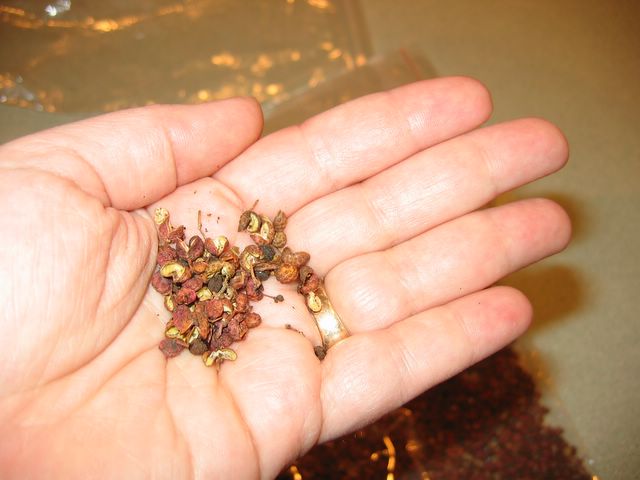
Sichuan Peppercorns. Notice the tiny black seeds which are very gritty and the presence of some twiggy bits which are not really edible.
No, it is not a ring.
(Though, I have to say, my jade and gold wedding ring rocks most bodaciously.)
My most best beloved flavor, my precious, is my hoard of Sichuan peppercorns.
Xanthoxylum piperitum.
Fagara. Hua jiao. Ma lar. Sansho.
Called by many names across Asia, the spice known to me as Sichuan peppercorns are the mature fruit of a medium sized shrub called colloquially “prickly ash” or “mountain ash.” The fruits come in the form of a pericarp, which is the mature ovary wall which contains the seeds of the plant. The seeds are said by some to be bitter, however, this has not been my experience. On the other hand, their texture is less than stellar, and so if you can remove them before using the spice, particularly when it is to remain whole, then you avoid the rather sand-like grittiness they can impart to a dish.
Often there are little twigs or thorns present in among the pericarps which must be picked out carefully, as they contain no essential oils to speak of and are a choking hazard.
The little fruits range in color from dark brownish red to a bright brick color; I have found that the brighter the color the fresher they seem to be. The aroma is complex: floral with a strong hint of lemon (likely owing to the citronellal terpine found as a constituent of the essential oil) and a black pepper-like overtone. The flavor is equally multi-faceted; it is astringent and biting without being hot in the way of either black pepper or chile, but at the same time, it has a lingering herbal quality that always reminds me of the way a field of rosemary in bloom smells. In addition to the dancing bouquet of flavors and aromas present in the Sichuan peppercorn, eating the spice gives the diner a pleasant tingling or numbness to the lips and tongue that is both cooling and warming at the same time. This is a harmless, transitory effect; after eating, the sensation fades quickly.
Because the prickly ash is a member of the citrus family, and apparently can carry a very virulent disease called citrus canker; for a time in the recent past, Sichuan peppercorns were banned from being imported into the US. Apparently the ban had been in effect for a very long time, but had never been enforced. With devastating losses of Florida citrus crops due to a newer outbreak of the disease, the FDA began enforcing the ban vigorously, and apparently, some retail stores had their stocks forcibly removed and destroyed.
However, within the past few months, the ban has been lifted; it has been found that if the peppercorns are heat treated, any disease-causing organisms that it might carry can be destroyed, without much loss of flavor or aromatic quality.
As soon as I heard about the ban, I ordered about eight ounces of the spice, and managed to store it quite effectively in a way which preserved both flavor and scent. I had been given conflicting advice on how to keep it fresh; one source gave the standard advice to keep the spice in a cool dark place, sealed airtight, while another source insisted that I keep it in a loosely woven basket in a dark cool place in order to allow air circulation.
I went my own way and sealed the pericarps in air-tight double layered ziplock freezer bags from which I removed all the air. Then I bagged them again, so that four layers of plastic protected it from the cold and the light, and tucked them into my freezer. I kept the majority of the peppercorns this way, with only a small supply left out in a small sealed bottle for every day use at any given time, replentishing from the freezer as needed. This arrangement worked wonderfully; I managed to keep the peppercorns fresh and flavorful until the ban was lifted about a year and a half later. I just recently used the last of that batch and they had just begun to lose their characteristic zingy scent.
I have had good luck purchasing Sichuan peppercorns online through the CMC Company.
I heard it through some posts on Chowhound after the ban that CMC had a good supply of pre-ban Sichuan peppercorns left, so I clicked the link and purchased some. At that point, there were none to be found locally. When they came, they were a nice dark russet and very fragrant. I still have a few of them left, but have since bought new ones at the local Chinese market which were redder, and were so aromatic that after just picking up the bag, the scent lingered on my fingertips. Mmm: better than perfume!
I generally feel that if you can get them locally, you should inspect the Sichuan peppercorns carefully; as I noted above, they should be brightly colored, and the scent should penetrate the plastic or cellophane wrapper. I will not buy them in glass or plastic jars, because there is no way to gauge the smell through airtight containers. I have never failed in choosing them by either sticking with a tried and true supplier like CMC or trusting my nose to tell me a good batch from a bag that has been sitting around forgotten and lonely for years on the bottom shelf in the shop.
I seldom use them whole, as I do not like the texture of them, even in braised foods. I have also noticed that they give a sharper, more penetrating flavor when ground. Before grinding them, however, I always toast them in a small cast iron skillet over medium heat. I pour them in a single layer in the bottom of the skillet, and shake it constantly over the burner, though you can also stir them. This keeps the spice from scorching; scorched Sichuan peppercorns have an acrid, bitter pungency which is less than salutary. As soon as the color deepens slightly and the scent suddenly intensifies, they are ready. I pour them into a shallow bowl to cool before grinding them finely.
When I use them in stir fries, I like to do it in two stages; I put half the amount into the oil after it has just heated up, at the same time as I put in the scallions, garlic, ginger and chiles. This flavors the oil and allows the spices to meld together. Then, I add the rest right before serving, in order to preserve the lemony top notes of the spice and to deepen the darker bouquet of the peppercorn-flavored oil.
Since I haven’t had time to stir fry in days, and I am going to pack my wok tomorrow (whimper, whine, sniff) I will not post a recipe of my own featuring my precious. However, I am giving a link to a recipe from Grace Young’s Breath of a Wok, which I -have- made in the past and found to be a great way to feature the haunting and addicting flavor of Sichuan peppercorns.
Spice Girl: She Who Must Be Stopped

This is a partial view of my spice cabinet. This is one sixth of it–there are three shelves total, twice as wide as what is shown in this picture.
So, I am still packing–that is a big surprise, I know. And I am on the phone with a friend, discussing putting together a series of lessons for her to learn how to cook lactose and gluten-free, while I am packing up my spice cabinet.
I have an entire large, three shelf, thirty-two inch wide cabinet devoted to spices and herbs.
Apparently, not only do I compulsively buy weird legumes, I purchase every spice known to humankind.
Lots of them at Penzey’s, as you can see.
So, while I am talking with my friend, I am taking up the various jars, bottles, bags and boxes of herbs and putting the ones I am not likely to use in the next week into a file box. And I am finding all sorts of things that, while, I didn’t exactly forget I had them, I didn’t realize how many of them there were.
I have fourteen kinds of dried chile products: whole and ground chipotles, whole and ground anchos, chiltepen, tien tsin, Pakistani chile flakes, Californian chile flakes, dried jalapenos, chiles colorado, ground cayenne, sweet paprika, half-sharp paprika and hot paprika, and Aleppo chile flakes. Oh, and chile con carne powder. That makes fifteen.
Then there are the dried flowers: lavender and rose buds, both food grade.
Four kinds of peppercorns.
Two kinds of cinnamon, and four different forms or varieties of cardamom.
Many kinds of Indian spices which many normal Americans have not heard of, such as amchoor, ajwain, kala jeera, asafoetida and kali elaichi.
Black and white sesame seeds.
And, of course, my beloved Sichuan peppercorns.
So, what I want to know is, when does a lot turn into too much, and when does too much turn into way too much and when does way too much turn into, “Hello, my name is Barbara, and I have a problem with spices. I love them. I collect them, and I use them every day. I am a user?”
And for those who have a similar problem with spices, or wantt to develop a similar problem with them, or for culinary nerds like myself who like to read stuff written by similarly obsessed people, here is a great resource for everything you ever wanted to know about herbs and spices.
The emphasis on the site is on Asian herbs and spices, and is written by a man after my own heart. It is truly an educational experience to read his work.
Okay, enough stalling for me.
Back to the boxes!
Never Again the Beans
So, I am packing. Packing, packing, packing. Boxes, boxes, tape, newspapers, styrofoam peanuts (which were leftover from the last move, three years ago), and markers make up my days and nights. I dream of boxes, tape, and more boxes, then wake up flailing and screaming, “Where did the goddamned marker go?”
And then I get up and so some more packing.
Packing, packing, packing.
Packing.
It is not fun.
We had to travel to the new house today to talk with our contractor about something or another having to do with the bathroom he is redoing. Which was cool, because we could take stuff with us to go into the house. Which is great, because we have a couple of light fixtures we want him to put in said bathroom (they are ultra-cool, as they look like stylized glass UFOs), so we took those along. But there was room in the car for more.
So, tired as I was of packing files, stuff from the closets and dishes, I got the grand idea to start packing non-perishable food items to take with us and put in the pantry of the new house.
Oh, the cleverness of me.
So, I put together some boxes, and dragged them into the kitchen and plunked myself down in front of the pantry and started dragging stuff out of the bottom shelf, which is where I keep the dried staples. You know, like grains (except rice, that has its own special place) and pasta and things like that.
Oh, yeah, and beans. Dried beans live there.
Lots of them.
Package after package of dried beans began to emerge from the depths of the bottom pantry shelf. Beans that had not seen the light of day since Methuselah walked the earth. (Okay, so maybe they weren’t that old. Maybe they had been hidden only since Jesus walked on water to the amazement of his friends and neighbors.)
And not just any old kind of beans, but a plethora of beans from cuisines spanning the globe lived in that pantry in a veritable United Nations of Leguminous Vegetables.
Well, it is true that I found some old standard United States favorites, like pinto beans, black beans and plain brown lentils.
But I also found French black beluga lentils and green lentils as well as the lovely Indian salmon-colored masoor dal, which as we know, are brown lentils split and stripped naked.
Also hailing from India were toor dal–yellow split peas. Urad dal, both split and whole. Kali Channa, otherwise known as black chickpeas, white chickpeas which I didn’t even know we had, or I would have used them for the channa masala, and moong dal.
Then there were the three packages of azuki beans, which are used in both Japanese and Chinese cuisines. Behind them were stuffed a couple of pounds of French flageolet, looking pale and lovely next to the dusky Italian borlotti. Louisiana red beans and Italian cannellini beans were crammed beside the Caribbean’s beloved pigeon peas.
I am never going to buy a dried bean or lentil or dal or legume ever again. Ever.
Never, ever, ever.
And then, when that was done, out came the grains. Bulgar, brown rice, wild rice, corn. Quinoa. Posole. Pounds of posole, which I bought because I figured that I wouldn’t be able to buy it in Athens.
And after that, I found the stash of rice noodles. Thick, thin, narrow, wide, and all sizes in between. And the bean thread noodles. And the rice wrappers.
And behind them, was one more package of lentils.
As if I needed more.
As I shoved all of this bounty into boxes, I reflected on my hoarding behavior and realized something about myself.
I must be stopped.
At all costs.
Because if I ever cook all of these beans, the air will not be fit to breathe in my house. There is not enough Beano in the world to save Zak and I from ourselves.
With that realization, I decided that after we get settled into the new house, I will institute a policy of making one new bean dish a week until we are rid of this uncanny surfeit of legumes. I will invite friends over and we will eat beans until there are no more.
So stay tuned for the further adventures of the Bean Babe and her faithful sidekick in the kitchen, Beano the Magnificent as they endeavor to rid the pantry of an overabundance of healthy and flavorful legumes without gassing the entire small town of Athens, Ohio into oblivion.
Of course, the obvious question that arises is what will the Bean Babe do when she runs out of beans?
The answer is elementary: go out and buy some more.
Appalachian Wild Leeks

The lovely green spearhead-shaped leaves are ramps–a wild cousin to leeks. The stalk is white fading into cerise down near the roots: both stalk and leaves are eaten.
As most folks know, I grew up in West Virginia, in the heart of Appalachia.
This time of year, in the early spring, my heart instinctively yearns for the mountains, and my feet get to itchin’ and I want to go clambering around through hilly woodlands. My fingers long to dig the cool red clay soil in search of the first wild harvest food: ramps.
Ramps, or wild leeks, (Allium tricoccum for all you botanists and Latin speakers out there), are a plant native to the Appalachian region. They range all the way north to Novia Scotia down south to Georgia, and will grow in damp woodland soils as far west as Iowa and Minnesota. (And no, neither Iowa nor Minnesota are considered part of Appalachia–but the ramp doesn’t just associate with hillbillies–it goes whither it will wander.) They are a true allium, which makes it part of the lily family, and is related to leeks, onions, garlic, chives and a bunch of really pretty flowers.
The leaves, which are lance-shaped and brilliant emerald green, and the stalks, which swell underground into small bulb shapes without making true bulbs, are both edible, though the leaves are more strongly flavored than the stalks. They sprout up out of the still cool woodland soil in damp areas near springs and streams, climbing slopes and carpeting bottomlands with thick clumps in the early spring months.
The name, “ramp,” is from “ramson,” which is a survival of archaic British dialect, which is one of the roots of Appalachian dialect that peppers the speech of folks native to that region. Apparently, in the British Isles, another wild allium, allium ursinum, grows unfettered by cultivation, and is colloquially called a ramsen or ramson. Some say that the term comes from “Ram’s son,” which indicates that it sprouts during the sign of Aries the ram, but I prefer the theory that it comes from the Old English plural form of “hramsa, ” which indicated a wild garlic. When the English, Welsh and Scots settled the Appalachian mountains, they found a familiar plant growing, and used their own familiar name for it, much as they named the red-breasted thrush of North America after their very own robin redbreast.
Some folks call them ramsons to this day, while others call them “ramscallions–” a name which I like not only because it likens them to another non-bulb producing allium which I use often, the scallion, but because it sounds like one of my favorite words, “rapscallion,” which is an archaic form of “rascal.” I like to think of ramps as wily, rascally little leeks whose beauty belie their strong flavor and even stronger odor.
Now seems to be a good time to mention the smell of my beloved ramps.
They are stinky wee beasties, and if you eat them, particularly raw, they will make you stink, too.
The scent of them is so strong, it gets into your bloodstream, and into your sweat. Your breath and person will smell very strongly for a couple of days after you eat a substantial amount of ramps. The old hillfolk always said that was proof of its power as a spring tonic and blood cleanser, but these days, the smell is viewed with a less tolerant eye. School systems in West Virginia outlaw thier students from either bringing ramps to school or eating them and coming to school; I got in trouble for bringing some for my city friends to try after a weekend out foraging in the southern mountains. I didn’t get suspended or anything, just a stern-talking to. I guess it was okay–none of my friends much cared for them, anyway.
When I was a kid, we used to make pilgrimages to the southern mountains, down in Nicholas, Greenbriar and Fayette counties in March, to go “ramp hunting.” This is the origin of my itchy feet and tingling fingers right about this time every year. Just yesterday was Richwood West Virginia’s “Ramp Festival.”
I must have instinctively known that, because while I was packing boxes I had a sudden longing for the woods, and the smell of damp earth and the taste of a freshly dug up ramp.
We’d go with my aunt and uncle and their three kids, and they would let us loose in the woods above the beautiful Greenbriar river, and we’d go clambering up steep hills, our eyes glued to the sometimes knee-deep leaf litter, looking for clumps of green. When we’d find them, we’d fall to our knees and industriously dig with screwdrivers we kept in our back pockets, and pull the beautiful plants whole from the earth and tuck them into the grocery bags we carried. We were taught to always leave one third of the clump behind so it could keep growing and make more ramps for next year, and we’d solemnly obey this injunction, knowing that our grandfather practiced the same care in culling his cattle herd and harvesting his black walnuts.
We’d end up with pounds of the things, piled up in paper bags, which we’d have to carry out of the woods and back to the car, where we would have to drive for hours to get back to Mom’s house, where she would then cook us a feast with our bounty.
Fried potatoes with ramps is a classic, though she always had a pot of pinto beans ready to heat up. Those we’d eat with raw chopped ramps right on top (instead of the usual raw onions), with a side of cornbread. The best thing she’d have ready, though was a big bowl of her potato salad–both sides of our family acknowledges that my Mom makes the best damned potato salad anyone has ever had. She’d make it by the roasting pan full for family gatherings and after a session of “ramp hunting,” she’d have a punchbowl of it ready, and would add freshly chopped ramps to it and mix it all in with her softly tanned, long-fingered hands.
I am lucky enough to have ramps growing in the woods that surround this house in Pataskala. I found that out on my first ramble through the forest after we moved here four years ago, in May. I had clambered down the trail into the soggy bottomland next to our creek, and saw a familiar sight–a clump of big, lance-shaped leaves standing proudly out among a bunch of blooming violets.
Squealing with delight, I fell upon them and dug them up with my bare hands, and wiping the garnet-colored stalks on my jeans, inhaled three. The pungent flavor struck my sinuses with the force of a fastball that slipped past the catcher’s mitt, and I started salivating like a coonhound on a hot trail. Dancing around, I probably looked like a demented jackrabbit, but I didn’t care. Forging up the creek, I crossed the rain-swollen stream by way of a fallen tree, and found more patches dotting the ravine slopes. Knowing it was near the end of the season, I picked a few and dragged them back to the house, to show to Zak, whom I reckoned had never seen nor heard of ramps before.
Being an aficionado of garlic, Zak liked the flavor immediately, and after cleaning my catch, I added them to the lamb stew we had for supper, and we feasted royally, though, of course, we smelled funky the next day.
The next year, I sought them out earlier, and found them coming up in full force by mid-April. Here in central Ohio, it is a good bit cooler than even the mountainous regions of southern West Virginia, so our season starts much later.
However, catching them just as they came up showed me just how big the ramp population was in our woods–they were everywhere, painting broad swaths of green against the crackling brown leaves on the woodland floor. There were thousands of them.
So, I took to harvesting them, and using them in whatever I happened to be cooking at the time.
I discovered that not only are they delicious in traditional Appalachian foods like my Mom makes, but they are amazing when cooked in Chinese foods.
I added them to stir fries. I added them to red-cooked dishes. I added them to Thai curries, to pad thai, to hot and sour soup and to scallion pancakes.
They were all fantastic.
I added them to potluck dishes like shepherd’s pie and au gratin potatoes with chipotle peppers, and took them to city-friend’s houses. They were a smashing success, and not just among the other transplanted hillfolk who recognized them for what they were and drooled accordingly. It seems that city people have lost a lot of their fear of flavor and are more daring when it comes to trying new things that promise a punch to the tastebuds.
(I must add that ramps in recent years have become trendy. It seems that city chefs have heard about them and are clamoring for them and one can find them for sale in some markets in New York City these days. When I was in culinary school back in 1998, I remember watching both Mario Batalli and Curtis Aiken use ramps on their shows within a week of each other. I had to call Mom and let her know that our beloved hillbilly tonic had hit the big time. She was floored.)
So, it is March, and I know that in southern Appalachia, the ramps are already up and are being eaten by the bushel by the lucky hillbillies who can get to them. And my fingers are itching to dig.
But, around here, I have to wait another month or so for our little green beauties to start showing their pretty foliage. By then, we will have moved to the new house. I console myself with the knowledge that we will have to come back here to dig up some of our perennials we are transplanting from the garden here to the new place, and I can sneak off to the woods and forage some ramps for us to take home.
We do have a little patch of trees at our new house, that is part of string of woods that winds through the houses in the hills surrounding Athens. I am thinking that I might try and transplant some ramps out there, and see if I can convince them to take root and multiply so I can continue my spring ritual of just hopping outside and picking some goodness from the ground and cooking it. I bet it will work; there are even some folks researching how to cultivate ramps for commercial production, and they have had some success so long as they keep the habitat (below trees in rich, damp soil) right.
So, having written all of this, I do hope that folks will give ramps a try if you can find them.
Though, do remember, they are stinky rascals, and they will leave their scent behind for a while.
But it is a small price to pay for such a delicious kick of flavor.
Keema Sookh: North Indian Home Cooking
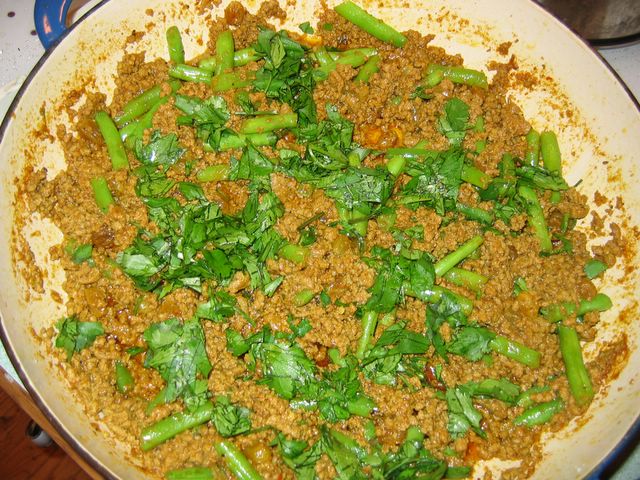
A finished pan of keema sookh; this version has green beans and cilantro, but there are many other possible additions to the recipe.
My very first personal chef clients were a young couple of computer programmers, one from Bangladesh, and the other from Pakistan. I came about them as clients in a weird way, which is normal for me, I suppose. I had been describing my new business venture to a fellow employee at the local Borders bookstore, explaining how being a personal chef is supposed to work, when I noticed a young Muslim woman dressed in a salwaar-kameez set with her dupatta draped over her hair lurking nearby, listening intently. Once she saw me glance in her direction, she approached, and apologizing profusely for having been eavesdropping, asked if I could cook Indian food.
Now, if the truth would be known, I could cook -some- Indian food, but my knowledge of the cuisine was limited, as I was very intimidated by all of the different spices. I hadn’t the ability to parse out and analyze the flavors so I could understand exactly what seasoned each dish in the same way I could with Chinese foods. I just didn’t’ have the experience.
However, I wanted a client. I needed a client, and this lady was very adamant that she needed a cook.
So, I told a half-truth and said, “Yes, I know how to cook Indian food.”
The truth was, I knew how to cook exactly five dishes. However, I also knew that I had at least a month before my business license came through and all of the other paperwork was done, so I had that time to get on the ball and learn how to make Indian food.
She gave me her business card and told me that as soon as I was legal to do business, she wanted me to call her and set up an appointment to meet with her and her husband to we could finalize the deal.
As soon as she left, I marched into the bookstore, and bought about twelve Indian cookbooks to supplement the five or so I had at home. I then marched into the breakroom and informed Zak that for the next month, he was likely to only eat Indian food. He looked up from his lunch of leftover jambalaya, blinked and said, “Oh, damned. Nothing but Indian food for a month. Darn. I might die, or something.”
Everyone else in the breakroom offered to be guinea pigs, however, my most valued guinea pig was Tanbir, a co-worker in the cafe whose parents were from northern India.
And so, I began cooking. And studying, and cooking. And eating out at the local Indian restaurant, and asking questions and playing guessing games with the waiters and eating some more. And cooking. And studying, and reading and generally, obsessing.
At the end of the month, not only could I make credible, recognizable foods that exist on nearly every North Indian restaurant’s menu, but I could make stuff that is never seen on a restaurant menu.
Things like keema sookh.
Keema sookh is essentially a recipe for spiced, dry-cooked ground meat. It is a homey dish, quick to prepare, that is used for a family supper or lunch, but that can be dressed up in a variety of ways or used as a filling in many other dishes. It is extremely versatile, and is a great way to use up bits and pieces of vegetables in the refrigerator.
It was very popular with my clients, and it became a standard quick dinner at my house, and is a favorite of Zak, one that he will ask for fairly often.
It is one of those dishes that I seem to cook differently every time, but I can give a basic recipe here.
Keema Sookh
Ingredients:
4 cloves garlic
1 1″ cube fresh ginger
2 fresh thai chile peppers, stemmed
2 tablespoons cumin seeds
2 1/2 tablespoons coriander seeds
1/4 teaspoon cardamom seeds
1 teaspoon black peppercorns
1/2 teaspoon red pepper flakes
1 medium onion, sliced as thinly as possible
1 teaspoon salt
2-3 tablespoons vegetable oil or ghee
1 pound ground lamb, goat or beef
1/2 cup milk
2 tablespoons sweet paprika
2 tablespoons turmeric
1/4 cup golden raisins
water as needed
1 cup fresh green beans, stringed and snapped into 1″ pieces
salt to taste
1/2 cup fresh cilantro leaves, lightly chopped
Method:
Grind the dry spices. If you have a coffee grinder dedicated to the purpose of spice grinding, grind them in that, then add them to a blender jar with the wet spices, and adding a couple of tablespoons of water, puree them. If you use a mortar and pestle, you can grind the garlic, ginger and chiles at the same time as the dry spices; the dry spices will help break down the wet spices, and the wet spices will help keep the dry spices from popping out of the mortar while you grind.
(If you make a lot of Indian food, you might consider investing in a Sumeet Multi Grind. It can do wet and or dry spices, in both small and large quantities. It can grind nearly anything, in fact, with nary an issue. It is the best Yule gift Zak ever gave me and I use it to make Thai curry pastes, Mexican mole sauces and Indian curries all the time. It can even grind small amounts of grain and lentils if you need it to.)
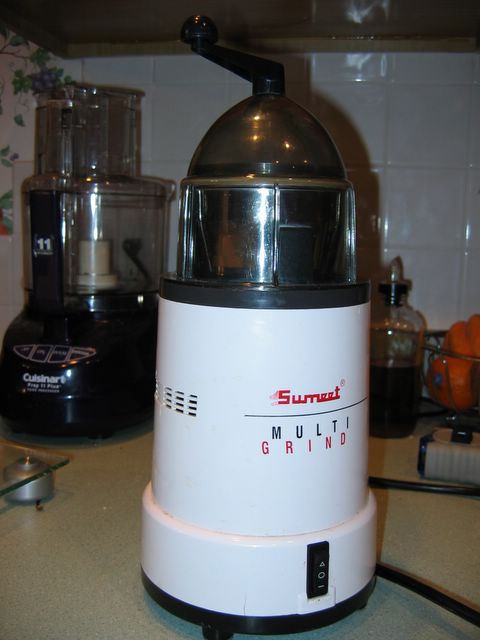
My super-efficient grinding machine from India: the Sumeet Multi-Grind. It is a wonder for making curry pastes, chile sauces and for grinding small amounts of dry spices.
Heat a heavy skillet over medium heat, add oil or ghee. As soon as oil is hot, add the onions, and cook, stirring, until they are a very dark reddish brown. (Yes, you must stand over it and stir. Because if you turn your back to answer the phone, blow your nose or dash off look something up on the computer, the onions will burn. And they will smell awful. So, please, just stand there and stir.) When they are about halfway cooked (golden brown) add salt and keep cooking. This helps force out as much juice as possible, which hastens the browning process.
Once the onions are brown, add the ground wet and dry spices together and cook in the oil for about a minute. Add the ground meat and the milk, and begin chopping the meat into the milk until it all begins to fall apart and brown. Add the paprika and turmeric, the raisins and cook down until the milk is evaporated. At this point, add water, and continue cooking for twenty minutes, adding water as needed to keep it from boiling completely away.
After twenty minutes of simmering, add the green beans and about 1/2 cup of water and cook until the green beans are barely tender and the water is completely cooked away. Add salt to taste, and garnish with the cilantro. Serve over plain basmati rice or a rice pillau.
There are many different variations you can make out of this dish. You can add almonds at the same time as the green beans. You can add carrots at that time, too. You can leave out the raisins. You can use fresh pomegranate seeds, fresh mint or cubes of fresh mango as a garnish. You can add diced, mostly cooked new potatoes at the same time as the meat and allow them to finish cooking in the seasoned liquid. You can also cook it with fresh curry leaves or fresh fenugreek greens. You can add chopped fresh spinach or kale to the dish, too.
There are endless possibilities. Use your imagination.
Traditionally, the dish is served with either a fresh or cooked chutney or a raita to go with it to offset the dry texture. I like it with a fresh mango, lime and green chile chutney, myself.
You can mix keema sookh with rice or rice pillau and use it to stuff peppers, eggplants, chiles, patty pan squashes or portabello mushrooms and then either steam, bake or braise the resulting stuffed item. Stuffed orange red and yellow bell peppers are especially nice when you make the mango chutney, because you top the cooked, steaming hot peppers with the cool chutney and it is a symphony of color and flavor. If you sprinkle the pomegranate seeds over the whole thing just before serving it, you push the dish over the top, and it ceases to be a homestyle food and becomes a little bit of nirvana.

Categories:
- Admin (rss) (55)
- Blogs and Blogging (rss) (81)
- Book Reviews: Cookbooks (rss) (43)
- Book Reviews: Non-Cookbook Food Books (rss) (38)
- Cats and Cat Blogging (rss) (47)
- Chinese Cooking Lessons (rss) (32)
- Culinary School Stories (rss) (18)
- Dairy Pruducts: Cultured and Barbaric (rss) (4)
- Documentary Filmmaking (rss) (1)
- Essays, Rants and Reflections (rss) (260)
- Fighting Hunger (rss) (12)
- Food and Kids (rss) (45)
- Food in the News (rss) (126)
- Food Media (rss) (98)
- Food Preservation (rss) (18)
- Food Safety (rss) (45)
- Gardening (rss) (30)
- Herbs and Herb Blogging (rss) (20)
- Holidays (rss) (50)
- Kat Blogging (rss) (22)
- Kitchen Science (rss) (36)
- Leftover Makeover (rss) (8)
- Life, the Universe and Everything (rss) (131)
- Local and Sustainable (rss) (227)
- Local Athens Food and Foodies (rss) (42)
- Meatless Mondays (rss) (32)
- Menu For Hope (rss) (5)
- Nutrition, Diet and Health (rss) (84)
- On The Farm (rss) (8)
- Recipes: Almost Vegetarian, Vegetarian and Vegan (rss) (294)
- Recipes: American Regional (rss) (37)
- Recipes: Appalachian Hillbilly (rss) (33)
- Recipes: Bread, Pasta, Grains (rss) (95)
- Recipes: Canning and Preserving (rss) (8)
- Recipes: Chinese (rss) (123)
- Recipes: Comfort Food (rss) (120)
- Recipes: Cookies (rss) (16)
- Recipes: Desserts (rss) (48)
- Recipes: French (rss) (25)
- Recipes: Fruits and Vegetables (rss) (302)
- Recipes: Greek, North African and Middle Eastern (rss) (31)
- Recipes: Indian (rss) (137)
- Recipes: Italian (rss) (42)
- Recipes: Japanese (rss) (7)
- Recipes: Jewish (rss) (4)
- Recipes: Korean (rss) (6)
- Recipes: Meat, Poultry and Fish (rss) (220)
- Recipes: Mexican/Native American/ Latin American/Caribb (rss) (27)
- Recipes: Original (rss) (108)
- Recipes: Thai (rss) (27)
- Recipes: Tofu (rss) (17)
- Recipes: US Regional (rss) (16)
- Recipes: Vietnamese (rss) (8)
- Restaurant Stories (rss) (28)
- Sewing, Quilting, Arts and Crafts (rss) (16)
- Simple Chinese Recipes (rss) (30)
- Slow Food and Heritage Foods (rss) (10)
- Spice Blogging (rss) (44)
- The Chinese Cookbook Project (rss) (14)
- The Chinese Pantry (rss) (39)
- The Documentary (rss) (2)
- The Kitchen Saga (rss) (17)
- The Locavore's Bookshelf (rss) (15)
- The Unsung Adventures of The Culinary Nerd (rss) (6)
- Tools and Toys (rss) (35)
- Uncategorized (rss) (10)
- With a Side of Politics (rss) (48)
Archives:
- August 2012 (9)
- July 2012 (12)
- September 2011 (3)
- August 2011 (7)
- July 2011 (8)
- June 2011 (16)
- May 2011 (17)
- April 2011 (11)
- December 2010 (9)
- November 2010 (5)
- February 2010 (1)
- December 2009 (5)
- November 2009 (7)
- October 2009 (10)
- September 2009 (16)
- August 2009 (14)
- July 2009 (14)
- June 2009 (7)
- May 2009 (17)
- April 2009 (10)
- March 2009 (25)
- February 2009 (13)
- January 2009 (10)
- December 2008 (5)
- November 2008 (5)
- October 2008 (6)
- September 2008 (13)
- August 2008 (8)
- July 2008 (11)
- June 2008 (18)
- May 2008 (13)
- April 2008 (14)
- March 2008 (16)
- February 2008 (17)
- January 2008 (19)
- December 2007 (25)
- November 2007 (18)
- October 2007 (24)
- September 2007 (16)
- August 2007 (15)
- July 2007 (15)
- June 2007 (10)
- May 2007 (14)
- April 2007 (16)
- March 2007 (17)
- February 2007 (20)
- January 2007 (13)
- November 2006 (1)
- October 2006 (8)
- September 2006 (14)
- August 2006 (25)
- July 2006 (30)
- June 2006 (28)
- May 2006 (34)
- April 2006 (29)
- March 2006 (24)
- February 2006 (30)
- January 2006 (38)
- December 2005 (40)
- November 2005 (37)
- October 2005 (32)
- September 2005 (25)
- August 2005 (30)
- July 2005 (28)
- June 2005 (21)
- May 2005 (8)
- April 2005 (22)
- March 2005 (17)
- February 2005 (29)
- January 2005 (10)
Search Site:
Links:
- Lily’s Wai Sek Hong
- 101 Cookbooks
- A cat in the kitchen
- A Veggie Venture
- Accidental Hedonist
- Cha Xiu Bao
- chez pim
- Chocolate & Zucchini
- Chopstick Cinema
- Chowhound.com
- Chubby Hubby
- Cook sister!
- Cooking with Amy
- da*xiang
- Eat Local Challenge
- Eating Liberally
- Ecocentric
- Eggbeater
- Epicurious
- Farmgirl Fare
- Fatfree Vegan
- Foodgoat
- ForkandBottle.com
- Green Olive Tree
- Hooked on Heat
- Jaden’s Steamy Kitchen
- Kalyn’s Kitchen
- Lucullian delights
- Mahanandi
- Matt Bites
- MeatHenge
- mmm-yoso!!!
- New York Times – Dining & Wine
- Pizza Goon
- Rasa Malaysia
- Ruhlman
- Sailu's Kitchen
- Serious Eats
- SF Gate: Food & Dining
- Simply Recipes
- Soul Fusion Kitchen
- Tastespotting
- The Amateur Gourmet
- The Cleaner Plate Club
- The Food Section
- The Grub Report
- thecookscottage
- U.S. Food Policy
- Wandering Chopsticks
- Washington Post Food and Dining
- Wasted Food
Meta:


Powered by WordPress. Graphics by Zak Kramer.
Design update by Daniel Trout.
Entries and comments feeds.