
Cook Local, Eat Global
Chupacabra T-Shirt, Part II
Okay, number 36 did not work, so the random number generator gave me number 2.
So, if you hold the card with number 2 on it, post a reply here within three days to claim your very own Chupacabra Chili t-shirt, one of only three currently in existence, giving your email address so I can email you and get the proper snailmail address to send this lovely and talented bit of wardrobe whimsy right to your door. Yes, right to your door.
Stay tuned, I have more to post later, and a food related topic, even.
And the number, by the way, is 2.
A Boy and His Dog, I Mean, Dough
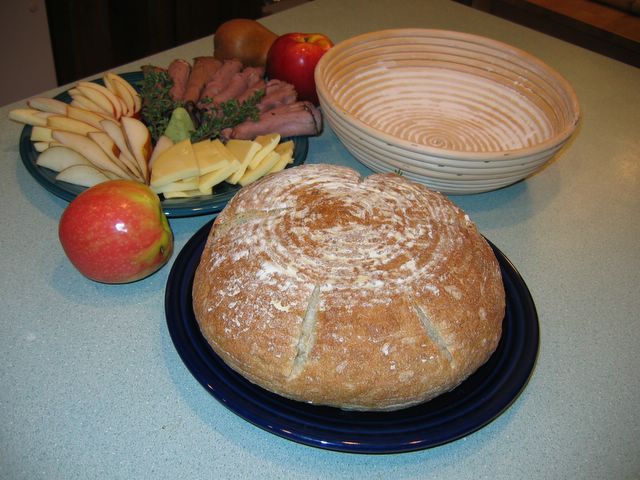
Zak’s second loaf of bread, pictured with the rest of dinner and the banneton which he used for proofing the dough. The shape of the basket made an interesting spiral design on the bread.
So, the end of February seems like a good time to talk about New Year’s Resolutions.
Right?
Well, I think so. By this time, most people have either finally gotten around to keeping their resolutions or have already broken them and gone on with life. Which is usually how it happens with me, but this year is different. This year, Zak and I made a pledge to each other to each learn a new, and useful skill.
I pledged to pick the guitar back up and learn to play it again and get it right this time around, and he promised to learn how to bake bread so we could do something fun in the kitchen together and he could contribute positively to our household caloric intake.
As you can see from the picture above, he is doing quite well. That is the loaf of bread he baked yesterday that we had for dinner. I put together the platter of sliced gouda, Pink Lady apples, a Bosc pear and some roast beef with wasabi. Yes, you can tell by looking that I studied under folks who were food stylists and worked with Martha Stewart. Yeah, every now and then I have to make the food pretty. It just happens.
But don’t look at that, look at the pretty bread! It turned out really well; he used the recipe for Basic Hearth Bread in Rose Levy Beranbaum’s The Bread Bible. It turned out very, very well–especially since it was only his second attempt; he even added a pinch of cardamom and allspice without fear of “messing up” the recipe. I was proud of him.
The crust was fantastic, chewy without being shatteringly crisp, which Zak doesn’t much care for. The crumb was tender, but with many irregularly shaped holes that give artisan breads their character. It was fragrant, but the spices were delicate and not overpowering at all. His timidity with the kitchen served him well in this instance; it gave the bread a definite lift in flavor without being in the least bit obtrusive or overpowering.
He is getting very into baking; we bought the banneton just yesterday and used it for the final proofing of the bread, because he wanted to see what difference it made in the shape and the crust. The week before, we bought a baking scale so he could more accurately measure ingredients as well as a baker’s lame, which is a curved razor used to slash the bread dough so that the crust splits evenly.

The first loaf of bread before being cut by the baker’s lame, pictured in the lower right corner.
My previous attempts to get Zak to learn to cook have been failures, however, I think that the combination of the precision which baking requires and which appeals to his orderly way of doing things, and the forgiving nature of bread have combined to intrigue him.
His first loaf of bread, which he made a couple of days ago, was from the same recipe, but he ended up leaving the sponge in the refrigerator for around 36 hours total, which is about 32 hours more than Rose suggests. He became very anxious about it, and was certain that he had destroyed his poor little yeasty fellows, but I assured him that bread dough is very forgiving (and the SAF yeast we were using was a nice, strong strain) and all would be well. He was overjoyed when he took it out and kneaded it, then began the proofing process, to see that not only were the yeast beasties alive, but they were very active.

The first loaf of bread, after having the sponge sit in the refrigerator for 32 hours, the kneading and proofing continued in a more normal time frame.
When he baked it, a delicious aroma filled the kitchen, and when he took it from the oven, he was overjoyed to see such a pretty golden crust. We rubbed it with butter to keep it soft, and set to eating it for dessert.
I liked the bread–the yeast had a long time to transform starch into sugars, and some of them stuck around in the bread and gave it a nice, complex aromatic flavor. The crumb was very chewy and strong, owing in part, I suspect to the long, slow fermentation and the hand kneading. But he wasn’t satisfied with that, so he made the same recipe again, only this time, he followed the directions more carefully.
In either case, I think that he is quite well on his way to becoming a good bread baker. Which is not only a useful skill, but it is a tasty one as well.
His next plans are to experiment with Rose’s Heart of Wheat recipe, which uses bread flour and wheat germ, which she says makes whole wheat flour minus the bran, which make whole wheat bread bitter. I eventually want him to give focaccia a shot, but his very first bread, naan, which was quite good, made him want to try something other than a flat bread for a while.
Whatever he ends up doing, I will update everyone here.
Too bad I can’t post samples for everyone to taste on the site, but while the Internet is great with words and images, it hasn’t yet managed to transmit flavors and scents yet.
As for me–I am on my way to learning how to play Bob Marley’s “Redemption Song.” The first night I took up the guitar, I picked out the opening notes by ear, and memorized them, then two days later, Zak gave me the chords, which I am remembering how to play.
Not bad for a woman who last really tried to learn guitar over twenty years ago.
Spiced Dry Tofu
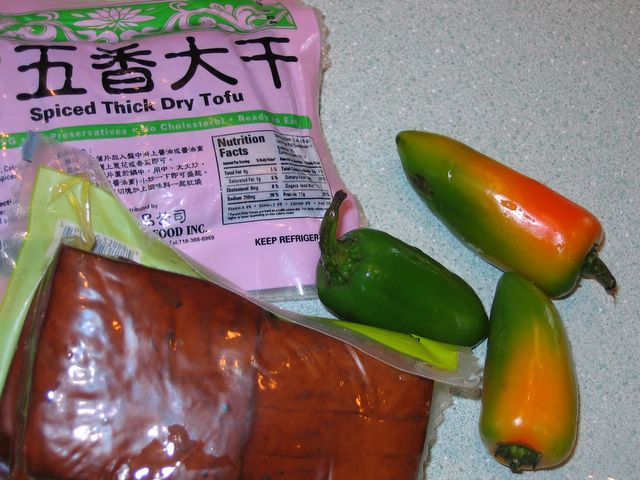
Two favorite ingredients in my kitchen: jalapeno chile peppers and spiced dry tofu.
Spiced dry tofu is a great variant on tofu that I suggest people try if they are of the belief that they “don’t like tofu.”
I know lots of people have told me that “I don’t like tofu, but when I had yours, it was really good and I loved it.” Well, part of the reason for that has to do with the fact that in the US, there are lots of people doing things to tofu that the innocent beancurd does not deserve which end up with results which are less than stellar, to say the least. I personally don’t care for most of these American tofu travesties, and I hope that the Kitchen God snitches to the Jade Emperor and suggests that he strike me dead if I ever foist such a dish upon unsuspecting guests in my home.
I am strictly an Asian-style tofu woman, myself. Tofu was not meant to pretend to be hot dogs, bologna, and for God’s sake, not cheese! Please, not cheese! No soy cheese! No. No, no. Ugh.
I used to work for a very sweet older vegan couple who wanted me to make vegan lasagne with bechamel sauce. Which presented me with lots of problems that had to be solved with cunning, quick wits and soy cheese.
Bechamel is a milk based sauce. However, I dislike the flavor of cooked soy milk intensely, and couldn’t imagine making a soy milk bechameloid thing that wasn’t just this side of nauseating. So, I improvised. I used a vegan “cream” of potato soup which was thickened with ground rice and potato, and used almond milk for the dairy, and added a great deal of sauted shallots and garlic to make it taste good. Faux bechamel achieved, I moved on to the problem of the ricotta filling.
I used Japanese style soft tofu which I mashed up with a little bit of white miso in order to give it the cheesy taste that Parmesan would add to ricotta filling. Then, I added cheeseless fresh pesto, and chopped spinach, and made a really pretty good approximation of ricotta filling.
The tomato sauce was easy and was made with all fresh ingredients, and turned out light and flavorful.
I thought that was good enough, but the lady of the house said, “I have soy mozzarella in the fridge. Shred that and put it on top.
I was not happy, but it is her food, so I did it. I assembled the lasagne and put it in the oven and baked it. It smelled pretty good.
But I want to say something about soy cheese–it has the texture of a rubber tire and doesn’t bloody well melt. It just kind of goes stringy and rubberier, if one can imagine it. And the flavor–ugh.
The dish turned out fine, except for that rubbery white nastiness on the top. But my clients loved it, so whatever, fine, it is their food, they eat it, pay me, we are all happy.
But to this day, I have it in for soy cheese.
But I love, absolutely love tofu, especially spiced dry tofu.
I first had it at Huy’s restaurant. He used it in his twice cooked pork, along with the pork, plain old regular cabbage, bamboo shoots and lots of chile action. Man, that stuff was good and Heather, June and I would fight over it. June may not have cottoned to greens, but she loved twice cooked pork, and for such a little delicate ladylike person, she sure could get pushy when it came down to one of the last few pieces of the dried tofu on the platter. At first, she was elaborately polite in the Chinese fashion about, “Here you take this,” and putting it on my or Heather’s rice bowl with her chopsticks, but when I realized I was supposed to refuse and the wrangling began back and forth in proper Chinese style, sometimes she would snatch that piece of tofu and gobble it down before anyone could say, “ai ya.”
Which always made Huy and Mei laugh uproariously. Me, too, because then June would blush and apologize for her rudeness.
And of course, it seldom mattered, because Huy or one of the cooks would just go into the kitchen and bring out more.
When we moved to Columbia, Maryland, there were two restaurants which used my favorite tofu. One place, called Noodles Corner, was a pan-Asian noodle shop, and they used it in their version of pad thai. That is still Zak’s favorite version of pad thai ever; we often got it without the shrimp or chicken and just had the tofu with the rice noodles and vegetables. They also used it in a dish they called Beijing meat sauce noodles, which consisted of ground pork seasoned with soybean paste, onions, and chile paste. They would dice the spiced tofu up finely and add it to the sauce, which was served over fresh wheat noodles with a garnish of shredded cucumber.
Another place, called Hunan Manor, which was our favorite Chinese restaurant in town, made a great dish called “Hunan Spicy Pork with Tofu.” It consisted of shreds of pork, dry tofu and jalapeno peppers stir fried in a delicious dark sauce and garnished with slivered scallion tops. After we moved back to Ohio, I pined for that dish, and tried often to recreate it. It wasn’t until I saw a very similar recipe in Grace Zia Chu’s cookbook, Madame Chu’s Chinese Cooking School that I was able to really replicate the dish. (I had been using less sugar and light instead of dark soy sauce.)
Spicy Pork with Pressed Beancurd
Ingredients:
1 pound fresh pork (I use a lean sirloin roast or chops), cut into thin 1” long shreds
1 ½ tbsp. cornstarch
1 tbsp. dark soy sauce
1 tbsp. Shao hsing wine
peanut oil for stir-frying
2”” cube of fresh ginger, peeled and shredded
6 cloves of garlic, thinly sliced
3 scallions, trimmed and cut into 1” chunks, then shredded—, green separate from white parts
6 Tsien tien dried chilis (used whole for the mildest taste, cut into chunks with seeds discarded for more heat, or chopped up with the seeds included for hottest flavor)
3-4 large jalapeno peppers, seeded, and cut into matchstick shreds
3-4 squares pressed tofu shredded into matchstick pieces
½ tbsp. raw sugar
2 tbsp. dark soy sauce
2 tbsp. Shao hsing wine
Method:
Toss pork with cornstarch and 1 tbsp. dark soy sauce and wine. Allow to marinate at least twenty minutes, while shredding and cutting other ingredients.
Heat wok, then heat oil until smoking. Add ginger, garlic, white part of scallions and dried chilis into wok, and stir fry until very fragrant. Add meat and allow to brown a bit on bottom before stirring constantly.
When meat is nearly done, add jalapenos and tofu. Stir and fry until you can smell peppers.
Add sugar, soy sauce and wine, stir and fry until sauce clings to meat and tofu. Serve immediately with steamed rice.
Since I started making this dish, I have done a few variations. I’ve added flowering chives instead of the scallions, but Zak thought they were too oniony in flavor, so I never did that again. A recent variant, which I will likely repeat in the future, included slivers of lop cheong sausage and pieces of gai lan–Chinese broccoli. That is the version pictured below.

The finished dish in the wok. In this version, I added some strips of lop cheong, sweet Chinese pork sausage and gai lan, or Chinese flowering broccoli. They were both inspired additions, though I think I will add less lop cheong next time. The sweetness can overpower the flavor of the dish. The gai lan, however, is a keeper. The contrast in flavor and texture was perfect.
Wrapping up the Chupacabra Chili

Here is the design on the t-shirt we are giving away. The T is a baseball shirt with black three-quarter length sleeves, sized extra large.
Okay, first, let’s talk about this t-shirt contest. Saturday, at the North Market’s Second Annual Fiery Foods Festival, I gave out fifty business cards with the Chupacabra design pictured above on them, along with the address to this blog, with a blurb about how folks could get the recipe for the chili and more at Tigers and Strawberries. On the back of each card I wrote a number between 1 and 50.
This is how it works: we will give away a t-shirt featuring the frolicking, fire-breathing cutsie Chupacabra to whosoever has the card with the number on it that I post on this blog. However, if you are the number holder, you have to notify me within three days of my posting this, so by Thursday night at midnight, you need to comment to this post, right here, and give me your email address so I can write and get your snail-mail addy so I can send you the shirt.
So, drumroll, please–the number that my random-number generating beastie is showing is:
36.
That is right, folks, 36. So, whosoever holds the card with the number 36 on the back of it, give me a holler on this blog by posting a comment (you do that by clicking on the comments link at the bottom of this post and following the directions) and leave me your email address in your comment. I will email, we will be in touch, the t-shirt will be yours.
If you do not get in touch with me in three days, I will employ the random number generator again and come up with a new number. If that doesn’t work, I will try a third time. If that doesn’t work, I will come up with a new plan.
Now, on to even more fun and exciting things: the recipe.
Note–it looks complex, but that is just because I put a lot of stuff in it. Once it is cooking, all you have to do is turn it down to low and keep an eye on it.
Another note–you can use already ground cumin and coriander, but you may have to use a bit more or less depending on how fresh your spices are and your own personal taste.
As always, these ingredients are “to taste.” Meaning, to your own taste. You don’t like cilantro? Fine, don’t put it in. You don’t like so much cumin, fine, use less. You can’t find posole, add a can of drained hominy in the last hour of cooking (but rinse it first, please). You’d rather use freshly roasted corn and it is in season, go right on with your bad self, I am right behind you. You hate beans, leave them out. You don’t have red beans, but pintos, fine, that is great, I don’t care. You want more chiles or less, or you don’t want to use powdered chiles and use only fresh, you want to roast them first, whatever floats your boat.
Do it, and when you do, write and tell me all about it. I’ll be happy that you took my recipe and ran a marathon with it and made it your own.
The only thing I will insist upon is that you use lamb and you at least try using goat. I understand if you cannot find goat meat anywhere, but don’t not use it because you are scared of what goat tastes like. If you don’t believe me that it tastes good, then take it from Chupacabra. Goat is so good, that El Chupacabra took it as part of his own name, man.
That is devotion to a foodstuff, right there. You have to respect that.
Chupacabra Chili
Ingredients:
2 1/2 tablespoons cumin seeds
1 tablespoon coriander seeds
1 teaspoon whole black peppercorn
½ cup flour
2 tablespoons Northwoods Seasoning from PenzeyÂ’s (or use seasoned salt)
olive oil to cover the bottom of your pot
1 lamb shank
1 pound lamb stew meat or lamb shoulder cut into small cubes
1½ pounds of goat stew meat (I removed the bones for the contest, but you can leave them in to flavor the stock, then remove them after it is cooked)
2 medium onions, chopped finely
2 fresh poblano chiles, chopped finely
1-3 chipotle en adobo, minced (to taste–1 makes a mild chili, 2, mild-medium and 3 medium hot)
4 large cloves of garlic, chopped
2 teaspoons ancho chile powder
1 teaspoon chipotle chile powder
2 bay leaves
1 teaspoon dried Mexican oregano or regular oregano
1 bottle dark beer
½ pound posole, rinsed and soaked overnight in water to cover, then rinsed and drained
¾ pound cannellini beans soaked overnight, then drained and rinsed
½ pound small red beans or pink beans, soaked overnight then drained and rinsed
1 quart chicken broth (homemade stock is great, but the organic Pacific brand in the aseptic packaging is good, too.)
1 quart vegetable broth (Pacific organic in the aseptic package is good)
¼ cup Penzey’s Hungarian sweet paprika (for color and a slightly sweet flavor)
1 pound fresh tomatillos–husked, cored and cut into a medium dice
1 bunch cilantro, stems removed and roughly chopped
salt to taste
Method:
I know that the ingredient list looks long. Do not panic–it cooks down into a delicious stew. The prep takes a while, but once it is simmering, you just have to leave it alone and stir it now and again and that is all.
Take your cumin seeds and in a heavy-bottomed skillet, toast them over medium heat until they are brown and release a nutty aroma. Set aside to cool. Put into pan the coriander seeds and peppercorns and toast until they throw off a good aroma, then set aside to cool. Grind spices in an electric grinder (coffee grinders work well) or a mortar and pestle. Set aside.
Mix the flour with the Northwoods Seasoning (which btw, is great on pork chops when you grill them), and coat the bottom of your stew pot with olive oil and heat on high. While the oil heats, dredge the lamb shank into the flour mixture, and as soon as the oil is hot, brown the shank well on all sides. When it is nearly done, dredge the lamb chunks and coat well with flour. Remove the shank and set aside and brown your lamb meat on all sides. When it is nearly done, dredge the goat. Remove the lamb cubes when they are brown, and set aside, then add the goat and brown well.
When the goat meat is well browned, add the onions, poblano chiles, and chipotle en adobo, and let the onion barely begin to brown. Add the lamb shank and lamb back into the pot along with the garlic, and stir everything together well. As the onions reach a medium golden brown, add the cumin, coriander and peppercorns, then the ancho chile powder, the chipotle chile powder, the bay leaves and the oregano. Cook, stirring constantly, until the spices release a strong fragrance, then immediately pour beer into pot, and stir to deglaze the pan, digging up the bits of flour and spices that have stuck to the bottom of the pot. Allow most of the alcohol to simmer off.
Add posole and beans, then the two broths, and turn heat down to low and cover pot. Simmer, covered, until meat is tender and beans are cooked. Posole will still be a bit chewy, but will definitely be cooked. This takes anywhere from 3-6 hours. Add water or beer as needed to keep the chili reasonably hydrated. Most of this time, you can ignore the pot, and leave it alone and it will be fine.
Remove lid to pot, and add paprika to give the chili a nice reddish color. Allow the liquid to reduce, simmering off excess water, stirring frequently. Add tomatillos and cook until softened. Be careful to keep stirring so that the thickened chili doesnÂ’t stick to the bottom of the pot and burn. Add salt to taste.
Just before serving, stir in cilantro. You can serve with a dollop of sour cream and a sprinkling of sliced green onions if you like. Fresh flour tortillas, warm and buttered would be nice, too.
The Pizza Tree: A Story about the Chef’s Dog

Liriel, the dog who is trying to grow a pizza tree.
Okay, I wasn’t going to post anything else until tomorrow when I posted the Chupacabra Chili recipe tomorrow, but as I was doing dishes, I looked outside and beheld a most droll sight and had to share.
The above picture is one of our two huskies, the eldest one, Liriel. Liriel used to live in the house about half the time and outside the other half, but she essentially prefers being outside. The other one, Nanika, has always had to live outside; we found her by the side of the road, starved, beaten and pregnant, and owing to her awful childhood, she never really got over her desire to eat cats, though she did eventually learn to become somewhat housebroken.
However, since we have a lot of cats, Nan has to stay outside.
Anyway, I looked out to where Liriel was supposed to be enjoying the leftover pizza I had just taken to her as a treat, and saw her half-hidden behind her doghouse. Her head was not visible, but most of her body was, and it seemed to be lurching in an odd, spasmodic fashion.
She is around fourteen years old, so I was afraid she was vomiting or choking on something, so I ran outside, leaving the sink water running in my haste, to see what was amiss.
When I got next to her, however, I could see that she was not in any sort of discomfort or distress. She was not retching, but was using her nose to cover something with dirt. She was burying something.
Now, here is the thing about some huskies. They can be ferocious diggers. Liriel is one of them; Nanika is not. Liriel used to dig such big holes in her youth, we thought she was either going to end up in China, or that we should hire her out to some archeologists as an assistant. She is an expert at excavating large expanses of heavy clay soil, and tends to go about with her forepaws constantly stained with mud and her nose covered in what looks like a clay mask. You’d never know it from the picture above–she cleans up to be a gorgeous dog, but in her natural state, she is generally coated in grime. Happily so, I might add.
I looked at what she was burying it and saw it was the crust to one of the pieces of pizza I had given her. Which is odd, because that is her favorite part of the pizza. Not that she turns up her nose at any of it, but still–she really likes the crust.
I looked at her, and she finished her burying job and looked up at me. “You trying to grow a pizza tree?” I asked. She tipped her head to one side, wagged her tail and bounced over to the remaining pieces of pizza and picked one up, then began pacing across the yard restlessly.
I went back inside, finished up the dishes and watched her.
She paced around until she came to the stump next to the driveway. This has been her favorite digging spot for a while–she has torn up at least half of the stump, and like Joe Starrett in the movie Shane, the stump has become a bit of an obsession for her. She hasn’t had a handsome gunfighter ride up to help her dig out and destroy the stump yet, so she hasn’t yet defeated it, but she has given it a good shot. She has a good sized hole on one side of it. She stood in front of the hole, chewed the flat part of the pizza off from the crust, ate it, then dumped the crust into the hole and began covering it with loose earth.
Then she took the third piece of pizza, and paced around until she found a good spot at the edge of the woods, where the former owners of the house had an ill-fated flower bed. Once again, she ate the flat part, and buried the crust.
By the time she got to the fourth piece of pizza, she was either creating a pizza graveyard or she really wanted to grow a grove of pizza trees.
I giggled as she worked, then realized what she was doing.
She was burying the “pizza bones.”
Duh! How could I have not thought of it before?
The day before I had given her the bones from the lamb shanks, and had watched her gnaw the meat, gristle and fat from them, then crunch one of them up and carry the other to a spot next to her house and bury it. Dogs bury bones in part to save them for later, but also to let the marrow partially decompose. My Grandpa said it was to make the bones easier to chew up, but my Grandma always said she thought that the decomposition made them taste different and maybe to the dog’s taste, a little bit better.
Considering that our dogs will eat deer scat and cat droppings when they can get them, I don’t doubt that partially decomposed bones and such taste good to them.
To Liriel’s mind, the thicker, harder crust of the pizza must be its “bone.” And she thinks that by burying it, she is seasoning it more to her taste.
Leave it to me to have a gourmand for a dog.
Now, I wonder what it will taste like when she digs them back up?


Categories:
- Admin (rss) (55)
- Blogs and Blogging (rss) (81)
- Book Reviews: Cookbooks (rss) (43)
- Book Reviews: Non-Cookbook Food Books (rss) (38)
- Cats and Cat Blogging (rss) (47)
- Chinese Cooking Lessons (rss) (32)
- Culinary School Stories (rss) (18)
- Dairy Pruducts: Cultured and Barbaric (rss) (4)
- Documentary Filmmaking (rss) (1)
- Essays, Rants and Reflections (rss) (260)
- Fighting Hunger (rss) (12)
- Food and Kids (rss) (45)
- Food in the News (rss) (126)
- Food Media (rss) (98)
- Food Preservation (rss) (18)
- Food Safety (rss) (45)
- Gardening (rss) (30)
- Herbs and Herb Blogging (rss) (20)
- Holidays (rss) (50)
- Kat Blogging (rss) (22)
- Kitchen Science (rss) (36)
- Leftover Makeover (rss) (8)
- Life, the Universe and Everything (rss) (131)
- Local and Sustainable (rss) (227)
- Local Athens Food and Foodies (rss) (42)
- Meatless Mondays (rss) (32)
- Menu For Hope (rss) (5)
- Nutrition, Diet and Health (rss) (84)
- On The Farm (rss) (8)
- Recipes: Almost Vegetarian, Vegetarian and Vegan (rss) (294)
- Recipes: American Regional (rss) (37)
- Recipes: Appalachian Hillbilly (rss) (33)
- Recipes: Bread, Pasta, Grains (rss) (95)
- Recipes: Canning and Preserving (rss) (8)
- Recipes: Chinese (rss) (123)
- Recipes: Comfort Food (rss) (120)
- Recipes: Cookies (rss) (16)
- Recipes: Desserts (rss) (48)
- Recipes: French (rss) (25)
- Recipes: Fruits and Vegetables (rss) (302)
- Recipes: Greek, North African and Middle Eastern (rss) (31)
- Recipes: Indian (rss) (137)
- Recipes: Italian (rss) (42)
- Recipes: Japanese (rss) (7)
- Recipes: Jewish (rss) (4)
- Recipes: Korean (rss) (6)
- Recipes: Meat, Poultry and Fish (rss) (220)
- Recipes: Mexican/Native American/ Latin American/Caribb (rss) (27)
- Recipes: Original (rss) (108)
- Recipes: Thai (rss) (27)
- Recipes: Tofu (rss) (17)
- Recipes: US Regional (rss) (16)
- Recipes: Vietnamese (rss) (8)
- Restaurant Stories (rss) (28)
- Sewing, Quilting, Arts and Crafts (rss) (16)
- Simple Chinese Recipes (rss) (30)
- Slow Food and Heritage Foods (rss) (10)
- Spice Blogging (rss) (44)
- The Chinese Cookbook Project (rss) (14)
- The Chinese Pantry (rss) (39)
- The Documentary (rss) (2)
- The Kitchen Saga (rss) (17)
- The Locavore's Bookshelf (rss) (15)
- The Unsung Adventures of The Culinary Nerd (rss) (6)
- Tools and Toys (rss) (35)
- Uncategorized (rss) (10)
- With a Side of Politics (rss) (48)
Archives:
- August 2012 (9)
- July 2012 (12)
- September 2011 (3)
- August 2011 (7)
- July 2011 (8)
- June 2011 (16)
- May 2011 (17)
- April 2011 (11)
- December 2010 (9)
- November 2010 (5)
- February 2010 (1)
- December 2009 (5)
- November 2009 (7)
- October 2009 (10)
- September 2009 (16)
- August 2009 (14)
- July 2009 (14)
- June 2009 (7)
- May 2009 (17)
- April 2009 (10)
- March 2009 (25)
- February 2009 (13)
- January 2009 (10)
- December 2008 (5)
- November 2008 (5)
- October 2008 (6)
- September 2008 (13)
- August 2008 (8)
- July 2008 (11)
- June 2008 (18)
- May 2008 (13)
- April 2008 (14)
- March 2008 (16)
- February 2008 (17)
- January 2008 (19)
- December 2007 (25)
- November 2007 (18)
- October 2007 (24)
- September 2007 (16)
- August 2007 (15)
- July 2007 (15)
- June 2007 (10)
- May 2007 (14)
- April 2007 (16)
- March 2007 (17)
- February 2007 (20)
- January 2007 (13)
- November 2006 (1)
- October 2006 (8)
- September 2006 (14)
- August 2006 (25)
- July 2006 (30)
- June 2006 (28)
- May 2006 (34)
- April 2006 (29)
- March 2006 (24)
- February 2006 (30)
- January 2006 (38)
- December 2005 (40)
- November 2005 (37)
- October 2005 (32)
- September 2005 (25)
- August 2005 (30)
- July 2005 (28)
- June 2005 (21)
- May 2005 (8)
- April 2005 (22)
- March 2005 (17)
- February 2005 (29)
- January 2005 (10)
Search Site:
Links:
- Lily’s Wai Sek Hong
- 101 Cookbooks
- A cat in the kitchen
- A Veggie Venture
- Accidental Hedonist
- Cha Xiu Bao
- chez pim
- Chocolate & Zucchini
- Chopstick Cinema
- Chowhound.com
- Chubby Hubby
- Cook sister!
- Cooking with Amy
- da*xiang
- Eat Local Challenge
- Eating Liberally
- Ecocentric
- Eggbeater
- Epicurious
- Farmgirl Fare
- Fatfree Vegan
- Foodgoat
- ForkandBottle.com
- Green Olive Tree
- Hooked on Heat
- Jaden’s Steamy Kitchen
- Kalyn’s Kitchen
- Lucullian delights
- Mahanandi
- Matt Bites
- MeatHenge
- mmm-yoso!!!
- New York Times – Dining & Wine
- Pizza Goon
- Rasa Malaysia
- Ruhlman
- Sailu's Kitchen
- Serious Eats
- SF Gate: Food & Dining
- Simply Recipes
- Soul Fusion Kitchen
- Tastespotting
- The Amateur Gourmet
- The Cleaner Plate Club
- The Food Section
- The Grub Report
- thecookscottage
- U.S. Food Policy
- Wandering Chopsticks
- Washington Post Food and Dining
- Wasted Food
Meta:


Powered by WordPress. Graphics by Zak Kramer.
Design update by Daniel Trout.
Entries and comments feeds.