
Cook Local, Eat Global
On The Subject of Tea: Puer

Although we do drink a fair amount of coffee in the morning at our house, the signature beverage here is actually tea.
I know this to be true because we have more varieties of tea in our cupboard than we do coffee.
And though we do have many types of tea which that we enjoy, the tea most often brewed and consumed–on at least a once daily basis, is a Chinese fermented black tea known as shou puer. (There is also a less oxidized variety that can be classified as a green tea known as sheng puer, but I prefer the black tea, so when I talk about puer, I mean shou puer and I am just too lazy to type the entire thing.)
Puer, also know as pu-ehr comes from a large-leaf variety of Camillia sinensis that is grown in Yunnan province, China, and is famous throughout the country for its earthy flavor and aroma and its reputed restorative, healing and digestive properties.
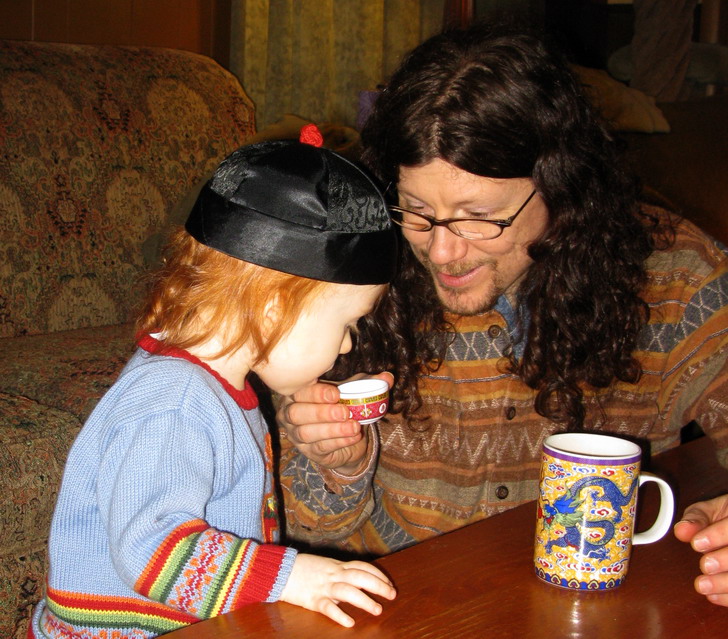
I am told that it is often the chosen beverage for a dim sum luncheon, where its stomach-calming properties make it a perfect accompaniment to the rich meat-stuffed steamed dumplings, pan-fried turnip cakes and crispy, deep-fried taro fritters that are consumed in great quantities. I like to drink it by itself–just as a sort of pick-me-up for long evenings spent sewing, writing, playing with Kat or cooking, and Zak finds it invaluable as an aid to late-night guitar playing.
I have seen it written that puer has the highest amount of caffeine in a Chinese tea, but I must say that I have never had trouble sleeping even on nights when I have stayed up late quilting and drinking cup after cup of puer like a madwoman. If I tried that trick with coffee, I would be up for the next three days, my eyes bugged out with fingers twitching like an addict coming off of crystal meth. Zak doesn’t seem to have that trouble, either–he can sleep just fine after drinking puer by the potful and playing guitar while Kat safely slumbers upstairs.
The truth is, neither of us drink puer because it keeps us awake–we drink it because it tastes good.
The lady who owns our Chinese market in town says we are the only Anglos who buy puer, or who even know what it is. Most people, she says, when they taste it curl their lips and say it tastes like dirt.
Which, in a way, it does. Poetically speaking, it tastes the way the sun-warmed rich soil of the forest smells–it is like drinking the lifeblood of Mother Earth herself. It is rich and complex–and has a rich reddish-amber-brown color. And while I guess some people find that distasteful–I find it to be intoxicating. I love the flavor of it–it is seductive, and after drinking it often for a long time, I find it hard to be happy with other types of tea, even my long time favorites, pouchong and lapsang souchong.
Some people may be put off by the cost of puer tea–because it is fermented and aged, the older teas are more expensive. It is fairly rare, since it comes only from old wild tea trees in the mountains of Yunnan province.
But what is interesting about puer is that you can get a huge number of steepings from a single pot-sized portion of tea leaves. We’ve steeped one batch of really nice puer leaves about six or seven times, and the flavor only gets nicer as we go along. It isn’t odd to get multiple steepings from one pot of good Chinese tea leaves, but puer just seems to be the workhorse of the tea leaf world–it’s just keeps going and going like the Energizer Bunny. It is just a highly forgiving type of tea–many tea leaves require exact temperatures and brewing times to the point that it seems like they are harder to make than meringue on a humid day, but puer is really hard to screw up.
Here is a good overview of how to brew puer tea, along with information on the history, culture and health benefits of puer tea.
We have bought good puer from several sources, but our favorites have been from Holy Mountain Trading Company, Special Teas,. and the Tao of Tea.
You can get it in several forms–loose leaf, which is the type we prefer, in compressed bricks, which is easier to store, and stuffed into dried tangerine skins, which scents the leaves with a lovely floral citrus note that floats as light as a dancing feather over the darker, earthy notes of the tea’s natural flavor.
So there you are–in a household of tea drinkers, this is our favorite, and can be considered the house beverage, since we drink it easily two or three times a day.
Even if it does taste a bit like dirt.
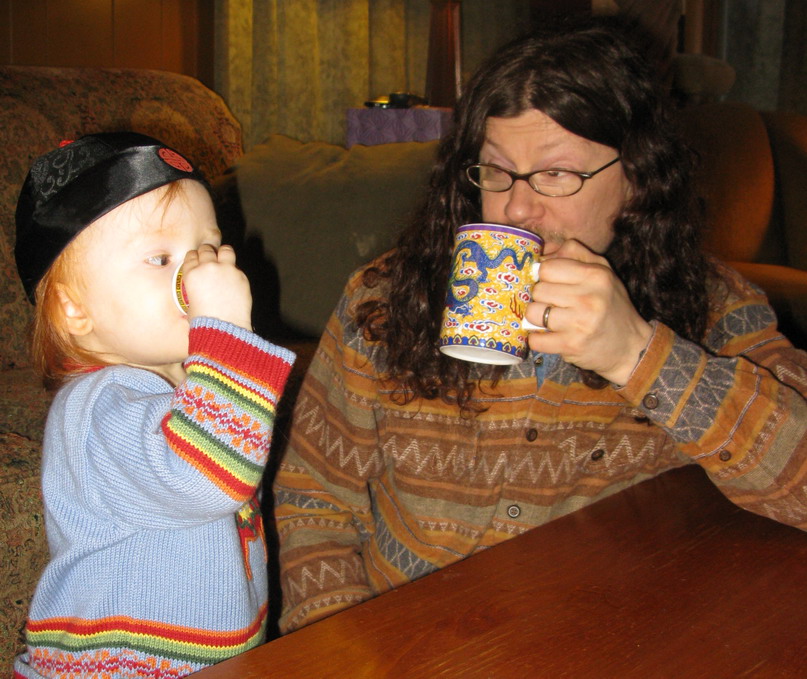
(And yes, Kat loves it, too.)
Happy Chinese New Year!

This is just a quick post to welcome in The Year of Ox!
Here is our little Lunar New Year mascot, on the left, Sammo, the Lucky Ox.
He came to us all the way from China, but his friends are pure Appalachian mythology–two crypto-critters from the West Virginia UFO flaps of the 1950’s and 60’s. (This heroic trio of beasts lives on the windowsill in my kitchen where I can look at them and smile while I do the dishes.)
The green guy is Flatso, the Flatwoods Monster which was sighted after an apparent meteor crashed in the woods surrounding Flatwoods, West Virginia in 1952. You can read all about Flatso on Loren Coleman’s excellent blog, Cryptomundo.
The rather sinister looking black critter with the burning red eyes and menacing wings is none other than the Mothman, who was seen in and around Point Pleasant, West Vriginia, 1966, in the months preceding the tragic collapse of the Silver Bridge, which spanned the Ohio River between Point Pleasant and Gallipolis, Ohio.
I grew up steeped in the stories of these two mythical creatures and in fact, have relatives and friends who swear they have seen the Mothman or something akin to him, one in the 1970’s, and three in the 1990’s.
So, here’s to a happy, healthy, abundant New Year for everyone, including Flatso and Mothman, wherever they may or may not be.
Sinfully Simple: Chicken with Bok Choy and Bacon
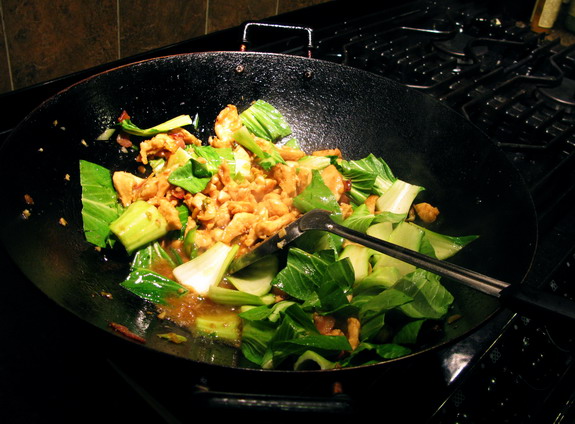
This dish is a Barbara original, although it was inspired by the simple, clean flavors prevalent in the Cantonese cuisine of southern China. It was born of the fact that I had fresh, local bacon, Shanghai bok choy and chicken breasts in my refrigerator that needed to be used. And, I thought to myself, “I wonder how they would taste together?”
There is precedent for the use of bacon in stir-fried Chinese dishes–and of course, we Appalachians have been using smoked pork products to flavor greens ever since there were hillbillies, pigs and greens here in the mountains.
So this recipe is a natural result of an Appalachian-born chef’s interest and education in Chinese cookery.
What is odd is that I had never thought of doing this before.
I have to stress here that it is best to use really fresh, high quality ingredients for this dish, because there is a minimum of condiments and flavorings, so there is nothing to cover old, bitter greens, flavorless chicken or overly salty bacon. Tje three aromatics are simply minced fresh garlic, ginger and very thinly sliced scallions, while the condiments are good quality light soy sauce, raw sugar, a tiny bit of rice vinegar, sesame oil and Shao hsing wine or sherry. The only other ingredients are canola or peanut oil, chicken broth or stock, and cornstarch for thickening.
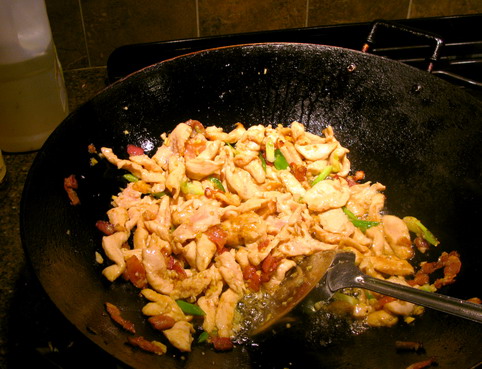
One thing you will note, is that the order of stir-frying in this recipe is different than most of my stir-fried recipes; the aromatics are added -after- the chicken, which is cooked -after- the bacon.
The reason for this is two-fold. One, it is necessary to cook the bacon before cooking anything else, because it takes longer to cook than any of the other ingredients, and two, if you cook the bacon first and remove it from the wok and set it aside until later, the meat will render its fat into the cooking oil, and will then add all of its flavor to the dish. If you were to try and add the aromatic ingredients before the bacon, they would burn long before the bacon and then the chicken were finished cooking, and no one would like dinner. It would just be a waste of good ingredients, and really, who wants to waste garlic and bacon? In fact, such profligate waste of good ingredients is a crime in certain jurisdictions.
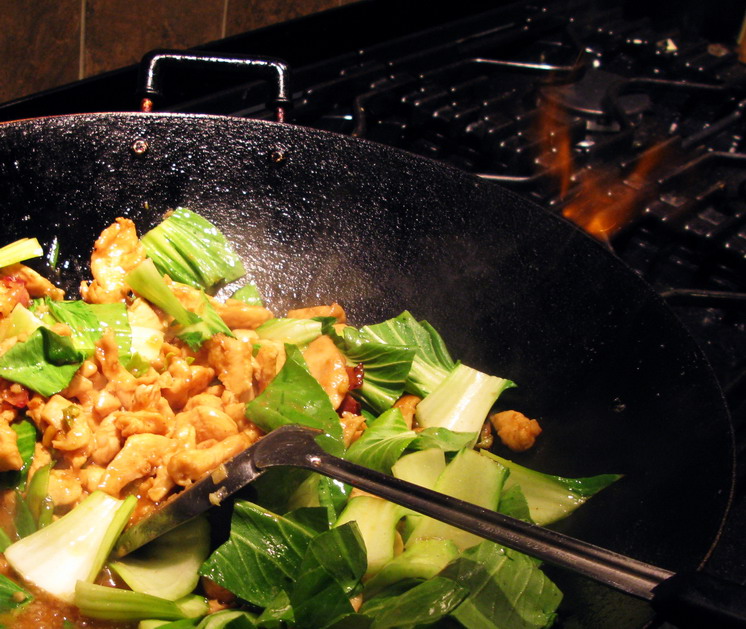
One other thing about this recipe–not only does it taste really, really good and is loved by everyone who tastes it (except for vegetarians and Muslims, of course–the chicken and bacon rather put the kibosh on those folks enjoying this dish), it is fast and easy to make. I can start a pot of jasmine rice in my rice cooker and in the forty minutes or so it takes to cook, I can have everything else prepped and ready to stir fry. (Okay, that isn’t really fair of me to say–I can also prep plenty of more complex stir-fried dishes in the same amount of time, because I have been working as a professional chef for the past year, but what I am saying is that -anyone- could prep the ingredients in that time.)
So, without further ado, here is my newest favorite dish, from my kitchen to yours.
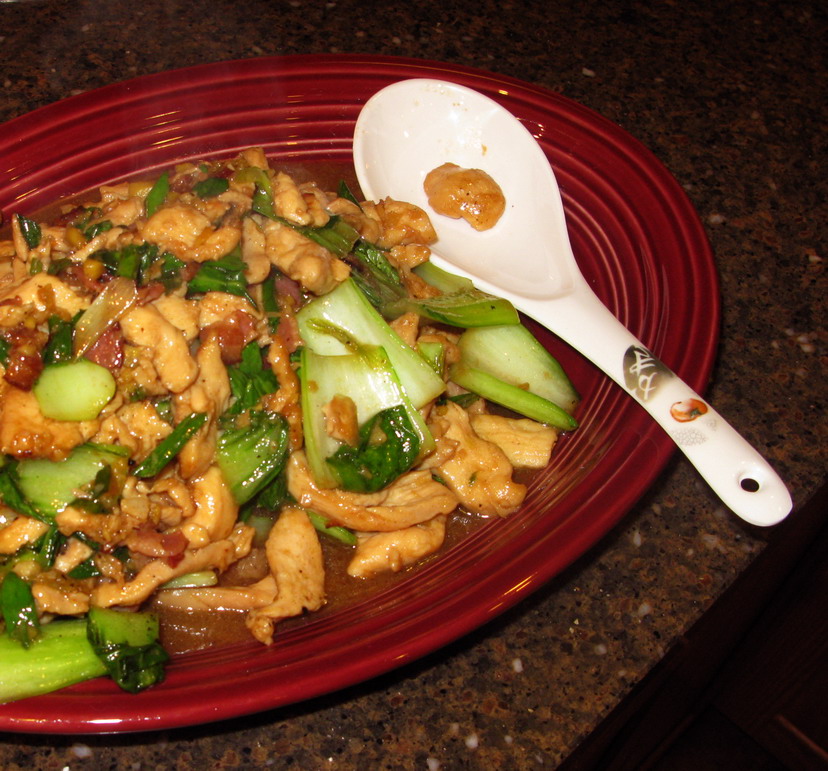
Chicken With Bok Choy and Bacon
Ingredients:
1 1/2 boneless skinless chicken breasts, cut into slices 1/8″ thick by 1/4″ by 1″
1 tablespoon premium light soy sauce
1 teaspoon Shao Hsing wine
1 tablespoon cornstarch
2 tablespoons peanut or canola oil
4-6 slices smoked thick bacon, cut crossways into 1/2 slices
1 tablespoon raw sugar
5 cloves garlic, minced finely
1 1/2 inch cube fresh ginger, peeled and minced finely
6 large scallions, white and light green parts only, thinly sliced on the diagonal
1 1/2 tablespoons premium light soy sauce
1 tablespoon Shao Hsing wine
1 teaspoon rice vinegar
1 pound Shanghai or baby bok choy, rinsed, bottom trimmed away and cut into 1″ chunks
3/4 cup chicken stock or broth into which 1 teaspoon of cornstarch has been dissolved
dark green tops of the scallions, cut into thin slices on the diagonal
1 teaspoon sesame oil
Method:
Gently toss chicken breast slices with the first measures of light soy sauce, Shao hsing wine and cornstarch, and allow to marinate at least twenty minutes.
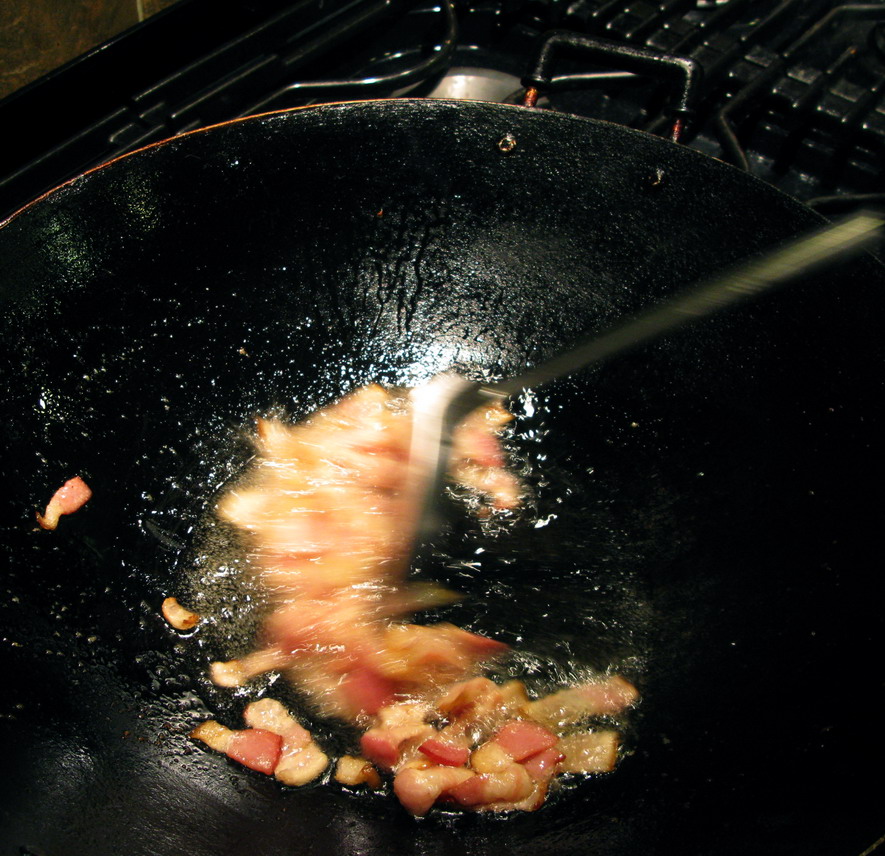
Heat wok on high heat until a thin ribbon of smoke spirals up from the hot metal. Add peanut or canola oil, and let it heat for thirty seconds. Add the bacon, and stir well to separate each piece out from the others.
Cook, stirring, until the bacon has rendered its fat and is done but not crispy. Remove from the wok and set aside.
To the wok add the chicken, spreading it out into a single layer against the bottom of the wok. Sprinkle with the sugar, garlic, ginger and scallion slices. Leave the chicken undisturbed for a minute or so, until the bottom of the chicken begins to brown, then cook, stirring until 2/3 of the chicken is no longer pink, but white and brown. Sprinkle the chicken with the soy sauce, wine and vinegar and stir, scraping up any browned bits from the bottom and sides of the wok. Add the bacon back to the wok.
Add the bok choy and the broth or stock and cook, stirring, and scraping any more browned bits from the bottom of the wok, until the bok choy wilts slightly and a sauce forms.
Sprinkle with the scallion tops, drizzle with sesame oil, and give the whole thing a final stir before scraping it out of the wok into a warmed serving
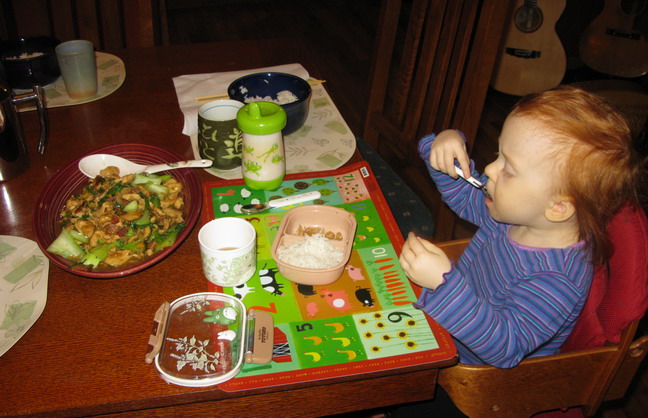
Serve with steamed rice and really good Chinese tea.
As you can see, this dish has been taste-tested and approved by Kat–one of my toughest critics!
(She liked it so much that she ate seconds of it!)
A Personal Loss
I just got a call this morning from my Aunt Judy.
Uncle Frank died in his sleep last night.
This was not unexpected–right after I had written the final post in December, I flew down to stay with them for a week, and came back about three days before Christmas. He was in good spirits then, but it was obvious to us all that he was in great pain and was very tired–he had cerebral palsy–and had suffered from several bouts of pneumonia in the past several years. He was no longer able to swallow, so was being fed by stomach tube, and he was just tired and weak.
Uncle Frank was a wonderful man–he had a PhD in psychology and had taught at Vanderbilt University in Nashville, but I think he was proudest of his clinical work. He was particularly effective with people suffering from PTSD, and was involved in a high-profile court cases involving women who were victims of domestic violence. He was very, very good at calming people who were considered to be too violent for other doctors to deal with, and he was very loving and compassionate.
He was a wonderful husband to Aunt Judy, always supporting her in her creative endeavors and was her best friend in all ways. He, and she, for that matter, helped keep me together during the darkest years of my life, those being the ones immediately following me leaving Morganna’s father, the divorce and long, horrid custody battle. Without the two of them, Zak and Gram, Aunt Judy and my Dad’s mother, I would have not made it through those years, and I am not sure how Morganna would have fared, either.
So, I will be traveling with Zak and Kat soon to Tennessee for the memorial service.
For those of you who do such things, if you could keep my Aunt Judy in your prayers, she and I would appreciate it.
Thank you all.
Sewing And Craft Projects Part One: My First Rag Quilt

Since folks asked, I guess that I will post pictures and explanations of some of my recent sewing projects on Saturdays and leave Sundays for Weekend Kat Blogging, with the weekdays reserved for all things food and culinary. Since I get most of my foodie traffic on weekdays, this arrangement should satisfy just about everyone, including myself.
So, what is a rag quilt?
Well, it is a blanket or quilt made of easily frayed fabrics, often flannel or recycled (or as they say in the world of crafts these days, “upcylced”) denim, but plain cotton fabric is used as well. The quilt is put together completely differently than the traditional method of sewing a top out of patchwork or applique blocks, then layering it with batting and backing fabric, quilting it, then binding the edges. Instead of these usual techniques, rag quilts are constructed by sandwiching together front and back fabric with either flannel or batting in between block by block. After the blocks are layered, each one is individually quilted–most often with a simple “X” of stitches from corner to corner, then each block is sewn together, with the seams exposed on the TOP of the quilt. Instead of the usual 1/4″ seams used in traditional patchwork, these exposed seams are at least 1/3″ to 1″ wide, with most quilters using a 3/4″ seam.
After each row of blocks is assembled and stitched into a complete quilt, it can either be bound, or finished by sewing a line of stitching of the same depth as the seam allowance used in the rest of the quilt all the way around the edge. I chose the latter method, being as binding a quilt is my least favorite part of the exercise.
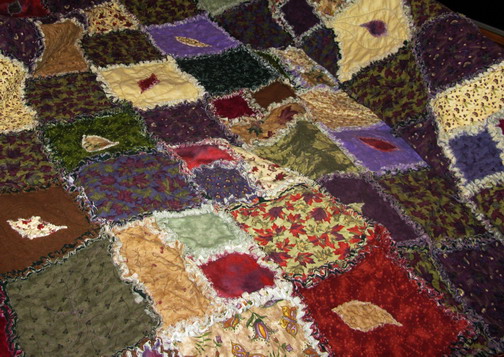
Then comes the tedious and somewhat tiring part: each seam is snipped through all three layers, to, but not through the stitches that hold them together, with each clip about 1/4″ apart. If you make a queen sized quilt like I did, this takes a while, and frankly, it is kind of hard to keep track of what has been snipped and what hasn’t. (Spring-loaded scissors help keep the hand fatigue at a minimum while executing this step in the process.)
Then, you wash and dry the quilt, preferably at least twice, although three times is better. This allows the snipped seams to fray, and the colors of the fabric, particularly if you use flannels blend into a fuzzy, soft chenille that frames each block.
That is the simplest method of method of making a rag quilt although my explanation probably makes it sound harder to do than it actually is. Most of the difficulty in making this quilt, which features flannel fabric with leaf, flower and vine motifs, along with hand-dyes and solids, came about because of the weight and the size of the thing. Putting it together, row by row, after about five rows was nearly impossible. This one is constructed of ten rows with eight ten inch blocks per row, some of them with appliqued leaves on them, and others constructed of smaller squares and rectangles sewn together into a ten inch square.After stitching five rows together, the weight of the three layers of flannel makes stitching it nearly impossible, as gravity wants to drag the quilt down from the sewing table, pulling it from under the feed presser foot of the machine.
So, I put it together in two five-row chunks, and then sewed those together, with my friends Britanny and Heather holding the weight of the rest of the quilt up in the air to keep it from slithering out of the grasp of the sewing machine while I grappled to keep the seams relatively straight. Without their help, I would never have gotten the thing put together, and it would have ended up to be two oddly shaped and sized quilts instead of one magnificent one.
All of that said, I had a great time making this quilt. It took me only a week, which is pretty impressive considering that it is the largest quilt I have made to date, and it is my first attempt at complex free-motion quilting. Instead of just quilting an “X” through each block, I stitched leaf-shaped designs, vines, curving lines representing the wind and stylized flowers that matched the motifs on the fabrics. And, instead of just using plain square blocks, I added texture by piecing some of them, which had the added benefit of allowing me to use up nearly every bit of the fabric, which nearly cleaned out my stash of pretty flannels. (I had bought most of these fabrics right after Kat was born while we were staying in Columbus to be with her. There was a quilt shop a block from one of our hotels and I saw the gorgeous leaf fabric and bought some intending to make a baby quilt which never happened. So, instead, I combined these fabrics with other flannels I had bought years before just because it was pretty and ended up making this pretty thing.)
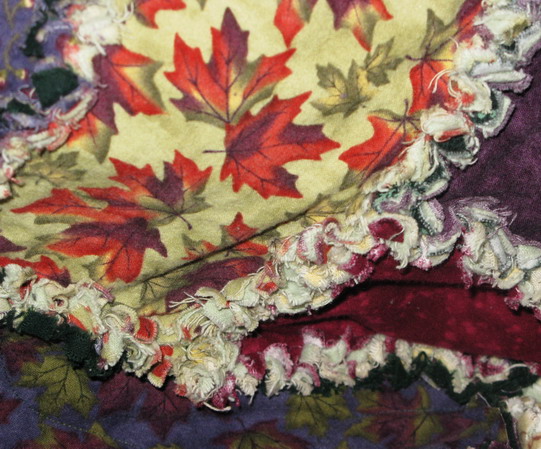
My favorite part about these quilts, aside from the ease of their construction and how quickly they come together, is the way the colors of the flannels blend together in the fuzzy seams. Especially the parts where the purples and greens blend together. I specifically used dark and pale green flannel–the only stuff I bought especially for this quilt–for the center layer, which only shows at the edges. I liked the way the two colors brought the different shades of plum, russet, green, purple, brown and cream together on the quilt.
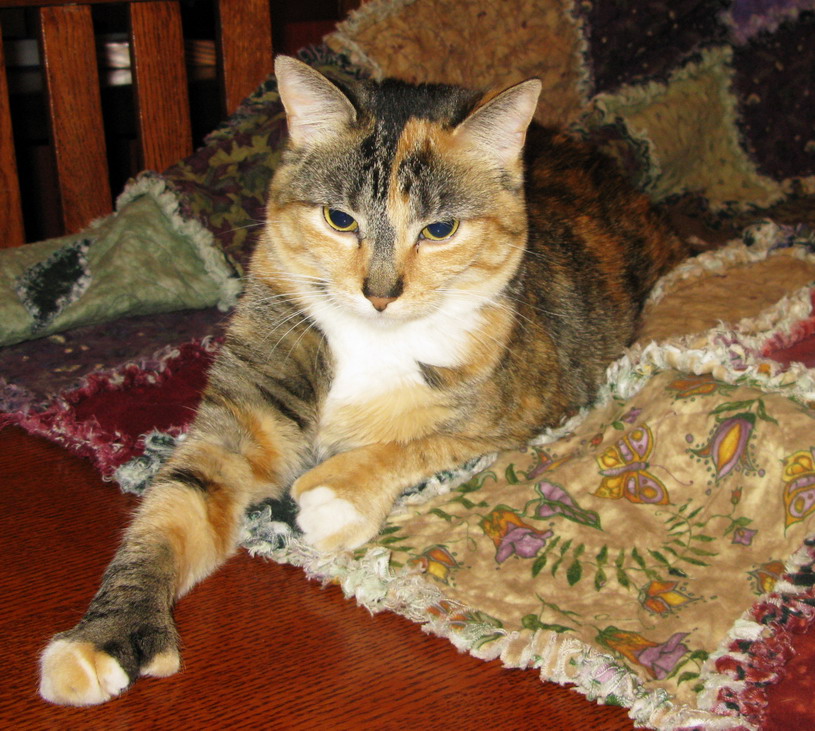
So, there you have it–a cuddly, soft and sweet queen sized quilt, ready to pack in a box and ship to its destination–it is a late Generic Winter Holiday gift for friends having a hard time. I think it will cheer them up–it will certainly warm them up. Wrapping up in it is like having a warm hug–which Cordelia agrees with as you can see.
When I brought the quilt back from the laundromat–I washed it in the big commercial machines so as to not overwhelm my washer with the weight–it was still damp, so I spread it out on the dining room table to let it finish drying before I folded it up and put it away.
The kitties took this opportunity to curl up on it, which was cute–except when I went to fold it up right before bed, I found that one of them had felt the need to anoint the quilt with a regurgitated offering of a hairball.
So, the next day, I was back at the laundromat, washing and drying it again.
Which is okay–because the more a quilt like this is washed and dried, the softer and fuzzier it gets, and the seams fluff out into really beautiful chenille. I took these photos before the third washing–the quilt is even prettier now. But, I have already wrapped it up with a matching lavender sachet and put it safely in a shipping box to go to UPS tomorrow, thus keeping it safe from feline intervention.
I can’t wait to make another one–I have a pile of old jeans from myself, Zak, Morganna and Kat to cut apart and combine with some really yummy hand-dyed orange flannel for a quilt for our guest room, which is done in blues and oranges and is decorated with a southwestern desert theme, and which features a bunch of paintings I did years ago. (Yes, I paint, too.) When it is done, I will feature it here, and maybe will take pictures of its construction while I am at it.

Categories:
- Admin (rss) (55)
- Blogs and Blogging (rss) (81)
- Book Reviews: Cookbooks (rss) (43)
- Book Reviews: Non-Cookbook Food Books (rss) (38)
- Cats and Cat Blogging (rss) (47)
- Chinese Cooking Lessons (rss) (32)
- Culinary School Stories (rss) (18)
- Dairy Pruducts: Cultured and Barbaric (rss) (4)
- Documentary Filmmaking (rss) (1)
- Essays, Rants and Reflections (rss) (260)
- Fighting Hunger (rss) (12)
- Food and Kids (rss) (45)
- Food in the News (rss) (126)
- Food Media (rss) (98)
- Food Preservation (rss) (18)
- Food Safety (rss) (45)
- Gardening (rss) (30)
- Herbs and Herb Blogging (rss) (20)
- Holidays (rss) (50)
- Kat Blogging (rss) (22)
- Kitchen Science (rss) (36)
- Leftover Makeover (rss) (8)
- Life, the Universe and Everything (rss) (131)
- Local and Sustainable (rss) (227)
- Local Athens Food and Foodies (rss) (42)
- Meatless Mondays (rss) (32)
- Menu For Hope (rss) (5)
- Nutrition, Diet and Health (rss) (84)
- On The Farm (rss) (8)
- Recipes: Almost Vegetarian, Vegetarian and Vegan (rss) (294)
- Recipes: American Regional (rss) (37)
- Recipes: Appalachian Hillbilly (rss) (33)
- Recipes: Bread, Pasta, Grains (rss) (95)
- Recipes: Canning and Preserving (rss) (8)
- Recipes: Chinese (rss) (123)
- Recipes: Comfort Food (rss) (120)
- Recipes: Cookies (rss) (16)
- Recipes: Desserts (rss) (48)
- Recipes: French (rss) (25)
- Recipes: Fruits and Vegetables (rss) (302)
- Recipes: Greek, North African and Middle Eastern (rss) (31)
- Recipes: Indian (rss) (137)
- Recipes: Italian (rss) (42)
- Recipes: Japanese (rss) (7)
- Recipes: Jewish (rss) (4)
- Recipes: Korean (rss) (6)
- Recipes: Meat, Poultry and Fish (rss) (220)
- Recipes: Mexican/Native American/ Latin American/Caribb (rss) (27)
- Recipes: Original (rss) (108)
- Recipes: Thai (rss) (27)
- Recipes: Tofu (rss) (17)
- Recipes: US Regional (rss) (16)
- Recipes: Vietnamese (rss) (8)
- Restaurant Stories (rss) (28)
- Sewing, Quilting, Arts and Crafts (rss) (16)
- Simple Chinese Recipes (rss) (30)
- Slow Food and Heritage Foods (rss) (10)
- Spice Blogging (rss) (44)
- The Chinese Cookbook Project (rss) (14)
- The Chinese Pantry (rss) (39)
- The Documentary (rss) (2)
- The Kitchen Saga (rss) (17)
- The Locavore's Bookshelf (rss) (15)
- The Unsung Adventures of The Culinary Nerd (rss) (6)
- Tools and Toys (rss) (35)
- Uncategorized (rss) (10)
- With a Side of Politics (rss) (48)
Archives:
- August 2012 (9)
- July 2012 (12)
- September 2011 (3)
- August 2011 (7)
- July 2011 (8)
- June 2011 (16)
- May 2011 (17)
- April 2011 (11)
- December 2010 (9)
- November 2010 (5)
- February 2010 (1)
- December 2009 (5)
- November 2009 (7)
- October 2009 (10)
- September 2009 (16)
- August 2009 (14)
- July 2009 (14)
- June 2009 (7)
- May 2009 (17)
- April 2009 (10)
- March 2009 (25)
- February 2009 (13)
- January 2009 (10)
- December 2008 (5)
- November 2008 (5)
- October 2008 (6)
- September 2008 (13)
- August 2008 (8)
- July 2008 (11)
- June 2008 (18)
- May 2008 (13)
- April 2008 (14)
- March 2008 (16)
- February 2008 (17)
- January 2008 (19)
- December 2007 (25)
- November 2007 (18)
- October 2007 (24)
- September 2007 (16)
- August 2007 (15)
- July 2007 (15)
- June 2007 (10)
- May 2007 (14)
- April 2007 (16)
- March 2007 (17)
- February 2007 (20)
- January 2007 (13)
- November 2006 (1)
- October 2006 (8)
- September 2006 (14)
- August 2006 (25)
- July 2006 (30)
- June 2006 (28)
- May 2006 (34)
- April 2006 (29)
- March 2006 (24)
- February 2006 (30)
- January 2006 (38)
- December 2005 (40)
- November 2005 (37)
- October 2005 (32)
- September 2005 (25)
- August 2005 (30)
- July 2005 (28)
- June 2005 (21)
- May 2005 (8)
- April 2005 (22)
- March 2005 (17)
- February 2005 (29)
- January 2005 (10)
Search Site:
Links:
- Lily’s Wai Sek Hong
- 101 Cookbooks
- A cat in the kitchen
- A Veggie Venture
- Accidental Hedonist
- Cha Xiu Bao
- chez pim
- Chocolate & Zucchini
- Chopstick Cinema
- Chowhound.com
- Chubby Hubby
- Cook sister!
- Cooking with Amy
- da*xiang
- Eat Local Challenge
- Eating Liberally
- Ecocentric
- Eggbeater
- Epicurious
- Farmgirl Fare
- Fatfree Vegan
- Foodgoat
- ForkandBottle.com
- Green Olive Tree
- Hooked on Heat
- Jaden’s Steamy Kitchen
- Kalyn’s Kitchen
- Lucullian delights
- Mahanandi
- Matt Bites
- MeatHenge
- mmm-yoso!!!
- New York Times – Dining & Wine
- Pizza Goon
- Rasa Malaysia
- Ruhlman
- Sailu's Kitchen
- Serious Eats
- SF Gate: Food & Dining
- Simply Recipes
- Soul Fusion Kitchen
- Tastespotting
- The Amateur Gourmet
- The Cleaner Plate Club
- The Food Section
- The Grub Report
- thecookscottage
- U.S. Food Policy
- Wandering Chopsticks
- Washington Post Food and Dining
- Wasted Food
Meta:


Powered by WordPress. Graphics by Zak Kramer.
Design update by Daniel Trout.
Entries and comments feeds.