
Cook Local, Eat Global
Tomatoes That Taste Like Tomatoes
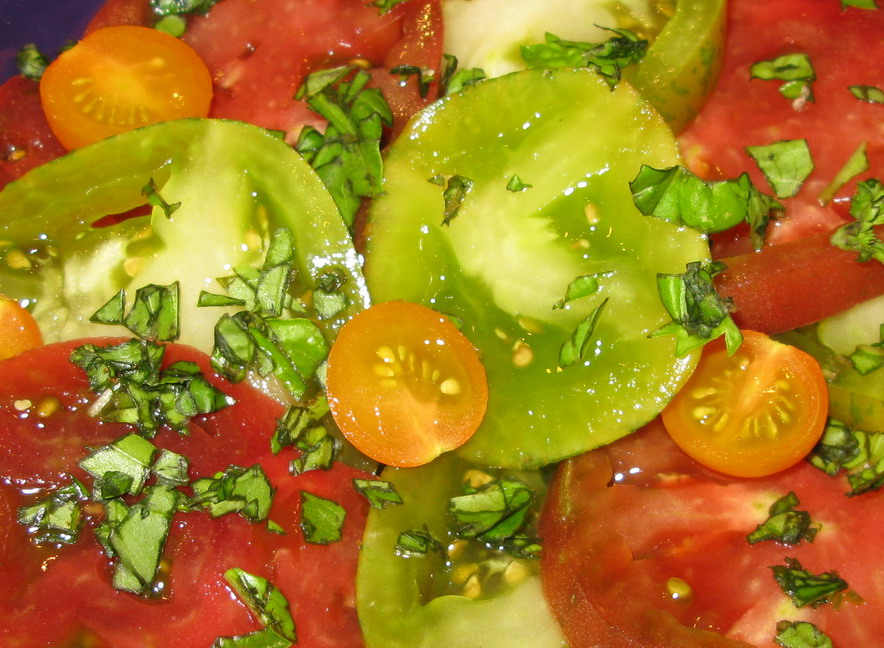
My parents came to visit two weeks ago, and wanted to stop by the Athens Farmer’s Market in search of one thing:
Tomatoes that taste like tomatoes.
Apparently, the farmers around Putnam County, West Virginia, where my Mom and Dad live have taken to growing tomatoes that are perfectly round, beautifully red, and look lovely, but which have the texture of styrofoam and the flavor of, well, wet styrofoam. It sounds to me like these farmers have taken to growing tomatoes meant for the wholesale grocery store trade, which means they look pretty on the shelves, and are a uniform color, size and shape, and have no smell, flavor or texture to speak of.
Here’s the deal–I’d rather eat something ugly that tastes good than something beautiful that has no flavor (and probably little in the way of nutritive value as well.)
Luckily, the farmers here in Athens have learned the cure for the market tomato blahs–heirloom tomatoes.
Now, I have written aboutthese lovelies before—several times–but this time, I wanted to evangelize a little bit, just as I did with my parents.
Look at the sliced tomatoes up above, all grown by Becky, Kip and the interns at Green Edge Gardens/Athens Hills CSA. (Same folks, same farm, different business names, same great produce.)
Aren’t those sliced tomatoes beautiful? They look like gemstones, shimmering in the sunlight. Three varieties of tomato are represented there: Green Zebra, Cherokee Purple and Sungold. I will let you guess which is which, since the colors of the tomatoes are mentioned in their names. Not one of them is the typical scarlet red of the tomatoes in the produce section of your local supermarket, and the Cherokee Purples are definitely a different shape. But who cares, when you can smell their delicious fragrances as soon as you slice into them? Look at how juicy they are? They are bursting with juice, life and goodness–and you can just see it. Imagine if you could taste it–the earthy sweetness of the Cherokee Purple, the tangy zing of Green Zebra and the honey-tinged richness of Sungold.
These are the tomatoes I introduced my parents to the last time they were here.
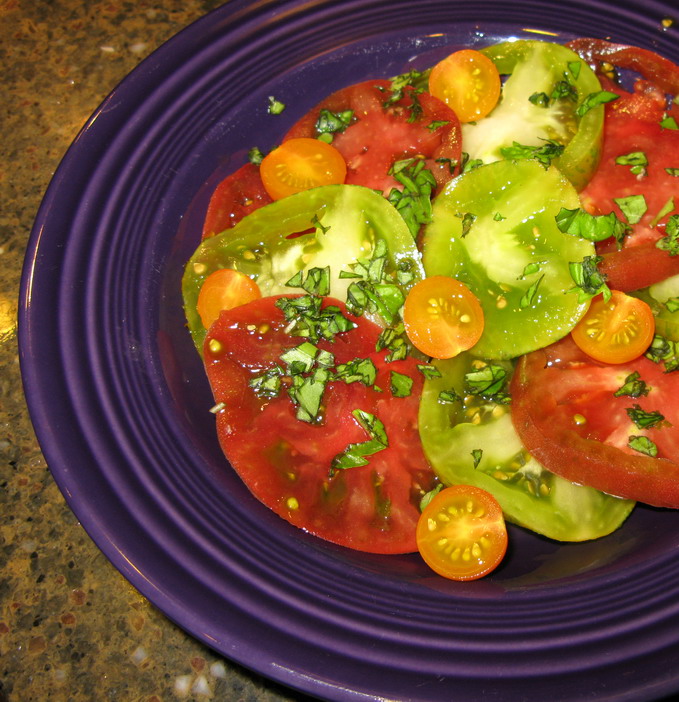
And these are the types of tomatoes I wish I could serve to everyone in America, just so they know what tomatoes are supposed to taste like. Heck, why stop at America?
I wish I could personally slice up a tomato for everyone on earth, and serve it to them simply, like these pretties, with a sprinkling of fresh basil (grown up on my deck garden) and a little shake of pure sea salt.
I think that if people could just taste these gems from the garden, there would be a tomato revolution. People would want that taste again and again, and would be willing to do what it would take to get it, whether it was shop at a farmer’s market, insist upon local tomatoes being sold in local supermarkets, grow them in a community garden or get them at a local restaurant.
I’d love to see people stop buying the supposedly “fresh” tomatoes at the grocery store.
The truth is, I haven’t bought one in years. I just don’t eat fresh tomatoes when they aren’t in season.
I eat them canned, in juice, in sauces, dried and pureed, but not fresh. There just isn’t any point.
Those red baseball sized “tomatoes” in the grocery store just don’t taste like anything. Who knows how long they have been off the vine, and who knows how many vitamins or minerals are left in their crisp, nearly juiceless flesh?
They just are not worth the bother or the price.
Nope, it is all about the seasonal, home-grown, freshly picked tomatoes.
They are where its at.
And I am so there.
Tunisian Lamb, Eggplant and Chickpea Stew
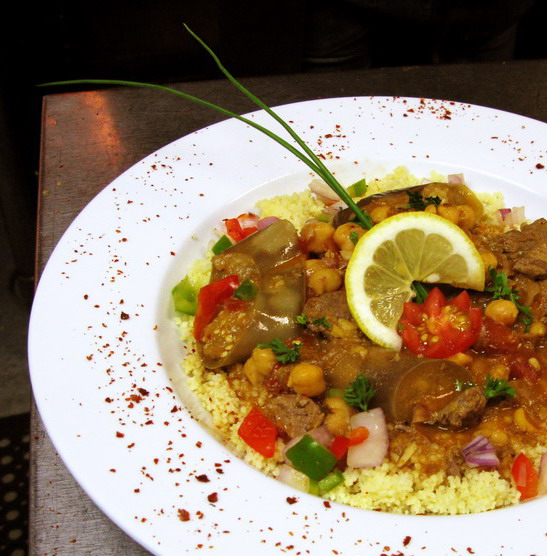
Have I ever said how much I love the combination of eggplant with lamb?
To me, it is a match made in heaven.
The rich flavor and tender chew of the lamb goes perfectly with the velvety, melting quality and delicate scent of the eggplants, and the way in which eggplants soak up oils and fats allows it to absorb the essence of the meat, melding them together into a delicious melange. Add garlic and caramelized onions, and everything even better; add chickpeas and tomatoes and cook it all into a delicious summer stew and I am head-over-heels in love.
I found the recipe for this dish in Claudia Roden’s amazing cookbook, The New Book of Middle Eastern Food.
This book is a treasure trove of recipes from the Middle Eastern region, all of them well-tested and researched, with extensive notes and commentary about many of them. In addition to the recipes, Roden includes cultural notes, such as bits of folklore relating to food, or descriptions of customs and celebrations and the foods appropriate to them. I love the way she writes; her prose is expressive, poetic and precise all at the same time. She is truly a talented author, and I really must write a post reviewing her books that I have cooked from.
Anyway, this Tunisian recipe was found as a variant of the Arab dish called lahma bi betingan, which is a stew of lamb and eggplant. I focused on the Tunisian variation because it featured chickpeas in addition to the lamb and eggplant, which I thought would be an amazing combination of flavors, textures and colors. I am pleased to report that my intuition was correct, and when I made this stew for Restaurant Salaam as a dinner special a couple of weeks ago, it sold out.
The dish is simplicity itself to make, and while it is hearty, it is not so heavy that it dulls the stomach on a warm night. I think it is best made in the early autumn when the eggplant and tomatoes are still madly fecund, but when the nights have begun to cool slightly from the swelter of midsummer.
I served this with a green salad and a pita at work, but I could also see it going beautifully with a refreshing salad of cucumber, red onion, tomato, vinegar, salt and a pinch of sugar.
Traditionally, Roden notes that the eggplants were fried prior to putting them in the stew, but she prefers to cook them on the grill or under the broiler. There are several good reasons to follow her method: one–grilling or broiling use less oil than frying, so the end result is a dish which is lower in fat and calories, and which isn’t quite so heavy to eat. Two–grilling or broiling the eggplant before adding it to the stew adds a layer of smoky savor to the dish that is haunting in its character.
So, understand that while you may fry the eggplant slices for this dish and it is even traditional to do so, you may also grill or roast them for a less oily and a more smokey result.
Finally, I suspect that it would be possible, and indeed, tasty, to make a vegetarian version of this dish by leaving out the lamb and using more eggplant and tomatoes.
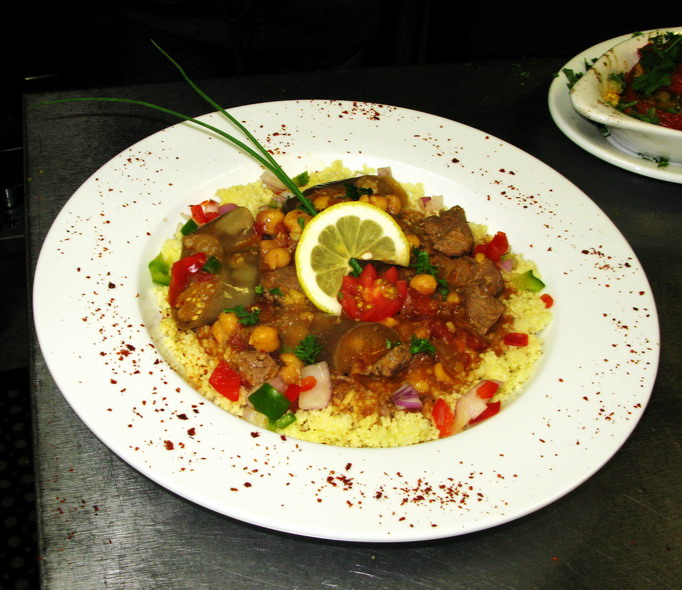
Tunisian Lamb, Eggplant and Chickpea Stew
Ingredients:
3 tablespoons olive oil
3 large onions, peeled and thinly sliced (about three and a half cups sliced onions)
6 cloves garlic, peeled and minced
2 tablespoons Aleppo or Kirmizi pepper flakes or harissa sauce to taste
1 1/2 pounds lamb shoulder, trimmed, boned and cut into 1″ cubes
2 cups fresh tomato, peeled and cubed
1 quart chicken broth
2 15 to 20 ounce cans chickpeas, drained (ounces depend on the brand, hence the variation)
juice of 1 lemon
1 scant teaspoon ground cinnamon
1 bay leaf
salt tot aste
2 tablespoons olive oil
salt and pepper to taste
2 pounds of small eggplant fruits
3 tablespoons minced fresh parsley for garnish
harissa for serving
Method:
Heat olive oil over a medium fire in a deep, heavy-bottomed pot. Add onions and cook, stirring, until the onions are a deep golden brown. Add garlic and pepper flakes or harissa sauce, and cook for one more minute.
Add meat cubes and cook stirring, until browned on all sides. Add tomatoes, chicken broth, chickpeas, lemon juice, cinnamon, bay leaf and salt to taste.
Bring to a simmer, and cook slowly, covered, until the meat is tender and the stew is well-seasoned.
While the stew cooks, peel away alternating strips of the eggplants’ skin so that there are stripes of light and dark longways on the fruit. Heat broiler or grill on high heat and cut the fruits into 1/2 inch thick slightly diagonal, oval slices.
Brush the slices with olive oil on both sides and salt and pepper each side to taste. Place on rack and broil or grill, turning once, until the slices are lightly browned and slightly softened.
Cut each slice in half and add to stew. Simmer for twenty more minutes, or until eggplant slices soften completely and meld with the stew. Add liquid as necessary to the stew during the cooking process to keep it from burning and sticking to the bottom of the pot.
If you wish to thicken the stew you may remove 1/2 cup of the chickpeas and puree them in a blender or food processor, and stir them back into the pot. (Or, if you have any hummus around, stir 1/2 cup of that into the stew to thicken it. That is my sneaky method that I started using at work.)
Stir in 1/2 of the fresh parsley into the stew just before service, and sprinkle the rest over each serving as a garnish. Serve over couscous if you wish and serve with either a dab of harissa sauce in the center of each bowl, or on the side.
The Vegetarian Hundred
A long-time reader here at Tigers & Strawberries, upon reading my participatory post for Dave of Very Good Taste’s list of one hundred comestibles that every omnivore should try at least once, entitled The Omnivore’s Hundred, said that someone should make a list of one hundred foods that vegetarians should eat at least once.
I thought Alexis had a great idea, so here is my version: The Vegetarian’s Hundred. Included in this list are both vegan dishes and vegetarian dishes which include the use of dairy products and eggs. I chose to not go strictly vegan in my list because while I have been eating more and more vegetarian meals this past few years, I am by no means a vegan, so I just don’t feel qualified to really choose the 100 vegan dishes that everyone needs to try.
Why am I doing this?
Well, mostly for fun, but also to see where the idea goes. If you want to play along, here’s how you do it: copy the list, including my instructions, and bold any items you have eaten and strike out any you would never eat, and then post it to your blog. If you want, you can leave a comment here, linking to your results, or you can link back to this post so I can try and keep tabs on what folks have eaten and not eaten. Finally, if you think something else should be on the list–feel free to add that to your post, and add any comments you like to your own posting of the list. I am just as curious to see what people have to say about food as whether or not they have eaten them.
Before I start, I want to let you know how I chose the foods, which are in no particular order of importance, they are just in the order in which I thought of them. Basically, these are the foods that I think that these are the vegetarian foods that -everyone- should try, not just vegetarians, because they are amazingly good. Each of these foods puts the lie to the still-prevalent idea that vegetarian and especially vegan food, is either boring, hard to make or just plain bad. These are flavors that I think are not only amazingly good, but they are also ones that I think are pretty accessible to everyone.
You will notice a preponderance of non-Western dishes. (But there are still a lot of European and American classics represented, have no fear.) There is a reason for that–around the world, there are many cultures where vegetarian dishes are important parts of the diets of large numbers of people. Any time you have that many people eating a food, you can be pretty certain that it is going to taste good, because frankly, it has to be. This isn’t always the case of course, but staple foods tend to be tasty ones. You will also note that I have a bias towards freshly made items, because I believe that fresh is better. (Unless we are talking about fermented foods–then, fermented is better!)
I think that lists like this very definitely show the biases of the list maker. I am certain that many things about my personality, cooking style and food biases can be inferred from this list.
As for a vegan list–I will leave that project in the capable hands of one of the many vegan food bloggers out there in the blogosphere.
The Vegetarian Hundred
1. Real macaroni and cheese, made from scratch and baked
2. Tabouleh
3. Freshly baked bread, straight from the oven (preferably with homemade strawberry jam)
4. Fresh figs
5. Fresh pomegranate
6. Indian dal of any sort
7. Imam bayildi
8. Pressed spiced Chinese tofu
9. Freshly made hummus
10. Tahini
11. Kimchi
12. Miso
13. Falafel
14. Potato and pea filled samosas
15. Homemade yogurt
16. Muhammara
17. Brie en croute
18. Spanikopita
19. Fresh, vine-ripened heirloom tomatoes
20. Insalata caprese
21. Stir-fried greens (gai lan, bok choi, pea shoots, kale, chard or collards)
22. Freshly made salsa
23. Freshly made guacamole
24. Creme brulee
25. Fava beans
26. Chinese cold sesame peanut noodles
27. Fattoush
28. New potatoes
29. Coleslaw
30. Ratatouille
31. Baba ganoush
32. Winter squash
33. Roasted beets
34. Baked sweet potatoes
35. Plantains
36. Chocolate truffles
37. Garlic mashed potatoes
38. Fresh water chestnuts
39. Steel cut oats
40. Quinoa
41. Grilled portabello mushrooms
42. Chipotle en adobo
43. Stone ground whole grain cornmeal
44. Freshly made corn or wheat tortillas
45. Frittata
46. Basil pesto
47. Roasted garlic
48. Raita of any type
49. Mango lassi
50. Jasmine rice (white or brown)
51. Thai vegetarian coconut milk curry
52. Pumpkin in any form other than pie
53. Fresh apple pear or plum gallette
54. Quince in any form
55. Escarole, endive or arugula
56. Sprouts other than mung bean
57. Naturally brewed soy sauce
58. Dried shiitake mushrooms
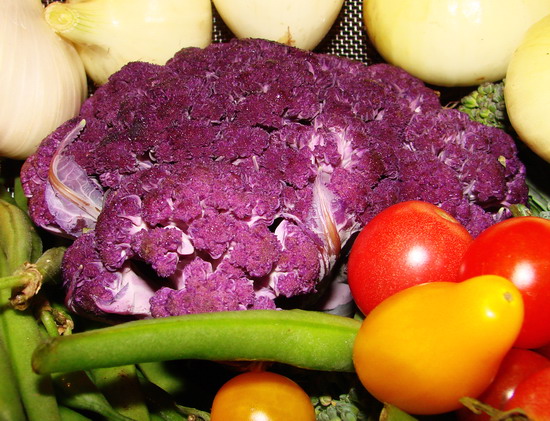
59. Unusually colored vegetables (purple cauliflower, blue potatoes, chocolate bell peppers…)
60. Fresh peach ice cream
61. Chevre
62. Medjool dates
63. Kheer
64. Flourless chocolate cake
65. Grilled corn on the cob
66. Black bean (or any other bean) vegetarian chili
67. Tempeh
68. Seitan or wheat gluten
69. Gorgonzola or any other blue veined cheese
70. Sweet potato fries
71. Homemade au gratin potatoes
72. Cream of asparagus soup
73. Artichoke-Parmesan dip
74. Mushroom risotto
75. Fermented black beans
76. Garlic scapes
77. Fresh new baby peas
78. Kalamata olives
79. Preserved lemons
80. Fried green tomatoes
81. Chinese scallion pancakes
82. Cheese souffle
83. Fried apples
84. Homemade frijoles refritos
85. Pasta fagiole
86. Macadamia nuts in any form
87. Paw paw in any form
88. Grilled cheese sandwich of any kind
89. Paneer cheese
90. Ma Po Tofu (vegetarian style–no pork!)
91. Fresh pasta in any form
92. Grilled leeks, scallions or ramps
93. Green papaya salad
94. Baked grain and vegetable stuffed tomatoes
95. Pickled ginger
96. Methi greens
97. Aloo paratha
98. Kedgeree (the original Indian version without the smoked fish, not the British version with fish)
99. Okra
100. Roasted brussels sprouts
There it is–my list of 100 vegetarian foods that everyone–not just vegetarians–should eat at least once. rest assured that I have eaten all of these at least once, and the truth is, I like nearly all of these foods a great deal. There are a couple of exceptions, and they are related to each other. While I love blue-veined cheeses, I am sensitive to blue-green molds, which is probably related to my penicillin allergy. So, I -can- eat the cheeses, but I generally get very ill after I do so, so I try to avoid them. In fact, just about any cheese with bloom or mold on it I tend to avoid, or in the case of brie and similar cheese, I cut the rind away.
Similarly, I do not much care for tempeh–it is inoculated with a mold in order to produce it, and because of that, I tend to leave it alone. The flavor is okay, but my stomach gets queasy just smelling it, so I leave it be.
Everything else on this list is okay by me. I addition to putting together a fun game to play, I have also maybe given readers new ideas in vegetarian foods to try sometime.
Eggplants So Sensual That They Made the Imam Faint
I love me some eggplant, and I love them every way you can make them. I like them battered and deep fried, with a tomato sauce. I like the little Asian ones braised in a Thai curry sauce, or stir fried with a Chinese garlic sauce. I love them in baba ganoush. I love them in moussaka. I love them as baigan bartha.
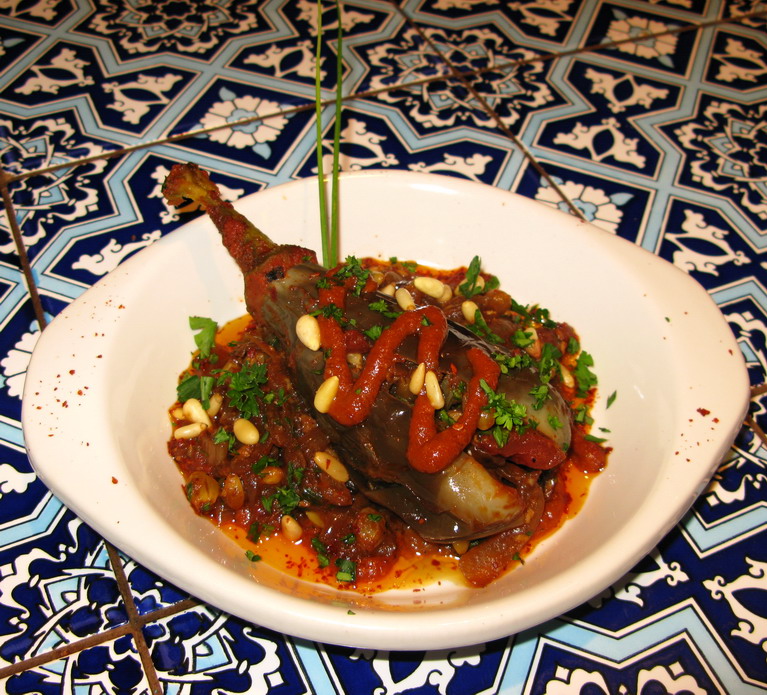
But, as much as I love all of those ways with eggplant, this dish of baby eggplant braised in copious amounts of olive oil and seasoned tomato sauce or juice, then stuffed with caramelized onions, golden, tomatoes, garlic, and in my version, golden raisins and pine nuts, and served cold, is my very favorite. It is lush. It is seductive. It is rich without being heavy.
It is, in a word, delightful.
This Turkish delicacy, which is served along with other cold mezze in the heat of summer, is called Imam Bayilidi, which translates literally to, “The Imam Fainted.”
Why ever did the Imam faint, you may be asking?
Well, it is said that the Imam (an Imam is an Islamic religious leader and scholar of the Koran who serves his community by leading prayers and teaching–he is essentially like a Protestant minister, because of course, an Imam can marry, unlike a Catholic priest) came home from a long day of study and ministering to his people, and was quite overcome with heat and weariness. His wife, whom he loved very much, had prepared for him a very special dish of braised, stuffed eggplant served cold. He took one bite of it, and the divine velvety richness of it quite overcame him and he fell into a swoon, much to the pleasure of his wife who was also very in love with her husband.
From that day forward, this dish has been known by the name, “Imam Bayildi” in memory of the beloved Imam and his culinarily-blessed wife.
That is one story about the name, anyway.
It is the one I prefer, because the other version says that that Imam fainted when he found out how much expensive olive oil went into the making of the dish.
That isn’t nearly so romantic a tale, nor is it very complimentary to the Imam or his wife, so I prefer the first story.
The method I use to make this classic dish is different than the usual way. In every recipe I have read, the stuffing is made first, and then the raw eggplants, which have had their tops trimmed off, are slit lengthwise from the bottom nearly to the top. The stuffing is then crammed into the slit, and the eggplants are put into either a deep pot or a baking dish, and the olive oil and tomato sauce are poured over it, and they are braised on the stove or in the oven.
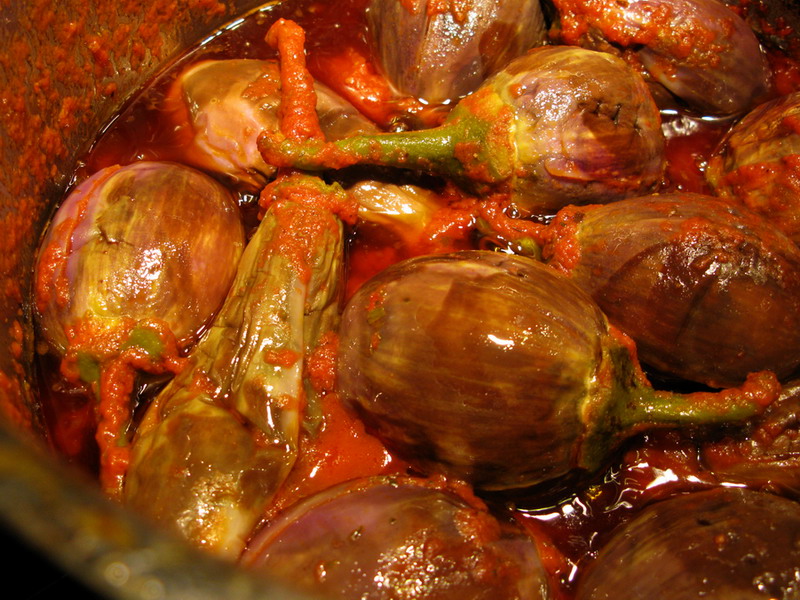
What I do instead is prepare and slit the eggplants, then braise them unstuffed. Then, I make the stuffing and when the eggplants are fully cooked, I stuff it in, and chill the eggplants. I find that it is easier to get a large amounts of the stuffing mixture into the fruit by working with it after the eggplants are soft.
I also braise the eggplants uncovered so that the tomato sauce reduces a bit. If it reduces too much and starts to stick, some water, tomato juice or V-8 juice can be added (actually, you can season V-8 and use -that- in place of the tomato sauce to braise the eggplants–it works beautifully) in order to keep the sauce from sticking. Once the eggplants are done, I then take the reduced sauce or juice and olive oil, and whir it in a blender or food processor to emulsify it into a thick, deep red sauce. Then, I put the sauce into a squeeze bottle, chilled it, and applied it in an zigzag pattern over the cold eggplant for serving, and garnished it with a sprinkle of minced parsley and pine nuts. This not only dresses up the presentation–because, frankly, as tasty as Imam Bayildi is, it isn’t very pretty to look at–it adds another level of flavor and richness to the dish.
I also had extra stuffing left over, which I used to make a nest on the serving plate to cradle the eggplant. It made a pretty presentation, and once more, added more flavor and goodness to an already delicious dish.
I made this dish as an appetizer special for the weekend, and I thought that a dozen eggplants would be enough to carry us over both Friday and Saturday.
I was wrong. We sold out of the entire lot on Friday night, and people were raving about them.
So I bought another dozen at the Farmer’s Market on Saturday and made those and we nearly sold out that night, too. Luckily, we had enough left that I could eat one myself and give two to Leah, our bellydancer, for dinner that night. (I figured that a woman as graceful and beautiful as Leah is deserves the most sensuous foods to feed her loveliness.)
So here it is–my recipe for the best damned eggplant dish in the entire world–Imam Bayildi. You can leave out the pine nuts and golden raisins as they are not traditional, but let me tell you, they take the dish right over the top and to the moon.
So, go forth and get in the kitchen and make this dish for someone you love.
And when they swoon, make sure you are there to catch them, because you will definitely want to see the look of unbridled love that will flash in their eyes for you after they taste this.
(Oh, and don’t worry if they think that they don’t like eggplant. Because, frankly, everyone who tastes this loves it, even dedicated non-eggplant lovers like my dear friend Dan, who tasted it and said, “Damn. I don’t even like eggplant and that is nothing that I would ever eat, but man is that good.”)
Oh, and one more thing. This super-sexy, amazingly delish dish is vegan.
So, make this and serve it to someone who thinks that they don’t like vegan food, and evangelize on behalf of the delectable comestibles of the plant kingdom!
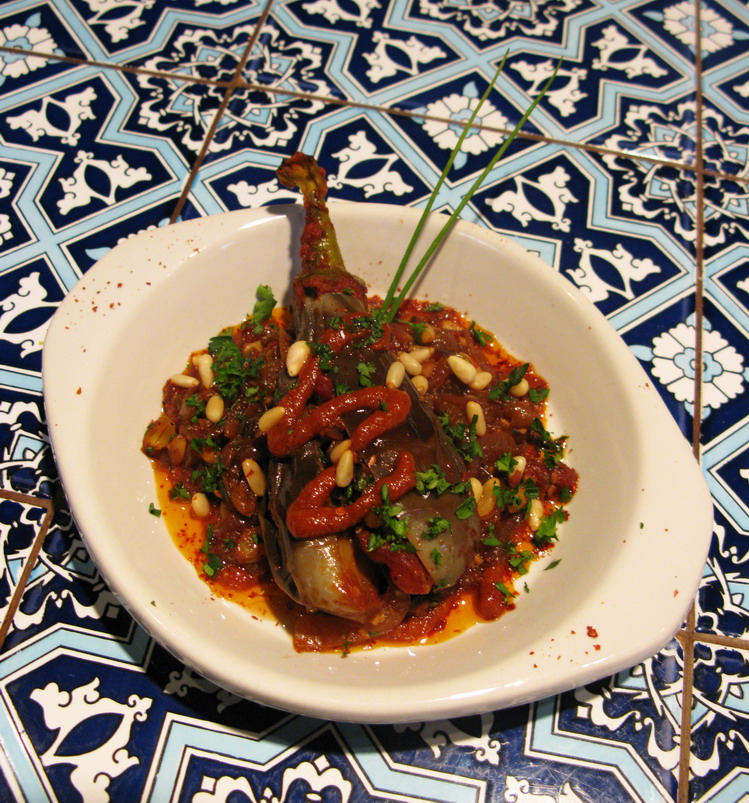
Imam Bayildi
Ingredients:
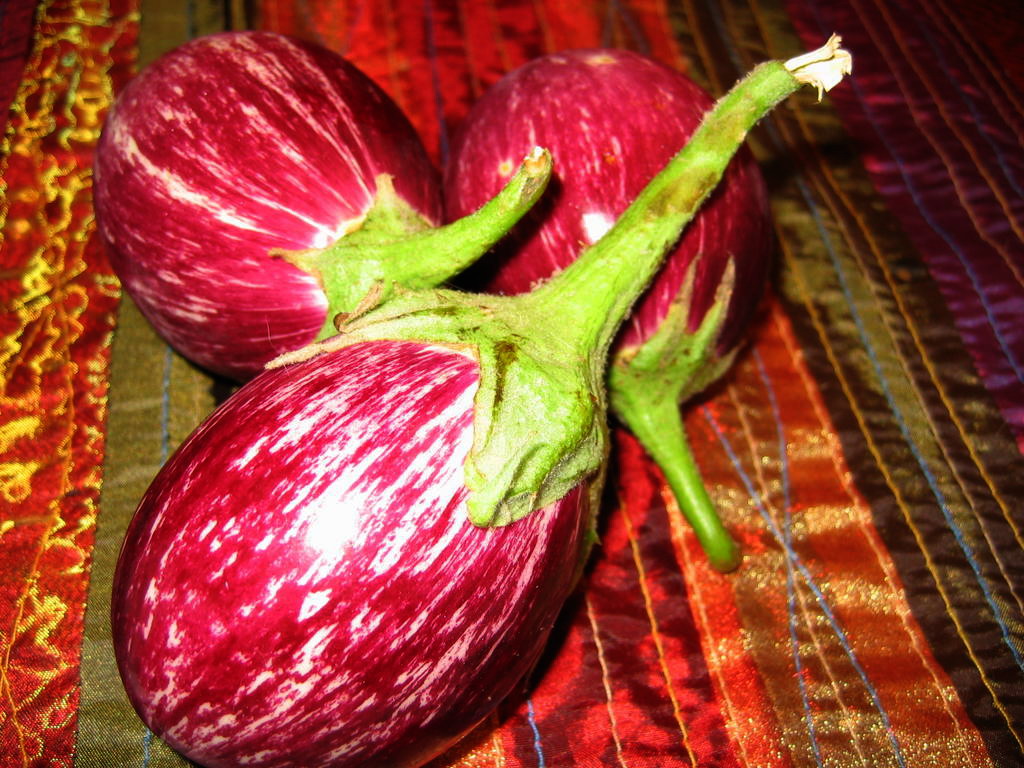
8 baby eggplants
1 cup extra virgin olive oil
4 cups tomato sauce or V-8 juice
1 tablespoon minced fresh garlic
1/4 teaspoon salt
1 teaspoon Aleppo pepper flakes
1/4 teaspoon ground cumin
1/2 teaspoon dried thyme leaves
4 tablespoons olive oil
5 cups thinly sliced onions
1/2 teaspoon salt
1/2 cup golden raisins
3 tablespoons minced fresh garlic
1/2 tablespoon Aleppo pepper flakes
1/4 teaspoon ground cumin
1/4 teaspoon dried thyme leaves
1/4 cup pine nuts
1 cup canned tomatoes or peeled and seeded ripe fresh tomatoes
salt to taste
1/4 cup fresh parsley finely minced
pine nuts, Aleppo pepper flakes and fresh parsley finely minced for garnish
Method:
Wash the eggplants thoroughly and, keeping the stems on them, trim the leafy cap off the tops with a paring knife. Cut a slit lengthwise from the bottom of the eggplant toward the cap without slicing all the way through the fruit. Stop about 3/4 of an inch from the stem of the fruit.
Pour the olive oil, the tomato sauce or V-8 juice, garlic, Aleppo pepper, cumin, thyme and the salt in a big pot. Add the eggplants and bring to a boil over high heat. Turn the heat down and simmer uncovered, turning the eggplants as necessary, until the eggplants are completely softened. If the sauce reduces too much and starts to stick, add water, tomato juice or V-8 juice in small amounts to keep it from sticking.
While the eggplants cook, make the stuffing.
Heat the olive oil in a large skillet, and add the onions. Sprinkle the salt over them and cook, stirring, until they are a deep golden color. add the raisins, garlic and Aleppo pepper flakes, as well as the cumin, thyme and pine nuts, and keep cooking, stirring constantly, until the onions are deep brown and fragrant, and the pine nuts are golden. Add the tomatoes, and cook, stirring, until the juices come out and moisten the rest of the stuffing mixture. Taste for salt and adjust seasoning as needed. Remove from heat and put stuffing in bowl to cool until you can safely handle it. When it has cooled, stir in the minced parsley.
When the eggplants are done, remove them from the pot and let them sit to cool until you can handle them.
Spoon about 1/3 of the olive oil off the top of the sauce, and discard or reserve for another purpose. Put the remaining contents of the pot into a blender or food processor and process until a thick, deep red emulsified sauce is formed.
Stir about 1/4 cup of this thick sauce into the stuffing mixture, then put the rest into a squeeze bottle or a small bowl and chill until completely cold.
Stuff about a tablespoon or two of the stuffing mixture into each eggplant by pulling apart the body of the fruit. Close back up and squeeze gently back into shape and set into a sealable container, and then chill the stuffed fruits. Any stuffing that is left should also be sealed up and chilled until cold.
To serve, make a nest out of the reserved stuffing mixture on an individual serving plate, and set one or two eggplants on top of it. Squeeze a zigzag line of the sauce over the top of the fruit, and sprinkle with the reserved minced parsley, Aleppo pepper flakes and pine nuts for a garnish.
Serves 8 as an appetizer or 4 as a main course.
I like to serve this with warm pita bread wedges for sopping up all the good juices and olive oil from the plate.
A Post For Fun: The Omnivore’s Hundred
Andrew, the blogger behind the UK food blog, Very Good Taste, (and author of the book, Eat Britain) made a list of one hundred comestibles which he believes every omnivore should try at least once in their lives. He asks that other bloggers copy the list to their blogs, bold the items they have personally consumed and strike out any item that they under no circumstances would consume, and post it to their blog, then if they like, post a comment on his blog linking to their lists.
So, in honor of Labor Day which supposedly celebrates the Labor Movement in the US, but usually is celebrated by a last bit of summer fun before all the work of autumn commences, I decided to play along.
In addition to following Andrew’s instructions, I figured it would be more interesting if I not only boldfaced the items I had consumed, but made note of where I first did so, and perhaps, boldfaced and changed the color of items which I cook and eat on a regular basis. (If I cook the dish, it will be green and bold.) Not only that, but at the end of the post, I am going to add my own list of dishes, foods and drinks I think that everyone should taste at least once.
Here are Andrew’s instructions, if any of my food blogging buddies want to play along:
1) Copy this list into your blog or journal, including these instructions.
2) Bold all the items you’ve eaten.
3) Cross out any items that you would never consider eating.
4) Optional extra: Post a comment here at www.verygoodtaste.co.uk linking to your results.
The VGT Omnivore’s Hundred:
1. Steak tartare Zak introduced me to this classic. I now only make it myself from beef tenderloin from a local producer I trust.
5. Crocodile
6. Black pudding
7. PB&J sandwich I guess that this would be unusual for a foodie anywhere else but the US.
14. Aloo gobi I make this all the time.
15. Hot dog from a street cart From New York, no less.
16. Epoisses
17. Black truffle And white truffle, while we are at it. I ate the former in culinary school, and the latter in risotto at Biba.
18. Fruit wine made from something other than grapes Elderberry wine, from Shade Winery here in Athens County.
19. Steamed pork buns I cannot count how many times I have eaten and made these.
20. Pistachio ice cream Pistachio gelato is even better.
21. Heirloom tomatoes I grow them, so of course, I eat them. I also make salsa, salads, sauces and all sorts of other stuff from them.
22. Fresh wild berries I grew up eating wild blackberries and continue the tradition to this day.
23. Foie gras Seared foie gras over a rare bison tenderloin at Handke’s in Columbus about five years ago. Amazingly tasty.
24. Rice and beans Every week, in a myriad of forms, I cook and/or eat beans and rice.
25. Brawn, or head cheese
26. Raw Scotch Bonnet pepper Yep. Been there, done that.
27. Dulce de leche Oh, my, yes. Every time I visit the in-laws in Miami, I must eat dulce de leche at least once.
28. Oysters I’ve had them, but don’t like them. They taste fine, but the texture–ick. It gets me every time.
29. Baklava We have it at work. ‘Nuff said.
30. Bagna cauda We made this in culinary school, and I nearly made myself sick on it. Other kids got sick on sweets, I gorged on this.
31. Wasabi peas A favorite snack.
32. Clam chowder in a sourdough bowl I love the chowder, hate the bowl. Soggy bread. Ugh.
33. Salted lassi A fine and delicious drink.
34. Sauerkraut On the farm, we made huge crocks of this every year. This fall, the tradition continues.
35. Root beer float If there was no root beer in it, I’d like it.
36. Cognacwith a fat cigar–Love the cognac, though I can no longer drink. But the cigar–euww, no. Allergic to tobacco.
37. Clotted cream tea One of the best culinary traditions in Britain.
38. Vodka jelly/Jell-O
39. Gumbo I like it best with crab, crayfish, shrimp and duck.
40. Oxtail I love it in lentil soup.
41. Curried goat I make it Pakistani, not Jamaican style.
42. Whole insects
43. Phaal
44. Goat’s milk I like it in all forms, but especially cheese.
45. Malt whisky from a bottle worth £60/$120 or more I wish I could still drink, dammit.
46. Fugu
47. Chicken tikka masala I make this all the time for work. We sell out every time, too.
48. Eel Not bad, but not a favorite.
49. Krispy Kreme original glazed doughnut Oh, yeah.
50. Sea urchin Even though the texture is squiggly, when it is good, it tastes so good, I don’t care.
51. Prickly pear
52. Umeboshi Tasty and pretty stuff.
53. Abalone
54. Paneer I cook this all the time at home and at work, and have made it from scratch. Great.
55. McDonald’s Big Mac Meal To my sorrow, I have eaten this. However, recently, I have found my stomach rejects McDonald’s food violently.
56. Spaetzle Pretty good stuff.
57. Dirty gin martini
58. Beer above 8% ABV Yeah, that was good stuff. Alas, I can no longer imbibe.
59. Poutine No, but I want to!
60. Carob chips I don’t like them, but I have eaten them. Give me chocolate, dammit, not that fake-assed “healthy” shit.
61. S’mores I was a Girl Scout, for God’s sake. I couldn’t have avoided s’mores if I wanted to.
62. Sweetbreads Oh, yes. Very tasty.
63. Kaolin In the form of kaopectate, though I suspect that is too much information and not what Andrew was talking about.
64. Currywurst No, but I want to. Must go to Berlin….
65. Durian No, but I want to. Anything described by a friend as “its like eating raspberries in a latrine” has to be experienced.
66. Frogs’ legs I like them salt-and-pepper fried Chinese style.
67. Beignets, churros, elephant ears or funnel cake It is fried dough. What is not to love?
68. Haggis
69. Fried plantain I have in laws in Miami who introduced me to Cuban food. I love the plantain.
70. Chitterlings, or andouillette No, but I have cleaned them. It is a long story, fit for a post on its own.
71. Gazpacho I’ve made several versions of this every summer for years.
72. Caviar and blini In culinary school. I wasn’t quite certain what all the fuss was about. It was sorta salty and that is all. I like salmon roe better.
73. Louche absinthe Absinthe rules. It loosens up my vocal chords and makes singing like breathing. Beautiful stuff.
74. Gjetost, or brunost
75. Roadkill
76. Baijiu
77. Hostess Fruit Pie Cherry was my favorite as a kid.
78. Snail Garlic butter makes everything good.
79. Lapsang souchong This is my second favorite tea, next to pu er.
80. Bellini I used to make these all the time when I was a bartender. They are right tasty, but I like mojitos better. And did I mention I cannot drink anymore? And that it sucks?
81. Tom yum I like tom kha gai better, though.
82. Eggs Benedict Rich, but amazingly good.
83. Pocky Love at first crunch.
84. Tasting menu at a three-Michelin-star restaurant.
85. Kobe beef Good, but not all that. No, really.
86. Hare Lagomorphs are lovely.
87. Goulash My Grandma made this every Thanksgiving along with about thirty other dishes. No, I am not kidding. We aren’t Hungarian, either.
88. Flowers I love flowers. Roses are a favorite, and I will incorporate them into whatever I can.
89. Horse I have not ever had the opportunity, but I would eat it.
90. Criollo chocolate
91. Spam I grew up in Appalachia. What do you think?
92. Soft shell crab Crab is one of the reasons I miss living in Maryland. I love me some crab.
93. Rose harissa Is rose harisssa different than regular harissa? Anyway, I cook with and eat regular harissa every week at work.
94. Catfish Fried Japanese style, catfish is divine. Just plain fried hillbilly style is pretty good, too.
95. Mole poblano I had this first in Miami at a wonderful regional Mexican restaurant. So delicious.
96. Bagel and lox My husband is one of the few Jews who doesn’t like lox, so this shiksa eats his portion. I have to fight with him over the bagels, though.
97. Lobster Thermidor Rich enough to strike you dead, but delicious.
98. Polenta Who can resist polenta?
99. Jamaican Blue Mountain coffee I like Kenyan better, but this is nothing to turn your nose up at.
100. Snake I haven’t gotten around to it is all.
I suspect that my Omnivore’s Hundred would be different. Okay, I know it would be.
Here is a taste of some of the foods/dishes I would put in my own version:
Imam bayildi (Look for a recipe in tomorrow’s post)
Muhammara
She-crab soup
Scallion pancakes
Ma po tofu
Shajahani biryani
Kashmiri dhingri chole
King Crab Rolls (From Sushi King in Columbia, Maryland)
really good sparkling mead or metheglyn (drink some for me, okay?)
Puttanesca

Categories:
- Admin (rss) (55)
- Blogs and Blogging (rss) (81)
- Book Reviews: Cookbooks (rss) (43)
- Book Reviews: Non-Cookbook Food Books (rss) (38)
- Cats and Cat Blogging (rss) (47)
- Chinese Cooking Lessons (rss) (32)
- Culinary School Stories (rss) (18)
- Dairy Pruducts: Cultured and Barbaric (rss) (4)
- Documentary Filmmaking (rss) (1)
- Essays, Rants and Reflections (rss) (260)
- Fighting Hunger (rss) (12)
- Food and Kids (rss) (45)
- Food in the News (rss) (126)
- Food Media (rss) (98)
- Food Preservation (rss) (18)
- Food Safety (rss) (45)
- Gardening (rss) (30)
- Herbs and Herb Blogging (rss) (20)
- Holidays (rss) (50)
- Kat Blogging (rss) (22)
- Kitchen Science (rss) (36)
- Leftover Makeover (rss) (8)
- Life, the Universe and Everything (rss) (131)
- Local and Sustainable (rss) (227)
- Local Athens Food and Foodies (rss) (42)
- Meatless Mondays (rss) (32)
- Menu For Hope (rss) (5)
- Nutrition, Diet and Health (rss) (84)
- On The Farm (rss) (8)
- Recipes: Almost Vegetarian, Vegetarian and Vegan (rss) (294)
- Recipes: American Regional (rss) (37)
- Recipes: Appalachian Hillbilly (rss) (33)
- Recipes: Bread, Pasta, Grains (rss) (95)
- Recipes: Canning and Preserving (rss) (8)
- Recipes: Chinese (rss) (123)
- Recipes: Comfort Food (rss) (120)
- Recipes: Cookies (rss) (16)
- Recipes: Desserts (rss) (48)
- Recipes: French (rss) (25)
- Recipes: Fruits and Vegetables (rss) (302)
- Recipes: Greek, North African and Middle Eastern (rss) (31)
- Recipes: Indian (rss) (137)
- Recipes: Italian (rss) (42)
- Recipes: Japanese (rss) (7)
- Recipes: Jewish (rss) (4)
- Recipes: Korean (rss) (6)
- Recipes: Meat, Poultry and Fish (rss) (220)
- Recipes: Mexican/Native American/ Latin American/Caribb (rss) (27)
- Recipes: Original (rss) (108)
- Recipes: Thai (rss) (27)
- Recipes: Tofu (rss) (17)
- Recipes: US Regional (rss) (16)
- Recipes: Vietnamese (rss) (8)
- Restaurant Stories (rss) (28)
- Sewing, Quilting, Arts and Crafts (rss) (16)
- Simple Chinese Recipes (rss) (30)
- Slow Food and Heritage Foods (rss) (10)
- Spice Blogging (rss) (44)
- The Chinese Cookbook Project (rss) (14)
- The Chinese Pantry (rss) (39)
- The Documentary (rss) (2)
- The Kitchen Saga (rss) (17)
- The Locavore's Bookshelf (rss) (15)
- The Unsung Adventures of The Culinary Nerd (rss) (6)
- Tools and Toys (rss) (35)
- Uncategorized (rss) (10)
- With a Side of Politics (rss) (48)
Archives:
- August 2012 (9)
- July 2012 (12)
- September 2011 (3)
- August 2011 (7)
- July 2011 (8)
- June 2011 (16)
- May 2011 (17)
- April 2011 (11)
- December 2010 (9)
- November 2010 (5)
- February 2010 (1)
- December 2009 (5)
- November 2009 (7)
- October 2009 (10)
- September 2009 (16)
- August 2009 (14)
- July 2009 (14)
- June 2009 (7)
- May 2009 (17)
- April 2009 (10)
- March 2009 (25)
- February 2009 (13)
- January 2009 (10)
- December 2008 (5)
- November 2008 (5)
- October 2008 (6)
- September 2008 (13)
- August 2008 (8)
- July 2008 (11)
- June 2008 (18)
- May 2008 (13)
- April 2008 (14)
- March 2008 (16)
- February 2008 (17)
- January 2008 (19)
- December 2007 (25)
- November 2007 (18)
- October 2007 (24)
- September 2007 (16)
- August 2007 (15)
- July 2007 (15)
- June 2007 (10)
- May 2007 (14)
- April 2007 (16)
- March 2007 (17)
- February 2007 (20)
- January 2007 (13)
- November 2006 (1)
- October 2006 (8)
- September 2006 (14)
- August 2006 (25)
- July 2006 (30)
- June 2006 (28)
- May 2006 (34)
- April 2006 (29)
- March 2006 (24)
- February 2006 (30)
- January 2006 (38)
- December 2005 (40)
- November 2005 (37)
- October 2005 (32)
- September 2005 (25)
- August 2005 (30)
- July 2005 (28)
- June 2005 (21)
- May 2005 (8)
- April 2005 (22)
- March 2005 (17)
- February 2005 (29)
- January 2005 (10)
Search Site:
Links:
- Lily’s Wai Sek Hong
- 101 Cookbooks
- A cat in the kitchen
- A Veggie Venture
- Accidental Hedonist
- Cha Xiu Bao
- chez pim
- Chocolate & Zucchini
- Chopstick Cinema
- Chowhound.com
- Chubby Hubby
- Cook sister!
- Cooking with Amy
- da*xiang
- Eat Local Challenge
- Eating Liberally
- Ecocentric
- Eggbeater
- Epicurious
- Farmgirl Fare
- Fatfree Vegan
- Foodgoat
- ForkandBottle.com
- Green Olive Tree
- Hooked on Heat
- Jaden’s Steamy Kitchen
- Kalyn’s Kitchen
- Lucullian delights
- Mahanandi
- Matt Bites
- MeatHenge
- mmm-yoso!!!
- New York Times – Dining & Wine
- Pizza Goon
- Rasa Malaysia
- Ruhlman
- Sailu's Kitchen
- Serious Eats
- SF Gate: Food & Dining
- Simply Recipes
- Soul Fusion Kitchen
- Tastespotting
- The Amateur Gourmet
- The Cleaner Plate Club
- The Food Section
- The Grub Report
- thecookscottage
- U.S. Food Policy
- Wandering Chopsticks
- Washington Post Food and Dining
- Wasted Food
Meta:


Powered by WordPress. Graphics by Zak Kramer.
Design update by Daniel Trout.
Entries and comments feeds.