
Cook Local, Eat Global
For A Snowy Night: Spiced Beef And Lentil Stew

This hearty stew is based upon the plain German lentil soup I grew up eating.
The soup of my childhood was taught to my Dad’s mom by her mother-in-law, Anna Marie Fisher, whose parents were German immigrants. She had it from her Bavarian mother, and as I understand it, the dish was typical winter food for the farmers and working class people of the region. Gram taught the soup to my mother, who then taught her sister-in-law, my Aunt Nancy, and her mother, Grandma how to make it. I learned how to make it, and taught my ex-husband who taught his sister.
This is the way that recipes are passed, not only down through the generations, but back around, over and through whole communities.
The original recipe was very simple, not spiced, the way I make mine. It consisted of beef chuck cubes and perhaps a beef soup bone, browned with onions in a pot. Then water was added, and salt, and pepper, and the beef was simmered until it was half tender. Then, the lentils were added, along with sliced celery and carrots, and perhaps diced potatoes. Then, the whole thing was cooked until the lentils were soft and the beef was tender.
It was warming, simple and good, and very few people, once they tasted it, disliked it.
Of course, every cook who has made it in our family circle has added his or her own touches. Aunt Nancy added bay leaves and garlic. Aunt Judy added thyme, I think. I liked thyme, rosemary, garlic and bay leaves.
The truth is, every version of it is good.
This version is a particularly good one, though one cannot call it quite “simple.”
In addition to the celery and carrots, there are both shiitake and white button mushrooms, which add texture and a wonderful, earthy flavor to the stew which goes perfectly with the lentils. As well as onion, garlic, bay leaves, salt, pepper and thyme, there is cumin, a dash of cinnamon, and Aleppo pepper for added fragrance and a deeper beef flavor. (I am certain that cumin has the ability to make beef taste beefier, if used judiciously.)
I also added a tot of dry sherry which gave a sweet, nutty flavor to the broth that then made the lentils taste almost toasted.
In the end, this stew turned out to be a very welcome, warming supper on a very cold, very snowy night. It was, if not purely simple by nature and flavor, simple in execution, and was very, very filling.

Spiced Beef and Lentil Stew
Ingredients:
4 tablespoons olive oil
1 pound cubed beef chuck
3 cups thinly sliced onions
1 teaspoon salt
6 large cloves garlic, minced
1 teaspoon dry thyme
1 tablespoon Aleppo pepper
1 tablespoon ground cumin
1/4 teaspoon ground cinnamon
2 bay leaves
1 cup dry sherry
1 quart beef broth or stock
1 pound brown or green lentils, sorted and rinsed
2 stalks celery, cleaned and thinly sliced
2 cups small baby carrots or peeled and sliced larger carrots
4 ounces button mushrooms, cleaned and sliced
4 ounces fresh shiitake mushrooms, stems removed, and sliced
water as needed
salt and pepper to taste
lemon juice to taste (optional)
1/2 cup thinly sliced scallions for garnish
Aleppo pepper for garnish
Method:
Heat olive oil in a heavy bottomed pot. Pat meat cubes dry with paper towels and then add to pot, and brown well on all sides. Remove from pot and add onions and sprinkle with salt. Cook, stirring, until they turn deep golden. Add garlic, spices and herbs, and cook, stirring, until the onions are brown and fragrant. Add meat back to the pot, and deglaze with sherry. Add broth, and bring to a boil. Simmer until the meat is tender enough to pierce easily with a fork, but will not slide off the fork easily.
Add lentils and vegetables. If needed, add more water to cover the lentils. Cook, stirring now and again, and checking to make certain that the water doesn’t boil completely away, until the lentils are soft and the meat is fork tender–it not only is easily pierced with a fork, but will slide off the tines with no effort.
Season to taste with salt and pepper and lemon juice, if you desire.
Garnish with scallions and Aleppo pepper.
A Very Quick And Simple Chinese Stir Fry: Cilantro Chicken

This is one of those easy to put together, simple stir-fries which has a minimum of ingredients but a maximum of flavor that make it perfect for a quick dinner after work.
While this is an original recipe, I didn’t come up with the idea myself; I based it on a dish I had at China Fortune here in Athens the other week.
Their version had tiny cubes of chicken breast and thigh, coated in cornstarch and deep fried until crispy. Then, they were stir fried with scallion, garlic, ginger and chilies with a thick, dark brown sauce. At the end, a large amount of roughly chopped cilantro leaves and stems were added, and stir fried until they wilted.
The main flavors are the cilantro, garlic and chilies, and I wanted to do a version that was similar, but with a lighter, less thick sauce, and without the extra step and added fat of deep-frying. I also wanted to add a vegetable so that I could get away with serving it after work without having to go through the added effort of making a second vegetable dish.
And since everyone in our household loves carrots, and their brilliant orange color would go beautifully with the green cilantro, they seemed like a natural choice. Of course, you could add a different vegetable, or entirely leave out the vegetation, with the exception of the cilantro and aromatics.
So, without further blather, he is another simple Chinese stir fry, from my kitchen to yours.

Cilantro Chicken
Ingredients:
1 pound boneless skinless chicken breast or thigh, cut into 1 1/2″ X 1/2″ X 1/4″ strips
2 tablespoons Shao Hsing wine or dry sherry
1 tablespoon dark soy sauce
2 tablespoons cornstarch
3 tablespoons peanut or canola oil
2″ cube fresh ginger, peeled and cut into thin slices
2-4 fresh Thai chilies, sliced thinly on the diagonal
8 cloves garlic, peeled and thinly sliced
5 large scallions, thinly sliced on the bias, light green and white parts only (reserve the dark green slices for garnish)
1 teaspoon sugar
1/4 teaspoon salt
1/8 cup Shao Hsing wine or dry sherry
2 cups carrots, peeled and thinly sliced on the bias
1 tablespoon dark soy sauce
4 cups roughly chopped cilantro leaves (about two big bunches from the store)
reserved thinly sliced dark green scallions
1/4 teaspoon toasted sesame oil
Method:
Toss together the chicken, wine, soy sauce and cornstarch and allow to marinate for at least twenty minutes, but no more than an hour and a half.
Heat wok on the highest heat your stove can produce until a thin wisp of smoke rises from the bottom. Drizzle oil into the wok, and allow to heat for about thirty seconds or so, or just until the oil shimmers in the bottom of the wok.
Add ginger and stir fry for about a minute. Add chilies, garlic and scallions and stir fry for thirty seconds.
Spread chicken in a single layer over the bottom of the wok, and allow to sit undisturbed for about a minute. While chicken is browning on the bottom, sprinkle with the sugar and salt. When chicken has browned a bit, stir fry until almost all of the pink is gone from the chicken. You will see that browned bits of marinade have begun to stick to the sides of the wok.
Drizzle the wine around the sides of the wok, and deglaze, scraping up the browned bits.
Toss in the carrots, and continue stir frying until all of the pink is gone from the chicken.
Add soy sauce, cilantro and scallion tops, and stir fry for about one minute more.
Remove from heat and drizzle with sesame oil.
Serve immediately with steamed rice.
This Should Surprise No One: Dangerous Mercury Levels Found in Sushi Tuna in NYC
I love me some tuna. Toro, maguro, yellowfin-I love them all.
I love the roseate slices draped over nigiri, enrobing the rice and vinegar balls with their delicate flavor and buttery rich texture.
Even more, I love the sensual process of eating tuna sashimi, plucking each slice like the petal of a fleshy blossom, dipping it lightly in wasabi-kissed soy and popping them in my mouth. Sweet, salty, a little hot, definitely sexy.
And I am not the only one. Nearly every one loves tuna.
But, it looks like we may have to moderate our love a little bit in order to keep from poisoning ourselves, our unborn offspring and our nursing babies.
Yesterday, the New York Times published an article where tuna sushi was bought at several Manhattan outlets, both restaurants and stores, and all were found to have elevated amounts of mercury in the flesh of the fish, in some cases, amounts significantly higher than what is considered safe by the EPA.
In fact, some samples of the fish had mercury levels high enough that the FDA could have had them removed from the market. (Of course, the FDA did not take action.)
This is not just bad news for New York sushi lovers, but for everyone who loves tuna.
Because if the fish sold in New York City is contaminated, it is a good bet that the fish sold all across the country, indeed, the world, is contaminated.
Why?
Because it is the way that mercury works in the food chain that is in play here.
Tuna are top-level predators in the ocean; they are at the top of their food chain. Mercury is ingested first, by the plankton and becomes part of their body tissues, then the plankton are ingested by shrimp or other small crustaceans or fish, and then those animals are eaten by larger ones, so on and so on, until we get to the massive tuna, who eat the largest fish.
Each time mercury is eaten, whether directly, as in the case of the plankton, or indirectly, as in the case of the fish who eats the plankton, it settles in the tissues of the animal who eats it. Each time it moves up the food chain, the mercury level rises–it essentially concentrates as it is passed from fish to fish . By the time we get to the tuna, a very large, voracious predator fish–the levels of methyl mercury in its flesh are quite high–in many cases, high enough to be unsafe for children, and pregnant or nursing mothers to safely eat.
What is sad is that this is not a new problem–it has been known for years that tuna is only moderately safe to eat. In 2004, the EPA issued a report warning pregnant and nursing mothers to eat only moderate amounts of certain kinds of seafood, including fresh tuna. It is probably that the EPA/FDA is going to revisit those guidelines and adjust them sometime in the coming year to reflect new data.
A similar study of sushi tuna in Chicago from 2006 also resulted in findings of higher than safe levels of methyl mercury in the fish, similar to the findings of this month’s New York survey. The Chicago survey, however, used a larger number of samples, which, again, points to a larger problem than most people might realize.
In July of last year, one quarter of New Yorkers were found to have elevated mercury levels, primarily from eating fish. The people with the highest amount of mercury in their bloodstream in this survey of New Yorkers were Asians, women and those with higher income levels.
So, what is the big deal about mercury anyway–what is it going to do to us?
For most adults, these levels of mercury are not that problematic, but for women who are of childbearing age, who may be pregnant or nursing, the dangers to their children are sobering.
In a developing fetus, or a breastfeeding infant, mercury can cause neurological and brain deformities, severe physical deformities and can wreak havoc on many developing organ systems. The danger is great for young children, too–so long as a child’s brain and nervous system are developing, mercury can cause significant damage.
((For a more in-depth article on mercury in fish, and its implications for children and women, see my older post here.)
What is the upshot of all of this?
First of all, I think that the FDA and EPA should revisit their guidelines for safe consumption of tuna, particularly in regards to women of childbearing age and children.
And secondly, I think that we need better regulation on the amount of mercury that is allowed to be dumped into our atmosphere by industry; pollution is the major source of the mercury which eventually ends up in blue fin tuna on our plates in sushi restaurants.
Thirdly, perhaps we should be more careful about testing mercury levels in fish before it goes to the marketplace.
Of course, all of this requires money from the government to fund these enterprises, and since these regulations would go against the interests of the fishing industry and various manufacturing, chemical and coal industries, I doubt that much will be done.
Maybe I am just being cynical about all of this, but I don’t really think so–just look at the FDA’s track record on the issue of food safety in the beef industry.
Why should the fish industry be any different?
It’s Storytime: My Dad and the Cow

This is a true story I’m about to tell you.
I know it’s true, because while I wasn’t yet born, I have heard the story, over and over, told by all the participants, my whole life.
It is an illustration of the sort of people my parents were, and a glimpse at the kind of life I experienced on my grandparent’s farm in West Virginia, in the sixties, seventies and early eighties. This life is one that is long gone, and was a part of the past even as I lived it, for most of my peers were astonished that I was privy to experiences that were most similar to the lifestyles of the earlier decades of the twentieth century.
Now, before I get on to the meat of the story, as it were, I have to give a few caveats and warnings.
You see, there is livestock in this story, and there is some violence, both in word and deed. That is to say, while there is no blood and guts involved, there is a might bit of pain and no small amount of cussing that goes on in this tale.
So, if you are a vegan, or an animal rights activist, you might not want to read this story, because I suspect you will not see the humor in it, and might get the idea that I and my family are a bunch of hillbilly barbarians who treat animals like objects with no feelings of remorse. This could not be further from the truth, of course, because we always treated our pets and livestock with fondness,love and care, if not always with dignity, as you will see. But, we took care of them when they were sick, we helped them give birth, we nurtured and loved them and fed them well and generally, gave them happy lives, filled with as much tranquility as possible, with a few exceptions.
This story illustrates one of those exceptions.
I am not sure why I am telling you all this tale, except that I was thinking about my Dad, who is now older than my Grandpa was in this story, and he is a little bit unwell, and I wanted to maybe share a bit of him with my readers, who will likely never have any other chance at meeting him, either virtually (he hates computers) or in the flesh, as he also hates traveling.
So, here it is, the story of my Dad and The Cow. (Not “a cow,” mind you, but “The Cow.” For him, his entire life since this happened, there has only been one cow. Kind of like Sherlock Holmes and Irene Adler, to whom he referred ever after as “The Woman.”)
A long time ago, there were two people who grew up to be my father and my mother. They were as different as two people could be, and in fact, some
would say that they aren’t really real people at all, just characters in an unwritten novel.
But, I reckon that they are real enough, because they came together and made me and last I checked, characters in unwritten novels don’t make a great
habit out of procreating amongst themselves.
My father grew up in the city, to a shabbily genteel family of reasonably educated introverts. His father’s family, before the Depression, had been
very well off, so there was still an aura of decayed refinement tot hem….especially to his aunts and uncles.
His father, however, was an alcoholic, and his mother, my Gram, was born very poor, and from a family well known to be opinionated extroverts, so Dad
had an interesting childhood.
It was a city childhood, with baseball in the backlots, paper routes, milk delivery and weekly outings to the movies. His mother was quite
liberated, meaning she could smoke, drink and cuss a blue streak as well as his dad, all the while taking care of five children, getting food on the
table with no budget, make clothes for herself and said children with no budget or patterns, either, -and- work as a waitress if need be. During
prohibition, Gram told me worked as a waitress in a speakeasy…..but that is another story.
So, my Dad took after his father’s family in a lot of ways: he was highly intelligent, well-read and quite intellectual, but in his way, shy. He hated
school, though, so he took to skipping and hanging out in poolhalls where he learned to play pool well enough to hustle by the time he was fifteen. I think this is part of what made him such a good gunner in the Navy, since he was found to have an uncanny instinctive
understanding of the aiming and firing of the big twelve-inch guns on his ship, so much so, that they sent him to training usually only given to
officers in the operation of said weapons.
And, then, there was my Mom, and she was very different from my father. A plain-spoken country girl to the core, she was born in Buffalo, New York,
but her folks moved to West Virginia when she was four. The year she turned four was also when she learned how to drive the family tractor. Her father
worked in a munitions plant in Nitro, West Virginia, while she and her mother and brothers ran the vegetable farm….they sold vegetables by the
truckload, had milk and beef cows, pigs, geese, ducks and chickens.
Mom grew up knowing how to milk a cow, pasteurize milk, castrate hogs, kill and butcher anything, how to grow any plant, and harvest it, and how to
drive anything that had wheels and moved, preferably fast. She also grew up knowing how to devil her mother to distraction, wrestle her older brothers
and knock them into the pigpen, and how best to sneak herself and them into and out of the house for late night drinking forays.
She played basketball in school, and when she had a legal driver’s license, she tricked out her car with the help of an older brother with a genius for
auto mechanics, and then went and raced at a local racetrack. At first, she raced in the women’s races, which were called “Powderpuff Derbies”, and
then, later against the male drivers. She won, too.
All of this went on behind the back of her father, who disapproved of that sort thing for women, and her mother, who was such a good Christian woman
that no one ever said anything bad about her.
So here was Dad, the intellectual introvert, straight out of the Navy, and my Mom, the extroverted closet race-car driver. They met at a honky-tonk by
the name of “The Garden of Eden,” and apparently, it was love, or lust, at first sight.
Mom had her own apartment, and Dad took to basically living there, and his mother noticed an even worse tendency to take up way too much time in the
bathroom grooming. She figured he had a girl somewhere.
A few months after they met, they decided to get married, a decision probably based on the fact that I was thinking about being born. They, being
of adult age and independent means, decided that they had no need to tell their parents.
So, one weekend, they drove off to Virginia Beach, eloped, drove back the next
day, and Dad said, “Surprise, I’m married,” to his parents as he moved officially out of their house to Mom’s apartment.
Mom told her Mom, my Grandma, over the phone, and then brought Dad to her parent’s farm to meet them the next weekend.
Now, as I said, my Dad was sometimes very shy and awkward, and a very reserved person. There was not much hugging and kissing in his family. I
guess they were too stiff and Germanic and formal for all of that stuff, so he was already somewhat uncomfortable when my Grandma greeted him with a big smile and a hearty hug and kiss, and a comment to my Mom about how handsome
he was with his blue eyes, fair skin and ash brown hair. All of her children were dark skinned with brown or black hair and dark eyes, their high cheekbones and sturdy builds pointing to her own Cherokee lineage.
He was more uncomfortable when he shook hands with my Grandpa, a very short, wiry old man whose parents were Welsh and Anglo-Irish immigrants. Grandpa turned his fiery blue eyes up up at Dad, narrowed them and grunted through frowning lips, “We’re about to move the cows. I guess you can come help.”
Mom was enthusiastic, and took off after her three brothers, bouncing and laughing down over the steep hill to the pasture where the herd was milling about in typical bovine fashion.
Meanwhile, Grandpa, obviously having already measured Dad up as a stupid city feller, set him a simple task. He was to wait beside the open gate of
the second pasture, and when the cows came up, he was to usher them into the gate, and close and lock it behind them.
“George,” my Grandpa says, “Now, when these here cows come up,” he said, “There’s gonna be one cow in front. She’s whatchacall the lead cow, and
she’s the boss, you see, do you understand what I am saying, George?”
Dad nodded and Grandpa continued, after spitting a stream of tobacco juice to the ground, knocking a grasshopper from a stalk of grass. “Now this here
lead cow, whatever she does, them other cows, they do it, too. So, you just gotta make sure she goes in that gate, and all them other cows will follow
her slicker’n a whistle, ’cause they are pretty stupid, dontcha see?” Dad nodded.
“Think you can do that for me, George?”
Dad nodded again. Grandpa turned and headed down this steep hill, where the cows and his kids waited.
Grandma sat on the fence, and watched it all, grinning. Dad had no idea why she was grinning. He thought maybe she was just friendly, and so he smiled
at her, and she called out, “You watch out for that cow, there George….she’s a character.”
Dad nodded and smiled charmingly, thinking that no cow could scare him: they were no problem. Didn’t his grandfather make his fortune with a
slaughterhouse, butcher shop and meat packing company? Why he was heir to a line of German butchers, right, and wouldn’t that cow smell that on him?
Sure, no problem.
So, Dad turned and waited. From down below, he heard Grandpa and Mom and her brothers shouting, the lowing of the cows, and finally the thunder of their hooves as they trotted ponderously up the hill.
Well, they crested the hill and he saw that the herd was around twenty head of prime White-Faced Hereford beef cattle.
For those who don’t know from beef cattle, Herefords were the favored beef cattle breed for years in the US, particularly in the southeast. They are
characterized by reddish brown bodies, with white socks, and white splashes on their faces. They are generally of two body types: either tall and rangy
with long legs, or stocky and square with short legs. My grandpa had some of both, but he favored the leggy ones, because he thought that they were hardier.
So, they crested the hill, with, strangely enough, the lead cow in the lead.
She was of the leggy sort, and she was tall. And she was big. And she had horns.
And she had a mean, canny look in her eyes. She stopped at the top of the hill, and leveled that look at Dad, while lowering her head and snorting derisively.
She didn’t look like a character to him; she looked downright evil.
Lead cows don’t get to be lead cows by giving tea parties and telling all the other cows how pretty they are. They get where they are by being the
biggest, smartest, wickedest critters of the herd. (And that is assuming that the herd did not have a bull in residence. Dad was lucky that this herd was currently sans bull. If not, it would have bode ill for him.)
And this lead cow was giving Dad the once over, and had judged him to be nothing she had to worry about, or listen to, for that matter. She pricked her ears forward, just to hear what he might say, while pointing her horns in his general direction.
Dad saw this large creature snorting at him in a semi-threatening fashion,and proceeded to gesticulate towards the gate, in an attempt to usher her
inside. “Come on, girl,” he said politely, “Let’s go in the gate, come on.”
She pawed the earth, lowered her head, snorted, and turned cold eyes upon my father. He wisely ceased his gesticulation and fell silent. With that, she
jerked her head up, and turning faster than anything that big and ungainly had a right to, twitched her tail, and cantered down the hill. The entire
herd of cows, steers, heifers and calves turned and followed her, their thunderous hoofbeats churning up an enormous cloud of red clay dust.
Dad swallowed and glanced over at Grandma who was holding her hands over her mouth to try and cover the fact that she was laughing. Nothing could cover her pink tinged cheeks, shaking shoulders and suspiciously bright eyes, however.
At that precise moment, my Grandpa stepped through the cloud of dust, mad as hell. He stalked up to my Dad with Mom and her brothers trailing him,
laughing openly.
Grandpa stopped in front of Dad and put his hands on his hips, glaring up at his obviously worthless son-in-law. “Dammit George, now what happened? I told you what she was likely to do, and you let her get away with it? Now, you can’t let her buffalo you like that, you need to let her know who’s boss here! You’re a city boy, but you’re still smarter than a cow. You gotta be firm with’em.”
He punched his left palm with his right hand for emphasis.
He looked like he’d rather have punched Dad.
Dad swallowed, head bowed, and nodded. “I’m sorry, don’t know what happened, sir, yessir, I’ll let her know who’s boss, yessir, I’m sorry….”
“Dammit, I gotta go back over that hill and get them cows up here again, and this time, I want you to pick you up a stick and hit her a good one and holler at her, and she’ll go in that gate real docile-like if you do that.”
Fierce gas-jet eyes narrowed and stared up at my father’s grey blue ones. “Think you can do that for me, George?”
Dad nodded, and Grandpa stalked off, impatiently sweeping his arms at his children for them to follow.
The fell in behind him, glancing back at Dad and snickering.
Dad glanced over at Grandma, who by this time had recovered her composure. She nodded at the treeline near the fence. “There’s some sticks there you
can try.”
So, he went and got a stick, about the thickness of his thumb, which considering my Dad is not a small man, is pretty good sized.
Moments later, he heard the shouts, the cows lowing, and thier hooves thundering. Then, there she was, rising up to the top of the hill.
The Cow.
His nemesis.
She looked at the gate and saw -him- again. She shook her head, and pawed the ground, snorting. Her tail twitched impatiently as she stared at this
stupid human who thought he could tell her what to do.
Dad advanced on her, stick in hand, and he half-yelled at her, obviously feeling somewhat silly and ill at ease to be addressing a cow with a
murderous look in her eyes.
Keeping well out of reach of the horns, he sternly declared, “Into that gate, cow, or I’ll hit you.” She huffed and began to turn.
He yelled, “Dammit, I said,” and struck her in the ribs, promptly breaking the stick which turned out to be rotted on the inside.
Apparently, it felt no worse than a fly bite, for all that show of strength did was hasten her progress back down the hill. All of the other bovines
turned tail and followed at an udder-swinging trot.
This left Dad with a nub of a stick and an empty pasture with which to confront Grandpa, who cursed with each step as he trudged up the hill.
Turning to my Grandma for comfort, he saw her clinging weakly to the fence, head thrown back, tears cascading down her face as she laughed.
No help there.
Dad flushed as Grandpa stomped up to him and spat on the ground. “Dammit, George, now that wasn’t no good, she done got away from you again!”
Catching sight of the stick, he grabbed it from my Dad’s hand and broke it between his fingers, exclaiming, “Why, Goddammit, that ain’t no kind of
stick! What the hell is that, no wonder that ole bitch done turned her back on you! When I said stick, I meant a stick, a real hefty one.”
He cast about for something that would fit the bill and came up with a fallen branch that was about the size and weight of a baseball bat. It
wasn’t so much of a stick as a cudgel. He whacked the fencepost with it, and satisfied with its solidity, half threw it at my father.
The veins on his temple were beginning to show as he hollered, “Now take this damned stick George, and when that ole bitch of a cow comes up to you,
I want you to hit her, and hit her hard and show her you mean business and make sure she gets her ass in that gate, cause I don’t want to be chasing
those damned cows back up this hill! I’m too goddamned old for this shit!”
Dad swallowed and took the stick, his hands closing around it tightly.
Clutching it, he nodded, murmuring, “Yessir, I will, I’ll hit her with the stick, nosir, you don’t have to go down over the hill again, nope, I’ll get
them in the gate, yessir, I will.”
Fuming, Grandpa clomped off, not even bothering to motion for his children to follow. They padded after him, with only a few snickers punctuating thier
silence.
Dad hefted the stick, and brandished it like a baseball bat. Baseball he knew from, and the stick almost had the comforting feel of a Louisville
Slugger in his grip. He settled himself to wait, eyes forward, face resolute.
From down below came the shouts, the mooing, the hooves, and finally, the sight of her horns cresting the hill. (Dad swears he heard the theme to “The Good, The Bad, And The Ugly,” playing in his head at that moment. Who am I to argue with him?)
Without waiting for her usual commentary of snorting and pawing, Dad walked up and yelled savagely at The Cow, “Get in there!”
The cow narrowed her eyes and Dad aimed a blow to her shoulder. He pulled the stick back like he was Babe Ruth, and threw his considerable strength
into the swing.
He was concentrating on the swing so much, he didn’t see the cow turn her head as she prepared to return from whence she came.
Roaring, “NOOOOOOO!” at the top of his lungs, Dad hit the cow right between the eyes, full force, with the stick. He hit her so hard, that his bones
were jarred by the impact, and the stick cracked and broke on her head.
She had turned right into the blow.
While my Dad looked on in horror, her eyes rolled and showed the whites, and with the barest of grunts, she fell to her knees. Dad stood dumbly over her, adrenaline pumping, his heart racing, a broken stick drooping in his hand.
The cow sagged from her knees to the ground, and was still.
The other cows, wide eyed, took in this situation, and made a hasty decision. They, as one, dashed into the gate, past my father and thier
fallen leader.
Dad closed the gate, and glanced up at my Grandma, his face white as a sheet.
Grandma was laughing so hard, she had fallen from the fence, and was sitting in heap on the grass, hiccuping and pointing, tears completely obscuring her glasses. She told me years later that she nearly wet her pants, she laughed so hard.
Appalled, Dad walked back over to the cow and looked down at her unmoving bulk, and nudged her with his foot, the murder weapon still broken in his hand.
She did not move.
Grandpa huffed up, and stopped in front of his favorite cow. Frowning, he put his hands on his hips, and stared up at Dad, shaking his head. He
slapped the stick out of his son-in-law’s hand.
“Jesus Christ, George! I told you to -hit- her,” he shouted, “Not -kill- her!”
Mom and her brothers couldn’t speak for laughing, while they watched their red-faced father lean over to check on the fallen animal.
At that moment, she moaned, and scrabbled to her feet. She swayed and took one look at my father, snorted, moaned again, and staggered double-time to the gate. There she waited patiently to be let in.
He opened the gate and beckoned her in. She followed him, quite docile, into the smaller pasture, though she shuffled and shook her head a bit oddly. Dad patted her gently on the rump as she went past, relieved that he had not, indeed, killed a not-quite-innocent-but-favored cow, that day. He swung the gate closed and latched it carefully, then dusted off his hands, folding his arms, and smiled broadly at his short father-in-law who shook his head in disbelief.
As for The Cow, she was fine, if a bit less apt to be aggressive around humans.
She soon lost her status as the leader of the herd, though, not because of her fateful encounter with my Dad.
It was because Grandpa had bought and brought in a new bull, Daniel, who soon asserted his testosterone and became the top bovine on the farm.
Pakistani Meat and Potatoes

I grew up eating meat and potatoes at least once a day; but I never had them in a curry until I was an adult. The first time I ate this curry, it was at the home of a Pakistani friend’s mother, who put it in front of me humbly and said, “This is not much, just an everyday curry. Nothing special.”
It may not have seemed special to her, but to my tastebuds, it was absolutely delicious, and was a completely new and amazing way to cook what was a rather plain staple from my childhood. I praised it vociferously, much to her surprise, and begged for the recipe. She had never written it down, but she told me how she made it, and then said that if I wanted to, I could add tomatoes to the sauce, or near the end, I could add peas or green beans to the dish so they barely cooked, to give, as she said, “A fresh, new taste and texture.”
Or, I could do as I did New Year’s Eve, and make it with several vegetable side dishes.
This is a very easy to make curry, but it is fairly unusual in that the meat (in this case, lamb) is cooked in milk. This makes it especially tender, and makes for a thick, rich sauce, when yogurt is added and the liquid reduced. There is no heavy cream or half-and-half in this recipe, so the fat content is a bit lower than it would be for a korma. There are no ground up nuts, either, so this dish, while seeming to be rich, is lighter than one would think.
I am giving pressure-cooker instructions along with conventional cooking instructions in the method of the recipe; I make most of my long-cooked red meat curries in the pressure cooker because it cuts the cooking time by about two thirds and makes the meat very tender. That way, I can use tougher cuts of meat which are less expensive, but which have more flavor than tenderer cuts. The pressure cooker extracts the greatest amount of flavor possible, and tenderizes the meat to a delectable, fork-tender texture.
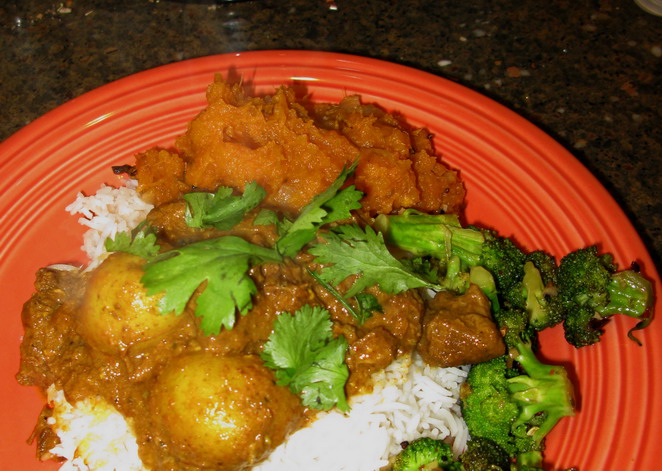
Everyday Pakistani Meat and Potatoes Curry
Ingredients:
4 tablespoons canola oil
4 large yellow onions, peeled and thinly sliced
1 teaspoon salt
2 bay leaves
5 cloves garlic, peeled and minced
2″ cube fresh ginger, peeled and minced
6 whole cloves
1 1″ stick cinnamon
2 whole dried Indian chili peppers (I used the narrow red 1″ long peppers)
1/2 teaspoon whole peppercorns
1 whole black cardamom
4 whole green cardamoms
1/2 tablespoon while cumin seeds
1 tablespoon whole coriander seeds
1/4 teaspoon fennel seeds
1 tablespoon turmeric powder
1 1/2 tablespoons paprika
1 pound cubed lamb–shoulder and leg mixed if you can get it
1 1/2 cups whole milk
1 pound whole or halved baby potatoes
1 cup yogurt
salt to taste
roughly chopped cilantro and/or mint for garnish
Method:
Heat oil over medium high heat in a heavy-bottomed pan–cast iron is great for this–and add onions and bay leaves. Sprinkle with salt and cook, stirring constantly until the onions are a deep golden color and have shrunk considerably. This takes about ten minutes or more. Add the garlic and ginger, and whole spices and continue cooking until the onions are a deep reddish brown, and everything is fragrant.
Remove contents of pan to a spice grinder, pick out and reserve bay leaves, and grind everything into a paste, mix in the turmeric and paprika, and set aside.
Add lamb to the pan, and brown on all sides. Transfer lamb to a pressure cooker, and add bay leaves and spice paste. Pour in milk, and bring to a boil over high heat. Lock down lid, set pressure to highest setting and when the cooker comes to pressure, turn down heat to low and cook for about twenty five minutes. After twenty five minutes, turn off heat, and allow pressure to release naturally. (To cook this without a pressure cooker, put meat, spices and milk into a dutch oven or stew pot, cook on low heat, covered, stirring as needed, until meat is tender. Continue with directions as written from this point on.)
While meat is cooking, boil potatoes until tender, and drain well.
When pressure has come down, open cooker, and stir in yogurt and add potatoes. Cook over high flame, with the cover off to reduce liquid to a thick, velvety sauce, stirring as needed. Taste for salt and correct seasoning as needed.
Garnish with chopped cilantro or mint, and serve with basmati rice and vegetables.

Categories:
- Admin (rss) (55)
- Blogs and Blogging (rss) (81)
- Book Reviews: Cookbooks (rss) (43)
- Book Reviews: Non-Cookbook Food Books (rss) (38)
- Cats and Cat Blogging (rss) (47)
- Chinese Cooking Lessons (rss) (32)
- Culinary School Stories (rss) (18)
- Dairy Pruducts: Cultured and Barbaric (rss) (4)
- Documentary Filmmaking (rss) (1)
- Essays, Rants and Reflections (rss) (260)
- Fighting Hunger (rss) (12)
- Food and Kids (rss) (45)
- Food in the News (rss) (126)
- Food Media (rss) (98)
- Food Preservation (rss) (18)
- Food Safety (rss) (45)
- Gardening (rss) (30)
- Herbs and Herb Blogging (rss) (20)
- Holidays (rss) (50)
- Kat Blogging (rss) (22)
- Kitchen Science (rss) (36)
- Leftover Makeover (rss) (8)
- Life, the Universe and Everything (rss) (131)
- Local and Sustainable (rss) (227)
- Local Athens Food and Foodies (rss) (42)
- Meatless Mondays (rss) (32)
- Menu For Hope (rss) (5)
- Nutrition, Diet and Health (rss) (84)
- On The Farm (rss) (8)
- Recipes: Almost Vegetarian, Vegetarian and Vegan (rss) (294)
- Recipes: American Regional (rss) (37)
- Recipes: Appalachian Hillbilly (rss) (33)
- Recipes: Bread, Pasta, Grains (rss) (95)
- Recipes: Canning and Preserving (rss) (8)
- Recipes: Chinese (rss) (123)
- Recipes: Comfort Food (rss) (120)
- Recipes: Cookies (rss) (16)
- Recipes: Desserts (rss) (48)
- Recipes: French (rss) (25)
- Recipes: Fruits and Vegetables (rss) (302)
- Recipes: Greek, North African and Middle Eastern (rss) (31)
- Recipes: Indian (rss) (137)
- Recipes: Italian (rss) (42)
- Recipes: Japanese (rss) (7)
- Recipes: Jewish (rss) (4)
- Recipes: Korean (rss) (6)
- Recipes: Meat, Poultry and Fish (rss) (220)
- Recipes: Mexican/Native American/ Latin American/Caribb (rss) (27)
- Recipes: Original (rss) (108)
- Recipes: Thai (rss) (27)
- Recipes: Tofu (rss) (17)
- Recipes: US Regional (rss) (16)
- Recipes: Vietnamese (rss) (8)
- Restaurant Stories (rss) (28)
- Sewing, Quilting, Arts and Crafts (rss) (16)
- Simple Chinese Recipes (rss) (30)
- Slow Food and Heritage Foods (rss) (10)
- Spice Blogging (rss) (44)
- The Chinese Cookbook Project (rss) (14)
- The Chinese Pantry (rss) (39)
- The Documentary (rss) (2)
- The Kitchen Saga (rss) (17)
- The Locavore's Bookshelf (rss) (15)
- The Unsung Adventures of The Culinary Nerd (rss) (6)
- Tools and Toys (rss) (35)
- Uncategorized (rss) (10)
- With a Side of Politics (rss) (48)
Archives:
- August 2012 (9)
- July 2012 (12)
- September 2011 (3)
- August 2011 (7)
- July 2011 (8)
- June 2011 (16)
- May 2011 (17)
- April 2011 (11)
- December 2010 (9)
- November 2010 (5)
- February 2010 (1)
- December 2009 (5)
- November 2009 (7)
- October 2009 (10)
- September 2009 (16)
- August 2009 (14)
- July 2009 (14)
- June 2009 (7)
- May 2009 (17)
- April 2009 (10)
- March 2009 (25)
- February 2009 (13)
- January 2009 (10)
- December 2008 (5)
- November 2008 (5)
- October 2008 (6)
- September 2008 (13)
- August 2008 (8)
- July 2008 (11)
- June 2008 (18)
- May 2008 (13)
- April 2008 (14)
- March 2008 (16)
- February 2008 (17)
- January 2008 (19)
- December 2007 (25)
- November 2007 (18)
- October 2007 (24)
- September 2007 (16)
- August 2007 (15)
- July 2007 (15)
- June 2007 (10)
- May 2007 (14)
- April 2007 (16)
- March 2007 (17)
- February 2007 (20)
- January 2007 (13)
- November 2006 (1)
- October 2006 (8)
- September 2006 (14)
- August 2006 (25)
- July 2006 (30)
- June 2006 (28)
- May 2006 (34)
- April 2006 (29)
- March 2006 (24)
- February 2006 (30)
- January 2006 (38)
- December 2005 (40)
- November 2005 (37)
- October 2005 (32)
- September 2005 (25)
- August 2005 (30)
- July 2005 (28)
- June 2005 (21)
- May 2005 (8)
- April 2005 (22)
- March 2005 (17)
- February 2005 (29)
- January 2005 (10)
Search Site:
Links:
- Lily’s Wai Sek Hong
- 101 Cookbooks
- A cat in the kitchen
- A Veggie Venture
- Accidental Hedonist
- Cha Xiu Bao
- chez pim
- Chocolate & Zucchini
- Chopstick Cinema
- Chowhound.com
- Chubby Hubby
- Cook sister!
- Cooking with Amy
- da*xiang
- Eat Local Challenge
- Eating Liberally
- Ecocentric
- Eggbeater
- Epicurious
- Farmgirl Fare
- Fatfree Vegan
- Foodgoat
- ForkandBottle.com
- Green Olive Tree
- Hooked on Heat
- Jaden’s Steamy Kitchen
- Kalyn’s Kitchen
- Lucullian delights
- Mahanandi
- Matt Bites
- MeatHenge
- mmm-yoso!!!
- New York Times – Dining & Wine
- Pizza Goon
- Rasa Malaysia
- Ruhlman
- Sailu's Kitchen
- Serious Eats
- SF Gate: Food & Dining
- Simply Recipes
- Soul Fusion Kitchen
- Tastespotting
- The Amateur Gourmet
- The Cleaner Plate Club
- The Food Section
- The Grub Report
- thecookscottage
- U.S. Food Policy
- Wandering Chopsticks
- Washington Post Food and Dining
- Wasted Food
Meta:


Powered by WordPress. Graphics by Zak Kramer.
Design update by Daniel Trout.
Entries and comments feeds.