
Cook Local, Eat Global
What Is The Deal with Fish, Omega 3’s and Mercury?
By now, everyone who reads about food and health should know that seafood, particularly fatty fish such as king mackerel, salmon and tuna, are good for you. They are full of beneficial fats, particularly omega 3 fatty acids, which protect against heart disease, diabetes and help children and developing fetuses build better brains and eyes.
On top of that, those fish are mighty tasty, and can add an awful lot of flavor to a healthy diet.
That’s all kinds of great, isn’t it?
Well, yeah, sort of.
It -would- be all kinds of great if it wasn’t for the fact that thanks to coal burning power plants and pollution from heavy industry, our oceans and waterways are all contaminated with a compound called methyl mercury. Methyl mercury makes its way into the food chain, and eventually into us insidiously by being consumed by small critters such as filter feeders or plankton, which in turn get eaten by consecutively larger fish, until those big, tasty fatty fish full of their wonderful omega 3’s get caught and eaten by us, humans, the critters at the top of the food chain.
The thing is, the methyl mercury doesn’t just travel up the food chain, it is bioaccumulative. This means that t gets stored in body tissues of the organisms that eat it, the concentration of contamination rising the higher it travels up the food chain until it stops with humans. It is fat soluble, and in humans, is stored in body fat.
Except humans aren’t really at the top of the food chain. Specific humans are the end-point of the food chain–fetuses and breast-fed babies are actually at the very top of the food chain. And, guess what–these wee humans who teeter at the top of the food chain are also the most vulnerable to the effects of methyl mercury. The bodies of nursing women often use the mother’s accumulated body fat, which can have mercury stored up in it for years, in order to make milk, meaning that mercury-contaminated fish that was eaten years before can essentially contaminate the milk she is feeding her baby.
Want to know the effects of mercury poisoning? Read a bit about what happened in Minimata, Japan, back in the 1950’s when people unkowingly ate fish from Minimata Bay which had been contaminated by a local fertilizer factory. Brain damage, neurological dysfunction, blindness, muscular and skeletal abnormalities have all been linked to severe cases of mercury poisoning.
Of course, you notice I said “severe mercury poisoning.” As most saavy readers probably know the levels of mercury in the fish eaten by the victims in Minimata was much higher than the levels the EPA is reporting in fish in the US marketplace.
However, even lower levels of mercury are problematic, especially for fetuses, babies and small children.
Which is why the US government has warned pregnant and nursing women and young children against eating canned tuna, king mackerel, shark, and grouper, and to limit their consumption of many other kinds of seafood, including fresh and canned tuna.
But, of course, that would limit women and children’s access to the health benefits of the omega 3’s in fish. (Now is a good time to note that one can get omega 3’s from flaxseed, flaxseed oil, purified fish oil supplements that have had the mercury removed from them, grassfed beef, eggs, and dairy. Fish derived omega 3’s are being used to supplement all sorts of processed foods in order to provide risk-free health benefits.)
In light of this ironic problem that large fatty predatory fish contain lots of what is good for humans as well as lots of what will cause humans harm, a great many Americans have avoided fish altogether, because the risk of mercury poisoning outweighed the health benefits in the minds of many consumers.
However, a pair of new studies on the subject show that the potential benefits of eating fish outweigh the potential risks of mercury contamination. All reports of the studies however, are careful to reiterate the US government’s guidelines to women of childbearing age, pregnant or nursing women, and young children: eat only certain types of fish in specifically prescribed “safe” amounts. (For EPA information about various species of fish and the levels of mercury contamination found in them, look here.)
However, various consumer and public interest groups contend that the government’s guidelines do not go far enough to protect the public, particularly children, from the dangers of mercury contamination in seafood.The Public Interest Research Group states int their 2001 report, Brain Food: What Women Should Know About Mercury Contamination In Fish, “If American women ate a varied diet of FDA’s recommended 12 ounces of fish a week (and none of the four prohibited fish) they would expose more than one fourth of all fetuses (one million babies) to a potentially harmful dose of methylmercury for at least one month during pregnancy.”
The Center for Science in the Public Interest criticized (and rightfully so, in my opinion) the recent reports for not really providing useful tools for consumers to safely eat fish. In addition, the CSPI points out something that most major media coverage has ignored about one of the reports, titled, Seafood Choices: Balancing the Benefits and the Risks, which was commissioned by the National Marine Fisheries Service, a governmental body “dedicated to the stewardship of living marine resources through science-based conservation and management, and the promotion of healthy ecosystems.”
Interestingly, these reports are being trumpeted in most media outlets as being “independent,” and thus not connected with the fishing industry. However, one branch of the National Marine Fisheries Service, the
NOAA Fisheries Office of Constituent Services, is involved in “promoting and facilitating trade for the U.S. seafood and aquaculture industries by expanding existing markets and opening new ones for U.S. producers and processors”.
(Hrm…suddenly this report is not sounding as independent and unbiased as most media outlets portray it as being. In fact, I am sensing a bit of conflict of interest here.)
According to CSPI, this report downplays the dangers of consuming mercury-contaminated species for children, and does not follow the FDA’s recommendations that children eat smaller portion sizes. This action does not take into account the difference in body weight between children and adults and ignores the fact that what is a non-toxic amount of mercury to an adult is proportionally quite dangerous when it comes to a child.
In July, prior to the release of these reports, Consumer Reports took to task the government’s assertion that canned light tuna was lower in mercury (and thus safe for pregnant and nursing women and young children to consume) than albacore tuna, when they did an independant analysis of FDA data on the subject. They concluded that pregnant women should simply avoid eating canned tuna altogether, rather than follow the EPA guidelines.
So, what is my take on all of this?
Well, I am of the opinion that pregnant and nursing women, and infants and children are probably better off getting their omega 3 fatty acids from non-fish sources at this time. The evidence is not as clear cut as the new media stories want to portray it, and I, personally see no reason for pregnant and nursing women who have no idea how much mercury they have already accumulated in their body fat to risk adding to that already present store of a toxic material by ingesting more of it. The potential risk to the developing bodies and brains of our infants is just too great, and there are other ways to get those omega 3’s than just by eating fish. Flax seeds, eggs, dairy and meat from grass-fed livestock and purified fish-oil based supplements are all good, safe sources of omega 3’s in the human diet.
That said, I have to admit that I still miss my tuna and salmon, and have recently indulged in some wild-caught smoked salmon, which most sources cite as being minimally contaminated with mercury.
However, not knowing how much mercury I have stored away in my body fat which is slowly melting away as it is being metabolized into breast milk production, I am not about to go hog-wild and start eating salmon every day, not matter what any governmental agency or scientist paid by any said agency tells me is safe.
For some reason, I just don’t quite trust them enough to take their advice on this matter, and put at risk my daughter’s developing brain.
Chinese Homestyle Favorites
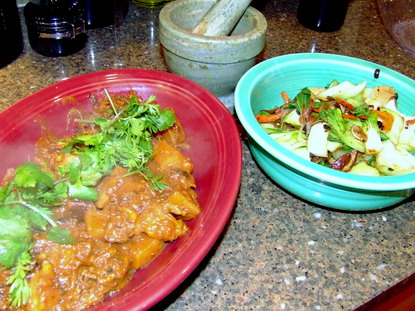
Regular readers must have thought that I was never going to cook Chinese food again, after my hiatus on it during the latter half of my pregnancy. Brought on by the loss of mobility in my right arm caused by an intensification of my already extant carpal tunnel syndrome which came about through the general fluid retention and swelling of pregnancy, my reluctance to cook stir fries was due to the intense amounts of cutting and prep involved in the cooking process.
However, after the fluid has gone down, and I have been doing daily stretches and exercises to gain my hand and forearm strength back, I am more than ready to hop back into the routine of cooking good homestyle Chinese dishes in my kitchen.
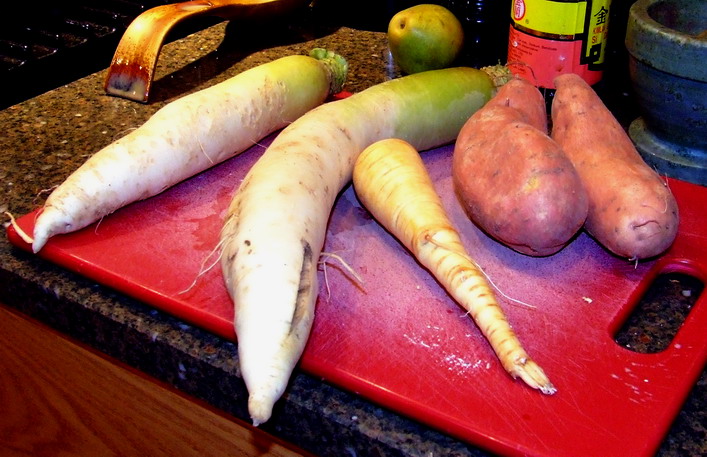
The first Chinese dinner I made came about because I found gorgeous seasonal Asian produce at the farmer’s market on Saturday. Long beans, baby bok choi, tatsoi, Japanese turnips, fresh shiitake mushrooms and diakon radish all found their way into my market basket and came home with us, leading me to want to make Sichuan red-cooked beef with turnips, paired with steamed rice and a simple stir fry of baby bok choi and shiitake mushrooms.
The two dishes complemented each other perfectly; the red-cooked beef was tender with soft root vegetables that all but melted in the mouth, with an abundant savory-spicy sauce that was easily soaked up by the neutral flavor of the steamed rice. The stir-fried bok choi on the other hand, was crisp, light and naturally sweet, with a minimum of sauce clinging to each bit of greens, sweet peppers and mushrooms.The meat was heavy in yang energy, while the greens were yin, with the rice balancing the two. (It is good to remember that the Chinese ideas of menu planning include balancing the flavors, colors, textures, health properties and energy of foods within each meal. This is an aesthetic practice that also has philosophical, health and cultural meaning. One must be aware when serving Chinese foods that these cultural, philosophical, aesthetic and medicinal qualities of food are all in play at the same time, and are all equally important. It is a lot to think about, but that is also part of why I find Chinese cookery so endlessly fascinating.)
But, as everyone knows, I couldn’t leave well enough alone. When it came time to cook the beef, I couldn’t just use either the turnips or the diakon alone, especially since I had found some lovely deep reddish-orange sweet potatoes and creamy parsnips at the market as well. Zak, Morganna and I still felt distinctly starved for vegetables, so, I had to use them, too.
Besides, I have found that when the diakon or turnips (this time around I used the diakon and saved the turnips for a later use) are spicy rather than sweet, a sweet root vegetable makes a good flavor counterpoint. In the past, I have used carrots to provide this note of sweetness, but I saw no reason why sweet potatoes and parsnips could not perform the same function. Besides, I was pretty certain that the honey-like flavor of the sweet potatoes would be enhanced greatly by the deeply spicy, rich sauce that the long simmering of the beef creates. (I also substituted young leeks for scallions as those were on hand from the CSA and scallions were not. The effect in the dish was perfect–the leeks were a bit more assertive in taste, which added another note of complexity to an already multi-layered set of flavors.)
As for the bok choi, I planned to flavor them simply with garlic, onion and ginger, with fermented black beans, my own chicken stock and oyster sauce as the main sauce components. Morganna wanted chile peppers, but I noted that the beef was already going to be quite spicy from the broad bean and chile paste, so that perhaps instead of chiles, I would use a sweet red pepper instead. This added color and another note of sweetness to the dish that contrasted beautifully with the musky flavor of the black beans.
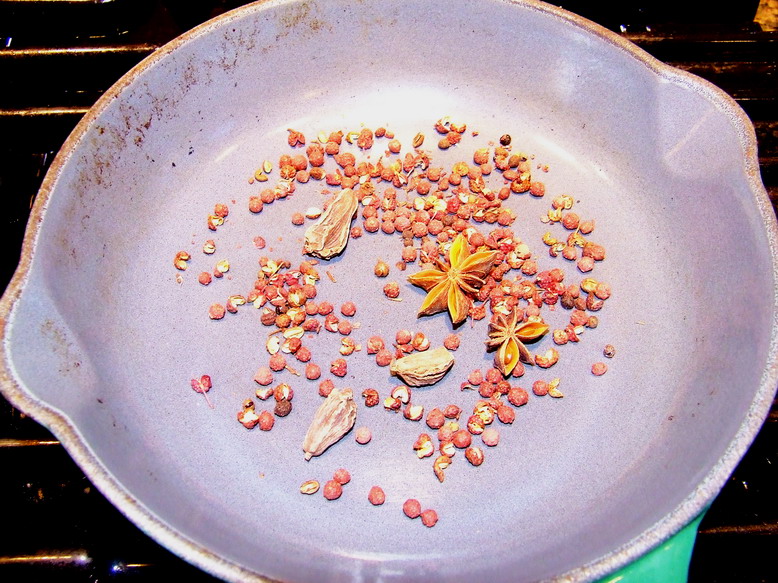
I am not giving a recipe for the Sichuan red-cooked beef; it is a simple variation on the recipe I adapted from Fuschia Dunlop and posted long ago. In order to recreate it, simply toast -all- of the spices called for in the original recipe, where only the Sichuan peppercorns are toasted, and then add two sweet potatoes and one parsnip, cut into chunks, with the diakon or turnips. The rest of the method and ingredients are exactly the same as the previously published recipe.
As for the baby bok choi and mushroom stir fry–after you take a look at my general instructions on stir-frying posted here, you can follow the recipe below and recreate the dish as I made it Saturday night.
If you wanted to make the bok choi as a stand-alone dish, I suggest you add shrimp or tofu for a light supper of a stir-fry and steamed rice.
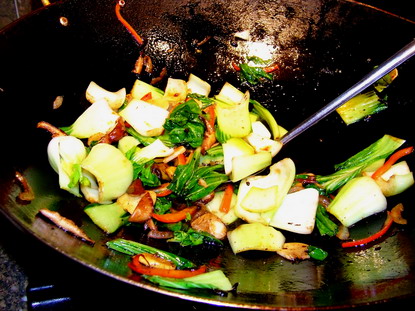
Stir Fried Bok Choi, Mushrooms and Sweet Pepper With Fermented Black Beans
Ingredients:
3 tablespoons peanut or canola oil
1 small onion, peeled and sliced thinly
2 cloves garlic, peeled and sliced thinly
1/2″ cube ginger, peeled and sliced thinly
1 tablespoon fermented black beans, mashed lightly
4 fresh shiitake mushrooms, stems discarded and caps sliced thinly
1 small sweet red bell pepper, seeded and sliced into thin jullienne slices
3/4 pound baby bok choi, bottoms trimmed off, washed, dried and cut into bite sized chunks (about 1″ square)
2 tablespoons chicken broth or stock
1 teaspoon dark soy sauce
2 tablespoons oyster sauce
1/8 teaspoon sesame oil
Method:
Heat wok on high heat until a thin ribbon of smoke appears. Add peanut or canola oil and heat until it shimmers–about thirty seconds to a minute.
Add onion, garlic, ginger, and black beans and stir fry until the onions become transluescent and limp, and all of the aromatics are fragrant and tender–about a minute or two.
Add mushrooms and stir fry one more minute. Add bell peppers and stir fry thirty seconds.
Add bok choi, chicken broth, and dark soy sauce and continue stir frying until the leaves darken and become velvety, and the stems are tender crisp, and the sauce reduces and clings to the vegetables. This should take about two minutes.
Add oyster sauce and sesame oil and stir fry for about thirty seconds to a minute more, then pour into a heated serving dish and serve immediately.
Autumn Roots and Lamb Stew a Great Welcome Home
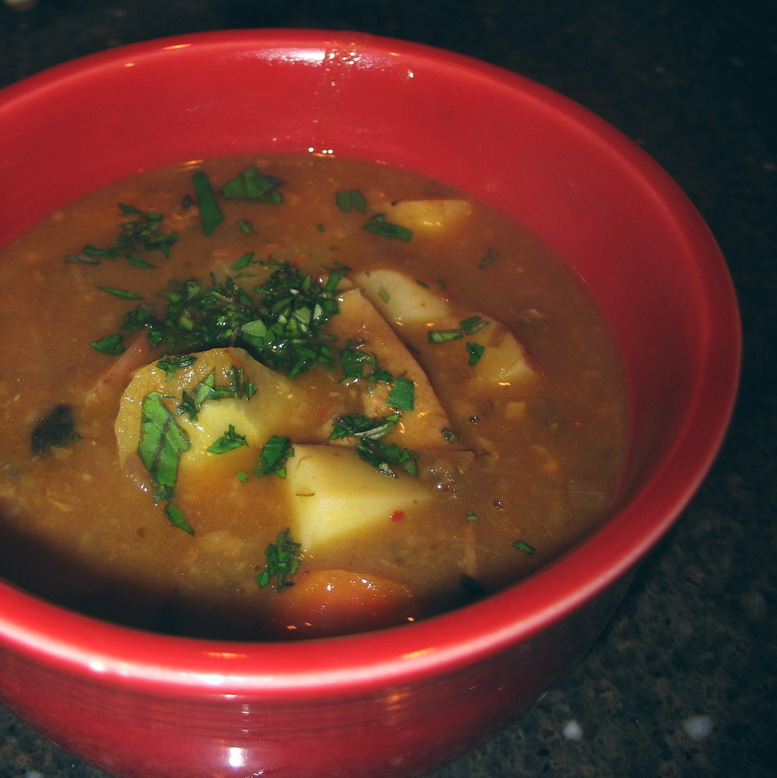
I know that a lot of people prefer eating out all the time to cooking at home.
I, however, am not one of those folks.
After being forced to eat out for three weeks straight in Columbus, Ohio, and having to limit our choices to a few places downtown in order to stay close to the hospital, I can honestly say that I am tired of eating other people’s food, no matter how good it is.
And that is the thing–a lot of what we ate was quite good, but considering our stress level (very high) and our patience (very low) and our general physical condition (tired, with sluggish digestion), after about the first week and a half, it all became distinctly unappealing. There were very few places to get really good salads that didn’t cost an arm and a leg, and I am convinced that most people in Columbus see vegetables as a garnish to make a plate of meat and starch look colorful. (Again, there is plenty of good food in Columbus to be had–but we were limited in where we could go due to scheduling constraints with Kat’s feeding schedule.)
Needless to say, as soon as we got home, and could eat home-cooked food again, we were ecstatic.
The first two days of our time home featured lunches and dinners cooked by Karl, Zak’s dad. Karl is a great instinctive cook who likes to play with ingredients in creative ways; my one criticism of his cookery is that he is too self-effacing about it. While most often he creates his own innovations and variations on simple themes for his meals, Karl also is a careful methodologist (this comes from being a physician, I think), who will tirelessly tinker with a recipe, recreating it over and over until he gets it just right. At that point, he records the recipe and uses it over and over again, to much acclaim which he then minimizes by saying, “Oh, it is nothing, really.”
Well, I am here to tell you, it is not nothing. And it is certainly not nothing when Karl came to our house and cooked all of our meals for two days, plus extras that he popped into the freezer for later, helping rebuild the stock of ready-made meals I had laid in before I had Kat.
Nope, that is not nothing–that definately counts as a very thoughtful, loving, and kind gift from a new Grandpa to his son and daughter-in-law.
After Karl left, I was itching to get back in the kitchen.
But what to make?

I had no local veggies left save some onions, garlic and potatoes, as most of our CSA veggies had gone bad in our absence. But, a visit to the Village Bakery down the hill from us, which features locally produced cheeses, milk, baked goods, eggs, meats, fruits and veggies, netted me a handful of sweet leeks, some turnips, parsnips, carrots and salad greens, all grown in Athens County. Up on my deck, herbs still straggled on in their planters, barely surviving the three weeks of neglect that sadly had been thrust upon them by my absence. I found parsley, marjoram, oregano, rosemary and thyme yet living, as well as some scraggly, unkempt basil struggling against the rapidly dipping temperatures.
Chunks of lamb shoulder lay in my freezer, and so I decided to put together a lamb stew that featured all of these autumn root vegetables, as well as the locally grown shiitakes that I had dried before Kat was born.
Stews are one of my chief comfort foods. To me, stews are like soups on steroids: chunks of meat and vegetables, cooked to savory perfection with a host of pungent aromatics such as onions, leeks, garlic and herbs, and bathed in a roiux-thickened broth that is nothing less than magical in its ability to marry the disparate flavors into a cohesive, warming, filling whole that is significantly greater than its constituent parts.
Think about it–there is nothing inherently special about cubes of lamb shoulder, parsnips, carrots, turnips, potatoes, leeks, onions, garlic, mushrooms and herbs, is there? But add a good broth, and cook it all down together and maybe add a splash or two of wine, and the flavors come together and meld into something that is so evocative of home, it might as well be served on a welcome mat instead of a tablecloth.
And for us, adding a big green salad with plain vinaigrette and a loaf of the Village Bakery’s Dakota Whole Wheat bread, made the humble meal so special that it outshone the excellent white-tablecloth steakhouse meals we ate at Mitchell’s Steakhouse in Columbus. (A word about Mitchell’s–the food, service and decor is great. The portions are hideously large, particularly on the eight-inch high, eight layer carrot cake. I’m just saying that not only does no one need to eat a steak as large as twenty ounces at a sitting, neither does anyone need to eat a half a pound of cake, either. Other than that, the restaurant was exemplary.)
(Note about the use of the pressure cooker: If you do not have one, start this stew much earlier in a regular stew pot or Dutch oven, and cook conventionally, adding the vegetables to cook after the meat is mostly fork tender. I will say, however, that the use of the pressure cooker means you get stew in around an hour and a half, instead of the three to five hours it takes normally, and it tastes every bit as good as the long-cooked version.)
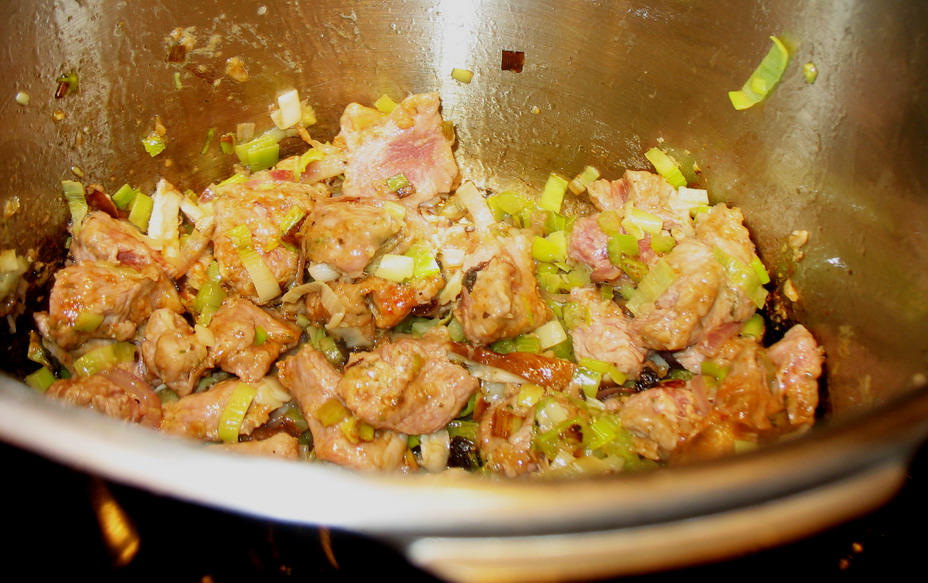
Autumn Roots and Lamb Stew
Ingredients:
3 tablespoons olive oil
4 medium leeks, cut in half lengthwise, then sliced thinly and rinsed well in several changes of water, then drained completely
1 medium onion, sliced thinly
1 stalk celery, minced
3 fresh or dried and rehydrated shiitake mushrooms, stems removed and cut into thin slices
4 large cloves garlic, minced
2 tablespoons fresh rosemary, minced
1 tablespoon fresh marjoram, minced
1 tablespoon sweet paprika
1 tablespoon Aleppo pepper flakes or black pepper to taste
1 teaspoon salt
1 pound boneless lamb shoulder or leg, cut into 1″ cubes
1/4 cup flour
1 quart vegetable broth
1 quart chicken stock
1 1/2 cups dry white wine (I used a Riesling)
3/4 pound redskinned new potatoes, well scrubbed and quartered
3 medium turnips, peeled and cut in half, then into 1/4″ slices
1 large parsnip, peeled and cut on the bias into 1/4″ slices
3 large carrots, peeled and cut on the bias into 1/4″ slices
roux made from 4 tablespoons butter and 4 tablespoons flour, cooked to a medium brown color
4 tablespoons mixed fresh herbs (I used parsley, thyme, rosemary and marjoram), minced
Method:
Heat oil in the bottom of an eight to twelve quart pressure cooker over medium heat. Add leeks, onions, celery, mushrooms and garlic and saute until onions take on a slight yellowish hue and the leeks begin to take on color. Add the herbs, paprika, pepper flakes and salt and continue cooking for about three minutes.
Toss lamb with flour and add to pressure cooker and brown on all sides. When meat is thorougly browned, deglaze the bottom of the pot with vegetable broth, scraping up all the browned bits. Add chicken broth and wine, and bring to a boil.
Put lid on cooker, bring to full pressure, turn down heat to low and cook for forty-five minutes. Quick release pressure and open lid; the meat should be fork-tender.
Add potatoes into the pot, bring liquid to a boil, put the lid on, lock it and bring to full pressure. Cook for seven minutes, quick release pressure, remove lid and bring to a boil.
Add remaining vegetables, lock on lid, bring to full pressure and cook for two minutes. Quick release pressure and remove lid.
All vegetables and meat should be fork tender.
To thicken the stew, bring the broth to a boil in pressure cooker, with the lid off. Bring the roux to bubbling. Pour the bubbling hot roux into the stew, and stir like mad. The broth will thicken as it boils in about three minutes.
(To make roux, melt the butter in a heavy small skillet over medium heat. When it is melted and bubbly, add the flour, and stirring constantly, allow to brown. When it is the depth of color you want, and quite bubbly add to the stew. Do not ever stop stirring the roux, and do not cook it on too high of a heat or it will scorch and if you use it at that point, your entire stew will taste bitter and burnt. Roux is scortched when it smells burned and little flecks of black appear in it.)
Garnish with the chopped herbs, and serve with a large salad and some really hearty whole wheat bread.
Super Quick Update
It looks like we will be here in Columbus for another week or so; but the news, other than that, is all to the good.
Kat caught onto breastfeeding the day before yesterday and fed very well. Yesterday, a new order came from her doctor that I can give her up to every other feeding from the breast, with a supplemental bottle afterwards. Yesterday, I gave her two feedings; the first was very successful–she only took 10 ml of her supplemental bottle, and the second one was not successful. It happened after her bath–and I think that she was just too worn out.
Today, we are trying three feedings–one at eleven AM, one at five PM and one at eleven PM. We’ll see how it goes, but so far, she seems to have a good latch-on, and she has learned how to coordinate the suck-swallow-breathe actions into a successful feeding.
One thing that is interesting is that she doesn’t much care for the bottle–the lactation consultant–who said that Kat was doing excellently for her developmental age, told me that there are some babies who just breast babies and who don’t like the feel or taste of silicone or rubber nipples in their mouths. I always heard it was the other way around–babies prefer bottles beacuse they are easier.
Well, I have to go–all is well here, and Kat and I are working hard learning to feed her so she can come home.
The Kat in the Hat

Zak caught this shot last night when we visited Kat; the mother of the baby in the crib next to Kat’s was learning how to evaluate her son’s oxygen intake while he fed from a bottle by observing his facial skin tone, and so the nurse had brightened the overhead lights.
Kat doesn’t care for bright lights, so Zak, who was holding her on his lap, pulled the brim of her little hat over her eyes so she could go on snoozing unfazed by the brilliance.
And since she looked so cute, he took a picture.
As for how Kat is doing–she is gaining some weight–her cheeks have rounded out and her abdomen is a good centimeter larger.
She is still having troubles feeding from a nipple, however.
She has the rooting reflex, and while she is completely disinterested in a pacifier, she sucks quite strongly and capably on my fingers, and I can tell when she does it that her tongue, lower gum and jaw are all in the right position to nurse effectively.
However, when she is put to the breast, she cannot coordinate the three things that must happen simultaneously: sucking, swallowing and breathing. Her attempts to nurse, once she gets a semi-effective latch on, go like this: suck, suck suck, pause, breathe, breathe, breathe, swallow, swallow. This gets her very little milk, and the first time she tried it–yesterday, she got SO frustrated she started to cry. Today, she was more patient, and tried for longer, but, as is typical of many preemies, she ended up getting tired and just going to sleep without getting much in the way of food.
She was worse on the bottle yesterday–Zak tried to feed her and she sucked really hard, like she had at the breast, and since bottles spurt milk more easily, she got a huge mouthful of milk, which choked her. She choked like this twice, and was quite scared by it, and then clamped her mouth shut and refused to try again.
So, she is still being tube-fed. But, we are very slowly still trying to work with her to get the nipple-feeding to work; I am confident that she will get it eventually. It is just going to take her time.
In other news, she is awake more often and has been interacting more and more with us. We’ll try to get a good picture of her with her eyes open as they are very pretty, but she really doesn’t like the flash much.
And as for us–we are now in a Residence Inn, which has a kitchen in it. Wonder of wonders! I’ll start cooking us some good food starting tomorrow. It is amazing how tiring restaurant food can get, no matter if it is good, bad or indifferent, when that is all one has to eat. I much prefer my own food to anyone else’s, so I am glad that I am feeling well enough to be able to cook for us at least some of the time.
And yes, I am healing nicely. My energy level still fluctuates, but I am still doing the breastpump and am in danger of filling up the refrigerator and freezer at the NICU with milk for Kat. I think that my body is convinced that I gave birth not to one preemie but a small island nation of them, because of all the milk it is producing!
Thank goodness for good breastpumps is all I have to say!
More news later, and maybe some pictures of my home-away-from-home dinners soon.

Categories:
- Admin (rss) (55)
- Blogs and Blogging (rss) (81)
- Book Reviews: Cookbooks (rss) (43)
- Book Reviews: Non-Cookbook Food Books (rss) (38)
- Cats and Cat Blogging (rss) (47)
- Chinese Cooking Lessons (rss) (32)
- Culinary School Stories (rss) (18)
- Dairy Pruducts: Cultured and Barbaric (rss) (4)
- Documentary Filmmaking (rss) (1)
- Essays, Rants and Reflections (rss) (260)
- Fighting Hunger (rss) (12)
- Food and Kids (rss) (45)
- Food in the News (rss) (126)
- Food Media (rss) (98)
- Food Preservation (rss) (18)
- Food Safety (rss) (45)
- Gardening (rss) (30)
- Herbs and Herb Blogging (rss) (20)
- Holidays (rss) (50)
- Kat Blogging (rss) (22)
- Kitchen Science (rss) (36)
- Leftover Makeover (rss) (8)
- Life, the Universe and Everything (rss) (131)
- Local and Sustainable (rss) (227)
- Local Athens Food and Foodies (rss) (42)
- Meatless Mondays (rss) (32)
- Menu For Hope (rss) (5)
- Nutrition, Diet and Health (rss) (84)
- On The Farm (rss) (8)
- Recipes: Almost Vegetarian, Vegetarian and Vegan (rss) (294)
- Recipes: American Regional (rss) (37)
- Recipes: Appalachian Hillbilly (rss) (33)
- Recipes: Bread, Pasta, Grains (rss) (95)
- Recipes: Canning and Preserving (rss) (8)
- Recipes: Chinese (rss) (123)
- Recipes: Comfort Food (rss) (120)
- Recipes: Cookies (rss) (16)
- Recipes: Desserts (rss) (48)
- Recipes: French (rss) (25)
- Recipes: Fruits and Vegetables (rss) (302)
- Recipes: Greek, North African and Middle Eastern (rss) (31)
- Recipes: Indian (rss) (137)
- Recipes: Italian (rss) (42)
- Recipes: Japanese (rss) (7)
- Recipes: Jewish (rss) (4)
- Recipes: Korean (rss) (6)
- Recipes: Meat, Poultry and Fish (rss) (220)
- Recipes: Mexican/Native American/ Latin American/Caribb (rss) (27)
- Recipes: Original (rss) (108)
- Recipes: Thai (rss) (27)
- Recipes: Tofu (rss) (17)
- Recipes: US Regional (rss) (16)
- Recipes: Vietnamese (rss) (8)
- Restaurant Stories (rss) (28)
- Sewing, Quilting, Arts and Crafts (rss) (16)
- Simple Chinese Recipes (rss) (30)
- Slow Food and Heritage Foods (rss) (10)
- Spice Blogging (rss) (44)
- The Chinese Cookbook Project (rss) (14)
- The Chinese Pantry (rss) (39)
- The Documentary (rss) (2)
- The Kitchen Saga (rss) (17)
- The Locavore's Bookshelf (rss) (15)
- The Unsung Adventures of The Culinary Nerd (rss) (6)
- Tools and Toys (rss) (35)
- Uncategorized (rss) (10)
- With a Side of Politics (rss) (48)
Archives:
- August 2012 (9)
- July 2012 (12)
- September 2011 (3)
- August 2011 (7)
- July 2011 (8)
- June 2011 (16)
- May 2011 (17)
- April 2011 (11)
- December 2010 (9)
- November 2010 (5)
- February 2010 (1)
- December 2009 (5)
- November 2009 (7)
- October 2009 (10)
- September 2009 (16)
- August 2009 (14)
- July 2009 (14)
- June 2009 (7)
- May 2009 (17)
- April 2009 (10)
- March 2009 (25)
- February 2009 (13)
- January 2009 (10)
- December 2008 (5)
- November 2008 (5)
- October 2008 (6)
- September 2008 (13)
- August 2008 (8)
- July 2008 (11)
- June 2008 (18)
- May 2008 (13)
- April 2008 (14)
- March 2008 (16)
- February 2008 (17)
- January 2008 (19)
- December 2007 (25)
- November 2007 (18)
- October 2007 (24)
- September 2007 (16)
- August 2007 (15)
- July 2007 (15)
- June 2007 (10)
- May 2007 (14)
- April 2007 (16)
- March 2007 (17)
- February 2007 (20)
- January 2007 (13)
- November 2006 (1)
- October 2006 (8)
- September 2006 (14)
- August 2006 (25)
- July 2006 (30)
- June 2006 (28)
- May 2006 (34)
- April 2006 (29)
- March 2006 (24)
- February 2006 (30)
- January 2006 (38)
- December 2005 (40)
- November 2005 (37)
- October 2005 (32)
- September 2005 (25)
- August 2005 (30)
- July 2005 (28)
- June 2005 (21)
- May 2005 (8)
- April 2005 (22)
- March 2005 (17)
- February 2005 (29)
- January 2005 (10)
Search Site:
Links:
- Lily’s Wai Sek Hong
- 101 Cookbooks
- A cat in the kitchen
- A Veggie Venture
- Accidental Hedonist
- Cha Xiu Bao
- chez pim
- Chocolate & Zucchini
- Chopstick Cinema
- Chowhound.com
- Chubby Hubby
- Cook sister!
- Cooking with Amy
- da*xiang
- Eat Local Challenge
- Eating Liberally
- Ecocentric
- Eggbeater
- Epicurious
- Farmgirl Fare
- Fatfree Vegan
- Foodgoat
- ForkandBottle.com
- Green Olive Tree
- Hooked on Heat
- Jaden’s Steamy Kitchen
- Kalyn’s Kitchen
- Lucullian delights
- Mahanandi
- Matt Bites
- MeatHenge
- mmm-yoso!!!
- New York Times – Dining & Wine
- Pizza Goon
- Rasa Malaysia
- Ruhlman
- Sailu's Kitchen
- Serious Eats
- SF Gate: Food & Dining
- Simply Recipes
- Soul Fusion Kitchen
- Tastespotting
- The Amateur Gourmet
- The Cleaner Plate Club
- The Food Section
- The Grub Report
- thecookscottage
- U.S. Food Policy
- Wandering Chopsticks
- Washington Post Food and Dining
- Wasted Food
Meta:


Powered by WordPress. Graphics by Zak Kramer.
Design update by Daniel Trout.
Entries and comments feeds.